A DISSERTATION
SUBMITTED TO THE DEPARTMENT OF ELECTRICAL
ENGINEERING
AND THE COMMITTEE ON GRADUATE STUDIES
OF STANFORD UNIVERSITY
IN PARTIAL FULFILLMENT OF THE REQUIREMENTS
FOR THE DEGREE OF
DOCTOR OF PHILOSOPHY
Christina Delimitrou August 2015
http://creativecommons.org/licenses/by-nc/3.0/us/
This dissertation is online at: http://purl.stanford.edu/mz539pv2699
© 2015 by Christina Delimitrou. All Rights Reserved. Re-distributed by Stanford University under license with the author.
This work is licensed under a Creative Commons Attribution-Noncommercial 3.0 United States License.
Christos Kozyrakis, Primary Adviser
I certify that I have read this dissertation and that, in my opinion, it is fully adequate in scope and quality as a dissertation for the degree of Doctor of Philosophy.
John Ousterhout
I certify that I have read this dissertation and that, in my opinion, it is fully adequate in scope and quality as a dissertation for the degree of Doctor of Philosophy.
Mendel Rosenblum
Approved for the Stanford University Committee on Graduate Studies.
Patricia J. Gumport, Vice Provost for Graduate Education
This signature page was generated electronically upon submission of this dissertation in electronic format. An original signed hard copy of the signature page is on file in
University Archives.
Cloud computing is at a critical juncture. An increasing amount of computation is now hosted in private and public clouds. At the same time, datacenter resource efficiency, i.e., the effective utility we extract from system resources has remained notoriously low, with utilization rarely exceeding 20-30%. Low utilization coupled with the lack of scaling in hardware due to technology limitations poses threatening scalability roadblocks for cloud computing.
At a high level, two main reasons hinder efficient scalability in datacenters. First, the reservation-based interface through which resources are currently allocated is fundamentally flawed. Users must determine how many resources a new application requires to meet its quality of service (QoS) constraints. Unfortunately this is ex-tremely difficult for users that tend to overprovision their reservations, resulting in mostly-allocated, but lightly-utilized systems. Second, underutilization is aggravated by performance unpredictability; the result of heterogeneity in hardware platforms, interference between applications contending in shared resources, and spikes in input load. Unpredictability results in further resource overprovisioning by users.
The focus of this dissertation is to enable efficient, scalable and performance-aware datacenters with tens to hundreds of thousands of machines by improving cluster management. To this end, we present contributions that address both the system-user interface, and the complexity of resource management at scale. These techniques are directly applicable to current systems, with modest design alterations. We first present a new declarative interface between users and cluster manager that centers around performance, instead of resource reservations. This enables users to focus on the high level performance objectives an application must meet, as opposed
practical system that leverages data mining to quickly understand the resource re-quirements of incoming applications in an online manner. We establish that resource management at this scale cannot be solved with the traditional trial-and-error ap-proach of conventional architecture and system design. We show that instead we can introduce data mining principles which leverage the knowledge the system accumu-lates over time from incoming applications, to significantly benefit both performance and efficiency. We first use this approach in Paragon to tackle the platform hetero-geneity and workload interference challenges in datacenter management. The cluster manager relies on collaborative filtering to identify the most suitable hardware plat-form for a new, unknown application and its sensitivity to interference in various shared resources. We then extend a similar approach to address the larger prob-lem of resource assignment and resource allocation with Quasar. To ensure minimal management overheads, we decompose the problem to four dimensions; platform het-erogeneity, application interference, resource scale-up and scale-out. This enables the majority of applications to meet their QoS targets, while operating at 70% uti-lization, on a cluster with several hundred servers. In contrast, a reservation-based system rarely exceeds 15-20% utilization, with worse per-application performance.
Our second contribution pertains to designing scalable scheduling techniques that use the information from Paragon and Quasar to perform efficient and QoS-aware resource allocations. We develop Tarcil, a scalable scheduler that reconciles the high quality of sophisticated centralized schedulers with the low latency of distributed sampling-based systems. Tarcil relies on a simple analytical framework to sample resources is a way that provides statistical guarantees on a job meeting its QoS con-straints. It incurs a few milliseconds of scheduling overhead, making it appropriate for highly-loaded clusters, servicing both short- and long-running applications. Finally, we design HCloud, a resource provisioning system for public cloud providers. HCloud leverages the information on the resource preferences of applications to determine the type (e.g., reserved versus on-demand) and size of required instances. The system guarantees high application performance, while securing significant cost savings.
Many people are responsible for supporting me in completing this dissertation. First and foremost, I want to thank my advisor, Christos Kozyrakis, for his advice not only on research, but career paths and life in general. Working on a topic you are passionate about is one of the most important aspects of graduate studies, and Christos’ support on selecting a project I found compelling has been invaluable; even if it had a lot of math. On a more personal note, I also want to thank him for being on several occasions family away from family.
I am also thankful to all the faculty members of the Stanford Experimental Data-center Lab (SEDCL) and the Pervasive Parallelism Lab (PPL), and especially Mendel Rosenblum and John Ousterhout for their advice, feedback and inspiration over the years, and for taking the time to be on my reading committee. I am also grateful to Bill Dally and Kunle Olukotun for their help and advice for my future endeavors, and to Nick Bambos and Olivier Gevaert for being on my defense committee. Finally, I want to thank Nectarios Koziris, my undergraduate advisor, for introducing me to research, and encouraging me to pursue graduate studies.
I have been truly lucky to interact with many brilliant people at Stanford. Thanks to all the members of the MAST group, past and current, for all I learned from them: Jacob Leverich, Daniel Sanchez, David Lo, Richard Yoo, Ana Klimovic, Grant Ayers, Mingyu Gao, Adam Belay, Felipe Munera, Camilo Moreno, Sam Grossman, Raghu Prabhakar, Rakesh Ramesh, Greg Kehoe, Tomer London, Asaf Cidon, Shingo Tanaka, Kenta Yasufuku, Woongki Baek, Michael Dalton, and Hari Kannan. Also thanks to George Michelogiannakis, John Brunhaver, Andrew Danowitz, Mario Flajslik, Kr-ishna Malladi, and Nicole Rodia for all the technical, and non-technical discussions.
experiments would finish in time for each deadline. I also want to thank our wonderful admins Sue and Teresa for ensuring I never had to worry about anything adminis-trative. Finally, I am grateful to Nick Arvanitidis and Facebook for supporting my Ph.D. studies financially through fellowships.
My years at Stanford have been made better by the many wonderful friends I met here and by the support of my friends back in Greece. I have certainly missed listing some below, but they can be identified as members of the Greek, Spanish, Belgian and other mafia organizations around the world. Thanks to George, Idoia, Mikel (and Naroa), Eleftheria, Peggy, Konstantinos, Gemma, Borja, Carlos, Yian-nis, Sotiria, Nicholas, Stephanie, Nadine, Olivier, Leen, Lynn, Adrian, Felix, Manu, George, Yorgos, Alexandros, Ioanna, Nicole, John, Sam, Andrew, Mario, Laura, TY, Kshipra, Cristina, Karthika, Diego, Daniel, and many others for the fun memories.
Finally, I want to thank Daniel, for his love, advice and for being there, even when “there” was in the other end of the world. Last but not least, my parents and family (especially my nephews and nieces) for always encouraging me to continue my studies and follow a career path I loved, and for “stoically” putting up with me being ten timezones away, although given the distance, they have certainly regretted the encouragement.
“Have Ithaka always in your mind. Your arrival there is what you are destined for. But don’t in the least hurry the journey... ” C.P. Cavafy
Abstract iv
Acknowledgements vi
1 Introduction 1
1.1 Resource Efficiency Challenges . . . 2
1.2 Contributions . . . 3
1.3 Thesis Organization . . . 8
2 Background & Motivation 9 2.1 Cloud Computing Background . . . 9
2.2 Datacenter Scalability Challenges . . . 11
2.3 Cluster Management . . . 13
2.3.1 Understanding Resource Requirements . . . 14
2.3.2 Resource Management Decisions . . . 19
2.4 Data Mining in Systems . . . 22
3 Paragon: QoS-Aware Scheduling in Heterogeneous Datacenters 24 3.1 Introduction . . . 24
3.2 Fast & Accurate Classification . . . 27
3.2.1 Collaborative Filtering Background . . . 28
3.2.2 Classification for Heterogeneity . . . 30
3.2.3 Classification for Interference . . . 33
3.2.4 Putting It All Together . . . 35 viii
3.3.2 Greedy Server Selection . . . 37
3.3.3 Statistical Framework for Server Selection . . . 39
3.3.4 Discussion . . . 42
3.4 Methodology . . . 43
3.5 Evaluation . . . 46
3.5.1 Comparison of Schedulers: Small Scale . . . 46
3.5.2 Comparison of Schedulers: Large Scale . . . 52
3.6 Related Work . . . 56
3.7 Conclusions . . . 58
4 Quasar: QoS-Aware and Resource Efficient Cluster Management 60 4.1 Introduction . . . 60
4.2 Motivation . . . 65
4.2.1 Cluster Management Overview . . . 65
4.2.2 The Case for Coordinated Cluster Management . . . 66
4.3 Quasar . . . 68
4.3.1 Overview . . . 68
4.3.2 Fast and Accurate Classification . . . 70
4.3.3 Greedy Allocation and Assignment . . . 77
4.3.4 Putting it All Together . . . 78
4.4 Implementation . . . 80
4.4.1 Dynamic Adaptation . . . 80
4.4.2 Side Effect Free Profiling . . . 81
4.4.3 Stragglers . . . 82
4.4.4 Discussion . . . 82
4.5 Methodology . . . 83
4.6 Evaluation . . . 86
4.6.1 Single Batch Job . . . 86
4.6.2 Multiple Batch Frameworks . . . 88
4.6.5 Large-Scale Cloud Provider . . . 92
4.7 Conclusions . . . 93
5 iBench: Quantifying Interference in Datacenter Workloads 95 5.1 Introduction . . . 95
5.2 Related Work . . . 98
5.3 iBench Workloads . . . 99
5.3.1 Overview . . . 99
5.3.2 Designing the SoIs . . . 100
5.4 Validation . . . 105
5.4.1 Individual SoIs Validation . . . 105
5.4.2 SoI Impact on Applications . . . 106
5.4.3 Correlation between SoIs . . . 108
5.5 Use Cases . . . 109
5.5.1 Datacenter Scheduling . . . 109
5.5.2 Server Provisioning . . . 112
5.5.3 Application Development/Testing . . . 113
5.5.4 Scheduling in Heterogeneous CMPs . . . 115
5.6 Conclusions . . . 117
6 ARQ: QoS-Aware Admission Control 119 6.1 Introduction . . . 119
6.2 Background . . . 120
6.3 Admission Control . . . 121
6.3.1 Overview . . . 121
6.3.2 Waiting Time versus Resource Quality . . . 123
6.4 Methodology . . . 126
6.5 Evaluation . . . 128
6.5.1 Small-scale Experiments . . . 128
6.6 Related Work . . . 131 x
Clusters 134
7.1 Introduction . . . 134
7.2 Background . . . 138
7.3 The Tarcil Scheduler . . . 140
7.3.1 Overview . . . 140
7.3.2 Analytical Framework . . . 140
7.3.3 Sampling-based Scheduling with Guarantees . . . 143
7.4 Admission Control . . . 146
7.4.1 Pre-scheduling Queueing . . . 146
7.4.2 Post-scheduling Queueing . . . 148
7.5 Tarcil Implementation . . . 149
7.5.1 Tarcil Components . . . 149
7.5.2 Adjusting Allocations . . . 151
7.5.3 Fairness . . . 152
7.6 Evaluation . . . 153
7.6.1 Tarcil Analysis . . . 153
7.6.2 Comparison with Other Schedulers . . . 156
7.6.3 Large-Scale Evaluation . . . 160
7.7 Conclusions . . . 163
8 HCloud: Optimizing Resource Provisioning in Public Clouds 165 8.1 Introduction . . . 165
8.2 Cloud Workloads and Systems . . . 169
8.2.1 Workload Scenarios . . . 169
8.2.2 Cloud Instances . . . 170
8.2.3 Cloud Pricing . . . 171
8.3 Provisioning Strategies . . . 172
8.3.1 Statically Reserved Resources (SR) . . . 172
8.3.2 Dynamic On-Demand Resources (OdF, OdM) . . . 173 xi
8.4 Hybrid Provisioning Strategies . . . 178
8.4.1 Provisioning Strategies . . . 179
8.4.2 Application Mapping Policies . . . 179
8.4.3 Provisioning Strategies Comparison . . . 183
8.5 Discussion . . . 185
8.5.1 Sensitivity to Job/System Parameters . . . 185
8.5.2 Provisioning Overheads . . . 188
8.5.3 Different Pricing Models . . . 188
8.5.4 Resource Efficiency . . . 190
8.5.5 Additional Provisioning Considerations . . . 193
8.5.6 Sensitivity to Workload Characteristics . . . 194
8.5.7 Cost Impact of Information from Quasar . . . 195
8.6 Related Work . . . 196
8.7 Conclusions . . . 197
9 Conclusions and Future Work 199 A Storage Modeling of Datacenter Workloads 201 A.1 Introduction . . . 201
A.2 Related Work . . . 203
A.3 Modeling and Generation Process . . . 205
A.3.1 Basic State Diagram Model . . . 205
A.3.2 Hierarchical State Diagram Model . . . 206
A.3.3 Storage Activity Fluctuation . . . 207
A.3.4 Generation Tool Design - DiskSpd . . . 208
A.4 Characterization and Validation . . . 212
A.4.1 Original DC Workloads . . . 212
A.4.2 Generating Models from Traces . . . 213
A.4.3 DC Application Characterization . . . 213
A.4.4 Validation . . . 215 xii
A.5.1 SSD caching . . . 221
A.5.2 Defragmentation . . . 222
A.6 Conclusions . . . 224
B BLOC: Bandwidth-Aware Storage Consolidation 225 B.1 Introduction . . . 225
B.2 BLOC Design . . . 228
B.2.1 System Overview . . . 228
B.3 Quantifying Storage Interference . . . 230
B.3.1 Motivation . . . 230
B.3.2 Application Models . . . 231
B.3.3 Trimming the Search Space . . . 232
B.3.4 Profiling . . . 232
B.3.5 Validation . . . 233
B.4 Bin Packing . . . 234
B.4.1 Limiting Storage Resource Usage . . . 234
B.4.2 Bin Packing Algorithm . . . 235
B.4.3 Consolidation Granularity . . . 236
B.4.4 Dynamic Demands . . . 237
B.5 Dynamic Adaptation . . . 238
B.5.1 Predicting User Load . . . 239
B.5.2 Dynamic Updates to Bin Packing . . . 240
B.5.3 Migration Costs . . . 240
B.5.4 Performance and Efficiency Trade-offs . . . 242
B.6 Implementation . . . 243
B.7 Evaluation . . . 245
B.7.1 Comparison of Consolidation Schemes . . . 246
B.7.2 BLOC Behavior . . . 248
B.8 Discussion . . . 250
C ECHO: Network Modeling of Datacenter Workloads 255
C.1 Introduction . . . 255
C.2 Related Work . . . 257
C.3 Single Server Temporal Model . . . 259
C.4 Temporal and Spatial Network Traffic Characterization . . . 261
C.5 System-Wide Spatial Model . . . 265
C.5.1 Overview . . . 265
C.5.2 Design . . . 266
C.5.3 Validation . . . 271
C.6 Conclusions . . . 281
Bibliography 282
Introduction
Cloud computing is at a critical junction. Its popularity has increased drastically over the past decade, with a growing number of applications and data hosted both on public and private clouds. At a high level, cloud computing offers three premises, both from the perspective of datacenter operators and end users: flexibility as resources can easily be obtained and released, high performance, and cost efficiency, as the infrastructure is shared across multiple users.
Despite its prevalence, cloud computing today faces significant scalability chal-lenges. Traditionally, to scale a datacenter, operators would improve its cost efficiency or improve its compute capabilities. With respect to cost efficiency, two approaches have prevailed: switching from the specialized machines that used to populate these systems to commodity computing, and reducing the cost of power delivery and cool-ing. With most datacenters already consisting of commodity servers, and power delivery and cooling introducing less than 10% cost overheads, both approaches are reaching the point of diminishing returns. On the other hand, we can improve scal-ability by increasing the compute capabilities of a datacenter. This requires either building more datacenters, which requires a capital investment of hundreds of millions of dollars [31, 136], increasing the number of servers in each datacenter, albeit with bounded benefits, given the provisioning constraints of power delivery and cooling, or relying on the process technology to provide higher performance for the same power consumption. Unfortunately, process technology in microprocessors has slowed down
with the end of voltage (or Dennard) scaling, and with Moore’s Law projected to end in the next five to ten years, relying on hardware alone to improve datacenter scala-bility is not a viable option. This underlines the importance of operating datacenters at high utilization.
Unfortunately, while the large-scale datacenters that host cloud computing ser-vices have grown in number and size, the utilization at which they operate has re-mained prohibitively low [31,79]. Even at the high end of the spectrum of production datacenters, utilizations rarely exceed 20-30% [31,79], with most systems operating at even lower utilizations. This is the case even for systems that use virtualization [177] for multi-tenancy, and employ sophisticated systems to manage resources across ap-plications. In the rest of this Section, we highlight the reasons behind low datacenter utilization, and the contributions of this thesis towards improving datacenter resource efficiency.
1.1
Resource Efficiency Challenges
At a high level, datacenter underutilization stems from two interacting factors. The first is the currentinterface between the users that submit applications to clusters and the system that must schedule these applications. Resources in datacenters today are allocated using a reservation-based API, where the user has to determine how many resources an application needs. Unfortunately this is extremely difficult for users, that tend to request a lot more resources than their applications truly require, resulting in grossly underutilized clusters.
The second reason behind datacenter underutilization justifies these exaggerated resource reservations. Performance unpredictability is the result of resource con-tention between applications sharing the system, platform heterogeneity as machines get progressively replaced over the provisioned lifetime of a datacenter, and fluctu-ations in user load. Unpredictability becomes even more of a challenge for user-interactive applications, like search, which have millions of users, experience spikes in their traffic and are provisioned for future growth. The performance metric of interest for such services is tail latency, which is much more difficult to satisfy than
average performance [73]. The risk of unpredictable performance together with the complexity of resource management leads users to significantly overprovisioning their resource reservations.
1.2
Contributions
The focus of this dissertation is to improve datacenter scalability, by increasing re-source efficiency. While inefficiencies exist across the hardware and software stack, application performance and datacenter utilization are to a large extent determined by the cluster manager; the system that orchestrates resource allocation and application scheduling in large-scale systems. To this end, our contributions focus on increasing datacenter-wide utilization, by improving cluster management, while guaranteeing that each scheduled application satisfies its performance requirements.
To achieve this goal, we use three main insights. First, we take a top-down
ap-proach that bridges the different layers of the system stack from the user interface, to
the cluster scheduler and down to hardware issues. Tackling the problem of datacen-ter efficiency cannot be addressed in a single level of the system stack, for example in hardware or software only. It requires in-depth understanding of the challenges and opportunities that each layer presents as well as their interactions. To this end, this work spans several levels of the stack from high-level distributed system design, to low-level architectural considerations.
Second, we introduce a high-level, declarative interface between users and system that focuses on performance, not resource reservations. We demonstrate that the existing reservation-based interface is poorly formalized and overly complex, leading to low system utilization. Instead, by simplifying the interface, the user is tasked with specifying what performance an application must achieve, not how to achieve it with low-level, raw resources.
Third, we show that the traditional, trial-and-error approach used in computer architecture and systems is prohibitively impractical at datacenter scale. We instead propose a new approach that leverages the knowledge on application behavior the system accumulates through data collection over time. By applying data mining
principles to these datasets in a mindful fashion we significantly improve both the quality and practicality of large-scale scheduling.
Using the insights described before, we have designed and built several systems, which together improve the performance and resource efficiency of cloud computing. Below, we provide a brief overview of each system.
Paragon: QoS-aware application assignment. Paragon is an online datacenter
manager that, given a resource reservation, accounts for platform heterogeneity and workload interference in scheduling decisions [76, 80, 77, 78]. Paragon leverages two main insights.
First, Paragon takes into account the various shared resources where interference may occur, including the CPU, memory and I/O subsystems. To measure the sen-sitivity of an application to different sources of interference we designed iBench [74], a suite that consists of a set of benchmarks that put progressively more pressure on a specific resource, and can be used to determine how much interference a workload can tolerate in shared resources and how much pressure it itself creates.
Second, Paragon does not require detailed application profiling to extract its plat-form and interference preferences. Instead, it leverages the knowledge the system already has from previously-scheduled workloads. To this end, we designed an online recommender system, based on matrix factorization (SVD) and latent-factor models, that determines which platforms, and co-scheduled workloads will allow the job to satisfy its QoS constraints. The system is similar to the recommender systems used in sites like Netflix or e-commerce, where a sparse information signal for a new user is projected against the rich information from previous users to provide the new user with accurate movie or item recommendations.
Paragon is a practical system: the profiling and data mining techniques add min-imal scheduling overheads. Using the information from the recommender system allows the scheduler to improve performance, and because applications are packed more tightly it also improves system utilization. In a 5,000 application scenario run-ning on 1,000 servers on Amazon EC2, Paragon achieves performance within 4% of the optimal for that cluster. In comparison, a heterogeneity- and interference-agnostic scheduler degrades performance by 48% on average and violates QoS for
97% of workloads.
Quasar: Resource-efficient cluster management. Quasar takes the approach
in Paragon one step further to address the more general problem of cluster manage-ment in datacenters [79]. Paragon has one limitation. While it can determine where to place an application in a large-scale system, it lacks the ability to determine how many resources that application needs to satisfy its performance constraints. This means that the user is still tasked with requesting an appropriate resource amount for a new job. However, because resource allocation is a complex, multi-dimensional problem, users rarely estimate their resource needs correctly. More often they over-provision their reservations, hurting system utilization. During a study of Twitter’s datacenters, we verified that reservations often exceed usage by an order of magnitude. Quasar addresses this issue through two main contributions.
First, Quasar shifts from the traditional reservation-based interface between user and system to a high-level declarative interface, which draws from the concept of Domain-Specific Languages (DSLs) and SQL. Now, instead of the user specifying the low-level, raw resources (e.g., memory, cores, storage) he expects an application to need, he simply specifies the performance target the new application must meet, for example tail latency. This simplifies the responsibility of the user, and gives enough flexibility to the cluster manager to better place jobs on available resources. Subsequently the cluster manager translates this performance goal to resources.
To perform this translation, Quasar leverages fast data mining techniques in a similar way to Paragon. The difference is that the system must also provide rec-ommendations on the amount of resources a job needs, specifically the resources per node and the number of nodes across which the workload should be distributed. At first glance this adds significant complexity to the recommender system, posing the question: can we maintain all this information, but solve a much simpler problem? We address this question by decomposing the problem to the four dimensions of re-source allocation that affect application performance: platform heterogeneity, work-load interference, scale-up (resources per node) and scale-out (number of nodes). This dramatically reduces the scheduling overheads, without sacrificing scheduling quality. Importantly, Quasar enables common datacenter application functionality, including
both distributed batch workloads and user-interactive services that are more sensitive to unpredictability.
Quasar is practical. The information required for the cluster manager’s decisions adds negligible overheads to application execution. These overheads can be further re-duced as more sophisticated data mining techniques are designed. In a 200-server EC2 cluster Quasar meets the QoS requirements of 95% out of 1,200 applications, while increasing system utilization by more than 2x. In contrast, a traditional reservation-based cluster manager with a baseline least-loaded scheduler violates QoS for most workloads, despite system utilization rarely exceeding 25%. The approach proposed with Quasar has had some early adoption in real production systems, with both Twitter and AT&T adopting similar approaches in their latest system designs.
Tarcil: Improving scheduling scalability. The structure of the scheduler itself and the algorithms it employs are critical components of a cluster manager. Tradition-ally there has been a disparity in cluster scheduling. On one hand there are sophisti-cated, centralized schedulers, that examine all (or most) of the cluster state to improve scheduling quality (e.g., Quasar). On the other hand there are distributed, typically sampling-based, schedulers that make fast decisions by only examining a small subset of resources. Unfortunately, neither approach achieves both high scheduling quality and high scheduling speed. To bridge this gap we developed Tarcil [81, 82], a cluster scheduler designed both for short and long jobs. Tarcil is built on two insights: first, it accounts for the resource preferences of incoming workloads, to keep scheduling quality high. Second, it uses adaptive resource sampling to reduce the latency of each scheduling decision. The sample size is set based on how strictly QoS must be met, following a simple analytical framework that provides statistical guarantees on scheduling quality. Tarcil also uses admission control that takes action when load is very high to avoid overloading the system. Admission control determines how long applications should be queued for before being scheduled [72]. Finally, Tarcil is struc-tured as a distributed system with multiple concurrent scheduling agents making task placement decisions.
In EC2 clusters with several hundred machines, Tarcil improves performance by 41% on average for short tasks over state-of-the-art distributed schedulers, and
scheduling latency by 1-2 orders of magnitude compared to sophisticated, centralized systems.
Cost-efficient cloud provisioning strategies. So far we assume that the clus-ter manager has full control over the entire system. In practice, many systems are deployed in public cloud providers where the visibility an external scheduler has is limited. In this case, apart from deciding the amount of needed resources, the user must also decide betweenon-demand,reserved and spot instances, each of which has different advantages and challenges. In this work, we present a set of provisioning techniques that, based on the characteristics of incoming workloads, determine the most appropriate type and size of instances that should be purchased. They also de-termine how long resources should be retained for once idle, to prevent re-instantiation overheads during periods of high load.
We have evaluated the system on a large Google Compute Engine cluster with several hundred instances, and showed that a hybrid configuration with both reserved and on-demand instances improves performance by 2.1× over a fully on-demand sys-tem, and reduces cost by 46% over a fully-reserved system [75].
Other contributions: Finally, a major roadblock in datacenter research in academia is the lack of representative, open-source datacenter applications. To address this is-sue, we designed analytically-driven models that capture the temporal and spatial characteristics of datacenter application storage and network activity and can gener-ate representative access patterns [83,84,85, 86, 87,88]. These models are validated against real datacenter applications running in Microsoft’s cloud facilities and used for troubleshooting and to identify hardware and software inefficiencies, such as imbal-anced data sharding and suboptimal SSD caching without the need for a full system deployment.
1.3
Thesis Organization
The rest of this thesis is organized as follows. Chapter 2 provides relevant back-ground and motivation. Chapter 3 presents Paragon, a QoS-aware datacenter sched-uler that accounts for platform heterogeneity and application interference. Chapter 4 discusses Quasar, a new cluster manager that introduces a high-level declarative in-terface between users and system, and leverages data mining to provide efficient, and high-quality resource allocations. In Chapter 5 we present iBench, a benchmark suite that quantifies the impact of interference in the various shared system resources. In Chapter 6 we describe ARQ, a multi-class admission control protocol that prevents the system from becoming oversubscribed. Chapter 7 discusses Tarcil, a scalable and low-latency sampling-based datacenter scheduler, and Chapter 8 presents resource provisioning strategies in the presence of hybrid resources, i.e., when part of the sys-tem resides on a public cloud provider. Finally, Chapter 9 concludes this dissertation. Appendices A and B discuss an analytical model for the storage activity of datacenter workloads, and a bandwidth-aware storage consolidation system that leverages this model. Appendix C presents a similar analytical approach for the network activity of distributed datacenter applications.
Background & Motivation
2.1
Cloud Computing Background
Datacenters, the large-scale infrastructures that host cloud computing services, have experienced a rapid increase in both their number and size in the past ten years [31]. Cloud computing has become an essential tool and a catalyst for innovation in all aspects of endeavor, including healthcare, education and science [217]. Both private and public datacenters with tens of thousand of machines now host popular services, such as search, social networking, email, video streaming, enterprise management tools, maps, natural language processing, big-data analytics and general purpose storage platforms [13, 279, 45, 218, 110, 65]. We have come to expect that these services provide us with real-time, personalized, and contextual access to terabytes of data.
The popularity of cloud computing services has led to significant work on analyzing these workloads and the infrastructure that supports them. Researchers have charac-terized the behavior of webserving environments [5,42,216], search engines [30,220], distributed computing frameworks like MapReduce [57,157,69], memory-based stor-age services [23, 70], and large-scale storage systems [9,156,129,85]. Recent studies have used datacenter traces to extract observations on the duration, CPU and memory usage, and variability of cloud workloads [222,89,223, 179,295]. These observations are particularly important in guiding scheduling decisions. Finally, researchers have
Figure 2.1: (a) Breakdown of the total cost of ownership (TCO) of a 10MW datacenter assuming 3 year server amortization and 15 year facility amortization [262, 136]. developed guidelines on how to study and benchmark these workloads at scale [233].
Datacenter services fall in one of two main categories; batch analytics work-loads [69,288], andlatency-critical online services [30,107,49,51]. Analytics optimize for computation throughput as they process vasts amounts of data, for example user preferences for advertisements or movies. Online services, on the other hand, are user-interactive applications, such as search and email, and they must meet strict latency (or response time) constraints. Additionally, due to the organization of these distributed services, latency requirements are formalized with respect to tail latency, for example 99thpercentile, instead of average response time [68]. This puts increased
pressure on the system to behave in a high-performant and predictable way.
In general, cloud computing offers three main premises, both to end users and datacenter operators;resource flexibility,high performance, andcost efficiency. Users can increase or decrease the resources they use at runtime according to the needs of their applications, and only pay for resources used at each point in time. Addi-tionally, hosting applications in the cloud is less costly for users than setting up and maintaining a local infrastructure, even for large-scale services that require thousands of machines, such as Netflix [202]. At the same time, datacenter operators achieve cost benefits by sharing their infrastructure across multiple tenants.
The primary cost metric in datacenters is the total cost of ownership (TCO). The TCO includes both the capital expenditures to build a datacenter and populate it with servers (CAPEX), and its operational expenses in terms of power consumption,
cooling and maintenance (OPEX). Figure 2.1 shows a breakdown of the TCO of a large-scale datacenter [136]. The capital expenses for purchasing the servers accounts for 61% of the total cost of the system, while the energy to power the machines amounts to another 18%. This places a particular emphasis on how well datacenter resources are being used. The next section details the scalability challenges that stem from poor datacenter utilization.
2.2
Datacenter Scalability Challenges
In the past ten years, operators have scaled the capabilities of cloud services by building larger datacenters that can host tens to hundreds of thousands of multi-core servers [137]. The servers are connected by networks with high-speed links (e.g., 10Gbps Ethernet) and advanced topologies that support high bandwidth between any two servers [11, 122]. At the same time, operators leveraged two approaches to improve cost efficiency. First, they switched from the specialized machines that used to populate datacenters to commodity servers that benefit from economies of scale. Second, they reduced the cost and energy overheads of the power delivery and cooling infrastructure [137]. While a few years ago the power usage effectiveness (PUE) of datacenters was as high as 3.0, the PUE of modern facilities is as low as 1.1, reaching the point of diminishing returns1.
Unfortunately, we have reached the end of the road for these scaling techniques. Datacenters are already consuming tens of MWatts, stressing the capabilities of power generation facilities and making it difficult to continuously increase the number of servers per facility [137, 262]. At the same time, the end of voltage (or Dennard) scaling, and the projected end of Moore’s Law mean that hardware alone can no longer provide improved performance for the same power budget [142, 96, 158, 64].
To achieve further improvements in datacenter scalability, we must improve their 1PUE of 3.0 indicates that for every 1W consumed by the servers, another 2W are consumed
by the power delivery and cooling infrastructure. PUE of 1.1 indicates that the overhead of power delivery and cooling is merely 10%.
0 20 40 60 80 100 CPU Utilization (%)
0.000 0.005 0.010 0.015 0.020 0.025 0.030 0.035 0.040
F
ra
ct
io
n
o
f
T
im
e
Figure 2.2: Probability distribution functions (PDF) of the CPU utilization in a production datacenter at Twitter (left) [79] and Google (right) [31].
resource efficiency, i.e., we must extract as much compute as possible from the
re-sources available in these systems today [29]. Figure 2.2 shows the probability distri-bution function of CPU utilization in a production datacenter at Twitter (left) and Google (right) [79, 31]. Both systems consist of several thousand machines servicing user-interactive and analytics jobs, and enable resource sharing across applications with techniques like containerization and virtualization. Nevertheless, utilization is quite low, typically ranging from 10% to 30% of the system’s nominal compute capa-bilities, and wasting a significant fraction of capital expenses invested towards pur-chasing the server infrastructure. Hence the obvious path forward is to increase the utilization of datacenter servers. High server utilization is also beneficial for energy efficiency. Since most servers are not energy proportional, consuming 40% to 60% of their peak power when idling [32, 29, 31, 170, 191], they operate more efficiently at high utilization.
Nevertheless, there are several challenges towards achieving resource efficiency through high server utilization.
First, datacenter operators must plan for diurnal usage patterns, unexpected spikes in user demands, and future growth. This results in significantly overpro-visioned resource allocations, leaving servers underutilized for most of the time.
Second, datacenters are inherently heterogeneous, both in an effort to match the requirements of widely diverse applications, and due to the progressive server replace-ment during the typical 15-year lifetime of a datacenter infrastructure [31, 136, 137,
163, 186, 199]. At any point in time, a datacenter may host 3-5 server generations with a few hardware configurations per generation, in terms of the specific speeds and capacities of the processor, memory, storage and networking subsystems. Hence, it is common to have 10 to 40 configurations throughout the datacenter. Ignoring heterogeneity can lead to significant inefficiencies, as some workloads are sensitive to the hardware configuration.
Third, and most important, increasing server utilization by scheduling multiple services on each server leads toperformance loss due to interference. Even when using different processor cores, co-scheduled applications can interfere on shared caches, memory channels, storage and networking devices [120,188, 200].
Interference is particularly detrimental for latency-critical, user-facing services
with strict quality-of-service (QoS) guarantees. For instance, updating a social
net-working news feed involves queries for the user’s connections and recent status up-dates; ranking, filtering, and formatting upup-dates; retrieving related media files; and selecting and formatting relevant advertisements and recommendations. Since tens of servers are involved in each user query, low average latency is not sufficient. The requirement is for low tail latency (e.g., low 95th or 99th percentile) so that latency
variability does not impact a significant percentage of user requests. Assigning addi-tional workloads to each server to raise utilization typically leads to higher latency and higher variability. Latency-critical requests may be queued for milliseconds if other tasks occupy processing cores. But even if cores are available, the latency-critical requests may underperform due to interference and contention on shared resources. Hence, it is common for latency-critical services to be deployed on dedicated machines, which are underutilized for the majority of time.
2.3
Cluster Management
Datacenters are commonly orchestrated by systems called cluster managers. Cluster managers are primarily responsible for scheduling incoming applications and manag-ing system resources [232, 139, 267]. They also have additional responsibilities that pertain to fault tolerance [174,115,139], reliability [259,299], enforcement of security
Users App
Determine resource requirements
Allocate resources
Figure 2.3: Cluster manager structure.
constraints [146], and various monitoring capabilities [62, 139]. In the context of this dissertation we focus on the responsibilities of cluster managers with respect to the management of applications and system resources.
Figure 2.3 shows a simplified overview of the functionality of a cluster manager with respect to managing system resources. This functionality can be divided to two main components: first, the system must understand the resource requirements
incoming, potentially-unknown applications have. This includes determining both the amount of resources an application needs, and the specific configuration of resources required. Second, the system mustmake and enforce resource allocation decisions in a way that satisfies the resource requirements of incoming jobs. For both components there is a wide spectrum of designs and implementations. The following sections provide an overview of related work in each area.
2.3.1
Understanding Resource Requirements
Cloud services are widely diverse with respect to their resource requirements. While certain applications, such as websearch, require the latest platforms to deliver low end-to-end request latencies, other services, such as background analytics and log-ging operations are less sensitive to allocated resources. Current cluster management interfaces are reservation-based, tasking users with specifying the resources a new, potentially-unknown job should receive. However, determining the appropriate re-sources for a new application is a very complex, multidimensional problem. Consider, for example, a single service whose required resources we want to establish. For the
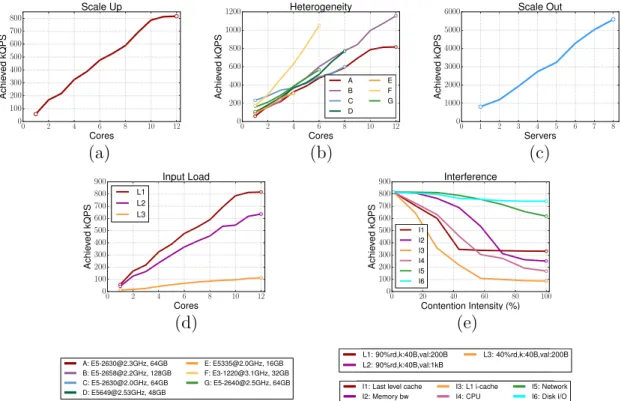
purpose of the example, we select memcached, a low-latency, in-memory key-value store [107]. We first need to determine how the performance for memcached scales as we increase the number of cores allocated to the application in a single node ( scale-up). For simplicity memory is unconstrained. We are interested in the maximum throughput, in queries per second (QPS) that memcached can achieve, such that its 99th percentile latency is below 200usec. Figure 2.4a shows this scaling experiment.
Since memcached is memory-bound, increasing the number of cores beyond a certain point does not benefit performance. The experiment is conducted on a 12 core In-tel Xeon server (CPU E5-2630 @ 2.30GHz) with 64GB of RAM. Since datacenters consist of several hardware platforms, we need to repeat this experiment on each of them. Figure 2.4b shows the different scaling curves for servers ranging from low-end Clovertown-based servers to high-end Haswell-based machines. Performance varies widely, as the low-end platforms become saturated much faster. In addition to the type of platform, a user must also know how the performance of a job scales as the load becomes distributed across an increasing number of servers (scale-out). Figure 2.4c shows the throughput of memcached in QPS when scaling out from a single Xeon server to 8 servers of the same type. Since there is limited communication between servers, performance is almost linear for memcached. This, however, is not the case in general, especially for applications sharing common state.
So far we have maintained the characteristics of the input load constant, i.e., same key-value distributions. In real datacenter settings load fluctuates widely as user traffic is higher during the day, and drops during the night. This is mostly the case for user-interactive services, such as search, email, and social networks. Batch applications, like analytics, also experience variations in the size and characteristics of their input datasets. Figure 2.4d shows how performance changes, as we vary the read:write request ratio and the size of keys and values. As expected when requests are write-dominated (L3), the throughput is significantly lower.
Finally, a principal objective of the cluster manager is to increase system uti-lization, by sharing resources across applications. Unfortunately, resource sharing incurs interference due to contention. Understanding the sensitivity of an applica-tion to different types and intensities of interference is a critical dimension in cluster
0 2 4 6 8 10 12 Cores 0 100 200 300 400 500 600 700 800 A ch ie ve d kQ P S
0 2 4 6 8 10 12
Cores 0 200 400 600 800 1000 A ch ie ve d kQ P S A B C D E F G
0 1 2 3 4 5 6 7 8
Servers 0 1000 2000 3000 4000 5000 A ch ie ve d kQ P S
(a) (b) (c)
0 2 4 6 8 10 12
Cores 0 100 200 300 400 500 600 700 800 900 A ch ie ve d kQ P S Input Load L1 L2 L3
0 20 40 60 80 100
Contention Intensity (%)
0 100 200 300 400 500 600 700 800 900 A ch ie ve d kQ P S Interference I1 I2 I3 I4 I5 I6 (d) (e)
A: [email protected], 64GB B: [email protected], 128GB C: [email protected], 64GB D: [email protected], 48GB
E: [email protected], 16GB F: [email protected], 32GB G: [email protected], 64GB
L1: 90%rd,k:40B,val:200B L2: 90%rd,k:40B,val:1kB
L3: 40%rd,k:40B,val:200B
I1: Last level cache I2: Memory bw
I3: L1 i-cache I4: CPU
I5: Network I6: Disk I/O
Figure 2.4: The steps needed to determine the appropriate resources for a new, un-known workload.
management. Figure 2.4e shows how the performance of memcached changes with increasing amounts of interference in various resources. Moreover, since most of these dimensions are affected by the application itself and the system setup, the explo-ration must be repeated upon application updates, operating system upgrades, or the introduction of new hardware platforms.
This analysis highlights the fact that understanding the resource requirements of a potentially new application is a challenging problem. This is, however, the task that most cluster management frameworks require users to perform. These interfaces foster underutilization, as conservative users overprovision their reservations to avoid insufficient resources, and performance unpredictability.
There has been significant work on determining the amount of resources needed by an application in both virtualized and non-virtualized systems [50,54,61,93, 99, 118, 119, 124, 238, 248, 261, 276, 298, 300]. Rightscale [224], for example, uses a load threshold to automatically scale out 3-tier applications to react to changes in
the load in Amazon’s cloud service [13]. CloudScale identifies application resource requirements using online demand prediction and prediction error handling, without a priori assumptions on application behavior [240]. Dejavu serves a similar goal by identifying a few workload classes and based on them, reuses previous resource allocations to minimize reallocation overheads [266]. Dominant Resource Fairness (DRF) [114] provides a generalization of max-min fairness across multiple resources that disincentivizes users from lying about their requirements, and preventing resource sharing. Zhu et al. [300] present a resource management scheme for virtualized datacenters that preserves service level agreements (SLAs), and Gmach et al. [117] present a resource allocation scheme for datacenter applications that relies on the ability to predict their behavior a priori. Finally, there is a lot of work on determining allocation requirements in virtualized environments [3,284, 249,250], and reclaiming unused resources that can service new load [1,48, 274, 272].
Resource assignment, i.e., determining the appropriatetype of allocated resources, is equally critical to resource sizing. Given the fact that platforms vary considerably in modern datacenters, and that interference in shared resources is detrimental to performance, understanding how application behavior changes with platform
hetero-geneity and workload interference is essential.
Recent work on datacenter management has highlighted the importance of these two factors. Mars et al.[186, 187] have shown that the performance of Google work-loads can vary by up to 40% due to heterogeneity even when considering only two server configurations and up to 2x due to interference even when considering only two colocated applications. In [186], they present a system that uses combinatorial opti-mization to select the proper server configuration for a given workload. In [187], they present a two-step method to characterize the sensitivity of workloads to memory pressure and the stress each application exercises to the memory subsystem. In the same spirit Yang et al. [285] apply a dynamic interference sensitivity detection scheme to preserve the performance of batch and latency-critical applications under coloca-tion scenarios. Govindan et al. [120] also present a scheme to quantify the effects of cache interference between consolidated workloads, although they require access to physical memory addresses. Zhang et al. [296] use cycles-per-instruction (CPI)
as a proxy for interference between workloads and throttle the offending co-runners such that the applications return to their expected behavior. Quincy [149] formulates resource assignment as a graph optimization problem, accounting for fairness, and placement constraints application may have. Finally, Nathuji et al. [200] present a control-based resource allocation scheme that mitigates the effects of cache, mem-ory and hardware prefetching interference between co-scheduled workloads. While these systems highlight the importance of factoring heterogeneity and interference in scheduling decisions, they incur significant profiling overheads, and are limited to capturing interference in a small number of shared resources.
The problem of resource assignment is well-established in systems using virtual-ization. VM management systems such as vSphere [273], XenServer [4] or the VM platforms on EC2 [13] and Windows Azure [279] can schedule diverse workloads sub-mitted by a large number of users on the available servers. In general, these platforms account for application resource requirements which they learn over time by monitor-ing workload execution. VMWare’s Distributed Resources Scheduler (DRS) [271] for example accounts for CPU and memory requirements when scheduling applications. Recently, DeepDive [204] proposed a black-box system for management of virtual machines which accounts for interference, while minimizing migration overheads.
Finally, resource management in heterogeneous CMPs shares some concepts and challenges with datacenter management. Fedorova et al. [102] discuss OS level schedul-ing for heterogeneous multi-cores as havschedul-ing the followschedul-ing three objectives: optimal performance, core assignment balance and response time fairness. Shelepov et al. [239] present a resource manager that exhibits some of these features and is sim-ple and scalable, while Craeynest et al. [263] use performance statistics to estimate which workload-to-core mapping is likely to provide the best performance. Datacen-ter management also has similar requirements as applications should observe their QoS, resource allocation should follow application requirements closely and fairness between co-scheduled workloads should be preserved.
2.3.2
Resource Management Decisions
Once the cluster manager has been given, or has determined itself, the resource re-quirements of a new application, it must perform a scheduling decision. Ideally, datacenter management should have three desirable properties. First, each workload should receive the resources that enable it to achievehigh and predictable performance. Second, jobs should be tightly packed on available servers to achievehigh cluster
uti-lization. Third, scheduling overheads should be minimal to allow the scheduler to
scale to large clusters and high job arrival rates. With these three objectives in mind,
cluster schedulers follow a diverse set of designs.
Cluster managers can be examined along two dimensions with respect to their scheduling decisions: scheduling concurrency (throughput) and scheduling speed (la-tency).
With respect to scheduling concurrency, there are two groups of work. In the first, scheduling is serialized, with a centralized scheduler making all decisions [149, 79]. However, application scheduling in clusters with thousands of servers and high work-load churn becomes a bottleneck. The second group of work addresses this problem by scheduling multiple jobs in parallel through two-level, distributed or shared-state designs [139, 232]. Two-level schedulers, such as Mesos and YARN, use a central-ized coordinator to divide resources between frameworks like Hadoop, Spark and MPI [139, 267]. Each framework uses its own scheduler to assign resources to tasks. Since neither the coordinator nor the framework schedulers have a complete view of the cluster state and all task characteristics, scheduling is suboptimal [232]. Shared-state schedulers like Omega [232] allow multiple scheduling agents to concurrently access the whole cluster state using atomic transactions. As long as these agents rarely attempt to schedule work to the same servers (infrequent conflicts), concur-rency comes with a low performance cost. Finally, Sparrow uses multiple concurrent, stateless schedulers to sample and allocate resources [209].
With respect to the speed at which scheduling decisions happen, there are again two groups of work. The first group examines most of (or all) the cluster state to determine the most suitable resources for incoming tasks, in a way that addresses
the performance impact of hardware heterogeneity and interference in shared
re-sources [76, 120, 285, 200, 186, 296, 241]. For instance, Quincy [149] formulates
scheduling as a cost optimization problem that accounts for job preferences with respect to locality, fairness and starvation-freedom. Similarly, Tetris [121] uses a greedy algorithm to pack machines in a way that matches the resource requirements of tasks to the resource availability of a particular machine. These schedulers make high-quality decisions that lead to high application performance and high cluster uti-lization. However, they inspect the full cluster state on every scheduling event. Their decision overhead can be prohibitively high for large clusters, and in particular for the very short jobs of real-time analytics (100 ms–10 s) [209, 288]. Using multiple greedy schedulers improves scheduling throughput but not latency, and terminating the greedy search early hurts decision quality, especially at high cluster loads.
The second group leverages results from randomized load balancing [193, 212], to design sampling-based cluster schedulers [52, 91, 209]. Sampling the state of just a few servers reduces the latency of each scheduling decision and the probability of conflicts between concurrent agents, and is likely to find available resources in non heavily-loaded clusters. The recently-proposed Sparrow scheduler uses batch
sampling and late binding [209]. Batch sampling examines the state of two servers
for each ofmrequired cores by a new job and selects them best cores. If the selected cores are busy, tasks are queued locally in the sampled servers and assigned to the machine where resources become available first. While sampling-based schedulers improve scheduling speed, their decisions can be poor because they ignore the resource preferences of jobs. Typically concurrent schedulers follow sampling schemes, while centralized systems are paired with sophisticated algorithms. In Section 7 we present a cluster scheduler that bridges the disparity between the high quality and low speed centralized schedulers and the high speed and low quality of distributed, sampling-based systems.
Public clouds becoming the platform of choice for many cloud services users has also motivated a large body of work on optimizing cloud provisioning for both perfor-mance and cost. For example, Deelman et al. [71] discuss cost-efficient provisioning strategies for specific astronomy applications on a cloud provider. Li et al. [172]
compare the resource pricing of several cloud providers to help users provision their applications. There are also studies that analyze resource pricing strategies in public clouds, and contest whether pricing is indeed market-driven, for example for spot instances on Amazon EC2, compared to alternative strategies [36]. Finally, Guevara et al. [127] and Zahed et al. [290] have incorporated the economics of heterogeneous resources in market-driven and game-theoretic strategies for resource allocation in shared environments.
While cloud providers are suitable for several online services, there are others that due to security and privacy concerns or cost limitations are still hosted on private systems. Trying to achieve the best of both worlds, many cloud computing users now deploy hybrid clouds, which consist of both privately-owned and publicly-rented ma-chines [20,44,143,159,294]. Hybrid clouds raise additional provisioning challenges, as a user must now determine not only the type and configuration of resources rented on a public cloud, but in addition how to partition the load (and data) between pri-vate and public machines. Breiter et al. [44], for example, have described a framework that allows service integration in hybrid cloud environments, including actions such as overflowing in on-demand resources during periods of high load. Farahabady et al. [143] also present a resource allocation strategy for hybrid clouds that attempts to predict the execution times of incoming jobs and based on these predictions generate Pareto-optimal resource allocations. Finally, Annapureddy et al. [20] and Zhang et al. [294] discuss the security challenges of hybrid environments, and propose ways to leverage the private portion of the infrastructure for privacy-critical computation. In such settings, where the options for resource offerings are plentiful, understanding the requirements of scheduled applications becomes even more critical. In Section 8 we show that by accounting for the resource preferences of incoming workloads, a hybrid provisioning system can improve over the performance of public resources, and the cost efficiency of private, reserved servers.
2.4
Data Mining in Systems
The conventional design approach in architecture and systems has several drawbacks for large-scale datacenters. For example, while in a traditional desktop or mobile system, exhaustively characterizing the behavior of the handful of applications of interest would be a viable solution, the scale at which datacenters operate do not allow for such best-effort designs. Specifically, because instead of a few cores or servers, we now have tens to hundreds of thousands of machines running diverse applications with a high churn, we need practical solutions, that quickly and accurately determine the resource requirements of new workloads, and can provide guarantees on performance and system efficiency. Unfortunately, the empirical approach adopted so far cannot provide such practical designs, and instead results in overly complex solutions with poor predictability, leading to overprovisioning and underutilization.
A major contribution of this thesis is the introduction of a new approach in solving large-scale systems problems that relies on data mining. While machine learning tech-niques have been previously applied in system management [135, 152, 278, 41, 190], they were designed for small-scale systems, making their computational overheads when scaling to the hundreds of thousands of servers in modern datacenters imprac-tical. Instead, in this dissertation we focus on simple data mining techniques that leverage the massive amounts of monitoring data, including information on the be-havior of scheduled applications, datacenters collect today. We show that by mining
this data in a mindful fashion we can not only get rich insights on the resource re-quirements of previously-unseen applications, but also produce practical solutions for cluster management that can be deployed in real-world environments and benefit both performance and resource efficiency. Specifically, with Paragon we show that data mining can help the scheduler determine which hardware platform is most suit-able for a given workload, as well as the sensitivity an application has to different types of interference. With Quasar we generalize this insight to solve the more gen-eral cluster management problem, where the system must also determine the amount of resources needed by an application, without burdening the user with specifying
resource reservations. This enables not only high and predictable application perfor-mance, but allows datacenters to operate at 2-3x higher utilizations than before.
Paragon: QoS-Aware Scheduling in
Heterogeneous Datacenters
3.1
Introduction
An increasing amount of computing is performed in the cloud, primarily due to cost benefits for both the end-users and the operators of datacenters (DC) that host cloud services [31]. Large-scale providers such as Amazon EC2 [13], Microsoft Windows Azure [279], Rackspace [218] and Google Compute Engine [110] host tens of thou-sands of applications on a daily basis. Several companies also organize their IT infras-tructure as private clouds, using management systems such as VMware vSphere [273] or Citrix XenServer [4].
The operator of a cloud service must schedule the stream of incoming applications on available servers in a manner that achieves both fast execution (user’s goal) and
high resource efficiency (operator’s goal), enabling better scaling at low cost. This
scheduling problem is particularly difficult as cloud services must accommodate a diverse set of workloads in terms of resource and performance requirements [31]. Moreover, the operator often has no a priori knowledge of workload characteristics.
In this chapter, we focus on two basic challenges that complicate scheduling in large-scale DCs: hardware platform heterogeneity and workload interference.
Heterogeneity occurs because servers are gradually provisioned and replaced over 24
0 1000 2000Workloads3000 4000 5000
0.0 0.2 0.4 0.6 0.8 1.0
Speedup over Alone on Best Platform
Alone on Best Platform
No Heterogeneity No InterferenceLeast Loaded
Figure 3.1: Performance degradation for 5,000 applications on 1000 EC2 servers with heterogeneity-oblivious, interference-oblivious and baseline least-loaded sched-ulers compared to ideal scheduling (application runs alone on best platform). Results are ordered from worst to best-performing workload.
the typical 15-year lifetime of a DC [31, 136, 163, 188,199]. At any point in time, a DC may host 3-5 server generations with a few hardware configurations per genera-tion, in terms of the specific speeds and capacities of the processor, memory, storage and networking subsystems. Hence, it is common to have 10 to 40 configurations throughout the DC. Ignoring heterogeneity can lead to significant inefficiencies, as some workloads are sensitive to hardware configurations. Figure 3.1 shows that a heterogeneity-oblivious scheduler will slow applications down by 22% on average, with some running nearly 2x slower (see Section 3.4 for methodology). This is not only suboptimal from the user’s perspective, but also for the DC operator as workloads occupy servers for significantly longer.
Interference is the result of co-scheduling multiple workloads on a single server to increase utilization and achieve better cost efficiency. By co-locating applications a given number of servers can host a larger set of workloads (better scalability). Alternatively, by packing workloads in a small number of servers when the overall load is low, the rest of the servers can be turned off to save energy. The latter is needed because modern servers are not energy-proportional and consume a large fraction of peak power even at low utilization [29,31, 171, 191]. Co-scheduled applications may interfere negatively even if they run on different processor cores because they share
caches, memory channels, storage and networking devices [120,187,200]. Figure 3.1 shows that an interference-oblivious scheduler will slow workloads down by 34% on average, with some running more than 2x slower. Again, this is undesirable for both users and operators. Finally, a baseline scheduler that is both interference and heterogeneity-oblivious and schedules applications to least-loaded servers is even worse (48% average slowdown), causing some workloads to crash due to resource exhaustion on the server.
Previous work has showcased the potential of heterogeneity and interference-aware scheduling [188, 187]. However, techniques that rely on detailed application charac-terization cannot scale to large DCs that receive tens of thousands of potentially unknown workloads every day [45]. Most cloud management systems have some no-tion of contenno-tion or interference-awareness [139,200,266, 2, 283, 4]. However, they either use empirical rules for interference management or assume long-running work-loads (e.g., online services), whose repeated behavior can be progressively modeled. In this work, we target both heterogeneity and interference and assume no a priori analysis of the application. Instead, we leverage information the system already has about the large number of applications it has previously seen.
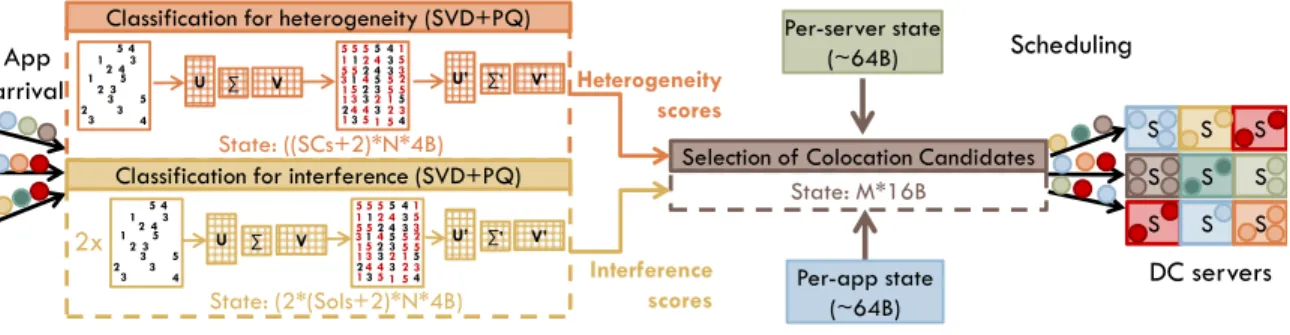
We present Paragon, an online and scalable datacenter scheduler that is hetero-geneity and interference-aware. The key feature of Paragon is its ability to quickly and accurately classify an unknown application with respect to heterogeneity (which server configurations it will perform best on) and interference (how much interference it will cause to co-scheduled applications and how much interference it can tolerate itself in multiple shared resources). Paragon’s classification engine exploits existing data from previously scheduled applications and offline training and requires only a minimal signal about a new workload. Specifically, it is organized as a low-overhead recommendation system similar to the one deployed for the Netflix Challenge [34], but instead of discovering similarities in users’ movie preferences, it finds similarities in applications’ preferences with respect to heterogeneity and interference. It uses sin-gular value decomposition to perform collaborative filtering and identify similarities between incoming and previously scheduled workloads.
server that is the best possible match in terms of platform and minimum nega-tive interference between all co-scheduled workloads. Even though the final step is greedy, the high accuracy of classification leads to schedules that satisfy both user requirements (fast execution time) and operator requirements (efficient resource use). Moreover, since classification is based on robust analytical methods and not merely empirical observation, we have strong guarantees on its accuracy and strict bounds on its overheads. Paragon scales to systems with tens of thousands of servers and tens of configurations, running large numbers of previously unknown workloads.
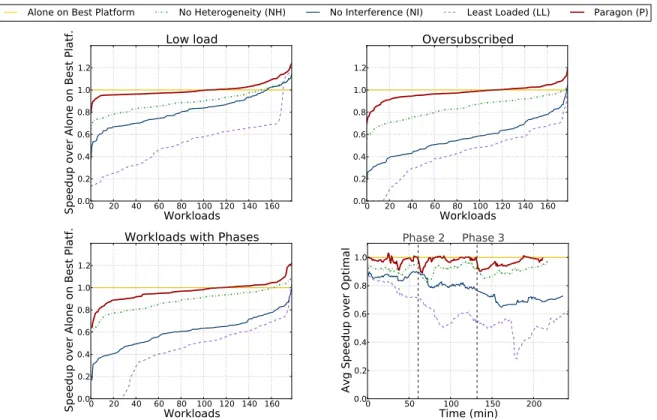
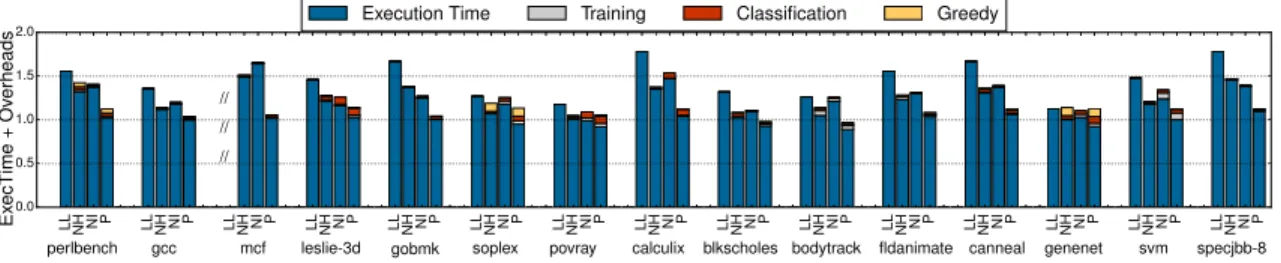
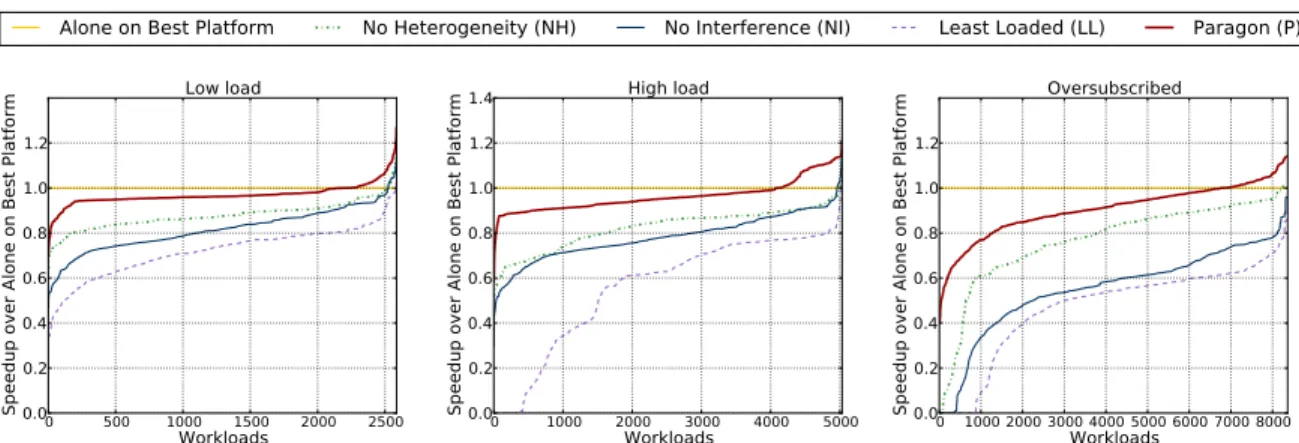
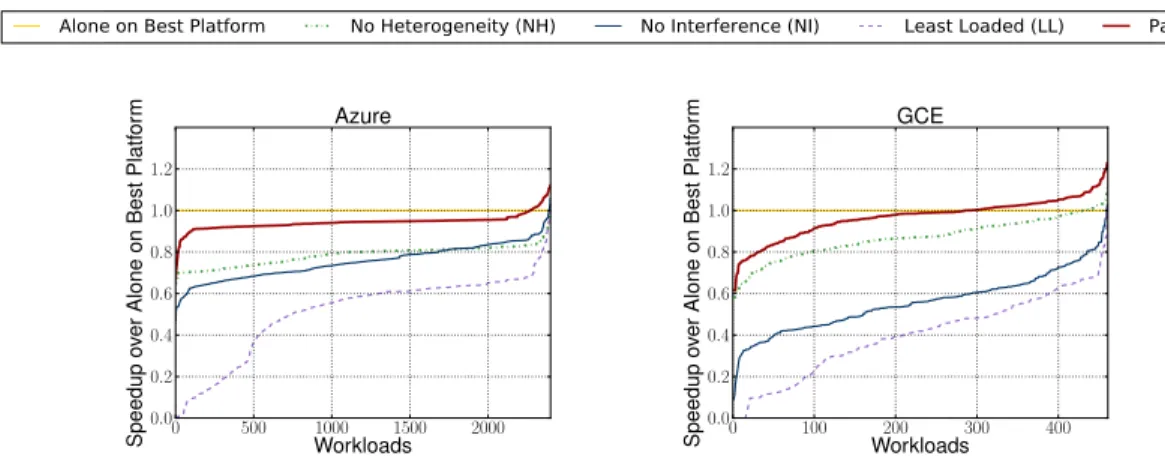
We implemented Paragon and evaluated its efficiency using a wide spectrum of workload scenarios (light, high, and oversubscribed). We use Paragon to schedule ap-plications on a private cluster with 40 servers of 10 different configurations and on 1000 exclusive servers on Amazon EC2 with 14 configurations. We compare Paragon to a heterogeneity-oblivious, an interference-oblivious and a state-of-the-art least-loaded scheduler, which ignores both heterogeneity and interference. For the 1000-server experiments and a scenario with 2500 workloads, Paragon maintains QoS for 91% of workloads (within 5% of their performance running alone on the best server). The heterogeneity-oblivious, interference-oblivious and least-loaded schedulers offer such QoS guarantees for only 14%, 11%, and 3% of applications respectively. The results are more striking in the case of an oversubscribed workload scenario, where efficient resource use is even more critical. Paragon provides QoS guarantees for 52% of work-loads and bounds the performance degradation to less than 10% for an additional 33% of workloads. In contrast, the least-loaded scheduler dramatically degrades per-formance for 99.9% of applications. We also evaluate Paragon on a Windows Azure and a Google Compute Engine cluster and show similar gains. Finally, we validate that Paragon’s classification engine achieves the accuracy and bounds predicted by the analytical methods and evaluate various parameters of the system.
3.2
Fast & Accurate Classification
The key requirement for heterogeneity and interference-aware scheduling is to quickly and accurately classify incoming applications. First, we need to know how fast an