WP 3 - D3.4
Validation Procedure.
ANNEX 4. Security Testing Basis
Project Acronym: ExtremeFactories
Full Title:
Internet based environment implementing agile management meth-ods for enabling the set-up, monitoring and follow-up of business innovation processes in industrial SMEs
List of ExtremeFactories Beneficiaries Page II of 133
List of ExtremeFactories Beneficiaries
No. Participant Organisation Name Participant Short Name Country
1 INNOPOLE S.L. INNO ES
2 Institut für angewandte Systemtechnik ATB DE
3 Centre for Factories of the Future, Ltd. C4FF UK
4 Vaibmu Ltd. VAI FI
5 Safeview, S.L. SFV ES
6 FAMMSA, S.A. FAM ES
7 OAS A.G. OAS DE
8 Armbruster Engineering AE DE
9 MB Air Systems Ltd. MBAS UK
10 Charles Robinson (Cutting Tools), Ltd. CTOOLS UK
Summary Page III of 133
Summary
ExtremeFactories project is about enhancing the innovation management process in globally acting networked SMEs by means of implementing a new methodology, based on Agile Meth-odologies, and a collaborative internet-based platform for adoption of a systematic innovation process. Targeted innovation process support should cover all the phases of the process from its inception over ideas prioritisation phase and implementation phase till the follow-up of the implemented innovations, following an agile approach.
The present document is an annex to the deliverable D3.4 “Validation Procedure”. It contains: − OWASP ASVS foundations.
− Testing Tools for security testing.
Table of Contents Page IV of 133
Table of Contents
1
Owasp Asvs ...9
1.1.1 Detailed Verification Requirements ...17
1.1.2 Verification Reporting Requirements ...34
2
EFF Application Penetration Testing ... 37
2.1
Information Gathering ... 37
2.1.1 Testing: Spiders, Robots, and Crawlers (EFF--IG-001) ...38
2.1.2 Search Engine Discovery/Reconnaissance (EFF--IG-002) ...39
2.1.3 Identify Application Entry Points (EFF-IG-003) ...41
2.1.4 Testing for Web Application Fingerprint(EFF--IG-004) ...43
2.1.5 Application Discovery (EFF--IG-005) ...43
2.1.6 Analysis of Error Codes (EFF-IG-005) ...44
2.2
Configuration Management Testing ... 47
2.2.1 SSL/TLS Testing (EFF-SEC-CM-001) ...49
2.2.2 DB Listener Testing (EFF-SEC-CM-002) ...49
2.2.3 Infrastructure Configuration Management Testing (EFF-SEC-CM-003) ...50
2.2.4 Application Configuration Management Testing (EFF-SEC-CM-004) ...51
2.2.5 Testing for File Extensions Handling (EFF-SEC-CM-005) ...51
2.2.6 Backup and Unreferenced Files (EFF-SEC-CM-006) ...52
2.2.7 Infrastructure and Application Admin Interfaces (EFF-SEC-CM-007) ...54
2.2.8 Testing for HTTP Methods and XST (EFF-SEC-CM-008) ...55
2.3
Authentication Testing ... 56
2.3.1 Credentials transport over an encrypted channel (EFF-SEC -AT-001) ...58
2.3.2 Testing for user enumeration (EFF-SEC -AT-002) ...58
2.3.3 Testing for Guessable (Dictionary) User Account (EFF-SEC -AT-003) ...59
2.3.4 Brute Force Testing (EFF-SEC -AT-004) ...60
2.3.5 Testing for bypassing authentication schema (EFF-SEC -AT-005) ...61
2.3.6 Testing for vulnerable remember password and pwd reset (EFF-SEC -AT-006) ...61
2.3.7 Testing for Logout and Browser Cache Management (EFF-SEC -AT-007) ...62
2.3.8 Testing for CAPTCHA (EFF-SEC -AT-008) ...63
Table of Contents Page V of 133
2.3.10 Testing for Race Conditions (EFF-SEC -AT-010) ...65
2.4
Session Management Testing ... 66
2.4.1 Testing for Session Management Schema (EFF-SM-001) ...67
2.4.2 Testing for Cookies attributes (EFF-SM-002) ...68
2.4.3 Testing for Session Fixation (EFF-SM-003) ...71
2.4.4 Testing for Exposed Session Variables (EFF-SM-004) ...71
2.4.5 Testing for CSRF (EFF-SSM-005) ...72
2.5
Authorization Testing ... 78
2.5.1 Testing for Path Traversal (EFF-SEC-AZ-001) ...79
2.5.2 Testing for bypassing authorization schema (EFF-SEC-AZ-002) ...80
2.5.3 Testing for Privilege Escalation (EFF-SEC-AZ-003) ...81
2.6
Data Validation Testing ... 81
2.6.1 Testing for Reflected Cross Site Scripting (EFF-SEC-DV-001)...84
2.6.2 Testing for Stored Cross Site Scripting (EFF-SEC-DV-002) ...85
2.6.3 Testing for DOM based Cross Site Scripting (EFF-SEC-DV-003) ...90
2.6.4 Testing for Cross Site Flashing (EFF-SEC-DV-004) ...91
2.6.5 SQL Injection (EFF-SEC-DV-005) ...92
2.6.6 XML Injection (EFF-SEC-DV-006) ... 100
2.6.7 SSI Injection (EFF-SEC-DV-007) ... 111
2.6.8 XPath Injection (EFF-SEC-DV-008) ... 112
2.6.9 IMAP/SMTP Injection (EFF-SEC-DV-009) ... 113
2.6.10 Code Injection (EFF-SEC-DV-010) ... 115
2.6.11 OS Commanding (EFF-SEC-DV-011) ... 115
2.6.12 Testing for HTTP Splitting/Smuggling (EFF-SEC-DV-013) ... 120
2.7
Denial Of Service Testing ... 122
2.7.1 Testing_for_SQL_Wildcard_Attacks (EFF-SEC-DoS-001) ... 123
2.7.2 D Locking Customer Accounts (EFF-SEC-DoS-002) ... 125
2.7.3 Buffer Overflows (EFF-SEC-DoS-003) ... 126
2.7.4 User Specified Object Allocation (EFF-SEC-DoS-004) ... 127
2.7.5 User Input as a Loop Counter (EFF-SEC-DoS-005) ... 128
2.7.6 Writing User Provided Data to Disk (EFF-SEC-DoS-006) ... 128
Table of Contents Page VI of 133
2.7.8 Storing too Much Data in Session (EFF-SEC-DoS-008) ... 130
3
Tools For Security Testing ... 131
3.1
Open Source Black Box Testing Tools ... 131
3.2
Testing for Specific Vulnerabilities ... 131
3.2.1 Testing Flash ... 131
3.2.2 Testing AJAX ... 131
3.2.3 Testing for SQL Injection ... 131
3.2.4 Testing Oracle ... 132
3.2.5 Testing SSL ... 132
3.2.6 Testing for Brute Force Password ... 132
3.2.7 Testing for HTTP Methods ... 132
3.2.8 Testing Buffer Overflow ... 132
3.2.9 Fuzzer ... 132
3.2.10 Googling ... 132
3.3
Commercial Black Box Testing Tools ... 132
List of Tables Page VII of 133
List of Tables
Table 1-1: V1 - Security Architecture Documentation Verification Requirements 19
Table 1-2: V2 - Authentication Verification Requirements 20
Table 1-3: V3 - Session Management Verification Requirements 22
Table 1-4: V4 - Access Control Verification Requirements 23
Table 1-5: V5 - Input Validation Verification Requirements 24
Table 1-6: V6 - Output Encoding/Escaping Verification Requirements 26
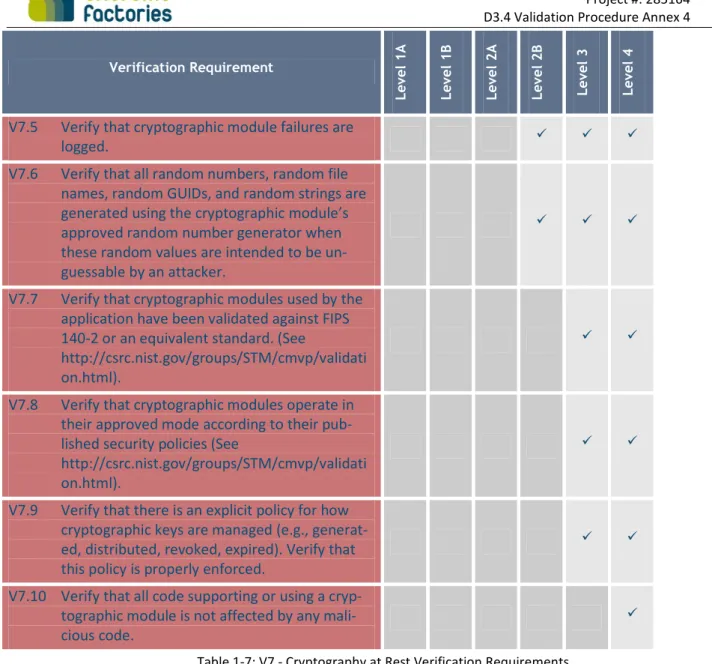
Table 1-7: V7 - Cryptography at Rest Verification Requirements 27
Table 1-8: V8 - Error Handling and Logging Verification Requirements 29
Table 1-9: V9 - Data Protection Verification Requirements 30
Table 1-10: V10 - Communications Security Verification Requirements 32
Table 1-11: V11 - HTTP Security Verification Requirements 32
Table 1-12: V12 - Security Configuration Verification Requirements 33
Table 1-13: V13 - Malicious Controls Verification Requirements 34
Table 1-14: V14 - Internal Security Verification Requirements 34
Table 1-15: OWASP ASVS Report Verification Results Contents 36
List of Figures
Figure 1: OWASP ASVS Levels 9
Figure 2: OWASP ASVS Levels (2) 9
Figure 3: OWASP ASVS Levels 1A, 1B 10
Figure 4: OWASP ASVS Levels 2, 2A, and 2B 12
Figure 5: OWASP ASVS Level 3 14
Abbreviations Page VIII of 133
Abbreviations
ASVS Application Security Verification Standard Project
app. Application DB Database
EFF ExtremeFactories
ICT Information and Communication Technologies
IDE Integrated Development Envi-ronment
IT Information Technologies
OWASP The Open Web Application Secu-rity Project
Ref. Reference
RTD Research and Technological De-velopment
SW Software TC Test Case
Owasp Asvs Page 9 of 133
1
Owasp Asvs
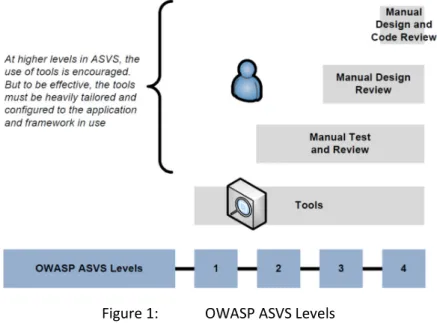
The use of ASVS in the project has two main goals, as depicted in the figure below: to help ExtremeFacto-ries Consortium develop and maintain secure applications; and to allow security service/tools providers and consumers to align their requirements and offerings. The Standard defines four hierarchical levels (e.g. Level 2 requires more coverage and rigor than Level 1)
Figure 1: OWASP ASVS Levels
The ASVS defines four levels of verification, with each level increasing in breadth as the application moves up the levels.
Figure 2: OWASP ASVS Levels (2)
ASVS DEFINES DETAILED VERIFICAITON REQUIREMENTS FOR LEVELS 1 AND ABOVE; WHEREAS LEVEL 0 IS MEANT TO BE FLEXIBLE AND IS CUSTOMIZED BY EACH ORGANIZATION.
Owasp Asvs Page 10 of 133
The breadth is defined in each level by a set of security verification requirements that must be ad-dressed. It is a verifier’s responsibility to determine if a target of verification (TOV) meets all of the re-quirements at the level targeted by a review. If the application meets all of the rere-quirements for that level, then it can be considered an OWASP ASVS Level N application, where N is the verification level that application complied with. If the application does not meet all the requirements for a particular level, but does meet all the requirements for a lower level of this standard, then it can be considered to have passed the lower level of verification
The depth of the verification is defined by the scope of the application included when verifying each se-curity requirement. For example, the scope of the verification may go beyond the application’s custom-built code and include external components. Achieving a verification level under such scrutiny can be represented by annotating a “+” symbol to the verification level.
Web application security verification is performed from a logical point of view by following (or attempt-ing to follow) paths into and out of a targeted application (called the Target of Verification or TOV) and performing analysis along those paths. More complex applications typically take more time to analyze resulting in longer and more costly verifications. Lines of code are not the only factors that determine the complexity of an application – different technologies will typically require different amounts of analysis. Simple applications may include for example libraries and frameworks. Applications of moderate com-plexity may include simple Web 1.0 applications. Complex applications may include Web 2.0 applications and new/unique Web technologies.
Level 1 – Automated Verification
Level 1 (“Automated Verification”) is typically appropriate for applications where some confidence in the correct use of securi-ty controls is required. Threats to securisecuri-ty1 will securi-typically be viruses and worms (targets are chosen indiscriminately through wide scans and impact the most vulnerable). The scope of verification includes code that was developed or modified in order to create the application.
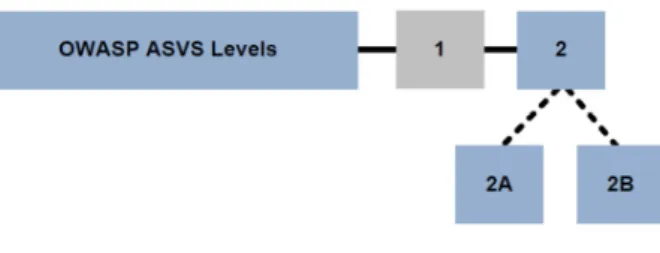
In Level 1, the verification involves the use of automated tools augmented with manual verification. This level only provides partial application security verification coverage. The manual verification is not intended to make the application security verification performed at this level complete, only to verify that each automated finding is correct and not a false positive. There are two constituent components for Level 1. Level 1A is for the use of automated application vulnerability scanning (dynamic analysis) tools, and Level 1B is for the use of automated source code scanning (static analysis) tools. Verification efforts may use either of these components individually, or may perform a combination of these approaches to achieve a complete Level 1 rating. The structure of these levels is depicted in the figure below.
While it may be determined that an application meets either Level 1A or 1B, neither of these levels alone provide the same levels of rigor or coverage as an application that meets Level 1. An application that meets Level 1 must meet both Level 1A and 1B requirements.
Figure 3: OWASP ASVS Levels 1A, 1B
1 For more information about identifying risks and estimating risks associated with vulnerabilities, see the OWASP Testing Guide
Owasp Asvs Page 11 of 133
The following are the minimal high-level requirements for Level 1, 1A, or 1B applications:
Verification Scope
L1.1 The scope of the verification includes all code that was developed or modified in order to create the application.
Security Control Behavior Requirements
None There are no requirements for how application security controls make decisions at Level 1.
Security Control Use Requirements
None There are no requirements for where application security controls are used within the application at Level 1.
Security Control Implementation Requirements
None There are no requirements for how the application security controls are built at Level 1.
Security Control Verification Requirements
L1.2 Dynamically scan the application according to the Level 1A requirements in the “Detailed Verification Requirements” section.
L1.3 Perform source code scanning on the application according to the Level 1B requirements in the “Detailed Verification Requirements” section.
Requirements at Level 1 that allow the use of either verification technique only have to be verified with one technique. In addition, if the verifier’s selected tool suite does not have the capability to verify a specified verification requirement, the verifier can perform manual verification to fill this gap
Reporting Requirements
L1.4 Create a verification report that details the application’s security architecture by listing its components, and includes the results of the verification according to the requirements in the “Verification Reporting Requirements” section.
At Level 1, application components may be defined in terms of either individual or groups of source files, libraries, and/or executable, as depicted in the figure below. At Level 1, the list need not be sorted or otherwise organized other than identifying which components are part of the application, and which components are part of the IT environment. The application can then be treated as groups of compo-nents within a single monolithic entity. The path or paths a given end user request may take within the application do not need to be identified and documented.
In EFF project we have chosen to comply with L0 security approach in a first stage reaching a L2 at end of project.
Level 1A – Dynamic Scan (Partial Automated Verification)
Dynamic Scanning Security Control Verification Requirements
Dynamic scanning (also known as “application vulnerability scanning”) consists of using automated tools to access application interfaces, while the application is running, in order to detect vulnerabilities in the application’s security controls. Note that this is not sufficient to verify the correct design, implementation, and use of a security control, but is acceptable verification at Level 1. The scope of verification is defined by this Level’s security architecture requirements.
L1A.1 Dynamically scan the application according to the Level 1A requirements specified in the “Detailed Verification Re-quirements” section.
Owasp Asvs Page 12 of 133
L1A.2 Verify all dynamic scan results using either manual application penetration testing or code review. Unverified auto-mated results are not considered to provide any assurance and are not sufficient to qualify for Level 1.
Multiple instances of a particular type of vulnerability that can be traced to a single root cause should be combined into a single finding if the scanning tool does not already do so.
Level 1B – Source Code Scan (Partial Automated Verification)
Source Code Scanning Security Control Verification Requirements
Source code scanning (also known as “static analysis”) consists of using automated tools to search through the application source code to find patterns that represent vulnerabilities. Note that this is not sufficient to verify the correct design, imple-mentation, and use of a security control, but is acceptable verification at Level 1. The scope of verification is defined by this Level’s security architecture requirements.
L1B.1 Perform source code scanning on the application according to the Level 1B requirements specified in the “Detailed Verification Requirements” section.
L1B.2 Verify all source code scan results using either manual application penetration testing or code review. Unverified automated results are not considered to provide any assurance and are not sufficient to qualify for Level 1.
Multiple instances of a particular type of vulnerability that can be traced to a single root cause should be combined into a single finding if the code analysis tool does not already do so.
Level 2 – Manual Verification
Level 2 (“Manual Verification”) is typically appropriate for applications that handle personal transactions, conduct business-to-business transactions, process credit card information, or process personally identifiable information. Level 2 provides some confidence in the correct use of security controls and confidence that the security controls are working correctly. Threats to security will typically be viruses, worms, and unsophisticated opportunists such as attackers with professional or open source attack tools. The scope of verification includes all code developed or modified for the application as well as examining the security of all third party components that provide security functionality for the application. There are two constituent com-ponents for Level 2, as depicted in the figure below.
Figure 4: OWASP ASVS Levels 2, 2A, and 2B
While it may be determined that an application meets either Level 2A or 2B, neither of these levels alone provide the same levels of rigor or coverage as Level 2. Further, while Level 2 is a superset of Level 1, there is no requirement to run an auto-mated tool to meet the Level 2 requirements. Instead, the verifier has the option of using just manual techniques for all re-quirements. If automated tool results are available, the verifier may use them to support the analysis. However, even passing a requirement at Level 1 does not automatically indicate passing the same requirement at Level 2. This is because automated tools do not provide sufficient evidence that the positive requirement has been met.
Owasp Asvs Page 13 of 133
Manual techniques are still assumed to employ the use of tools. This can include the use of any kind of security analysis or testing tool, including the automated tools that are used for Level 1 verifications. However, such tools are simply aids to the analyst to find and assess the security controls being verified. Such tools may or may not contain logic to automatically detect application vulnerabilities.
The following are the minimal high-level requirements for Level 2, 2A, or 2B applications:
Verification Scope
L2.1 The scope of the verification includes all code that was developed or modified in order to create the application. This requirement was introduced at Level 1.
L2.2 The scope of the verification includes the code for all third-party framework, library, and service security functionality that is invoked by or supports the security of the application. This is a new requirement at Level 2.
Security Control Behavior Requirements
L2.3 Verify that all technical security controls that perform security checks make decisions using a whitelist approach. This is a new requirement at Level 2.
L2.4 Verify that all security controls that perform security checks and security controls that result in security effects can-not be bypassed according to the Level 2A and 2B requirements specified in the “Detailed Verification Requirements” section. This is a new requirement at Level 2.
Security Control Use Requirements
L2.5 Verify that all security controls are used everywhere within the application they need to be, and the implementations are centralized within the application, on the server side, according to the Level 2 requirements specified in the “De-tailed Verification Requirements” section. This is a new requirement at Level 2.
Security Control Implementation Requirements
None There are no requirements for how application security controls are built at Level 2.
Security Control Verification Requirements
L2.6 Perform manual application penetration testing on the application according to the Level 2A requirements specified in the “Detailed Verification Requirements” section. This is a new requirement at Level 2.
L2.7 Perform a manual source code review on the application according to the Level 2B requirements specified in the “Detailed Verification Requirements” section. This is a new requirement at Level 2.
Requirements at Level 2 that allow the use of either verification technique only have to be verified with one technique. The verifier may include automated scanning or code analysis as part of their verification effort at Level 2, but automated verification cannot be used in place of the manual review required for each Level 2 requirement. If the scan results help the verifier perform their work more quickly or augment the results of the manual portion of the review, they can certainly be used to assist in performing a Level 2 verification.
Reporting Requirements
L2.8 Create a verification report that describes the application’s security architecture by grouping its components into a high-level architecture, and includes the results of the verification according to the requirements in the “Verification Reporting Requirements” section. This augments the reporting requirement introduced at Level 1.
At Level 2, application components may be defined in terms of either individual or groups of source files, libraries, and/or executable files that are organized into a high-level architecture (for example Model-View-Controller (MVC) components, business function components, and data layer components). For example, the diagram below depicts an application that consists of a server application, an application server application, custom code, libraries, and a database application that are grouped according to an
Owasp Asvs Page 14 of 133
MVC architecture. At Level 2, the path or paths a given end user request may take within the application must be documented, as depicted in the figure below. However, not all such paths must be examined.
Level 2A – Security Test (Partial Manual Verification)
Manual Application Penetration Testing Security Control Verification Requirements
Manual application security testing consists of creating dynamic tests to verify an application’s proper design, implementa-tion, and use of security controls. The scope of verification is defined by this Level’s security architecture requirements. L2A.1 Perform manual application security testing on the application according to the Level 2A requirements specified in
the “Detailed Verification Requirements” section. This is a new requirement at Level 2.
Where appropriate, the verifier may use sampling to establish the effective use of a security control. The verifier may choose to document a vulnerability pattern that will allow developers to confidently find and fix all instances of the pattern in the software baseline. Multiple instances of a vulnerability pattern that can be traced to a single root cause should be combined into a single finding.
Level 2B – Code Review (Partial Manual Verification)
Manual Code Review Security Control Verification Requirements
Manual code review consists of human searching and analysis of the application source code in order to verify the applica-tion’s design, implementation, and proper use of security controls. Such analysis is expected to be tool assisted, but could simply involve commonly available tools such as a source code editor or IDE. The scope of verification is defined by this Level’s security architecture requirements.
L2B.1 Perform a manual code review on the application according to the Level 2B requirements specified in the “Detailed Verification Requirements” section. This is a new requirement at Level 2.
Where appropriate, the verifier may use an appropriate sampling method to establish the effective use of a security control. The verifier may choose to document a vulnerability pattern that will allow devel-opers to confidently find and fix all instances of the vulnerability pattern in the software baseline. Multi-ple instances of a vulnerability pattern that can be traced to a single root cause should be combined into a single finding.
Level 3 – Design Verification
Level 3 (“Design Verification”) is typically appropriate for applications that handle significant business-to-business transac-tions, including those that process healthcare information, implement business-critical or sensitive functransac-tions, or process other sensitive assets. Threats to security will typically be viruses and worms, opportunists, and possibly determined attackers (skilled and motivated attackers focusing on specific targets using tools including purpose-built scanning tools). The scope of verification includes all code developed or modified for the application, as well as examining the security of all third party components that provide security functionality for the application. Level 3 ensures that security controls themselves are work-ing correctly, and that security controls are used everywhere within the application they need to be used to enforce applica-tion-specific policies. Level 3 is not broken into multiple components, as depicted in the figure below.
Figure 5: OWASP ASVS Level 3
The following are the minimal high-level requirements for Level 3 applications:
Owasp Asvs Page 15 of 133
L3.1 The scope of the verification includes all code that was developed or modified in order to create the application. This requirement was introduced at Level 1.
L3.2 The scope of the verification includes the code for all third-party framework, library, and service security functionality that is invoked by or supports the security of the application. This requirement was introduced at Level 2.
L3.3 The scope of the verification includes the code for all third-party frameworks, libraries, and services associated with the application. This is a new requirement at Level 3.
Security Control Behavior Requirements
L3.4 Verify that all security controls that perform security checks make decisions using a whitelist approach. This require-ment was introduced at Level 2.
L3.5 Verify that all security controls that perform security checks and security controls that result in security effects can-not be bypassed according to the Level 3 requirements specified in the “Detailed Verification Requirements” section. This requirement was introduced at Level 2.
Security Control Use Requirements
L3.6 Verify that all security controls are used everywhere within the application they need to be, and the implementations are centralized within the application, on the server side, according to the Level 3 requirements specified in the “De-tailed Verification Requirements” section. This requirement was introduced at Level 2.
Security Control Implementation Requirements
None There are no requirements for how application security controls are built at Level 3.
Security Control Verification Requirements
L3.7 Manually verify the application according to the Level 3 requirements specified in the “Detailed Verification Re-quirements” section. This augments the manual verification requirements introduced at Level 2.
L3.8 Document a security architecture and use it to verify the proper design and use of all security controls by performing threat modeling. This is a new requirement at Level 3.
Reporting Requirements
L3.9 Create a verification report that describes the application’s security architecture by grouping its components into a high-level architecture that includes threat modeling information, and includes the results of the verification accord-ing to the requirements in the “Verification Reportaccord-ing Requirements” section. This augments the reportaccord-ing require-ment from Level 2.
At level 3, application components may be defined in terms of either individual or groups of source files, libraries, and/or executables that are grouped into a high-level architecture (for example MVC compo-nents, business function compocompo-nents, and data layer components). At Level 3, supporting threat model-ing information about threat agents and assets must additionally be provided. The path or paths a given end user request may take through a high-level view of the application must be documented, as depicted in the figure below. At Level 3, all potential paths through the high-level view of the application must be examined
Level 4 – Internal Verification
Level 4 (“Internal Verification”) is typically appropriate for critical applications that protect life and safety, critical infrastruc-ture, or defense functions. Level 4 may also be appropriate for applications that process sensitive assets. Level 4 ensures that security controls themselves are working correctly, that security controls are used everywhere within the application they need to be used to enforce application-specific policies, and that secure coding practices were followed. Threats to security will be from determined attackers (skilled and motivated attackers focusing on specific targets using tools including
purpose-Owasp Asvs Page 16 of 133
built scanning tools). The scope of verification expands beyond the scope of Level 3 to include all code used by the application. Level 4 is not broken out into constituent components, as depicted in the figure below.
Figure 6: OWASP ASVS Level 4
The following are the minimal high-level requirements for Level 4 applications:
Verification Scope
L4.1 The scope of the verification includes all code that was developed or modified in order to create the application. This requirement was introduced at Level 1.
L4.2 The scope of the verification includes the code for all third-party framework, library, and service security functionality that is invoked by or supports the security of the application. This requirement was introduced at Level 2.
L4.3 The scope of the verification includes the code for all third-party frameworks, libraries, and services associated with the application. This requirement was introduced at Level 3.
L4.4 The scope of the verification includes all remaining code associated with the application, including frameworks, li-braries, runtime environments, development tools, build tools, and deployment tools. The scope does not include the code for platform software, such as an application server, database server, virtual machine, or operating system, that has received a substantial amount of public scrutiny. This is a new requirement at Level 4.
Security Control Behavior Requirements
L4.5 Verify that all security controls that perform security checks make decisions using a whitelist (“positive”) approach. This requirement was introduced at Level 2.
L4.6 Verify that all security controls that perform security checks and security controls that result in security effects can-not be bypassed according to the Level 4 requirements specified in the “Detailed Verification Requirements” section. This requirement was introduced at Level 2.
Security Control Use Requirements
L4.7 Verify that all security controls are used everywhere within the application they need to be, and that the implemen-tations are centralized within the application, on the server side, according to the Level 4 requirements specified in the “Detailed Verification Requirements” section. This requirement was introduced at Level 3.
Security Control Implementation Requirements
L4.8 Verify that the application does not contain any malicious code according to the Level 4 requirements specified in the “Detailed Verification Requirements” section. This is a new requirement at Level 4.
Security Control Verification Requirements
L4.9 Manually verify the application against the Level 4 requirements specified in the “Detailed Verification Require-ments” section. This augments the requirement from Level 3.
L4.10 Document a security architecture and use it to verify the proper design and use of all security controls by performing threat modeling. This requirement was introduced at Level 3.
L4.11 Manually review all code developed or modified for this application for malicious code2 according to the Level 4 requirements specified in the “Detailed Verification Requirements” section. This is a new requirement at Level 4.
Owasp Asvs Page 17 of 133
Reporting Requirements
L4.12 Create a verification report that describes the application’s security architecture according to the Level 3 ments, which encompasses all application code, and includes the results of the verification according to the require-ments in the “Verification Reporting Requirerequire-ments” section. This augrequire-ments the reporting requirement from Level 3.
At Level 4, the application’s architecture shall be captured as required at Level 3. Further, Level 4 re-quires that all application code, including code not explicitly examined, be identified as part of the appli-cation definition, as depicted in the figure below. This code must include all libraries, frameworks, and supporting code that the application relies on. Previous verifications of these components can be reused as part of another verification effort. Platform code, such as the operating system, virtual machine, or core libraries issued with a virtual machine environment, Web server, or application server are not in-cluded in Level 4. For example, libraries associated with the Java runtime would not need to be assessed at Level 4.
1.1.1
Detailed Verification Requirements
The ASVS defines the following security requirements areas:
V1. Security Architecture V2. Authentication V3. Session Management V4. Access Control V5. Input Validation
V6. Output Encoding/Escaping V7. Cryptography
V8. Error Handling and Logging V9. Data Protection
V10. Communication Security V11. HTTP Security
V12. Security Configuration V13. Malicious Code Search V14. Internal Security
For each of these areas, the requirements that must be met at each of the verification levels listed below are specified:
Level 1: Automated Verification
Level 1A – Dynamic Scan (Partial Automated Verification) Level 1B – Source Code Scan (Partial Automated Verification) Level 2: Manual Verification
Owasp Asvs Page 18 of 133
Level 2B – Code Review (Partial Manual Verification) Level 3: Design Verification
Level 4: Internal Verification
1.1.1.1
V1: Security Architecture Documentation Requirements
Documenting some basic security architecture information is necessary to ensure both the completeness and accuracy (and repeatability when remediation is required) of the application security verification that is performed. Analysis can be directed and results can be traced back to the application’s high level security architecture. These requirements start with a base level of security architecture detail that must be captured and this level of detail grows with each level. The table below defines the corresponding security architecture documentation requirements that apply for each of the four verification levels.
Verification Requirement L e v e l 1 A L e v e l 1 B L e v e l 2 A L e v e l 2 B L e v e l 3 L e v e l 4
V1.1 Verify that all application compo-nents (either individual or groups of source files, libraries, and/or ex-ecutables) that are present in the application are identified.
V1.2 Verify that all components that are not part of the application but that the application relies on to operate are identified.
V1.3 Verify that a high-level architecture for the application has been de-fined.3
V1.4 Verify that all application compo-nents are defined in terms of the business functions and/or security functions they provide.
V1.5 Verify that all components that are not part of the application but that the application relies on to operate are defined in terms of the busi-ness functions and/or security functions they provide.
Owasp Asvs Page 19 of 133
V1.6 Verify that threat modeling
infor-mation has been provided.
Table 1-1: V1 - Security Architecture Documentation Verification Requirements
1.1.1.2
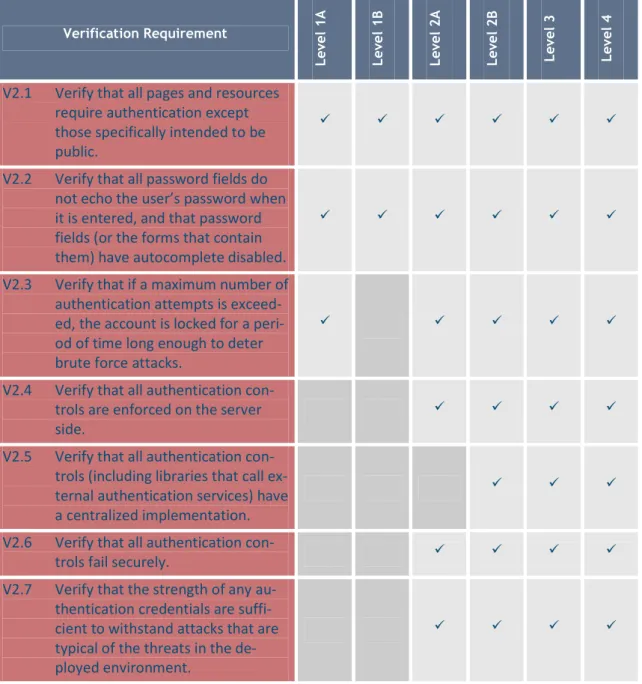
V2 – Authentication Verification Requirements
The Authentication Verification Requirements define a set of requirements for generating and handling account credentials safely. The table below defines the corresponding verification requirements that apply for each of the four verification levels.
Verification Requirement L e v e l 1 A L e v e l 1 B L e v e l 2 A L e v e l 2 B L e v e l 3 L e v e l 4
V2.1 Verify that all pages and resources require authentication except those specifically intended to be public.
V2.2 Verify that all password fields do not echo the user’s password when it is entered, and that password fields (or the forms that contain them) have autocomplete disabled.
V2.3 Verify that if a maximum number of authentication attempts is exceed-ed, the account is locked for a peri-od of time long enough to deter brute force attacks.
V2.4 Verify that all authentication con-trols are enforced on the server side.
V2.5 Verify that all authentication con-trols (including libraries that call ex-ternal authentication services) have a centralized implementation.
V2.6 Verify that all authentication
con-trols fail securely.
V2.7 Verify that the strength of any au-thentication credentials are suffi-cient to withstand attacks that are typical of the threats in the de-ployed environment.
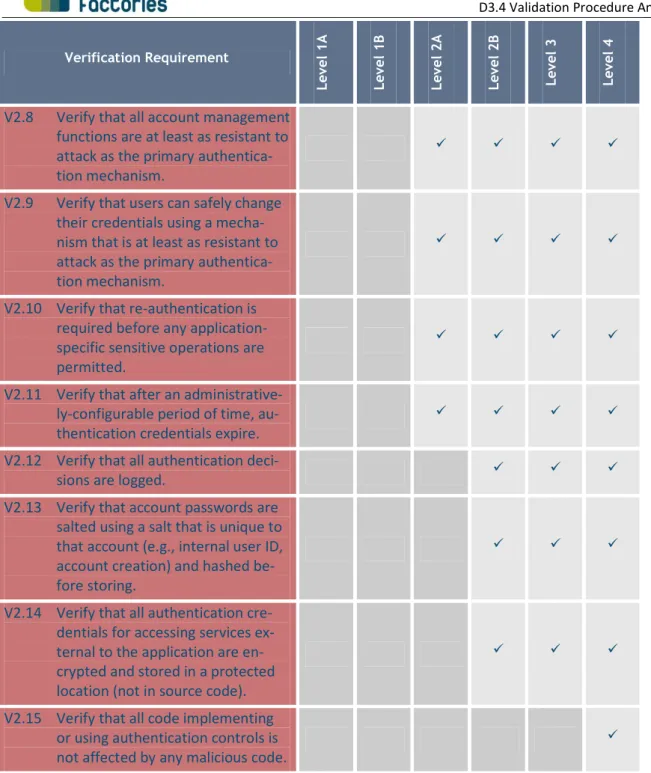
Owasp Asvs Page 20 of 133 Verification Requirement L e v e l 1 A L e v e l 1 B L e v e l 2 A L e v e l 2 B L e v e l 3 L e v e l 4
V2.8 Verify that all account management functions are at least as resistant to attack as the primary authentica-tion mechanism.
V2.9 Verify that users can safely change their credentials using a mecha-nism that is at least as resistant to attack as the primary authentica-tion mechanism.
V2.10 Verify that re-authentication is required before any application-specific sensitive operations are permitted.
V2.11 Verify that after an administrative-ly-configurable period of time, au-thentication credentials expire.
V2.12 Verify that all authentication
deci-sions are logged.
V2.13 Verify that account passwords are salted using a salt that is unique to that account (e.g., internal user ID, account creation) and hashed be-fore storing.
V2.14 Verify that all authentication cre-dentials for accessing services ex-ternal to the application are en-crypted and stored in a protected location (not in source code).
V2.15 Verify that all code implementing or using authentication controls is not affected by any malicious code.
Table 1-2: V2 - Authentication Verification Requirements
1.1.1.3
V3: Session Management Verification Requirements
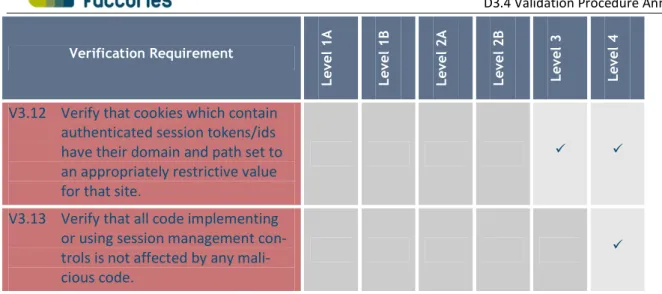
The Session Management Verification Requirements define a set of requirements for safely using HTTP requests, responses, sessions, cookies, headers, and logging to manage sessions properly. The table be-low defines the corresponding verification requirements that apply for each of the four verification lev-els.
Owasp Asvs Page 21 of 133 Verification Requirement L e v e l 1 A L e v e l 1 B L e v e l 2 A L e v e l 2 B L e v e l 3 L e v e l 4
V3.1 Verify that the framework’s default session management control im-plementation is used by the appli-cation.
V3.2 Verify that sessions are invalidated
when the user logs out. V3.3 Verify that sessions timeout after a
specified period of inactivity. V3.4 Verify that sessions timeout after
an administratively-configurable maximum time period regardless of activity (an absolute timeout).
V3.5 Verify that all pages that require authentication to access them have logout links.
V3.6 Verify that the session id is never disclosed other than in cookie headers; particularly in URLs, error messages, or logs. This includes verifying that the application does not support URL rewriting of ses-sion cookies.
V3.7 Verify that the session id is
changed on login.
V3.8 Verify that the session id is
changed on reauthentication. V3.9 Verify that the session id is
changed or cleared on logout. V3.10 Verify that only session ids
gener-ated by the application framework are recognized as valid by the ap-plication.
V3.11 Verify that authenticated session tokens are sufficiently long and random to withstand attacks that are typical of the threats in the de-ployed environment.
Owasp Asvs Page 22 of 133 Verification Requirement L e v e l 1 A L e v e l 1 B L e v e l 2 A L e v e l 2 B L e v e l 3 L e v e l 4
V3.12 Verify that cookies which contain authenticated session tokens/ids have their domain and path set to an appropriately restrictive value for that site.
V3.13 Verify that all code implementing or using session management con-trols is not affected by any mali-cious code.
Table 1-3: V3 - Session Management Verification Requirements
1.1.1.4
V4: Access Control Verification Requirements
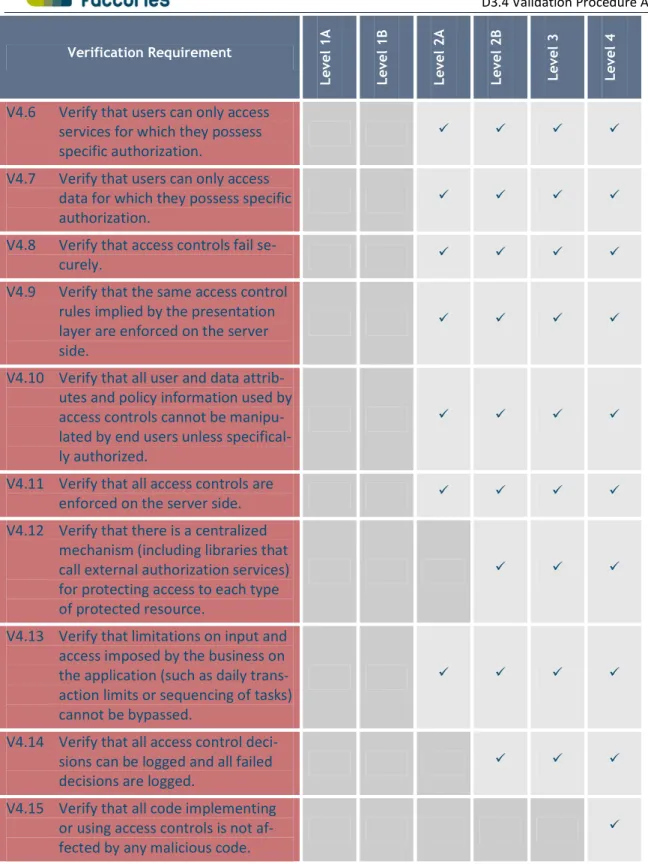
The Access Control Verification Requirements define how an application can safely enforce access con-trol. In most applications, access control must be performed in multiple different locations across the various application layers. These requirements define verification requirements for access controls for URLs, business functions, data, services, and files. The table below defines the corresponding verification requirements that apply for each of the four verification levels
Verification Requirement L e v e l 1 A L e v e l 1 B L e v e l 2 A L e v e l 2 B L e v e l 3 L e v e l 4
V4.1 Verify that users can only access protected functions for which they possess specific authorization.
V4.2 Verify that users can only access URLs for which they possess specif-ic authorization.
V4.3 Verify that users can only access data files for which they possess specific authorization.
V4.4 Verify that direct object references are protected, such that only au-thorized objects are accessible to each user.
V4.5 Verify that directory browsing is disabled unless deliberately de-sired.
Owasp Asvs Page 23 of 133 Verification Requirement L e v e l 1 A L e v e l 1 B L e v e l 2 A L e v e l 2 B L e v e l 3 L e v e l 4
V4.6 Verify that users can only access services for which they possess specific authorization.
V4.7 Verify that users can only access data for which they possess specific authorization.
V4.8 Verify that access controls fail
se-curely.
V4.9 Verify that the same access control rules implied by the presentation layer are enforced on the server side.
V4.10 Verify that all user and data attrib-utes and policy information used by access controls cannot be manipu-lated by end users unless specifical-ly authorized.
V4.11 Verify that all access controls are
enforced on the server side. V4.12 Verify that there is a centralized
mechanism (including libraries that call external authorization services) for protecting access to each type of protected resource.
V4.13 Verify that limitations on input and access imposed by the business on the application (such as daily trans-action limits or sequencing of tasks) cannot be bypassed.
V4.14 Verify that all access control deci-sions can be logged and all failed decisions are logged.
V4.15 Verify that all code implementing or using access controls is not af-fected by any malicious code.
Owasp Asvs Page 24 of 133
1.1.1.5
V5: Input Validation Verification Requirements
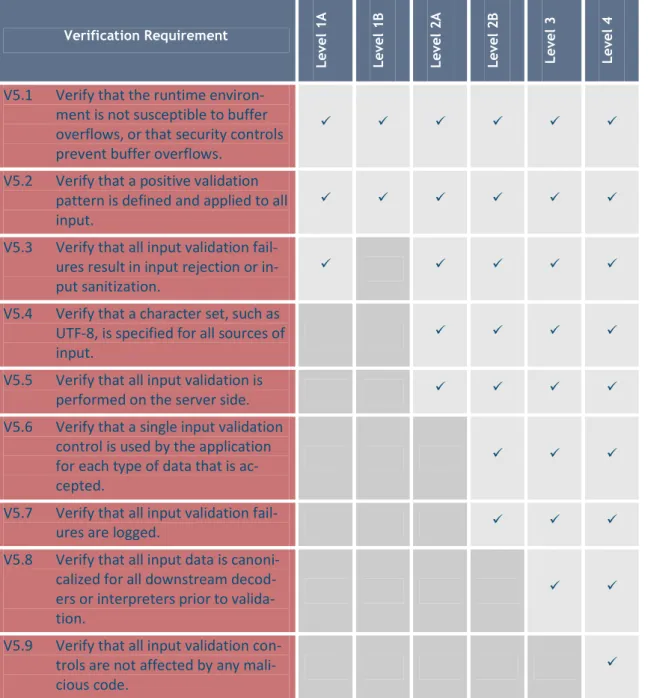
The Input Validation Requirements define a set of requirements for validating input so that it is safe for use within an application. The table below defines the corresponding verification requirements that ap-ply for each of the four verification levels.
Verification Requirement L e v e l 1 A L e v e l 1 B L e v e l 2 A L e v e l 2 B L e v e l 3 L e v e l 4
V5.1 Verify that the runtime environ-ment is not susceptible to buffer overflows, or that security controls prevent buffer overflows.
V5.2 Verify that a positive validation pattern is defined and applied to all input.
V5.3 Verify that all input validation fail-ures result in input rejection or in-put sanitization.
V5.4 Verify that a character set, such as UTF-8, is specified for all sources of input.
V5.5 Verify that all input validation is
performed on the server side. V5.6 Verify that a single input validation
control is used by the application for each type of data that is ac-cepted.
V5.7 Verify that all input validation
fail-ures are logged.
V5.8 Verify that all input data is canoni-calized for all downstream decod-ers or interpretdecod-ers prior to valida-tion.
V5.9 Verify that all input validation con-trols are not affected by any mali-cious code.
Owasp Asvs Page 25 of 133
1.1.1.6
V6: Output Encoding/Escaping Verification Requirements
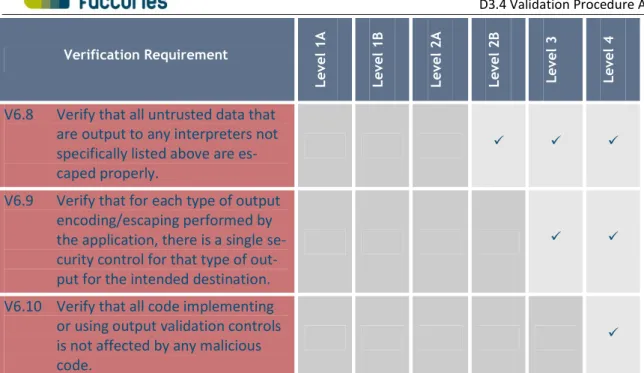
The Output Encoding/Escaping Validation Requirements define a set of requirements for verifying that output is properly encoded so that it is safe for external applications. The table below defines the corre-sponding verification requirements that apply for each of the four verification levels.
Verification Requirement L e v e l 1 A L e v e l 1 B L e v e l 2 A L e v e l 2 B L e v e l 3 L e v e l 4
V6.1 Verify that all untrusted data that are output to HTML (including HTML elements, HTML attributes, javascript data values, CSS blocks, and URI attributes) are properly escaped for the applicable context.
V6.2 Verify that all output encod-ing/escaping controls are imple-mented on the server side.
V6.3 Verify that output encoding /escaping controls encode all char-acters not known to be safe for the intended interpreter.
V6.4 Verify that all untrusted data that is output to SQL interpreters use parameterized interfaces, prepared statements, or are escaped proper-ly.
V6.5 Verify that all untrusted data that are output to XML use parameter-ized interfaces or are escaped properly.
V6.6 Verify that all untrusted data that are used in LDAP queries are es-caped properly.
V6.7 Verify that all untrusted data that are included in operating system command parameters are escaped properly.
Owasp Asvs Page 26 of 133 Verification Requirement L e v e l 1 A L e v e l 1 B L e v e l 2 A L e v e l 2 B L e v e l 3 L e v e l 4
V6.8 Verify that all untrusted data that are output to any interpreters not specifically listed above are es-caped properly.
V6.9 Verify that for each type of output encoding/escaping performed by the application, there is a single se-curity control for that type of out-put for the intended destination.
V6.10 Verify that all code implementing or using output validation controls is not affected by any malicious code.
Table 1-6: V6 - Output Encoding/Escaping Verification Requirements
1.1.1.7
V7: Cryptography at Rest Verification Requirements
The Encryption Verification Requirements define a set of requirements that can be used to verify an ap-plication’s encryption, key management, random number, and hashing operations. Applications should always use FIPS 140-2 validated cryptographic modules, or cryptographic modules validated against an equivalent standard (e.g., a non-U.S. standard). The table below defines the corresponding verification requirements that apply for each of the four verification levels.
Verification Requirement L e v e l 1 A L e v e l 1 B L e v e l 2 A L e v e l 2 B L e v e l 3 L e v e l 4
V7.1 Verify that all cryptographic functions used to protect secrets from the application user are implemented server side.
V7.2 Verify that all cryptographic modules fail
se-curely.
V7.3 Verify that access to any master secret(s) is protected from unauthorized access (A master secret is an application credential stored as plaintext on disk that is used to protect access to security configuration information).
V7.4 Verify that password hashes are salted when
Owasp Asvs Page 27 of 133 Verification Requirement L e v e l 1 A L e v e l 1 B L e v e l 2 A L e v e l 2 B L e v e l 3 L e v e l 4
V7.5 Verify that cryptographic module failures are
logged.
V7.6 Verify that all random numbers, random file names, random GUIDs, and random strings are generated using the cryptographic module’s approved random number generator when these random values are intended to be un-guessable by an attacker.
V7.7 Verify that cryptographic modules used by the application have been validated against FIPS 140-2 or an equivalent standard. (See
http://csrc.nist.gov/groups/STM/cmvp/validati on.html).
V7.8 Verify that cryptographic modules operate in their approved mode according to their pub-lished security policies (See
http://csrc.nist.gov/groups/STM/cmvp/validati on.html).
V7.9 Verify that there is an explicit policy for how cryptographic keys are managed (e.g., generat-ed, distributgenerat-ed, revokgenerat-ed, expired). Verify that this policy is properly enforced.
V7.10 Verify that all code supporting or using a cryp-tographic module is not affected by any mali-cious code.
Table 1-7: V7 - Cryptography at Rest Verification Requirements
1.1.1.8
V8: Error Handling and Logging Verification Requirements
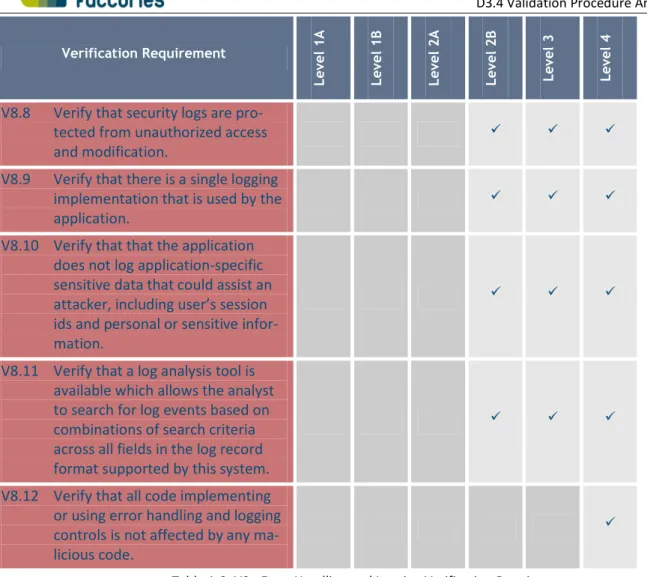
The Error Handling and Logging Verification Requirements define a set of requirements that can be used to verify the tracking of security relevant events and the identification of attack behavior. The table be-low defines the corresponding verification requirements that apply for each of the four verification lev-els. Verification Requirement L e v e l 1 A L e v e l 1 B L e v e l 2 A L e v e l 2 B L e v e l 3 L e v e l 4
Owasp Asvs Page 28 of 133 Verification Requirement L e v e l 1 A L e v e l 1 B L e v e l 2 A L e v e l 2 B L e v e l 3 L e v e l 4
V8.1 Verify that that the application does not output error messages or stack traces containing sensitive data that could assist an attacker, including session id and personal information.
V8.2 Verify that all server side errors are
handled on the server.
V8.3 Verify that all logging controls are
implemented on the server. V8.4 Verify that error handling logic in
security controls denies access by default.
V8.5 Verify security logging controls provide the ability to log both suc-cess and failure events that are identified as security-relevant.
V8.6 Verify that each log event includes: 1. a time stamp from a reliable
source,
2. severity level of the event, 3. an indication that this is a
secu-rity relevant event (if mixed with other logs),
4. the identity of the user that caused the event (if there is a user associated with the event),
5. the source IP address of the re-quest associated with the event,
6. whether the event succeeded or failed, and
7. a description of the event.
V8.7 Verify that all events that include untrusted data will not execute as code in the intended log viewing software.
Owasp Asvs Page 29 of 133 Verification Requirement L e v e l 1 A L e v e l 1 B L e v e l 2 A L e v e l 2 B L e v e l 3 L e v e l 4
V8.8 Verify that security logs are pro-tected from unauthorized access and modification.
V8.9 Verify that there is a single logging implementation that is used by the application.
V8.10 Verify that that the application does not log application-specific sensitive data that could assist an attacker, including user’s session ids and personal or sensitive infor-mation.
V8.11 Verify that a log analysis tool is available which allows the analyst to search for log events based on combinations of search criteria across all fields in the log record format supported by this system.
V8.12 Verify that all code implementing or using error handling and logging controls is not affected by any ma-licious code.
Table 1-8: V8 - Error Handling and Logging Verification Requirements
1.1.1.9
V9: Data Protection Verification Requirements
The Data Protection Verification Requirements define a set of requirements that can be used to verify the protection of sensitive data (e.g., credit card number, passport number, personally identifiable in-formation). The table below defines the corresponding verification requirements that apply for each of the four verification levels.
Verification Requirement L e v e l 1 A L e v e l 1 B L e v e l 2 A L e v e l 2 B L e v e l 3 L e v e l 4
V9.1 Verify that all forms containing sensitive information have disabled client side caching, including auto-complete features.
Owasp Asvs Page 30 of 133 Verification Requirement L e v e l 1 A L e v e l 1 B L e v e l 2 A L e v e l 2 B L e v e l 3 L e v e l 4
V9.2 Verify that the list of sensitive data processed by this application is identified, and that there is an ex-plicit policy for how access to this data must be controlled, and when this data must be encrypted (both at rest and in transit). Verify that this policy is properly enforced.
V9.3 Verify that all sensitive data is sent to the server in the HTTP message body (i.e., URL parameters are nev-er used to send sensitive data).
V9.4 Verify that all cached or temporary copies of sensitive data sent to the client are protected from unauthor-ized access or purged/invalidated after the authorized user accesses the sensitive data (e.g., the proper no-cache and no-store Cache-Control headers are set).
V9.5 Verify that all cached or temporary copies of sensitive data stored on the server are protected from un-authorized access or
purged/invalidated after the au-thorized user accesses the sensitive data.
V9.6 Verify that there is a method to remove each type of sensitive data from the application at the end of its required retention period.
Table 1-9: V9 - Data Protection Verification Requirements
1.1.1.10
V10: Communications Security Verification Requirements
The Communication Security Verification Requirements define a set of requirements that can be used to verify that all communications with an application are properly secured. The table below defines the cor-responding verification requirements that apply for each of the four verification levels.
Owasp Asvs Page 31 of 133 Verification Requirement L e v e l 1 A L e v e l 1 B L e v e l 2 A L e v e l 2 B L e v e l 3 L e v e l 4
V10.1 Verify that a path can be built from a trusted CA to each Transport Lay-er Security (TLS) sLay-ervLay-er cLay-ertificate, and that each server certificate is valid.
V10.2 Verify that failed TLS connections do not fall back to an insecure con-nection.
V10.3 Verify that TLS is used for all con-nections (including both external and backend connections) that are authenticated or that involve sensi-tive data or functions.
V10.4 Verify that backend TLS connection
failures are logged.
V10.5 Verify that certificate paths are built and verified for all client certif-icates using configured trust an-chors and revocation information.
V10.6 Verify that all connections to exter-nal systems that involve sensitive information or functions are au-thenticated.
V10.7 Verify that all connections to exter-nal systems that involve sensitive information or functions use an ac-count that has been set up to have the minimum privileges necessary for the application to function properly.
V10.8 Verify that there is a single stand-ard TLS implementation that is used by the application that is config-ured to operate in an approved mode of operation (See
http://csrc.nist.gov/groups/STM/c
mvp/documents/fips140-2/FIPS1402IG.pdf ).
V10.9 Verify that specific character en-codings are defined for all connec-tions (e.g., UTF-8).
Owasp Asvs Page 32 of 133
Table 1-10: V10 - Communications Security Verification Requirements
1.1.1.11
V11: HTTP Security Verification Requirements
The HTTP Security Verification Requirements define a set of requirements that can be used to verify se-curity related to HTTP requests, responses, sessions, cookies, headers, and logging. The table below de-fines the corresponding verification requirements that apply for each of the four verification levels
Verification Requirement L e v e l 1 A L e v e l 1 B L e v e l 2 A L e v e l 2 B L e v e l 3 L e v e l 4
V11.1 Verify that redirects do not include
unvalidated data.
V11.2 Verify that the application accepts only a defined set of HTTP request methods, such as GET and POST.
V11.3 Verify that every HTTP response contains a content type header specifying a safe character set (e.g., UTF-8).
V11.4 Verify that the HTTPOnly flag is used on all cookies that do not spe-cifically require access from JavaS-cript.
V11.5 Verify that the secure flag is used on all cookies that contain sensitive data, including the session cookie.
V11.6 Verify that HTTP headers in both requests and responses contain on-ly printable ASCII characters.
V11.7 Verify that the application gener-ates a strong random token as part of all links and forms associated with transactions or accessing sen-sitive data, and that the application verifies the presence of this token with the proper value for the cur-rent user when processing these requests.4
Table 1-11: V11 - HTTP Security Verification Requirements
Owasp Asvs Page 33 of 133
1.1.1.12
V12 – Security Configuration Verification Requirements
The Security Configuration Verification Requirements define a set of requirements that can be used to verify the secure storage of all configuration information that directs the security-related behavior of the application. Protection of this configuration information is critical to the secure operation of the applica-tion. The table below defines the corresponding verification requirements that apply for each of the four verification levels. Verification Requirement L e v e l 1 A L e v e l 1 B L e v e l 2 A L e v e l 2 B L e v e l 3 L e v e l 4
V12.1 Verify that all security-relevant configuration information is stored in locations that are protected from unauthorized access.
V12.2 Verify that all access to the applica-tion is denied if the applicaapplica-tion cannot access its security configu-ration information.
V12.3 Verify that all changes to the secu-rity configuration settings managed by the application are logged in the security event log.
V12.4 Verify that the configuration store can be output in a human-readable format to facilitate audit.
Table 1-12: V12 - Security Configuration Verification Requirements
1.1.1.13
V13: Malicious Controls Verification Requirements
For Level 4, searching for malicious code in any code that has not yet been examined after performing a Level 3 application verification is required. The table below defines the Malicious Code Search require-ments that are introduced at Level 4.
Verification Requirement L e v e l 1 A L e v e l 1 B L e v e l 2 A L e v e l 2 B L e v e l 3 L e v e l 4
Owasp Asvs Page 34 of 133
V13.1 Verify that no malicious code is in any code that was either developed or modified in order to create the application.5
V13.2 Verify that the integrity of inter-preted code, libraries, executables, and configuration files is verified using checksums or hashes.
Table 1-13: V13 - Malicious Controls Verification Requirements
1.1.1.14
V14 – Internal Security Verification Requirements
The Internal Security Verification Requirements define a set of requirements that can be used to verify that the application protects itself to an additional degree to guard against implementation flaws. The table below defines the corresponding verification requirements that apply for each of the four verifica-tion levels Verification Requirement L e v e l 1 A L e v e l 1 B L e v e l 2 A L e v e l 2 B L e v e l 3 L e v e l 4
V14.1 Verify that the application protects user and data attributes and policy information used by access con-trols from unauthorized access or modification.
V14.2 Verify that security control inter-faces are simple enough to use that developers are likely to use them correctly.
V14.3 Verify that the application properly protects shared variables and re-sources from inappropriate concur-rent access.
Table 1-14: V14 - Internal Security Verification Requirements
1.1.2
Verification Reporting Requirements
5 E.g. examine system clock calls to look for time bombs, functions unrelated to business requirements for back doors,
execu-tion paths for Easter eggs, financial transacexecu-tions for incorrect logic that may indicate a salami attack, other types of mali-cious code.