ISSN: 2147-611X
www.ijemst.com
Microteaching
Lesson
Study:
An
Approach to Prepare Teacher Candidates
to Teach Science through Inquiry
George Zhou, Judy Xu University of Windsor
To cite this article:
Zhou, G. & Xu, J. (2017). Microteaching lesson study: An approach to prepare teacher
Candidates to Teach Science through Inquiry.
International Journal of Education in
Mathematics, Science and Technology (IJEMST), 5
(3), 235-247. DOI:10.18404/ijemst.
296039
This article may be used for research, teaching, and private study purposes.
Any substantial or systematic reproduction, redistribution, reselling, loan, sub-licensing,
systematic supply, or distribution in any form to anyone is expressly forbidden.
Authors alone are responsible for the contents of their articles. The journal owns the
copyright of the articles.
Volume 5, Number 3, 2017
DOI:10.18404/ijemst.296039
Microteaching Lesson Study: An Approach to Prepare Teacher Candidates
to Teach Science through Inquiry
George Zhou, Judy Xu
Article Info
Abstract
Article History
Received: 01 June 2016
Inquiry-based teaching has become the most recommended approach in science education for a few decades; however, it is not a common practice yet in k-12 school classrooms. In order to prepare future teachers to teach science through inquiry, a Microteaching Lesson Study (MLS) approach was employed in our science methods courses. Instead of asking teacher candidates to simply share (present) their inquiry-based lesson plans with peers, we requested teacher candidates to develop, teach, and collaboratively reflect upon their lessons. This paper reports our findings from a recently finished study that investigated teacher candidates‟ learning from and perspectives about MLS. Data were collected through teacher candidates‟ lesson plans, teaching performances, and reflective reports. The study concluded that MLS provided teacher candidates valuable practical opportunity and their learning through such collaborative action was significant. Participating teacher candidates highly valued MLS approach even though a few of them raised some concerns about it.
Accepted: 10 November 2016
Keywords
Microteaching lesson study
Inquiry-based science teaching
Science methods course Teacher education
Introduction
Inquiry-based science teaching has a variety of underlying approaches including student-centered interactions, student investigations and hands-on activities, and the use of models and applications. This type of teaching allows students to engage in science by means of processes such as questioning, exploring, interacting, observing, reasoning, and reflecting. Many studies have indicated that these approaches have the potential of enhancing students‟ metacognition and argumentation; may assist in developing/improving students‟ positive attitudes toward science (Mooney & Laubach, 2002; Oliver-Hoyo & Allen, 2005); have positive effects on their science achievement and interest in science (Areepattamannil, 2012); and maintain their motivation and engagement in the subject (Heflich, Dixon, & Davis, 2001). Two recently published meta-analysis reports (Furtak, Seidel, Iverson, & Briggs, 2012; Minner, Levy, & Century, 2010) confirmed the positive effect of inquiry-based teaching reforms on student learning achievements in science, particularly when teachers actively guided student activities in the context of inquiry-based learning.
Inquiry-based science teaching has been promoted by a number of science education associations (American Association for theAdvancement of Science, 1993; Mullis, Martin, Ruddock, O‟Sullivan, & Preuschoff, 2009; National Research Council, 2001; Organisation for Economic Co-Operation and Development, 2009). However, it has not been well implemented in the classroom (Kazempour, 2009; Zhou, 2014). Teacher preparation has been acknowledged as a significant factor for such a gap between theory/policy and practice (Kazempour, 2009; Richardson & Liang, 2008; Ruiz-Primo, Li, Tsai & Schneider, 2008; Sadler & Klosterman, 2009). Many new and experienced teachers have not learned through inquiry, but rather through passive learning (Friesen & Jardine, 2010). As teachers have the tendency to teach in a way they were taught (Britzman, 1991; Lortie, 1975), it has proven to be a challenge for teachers to shift to facilitating inquiry-based classrooms (Potvin & Dionne, 2007).
(Sanger, 2007) and increases the possibilities of their applying the approach in their future classrooms (Aubrecht, 2005). Science methods courses could prepare and support pre-service science teachers to teach inquiry-based science through exploration into the nature of science and science education, involvement in science investigations, placement in classrooms that model inquiry-based teaching, the planning of units that highlight core scientific concepts, and reflection upon their own past teaching/learning experiences and current teaching practices (Fazio, Melville, & Bartley, 2010).
As science teacher educators, we have always been willing to try different evidence-based pedagogy in our teaching. Since lesson study has been documented as an effective way of professional development (Lewis, 2002; Lewis, Perry, & Hurd, 2004; Lewis, Perry, & Murata, 2006) as it involves teachers‟ collaborative development of and reflection upon their teaching, we employed the pedagogical techniques suggested by lesson study in the past several years in order to prepare future teachers to teach science through inquiry. The purpose of this study was to investigate the effectiveness of Microteaching Lesson Study (MLS) through examining teacher candidates‟ learning experience with this pedagogical approach within the context of a science methods course. The following two research questions guided the study:
1. How does MLS enhance teacher candidates‟ learning of inquiry-based science teaching in the context of a science methods course?
2. What are teacher candidates‟ perceptions about MLS implemented in a science methods course?
(Microteaching) Lesson Study as a Way of Professional Learning
Lesson study is a professional learning process that engages teachers in collaboratively examining their practice of instruction with a goal of improvement. It involves a cycle of planning, teaching, observing, critiquing, and revising of selected lessons with clear overarching goals and research questions established by participating teachers (Lewis, 2002; Stigler & Hiebert, 1999). Lesson study is centered on student learning. Critiques and suggestions for changes come from the observations about how student learning, thinking, and behavior change as results of the lesson. Lesson study can lead to instructional improvement and high-quality teaching materials (Lewis, Perry, Murata, 2006), develop a vision to see students in the process of teaching (Lewis, 2000), deepen participating teachers‟ subject matter knowledge as well as their pedagogical content knowledge (Lim, Lee, Saito, & Haron, 2011; Puchner & Taylor, 2006), and create the awareness that they significantly impact their students‟ learning, and the belief that changes could occur in relation to student engagement and learning in ways they had not imagined (Puchner & Taylor, 2006).
For its collaborative nature, lesson study can help spread new perspectives to teaching and learning, facilitate the formation of learning community, and promote recognition of the advantages of collaboration (Puchner & Taylor, 2006). Lesson study allows teachers to develop and reaffirm their identities as professionals (Leiberman, 2009). These new identities break traditional teaching norms (such as individualism, presentism and conservatism) and assist teachers in their persistent efforts to support students (Lieberman, 2009). Lesson study may influence the national curriculum policy as well through a grass root approach (Lewis, 2000).
Lesson study is not only an effective approach for in-service teachers‟ professional learning. There are some research reports claiming that lesson study can be a useful tool for teacher candidates‟ learning as well. For example, Burroughs and Luebeck (2010) engaged teacher candidates enrolled in their mathematics methods course in collaboration with in-service teachers in lesson study. They found that teacher candidates could contribute to lesson study in meaningful ways, gained new ideas about the ways lessons were developed and enacted, and developed insights into the ways lessons directly influence students‟ learning. Marble (2007) asked teacher candidates enrolled in his elementary science methods course to conduct lesson study at schools. He found that through three teaching occasions, teacher candidates demonstrated greater understanding and ability of designing an effective lesson, creating and using materials effectively, providing clear instructions, and asking questions that prompt meaningful student engagement and enable teachers to gauge student understanding. Marble indicated that teacher candidates repeatedly showed a strong propensity to perceive their teaching as an evolving practice that necessitates active attention and thoughtful reflection. Even those teacher candidates who struggled with the delivery during their individual teaching episode felt they contributed significantly to the process and product of lesson study.
through drawing elements from both lesson study and microteaching. It intends to provide teacher candidates enrolled in methods courses with hands-on teaching experiences that engage them in the cycle of planning, teaching, reflecting on, and revising lessons. MLS is a collaborative learning approach that challenges prospective teachers' thinking about teaching and learning, and encourages their connection between theory and practice (Fernandez, 2005). There is little research about the effect of MLS on teacher candidates‟ learning, except for Fernandez (2010) and Fernandez and Robinson (2007). These two studies revealed that teacher candidates enrolled in secondary mathematics methods courses perceived MLS to be a worthwhile learning experience. Particularly, participants pointed out that the most important thing about learning through MLS was connecting theory to practice, collaboration, and reflection. There is no reported research regarding the learning experience of science teacher candidates with MLS approach. Our study intends to fill this literature gap.
Study Context
The study was conducted in a Faculty of Education at a Canadian middle-sized comprehensive university where pre-service teacher education program lasts two semesters. Its enrollment came from students who already had completed a bachelor‟s degree. During the program, teacher candidates were sent to school for practice teaching three times, each lasting 4 or 5 weeks. We have applied MLS in science methods courses for many years. Data for this study were collected from physics and chemistry methods courses over several years. These methods courses had a total of 48 hours, running through two semesters. One of the course goals was to develop teacher candidates‟ understanding of and ability to implement inquiry-based science teaching.
Using a 3-stage inquiry framework (Exploration-Invention-Application) (Atkin & Karplus, 1962; Lawson, 1995), the lecture and discussion lead teacher candidates to think about what-, why-, and how-questions about the inquiry approach. What-question entails what is the topic of teaching and what are the goals of instruction. Why-question answers why teachers choose inquiry approach and why it is better than traditional lecture-based methods. How-question deals with the way inquiry to be used effectively together with other methods for pedagogical effectiveness. Inquiry-based lesson examples were modeled to the class to make sure the discussion of inquiry meaningful and concrete to teacher candidates.
Approximately in the fourth class, teacher candidates were required to develop an inquiry-based lesson plan in small groups (2-4 members) after six hours of lecture, modeling, and discussion about inquiry in science teaching. The topic of their lesson plan was determined by the group. Unlike a usual assignment asking students to present their lesson plans for class sharing, teacher candidates were asked to teach their planned lessons to the class. They were asked to treat their peers as school students when they taught, that is, performing like a real classroom teaching by asking questions, probing response, breaking the class into group activities, requesting students to report group work or discussion, asking students to come to conclusion by themselves, and so on. Considering the fact that teacher candidates were likely to know some of the content already, each teaching group was given only 45-50 minutes to teach their lesson planned for a 75-minute school class. The lesson was team-taught. It was up to the group how they would divide the teaching tasks among group members. Group members usually divided the teaching into equal sections and each of them took care of one section. While one member was teaching his or her section, the other members facilitated the teaching.
At the end of teaching, the class was invited to ask questions and provide comments or critiques on any aspect of the lesson: planning, execution, and particularly the design of inquiry. After peer teacher candidates provided feedback, the teaching group members were asked to verbally reflect on their own teaching. These reflections included their responses to peers‟ comments and feeling about their own teaching. Finally, we provided a synergy of the comments and suggestions generated from the class discussion, including our own comments and suggestions for lesson improvement. The class discussion usually lasted 15-30 minutes varying from group to group. In addition, teacher candidates were required to individually submit written reflections as part of the lesson plan assignment. Teacher candidates had one week to write their reflective reports.
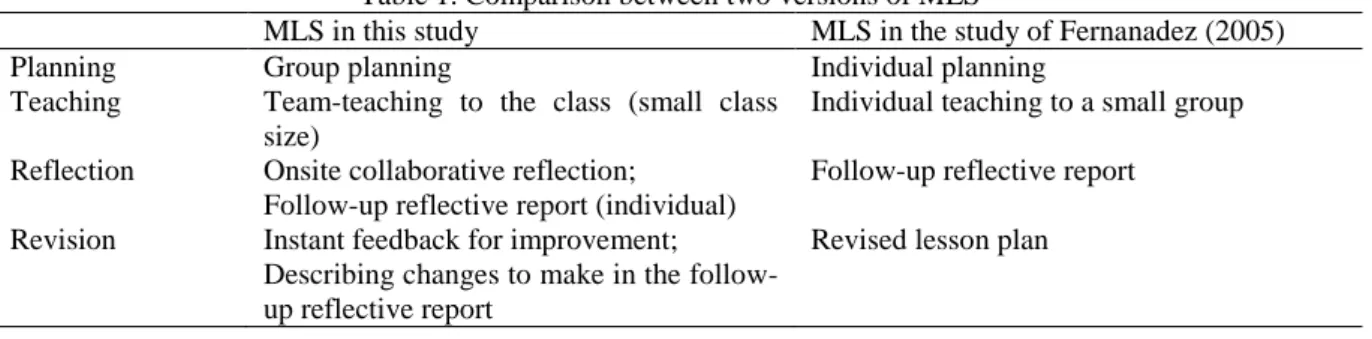
instant feedback were emphasized in addition to the follow-up written reflection. Due to the tight course schedule, teacher candidates were not required to submit a revised lesson plan. Instead, teacher candidates got suggestions for lesson improvement from their peers and the instructor right after their teaching, and their follow-up reflective reports were required to describe what changes they would make if planning and teaching the same lesson again.
Table 1. Comparison between two versions of MLS
MLS in this study MLS in the study of Fernanadez (2005)
Planning Group planning Individual planning
Teaching Team-teaching to the class (small class size)
Individual teaching to a small group Reflection Onsite collaborative reflection;
Follow-up reflective report (individual)
Follow-up reflective report Revision Instant feedback for improvement;
Describing changes to make in the follow-up reflective report
Revised lesson plan
Method
This explorative study was carried out in an authentic teaching context without any manipulative data collection measures such as testing and survey. In order to find out teacher candidates‟ learning experiences with and their perspectives about MLS, data were collected through three avenues: 1) teacher candidates‟ reflective reports, 2) teacher candidates‟ lesson plans, and 3) instructors‟ observation notes of teaching performance. In their reflective reports, participants were asked to reflect on what worked and what could be done differently in their lesson plans and teaching. They were also asked about how the MLS process helped with their learning about inquiry-based teaching. Several open-ended questions were used to guide teacher candidates to write their reflection, including:
1. What is inquiry-based teaching? 2. What works in your plans? 3. What needs to be done differently?
4. How did MLS help you understand inquiry-based teaching and develop your ability to teach science through inquiry (please comment on the teaching component and as well collaborative discussion)
Participants‟ reflections were semi-structured. That is, their writing needed to follow the guiding questions, and meanwhile there were no fixed answers to each question. Participants needed to reflect upon their group teaching and their own personal learning experience and perspectives about MLS. The lesson plan assignment required teacher candidates recorded their planning of lesson instruction. In addition to those conventional components of a lesson plan, such as lesson objectives, materials, instructional process and activities, and assessment strategies, teacher candidates were specifically required to demonstrate how they built inquiry into their instructional process and activities. They were also required to include a paragraph to explain the rationale of their choices of instructional methods. Careful notes were taken while we observed participants‟ teaching performance and class discussion. For each teaching group, our field notes covered information about: lesson introduction, instructional progression, classroom interaction, and learner engagement. Since teaching performance contributed to the marks teacher candidates would get for the assignment, quick evaluative comments were marked through the field notes against a preset rubric for inquiry-based teaching.
Participants‟ final reflective reports served as the main data source of this study. The data gained from lesson plans and observation notes were used for the purpose of triangulation. In other words, the lesson plans and observation data were cross read with participants‟ reflections to make sure an accurate understanding of each group‟s learning experience. To be more specific, lesson plans and observation notes were used as the context to help us interpret what participants reported in their reflective writing. Particularly, observation data provided clues about what achievements and deficits existed in participants‟ understanding of inquiry-based teaching approach, challenges they faced with MLS, and so on. To ensure the trustworthiness of our findings, two researchers cross-checked the procedure and results of data analysis.
antecedent-consequent patterns of theme, quantitative analysis deals with duration and frequency of theme. In this study, we conducted quantitative analysis to collect information about questions such as how many participants held positive attitude toward MLS and how many raised concerns about it. It was simply to tally participants‟ responses embedded in their reflections.
Qualitative analysis was used to answer questions such as what participants learned from MLS about inquiry-based science teaching, how MLS helped participants to learn about teaching, and what concerns they raised. Qualitative analysis was much more complex than the quantitative process since it involved a process of coding and recoding. Berg (2009) stated that the process of coding could employ both deductive and inductive approaches. The deductive approach uses some categories suggested by a theoretical perspective, literature review, research questions or interview questions. It creates analytical categories for the researcher to start assessing data. In contrast, the inductive approach begins with the researchers immersing themselves in the documents in order to make sense of them. When analyzing data, we were aware that we looked for the evidence of participants‟ success and challenges with MLS, which served as analytical categories. However, our coding followed an inductive approach. When we initially read over the data, we noted down any significant items along the documents without limiting our attention to any preset topics. In later stages, initial codes were merged or integrated into several significant themes including what teacher candidates learned from MLS, how teacher candidates perceived the use of this approach in a methods course, and their concerns with MLS. For each theme, there are a few subthemes to support the main concept.
Findings and Discussion
All 73 teacher candidates registered in the physics and chemistry methods courses over years participated in this study. We collected 200 pages of reflective reports, 21 group lesson plans, and 45 pages of observation notes. The findings from these data were organized into the following three major themes: teacher candidate‟s learning from MLS, teacher candidates‟ perceptions of MLS, and teacher candidates‟ concerns with MLS.
Teacher Candidates’ Learning from MLS
Improved Understanding of Inquiry Approach. For most of the participating teacher candidates, inquiry-based teaching was a new concept. Our methods courses provided them the first-time experience with this approach to science teaching. MLS allowed them to practice relevant teaching techniques and reflect on their understanding of such instructional approach. It was easy to notice during the MLS practice that some teacher candidates struggled with various aspects of inquiry-based teaching. MLS did not only demonstrate the exemplar practices, but also made explicit inaccurate understanding and inadequate skills among teacher candidates and offered them opportunities to gain feedback from peers and the instructor. All teacher candidates reported an enhanced understanding of inquiry approach as results of MLS exercise. The following quotation represents typical reflections in this regard.
I felt that MLS in class helped me better understanding inquiry-based science teaching because I got to practice it right on the spot and get immediate feedback. Coming up with a lesson that was specifically inquiry-based seemed like a challenge at first. Since we had been given the chance to do this, I now feel like I understand the concept a lot better. I now know what types of preparation go into making this type of lesson and how the students can become more engaged in the learning process. (Natalie)
reflection. Of course, such improved understanding applied to all class participants as well since they were part of the learning community.
Learning of Inquiry Techniques. The success of inquiry-based teaching requires students‟ active participation. What questions to ask, when to ask such questions, and how to deal with students‟ responses are key factors to engage and scaffold students in the process of inquiry. Among the techniques of questioning, wait time is critical since students should be given time to digest the question, form responses or evaluate peers‟ answers (Walsh & Sattes, 2005). Equally important is to avoid the one (student) to one (the teacher) dialogue, but involve the whole class as a learning community (Chin, 2007). MLS exercise provided opportunities for teacher candidates to self-experience these skills and witness the significance of these skills through observation of peers‟ teaching. The following quotation represents participants‟ learning on this aspect.
Preparing the lesson plan forced my group and me to acknowledge the strategy and learning cycle of inquiry-based instruction. Teaching the lesson to the class allowed me to see the difficulties that may arise when using this approach. I realized that students must be willing and open to participate and communicate their ideas, but it is up to the teacher to guide them with the right questions to enable confusion and self-discovery. The discussion session following the lesson was most helpful. It allowed me to see the importance of providing wait time to a class. Also, it enabled me to understand the difference between a demonstration experiment and an experiment based on inquiry. (Vanessa)
Vanessa group taught a lesson on molecular structure designed for grade 11 chemistry students. Toward the end of this quotation, Vanessa explicitly reported her improved awareness of wait time as a questioning technique. We emphasized in our lecture that the purpose of teacher questioning should not be aimed at a correct answer but for student engagement in thinking. This transformation of the purpose of teacher questioning is a necessity for a change from the format of traditional questioning to constructivist questioning, whose differences were nicely outlined in Chin‟s work (2007). Constructivist questioning engages students in thinking and allocates time for students to think.
Vanessa also pointed out her learning about the difference between demonstration and inquiry experiments. Demonstration experiment is usually pre-setup and performed by the teacher with a purpose to demonstrate a phenomenon. It is often used by the teacher during a lecture to provide quick evidence for the lecture topic or generate a surprising effort to draw students‟ attention to and trigger their interest in the topic. Inquiry experiment, in contrast, usually engages students in hands-on exploration. It was designed as a segment of inquiry process that collects evidence. Its design can come from student discussion or directly link to student discussion. That is, students got involvement in the design of the experiment so that the purpose of experiment was clear to students.
Even though in many cases, the teacher needs to preplan the inquiry task, he or she should not jump onto it without pre-discussion with students about the inquiry question and possible investigation designs. To serve such different purposes, demonstration experiment is often short and simple and demands one-time accuracy and success. Inquiry experiment however can be lengthy and messy and realize the value of student learning from mistakes. Since we encouraged teacher candidates to consider how they integrated inquiry with traditional instructional approaches for their teaching, participants were required to think through which activities can be used for the demonstration purpose and which activities for inquiry purpose. Through MLS practice, Vanessa had a better understanding of different types of experiments.
Learning of Instructional Skills. Most of participating teacher candidates had no prior classroom teaching experience. The typical challenges teacher candidates may experience with lesson planning such as time management and instructional pace were witnessed in their teaching. MLS allowed teacher candidates to realize and collaboratively examine these issues. One of the typical reflections went like this:
Yukaya‟s group planned a lesson that taught grade 9 students the topic of electron orbits. The group finished their teaching within 30 minutes instead of 45-50 minutes each teaching group was allocated for its teaching. The group did not provide enough time for peer teacher candidates to relate what they were taught to their prior knowledge and their hands-on exploration. They seemed to be afraid of any silent moment in their teaching. Some of the group members sounded like recalling their stage scripts when teaching and any pause or break in their teaching was perceived as not being prepared well. If no student responded to their question right away, they often nervously answered their own question, asked a new question, or simply moved onto the next topic. Relevant to the pace issue, another common mistake that teacher candidates often made with the lesson plan assignment was content coverage. In our study, we noticed some groups tried to cover too much content in one lesson which went beyond the learning task school students could handle in one class period. For example, one group developed their lesson plan around the topic of friction for grade 12 students. The group started their teaching with defining friction, discussing different types of frictions, comparing static and kinetic frictions, playing a video about different types of frictions, then verifying the static coefficient is equal to the slope of an incline plane, and finally letting student investigate the factors that influence friction coefficient. MLS exercise made the teaching group and the rest of class fully realize this issue.
Impact on Teaching Practicum. The MLS exercise took place right before the first teaching placement. What teacher candidates learned from MLS went beyond leaning from traditional lectures. Such learning generated significant impact on their performance during the first teaching practicum. In their follow-up reflective reports, some teacher candidates mentioned how the MLS exercise impacted their practice teaching. Such impact is nicely represented by the following quotation:
These processes [teaching and following-up discussion] …did greatly help me to develop my ability to teach science through inquiry. By teaching I was able to understand the time-constraint issues associated with this method and the need for careful direction when teaching… This affected the planning I took when constructing inquiry activities during my practicum; I was sure to allot extra time for students to complete activities as well as outlined what steps they should be following in order to solve the problem so that I could effectively guide them. I also made sure to circulate myself around the room when they were conducting their activity in order to monitor their progress and conceptual development. For these activities I also decided to allow them to form their own groups as most [students] were more comfortable discussing ideas with people they already knew. (Chris)
In this quotation, Chris explicitly pointed out that, through MLS exercise, he understood the time constrain issue around the inquiry approach and the need of teacher guide for student inquiry. This in-depth learning greatly impacted his practice teaching in schools. At his teaching practicum, He deliberately allocated extra time to student investigation and scaffold student inquiry. Such in-depth understanding and its practical consequence was hard to achieve just through an instructor‟s lecture and demonstration without providing teacher candidates with practical and reflective exercise (Biggers & Forbes, 2012; Crawford, 2007).
Teacher Candidates’ Perceptions of MLS
Teacher candidates were asked to reflect how MLS helped them develop their understanding and skills to teach science through inquiry with respect to the teaching exercise and collaborative reflection. All participants reported that MLS pushed them think through every detail about their lessons and provided them opportunities to put into practice various techniques of teaching inquiry-based science. A typical writing piece is quoted below.
Overall, MLS was very beneficial. It really enabled me to hone some lesson planning skills and my inquiry-based lesson structuring. I found it to be a very positive experience in preparation for our practicum and it made me a better teacher during my placement. (Robert)
I feel that developing and teaching an inquiry based lesson allowed me to understand better the concept behind this method of teaching. In addition to performing a lesson, it also helped to watch and evaluate the lessons of other teacher candidates in our class. This not only provided me with ideas of how to implement inquiry based teaching into the chemistry classroom, but it also allowed me to critically evaluate a lesson plan based on my own experience of learning that lesson. I felt that the in-class critiques and discussions we had after each inquiry based lesson were the most helpful to me, and I was able to remember some of these critiques and discussions as I planned my lessons throughout my placement. (Daniel)
According to Jaworski (1998), reflective practice in teaching helps make explicit „„teaching approaches and processes so that they can become the objects of critical scrutiny‟‟ (p. 7). Collaborative reflection and feedback in the process of MLS was designed to provide teacher candidates opportunities to learn from each other‟s success and challenges, which was valuable to both the teaching group and the rest of class. It allowed teacher candidates to view the appraisal of their teaching performance from three different perspectives: peer comments, teaching group‟s self-reflection, and the instructor‟s onsite feedback.
In the process of MLS, peer teacher candidates acted as a dual role: school students and future teachers. They could provide critiques from the point view of student learning and as well from their professional understanding of teaching. The teaching group‟s self-reflection was significant as well since they often could realize what was going well and what could be improved while they were teaching based on their own observation of the participation of their peer teacher candidates. The instructor‟s onsite feedback finally pushed the exercise to another level. It opened teacher feedback to all class participants rather than being kept to the teaching group members only as in a traditional assignment. All participants appreciated the significance of the collaborative reflection and instant feedback in their reflective writings. Provided below is one representative quotation in this regard.
The discussion that occurred after teaching our lesson was very helpful. Given the opportunity to receive constructive criticism from the teacher and our peers was very insightful and allowed us to look at things from new perspectives. Since our peers were about to „be the students.‟ they were able to vie us tips on how we would make the lesson more engaging and become better teachers in general. (Nadia)
To summarize teacher candidates‟ learning from and perceptions about MLS approach, the following quotation from a participant‟s reflective report sets a good elaboration on both the teaching and collaborative reflection components of MLS.
The teaching activity in our class was a very valuable experience. It taught me methods of instruction that I could use in my placement. It was important to do this activity because it helped me to be comfortable in front of the class and to show me that I can teach a lesson. That first lesson you teach is always very nerve racking so being able to get the first one in a controlled setting was very beneficial. This lesson also showed me ways to interact with the class and what may work and what doesn‟t in a trial and error situation. The discussion and comments provided by the students and the teacher after the teaching activity were very valuable. It helped me to refine my technique and learn what part of my lesson was useful and what parts I should change. Before doing this exercise, I was unsure on how inquiry based instruction could work in the classroom but by completing this exercise I became confident in how to approach it. (Mark)
Teacher Candidates’ Concerns with MLS
Although all 73 participants considered MLS as an effective way of professional learning, a couple of them raised some concerns with this approach. One participant wrote:
I think it was more difficult to be one of the students participating in a teaching session than to be one of the presenters – we didn‟t know whether to act like we didn‟t know the material or to go through the lesson with the base knowledge we had. Knowing that the “students” were unsure of their role really played a part in how we as presenters felt during the teaching. (Carol)
were asked to exercise two roles: school students and future teachers. They were suggested to provide the teaching group feedback from both perspectives. Carol‟s writing reminds us that she was not sure about such a requirement of double identities. As far as the teaching group were concerned, they were asked to teach the lesson to their peers as they were teaching school students. However, we noticed that a small portion of teacher candidates experienced some difficulty in treating their peers as school students as Carol reported. For example, the following comment followed right after asking a question, “I know you guys know the answers, but in real classroom, we will ask students to do…” They switched from teaching to describing their lessons. We found a need to remind teacher candidates to teach instead of presenting their lesson at such occasions.
Another participant realized from his first teaching placement that student motivation was one of the key factors for the success of inquiry-based teaching. He reported that MLS did not cover relevant techniques to motivate students to participate in inquiry:
One thing that these activities [teaching and discussion] did not prepare me for was the general apathy towards classroom activities that I encountered during the start of my practicum. As students are subjected to so many useless tasks in their classrooms in order to fill time, a great deal of them stop caring about content covered in lessons as it loses its inherent value to them. The inquiry-based techniques help with this; however, they still do not work if students refuse to participate or are apathetic towards learning. This lead to a change in my teaching style in which I (a) had to enforce and repeat my expectations for what they need to be doing and (b)…selectively monitored individual students, who were not participating at all, and elicit their responses in order to ensure that they had a motivation to participate. In this case the motivating factor was the immediate consequence of having to express their thoughts in front of their peers. (Chris)
This participation‟s critic is not really about MLS itself, but a suggestion to including motivation into consideration when planning inquiry-based lesson. When we lectured about, modeled, and negotiated a meaning with teacher candidates about inquiry-based teaching, we mostly focused on what inquiry-based teaching is, why it should be used in science teaching, and how it should be done properly. Chris‟ comment made us reflect on our implementation of MLS and realized that we should have given more attention to relevant aspects associated with inquiry such as student motivation. Behavior management is another thing we will pay more attention to since inquiry-based activities might create moments for student distraction and misbehaviors.
Conclusion and Implications
Effective professional learning involves understanding, modeling, practice, and feedback (Desimone, 2009; Hawley& Valli, 1999). Grossman and McDonald (2008) argued that pedagogies in teacher education need to approximate practice in such a way that prospective teachers should engage in „„intensive, focused opportunities to experiment with aspects of practice and then learn from that experience‟‟ (p. 189-190). In order to prepare future teachers to teach science through inquiry, teacher education programs need to provide teacher candidates with opportunities to learn and practice the inquiry approach and as well reflect upon their learning and practice. This study indicates that MLS within the context of methods courses is a promising way to develop teacher candidates‟ understanding and ability of teaching inquiry-based science. Through MLS, teacher candidates advanced their understanding of the inquiry approach to science teaching. Their inquiry-based teaching skills were horned. All participating teacher candidates viewed MLS as an effective tool for their professional learning. These findings are consistent with previous study reports about teacher candidates‟ positive learning experience with MLS in math methods courses (Fernandez, 2010; Fernandez & Robinson, 2007). The significance of MLS lies in the opportunities for practicing what they learned, collaborative reflection on their teaching, instant feedback, and learning from each other. MLS offers a tool to address prospective teachers‟ complain about the lack of intellectual substance and connection between theory and practice in methods courses reported in the literature (Grossman, 2005). It also provides a context for teacher candidates to exercise collaborative learning and reflective practice, the significance of which has been claim important in the literature (Korthagen, Loughran, & Russell, 2006; Schon, 1987).
Another teacher candidate, as indicated in the following quotation, recommended extending MLS practice to their teaching practicum:
The teacher constantly needs to gage the students understanding and reassess the “to say” and “to do” list. The implementation of MLS on my lessons during practicum to gain critique would have helped tailor my lesson plans to be even more effective. Critique can be very specific for a lesson and may help to remove any oversights by the teacher and enriches the lesson. It would be interesting if teachers were able to collaborate somehow and discuss their lesson plans in placement. (Norm)
Studies have actually indicated the effectiveness of lesson study in the context of practice teaching (Burroughs & Luebeck, 2010; Marble, 2007).
Since microteaching is more established approach in teacher education than MLS, it is important to notice the difference and connection between these two. Microteaching was proposed for teacher candidates/other in-training teachers to practice a specific teaching skill that was modeled to them in a short time of period (Benton-Kupper, 2001; Cruickshank & Metcalf, 1990; Grossman, 2005). Peers or experienced instructors were usually the audience. The purpose of microteaching was for learners to practice newly learned skills and collect feedback from other professionals. While this format of microteaching has been proved to be successful (Amobi & Irwin, 2009; Mergler & Tangen, 2010; Peker, 2009), it received criticism as well for being too short, missing the complexity of a real classroom, and often superficial and delayed feedback, and so on (Calonge, Mark, Chiu, Thadani, & Pun, 2013). In our study, MLS simulated a whole lesson teaching with onsite feedback to address such criticism. Peer teacher candidates were required to act two roles: school students and future teachers. Therefore, the instructional approach in our study is more lesson study than microteaching because it deals with a whole lesson and aims at feedback, reflection, and improvement. However, our MLS approach has the attributes of typical microteaching as well because it simulates school class with a small group of “students” (peers) plus the instructor to practice their learning about inquiry. In other words, our MLS approach is a pedagogical effort “incorporating the collaborative, continuous improvement aspects of lesson study and the simplified environment associated with microteaching” (Fernandez, 2010, p. 352).
Compared with lesson study approach reported in the literature (Lewis, 2002; Stigler & Hiebert, 1999), MLS in this study goes beyond lesson study since it embraced student voices into the scope. In lesson study, only teachers‟ experiences are considered, including their collaborative planning, teaching, observing, reflecting, revising, and re-teaching. There are no direct inputs from students. In our MLS approach, peer teacher candidates were asked to play dual roles. They were asked to provide feedback from the student point of views in addition to their professional views. It is our recommendation that future lesson study may consider student voices into its scope. Of course, any potential issues associated with such additional component should be subjective to research scrutiny.
It should be noticed that our implementation of MLS encountered teacher candidates‟ concerns although these concerns came from a very small number of teacher candidates. They reported their discomfort with teaching peers as school students and confusion about the dual roles of peer teacher candidates in the process of MLS. Such concerns remind us to clarify the double identities of teacher candidates in future teaching and should be informative for any science teacher educators who are or will be implementing MLS in their methods courses. Also, teacher candidates reported some missing aspects in our teaching including student motivation and behavior management. We consider these as worthwhile topics to explore in our further teaching and relevant research.
In this study, MLS exercise revealed teacher candidates‟ real understanding of inquiry through multiple avenues: their lesson plans, their teaching, class discussion, and reflective reports. This provided us an opportunity to properly assess teacher candidates‟ learning difficulties, which might be disgusted in the writing of lesson plans. Such formative assessment information is valuable for our future teaching. In our study, we noticed that teacher candidates often equalized hands-on activities to inquiry and failed to realize the significance of the connection between student investigation and the content. Such findings remind us to emphasize in future teaching that hands-on activities are not everything, but only one segment of an inquiry process.
measure teacher candidates‟ knowledge and skills about inquiry-based teaching at the stages of pre and post the MLS process. Such quantitative research will set up further and direct evidence to claim the effectiveness of MLS. The challenges teacher candidates might have with MLS was not an explicit focus of this study. However, since some participants voiced their concerns with this approach, future research could pay particular attention to these issues.
References
American Association for the Advancement of Science. (1993). Benchmarks for science literacy. New York, NY: Oxford University Press.
Amobi, F. A. & Irwin, L. (2009). Implementing on-campus microteaching to elicit preservice teachers' reflection on teaching actions: Fresh perspective on an established practice. Journal of the Scholarship of Teaching and Learning, 9(1), 27-34.
Areepattamannil, S. (2012). Effects of inquiry-based science instruction on science achievement and interest in science: Evidence from Qatar. The Journal of Educational Research, 105(2), 134-146.
Atkin, J. M., & Karplus, R. (1962). Discovery or invention? The Science Teacher, 29(5), 45-51.
Aubrecht, G. J. (2005). Grounding inquiry-based teaching and learning methods in physics experiences for prospective elementary teachers. AIP Conference Proceedings, 790(1), 89-92.
Benton-Kupper, J. (2001). The microteaching experience: Student perspectives. Education, 121(4), 830-835. Berg, B. L. (2009). Qualitative research methods for the social sciences (7th ed.). Boston: Pearson.
Biggers, M., & Forbes T. C. (2012). Balancing teacher and student roles in elementary classrooms: Preservice elementary teachers‟ learning about the inquiry continuum. International Journal of Science Education, 34(14), 2205-2229.
Britzman, D. (1991). Practice makes practice: A critical study of learning to teach. Albany: State University of New York press.
Burroughs, E. A., & Luebeck, J. L. (2010). Pre-service teachers in mathematics lesson study. Montana Mathematics Enthusiast, 7(2/3), 391-400.
Calonge, D.S., Mark, K-P., Chiu, P. H. P., Thadani, D. R., & Pun, C. F. K. (2013). Extreme-Teaching-2 (XT²): Evaluation of an Innovative Semester-Long Intensive GTA Training Program Based on Microteaching. International Journal of Teaching and Learning in Higher Education, 25 (1), 129-143.
Chin, C. (2007). Teacher questioning in science classrooms: Approaches that stimulate productive thinking.
Journal of Research in Science Teaching, 44(6), 815–843.
Crawford, B. (2007). Learning to teach science as inquiry in the rough and tumble of practice. Journal of Research in Science Teaching, 44(4), 613-642.
Cruickshank, D. R., & Metcalf, K. K. (1990). Training within teacher preparation. In W. R. Houston (Ed.), Handbook of research on teacher education (pp. 469–497). New York: Macmillan.
Desimone, L. M. (2009). Improving impact studies of teachers‟ professional development: Towards better conceptualisations and measures. Educational Researcher, 38(3), 181-199.
Fazio, X., Melville, W., & Bartley, A. (2010). The problematic nature of the practicum: A key determinant of pre-service teachers‟ emerging inquiry-based science practices. Journal of Science Teacher Education, 21, 665–681.
Fernandez, M. L. (2005). Learning through microteaching lesson study in teacher preparation. Action in Teacher Education, 26(4), 37–47.
Fernandez, M. L. (2010). Investigating how and what prospective teachers learn through microteaching lesson study. Teaching and Teacher Education, 26(2), 351-362.
Fernandez, M. L., & Robinson, M. (2007). Prospective teachers‟ perspectives on microteaching lesson study. Education, 127(2), 203–215.
Forbes, C. T. (2011). Preservice elementary teachers‟ adaptation of science curriculum materials for inquiry-based elementary science. Science Education, 95(5), 927-955
Friesen, S., & Jardine, D. (2010). New times, new ways. ATA Magazine, 91(1), 48-51.
Furtak, E. M, Seidel, T., Iverson, H., & Briggs, D.C. (2012). Experimental and quasi-experimental studies of inquiry-based science teaching: A meta- analysis. Review of Educational Research, 82(3), 300–329. Grossman, P. (2005). Research on pedagogical approaches in teacher education. In M. Cochran-Smith and K.
M. Zeichner (Eds.), Studying Teacher Education (pp 425-476). Washington, D.C.: American Educational Research Association.
Hawley, W. D. & Valli, L. (1999). The essentials of effective professional development: A new consensus. In L. Darling-Hammond and G. Sykes (Eds.), Teaching as the learning profession: Handbook of policy and practice. San Francisco: Jossey-Bass Publishers.
Heflich, D., Dixon, J., & Davis, K. (2001). Taking it to the field: The authentic integration of mathematics and technology in inquiry-based science instruction. Journal of Computers in Mathematics and Science Teaching, 20(1), 99.
Jaworski, B. (1998). Mathematics teacher research: process, practice and the development of teaching. Journal of Mathematics Teacher Education, 1, 3–31.
Kazempour, M. (2009). Impact of inquiry-based professional development on core conceptions and teaching practices: A case study. Science Educator, 18(2), 56-68.
Korthagen, F., Loughran, J., & Russell, T. (2006). Developing fundamental principles for teaching education programs and practices. Teaching and Teacher Education, 22, 1020–1041.
Lawson, A. E. (1995). Science teaching and the development of thinking. Belmont, CA: Wadsworth Publishing Company.
Leiberman, J. (2009). Reinventing teacher professional norms and identities: the role of lesson study and learning communities, Professional Development in Education, 35(1), 83-99
Lewis, C. (2000, April). Lesson study: The core of Japanese professional development. Paper presented at the Annual Meeting of the American Educational Research Association. New Orleans, LA. ERIC#: ED 444 972
Lewis, C. (2002). Lesson study: A handbook of teacher-led instructional change. Philadelphia, PA: Research for Better Schools, Inc.
Lewis, C., Perry, R., & Hurd, J. (2004). A deeper look at lesson study. Educational Leadership, 61(5), 18–22. Lewis, C., Perry, R., & Murata, A. (2006). How should research contribute to instructional improvement? The
case of lesson study. Educational Researcher, 35(3), 3-14.
Lim, C., Lee, C., Saito, E., & Haron, S. (2011). Taking stock of lesson study as a platform for teacher development in Singapore. Asia-Pacific Journal of Teacher Education, 39(4), 353-365.
Lortie, D. (1975). Schoolteacher: A sociological study. Chicago: University of Chicago Press.
Marble, S. (2007). Inquiring into teaching: lesson study in elementary science methods. Journal of Science Teacher Education, 18(6), 935-953.
Mergler, A.G., & Tangen, D. (2010). Using microteaching to enhance teacher efficacy in preservice teachers. Teaching Education, 21 (2), 199-210.
Minner, D., Levy, A., & Century, J. (2010). Inquiry-based science instruction - What is it and does it matter? Results from a research synthesis years 1984 to 2002. Journal of Research in Science Teaching, 47(4), 474- 496.
Mooney, M. A., & Laubach, T. A. (2002). Adventure engineering: A design centered, inquiry based approach to middle grade science and mathematics education. Journal of Engineering Education, 91(3), 309-318. Mullis, I. V. A., Martin, M. O., Ruddock, G. J., O‟Sullivan, C. Y., & Preuschoff, C. (2009). TIMSS 2011
assessment frameworks. Boston, MA: TIMMS & PIRLS International Study Center.
National Research Council. (2001). Inquiry and the national science education standards. Washington, DC: National Academies Press.
Oliver-Hoyo, M., & Allen, D. (2005). Attitudinal effects of a student-centered active learning environment. Journal of Chemical Education, 82(6), 944–49.
Organisation for Economic Co-Operation and Development. (2009). PISA 2009 assessment framework: Key competencies in mathematics, reading and science. Paris, France: Author.
Peker, M. (2009). The use of expanded microteaching for reducing pre-service teachers‟ teaching anxiety about mathematics. Scientific Research and Essay, 4 (9), 872-880.
Potvin, P., & Dionne, E. (2007). Realities and challenges of educational reform in the province of Ontario: Exploratory research on teaching science and technology. McGill Journal of Education, 42(3), 393-410. Puchner, L., D. & Taylor, A. R. (2006). Lesson study, collaboration and teacher efficacy: stories from two
school-based math lesson study groups. Teaching and teacher education, 22(7), 922-934.
Richardson, G. M., & Liang, L.L. (2008). The use of inquiry in the development of pre-service teacher efficacy in mathematics and science. Journal of Elementary Science Education, 20(1), 1-16.
Ruiz-Primo, M. A., Li, M., Tsai, S., & Schneider, J. (2008). Testing one premise of scientific inquiry in science classrooms: A study that examines students’ scientific explanations. National Center for Research on Evaluation, Standards and Student Testing. University of California, Los Angeles.
Sanger, M. J. (2007). Is inquiry-based instruction good for elementary teaching majors? The effects on chemistry content knowledge and views about teaching and learning science. AIP Conference Proceedings, 883(1), 7-10.
Schon, D. A. (1987). Educating the reflective practitioner. San Francisco, CA: Jossey-Bass Publishing. Stigler, J., & Hiebert, J., (1999). The teaching gap. New York: The Free Press.
Walsh J. A., & Sattes, B. D. (2005). Quality questioning: Research-based practice to engage every learner. Thousand Oak, California: Corwin Press.
Zhou, G. (2014). Observation and reflection on Chinese education. Journal of Soochow University (Education), 2(1), 120-124 (in Chinese).
Author Information
George Zhou Faculty of Education University of Windsor
401 Sunset Ave. Windsor, ON, Canada N9B 3P4 Contact e-mail: [email protected]
Judy Xu
Faculty of Education University of Windsor