A.S.Vamsi Kumar. Dept., of Computer Science. Page 1 Q. Explain basic processor architecture with neat diagram
Basic Processor Architecture:
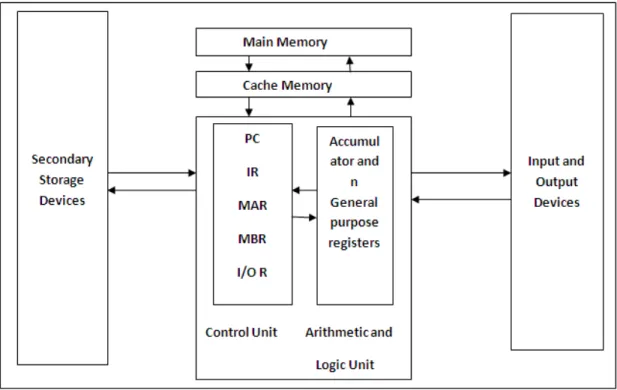
A basic processor consists of two main parts-ALU and control unit (CU). In addition to these components, there are also Registers, an Execution Unit, and a Bus Interface Unit (BIU) as shown below.
Fig: Basic processor Architecture
a. Execution unit:
The execution unit mainly consists of the CU, ALU, and registers.
Control unit:
The main function of the CU is to direct and co-ordinate the computer operations. The CU controls the flow of data through the computer system and directs the ALU, registers, buses, and input/output (I/O) devices.
It is, therefore, called the brain of the computer system. Similar to the human brain. In addition, the CU is responsible for fetching, decoding, executing instructions, and storing results.
Arithmetic and logic unit:
A.S.Vamsi Kumar. Dept., of Computer Science. Page 2 b. Registers:
A processor register is a computer memory that provides quick access to the data currently being used for processing. The ALU stores all temporary results and the final result in the processor registers. Registers are at the top of memory hierarchy and are always preferred to speed up program execution.
There are different types of registers, each with a specific storage function.
Accumulator and general purpose registers:
These are frequently used to store the data brought from the main memory and the intermediate results during program execution. The number of general purpose registers present varies from processor to processor. When program execution is complete, the result of processing is transferred from the accumulator to the memory through the Memory Buffer Register (MBR).
Special purpose registers:
These include the following:
Memory Address Register:
The Memory Address Register (MAR) stores the address of the data or instruction to be fetched from the main memory.
Memory Buffer Register:
The MBR stores the data or instruction fetched from the main memory. The MBR is used to read data and instructions from main memory, also used while writing contents in the main memory.
Instruction Register:
The IR stores the instructions currently being executed.
Input/Output Register:
The I/O register is used to transfer data or instructions to or from an I/O device.
Program Counter:
A.S.Vamsi Kumar. Dept., of Computer Science. Page 3 c. Bus Interface Unit:
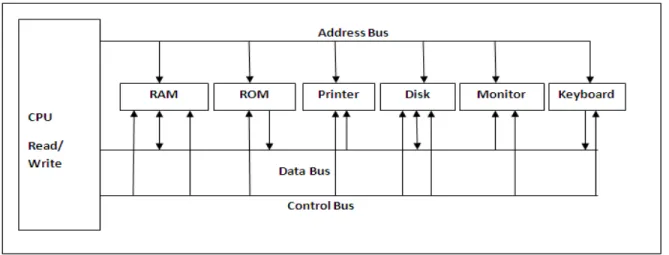
The BIU provides functions for transferring data between the execution unit of the CPU and other components of the computer system that lie outside the CPU.
Every computer system has three different types of busses to carry information from one part to the other. These are the data bus, control bus, and address bus.
Fig: BIU
****************************************************************************** Instruction Set
The instruction set is a set of commands that instructs the processor to perform specific tasks. It tells the processor what it needs to do, from where to find data (register, memory, or I/O device), from where to find instruction, and so on.
Instruction life Cycle
To execute an instruction, a processor normally follows a set of basic operations that are together known as an instruction cycle. The operations performed in an instruction cycle involve the following:
Fetch: Retrieving an instruction or a data from memory.
Decode: Interpreting the instruction.
Execute: Running the corresponding commands to process the data.
Store: Writing the results of processing into memory.
This instruction cycle is repeated continuously until the power is turned off.
A.S.Vamsi Kumar. Dept., of Computer Science. Page 4 Pipelining and Parallel Processing
Most of the modern PCs support pipelining. Pipelining is a technique with which the processor can fetch the second instruction before completing the execution of the first instruction. Initially, a processor had to wait for an instruction to complete all stages before it could fetch the next instruction, thereby wasting its time.
However, with pipelining, processors can operate at a faster speed as they no longer have to wait for one instruction to complete before fetching the next instruction. Such processors that can execute more than one instruction per clock cycle are called super scalar processors.
The other technique is parallel processing. With this method, multiple processors can be used simultaneously to execute a single program or task. In parallel processing, a complex and large task is divided into smaller tasks in such a way that each task can be allocated to a processor. Thus, multiple processors work together simultaneously on the sub-parts of the task assigned to them.
Modern-day PCs implement parallel processing by using dual-core processors or multi-core processors. Dual-multi-core architecture is like having two separate processors installed in the same computer.
Computers working on high-end applications, such as artificial intelligence and weather forecasting, use a multi-core processor, tens or hundreds of processors are incorporated in a single chip.
A.S.Vamsi Kumar. Dept., of Computer Science. Page 5 Types of processors
A computer is a combination of hardware and software. However, companies often argue about the role that hardware and software should play in the design of processor architecture.
Companies such as Intel want the hardware to bear more responsibilities than the software so that the software can be simple and easy
But companies such as Apple, want the software to lead. Based on these entirely different opinions, there are two major processor architectures Complex Instruction Set Computer (CISC) and Reduced Instruction Set Computer (RISC).
Complex Instruction Set Computer (CISC):
Intel’s hardware-oriented approach has given rise to CISC architecture in which more complexities have been added in the hardware to allow the software to be simpler. In CISC machines, most of the instructions are implemented using hardware. The hardware in such machines is capable of understanding and executing the instructions.
For example, in a CISC machine, when multiplication needs to be performed, the programmer just has to write the name of the instruction and its operands (e.g.,MUL 2,3).The processor will automatically load the data values in processor registers, multiply them in the execution unit, and store the result.
The advantages of CISC processors include the following:
o Programs can be very simple and short.
o Short programs require less memory space.
o Less effort is required by the translator to convert the program into machine language.
o Faster execution of instructions is possible.
However, on the downside, CISC machines require additional hardware circuitry to handle instructions. This adds to the complexity and cost of the processors is more expensive than RISC processors.
NOTE: Majority of the PCs use CISC processors
Reduced Instruction Set Computer (RISC):
A.S.Vamsi Kumar. Dept., of Computer Science. Page 6 The main principle of RISC is; it takes long and complex instructions from a CISC design and reduces it to multiple shorter instructions, which can execute faster. The simplicity of RISC gave more freedom to computer companies to decide on the efficient use of space on a microprocessor.
Although RISC machines are less complex and less expensive, they place extra demand on programmers to implement complex computations by combining simple instructions. Unlike CISC machines, programs developed for RISC machines have more lines of code. Therefore, they require more memory space and more effort from a translator to convert the code into machine language.
Whether RISC or CISC is used depends on the application. For some applications, RISC performs better, whereas for others, CISC will be preferable.
Since both RISC and CISC have their own advantages, the recent trend is the merging of these two technologies.