R E V I E W
Open Access
Parturition dysfunction in obesity: time to
target the pathobiology
Nicole S. Carlson
1, Teri L. Hernandez
2and K. Joseph Hurt
3*Abstract
Over a third of women of childbearing age in the United States are obese, and during pregnancy they are at
increased risk for delayed labor onset and slow labor progress that often results in unplanned cesarean delivery.
The biology behind this dysfunctional parturition is not well understood. Studies of obesity-induced changes in
parturition physiology may facilitate approaches to optimize labor in obese women. In this review, we summarize
known and proposed biologic effects of obesity on labor preparation, contraction/synchronization, and endurance,
drawing on both clinical observation and experimental data. We present evidence from human and animal studies
of interactions between obesity and parturition signaling in all elements of the birth process, including: delayed
cervical ripening, prostaglandin insensitivity, amniotic membrane strengthening, decreased myometrial oxytocin
receptor expression, decreased myocyte action potential initiation and contractility, decreased myocyte gap junction
formation, and impaired myocyte neutralization of reactive oxygen species. We found convincing clinical data on the
effect of obesity on labor initiation and successful delivery, but few studies on the underlying pathobiology. We
suggest research opportunities and therapeutic interventions based on plausible biologic mechanisms.
Keywords:
Cesarean section, Cholesterol, Dystocia, Labor, Leptin, Meta-inflammation, Myometrium, Pregnancy, Uterus
Background: The clinical phenotype of labor in
obese women
Over 30% of childbearing age women in the United
States are obese (body mass index [BMI]
≥
30 kg/m
2),
with higher rates among racial and ethnic minority
groups (31.8 % overall, 35.8 % among Hispanic and 55.8 %
among non-Hispanic Black women) [1]. Obesity is
associ-ated with a number of pregnancy complications including
increased risk of gestational diabetes (OR 2.83), gestational
hypertension/pre-eclampsia (OR 2.68) [2], and maternal
depression (OR 1.43) [3]. Maternal obesity also increases
fetal risks for congenital anomalies [4] and macrosomia
(birth weight > 4,500 g) [5], and for lifetime risks of heart
disease [6], diabetes, and obesity [4] as an adult.
The onset of parturition in obese women is frequently
delayed. Without induction, obese women are nearly
twice as likely as normal-weight women to have
pro-longed pregnancy (
≥
41 weeks gestation), particularly
with BMI of 35 kg/m
2or higher [7–9]. In contrast,
underweight women (BMI < 17 kg/m
2) are more than
twice as likely to deliver preterm in spontaneous labor
[10]. Prolonged pregnancy is concerning because there is
a two-fold increased risk of third-trimester stillbirth in
obese women [11]. Interestingly, obese women are also
more likely than normal-weight women to deliver preterm
[12, 13], although 60% of those early births are medically
indicated [13] so the majority of these early deliveries are
likely related to obesity-associated pathology.
During labor, the progress of cervical dilation in obese
women is slower than in normal-weight women [14–17],
a complication known as labor dystocia [18]. In two
large prospective cohorts, increasing maternal BMI had
a clinically relevant dose relationship with protracted
labor (Table 1) [19, 20]. The time to full cervical dilation
in morbidly obese (BMI
≥
40 kg/m
2) mothers was
signifi-cantly longer than normal weight women, regardless of
parity. Even in healthy obese women (without diabetes,
chronic hypertension, or cardiovascular disease) the
in-creased risk for slow cervical dilation (OR 3.9) and
cesarean section (OR 3.2) persists [21]. We found no
stud-ies comparing labor outcomes directly in obese women
with or without obesity-related metabolic dysfunction.
* Correspondence:[email protected]
3Department of Obstetrics & Gynecology, Divisions of Maternal-Fetal Medicine & Reproductive Sciences, University of Colorado School of Medicine, 12700 East 19th Ave, MS 8613, Aurora, CO 80045, USA Full list of author information is available at the end of the article
Obese women are more likely to be admitted to the
hospital at earlier cervical dilation, and to undergo
add-itional intervention to facilitate labor [22, 23], including
administration of synthetic oxytocin (Pitocin; Table 2).
Currently, a standard Pitocin regimen is typically used
regardless of BMI [15] though evidence suggests that
higher median dose and longer duration may be
neces-sary for labor progress in obese women [24]. Despite
in-creased clinical intervention, obese women are two to
three times more likely than normal-weight women to
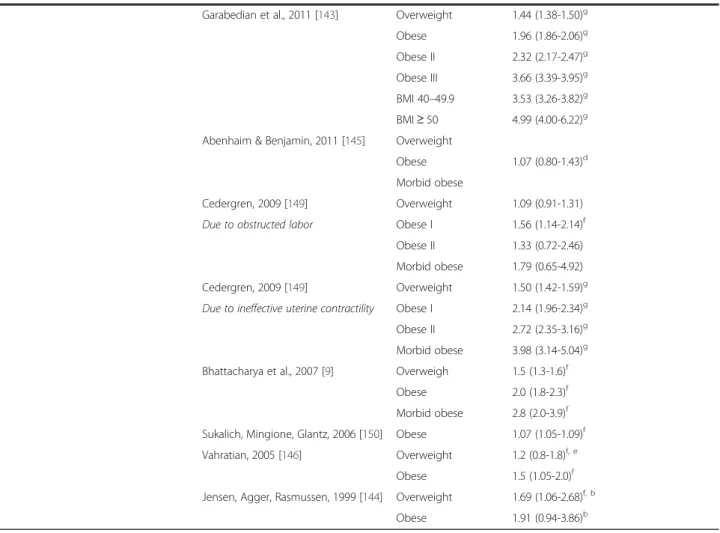
have unplanned cesarean section (Table 2) [17, 25], a
risk that persists after controlling for obesity-associated
co-morbidities [16, 17]. Post-operative complications are
also more common among obese women, including
in-fection (18.8 % BMI > 45 kg/m
2vs. 7.5 % normal-weight)
[26, 27], postpartum hemorrhage (32.6 % morbidly obese
vs. 4.9 % normal-weight), and prolonged hospitalization
(34.9 % morbidly obese vs. 2.3 % normal-weight) [28].
Reduced gestational weight gain in obese women
im-proves maternal and fetal outcomes in pregnancy, and
the Institute of Medicine has recommended revised
pre-natal care guidelines [29, 30]. Lower weight gain
de-creases the risk of preeclampsia, cesarean delivery, large
for gestational age neonates, and small for gestational age
neonates [29]. There are no data on the safety and
out-comes of intentional weight loss for obese pregnant
women, and that approach is controversial due to
con-cerns for fetal growth and maternal ketosis [31]. In studies
using obese mice, maternal weight loss alters epigenetic
signatures in the offspring [32], emphasizing the need to
understand possible influences of altered prenatal goals.
We need new approaches to improve birth outcomes
in obese women, who have a unique parturition
phenotype [24, 33, 34]. Biologic mechanisms linking
obesity to dysfunctional labor, independent of
obesity-associated comorbidities, are largely unknown. In this
review, we first outline normal parturition physiology and
relevant obesity pathophysiology. We then summarize
studies from human and animal models identifying the
possible molecular basis for differences in labor
prepar-ation, uterine contraction/synchronizprepar-ation, and labor
endurance in obese women. We suggest opportunities for
future investigation, and possible therapeutic targets and
approaches to improve birth outcomes.
Overview of normal parturition physiology
relevant to obesity
Human parturition can be described by myometrial
phases:
quiescence,
preparation
(activation),
labor
(contractions), and recovery (involution) [35].
Ninety-five percent of human gestation is spent in quiescence,
when the myometrium is not contracting and the cervix
is closed. In the preparation phase, the myometrium
ex-presses contractile-associated proteins (CAPs) including
oxytocin receptor (OTR), prostaglandin F receptor, and
connexin-43, and the cervix softens and shortens [36].
In active labor, synchronized uterine contractions dilate
the cervix for delivery of the fetus. In recovery, the uterus
and cervix involute and remodel for future pregnancy.
Specific signals regulate each phase of parturition.
Preparation for parturition
Preparation for parturition is initiated during the final
12 weeks of pregnancy when placental
corticotropin-re-leasing
hormone
(pCRH)
increases
dramatically,
leading some investigators to characterize pCRH as a
Table 1
Obese women demonstrate abnormally slow cervical dilation in first stage labor
Number previous vaginal births Study BMI <25.0 BMI 25.0-29.9 BMI 30.0-34.9 BMI 35.0-39.9 BMI≥40 pvalue Zero Kominiarek et al., 2011 [19]
Median 5.4 hrs 5.7 hrs 6.0 hrs 6.7 hrs 7.7 hrs <0.0001
(95 % ile) (18.2 hrs) (18.8 hrs) (19.9 hrs) (22.2 hrs) (25.6 hrs)
Norman et al., 2012 [20]
Median 4.6 hrs 5.0 hrs 5.5 hrs 6.7 hrs <0.01
(95 % ile) (14.4 hrs) (15.7 hrs) (17.3 hrs) (21.2 hrs)
One Kominiarek et al., 2011 [19]
Median 4.6 hrs 4.5 hrs 4.7 hrs 5.0 hrs 5.4 hrs <0.0001
(95 % ile) (17.5 hrs) (17.4 hrs) (17.9 hrs) (19.0 hrs) (20.6 hrs)
Norman et al., 2012 [20]
Median 3.3 hrs 3.9 hrs 4.3 hrs 5.0 hrs <0.01
(95 % ile) (12.6 hrs) (15.1 hrs) (16.5 hrs) (19.2 hrs)
Adjusted duration of labor from 4–10 centimeters cervical dilation by BMI at the time of delivery. Data are median and 95%ile hours in labor
Kominiarek’s median duration adjusted for age, height, race, gestational age, diabetes, induction, augmentation, epidural (first stage), operative vaginal delivery, and birthweight (N= 118,978)
Table 2
Increased intrapartum interventions and increased risk for cesarean delivery for obese parturients
Intrapartum intervention Study BMI category Odds of use in labor, OR (95 % CI)
Induction of Labor Scott-Pillai et al., 2013 [142] Overweight 1.2 (1.1-1.3)g, h
Obese 1.3 (1.2-1.5)g, h
Obese II 1.4 (1.3-1.6)g, h
Morbid obese 1.6 (1.3-1.9)g, h
Garabedian et al., 2011 [143] Overweight 1.51 (1.42-1.60)a
Obese 2.00 (1.87-2.15)
Obese II 2.36 (2.16-2.58)
Obese III 3.66 (3.30-4.01)
BMI 40–49.9 3.51 (3.15-3.91)
BMI≥50 5.25 (3.87-7.10) Bhattacharya et al., 2007 [9] Overweight 1.3 (1.2-1.4)f
Obese 1.8 (1.6-2.0)f
Morbid obese 1.8 (1.3-2.5)f
Artificial Rupture of Membranes prior to 6 cm cervical dilation
Jensen, Agger, Rasmussen, 1999 [144] Overweight 1.63 (1.18-2.25)g,b
Obese 1.97 (1.20-3.25)g, b
Oxytocin Augmentation of Labor Garabedian et al., 2011 [143] Overweight 1.38 (1.28-1.49)a
Obese 1.87 (1.70-2.06)
Obese II 2.05 (1.79-2.34)
Obese III 3.02 (2.57-3.55)
BMI 40–49.9 3.00 (2.53-3.56)
BMI≥50 3.21 (1.97-5.23) Abenhaim & Benjamin, 2011 [145] Overweight 1.31 (1.15-1.49)g
Obese 1.51 (1.31-1.75)g
Morbid obese 3.05 (1.89-4.94)g
Vahratian, 2005 [146] Overweight Significantly higher use in both categoriesc
Obese
Jensen, Agger, Rasmussen, 1999 [144] Overweight 1.59 (1.22-2.06)f, b
Obese 1.98 (1.28-3.05)g, b
Unplanned Cesarean Delivery Vinturache et al., 2014 [147] Overweight
Spontaneous labor 1.1 (0.6-1.8)
Induced labor 1.2 (0.7-2.0)
Obese
Spontaneous labor 1.5 (0.7-3.0)
Induced labor 2.2 (1.2-4.1)f
Scott-Pillai et al., 2013 [142] Overweight 1.4 (1.2-1.5)g, h
Obese 1.6 (1.4-1.8)g, h
Obese II 1.8 (1.5-2.2)g, h
Morbid obese 1.9 (1.4-2.5)g, h
gestational clock [37]. Simultaneously, maternal plasma
CRH binding protein decreases, allowing increased free
pCRH to activate myometrial CRH-receptors that switch
from an isoform that enforces quiescence to an isoform
that activates CAP expression [38]. pCRH also stimulates
fetal pituitary adrenocorticotropic hormone (ACTH)
re-lease, increasing fetal adrenal cortisol production and
ma-ternal myometrial expression of cyclooxgenase-2 (COX-2)
[35]. COX-2 synthesizes prostaglandins (PG) E
2and
PGF
2alphato promote myometrial activation. Fetal cortisol
increases placental pCRH production in a feed-forward
loop that stimulates fetal production of
dehydroepiandros-terone (DHEA) which is converted to estriol by placental
enzymes [39]. Estriol, the dominant placental estrogen,
increases myometrial sensitivity to oxytocin and PGs,
and stimulates oxytocin release from choriodecidual
tissues [40].
In humans, progesterone does not decline dramatically
at term, but serum progesterone increases at a slower
rate while estradiol or estriol production accelerates,
leading to an elevated estrogen to progesterone ratio.
These changes are sometimes characterized as functional
progesterone withdrawal [35]. Further, and perhaps
more important, progesterone receptor (PR) expression
changes from a predominance of PR-B to more PR-A
receptors [35], thereby activating a different set of genes
[41]. PR-B mediates the primary pro-gestational (i.e.,
quiescence) function of progesterone while the truncated
Table 2
Increased intrapartum interventions and increased risk for cesarean delivery for obese parturients
(Continued)
Garabedian et al., 2011 [143] Overweight 1.44 (1.38-1.50)g
Obese 1.96 (1.86-2.06)g
Obese II 2.32 (2.17-2.47)g
Obese III 3.66 (3.39-3.95)g
BMI 40–49.9 3.53 (3.26-3.82)g
BMI≥50 4.99 (4.00-6.22)g Abenhaim & Benjamin, 2011 [145] Overweight
1.07 (0.80-1.43)d Obese
Morbid obese
Cedergren, 2009 [149] Overweight 1.09 (0.91-1.31)
Due to obstructed labor Obese I 1.56 (1.14-2.14)f
Obese II 1.33 (0.72-2.46)
Morbid obese 1.79 (0.65-4.92)
Cedergren, 2009 [149] Overweight 1.50 (1.42-1.59)g
Due to ineffective uterine contractility Obese I 2.14 (1.96-2.34)g Obese II 2.72 (2.35-3.16)g
Morbid obese 3.98 (3.14-5.04)g
Bhattacharya et al., 2007 [9] Overweigh 1.5 (1.3-1.6)f
Obese 2.0 (1.8-2.3)f
Morbid obese 2.8 (2.0-3.9)f
Sukalich, Mingione, Glantz, 2006 [150] Obese 1.07 (1.05-1.09)f
Vahratian, 2005 [146] Overweight 1.2 (0.8-1.8)f, e
Obese 1.5 (1.05-2.0)f
Jensen, Agger, Rasmussen, 1999 [144] Overweight 1.69 (1.06-2.68)f, b
Obese 1.91 (0.94-3.86)b
Updated from Carlson & Lowe [111]. Odds ratios are for comparison with women of normal BMI
a
Significance not computed
b
OR and CIs calculated from frequency tables provided in manuscript
c
OR and CI not provided
d
Not significant when adjusted for known confounders (maternal age, parity, previous c/s, DM, GDM, hypertension, preeclampsia, cervix on admit, IOL, birthweight, gestational age) and for labor management differences (use of epidural analgesia, oxytocin, forceps, vacuum)
e
Adjusted risk ratio reported
f
Significant atp< .05
g
Significant atp< .001
h
N-terminal of PR-A prevents recruitment of coactivators
and alters myometrial progesterone gene activation.
Thus, the PR isoform switch reduces progesterone’s
pregnancy maintenance function and facilitates the
mo-lecular program leading to myometrial contractility.
Other factors suggested to modulate the myometrial
labor program include epigenetic regulation of pCRH
gene expression [42], NFkappaB inflammatory blockade
of PR responsive genes [43], recruitment of
inflamma-tory macrophages to the myometrium [44], and
per-haps increased cell-free fetal DNA in the maternal
circulation [45].
The cervix shortens and ripens for several weeks
be-fore labor in response to PGE
2and PGF
2alpha, released
by fetal membranes [35]. Cervical extracellular collagen
disperses, water content increases, and fibrous stroma
degrades. Matrix metalloproteinases (MMPs), released
by cervical stromal fibroblasts and smooth muscle cells,
break down cervical stromal proteoglycans [46, 47]. In
addition, cervical epithelial and stromal cells undergo
apoptosis, decreasing the cellular content of the laboring
cervix [48]. The amnion and chorion overlying the
in-ternal cervical os degrade before labor, with increased
apoptosis leading to rupture of membranes [49].
Disrup-tion of fetal membranes releases amniotic fluid that
ex-poses decidua and myometrium to PGE2 and oxytocin,
enhancing labor activation [35].
Contraction & synchronization in parturition
Phasic uterine contractions are a hallmark of active
labor, accompanied by progressive cervical dilation.
Indi-vidual myocytes contract when actin and phosphorylated
myosin interact via ATP-consuming cross-bridge
cyc-ling [50] triggered by increased intracellular calcium
ion (Ca
2+). Prior to parturition, Ca
2+efflux and
intra-cellular sequestration lead to decreased intraintra-cellular
Ca
2+and myocyte relaxation. Low resting Ca
2+, along
with potassium (K
+) channel opening and plasma
membrane repolarization promote the quiescent state.
During labor, myosin phosphorylation is initiated by
myocyte depolarization leading to calcium influx,
pri-marily via L-type Ca
2+channels. Oxytocin signaling via
the oxytocin receptor (OTR) promotes more frequent and
forceful uterine contractions and release of PGs from the
decidua [35, 51]. The posterior pituitary releases pulsatile
oxytocin, and decidual and placental tissues produce
oxy-tocin continuously [35, 52]. During late gestation, OTRs
increase sharply in the myometrium and decidua as the
primary mediator of oxytocin response in labor. The basic
biology of myocyte contractility has been reviewed in
detail elsewhere [35, 50, 53, 54].
During labor, myocyte contraction is coordinated,
starting in the uterine
“pacemaker”
at the fundus and
spreading toward the cervix [55, 56]. Neighboring
myocytes become connected via plasma membrane gap
junctions that assemble immediately before labor [57].
These low-resistance pores formed by connexins (e.g.,
connexin-43), allow action potentials to travel freely
from cell to cell, transforming the uterus into a
func-tional syncytium [58]. Stronger and longer originating
action potentials result in organized uterine contractions
of increasing force [59, 60].
Uterine endurance in parturition
During labor, the uterus must maintain sufficient
strength and duration of contraction, or endurance, to
expel the fetus and maintain postpartum hemostasis.
During contractions, ATP hydrolysis releases protons,
producing transient acidification [50]. Forceful
contrac-tions occlude blood vessels in the uterine wall, causing
repetitive ischemia and reperfusion that leads to periodic
acidification due to anaerobic lactic acid production
[50, 61]. Cyclic hypoxia/reperfusion also produces
re-active oxygen species (ROS) [62]. Myocyte regulatory
mechanisms counteract the lower pH (e.g.,
hypoxia-resistant lactate dehydrogenase isoform) and elevated
ROS (e.g., Glutathione Peroxidase [GSHPx]),
main-taining labor endurance [50, 63].
Overview of obesity physiology relevant to
pregnancy
Nearly 70 % of obese patients exhibit metabolic
dysregu-lation with changes in circulating hormones [64–66] and
free fatty acids (FFA). For this reason, obesity results in
altered physiology that may influence normal parturition
pathways.
Circulating molecules in obesity
Increasing BMI alters the secretion of a range of
hor-mones from adipose tissue. Highly relevant to pregnancy
is leptin, an adipokine secreted primarily by white
adi-pose tissue. Leptin suppresses appetite, stimulates
adipo-cyte hypertrophy, and increases FFA oxidation [67, 68].
Free leptin rises with BMI and increased adiposity, but
obese individuals also exhibit impaired satiety feedback.
This
“leptin resistance”
may be the result of chronic
in-flammatory mediators that disrupt normal hypothalamic
homeostasis [67, 69, 70]. The placenta also secretes
lep-tin [67, 71], peaking in the second trimester. Leplep-tin is
significantly increased in obese compared to
normal-weight pregnant women [72]. In contrast, soluble leptin
receptor decreases linearly with increasing BMI in
nancy, leading to high serum free leptin in obese
preg-nant women [67].
hypotension, regulates fluid homeostasis intake, and is
produced in response to insulin release [73]. Visfatin
in-creases in pregnant women near labor [76]. Visfatin is
highly expressed by visceral adipose cells, and activates
insulin receptors. Ghrelin, in contrast, is inversely
re-lated to maternal BMI. It stimulates insulin secretion,
and regulates food intake and fat utilization during
preg-nancy [77, 78]. The most abundant adipokine is
adipo-nectin, which regulates energy metabolism by increasing
glucose uptake, lipid catabolism, and insulin sensitivity
[79]. Adiponectin is decreased among pregnant women
with higher BMI and those with more pronounced
dyslipidemia [80].
Plasma cholesterol increases with obesity and also in
pregnancy. Plasma lipids and lipoproteins increase
throughout pregnancy, supplying nutrients to the fetus
and supporting fetal cholesterol biosynthesis [80]. In
re-productive age females, hypercholesterolemia increases
with BMI beyond that associated with normal pregnancy
[81]. Perhaps more importantly, obese insulin resistant
women (i.e., more metabolically dysfunctional) show a
shift to an atherogenic lipoprotein phenotype, including
increased plasma triglycerides and small low density
lipoproteins (LDL) [80, 82], that is associated with
gesta-tional diabetes [83], ectopic fat deposition [84], and
ath-erosclerosis [85].
Obesity also alters vitamins, minerals, and cofactors.
For example, low vitamin D levels are found more often
among obese and overweight individuals, and associated
with chronic disorders like cardiovascular disease and
diabetes [86]. Low folic acid levels are similarly linked to
obesity, resulting in increased neural tube defects in
offspring of obese women [87].
FFA storage and meta-inflammation
In pregnancy, obese women have higher triglyceride and
FFA levels than normal-weight pregnant women. When
FFA levels overwhelm adipocyte storage capacity, excess
FFA is sequestered as triglyceride in new adipocytes or
within fat droplets in non-adipose tissues (ectopic fat)
[65]. As FFA levels increase further, they may circulate
and be used instead of glucose for cellular metabolism
[88]. Mitochondrial lipid metabolism produces ROS that
can damage cellular structures and impair insulin
re-sponses, a process called lipotoxicity. Normally, cells
neutralize ROS with cellular antioxidants, but with
in-creased FFA, that capacity is overwhelmed, and ROS
cause RNA/DNA damage, protein carbonylation, and
eventual apoptosis [63, 89, 90]. ROS-mediated cell
dam-age releases inflammatory mediators (e.g., interleukin-6,
interleukin-1ß,
tumor
necrosis
factor-
α
),
creating
chronic low-grade inflammation throughout the body
known as meta-inflammation [91, 92], which further
increases ROS production [90].
Insulin is crucial for glucose uptake, glycogen
synthe-sis, lipogenesynthe-sis, and cell growth, and stimulates adipose
uptake and storage of FFA [93]. Insulin resistance is
nor-mal in human pregnancy, a necessary adaptation to
en-sure appropriate maternal nutrient shunting to the fetus
[94]. As insulin resistance exacerbates the FFA storage
problem, pregnancy may worsen obesity-related ROS
damage and meta-inflammation [93].
Methods: a literature search for interactions
between obesity and parturition signaling
Considering the known physiology described above, we
explored the experimental evidence for interactions
be-tween the physiology of obesity and normal parturition
signaling. Our primary question was: What biologic
mechanisms could be responsible for parturition
dys-function in obesity? In June 2015, we performed a
com-prehensive literature review using PubMed, Google
Scholar, Web of Science, and MEDLINE databases with
the primary medical subject heading (MeSH) search
terms: obesity, labor, parturition, and pregnancy.
Add-itional search terms included: BMI, uterus, myometrium,
dystocia, mechanism, and dysfunction. We considered
all original research in the English language from any
year. We also considered relevant articles from citations
in these publications. After initial screening, we obtained
full-text articles for evaluation of content, quality, and
relevance and included all studies relevant to potential
interactions between physiologic changes of obesity and
dysfunctional labor (Additional file 1: Table S1).
Review of evidence: biologic mechanisms of labor
dysfunction in obesity
We identified 31 studies for review (Additional file 1:
Table S1) and have grouped them into three categories:
labor onset, contraction/synchronization, and
endur-ance. They include human, animal, and cell culture
studies. Figure 1 summarizes interactions between
obes-ity and parturition. Some mechanisms were
corrobo-rated by multiple investigators, while others involve only
early work and suggested hypotheses.
Changes in labor preparation due to obesity
Placental function
is associated with lower mid- and late-pregnancy
pCRH [100, 101]. Decreased pCRH together with
changes in placental structure/function could alter
estrogen/progesterone production, metabolism, or
ra-tio resulting in delayed onset of parturira-tion [102]. We
found no studies on the changes in placental
partur-ition steroid hormone signaling with obesity that
might account for altered parturition timing.
Elevated leptin
Leptin stimulates PGE
2release from placental and
adi-pose tissue via inflammatory signaling pathways [103].
Chronically elevated PGE
2in late pregnancy among
obese women with meta-inflammation could decrease
the sensitivity of maternal tissues to PGE
2during labor
activation, a finding that has been documented clinically
[104] and is supported by the known elevated PGE
2in
obesity [105, 106]. Insensitivity to PGE
2during labor
in-duction is linked to failed functional progesterone
with-drawal [107]. Thus, the chronic inflammatory state of
obese women could impede functional progesterone
withdrawal and PGE
2activation. There is no current
evi-dence examining changes in myometrial PRB/PRA
switching with obesity.
Leptin also disrupts in vitro collagen degradation by
MMPs, as well as cervical cell apoptosis [108, 109], two
effects that may inhibit cervical ripening in obese
women. Further, leptin stimulates cervical collagen
syn-thesis in late pregnancy [108, 151], possibly explaining
the decreased cervical ripening at term in obese women
that we see clinically [110]. High circulating leptin in the
second trimester may also inhibit fetal membrane
weak-ening through decreased membrane apoptosis [109],
thereby inhibiting spontaneous rupture of membranes in
obese women [49]. The clinical finding that there is an
increased requirement for artificial rupture of
mem-branes with increasing BMI supports this hypothesis
(Table 2) [111].
Changes in labor contraction/synchronization due
to obesity
Adipokines
Leptin exerts an inhibitory effect on spontaneous and
oxytocin-stimulated myometrial contractions in vitro
[112] however, the second trimester serum leptin level
does not explain the risk of failed first-stage labor in an
adjusted model [113]. To our knowledge, there are no
published reports on labor outcome related to
third-trimester leptin levels. Visfatin also decreases both
spon-taneous and oxytocin-induced contractions [76]. There
are no data on whether adiponectin influences
myome-trial contractility [114]. Apelin also inhibits spontaneous
and oxytocin-induced myometrial contractions in organ
bath, but has not been evaluated clinically [73]. Ghrelin
may stimulate myometrial contractions [114], although
there are conflicting reports [78].
Cholesterol
Cholesterol supports plasma membrane channel
func-tion in cholesterol-rich
“lipid rafts”
[115]. Smooth
muscle cells, including myocytes, are rich in a particular
type of lipid raft, the caveolae [116], on which potassium
channels such as Maxi-K and human ether-a-go-go–
related gene (hERG) K
+channels cluster [60, 117].
These
hyperpolarizing,
and
therefore
pro-relaxant
channels, are more active with the
hypercholesterol-emia that is more common among obese than
normal-weight women. Both estrogen receptors [118] and
oxytocin receptors [119] associate with myocyte
mem-brane caveolae, but it is unknown whether maternal
hypercholesterolemia alters the stability or function of
these receptors. Cholesterol and LDL reduced
con-traction force and frequency in human and rodent
myometrial strips, effects that were not alleviated by
exogenous oxytocin [120, 121]. Mice with
dysfunc-tional hepatic cholesterol clearance exhibited reduced
oxytocin responses and abnormal labor without pup
expulsion [122]. In humans, elevated maternal
choles-terol at 14–16 weeks gestation is not a risk factor for
first stage labor dystocia leading to cesarean section
[123]. We found no studies that evaluated labor
pro-gress or outcomes by maternal cholesterol or
mater-nal triglyceride levels near the time of birth.
Oxytocin receptors (OTR)
Obese women require more Pitocin for labor induction,
even controlling for neonate size, parity, and epidural
anesthesia [33, 124, 125]. Existing reports on
obesity-dependent changes in OTR are contradictory [152]. In
one study, OTR mRNA was decreased in myometrial
bi-opsies from term pregnancies in women with higher
BMI at delivery [126], but another group found no
change in OTR gene or protein expression with
in-creasing BMI [127], though greater than 30% of those
subjects were laboring. Biopsy location, timing in
pregnancy, and stage of labor could all influence OTR
results [51], and women with protracted labor and
delayed transition to active labor have different OTR
gene polymorphisms than those with efficient labor
[128]. Thus, labor progress is demonstrably sensitive
to OTR expression, suggesting the important question
of whether altered OTR is in part responsible for
de-layed labor in obese women. Genome-wide
associ-ation studies have not evaluated interactions between
obesity, OTR, and labor outcomes.
Gap junctions
We found no human studies investigating uterine
connexin-43 expression in obesity or with labor dystocia.
Uterine biopsies from a mixed-weight sample of women
with prolonged labor have decreased connexin-43
mRNA compared to normal labor [58]. Rats fed a
high-fat, high-cholesterol diet during pregnancy showed
significantly lower connexin-43 expression compared to
animals eating regular chow, although contractility was
not examined [129].
Changes in uterine endurance in labor due to obesity
Women with slow labor have lower oxygen saturation,
in-creased myometrial lactate, and more acidic capillary pH
compared to normal controls (pH 7.35 in dysfunctional
labor vs. 7.48 in normal labor) [130]. One labor dystocia
theory posits that lower pH and increased ROS cause
unorganized and ineffective contractions, and an
individ-ual’s capacity to buffer pH and neutralize ROS predicts
labor dystocia [130]. It is possible that obesity-related
lipo-toxicity when combined with normal myometrial ROS
production during labor leads to excess ROS that might
cause labor dystocia. Increased pre-pregnancy BMI is
as-sociated with excessive placental ROS and decreased ATP
production [131]. However, high-fat/cholesterol diet did
not change term non-laboring rat myometrial
mitochon-drial function [132]. We found no evidence for changes in
myometrial cellular respiration, ROS with obesity, or
effects of either on labor endurance.
Discussion
In a theoretical model of successful human parturition,
labor occurs as a result of
“integrative and synergistic
coordination”
of separate biological processes or
mod-ules, occurring across many tissues [133]. With obesity,
the delayed labor and labor dystocia phenotypes could
result from multiple accumulated parturition
malfunc-tions (Fig. 2) in the placenta, cervix, amnion, and
myo-metrium. Obesity may also decrease labor endurance,
with meta-inflammation and excess FFA causing excess
myometrial ROS accumulation. Changes in biologic
sig-nals or responses with obesity could alter the onset,
synchronization, and endurance of labor. Our literature
search identified several questions that require additional
basic and translational investigation, and as the effects of
obesity are better understood, additional hypotheses will
likely be generated. Considering the evidence for the
pathobiology of labor dystocia in obesity, we suggest
sev-eral investigative and therapeutic opportunities to
im-prove vaginal delivery rates:
Basic science investigation:
We have summarized the
existing evidence that obesity produces important
changes in parturition signaling and the molecular
program of labor in placenta, myometrium, and
cervix. It is clear that each known step in the
parturition process could be altered by hormones
or other unique regulation produced by adipose
tissue or associated meta-inflammation. However,
we need to identify specific mechanisms.
hormone production and myometrial progesterone
receptor expression must be quantified in both
animal models and women if we are to develop new
approaches to modifying the deleterious effects of
obesity.
o
Preclinical animal models of obesity management
in pregnancy, for example limited weight gain and
intentional weight loss, may reveal important
parturition and fetal effects.
o
Basic investigation of whether increased fat
mass alone or associated metabolic syndrome
and meta-inflammation drive parturition
dysfunction is warranted. Metabolomic
characterization of obese women with labor
dystocia or Pitocin resistance could further
our understanding of the signals linking obesity
and labor outcome versus the separate influence
of metabolic syndrome.
Clinical management:
Allowing additional time
for obese women to complete cervical ripening
and the first stage of labor before proceeding to
cesarean delivery for slow labor progress could
immediately improve outcomes [
134
,
135
]. Clinical
tools to identify aberrant labor progress with obesity,
such as BMI-determined labor partograms, are
needed. Further, investigating parturition changes
with decreased weight gain or weight loss during
obese pregnancy may be informative. The safety
and outcome of altered prenatal and obstetric
management requires thorough clinical evaluation
and prospective trials [
136
].
Therapeutic investigation:
o
Cholesterol-lowering therapies (e.g., statins,
niacin, bile acid sequestrants) might prevent
hypercholesterolemia-linked suppression of
contractions in obese women. Although statins
are rated Category X in pregnancy, the
teratogenic potential appears to be limited to
extraordinarily high doses in animal models,
and in select cases the potential benefits may
outweigh the risks, even during pregnancy
[
137
]. Randomized controlled trials (RCT) are
needed.
o
Thiazolidinedione (TZD) activates peroxisome
proliferator-activated receptors (PPARs), allowing
for safe storage of FFA, improved insulin
sensitivity, and decreased cellular ROS damage
[
138
]. Activation of the PPAR system is known to
reduce recruitment of immune cells and inhibit
inflammation, allowing better utilization of
glucose as an energy source for cellular
processes [
65
]. TZD therapy could improve
labor endurance by decreasing myometrial
ROS damage from FFA metabolism, although
the known association of TZD with increased
weight gain [
139
] could carry other risks. A RCT
of TZD therapy to improve labor endurance is
needed.
Nutrition intervention:
o
High-fat diet apparently decreases uterine blood
flow [
96
] and lowers connexin-43 expression
[
129
] in animal models. Prospective investigation
of the effect of dietary fat in normal and obese
women on labor length, induction response, and
dystocia incidence is needed.
o
Serum vitamin D is inversely related to both
visceral and subcutaneous fat and insulin
resistance [
140
], and significantly decreases
biomarkers of oxidative stress [
141
]. A RCT
investigating nutritional supplementation of
anti-oxidants (e.g., vitamins D, C, E, and
DHA/EPA) to modulate lipotoxicity-linked ROS
elevation and improve labor outcomes is needed.
Conclusion
Obesity is associated with changes in the placenta,
cervix, amnion, and myometrium that could alter labor
preparation, contraction/synchronization, and
endur-ance. Studies investigating the biologic mechanisms of
labor dystocia and failed induction due to obesity, both
basic and translational, are needed. With a better
under-standing of the unique biology of obese parturients, we
may develop better techniques and treatments to
optimize labor outcomes, increase the rate of vaginal
de-liveries, and reduce the risk of obstetric complications.
Even without new medications, changing our clinical
management of obese women offers an immediate
op-portunity to decrease unplanned cesareans. Simply
offer-ing additional time in labor for obese women could
result in increased vaginal deliveries. Therefore, while
initial efforts to address obesity-related labor dysfunction
could be directed to clinical management, future
inter-ventions can be designed to correct or overcome the
altered parturition physiology in obese women.
More-over, as additional molecular details of human
partur-ition are discovered, there may be substantial benefit to
exploring the interactions with obesity. As obesity
in-creases in the population, addressing the interactions
between obesity and normal physiology is a women’s
health priority, and may lead to important
improve-ments in obstetric care and the well-being of mothers
and their newborn children. For now, we suggest giving
more time clinically to circumvent the parturition
dys-function in obesity, while we invest additional time and
research in understanding better the pathobiological
effects of obesity on normal parturition signaling.
Additional file
Additional file 1: Table S1.Studies Located in Comprehensive Review of Mechanisms of Parturition Dysfunction in Obesity (PDF 956 kb)
Abbreviations
ATP:adenosine triphosphate; ACTH: adrenocorticotropin hormone; BMI: body mass index; Ca2+: calcium ion; CAP: contractile associated protein; COX-2: cyclooxgenase-2 enzyme; CRH: corticotropin-releasing hormone; DHA/EPA: docosahexaenoic acid and eicosapentaenoic acid (omega-3 fatty acids); DHEA: dehydroepiandrosterone; DM: diabetes mellitus; FFA: free fatty acid; GDM: gestational diabetes mellitus; GSHPx: glutathione peroxidase; hERG: human ether-a-go-go-related gene (potassium channel); K+: potassium ion; LDL: low-density lipoprotein; Maxi-K channel: large conductance potassium channel; MMP: matrix metalloproteinase; OR: odds ratio; OTR: oxytocin receptor; pCRH: placental corticotropin-releasing hormone; PGE2: prostaglandin E2 (dinoprostone; naturally occurring prostaglandin); PGF2alpha: prostaglandin F2alpha (dinoprost; naturally occurring prostaglandin); PR: progesterone receptor;
ROS: reactive oxygen species; PPAR: peroxisome proliferator-activated re-ceptor; Pitocin: synthetic oxytocin; TZD: thiazolidinedione.
Competing interests
The authors declare that they have no competing interests.
Authors’contributions
NC and KJH conceived of and designed the approach to the review and the manuscript summary. NC conducted literature search with TLH (obesity metabolism) and KJH (labor mechanism). NC drafted the manuscript with critical revision by TLH and KJH. All authors read, revised, and approved the submitted version.
Acknowledgements
The authors acknowledge Dr. Nancy Lowe for her mentorship of NC through studies on labor dystocia, and David Carlson, for the original medical illustration. Our appreciation to Drs. Thomas Jansson, Peggy Neville, Andy Bradford, Elizabeth Holt, Emily Su, Gosia Skaznik-Wikiel, and Nancy Lowe for discussions and helpful feedback on the manuscript.
Scholarship (NC); R01-DK101659 (TLH); and March of Dimes Basil O’Connor award, #5-FY12-37, NIH/NCATS Colorado CTSA Grant #UL1TR001082, and UCDenver WRHR #2K12HD001271 (KJH).
Author details 1
Emory University, Nell Hodgson Woodruff School of Nursing, 1520 Clifton Road NE, Atlanta, GA 30322, USA.2Department of Medicine, Division of Endocrinology, Metabolism, & Diabetes, College of Nursing, University of Colorado School of Medicine, 12801 E. 17th Ave, MS 8106, Aurora, CO 80045, USA.3Department of Obstetrics & Gynecology, Divisions of Maternal-Fetal Medicine & Reproductive Sciences, University of Colorado School of Medicine, 12700 East 19th Ave, MS 8613, Aurora, CO 80045, USA.
Received: 7 October 2015 Accepted: 24 November 2015
References
1. Ogden CL, Carroll MD, Kit BK, Flegal KM. Prevalence of childhood and adult obesity in the United States, 2011–2012. JAMA. 2014;311:806–14. 2. Chung JH, Melsop KA, Gilbert WM, Caughey AB, Walker CK, Main EK.
Increasing pre-pregnancy body mass index is predictive of a progressive escalation in adverse pregnancy outcomes. J Matern Fetal Neonatal Med. 2012;25:1635–9.
3. Molyneaux E, Poston L, Ashurst-Williams S, Howard LM. Obesity and mental disorders during pregnancy and postpartum: a systematic review and meta-analysis. Obstet Gynecol. 2014;123:857–67.
4. O'Reilly JR, Reynolds RM. The risk of maternal obesity to the long-term health of the offspring. Clin Endocrinol (Oxf). 2013;78:9–16.
5. Ovesen P, Rasmussen S, Kesmodel U. Effect of prepregnancy maternal overweight and obesity on pregnancy outcome. Obstet Gynecol. 2011;118:305–12.
6. Forsen T, Eriksson JG, Tuomilehto J, Teramo K, Osmond C, Barker DJ. Mother’s weight in pregnancy and coronary heart disease in a cohort of Finnish men: follow up study. BMJ. 1997;315:837–40.
7. Arrowsmith S, Wray S, Quenby S. Maternal obesity and labor complications after induction of labor in prolonged pregnancy. Obstet Anesth Dig. 2012;32:39.
8. Bogaerts A, Witters I, Van den Bergh BRH, Jans G, Devlieger R. Obesity in pregnancy: altered onset and progression of labour. Midwifery. 2013;29:1303–13.
9. Bhattacharya S, Campbell DM, Liston WA, Bhattacharya S. Effect of body mass index on pregnancy outcomes in nulliparous women delivering singleton babies. BMC Public Health. 2007;7:168.
10. Lynch AM, Hart JE, Agwu OC, Fisher BM, West NA, Gibbs RS. Association of extremes of prepregnancy BMI with the clinical presentations of preterm birth. Am J Obstet Gynecol. 2014;210:428 e421–429.
11. Chu SY, Kim SY, Lau J, Schmid CH, Dietz PM, Callaghan WM, et al. Maternal obesity and risk of stillbirth: a metaanalysis. Am J Obstet Gynecol. 2007;197:223–8.
12. Suidan RS, Apuzzio JJ, Williams SF. Obesity, Comorbidities, and the Cesarean Delivery Rate. Am J Perinatol. 2012;29:623–8.
13. Cnattingius S, Villamor E, Johansson S, Edstedt Bonamy AK, Persson M, Wikstrom AK, et al. Maternal obesity and risk of preterm delivery. JAMA. 2013;309:2362–70.
14. Dietz PM, Callaghan WM, Morrow B, Cogswell ME. Population-Based Assessment of the Risk of Primary Cesarean Delivery Due to Excess Prepregnancy Weight Among Nulliparous Women Delivering Term Infants. Matern Child Health J. 2005;9:237–44.
15. Arrowsmith S, Wray S, Quenby S. Maternal obesity and labour complications following induction of labour in prolonged pregnancy. BJOG. 2011;118:578–88.
16. Fyfe EM, Anderson NH, North RA, Chan EH, Taylor RS, Dekker GA, et al. Risk of first-stage and second-stage cesarean delivery by maternal body mass index among nulliparous women in labor at term. Obstet Gynecol. 2011;117:1315–22.
17. Poobalan AS, Aucott LS, Gurung T, Smith WCS, Bhattacharya S. Obesity as an independent risk factor for elective and emergency caesarean delivery in nulliparous women–systematic review and meta‐analysis of cohort studies. Obes Rev. 2009;10:28–35.
18. ACOG. Practice Bulletin Number 49, December 2003: Dystocia and augmentation of labor. Obstet Gynecol. 2003;102:1445–54.
19. Kominiarek M, Zhang J, VanVeldhuisen P, Troendle J, Beaver J, Hibbard JU. Contemporary labor patterns: the impact of maternal body mass index. Am J Obstet Gynecol. 2011;205:244.e241–8.
20. Norman SM, Tuuli MG, Odibo AO, Caughey AB, Roehl KA, Cahill AG. The effects of obesity on the first stage of labor. Obstet Gynecol. 2012;120:130–5.
21. Gilead R, Yaniv Salem S, Sergienko R, Sheiner E. Maternal“isolated” obesity and obstetric complications. J Matern Fetal Neonatal Med. 2012;25:2579–82.
22. Buhimschi CS, Buhimschi IA, Malinow AM, Weiner CP. Intrauterine pressure during the second stage of labor in obese women. [Erratum appears in Obstet Gynecol. 2004 May;103(5 Pt 1):1019]. Obstet Gynecol. 2004;2004(103):225–30.
23. Vahratian A, Zhang J, Troendle JF, Savitz DA, Siega-Riz AM. Maternal prepregnancy overweight and obesity and the pattern of labor progression in term nulliparous women. Obstet Gynecol. 2004;104:943–51.
24. Pevzner L, Powers BL, Rayburn WF, Rumney P, Wing DA. Effects of maternal obesity on duration and outcomes of prostaglandin cervical ripening and labor induction. Obstet Gynecol. 2009;114:1315–21.
25. Chu SY, Kim SY, Schmid CH, Dietz PM, Callaghan WM, Lau J, et al. Maternal obesity and risk of cesarean delivery: a meta-analysis. Obes Rev. 2007;8:385–94.
26. Leth RA, Uldbjerg N, Norgaard M, Moller JK, Thomsen RW. Obesity, diabetes, and the risk of infections diagnosed in hospital and post-discharge infections after cesarean section: a prospective cohort study. Acta Obstet Gynecol Scand. 2011;90:501–9.
27. Stamilio DM, Scifres CM. Extreme obesity and postcesarean maternal complications. Obstet Gynecol. 2014;124:227–32.
28. Perlow JH, Morgan MA. Massive maternal obesity and perioperative cesarean morbidity. Am J Obstet Gynecol. 1994;170:560–5. 29. Rasmussen KM, Yaktine AL, Institute of Medicine (U.S.). Committee to
Reexamine IOM Pregnancy Weight Guidelines. Weight gain during pregnancy: reexamining the guidelines. Washington, DC: National Academies Press; 2009.
30. Rodgers AB, Yaktine AL, Institute of Medicine (U.S.). Food and Nutrition Board, National Research Council (U.S.), Committee on Implementation of the IOM Pregnancy Weight Gain Guidelines. Leveraging action to support dissemination of the pregnancy weight gain guidelines : workshop summary. Washington, D.C.: National Academies Press; 2013.
31. Nicklas JM, Barbour LA. Optimizing Weight for Maternal and Infant Health -Tenable, or Too Late? Expert Rev Endocrinol Metab. 2015;10:227–42. 32. Wei Y, Yang CR, Wei YP, Ge ZJ, Zhao ZA, Zhang B, et al. Enriched
environment-induced maternal weight loss reprograms metabolic gene expression in mouse offspring. J Biol Chem. 2015;290:4604–19.
33. Hill M, Reed KL, Cohen WR. Oxytocin utilization for labor induction in obese and lean women. J Perinat Med. 2015;43:703–6.
34. Walsh J, Foley M, O'Herlihy C. Dystocia correlates with body mass index in both spontaneous and induced nulliparous labors. J Matern Fetal Neonatal Med. 2011;24:817–21.
35. Cunningham FG, Williams JW. Williams obstetrics. 23rd ed. New York: McGraw-Hill Medical; 2010.
36. Word RA, Li XH, Hnat M, Carrick K. Dynamics of cervical remodeling during pregnancy and parturition: mechanisms and current concepts. Semin Reprod Med. 2007;25:69–79.
37. McLean M, Bisits A, Davies J, Woods R, Lowry P, Smith R. A placental clock controlling the length of human pregnancy. Nat Med. 1995;1:460–3. 38. Markovic D, Vatish M, Gu M, Slater D, Newton R, Lehnert H, et al. The onset
of labor alters corticotropin-releasing hormone type 1 receptor variant expression in human myometrium: putative role of interleukin-1beta. Endocrinology. 2007;148:3205–13.
39. Heffner LJ, Schust DJ. The reproductive system at a glance. 4th ed. Hoboken: John Wiley & Sons, Ltd.; 2014.
40. Chibbar R, Miller FD, Mitchell BF. Synthesis of oxytocin in amnion, chorion, and decidua may influence the timing of human parturition. J Clin Invest. 1993;91:185–92.
41. Jacobsen BM, Horwitz KB. Progesterone receptors, their isoforms and progesterone regulated transcription. Mol Cell Endocrinol. 2012;357:18–29. 42. Hogg K, Blair JD, McFadden DE, von Dadelszen P, Robinson WP. Early
43. Allport VC, Pieber D, Slater DM, Newton R, White JO, Bennett PR. Human labour is associated with nuclear factor-kappaB activity which mediates cyclo-oxygenase-2 expression and is involved with the 'functional progesterone withdrawal'. Mol Hum Reprod. 2001;7:581–6.
44. Hamilton S, Oomomian Y, Stephen G, Shynlova O, Tower CL, Garrod A, et al. Macrophages infiltrate the human and rat decidua during term and preterm labor: evidence that decidual inflammation precedes labor. Biol Reprod. 2012;86:39.
45. Farina A, LeShane ES, Romero R, Gomez R, Chaiworapongsa T, Rizzo N, et al. High levels of fetal cell-free DNA in maternal serum: a risk factor for spontaneous preterm delivery. Am J Obstet Gynecol. 2005;193:421–5. 46. Canty EG, Kadler KE. Procollagen trafficking, processing and fibrillogenesis.
J Cell Sci. 2005;118:1341–53.
47. Stygar D, Wang H, Vladic YS, Ekman G, Eriksson H, Sahlin L. Increased level of matrix metalloproteinases 2 and 9 in the ripening process of the human cervix. Biol Reprod. 2002;67:889–94.
48. Hassan SS, Romero R, Haddad R, Hendler I, Khalek N, Tromp G, et al. The transcriptome of the uterine cervix before and after spontaneous term parturition. Am J Obstet Gynecol. 2006;195:778–86.
49. Reti NG, Lappas M, Riley C, Wlodek ME, Permezel M, Walker S, et al. Why do membranes rupture at term? Evidence of increased cellular apoptosis in the supracervical fetal membranes. Am J Obstet Gynecol. 2007;196:484.e1–10. 50. Wray S. Insights into the uterus. Exp Physiol. 2007;92:621–31.
51. Garfield RE, Beier S. Increased myometrial responsiveness to oxytocin during term and preterm labor. Am J Obstet Gynecol. 1989;161:454–61.
52. Fuchs AR, Romero R, Keefe D, Parra M, Oyarzun E, Behnke E. Oxytocin secretion and human parturition: pulse frequency and duration increase during spontaneous labor in women. Am J Obstet Gynecol. 1991;165:1515–23. 53. Young RC. Myocytes, myometrium, and uterine contractions. Ann N Y Acad
Sci. 2007;1101:72–84.
54. Smith R. Parturition. N Engl J Med. 2007;356:271–83.
55. Aslanidi O, Atia J, Benson AP, van den Berg HA, Blanks AM, Choi C, et al. Towards a computational reconstruction of the electrodynamics of premature and full term human labour. Prog Biophys Mol Biol. 2011;107:183–92.
56. Buhimschi CS. Spatiotemporal electromyography during human labor to monitor propagation of the uterine contraction wave and diagnose dystocia. Am J Obstet Gynecol. 2009;200:1–3.
57. Bru-Mercier G, Gullam JE, Thornton S, Blanks AM, Shmygol A. Characterization of the tissue-level Ca2+ signals in spontaneously contracting human myometrium. J Cell Mol Med. 2012;16:2990–3000.
58. Cluff A, Bystrom B, Klimaviciute A, Dahlqvist C, Cebers G, Malmstrom A, et al. Prolonged labour associated with lower expression of syndecan 3 and connexin 43 in human uterine tissue. Reprod Biol Endocrinol. 2006;4:24. 59. Burdyga T, Borisova L, Burdyga AT, Wray S. Temporal and spatial variations
in spontaneous Ca events and mechanical activity in pregnant rat myometrium. Eur J Obstet Gynecol Reprod Biol. 2009;144 Suppl 1:S25–32. 60. Parkington HC, Stevenson J, Tonta MA, Paul J, Butler T, Maiti K, et al. Diminished hERG K+ channel activity facilitates strong human labour contractions but is dysregulated in obese women. Nat Commun. 2014;5:4108.
61. Taggart MJ, Wray S. Occurrence of intracellular pH transients during spontaneous contractions in rat uterine smooth muscle. J Physiol. 1993;472:23–31.
62. Khan KS, Kunz R, Kleijnen J, Antes G. Five steps to conducting a systematic review. J R Soc Med. 2003;96:118–21.
63. Khan RN, Matharoo-Ball B, Shaw RW. Antioxidant enzyme expression, lipid peroxidation, and protein oxidation in human myometrium with parturition. Reprod Sci. 2010;17:78–84.
64. Karelis AD, St-Pierre DH, Conus F, Rabasa-Lhoret R, Poehlman ET. Metabolic and body composition factors in subgroups of obesity: what do we know? J Clin Endocrinol Metab. 2004;89:2569–75.
65. Frayn KN. Metabolic regulation : a human perspective. 3rd ed. Chichester, U.K; Malden, MA: Wiley-Blackwell Pub.; 2010. 66. Unger RH, Scherer PE. Gluttony, sloth and the metabolic syndrome: a
roadmap to lipotoxicity. Trends Endocrinol Metab. 2010;21:345–52. 67. Tsai PJ, Davis J, Bryant-Greenwood G. Systemic and Placental Leptin
and Its Receptors in Pregnancies Associated With Obesity. Reprod Sci. 2015;22:189–97.
68. Unger RH, Clark GO, Scherer PE, Orci L. Lipid homeostasis, lipotoxicity and the metabolic syndrome. Biochim BiophysActa . 2010;1801:209–14.
69. Hamed EA, Zakary MM, Ahmed NS, Gamal RM. Circulating leptin and insulin in obese patients with and without type 2 diabetes mellitus: relation to ghrelin and oxidative stress. Diabetes Res Clin Pract. 2011;94:434–41. 70. de Git KC, Adan RA. Leptin resistance in diet-induced obesity: the role of
hypothalamic inflammation. Obes Rev. 2015;16:207–24.
71. Tessier DR, Ferraro ZM, Gruslin A. Role of leptin in pregnancy: consequences of maternal obesity. Placenta. 2013;34:205–11.
72. Domali E, Messinis IE. Leptin in pregnancy. J Matern Fetal Neonatal Med. 2002;12:222–30.
73. Hehir MP, Morrison JJ. The adipokine apelin and human uterine contractility. Am J Obstet Gynecol. 2012;206:359.e1–5.
74. Hanssens S, Laura B, Laurent S, Lesage J, Deruelle P. 267: Plasma apelin variations during pregnancy in obese mice. Am J Obstet Gynecol. 2014;210:S142.
75. Boucher J, Masri B, Daviaud D, Gesta S, Guigne C, Mazzucotelli A, et al. Apelin, a newly identified adipokine up-regulated by insulin and obesity. Endocrinology. 2005;146:1764–71.
76. Mumtaz S, AlSaif S, Wray S, Noble K. Inhibitory effect of visfatin and leptin on human and rat myometrial contractility. Life Sci. 2015;125:57–62. 77. Broglio F, Prodam F, Me E, Riganti F, Lucatello B, Granata R, et al. Ghrelin:
endocrine, metabolic and cardiovascular actions. J Endocrinol Invest. 2005;28:23–5.
78. Hehir MP, Glavey SV, Morrison JJ. Uterorelaxant effect of ghrelin on human myometrial contractility. Am J Obstet Gynecol. 2008;198:323.e321–325. 79. Axelsson J, Heimburger O, Lindholm B, Stenvinkel P. Adipose tissue and its
relation to inflammation: the role of adipokines. J Ren Nutr. 2005;15:131–6. 80. Meyer BJ, Steward FM, Brown EA, Cooney J, Nilsson S, Olivecrona G, et al.
Maternal obesity is associated with the formation of small dense LDL and hypoadiponectinemia in the third trimester. J Clin Endocrinol Metab. 2013;98:643–52.
81. Gostynski M, Gutzwiller F, Kuulasmaa K, Doring A, Ferrario M, Grafnetter D, et al. Analysis of the relationship between total cholesterol, age, body mass index among males and females in the WHO MONICA Project. Int J Obes Relat Metab Disords. 2004;28:1082–90.
82. Selby JV, Austin MA, Newman B, Zhang D, Quesenberry Jr CP, Mayer EJ, et al. LDL subclass phenotypes and the insulin resistance syndrome in women. Circulation. 1993;88:381–7.
83. Rizzo M, Berneis K, Altinova AE, Toruner FB, Akturk M, Ayvaz G, et al. Atherogenic lipoprotein phenotype and LDL size and subclasses in women with gestational diabetes. Diabet Med. 2008;25:1406–11.
84. Mackay VA, Huda SS, Stewart FM, Tham K, McKenna LA, Martin I, et al. Preeclampsia is associated with compromised maternal synthesis of long-chain polyunsaturated fatty acids, leading to offspring deficiency. Hypertension. 2012;60:1078–85.
85. Watson TD, Caslake MJ, Freeman DJ, Griffin BA, Hinnie J, Packard CJ, et al. Determinants of LDL subfraction distribution and concentrations in young normolipidemic subjects. Arterioscler Thromb. 1994;14:902–10.
86. Samuel L, Borrell LN. The effect of body mass index on optimal vitamin D status in U.S. adults: The National Health and Nutrition Examination Survey 2001–2006. Ann Epidemiol. 2013;23:409–14.
87. McMahon DM, Liu J, Zhang H, Torres ME, Best RG. Maternal obesity, folate intake, and neural tube defects in offspring. Birth Defects Res A Clin Mol Teratol. 2013;97:115–22.
88. Schrauwen P, Schrauwen-Hinderling V, Hoeks J, Hesselink MK. Mitochondrial dysfunction and lipotoxicity. Biochim Biophys Acta. 1801;2010:266–71. 89. Demozay D, Mas JC, Rocchi S, Van Obberghen E. FALDH reverses the
deleterious action of oxidative stress induced by lipid peroxidation product 4-hydroxynonenal on insulin signaling in 3T3-L1 adipocytes. Diabetes. 2008;57:1216–26.
90. Curtis JM, Hahn WS, Long EK, Burrill JS, Arriaga EA, Bernlohr DA. Protein carbonylation and metabolic control systems. Trends Endocrinol Metab. 2012;23:399–406.
91. Segovia SA, Vickers MH, Gray C, Reynolds CM. Maternal obesity, inflammation, and developmental programming. Biomed Res Int. 2014;2014:418975.
92. Hotamisligil GS. Inflammation and metabolic disorders. Nature. 2006;444:860–7.
94. Catalano PM. Carbohydrate metabolism and gestational diabetes. Clin Obstet Gynecol. 1994;37:25–38.
95. Wallace JM, Horgan GW, Bhattacharya S. Placental weight and efficiency in relation to maternal body mass index and the risk of pregnancy complications in women delivering singleton babies. Placenta. 2012;33:611–8.
96. Frias AE, Morgan TK, Evans AE, Rasanen J, Oh KY, Thornburg KL, et al. Maternal high-fat diet disturbs uteroplacental hemodynamics and increases the frequency of stillbirth in a nonhuman primate model of excess nutrition. Endocrinology. 2011;152:2456–64.
97. Farley DM, Choi J, Dudley DJ, Li C, Jenkins SL, Myatt L, et al. Placental amino acid transport and placental leptin resistance in pregnancies complicated by maternal obesity. Placenta. 2010;31:718–24.
98. Rosario FJ, Kanai Y, Powell TL, Jansson T. Increased placental nutrient transport in a novel mouse model of maternal obesity with fetal overgrowth. Obesity (Silver Spring). 2015;23:1663–70.
99. Jansson N, Rosario FJ, Gaccioli F, Lager S, Jones HN, Roos S, et al. Activation of placental mTOR signaling and amino acid transporters in obese women giving birth to large babies. J Clin Endocrinol Metab. 2013;98:105–13. 100. Kramer MS, Lydon J, Seguin L, Goulet L, Kahn SR, McNamara H, et al.
Non-stress-related factors associated with maternal corticotrophin-releasing hormone (CRH) concentration. Paediatr Perinat Epidemiol. 2010;24:390–7. 101. Stirrat LI, O'Reilly JR, Riley SC, Howie AF, Beckett GJ, Smith R, et al. Altered maternal hypothalamic-pituitary-adrenal axis activity in obese pregnancy is associated with macrosomia and prolonged pregnancy. Pregnancy Hypertens. 2014;4:231–9.
102. Denison FC, Price J, Graham C, Wild S, Liston WA. Maternal obesity, length of gestation, risk of postdates pregnancy and spontaneous onset of labour at term. BJOG. 2008;115:720–5.
103. Lappas M, Permezel M, Rice GE. Leptin and adiponectin stimulate the release of proinflammatory cytokines and prostaglandins from human placenta and maternal adipose tissue via nuclear factor-kappaB, peroxisomal proliferator-activated receptor-gamma and extracellularly regulated kinase 1/2. Endocrinology. 2005;146:3334–42.
104. Suidan RS, Rondon KC, Apuzzio JJ, Williams SF. Labor Outcomes of Obese Patients Undergoing Induction of Labor with Misoprostol compared to Dinoprostone. Am J Perinatol. 2015;30:187–92.
105. Subbaramaiah K, Morris PG, Zhou XK, Morrow M, Du B, Giri D, et al. Increased levels of COX-2 and prostaglandin E2 contribute to elevated aromatase expression in inflamed breast tissue of obese women. Cancer Discov. 2012;2:356–65.
106. Martinez ME, Heddens D, Earnest DL, Bogert CL, Roe D, Einspahr J, et al. Physical activity, body mass index, and prostaglandin E2 levels in rectal mucosa. J Natl Cancer Inst. 1999;91:950–3.
107. Konopka CK, Morais EN, Naidon D, Pereira AM, Rubin MA, Oliveira JF, et al. Maternal serum progesterone, estradiol and estriol levels in successful dinoprostone-induced labor. Braz J Med Biol Res. 2013;46:91–7. 108. Wendremaire M, Goirand F, Barrichon M, Lirussi F, Peyronel C, Dumas M,
et al. Leptin prevents MMP activation in an in vitro model of myometrial inflammation. Fundam Clin Pharmacol. 2012;26:83.
109. Wendremaire M, Bardou M, Peyronel C, Hadi T, Sagot P, Morrison JJ, et al. Effects of leptin on lipopolysaccharide-induced myometrial apoptosis in an in vitro human model of chorioamnionitis. Am J Obstet Gynecol. 2011;205:363.e1–9.
110. Zelig CM, Nichols SF, Dolinsky BM, Hecht MW, Napolitano PG. Interaction between maternal obesity and Bishop score in predicting successful induction of labor in term, nulliparous patients. Am J Perinatol. 2013;30:75–80. 111. Carlson NS, Lowe NK. Intrapartum management associated with obesity in
nulliparous women. J Midwifery Womens Health. 2014;59:43–53. 112. Moynihan AT, Hehir MP, Glavey SV, Smith TJ, Morrison JJ. Inhibitory
effect of leptin on human uterine contractility in vitro. Am J Obstet Gynecol. 2006;195:504–9.
113. Zera CA, McElrath TF, Rifas-Shiman SL, Parker M, Rich-Edwards JW, Gillman MW. A prospective study of second trimester leptin level and failed first stage of labor. Reprod Sci. 2010;17:211A.
114. AlSaif S, Mumtaz S, Wray S. A short review of adipokines, smooth muscle and uterine contractility. Life Sci. 2015;125:2–8.
115. Dopico AM, Bukiya AN, Singh AK. Large conductance, calcium- and voltage-gated potassium (BK) channels: regulation by cholesterol. Pharmacol Ther. 2012;135:133–50.
116. Noble K, Zhang J, Wray S. Lipid rafts, the sarcoplasmic reticulum and uterine calcium signalling: an integrated approach. J Physiol. 2006;570:29–35.
117. Shmygol A, Noble K, Wray S. Depletion of membrane cholesterol eliminates the Ca2 +−activated component of outward potassium current and decreases membrane capacitance in rat uterine myocytes. J Physiol London. 2007;581:445–56.
118. Turi A, Kiss AL, Mullner N. Estrogen downregulates the number of caveolae and the level of caveolin in uterine smooth muscle. Cell Biol Int. 2001;25:785–94.
119. Klein U, Gimpl G, Fahrenholz F. Alteration of the myometrial plasma membrane cholesterol content with beta-cyclodextrin modulates the binding affinity of the oxytocin receptor. Biochemistry. 1995;34:13784–93. 120. Smith RD, Babiychuk EB, Noble K, Draeger A, Wray S. Increased
cholesterol decreases uterine activity: functional effects of cholesterol alteration in pregnant rat myometrium. Am J Physiol Cell Physiol. 2005;288:C982–8.
121. Zhang J, Kendrick A, Quenby S, Wray S. Contractility and calcium signaling of human myometrium are profoundly affected by cholesterol manipulation: implications for labor? Reprod Sci. 2007;14:456–66. 122. Mouzat K, Prod'Homme M, Volle DH, Sion B, Dechelotte P, Gauthier K,
et al. Oxysterol nuclear receptor LXR beta regulates cholesterol homeostasis and contractile function in mouse uterus. J Biol Chem. 2007;282:4693–701.
123. Fyfe EM, Rivers KS, Thompson JM, Thiyagarajan KP, Groom KM, Dekker GA, et al. Elevated maternal lipids in early pregnancy are not associated with risk of intrapartum caesarean in overweight and obese nulliparous women. BMC Pregnancy Childbirth. 2013;13:143.
124. Nuthalapaty FS, Rouse DJ, Owen J. The association of maternal weight with cesarean risk, labor duration, and cervical dilation rate during labor induction. Obstet Gynecol. 2004;103:452–6.
125. Roloff K, Peng S, Sanchez-Ramos L, Valenzuela GJ. Cumulative oxytocin dose during induction of labor according to maternal body mass index. Int J Gynecol Obstet. 2015;131:54–8.
126. Garabedian MJ, Hansen WF, Manning MA, McCord LA, Curry TE. Expression of uterine oxytocin receptor mrna increases with maternal obesity. Reprod Sci. 2011;18:131A.
127. Grotegut CA, Gunatilake RP, Feng L, Heine RP, Murtha AP. The influence of maternal body mass index on myometrial oxytocin receptor expression in pregnancy. Reprod Sci. 2013;20:1471–7.
128. Terkawi AS, Jackson WM, Thiet MP, Hansoti S, Tabassum R, Flood P. Oxytocin and catechol-O-methyltransferase receptor genotype predict the length of the first stage of labor. Am J Obstet Gynecol. 2012;207:184.e1–8. 129. Elmes MJ, Tan DS, Cheng Z, Wathes DC, McMullen S. The effects of a high-fat, high-cholesterol diet on markers of uterine contractility during parturition in the rat. Reproduction. 2011;141:283–90.
130. Quenby S, Pierce SJ, Brigham S, Wray S. Dysfunctional labor and myometrial lactic acidosis. Obstet Gynecol. 2004;103:718–23.
131. Mele J, Muralimanoharan S, Maloyan A, Myatt L. Impaired mitochondrial function in human placenta with increased maternal adiposity. Am J Physiol Endocrinol Metab. 2014;307:E419–425.
132. Gam CM, Mortensen OH, Qvortrup K, Damm P, Quistorff B. Effect of high-fat diet on rat myometrium during pregnancy-isolated myometrial mitochondria are not affected. Pflugers Arch. 2015;467:1539–49.
133. Mitchell BF, Taggart MJ. Are animal models relevant to key aspects of human parturition? Am J Physiol Regul Integr Comp Physiol. 2009;297:R525–545. 134. Kaiser PS, Kirby RS. Obesity as a risk factor for cesarean in a low-risk
population. Obstet Gynecol. 2001;97:39–43.
135. Kominiarek M, Vanveldhuisen P, Hibbard J, Landy H, Haberman S, Learman L, et al. The maternal body mass index: a strong association with delivery route. Am J Obstet Gynecol. 2010;203:264.e261–267. 136. Rasmussen T, Stene LC, Samuelsen SO, Cinek O, Wetlesen T, Torjesen PA,
et al. Maternal BMI before pregnancy, maternal weight gain during pregnancy, and risk of persistent positivity for multiple diabetes-associated autoantibodies in children with the high-risk HLA genotype: the MIDIA study. Diabetes Care. 2009;32:1904–6.
137. Morton S, Thangaratinam S. Statins in pregnancy. Curr Opin Obstet Gynecol. 2013;25:433–40.
138. Jiang M, Strand DW, Franco OE, Clark PE, Hayward SW. PPAR gamma: A molecular link between systemic metabolic disease and benign prostate hyperplasia. Differentiation. 2011;82:220–36.
140. Cheng S, Massaro JM, Fox CS, Larson MG, Keyes MJ, McCabe EL, et al. Adiposity, cardiometabolic risk, and vitamin D status: the Framingham Heart Study. Diabetes. 2010;59:242–8.
141. Asemi Z, Samimi M, Tabassi Z, Shakeri H, Esmaillzadeh A. Vitamin D supplementation affects serum high-sensitivity C-reactive protein, insulin resistance, and biomarkers of oxidative stress in pregnant women. J Nutr. 2013;143:1432–8.
142. Scott-Pillai R, Spence D, Cardwell CR, Hunter A, Holmes VA. The impact of body mass index on maternal and neonatal outcomes: a retrospective study in a UK obstetric population, 2004–2011. BJOG. 2013;120:932–9. 143. Garabedian MJ, Williams CM, Pearce CF, Lain KY, Hansen WF. Extreme morbid obesity and labor outcome in nulliparous women at term. Am J Perinatol. 2011;28:729–34.
144. Jensen H, Agger AO, Rasmussen KL. The influence of prepregnancy body mass index on labor complications. Acta Obstet Gynecol Scand. 1999;78:799–802.
145. Abenhaim HA, Benjamin A. Higher cesarean section rates in women with high body mass index: are we managing differently? J Obstet Gynaecology Canada. 2011;33:443–8.
146. Vahratian A, Siega-Riz AM, Savitz DA, Zhang J. Maternal Pre-pregnancy Overweight and Obesity and the Risk of Cesarean Delivery in Nulliparous Women. Ann Epidemiol. 2005;15:467–74.
147. Vinturache A, Moledina N, McDonald S, Slater D, Tough S. Pre-pregnancy Body Mass Index (BMI) and delivery outcomes in a Canadian population. BMC Pregnancy Childbirth. 2014;14:422.
148. Green C, Shaker D. Impact of morbid obesity on the mode of delivery and obstetric outcome in nulliparous singleton pregnancy and the implications for rural maternity services. Aust N Z J Obstet Gynaecol. 2011;51:172–4. 149. Cedergren MI. Non-elective caesarean delivery due to ineffective uterine
contractility or due to obstructed labour in relation to maternal body mass index. Eur J Obstet Gynecol Reprod Biol. 2009;145:163–6.
150. Sukalich S, Mingione MJ, Glantz JC. Obstetric outcomes in overweight and obese adolescents. Am J Obstet Gynecol. 2006;195:851–5.
151. Wendremaire M, Mourtialon P, Goirand F, Lirussi F, Barrichon M, Hadi T, et al. Effects of leptin on lipopolysaccharide-induced remodeling in an in vitro model of human myometrial inflammation. Biol Reprod. 2013;88:45. 152. Higgins CA, Martin W, Anderson L, Blanks AM, Norman JE, McConnachie A,
et al. Maternal Obesity and its Relationship With Spontaneous and Oxytocin-Induced Contractility of Human Myometrium In Vitro. Reprod Sci. 2009;17:177–85.
• We accept pre-submission inquiries
• Our selector tool helps you to find the most relevant journal
• We provide round the clock customer support
• Convenient online submission
• Thorough peer review
• Inclusion in PubMed and all major indexing services
• Maximum visibility for your research
Submit your manuscript at www.biomedcentral.com/submit