AUSTRALIAN JOURNAL OF BASIC AND
Open Access Journal
Published BY AENSI Publication
© 2016 AENSI Publisher All rights reserved
This work is licensed under the Creative Commons Attribution International License (CC BY).
http://creativecommons.org/licenses/by/4.0/
To Cite This Article: Anandhi and M.S.Josephine J. Basic & Appl. Sci., 10(2): 290-296, 2016
Efficient and Enhanced Visual Cryptographic Schemes
Applications
1Anandhi and 2M.S.Josephine
1Research Scholar, Computer Applications, St.Peter’s University, Avadi 2
Professor, Computer Applications Dr.MGR University,Chennai
Address For Correspondence:
Anandhi, Research Scholar, Computer Applications, St.Peter’s University, Avadi, E-mail: [email protected]
A R T I C L E I N F O Article history:
Received 04 December 2015 Accepted 22 January 2016 Available online 14 February 2016
Keywords:
edge, edge detection, edge detection operators
In Biometric is an expert way of art, Iris recognition is a well
its kind in the bio-metric applications, but when made a comparison to others, the Iris has some better chances such as without change, unmoving and high clarity is being seen. Specially it is separated in
segmentation, normalization, feature extraction and matching. So persons making observations discovering it not hard, slowly and simply, and they use these methods to produce the most optimal selection of elements which could represent iris signal with very low cost.
Security and the checking of individuals is necessary for many different areas of our lives, with most people having to make certain their mind and physical qualities on a daily basis. Biometric identification provides a valid alternative to old and wise checking mechanisms. Iris recognition is a sort of biometric system that can be used to safely to identify a person by getting the details and the designs discover from the iris. The iris is the most reliable form of recognition because of the specialty of its pattern. Iris recognition techniques identify a person by getting the details mathematically and the unique patterns of iris are compared with an already existing one in the database. The overall performance of iris recognit
appropriate results after the conversion of iris features into iris code. Edge detection is separated into three main steps: image pre
example copy matching. Edge detection is a well undergone growth field on its own within image processing. Edge detection is basically image segmentation technique, on which the image is formed, into purposeful parts
AUSTRALIAN JOURNAL OF BASIC AND
APPLIED SCIENCES
ISSN:1991-8178 EISSN: 2309-8414 Journal home page: www.ajbasweb.com
© 2016 AENSI Publisher All rights reserved
This work is licensed under the Creative Commons Attribution International License (CC BY). http://creativecommons.org/licenses/by/4.0/
Anandhi and M.S.Josephine., Efficient and Enhanced Visual Cryptographic Schemes in Biometric
nd Enhanced Visual Cryptographic Schemes in Biometric
St.Peter’s University, Avadi ,Chennai Dr.MGR University,Chennai
Research Scholar, Computer Applications, St.Peter’s University, Avadi, Chennai.
A B S T R A C T
Iris Recognition is a highly good at producing an effective biometric identification system for future safety in the security systems to avoid fraudulent use. Iris recognition systems obtain a unique mapping algorithm for each person. And identification of person can be done by applying the right matching algorithm. In this paper, normalization segmentation is done with canny segmentation technique. With statistical observation of different detection operators is performed and many features are extracted, encoded for classification. And appropriate matching algorithm is used. Discovery of edges may help the image for image segmentation, normalization, data compression. Here we are seeing different edge detection techniques. On making the comparison we can see that canny edge detector acts better than all other edge detectors on different aspects such as give better results for noisy image, remove complexity of the images & adaptive in nature etc. Using least possible curvelets coefficients, we can get up to 100 % accuracy and the time using up of the system is also very low to identify the iris. The Implementation and the discovery of the iris has given better outcomes.
INTRODUCTION
In Biometric is an expert way of art, Iris recognition is a well certain one, The Iris recognition is also one of metric applications, but when made a comparison to others, the Iris has some better chances such as without change, unmoving and high clarity is being seen. Specially it is separated in
segmentation, normalization, feature extraction and matching. So persons making observations discovering it not hard, slowly and simply, and they use these methods to produce the most optimal selection of elements
signal with very low cost.
Security and the checking of individuals is necessary for many different areas of our lives, with most people having to make certain their mind and physical qualities on a daily basis. Biometric identification provides a lternative to old and wise checking mechanisms. Iris recognition is a sort of biometric system that can be used to safely to identify a person by getting the details and the designs discover from the iris. The iris is the because of the specialty of its pattern. Iris recognition techniques identify a person by getting the details mathematically and the unique patterns of iris are compared with an already existing one in the database. The overall performance of iris recognition system is decided according to the appropriate results after the conversion of iris features into iris code.
Edge detection is separated into three main steps: image pre-processing, feature extraction of iris image and ection is a well undergone growth field on its own within image processing. Edge detection is basically image segmentation technique, on which the image is formed, into purposeful parts
Efficient and Enhanced Visual Cryptographic Schemes in Biometric Applications. Aust.
n Biometric
Iris Recognition is a highly good at producing an effective biometric identification system for future safety in the security systems to avoid fraudulent use. Iris recognition systems obtain a unique mapping algorithm for each person. And identification of this person can be done by applying the right matching algorithm. In this paper, normalization segmentation is done with canny segmentation technique. With statistical observation of different detection operators is performed and many features are ed, encoded for classification. And appropriate matching algorithm is used. Discovery of edges may help the image for image segmentation, normalization, data compression. Here we are seeing different edge detection techniques. On making the can see that canny edge detector acts better than all other edge detectors on different aspects such as give better results for noisy image, remove complexity of Using least possible curvelets coefficients, we can p to 100 % accuracy and the time using up of the system is also very low to identify the iris. The Implementation and the discovery of the iris has given better
certain one, The Iris recognition is also one of metric applications, but when made a comparison to others, the Iris has some better chances such as without change, unmoving and high clarity is being seen. Specially it is separated in to four steps, segmentation, normalization, feature extraction and matching. So persons making observations discovering it not hard, slowly and simply, and they use these methods to produce the most optimal selection of elements
Security and the checking of individuals is necessary for many different areas of our lives, with most people having to make certain their mind and physical qualities on a daily basis. Biometric identification provides a lternative to old and wise checking mechanisms. Iris recognition is a sort of biometric system that can be used to safely to identify a person by getting the details and the designs discover from the iris. The iris is the because of the specialty of its pattern. Iris recognition techniques identify a person by getting the details mathematically and the unique patterns of iris are compared with an already ion system is decided according to the
or fields. High probability of sensing false edges and the localization error may be serious at curved edges but algorithm offered by John F. Canny in 1986 is thought out as the high purpose ideal edge detection algorithm for images that had errors or changes with noise (Muhammad Faisal Zafar, 2013).
Edges typically occur on the division line between two different ranges in an image. Edge detection lets the user to make observation of those features of an image where there is a more or less sudden change in gray level or texture giving an idea of the end of one region in the image and the beginning of another. It is being useful in many applications like medical imaging, computer guided surgery diagnosis, giving position of object in satellite images, face recognition, and finger print recognition, automatic traffic controlling systems, study of anatomical structure and so on.
Edge detection plays a vital role in electronic image processing and in different aspects of man-like living. Many edge detection techniques have been undergone growth for extracting edges from electronic images .Gradient based classical operators like Robert, Prewitt, Sobel were started using first for edge detection but they did not give sharp edges and were highly sensitive to corrupted images.
Research Method:
The color iris images which are acquired from the database are converted to gray level in order to save the cost and storage space. To adjust the contrast of the image histogram equalization has been applied. The segmentation method detects the limits and it is a good method but lots of time and memory are wasted for processing. Using the image processing technique the special iris pattern from a digitalized image of the eye is extracted and encoded into a biometric format. This can later be stored in the database. The unique information in the iris is represented as objective mathematical representation (Rashmi, Mukesh Kumar, 2013).
When a person wishes to be authorized by an iris recognition system, their eye has to be first photographed, and a template is created for their iris region. The comparison will be done until a matching template is found and the person is recognized, or no match is found otherwise that person is unauthorized.
There are five main steps for the iris recognition process. The first step is the process, where the eye image is acquired and second one is the segmentation of the iris from its own parts of the eye image. Normalization is the third step, in which the constant size is obtained by scaling the iris pattern. In the fourth step the features are converted and iris is represented as iris code. The classification phase is the last step, in which a matching technique is followed to find out the similarities between the two iris codes.
In order to obtain smoothened image canny edge detection technique is applied. As a result we get the major boundaries limits of the edges in the image. The outer boundary of the iris is the biggest connected component in the resultant image so it is called as the outer segmentation.
Canny Edge Detection Algorithm: Step 1: Start: Read the input image.
Step2: Computing Gradients: Edges should be marked according to the gradients of the image which is larger. Step 3: Non Maximum suppression: Only local maxima has been marked as edges.
Step 4: Threshold: Final edges are determined by suppressing all edges that are not connected to a very Strong edge.
Step 5: End: Input image resulted into edge extracted image
Canny edge detector have advanced algorithm which provides good detection, clear response and good localization. It is widely used in many image processing techniques and applications with further improvements [36].
Implementation:
Curvelets Transform returns on average 28000 coefficients/features and we cannot pass such a large number of features directly to the classifier because of two reasons; 1) Classification time and memory usage will be increased due to the large number of features. 2) Most of the coefficients cannot have much crucial information of the image and hence it leads to false classification. By reducing the dimensionality of the features we can reduce these above said two problems and choose the best features for the images.
From the database around two hundred sets of eye images f was taken for experiment. At different timings two eye images of a person is taken randomly and along with its fields. A single image is randomly selected and its features are stored in the knowledgebase and those images are so called as registered listed images. As an outcome of that total of 200 sets of images were used for experiment. The main challenge is to identify the other two images in which their features are not stored in knowledge base hence they are called unregistered listed images[ which are also used to test the algorithm.
pattern as not the appropriate one but it is. FAR is one where the pattern is considered as the appropriate one while it is not.
(a)
(b)
(c)
(d)
Fig. 1: Acquire Eye Image, (b) Outer Iris Circle Fitted & Segmented Iris Image (c) Normalized Iris Image (d)
Encoding.
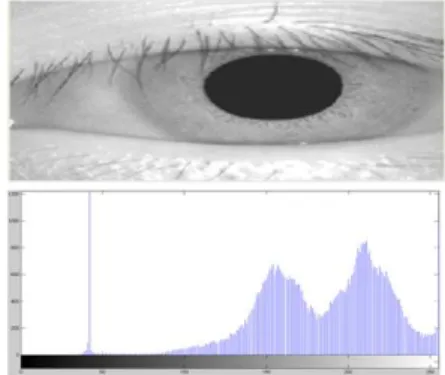
Fig. 2: Input Image & Histogram Chart.
Fig. 3: Input Images for Iris Recognition.
Fig. 5: Feature Extraction Completed.
The performance of an operator is said to be comfortable only when the size of SRR is high and size of FAR or FRR is low [16]. In this study, it is found that Canny edge detection technique is the most efficient to capture the iris texture when compared to the other operators. It was found that a most good outcome is obtained at hamming distanced edge of 0.4. If hamming distance, between the iris code in the knowledgebase and the testing iris code, is less than the threshold then the person is authorized and accepted otherwise rejected as unauthorized. iris code in the knowledgebase. And the testing the iris code, is less than the threshold then the person is authorized and accepted otherwise rejected as unauthorized.
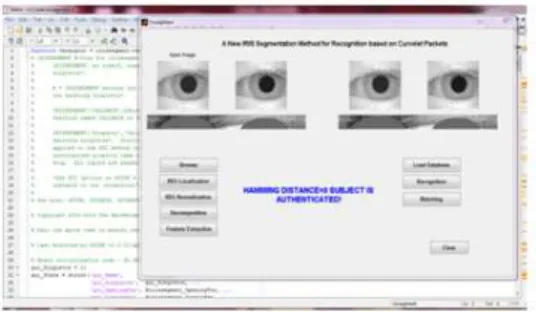
Fig. 6: Authenticated Responses for Iris Segmentation and Recognition System for Human Recognition System.
RESULTSANDDISSCUSSION
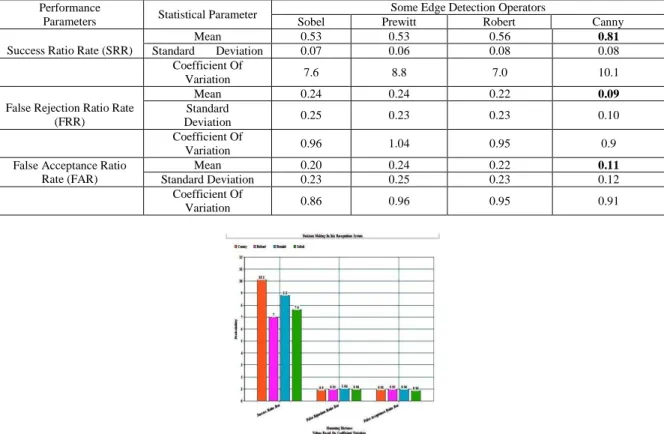
The good outcome of, FAR and FRR of the Iris recognition has been recorded for different edge detection operators -Prewitt, Robert, Sobel and Canny. The statistical details of the success ratio rate (SRR), false acceptance ratio (FAR) and false rejection ratio (FRR)[37] of Prewitt, Robert, Sobel, and Canny edge detection operators are listed in the above 1table.
Fig. 7: Iris Detection Using Various Operators.
The coefficient variation value of false acceptance ratio and false rejection ratio of canny is less than other operators. The performance of an operator is said to be acceptable when the size of SRR is high and size of FAR or FRR is low. The algorithm tested against 400 sets eye images out of which 50% are authorized and other 50% are unauthorized. The result indicates that the canny operator is a better operator for iris recognition and feature extraction. The good outcome rate of feature detection using canny is found to be 81%, False Acceptance Rate is 9% and False Rejection Rate is 11%.Hence it may be concluded that good example proposed in this study is effective for segmentation and classification of iris with less loss of features. This algorithm can be further developed in the future for iris image capture from the moving face.
Table I Matching Results Processed With Reduced Different Number Of Features.
using segmentation method. Using 18 or more Curvelets coefficients, from the database obtained from histogram equalization can give up to 100 % accuracy of the recognition of the iris image. The time consumption is also very low, as it can identify an iris within ~3.89 seconds. This time includes segmentation, feature extraction, feature detection and classification time (Sudha, N., 2009).
Table 1: Statistical Report of SR, FAR and FRR of Iris Recognition System. Performance
Parameters Statistical Parameter
Some Edge Detection Operators
Sobel Prewitt Robert Canny
Success Ratio Rate (SRR)
Mean 0.53 0.53 0.56 0.81
Standard Deviation 0.07 0.06 0.08 0.08
Coefficient Of
Variation 7.6 8.8 7.0 10.1
False Rejection Ratio Rate (FRR)
Mean 0.24 0.24 0.22 0.09
Standard
Deviation 0.25 0.23 0.23 0.10
Coefficient Of
Variation 0.96 1.04 0.95 0.9
False Acceptance Ratio Rate (FAR)
Mean 0.20 0.24 0.22 0.11
Standard Deviation 0.23 0.25 0.23 0.12
Coefficient Of
Variation 0.86 0.96 0.95 0.91
Fig. 8: Decision making in Iris Recognition System And Its Graph Shows that Canny Operator Has The
Highest Success Ratio.
Table II: Statistical Report of SR, FAR and FRR of Iris Recognition System.
No: of Features Percentage of Accuracy Sigma Segmentation Accuracy
5 81.2% 3.0 88.59%
11 97.3% 4.0 90.58%
15 98.6% 5.0 100%
Table III: Canny Based Segmentation Using Different Sigma Values and Time Consumption Chart. Total Images In The Database & Time for
segmenting whole database Average segmentation time for One image Total time for Identification of Iris
400 Sets of Images & 1446.36 Seconds 3.45 Seconds ~3.89seconds
From the above statistical report table the coefficient value success ratio of canny operator is greater than the other operators. The coefficient variation of false acceptance ratio and false rejection ratio of canny operator is less than other operators..
This algorithm can be further developed in the future for iris image capture from the moving face. After the successful experiments and the encouraging results got done, it can be claimed that the proposed system is capable of fast and efficient iris identification. It is considered as t h e p e r f e c t s e l e c t i o n o f edge detection technique hence lot of work and improvement on this algorithm has been done and further improvements are possible in future as an improved better canny algorithm can detect edges in color image without g e t t i n g c h a n g e d in t h e gray image[35]. In the proposed system, databases have been used for iris images. Moreover, average time consumption of the system could be improved by changing / improving the segmentation technique and other classifiers may also be used to evaluate the system.
REFERENCES
Kluwer Academic Publishers, 1-41.
Johnson, R.G., 1991. “Can Iris Patterns be used to Identify People?” Chemical and Laser Sciences Division, LA-12331-PR, LANL, Calif.
Kong, W., D. Zhang, 2001. “Accurate Iris Segmentation based on Novel Reflection and Eyelash Detection Model”, Proceedings of International Symposium on Intelligent Multimedia, Video and Speech Processing, Hong Kong, pp: 263–266.
Daugman, J., 2004. “How iris recognition works”, IEEE Transactions on Circuits and Systems for Video Technology, 14(1): 21-30.
Proenca, H., L. Alexandre, 2004. “UBIRIS: Iris Image Database”, Available: http://iris.di.ubi.pt.
Zhang, D., 2003. “Detecting eyelash and reflection for accurate iris segmentation”, International journal of Pattern Recognition and Artificial Intelligence, 1(6): 1025-1034.
Kovesi, P., “MATLAB Function for Computer Vision and Image Analysis”, Available at:http://www.cs. uwa. edu.au/ ~pk/Research/ MatLabFns/ index.html.
http://homepages.inf.ed.ac.uk/rbf/HIPR2/roberts.htm l
http://euclid.ii.metu.edu.tr/~ion528/demo/lectures/6/2/2/index.html
Canny, J., 1986. “A computational approach to edge detection”, IEEE Transaction on Pattern Analysis and Machine Intelligence, 8: 679-698.
Boles, W., B. Boashash, 1998. “A Human Identification Technique using Images of the Iris and Wavelet Transform”, IEEE Trans. Signal Processing, 46(4): 1185-1188.
Lim, S., K. Lee, O. Byeon, T. Kim, 2001. “Efficient iris recognition through improvement of feature vector and classifier”, ETRI Journal, 23(2): 61-70.
Daugman, J., 1993. “High confidence Visual Recognition of Person by a test of statistical Independence”, IEEE transactions on pattern analysis and machine intelligence, 15(11): 1148-1161.
Binsu, C., Kovoor, M.H. Supriya and K. Poulose, 2013. Jacob in International Journal of Network Security & Its Applications (IJNSA), 5-5. “Effectiveness of feature detection Operators on the performance of iris biometric recognition system”
Rashmi, Mukesh Kumar, 2013. Rohini Saxena Signal & Image Processing : An International Journal (SIPIJ), 4-3. Algorithm And Technique On Various Edge Detection: A Survey.
Muhammad Faisal Zafar, Manel, Zaigham Zaheer, Lavaid Khurshid, Daugman, 2013. J. IEEE Transactions On Information Technology In Image Processing, 15(2). Novel Iris Segmentation and Recognition System for Human Recognition.
Sudha, N., N. Puhan, H. Xia and X. Jiang., 2009. Iris recognition on edge maps., lET Computer Vision, 3(I): 1-7.
Ma, l., T. Tan, D. Zhang, Y. Wang, 2004. 'Local intensity variation analysis for iris recognition', Pattern Recognition, 37(6): 1287-1298.
Park, C., J. lee, M. Smith, K. Park, 2003. 'Iris-based personal authentication using a normalized directional energy feature'. Proc. 4th Int. Conf Audio- and Video-Based Biometric Person Authentication, 224-232 .
Boles, W.W., B. Boashash, 1998 'A human identification technique using images of the iris and wavelet transform', IEEE Trans. Signal Process., 46(4): 1185-1188
Daugman, 1., 2003. 'The importance of being random: statistical principles of iris recognition', Pattern Recognition., 36: 279-291.
Dobes, M., l. Machala, P. Tichavsky, 1. Pospisil, 2004. 'Human eye iris recognition using the mutual information', Opt. Opt., 115(9): 399-404.
Daugman, 1., 2004. 'How iris recognition works', IEEE Trans. Circuits Syst. Video Technol., 14(I): 21-30. Ma, l., T. Tan, Y. Wang, D. Zhang, 2003. 'Personal identification based on iris texture analysis', IEEE Trans. Pattern Anal. Mach. Lntell., 25(12): 1519-1533.
Ma, l., T. Tan, Y. Wang, D. Zhang, 2004. 'Efficient iris recognition by characterizing key local variations', IEEE Trans. Image Process., 13(6): 739-750
Sanchez-avila, C., R. Sanchez-Reillo, 2005. 'Two different approaches for iris recognition using Gabor .lters and multi scale zero-crossing representation', Pattern Recognit., 38: 231-240.
Wikipedia.http://en.wikipedia.orglwikiICurvelet
Daugman, 1., 2004. "Recognizing persons by their iris patterns." Advances in Biometric Person Authentication, Proceedings, 3338: 5-25.
Zhou, Z., Y.Z. Du, 2009. "Transforming Traditional Iris Recognition Systems to Work in Non ideal Situations." IEEE Transactions on Industrial Electronics 56(8): 3203-3213.
Ross, A., 2010. "Iris Recognition: The Path Forward." Computer 43(2): 30-35.
Hollingsworth, K., T. Peters, 2009. "Lris Recognition Using Signal-Level Fusion of Frames From Video."IEEE Transactions on Information Forensics and Security, 4(4): 837-848.
TiborMoravcik, "Detection of Determined Eye Features in Digital Images", ANNALS OF FACULTY ENGINEERING HU2011.NEDOARA International Journal of Engineering, Tome LX, Fascicule, I: 155-160(ISSN 1584-2665)
Geng Xing, Chen ken , Hu Xiaoguang, 2012. “An improved Canny edge detection algorithm for color image” IEEE TRANSATION, 978-1-4673-0311-8/12/$31.00 ©2012 IEEE.James Clerk Maxwell,1868 DIGITAL IMAGE PROCESSING Mathematical and Computational Methods.
Gonzalez, R. and R. Woods, 1992. Digital Image Processing, Addison Wesley, 414-428.