SIUE Faculty Research, Scholarship, and Creative Activity
2016
Talking Through the Problems: A Study of
Discourse in Peer-Led Small Groups
Michelle D. Repice
Washington University in St. Louis
R. Keith Sawyer
University of North Carolina at Chapel Hill
Mark C. Hogrebe
Washington University in St. Louis
Patrick L. Brown
Fort Zumwalt School District
Sarah Luesse
Southern Illinois University Edwardsville, [email protected]
See next page for additional authors
Follow this and additional works at:http://spark.siue.edu/siue_fac
Part of theOther Chemistry Commons,Scholarship of Teaching and Learning Commons, and theScience and Mathematics Education Commons
This Article is brought to you for free and open access by SPARK. It has been accepted for inclusion in SIUE Faculty Research, Scholarship, and Creative Activity by an authorized administrator of SPARK. For more information, please [email protected].
Recommended Citation
Repice, Michelle D.; Sawyer, R. Keith; Hogrebe, Mark C.; Brown, Patrick L.; Luesse, Sarah; Gealy, Daniel J.; and Frey, Regina F., "Talking Through the Problems: A Study of Discourse in Peer-Led Small Groups" (2016).SIUE Faculty Research, Scholarship, and Creative Activity. 49.
Regina F. Frey
Cover Page Footnote
This is an Accepted Manuscript version of an article published by the Royal Society of Chemistry inChemistry Education Research and Practice, Issue 3, 2016, available online athttp://dx.doi.org/10.1039/C5RP00154D.
1 Talking Through the Problems: A Study of Discourse in Peer-Led Small Groups
Michelle D. Repice1, R. Keith Sawyer2, Mark C. Hogrebe3, Patrick J. Brown4, Sarah B. Luesse5, Daniel J.
Gealy6, and Regina F. Frey1,6,7, *
1 The Teaching Center, Washington University in St. Louis, One Brookings Drive, St. Louis, MO 63130
2 School of Education, The University of North Carolina at Chapel Hill, Peabody Hall, Chapel Hill, NC
27599
3 Department of Education, Washington University in St. Louis, One Brookings Drive, St. Louis, MO
63130
4 Science Department, Fort Zumwalt School District, O’Fallon, MO 63366
5 Department of Chemistry, Southern Illinois University - Edwardsville, Edwardsville, Illinois 62026
6 Department of Chemistry, Washington University in St. Louis, One Brookings Drive, St. Louis, MO
63130
7 Center for Integrative Research on Cognition, Learning, and Education, Washington University in St.
Louis, One Brookings Drive, St. Louis, MO 63130
2 Abstract
Increasingly, studies are investigating the factors that influence student discourse in science
courses, and specifically the mechanisms and discourse processes within small groups, to better
understand the learning that takes place as students work together. This paper contributes to a growing
body of research by analyzing how students engage in conversation and work together to solve problems
in a peer-led small-group setting. This qualitativestudy evaluates video of Peer-Led Team Learning
(PLTL) sessions in general chemistry, with attention to both the activity structures and the function of
discourse as students undertook different types of problems across one semester. Our findings suggest
that students talk their way through the problems; practicing a combination of regulative and
instructional language to manage the group dynamics of their community of peer learners while
developing and using specific disciplinary vocabulary. Additionally, student discourse patterns revealed
a focus on the process of complex problem-solving, where students engage in joint decision-making by
taking turns, questioning and explaining, and building on one another’s ideas. While students in our
study engaged in less of the deeper, meaning-making discourse than expected, these observations about
the function of language in small-group learning deepens an understanding of how PLTL and other types
of small-group learning based on the tenets of social constructivism may lead to improvements in
science education, with implications for the structure of small-group learning environments, problem
design, and training of peer group leaders to encourage students to engage in more of the most effective
3 Introduction
Language plays an important role in science learning, and especially among students working on
shared group problem-solving tasks. It is often in these smaller, collaborative settings where students
learn to “talk science,” or what Lemke (1990) refers to as the process of “doing science through the
medium of language.” The verbal communication that occurs as students talk through problems with one
another may help explain the emerging consensus from research suggesting that student-centered
collaborative activities effectively result in greater understanding of scientific thinking and practice
(Brewer and Smith, 2011; Olson and Riordan, 2012; Freeman et. al., 2014).Problem-solving activities
are critical because they engage students in processes similar to those undertaken by practicing
scientists; and collaboration is critical because participating in scientific discourse requires students to
articulate their own developing understandings, resulting in a heightened metacognitive awareness that
enhances learning (Forman, 1992; Forman and Cazden, 1998; Sawyer, 2005; Krajcik and Blumenfeld,
2006; Scardamalia and Bereiter, 2006).
Reform efforts to include more opportunities for student-centered and peer-led instruction in
large science classes have demonstrated their effectiveness in promoting positive student learning
outcomes (Webb, 1989; Johnson and Johnson, 2002; Preszler, 2009; Kirik and Boz, 2012). In higher
education, popular collaborative pedagogical strategies include Peer-Led Team Learning (PLTL)
(Gosser et. al., 2001; Gafney and Varma-Nelson, 2008; Hockings et. al., 2008; Mitchell et. al., 2012),
Process Oriented Guided Inquiry Learning (POGIL) (Lewis and Lewis, 2005, 2008; Moog and Farrell,
2008), and Problem Based Learning (PBL) (Hmelo-Silver, 2004). This study focuses on students
working together in PLTL groups in a first-year general chemistry course. In addition to improving
academic performance, research shows that PLTL and other cooperative-learning techniques have
4
Hockings et. al., 2008). From these largely quantitative studies, we know that cooperative techniques
enhance student learning and student attitudes, yet the mechanisms leading to these positive outcomes
are less well known.
Given the agreement on the benefits of student collaboration, research has increasingly attempted
to identify the factors that influence student discourse in science courses, and specifically the
mechanisms and discourse processes within small groups to better understand the learning that takes
place as students work together, facilitated by instructors or peer leaders. Scholars of classroom
discourse investigate how classroom talk helps accomplish pedagogic goals, or more specifically how
language and interaction facilitate knowledge construction (Christie, 2002; Cazden and Beck, 2003).
Allowing students the opportunity to discuss science concepts and problem-solving processes with one
another provides meaningful practice in using newly learned vocabulary and knowledge in an academic
setting (Lemke, 1990). In addition, students working in small groups use language to structure activities,
challenge one another, swap information, and build on explanations within a community of other
learners (Hogan et. al., 1999; Osborne, 2010).
Much recent research on scientific discourse in small-group learning settings has focused on
student argumentation as one way to assess whether students are gaining skills important to science
knowledge construction, including making claims and supporting those claims or backing them with
further evidence (Erduran et. al., 2004; Cole et. al., 2012; Becker et. al., 2013; Kulatunga et. al., 2013;
Andriessen and Baker, 2014). Applying Toulmin’s argumentation scheme, scholars have observed the
structural patterns of student argumentation taking place in collaborative learning contexts in an effort to
understand and improve student forms of scientific arguments in math and science learning (for review,
Jimenez-Aleixandre & Erduran, 2007). Whether focused on the effects of instructor or peer-leader
5
Warfa et. al., 2014), the differences between in-person and online peer learning (Smith et. al., 2014), or
on students’ verbal behaviors with each other as they work through problems in groups (Xu and
Talanquer, 2012; Young and Talanquer, 2013), recent investigations reveal the importance of student
talk and the insights gained from analyzing student discourse to determine how learning works in these
contexts.
This study contributes to the growing literature on student discourse by analyzing the functions
of student talk while engaging in the particular pedagogical activities of introductory university-level
chemistry within the social context of collaborative peer-led team learning groups. We find, as Lemke
(1990) has suggested, that students indeed gain ample practice in “talking science” in this setting
without an instructor controlling dialogue. In our study, “talking through the problems” includes
language deployed in learning and discussing science concepts and in facilitating group learning and the
formation of a community of learners. It is, in fact, the combination of discourse about science content
with talk that helps regulate and facilitate group behavior that leads to productive problem-solving
collaboration. An attention to the creation of a particular ‘community of practice’ (Lave and Wenger,
1991) and of the nature of student discourse related to the facilitation of collaboration through
productive group dynamics is often missing from work focused on the structure of effective
argumentation and evidence of conceptual thinking (Ryu and Sandoval, 2015). We aim to discover more
about how students talk together to develop collaborative problem-solving processes and facilitate peer
learning across a variety of activities. In addition to providing a social space in which to practice science
discourse, small peer-led groups create opportunities for students to engage in skills that help the group
talk through problems.
Increased knowledge of the discourse processes that occur among students contributes to our
6
of improving teaching and student learning in general chemistry. This qualitative study of discourse and
interactional patterns in PLTL sessions may help shed some light on our primary research question –
how are students using language to engage with each other in small-group learning settings? More
specifically, are students talking in ways that help them build discipline-specific science vocabulary and
collaborative problem-solving skills? Are they communicating to build community, engage in deeper
conceptual understanding, or to reflect on their learning process? While these are some of the potential
benefits of peer instruction (Mazur, 1997; Crouch and Mazur, 2001), this kind of communication does
not always happen automatically, so we also make suggestions for how to encourage more of the most
effective discourse for learning.
Our analysis is shaped by sociocultural views of learning, which emphasize student learning as a
participatory and interactional process that creates a community of learners through discourse
(Vygotsky, 1980; Wertsch, Wells and Arauz, 2006). This framework allows us to analyze what the
students are doing when they communicate, which varies based on the group dynamics and the demands
of the problem. Communication, in this regard, is considered effective if it fulfills a communicative
purpose, meaning that it helps the students succeed in a collaborative learning task. Students collectively
articulate the problem as the activity unfolds; language, in this setting, is a community endeavor, and
knowledge is constructed within the social setting of the peer group (Scardamalia and Bereiter, 2006).
While other recent studies have analyzed student argumentation and scientific reasoning in small
groups, this study presents a wider variety of linguistic functions undertaken by students as they work
together to solve different kinds of problems, with attention to both the talk about science content and
the talk that helps the group work together and move through the assigned tasks. By analyzing the nature
and function of student conversations, we can better understand the kinds of collaborative thinking
7
their knowledge together in small groups (Becker et. al., 2013; Sawyer et. al., 2013). Further, this study
builds on other work investigating how different types of activity structures and chemistry content
encourage different discourse dynamics, including variations in the level and types of student-to-student
interaction and conversation (Young and Talanquer, 2013). Looking at this wider range of discourse
reveals implications for problem design and peer-leader training to further help students communicate
effectively about underlying science concepts and develop metacognitive awareness of their
understanding of new concepts.
Setting of Study
This research was performed at a medium-size selective research university in the Midwest of
the United States, where the General Chemistry lecture course is a two-semester series enrolling
600-680 students each semester with a separate, independent laboratory course. To supplement the course
and improve student learning, there are several options available: help sessions and office hours held by
the course instructors; PLTL groups; and academic mentors (tutors) from the student-learning center.
Although there are still large lectures each week, PLTL supplements the lecture with formalized study
groups that provide opportunities for active and collaborative learning. In each PLTL session, students
work together to solve problems designed by the instructor of the class. Neither the peer leader nor the
students are given the solutions to the problems, because the goal of the session—consistent with
inquiry-based principles—is not only to get the correct answer; it is also to provide opportunities for
engaging in problem solving while discussing the processes and concepts used in the problem.
A PLTL study group contains 6-8 students facilitated by a student, called the peer leader, who
has previously received a high grade in the class, and who works under the close supervision of the
instructor of the class. The goals of PLTL are to: (i) teach undergraduates how to effectively study in a
8
provide an active-learning environment for students to engage in scientific discourse. Peer leaders
receive training to implement collaborative learning strategies that encourage equal participation from
the group members. Even though novice students may perceive peer leaders as more expert in chemistry
knowledge, the leaders moderate the group as an equal and limit their contributions to group discussions
and problem-solving activities by encouraging student engagement with the problems. Facilitated
learning by a peer leader, who is arguably much closer to the students in terms of chemistry
understanding or their ‘zone of proximal development,’ is also thought to aid learning (Vygotsky, 1980;
Cracolice, 2012).
While participation in PLTL is optional, once a student has signed up for the PLTL program,
attendance at each workshop session is mandatory. The student is a member of the same group led by
the same peer leader for one semester, allowing the group time to form social and communicative bonds.
Approximately 65% of the students in the general chemistry series participate in the PLTL program each
semester. The students in the PLTL groups meet weekly to solve selected problems that are: i) reflective
of the material covered in the course; ii) appropriately challenging; and iii) designed to encourage
students to collaborate. The problems are deliberately designed without a prescriptive structure to walk
the students through each step of problem, thus requiring the groups to make joint decisions about
problem-solving processes. Each problem is initially solved using a distinct collaborative-learning
strategy, including “round robin,” “scribe,” “pairs,” and “small groups,” all requiring students to write
the steps used in problem solving on the board. There are many variations on these basic instructional
strategies, the peer leaders are trained in facilitation of these strategies, and the peer leaders are
encouraged to creatively modify the strategies to increase participation and collaboration.
Method
9
There were 40 peer-led groups for general chemistry, consisting of 22 led by new peer leaders
and 18 led by returning peer leaders. Each PLTL group contained 6-8 students and one peer leader. We
gathered data on a sample of 15 of the groups, each led by one of the returning leaders. Ethical
considerations for this research were approved by IRB review for human subjects research, and
participants in the study completed an informed consent, which included guarantees of anonymity and
permission to video-record, transcribe, and analyze the discursive content of their sessions (Taber,
2014). We chose to analyze the interactions of students in the groups with experienced leaders to ensure
that the leaders understood and correctly implemented the philosophy of peer-led team learning. Over
the course of the semester, three PLTL sessions of each of these groups were videotaped. The first
recorded session (4th session) occurred after the beginning of the semester, the second recorded session
occurred near the midterm (7th session), and the final recorded session occurred approximately 4 weeks
before the end of term (9th session). Approximately 60 hours of video data were recorded.
Problem types and activity structures
The absence of an instructor in the PLTL sessions allows for more egalitarian conversations than
typically occur within a science classroom where an instructor controls the structure of the discourse.
Drawing on Lemke’s (1990) notion of activity structures, the patterns of activity that structure lessons or
learning sessions, we noticed that the most common activity structures observed in the recorded sessions
include True Dialogue, in which peer leaders or students ask questions without knowing or seeking the
“correct answer;” Cross-Discussion, or conversation between students moderated by the peer leader; and
Groupwork, in which small cooperative groups work on shared tasks. According to Lemke, these
particular activity structures give students more practice in “talking science” than structures like Triadic
10
We selected the three sessions because each one dealt with very different conceptual material,
which resulted in three different problem types, thus allowing us to observe consistencies between tasks
as well as note differences in communication patterns both across tasks and throughout the semester. All
problems required students to collaborate to determine the appropriate problem-solving processes, but
the peer leaders instructed students to engage using one of the collaborative-learning strategies
mentioned above. These strategies helped to give structure to the activities, leading to mix of
Groupwork, Cross Discussion, and True Dialogue. The question prompts did not contain explicit
information about progressive steps to take, nor did they identify which information was needed to solve
the problems. This approach to problem solving, informed by cognitive science research on transfer
(Gick and Holyoak, 1980) suggesting that students have difficulty applying knowledge across different
contexts, requires groups to make joint decisions about how to proceed, through conversation and
guidance from each other and from a more knowledgeable peer (Ge and Land, 2003).
The three selected types of problems represent those typically occurring in science classes and
commonly faced in science careers. We classified problems based on the nature of the tasks as
calculational, data analysis, or model building (see Appendix A in supplemental materials for text of the
problem prompts). The calculational problem involves quantitative skills, including solving equations
and working with numerical values to obtain a quantitative answer (i.e. computing the de Broglie
wavelength of an electron ejected from manganese by one photon at different given wavelengths). For
this problem, peer leaders instructed students to work in “small groups,” where 3-4 students work
together (Groupwork) before coming back as the entire group to discuss the problem
(Cross-Discussion). The model-building problem type involves primarily qualitative skills, including
developing mental models and making comparisons of properties or features, as well as hands-on
11
understanding of the structure of VSPER models by building them with toothpicks and marshmallows.
The data-analysis problem type requires a combination of quantitative and qualitative skills, including
the identification of properties of atoms and ions, followed by the spatial arrangement of items in order
of the correct property trends (e.g. increasing size of the atom). For this problem, peer leaders facilitated
students using the “round robin” strategy, in which one student provides the first step of a problem,
followed by successive steps contributed by the other students going around the table until the problem
is completed. This strategy ensures that all community members participate in the problem-solving
process (Cross Discussion). Throughout all sessions, episodes of True Dialogue emerged as students and
peer leaders questioned one another without knowing the answers.
Analysis
While the three problem types required students to engage with different cognitive tasks and
content-related knowledge, all problems encouraged a mix of regulative (managing discussion and
group), procedural (engaging in problem solving process), fact-based (exchanging chemistry content
knowledge), and conceptual (explaining and meaning-making) discourse. To analyze the discourse, we
transcribed the video-recorded PLTL sessions as the students worked and talked through the selected
problems, facilitated by a peer leader. We separated out each interaction as it occurred naturally in
conversations, recording the utterances, or discursive “moves,” students and peer leaders made as they
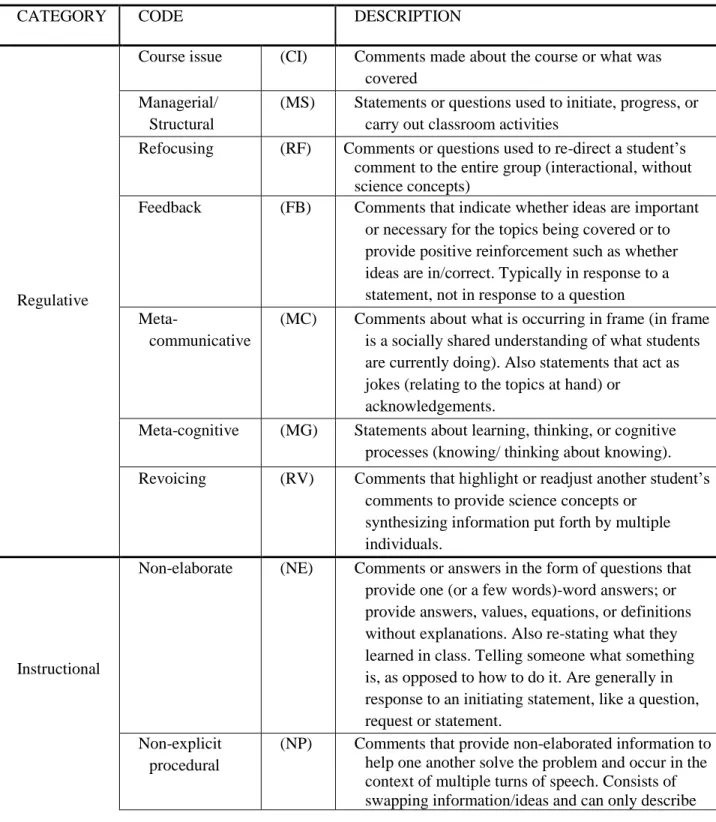
engaged in group problem-solving activities. Each utterance was assigned a category and a code (see
below for details of coding process and Table 1 for a list of categories and codes). While data from peer
leaders and students were coded and analyzed, student speech forms the basis for the analysis of this
study. Other research using these data has looked at the role of peer-leader style (facilitative vs.
instructive) in small-group learning settings (Sawyer et. al., 2013). Because the experienced peer leaders
12
analyzes only student utterances to see what happens when students struggle and work together to solve
problems.
Emergent coding categories
We used the constant comparative method of qualitative research to identify an emergent set of
coding categories (Glaser and Strauss, 2009). Discourse categories emerged that reflected the focus of
this inquiry and the functional nature of communication in small collaborative learning groups. The
emergent scheme involved two levels, categories and codes. Our two main discourse categories, which
align well with the nature of regulative and instructional registers established in systemic functional
theory, describe two general types of student speech: (1) regulative discourseand (2) instructional
discourse (Halliday, 1994; Bernstein, 1996; Christie, 2002). Regulative discourse is language that works
to establish certain behaviors among participants to promote discussion among the group and keep the
students moving through problems together, but does not contain chemistry content. These discursive
moves include pacing, sequencing, and determining the direction of group activities, as well as
affirmations of others’ contributions and recognition of the learning context (Christie, 2002). Regulative
discourse is especially important to the learning context of PLTL, where students take on some teacher
roles to facilitate their own and their group’s learning. Instructional discourse describes the particular
content being taught and learned, including factual exchanges of information, procedural suggestions
about the problem-solving process, conceptual explanations, and questions that confirm moves or
prompt further discussion (Christie, 2002). Through instructional discourse, students discuss the
problem-solving strategies, procedures, and information needed to work through the problems together.
Codes refer to specific types of identifiable speech that emerged within each of these categories.
13
instructional (see Table 1). For an expanded coding guide containing examples, refer to Appendix B in
supplemental materials.
Table 1. The emergent categories and codes.
CATEGORY CODE DESCRIPTION
Regulative
Course issue (CI) Comments made about the course or what was
covered Managerial/
Structural
(MS) Statements or questions used to initiate, progress, or
carry out classroom activities
Refocusing (RF) Comments or questions used to re-direct a student’s
comment to the entire group (interactional, without science concepts)
Feedback (FB) Comments that indicate whether ideas are important
or necessary for the topics being covered or to provide positive reinforcement such as whether ideas are in/correct. Typically in response to a statement, not in response to a question
Meta-communicative
(MC) Comments about what is occurring in frame (in frame
is a socially shared understanding of what students are currently doing). Also statements that act as jokes (relating to the topics at hand) or
acknowledgements.
Meta-cognitive (MG) Statements about learning, thinking, or cognitive
processes (knowing/ thinking about knowing).
Revoicing (RV) Comments that highlight or readjust another student’s
comments to provide science concepts or synthesizing information put forth by multiple individuals.
Instructional
Non-elaborate (NE) Comments or answers in the form of questions that
provide one (or a few words)-word answers; or provide answers, values, equations, or definitions without explanations. Also re-stating what they learned in class. Telling someone what something is, as opposed to how to do it. Are generally in response to an initiating statement, like a question, request or statement.
Non-explicit procedural
(NP) Comments that provide non-elaborated information to
14 discourse that falls within the Problem Solving category.
Explicit procedural
(EP) Comments that focus on problem formation and
include clear or precise procedural directions for solving a problem. Telling someone how to do something
Conceptual explanation
(CE) Comments that discuss the meaning of a number; or
discuss the meaning of equations; or discuss why or how an answer or equation makes sense; or relate numbers to real life experiences or analogies; or use diagrams to explain understanding
Closed question (PC) Questions or requests used to focus thinking on
particular content or procedures
Open question (PO) Questions used to promote discussions, student
interactions, or elaborate on conceptual explanations about content or procedures
After the categories and codes were identified and refined through the constant comparative
method, we developed a coding manual that instructed researchers on how to attach these categories and
codes to specific discourse turns in our transcripts. Although these data emerged from qualitative
analysis, qualitative methodologists generally agree that the codes can be considered to be objectively
valid data if two or more independent researchers assign the same codes to each discourse turn. The
quantitative measure of the reliability, and thereby the objectivity of the attached codes, is intercoder
reliability.
To calculate the reliability of the coding manual, three trained coders were used. The first coder
holds a doctorate in science education and was part of the research team. Two additional coders were
engaged to measure the reliability of the coding scheme. One of the two additional coders holds a
doctorate in chemistry, was a co-instructor of the General Chemistry series and co-director of the PLTL
15
and a General Chemistry peer leader. The additional coders were blind to the motivation and hypotheses
of the study. These coders were trained to apply the proper category and code to each utterance of the
training transcripts, which were not used in the final data analysis. When disagreements arose, the
coders discussed differences and either a rule for coding was decided upon or a revision was made to the
coding manual. The coders continued to code different training transcripts until reliability was obtained.
Once the three coders attained reliability on the training transcripts, they coded all of the data for the
three problems. In the final stage of coding, we compared the codes of the three coders. The Cohen’s
Kappa in the final stage of coding was 0.90. Cohen’s Kappa is an inter-rater reliability measure for
qualitative studies (Bakeman and Gottman, 1986; Lunn, 1998).
Results
Types of Talk
The transcribed student statements split approximately in
half between regulative talk (44%) and instructional talk (56%),
(see Figure 1). While the instructional category reflects student talk
that is directly about science or chemistry content, our results suggest that the regulative category is
crucial to the functioning of group dynamics and collaborative problem-solving processes within the
context of a peer-led learning group.
We summarized the categorical data across the three observed sessions and the three problem
types, and while there is some consistency, there are also noticeable differences in the breakdown of
types of talk for particular kinds of problems and activity structures (see Figure 2). For example, the
16
proportionately more regulative discourse and less instructional discourse than the other, earlier
problems, perhaps because students learned more effective strategies for group facilitation as the
semester progressed, or because the model-building problem engages students in a hands-on activity that
requires students to work cooperatively to physically build the models. If the desired learning outcomes
include more active collaboration and participation, asking students to work together to develop a shared
external representation (as in the model-building problem) is likely to be more successful in reaching
these learning outcomes than a calculational problem, in which students may be tempted to revert back
to solitary work between moments of checking in with each other. The results from the calculational
problem suggest that may be the case with fewer statements overall, and more questions to verify
answers to intermediate steps. For the remainder of our results, our analysis is broken down by discourse
categories and codes summarized across all three sessions, but we include notable differences between
problem and activity types where relevant.
Regulative Discourse
Regulative discourse is language that works to foster effective group dynamics and promote
discussion among the group, but does not contain content related to scientific concepts. This category
17
areas of agreement and disagreement, and maintains focus on the problem. It also includes comments
that indicate how individual students think about and reflect on their own learning. In many ways,
regulative discourse among students in peer-led cooperative learning groups looks remarkably similar
to teacher talk or discursive moves that instructors might employ to control and guide students and
keep their learning on track (Hogan et. al., 1999; Christie, 2002; Webb et. al., 2006). Because there is
no instructor present, the peer leaders are trained to encourage the students to take on much of this
role as they work to guide learning in their groups. The high proportion of regulative discourse (44%
of total discourse across three problem types, Figure 1) suggests that the groups are engaging in
collaboration on the task and functioning in ways that allow members to contribute to the process.
Regulative functions align well with the goals of the PLTL program, and also with the goals of other
collaborative learning pedagogies, to teach undergraduates how to study effectively in peer groups
and to actively participate in their learning (Eberlein et. al., 2008; Hockings et. al., 2008).
Interpersonal communication factors influence the effectiveness of student collaborations, and are
thus skills to be learned in addition to, and alongside, science content, methods, and concepts (Ryu
and Sandoval, 2015). Not surprisingly, students engaged in more regulative talk as the semester
progressed and they took on more of the role of keeping the group on task and moving forward
through the problems. In a traditional science classroom setting, the amount of regulative talk might
decline over time as the class learns the norms and structure of teacher-directed activities, the nature
of the PLTL inquiry leads students to co-construct plans to move through the problems together, thus
requiring more attention to the specific needs of the group and the activity, and more regulative talk
(Christie, 2002).
Finding 1: Students use regulative language in groups to promote discussion, exchange information,
18
Within the broad category of regulative discourse, we analyzed six different codes (see Table 1).
The code course issues includes comments made about the lecture course such as course logistics or
what was covered in lecture prior to the group meeting, as well as course concerns. When students make
statements that initiate or progress the activities of the group, those statements were coded as
managerial/structural, indicating that the participants are taking on a managerial role in facilitating the
pacing, sequencing, or direction of group work. Feedback comments provide responses about the
correctness of the problem solution or conceptual understanding; Meta-communicative comments
describe statements that indicate students are monitoring and interpreting one another’s verbal behaviors
or talking directly about talk; Meta-cognitive comments include those statements where students
explicitly talk about their learning, thinking, or cognitive processes; and Revoicing comments highlight
or readjust another student’s comments to provide science concepts, or synthesize information put forth
19
For all PLTL sessions, the most common codes of regulative discourse observed were
meta-communicative statements, managerial/structural statements, and feedback statements. Student
comments of a managerial/structural nature, i.e., discourse that helps the group progress through the
problem and move through the steps, accounted for 12% of all discourse (Figure 3), and roughly a
quarter of all regulative discourse across all problem types. In the interaction example below from the
model-building problem, students took responsibility for making decisions about what to do next,
sequencing and providing direction to productively move the problem forward. In this case, students are
working in small groups to decide together which model type to build, instead of following directions
from the peer leader or allowing one student to lead the group.
Note: All examples of student discourse in this paper are taken from transcribed PLTL sessions.
The F# refers to an utterance from a particular female-student group member, M# refers to utterances
from a particular male-student group member, PL refers to utterances from the group’s peer leader, and
S refers to numerous students talking at once. Italicized selections reflect the category under
consideration for each example.
Managerial/structural example of students working together to make decisions about next steps
(transcript taken from the model-building problem):
F2: We can do one with some lone pairs, or something.
F4: Can you pass me more of the toothpicks?
PL: Yeah. That enough?
F4: Thank you. All right. Yeah, that should be cool.
F3: Triagonal bipyramidal?
F4: All right, which one do we want to do? We have to do one of the … Should we do, like,
the see saw?
20
Students often provided feedback to one another by commenting on whether certain ideas were
important or necessary for the topics being discussed or by providing positive reinforcement when they
felt that certain ideas were correct or helpful. Consistent to all problems and activities, 10% of discourse
exhibited regulation through feedback (see Figure 3), which made up 23% of all regulative discourse
across all problem types. In the calculational problem, students provided feedback mostly in the form of
statements that verified the steps or affirmed the correctness of answers as they worked through the
problem. Since the calculational problem contained more intermediate steps, the feedback also served as
encouragement for the group to continue on through the problem.
Feedback example that reveals the function of brief affirmations (transcript taken from the
calculational problem):
F4: Ok. (Pause) So, 2.5 x 10⁻⁷ meters. Should we put it in nanometers? No it’s good in
meters.
F5: Yeah
F4: Equals 6.626 x 10^-34 joules seconds, divided by...
F5: Is this an electron?
F4: Do we know the mass of an electron offhand?
F5: Uhmmm, 9.11 x 10^-31.
F4: Awesome. Yeah, that sounds right.
In this example, the simple “yeah” and “that sounds right” worked to confirm intermediate steps
and the units of analysis in order to progress through the problem. These affirmations provided feedback
necessary to assure that group members were in agreement and it was time to move on. In the absence
of these kinds of statements, members of the group would continue seeking agreement before moving
forward through the problem.
Much of the regulative discourse in groups took the form of meta-communicative speech (13%
21
occurring in frame (in frame is a socially shared understanding of what students are currently doing).
These often took the form of statements that lightened the mood and yet still related to the topic at hand
or acknowledged what the group was doing. Metadiscourse functions, especially in collaborative
classroom situations, to provide cues for turn-taking in the group, checking in with each other for
understanding, and shared awareness of the learning context (Lemke, 1990; Sawyer, 2005). This
meta-communicative category, full of examples of students talking about talk, joking, or checking in with each
other, was slightly higher for the model-building problem than in other problem types, perhaps a signal
that students were working more collaboratively as they determined which direction to take the
model-building process.
Meta-communicative example of joking among group members that helps create a shared
experience (transcript from the model-building problem):
F1: Trigonal Planar. [Passes the materials to F2]
PL: Yeah? Do you guys like that? Trigonal Planar? (laughs) Supposed to (inaudible)
F2: [drops something] Oh oh oh. Oh we lost something.
F3: We only lost one of the toothpicks.
PL: It's okay, I don't think any of us are gonna eat them
F2: Are we eating these? (laughs) Yeah.
PL: I mean, you can eat whatever you want. (laughs) After everyone's hands have been all
over them. Go for it.
F2: Thanks, (inaudible). [to F3, who's picking it up]
M1: Mmm....
F4: Sounds good.... (laughs)
S: (laugh)
F2: Okay, that's kinda tetrahedral, but it's gonna fall down. (inaudible) [passes the materials to F3]
S: (laugh)
Sometimes the shared experiences of peer learning allow for moments of comic relief and
feelings of shared purpose. These meta-communicative interludes provide brief breaks that may
22
toothpicks and marshmallows provided fodder for jokes about eating model-building materials, but these
interactions also reveal the shared experiences of a group that has formed communicative bonds with
one another over the course of the semester. This communicative bond is important for students to feel
comfortable taking some intellectual risks in their group discussions about chemistry and problem
solving, especially when they are struggling to understand new concepts. Groups come to understand
themselves as a social group or community of learners focused on a group task with shared goals. Thus,
weekly PLTL groups help students form a smaller ‘community of practice’ within the context of a larger
science course, which contributes to student learning.
Last, meta-cognitive comments, which describe learning, thinking, and cognitive processes or an
awareness of these processes during the group discussion, work to identify areas of confusion among
group members. Increasingly, researchers are paying attention to the benefits of meta-cognitive
awareness in science learning, and the relationship between pedagogical strategies and student
understanding of science concepts and problem-solving processes (Schraw et. al., 2006). In this study,
student statements such as, “I just don’t get it” or “now I understand” made up 3% of overall student talk
(Figure 3), but flagged concepts that required more follow-up explanation by the group and also helped
identify “light-bulb moments” when students finally realized they understood something for the first
time. While only a small portion of overall discourse, meta-cognitive statements showed how students
viewed their own learning, and often revealed areas of confusion and understanding. Peer
communication in group learning settings is thought to encourage meta-cognitive awareness (Crouch
and Mazur, 2001; Dunlosky and Metcalfe, 2009). In this study, the students used language to put
underlying concepts into their own words, which provided them with opportunities to identify areas of
confusion when they struggled to explain something to others. The group members also likely benefited
23
along instead of waiting until the exam to discover misunderstandings. We would like to see much more
of this type of conversation, and thus recommend placing direct prompts in the problem sets to identify
the “most confusing part” or the “most important concept learned” to help students more regularly
engage in meta-cognitive awareness of their learning.
Instructional Discourse
Another goal of the PLTL model is to increase students’ content-specific knowledge, science
vocabulary, and collaborative problem-solving abilities as they apply newly learned concepts and
knowledge to new contexts. Thus, we focused our analysis on a category of instructional discourse that
helps to reveal how students use the language of science to collaborate on solving problems in a group
setting. The category of instructional discourse includes procedural (engaging in problem solving
process), fact-based (exchanging chemistry content knowledge), and conceptual (explaining and
meaning-making) discourse.
The six instructional discourse codes are: non-elaborate comments, which provide answers
without explanation; closed questions, which are used to focus conceptual thinking on particular content
or procedures; non-explicit procedural comments, which provide information to help solve a problem
and typically occur during the swapping of ideas; explicit procedural comments, which give precise
procedural directions for solving a problem; conceptual explanations, which work to explain the
conceptual meaning of an equation or solution, or why a specific step was used in the procedure; and
open questions, which are used to promote discussions to elaborate on conceptual explanations about
24 Finding 2: Student instructional discourse patterns suggest that participants in small peer-led
learning groups practice “talking science” to each other in ways that reveal the development of
a shared understanding of chemistry knowledge and vocabulary.
In order to solve the problems, students engaged in frequent exchanges of fact-based comments
and questions that worked to gather information necessary to move forward. These exchanges occurred
throughout the problems in an iterative process. The combination of closed questions and non-elaborate
comments or answers, often in the form of brief questions and one-word (or a few words) answers, were
the most common instructional discourse, making up 38% of all discourse across problems (Figure 4)
and two-thirds of all instructional discourse. These comments provide very short answers, values,
equations, or definitions, but without explanations about how or why they make sense. For all problem
types, non-elaborate answers made up nearly 30% of all recorded student statements, and half of
instructional discourse. On the surface, these results may suggest that students in PLTL groups are not
engaging in deeper conceptual conversations that undergird the problem content, but the example below
shows that non-elaborated answers function to transmit necessary information about chemistry terms
and ideas, giving students opportunities to practice communicating in the language of chemistry as they
25
Non-elaborate example of comments to verify answers (transcript taken from the data-analysis
problem)
F5: Sulfur is smaller than Chlorine.
PL: Ok. Tavares (M2) (facilitating the round robin method)
M2: Ok, Uhmmm. Boron then Beryllium.
F1/F2: We got Beryllium then Boron.
M2: Beryllium then Boron. Ohhh, yeah, yeah, wait, I'm sorry, yeah. Beryllium is the bigger
one.
PL: Yeah ok.
F4: Lithium minus, then Lithium, then Fluorine.
PL: Uh-huh. (indicating answer is correct)
F1: Then N, O, F.
F2: Uhmmm, Calcium, Sulfur, and Chlorine.
PL: Ok.
F5: Barium, Thallium, and Iodine
M2: And the last one - Astatine, Iodine, and Bromine.
In this example, students were instructed by the peer leader to work in the “round robin” format
– where each member adds on to the problem. This particular collaborative-learning approach requires
participation from all members in the group as they take turns providing answers to the question prompt
in order. Nearly every group member speaks during this episode and contributes a brief answer, but not
an explanation of their contribution. In this problem, the students are working together to visualize data
trends and determine the order of elements, while their peer leader adds affirming feedback.
The questioning of students within a group often prompts group members to confirm answers or
explain concepts, and in this way such statements often function to query each other as peers, promoting
a kind of learning that is different from teacher questioning which typically follows a triadic pattern of
teacher questions, student answers, and teacher affirmations or corrections (Lemke, 1990; Hogan et. al.,
1999). Our analysis revealed that closed questions made up the majority of student-student questioning
26
Closed questions often initiated non-elaborate responses, creating a discursive routine where
students asked and exchanged content needed to solve the problems. Since students use closed questions
to focus thinking on particular content or procedures, they often lead to simple, one-word, or
single-concept answers. This type of question occurred more frequently during group work focused on the
calculational problem (16% of total discourse), likely in the form of questions that aimed to verify steps
of the problem. These questions often did not encourage deeper conceptual understanding, but helped
students verify the answers as they progressed to the next step or next problem. While closed questions
are generally regarded as less effective in promoting student learning, they nonetheless function to make
sure that all students in the group are on the same page, and to encourage students to exchange necessary
information required to solve a particular problem (Cazden and Beck, 2003). The following example
exhibits a discursive routine where students are using closed questions to check each other’s calculations
and problem-solving steps, prompting non-elaborate answers in return that move the problem forward.
Closed question example that leads to non-elaborate answers (transcript taken from the
calculational problem):
F5: For the energy of the photon it would be 6.6 x10^-19.
F4: I got 6.26 x 10^-19.
F5: you got 6.26 x 10^-19 and then did you subtract the work function?
F4: Let me do my calculations again...6.26 x 10^-21.
F5: yeah, and then you use the kinetic energy to get velocity.
F4: what?
F5: would you use that as the kinetic energy to get velocity?
F4: I would think so.
M1: Yeah, I think so.
F5: what is the mass of an electron again?
M1: I think it's 9.11 x 10^-31. 9.11x10^-31.
The combination of closed questions and non-elaborate comments formed an activity structure
27
The structure resembles Triadic Dialogue, in which teachers ask questions, students answer, and
teachers provide evaluation, but in the case of peer learners working together in groups, it is a specific
kind of Groupwork where there is no speaker in control of the problem-solving process. While these
exchanges did not probe for deeper meaning, they helped students gather the information necessary to
solve the problems and check answers. These categories of discourse also displayed the students’
development and growing use of chemistry-specific language.
Finding 3: Students communicate in ways that reveal a focus on the process of complex
problem-solving to move through the problems together.
In working through the problems using the collaborative learning strategies of PLTL, students
engaged in two distinct kinds of procedural discourse, revealing the ways in which language functions to
determine problem-solving process. These procedural exchanges account for 14% of overall student
discourse for the sessions analyzed (Figure 4). The provided prompts did not specify the intermediate
steps to take in solving each of the problems. Thus, it is not surprising that students spent a good deal of
their conversations discussing and proposing steps in the problem solving processes. The explicit
procedural code includes clear or precise procedural directions for solving a problem, often in the form
of a command. Overall, these comments comprised only 5% of total discourse (Figure 4), but the
small-group sessions solving the calculational problem exhibited a higher proportion (25%) of student
discourse relating to explicit procedural comments that focused on clear directions to solve problems.
With the focus on problem-solving process, the students solving the calculational problem engaged in
little non-explicit dialogue, compared to the amount of explicit procedural commands. As the example
below demonstrates, the explicit procedural code of student discourse is used by M2 to communicate the
28
Explicit procedural example of students describing problem-solving steps (transcript taken from
the calculational problem):
M2: First we'll have to figure out the energy of a photon, because eventually we are going to
need the velocity of the electron. We know h, and we know m, so velocity is what we need. So we can get that if we know the kinetic energy, right?
F4: And the kinetic energy we don't know.
M2: The kinetic energy we get from energy of the photon minus the work function.
F4: So the work function is 6.6
M2: Yes, so it’s going to be hc/lambda minus the work function.
Alternatively, the non-explicit procedural code describes statements or conversations in which
students build upon one another’s knowledge in order to solve a problem, giving evidence that students
working in PLTL groups swap information to collaborate. This code, making up approximately 10% of
all group speech (Figure 4), and a quarter of all conversational moves in the model-building problem,
revealed the ways in which students took turns sharing information and ideas about the problems.
Instead of making brief statements about next steps, like those in the explicit procedural example above,
the students in the following two examples are engaging in a back-and-forth exchange of ideas, building
on each other’s contributions and adding information to the conversation. In addition to practicing the
language of chemistry, students are listening to other group members and responding in ways that reveal
the benefits of engaging in group problem solving.
Non-explicit procedural example of students building on one another’s explanation (transcript
taken from the calculational problem):
F3: But we want it to be ejected right? So we want to set those two equal to each other.
F3: We don't know E.
F2: But if we find E.
F2: We could find it. They give you wavelength.
F3: They give you wavelength and the work function, and then we can find the other kind of
29
Non-explicit procedural example of students swapping information (transcript taken from the
data-analysis problem):
F4: So it would be Li-, Li, and then Fluorine.
F1: But this Li is like Helium
F3: So I think it would be Li- first because that's a negative.
F4: Yeah because it’s going to lose energy. Yeah, sorry it took me a while.
As the above examples show, in addition to practicing the language of chemistry, students are
listening to other group members and responding in ways that reveal the benefits of engaging in
collaborative problem solving.
Finding 4: Students engaged in little of the deeper meaning-making discourse, but an identifiable
pattern emerged between open questioning and conceptual explanations, suggesting that more open
prompting by students may encourage deeper conceptual understanding.
While it represented the smallest proportion of problem-solving discourse, the code conceptual
explanation is extremely important because it includes meaning-making speech, which we define as the
utterances where students discussed the underlying concepts or ideas that allowed them to comment on
whether answers made sense, or why one would use a particular equation. Examples of conceptual
explanation also include connections that students made to real-world applications or experiences,
analogies to other settings, and the creation of diagrams to explain their understanding of a concept. It is
this kind of communication that proponents of PLTL and other collaborative learning strategies hope to
encourage. Representing a small proportion of the total discourse (just 3%, Figure 4), this code was
proportionately higher in the data-analysis problem (11%) as students worked together to make meaning
30
Conceptual explanation example of a student elaborating to explain her answer (transcript data
from the data-analysis problem):
F2: So, arrange each atom in order of increasing atomic radii (reading problem). So, Rb,
where is RB? CS is here and Li.
F4: Rb (pointing to Rb on Periodic table).
F2: So it goes, increasing. (Inaudible) so as we go across our atomic radii increases, right.
F4: Yeah. So, Li, Rb, CS. (Pause) (students look for atoms on Periodic table). So it
increases as we go across.
F2: Atomic radii go this way because the Z effective is increasing but it's not getting that much farther away. So it increases going this way.
F4: Yeah, because the Z effective increases and pulls everything in closer.
Open questions, accounting for only 1% of student talk (Figure 4), nonetheless play an important
role in promoting discussions or eliciting elaborations about science concepts or procedures. These
questions often take the form of “how” or “why” questions that prompt other group members to explain.
The data-analysis problem elicited proportionately more open questions, likely in response to the need to
explain the trends observed as the problem-set prompt requested. Conversely, students discussing the
calculational problem hardly asked any of these open questions with a prompt focused on process over
concept. This result connects nicely with the higher observed conceptual explanations during the
discussions of the data-analysis problem. The answer to this problem was relatively easy to ascertain
from the diagram, but the explanation for why the trend exists required further explanation on the part of
the students. Open questions tended to create a discursive routine that led to student conceptual
explanations. Since this kind of communication is considered especially effective in learning,
small-group activities and problems could be designed to explicitly ask students to engage with open questions
as they work through problems.
Open question example leading to conceptual explanation as students build on one another’s
31
F4: But here, they have the same number of electrons, 'cause this has two extra and this has
one extra. So, we have to figure out which one's gonna be smaller.
F4: This has two extra things added to it. This has more protons, right. So I would think, that
F would be smaller, I don't know if it's right, but that's what I'm guessing. Meg, what do you think?
F3: That's what I was thinking too.
M6: Why?
F4: Because there are more protons to pull in the same number of electrons.
M6: Oh.
F4: Because, adding two to this and adding one to this gives them the same number of
electrons, but this still has one more proton.
F3: So then all that matters is the positive charge in the middle. Whichever one's stronger is
gonna pull them in tighter.
Open question example shows how students ask others to explain their process toward
conclusions (transcript taken from the data-analysis problem):
F4: And, umm, because the Li and Li-.... Umm... Why?
M4: We were wondering how you guys arrived at your conclusion.
F4: Yeah.
M1: Well, because, it's electron affinity, right? Okay, if, uh, Li, just regular Li, were to lose an electron, it would get a noble gas configuration, so, it really wants to lose one so the electron affinity would be …
The above examples demonstrate the activity structure that links open questions with conceptual
explanations. When students ask each other “why” or “how” they reached their answers or conclusions,
a conceptual explanation often followed. This result suggests that students working together may not
automatically engage in this kind of inquiry without prompting, and as such would benefit from the
placement of more open conceptual questions into the problem assignment to encourage students to
engage in conversation about the reasons behind the calculational steps or observed trends. Research on
student discourse also supports the connection that open questions (usually initiated by the instructor)
lead students to engage in more scientific explanation and argumentation, something that may need to be
more integral to peer instruction (McNeil and Pimentel, 2010). Given that open questions help to prompt
32
questioning patterns naturally occurring in the small groups under consideration and speculate ways to
promote more of this in peer instruction.
The above analysis of student instructionaldiscourse reveals characteristics of the process of
collaboration in small groups. As they talked through the problems, students exchanged fact-based
information, made joint decisions about how to proceed, engaged in deeper thinking on underlying
concepts, and used verbal expressions to communicate different ways of thinking and knowing.
Discussion and Conclusions
Implications
The discourse analysis reported on in this paper provides an opportunity to visualize the
distribution and functional nature of different types of student talk occurring within the framework of
the Chemistry PLTL method of small-group learning. Our findings support the importance of
communication as a crucial aspect of learning in this setting, with implications for features of
small-group learning settings that encourage equal communicative participation among small-group members (as
with PLTL). Further, our study helps us understand what students are doing as they talk through
problems together, with particular attention to how language functions to help students work together,
solve problems in multiple ways, discuss ideas, learn about their own learning, and learn professional
social and communicative skills. Students experience a communicative space where they get to practice
“talking science” with others – not only by discussing their ideas, but also by developing a disciplinary
cognitive practice that focuses on the process of learning chemistry.
In talking through the problems, students take on regulative and instructional tasks, articulate
problem-solving skills, ask and answer questions, and reflect on their learning. Our analysis suggests
33
learning process, promoting discussion, restating or summarizing ideas, and confirming or questioning
one another’s contributions. Our findings on instructional communication show evidence of students
actively practicing science language as they communicate with one another to move through and build
content knowledge. Additionally, student discourse patterns revealed a focus on the process of complex
problem-solving, where students engage in joint decision-making by taking turns, questioning and
explaining, and building on one another’s ideas. While “talking science” in a group setting encourages
the creation of a community of practice around chemistry, our data show fewer examples of students
engaging in open questioning, deeper conceptual explanations, and self-monitoring of their learning -
aspects that scholars suggest are important benefits of peer learning. This result implies that such
benefits do not happen automatically with the implementation of peer learning activities, but instead
require carefully constructed activities and well-trained peer leaders to prompt students to engage in the
most effective kinds of discourse for learning. With the observed distribution of student discourse in
mind, we suggest below some implications of this research for collaborative learning.
Through effective peer-learning environments and task assignments:
Students develop social and communicative skills in an academic setting – In the small groups
we observed, students exhibited skills in using language to work with others on a shared task. The high
proportion of regulative language overall - and especially the codes of feedback, meta-communicative
talk, managerial regulation, and strategic questioning – revealed the ways in which students took on
regulative roles within the social environment to ask for clarification, check on their understanding,
attempt to explain complex ideas, move toward consensus, and mediate disagreements. These social and
communicative skills help students to talk through the problems, but also prepare students to work in
34
learning creates for students to practice interacting with one another as they use language to work
toward a shared goal.
Students engage in the process of solving complex problems – We see evidence of students
wrestling with alternative perspectives, especially in the case of problem-solving discourse when
students engage in non-explicit procedural conversations about how to proceed. The emphasis on
turn-taking (an element built into the structure of PLTL sessions) exposes students to different ways of
understanding, explaining, and discussing certain ideas. As students hear and see alternative ways of
approaching problems and concepts, they present ideas to each other, and get feedback on their ideas
and explanations in an environment that encourages them take some intellectual risks as they discover
and build knowledge together. Our data reveal a discursive focus on the process of working through
problems, and not simply on getting the “right” answer. This focus on process may also relate to the
structure of PLTL sessions in which neither the students nor the peer leaders have an answer key. The
students stop to listen to one another and share their ideas about how to solve the problems – what
information they need next and why. Peer leaders can be trained to help facilitate this pattern of
turn-taking in other group settings, and the structure of assigned problems can encourage a focus on
problem-solving process.
Students discuss ideas and practice disciplinary ways of thinking and talking– Students in the
PLTL groups worked together over the course of a semester and developed skills in using disciplinary
language and practices to discuss the problems. During some especially effective interactions, students
established noticeable discursive routines involving asking open questions followed by conceptual
explanations, a pattern that shows the practice of explaining scientific concepts and making arguments
35
concepts as they learn and practice a language of chemistry. Thus, the small-group setting provided a
social space to build a science vocabulary and practice communicating in the language of the course.
Students develop skills to monitor and learn about their own learning – Through explaining the
steps in the problem-solving process and the underlying concepts to group members, students learned to
reflect on their own learning and to monitor when something did not make sense or required more
explanation. Meta-cognitive statements, while only a small portion of the total discourse, present
evidence that students in small groups are engaging in reflective learning practices where they notice
when they lack understanding or share with others when something finally makes sense. Working in
groups helps students find gaps in their understanding. These reflective learning practices could be
further encouraged by the use of built-in exercises in the problem sets that prompt students to identify
areas of confusion and support the use of metacognition as a learning tool.
Limitations
One limitation of this study is that it does not analyze the effects of the peer leader in facilitating
these interactions. By selecting groups led by experienced peer leaders familiar with the methods and
philosophy of PLTL, we purposely studied groups whose leaders knew how to limit their own talking to
get the students to discuss the problems. Other studies analyzing the effects of different peer leaders
show that leader style does affect the nature and amount of student discourse in groups (Kulatunga and
Lewis, 2013; Sawyer et. al., 2013).
In choosing to focus on the overall mix of communication, this study describes but does not
statistically measure differences in student discourse by problem type or assigned task. Moreover, while
many findings of this study are generalizable to other small-group peer-learning settings, these data