THE REPRESENTATION AND OTHER IMAGININGS OF PACIFICATION: FROM GOVERNMENT SPEECHES TO LIVED EXPERIENCES IN RIO DE JANEIRO'S
FAVELAS
By
Juliana de Souza Ritter
This project was supported by the Gillian T. Cell Senior Thesis Research Award in the College of Arts & Sciences administered by Honors Carolina
Senior Honors Thesis Geography
University of North Carolina at Chapel Hill
April 10, 2017
TABLE OF CONTENTS
ACKNOWLEDGEMENTS………iii
LIST OF MAPS AND TABLES...iv
INTRODUCTION: FAVELA PACIFICATION.………...1
CHAPTER I: PACIFICATION’S GEOGRAPHICAL CONTEXT…………..………...3
Territory, Place, and Space...3
Power………...5
Militarization...7
Securitization...9
CHAPTER II: RIO DE JANEIRO AND FAVELAS IN CONTEXT…………...………...12
History of Favelas...12
History of Favela Removal...15
Favela Stigma...17
Pacification...20
History of Pacification...21
Pacification in Rio de Janeiro...24
CHAPTER III: METHODOLOGY………...………...29
The Participants……….33
CHAPTER IV: ANALYSIS: TWO VIEWS OF PACIFICATION………..…36
The Representation of Pacification...36
Pacification’s Other Imaginings...48
CONCLUSION…………...………...…………...64
ACKNOWLEDGEMENTS
LIST OF MAPS AND TABLES
Map 1 Percentage of People of Color in Rio de Janeiro’s Neighborhoods………...76 Map 2 Salary Per Capita in Rio de Janeiro’s Neighborhoods………...……….……...76
Map 3 UPP location and Percentage of People of Color in Rio de Janeiro’s
INTRODUCTION
In 2008, Rio de Janeiro’s government launched a project to pacify favelas through the implementation of Pacifying Police Units (UPPs), establishing a continuous military presence in the lives of its residents. The project required not only physical occupation, but also a vast publicity campaign of daily commercials, videos of each pacification, and events held within favelas with top government officials in attendance. Through active constructive discourse, this propaganda developed a singular image of favelas and their residents: of a place and people that necessitated pacification.
However, the implementation of the project fell short of its publicized goals. The vastness of favelas—home to 1.5 million or about 24% of Rio de Janeiro’s population—problematizes pacification as a ready-made military project that is not tailored to each favela’s needs. While the UPPs claim within their logo that “the UPP came to stay!” people who live in favelas see pacification differently, using words like “spoiled” to describe its current state.
CHAPTER I: PACIFICATION’S GEOGRAPHICAL CONTEXT
This chapter situates my research within geographical concepts of territorialization/boundaries, power and the construction of identity, militarization, and securitization. These concepts provide the framework for understanding the context of Rio de Janeiro as a place that becomes created through the assertion of state territory upon the favelas through a long history of policing and militarization.
Territory, Place, and Space
Pacification, and militarization more broadly, necessitate a territory in order to provide some concrete place to be pacified. The selection of this place involves an immense amount of power, as its imagining is “shot through with ideology” (Knott 2009, 156). Within the field of geography, space does not simply exist, it is constructed depending on whose lens you are experiencing it through and it is intertwined with political, cultural, and economic networks (Agnew 2011). Militarization occurs through a particular space, which continues the colonial process of defining territory as a part of “conceptualizing differences spatially and governing through them” (Bryan 2012, 220). For example, in her piece about immigration detention centers,
pacification occurs; in other words, strong boundaries are imposed and policed “that both hold things in and, more importantly still, keep other things out” (Philo 2012, 5).
As described in following sections, favelas have continuously dealt with the question of territorial recognition (Perlman 1974, Perlman 2010). As favelas have experienced, territories are continually adapted to what is most beneficial for government systems (Bryan 2012; Agnew and Oslender 2010). What is at stake for the Brazilian government is not just the official demarcation of territory with titles naming favelas. Movements for spatial recognition of favelas have more at mind than the continuation of the colonial creation and importance of borders (Bryan 2012). Rather, the recognition of territory comes with a slew of government services in addition to the ownership of land and official boundaries defining communities. In relation to favelas, recognition means that governments begin to be accountable to these areas providing basic services including running water, electricity, and trash collection. For this reason, favelas are kept at a halfway point: close enough for an accessible labor force, yet far enough as to not be acknowledged and considered a responsibility.
sharp increase of inequality (Sassen 1991). These cities are also economic centers valued for their specialized services while distinctly undervaluing the other “economic activities and workers” deeming them “unnecessary or irrelevant to an advanced economy” (Sassen 1991, 82). In reality, these bodies are at the core to the success of the global city itself. Because global cities are based on the hierarchical organizations of localities, the image of a global oriented elite is only possible if this elitism is attainable by few (Sassen 1991).
The production of the global city can be explained through scales including government agendas or global systems. Even in the later, “changing connections beyond cities are inimically related to contestation and power relations within cities” (Dell’Agnese 2013, 120; Massey 1994). Despite the scale, defining a space involves power, as it brings to question what attributes we are assigning to that space (Asad 1993).
Power
Places are created through ideologies in an exercise of power (Bernazzoli and Flint 2009a; Tyner and Inwood 2012; Asad 1993; and Knott 2009). Cynthia Cockburn classifies three types of power:
In sum, Cockburn is speaking to the power of class, race, and gender in influencing the production of space along differences. An example of this spatial production (see Map 1 and Map 2), are cartographic displays of race and income in the 158 districts of Rio de Janeiro. Looking at race specifically, although people of color constitute nearly fifty percent of Rio’s population, there is a clear demarcation of a white city center and Black periphery. These maps are evidence of the race and class power structures involved in the creation of Rio. My research will not encompass a full literature review on class, racism, and gender and their spatial production but it is important to note the physical display of these powerful systems while they can remain “intractable” (Ford 2011, 223). “Intractable” does not mean that they do not have a historical basis and specific events codifying their actual existence, but rather, that no one claims to be classist, racist, and sexist, making it difficult to fight against systemic issues. As Tyner and Inwood state, “the individuals ‘responsible’ for the creation of such conditions are neither readily identifiable nor necessarily in the immediate vicinity” (2014, 781).
Militarization
Pacification in Rio’s favelas involves the rhetoric of peace, integration, and proximity in order for a deeply militaristic project to be perceived as an alternative form of community control and public security. Such a construction of a policing project has been subject to heavy criticism by geographers who study militarization and securitization within the overarching field of political geographies. Because of the intent deflection of ties with the military (i.e. the use of words that connote peace), pacification has avoided the geography scholar’s attention despite its clear connection to militarization of territory. This section will focus on the multiple definition of militarization within geography and then apply these meanings to the specific case of pacification in Rio’s favelas.
Military, militarism, and militarization, all deserve attention as their definitions alter the treatment of each of the terms’ objects. The evolution of these terms is seen within Rachel Woodward’s pieces, in 2005 and ten years later in 2014. In the former, Woodward defines ‘military geographies’ as “geographies both constituted and expressed by military activities and militarism” (Woodward 2005, 720). Here, “military” means the human, physical, and organizational aspects of military objectives including defense while “militarism” is the manipulation of everyday space and social relations by military objectives (Woodward 2005; Johnson 2004).
issues gain both elite and popular acceptance” (Woodward 2014, 41). This definition is inspired by Lorraine Dowler’s work, whose definition is similar: a form of mobilization for conflict and expression of state sovereignty accomplished through private interactions that create an acceptance of militarization (Dowler 2012, 491).
Following a trend towards geographies of securitization, Woodward and Dowler stress societal “acceptance” and perpetuation as an inherent part of militarization (Woodward 2014; Dowler 2012). Looking specifically at favelas in Rio, it is difficult to understand the correspondence of these definitions of militarization with pacification—a clear enforcement of military strategies by a more powerful entity on a less advantaged subject. However, the stress on “acceptance” and perpetuation speaks to Tyner and Inwood‘s point that violence doesn’t just exist, but comes into being (2014). Similar to violence, the reality of militarization is an assemblage of political practices; militarization does not come from a single source (Tyner and Inwood 2014). Therefore, violence, militarization, and pacification, cannot be made simple by stating that they are a choice made by the state. Rather, as Dowler states, it is a “process perpetuated and maintained by society more generally” (2012, 492).
Securitization
This thesis is in conversation with political geography and specifically political geography of militarization because it acknowledges the power that the government has in curating the favela as a distinct place while giving its residents a particular characteristic. Pacification becomes imposed through government definitions leading to the production of a place sustained by 24/7 military surveillance working through power, territory, and place. However, it is often a discursive practice to paint pacification in terms of public security rather than militarism. Securitization is different from militarization, yet it is a critically complementary conceptualization of military occupation therefore it is important to discuss its relationship to pacification. Pacification must be viewed within the concepts of both militarization and securitization to have a complete view of its place within the former rather than the later.
There has been a call by geographers, including Loyd (2009) and Bernazzoli and Flint (2009b), to replace militarization with securitization. Securitization acknowledges multiple agents, including civil society itself, in the process of “organizing itself around the production of violence” (Bernazzoli and Flint 2009b, 450). The study of militarization differs from that of securitization because it creates a binary between actor/subject, militarized/militarizing, state/society, etc. (Bernazzoli and Flint 2009b). These binaries that militarization creates, has been deemed false and unavoidably messy because of the blur between militarized and non-militarized (Loyd 2009).
the military” (2015, 52). Therefore looking at pacification in terms of securitization rather than militarization would ignore the fact that this project is a policing project, directed by Rio’s government, enacting power and reconfiguring society. Because pacification is not a slow process, it cannot be “accepted” and reproduced by civil society as other militarization projects may (Dowler 2012; Bernazzoli and Flint 2009a). Pacification begins with a police raid conducted by BOPE, Rio’s highest ranking and most aggressive military police unit, and it ends with an implementation of a Pacifying Police Unit (UPP).
CHAPTER II—RIO DE JANEIRO AND FAVELAS IN CONTEXT
History of Favelas
The history of favelas is one of spaces created out of functional necessity, paralleling the growth of Rio as a global city. The history begins with two coinciding events causing a mass rural to urban migration in Brazil: the abolition of slavery and the military coup that established the Republic of the United States of Brazil. In 1888, the Brazilian monarchy signed the Golden Law, making Brazil one of the last to abolish its 300-year long complicity in slavery after four million enslaved Africans, 40% of the ten million Africans who survived the Middle Passage, came to the country (Cottrol 2011). With the creation of the Brazilian Republic in 1889, the capital was determined as Rio de Janeiro—this was changed in 1960, when Brasilia became the official capital (Perlman 2010). Only one year earlier, in 1888, the abolition of slavery in Brazil caused a vast migration of plantation workers from inner cities to Rio de Janeiro. For this reason, many recently freed enslaved Africans settled in Rio aside from the soldiers who were promised land in the new capital.
soldiers settled in the hills of Rio de Janeiro besides recently freed enslaved Africans in what is today Morro da Providência. Morro da Providência was initially called Morro da favela after the resembling plant that grew in Canudos and was later found in Providência.
Favelas exist as physical places in conjunction with their imagined dimension or the “production of landscape, and the myriad cultural processes and politics” involved (Mitchell 2003). It is the interaction and co-constitution of the materiality and imagination of favelas that is important to note when describing their history and their symbology prompting their removal (Price 2004). Materially, favelas can be defined as creative adaptations of built environment stemming from an unmet need for housing (Williamson). In 1889 when Rio was designated the capital, one year after slavery was abolished, Rio saw a mass influx of people yet no plan to receive these new residents. This instance was when Rio’s paradoxical relationship with favelas began: Rio strives for development and growth requiring manual labor, while preserving a deep desire to hide the visible laborers.
to inhabit the region now known as Valongo. Valongo would go on to become the largest slave market in the world (CDURP).
Favelas became home to 24% of Rio de Janeiro residents not out of negligence, but out of extreme repression by Rio’s government. It was an act of meticulously removing and strategically ignoring issues that would cause the vertical growth of favela houses. Pereira Passos, Rio’s mayor between 1902 and 1906, is responsible for the initial envisioning of Rio as a “tropical Paris” (Perlman 2010, 26). This plan began with the removal of the residencies of Rio’s poor, and continued to include wide boulevards, and public squares (Ruchaud 2011). Just like in the Parisian reforms between 1853 and 1870, Passos tore the city apart for grand architecture, pavement, and the housing for Rio’s poor being pushed to the peripheries (Ruchaud 2011). During his term, Passos destroyed an untold number of favelas, 1,691 cortiços (tenements), and thousands of other buildings (Perlman 2010). Yet, he was unable to stop the existence of laborer’s residencies coupling the growth of the city. His term ended with 100 small buildings remaining on Morro da Providência, vulnerable to another government figure to enact their policy of favela containment/removal.
origin (Perlman 1976, 200). These explicit laws were never conceived because of the lack of concentrated power and resources given to Rio’s government.
The 1964 military coup marks a shift in favela eradication policies due to the inability for Rio de Janeiro do elect their own mayor. Notably, Rio de Janeiro policies were made on a national level which was now located in Brasilia after the shift in the capital’s location in 1960. Since their initiation, government policies towards favelas were to strictly eliminate them. Upon their expansive growth, which was considerably faster than the rest of the city, this stance changed to the containment of favelas. It also laid the foundation for the most recent attempts of Rio’s government to integrate favelas into the rest of the city through pacification (Perlman 2010). The next section will detail all of these histories of favela removal post 1964 military coup.
History of Favela Removal
Favelas are adaptations to economic circumstances of both the less wealthy favela residents and the extreme wealth just below the favela: Rio’s upper class. In their book, Maria Alves and Philip Evanson confirm, “there are sound economic reasons behind the continued growth of favelas” (2011). One of the largest is the aforementioned proximity to work. The consistencies of employment being in wealthy regions of Rio make favelas continue to grow vertically for residencies to remain close to work and therefore transportation to remain affordable. After the military coup of 1964, realizing that favela residents would continue to inhabit the city, Rio’s government began making plans for an aesthetically pleasing accommodation and containment of favelas rather than their removal.
(Perlman 2010). Not only were the houses unaffordable, they also did not prioritize location and sustainability of the houses needed by most favela residents. CODESCO, created in 1968, contrasted Brazil’s National Housing Bank by aiming to improve three already established favela neighborhoods as a pilot project. Four key things led to the success of this project: it took place over a long period of time, it was inexpensive, all building materials were shared, and most importantly, all people whose homes had to be demolished for roads, services, and new public buildings were relocated in the same community. After the success and completion of the three projects in 1969, CODESCO did not further its projects and Rio’s government returned to the strategy of favela eradication.
Carrying an all too familiar tone, in 1968 Coordenação de Habitação de Interêsse Social da Area Metropolitana do Grande Rio (CHISAM) was implemented and tasked to remove all
persons living in the “slums” of Rio de Janeiro by 1976 (Perlman 1976). In CHISAM’s words: “The urban landscape, at present marred by conglomerations of sub-dwellings would be reclaimed by replacing the shacks with worthy housing, public works and parks” (Perlman 1976, 202). Funded again by Brazil’s National Housing bank, CHISAM was the military might to remove favelas while its counterpart, Companhia de Habitação Popular do Estado da Guanabara (COHAB-GB), resettled the favela residents in 40,277 housing units (Perlman 2010). The number of units built under COHAB-GB does not come close to the 100,000 dwellings CHISAM removed, and over 500,000 people were left without a home (Perlman 2010). In 1975, it officially closed and stopped systematic favela removal because as fast as favelas were removed, the causes of favela growth remained.
contemporary favela removal was that of Vila Autódromo, a community of 800 families. Vila Autódromo gets its name from its initial residents moving to this region to build Rio’s racecar track, Autódromo International Nelson Piquet, in the upscale neighborhood of Barra da Tijuca (Hall 2012). Although Rio’s 2016 slogan remained “a new world,” residents of Vila Autódromo criticize that new world of Olympic Parks for not having room for the poor. When residents resisted eviction, police began using riot batons, rubber bullets, and percussion grenades (Watts 2015). Vila Autódromo also tells the story of fierce favela resistance to removals. The history of the Brazilian National Housing bank, CHISAM, and later pacification, are all paralleled with unified favela residents’ resistance. Although opposition became more difficult under the military dictatorship, favela residents persisted even when up to 80% of them living in the South zone knew that their favela was threated with removal by the government (Perlman 2010).
Favela Stigma
The view of the favelas as “a social problem” is produced and reproduced on a daily basis as
those who live there are treated as a threat to the social system that created the favelas in the
first place. (Perlman 2010, 148)
are not slums, shantytowns, squatter settlements, ghettos, lawless, irregular, and they are definitely not the dark side of Rio. Favelas can no longer be defined by their impermanence; today most residences are several stories high, made with brick and cement, and built to last (with pride) for several generations. Favelas today have become concrete housing developments that provide residents of favelas solutions to several economic constraints. For example, favelas are located in close proximity with the city in general but specifically jobs, schools, and free medical clinics. Favelas are no longer run-down and characterized by squalor; many public services such as running water, electricity, and garbage collection have reached most favelas, despite these services still necessitating improvement (Catalytic Communities 2014). Although favelas began as areas settled without government permission, all favelas are no longer illegal. In 1988, Brazil established a constitutional right to adverse possession after five years of land occupation—one of the strongest housing rights in the world (Catalytic Communities 2014). The stereotype of favelas as poor is also not entirely accurate: favela residents across Brazil generate R$38.6 billion per year in commercial activity and 65% of them are in the middle class (Catalytic Communities 2014).
Lastly, favelas cannot be described as an inherently separate world from the rest of Rio, as Perlman (1976) explains. Rather, favelas are tightly bound to the political, economic, social, and cultural, system of Rio de Janeiro. Perhaps favelas continue to be classified as at the margins of the city, necessitating integration, because the government does not was to confront how favelas are integrated and essential to the prosperity of few at the expense of many. Perlman contends that favelas are not marginal but “actively marginalized by the system and by public policy” (Perlman 1974, 4).
between favelas and the rest of the city is the deeply rooted stigma that adheres to them and to those who reside in them” (Perlman 2010, 30). Many of the stereotypes ascribed to favela residents are then used to justify their removal or repression. For example, favela residents can be deemed cancerous, parasitic, and sickly as they were in 1907 under Osvaldo Cruz the federal director of public health, or they can be characterized as drug traffickers as they were in 1980s (Perlman 2010). Favela residents can also be characterized as sensual, poor but happy, and passionate, as a form of a global marketing of the “marvelous city” as described in Erika Larkin’s book The Spectacular Favela (2015). In the chapter “Favela Inc.” Larkin describes the marketable global brand that the favela has become including even organized crime as “a source of fascination and fetish; a place where the allure of tropical Brazil merges with Rio’s illicit narco-glamour” (2015, 81). Favela Inc. is defined by Larkin as the identities becoming commodified as a part of a larger consumer market (2015, 81). However, there is a discrepancy between who consumes, profits, and circulates this image, and who lives in the favela.
a house, or to pick up trash in a community, favela residents will call on a mutirão. This theme of solidarity is repeated in protests in the United States, (“the people united will never be defeated!”) as we have learned that change does not occur through individualism. Yet, the positive aspects that are benefits of living in favelas are not publically marketed because unlike drug trafficking or Carnival, they are not sensationalized.
In sum, the description given to favela residents, positive or negative, are always used at the discretion of the government to either gain support for their removal, appear inclusive in international arenas, or to justify the policing activities within favelas such as pacification.
Pacification
In 1969, the poor living in favelas feared that their homes and communities would be
demolished. Today, they fear for their lives. (Perlman 2010, 165)
History of Pacification
Pacification can be approached from two key perspectives: the historical military strategy of pacification and the pacification theory analyzing the intentions and effects of this government tactic. The most prominent examples of the implementation of pacification are France’s pacification of Algeria from 1956 to 1958, and United States’ adoption of pacification against Vietnam in the 1960s. Pacification in both of these cases was established as a form of bringing peace and tranquility in a country. However both countries interpreted how to implement pacification, or when pacification was achieved, in the broadest sense (“1967 – Pacification”). In the case of Vietnam, the projected words of U.S. involvement was that the military was going to pacify the population by “changing the hearts and minds” of the people there (Jacobsen 2009). In the singular case of the Kien Hoa province, pacification had a death toll of 5,000 civilians killed by U.S. firepower. To the U.S., the 120,000 remaining people were said to be successfully pacified in Kien Ho, but to the Vietnamese 120,000 people were said to have survived pacification (Buckley 1972).
itself (Galula 1963). It is in these cases of pacification that authors have theorized and come to a consensus that in the very least, “pacification is a euphemism for social control which has sinister connotations” (McMichael 2015).
Pacification has been heavily explored within academia especially involving its implications on security and capital (Rigakos 2016; Neocleous and Rigakos 2011; Saborio 2013; Francis 2010). Neocleous outlines the general concept of pacification as follows:
The thread, in other words, reminds us that pacification concerns the police power and its central role in the fabrication of social order (Neocleous, 2000; also Dubber, 2005), that the core logic of police power is peace and security, and that the war machine that is the state and capital is to be organized around this logic. It reminds us that the insecurity of bourgeois order must be permanently secured. (Neocleous 2011, 201)
There are many examples that can be given for this thread of events that are extremely familiar to citizens of the United States. For example, In the American South, lynchings were normalized as form of racial discrimination and oppression to maintain the familiar social order in the United States after the 13th amendment ended slavery. Together, the government and the media created a campaign filling newspapers of false accusations of Black men raping white women to encourage the political suppression of Black people (Tyson 2006). This fear wrongfully “justified” murder, and allowed laws to be created around racial segregation. Similarly, pacification emphasizes the necessity of security and peace in order to manipulate the social ordering of society with the portrayed exception of force. Using pacification in Rio as an example, I will later discuss the discourse that is embedded in Rio’s pacification project.
Specifically, pacification is an attempt to win compliance with the aim of fabricating a “capitalist order, from creating the conditions for accumulation to sustaining accompanying class, racial, gender, and other forms of domination” (McMichael 2015, 1262). This definition can be expanded to how social ordering, through pacification, becomes reproduced spatially in cities like Rio de Janeiro. George Lipsitz calls this the “white spatial imaginary” or the visualization of whiteness onto cities depending on systematic exclusion while idealizing “pure” homogenous spaces (2011, 25). A part of Rio’s spatial imaginary is its view as a global city and economic center valued for its specialized services. However, as previously mentioned, global cities are based on the hierarchical organization of localities (Sassen 1991, 82). The image of a global oriented elite or international culture produced is possible if this elitism is only attainable by some. All of the rules and the invisible norms created by the global city (fine dining, art galleries, yoga studios, etc.) are used to promote segregation while still making segregation itself “intractable” (Ford 223). In Rio, where there is a visible connection between race and residency as shown in Maps 1 and 2, not once is race mentioned in the discourse of pacification. This idea gives way to what Ford calls “racism without racists” and allows for segregation to be attributed to human nature (2011, 235). It takes out the agency that those in power, predominately white people, have in this mode of segregation and further police tactics.
political interests of those who control it” (2010, 76). As McMichael’s does within the context of Johannesburg, I will attempt to apply the vast theories of pacification to the ongoing case of Rio de Janeiro’s favelas.
Despite these historical cases in both Vietnam and Algeria, and their respective critiques, in 2008 Rio de Janeiro chose its latest sector of the military police to be called the Pacifying Police Units and began their planning their placement within favelas (UPPRJ). As the previous sections show, attempts to place the exterior police within favelas were not limited. The word “pacification” is even present within the history of Brazilian colonialism; in 1549, the Catholic Society of Jesus, under the order of Portuguese Kind João II, travelled to Brazil to pacify and subjugate the indigenous population. This included the use of “forced recruitment of indigenous labor and the instruction and conversion of native people in Jesuit-controlled Indian villages, called aldeias” (Alden 1996; The Jesuit Order in Colonial Brazil 2012). Aldeias aided the enslavement of indigenous people through a system of organized conversion (Alden 1996). The 2008 pacification project, detailed in the following section, was an extension of colonial-white-supremacist control of favelas.
Pacification in Rio de Janeiro
in two favelas, Cantagalo and Pavão-Pavãozinho, the social demands were not met due to GPAE’s institutional fragility. The top down approach of the GPAE would not be sustainable long term and the program ended in 2007 when Sérgio Cabral was elected as the Rio de Janeiro State Governor and, within the same party, Eduardo Paes became Rio’s mayor (Penglase 2014). Cabral appointed José Beltrame as the Secretary of Security who would envision and implement the Pacifying Police Units (UPPs) in Rio’s favelas (Riccio 2013).
The political climate in Brazil influenced the failures of the GPAE and the future “successes” of the UPPs. Not only was there a shift in governor of the state of Rio de Janeiro, but there was also a presidential election of a highly popular president amongst lower class Brazilians, Lula da Silva. Lula became president on January 2003 and is a founding member of Partido dos Trabalhadores (PT), the Workers’ Party in Brazil. The PT is a close ally to the Brazilian Democratic Movement Party (PMDB) which both Cabral and Beltrame were a part of (La Botz 013). Because of the close connection between national and regional governments, a clear plan for intervention in favelas could be created (La Botz 2013).
false necessity of integration claiming that favelas were never marginal to the city but closely integrated to the creation and sustenance to the city in itself (1976). After the ceremony, BOPE remains there until the implementation of the UPPs, the police body that will patrol the area for a prolonged period. This patrol is a complete penetration of the state in a residential area made possible by 24/7 officers on foot to impose order.
When describing the UPP, it’s important to note that the policing project significantly changed since 2008; the changes will be spoken about more directly in the fourth chapter of this thesis under, “Analysis: two views of pacification.” The pacifying police were officers specifically trained for a community style policing who had no prior experience in the academy in order to break patterns of police corruption (Penglase 2014). These officers wore newly pressed light blue uniforms intended to bring peace, serenity, and trust into the communities. This is common, as Diana Francis suggests: “those engaged in pacification often wear peacebuilders’ clothes, covering themselves with the benign language of ‘humanitarian intervention’, [and] ‘peacekeepers’” (2010, 77). In all, pacification relies on three things: the creation of the favelas as a distinct place that necessitates government control, the idea that residents of favelas are passive objects and incapable of imaging (or implementing) a solution to the drug problem, and instilling fear of Rio’s growing security problem on its residents (Penglase 2014, 12).
time in 2006, and winning the bid to host both the 2014 FIFA World Cup and the 2016 Olympics. However, at the time there was a “widespread perception of insecurity” that “had come to be seen not just as a public safety issue but also as a drain on the city’s economy, negatively impacting investment” (Penglase 2014, 11). The United Nations Council of Human Rights echoed this sentiment in 2008 where they criticized Brazil for its public security leading the national government to create the National Program for Public Security with Citizenship (PRONASCI). However, the 97 social programs that PRONASCI envisioned would only be implemented in Rio after José Beltrame, Rio’s Secretary of Security, established control of the favela territories (Alves and Evanson 2011).
Favelas were targeted as the problems of Rio de Janeiro’s insecurity, continuing Rio’s history with the criminalization of poverty, and the solution was increased policing of these “poor” areas. This is not to say that Rio did not have a drug problem or that favela residents did not want a solution to the presence of trafficking in their communities. However, as many protest against police brutality read, “The Rich Want Peace to Stay Rich. We Want Peace to Stay Alive” (Alves and Evanson 2011, 118).
Thus, in 2008 Santa Marta was the first of thirty-eight UPPs installed, the latest one being Vila Kennedy on May 23, 2014.
Conclusion
The declaration that peace has to be brought inside the favelas … was a communicative
tactic used to legitimize the militarization of civilian territories. (Saborio 2016, 132)
CHAPTER III—METHODOLOGY
Introduction
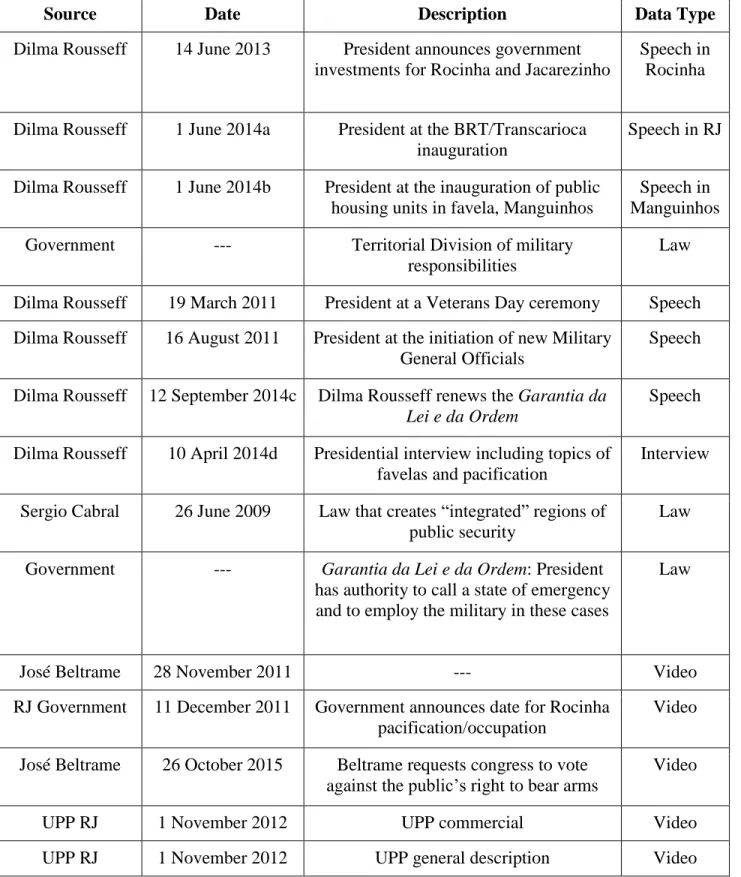
The main question driving this thesis is: How does the Brazilian government’s presentation of pacification differ from the lived experiences of residents within pacified favelas? More specifically, I was interested in examining (1) the construction of pacification by the government and, (2) perspectives from within the favelas on the realities of pacification. To do this, I used archives of documents and speeches to analyze discourse used by Rio de Janeiro’s government surrounding pacification, and conducted semi-structured interviews with six favela residents to understand their lived experiences of pacification. In this chapter, I outline my methodology, data, and analysis.
Archival data
The first set of data consisted of an analysis of the construction of pacification by the government, which is facilitated by the enormous presence that Rio’s government has on social media and their upkeep of digital archives1. This deliberate and conscious form of pacification’s representation within government speeches, coupled the physical presence of the pacifying police within favelas. Between 2008 and 2014, Sergio Cabral (Rio’s governor at the time), José Beltrame (Rio’s Secretary of Security at the time), and the former president, Dilma Rousseff, attended numerous events held within Rio’s favelas inaugurating public services and Pacifying Police Units (UPPs). These events were no small feat; there were gates filled with people waiting to hear the president, as well as about twenty of Rio de Janeiro’s top politicians present and simultaneously congratulated. The president herself attended all of the initiatives meanwhile commercials were
circulating Rio de Janeiro with advertisements coming directly from UPPs explaining their objectives. In addition, Sergio Cabral, José Beltrame, and all 38 UPPs have their individual YouTube channel consisting of a mix of videos representing every stage of pacification. Each UPP, and their respective police body, films the process of pacification, recording unedited, handheld selfie-videos of every stage. Further, Rio has a database of all government speeches and agendas called Palácio do Planalto: Presidência da República that was filtered for the following keywords: favela (and seven alternatives to “favela”), pacification, police, military, security, and integration.
Amongst hundreds of speeches, videos, and propaganda material, I analyze twenty-five that elaborate on how pacification occurs through deliberate and conscious discourse supplementing physical occupation. I chose to engage in this archival research for the reasons Jason Dittmer gives this method importance: “through the recognition and interaction of the various discourses in which we are embedded…meaning is created, power is conveyed, and the world is rendered recognizable” (2010, 275). Approaching these documents with an ontology of political geographies of militarization and securitization, all speeches were coded or categorized in order to help analysis. By coding, I took “text data or pictures gathered during data collection, segmenting sentences (or paragraphs) or images into categories, and [labeled] those categories with a term” (Creswell 2009, 186). These terms led to twelve categories which helped me delve into the data and establish seven dominant themes used to sell pacification to the public. These included the construction of favelas as a place, construction of a favela resident, nationalism and the establishment of a collective “we,” branding of public security, branding of success, technology, and pacification as race-less.
than the colonized (Nader 1972; Ashgate, Farnham, Surrey 2012). Yet, limiting my research to studying the Brazilian government would lead to an incomplete perspective of pacification because of the naturally skewed source of my information: the archives. Archives, especially those taken directly from government sources, are “still the source of knowledge about the colonial past” (Arondekar 2005, 11). In addition, allowing archival research stand alone is dangerous it allows for a single narrative to emerge of a place and people “recuperated from the breach and shadow of the settler archive and colonial history” (Arondekar 2005, 18). Because of this, I have chosen a mixed methods approach within qualitative data: beginning with the construction of pacification by the government, which juxtaposes favela residents’ perspectives of pacification.
Semi-structured interviews
variety of experiences with pacification in different favelas allowing me to extrapolate meaning from and give importance to the individual recounts of favela residents.
My participants were selected via the snowball sampling method, beginning with previous contacts and the already established precedence for entering these communities as a researcher. The interviews were set up prior to arriving in Rio due to the limited time and originally lofty goals. My initial goals for this part of my thesis looked vastly different from reality: I planned to conduct ten interviews and two focus groups. For several reasons, I found it difficult for to “come out” as a researcher within the favelas my contacts lived in which made me conduct fewer interviews than intended. Favela members have a historical memory of research being exploitive, with little in return for their stories being shared. In many ways, these criticisms are completely accurate, especially within the work I would ultimately do: I would leave the favela, return to UNC Chapel Hill, and write an honors thesis, while the lives of those who contributed to my thesis would remain unchanged. If time allowed it, I would have developed this thesis into a collaborative project not keeping the power and privilege of interpretation at my hands as someone who does not live in a favela and thus does not experience pacification intimately. However, sharing authority also means sharing control of the outcomes and while I attempt to let interviewee’s voices stand for themselves, I ultimately needed to formulate my thesis independently (Benson and Nagar 2006).
Thus, during the two weeks in Rio, I conducted five semi-structured interviews, all of which were recorded on a digital audio recorder and later transcribed for coding. The interviews were guided by the following questions:
interactions with the Pacifying Police Units? How present are police (of any sort) a part of your daily life? A part of my project consists of analyzing government’s discourse surrounding pacification; here is a clip of a speech that occurred in (date)—what are your impressions of this speech? How does (government figure) represent your community? Is this an accurate representation of your community members? How accurate of a description of pacification is it? After hearing this speech, and from your past experiences, how are members of your community usually portrayed by the government? What are the good or bad things that can be attributed to pacification? How are you and your community dealing with those benefits/problems?
The Participants
The five interviews included six participants from the following favelas: Rio das Pedras, Providência, São Carlos, Vidigal, and Rocinha, the largest favela in Brazil. By including interviews with favela residents, I am intentionally shifting the focus to the objects of pacification—favela residents. In national and international discourse, pacification usually expresses the government and police bodies’ opinions and it is essential for my research to break from this trend and include knowledge coming from within favelas instead of epistemology about favelas. In this same vain, it is important to give enough details of participants in order to humanize their experiences, while maintaining their anonymity through aliases and not specifying which favela they currently live in. The following paragraphs will detail the lives of Aline, Felipe, Bruna, Rosa, Danielle, and Priscila.
importance to staying informed in order to one-day participate in demonstrations if needed. If not a manicurist, Aline would make an excellent politician and community organizer.
Felipe and Bruna are a young couple who come from the Northeastern state of Ceará. Felipe grew up in Rio de Janeiro within two different favelas while Bruna only moved to Rio within the last five years. Because of their different experiences, I interviewed them separately. Felipe is a young entrepreneur who works in any job that involves meeting new people, taking every opportunity to inform them about the history of the city of Rio de Janeiro. Scared of the impact that the violence would have on their two sons, Felipe’s family moved to the suburbs of Rio de Janeiro when he was in his twenties. Now in his mid-thirties, Felipe has seen pacification in both of the favelas he grew up in while he lived there and during his visits. Bruna recently moved to Rio, quitting her job at the local radio station in her hometown near Fortaleza, Ceará to begin learning about wines and taking up a job as a sommelier at a wine shop at the mall. She is extremely professionally motivated; working twelve hour days while still managing to take English courses on the side. She lives in the same favela as Aline: a horizontally sprawling favela known for the vast amount of immigrants that make a home there from Northeastern Brazil.
Rosa has a different experience than my other participants in that she is a leader of a theatre non-profit in a compact, vertical favela. She has worked in several other favelas—some further from the city—but she speaks to her experiences where she has been for the last five years. Within this timeframe, she has seen the evolution of pacification: its strong beginnings to its eventual deterioration. Rosa is also used to giving interviews within her position at work, but it was the first time she spoke about pacification specifically.
worker for a family that she is still with today. In 2008, Danielle came to Rio from Chile for Carnaval where she met Priscila. Nine months later, she returned, married Priscila, and lived with her in a favela. They both love to dance, enjoy the beach, and travel as much as their jobs allow. They experienced the police raids prior to pacification, during pacification itself, and in the attempts to pacify the favela that the majority of Priscila’s family currently live in. They are particularly attentive to issues surrounding racism, police brutality, and the comparison of Brazilian and Chilean politics.
CHAPTER IV: ANALYSIS: TWO VIEWS OF PACIFICATION
THE REPRESENTATION OF PACIFICATION
Pacification is much more than BOPE’s initial entrance, the establishment of a police force, and the 24/7 presence of the Pacifying Police. Pacification includes the creation of a compelling discourse selling a military project, the establishment of a place/person/identity that necessitates pacification, and the technologies created to accomplish this promotion. This section explores how government discourse accomplishes these above tasks through seven primary themes.
Construction of Favelas and Favela Residents
The legitimization of pacification begins with creating a place and a people that necessitate pacification. The construction of favelas as a place is the creation of attributes assigned to favelas through government discourse, which in turn influences the policies or actions towards them. This section brings the literature review of “territory, place, and space” as well as that of “power” in conversation with the actual place making of favelas done by Rio’s government through government speeches. As previously mentioned, the creation of a place requires power, as its imagining is permeated with ideology (Knott 2009). Within Rio, the government has the power in place making and assigning attributes to locations is based on their biases and visions for the future of the city. Through excerpts from speeches and videos, I show the characteristics given to favelas and their residents that help justify and continue pacification’s agenda.
In 2013, a crowd of hundreds came to watch the former president, Dilma Rousseff inaugurate the PAC 2, the growth acceleration program that invested in infrastructure issues (Rousseff 2013). Within this speech, she distinguishes between the favela and its surrounding neighborhoods:
Investing in favelas in our Brazil was something, I would say, transformational. Transformational because not only does it improve the quality of life here, of the people that live in Rocinha, but it improves the quality of life of all the neighborhoods surrounding Rocinha. (Rousseff 2013)
In her speech, Rousseff outlines Rocinha as a particular place by differentiating its life as parasitic to surrounding neighborhoods, meanwhile making its improvement an investment, as it is beneficial to others. The demarcation of Rocinha occurs to both “hold things in and, more importantly still, keep other things out” (Philo 2012, 5). In her speech, and throughout the discourse on pacification, integrating favelas into the greater Rio is stressed, most frequently when thanking the military for their services integrating favelas (Rousseff 2011, 2013). However, Rio’s favelas have always been tightly bound to the political, economic, social, and cultural systems of Rio de Janeiro. After all, its residents largely created the physical structures of what the city is today (Perlman 1974). The government and police discourse surrounding pacification relies heavily on integrating favelas into Rio; however, it does not discuss its role in actively marginalizing those who live in favelas. As Janice Perlman contends, favelas are not marginal but “actively marginalized by the system and by public policy” (1974, 4).
What is important to note within this speech is that Rousseff was speaking directly to the people of Rocinha, something that as the head of the PT (the Workers Party, a political party in Brazil), she did often. Although pacification was a highly publicized tactic, its success depends on its credibility with the people that are being pacified
The visibility of favelas is solidified in Rousseff’s speech in 2014 at the inauguration of the transcarioca (the BRT), the rapid bus transit opening just before the World Cup. Rousseff states, “It becomes visible when we ride the transcarioca that, without pacification of the various neighborhoods here in Rio, this fantastic construction that is the BRT, would not be possible” (Rousseff 2014a). This statement complicates the visibility of pacified favelas versus the visibility of favelas in general. Through its vagueness, the questions of “what is it about these “neighborhoods” that would not allow for a new transit system?” and “what is it about these now pacified “neighborhoods” that make them visible?” arise. Rousseff continues to talk about the importance of a bus line that is above ground and exposes people to Rio’s landscape versus a metro that hides all of the realities by going underground. She states, “For many years, this whole region wasn’t visible, now it will be visible and now it will also be transformed” (Rousseff 2014a). The history of favelas corroborate that they have always been present, visible, and at odds with the wealthy parts of Rio de Janeiro. Through constant plans for demolition and removal, favelas have only been “invisible” to those who benefited from their lack of recognition. Here, Rousseff demonstrates discourse’s power; deeming when a region is “visible” or “invisible” and depending on that classification, calling for action or in this case “transformation” (Rousseff 2014a).
it is visible” (Portal UPP RJ 2012). Later, Rio’s UPP headquarters allowed the news agency, Jornal do Dia, to accompany them through the training of new Pacifying Police officers in the favela Mangueira in which the UPP general stated, “The first thing that the police has to do in this area of this service is identify your territory” (Jornal do Dia 2012). In both of these videos, a place is created in which pacification occurs and creates a visible transformation of the favela. The later speech shows that pacifying police, as a part of their training, must define the area that necessitates pacification, or generally, what counts as a favela.
Asserting a place matters, not only for those creating the definition, but also for those who experience the effects of it. Because of this, the characteristics and demarcations of favelas also reach their residents who in turn become people and not just locations that require pacification. Looking at two videos produced by the UPP’s YouTube channel, Portal UPP RJ, the history of favelas and their residents is shown through the lens of the UPPs. Above all stereotypes perpetuated by the archives, the two themes that were predominant was that of favela residents being involved with drug trafficking and favela residents as incapable of imagining and implementing change within their communities.
developed at the total absence of the government. In its early stages, politicians realized the control that new traffickers had as community leaders and began to work alongside them to obtain political support in exchange for monetary assistance with social projects in favelas (Arias 2006). In many ways, the police and state policy then sustain the existence of trafficking in Rio forming a relationship that is not “parallel” but instead one that helps maintain a trafficker’s power over favelas (Arias 2006). The language used to describe favela residents as drug dealers, has negative consequences mentioned by Teresa Caldeira (2000):
The fear and talk of crime not only produce certain types of interpretations and explanations (usually simplistic and stereotypical); they also organize the urban landscape and public space, shaping the scenario for social interactions, which acquire new meanings in a city becoming progressively walled. (Caldeira 2000, 19)
In the case of pacification, this means using a communicative tactic to “legitimize the militarization of civilian territories” and creating a place, the favela, where peace has to be brought into (Saborio 2013, 132).
Unlike what Paulo Henrique says, the “first step” may not be the police; rather it may be a discussion of what favela residents want and need. In Aranda-Comer and Gama’s article, “If The City Were Ours,” Rocinha residents discuss changes to public policy that directly affect them (2015). It is clear that not only do members of favelas have the ability to make decisions for themselves but they also crave that jurisdiction over their lives (Aranda-Comer and Gama 2015). This form of community control is a feasible alternative to Pacifying Police Units that already exists but receives little to no attention.
Nationalism and the Collective “We”
Through all government speeches, there is a presence of nationalism and an attempt at a collective ownership of pacification. Dilma Rousseff was the primary speaker, giving speeches within various favelas that were highly emotional, and occurred most often during an inauguration of new buildings and public housing within favelas. The following quotations are examples of the emotions and the nationalism conveyed:
“I know that the real Brazil, the real Brazil, my true Brazil, the Brazil that I owe my elections to lives here, are here, and this is the Brazil that allows for us to change.” (Rousseff 2013) “We created, more and more, a process in which the people, the people of our country, the true Brazilian, the worker, the entrepreneur, the hairdresser, the owner of the shop, the factory worker, can all have a turn. Have a turn to be the object of concern of the federal government’s politics.” (Rousseff 2013)
of concern of the federal government’s politics.” Her convincing words are given credibility as they are usually at a timely event where a project is being revealed. For example, at the Minha Casa, Minha Vida, reveal Rousseff said,
We believed that people had the right to have their own house. What people? Not the rich who can pay for their own houses. The right to access this dream of having a decent house to live in could only be given to the most poor. So, what did the government do? …The federal government put their hands in their own pockets, in their own pockets, and created a public housing program called Minha Casa, Minha Vida.” (Rousseff 2014b).
Rousseff recounts the creation of public housing units as a direct relationship she has with the residents of a favela; reaching into her own “pocket” to provide a social project. This speech is a form of gratitude that she expresses to its residents for voting for her and it creates an image of the government working for projects that it wants with ease.
confrontation. It can’t just be police officers, we can’t work alone. This project is everyone’s” (Carvalho 2010). These examples show that through the inclusive discourse of pacification, the ownership of government projects can be dispersed to the objects of the project themselves using both nationalism and a sense of a collective “we.”
Public Security
Another form of selling pacification is branding it as a stride toward public security. Beginning with a publicized creation of fear of a particular type of people, favela residents, Rio justifies pacification by stating that it is necessary for the security of the city. This was not too far from what Loïc Wacquant describes during the 1980s campaign in the United States to criminalize and effectively discard or imprison “those segments of urban society deemed disreputable, derelict, and dangerous” (2001, 107). Here Wacquant speaks to the replacement of the ‘Black Codes’ of reconstruction or slavery itself with the carceral institution as a new tactic to constrict Black people (2001). In Brazil, the government’s discourse of favelas and their residents has crystalized a false reality of people who pose a risk to Rio as a whole. In the United States, authors including Khalil Muhammad, Antero Pietila and Ruth Gilmore, attempt to explain this myth and reconfigure what has for so long been a part of the white spatial imaginary.
Pacification sold as public security not only creates a society based on fear but it also gives a false sense of public input in the military project. In Rafael Dia’s interview for Sur International Journal on Human Rights, he expresses how the Pacifying Police Units are often times wrongfully
would not have chosen an “overt and permanent presence of the armed police implies the militarization of everyday life in these communities” (Saborio 2013). Instead, coupled with pacification in Rio de Janeiro was the release of the Garantia da Lei da e da Ordem (Guarantee of law and order) which allowed the President to bear full power to employ the military forces until “the reestablishment of normalcy” in order to “preserve public order, [and] the integration of the population” in a community (Rousseff 2014c). In her speech during the reinstatement of this law she claimed, “this was the origin, the origin of all the transformation of Rio de Janeiro, the origin of all the transformation in the sector of our conception of public security” (2014c). These declarations of public security being brought to Rio, Saborio describes as a “communicative tactic used to legitimize the militarization of civilian territories” (Saborio 2013, 132).
Success
public speaker and those listening to this speech within Rocinha, may reasonably feel a connection with the president who is introducing new public services to the favela. These inaugurations also are used as examples of the government’s tangible accomplishments. Using this in her favor in a later speech, Rousseff states, “One thing is putting something on paper, it is another very different thing to apply it, to know that it works” (2014c).
The portrayal of success is also essential for the Pacifying Police to believe in their own pacification efforts. Thus, there were numerous awards created and ceremonies held to commemorate officers. For example, in one of these ceremonies, recorded and published by the Rio de Janeiro Government’s YouTube channel, José Beltrame expresses why it’s important to congratulate the police involved with pacification because it “not only recognizes the activities of the police officers, but also other activities that the officers have done for the community. The people that have engaged in this process and also produced really positive results” (Governo RJ 2016). In the second portion of this chapter, I will compare the claimed successes of pacification with the realities of pacification experienced by favela residents.
Technology
It was time to establish public security policy with heavy investments in technology…and a new concept of combating criminality. The state government began doing what seemed impossible: win the war against trafficking and violence. (Portal UPP RJ 2012)
Nearly all of the themes touched on above are used within this narrative told by the UPPs including the construction of favelas and favela residents, branding pacification as public security, and publicizing the program’s “successes.” The technologies that the quotation refers to are never fully explained as the commercial continues to say, “With new equipment, vehicles, and modern technologies, the UPPs take care of people. The role of the police is to prioritize the preservation of life and liberties” (Portal UPP RJ 2012). Dilma Rousseff also refers to “technologies” when speaking about the World Cup stating, “we are leaving a legacy for our population, for our people, something fundamental which is putting technology at the service of public security” (Rousseff 2013). When Rousseff clarifies what technologies she is talking about, she points to “devices that ensure a very precise degree of oversight of events, which allows you to control violence in a region,” or as I interpreted it, the everyday surveillance of the lives of favela residents (Rousseff 2013). Interestingly, many favelas began installing their own cameras in public spaces during the World Cup and Olympics to monitor the actions of the pacifying police and tourists (Kuitert 2016). The conversation of technology is another prominent difference between the narrative told by the government and that of favela residents. These differences will later be discussed with the introduction of the interviews conducted in Rio de Janeiro.
Pacification as Race-less
is most prominent in the context of a military program that disproportionately affects Afro-Brazilian people. Given the historical relationship that favelas have with race, the absence of race becomes evident in pacifications discourse.
Despite Afro-Brazilians accounting for 50.7 percent of Brazil’s population, Black people were disproportionately disadvantaged (beginning with being forcibly enslaved) in Brazil creating a social hierarchy that is reflected spatially in its largest cities (Berenguer 2014). Despite these facts, Brazil has claimed itself as race-less with the proponent of this idea being Gilberto Freyre. In 1987, Gilberto Freyre, introduced the term “mixed race” explaining how Brazilians saw themselves as racially more complicated than Black, white or Hispanic (Rosas-Moreno and Straubhaar 2015). In his book, Casa Grande e Senzala, Freyre claims that Brazil was unlike any other society in that it was free of racism. Freyre also argued that Brazil had “a more benign system of slavery and as a result was ‘free of the racism that affected the rest of the world’” (Farfán-Santos 2011, Freyre 1956, xiii-xv). However, by enforcing that racial myth, we fail to enforce the few laws that can exist to counter racial discrimination (Rosas-Moreno and Straubhaar 2015). By its enforcement, we also continue to disregard the history of Afro-Brazilians and the systemic racism that Brazil perpetuates.
The “invisibility” of race is also maintained today within the discourse of favelas and pacification. Between all twenty-five speeches analyzed, race appears once at Rousseff’s inauguration of the BRT:
and affection in the deal.2 (Rousseff 2014a)
Despite mentioning race, Rousseff paints a similar picture to that of Freyre’s race-less or post-racial society. This points to the pluralism in race within Brazil but it is simultaneously from a privileged perspective of Rousseff, who does not consider that the “combination” of races was a product of slavery and often, the rape of women of color.
PACIFICATION’S OTHER IMAGININGS
In the previous section, I recounted one side of pacification: the tremendous effort on the government’s part in publicizing pacification while accompanying the physical insertion of the military within favelas. A part of pacification’s story is also the generated responses and concerns of favela residents regarding its implementation. This section will speak to how pacification goes beyond carefully constructed official discourse by generating conversation amongst residents of favelas. Speaking to residents of four different favelas in Rio de Janeiro, I listened to six people share their experiences with pacification. Often times the conversations responded directly to themes within the formulated government discourse of pacification. Other times, newly emerging themes were consistent in what people found important when talking about pacification. These themes included geographies of pacification, the lack of trust in the Brazilian government, the proximity to drug traffickers, and the change in the Pacifying Police Units since its 2008 initiation. Reorienting the conversation of pacification to favela residents allows for a comparison of the advertised versus the realities of pacification. Here, I am intentionally shifting the focus to the objects of pacification—favela residents. With this in mind, I try to have the voices of favela
2 Nós também, que somos um povo afrodescendente, indígena, e também com toda a tradição branca, a
residents to speak for themselves allowing knowledge to come from within favelas instead of analyzing epistemology about favelas.
Nearly all interviews touched on the themes that were consistent across the language used by the government and military: construction of favelas and favela residents, nationalism and the collective “we,” public security, success of pacification, and race. However, across all conversations, there was a more explicit direct response to the themes of public security, the success of pacification, and Mega-Events. To facilitate the explorations of these topics, I have broken each major theme into its individual section. To protect their identities, throughout this section I will be referencing all of the people I interviewed by an alias and will not be identifying the name of the favela they live in.
Success
order for people to buy pacification, “you have to sell it as a good thing, the best thing in the world3.”
Rosa, another person interviewed, was a strong proponent of separating the initial pacification effort and the current reality. Rosa viewed the Pacifying Police Units as entering “serene, strong, and wanting to create a dialogue. And now, pacification is completely different. They are alert, tense, nervous, fearful.” All people interviewed agreed on this point, however Rosa went further to describe what I argue is a third phase of pacification: “The situation is, in popular terms, spoiled. It comes and presents itself as a solution, and it had a good opening, it was necessary, but today the image is already different. It is already descending” (Rosa). This descent is interesting because it justifies the many fears of what pacification looks like after the World Cup and Olympic games—a point that deserves its own section as all favela residents mentioned these Mega-Events. In these quotations, Felipe and Rosa both acknowledge the hope these residents gave pacification initially. In both of their interviews, they recognize the problem that drug trafficking posed favelas and saw that something needed to change. However, eight years after its initiation, it is difficult for interviewees to recall the positivity they originally felt.
Instead, pacification is viewed as an empty promise on social services and a temporary mask for national and international media. Aline, a Rio de Janeiro resident who stresses the importance of reading and listening to the news, reflects on pacification in the following way:
Now that it has been eight years, we can see that [the vision of pacification] is different from what happened in reality. It was a project that never came, a project where the only thing that happened was putting police in favelas, no social actions. (Aline).