Anthony
The rise in popularity and ubiquity of social media has led to an increase in archival collection of social media data. Collecting and preserving this data is a relatively new challenge and creates technical and staffing barriers for archives. In an exploratory study of the practices and ethics of social media archiving, thirty-eight archivists responded to a Qualtrics survey about their institutional practices, their opinions of the ethical
responsibilities of archives toward social media users, and the questions they still have about social media archiving. The survey revealed that only half the participating archival institutions collect social media. A majority of institutions collect data from blogs,
Facebook, and YouTube, and most report using some form of API collecting tool. After reviewing the results of the survey, some current social media collecting policies, and a national web archiving survey, findings were framed using the ethical concerns voiced by the Documenting the Now project. The study suggests that archivists in general have the desire to use donor agreements and other permission forms for social media archiving, but the tools to contact all potential users are not yet available. This study forms an initial argument for further research into the best practices and ethical responsibilities of social media archiving.
ARCHIVING
by Miana Breed
A Master's paper submitted to the faculty of the School of Information and Library Science of the University of North Carolina at Chapel Hill
in partial fulfillment of the requirements for the degree of Master of Science in
Library Science.
Chapel Hill, North Carolina April, 2019
Approved by:
Table of Contents
1 Introduction ... 3
2 Literature Review... 5
2.1 The Prevalence of Social Media Archiving ... 6
2.2 Legal Considerations ... 8
2.2.1 Copyright and Retrieval of Social Media... 9
2.2.2 Terms of Service ... 11
2.2.3 Privacy Expectations ... 11
2.3 Ethical Considerations ... 13
2.3.1 Ethics of Collecting ... 13
2.3.2 Research Ethics ... 17
2.4 Social Media Archiving Tools ... 18
2.4.1 Social Feed Manager ... 19
2.4.2 twarc ... 20
2.4.3 ArchiveSocial ... 21
2.4.4 Archive-It ... 23
2.5 Real-World Examples ... 24
2.5.1 Duke University ... 25
2.5.2 State Archives of North Carolina ... 26
2.5.3 National Archives and Records Administration ... 27
3 Research Questions ... 30
4 Methods ... 31
4.1 Participants ... 33
4.2 Data Collection ... 33
5 Findings ... 35
6 Discussion ... 55
6.1 Recommendations from Groups, Professionals, and Projects ... 56
6.1.1 Lack of Awareness ... 56
6.1.2 Potential for Manipulation of Data ... 57
6.1.4 Difficulty Applying Traditional Archival Practices ... 59
7 Conclusion ... 61
8 Appendix ... 63
1 Introduction
Since its inception in Cold War-era government research labs, the Internet has become an integral part of the everyday lives of most Americans. The newest generation of legal adults has not known a time in which the Internet did not perform some function, vital or otherwise, that affected them personally. The question is not whether the Internet is a valuable part of our history that needs preservation. Instead, the question becomes, what parts of the Internet do we save, and how do we do it?
Arguably, social media is the most difficult aspect of the Internet to archive. The shifting, evolving nature of most social media websites renders the collection of data and the capture of specific moments a complex task. There is also the issue of ownership. Websites often have a visible creator and, if multiple people are involved, authors of specific pages and posts. Social media sites like Twitter and Facebook often have an original poster, multiple people who have liked or interacted with the post, and then the social media site itself.
These are all issues that affect the way an archive will treat, describe, and retain records. There are tools for archivists and records managers to use in their pursuit of a website collection, but the needs of social media archives are different from those
accessible. However, should we disregard legal and ethical considerations in the pursuit of easy and accessible, or do the available tools perform those functions for us too?
After examining the literature and discussions centered around archival ethics in a digital age, I realized that a great many university and governmental archives in the United States do not have a visible social media collections policy or collecting guidelines. It is difficult, therefore, to determine which of the professionals’,
2 Literature Review
The past three decades have seen significant leaps in the use and development of the Internet. In a 1997 paper written for the 63rd annual International Federation of Libraries Associations and Institutions (IFLA) conference, Terry Kuny expressed a fear that, without adequate interest and investment in digital preservation, the documents and history of the modern age would be lost. He lamented that “[we] are, to my mind, living in the midst of digital Dark Ages; consequently, much as monks of times past, it falls to librarians and archivists to hold to the tradition which reveres history and the published heritage of our times” (Kuny, 1).
A year before Kuny’s IFLA paper, Brewster Kahle founded the Internet Archive with the mission to provide an online digital library with access to digitized books, audio recordings, videos, images, web pages and more. According to the Internet Archive’s website, the non-profit began in 1996 by archiving the Internet: “Like newspapers, the content published on the web was ephemeral--but unlike newspapers, no one was saving it” (Internet Archive). In order to avoid Kuny’s digital Dark Age, the Internet Archive crawls and stores the code of over 330 billion web pages and hosts over 30 million other forms of digital cultural artifacts. The digital abundance shows no sign of slowing, which makes projects to preserve the Internet and other digital spaces of utmost importance.
fleeting photos and messages will disappear after 24 hours. So, then, how is archiving social media different from archiving the web? In some ways, the differences are few. Archive-It, the Internet Archive’s web archiving service, has the capability to collect some social media sites, albeit with varying degrees of success. A web page may have two or three varieties of content, such as text, image, and video, but social media is comprised of linked sites, web sources, and text. A single Facebook post can be comprised of a block of text, a profile picture, a video, and a stream of comments with moving GIFs. It is no wonder, then, that developers have created tools and services specifically for the archiving of social media.
2.1 The Prevalence of Social Media Archiving
Later in the NDSA survey report, several questions focused on institutional policies for Web archiving programs. While not all policy questions included social media, some of the content can apply to both web and social media archiving. Of note was the relative consensus toward permission policies, which most (70%) considered unnecessary. A permission policy requires an institution to “seek permission or attempt to notify the content owner that their website is being archived” (24). The report says that this number is up slightly from the 2016 survey, indicating a general trend of archives to not seek permission to archive content. The relatively low (9%) number of individuals who had ever received a takedown request for their archived content may cause this, according to the report (27).
In the same vein, only 14% of archivists surveyed used embargoes or access restrictions on their web archives, and 6% kept their web archives dark (28). This trend toward open access continued through the discussion of whether archivists respected robots.txt files (files that web developers include in their code to restrict web crawling): 64% of participants said that they respected these files only sometimes and 10% saying they never respect them (29).
around social media archiving found in their 2013 report might have subsided over the years due to the increasing technological challenges of collecting social media.
The question then becomes whether archives have social media policies, what they should contain, and whether they should be separate from a general web archiving policy. While it may be tempting to lump all online services into one large category, it is important to note the distinctions between a web page and a social media account, hashtag, or location feed. Web pages often have identifiable creators with contact information and web management. One or more people may run social media accounts, with varying degrees of transparency. The linked nature of social media often makes it difficult to capture the context that surrounds every tweet or Facebook post, which can lead to misconceptions and misuse by researchers who do not have the full picture. In addition, social media accounts very often contain personally identifying information (PII) that may or may not be harmful to the individual if someone were to archive their identity and use them in research. Consequently, the concerns surrounding social media archiving are somewhat different from those of web archiving, which may change the archivist’s approach and require further explanation and guidance.
2.2 Legal Considerations
online content. Finally, this section will include a short discussion of where the United States may be headed in terms of social media privacy and usage.
2.2.1 Copyright and Retrieval of Social Media
The copyright and intellectual property laws of the United States are somewhat muddled when it comes to social media. The current law, the Digital Millennium Copyright Act (DMCA) of 1998, has not significantly evolved to include the problems and exceptions born-digital and social media content may require. In their online Social Media Archives Toolkit, North Carolina State Libraries discusses the liminal nature of social media: “Current laws fail to directly address social media, and discussions and conflicts regarding their legal standing are ongoing in the courts” (Legal and Ethical
Implications, np). While the NC State project began in 2014, a majority of the toolkit’s
information holds true in 2019. Without a new, technologically friendly copyright law on the books, the intellectual property debates will continue to be slugged out in the court in order to set precedent.
However, some debate exists regarding the laws that apply to social media
content ownership. Tiffany Miao, in her 2013 article for Fordham’s Intellectual Property, Media & Entertainment Law Journal, frames her discussions of legal recourse around a social media account created for a business rather than an individual. Miao argues that parties should use the Computer Fraud and Abuse Act (CFAA) to litigate social media content disputes instead of Copyright law, which does not adequately address all aspects of social media accounts (Miao, 1020). Miao’s three key assets include access
information (password), posted content, and subscriber lists. Her assertion that
intellectual property laws are not adequate for computer-based content both highlights the gaps in copyright protection and enhances the argument that digital-age laws should be in place to guard digital entities.
Social media archiving tools do not directly address copyright and, therefore, archives must themselves consider them. Archives and other memory institutions have long been able to claim fair use for most items they collect and provide access to, but digital items can sometimes prove more difficult than analog collections. The NC State toolkit agrees that, amid the ambiguity of current copyright law, fair use “provides
2.2.2 Terms of Service
Terms of service apply to both the users of social media platforms and the
archives and other entities collecting social media data. On the user side, terms of service (ToS) include privacy policies and intellectual property rights. Twitter’s ToS explain that users retain the rights to any content they submit, post, or display on Twitter. This
protects text posts, photographs, videos, audio, and other original content. However, by submitting content to Twitter, users give Twitter a license to “use, copy, reproduce, process, adapt, modify, publish, transmit, display and distribute such Content in any and all media or distribution methods” (Twitter Terms of Service, np). Facebook’s ToS has similar language granting users the rights to their own content and a distributing license to Facebook.
Alternatively, data collectors such as archives, applications, and data mining services are restricted somewhat by terms of service. API collecting, which uses a platform’s Application Programming Interface (API) in order to access site content and retrieve data, is sometimes limited to a certain number of queries or requests per hour. Twitter, for instance, divides its rate limits in 15-minute windows that allow applications to retrieve data 180 times in each 15-minute increment (Rate Limiting, np). Many
archiving tools help archivists abide by these terms of service automatically.
2.2.3 Privacy Expectations
Twitter, Facebook, and other platforms’ culture. Posts go around every few years on Facebook warning users that everything they have ever posted will become public if they do not publish a disclaimer (Mikkelson, np). Snapchat released a feature in 2017 that shared users’ locations on Snap Map every time they opened the app if they opt in to the service (Deahl, np). Users have speculated that apps and websites listen to their
conversations through their phone’s microphone or gather words from emails in order to target ads (Tiffany, np). While some of these stories may seem like paranoia, many users have cause to be concerned.
Amid this growing worry that entities are using social media data in ways that go beyond the advertisement algorithm that keeps social media platforms solvent, a scandal in March of 2018 exposed exactly how some entities use that data. Authorities found that Cambridge Analytica, a data analytics firm hired by the Trump 2016 campaign, collected the Facebook data of 87 million accounts using online personality quizzes and other means. Technicians analyzed the psychological data gathered by Cambridge Analytica and used it to create ads, campaign videos, and Facebook pages that sent users pro-Trump messages (Meredith, np).
data exposure. According to a report from CNET, Twitter and Facebook have extended the rights afforded to Europeans by the General Data Protection Regulation (GDPR) to give people the right to access and delete data that social media and other companies collect about them (Hautala, np). These rights are reflected in the ability to download your personal data archive and set retroactive privacy measures to remove yourself from certain ad and collection groups.
Archivists are not using social media data to advertise or otherwise make a profit. Instead, privacy in archives becomes as much an ethical issue as a legal one. Since social media is generally public and widely available, laws such as HIPAA and FERPA do not apply. Instead, the expectation of privacy is laid out in the Society of American
Archivists’ Code of Ethics, which states that “[as] appropriate, archivists place access restrictions on collections to ensure that privacy and confidentiality are maintained, particularly for individuals and groups who have no voice or role in collections’ creation, retention, or public use” (SAA Core Values Statement and Code of Ethics, np). At this stage of digital archiving, most social media users do not have a say in what is collected or even know that their posts are being harvested. How, then, do archives address privacy issues?
2.3 Ethical Considerations
2.3.1 Ethics of Collecting
companies, state and federal government, public and private universities, and local historical societies. Each archive is unique, and each comes with its own set of rules, regulations, mandates, and collecting abilities. Governments are required by public records law to retain all interactions with government accounts. Universities may choose to archive their departmental and official accounts to keep a record of campus life and major events. However, the archiving of hashtags, Twitter feeds, public accounts, and other non-affiliated social media may pose difficult ethical questions.
Catherine Marshall and Frank Shipman’s 2012 study on institutional archiving of social media explains the sharp difference between social media archiving and other, traditional methods of collecting:
Most transfer of personal materials to institutions used to be done by explicit design, through donor agreements that linked individuals and their families with specific archives or libraries that had the resources to maintain such collections, and possibly to provide future generations of historians and researchers access to them. (Marshall and Shipman, 1)
Their paper’s introduction reacts to the 2010 Library of Congress project to archive all public tweets after a donation from Twitter, which included all posts since the platform’s birth in 2006. The study they subsequently conducted found that archivists had many concerns regarding social media capture, including the need for obtaining the creator’s permission, privacy, the value of the content, the veracity of the content, and the social good (7-9).
nor does it provide criteria for collected tweets (Osterberg, np). In a 2010 blog, the Library of Congress made the argument that “Twitter is part of the historical record of communication, news reporting, and social trends--all of which complement the Library’s existing cultural heritage collections” (Raymond, np). This reasoning mirrors the findings of Marshall and Shipman, who discussed the potential argument that the social good outweighs the needs of the individual (Marshall and Shipman, 9).
Other archives have since begun to archive social media in much the same way they archive websites. Tools have emerged, both proprietary and open-source, to aid in the capture and preservation of social media records. Several tools, such as ArchiveSocial and Social Feed Manager, have sections on their websites that focus on the ethical issues surrounding social media archiving. I will discuss these tools in detail in the next section of this paper, but their ethical discussions are situated here.
ArchiveSocial, an archiving service that focuses on government and other
publicly funded agencies, recommends creating a comprehensive social media policy that identifies social media as a public record and plans for retention. Their blog says, “if a government agency is communicating via social media in any official capacity, those communications could be considered public record--and records have to be retained” (Gordon, np). They emphasize the requirements of a FOIA request and state retention laws, which should govern agencies’ social media policies.
Manager users to abide by Twitter policies, which includes advice to “only post tweet ids of the tweets. To be clear: Do not publicly post or share datasets which contain the text of tweets” (“Social media research ethical and privacy guidelines”, 2). The paper also reminds SFM users that social media account holders have not given consent for posts to be collected for research, and GWU requests that users be sensitive to the privacy of personal accounts.
Finally, in 2018, the Documenting the Now (DocNow) project, which the Andrew W. Mellon Foundation funded, focused on the development of social media as a
collecting area in modern archives. Specifically, the project addressed the inclusion of social media posts written by activists, marginalized peoples, and at-risk groups in project archives and other collections. The project produced discussions and conclusions
regarding ethical practices, basic guidelines, and recommendations for the future of archival practices and collecting policies. Through their project, developers have created several social media archiving tools and released them as open-source software, one of which I will discuss later in this paper.
The DocNow project produced a white paper that discusses social media in terms of its usefulness and its pitfalls.
While such digital content adds a new layer of documentary evidence that is immensely valuable to those interested in documenting, researching and interpreting contemporary events, it also presents significant archiving, data management and ethical challenges for archivists and other historical documenters. (Jules et. al, 2).
the usual rigor to social media content “given the sheer volume of data and complicated logistics of interacting with content creators” (3).
2.3.2 Research Ethics
While some archives, such as the Library of Congress, place embargoes on their social media content, the purpose behind collecting records is to someday share them with researchers. SAA’s Core Values Statement places access and use in the forefront, stating that “archivists seek to promote open access and use when possible” and “use of records should be both welcomed and actively promoted” (SAA Core Values Statement
and Code of Ethics, np). Whether now or in 15 years, researchers will use social media
archives for a variety of studies, papers, and works of fiction.
In an ethics guide to social media research for the University of Aberdeen, Dr. Leanne Townsend and Professor Claire Wallace provide a set of use guidelines for researchers, students, and other entities. Their paper identifies four key points of concern: private vs public, informed consent, anonymity, and risk of harm (Townsend and
Wallace, 5). I would argue we could also apply their paper’s concerns to social media collecting, which can and will directly result in social media research. The onus often shifts from one place to another when considering ethical and legal responsibility. The archiving tool moves the responsibility to the archive, which in turn places the burden on the researcher.
Caitlin Rivers and Bryan Lewis strove in a 2014 article to develop ethical
stands for Transparent, Anonymity, Control, Tracking, IRB, and Context. Their
suggestions would lead to studies that are publicly available, keep Twitter users’ privacy intact, provide context for the data, and include scrutiny by an Institutional Review Board. They also recommend respecting users’ privacy settings (Rivers and Lewis, np). While these suggestions are sound, it does seem rather impossible in the searchable digital age to prevent someone from tracing a user’s tweets back to them.
2.4 Social Media Archiving Tools
After understanding the legal and ethical issues that archives and other users of social media data must consider, it is important to examine the tools that are currently used in the archiving community to collect social media posts. Truman (2016) notes that “many of these capture and analysis tools are very specific to narrow types of media (e.g. capturing tweets)” and do not fulfill every need (27). This section will examine several of the better-known social media archiving tools and explain what each of these tools does, the affordances its collecting methods offer, and the perceived ethical pros and cons of the tools. While this list is certainly not exhaustive, it will cover the basics and provide a glimpse into the types of tools that are available.
2.4.1 Social Feed Manager
George Washington University designed Social Feed Manager, an open-source tool, to harvest data from Twitter, Tumblr, Flickr, and Sina Weibo. The goal of the tool and its creators is to make social media archiving accessible for students, faculty, archivists, and communities. According to a 2016 journal article from Social Feed
Manager developers, “SFM uses the Twitter API to collect tweets from an identified user or to filter the stream of all tweets based on user, keywords, or geolocation” (Littman et al., 21).
The application requires users to supply credentials for the social media sites they wish to collect. For instance, in order to create an archive of blog posts from a particular Tumblr account, SFM will need the ability to log into Tumblr and access the blogs via the API (application programming interface). The user is responsible for setting up collection rates and abiding by each social media site’s terms of service (API Credentials, np). SFM has a comprehensive guide to setting up the tool, adding credentials, creating collections, and managing a social media archive.
identifiers of the social media posts, accounts, or individual items (“Releasing public datasets”, np). It is then up to the researcher to retrieve the dataset using the ids, which should only produce items that have not been deleted or restricted by the authors.
2.4.2 twarc
Twarc, which the Documenting the Now project developed, is an open-source command line tool that uses Python library scripts to harvest JSON Twitter data through Twitter’s API. This tool allows users to collect the fundamental data that makes up a tweet, including the tweet id, creation date, content, and user id. The Twitter data is exported as a CSV spreadsheet that can be further analyzed, uploaded, and preserved (A
Command Line Tool (and Python Library) for Archiving Twitter JSON, np). Twarc can
search via account, Twitter feed, hashtags, and geolocations in order to collect the data desired by archivists.
Documenting the Now has a suite of social media harvesting and parsing tools, including twarc. They have also developed a tool, called Hydrator, which takes tweet ids and uses Twitter’s API to find the full content of those tweets. By using ids and Twitter’s API, Documenting the Now’s tools that take the individual’s wishes into consideration. The DocNow tools cannot “rehydrate” a deleted tweet. Similarly, twarc will not harvest an owner’s deleted or privacy-protected tweets.
applications, and the Hydration section, which discusses the sharing and use of Twitter data (A Command Line Tool (and Python Library) for Archiving Twitter JSON, np). As discussed in the Ethics section of this paper, Documenting the Now places large emphasis on ensuring the rights of Twitter users are appropriately cared for. Their recommendation for archivists and other social media data collectors is to share only the list of tweet ids generated by twarc, rather than the entire JSON string associated with the tweets. Not only does this put the responsibility for content retrieval on the researcher, but it also allows Twitter users to maintain the power to delete and edit their tweets.
However, like most tools, twarc is susceptible to misuse. The CSV that the application produces contains all the data about a tweet, including the content and hashtags of an individual post. If the collecting organization were to ignore the recommendations of DocNow and Twitter and provide the entire CSV to researchers, there would be no way to determine if the tweets themselves were still publicly available. The amount of data shared is left up to the collecting institution, although DocNow makes concerted efforts to enforce Twitter’s rules.
2.4.3 ArchiveSocial
also provides “replay” services, which allows posts to appear in their original context with comments, likes, and other interactions preserved (Social Media Archiving, np). The ArchiveSocial service advertises itself as the “most trusted social media archiving solution for public agencies & K-12 districts to maintain public records of social media” that is used by more than 1,800 agencies (Social Media Archiving, np). The service itself is a cloud-based storage solution that saves social media content, creates timestamps for each post and record, and allows government entities to retrieve their data
(Solution Overview, np). Unlike many other collecting tools, ArchiveSocial does not
require much action from the organization or agency collecting their social media. Rather, its own employees run ArchiveSocial and collect social media data through account information provided from the agency requesting the archive.
It is not readily clear exactly how ArchiveSocial collects social media posts, other than their assertion that they interface directly with social media sites (Solution Overview, np). Without requesting a full demo and tutorial, the information on the website includes the following: The storage is cloud-based and allows organizations to view and export their records at any time. Social media accounts must give access to ArchiveSocial in order for archiving to begin. Once added, ArchiveSocial can create a complete historical archive of all posts created prior to starting the archive. Finally, ArchiveSocial can include retention rules in order to set up automating record scheduling (Solution
Overview, np).
who interact with those agencies online are creating public records with their comments and replies. However, this also means that most users of ArchiveSocial will not be collecting data from accounts they do not own and operate, which can be the case in an academic or activist archive.
2.4.4 Archive-It
Introduced in 2006, Archive-It is the subscription web crawling service of the Internet Archive. The service allows archive partners to harvest and preserve collections of online content that is stored and hosted in Internet Archive data centers (Internet
Archive: About IA, np). Although not specifically intended for social media archiving, the
service can capture social media pages and posts that are not behind a login page or pay wall. Institutions can catalog and describe the websites and social media accounts they crawl and make their Archive-It archives available to patrons through an online portal. Archive-It works with more than 400 partner organizations in the US and 16 countries across the globe (Internet Archive: About IA, np).
The Internet Archive, where all Archive-It data is stored, can replay social media feeds in a way that looks and feels like visiting the “live” webpage. However, unless certain scoping and seed rules are applied, social media data will not be replayed fully. For example, Archive-It warns its users not to expect a Twitter feed to replay perfectly if dynamic content is present, such as video, GIFs, etc. (“Archiving Twitter feeds”, np).
Some content, such as Facebook posts only available to friends, will block a crawler with code called robots.txt. These blocks are a “tool used by a webmaster to direct a web crawler not to crawl all or specified parts of their website” (“Avoid
robots.txt exclusions”, np). Archive-It provides a feature that will allow its web crawlers to ignore robots.txt, which should let the pages in question be archived. The help pages do suggest that an archive contact the webmaster of a particular page to request
permission for Archive-It crawlers to crawl their site, but users can ignore robots with the click of a button. The institution or organization creating the archive dictates all crawling time and data limits, to a certain extent.
2.5 Real-World Examples
When looking for social media archiving practices in action, it can be difficult to find examples of collecting policies, guidelines, and collections that are available to the public. As referenced in the NDSA 2017 survey, only 11% of survey participant
media collecting policies, they do represent the policies I was able to find through Internet searching and word of mouth.
2.5.1 Duke University
Duke University’s social media policy is linked with its website policy. They discuss the collecting scope of the University Archive and include the platforms they archive, Twitter, Facebook, and Instagram, but leave room for future additions. One section of the policy overview states that Duke “will occasionally collect materials not through an account but through shared hashtags, in order to preserve conversations on topics of importance to university history” (Duke, 2017). They also include a disclaimer that some social media platforms are difficult to collect and do not guarantee that they will be able to collect all social media platforms on an ongoing basis.
In a topic that is relevant to the 2018-2019 activist climate, Duke’s policy also contains a section on web collecting relating to campus controversies. This section highlights the possible reasons for collecting material on controversial events, includes a basis for appraisal, and states that “care will be taken to consider legal and ethical concerns, and to select resources that have statements of attribution” (Duke, 2017). The content Duke collects may affect members of the university and surrounding community, which makes it imperative that their collecting be as conscientious as possible.
breaks research access down into Archive-It collections, collections for reading room use, and restricted collections. The finding aids include web and social media collections are included in the finding aids under the University Archives’ Web Archive, which also provides links to content or catalog records. They provide for changing terms of service and varying degrees of privacy concerns, noting that some social media may be restricted (Duke, 2017).
2.5.2 State Archives of North Carolina
Unlike the Duke University archives, the State Archives of North Carolina (SANC) are a government archives that must abide by public records law. Once again, the umbrella of web-based activities covers social media and website archiving. In a 2003 guidelines document, SANC explains their warrant in collecting web content by
emphasizing the importance of websites and social media in communicating with the citizens of North Carolina. These online documents are sometimes only available in their digital form, which creates a need for web-based archiving (“Guidelines for Maintaining and Preserving Records of Web-Based Activities”, 1).
More recently, SANC has collaborated with ArchiveSocial to provide access to the social media records created by state agencies and officials. The SANC
government or its subdivisions” and quotes General Statute 132-1 (State of North
Carolina - Social Media Archive, 2019).
While the SANC website provides collecting procedures and guidelines, the policies vary in creation year and focus. SANC directs several at individual agencies, requiring them to archive their own websites through Archive-It or other means. The North Carolina State Government Social Media Archives is essentially a beta version in which only “a core of state agencies and offices are participating in a pilot program” (NC
Archives: Digital Records Policies and Guidelines, np). The majority of documents
appear to relate solely to web archiving, although one can apply many of the tenets of web archiving can be applied to social media collecting.
2.5.3 National Archives and Records Administration
The National Archives and Records Administration (NARA) has two guiding documents relating to the capture and preservation of social media. The first is Bulletin 2014-02, which does not appear to have been superseded. This message describes how to recognize and handle social media records within Federal agencies, citing the Federal Records Act (44 U.S.C. 3301), which defines Federal records as “any material that is recorded, made or received in the course of Federal business, regardless of its form or characteristics, and is worthy of preservation” (“Bulletin 2014-02”, np). Social media, NARA asserts, may meet this definition, and one should follow applicable laws in their management.
“Does it contain evidence of an agency’s policies, business, or mission? Is the information only available on the social media site?
Does the agency use the tool to convey official agency information? Is there a business need for the information?” (“Bulletin 2014-02”, np).
NARA leaves agencies to their own devices when choosing a method of record capture, but the agency does offer assistance in choosing a tool. The second document NARA provided is a set of best practices for capture, which I will discuss next.
This guidance does leave a somewhat vague impression for casual readers as to what will be collected. If a civilian were to look at this page to determine if their messages to the Department of Energy were archiving their messages, they may have a difficult time sussing things out. However, this does show that each agency should have a policy in place that dictates their own social media collecting and preservation.
The white paper mentioned above includes a short discussion of the use of social media in government and the importance of capture. One can view the document as both an informational tool for federal agencies and a summary of some of the actions records managers should be taking with their social media. The paper offers some tool
9). However, the paper may be offering these solutions in order to simplify the process and entice more agencies into compliance.
3 Research Questions
Given the varying practices and opinions expressed in literature and publicly available social media policies, it becomes clear that social media is still something of an unknown entity. In order to begin distilling the legal, ethical, and practical considerations into a corpus of recommendations and best practices, I believe it will be useful to take stock of where the archive community is today in regard to social media collecting. This endeavor was certainly not an attempt to speak for all archivists and all institutions. It was, rather, to continue the conversation surrounding the development of best practices and guidelines for the capture and preservation of an important part of our lives.
The goal of this study was to perform an exploratory examination of archive professionals’ practices, policies, and attitudes regarding social media archiving.
Research began with a single question: What are the ethical and legal responsibilities of archivists toward social media users and researchers? This spawned several
sub-questions, including:
Which tools are professionals using to archive social media? What kinds of archives are collecting social media?
What are the opinions of archivists toward their perceived responsibilities (or lack thereof)?
4 Methods
For the purposes of this paper, I chose to use a mixed methods approach to gather data. Because this is an exploratory study, I wanted to reach as many subjects as possible while also gathering substantive information about the personal opinions of practitioners. I hoped that by combining qualitative and quantitative methods, I would be able to understand the general state of social media archiving before getting to the underlying thoughts of individual archivists. In order to achieve the depth and breadth of information I desired, it became apparent that I would not be able to use strictly one method.
Quantitative research consists of statistical and analytical examination of scores or results that will aid in the testing of a hypothesis (Creswell and Plano-Clark, 2007). This method uses closed-questions to gather very specific responses, often in the form of a survey. Some drawbacks of this method include an inability to gather responses in participants’ own voices and the potential for missing valuable information I had not thought to include. Lisa M. Given’s explains some of the possible shortcomings of closed-questions, including “eliciting responses where no knowledge or opinion actually exists, oversimplifying issues, and forcing answers into possibly unnatural categories” (Given, 2008).
they do a particular action or use a particular tool. Focus groups and interviews are common qualitative tools, which provide for richer description and deeper investigation.
I chose to join these methods in an attempt to have two tiers of data: generalizable surface data and in-depth responses that one could code and analyze. Mixed methods have the ability to take the best parts of both methods. As discussed by Lisa M. Given (2008), “qualitative data collected during the course of a questionnaire can be particularly important to contextualize more quantitative responses and to add depth and richness to the data set.” Creswell and Plano-Clark (2007) elaborates on this point, suggesting, “[by] mixing the datasets, the researcher provides a better understanding of the problem than if either dataset had been used alone.” My goal was to collect quantifiable data that
provides basic statistics about the participants’ social media collecting. I could then contextualize and elaborate on these quantitative questions by the quantitative short-answer and free text questions.
4.1 Participants
To meet my goals for this study, I wanted to send my survey to archive professionals in the United States who would be knowledgeable about social media archiving. To achieve this, I sent an email to the Society of American Archivists member listserv, which only current members of SAA, most of whom are still active in the field and will have relevant occupations, receive. SAA has over 6,200 members and many active groups or “sections” that focus on particular areas of archiving. While not all members of SAA will have relevant digital and social media archiving experience, the percentage should be high enough to provide a number of quality responses.
In order to provide safety and anonymity to the participants, whose opinions may directly conflict with their institution’s policies, I did not require names, locations, or email addresses. I asked participants to characterize the type of institution they work for, but I requested no identifying information about particular institutions. I did not contact any participants they submitted their surveys, nor did I conduct follow-up interviews. The survey was conducted through Qualtrics, which automatically anonymizes survey
responses and includes an option to halt the collection of IP addresses.
4.2 Data Collection
them. I wanted to be able to provide data on the number of institutions who were collecting social media and contrast that with the number of institutions who do not collect social media. The survey also included a question at the end that requested that the participants include the URLs for any publicly available social media collecting policies they were aware of, not necessarily from their own institution.
5 Findings
I analyzed qualitative data from the survey was analyzed using Qualtrics software and compiled into bar graph visualizations. I hand coded any qualitative data and
analyzed it following the quantitative section of these findings. Complex analysis of quantitative data was not necessary due to the simplistic nature of most responses. Filled in answers from respondents who replied “Other” to a question are noted and discussed in the breakdown of each survey question.
The survey received 44 responses over the course of one month, between 28 February and 2 April. Thirty-nine of those responses resulted in substantive answers, while five respondents dropped out of the survey before answering any questions. Of those 44 total survey visitors, 10 people (22.73%) dropped out of the survey after the second question: Does your institution collect social media in its archives or special collections? While the reason for dropping out will vary from participant to participant, and it is impossible to know why each person dropped out, there is the potential that participants believed they did not qualify for the rest of the survey if their institutions did not collect social media.
research into the state of social media archiving, archivists’ ethical responsibilities to digital users, and other potential studies.
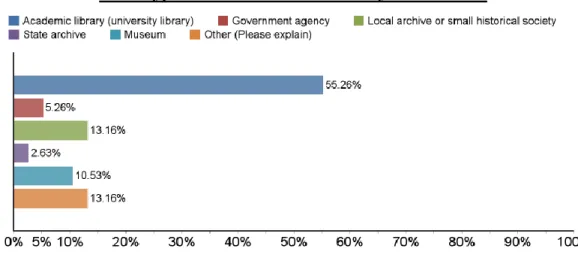
Table 1: Institution types represented.
What type of archival institution do you work for?
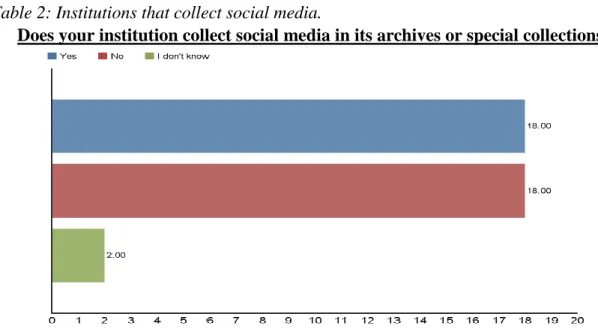
Table 2: Institutions that collect social media.
Does your institution collect social media in its archives or special collections?
According to the survey results, institutions are equally as likely to collect social media as not. Of the 38 responses to this question, 18 people said that their institutions do collect social media, 18 said that they did not, and two were unsure. Academic libraries represented 20 of the responses to this question, with nine participants stating that they do collect social media, 10 saying they do not, and one stating that they do not know.
Government archives and entities (which here combine government agencies, state archives, and two responses from “Other”) were responsible for five responses, all of which indicated that they do collect social media. One of five local archives and
historical societies did collect social media, and only one of the four museums indicated that they collect social media.
government-run agencies and institutions all collected social media, while many of the smaller institutions and museums reported that they did not. Social media use may be ubiquitous, but social media collecting in archives and special collections is not.
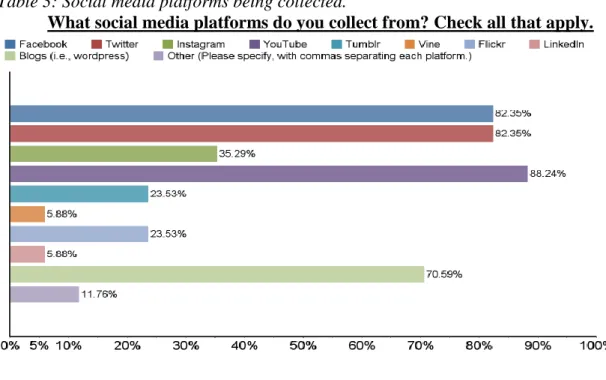
Table 3: Social media platforms being collected.
What social media platforms do you collect from? Check all that apply.
Social media platforms that are currently represented in the collections of the institutions that responded in this survey span a variety of formats and uses. Sites like Facebook, Twitter, and Instagram are generally intended for leisure and personal
connection, while one could consider LinkedIn a professional site. Formats include text-based posts, photographs, videos, and mixed-media. Respondents collected Facebook, Twitter, YouTube, and blogs most often, with 88.24% collecting YouTube. The 11.76% of people who replied Other included the following sites: SoundCloud, Google Plus, and Vimeo.
17, 2017, which may explain the low collection rate. Users were initially able to
download their old videos, but the service is no longer available (How to Download Your
Vines before It’s Too Late to Save Them, np). LinkedIn is still a viable service and acts as
a sort of Facebook-for-professionals with employment searches and resume sharing. It is unclear why this data is not more widely collected by archivists.
This question encouraged participants to choose all answers that apply. There are more responses to this question than the number of participants, indicating that most institutions are collecting more than one social media platform Of the 17 people who responded to this question, 14 indicated that they collected Twitter, 14 collect Facebook, and 15 collect YouTube. According to a Pew Research Center survey in March of 2018, Facebook and YouTube were the most-used social media platforms among adults (Social
Media Use 2018: Demographics and Statistics, np). The Pew Center results would seem
to support the collecting choices indicated in this survey.
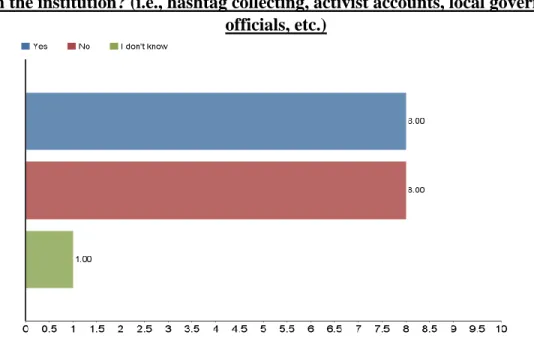
Table 4: Affiliation of social media posts collected.
Does your institution collect social media posts from accounts that are unaffiliated with the institution? (i.e., hashtag collecting, activist accounts, local government
officials, etc.)
I then asked participants whether their institution collects social media posts from accounts unaffiliated with their organization. Once again, results were split equally between “Yes” and “No” with eight responses for each, and one person replied that they did not know. Collecting initiatives and mandates differ for each type of institution, which may account for the disparity. For the purposes of this question, affiliated accounts could include online presences such as an institution’s Twitter or Facebook accounts, an institutional blog, or a university Instagram account. The collection of affiliated accounts may be to comply with public records law, to document an institution’s online presence, or for other reasons.
Table 5: Tools used to collect social media.
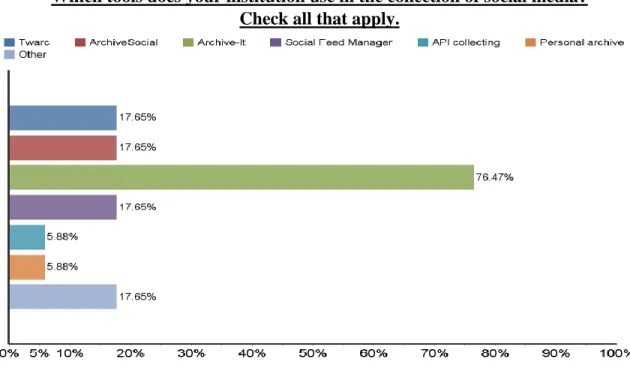
Which tools does your institution use in the collection of social media? Check all that apply.
their institution’s practices. This resulted in 27 answers from 17 participants, 13 of whom (76.47%) indicated that Archive-It was currently in use at their institution. Respondents chose twarc, ArchiveSocial, and Social Feed Manager three times each, while one each chose API collecting and Personal Archive Download. For the respondents who chose “Other,” written replies included Hanzo Archives, manual collection, and Adobe Acrobat.
Table 6: Reasons for selecting collection tools.
From the list below, please choose the phrase that best describes your highest-priority consideration when choosing a social media collecting tool.
The 16 responses to this question produced mixed results. Zero participants indicated that the price of a tool or data storage considerations factored into their choice of social media collecting tool. Availability of staff and “Other” each appeared twice in the responses; responses to “Other” included willingness to do one-time captures
participants), and accessibility and end-user retrieval received three selections (18.75%). Resources, while a factor in some institutions’ decision making, were not as large a concern as user- and donor-related questions such as tool operation, data access, and ethical responsibility. Tools such as Archive-It and ArchiveSocial reduce the overall time required from archive staff, while twarc and Social Feed Manager are open-source and emphasize ethical collecting. The results from this question and the previous question intellectually correlate, although this survey does not attempt to prove mathematical correlation.
Table 7: Availability of social media data for research.
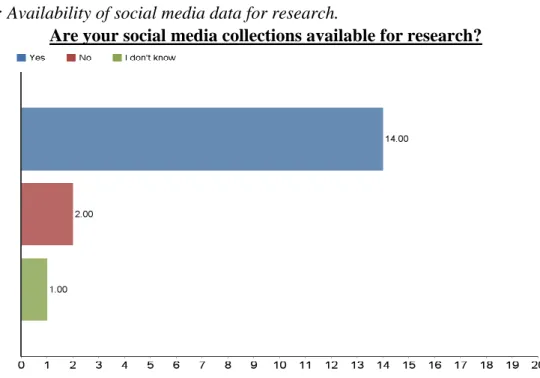
Are your social media collections available for research?
Table 8: How available collections are accessed.
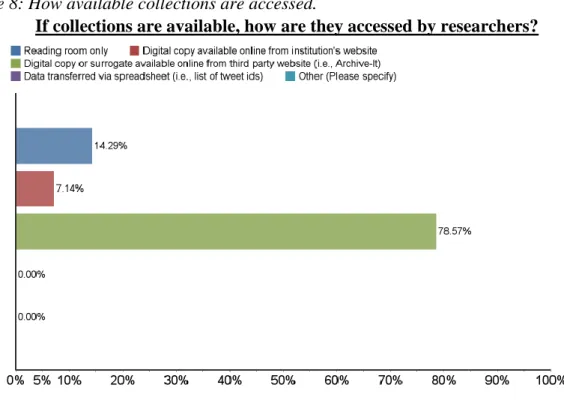
If collections are available, how are they accessed by researchers?
The survey then asked participants to indicate whether their social media collections were accessible to researchers. Of the 17 participants who answered this question, 14 answered “Yes,” two answered “No,” and one indicated they did not know. All 10 participants from academic libraries responded “Yes,” as did two museums (including the “Other” government-owned museum), one local archive or historical society, and one government entity. The overwhelming tendency for the institutions represented in this survey was to open their collections for research. I directed the 14 participants (85.32%) who answered “Yes” to a follow-up question: If collections are available, how do researchers access them?
museum, and one local archive or historical society. One academic library and one
government agency reported that they required researchers to use social media collections in the reading room. One participant from an academic library reported that their
institution provides digital copies of social media data online from their own website. With services such as Archive-It and ArchiveSocial making up the majority of the tools used, it follows that most institutions will provide access through those third party sites. These subscription services provide data hosting and GUIs that enable researchers to perform keyword searches and place filters on collections.
Table 9: Embargoes on social media collections.
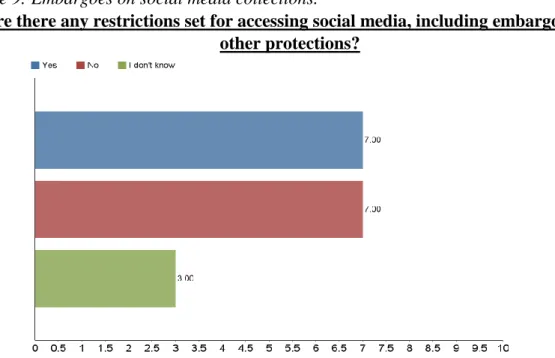
Are there any restrictions set for accessing social media, including embargoes or other protections?
however, judge the state of the entire archival community by these responses. A follow-up question asked participants who responded “Yes,” indicating that restrictions are placed on social media collections, to specify the restrictions. Six of the seven “Yes” respondents answered this follow-up. Two participants’ institutions place time embargoes on social media data, after which period the records will be available to researchers. One respondent said that data was available for use within the archives only and captures are stored on a digital asset management system. Another participant, whose institution uses Archive-It to collect social media, said that unprocessed collections that do not have descriptive metadata are not included in the public institutional Archive-It search interface.
The final answer included some platform-specific restrictions. The participant replied,
We may restrict some social media content for a certain number of years, but this is dependent on the nature of the content and hasn’t been decided. Twitter data will be restricted based on Twitter’s terms of service and possibly according to a researcher’s institutional affiliation. This policy has not been set in stone either. This is new territory for the library where I work.
Table 10: Formal written social media collecting policies.
Does your institution have a formal written social media collecting policy?
Table 11: Publicly available formal collecting policies.
Is it publicly available?
available. Collecting policies are important tools that help shape collections, make appraisal decisions, and determine what records have enduring value. While one might call this policy something different, like an appraisal policy, many institutions make their policies available to researchers, donors, and the public. Sixteen participants replied to this question, with five (31.25%) saying that their institutions do have a formal policy and 11 (68.75%) replying that they do not have a formal policy.
Of those who responded “Yes” to the question of a formal policy, one participant (25%) said that their policy was publicly available and 3 (75%) said that their policy was not. One participant chose not to answer. The survey did not ask whether unavailable policies would be shown upon request.
Table 12: Informal social media collecting policies.
Does your institution have an informal draft or verbal social media collecting policy?
answering “No,” and 3 (18.75%) saying they did not know. This indicates that, while not all institutions have a formal policy in place for social media, informal policies are more common. These informal policies may be in progress or at the conception stage, but institutions are thinking about social media collecting, appraisal, and procedures.
Table 13: Takedown policies for social media users.
Are any takedown policies or other deletion mechanisms in place for users whose social media posts have been collected?
Table 14: Contacting social media users.
The next two questions focused on the social media users whose posts were being collected for the archives. Deleting posts, web sites, and other forms of creator rights can be observed in several ways. For instance, the Internet Archive offers methods for
removing private (non-governmental) web sites from the Wayback Machine, which includes adding robots.txt code to block web crawlers. One can also request removal via the Digital Millennium Copyright Act (DMCA) of 1998 (The Internet Archive’s Policies
On Archival Integrity and Removal, np). Participants in this survey were asked whether
any takedown policies or other means of deletion were in place for users whose social media posts have been collected. Sixteen participants replied to this question, with three (18.75%) replying “Yes,” eight (50%) replying “No,” and five (31.25%) saying they did not know.
I then asked those who answered “Yes” to provide a brief description of the deletion request process. One participant said, “Communication with government agency social media accounts is a public record, so we still collect it.” It was not explained why removal requests were accepted if they would not be acted upon. Another replied that if a rights holder submits a takedown request, they “investigate if the request comes from the actual rights holder and then we remove from public access and update the finding aid to accordingly remove mention of the captured content.” The third participant who said “Yes” did not provide an explanation of their process.
responded to this question, 5 (33.33%) of whom answered “Yes.” Eight respondents (53.33%) selected “No” and two respondents (13.33%) indicated that they did not know. The responses leaned toward institutions not notifying social media users directly that the institution may be collecting their posts.
The final three questions of the survey asked participants to provide their own answers in brief sentences or paragraphs. These questions were open to all survey participants regardless of whether they indicated that their institutions do collect social media. The open-answer questions asked participants to provide their opinions on the issue of social media archiving. We should not consider their responses representative of the archival community as a whole, but rather a snapshot of their thoughts on social media collecting and the ethics thereof.
The first open-answer question asked participants what they felt were the ethical responsibilities of archivists toward social media users, researchers, and other populations who may in some way be affected by collected social media data. The question received 23 responses. Results showed a wide range of concerns that varied by collecting
account holders, such as activists, who may be put in harm’s way if their social media was preserved or surveilled.
In the vein of consent, three participants were also concerned about the consent of individuals who may appear in social media posts that are not their own. For instance, one participant discussed their University President’s social media, which has a few photographs of his sons. The participant voiced the opinion that the sons should have some say in whether an institution may preserve and make public their images, even though it would be their father’s account being collected. However, another participant argued that social media should be treated like other correspondence, which would generally preclude digging deeper than the creator of the posts themselves would.
Going further than simple written consent, four participants felt it was the
archive’s responsibility to have account holders sign a donor agreement before collecting any of their social media data. One of those participants emphasized educating donors on the rights they are transferring in a gift agreement. The knowledge of social media users was a topic discussed by six participants, who worried that account holders may not be aware of their rights regarding social media platforms. Three of the six participants who mentioned the understanding of rights and privacy stated that many account holders are limited in their knowledge of platform terms of service, a problem that archives may need to address to fulfill their ethical responsibilities.
participants mentioned. One participant stated, “[there] needs to be transparency and knowledge shared about what is being collected, why it is, and how it can be accessed later if so desired.” Both participants who advocated for transparency also suggested that accounts have disclaimers or footnotes that identify their status as an archived entity.
On another note, several participants cited their legal mandate to collect social media. Three participants said it was their institution’s responsibility to collect, and five participants cited the law in their decisions about social media collecting. Two of those participants mentioned that their institution’s social media was public record, which translates to the public’s interactions with those accounts being public record as well. Another participant said that the law requested that their institution not to capture social media because of concerns of capturing data from the public without their knowledge. These responses somewhat illustrate the variation in laws concerning social media and public data, which affect archives and their collecting practices.
In the second short-answer question, I asked participants whether their institution’s collection policy, if one existed, met the ethical responsibilities they
discussed in the previous question. I received 15 responses, 12 of which stated that their institution had no policy or wrote N/A. The three respondents who did have social media policies said yes, their policies meet the ethical standards they laid out. One participant did say that their policy lacked some clarity regarding the technical challenges of
archiving certain types of websites or platforms. They expressed that these issues “could be explained better so that no ill-will or malicious intent is attributed to either the social media account holder or the archives.” This response brings up a concern that 2
data being collected. If a policy outlines the potential challenges and pitfalls of social media archiving, such as incomplete capture or loss of certain context, users and
researchers will have a clearer picture of the data and the circumstances of its collection. The third short-answer question asked what ethical aspects of social media
archiving participants would like to see explored further in archival literature. One could read the responses to this question as gaps in knowledge and avenues for future research in the field. Fifteen participants answered this question, with the most common response being the privacy of users and the rules one can institute to protect that privacy (5 participants). Several respondents linked privacy to the rights of the creator, which brought up questions of donor rights, use of collections, and the need for opt-in policies or deeds of gift (5 participants). Participants noted that ethical considerations evolve as a medium ages and develops, which often changes the best practices surrounding the collection of that medium. The laws and tools have not kept pace with the social media explosion, and several participants noted that copyright is still an unsettled issue.
the literature also wanted to know how technology could assist with scalability issues and the implementation of policies that protect user rights and privacy. One participant said that they “don’t have confidence in the tools or my knowledge of the law to help me protect the student data that I gather.”
Two participants expressed interest in and gratitude for the Documenting the Now project in their answers. DocNow has brought awareness to the ethical issues surrounding social media collecting and the affects it can have on the account holders. One participant wanted to see work like the DocNow project continued in the future. Thirteen of the 15 participants who answered this question had aspects of social media archiving that they wanted to see explored in literature, which demonstrates that there is still work to be done to establish this facet of our field.
6 Discussion
The findings of this study indicate that, while nearly half of all participants who responded did have institutional social media archives, the collection of social media is far from ubiquitous. Several of the archivists who participated in this survey cited technological or legal barriers that prevent their institutions from collecting and
preserving social media. Those who do collect social media are unlikely to have a formal written social media collecting policy that is publicly available to researchers and other users. For some, the lack of formal policy may be due in part to the relatively new nature of social media. Analog collections, and even born-digital or web collections that do not contain social media, have had years to develop best practices, collecting scopes, and appraisal theories. Social media collecting can include as little as one tweet or as much as an entire hashtag that spans continents. The appraisal of social media collections may hover near Mark Greene and Dennis Meissner’s 2010 More Product Less Process
6.1 Recommendations from Groups, Professionals, and Projects
Multiple social media collecting practices and ethics discussions have emerged in recent years. Many have focused on ethical methods of archiving activist social media, which is a growing area for research and collecting. Incidents like the 2014 shooting death of Michael Brown and other cases of police brutality against people of color have resulted in many archiving projects that focus on the Twitter and Facebook response. Other communities being addressed in archives include #MeToo and student protesters on college campuses who work to change the historic racism of many US universities. Documenting the Now emphasizes the ethical challenges that working with these materials brings, which include lack of user awareness, potential for manipulation of content, heightened potential of harm, and difficulty applying traditional archival practices (Jules et. al, 3). While these questions are undoubtedly crucial for archivists planning to collect material from activists and marginalized people to consider, they are also important for those dealing with less fraught subjects. In the following sections, these four essential ethical concerns are used to structure a discussion of the findings of this survey.
6.1.1 Lack of Awareness
in our timelines, it is a different matter to assume that social media users know that their content may be archived and preserved.
This project has shown that nearly half of surveyed institutions collect material from unaffiliated accounts. Results also show that a majority of institutions who participated do not have formal, publicly available social media collecting policies. Without a policy available for public consumption, institutions reduce their options for combating the lack of awareness. One method is to contact users to either ask permission or notify them that we are collecting their data. When asked if they contacted individuals, 50% of individuals responded that they did not and 31.25% did not know.
In the short-answer portion of the survey, several participants indicated that they wanted to normalize donor agreements or other methods of gaining permission. This would certainly help solve the lack of knowledge and understanding that many social media users may have when it comes to their data being collected. Another option may include adding disclaimers or notices to accounts that are regularly archived. Currently, the @POTUS handle on Twitter has an archival disclaimer, but the more readily used account @realDonaldTrump does not. The results of this survey show that there is the desire among archivists to create a more traditional approach to getting consent. It may only be due to barriers of time, resources, and technology that more institutions have not made this change.
6.1.2 Potential for Manipulation of Data
eerie AI videos of Barack Obama as a new level of “deep fake” that uses machine learning to create false videos and audio that appear real (Bloomberg, np). It is not difficult to imagine given this sort of treatment can be applied to social media posts and videos to cast individuals in a bad light. Therefore, it may be necessary to reevaluate the restrictions and protections placed on social media data to safeguard it against such manipulations, although it is difficult to say whether social media is at any higher risk for this sort of treatment than other digital objects.
On the question of embargoes and other restrictions, 41.18% of participants said that some restrictions were in place. Some such restrictions include an embargo period and a reading room-only policy. The discussion of PII protection methods is ongoing, but a majority of archivists who participated in this project felt that some safeguards do need to be in place. Platforms like Twitter have attempted to aid in this struggle by requesting that only tweet ids be shared as datasets, which puts the onus on the researcher to
rehydrate and analyze available tweets. Other methods are likely in development, but only time, continued discussion, and archivist action will create proper solutions.
6.1.3 Heightened Potential for Harm
While not every Twitter or Facebook user is in an inherently vulnerable position, I would argue that the category of potential harm includes any person or group who is represented without having given consent. We can potentially address this ethical challenge by the solutions mentioned in the previous section, which include the
which can include requests to only share ids. As stated previously, the community is still testing solutions, but projects like DocNow can only enhance the work archives across the country are doing. The sensitivity of collections may vary, but inevitably they will involve human subjects who should be handled carefully.
6.1.4 Difficulty Applying Traditional Archival Practices
The DocNow white paper cites the “sheer volume of data and complicated
logistics of interacting with content creators” in their suggestion of difficulty (Jules et. al, 3). Results of this survey show that institutions are most likely to collect from Twitter, Facebook, YouTube, and blogs, which is largely in line with the Pew Research Center’s assertion that Facebook and YouTube are the most-used social media platforms among adults (Social Media Use 2018: Demographics and Statistics, np). We can then see the platform’s popularity as a correlation with which archives collect social media sites. That popularity, while creating a wealth of information, can also produce a veritable ocean of data.