GOAL INFLUENCE IN ORGANIZATIONAL IDENTIFICATION AND POST-CHOICE BEHAVIOR
Todd D. Woodruff
A dissertation submitted to the faculty of the University of North Carolina at Chapel Hill in partial fulfillment of the requirements for the degree of Doctor of Philosophy in the Kenan-Flagler Business School, Department of Marketing.
Chapel Hill 2012
Approved by:
Jan Benedict Steenkamp
Valarie Zeithaml
Morten Ender
Ryan Kelty
ii
iii ABSTRACT
TODD D. WOODRUFF: Goal Influence in Organizational Identification and Post-Choice Behavior
(Under the direction of Jan Benedict Steenkamp)
Consumption goals instill enduring motivational force and positive emotions,
making goal-relevant knowledge more accessible, directing attention, and shaping our
judgments. Consumer goals are often used to segment markets, target prospective
members, and inform marketers about the appropriate use of marketing mix instruments.
This article demonstrates that the individual membership goals used to generate interest
and induce membership have powerful and pervasive effects on the development of
organizational identification and the incidence of pro-organizational behaviors, such as
retention, providing word-of-mouth endorsement, and service-use. Moreover, these
individual membership goals vary significantly in their effects on identification and
behavior, and therefore in their value to the organization.
This paper develops and tests a conceptual framework for the relationship
between membership goals, organizational perceptions and satisfaction, identification,
and member behavior by using cross-sectional, multi-cohort, and two-wave panel data. It
consistently finds that membership goals have significant effects on how the organization
is perceived, satisfaction with the organization, organizational identification, and the
incidence of pro-organizational behaviors. In general, intrinsic membership goals, such
iv
associated with more positive perceptions of the organization, higher levels of social
satisfaction, increased organizational identification, and more frequent pro-organizational
behaviors. Conversely, economic membership goals tend to be associated with less
positive perceptions of the organization, higher levels of economic satisfaction, decrease
organizational identification, and fewer pro-organizational behaviors. Interestingly,
individual membership goals had no effect on identification growth. Nevertheless, the
difference in identification between those with strong intrinsic goals and those with
strong economic goals was quite large, with the level of post-socialization identification
among those with strong economic goals failing to reach the level of pre-socialization
identification among those with strong intrinsic goals.
This suggests that managers and marketers must understand how individual
membership goals affect perceptions of the organization, their members’ level of
satisfaction, their degree of identification, and their future behavioral choices. Exclusive
use of consumer goal knowledge to maximizing membership numbers and marketing
efficiency without considering the long-term impact on the relationship quality and
v
ACKNOWLEDGEMENTS
It would be remiss if I did not acknowledge the contributions of my wife,
Elizabeth, and my children, Madison, Joshua, and Jacob. After enduring the stress and
difficulties of my deployments to Iraq in 2006, 2007, 2008, and 2009, they endured
several additional years of self imposed separation as I struggled through the research and
writing process. Through the long nights, I was comforted by the knowledge that my
family was close by, safe, healthy, and happy. I want to acknowledge and thank
Professor J.B. Steenkamp for his mentorship and guidance throughout out the dissertation
process. Without his involvement, this dissertation would not have reached its current
level of rigor or contribution. More importantly, I would be a far less capable scholar and
teacher. I also want to recognize my parents, who helped me appreciate the value of
higher education and supported my decision to return to academics. Lastly, I want to
express my profound gratitude to my committee for their feedback, support, and
vi
TABLE OF CONTENTS
LIST OF TABLES... x
LIST OF FIGURES ...xiii
CHAPTER I INTRODUCTION... 1
Membership Organizations and Membership Marketing ... 1
The Influence of Membership Goals ... 4
Research Objectives ... 8
Empirical Context ... 9
Dissertation Structure and Preview ... 16
II IDENTIFICATION AND GOAL THEORY, HYPOTHESES, AND MODELS ... 23
Identification and Relationship Quality in Membership Organizations ... 24
Why Organizational Identification? ... 28
Where is Organizational Identification Most Appropriate? ... 30
Organizational Identification Based Model of Relationship Quality... 31
Goal Theory and the Effects of Individual’s Membership Goals on Identification ... 41
III SCALE AND INSTRUMENT DEVELOPMENT ... 72
The Scale and Item Development Process ... 73
vii
Exploratory and Confirmatory Factor Analysis ... 75
Scales Discussion ... 78
Control Variables and Demographics ... 88
IV RESEARCH METHODOLOGY AND RESULTS ... 90
Empirical Context ... 90
Response Bias and Data Issues ... 92
Measurement Model ... 96
Structural Models ... 103
Control Variable Effects ... 124
Moderation Analysis ... 125
Alternative Model Specifications ... 129
Robustness Analyses ... 133
V DISCUSSION AND MANAGERIAL IMPLICATIONS ... 138
Insights and Contributions to the Identification-Based Relational Model ... 138
Effects of Membership Goals on the Member-Organization Relationship ... 140
Managerial Insights and Implications for Relationship Marketing ... 145
VI THEORY, MEMBERSHIP LIFECYCLE, AND HYPOTHESES ... 150
Theory Review ... 151
Membership Lifecycle Stages ... 155
VII SAMPLING METHODOLOGY ... 163
viii
New Soldier Sampling and Survey Methodology ... 165
Current Soldier Sampling and Survey Methodology ... 167
VIII MULTI-COHORT METRIC AND STRUCTURAL INVARIANCE METHODOLOGY AND RESLUTS ... 170
Refining the Measurement Model and Establishing Configural Invariance ... 171
Metric Invariance Testing in the Measurement Model ... 179
Invariance Testing and Comparison within the Structural Model ... 184
IX MULTI-COHORT LATENT MEAN COMPARISONS METHODOLOGY AND RESLUTS... 197
Scalar Invariance Testing in the Measurement Model ... 197
Latent Mean Comparisons ... 198
Latent Mean Comparisons by Gender and Combat Specialty ... 200
X DISCUSSION AND MANAGERIAL IMPLICATIONS ... 204
Validation of the Measurement and Structural Models ... 205
Theoretical and Empirical Insights ... 207
Managerial and Marketing Implications ... 213
XI IDENTIFICATION GROWTH AND GOAL INFLUENCE HYPOTHESES AND MODELS ... 216
Growth within the Identification Model ... 219
Goal Influence (Time_1) on Growth in the Identification Model ... 224
XII RESEARCH METHODOLOGY AND RESULTS ... 229
The Panel Samples ... 230
ix
Individual Construct Latent Growth Models ... 235
Growth across the Identification Process ... 244
Goal Influence on Latent Growth and Behavior within the Identification Model ... 252
Goals Effects Differences by Median-Split Goal Groups ... 261
Test for Causal Predominance ... 266
XIII DISCUSSION AND MANAGERIAL IMPLICATIONS ... 269
Organizational Perceptions, Social Satisfaction, and Identification Growth ... 269
Effects of Identification Level and Growth on Behavior ... 270
The Role of Membership Goals in Identification Growth and Behavior ... 271
Managerial Implications and Recommendations ... 273
x
LIST OF TABLES Table
2.1 Membership Goal Effects ... 52
3.1 Organizational Perceptions and Satisfaction Scales ... 81
3.2 Organizational Identification Scale ... 83
3.3 Member Behavior Scales ... 85
3.4 Membership Goal Scales ... 88
4.1 Model Correlations, Means and Standard Deviations ... 97
4.2 Principal Components Analysis Pattern Matrix ... 98
4.3 Measurement Model Properties ... 102
4.4 Standardized Effects for Identification-Based Relational Models ... 110
4.5 Standardized Effects for Membership Goal- Identification Models ... 118
4.6 Goal Effect Decomposition... 121
4.7 Total, Direct, and Indirect Effects by Construct ... 122
4.8 Hypotheses Testing: Identification & Membership Goal-Identification Models ... 123
4.9 Demographics and Control Variables ... 125
4.10 Moderation Tests ... 128
4.11 Goal Effects on Specific Member Behaviors ... 133
4.12 Comparison of Final Model using Essay I and Essay II Scales ... 137
5.1 Goal Valence with Specific Member Behaviors ... 147
6.1 Multi-Cohort Hypotheses... 155
7.1 Cohort Descriptive Statistics... 169
xi
8.2 Multi-Cohort Scale Reliabilities ... 177
8.3 Multi-Cohort Constrained Model Properties ... 182
8.4 Simultaneous Estimation with Structural Paths Free to Vary ... 186
8.5 Simultaneous Estimation, Invariant Structural Paths Constrained Equal ... 189
8.6 Multi-Cohort Hypotheses Test Summary ... 190
8.7 Post Hoc Pairwise Comparisons ... 193
8.8 Total, Direct, and Indirect Goal and Identification Effects Across the Membership Cohorts ... 196
9.1 Latent Means Comparison ... 199
9.2 Latent Means Comparison by Gender for Future Soldier Cohort... 201
9.3 Latent Means Comparison by Combat Specialty... 203
10.1 Goal Influence by Cohort... 211
10.2 Total, Direct, and Indirect Goal Effects ... 211
11.1 Latent Growth Hypotheses for Current Soldiers ... 228
12.1 Relationship Inducing Factors and Control Variable Effects in Identification LGM Factors ... 247
12.2 Relationship Inducing Factors and Control Variable Effects on Identification LGM and Behavior Factors ... 250
12.3 Squared Multiple Correlations for the New Soldier Cohort ... 253
12.4 Membership Goals Effects on RIF Slope and Intercept Factors, Identification Slope and Intercept Factors, and Behaviors ... 254
12.5 Relationship Inducing Factors and Control Variable Effects on Identification LGM and Behavior Factors (when Membership Goal are Included)... 258
12.6 New Soldier Total Effects ... 260
xii
12.8 Effects of Time_1 Goals and Identification Antecedents in
Identification and Behaviors at Time_2 ... 267
xiii
LIST OF FIGURES Figures
1.1 Organizational Positioning by Benefit Type and Affiliation
Level ... 3
1.2 Identification-Based Relational Model ... 6
1.3 Goal Effects on Relational and AIDA Models ... 7
1.4 Hypothesized Effects of Membership Goals on the Relational Model ... 9
1.5 The Army Segmentation Model... 10
1.6 Membership Stages and Timeline ... 12
2.1 Identification-Based Relational Model (reprint of Fig 1.2) ... 28
2.2 The Relationship Marketing Framework ... 29
2.3 Antecedents of Identification ... 32
2.4 Behavioral Consequences of Organizational Identification ... 38
2.5 The Identification-Based Relational Model ... 40
2.6 Simplified Identification-Based Relational Model ... 40
2.7 Goal Influence ... 42
2.8 Goal Influence across Multiple Processes ... 44
2.9 Goal Effect Variation ... 50
2.10 Hypothesized Effects of Membership Goals (reprint of Fig 1.4) ... 53
2.11 Membership Goal – Relationship-Inducing Factors Path ... 54
2.12 Membership Goal Effects on Relationship-Inducing Factors ... 59
2.13 Membership Goal – Identification Path ... 60
2.14 Membership Goal Effects on Identification and RIFs ... 63
xiv
2.16 Membership Goal – Identification and Member Behavior Model... 67
2.17 Full Membership Goal – Identification Structural Model ... 68
3.1 Survey Likert Scale Heading ... 75
3.2 Scales Discussion Structure ... 79
4.1 Full Measurement Model ... 101
4.2 Estimates of Relationship-Inducing Factors Effects on Identification ... 105
4.3 Estimates of Identification Effects on Member Behaviors ... 106
4.4 Full Identification-Based Relational Model Estimates ... 108
4.5 Identification-Based Relational Model, 2nd Order Behavior Factor ... 109
4.6 Membership Goal – Identification Model Estimates ... 112
4.7 Membership Goal – Identification and Behavior Estimates ... 114
4.8 Full Membership Goal – Identification Estimates ... 116
4.9 Specific Membership Goal Effects ... 129
6.1 Membership Stages and Timeline ... 158
8.1 Multi-Cohort First-Order Measurement Model ... 174
8.2 Membership Goal – Identification Based Relational Model ... 188
8.3 Cohort Lifecycle Trends for Noninvariant Relationship Strength ... 194
11.1 Relationship Inducing Factors on Identification Level and Growth ... 222
11.2 Identification Level and Growth on Pro-organizational Behaviors ... 224
11.3 Goal Effects (Time_1) on RIFs and Identification Growth ... 227
xv
12.2 Identification Latent Growth Model (Future Soldier, Full
Sample) ... 235
12.3 Identification Latent Growth Model (Future Soldier, Identification <6) ... 237
12.4 Identification Latent Growth Model (New Soldier) ... 238
12.5 Distinctiveness Latent Growth Models ... 240
12.6 Prestige Latent Growth Model ... 241
12.7 Social Satisfaction Latent Growth Model ... 243
12.8 RIF Intercept and Slope Effects on Identification Slope and Intercept ... 245
12.9 Identification Slope and Intercept on Time_2 Behavior ... 251
12.10 Goal Effects on RIF and Identification Growth ... 253
12.11 Identification Level and Growth by Membership Goal Median Split ... 262
12.12 Identification Level and Growth by Membership Goal Median Split ... 264
12.13 Identification Level and Growth for all Membership Goal Median Splits ... 266
CHAPTER I: INTRODUCTION
1.1 Membership Organizations and Membership Marketing
This dissertation looks at the influence of membership goals on identification and
behavior in the context of membership organizations and membership marketing. For the
purpose of this dissertation, membership goals are defined as personal goals an individual perceives to be facilitated or advanced through the act of joining or maintaining membership. Membership goals are as varied as the individual, but can often be categorized as relating to either:
1. Altruism – An intrinsic goal focused on self-transcendence and service to the
organization or its causes.
2. Self-Enhancing – An intrinsic goal focused on improving one’s self-concept by
improving character or reinforcing/communicating self-definition and self-image.
3. Extrinsic/Economic – Calculative benefits or rewards (Schwartz 1992, Kasser and
Ryan 1993).
As an example, a person may have the altruistic goal of giving back to their alma
mater and believe this can be accomplished through membership in their university’s
alumni association.
Memberships are important for reasons beyond their ability to facilitate individual
goals; over 100,000 membership organizations represent an important component of the
2
large subset of the membership organizations, generate over $33 billion in revenue
annually, hold over $50 billion in assets, maintain a payroll of almost $50 billion, and
employ over 1.5 million people in the U.S. alone (American Society of Association
Executives (ASAE) 2007; 2009).
The impact of membership organizations is also considerable in terms of
individual participation and their presence in society. The three largest membership
organizations in the U.S. (AARP, AAA, and the U.S. Catholic Church) all have
membership of approximately 50 million people (AARP 2008; ASAE 2009) and the
average membership among the top 50 paid membership organizations exceeds 3 million
(Bhattacharya et al. 1995). A 2011 Google search for “memberships” yielded over 94
million hits representing almost every industry, profession, cause, and interest group.
These memberships include brand associations like the Harley Owners Group (HOG),
professional associations (e.g. American Marketing Association), advocacy groups (e.g.
AARP), political associations, armed forces, universities and educational organizations,
religious organizations, clubs, gyms, museums, zoos, and shopping clubs.
While this sampling is quite diverse, most membership organizations can be
categorized along two criteria of particular relevance to this study: 1) the type of benefits
they provide to their members (economic or socio-emotional) (Bhattacharya 1998) and 2)
the level of affiliation typically experienced by members.1 For example, retail
memberships such as Costco tend to be low affiliation (limited to transactional shopping)
and provide primarily economic benefits to its members. Doctors Without Borders, on
the other hand, is a non-profit, cause-based, high affiliation membership where member
1
3
doctors are embedded in the organization and receive socio-emotional benefits from their
service to others and the organization’s cause. University alumni associations represent a
membership organization that tends to be positioned near the middle of both criteria.
Members may derive both socio-emotional benefits (e.g. feeling good about supporting
their alma matter) and economic benefits (e.g. job networking), while being able to
maintain a level of affiliation that can range from high (e.g. someone who actively
attends sponsored events and promotes the university) to very low (e.g. limiting
involvement to passively receiving association emails and publications) (Figure 1.1).
This dissertation will focus on membership contexts where there are medium to high
levels of affiliation and membership benefits are not exclusively economic.
4 1.2 The Influence of Membership Goals
Regardless of their characteristics, most membership organizations 1) engage in
marketing activities to attract and enroll new members, 2) benefit from high quality
relationships with these members, and 3) receive value from their members’ relational
behaviors (Bhattacharya et al. 1995; Sheth and Parvatiyar 1995). Membership goals play
a key role in all three cases. In the first case, membership organizations use knowledge
about their prospective members’ goals, either directly or indirectly, to segment their
market, target prospective members, and make decisions regarding the appropriate use of
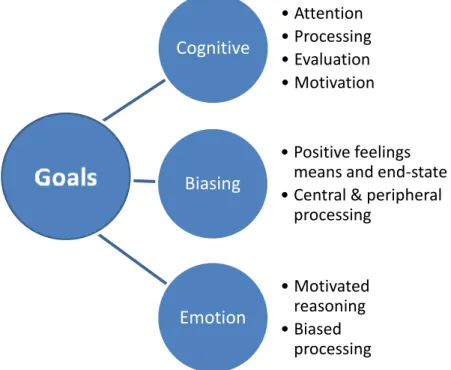
marketing mix instruments (Cermak, File, and Prince 1994). Goal knowledge is vital to
these actions because goals function as prime determinants of attitudes, choices, and
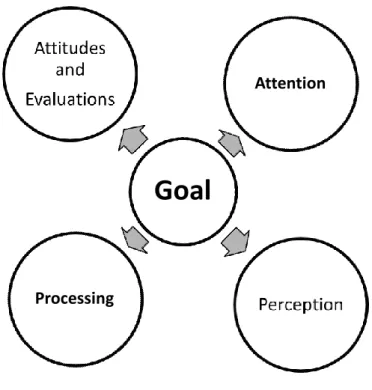
behaviors (Ajzen and Fishbein 1980). Furthermore, goal-relevant knowledge is more
accessible, receives increased attention and processing (Aarts, Dijksterhuis, and DeVries
2011; Fishbach and Ferguson 2011), and influences how prospective members evaluate
and organize information, options, and behaviors (Fishbach and Ferguson 2011; Warren,
McGraw, and Van Boven 2010).
In the second case, membership goals can affect identification through their
influence on attitudes, evaluations, and expectations regarding the member-organization
relationship (Ajzen and Fishbein 1980). In the final case, goals can influence member
behaviors through their indirect effect on identification (Arnett, German, and Hunt 2003)
and their direct effect on the evaluation and execution of behavioral options (Fishbach
and Ferguson 2011). This influence is potentially quite important, because the value of
relational behaviors (e.g. retention, advocacy, referrals and promoting, volunteering, and
5
non-paid memberships (Arnett et al. 2003; Bhattacharya et al. 1995). Even within
for-profit firms, relationship quality and behavior contributes substantial value through
increased buying, willingness to pay, retention, and referrals (Palmatier 2008).
The influence of membership goals on the evaluation of the membership offering,
identification, and future member behavior is not necessarily homogeneous across goals.
There is the potential that some goals will have a positive influence on membership
choice, identification, and behavior, while other goals will have a positive effect on only
the membership choice, with a null or negative effect on identification and/or future
behavior. Take for example university graduates considering membership in their
school’s alumni association. In this hypothetical illustration there is a segment of the
population that has the goal of acquiring access to member benefits, such as the
association’s credit union, and another segment that has the goal of giving back to their
alma mater. If the alumni association has identified these segments, it can cater its
offerings and marketing to address both segments’ membership goals and thereby
influence their membership choice. After the membership choice is made, the value
created for the organization by the individuals from these segments may vary based on
their reasons for choosing the membership. For example, individuals with a goal of
giving back to their alma mater may, on average, identify more strongly with the
organization and be more likely to enact behaviors that are important to the organization
than members seeking access to benefits.
While it seems reasonable that individuals with different membership goals could
select the membership with similar frequency, yet vary in their identification and
6
limited. Numerous studies have examined the antecedents and consequences of
relationship quality (Geyskens, Steenkamp, and Scheer 1996; Morgan and Hunt 1994;
Palmatier 2008), but few studies have looked at the antecedents and consequences of
relationship quality within the membership context. These few studies measured
relationship quality as organizational identification, which can be thought of as a sense of
connectedness to the organization and tendency to define one’s self in terms of the
organization (Bhattacharya et al. 1995; Mael and Ashforth 1992).2 These studies find
that identification with the membership organization has a strong positive effect on
relational behaviors, such as retention and promoting (Bhattacharya et al. 1995; Mael and
Ashforth 1992). They also find the effects of relationship-inducing factors, such as
perceived organizational prestige and distinctiveness, are largely mediated by
identification as depicted in Figure 1.2 (Arnett et al. 2003; Bhattacharya et al. 1995; Mael
and Ashforth 1992).
Figure 1.2 Identification-Based Relational Model (adapted from Arnett et al. 2003
While this body of research provides important insights into relationship quality
and marketing relevant membership behaviors, it does not explore the influence of
membership goals on the relational model in Figure 1.2. This omission is important
because 1) organizations are using knowledge of membership goals (directly and
indirectly) to target marketing actions and induce membership choice, and 2) goal and
hierarchy of needs theories suggest that membership goals should influence perceptions
2 One exception to the use of identity or identification as the measure of membership relationship quality is
7
and expectations of the organization, relationship quality, and member behavior (Hall and
Schneider 1972).
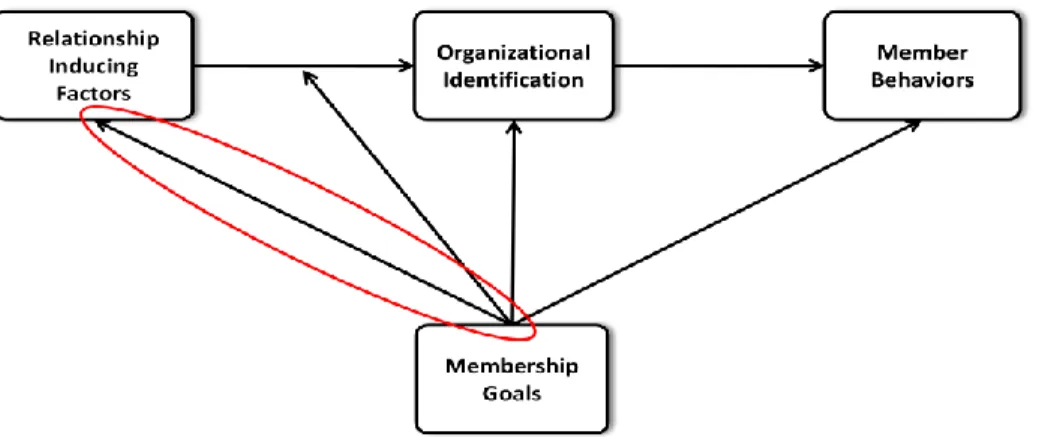
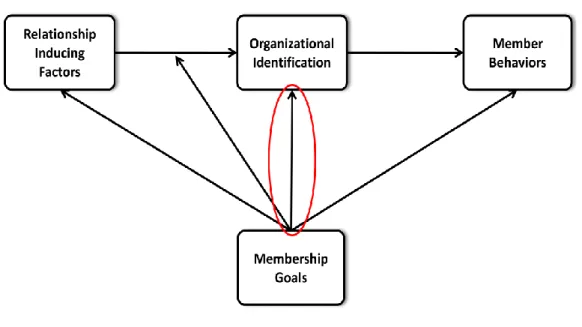
This argument can be illustrated by examining the effects of membership goals on an AIDA Hierarchy of Effects model and on an identification-based relational model
(Figure 1.3). The right side of the figure depicts that membership goals generate
‘attention’ to the offering, gain and hold ‘interest’ in the membership, arouse ‘desire’ to
become a member, and induce ‘action’ (membership choice). The left side of the figure
also represents that membership goals which remain salient following the membership
choice will influence the subsequent relationship by affecting perceptions of the
organization (and other relationship-inducing factors), relationship quality
(identification), and a number of important membership behaviors (e.g. retention and
promoting). Note that the AIDA model does not influence the relational model, rather it
depicts that persistently salient membership goals affect both choice and the subsequent
relationship.
8 1.3 Research Objectives
This dissertation makes use of earlier studies to integrate goal theory with social
identity and organizational identification theory within the membership context in order
to develop a conceptual framework for the effects of membership goals on an
identification-based relational model (Figure 1.2). This dissertation develops new
empirical evidence that demonstrates that membership goals do more than drive the
membership decision; they also have substantial effects on how an organization is
perceived, on organizational identification, and on member behaviors. Accordingly, I
argue that organizations marketing to prospective members should look beyond the use of
membership goals to target segments that can be recruited most efficiently or in the
greatest number, and should also consider the down-stream consequences of those goals
on the member’s value to the firm. Failing to do so can result in myopic marketing
decisions that drive higher membership numbers but create suboptimal customer lifetime
value.
This dissertation does not test the AIDA model, nor does it directly measure the
effect of specific membership goals on the initial membership choice. Instead it uses
specific membership goals that are both reasonably widespread in their application and
known to be used by the sample organization to segment their market and induce
membership choice. This approach enables me to test the hypotheses that membership
goals known to influence the initial membership choice have substantial effects on: 1)
perceptions of the organization and other relationship-inducing factors, 2) identification
with the organization, 3) member behaviors (i.e. retention, referrals, sacrifice,
9
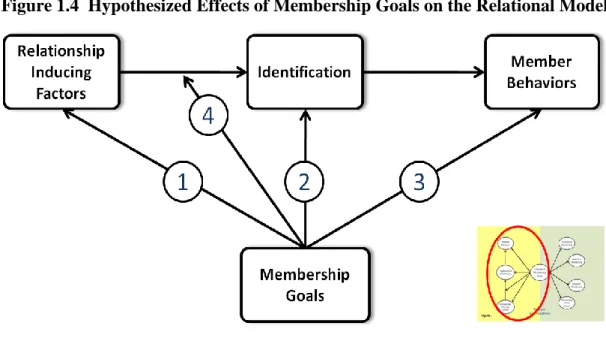
relationship-inducing factors and identification (Figure 1.4).3 Additionally, it enables me
to test the degree to which these specific membership goals differ in their effects and
investigate the dynamics of this relationship in terms of temporal precedence and growth
parameters of key constructs. From a managerial perspective, the knowledge generated
from this research should be particularly important for 1) assessing differences in
member’s long-term value to the organization based on their membership goals, in
settings where economic contributions reflect only a portion of a member’s value to the
organization and 2) developing approaches to influence retention, sacrifice, participation,
and promotion behaviors among different membership segments.
Figure 1.4 Hypothesized Effects of Membership Goals on the Relational Model
1.4 Empirical Context
This dissertation uses samples from the United States Army to refine the
conceptual model and to empirically test research hypotheses. The Army provides an
3 Figure 1.4 illustrates the four general hypotheses explored in this dissertation. The full hypothesized
10
interesting and important marketing and organizational behavior context for a number of
reasons. First, despite being a government institution, the Army’s marketing approach is
remarkably similar to those used
in both business and non-profit
settings, employing textbook
marketing strategies of
segmentation based on
motivations, attitudes, and
barriers to membership (Figure
1.5); brand positioning based on detailed knowledge of these segments; and a
sophisticated use of marketing mix tools based on their positioning strategy and
knowledge of each segment.
Second, the Army’s current marketing and member integration paradigms assume
that specific membership motivations or goals are less important as long as they induce
membership and the individual is a high school graduate, scoring sufficiently high on
aptitude testing. This is premised on the belief that initial training, acculturation, and
socialization will create the desired psychological and behavioral outcomes as part of the
civilian-to-soldier transformation. The Army, therefore, is focused on enlisting
sufficient numbers of qualified soldiers with the maximum efficiency and is not
considering the potential effects of membership goals on the Army-Soldier relationship
and future membership behaviors that are of great importance to the Army. This
provides a favorable setting for testing if the membership goals used to segment
11
prospective members and target marketing actions have downstream affects on
relationship quality and behavior.
Third, the Army is an inherently high-affiliation, identity-conferring membership
choice (Kleine, Kleine, and Brunswick 2009), requiring the individual to consider the
consequences of choosing a high-affiliation relationship and its effect on one’s identity.
But the Army also emphasizes numerous functional aspects of its membership in its
marketing campaign and direct recruiting efforts, resulting in its evaluation by some
potential members from this functional perspective. In fact, more than one-third of
Soldiers join primarily for reasons other than self-improvement or service/altruism goals
and are instead more motivated by college money, bonuses, pay, or other forms of
calculative benefits (Woodruff, Kelty, and Segal 2006).
Lastly, Soldier behavior aligns well with relational behaviors generally valued
within the membership context. For example, behaviors that contribute to the Soldier’s
lifetime value to the Army include providing word-of -mouth promoting to generate
interest and overcome concerns among prospective members, retention/reenlistment
(which occurs every two to six years), voluntary sacrifice for the organization,
participation in optional activities that benefit the Army, and increased consumption of
services that are intended to improve Soldier and family wellbeing. Importantly, these
are all discretionary behaviors, which should reflect relationship quality better than
compulsory behaviors. Overall, the Army context provides a range of membership goals,
sufficient variation in identification level, and a number of marketing and
organizationally relevant member behaviors necessary for hypotheses testing and
12
Enlistment and membership progresses across four general stages: pre-enlistment
(consistent with the AIDA model), partial membership among contracted Future Soldiers,
member integration and training of New Soldiers, and full membership of Current
Soldiers assigned to Army units (Figure 1.6).
Figure 1.6 Membership Stages and Timeline
In the pre-enlistment stage (not shown) prospective members speak with friends
or family having Army experience, review Army advertising (e.g. TV, radio, print, and
internet), explore the Army’s websites (e.g. GoArmy and America’s Army), and/or
engaging with an Army recruiter (e.g. the Army’s sales force and hometown
representatives). If the prospective member passes preliminary qualification screening
and desires membership, they proceed to the Military Entrance Processing Station
(MEPS) where they receive aptitude testing and screening for physical and mental
13
Qualified individuals then meet with a career counselor to select a job and
additional enlistment options, such as enlistment duration, cash bonuses, educational
benefits, specialized training options, reporting date for initial duty, and assignment
location. Once the contract is signed, the individual takes an oath to support and defend
the Constitution of the United States of America (see the arrow labeled as Initial
Enlistment in Figure 6). At this point, it is common for Future Soldiers to enter a partial
membership period that ranges from a couple weeks to 12-months, while waiting for their
report date. The length of this period is typically driven by high school or college
graduation or the next available slot for their selected job training. During this time,
Future Soldiers report to their recruiting company commander for periodic training and
accountability, remain at their home towns, are not paid, do not wear uniforms, and do
not have to meet Army physical or appearance standards. At the conclusion of this
period, the individual reports for active duty and begins initial entry training (see arrow
labeled Enters Army Full Time in Figure 1.6).
At initial entry training New Soldiers receive haircuts (males only), uniforms, and
medical/administrative in-processing and then begin an intense period of initial entry
training. For most New Soldiers this includes 2-months of basic training with an
additional 1 to 10-months of specific job training. At the conclusion of this period New
Soldiers are sufficiently trained and acculturated to join other Soldiers in operational
units. These Soldiers (now referred to as Current Soldiers) then serve their enlistments at
one or more of the hundreds of possible global assignments for the remainder of their
14
The ideal study of membership goal influence on identification and behavior
would include a longitudinal panel study across all four stages, as well as in-depth
cross-sectional surveys of each group. Two constraints require adjustments to this sampling
approach. First, access to potential members at the pre-enlistment stage was not possible,
and second, the total timeline of this research was insufficient to follow a panel (or
panels) of individuals through the remaining three stages. As an alternative approach,
three membership samples from the United States Army were used. The first sample was
drawn from Future Soldiers who had enlisted and were now awaiting their report dates
for their initial entry training. The second sample was drawn from New Soldiers
receiving initial entry training and integration. The final sample was drawn from the
population of active duty Soldiers (Current Soldiers) typically having between six months
and 15 years of membership in the Army.
Current Soldiers completed a single cross-sectional survey, while both New
Soldiers and Future Soldiers completed two-wave panel surveys. Figure 1.6 positions
these surveys along the membership timeline and within the membership stages. Current
Soldiers provided the best opportunity for testing the core hypotheses (Figure 1.4)
because they have the necessary experience to assess the behavioral intentions included
in the model. There is some concern that this group is the furthest removed from their
enlistment decision and may not recall their membership goals; however, Soldier
interviews suggest this is not the case. More concerning is the potential of biased
memories.
New Soldiers were surveyed immediately upon arriving to their administrative
15
haircuts and complete administrative and medical processing. The same New Soldiers
were surveyed again between two and three months later, just prior to graduation from
initial entry training. These surveys enable me to test the validity of the hypothesized and
final models from the Current Soldier sample within the previous membership stage and
then compare and contrast membership goal effects of Current and New Soldiers. Most
importantly, this membership stage is where I expect the greatest change in terms of
identification and behavioral intentions. The panel surveys from this group enable me to
examine changes in the level and slopes of identification and behaviors based on specific
membership goals.
The Future Soldier sample is most proximate to their enlistment decision and
should provide the most accurate measure of membership goals. Future Soldiers were
surveyed several months before reporting for initial entry training and again just prior to
reporting for their initial entry training. These two panel surveys enable me to test the
validity of the final models from the Current and New Soldier samples within the Future
Soldier sample and then compare and contrast membership goal effects of Current and
New Soldiers with Future Soldiers. The two panel surveys enable me to examine if
membership goals influence change in the level and slopes of identification and
behaviors. While I expect less change within this panel relative to the New Soldier panel,
anticipatory socialization and modest participation may still create sufficient change to
examine the differential effects of membership goals. Collectively, these three samples
provide the data necessary for testing and validating the four hypotheses depicted in
16
modeling, and latent growth modeling, which function as the three primary methods of
analysis in this study.
1.5 Dissertation Structure and Preview
This dissertation is divided into three essays. The first essay (Chapters II through
V) develops the theory, hypotheses and baseline structural model, the second essay
(Chapters IV through X) examines multiple membership cohorts, and the third essay
(Chapters XI through XIII) explores how membership goals affect change in the
member-organization identification and behavior.
1.5.1 Essay I (Chapters II through V)
The objectives of Essay I are threefold:
1. Develop an integrated ‘membership goal–identification’ model grounded on
strong theory and existing empirical evidence from multiple academic fields.
2. Introduce and discuss the development and validation of the scales and
instruments needed to test the research hypotheses.
3. Empirically test a ‘membership goal-identification’ structural model using the
Current Soldier sample in order to fully understand its mechanisms and
revealed structure. This includes validating the identification-based relational
model and then testing the effects of membership goals across the full breadth
of the relational model (see numbers 1 to 4 on page 18).
The essay begins with a discussion of goal, social identity, and organizational
17
an argument for using identification as a measure of relationship quality within this study.
This portion of Essay I concludes with a discussion of existing evidence that suggests
membership goals will affect identification-based relationships and behaviors and the
introduction of a conceptual model that illustrates these effects.
Essay I continues with the development of the full model and hypotheses. Here I
hypothesize the effects of specific types of membership goals (altruism/service,
self-image/self-enhancement, and three types of economic benefits) on the
identification-based relational model, lay out the supporting arguments for each relationship, and then
represent these relationships in a series of visual models.
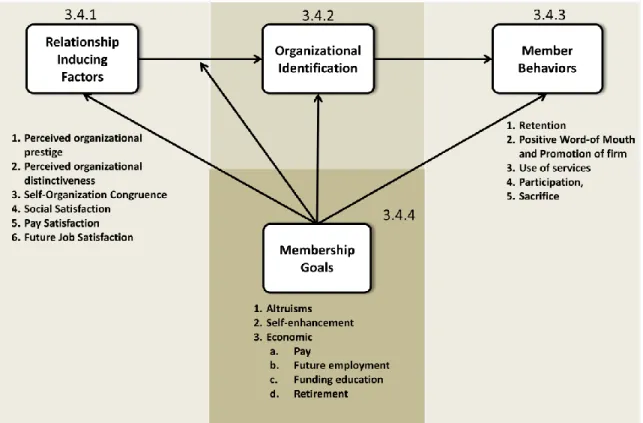
These hypotheses fall within four categories (see Figure 1.4, page 9):
1. The direct effects of membership goals on perceptions of the organization and
satisfaction with the organization.
2. The direct and indirect effects of membership goals on identification with the
membership organization.
3. The direct and indirect effects of membership goals on behavior (e.g.
retention, word-of-mouth referrals, participation, sacrifice, and use of member
services).
4. The moderating effects of membership goals on the relationship-inducing
factors→identification association.
After discussing the full model and its hypotheses, I introduce the construct
scales, survey instrument, and methods necessary for testing the model. I begin with a
discussion of the scale development process. Construct measures were adapted from
18
pretesting and factorial analysis, and trimming decisions to arrive at the final scales.
After discussing this process, I present the final scales and discuss their psychometric
properties. I also introduce the survey instrument and discuss the development and
pretesting of the survey for each of the three samples.
Essay I continues with a discussion of Confirmatory Factor Analysis (CFA) and
SEM testing of the full model using the cross-sectional data drawn from the sample of
approximately 1050 current Soldiers. CFA is used to test the factorial validity of the
hypothesized latent constructs and to confirm that items selected during pretesting remain
valid and reliable in the final sample. SEM is used to estimate the structural relationships
in my conceptual model and to test its fit against rival models and alternative
explanations. Effects of membership goal constructs in the full model are discussed and
compared to the initial hypotheses; this includes tests for moderation and the inclusion of
control variables.
1.5.2 Essay II (Chapters VI through X)
Essay II builds upon the theory, mechanisms, and structural model developed in
Essay1. The objectives of this essay are:
1. To understand how membership evolves across the three membership cohorts
representing the partial membership period (Future Soldiers), the membership
integration period (New Soldiers), and the full membership period (Current
Soldiers) (Figure 6). More specifically, this objective includes identifying
differences between cohorts in how they perceive the organization, their level
19
Also of interest are the differences between the effects of expected satisfaction
(Future Soldiers) versus experienced satisfaction (Current Soldiers).
2. To test the validity of the measurement and structural models from Essay I
using two other cohorts (New Soldiers and Future Soldiers).
Essay II begins with an introduction to the Army membership process and
discussion of the three Soldier samples. Each sample is then related to the Army’s
membership process and how they contribute to testing of the research hypotheses. From
this point, the groups are empirically tested for invariance in their measurement models,
structural models, and latent means. The samples are not expected to be fully
non-invariant and the purpose of this testing is not to combine the samples. Instead, the type,
structure, and magnitude of any differences are used to develop insights into the cohorts,
the model, and its mechanisms.
Essay II continues with an introduction to the methods used for testing invariance
of the items, the factorial structure, paths, and latent means. It then transitions to a
discussion of the results from each of these analyses and their implications for marketing,
organizational behavior, and managerial practice.
1.5.3 Essay III (Chapters XI through XIII)
Essay III focuses on the change process within cohorts and has three primary
objectives:
1. To identify, describe and explain the change process that occurs between
20
2. To identify, describe, and explain how different membership goals affect the
change process identified as part of Objective 1.
3. To validate the causal predominance represented in the final models from the
first two essays.
Essay III focuses on describing and explaining the change process that occurs
between time_1 and time_2. Change is expected to occur within both the New Soldier
and Future Soldier groups. New Soldiers are undergoing an immersive, intense two to
three month period of training and integration designed specifically to change civilians to
Soldiers or non-members to members. Future Soldiers are in a period of partial
membership that precedes training and integration, usually remaining in their home
communities and having limited contact with other members of the Army. Despite being
less immersive and intense than the initial training and integration period, these Future
Soldiers are expected to experience anticipatory socialization, as they prepare to accept
new norms, values, attitudes, and behaviors and begin to develop expectations about
membership in the Army (Simpson 1962).
This analysis uses the two-wave panel data from the New Soldier and Future
Soldier samples to complete latent growth modeling (LGM). LGM, which is also an
application of SEM, uses longitudinal variation and individual (cross-sectional) variation
to make strong inferences about the change process. The analysis seeks to discover the
mean trajectories of change observed in the two panel observations and understand the
extent of individual differences in change based on variance in their growth parameters
(Steenkamp and Baumgartner 2000). This ability is particularly important because it can
21
aggregate trends are present. More generally, LGM is used to link differences in
individual growth parameters to their antecedents and consequences and gain insights
into the reasons for individual variation. Essay III describes the LGM methodology in
greater detail and sets up the models to be tested. Emphasis is placed on linking
differences in identification growth parameters to membership goals,
relationship-inducing factors (e.g. perceptions of the organization), and behavioral consequences.
Also of interest are the effects of membership goals on relationship-inducing factors and
behavior growth parameters.
Essay III continues by discussing the method for testing moderation in LGM and
testing the degree to which membership goals moderate the influence of
relationship-inducing factors on identification growth parameters. Demonstrating moderation of
change in two-wave panel provides stronger evidence than the cross-sectional moderation
analysis presented in Essay 1.
Finally, the two-wave panel data from the New Soldier and Future Soldier
samples are used to provide additional evidence for the causal predominance suggested
by the structural models in Essays I and II. This analysis uses a structural model that
takes measures of each latent construct at two points in time and models causal paths
from the latent variables at time1 to the latent variables at time_2 (Byrne 2001). This
analysis tests the hypothesis that a latent variable at time1 causes another latent variable at
time2 or whether the process operates in reverse. For example, I expect identification at
time1 to cause word-of-mouth referral behavior at time_2, but I must rule out that
providing word-of-mouth referrals at time1 makes the member more identified at time2.
22
initial and final (best fitting) models and their implications for the full structural models
developed in the first two essays.
The essay concludes with a discussion of the results from each of these analyses
and their implications for marketing, organizational behavior, and managerial practice.
This is followed by a discussion of the overall findings and implications across all three
CHAPTER II:
IDENTIFICATION AND GOAL THEORY, HYPOTHESES, AND MODELS
High quality individual-organization relationships provide substantial value to
firms and non-profit organizations through members’ relational behaviors, such as
promoting the organization and increased use of the firm’s services (Bhattacharya et al.
1995; Palmatier 2008; Sheth and Parvatiyar 1995). Relationship quality may prove even
more important within the membership marketing context (Gruen et al. 2000), yet there
has been a dearth of academic study that addresses this area, and only a few have
explored the connection between identification and member behaviors. The few studies
that explored this relationship have been limited to the college alumni and art museum
settings (Arnett et al. 2003; Bhattacharya et al. 1995; Bhattacharya 1998; Mael and
Ashforth 1992), and none of these studies investigated the influence of membership goals
on identification or other measure of relationship quality.
This chapter seeks to close this gap by examining current organizational
identification and goals theory and empirical studies to develop hypotheses and models
for their integration. These hypotheses and models will demonstrate that membership
goals influence not only an organization’s efforts to attract and enlist new members (e.g.
the right side AIDA model in Figure 1.3), but also the quality of the organization’s
relationship with its members in terms of their perceptions of the organization,
satisfaction, organizational identification, and pro-organizational behaviors (e.g. the left
24
on identification, it is necessary to first outline and understand organizational
identification and its nomological network. This knowledge of organizational
identification, along with a well developed structural model, is then used as the basis for
empirically testing the effects of membership goals on identification, membership
behaviors, and members’ value to the organization.
Accordingly, this chapter discusses and develops organizational identification
theory and builds a set of hypotheses to model the identification process. After validating
the identification-based relational model, the chapter explores goal theory and its
application to the membership marketing context. Membership goal hypotheses are
developed and integrated into the previously validated identification-based relational
model. The results of this empirical testing are then discussed and their practical and
managerial implications developed. This study’s value stems primarily from developing
and testing membership goal effects on identification and members’ value, but it also
makes substantial contributions through 1) synthesizing and validating findings from the
few previous studies using identification in the membership marketing context and 2)
addressing empirical gaps and inconsistencies within these studies.
2.1 Identification and Relationship Quality in Membership Organizations There is substantial theoretical and empirical support for identity constructs,
which have been used for years to explain behavior and relationship performance by
multiple academic disciplines (e.g. organizational behavior, marketing, sociology, and
social psychology) (Mael and Ashforth 1992; Stryker and Serpe 1982). Identity has also
25
to focus on the role of identity in influencing preferences, choice, and consumption
related behaviors or on the use of the self-brand relationships to signal identity and
enhance self perceptions (Belk 1988; Berger and Heath 2007; Kleine, Kleine, and Brunswick
2009). Research in this area convincingly demonstrated that businesses benefit from
developing strong identity associations with their offerings, brands, and organization
(Cohen and Reed 2006). These identification-based benefits include increased brand
loyalty, repurchase and retention behavior, providing positive word of mouth, and public
and prominent consumption of the brand and its related products and services (Ahearne,
Bhattacharya, and Gruen 2005). Consequently, positioning brands and offerings to
reflect particularly desirable identities has become a common means to develop positive
brand attitudes and brand loyalty (Cohen and Reed 2006).
While the consumption of products and brand associations may contribute to an
individual’s identity, identity is principally derived from the social group memberships
and social roles of the individual (Ashforth and Mael 1989; Stets and Burke 2000;
Stryker and Serpe 1982). This is particularly true in the membership marketing context,
where identity is primarily conferred through affiliation with the membership
organization and less through the consumption of products, though this distinction can
become blurred in some situations (e.g. brand communities such as the Harley Owners
Group). This dissertation focuses on social identification with the membership
organization, where the individual defines himself in terms of the organization and
perceives a connectedness or belongingness with the organization.
Social identity argues that individuals derive their identity principally from the
26
combination of social categories (Brewer 1991; Stets and Burke 2000; Tajfel and Turner
1985). In this perspective, individuals engage in self categorization and social
comparison, through which they seek to develop and improve their positive self-image
and self-esteem (Hogg and Abrams 1988; Turner 1987). By classifying themselves and
others as in-group (or out-group), individuals enhance their self-image and strengthen
their identification with the group (Dutton, Dukerich, and Harquail 1994; Turner 1987).
This also functions to emphasize the perceived similarities with in-group members and
accentuates the perceived differences relative to out-groups (Stets and Burke 2000). In
this way, identity is both a result of social interaction and a source of subsequent
behaviors. In the context of relationship or membership marketing, social identity theory
suggests that identified individuals will evaluate themselves relative to the in-group’s
attributes, characteristics, beliefs, values, and behaviors and seek positive comparison and
differentiation relative to the other groups (Reed 2002). The more psychologically
significant the group membership is, the more salient the identity, and the more it
functions psychologically influence perception and behavior (Oakes 1987). Furthermore,
individuals tend to reinforce their most salient identities by engaging in relationships
(memberships) and enacting behaviors consistent with the expectations associated with
the identity. For this reason, organizations benefit from developing and retaining highly
identified members.4
Within the membership context, these processes are often referred to as
organizational identification. Organizational identification represents a specific form of
4
27
social identification, where the person defines one’s self in terms of membership in a
particular organization and perceives a "oneness with or belongingness” with the
organization (Mael and Ashforth 1992, p. 104). These individuals then evaluate
themselves relative to the attributes, characteristics, beliefs, values, and behaviors of the
organization to which they are most identified and are most situationally salient (Reed
2002; Stets and Burke 2000). The stronger this identification, the more it should
influence perceptions and behaviors of importance to the organization (Oakes 1987; Stets
and Burke 2000). The relationships with the organization and others associated with it are
used to signal one’s similarities with the firm, provide differentiation with out-groups,
and ultimately enhance self perceptions. The type of individuals that tend to identify
with organizations can vary dramatically, but they all fill some of their self-definitional
needs through their relationships with the organizations they support (Ahearne et al.
2005). Because the image, qualities, and mission of organizations vary greatly, so to
should the consumers that identify with them.
There are several key studies that illustrate the relationships inherent in
organizational identification. Mael and Ashforth (1992) found that organizational
prestige and distinctiveness, satisfaction, and length of membership all functioned as
antecedents of alumni’s identification with their alma mater. These conclusions are
echoed by later findings that prestige, satisfaction, and length of membership functioned
as antecedents of identification among art museum members (Bhattacharya et al. 1995).
Arnett et al. (2003) confirmed that participation and prestige functioned to influence
28
and identification. Lastly, Dutton and colleagues (1994) found that memberships that
provided self-continuity and self-enhancement strengthened identification.
In the most basic terms, the existing research suggests that positive perceptions of
distinctiveness and prestige, satisfaction, and increased/prolonged engagement with the
organization function as relationship-inducing factors that increase identification.
Identification then functions to increase the incidence of important relational behaviors
(Figure 2.1).
Figure 2.1 Identification-Based Relational Model (reprint of Fig 1.2)
2.2 Why Organizational Identification?
From a relationship marketing perspective, identification functions as an
important psychological driver in customer-company and member-organization
relationships and creates “the kind of deep, committed, and meaningful relationships that
marketers are increasingly seeking to build with their customers” (Bhattacharya and Sen
2003, 76). This is particularly true in settings where stakeholders receive social benefits
from the relationship (Arnett et al. 2003) and where there are greater levels of
involvement. The few relationship marketing studies that use identification as their core
relational construct suggest that the identification process fits nicely within the general
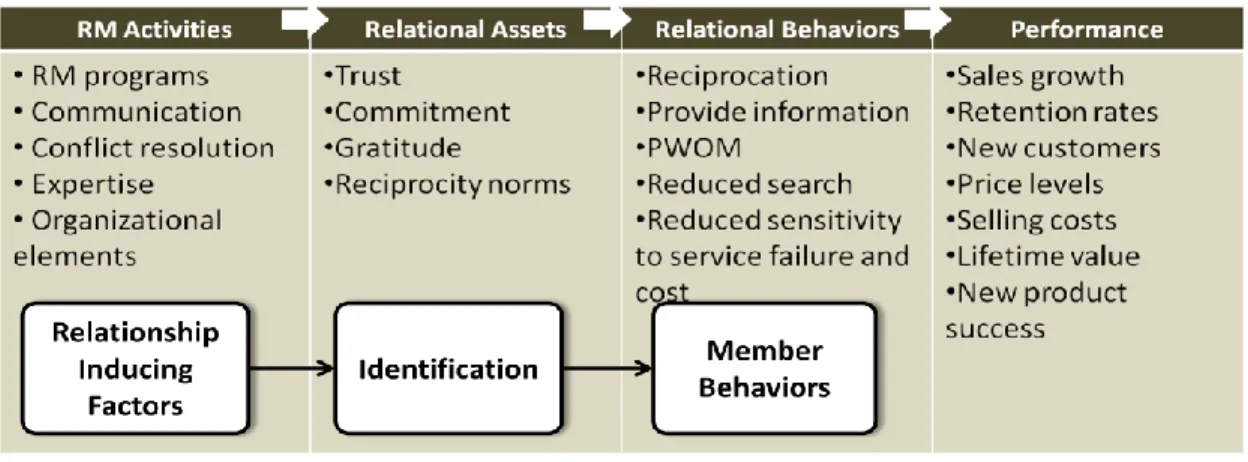
framework of relationship marketing. Based on the categorization from Figure 2.2,
relationship-inducing factors in the organizational identification model (e.g. developing
29
identification functions as a form of relational asset, and the behavioral outcomes of
identification fit within the categories of relational behaviors and performance outcomes.
Figure 2.2 The Relationship Marketing Framework (adapted from Palmatier 2008)
But why use identification rather than one of the other relational constructs (e.g.
commitment, trust, and gratitude/reciprocity) that are available to understand relationship
quality and explain/predict relational behaviors? Among the relational constructs,
commitment (particularly affective commitment) is most similar to identification, but
there are differences. At their core, identification reflects a sense of psychological
oneness and is more self-definitional, whereas commitment (affective commitment)
represents a psychological relationship between distinct entities and is more dependent on
social exchange (van Knippenberg and Sleebos 2006). In general, the more the
membership context 1) provides the opportunity for affiliation (direct or psychological),
2) creates social benefits, and 3) provides the basis for positive self comparison, the more
appropriate it will be to use identification. Because these conditions are common in
many membership contexts, identification is particularly well suited to measuring and
30
Identification also provides an understanding of certain behaviors that are not well
explained by commitment, gratitude/reciprocity, or other relational constructs that tend to
operate on the basis of social exchange. With identification, there is a greater potential
for hyper-citizenship behaviors. In this case a person that is highly identified with the
firm may perform relational behaviors that strongly benefit the organization even when
the organization does not seem to provide commensurate benefits to the individual in
return (Mael 1989; Swann, Gomez, Seyel, Morales, and Huici 2009).5 This may be one
of the reasons why nonprofit, cause-based organizations seem to benefit substantially
from relationships based on identification. For example, alumni that identified with their
university were more likely to donate and to promote the university without any
expectation of reciprocity (Arnett et al. 2003).
2.3 Where is Organizational Identification Most Appropriate?
Organizations with memberships that provide socioemotional benefits and offer
the potential for moderate to high levels of affiliation have the opportunity to benefit
from the development of identified individuals and the subsequent increase in its
members’ pro-organizational behaviors (Figure 1.1, pg 4). Identification is most likely to
occur when the individual desires and is able to self-categorize with the organization.
This tends to occur when the organization is perceived to 1) have prestige or a desirable
corporate image and 2) have some level of distinctiveness that enables the individual to
differentiate the firm (and therefore themselves) from other organizations and groups
5 Relationship marketing based on social exchange may limit the value of relational behaviors because the
31
(Ahearne et al. 2005; Bergami and Bagozzi 2000; Bhattacharya and Sen 2003; Dutton et
al.1994; Mael and Ashforth 1992; Whetten and Godfrey 1998). While prestige and
distinctiveness are important, the organizational image must also be congruent with the
individual’s self-image or desired self image. In other words, the organization must
reflect who the individual wants to be or how they want to be viewed. Additionally, the
relationship must be important enough to make the identity salient to the individual
(Bhattacharya and Sen 2003; Ahearne et al. 2005).
Identification is possible in many settings. In addition to contexts where the
customer is also a member (e.g. alumni associations, fitness clubs, or universities),
cause-based marketing, nonprofit marketing, and situations where the firm has a substantial
brand or consumption communities (e.g. Harley-Davidson or Apple) seem to be
particularly well-suited to identification-based relationships (Arnett et al. 2003;
Bhattacharya and Sen 2003; Ahearne et al. 2005; Bhattacharya et al. 1995).
2.3 Organizational Identification-Based Model of Relationship Quality 2.3.1 Antecedents of Identifications
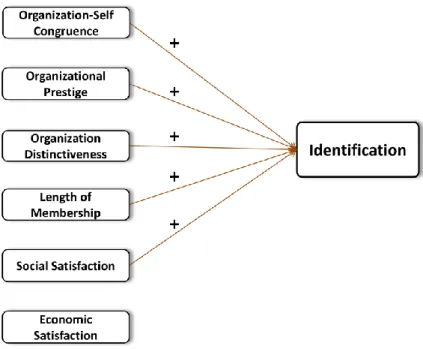
As shown in Figure 2.3, I anticipate that five factors will contribute to the
development of an identification-based relationship. From previous research I have
identified perceptions of congruence between the individual’s concept/desired
self-concept and their image of the organization, perceptions of organizational prestige and
distinctiveness, social satisfaction associated with the organization, and length of
32
Figure 2.3 Antecedents of Identification
Memberships, particularly those with high levels of affiliation, are evaluated not
only on their utility, but also in relation to the self, with the person asking, “Is this
organization a strong reflection of who I am or want to be?” and “Can I see myself in this
membership role?” This process is an aspect of individuals’ effort to engage in self
categorization and social comparison to maintain or improve their positive self-image and
self-esteem (Hogg and Abrams 1988). Ultimately, the membership needs to contribute to
the individual’s self-concept by providing self-consistency or self-enhancement. As such,
assessment of self-organization congruence and/or desired self-organization congruence
should also contribute to identification (Dutton et al. 1994). While the perception of
self-organization congruence is sometimes argued to be synonymous with self-organizational
identification, it is possible for a person to recognize the similarities or fit between one’s
self-image and the organization without feeling a sense of oneness with the organization.
33
values, and attributes with the Army without identifying with the Army. As such, I
hypothesize that self-organizational congruence is a necessary element of organizational
identification.
H1: Perceptions of self-organization and/or desired self-organization congruence will be positively related to identification with the organization.
In order for the organization to be perceived as a target for identity fulfillment, it
should also be perceived as prestigious and sufficiently distinct from other organizations.
When this is the case, the organization provides the opportunity for self-enhancement
through identification (self-categorization). In a seminal paper on organizational
identification, Mael and Ashforth (1992) find that organizational prestige and
organizational distinctiveness both function as antecedents of alumni identification with
their alma mater. Similar studies of art museum members and university alumni also
found that prestige was a primary factor influencing identification (Bhattacharya et al.
1995; Arnett et al. 2003). Ahearne and his colleagues (2005) show that perceived
prestige influenced identification even in a for-profit context where the identity
associations were less obvious (pharmaceutical sales). Interactions with other
organizational members also play a key role in perceptions of organizational prestige and
distinctiveness, so when organizational members were viewed favorably it increased the
likelihood that the potential member considered the organization a target for social
identity fulfillment (Bhattacharya and Sen, 2003). In general, the more prestigious the
organization is perceived to be, the greater the opportunity for enhancing self-concept.
Similarly, to the degree the organization is perceived as distinctive from other
organizations or competitors, the more clearly it can be used for self-categorization.
34
H3: Organizational distinctiveness is related positively to organizational
identification.
Dutton and her colleagues argued that the longer a member remains with the
organization the more salient it becomes as a basis for self-categorization (1994). Over
the last twenty years several studies have provided some evidence to support this
argument. Mael and Ashforth (1992) and Bhattacharya et al. (1995) both found that
length of membership positively influenced identification, while Arnett and colleagues
(2003) found that past participation positively affected identity salience.
H4: Length of membership will be positively related to organizational identification.
Early research found that satisfaction with the organization's contributions to
achieving goals was associated with identification (Hall and Schneider 1972). More
recent research has also postulated this relationship. Mael and Ashforth argued that
satisfaction depends on the organization 'contributions to the individual’s personal
objectives', with satisfaction then contributing to organizational identification (1992).
Arnett and his colleagues argued that satisfaction with the membership cause the
individual to reevaluate or reaffirm their identification with the organization. Despite the
earlier finding and the more recent theorizing, the empirical evidence supporting the
relationship has been sparse and the results across three studies have been mixed. Two
studies failed to find that satisfaction contributed to increased identification or increased
organizational identity salience (Arnett et al. 2003; Mael and Ashforth 1992), with only
Bhattacharya and his coauthors (1995) finding support for satisfaction (measured as
expectation confirmation) contributing to identification.
A review of the satisfaction scales used in these studies suggests a possible cause