American College of Cardiology/American Heart Association
(ACC/AHA) Class I Guidelines for the Treatment of Cholesterol to
Reduce Atherosclerotic Cardiovascular Risk: Implications for US
Hispanics/Latinos Based on Findings From the Hispanic Community
Health Study/Study of Latinos (HCHS/SOL)
Waqas T. Qureshi, MD, MS; Robert C. Kaplan, PhD; Katrina Swett, MS; Gregory Burke, MD, MSc; Martha Daviglus, MD, PhD; Molly Jung, MPH, PhD; Gregory A. Talavera, MD, MPH; Diana A. Chirinos, PhD; Samantha A. Reina, MS; Sonia Davis, DrPH; Carlos J. Rodriguez, MD, MPH
Background-—The prevalence estimates of statin eligibility among Hispanic/Latinos living in the United States under the new 2013 American College of Cardiology/American Heart Association (ACC/AHA) cholesterol treatment guidelines are not known.
Methods and Results-—We estimated prevalence of statin eligibility under 2013 ACC/AHA and 3rd National Cholesterol Education Program Adult Treatment Panel (NCEP/ATP III) guidelines among Hispanic Community Health Study/Study of Latinos (n=16 415; mean age 41 years, 40% males) by using sampling weights calibrated to the 2010 US census. We examined the characteristics of Hispanic/Latinos treated and not treated with statins under both guidelines. We also redetermined the statin-therapy eligibility by using black risk estimates for Dominicans, Cubans, Puerto Ricans, and Central Americans. Compared with NCEP/ATP III guidelines, statin eligibility increased from 15.9% (95% CI 15.0–16.7%) to 26.9% (95% CI 25.7–28.0%) under the 2013 ACC/AHA guidelines. This was mainly driven by the≥7.5% atherosclerotic cardiovascular disease risk criteria (prevalence 13.9% [95% CI 13.0–14.7%]). Of the participants eligible for statin eligibility under NCEP/ATP III and ACC/AHA guidelines, only 28.2% (95% CI 26.3–30.0%) and 20.6% (95% CI 19.4–21.9%) were taking statins, respectively. Statin-eligible participants who were not taking statins had a higher prevalence of cardiovascular risk factors compared with statin-eligible participants who were taking statins. There was no significant increase in statin eligibility when atherosclerotic cardiovascular disease risk was calculated by using black estimates instead of recommended white estimates (increase by 1.4%,P=0.12) for Hispanic/Latinos.
Conclusions-—The eligibility of statin therapy increased consistently across all Hispanic/Latinos subgroups under the 2013 ACC/AHA guidelines and therefore will potentially increase the number of undertreated Hispanic/Latinos in the United States. (J Am Heart Assoc. 2017;6:e005045. DOI: 10.1161/JAHA.116.005045.)
Key Words: ACC/AHA cholesterol treatment•disparities•epidemiology•guideline•Hispanics/Latinos•statin therapy
I
n 2013, American College of Cardiology/American Heart Association (ACC/AHA) cholesterol treatment guidelines based on high-quality evidence were published.1 These guidelines replaced the previous cholesterol treatmentguidelines: the third report of the national cholesterol education program/adult cholesterol treatment panel III (NCEP/ATP III).2Applying data from the National Health and Nutrition Examination Surveys, researchers suggested that
From the Division of Cardiology, Departments of Internal Medicine (W.T.Q., C.J.R.) and Public Health Sciences (K.S., C.J.R.), Wake Forest School of Medicine, Winston Salem, NC; Division of Cardiology, Department of Internal Medicine, Albert Einstein College of Medicine, New York, NY (R.C.K., G.B.); Division of Cardiology, Department of Internal Medicine, Northwestern University, Chicago, IL (M.D.); John Hopkins University, Baltimore, MD (M.J.); San Diego State University, San Diego, CA (G.A.T.); University of Miami, FL (D.A.C., S.A.R.); University of North Carolina, Chapel Hill, NC (S.D.).
Accompanying Tables S1 through S3 and Figure S1 are available at http://jaha.ahajournals.org/content/6/5/e005045/DC1/embed/inline-supplementary-material-1.pdf
Correspondence to:Waqas T. Qureshi, MD, MS, Wake Forest University School of Medicine, Watlington Building, Medical Center Blvd, Winston Salem, NC 27157. E-mail: [email protected]
Received November 14, 2016; accepted February 24, 2017.
the new 2013 ACC/AHA guidelines for the management of cholesterol could potentially increase the number of statin-therapy eligible US adults by 12.8 million.3 However, this study did not include several of the Hispanic/Latino subpop-ulations and only included Mexican Hispanics. In addition, current cholesterol treatment guidelines were based on either non-Hispanic white and/or black populations and did not take into account Hispanics/Latinos.
Hispanics/Latinos currently constitute 18% of the US population, making them the largest ethnic minority. It is important to study the statin eligibility to direct healthcare needs for primary prevention of cardiovascular disease in this ethnic group. The current guidelines provided an atheroscle-rotic cardiovascular disease (ASCVD) calculator to estimate 10-year ASCVD risk. This calculator uses the same estimates for Hispanic/Latinos as that of whites. However, several of the Hispanics/Latinos share their ancestry with African ancestry, particularly Caribbean-Hispanics (Cubans, Dominican, and Puerto Rican descent) and Central Americans.4–7 It is likely that not recognizing the African ancestry in certain Hispanic groups could underestimate ASCVD risk. It is important to address these knowledge gaps as it would potentially provide data of public health importance that could be utilized to address the current disparities in primary prevention of ASCVD. Therefore, we determined the prevalence estimates from the Hispanic Community Health Study/Study of Latinos eligible for cholesterol treatment under the new 2013 ACC/AHA guideli-nes and previous NCEP/ATP III guideliguideli-nes. We further examined the prevalence of US Hispanics/Latinos who are eligible for statin therapy but are currently not on statin therapy.
Methods
Study Design and Population
The Hispanic community health study/study of Latinos (HCHS/ SOL) is a community-based study of 16 415 Hispanic/Latino adults aged 18 to 74 years at recruitment, recruited from 4 US metropolitan areas (Bronx, NY; Chicago, IL; Miami, FL; and San Diego, CA).8 Participants were recruited by using a 2-stage probability sample design, as described previously.9A compre-hensive battery of interviews relating to personal and family characteristics, health status and behaviors, and a clinical assessment with blood draws were conducted at an in-person baseline clinic visit during 2008 to 2011. The study was approved by the institutional review boards at all participating institutions, and all participants gave written informed consent.
Risk Factor Assessment
Participants were asked to fast and refrain from smoking on the morning before the HCHS/SOL baseline clinic visit.
Following a 5-minute rest period, 3 seated blood pressure measurements were obtained with an automatic sphygmo-manometer, which were averaged. Total cholesterol, high-density lipoprotein cholesterol, low-density lipoprotein cholesterol, triglycerides, and fasting glucose were mea-sured using standardized methods described previously.10,11 Height, waist circumference, and hip circumference were measured to the nearest centimeter and weight to the nearest 0.1 kg. BMI was calculated as weight in kilograms divided by height in meters squared. Interviewer-adminis-tered questionnaires were used to collect information on age, sex, annual household income, educational attainment, Hispanic/Latino background, employment status, health insurance status, and history of smoking. Diabetes mellitus was defined as fasting glucose ≥126 mg/dL, 2-hour– postload plasma glucose ≥200 mg/dL, hemoglobin A1c
≥6.5%, use of diabetes medications, or self-reported history of diabetes mellitus. Participants were instructed to bring all prescription and nonprescription medications taken in the past 4 weeks; medication preparations, concentrations, and units were coded for analysis. We defined statin medication use as the use of at least 1 statin (3-hydroxy-3-methyglutaryl coenzyme A reductase inhibitors) medication.
Cholesterol Treatment Guidelines and Statin
Eligibility
Statin eligibility was defined by using the following NCEP/ATP III updated guidelines12 and ACC/AHA guidelines. As per 2004 NCEP/ATP III guidelines, statin-eligible participants included participants with (1) prevalent coronary heart disease, defined as myocardial infarction, coronary bypass surgery, balloon angioplasty, or stent placement in coronary arteries, and low-density lipoprotein (LDL) cholesterol of 100 or higher; (2) LDL cholesterol of 190 mg/dL or higher; (3) diabetes mellitus and LDL cholesterol of 100 or higher; (4) combination of calculated 10-year coronary heart disease Risk (using the Framingham risk calculator) and LDL choles-terol levels: (1) risk of 20% or greater and LDL cholescholes-terol of 100 mg/dL or higher; (2) risk of 10% to 20% and LDL cholesterol of 130 mg/dL or higher with 2 or more risk factors (smoking, hypertension, high-density lipoprotein cholesterol less than 40 mg/dL, myocardial infarction or angina in first-degree relative before age 50, and age [45 years or older for men, 55 years or older for women]); (3) risk of less than 10% and LDL cholesterol of 160 mg or higher with 2 or more risk factors.
By 2013 ACC/AHA class I guidelines,13 statin-eligible participants included the following: (1) prevalent cardiovas-cular disease, defined as coronary heart disease, angina, or stroke; (2) LDL cholesterol of 190 mg/dL or higher; (3) diabetes mellitus and LDL cholesterol of 70 mg/dL or
N
AL
RESE
higher; and (4) 10-year cardiovascular disease risk of 7.5% or greater, based on the pooled cohort equations and LDL cholesterol of 70 or higher.14
Statistical Analysis
We chose a probability sampling strategy with face-to-face recruitment. Geographic clusters were stratified by the proportion of the population found to be Hispanic/Latino in the 2000 decennial census, and clusters in the “high concentration” stratum were selected at a higher rate than clusters in the“low concentration”stratum at the first stage of sample selection. An optimal delineation point between high and low concentration was determined for each field center using Cochran’s cumulative√f rule.15Furthermore, we also used Hispanic/Latino surnames to identify home addresses in these geographic areas and were oversamples compared to the home addresses without Hispanic/Latino surnames. We used SAS SURVEY command to calculate the prevalence estimates by using sampling weights, which took into account nonresponse and oversampling of specific population subgroups to provide weighted frequencies of descriptive variables and population estimates of statin-therapy eligibility. Weights were calibrated to 2010 US census characteristics by age, sex, and Hispanic/Latino background in each field center’s target population, in accordance with the procedures commonly used in popula-tion-based studies.9 Continuous variables were compared using regression analysis and categorical variables were compared using Rao–Scott v2 test. We also classified prevalence that were statin-therapy eligible under previous versus newer guidelines. Under the new guidelines, statin eligibility falls into 3 criteria: (1) individuals with history of clinical cardiovascular disease; (2) those with LDL-C
≥190 mg/dL; (3) those without known ASCVD with LDL-C between 70 and 189 mg/dL but with ≥7.5% 10-year ASCVD risk; and (4) those with diabetes mellitus and LDL-C
≥70 mg/dL. The new Pooled Cohort Risk Assessment
calculator was used to assess ASCVD risk using white estimates for Hispanics.14
We then identified individuals who were not treated (undertreatment) by statin therapy but were classified as eligible for statin therapy. We defined statin-therapy undertreatment as the prevalence eligible for statin therapy under cholesterol treatment guideline but were not on statin. We then examined prevalence of various subgroups that were statin eligible under current and previous guidelines to show disparities and characteristics of these individuals. Race factors into ASCVD risk prediction in the new ACC/ AHA guidelines, with recommendations to assume white risk estimates in all Hispanics. Since certain Hispanic groups have more African ancestry, the current guidelines fail to
consider the complexity of the Hispanic/Latino population. Thus, race was treated separately in sensitivity analysis. All analyses were weighted to adjust for sampling probability and nonresponse, to make the estimates applicable to the target population from which the HCHS/SOL sample was drawn in accordance with guidelines suggested by the HCHS/SOL Steering and Data Analysis Committee. APvalue of <0.05 was considered significant. All analyses were performed using SAS v. 9.3 (Cary, NC).
Results
Participant Characteristics
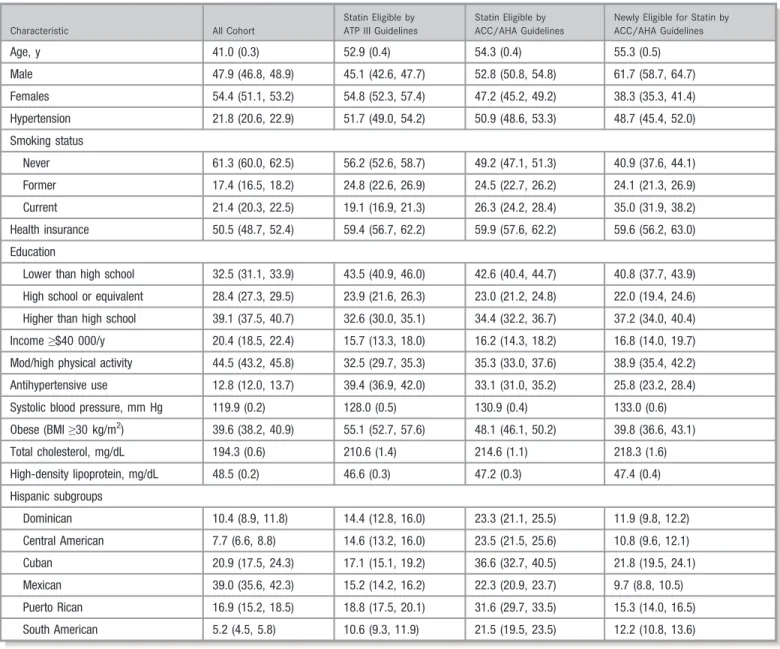
Descriptive characteristics are shown in Table 1. Hispanics/ Latinos statin-therapy eligible by ACC/AHA guidelines were more often older, more males, and had higher systolic blood pressure and total cholesterol than participants eligible by NCEP/ATP III guidelines. On the other hand, the prevalence of obesity and antihypertensive medication use was lower for statin-eligible participants by ACC/AHA guidelines than NCEP/ATP III guidelines.
Application of 2013 ACC/AHA Cholesterol
Treatment Guidelines to the Cohort
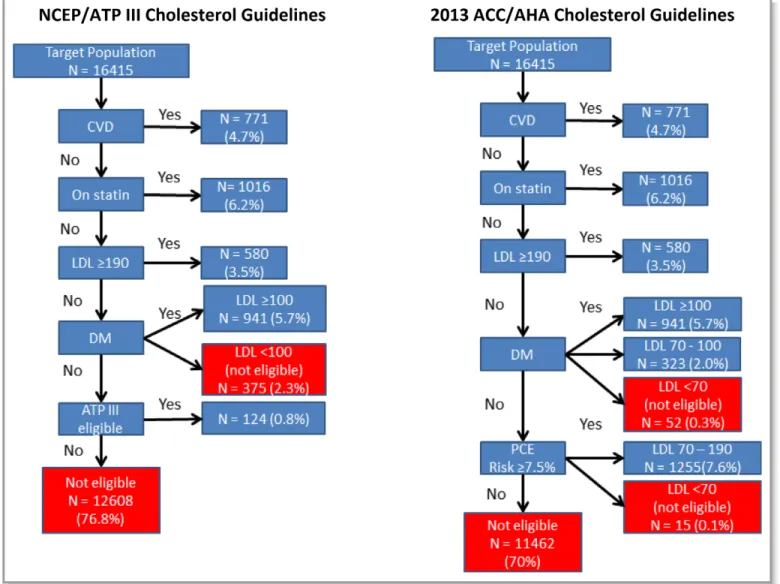
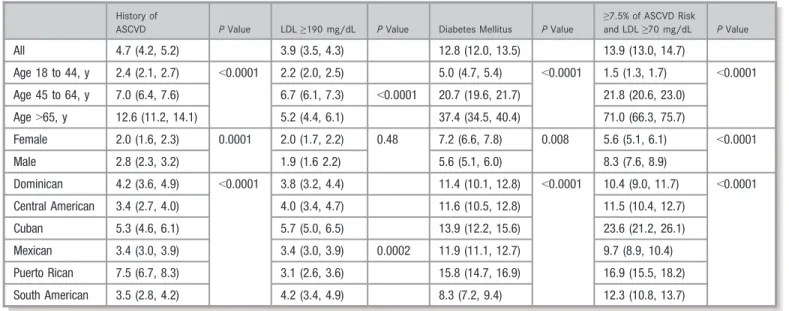
Figure shows the breakdown of study participants by cholesterol treatment guidelines. Out of 16 415 participants, 4160 (26.9%; 95% CI 25.7–28.0%) were statin eligible under the 2013 ACC/AHA guidelines while 2609 (15.9%; 95% CI 15.0–16.7%) were statin eligible under the NCEP/ATP III guidelines. This eligibility was based on prior history of ASCVD in 771 (4.7%; 95% CI 4.2–5.2%), LDL ≥190 mg/dL in 640 (3.9%; 95% CI 3.5–5.3%), history of diabetes mellitus in 2101 (12.8%; 95% CI 12.0–13.5%), and LDL ≥70 mg/dL with 10-year ASCVD risk of ≥7.5% in 2281 (13.9%; 95% CI 13.0– 14.7%) (Table 2). The overall most common indication for statin eligibility among all Hispanics/Latinos subgroups was having ASCVD risk of≥7.5%. When stratified by age and sex, Puerto Rican females aged 18 to 64 years had the highest prevalence of statin-eligible participants by 10-year ASCVD risk of≥7.5% criteria (v2statistic<0.05) than other subgroups (Table S1).
Increase in Eligibility for Statin Therapy
There was an increase in eligibility for statin therapy under the ACC/AHA guidelines across all Hispanic/Latino subgroups as shown in Table 3. The increase in eligibility was mainly driven by ASCVD risk score. There was an absolute increase by 11.0% (69.1% relative increase). Particularly, the subgroups aged>65 years and males had the highest increase in statin
N
AL
RESE
eligibility under the ACC/AHA guidelines: an absolute increase by 45.6% (114.9% relative increase) and 14.7% (98.6% relative increase), respectively. Among the Hispanic/ Latino subgroups, in unadjusted analysis, Cubans and South Americans had the highest increase in statin eligibility (Table 3). The increase in eligibility was more pronounced in >65-year-old individuals and males (P<0.05). The age- and sex-stratified analyses shown in Table S2 also demonstrated a consistent pattern of increase in prevalence of statin therapy among statin-eligible participants. In age- and sex-adjusted analyses, the South American subgroup had the least prevalence of statin-eligible participants by both NCEP/ATP III guidelines and ACC/AHA guidelines, while the Puerto Rican
subgroup had the highest prevalence of statin-eligible partic-ipants by both guidelines (Table S3).
Statin Treatment Rates of Hispanics/Latinos
Under 2013 ACC/AHA and 2004 NCEP/ATP III
Guidelines
Among Hispanics/Latinos, prevalence of statin use was 7.9% (95% CI 7.2–8.6%). Of the participants who were statin eligible, only about one third and onefifth of the participants were taking statins under NCEP/ATP III guidelines (28.2% [95% CI 26.3–30.0%]) and ACC/AHA guidelines (20.6% [95% CI 19.4–21.9%]), respectively (P for difference <0.0001).
Table 1. Prevalence Estimates and 95% CI by Category of ATP III and ACC/AHA Cholesterol Guidelines for Participants in the HCHS/SOL
Characteristic All Cohort
Statin Eligible by ATP III Guidelines
Statin Eligible by ACC/AHA Guidelines
Newly Eligible for Statin by ACC/AHA Guidelines
Age, y 41.0 (0.3) 52.9 (0.4) 54.3 (0.4) 55.3 (0.5)
Male 47.9 (46.8, 48.9) 45.1 (42.6, 47.7) 52.8 (50.8, 54.8) 61.7 (58.7, 64.7)
Females 54.4 (51.1, 53.2) 54.8 (52.3, 57.4) 47.2 (45.2, 49.2) 38.3 (35.3, 41.4)
Hypertension 21.8 (20.6, 22.9) 51.7 (49.0, 54.2) 50.9 (48.6, 53.3) 48.7 (45.4, 52.0)
Smoking status
Never 61.3 (60.0, 62.5) 56.2 (52.6, 58.7) 49.2 (47.1, 51.3) 40.9 (37.6, 44.1)
Former 17.4 (16.5, 18.2) 24.8 (22.6, 26.9) 24.5 (22.7, 26.2) 24.1 (21.3, 26.9)
Current 21.4 (20.3, 22.5) 19.1 (16.9, 21.3) 26.3 (24.2, 28.4) 35.0 (31.9, 38.2)
Health insurance 50.5 (48.7, 52.4) 59.4 (56.7, 62.2) 59.9 (57.6, 62.2) 59.6 (56.2, 63.0)
Education
Lower than high school 32.5 (31.1, 33.9) 43.5 (40.9, 46.0) 42.6 (40.4, 44.7) 40.8 (37.7, 43.9)
High school or equivalent 28.4 (27.3, 29.5) 23.9 (21.6, 26.3) 23.0 (21.2, 24.8) 22.0 (19.4, 24.6)
Higher than high school 39.1 (37.5, 40.7) 32.6 (30.0, 35.1) 34.4 (32.2, 36.7) 37.2 (34.0, 40.4)
Income≥$40 000/y 20.4 (18.5, 22.4) 15.7 (13.3, 18.0) 16.2 (14.3, 18.2) 16.8 (14.0, 19.7)
Mod/high physical activity 44.5 (43.2, 45.8) 32.5 (29.7, 35.3) 35.3 (33.0, 37.6) 38.9 (35.4, 42.2)
Antihypertensive use 12.8 (12.0, 13.7) 39.4 (36.9, 42.0) 33.1 (31.0, 35.2) 25.8 (23.2, 28.4)
Systolic blood pressure, mm Hg 119.9 (0.2) 128.0 (0.5) 130.9 (0.4) 133.0 (0.6)
Obese (BMI≥30 kg/m2) 39.6 (38.2, 40.9) 55.1 (52.7, 57.6) 48.1 (46.1, 50.2) 39.8 (36.6, 43.1)
Total cholesterol, mg/dL 194.3 (0.6) 210.6 (1.4) 214.6 (1.1) 218.3 (1.6)
High-density lipoprotein, mg/dL 48.5 (0.2) 46.6 (0.3) 47.2 (0.3) 47.4 (0.4)
Hispanic subgroups
Dominican 10.4 (8.9, 11.8) 14.4 (12.8, 16.0) 23.3 (21.1, 25.5) 11.9 (9.8, 12.2)
Central American 7.7 (6.6, 8.8) 14.6 (13.2, 16.0) 23.5 (21.5, 25.6) 10.8 (9.6, 12.1)
Cuban 20.9 (17.5, 24.3) 17.1 (15.1, 19.2) 36.6 (32.7, 40.5) 21.8 (19.5, 24.1)
Mexican 39.0 (35.6, 42.3) 15.2 (14.2, 16.2) 22.3 (20.9, 23.7) 9.7 (8.8, 10.5)
Puerto Rican 16.9 (15.2, 18.5) 18.8 (17.5, 20.1) 31.6 (29.7, 33.5) 15.3 (14.0, 16.5)
South American 5.2 (4.5, 5.8) 10.6 (9.3, 11.9) 21.5 (19.5, 23.5) 12.2 (10.8, 13.6)
Continuous variables are expressed as mean (standard error) and categorical as numbers (percentage). ACC/AHA indicates American College of Cardiology/American Heart Association; ATP III, 3rd National Cholesterol Education Program Adult Treatment Panel; HCHS/SOL, Hispanic Community Health Study/Study of Latinos.
N
AL
RESE
Figure S1 shows prevalence of statin therapy for age, sex, and Hispanic/Latino subgroups under both treatment guidelines. This figure shows that younger participants, males, and all Hispanic/Latino subgroups except Puerto Ricans were undertreated by statins. We observed that among those who were statin eligible under the ACC/AHA guidelines, those not on statin therapy were significantly younger and more likely to be males, smokers, and hypertensives. They were also more likely to have no medical insurance and be lower income (Table 4).
Accounting for African Ancestry of Dominicans,
Puerto Ricans, Dominicans, and Central
Americans for Calculation of 10-Year ASCVD Risk
When we used the white coefficient to calculate 10-year ASCVD risk for all Hispanics/Latinos subgroups, about one
fourth of the participants were statin eligible (26.9% [95% CI 25.8–28.0%]) under ACC/AHA guidelines. When we used black coefficient to estimate ASCVD risk for Dominicans, Puerto Ricans, and Central Americans, 28.2% (95% CI 27.0– 29.4%) were statin eligible, which was a 1.3% absolute increase in statin eligibility while 0.40% (95% CI 0.29–0.53%) became ineligible.
Discussion
In this large population-based sample of Hispanics/Latinos living in the United States, we observed that a higher number of Hispanics/Latinos will be eligible for statin therapy under the new 2013 ACC/AHA guidelines. The increase in eligibility was found across several demographic subgroups but was particularly higher among males, middle aged (45–64 years) individuals, and among certain Hispanic
Figure. Eligibility for statin therapy. ACC/AHA indicates American College of Cardiology/American Heart Association; CVD, cardiovascular disease; DM, diabetes mellitus; LDL, low-density lipoprotein; NCEP/ATP III, 3rd National Cholesterol Education Program Adult Treatment Panel; PCE, pooled cohort equation.
N
AL
RESE
background groups (Dominicans, Puerto Ricans, and Central Americans). We also found that only one third and onefifth of statin-eligible Hispanics/Latinos under NCEP/ATP III guidelines and 2013 ACC/AHA guidelines, respectively, were taking statins. In addition, we found that changing the estimates for 10-year ASCVD risk for the Hispanic/Latino subgroups for Dominicans, Puerto Ricans, and Central Americans did not significantly increase statin eligibility.
To our knowledge, this is thefirst population-based study of Hispanics/Latinos living in the United States that has provided prevalence estimates of statin eligibility under 2013 ACC/AHA cholesterol and 2004 NCEP/ATP III cholesterol treatment guidelines. Thefindings of this study are consistent with other studies showing increase in statin eligibility among whites,16 Europeans,17and Koreans, Mexican majority Hispanics, and Chileans.18–21 The newer guidelines have expanded the
Table 2. Prevalence Estimates and 95% CI for Statin Therapy by 2013 ACC/AHA Cholesterol Treatment Class I Guideline-Based Categories
History of
ASCVD PValue LDL≥190 mg/dL PValue Diabetes Mellitus PValue
≥7.5% of ASCVD Risk
and LDL≥70 mg/dL PValue
All 4.7 (4.2, 5.2) 3.9 (3.5, 4.3) 12.8 (12.0, 13.5) 13.9 (13.0, 14.7)
Age 18 to 44, y 2.4 (2.1, 2.7) <0.0001 2.2 (2.0, 2.5) 5.0 (4.7, 5.4) <0.0001 1.5 (1.3, 1.7) <0.0001
Age 45 to 64, y 7.0 (6.4, 7.6) 6.7 (6.1, 7.3) <0.0001 20.7 (19.6, 21.7) 21.8 (20.6, 23.0)
Age>65, y 12.6 (11.2, 14.1) 5.2 (4.4, 6.1) 37.4 (34.5, 40.4) 71.0 (66.3, 75.7)
Female 2.0 (1.6, 2.3) 0.0001 2.0 (1.7, 2.2) 0.48 7.2 (6.6, 7.8) 0.008 5.6 (5.1, 6.1) <0.0001
Male 2.8 (2.3, 3.2) 1.9 (1.6 2.2) 5.6 (5.1, 6.0) 8.3 (7.6, 8.9)
Dominican 4.2 (3.6, 4.9) <0.0001 3.8 (3.2, 4.4) 11.4 (10.1, 12.8) <0.0001 10.4 (9.0, 11.7) <0.0001
Central American 3.4 (2.7, 4.0) 4.0 (3.4, 4.7) 11.6 (10.5, 12.8) 11.5 (10.4, 12.7)
Cuban 5.3 (4.6, 6.1) 5.7 (5.0, 6.5) 13.9 (12.2, 15.6) 23.6 (21.2, 26.1)
Mexican 3.4 (3.0, 3.9) 3.4 (3.0, 3.9) 0.0002 11.9 (11.1, 12.7) 9.7 (8.9, 10.4)
Puerto Rican 7.5 (6.7, 8.3) 3.1 (2.6, 3.6) 15.8 (14.7, 16.9) 16.9 (15.5, 18.2)
South American 3.5 (2.8, 4.2) 4.2 (3.4, 4.9) 8.3 (7.2, 9.4) 12.3 (10.8, 13.7)
The percentages are related to the total number of individuals eligible for statin therapy by ACC/AHA class I guidelines in each subgroup. ACC/AHA indicates American College of Cardiology/American Heart Association; ASCVD, atherosclerotic cardiovascular disease; LDL, low-density lipoprotein.
Table 3. Prevalence Estimates and 95% CI of Statin-Therapy Eligible Under Both Guidelines
2004 ATP III/NCEP 2013 ACC/AHA Newly Eligible
PValue
Absolute Increase*
Relative Increase† Prevalence Estimates (95% CI)
All 15.9 (15.0, 16.7) 26.9 (25.7, 28.0) 13.2 (12.4, 14.1) 11.0% 69.1%
Age 18 to 44, y 7.0 (6.7, 7.2) 10.0 (9.4, 10.5) 4.3 (3.9, 4.6) <0.0001 3.0% 42.8%
Age 45 to 64, y 25.4 (24.5, 26.3) 42.0 (39.8, 44.1) 20.4 (19.1, 21.7) 16.6% 65.3%
Age>65, y 43.4 (38.8, 47.9) 89.0 (83.5, 94.5) 49.9 (46.3, 53.4) 45.6% 114.9%
Female 16.8 (15.9, 17.7) 24.4 (23.3, 25.6) 9.7 (9.1, 10.3) <0.0001 7.6% 45.2%
Male 14.9 (14.1, 15.7) 29.6 (28.1, 31.1) 17.8 (16.7, 18.8) 14.7% 98.6%
Dominican 14.4 (12.8, 16.0) 23.4 (21.2, 25.5) 11.0 (9.8, 12.2) <0.0001 9.0% 62.5%
Central American 14.6 (6.9, 22.4) 23.6 (21.5, 25.6) 10.8 (9.6, 12.1) 9.0% 61.6%
Cuban 17.1 (15.1, 19.2) 36.6 (32.7, 40.5) 21.8 (19.5, 24.1) 19.5% 114.0%
Mexican 15.2 (14.2, 16.2) 22.3 (20.9, 23.7) 9.7 (8.8, 10.5) 7.1% 46.7%
Puerto Rican 18.8 (17.5, 20.1) 31.6 (29.7, 33.5) 15.3 (14.0, 16.5) 12.8% 68.1%
South American 10.6 (9.3, 11.9) 21.5 (19.5, 23.5) 12.2 (10.8, 13.6) 10.9% 102.8%
ACC/AHA indicates American College of Cardiology/American Heart Association; ATP III/NCEP, 3rd National Cholesterol Education Program Adult Treatment Panel. *Absolute increase in eligibility in a subgroup=([Eligible by ACC/AHA Eligible by ATP III/NCEP]/total number at risk in that subgroup)9100%.
†Relative increase in eligibility in a subgroup=([Eligible by ACC/AHA Eligible by ATP III/NCEP]/Eligible by ATPIII/NCEP)9100%.
N
AL
RESE
indications for statin therapy by including ASCVD risk score and have shown almost doubling of the statin eligibility.16–18,22Our study confirms a prior study where the majority of the Hispanics were of Mexican origin. However, the study did not provide prevalence estimates and did not represent all the subgroups of Hispanic/Latino origin.22An important aspect of our analysis that sets it apart from other analyses is inclusion of younger (<45-year-old) individuals who are included in the guidelines but have not been studied in the European cohort. Approximately one tenth of these individuals were eligible for statins under the new guidelines and had significant differences among the
various Hispanic subgroups, with the Puerto Rican female subgroup having the highest prevalence of individuals who qualified for statin therapy. The prevalence of statin therapy eligibility among 6 Hispanics/Latinos subgroups that this study has provided has not been previously studied. In addition, there was a concern that using white estimates for Hispanics/Latinos under the newer guidelines might not be appropriate for Hispanic subgroups with predominance of African ancestry. However, we did not detect a significant difference in increase in prevalence when white estimates were used for Dominicans, Puerto Ricans, Central Americans, and Cubans.
Table 4. Prevalence Estimates (%) and 95% CI for Statin Eligible on Statins and Not on Statins Under Both Guidelines
Variables
Statin Eligible by ATP III Guidelines on Statins
Statin Eligible by ATP III Guidelines Not
on Statins PValue
Statin Eligible by ACC/AHA Guidelines on Statins
Statin Eligible by ACC/AHA Guidelines
Not on Statins PValue
All 28.2 (26.3, 30.0) 71.8 (68.4, 75.3) 20.6 (19.4, 21.9) 79.4 (75.6, 83.1)
Age, y 59.8 (0.5) 50.5 (0.5) <0.001 61.0 (0.4) 52.7 (0.4) <0.001
Male 43.4 (38.3, 48.4) 45.2 (42.1, 48.3) 0.29 46.9 (42.3, 51.4) 54.0 (51.6, 56.2) 0.007
Female 56.6 (51.5, 61.6) 54.9 (51.8, 58.0) 53.1 (48.6, 57.7) 46.0 (43.7, 48.3)
Hypertension 77.9 (74.1, 81.7) 42.8 (39.7, 45.9) <0.001 75.7 (71.9, 79.4) 45.6 (42.8, 48.4) <0.001
Smoking status 0.03 <0.001
Never 55.9 (51.5, 60.4) 56.4 (53.2, 59.6) 53.2 (49.2, 57.3) 48.5 (46.0, 50.9)
Former 28.8 (24.7, 32.8) 23.6 (21.1, 26.0) 30.1 (26.3, 33.9) 23.1 (21.1, 25.1)
Current 15.3 (11.8, 18.9) 20.0 (17.5, 22.5) 16.7 (13.3, 20.1) 28.4 (26.1, 30.8)
Health insurance 82.3 (78.4, 86.2) 50.9 (47.9, 53.8) <0.001 85.6 (82.6, 88.6) 53.4 (50.9, 56.0) <0.001
Education 0.007 0.004
Lower than high school 14.4 (12.7, 16.1) 29.6 (27.1, 32.1) 49.6 (45.4, 53.7) 41.1 (38.6, 43.5)
High school or equivalent 5.4 (4.0, 6.8) 17.6 (15.5, 19.7) 18.4 (14.8, 21.9) 23.6 (21.5, 25.8)
Higher than high school 8.4 (6.9, 10.0) 24.4 (22.2, 26.7) 32.0 (27.4, 36.7) 35.3 (32.8, 37.7)
Income≥$40 000/y 15.8 (11.6, 20.1) 15.1 (12.6, 17.5) 0.02 18.2 (14.0, 22.4) 15.7 (13.7, 17.8) 0.09
Moderate/high physical activity 27.9 (22.4, 33.5) 33.6 (30.2, 36.8) 0.10 26.8 (22.1, 31.6) 63.0 (60.2, 65.8) 0.001
Antihypertensive use 70.5 (66.4, 74.6) 27.3 (24.7, 29.8) <0.001 65.7 (61.6, 69.8) 24.6 (22.5, 26.7) <0.001
Systolic blood pressure, mm Hg 131.2 (0.8) 126.7 (0.6) <0.001 133.1 (0.7) 130.4 (0.5) <0.001
Obese (BMI≥30 kg/m2) 16.4 (14.3, 18.5) 39.2 (36.7, 41.6) 0.14 10.6 (9.2, 12.1) 37.6 (35.6, 39.7) 0.10
Total cholesterol, mg/dL 185.0 (2.1) 220.3 (1.6) <0.001 193.5 (1.9) 220.3 (1.2) <0.001
High-density lipoprotein, mg/dL 47.6 (0.6) 46.3 (0.4) <0.001 48.5 (0.6) 46.8 (0.3) <0.001
Hispanic subgroups <0.001
Dominican 10.5 (7.6, 13.3) 9.2 (7.0, 11.3) 9.8 (7.3, 12.3) 8.7 (7.0, 10.3)
Central American 5.7 (3.7, 7.8) 7.8 (6.4, 9.3) 4.9 (3.3, 6.6) 7.2 (6.0, 8.5)
Cuban 23.8 (18.4, 29.1) 22.3 (18.0, 26.7) 26.2 (21.6, 30.7) 29.2 (24.6, 33.7)
Mexican 29.4 (24.5, 34.2) 40.7 (36.3, 45.0) 28.0 (23.7, 32.3) 33.2 (29.3, 37.2)
Puerto Rican 27.3 (23.3, 31.3) 27.3 (23.3, 31.3) 27.6 (23.9, 31.2) 17.3 (15.0, 19.7)
South American 3.3 (2.1, 4.5) 3.7 (2.7, 4.7) 3.6 (2.4, 4.7) 4.4 (3.5, 5.2)
ACC/AHA indicates American College of Cardiology/American Heart Association; ATP III/NCEP, 3rd National Cholesterol Education Program Adult Treatment Panel.
Continuous variables are expressed as mean (SE) and categorical as numbers (percentage). Continuous variables were compared using survey regression method and categorical variables were compared using Rao–Scottv2method.
N
AL
RESE
Furthermore, the ASCVD risk estimator under the current guidelines may not hold for Hispanics the same way as they do for other ethnicities. The current guidelines rely on cardiovascular risk factors to assign particular 10-year ASCVD risk. Hispanics are known to have a higher burden of cardiovascular risk factors and thus are likely to have higher estimates for ASCVD risk based on current guidelines; however, there is a documented notion that despite high cardiovascular risk factor burden, Hispanics suffer from much lower overall and cardiovascular mortality than other race– ethnic groups such as non-Hispanic whites and black Americans, a phenomenon known as “Hispanic paradox” in scientific literature.23,24The Hispanic paradox may or may not be applicable across all Hispanic background groups,25,26and future prospective data from the HCHS/SOL will help elucidate cardiovascular risk for Hispanics. This becomes important in the light of a recent “real-world” study that showed that ASCVD risk by AHA/ACC guidelines might lead to overestimation of ASCVD risk.27 Among 18 745 (6.1%) Hispanics included in this study, the risk score overestimated the risk of ASCVD events. Thus, our study further emphasizes the critical need to have race/ethnic–based calibrated scores.28
There are several implications of this study. First, this study demonstrates and confirms findings similar to other cohort studies in Hispanics. Secondly, it showed important differences across several subgroups of Hispanics/Latinos. Thirdly, the study showed gross undertreatment of US-based Hispanics/Latinos in regard to primary prevention of cardio-vascular disease. This level of undertreatment is likely to increase when the indications for statin therapy are going to increase eligible participants under the newer ACC/AHA cholesterol treatment guidelines. We also observed gross differences in demographics of participants already on statin therapy compared with those not on statin therapy but who were eligible under the new and old guidelines. These differences will potentially inform public health policy makers to target certain subgroups of Hispanics/Latinos to improve primary prevention of ASCVD. Lastly, the study did not show a significant increase in statin eligibility when black ASCVD risk estimates were used to identify participants with greater than 7.5% 10-year risk of ASCVD, suggesting that it may be appropriate to use any of the estimates; however, having in mind the Hispanic paradox, the white and black estimates might erroneously increase the statin eligibility in Hispanics/ Latinos. Hispanics/Latinos constitute the largest ethnic minority in the United States and already suffer from disparities in cholesterol treatment that could potentially be increased by inaccurately estimating their ASCVD risk. However, this does not disregard the need for clinician– patient risk discussion. We also identified 2% to 3% of Hispanics who became ineligible by ACC/AHA guidelines who
were eligible under NCEP/ATP III guidelines. This is an important group to focus on, as they might still be at high risk of cardiovascular disease and would benefit from clinician– patient risk discussion.
There are several limitations of this analysis. First, this is a cross-sectional analysis and does not take into account the longitudinal changes in the risk factors that determine the eligibility of statin use nor the pretreatment LDL cholesterol levels among individuals who were using statins at enroll-ment. Therefore, it is likely that some individuals might be misclassified. Second, much of the data were self-reported, which can be a source of recall bias. However, the risk scores were calculated based on objective data. Third, we did not account for treatment adherence, which in several series has been reported to be low for statins.29–32
Currently, more than one third of the US community-dwelling Hispanics/Latinos eligible under the new as well as old treatment guidelines are not on statin therapy. There is a need for Hispanics/Latinos–specific ethnic estimates for estimating 10-year ASCVD risk. The study indicates the need for additional resources for improving cardiovascular health for Hispanics/Latinos.
Sources of Funding
The baseline examination of the Hispanic Community Health Study/Study of Latinos (HCHS/SOL) was conducted as a collaborative study supported by contracts from the National Heart, Lung, and Blood Institute (NHLBI) to the University of North Carolina HC65233), University of Miami (N01-HC65234), Albert Einstein College of Medicine (N01-HC65235), Northwestern University (N01-HC65236), and San Diego State University (N01-HC65237). The following Institutes/Centers/Offices contributed to the HCHS/SOL first funding period through a transfer of funds to the NHLBI: National Institute on Minority Health and Health Disparities, the National Institute of Deafness and Other Communications Disorders, the National Institute of Dental and Craniofacial Research, the National Institute of Diabetes and Digestive and Kidney Diseases, the National Institute of Neurolog-ical Disorders and Stroke, and the NIH Office of Dietary Supplements.
Disclosures
None.
References
1. Goff DC Jr, Lloyd-Jones DM, Bennett G, Coady S, D’Agostino RB, Gibbons R, Greenland P, Lackland DT, Levy D, O’Donnell CJ, Robinson JG, Schwartz JS, Shero ST, Smith SC Jr, Sorlie P, Stone NJ, Wilson PW, Jordan HS, Nevo L, Wnek J, Anderson JL, Halperin JL, Albert NM, Bozkurt B, Brindis RG, Curtis LH,
N
AL
RESE
DeMets D, Hochman JS, Kovacs RJ, Ohman EM, Pressler SJ, Sellke FW, Shen WK, Tomaselli GF. 2013 ACC/AHA guideline on the assessment of cardio-vascular risk: a report of the American College of Cardiology/American Heart Association Task Force on Practice Guidelines.Circulation. 2014;129:S49– S73.
2. Third report of the National Cholesterol Education Program (NCEP) expert panel on detection, evaluation, and treatment of high blood cholesterol in adults (adult treatment panel III)final report.Circulation. 2002;106:3143–3421.
3. Pencina MJ, Navar-Boggan AM, D’Agostino RB Sr, Williams K, Neely B, Sniderman AD, Peterson ED. Application of new cholesterol guidelines to a population-based sample.N Engl J Med. 2014;370:1422–1431.
4. Bonilla C, Parra EJ, Pfaff CL, Dios S, Marshall JA, Hamman RF, Ferrell RE, Hoggart CL, McKeigue PM, Shriver MD. Admixture in the Hispanics of the San Luis Valley, Colorado, and its implications for complex trait gene mapping.Ann
Hum Genet. 2004;68:139–153.
5. Bonilla C, Shriver MD, Parra EJ, Jones A, Fernandez JR. Ancestral proportions and their association with skin pigmentation and bone mineral density in Puerto Rican women from New York City.Hum Genet. 2004;115:57–68.
6. Manichaikul A, Palmas W, Rodriguez CJ, Peralta CA, Divers J, Guo X, Chen WM, Wong Q, Williams K, Kerr KF, Taylor KD, Tsai MY, Goodarzi MO, Sale MM, Diez-Roux AV, Rich SS, Rotter JI, Mychaleckyj JC. Population structure of Hispanics in the United States: the Multi-Ethnic Study of Atherosclerosis.PLoS Genet. 2012;8:e1002640.
7. Conomos MP, Laurie CA, Stilp AM, Gogarten SM, McHugh CP, Nelson SC, Sofer T, Fernandez-Rhodes L, Justice AE, Graff M, Young KL, Seyerle AA, Avery CL, Taylor KD, Rotter JI, Talavera GA, Daviglus ML, Wassertheil-Smoller S, Schneiderman N, Heiss G, Kaplan RC, Franceschini N, Reiner AP, Shaffer JR, Barr RG, Kerr KF, Browning SR, Browning BL, Weir BS, Aviles-Santa ML, Papanicolaou GJ, Lumley T, Szpiro AA, North KE, Rice K, Thornton TA, Laurie CC. Genetic diversity and association studies in US Hispanic/Latino popula-tions: applications in the Hispanic Community Health Study/Study of Latinos.
Am J Hum Genet. 2016;98:165–184.
8. Sorlie PD, Aviles-Santa LM, Wassertheil-Smoller S, Kaplan RC, Daviglus ML, Giachello AL, Schneiderman N, Raij L, Talavera G, Allison M, Lavange L, Chambless LE, Heiss G. Design and implementation of the Hispanic Community Health Study/Study of Latinos.Ann Epidemiol. 2010;20:629–641.
9. Lavange LM, Kalsbeek WD, Sorlie PD, Aviles-Santa LM, Kaplan RC, Barnhart J, Liu K, Giachello A, Lee DJ, Ryan J, Criqui MH, Elder JP. Sample design and cohort selection in the Hispanic Community Health Study/Study of Latinos.
Ann Epidemiol. 2010;20:642–649.
10. Daviglus ML, Talavera GA, Aviles-Santa ML, Allison M, Cai J, Criqui MH, Gellman M, Giachello AL, Gouskova N, Kaplan RC, LaVange L, Penedo F, Perreira K, Pirzada A, Schneiderman N, Wassertheil-Smoller S, Sorlie PD, Stamler J. Prevalence of major cardiovascular risk factors and cardiovascular diseases among Hispanic/Latino individuals of diverse backgrounds in the United States.JAMA. 2012;308:1775–1784.
11. Rodriguez CJ, Daviglus ML, Swett K, Gonzalez HM, Gallo LC, Wassertheil-Smoller S, Giachello AL, Teng Y, Schneiderman N, Talavera GA, Kaplan RC. Dyslipidemia patterns among Hispanics/Latinos of diverse background in the United States.Am J Med. 2014;127:1186–1194.e1181.
12. Grundy SM, Cleeman JI, Merz CN, Brewer HB Jr, Clark LT, Hunninghake DB, Pasternak RC, Smith SC Jr, Stone NJ. Implications of recent clinical trials for the National Cholesterol Education Program Adult Treatment Panel III guidelines.Circulation. 2004;110:227–239.
13. Stone NJ, Robinson JG, Lichtenstein AH, Bairey Merz CN, Blum CB, Eckel RH, Goldberg AC, Gordon D, Levy D, Lloyd-Jones DM, McBride P, Schwartz JS, Shero ST, Smith SC Jr, Watson K, Wilson PW, Eddleman KM, Jarrett NM, LaBresh K, Nevo L, Wnek J, Anderson JL, Halperin JL, Albert NM, Bozkurt B, Brindis RG, Curtis LH, DeMets D, Hochman JS, Kovacs RJ, Ohman EM, Pressler SJ, Sellke FW, Shen WK, Tomaselli GF. 2013 ACC/AHA guideline on the treatment of blood cholesterol to reduce atherosclerotic cardiovascular risk in adults: a report of the American College of Cardiology/American Heart Association Task Force on Practice Guidelines.Circulation. 2014;129:S1–S45.
14. Goff DC Jr, Lloyd-Jones DM, Bennett G, Coady S, D’Agostino RB Sr, Gibbons R, Greenland P, Lackland DT, Levy D, O’Donnell CJ, Robinson JG, Schwartz JS,
Shero ST, Smith SC Jr, Sorlie P, Stone NJ, Wilson PW. 2013 ACC/AHA guideline on the assessment of cardiovascular risk: a report of the American College of Cardiology/American Heart Association Task Force on Practice Guidelines.J Am Coll Cardiol. 2014;63:2935–2959.
15. Cochran WG.Sampling Techniques. New York: John Wiley & Sons; 2007.
16. Pursnani A, Massaro JM, D’Agostino RB Sr, O’Donnell CJ, Hoffmann U. Guideline-based statin eligibility, coronary artery calcification, and cardiovas-cular events.JAMA. 2015;314:134–141.
17. Kavousi M, Leening MJ, Nanchen D, Greenland P, Graham IM, Steyerberg EW, Ikram MA, Stricker BH, Hofman A, Franco OH. Comparison of application of the ACC/AHA guidelines, Adult Treatment Panel III guidelines, and European Society of Cardiology guidelines for cardiovascular disease prevention in a European cohort.JAMA. 2014;311:1416–1423.
18. Wong ND, Young D, Zhao Y, Nguyen H, Caballes J, Khan I, Sanchez RJ. Prevalence of the American College of Cardiology/American Heart Association statin eligibility groups, statin use, and low-density lipoprotein cholesterol control in US adults using the National Health and Nutrition Examination Survey 2011–2012.J Clin Lipidol. 2016;10:1109–1118.
19. Kim NH, So MS, Kang JG, Cho DS, Byrne CD, Lee SJ, Sung KC. Application of new guidelines for the primary prevention of atherosclerotic cardiovascular disease in a Korean population.J Atheroscler Thromb. 2015;22:293–303.
20. Jung CH, Lee MJ, Kang YM, Yang DH, Kang JW, Kim EH, Park DW, Park JY, Kim HK, Lee WJ. 2013 ACC/AHA versus 2004 NECP ATP III guidelines in the assignment of statin treatment in a Korean population with subclinical coronary atherosclerosis.PLoS One. 2015;10:e0137478.
21. Echeverrıa G, Dussaillant C, Villarroel L, Rigotti A. Increased statin eligibility based on ACC/AHA versus NCEP guidelines for high cholesterol management in Chile.J Clin Lipidol. 2016;10:192–198.e191.
22. Yeboah J, Sillau S, Delaney JC, Blaha MJ, Michos ED, Young R, Qureshi WT, McClelland R, Burke GL, Psaty BM. Implications of the new American College of Cardiology/American Heart Association cholesterol guidelines for primary atherosclerotic cardiovascular disease event prevention in a multi ethnic cohort: Multi-Ethnic Study of Atherosclerosis (MESA). Am Heart J. 2015;169:387–395.e383.
23. Ruiz JM, Steffen P, Smith TB. Hispanic mortality paradox: a systematic review and meta-analysis of the longitudinal literature.Am J Public Health. 2013;103: e52–e60.
24. Cortes-Bergoderi M, Goel K, Murad MH, Allison T, Somers VK, Erwin PJ, Sochor O, Lopez-Jimenez F. Cardiovascular mortality in Hispanics compared to non-Hispanic whites: a systematic review and meta-analysis of the non-Hispanic paradox.Eur J Intern Med. 2013;24:791–799.
25. Borrell LN, Lancet EA. Race/ethnicity and all-cause mortality in US adults: revisiting the Hispanic paradox.Am J Public Health. 2012;102:836–843.
26. Smith DP, Bradshaw BS. Rethinking the Hispanic paradox: death rates and life expectancy for US non-Hispanic White and Hispanic populations.Am J Public
Health. 2006;96:1686–1692.
27. Rana JS, Tabada GH, Solomon MD, Lo JC, Jaffe MG, Sung SH, Ballantyne CM, Go AS. Accuracy of the atherosclerotic cardiovascular risk equation in a large contemporary, multiethnic population.J Am Coll Cardiol. 2016;67:2118–2130.
28. Blaha MJ. The critical importance of risk score calibration: time for transformative approach to risk score validation? J Am Coll Cardiol. 2016;67:2131–2134.
29. Avorn J, Monette J, Lacour A, Bohn RL, Monane M, Mogun H, LeLorier J. Persistence of use of lipid-lowering medications: a cross-national study.JAMA. 1998;279:1458–1462.
30. Kulik A, Shrank WH, Levin R, Choudhry NK. Adherence to statin therapy in elderly patients after hospitalization for coronary revascularization. Am J
Cardiol. 2011;107:1409–1414.
31. Applegate WB. Elderly patients’ adherence to statin therapy. JAMA. 2002;288:495–497.
32. Jackevicius CA, Mamdani M, Tu JV. Adherence with statin therapy in elderly patients with and without acute coronary syndromes.JAMA. 2002;288:462– 467.
N
AL
RESE
1
2
categories
Age categories Sex Categories Ethnic Subgroups History of ASCVD LDL ≥190 mg/dl Diabetes mellitus ≥7.5% of ASCVD risk and LDL ≥70 mg/dl
18 – 44 Females
Dominican 2.2 (1.2, 3.1) 1.9 (1.1, 2.7) 4.7 (3.1, 6.2) 1.3 (0.7, 1.9) Central American 1.3 (0.8, 1.88) 2.1 (1.3, 2.8) 5.4 (4.2, 6.5) 1.8 (0.9, 2.8) Cuban 1.0 (0.5, 1.6) 2.0 (1.1, 2.9) 3.0 (2.1, 3.9) 2.0 (1.3, 2.8) Mexican 1.6 (1.2, 2.1) 0.5 (0.4, 0.7) 5.9 (5.1, 6.7) 1.4 (0.9, 1.9) Puerto-Rican 3.9 (2.6, 5.1) 1.5 (0.8, 2.2) 7.1 (5.6, 8.5) 5.5 (4.1, 6.8) South American 1.1 (0.3, 2.0) 1.1 (0.1, 2.1) 1.0 (0.4, 1.5) 0.5 (0.0, 1.0)
P 0.09 0.08 0.02 0.0002
18 – 44 Males
Dominican 1.6 (0.7, 2.5) 1.8 (1.0, 2.6) 5.3 (3.5, 7.2) 0.3 (0.0, 0.5) Central American 2.0 (1.2, 2.8) 3.0 (2.1, 4.0) 2.2 (1.4, 3.0) 0.5 (0.2, 0.9) Cuban 2.1 (1.1, 3.0) 4.2 (2.9, 5.6) 2.4 (1.6, 3.3) 1.7 (1.0, 2.4) Mexican 2.7 (1.8, 3.6) 4.0 (3.0, 4.9) 6.4 (5.4, 7.4) 1.0 (0.7, 1.3) Puerto-Rican 4.8 (3.4, 6.3) 2.8 (1.6, 3.9) 4.6 (3.4, 5.7) 0.8 (0.4, 1.3) South American 1.3 (0.5, 2.1) 2.2 (1.2, 3.1) 1.8 (0.8, 2.7) 0.6 (0.0, 1.1)
P 0.19 0.73 0.004 0.36
45 – 64 Females
Dominican 5.5 (4.3, 6.8) 8.7 (6.6, 10.7) 18.8 (16.0, 21.5) 7.0 (5.6, 8.3) Central American 2.4 (1.8, 3.1) 6.6 (5.0, 8.2) 20.3 (17.5, 23.2) 11.0 (8.8, 13.2) Cuban 3.8 (2.8, 4.7) 10.0 (8.3, 11.7) 17.8 (15.3, 20.4) 13.4 (11.5, 15.4) Mexican 3.7 (2.9, 4.4) 7.1 (5.7, 8.5) 22.7 (20.6, 24.9) 6.0 (5.2, 6.8) Puerto-Rican 9.7 (8.1, 11.3) 4.4 (3.5, 5.2) 25.2 (23.1, 27.3) 13.3 (11.9, 14.8) South American 5.8 (3.9, 7.6) 6.4 (4.5, 8.2) 13.5 (11.3, 15.7) 7.0 (5.3, 8.6)
P <0.0001 0.01 0.003 <0.0001
45 – 64 Males
Dominican 9.2 (7.2, 11.2) 4.2 (3.1, 5.4) 18.3 (15.1, 21.4) 31.6 (27.4, 35.8) Central American 8.9 (6,8, 11.1) 4.5 (3.0, 5.9) 26.0 (22.0, 30.1) 37.0 (31.8, 42.2) Cuban 8.4 (6.8, 10.0) 7.4 (5.9, 8.9) 16.9 (14.5, 19.3) 41.7 (36.6, 46.8) Mexican 7.3 (6.2, 8.3) 4.0 (3.0, 5.0) 20.8 (18.6, 23.1) 34.7 (30.9, 38.5) Puerto-Rican 11.3 (9.8, 12.9) 4.2 (3.2, 5.2) 21.5 (19.1, 23.8) 33.6 (30.5, 36.7) South American 5.2 (3.1, 7.2) 7.3 (5.3, 9.3) 13.2 (9.7, 16.6) 31.2 (26.4, 36.0)
3
Cuban 7.6 (5.2, 10.2) 12.2 (9.1, 15.3) 37.5 (30.4, 44.6) 70.9 (62.3, 79.6) Mexican 5.8 (4.2, 7.5) 6.2 (3.6, 8.9) 33.9 (27.9, 40.0) 71.0 (62.2, 79.7) Puerto-Rican 11.1 (8.8, 13.5) 2.4 (1.3, 3.5) 39.6 (33.2, 45.9) 64.7 (51.6, 77.8) South American 12.2 (7.0, 17.4) 5.2 (2.0, 8.4) 32.9 (23.5, 42.2) 63.4 (48.5, 78.3)
P 0.50 0.002 0.93 0.87
≥65 Males
Dominican 16.7 (8.8, 24.5) - 36.9 (25.0, 48.8) 73.1 (50.5, 95.7) Central American 10.2 (5.1, 15.3) 12.6 (2.2, 22.9) 42.6 (28.4, 56.8) 76.4 (58.6, 94.3) Cuban 20.1 (15.8, 24.5) 14.1 (13.4, 14.8) 34.6 (28.5, 40.8) 73.1 (61.3, 84.8) Mexican 16.6 (10.7, 22.5) 9.4 (8.0, 10.7) 31.6 (25.0, 38.3) 73.7 (62.1, 85.3) Puerto-Rican 16.2 (11.8, 20.6) 3.6 (2.0, 5.2) 44.8 (37.2, 52.5) 76.6 (65.8, 87.3) South American 5.5 (0.3, 10.7) 15.8 (10.3, 21.2) 28.5 (15.2, 41.8) 79.3 (60.3, 98.3)
P 0.71 - 0.58 >0.99 ASCVD = atherosclerotic cardiovascular disease; LDL = low density lipoprotein
4
by NCEP/ATP III and 2013 ACC/AHA cholesterol treatment guidelines
Age categories Sex Categories Ethnic Subgroups ATP III ACC/AHA
18 – 44 Females
Dominican 5.4 (3.8, 6.9) 9.1 (7.2, 11.1) Central American 6.9 (5.4, 8.3) 10.4 (8.4, 12.4) Cuban 4.8 (3.4, 6.1) 7.1 (5.4, 8.8) Mexican 6.9 (6.1, 7.7) 9.0 (8.0, 10.1) Puerto-Rican 8.9 (7.1, 10.8) 15.6 (13.3, 18.0) South American 2.4 (1.3, 3.6) 3.6 (2.1, 5.0)
p 0.08 0.0002
18 – 44 Males
Dominican 6.4 (4.5, 8.4) 8.4 (6.3, 10.6) Central American 4.3 (3.2, 5.4) 7.3 (5.9, 8.7) Cuban 5.2 (3.7, 6.6) 9.1 (7.3, 10.9) Mexican 9.6 (8.3, 10.9) 11.9 (10.3, 13.6) Puerto-Rican 7.4 (5.3, 9.5) 11.1 (9.0, 13.2) South American 3.2 (2.0, 4.5) 5.0 (3.6, 6.5)
p 0.02 0.09
45 – 64 Females
Dominican 23.3 (20.4, 26.2) 30.7 (27.3, 34.2) Central American 26.2 (23.0, 29.5) 30.8 (27.0, 34.6) Cuban 23.9 (20.6, 27.3) 33.4 (28.8, 38.0) Mexican 28.1 (25.7, 30.6) 30.7 (28.0, 33.4) Puerto-Rican 30.7 (28.2, 33.1) 37.8 (35.0, 40.7) South American 18.0 (15.2, 20.7) 24.1 (20.8, 27.4)
p 0.008 0.01
45 – 64 Males
Dominican 26.0 (20.9, 31.1) 51.3 (45.6, 57.0) Central American 28.9 (24.8, 33.0) 57.6 (50.9, 64.4) Cuban 18.6 (16.0, 21.3) 57.1 (50.0, 64.2) Mexican 26.5 (23.9, 29.1) 50.1 (45.2, 55.1) Puerto-Rican 23.0 (20.6, 25.4) 50.4 (46.5, 54.3) South American 16.4 (12.8, 20.1) 46.2 (40.2, 52.2)
p 0.006 0.14
≥65 Females
Dominican 52.0 (37.2, 66.8) 87.8 (68.3, 100) Central American 52.8 (37.5, 68.1) 88.5 (70.6, 100) Cuban 40.9 (33.2, 48.6) 91.4 (80.9, 100) Mexican 41.0 (34.6, 47.3) 82.9 (73.0, 92.8) Puerto-Rican 41.0 (34.6, 47.3) 78.7 (65.6, 91.9) South American 44.4 (38.0, 50.9) 80.6 (64.4, 96.9)
p 0.63 0.08
≥65 Males
Dominican 45.7 (32.8, 58.6) 89.8 (66.2, 100) Central American 43.9 (29.5, 58.2) 99.4 (78.3, 100) Cuban 41.0 (34.2, 48.0) 93.9 (80.5, 100) Mexican 41.5 (33.1, 50.0) 92.2 (78.6, 100) Puerto-Rican 49.9 (41.6, 58.3) 96.1 (84.4, 100) South American 37.4 (23.0, 51.7) 90.2 (69.0, 100)
p 0.87 0.58 ASCVD = atherosclerotic cardiovascular disease; LDL = low density lipoprotein
5
by NCEP/ATP III and 2013 ACC/AHA cholesterol treatment guidelines