IMPLEMENTATION OF A NURSE-DRIVEN EDUCATIONAL INTERVENTION FOR PROMPT REMOVAL OF URINARY CATHETERS IN THE NEURO-ICU
Elizabeth A. Ouma
A dissertation submitted to the faculty at the University of North Carolina at Chapel Hill in partial fulfillment of the requirements for the degree of Doctor of Nursing Practice in the School
of Nursing in the University of North Carolina.
Chapel Hill 2017
ABSTRACT
Elizabeth A. Ouma: Implementation of A Nurse-Driven Educational Intervention for Prompt Removal of Urinary Catheters in the Neuro ICU
(Under the direction of Diane Caruso)
Background: Catheter-associated urinary tract infections (CAUTIs) are the most
prevalent, yet preventable hospital acquired infections that are associated with adverse outcomes. CAUTIs have been linked to increased morbidity and mortality; increased healthcare cost, and extended hospital stays. Patients in the neurological intensive care units are at higher risk of acquiring CAUTIs due to their complex conditions requiring extended hospital stay and prolonged use of an indwelling urinary catheter.
Purpose: The purpose of this quality improvement project was to implement a unit-wide nurse-driven educational intervention using recommended guidelines to improve best practices related to prompt removal of the indwelling urinary catheter.
Methods: A quasi-experimental design was used to test the impact of nurse-driven educational intervention on practices related to prompt removal of the urinary catheter in the neuroscience intensive care unit. Records of patients admitted between August 1st 2016 and October 30th, 2016, were randomly reviewed retrospectively. Staff was educated on the
Results: Mean duration of time to urinary catheter removal post order for removal (n = 54 pre-intervention, n=54 post intervention) decreased from 241.26 minutes to 104.07 minutes. Although not statistically significant, the mean rate of CAUTIs decreased from 5.8 to 1.5 per 1,000 catheter days. Catheter reinsertion rates increased from 3.1 to 4.6 percent.
ACKNOWLEDGEMENTS
I would like to express my sincere gratitude to Dr. Diane Caruso, chair of my DNP committee for her endless love and generous support towards my completion of this project. She fearlessly stood by me through hard times and ensured that I stayed on track. Words cannot describe her commitment and sacrifices towards the success of this project. She along with my committee members Drs. Ann Jessup and Sara Hubbell provided me with valuable feedback and encouraged me to work towards perfection, they sat with me and provided one to one support and guidance that was much desirable and appreciated.
TABLE OF CONTENTS
LIST OF TABLES ...x
LIST OF FIGURES ... xi
LIST OF ABBREVIATIONS AND SYMBOLS ... xii
CHAPTER 1: INTRODUCTION ...1
Background and Significance ... 1
Problem Statement ... 2
Purpose Statement ... 3
CHAPTER 2: LITERATURE REVIEW ...5
Urinary Tract Infection ...5
Urinary Catheter Use ...5
CAUTI ...6
CAUTI Prevention in the ICU Settings ...7
The NSICU Patient ...11
CAUTI Prevention in the NSICU ...13
CHAPTER 3: THEORETICAL FRAMEWORK ...15
Background of Lippitt’s Theory of Change ...15
Application of Lippitt’s Theory in the NSICU ...16
CHAPTER 4: METHODOLOGY ...17
Design ...17
Subjects ...18
Ethical Consideration ...18
Procedure ...18
Data Collection ...27
Data Analysis ... 28
CHAPTER 5: RESULT ...29
Pre/Post Comparison on all Independent Variables...30
Pre/Post Comparison on Dependent Variable (Time) ...31
CAUTI Rates ...32
Catheter Reinsertion Rates ...33
CHAPTER 6: DISCUSSION ...34
Patient Age and Mean Time to Urinary Catheter Removal Post Order ...34
Gender and Mean Time to Urinary Catheter Removal Post Order ...35
Diagnoses and Mean Time to Urinary Catheter Removal Post Order ...35
CAUTI Rates ...36
Catheter Reinsertion Rates ...36
Limitations ...37
Recommendation ...37
Implication for Practice...38
APPENDIX 1: NSICU CAUTI BUNDLE COMPONENTS ...39
APPENDIX 2: NSICU FOLEY CATHETER REMOVAL SURVEY ...40
APPENDIX 3: SURVEY CONSENT AGREEMENT...41
LIST OF TABLES
Table 1: Knowledge, Attitude, and Barriers Survey Results ...23
Table 2: Nurses’ Response to Resource Availability Survey Result ...24
Table 3: NSICU Patient Characteristics ...29
Table 4: Results of Independent Variables (Age, Gender, Diagnoses) ...30
Table 5: Differences in Mean Time to Catheter Removal by Gender ...31
LIST OF FIGURES
LIST OF ABBREVIATIONS AND SYMBOLS
APIC Association for Professionals in Infection Control and Epidemiology ANA American Association of Nurses
ASAH Aneurysmal Subarachnoid Hemorrhage CAUTI Catheter Associated Urinary Tract Infection CDC Centers for Disease Control and Prevention CST Clinical Support Technicians
CMS Centers for Medicare &Medicaid Services CFU Colony- Forming Units
CLABSI Central Line Associated Blood Stream Infection df Degree of Freedom
EBP Evidence-Based Practice
HICPAC Healthcare Infection Control Practices Advisory Committee HHS Department of Health and Human Services
HAI Hospital Acquired Infection ICP Intracranial Pressure
IHI Institute for Healthcare Improvement IOM Institute of Medicine
ICU Intensive Care Unit
M Mean
PICCO Pulse Contour Cardiac Output
P Probability
SD Standard Deviation
SHEA Society for Healthcare Epidemiology of America SSI Surgical Site Infection
TBI Traumatic Brain Injury TJC The Joint Commission t T-test Statistic
UTI Urinary Tract Infection UNC University of North Carolina VAP Ventilator Associated Pneumonia
CHAPTER 1: INTRODUCTION
Background and Significance
Catheter associated urinary tract infections (CAUTI) are the most prevalent, yet
preventable healthcare-associated infections (HAIs) reported to the National Healthcare Safety Network (NHSN) (Centers for Disease Control and Prevention [CDC], 2015). It is estimated that more than 560,000 CAUTI cases occur annually leading to extended hospital stay, additional cost of hospitalization, and increased morbidity and mortality (American Nurses Association [ANA], 2015). Complications related to CAUTI have been linked to more than 13,000 deaths annually (CDC, 2015).
According to the recent annual HAIs progress report by the CDC, there was no overall decrease in CAUTI in intensive care units (ICUs) between the year 2009 and 2014, an indication for additional preventative efforts (CDC, 2016). Reducing the risk of HAIs is identified as a priority goal by the U.S Department of Health and Human Services [HHS](2015); and also a Joint Commission National Patient Safety Goal (The Joint Commission (TJC), 2015).
The Institute of Medicine (IOM) report To Err is Human showed thatthousands of hospitalized patients had adverse events leading to injury and or death each year as a result of preventable errors (Association for Professionals in Infection Control and Epidemiology Inc. [APIC], 2014). CAUTI is one of the HAIs recognized as a leading cause of these preventable events, causing significant patient harm and poor patient outcome (APIC, 2014).
related to CAUTI can exceed $10,000 per infection (Hoffman, 2015). Becauseof the financial impact of the nonpayment policy and tremendous human burden, healthcare organizations have made CAUTI prevention a priority (APIC, 2014).
Problem Statement
Despite the widespread use of evidence based practices, and expert opinion guidelines to assist in implementing strategies to prevent CAUTI in acute care settings, there is a lack of evidence-based quality improvement initiatives that have been effective in the prevention of CAUTI among patients in the neuroscience intensive care unit (NSICU) (Titsworth et al., 2012). The prospect of reducing CAUTI in the NSICU is particularly challenging and requires a novel approach (Schelling et al., 2015). CAUTI rates in the NSICU are typically higher than other hospitalized patients due to their higher risk for, and barriers to reducing CAUTI (Schelling et al., 2015).
Purpose Statement
The purpose of this quality improvement project was to implement a unit-wide nurse-driven educational intervention using the CAUTI bundle to improve best practices related to indwelling urinary catheter use, and prompt removal according to general recommendations by the CDC, theSociety for Healthcare Epidemiology of America, and the Infectious Diseases Society of America (SHEA/IDSA) Compendium (Gould, Umscheid, Agarwal, Kuntz, & Pegues, 2010; Yokoe et al., 2014; Hooton et al., 2010). While there has been improvement made in the prevention of CAUTI in the NSICU at the University of North Carolina medical center (UNC) since 2014, practices related to prompt removal of the urinary catheter are inconsistent.
In the NSICU at UNC medical center, three practices are required for the urinary catheter to be removed (1) catheter necessity is discussed during multidisciplinary rounds to determine clinical indication for continued use; (2) if not clinically indicated, an order is
transcribed to remove the urinary catheter; (3) a registered nurse is responsible for removing the urinary catheter. However, sometimes hours may elapse before the catheter is removed resulting in unnecessary extended duration of catheterization. Because duration of catheterization is an important risk factor for CAUTI acquisition, interventions that create awareness and importance of prompt removal of unnecessary catheters can have a positive impact on CAUTI rates
(Meddings et al., 2014).
Implementation and consistent use of evidence-based practices requires collaboration of the entire healthcare team (providers, nurses, assistive personnel) to prevent CAUTI (Hooton et al., 2010; Magers, 2013; Lo et al., 2014 ). Specifically, this project will address the following clinical questions:
1. Will an educational intervention that focuses on improving unit specific practices related to prompt removal of the urinary catheter reduce the mean duration of urinary catheterization?
2. Will decreasing the mean duration of catheterization, thereby promoting adherence to all components of the unit CAUTI bundle reduce CAUTI rates?
CHAPTER 2: LITERATURE REVIEW
Urinary Tract Infection
Urinary tract infection (UTI) is an inflammatory response to colonization of the urinary tract due to invasion of pathogens, most commonly Escherichia coli, Klebsiella
pneumoniae, Proteus mirabilis, Enterococcus faecalis and Staphylococcus saprophyticus (Flores-Mireles, Walker, Caparon, & Hultgren, 2015). These bacteria can invade any of the organs or structures of the urinary tract including the kidneys, ureters, bladder, and urethra causing a wide range of symptoms such as hematuria, fever, suprapubic or flank pain, change in urine color, and altered mental status, especially in the elderly population (Gray, 2010)
UTI may be classified as uncomplicated or complicated (Flores-Mireles et al., 2015). Uncomplicated UTIs usually affect individuals with intact immunity who do not have structural or neurological urinary tract abnormalities (Flores-Mireles et al., 2015). Complicated UTIs are associated with risk factors such as a compromised immune system, urinary obstruction, renal failure, renal transplant, pregnancy, calculi, or the use of indwelling urinary catheters or other drainage catheter abnormalities (Flores-Mireles et al., 2015). The use of indwellingurinary catheters is the cause of 70-80% ofcomplicated UTIin the United States (Lo et al., 2014).
Urinary Catheter Use
urinary catheters be used under certain circumstances, including:
• Preoperatively, for selected surgical procedures such as urologic surgery or surgery on contiguous structures of the genitourinary tract; prolonged surgery; need for large volume infusions or diuretics during surgery; intraoperative monitoring of urine output needed;
• Monitoring hourly assessment of urine output in patients in intensive care units (ICU);
• Management of acute urinary retention and urinary obstruction;
• Assistance in healing of open pressure ulcers or skin grafts for selected patients with urinary incontinence;
• As an exception, at patient request to improve comfort (e.g., end-of-life care).
The prevalence of UTI in the hospital setting, specifically CAUTI has been widely attributed to the inappropriate use, or overuse, of an indwelling urinary catheter (Hooton et al., 2010).
CAUTI
The IDSA defines the clinical diagnosis of CAUTI as the presence of symptoms or signs compatible with UTI in a patient with no identifiable source of infection other than an indwelling urinary device that has been removed within the previous 48 hours in addition to 103 colony- forming units (cfu)/mL of 1 bacterial species in a single catheter urine specimen or in a midstream voided urine specimen from the patient (Hooton et al., 2010).
A general practice at UNC Medical Center in diagnosing a suspected CAUTI is to first perform a urinalysis for a patient with urinary catheter with symptoms of UTI. Symptoms may include a fever of unknown etiology, purulent drainage from catheter, suprapubic tenderness or costo-vertebral angle pain. A urine culture is obtained only if the urinalysis shows positive nitrites and esterase, white blood cells (WBCs) >15-25, and if the patient remains febrile or is septic (UNC Hospitals Neuroscience ICU, 2015).
More specifically, in the NSICU at UNC hospitals, patients with fever of unknown etiology and a rise in the serum WBC by 20%, or the development of leukopenia (WBC < 3.5) since last cultures (within 72 hours) were sent are evaluated for a UTI (UNC Hospitals
Neuroscience ICU, 2015). If a UTI is suspected a urinalysis is performed, and a urine culture is sent only if the urinalysis demonstrates either WBC > 20 or positive leukocyte esterase and positive nitrites (UNC Hospitals Neuroscience ICU, 2015). A CAUTI is diagnosed in those patients with urinary catheters in place or if the indwelling urinary catheter was removed in the last 48 hours with symptoms of fever of unknown source, recent blood work shows a rise in the WBCs by 20% or leukopenia since last cultures, and positive urine cultures with greater than 100,000 colony forming units (CFU)/mL of one type of bacteria.
CAUTI Prevention in the ICU Settings
in 2011 from ICUs that reported to National Healthcare Safety Network (NHSN)ranged from 1.2 to 4.5 per 1,000 urinary catheter–days in adult ICU (Lo et al., 2014). Guidelines for preventing CAUTI and evidence-based practice have been established to provide strategic guidance for preventing CAUTI in the ICU. However, there are still gaps in knowledge as to which strategies are more specific and effective in preventing CAUTI in the ICU. (Galiczewski, 2016).
According to Chenoweth & Saint (2013), up to 95% of UTIs in the ICU setting are related to the use of an indwelling urinary catheter. ICU patients are at a greater risk of acquiring CAUTI because of their critical conditions requiring the use of an indwelling urinary catheter for an extended period (Hagerty et al., 2015). Decreasing the risk of CAUTI in the ICU is therefore an inevitable organizational priority. Strategies that have been used to decrease the risk of CAUTI in the ICU include implementation of the CAUTI bundle (Appendix 1), nursing education, a daily rounding goal sheet to improve communication and remind providers of the existence an indwelling urinary catheter, (Meddings et al., 2014; Houston, Anderson, & Larson, 2013; Gordon, 2015; Centofanti et al., 2014; Snyders et al., 2014).
CAUTI Bundle. A bundle is a multi-modal set of interventions that was originally created by the Institute for Healthcare Improvement (IHI) to assist health care providers in delivering the best possible care for patients at risk of an unexpected event from a medical intervention (IHI, 2011). This concept has been used successfully in the prevention of HAIs such as central line associated blood infections (CLABSI), ventilator associated pneumonia (VAP), surgical site infection (SSI), andalso in CAUTI prevention (APIC, 2014).
2013). It incorporates the best evidence from clinical studies and expert opinions from the Centers for Medicare &Medicaid Services (CMS), the CDC, and Healthcare Infection Control Practices Advisory Committee (HICPAC) (Magers, 2013). Components of the bundle varywith use, but typically include appropriate use of catheters, proper techniques for insertion, proper techniques for maintenance, prompt removal, hand hygiene, use of bladder ultrasound, use of closed drainage system, continued nursing education on prevention of CAUTI, and use of catheter alternatives (Chavez et al., 2011; T. L. Houston, D. Anderson, & D. Larson, 2013; Mulye, Saldhana, & Pandit, 2014; Rosenthal et al., 2012)
In an integrative review completed to examine the existing evidence on preventative interventions and protocols being implemented in the ICU and the impact they had on the
CAUTI rates and ultimately patient outcomes, Galiczewski, (2016) found that implementation of interventions that included criteria for catheter use, daily review of catheter necessity, and
prompt discontinuation of catheter were successful in decreasing CAUTI rates. In another review of literature by Chenoweth and Saint (2013), implementation of a CAUTI bundle that included interventions such as educational strategies, catheter avoidance, policies for catheter insertion, catheter selection, daily necessity review, and limiting catheter days were reported to be associated with decreased CAUTI rates in the ICU.
prevention has been found to require ongoing education, the identification of barriers that prevent catheter removal and ongoing support throughout the process before buy-in and sustainable change is achieved (Houston et al., 2013).
Gordon (2015) found that nursing education on current CDC guidelines for appropriate indications for usage, proper insertion techniques, prompt removal and re-insertion avoidance, and use of alternative devices such as the condom catheter was effective in decreasing
CAUTI rates from 10.40 pre-intervention to 0.00 post- intervention (p < 0.05) (Gordon, 2015). The outcomes of this study demonstrate that nursing education on best practices to prevent CAUTI may impact CAUTI rates and create social change that improves patient safety and quality outcome.
Daily Goals Tool.Critically ill patients have multiple medical problems, and solutions to these problems are dependent on a team of clinicians working collaboratively to address these issues (Centofanti et al., 2014). In order to ensure clear communication among team members, a streamlined method of communication is necessary to improve care coordination. The Joint Commission identified ineffective communication as one of the root causes of sentinel events in a hospital setting (TJC, 2015). Hospital acquired infections wereamong the sentinel events identified by TJC (2015) as a type of event that occurs becauseof ineffective communication among health care providers.
management, prevention of harmful events such thromboembolic events, ventilator associated pneumonia (VAP), CAUTI, central line bloodstream infections (CLABSI), and family update of the plan of care (Centofanti et al., 2014). This tool is particularly important in reminding the providers of an existing device such as the urinary catheter that could predispose a patient to CAUTI acquisition. The goal sheet serves as a proactive approach for reducing catheter days, and minimizing the risk of infection by prompting providers to determine the appropriateness of continuing urinary catheter use (Centofanti et al., 2014).
The NSICU Patient
Patients with neurological injuries are at higher risk of acquiring CAUTI and have the highest CAUTI rates compared to other patient populations (Schelling et al., 2015). This difference is largely credited to their complex conditions requiring the use of an indwelling urinary catheter (Saint et al., 2016; Schelling et al., 2015). Certain conditions that compel the use of an indwelling urinary catheter, thereby placing NSICU patients at high risk of acquiring a CAUTI includes strokes, particularlyaneurysmal Subarachnoid Hemorrhage (aSAH), being in a comatose state with limited mobility, and neurogenic bladder (Hagerty et al., 2015; Vigil & Hickling, 2016).
CAUTI among these patients is prolonged use of the indwelling urinary catheter (Hagerty et al., 2015). Therefore, careful daily assessment of urinary catheter use in the management of patients with aSAH at risk for complications from cerebral vasospasm, or the use of alternative fluid status and hemodynamic monitoring with Pulse Index Contour Continuous Cardiac Output (PICCO) monitors, for those patients in vasospasm could be considered as alternative means to prevent CAUTIs.
A retrospective study to determine the risk factors for CAUTI in critically ill patients with aSAH found that the rate of CAUTIs was 20.7 per 1,000 catheter days, six times higher than the reported national average (Hagerty et al., 2015). According to Hagerty et al. (2015), the high CAUTI rate was associated with prolonged use of the indwelling urinary catheter. These findings suggest that diligent monitoring is needed regarding the use of indwelling urinary catheter in aSAH patients (Hagerty et al., 2015). Currently there is no study that has evaluated the best strategies to prevent CAUTI in the aSAH population (Hagerty et al., 2015). However, attempts should be made to remove the urinary catheters as soon as possible, especially for those patients who can void and when urine output can be accurately monitored using alternatives means of collection, or use of alternative monitoring system, like the PiCCO device.
from incontinence care that could in turn increase ICP levels.
Neurogenic Bladder. Preventing UTI in patients withneurogenic bladder dysfunction caused by neurologic damage to the central nervous system is challenging (Vigil & Hickling, 2016). These patients are usually managed with indwelling catheterization or clean intermittent catheterization, both of which predispose them to an increased risk of acquiring CAUTI (Vigil & Hickling, 2016). However, despite the compelling need for urinary catheter in these patients to prevent retention, evidence shows that intermittent catheterization is associated with fewer complications when compared with indwelling urethral catheterization (Hooton et al., 2010). Neurogenic bladder is therefore not a true indication for indwelling urinary catheter (Hooton et al., 2010). Based on this information, it is recommended that patient with neurogenic bladder be safely managed with intermittent catheterization, as opposed to the use of indwelling catheters, to reduce the risk of acquiring CAUTI (Hooton et al., 2010).
CAUTI Prevention in the NSICU
Preventing CAUTI in the NSICU is particularly challenging due to the complex nature of patients and their comorbidities, requiring a novel approach to CAUTI reduction (Schelling et al., 2015). Despite broad implementation of relevant bundles to prevent CAUTI that have shown positive outcome in other ICUs, there are limited studies that have highlighted a particular approach that has been proven to be effective at preventing CAUTI in the NSICU (Titsworth et al., 2012).
standardized sterile insertion decreased CAUTI rates by 55 %, ICU length of stay 1.5 days, and risk-adjusted mortality by 11% (Halperin et al., 2016).
In another quasi-experimental study by Regagnin et al. (2016), implementation of a CAUTI bundle that included catheter insertion by a dedicated catheter insertion team, hand hygiene, urethral meatus care with chlorhexidine, sterile single attempt at insertion, adequate urinary catheter balloon inflation, and daily review of indication and prompt removal was found to decrease CAUTI rates from 14.9 to 1.0 per 1,000 catheter days (P< .001).
A quality improvement study conducted in a neuro-spine ICU revealed that there was a significant decrease in the CAUTI rate from 8.18 to 0.93 per 1,000 catheter-days and
CHAPTER 3: THEORETICAL FRAMEWORK
Background of Lippitt’s Theory of Change
Lippitt’s theory of planned change was chosen for the conceptual framework for this study (Lippitt, Watson & Westley, 1958). This theory was created with the purpose of presenting general principles and techniques for working to secure change through interaction with
individuals, groups of people, organizations, and societies (Harris, 1963).
Lippitt's theory has been used effectively in nursing to effect change in behavior that is influenced by a work environment that must continually adapt to new demands and changes required by management, policies, EBP guidelines, and advanced technology (Orr & Davenport, 2015). It is most commonly used in leadership and nursing care management to provide a
structured approach to planned change that encourages acceptance to change rather than resistance (MacDonald, 2013).
Application of Lippitt’s Theory in the NSICU
To effect change in the NSICU, the seven steps were used to assist with framing a process in order to change practices related to prompt removal of the urinary catheter
Problem identification. A problem related to prompt removal of the urinary catheter was identified and awareness created regarding the problem.
Assessing motivation and capacity for change. Creating awareness was done through meeting and assessing the stakeholders’ motivation for change, and providing support to improve the problem.
Assessing the change agent’s motivations and resources. Because the change agent’s (in this case the primary investigator) initiated the project, it was clear that they were motivated to bring about change. Additional resources to support the change agent were sought through the site’s nursing quality and research department and the school of nursing.
Change objectives. Another important step in this project was selecting the change objectives. The main change objectives were to decrease the mean duration of urinary catheterization and improve CAUTI rates without increasing re-insertion rates.
Choosing the appropriate role for the change agent. An appropriate role for the change agent to meet these objectives was to educate staff on best practices related to prompt removal of the urinary catheter.
Maintaining the change. Once implementation was complete, the next task was to maintain change through process re-evaluation, encouraging and empowering staff to adhere with prompt removal and by providing feedback to staff.
CHAPTER 4: METHODOLOGY
Design
This quality improvement project used a quasi-experimental design to compare pre- and post-intervention mean duration of urinary catheterization (Time to urinary catheter removal post order for removal), CAUTI rates, and re-insertion rates. The intervention consisted of educating staff on the importance of consistently using the NSICU CAUTI bundle (Appendix 1) using evidence and prevention guidelines from the CDC, and SHEA/ISDA. A reminder steps for prompt Foley removal (Appendix 4) was developed to prompt nurses to remove the urinary catheter as soon as no longer indicated. Additional resources were provided to nurses by educating nursing support staff on how to use the bladder scanner. Providers were also
encouraged to enter catheter removal orders in the electronic medical record as soon as deemed necessary. In addition, providers were encouraged to remind staff during rounding to remove urinary catheters if still in place after an order had been placed to discontinue the catheter.
Setting
This project took place in the NSICU at UNC Health Care, located in Chapel Hill, North Carolina. The NSICU is a Level I Trauma Center and Joint Commission designated
comprehensive stroke center as well as a regional referral center for neurologic emergencies. It is one of UNC Health Care’s seven ICUs and has a 16-bed occupancy capacity. This unit manages a large population of critically ill patients including those with intracranial hemorrhages,
Subjects
This project used a voluntary convenience sample of approximately 47 registered nurses employed full or part time in the NSICU, 10 clinical support staff (CST), nine Acute Care Nurse Practioners (ACNPs), and three attending physicians. In order to have a 90% confidence level with a 5% margin of error, a sample size of 45 subjects was neededto consider the educational intervention component successful.
Ethical considerations
This project was approved by the hospital Nursing Research Council and was determined by the Institutional Review Board to meet criteria as a quality improvement initiative. Neither patient norstaff identifiers were collected, thus assuring patient and staff confidentiality and anonymity.
Procedure
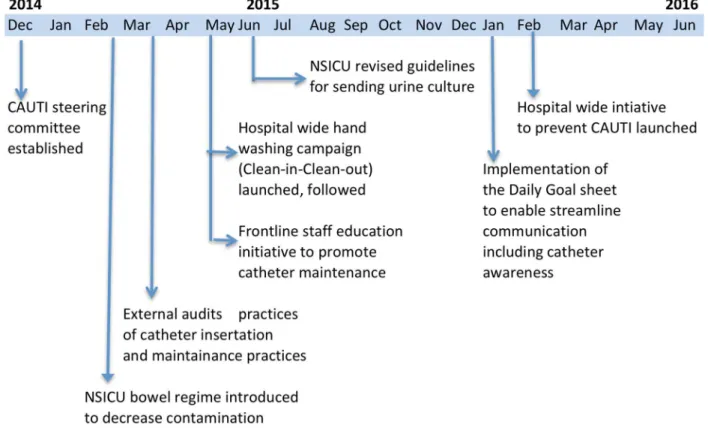
Prior to implementation of this project, previous interventions to reduce CAUTI in the NSICU were reviewed to identify areas for improvement. As shown in Figure 1, there were multimodal team-driven interventions that were initiated from December 2014 to February 2016. These interventions resulted in a decrease in CAUTI rates by almost 50%. However, it was noted that prompt removal practices was an area that still needed improvement in order to ensure consistency in practice and to reduce or even eliminate CAUTIs. Therefore, this project
Figure 1: NSICU Team-Driven Interventions to Reduce CAUTI
Olm-Shipman et al. (2016). Impact of implementing team-driven interventions to reduce catheter associated urinary tract infections in the Neuroscience-ICU. Poster session presented at the 14th Annual Neurocritical Care Society Meeting.
reinsertion rates data sets wereobtained from the hospital’s infection control department and labeled data set 1 for comparison with post data, which was labeled data set 2.
Phase II: Assessing motivation and capacity for change. The second phase involved gaining buy-in from stakeholders. An important aspect of this step was identifying the
stakeholder’s motivation and capacity for change as well as gaining their trust for the project to proceed. An initial meeting was held with nursing management and the director of the unit to discuss the proposed project. After gaining buy-in and permission from the department’s nurse manager, a pre-intervention CAUTI survey linked to an invitation to participate (Appendix 3) was sent out to staff via Qualtrics tool to obtain data on the barriers to urinary catheter removal and to identify any educational needs or knowledge deficits related to urinary catheter removal and documentation. The survey was conducted from November 15, 2016, to November 21, 2016.
Phase III: Assessing the change agent’s motivations and resources.The third phase of change involved identifying a change agent to implement the proposed change. Nurses are ideal candidates to act as change agents because they possess the skills and unique knowledge needed to implement EBP to prevent CAUTI. The original plan was to recruit unit CAUTI champions to change the culture around CAUTI prevention practices and improve compliance with these practices. However, the decision to recruit champions was not feasible due to other quality improvement projects in the unit requiring the use of unit champions. The primary investigator therefore, took the sole responsibility of implementing the change with additional resources and guidance from the unit management, nursing quality research, and theinfection control
department.
Phase IV: Change objectives. The fourth phase in the process of change
which was conducted from November 21, 2016 through to December 1st, 2016. It was expected that catheter re-insertion rates would be unchanged as a result of this project while CAUTI rates will be decreased due to decrease in mean duration of catheterization.
To meet the objectives of this project, a survey was developed to gain information for use in developing and refining educational interventions for project implementation. The 11-item survey assessed nurses’ knowledge, attitude, barriers, and resources related to prompt removal of the urinary catheter using Likert-type 5-point response vectors of strongly disagree (1), disagree (2), neither agree nor disagree (3), agree (4), strongly agree (5) (Appendix 2).
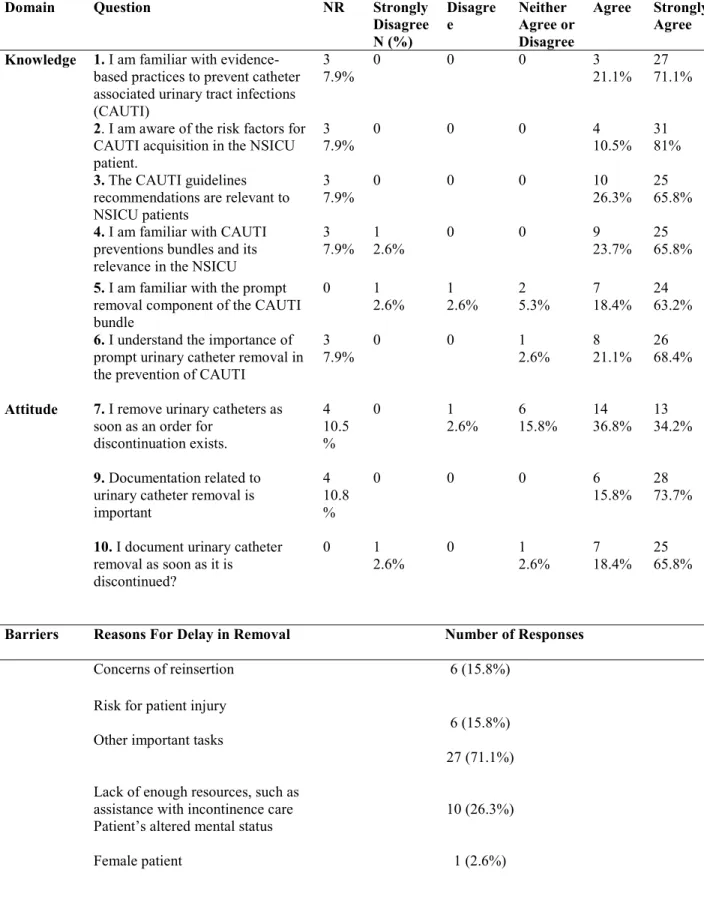
Knowledge. When asked questions on knowledge related to CAUTI prevention in the NSICU, an average of 69% of nurses strongly agreed that they are familiar with CAUTI prevention practices in the NSICU. The rest either agreed (20%) or chose neither agree or disagreed (4%), with two nurses (2.6%) each choosing either disagree or strongly disagree (Table 1).
Attitude. When asked questions on attitude related to prompt removal of the urinary catheter in the NSICU, 34.2% of nurses strongly agreed, 36.8% agreed, 15.8% disagreed, and 2.6% strongly disagreed that they remove the catheter as soon as an order existed for removal. When asked questions on attitude related to documentation of the urinary catheter in the NSICU, an average of 69.7% strongly agreed while the rest either agreed (17.1%) or neither agreed nor disagreed (2.6%) (Table 1).
resources to help with incontinence care or bladder scanning once urinary catheter is removed, and one (2.6%) nurse listed being a female patient as barrier to prompt removal (Table 1).
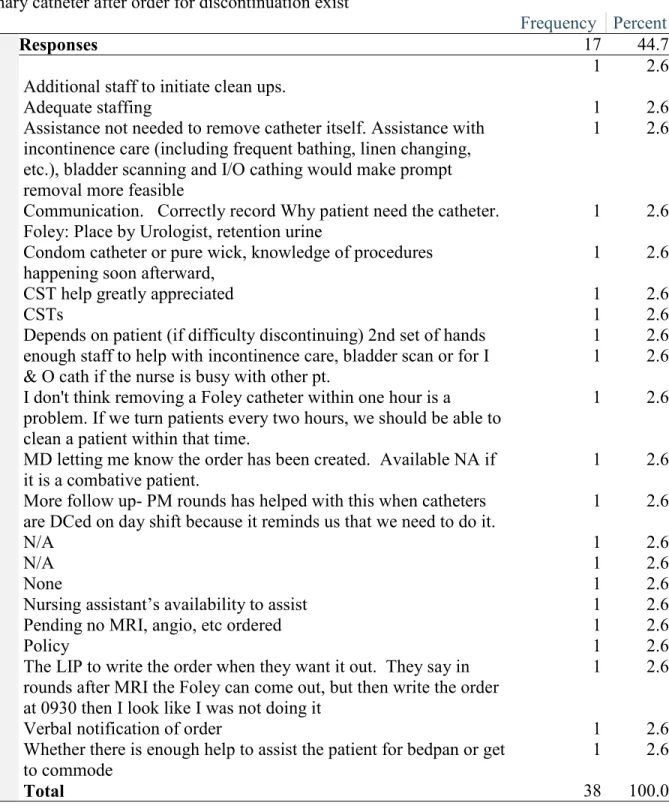
Resources. Questions were asked regarding the availability of resources to facilitate prompt removal of the urinary catheter in the NSICU. Nurses were asked to list the resources they felt would assist them with prompt removal of the urinary catheter after an order for
discontinuation was placed in the EMR. There were variable responses across the subjects
regarding the resources they would need to assist with prompt removal of the urinary catheter
(Table 2). Most nurses who chose to leave a comment listed the need for adequate staffing to help with incontinent care once the catheter is discontinued. Some nurses felt that there was lack
of communication between the nurses and the providers regarding when the urinary catheter
should be removed. They suggested that providers should more clearly communicate their order,
or write an order for a specific time for catheter. For example, one nurse wrote: “The LIP to write
the order when they want it out. They say in rounds after MRI the Foley can come out, but then
write the order at 0930 then I look like I was not doing it”.
Table 1: Knowledge, Attitude, and Barriers Survey Results
Domain Question NR Strongly Disagree N (%) Disagre e Neither Agree or Disagree
Agree Strongly Agree
Knowledge 1. I am familiar with evidence-based practices to prevent catheter associated urinary tract infections (CAUTI)
3 7.9%
0 0 0 3
21.1% 27 71.1%
2. I am aware of the risk factors for CAUTI acquisition in the NSICU patient.
3 7.9%
0 0 0 4
10.5% 31 81%
3. The CAUTI guidelines recommendations are relevant to NSICU patients
3 7.9%
0 0 0 10
26.3% 25 65.8%
4. I am familiar with CAUTI preventions bundles and its relevance in the NSICU
3 7.9%
1 2.6%
0 0 9
23.7% 25 65.8%
5. I am familiar with the prompt removal component of the CAUTI bundle
0 1
2.6% 1 2.6% 2 5.3% 7 18.4% 24 63.2%
6. I understand the importance of prompt urinary catheter removal in the prevention of CAUTI
3 7.9%
0 0 1
2.6%
8 21.1%
26 68.4%
Attitude 7. I remove urinary catheters as soon as an order for
discontinuation exists.
4 10.5 %
0 1
2.6% 6 15.8% 14 36.8% 13 34.2%
9. Documentation related to urinary catheter removal is important
4 10.8 %
0 0 0 6
15.8% 28 73.7%
10. I document urinary catheter removal as soon as it is discontinued?
0 1
2.6%
0 1
2.6%
7 18.4%
25 65.8%
Barriers Reasons For Delay in Removal Number of Responses
Concerns of reinsertion 6 (15.8%)
Risk for patient injury
6 (15.8%) Other important tasks
27 (71.1%) Lack of enough resources, such as
assistance with incontinence care Patient’s altered mental status Female patient
10 (26.3%)
Table 2: Nurses’ Response to Resource Availability Survey Result
Q 11: List the resources you feel you would need to assist you with prompt removal of the urinary catheter after order for discontinuation exist
Frequency Percent
Responses 17 44.7
Additional staff to initiate clean ups.
1 2.6
Adequate staffing 1 2.6
Assistance not needed to remove catheter itself. Assistance with incontinence care (including frequent bathing, linen changing, etc.), bladder scanning and I/O cathing would make prompt removal more feasible
1 2.6
Communication. Correctly record Why patient need the catheter. Foley: Place by Urologist, retention urine
1 2.6
Condom catheter or pure wick, knowledge of procedures happening soon afterward,
1 2.6
CST help greatly appreciated 1 2.6
CSTs 1 2.6
Depends on patient (if difficulty discontinuing) 2nd set of hands 1 2.6 enough staff to help with incontinence care, bladder scan or for I
& O cath if the nurse is busy with other pt.
1 2.6
I don't think removing a Foley catheter within one hour is a problem. If we turn patients every two hours, we should be able to clean a patient within that time.
1 2.6
MD letting me know the order has been created. Available NA if it is a combative patient.
1 2.6
More follow up- PM rounds has helped with this when catheters are DCed on day shift because it reminds us that we need to do it.
1 2.6
N/A 1 2.6
N/A 1 2.6
None 1 2.6
Nursing assistant’s availability to assist 1 2.6
Pending no MRI, angio, etc ordered 1 2.6
Policy 1 2.6
The LIP to write the order when they want it out. They say in rounds after MRI the Foley can come out, but then write the order at 0930 then I look like I was not doing it
1 2.6
Verbal notification of order 1 2.6
Whether there is enough help to assist the patient for bedpan or get to commode
1 2.6
Staff Education
Nursing. The survey results were used as a guide to design a 15-20 minute presentation that introduced the specifics of the unit CAUTI bundle (Appendix 1).The session emphasized that protocols were already in place and have been effective in reducing CAUTI rates, and that the purpose of this step was to create awareness on the importance of adherence to all
components of the CAUTI bundle to further reduce CAUTI in the NSICU. Educational material for presentation included:
• Results from retrospective chart review indicating longer duration of catheterization
• Hospital data on current CAUTI rates obtained from infection control share point website
• Survey Results
• CAUTI Bundle components (Appendix 1)
• NSICU reminder steps for prompt removal and documentation of the Foley (Appendix 4)
• IDSA guidelines for CAUTI prevention (Appendix 5)
• CDC guidelines for CAUTI prevention (Appendix 6)
• CAUTI facts (Appendix 7)
• SHEA/IDSA (2014) Recommended Indications for Urinary Catheter Use (Appendix 8).
educational session. Additional efforts included meeting with nurses individually, during staff meetings, and during unit practice council meetings. A total of 18 sessions were offered during a period of 2 weeks to ensure that most staff attended. Nurses were asked to sign the education materials after the educational session was completed.
Clinical Support Technicians. CSTs are important members of the nursing support team. Their role in the unit includes assisting nurses in delivering patient care by performing duties such assisting with incontinence care, performing EKGs and mobilizing patients among other duties. Their involvement in this project was very important in impacting practice change in the unit. With permission from the unit nurse manager, CSTs were educated on the
importance of prompt urinary catheter removal, reasons for assessing urine retention, and how to properly perform bladder scanning.
Neurocritical Care Team. A meeting was held with the Neurocritical Care team to discuss project goals and ways they could help to improve practice related to urinary catheter removal. It is an expectation that providers should be discussing indications for indwelling urinary catheter, and readiness for removal during rounds, and placing an order for removal as soon as criteria for removal is met. Based on the survey results, providers agreed to transcribe an actual order to discontinue the urinary catheter rather than give a verbal order or discontinue previous order for insertion. This would be helpful in alerting the nurses that a task is pending through the work list in electronic medical record charting. Providers also agreed to remind nurses to discontinue the urinary catheter if not already done during the PM rounding using the Daily Goal sheet (Appendix 9).
project. The change agent was responsible for educating, monitoring, and encouraging compliance with the CAUTI bundle while placing emphasis on prompt removal and documentation of the urinary catheter. The role of the change agent was active until the completion of the project. Compliance was monitored by the principal investigator using the process audit tool to collect data on the timeliness of the urinary catheter removal. Data from the process audit tool was used for improvement purposes and to communicate with staff on how the project was progressing. This role was critical to how change was implemented and accepted by the NSICU staff.
Phase VI: Maintaining change. Once change had begun to take place, the sixth phase was to maintain the change by keeping lines of communication open. Frequent, ongoing
discussions regarding the change continued throughout the implementation process. Nurses were also approached individually or as a group for feedback regarding the process. Most nurses agreed that step six of the NSICU reminder for prompt Foley removal and documentation (Appendix 4) was cumbersome. This concern was evaluated, and revised to indicate “when possible”. A monthly email was sent to nurses to thank and encourage them for their good work as an incentive for sustaining the change.
Phase VII: Terminating relationship. In the final phase when change became integral to the day-to-day functioning of the unit, and staff became familiar with the process, the role of the change agent was gradually withdrawn to mark project completion in February 28, 2017.
Data Collection
A retrospective chart audit was used to collect pre-intervention data. Patient
the order time and date of removal. Pre and post data on CAUTI rates and catheter re-insertions rates were obtained from the infection control department for comparison.
Data Analysis
Data were analyzed using the statistical package for the social sciences (SPSS) software, version 24.0 (IBM SPSS). Quantitative variables were expressed as means and standard
deviations and were compared using a t test or Chi-square test.Simple frequency tables and cross tabulation were generated to describe the data. Chi-square and t-tests were used to compare categorical and nominal data, respectively. Data on CAUTI rates and reinsertion rates are
CHAPTER 5: RESULTS
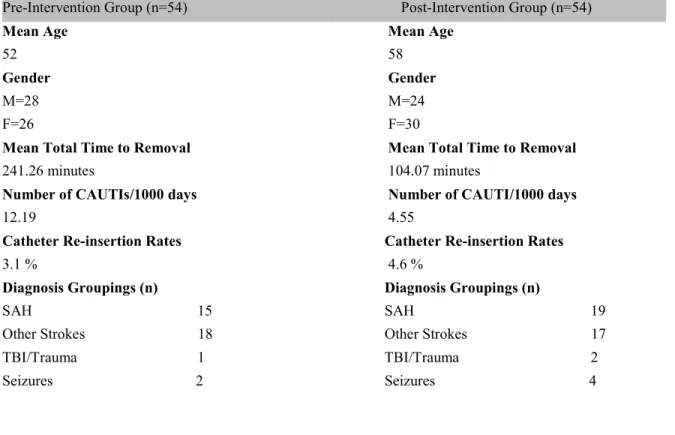
A random retrospective and prospective chart audit was performed on a total of 108 charts. Of the 108 charts, 54 charts were completed pre-intervention, and 54 were completed post intervention. Charts were excluded for auditing if the urinary catheter was discontinued by a flex or float nurse, or if an order for removal did not exist. Independent sample t-tests were used to compare mean differences in age, time to urinary catheter removal post order for removal, and to determine whether the mean time differed based on gender. Cross tabulation was performed on gender and diagnoses and a Chi-Square (χ2) test used to determine the distribution of data across pre and post groups for each variable (See table 3). Data were evaluated for statistical
significance, which was set at P-value <0.05 and results described below.
Table 3. NSICU Patient Characteristics
Pre-Intervention Group (n=54) Post-Intervention Group (n=54)
Mean Age Mean Age
52 58
Gender Gender
M=28 M=24
F=26 F=30
Mean Total Time to Removal Mean Total Time to Removal
241.26 minutes 104.07 minutes
Number of CAUTIs/1000 days Number of CAUTI/1000 days
12.19 4.55
Catheter Re-insertion Rates Catheter Re-insertion Rates
3.1 % 4.6 %
Diagnosis Groupings (n) Diagnosis Groupings (n)
Pre/Post Comparison on all Independent Variables
Age. As shown in table 4 below, the mean age in the post intervention group was found to be higher (58.22) than the mean age in the pre intervention group (52.07) ( = −2.04, df =
106, P =0.044).
Diagnoses. In evaluating the various diagnoses that might affect mean time to urinary catheter removal in the pre and post groups, results indicated that the distribution of diagnoses were similar across pre and post groups. Therefore, there was no difference in the types of diagnoses for each time period. (χ2 = 3.13, df = 5, P =0.67) See table 4.
Table 4: Results of Independent Variables (Age, Gender, Diagnoses)
Note. t =Sample t-test statistic; χ2 = Chi-Square test; df = Degree of freedom; P= Probability
value set at 0.05.
Gender. As shown in table 4 above,the Chi-Square test of whether there was significant difference in gender distribution between the two groups was measured and found not to be statistically significant (χ2 = 0.59, df = 1, P =0.44) (Table 4). Therefore, gender distribution
Tumor 14 Tumor 8 Other Neurological Disorders 4 Other Neurological Disorders 4
Total 54 Total 54
Pre-Intervention
Post-Intervention
Variables M (SD) M (SD) Test Statistic Df P
Age 52.07(16.5) 58.22(14.83) t = -2.03 106 0.04
Diagnoses χ2 = 3.13 5 0.67
was essentially the same in the pre and post-intervention groups. An independent samples t-test to examine gender differences in the time to urinary catheter removal found that time was reduced significantly in both groups (Male, t = 3.28, df = 50, P <0.01; female, t = 4.62, df = 54,
P <0.01). See table 5 below.
Table 5: Differences in Mean Time to Catheter Removal by Gender
Note. Interaction effect was calculated at -0.52
Pre/Post Comparison on Dependent Variable (Time to Catheter Removal after Order)
The mean time to urinary catheter removal after an order is in place for patients in the pre-intervention period was 241.26 minutes versus 104.07 minutes for those catheterized in the post-intervention period. This result indicated that there was statistically significance difference between the two groups ( = 5.59, df = 106, P <. 01) as shown in table 6.
Table 6: Differences in Mean Time to Catheter Removal Post Order
Pre-Intervention
Post-Intervention
Gender M (SD) M (SD) Test Statistic Df P
Male 219.50 (146.0) 107.83 (87.26) t = 3.28 50 < 0.01
Female 264.70(167.15) 101.07 (91.70) t = 4.62 54 < 0.01
Pre-Intervention
Post- Intervention
Variable M (SD) M (SD) Test Statistic Df P
CAUTI Rates
Catheter associated urinary tract infection rates data from August 2016 to October 2016 (Pre-intervention data) and from December 2016 to February 2017 (Post-intervention data) was obtained from hospital’s epidemiology department. As shown in figure 1, the average CAUTI rate decreased from 5.8 to 1.52 per 1000 catheter-days. P = 0.08; t = 2.38; df = 4). However, the decrease was found not be statistically significant.
Figure 2. Results of CAUTI Rates
Note. The month of November is the intervention period, therefore not included. Abbreviations: CL, control limit; UCL, upper control limit; LCL, lower control limit
-4 -2 0 2 4 6 8 10 Aug, 2016 Sep, 2016 Oct, 2016 Nov, 2016 Dec, 2016 Jan, 2017 Feb, 2017
CAUTI Rates per 1000 Catheter Days Months Measure UCL LCL Linear (Measure) Intervention
Mean at pre (5.8)
Catheter Reinsertion Rates
Catheter reinsertion rates data from August 2016 to October 2016 (Pre-intervention data) and from December 2016 to February 2017 (Post-intervention data) were obtained from
hospital’s epidemiology department. As indicated in Figure 2, the mean percentage of CAUTI reinsertion rates increased from 3.1 in the pre-intervention group to 4.6 in the post-intervention group. The difference in reinsertion rates between the two groups was found to be statistically significant (t = −1.33, df = 4, P = 0.025).
Figure 3. Results of CAUTI Reinsertion Rates
0 1 2 3 4 5 6 7
% of CAUTI Reinsertion
Rates
Months
% of reinsertion UCL
LCL
Linear (% of reinsertion)
Mean at pre (3.1)
Mean at post (4.6)
CHAPTER 6: DISCUSSION
Duration of urinary catheterization as a risk factor for CAUTI is well known. Hagerty et al. (2015) found that patients catheterized for a significantly longer duration were at much higher risk for CAUTI. The goal of this project was to decrease the mean duration of urinary
catheterization post removal order thereby potentially reducing CAUTI rates in the neurological patient population. This project compared the mean time to urinary catheter removal in the pre-intervention period with post-pre-intervention period, and also compared differences in age, gender, and diagnoses distribution in pre/post groups. Results of this project found that there was a significant decrease in time to urinary catheter removal post order in the post intervention period by 40%, with the time decreasing from 241.26 minutes to 104.07 minutes. This finding suggests that educational intervention aimed at decreasing the time to urinary catheter removal was effective.
Patient Age and Mean Time to Urinary Catheter Removal Post Order
Gender and Mean Time to Urinary Catheter Removal Post Order
The association between gender and duration of urinary catheterization was examined because of the female gender association with high risk of CAUTI. Studies have shown that female gender is a risk factor for CAUTI due to anatomical differences predisposing them to contamination (Lee et al., 2013; Termiz et al., 2012). This project however, was concerned with nurses’ reluctance to remove the catheter on female patients because unlike their male
counterparts, there is no alternative urine collection device for female patients. Despite the potential for differences, this project found that gender distribution was similar across pre and post groups and therefore, would have not likely influenced the mean time to urinary catheter removal. Perhaps a possible explanation for this finding could be the recent introduction of an alternative urine device for female patients, which was being piloted in the unit during the study period. This device offered an alternative means of collecting urine similar to the male external catheter commonly known as condom catheter.
Diagnoses and Mean Time to Urinary Catheter Removal Post Order
CAUTI Rates
When compared with the pre-intervention group, the number of CAUTIs in the post-intervention group decreased from four CAUTIs to one during the project period (5.8 to 1.5 per 1000 catheter-days). Although not statistically significant, this difference is likely to be of some clinical significance especially in a unit where any occurrence of a CAUTI is unacceptable. Perhaps with a larger sample and longer intervention period, the decrease in CAUTI rates would have been statistically significant to support other previous studies that have shown that an educational intervention that uses the CAUTI bundle and stresses the importance of prompt removal is effective in reducing CAUTI rates (Marigliano, Barbadoro, Pennacchietti, D'Errico, & Prospero, 2012; Rosenthal et al., 2012;Titsworth et al., 2012).
Catheter Reinsertion Rates
Although catheter reinsertion rates are not generally a common outcome that is tracked by the National Hospital Safety Network (NHSN), the hospital recently started tracking this data to ensure that urinary catheters were not being removedtoo soon leading to a high reinsertion rates which could in turn lead to high infection rates. There is a possibility that other factors could have contributed to higher reinsertion rates. For example, a change in patient status requiring reinsertion of catheter for vigilant fluid status monitoring could have contributed to higher reinsertion rates given that prior reinsertion rates were higher than the current rates.
Limitations
This project had several imitations. First, this project was conducted at a single unit with a small convenience sample size. Therefore, results are not generalizable to other patient
daily goal sheet that has enabled providers and nurses to effectively recognize and remove the urinary catheter, hospital wide initiatives that were rolled out in January 2016, and current unit practices that emphasize maintainance and monthly audits on measures (Appendix 10).
Specifically, in the months of August, September and October when high rates of CAUTI were reported, there were no audits performed, and this could have led to higher rates of CAUTI in that time period. Third, this project did not look at catheter utilization ratio.Catheter utilization ratio gives a measure of how manyurinary catheters are used on a given unit and is calculated by dividing the number of catheter days by the number of patient days. A reduction in catheter utilization during this quality improvement project period could have potentially influenced results. Lastly, This project assumed that unit staff understood and retained educational
information provided on unit protocol on the CAUTI bundle and prompt removal requirements. A follow up survey would have better elicited nurses’s perception of the CAUTI bundle
principles on prompt removal protocol adherence.
Recommendations
The findings from this project offer some new insights on the use of multi modality interventions in the prevention of CAUTI in the neurological patient population. Of particular interest, this project highlighted the potential need for using an alternative means of monitoring strict intake and output in the NSICU. Considering the lack of published research on the
particularly female patients. Future studies might examine the use of female external catheter and its effectiveness in preventing CAUTI and promoting compliance with prompt removal of the urinary catheter.
Implication for Practice
The significant of preventing CAUTI in the neurological patients cannot be overemphasized. Although challenges exist in the management of CAUTI in these patient populations, efforts should be made to prevent avoidable harm, morbidity and mortality, and healthcare costs related to CAUTI. This project has demonstrated that educational interventions aimed at improving prompt removal of the urinary catheter can be an effective means of
decreasing duration of urinary catheterization in the NSICU patients and improve compliance with such practices that are important in preventing CAUTIs. Nurses are capable of
APPENDIX 1: NSICU CAUTI BUNDLE COMPONENTS
Table adapted from Saint, S., Olmsted, R., Fakih, M., Kowalski, C., Watson, S., Sales, A., & Krein, S. (2009). Translating health care-associated urinary tract infection prevention research into practice via the bladder bundle. Joint Commission Journal On Quality & Patient Safety, 35(9), 449-455.
Adherence to general infection control principle
Education of staff on evidence-based best practices to prevent CAUTI
Hand hygiene
Sterile catheter insertion using insertion checklist and second personnel present.
Catheter maintenance: catheters care with Johnson & Johnson soap and water once a day and PRN
Urinary catheter use surveillance and feedback Catheter dependent loop. Use double Stat lock Maintain closed drainage system
Bladder Ultrasound Use protocol in place such as performing bladder scanning every 6 hours to check for retention.
Perform intermittent catheterization only if there is >400 cc in the bladder.
Use catheter alternatives Intermittent catheterization
External condom catheter for men and external female catheter for women (Purewick) with urinary incontinence. Indwelling Catheter
Avoidance
Refer to appropriate indications for insertion. Insert only with a provider’s order
APPENDIX 2: NSICU FOLEY CATHETER REMOVAL SURVEY
1. I am familiar with evidence-based practices to prevent catheter associated urinary tract infections (CAUTI)
(a) Strongly disagree (b) Disagree (c) Neither agree or disagree (d) Agree (e) Strongly agree
2. I am aware of the risk factors for CAUTI acquisition in the NSICU patient.
(a) Strongly disagree (b) Disagree (c) Neither agree or disagree (d) Agree (e) Strongly agree
3. The CAUTI guidelines recommendations are relevant to NSICU patients
a) Strongly disagree (b) Disagree (c) Neither agree or disagree (d) Agree (e) Strongly agree
4. I am familiar with CAUTI preventions bundles and its relevance in the NSICU
a) Strongly disagree (b) Disagree (c) Neither agree or disagree (d) Agree (e) Strongly agree
5. I am familiar with the prompt removal component of the CAUTI bundle
a) Strongly disagree (b) Disagree (c) Neither agree or disagree (d) Agree (e) Strongly agree
6. I understand the importance of prompt urinary catheter removal in the prevention of CAUTI a) Strongly disagree (b) Disagree (c) Neither agree or disagree (d) Agree (e) Strongly agree
7. I remove urinary catheters as soon as an order for discontinuation exists.
a) Strongly disagree (b) Disagree (c) Neither agree or disagree (d) Agree (e) Strongly agree
8. I have sometimes delayed urinary catheter removal as soon as an order for removal exist due to
i) Concerns of reinsertion j) Risk for patient injury
k) Other important tasks (procedures, tests, going to OR, or transport) l) Lack of enough resources, such as assistance with incontinence care m) Patient’s altered mental status and unable to communicate need to void n) Female patient
9. Documentation related to urinary catheter removal is important
a) Strongly disagree (b) Disagree (c) Neither agree or disagree (d) Agree (e) Strongly agree
10. I document urinary catheter removal as soon as it is discontinued?
a) Strongly disagree (b) Disagree (c) Neither agree or disagree (d) Agree (e) Strongly agree
11. List the resources you feel you would need to assist you with removing Urinary catheter as soon as an order exists for discontinuation.
APPENDIX 3: SURVEY CONSENT AGREEMENT Dear staff:
You are invited to participate in a web-based online survey on Nurse-Driven Educational Intervention For Prompt Removal of Urinary Catheter in the Neuroscience Intensive Care Unit. This is a research project being conducted by Elizabeth Ouma, a student at the University of North Carolina at Chapel Hill. If you choose to consent to participate in this project, please complete the survey, which should take approximately 5-10 minutes to complete.
Your participation in this survey is voluntary. You may refuse to take part in the research or exit the survey at any time without penalty. You are free to decline to answer any particular question you do not wish to answer for any reason. To thank you for your participation, an incentive of $5 STARBUCKS gift card will be offered randomly to 20 responders who complete the survey. There are no foreseeable risks involved in participating in this study other than those encountered in day-to-day life. Your survey answers will be sent to a link via qualtrics.com where data will be stored in a password protected electronic format. Qualtrics does not collect identifying information such as your name, email address, or IP address. Therefore, your responses will remain anonymous. No one will be able to identify you or your answers, and no one will know whether or not you participated in the study.
Thank you so much for considering my request. Link to Survey
Sincerely,
Elizabeth Ouma, BSN, RN Doctoral Student
University of North Carolina at Chapel Hill School of Nursing
APPENDIX 4: NSICU REMINDER STEPS FOR PROMPT FOLEY REMOVAL AND DOCUMENTATION
NSICU Reminder for Prompt Foley Removal and Documentation
Step 1: Foley removal discussed during daily rounds
Step 2: RN clarifies any obstacle to Foley removal delay such as possibility for a test, procedure or advancing to comfort care.
Step 3: Order for Foley removal transcribed in the Electronic medical
Step 4: Discontinue Foley within as soon as an order exist
Step 5: Document Foley removal at the time of discontinuation in intake and output section of the flowsheet. Document the following:
Date, Time
Reason for removal, such as no longer necessary or per protocol
Step 6: This step applies if unable to complete step 4. Document reasons for delay when possible in the comment box such as:
Patient in MRI/CT/VIR Procedure in progress
Possible advancement to comfort care discussed during rounds.
APPENDIX 5: IDSA GUIDELINES FOR CAUTI PREVENTION
A. Discontinuation of Catheter Recommendations
Indwelling catheters should be removed as soon as they are no longer required to reduce the risk of CA-bacteriuria (AI) and CA-UTI (A-II).
B. Limiting Unnecessary Catheterization
Indwelling catheters should be placed only when they are indicated (A-III). I. Indwelling urinary catheters should not be used for the management of urinary incontinence (A-III). Institutions should develop a list of appropriate indications for inserting indwelling urinary catheters, educate staff about such indications, and periodically assess adherence to the institution-specific guidelines (A-III).
Institutions should require a physician’s order in the chart before an indwelling catheter is placed (A-III).
APPENDIX 6: CDC PREVENTION GUIDELINES OF CAUTI
I. Appropriate Urinary Catheter Use
A. Insert catheters only for appropriate indications and leave in place only as long as needed.
(Category IB)
B. Consider using alternatives to indwelling urethral catheterization in selected patients when appropriate.
Consider using external catheters as an alternative to indwelling urethral catheters. (Category II)
Consider alternatives to chronic indwelling catheters, such as intermittent catheterization, in spinal cord injury patients. (Category II)
Intermittent catheterization is preferable to indwelling urethral or suprapubic catheters in patients with bladder emptying dysfunction. (Category II)
Systems of Documentation
Consider implementing a system for documenting the following in the patient record: indications for
catheter insertion, date and time of catheter insertion, individual who inserted catheter, and date and
time of catheter removal. (Category II)
Ensuring that documentation is accessible in the patient record and recorded in a standard
format for data collection and quality improvement purposes is suggested. Electronic
documentation that is searchable is preferable. (Category II)
Centers for Disease Control and Prevention (CDC). (2009).Guideline for Prevention of Catheter-associated Urinary Tract
APPENDIX 7: CAUTI FACTS
Facts about CAUTI:
1. Patients‘ risk for getting a CAUTI is about 3% to 7% every day the indwelling urinary catheter is left in place (Tominaga et al., 2014).
2. The cost of treating a single episode of CAUTI varies from $980 to $2900 with associated bacteremia (Gray, 2010).
3. CAUTI is among the hospital acquired infections that are no longer reimbursed by the Centers for Medicare and Medicaid Services (CMS) (Gray, 2010).
4. Duration of catheterization is the single most important risk factor for CAUTI (Lo et al., 2014).
CAUTIs can cause major harm and can increase cost for all.
Gray, M. (2010). Reducing catheter-associated urinary tract infection in the critical care unit. AACN Advanced Critical Care, 21(3), 247-257. doi: 10.1097/NCI.0b013e3181db53cb
Lo, E. M. D., Nicolle, L. E. M. D., Coffin, S. E. M. D. M. P. H., Gould, C. M. D. M. S., Maragakis, L. L. M. D. M. P. H., Meddings, J. M. D. M., . . . Yokoe, D. S. M. D. M. P. H. (2014). Strategies to Prevent Catheter-Associated Urinary Tract Infections in Acute Care Hospitals: 2014 Update. Infection Control and Hospital Epidemiology, 35(5), 464-479. doi:10.1086/675718
APPENDIX 8: SHEA/IDSA (2014) RECOMMENDED INDICATIONS FOR URINARY CATHETER USE.
Preoperatively, for selected surgical procedures such as urologic surgery or surgery on contiguous structures of the genitourinary tract.
Prolonged surgery
Need for large volume infusions or diuretics during surgery Intraoperative monitoring of urine output needed
Monitoring hourly assessment of urine output in patients in intensive care units
(ICU).
Management of acute urinary retention and urinary obstruction
Assistance in healing of open pressure ulcers or skin grafts for selected patients with urinary incontinence.
As an exception, at patient request to improve comfort (e.g., end-of-life care).
APPENDIX 9: NSCIU DAILY GOAL SHEET (BACK VIEW)
REFERENCES
American Nurses Association (2015). ANA CAUTI prevention tool. Retrieved from http://nursingworld.org/ANA-CAUTI-Prevention-Tool
Association for Professionals in Infection Control and Epidemiology, Inc. (APIC). (2014). Guide to Preventing Catheter-Associated Urinary Tract Infections. Retrieved from www.apic.org/implementationguides
Centers for Disease Control and Prevention. (2015). Urinary tract infection (Catheter-Associated Urinary Tract Infection [CAUTI] and non-catheter-associated urinary tract infection [UTI]) and other urinary system infection [USI]) events. Retrieved from http://www.cdc.gov/nhsn/PDFs/pscManual/7pscCAUTIcurrent.pdf
Centofanti, J. E., Duan, E. H., Hoad, N. C., Swinton, M. E., Perri, D., Waugh, L., & Cook, D. J. (2014). Use of a daily goals checklist for morning ICU rounds: a mixed-methods study. Critical Care Medicine, 42(8), 1797-1803.
doi:10.1097/ccm.0000000000000331
Chavez, M., Williams, C., Sincerbeaux, C., Rieken, L., Wilson, M., & English, A. (2011). Measuring the effect of a multifactorial intervention to decrease CAUTI in the acute care setting. American Journal of Infection Control, 39(5), E47.
doi:http://dx.doi.org/10.1016/j.ajic.2011.04.102
Chenoweth, C., & Saint, S. (2013). Preventing catheter-associated urinary tract infections in the intensive care unit. Critical Care Clinics, 29(1), 19-32.
doi:10.1016/j.ccc.2012.10.005
Connor, B. T. (2011). Exploring Factors Associated with Nurses' Adoption of an Evidence-Based Practice to Reduce Catheter-Associated Urinary Tract Infections. Ph.D., 106 p-106 p 101p.
Feneley, R. C., Hopley, I. B., & Wells, P. N. (2015). Urinary catheters: history, current status, adverse events and research agenda. Journal of Medical Engineering and Technology, 39(8), 459-470. doi:10.3109/03091902.2015.1085600
Flores-Mireles, A. L., Walker, J. N., Caparon, M., & Hultgren, S. J. (2015). Urinary tract infections: epidemiology, mechanisms of infection and treatment options. Nature Reviews: Microbiology, 13(5), 269-284. doi:10.1038/nrmicro3432
Galiczewski, J. M. (2016). Interventions for the prevention of catheter associated urinary tract infections in intensive care units: An integrative review. Intensive and Critical Care Nursing, 32, 1-11. doi:10.1016/j.iccn.2015.08.007