Full Terms & Conditions of access and use can be found at
http://www.tandfonline.com/action/journalInformation?journalCode=ftpv20
Terrorism and Political Violence
ISSN: 0954-6553 (Print) 1556-1836 (Online) Journal homepage: http://www.tandfonline.com/loi/ftpv20
Research on Terrorism, 2007–2016: A Review of
Data, Methods, and Authorship
Bart Schuurman
To cite this article: Bart Schuurman (2018): Research on Terrorism, 2007–2016:
A Review of Data, Methods, and Authorship, Terrorism and Political Violence, DOI: 10.1080/09546553.2018.1439023
To link to this article: https://doi.org/10.1080/09546553.2018.1439023
© 2018 Bart Schuurman. Published by Taylor & Francis.
Published online: 01 Mar 2018.
Submit your article to this journal
View related articles
Research on Terrorism, 2007
–
2016: A Review of Data,
Methods, and Authorship
Bart Schuurman
Institute of Security and Global Affairs, Leiden University, The Hague, The Netherlands
ABSTRACT
Research on terrorism has long been criticized for its inability to overcome enduring methodological issues. These include an over-reliance on secondary sources and the associated literature review methodology, a scarcity of statistical analyses, a tendency for authors to work alone rather than collaborate with colleagues, and the large number of one-time contributors to thefield. However, the reviews that have brought these issues to light describe thefield as it devel-oped until 2007. This article investigates to what extent these issues have endured in the 2007–2016 period by constructing a database on all of the articles published in nine leading journals on terrorism (N = 3442). The results show that the use of primary data has increased considerably and is continuing to do so. Scholars have also begun to adapt a wider variety of data-gathering techniques, greatly diminishing the overreliance on literature reviews that was noted from the 1980s through to the early 2000s. These positive changes should not obscure enduring issues. Despite improvements, most scholars continue to work alone and most authors are one-time contributors. Overall, however, thefield of terrorism studies appears to have made considerable steps towards addressing long-standing issues.
KEYWORDS
authorship; database; journals; primary sources; research on terrorism; review; state of the art; statistics
Introduction
The academic study of terrorism is often described as beset by numerous and pervasive conceptual and methodological problems.1Critiques of the state of the art have appeared since the 1970s and their conclusions have been worryingly similar.2One of these is that the definitional debate on what exactly constitutes terrorism continues to exert a detri-mental influence on thefield’s development. Another is that an overreliance on secondary sources, and the associated predominance of the literature review method, have seriously hampered the development of empirically-grounded insights and the ability to falsify the myriad potential explanations for terrorism that have been put forward.3The last in-depth assessment of terrorism as a scholarly discipline, however, reviewed the field as it had developed until 2007.4Thousands of articles have appeared since, many of them in new journals, and leading scholars have begun to question the prevailing pessimism.5To what degree do these critiques still reflect contemporary scholarship on terrorism?
CONTACTBart Schuurman [email protected] Institute of Security and Global Affairs, Leiden University, Turfmarkt 99, 2511 DV, The Hague, The Netherlands
Color versions of one or more of thefigures in the article can be found online atwww.tandfonline.com/ftpv.
https://doi.org/10.1080/09546553.2018.1439023
© 2018 Bart Schuurman. Published by Taylor & Francis.
This article presents the most extensive review of thefield of terrorism studies to date. Its goal is to assess whether the numerous methodological concerns raised over the past decades continue to exert an influence on the contemporary literature. Are there signs that the field is moving beyond these limitations or are there grounds for continued scepsis regarding the prospects for its maturation? To address these questions, a database was constructed using all articles published from 2007 to 2016 in nine academic journals on terrorism.
Enduring issues in the study of terrorism
There is a long tradition of self-criticism within the literature on terrorism that began soon after the field’s emergence in the 1960s and 1970s.6 In a 1977 book review, Bell lamented that there were “no agreed definitions, no accepted bounds to the subject, no very effective academic approach, no consensus on policy implications.”7Schmid’s 1982
book Political Terrorism found that “despite its volume . . . much of the writing [on
terrorism] is impressionistic, anecdotal, superficial and at the same time often also pretentious, venturing farreaching generalizations on the basis of episodical evidence.”8 At a 1985 symposium, Gurr remarked on the “disturbing lack of good empirically-grounded research on terrorism.”9 In 1986, Crenshaw decried much existing research for being unsystematic and ahistorical or alarmist.10Concluding an edited volume in 1990, Reich warned of a tendency toward overgeneralizations and simplistic explanations.11
Over a decade later, the situation had not improved. In his landmark 2001 study, Silke reviewed all research published between 1995 and 1999 in thefield’s two leading journals —Terrorism and Political Violence(TPV) andStudies in Conflict & Terrorism(SCT). Over 80% of those publications relied solely on data gathered from secondary sources such as books, articles, and media reporting. The literature review method was predominant (62%), with other forms of data collection, such as interviews (10%) or the use of databases (7%), trailing far behind.12 Moreover, a majority of papers (71–85% depending on the year) did not use any kind of statistical analysis.13 Silke’s 2004 work laid bare additional issues. Not only were there relatively few terrorism scholars, but over 90% of papers published in the 1990s were the work of single authors and 83% of these papers were written by one-time contributors.14Thefield lacked dedicated researchers and there was little collaboration between them, limiting the (intellectual) resources available to addressing the topics being investigated.
terrorism continued to be the work of “one-timers.”19 In the years following 9/11, terrorism research was still marred by a lack of methodological complexity, a dearth of primary data, and few dedicated scholars.20
Although researchers are apt to point to the lack of definitional consensus on“ terror-ism” when discussing the field’s progress,21 this may be less of an issue than is often thought.22 Research on terrorism has flourished, at the very least in terms of quantity, despite a lack of far-reaching consensus on how to define the subject under investigation.
-23 Indeed, there are few fields where core concepts are not subject to ongoing debate.24
Arguably the more pressing issue has been the field’s tendency to rely too heavily on secondary sources of limited detail and uncertain accuracy, principally newspaper articles, and associated research methodologies. As Schmid and Jongman wrote as early as 1988, “there are probably few areas in the social science literature in which so much is written on the basis of so little research.”25
Because journalists are often thefirst to report on terrorism and terrorists, media-based sources are particularly relevant to scholars. Yet, problems can arise when individual papers or the broader field rely predominantly, or even entirely, on such materials to describe terrorist phenomena or develop theories to explain them. While there are numerous journal-istic accounts of terrorism that are of very high quality, media-based sources present potential problems with regard to factual accuracy,26editorial bias,27and the underreporting of failed or foiled terrorist attacks.28These issues extend to the numerous large-N terrorism databases that rely primarily on media-based information.29Moreover, an overreliance on the broader academic and“grey”secondary literature runs the risk that scholars talk amongst themselves, rather than with or aboutfirst-hand data gathered on the subjects under investigation.30One of the consequences of these issues is that, while dozens of potential explanations for involvement in terrorism exist, few if any can count on the substantial empirical validation that is necessary to advance academic knowledge.31
Recent years have seen authors continue to underline the influence of these issues, but there have also been signs that positive changes are underway. Thefield appears to have matured as an academic discipline,32leading scholars argue that considerable progress has been made on advancing our understanding of key issues,33 quantitative approaches appear to be adopted more frequently,34 and opportunities for gathering primary data seem to have increased.35 In a 2013 review of 260 publications on radicalization that appeared between 1980 and 2010, Neumann and Kleinmann encountered “clusters of excellence that meet the highest scholarly standards.”36 They found that 54% of their sample used primary sources, suggesting that not all areas within the broader field of terrorism research are equally affected by the problems that Silke and others have highlighted.37
Research design
Dataset
The goal of this article is to provide a contemporary overview of the field of terrorism studies that is detailed, extensive in its coverage, and able to chart developments over time. To do so, data was gathered on all of the 3442 articles published between 2007 and 2016 in nine journals on terrorism. This timeframe not only provides insights into how thefield has fared in the decade since Silke last reviewed it, but coincides with the creation of seven new journals. Whereas previous reviews could focus on thefield’s two core journals, TPV (1989–present) and SCT (1977–present), an assessment of the current state of affairs requires broadening the analytical scope to these seven newcomers: Perspectives on
Terrorism (POT, 2007–present), the Combating Terrorism Center Sentinel (SNT, 2007–
present), Critical Studies on Terrorism (CST, 2008–present), Dynamics of Asymmetric
Conflict: Pathways Toward Terrorism and Genocide (DAC, 2008–present), Behavioral
Sciences of Terrorism and Political Aggression (BSTPA, 2009–present), Journal of
Terrorism Research (JTR, 2011–present) and Journal for Deradicalization (JDR, 2014–
present).
Data collection and analysis
A dataset on all publications in these journals was created using Microsoft Access. Data collection was geared towards assessing the degree to which the various methodological concerns noted by authors like Silke are still present in the literature on terrorism, and whether a trend can be observed in their development over time. The following data was recorded per article: title, author(s), publication year, publication type, method of data collection, whether any primary data was utilized, if and what type of statistical analysis was carried out, and a unique URL or DOI identifier. In order to enable a comparison with earlier research, Silke’s categorizations for the types of research methods and the types of statistical analyses were maintained.44Data collection began in late 2015 and was completed in September 2017.
The author conducted the bulk of the data collection but was aided by five research assistants and interns over the course of the project. Their work was checked by the author during regularly held meetings, by recoding random samples for accuracy, and by asking them to highlight any articles they had questions about in a“comments”field specifically included in the database for this purpose. The author used regular discussions with coders and randomized checks to ensure reliability.
Unless this step proved conclusive, a search for specific keywords was conducted (“ inter-view,” “field work”/“fieldwork,” “archive,” “court,” “database,” “dataset,” “data,” “%”). If this failed to yield conclusive results, the references were read to ascertain the types of sources utilized.
Once data collection was complete, the dataset was analyzed using the Microsoft Access and Microsoft Excel software packages. Access “queries” were created to enable specific types of information to be drawn from the dataset, such as the number of articles using primary sources published per year. This yielded data-subsets that were then imported into Excel for straightforward descriptive statistics to be applied to them, yielding such information as the average number of articles using primary sources, how this differed between journals, and whether trends in such usage could be seen over the decade under investigation.
Defining primary sources
Primary sources typically provide information based on the direct observation of, or participation in, a certain subject, whereas secondary sources relay such information indirectly.46 The transcript of a speech by a terrorist leader is a primary source; the newspaper article that publishes a journalist’s interpretation of the speech’s key points is a secondary source. Yet the difference is not always so clear-cut, as much depends on the type of question being asked. Interviews with family members of terrorists are a primary source when the researcher is concerned with their experiences, thoughts, and emotions, but a secondary source when the questions are about subjects that the interviewees have no direct experience with. Conversely, newspaper articles are considered a secondary source of information about terrorism and terrorists, but become a primary source when the research focuses on how media reports on terrorism.
On the use of statistics
Following Silke’s example, two types of statistics were recognized: descriptive and infer-ential. Thefirst describes a phenomenon, the second makes inferences about the degree to which a variable is linked to particular outcomes. For instance, descriptive statistics might provide the age or socioeconomic background of a group of terrorists. Articles using inferential statistics might study the links between economic development and a state’s vulnerability to political violence. Ascertaining these differences was usually, but not always, straightforward. Another challenge was assessing whether the statistical analyses were carried out by the author(s) or reproduced from an outside source. Only in thefirst case was the article considered to have used statistics; citing the outcomes of opinion polls conducted by others, for instance, or reproducing a graph made elsewhere, was not considered sufficient to qualify as such. The author(s) had to either collect and analyze the data themselves, or re-purpose or re-analyze existing datasets.
Inclusion criteria
collected and/or analyzed by the author, sufficed to tick the respective boxes in the dataset. As a result, authors who conducted years offield work in remote locations and authors who held a 10-minute telephone interview are both seen as using primary data. Similarly, authors who created an extensive dataset and carried out complicated statistical analyses are grouped together with authors who provide a relatively straightforward overview of the frequency with which a particular search-term appears on Google. This was done to avoid making subjective judgements on what primary data or which types of statistical analyses were “good” or “extensive” enough; a process bound to introduce considerable bias into the results.
Results
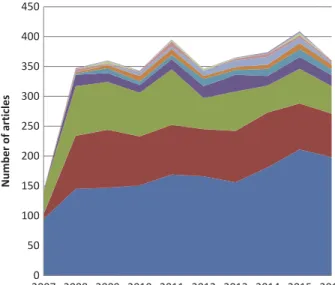
Figure 1illustrates the total output over the period 2007–2016. The introduction of seven
new journals dedicated to the study of terrorism heralded a marked increase in output; up from 143 articles in 2007 to a yearly average of 367 between 2008 and 2016. Total output levels appear relatively stable after 2008, with research articles and research notes con-stituting a steadily increasing majority of the items published, and book reviews occupying third place. With regard to “market share,” it is notable that four of the nine journals account for 74.4% of all the articles published. These are the field’s established“classics” TPV (21.2%) and SCT (17.1%), and newcomers POT (14.7%) and SNT (21.5%), both of which began publication in 2007 (Table 1).
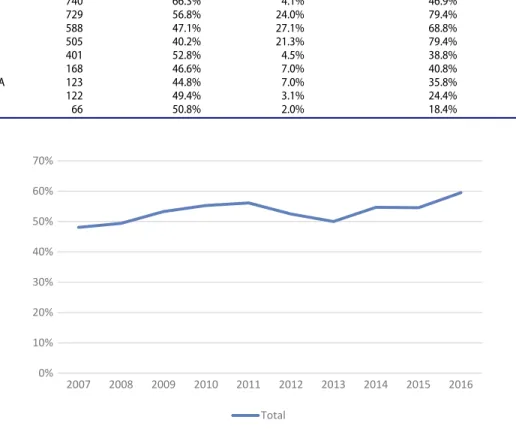
To assess the percentage of articles that use primary data, only the article types “research articles,” “research notes,” and “other resources” were analyzed. This avoids skewing the results by the inclusion of types of output such as books reviews and editorial news that are highly unlikely to include any first-hand information. Of the 2552 articles comprising this selection, 1372, or 53.8%, used some kind of primary sources. Figure 2
0 50 100 150 200 250 300 350 400 450
2007 2008 2009 2010 2011 2012 2013 2014 2015 2016
Number of
articles
Erratum / Retraction notice
Conference proceedings / summary
Opinion piece
Bibliography
Editorial news / information
Editorial introduction
Other resources
Book review
indicates a trend towards an increasing use of such data in the decade under investigation; from 48.1% in 2007 to 59.5% in 2016.
As can be seen in Table 1, there are marked differences in the degree to which the various journals publish primary sources-based research. With an average of 66.3% over the 10-year period, SNT leads the pack. This appears to reflect, at least in part, its emphasis on publishing work by counterterrorism and counterinsurgency practitioners withfield experience. But even if SNT were to be seen as an outlier, a positive trend can still be observed; albeit up from 36.8% in 2007 to 55.1% in 2016.
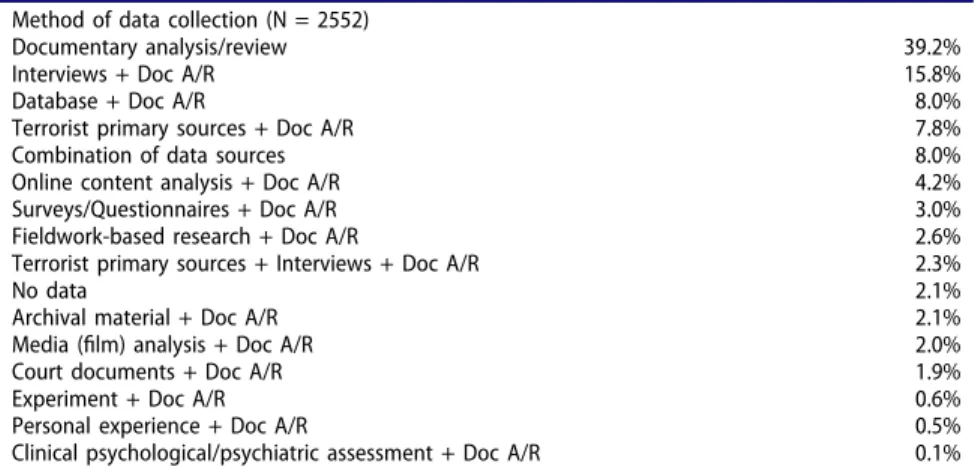
The increased use of primary sources coincides with a slight but steady decrease in a methodological reliance on the literature review method, or what Silke termed“ documen-tary analysis/review.”47 Looking at research articles, research notes, and other resources (N = 2552), the overall use of literature review as the only method of data collection and analysis dropped from 42.3% in 2007 to 32.5% in 2016. Still, asTable 2shows, this method remained predominant in the decade under review, with an average of 39.2% of articles relying entirely upon it. The second most common form of data collection was a combination of literature review with interviews (15.8%), followed by the use of databases (8.0%), drawing upon multiple forms of primary data (8.0%) and the study of terrorist primary sources (7.8%), such as speeches and writings. A variety of other types of (primary) data collection were encountered, but only in 0.1–3% of articles.
Table 1.Journal overview, 2007–2016.
Journal Total output Primary sources use Statistics Authors who also write in other journals
SNT 740 66.3% 4.1% 46.9%
TPV 729 56.8% 24.0% 79.4%
SCT 588 47.1% 27.1% 68.8%
POT 505 40.2% 21.3% 79.4%
CST 401 52.8% 4.5% 38.8%
DAC 168 46.6% 7.0% 40.8%
BSTPA 123 44.8% 7.0% 35.8%
JTR 122 49.4% 3.1% 24.4%
JDR 66 50.8% 2.0% 18.4%
0% 10% 20% 30% 40% 50% 60% 70%
2007 2008 2009 2010 2011 2012 2013 2014 2015 2016
Total
On the use of statistical analyses in research articles, research notes, and other resources, Figure 3shows a slow but steady upward trend; from 16.6% in 2007 to 28.0% in 2016. Thefigure also illustrates that descriptive statistics are used most often overall. Of the 2552 articles selected for analysis, 14.7% used descriptive statistics, 5.8% used a combination of descriptive and inferential statistics, and 1.3% used inferential statistics only. Overall, however, 78.1% of the articles studied did not use any kind of statistical analyses. Looking at the use of statistics per journal over the decade under investigation, some clear differences stand out. Three journals publish articles with statistical analyses much more frequently; SCT (27.1%), TPV (24.0%), and POT (21.3%), versus 2.0 to 7.0% for the others (Table 1).
On the question of authorship, the results indicate that 72.6% of research articles, research notes, and other resources were written by a single author, 17.8% by two authors, 6.8% by three or more authors, and 2.9% without attribution to an author. While the majority of terrorism scholars work alone, a trend towards greater collaboration was evident. Whereas 77.1% of research-based articles were the work of a single author in 2007, this dropped steadily to 68.7% in 2016.
Table 2. Methods of data collection for research articles, research notes, and other resources.
Method of data collection (N = 2552)
Documentary analysis/review 39.2%
Interviews + Doc A/R 15.8%
Database + Doc A/R 8.0%
Terrorist primary sources + Doc A/R 7.8%
Combination of data sources 8.0%
Online content analysis + Doc A/R 4.2%
Surveys/Questionnaires + Doc A/R 3.0%
Fieldwork-based research + Doc A/R 2.6%
Terrorist primary sources + Interviews + Doc A/R 2.3%
No data 2.1%
Archival material + Doc A/R 2.1%
Media (film) analysis + Doc A/R 2.0%
Court documents + Doc A/R 1.9%
Experiment + Doc A/R 0.6%
Personal experience + Doc A/R 0.5%
Clinical psychological/psychiatric assessment + Doc A/R 0.1%
0% 10% 20% 30% 40% 50% 60% 70% 80% 90% 100%
2007 2008 2009 2010 2011 2012 2013 2014 2015 2016 None
Inferential
Inf + Descr
Descriptive
A total of 2307 authors were identified, 2097 of whom made at least one research-based contribution. Looking at all authors first, 72.2% made one contribution (1665 authors), 13.4% made two contributions (309 authors), 5.5% published thrice (126 authors), 2.4% wrote 4 pieces (55 authors), and 6.6% authored five or more publications (152 authors). Narrowing this down to research-based output only (research articles, research notes, or other resources), these figures change to show that 74.8% were one-time contributors (1569 authors), 13.3% wrote two pieces (279 authors), 4.6% contributed thrice (96 authors), 2.7% made four contributions (56 authors), and 4.6% authored five or more articles (97 authors). In short, the majority of authors publishing on terrorism are one-time contributors.
For each journal, the percentage of authors who also published in one of the other 8 journals was calculated. Stacking these numbers yields the overall percentage of authors per journal that publish in the broaderfield (Figure 4). For instance, 79.4% of authors who published in TPV also wrote for one of the field’s other journals at least once. This underlines the importance of taking thefield as a whole into account when calculating the average number of contributions per author. It also shows that TPV, POT, and SCT attract the largest number of authors who make multiple contributions to thefield as a whole. In contrast, JDR and JTR especially are relatively “isolated” in that their authors only publish in the other terrorism journals to a limited degree. These disparities may also reflect the status of TPV and SCT in particular as established outlets for research on terrorism, which are thereby able to attract more (returning) contributors.
Discussion
Thefindings and longitudinal trends revealed by this study provide several clear indicators of positive developments in the academic study of terrorism. At the very least, they should serve to problematize the sense of enduring pessimism about the methodological issues
0% 10% 20% 30% 40% 50% 60% 70% 80% 90%
TPV SCT POT CST DAC BSTPA JDR JTR SNT
TPV SCT POT CST DAC BSTPA JDR JTR SNT
besetting such work; a position, incidentally, that this author also held in the past.48 In terms of the use of primary data, statistics, methods of data collection other than the literature review, and the degree of collaboration, there are signs of gradual and continu-ing improvement. Silke’s assessments in the early 2000s found that more than 80% of articles on terrorism used secondary sources only, that 62% were based exclusively on a literature review methodology, and that interviews and databases were utilized in only 10 and 7% of articles respectively.49 Between 2007 and 2016, these numbers rose consider-ably; 53.8% of articles used some kind of first-hand data, only 39.2% were based exclu-sively on literature review, 15.8% utilized interviews, and 8.0% incorporated databases.
Particularly in terms of the use of primary sources, thesefigures indicate that consider-able progress has been made. From a field of study in which experts mostly talked amongst themselves, endlessly referencing books, articles, and media reports, the study of terrorism has developed to a point where a (slim) majority of articles do use primary data. Moreover, there is a steady upward trend in the use of such data. The lack of research based on primary sources, one of the most enduring and detrimental problems to face the field, finally appears to be abating. Of course, this does not mean that all associated issues are similarly being resolved; the empirical verification of explanations for involvement in terrorism, for instance, still seems a long way off. Still, the increased use offirst-hand information places the development of a stronger empirical foundation for understanding terrorism and counterterrorism within scholars’grasp.
Unfortunately, progress towards addressing other areas of concern in research on terrorism has been less intrepid. To begin with, the use of databases remains relatively low at 8.0% and virtually unchanged from the 7% that Silke noted more than a decade ago.50 Strikingly, only 0.6% of articles used an experimental research design and a mere 0.08% (2 articles) were based on clinical assessment. The scarcity of this latter methodo-logical approach is particularly problematic, as questions surrounding terrorists’ psychol-ogy and the degree to which mental health issues can offer an explanation for this form of political violence remain highly salient in the literature.51 Here is one particular area of research that is urgently in need of a more extensive and robust empirical basis.
Another area of concern is the use of statistics. While the percentage of articles that incorporates such analyses has steadily increased, from 16.6% in 2007 to 28.0% in 2016, an average of 78.1% of pieces published in this period did not use statistics at all. This is actually a higher average than the 74% of articles without statistics that Silke noted in 2007.52Research on terrorism still favors qualitative research designs. While scholars have broadened their data collection methodologies within that spectrum, going a long way towards addressing the overreliance on literature reviews, quantitative research arguably remains underdeveloped. If the trend found in this study continues, however, this issue may be addressed within the next several years.
authors. With most scholars on terrorism continuing to work alone, the size and scope of the projects that can be undertaken will remain relatively modest and hamper the development of new insights. Similarly, the large number of transient scholars, many of whom are unlikely to have truly in-depth knowledge of ongoing debates and the state of the art, poses a serious obstacle to developing a committed core of researchers able to move thefield forward.
In terms of output, terrorism studies has undergone significant growth. This is pri-marily due to the addition of seven new journals in the 2007–2014 period that have expanded the core outlets for scholarly research beyond the mainstays TPV and SCT. Although quantity alone says little about the quality of the research being conducted, the addition of these new journals does speak to the ongoing ability of terrorism to attract academic attention. The rise of specialist journals, such as those focused on deradicaliza-tion or a“critical”perspective on terrorism, reflect thefield’s ongoing maturation in that it has been able to attract academics from specific backgrounds and with specific interests. Perhaps unfortunately, this has also led to considerable stratification, with authors in some journals preferring to publish only in that particular outlet. Going forward, it will be important to ensure that these research communities do not become islands and that scholars not only remain aware of developments in the broaderfield, but actively engage with those they may consider to be outside of their primary academic audience.
Another important point of discussion is that the findings presented in this article should not be taken as straightforward indicators of the quality of particular articles or authors. The emphasis on how a lack of primary sources in particular has had a detri-mental influence on thefield for decades, is not a dismissal of the value of non-empirical work.55Many authors who base themselves on the secondary literature have made stellar contributions by bringing together insights from a diverse range of scholarly, govern-mental, journalistic, and NGO-based works. Others have analyzed existing data in novel ways, presentedfindings from the non-English literature, or drawn attention to countries, case studies, and historical periods that have been undeservedly neglected. Similarly, the use of primary data is not a guarantee for high-quality work; some articles use only the barest of such sources or fail to study them in depth. The use of secondary or primary data should not be assessed at the level of individual authors, but at that of thefield of study. It is here that an overreliance on secondary sources has been well-documented and it is here that the present study notes considerable improvements.
Finally, there is a question of methodology that deserves to be underlined. Some previous assessments of thefield of terrorism studies have relied at least in part on the study of abstracts or methodology sections.56 While carrying out the data collection for this study, it quickly became apparent that most authors do not state their methodology and sources in the abstract and that a clearly marked“methods”section is often absent. To reliably ascertain whether a particular article used primary data, for instance, it was almost always necessary to read the references or bibliography. Although time consuming, this approach should be kept in mind when carrying out future evaluations of thefield.
Limitations
inject a degree of subjectivity into the results and their interpretation. In particular, some readers might object that only articles including first-hand information on terrorists should have qualified for the “primary data” designation. Indeed, if the data were to be recoded with such a much more stringent guideline, the results would undoubtedly paint a very different picture of the field. Yet, such a narrow perspective on primary sources would do a disservice to the many authors who have labored to advance our under-standing of the social, political, and economic causes and consequences of both terrorism and counterterrorism.
Another limitation is that the nine journals surveyed here clearly do not encom-pass the entire field of academic publications on terrorism. There are dozens of journals that publish such research,57 and many of the most cited articles on the subject have not appeared in primarily terrorism-focused ones.58 Additionally, there is a very sizeable number of books and an extensive grey literature that includes, for instance, reports by influential think tanks as well as government agencies. Still, the nine journals studied here are argued to constitute the core sites of the production and discussion of scholarly knowledge on the subject. Their selection was based on the author’s assessment of what constitute the most important journals in the field, and their prominence on Google Scholar’s h-factor overview for terrorism-related journals. Most importantly, by broadening the analysis beyond the field’s two core journals, a robust overview of the trends that are shaping research on terrorism became possible.
Conclusion
Between 2007 and 2016, thefield of terrorism studies has undergone significant develop-ments with regard to many of the methodological issues that have plagued it for decades. Above all, the use of primary data has increased considerably and appears to be continu-ing to do so. Concurrently, scholars have begun to adapt a wider variety of data-gathercontinu-ing techniques, greatly diminishing the overreliance on literature reviews that was noted from the 1980s through to the early 2000s. These positive changes should not obscure enduring issues. Despite improvements, most scholars continue to work alone and most authors are one-time contributors. Moreover, thefield remains predominantly qualitative in orienta-tion with the use of statistics remaining relatively low. Clearly, there remain numerous grounds for concern that will require ongoing and concerted effort to address. Yet, in reaching an overall conclusion there is considerable empirical support for an optimistic assessment. Research on terrorism has not stagnated; it has begun toflourish.
Acknowledgments
Notes
1. Bart Schuurman and Quirine Eijkman, “Moving Terrorism Research Forward: The Crucial Role of Primary Sources,”The International Centre for Counter-Terrorism - The Hague4, no. 2 (2013), 1-13
2. For instance: John Horgan,“Issues in Terrorism Research,”The Police Journal70, no. 3 (1997): 193–202; Ariel Merari,“Academic Research and Government Policy on Terrorism,”Terrorism and Political Violence 3, no. 1 (1991): 88–102; Andrew Silke, “The Devil You Know: Continuing Problems with Research on Terrorism,”Terrorism and Political Violence 13, no. 4 (2001): 1–14.
3. Alex P. Schmid, “The Definition of Terrorism,” in The Routledge Handbook of Terrorism Research, edited by Alex P. Schmid (London, New York: Routledge, 2011), 40–41; Schuurman and Eijkman (see note 1), 1–13.
4. Andrew Silke, “Contemporary Terrorism Studies: Issues in Research,”inCritical Terrorism Studies: A New Research Agenda, edited by Richard Jackson, Marie Breen Smyth, and Jeroen Gunning (New York, Abingdon: Routledge, 2009), 34.
5. John Horgan and Jessica Stern, “Terrorism Research Has Not Stagnated,”The Chronicle of Higher Education, May 8, 2013; Clark McCauley and Sophia Moskalenko,“Some Things We Think We’ve Learned Since 9/11: A Commentary on Marc Sageman’s ‘The Stagnation of Terrorism Research,’” Terrorism and Political Violence 26, no. 4 (2014): 601–6; Alex P. Schmid,“Comments on Marc Sageman’s Polemic ‘The Stagnation in Terrorism Research,’” Terrorism and Political Violence26, no. 4 (2014): 587–95.
6. Alex P. Schmid, “The Literature on Terrorism,” in The Routledge Handbook of Terrorism Research, edited by Alex P. Schmid (London, New York: Routledge, 2011), 458–59.
7. J. Bowyer Bell,“Trends on Terror: The Analysis of Political Violence,”World Politics29, no. 3 (1977): 488.
8. Alex P. Schmid,Political Terrorism: A Research Guide to Concepts, Theories, Data Bases and Literature(Amsterdam, New Brunswick: SWIDOC, Transaction Books, 1982), 418.
9. Ted Robert Gurr,“Empirical Research on Political Terrorism: The State of the Art and How It Might Be Improved,”inCurrent Perspectives on International Terrorism, edited by Robert O. Slater and Michael Stohl (London: Macmillan Press, 1988), 115.
10. Martha Crenshaw,“The Psychology of Political Terrorism,”inPolitical Psychology, edited by Margaret G. Hermann (San Francisco: Jossey-Bass Publishers, 1986), 381.
11. Walter Reich, “Understanding Terrorist Behavior: The Limits and Opportunities of Psychological Inquiry,”inOrigins of Terrorism: Psychologies, Ideologies, Theologies, States of Mind, edited by Walter Reich (Washington, DC: Woodrow Wilson Center Press, 1990), 261–71.
12. Silke (see note 2), 5. 13. Ibid., 10.
14. Andrew Silke, “The Road Less Travelled: Trends in Terrorism Research,” in Research on Terrorism: Trends, Achievements and Failures, edited by Andrew Silke (London, New York: Frank Cass, 2004), 183–84; Andrew Silke, “An Introduction to Terrorism Research,” in Research on Terrorism: Trends, Achievements and Failures, edited by Andrew Silke (London, New York: Frank Cass, 2004), 12–15.
15. Schmid (see note 6), 460.
16. Andrew Silke, “The Impact of 9/11 on Research on Terrorism,” in Mapping Terrorism Research: State of the Art, Gaps and Future Directions, edited by Magnus Ranstorp (New York, Abingdon: Routledge, 2007), 81; Silke (see note 4), 34–48; Richard Jackson,“The Study of Terrorism after 11 September 2001: Problems, Challenges and Future Developments,” Political Studies Review 7, no. 2 (2009): 171–84; Gary LaFree and Gary Ackerman, “The Empirical Study of Terrorism: Social and Legal Research,”Annual Review of Law and Social Science5 (2009): 347–74.
18. Andrew Silke,“Holy Warriors: Exploring the Psychological Processes of Jihadi Radicalization,” European Journal of Criminology5, no. 1 (2008): 101.
19. Avishag Gordon, “Transient and Continuant Authors in a Research Field: The Case of Terrorism,”Scientometrics72, no. 2 (2007): 213–24.
20. See also: John Horgan,“The Case for Firsthand Research,”inResearch on Terrorism: Trends, Achievements and Failures, edited by Andrew Silke (London, New York: Frank Cass, 2004), 30–56; Joshua Sinai, “New Trends in Terrorism Studies: Strengths and Weaknesses,” in Mapping Terrorism Research: State of the Art, Gaps and Future Directions, edited by Magnus Ranstorp (New York, Abingdon: Routledge, 2007), 43–44.
21. For instance: Ignácio Sanchez-Cuenca, “Why Do We Know So Little About Terrorism?,” International Interactions40, no. 4 (2014): 590–601.
22. Gilbert Ramsay, “Why Terrorism Can, but Should Not Be Defined,” Critical Studies on Terrorism8, no. 2 (2015): 212–16.
23. Schmid (see note 6), 460; Andrew Silke,“Research on Terrorism: A Review of the Impact of 9/ 11 and the Global War on Terrorism,”inTerrorism Informatics: Knowledge Management and Data Mining for Homeland Security, edited by Hsinchun Chen et al. (New York: Springer, 2008), 29.
24. Audrey Kurth Cronin, How Terrorism Ends: Understanding the Decline and Demise of Terrorist Campaigns(Princeton, Oxford: Princeton University Press, 2009), 7.
25. Alex P. Schmid and Albert J. Jongman, Political Terrorism: A New Guide to Actors, Authors, Concepts, Data Bases, Theories, and Literature (Amsterdam, New Brunswick: SWIDOC, Transaction Books, 1988), 179.
26. Tom Quiggin,“Words Matter: Peer Review as a Failing Safeguard,”Perspectives on Terrorism 7, no. 2 (2013): 71–81; Frederick Schulze, “Breaking the Cycle: Empirical Research and Postgraduate Studies on Terrorism,” in Research on Terrorism: Trends, Achievements and Failures, edited by Andrew Silke (London, New York: Frank Cass, 2004), 163; Silke (see note 2), 5–6.
27. Roberto Franzosi,“The Press as a Source of Socio-Historical Data: Issues in the Methodology of Data Collection from Newspapers,”Historical Methods20, no. 1 (1987): 6.
28. Schmid (see note 6), 461.
29. Ivan Sascha Sheehan, “Assessing and Comparing Data Sources for Terrorism Research,” in Evidence-Based Counterterrorism Policy, edited by Cynthia Lum and Leslie W. Kennedy (New York: Springer, 2011), 13–40; Mark Hamm and Ramón Spaaij, “Key Issues and Research Agendas in Lone Wolf Terrorism,”Studies in Conflict & Terrorism38, no. 3 (2015): 173–74. 30. Magnus Ranstorp, “Introduction: Mapping Terrorism Research—Challenges and Priorities,”
inMapping Terrorism Research: State of the Art, Gaps and Future Direction, edited by Magnus Ranstorp (London, New York: Routledge, 2007), 6.
31. Anne Aly and Jason-Leigh Striegher, “Examining the Role of Religion in Radicalization to Violent Islamist Extremism,” Studies in Conflict & Terrorism 35, no. 12 (2012): 849–50; Michael King and Donald M. Taylor, “The Radicalization of Homegrown Jihadists: A Review of Theoretical Models and Social Psychological Evidence,” Terrorism and Political Violence 23, no. 4 (2011): 616; Bradley McAllister and Alex P. Schmid, “Theories of Terrorism,” in The Routledge Handbook of Terrorism Research, edited by Alex P. Schmid (Abingdon, New York: Routledge, 2011), 261; Sarah L. Desmarais et al.,“The State of Scientific Knowledge Regarding Factors Associated with Terrorism,”Journal of Threat Assessment and Management4, no. 4 (2017): 180–209.
32. Avishag Gordon,“Can Terrorism Become a Scientific Discipline? A Diagnostic Study,”Critical Studies on Terrorism3, no. 3 (2010): 437–58.
34. Gary LaFree and Joshua D. Freilich, “Editor’s Introduction: Quantitative Approaches to the Study of Terrorism,”Journal of Quantitative Criminology 28, no. 1 (2012): 1–5; Charles W. Mahoney, “More Data, New Problems: Audiences, Ahistoricity, and Selection Bias in Terrorism and Insurgency Research,”International Studies Review(2017): 1, 4.
35. Michael Loadenthal, “Introduction: Like Finding a Needle in a Pile of Needles: Political Violence and the Perils of a Brave New Digital World,”Critical Studies on Terrorism 8, no. 3 (2015): 456–65.
36. Peter Neumann and Scott Kleinmann, “How Rigorous Is Radicalization Research?,” Democracy and Security9, no. 4 (2013): 360.
37. Neumann and Kleinmann (see note 36), 372. 38. Mahoney (see note 34 above), 2–18.
39. Nafeez Ahmed, “The Astonishingly Crap Science of ‘Counter-Extremism,’” Insurge Intelligence, March 17, 2016; Desmarais et al. (see note 31): 180–209; Richard English,Does Terrorism Work? A History(Oxford, New York: Oxford University Press, 2016), 22; Allard R. Feddes and Marcello Gallucci, “A Literature Review on Methodology Used in Evaluating Effects of Preventive and De-Radicalisation Interventions,”Journal for Deradicalization, no. 5 (2015): 11–12; Paul Gill et al.,What Are the Roles of the Internet in Terrorism? Measuring Online Behaviours of Convicted UK Terrorists(VOX-Pol, 2015), 5; Daniel J. Harris, Pete Simi, and Gina Ligon, “Reporting Practices of Journal Articles that Include Interviews with Extremists,” Studies in Conflict & Terrorism 39, no. 7 (2016): 602–16; Karen Jacques and Paul J. Taylor, “Female Terrorism: A Review,” Terrorism and Political Violence 21, no. 3 (2009): 502–3, 510–11; Angela McGilloway, Priyo Ghosh, and Kamaldeep Bhui,“A Systematic Review of Pathways to and Processes Associated with Radicalization and Extremism amongst Muslims in Western Societies,” International Review of Psychiatry 27, no. 1 (2015): 39–50; Minerva Nasser-Edine et al., “Countering Violent Extremism (CVE) Literature Review,” Australian Department of Defense, 2011, 3; Adam Roberts, “Terrorism Research: Past, Present, and Future,”Studies in Conflict & Terrorism 38, no. 1 (2015): 63; Schuurman and Eijkman (see note 1); Bart Schuurman, “Using Primary Sources for Terrorism Research: Introducing Four Case Studies,” Perspectives on Terrorism 8, no. 4 (2014): 62; Joseph K. Young and Michael G. Findley, “Promise and Pitfalls of Terrorism Research,”International Studies Review13, no. 3 (2011): 411–31.
40. Andrew Silke and Jennifer Schmidt-Petersen, “The Golden Age? What the 100 Most Cited Articles in Terrorism Studies Tell Us,”Terrorism and Political Violence29, no. 4 (2017): 692. 41. Lisa Stampnitzky, Disciplining Terror: How Experts Invented ‘Terrorism’ (Cambridge:
Cambridge University Press, 2014), 12–13, 44–46.
42. Marc Sageman,“The Stagnation in Terrorism Research,”Terrorism and Political Violence26, no. 4 (2014): 569.
43. Silke (see note 4), 34. 44. Silke (see note 2), 6.
45. Responses to other authors were coded as research notes, essays in which multiple books were reviewed were coded as book reviews. POT also uses the “policy notes” designator for 5 articles. These were labeled as research notes to avoid the unnecessary proliferation of article types.
46. “What Is a Primary Source?,” Princeton University, http://www.princeton.edu/~refdesk/pri mary2.html.
47. Silke (see note 2), 6.
48. Bart Schuurman, Becoming a European Homegrown Jihadist: A Multilevel Analysis of Involvement in the Dutch Hofstadgroup, 2002-2005 (PhD, Leiden University, 2017), 31-34; Schuurman and Eijkman (see note 1), 1-11.
49. Silke (see note 2), 5. 50. Ibid.
The Study of Mental Disorder and Terrorist Involvement,” American Psychologist72, no. 3 (2017): 231–41; John G. Horgan,“Psychology of Terrorism: Introduction to the Special Issue,” American Psychologist72, no. 3 (2017): 199–204.
52. Silke (see note 16), 81. 53. Ibid., 79–80.
54. Silke,“The Road Less Traveled”(see note 14), 183–84.
55. Richard English,“The Future Study of Terrorism,”European Journal of International Security 1, no. 2 (2016): 142–44.
56. Gill et al. (see note 39), 5–6; Lum, Kennedy, and Sherley (see note 17), 7–8.
57. Judith Tinnes, “100 Core and Periphery Journals for Terrorism Research,” Perspectives on Terrorism7, no. 2 (2013): 96–103.
58. Silke and Schmidt-Petersen (see note 40), 704–12.
ORCID