Import Block Enhances Host Transcription in Human Lung Cells
Amy C. Sims,aSusan C. Tilton,dVineet D. Menachery,aLisa E. Gralinski,aAlexandra Schäfer,aMelissa M. Matzke,d Bobbie-Jo M. Webb-Robertson,dJean Chang,eMaria L. Luna,dCasey E. Long,aAnil K. Shukla,dArmand R. Bankhead III,f Susan E. Burkett,cGregory Zornetzer,e* Chien-Te Kent Tseng,gThomas O. Metz,dRaymond Pickles,b,cShannon McWeeney,f Richard D. Smith,dMichael G. Katze,e,hKatrina M. Waters,dRalph S. Barica,b
Departments of Epidemiologyaand Microbiology and Immunologyband Cystic Fibrosis Center,cUniversity of North Carolina at Chapel Hill, Chapel Hill, North Carolina,
USA; Pacific Northwest National Laboratory, Richland, Washington, USAd; Department of Microbiology, School of Medicine, University of Washington, Seattle,
Washington, USAe; Oregon Health Sciences University, Portland, Oregon, USAf; University of Texas Medical Branch, Department of Microbiology and Immunology,
Galveston, Texas, USAg; Washington National Primate Research Center, University of Washington, Seattle, Washington, USAh
The severe acute respiratory syndrome coronavirus accessory protein ORF6 antagonizes interferon signaling by blocking karyopherin-mediated nuclear import processes. Viral nuclear import antagonists, expressed by several highly pathogenic RNA viruses, likely mediate pleiotropic effects on host gene expression, presumably interfering with transcription factors, cytokines, hormones, and/or signaling cascades that occur in response to infection. By bioinformatic and systems biology approaches, we evaluated the impact of nuclear import antagonism on host expression networks by using human lung epithelial cells infected with either wild-type virus or a mutant that does not express ORF6 protein. Microarray analysis revealed significant changes in differential gene expression, with approximately twice as many upregulated genes in the mutant virus samples by 48 h postinfec-tion, despite identical viral titers. Our data demonstrated that ORF6 protein expression attenuates the activity of numerous karyopherin-dependent host transcription factors (VDR, CREB1, SMAD4, p53, EpasI, and Oct3/4) that are critical for establish-ing antiviral responses and regulatestablish-ing key host responses durestablish-ing virus infection. Results were confirmed by proteomic and chro-matin immunoprecipitation assay analyses and in parallel microarray studies using infected primary human airway epithelial cell cultures. The data strongly support the hypothesis that viral antagonists of nuclear import actively manipulate host re-sponses in specific hierarchical patterns, contributing to the viral pathogenic potentialin vivo. Importantly, these studies and modeling approaches not only provide templates for evaluating virus antagonism of nuclear import processes but also can reveal candidate cellular genes and pathways that may significantly influence disease outcomes following severe acute respiratory syn-drome coronavirus infectionin vivo.
N
ovel research strategies are needed to elucidate the complex virus-host interaction networks that regulate viral pathogen-esis and to provide rapid response strategies for control of newly emerging viral pathogens. Prior to 2003, human coronaviruses were categorized as mildly virulent upper respiratory pathogens; however, severe acute respiratory syndrome coronavirus (SARS-CoV) infection results in high mortality rates (⬃10%) (1, 2). SARS-CoV emerged suddenly from zoonotic reservoirs and rap-idly circumnavigated the globe in 2003 (3–8). The SARS-CoV pos-itive-stranded RNA genome encodes a variety of novel genes that do not exist in other human coronaviruses, which likely contrib-utes to the alteration of virulence and disease severity (9). In our study, a systems biological approach was used to examine the con-sequences of antagonizing karyopherin-dependent nuclear im-portation during SARS-CoV infection.Signal-mediated macromolecular transport between the cyto-plasm and nucleus is an integral part of cellular processes, includ-ing gene expression, signal transduction, development of antiviral states, and cell cycle progression. Highly pathogenic RNA viruses, including SARS-CoV, enteroviruses, Ebola virus, human immu-nodeficiency virus, cardioviruses, and Nipah viruses, encode pro-teins that antagonize nuclear importation processes, suggesting a common modality for regulating viral pathogenesis and disease outcomes across disparate virus families (10–14). Interestingly, the consequences of viral antagonism on host nuclear import and mRNA expression have not been carefully evaluated using
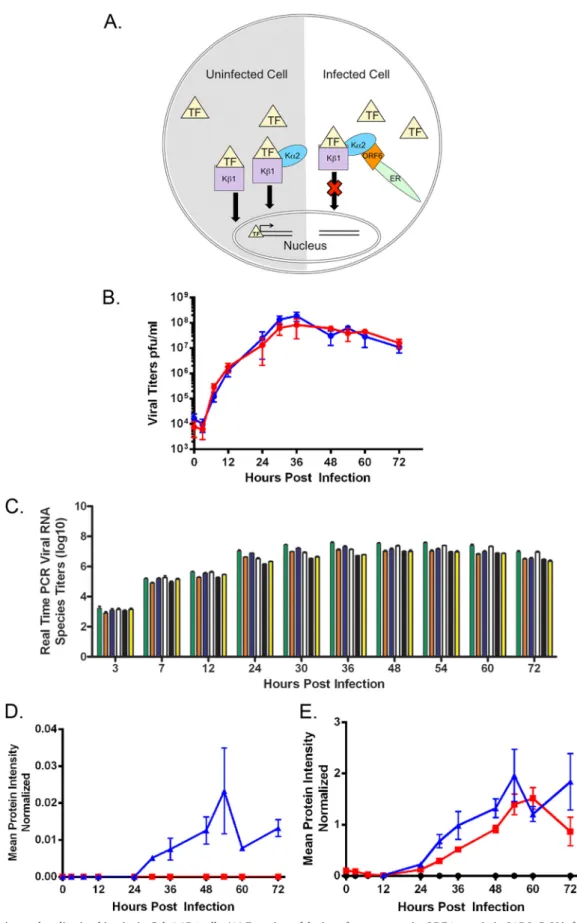
genomic-based strategies. Rather, elegant reductionist approaches have demonstrated targeted antagonism of innate immune signal-ing pathways, typically involvsignal-ing interferon (IFN) regulatory fac-tor 7 (IRF-7) and STAT transcription facfac-tors (15–20). Reflecting this approach, the interferon antagonist activity of the SARS-CoV ORF6 protein has been demonstrated to mediate its function by binding to the nuclear importation chaperone protein karyopherin. ORF6 protein binds specifically to karyopherin␣2, trapping the import factor on intracellular membranes, where the complex then sequesters karyopherin1 (17), preventing nuclear transportation of cargo into the host cell nucleus (seeFig. 1A). As karyopherin1 is essential for all nuclear import by karyopherin ␣proteins, depletion of this factor may dramatically reduce or
Received17 October 2012Accepted17 January 2013
Published ahead of print30 January 2013
Address correspondence to Amy C. Sims, [email protected].
* Present address: Gregory Zornetzer, Institute for Systems Biology, Seattle, Washington, USA.
A.C.S. and S.C.T. contributed equally to this article.
Supplemental material for this article may be found athttp://dx.doi.org/10.1128 /JVI.02520-12.
Copyright © 2013, American Society for Microbiology. All Rights Reserved.
alter the transport of other cargo by karyopherin-based transport mechanisms (21). We hypothesized that the ORF6 protein may actively manipulate the translocation of multiple transcription factors, coordinately modulating the levels of host transcription during infection.
Using SARS-CoV as a model system, we investigated whether the ORF6 accessory protein mediated a specific or more general block of karyopherin-mediated nuclear translocation and host gene expression. We identified a cluster of genes that are uniquely upregulated during infection with a mutant SARS-CoV strain that does not express ORF6 protein. Our data showed that ORF6 protein expression effectively ablates the activity of numerous karyopherin-dependent host transcription factors that are critical for establishing antiviral responses and regulating other key host responses during virus infection. The transcription factors identi-fied in these studies (vitamin D receptor [VDR], cyclic AMP re-ceptor binding protein 1 [CREB1], Oct3/4, hypoxia-inducible fac-tor␣2 [HIF␣2]-Epas, p53, and SMAD4) play important roles in the regulation of a variety of cellular processes, including trans-forming growth factor beta induction, maintenance of normal lung cell functions, prevention of lung disease phenotypes, and proper immune cell functions (21–29). Finally, we verified our hypothesis that the upregulation of nuclear translocation attenu-ates viral pathogenesis with bothin vitroandin vivostudies. To-gether, these data suggest that the ORF6 protein mediates the establishment of an intracellular environment that enhances SARS-CoV replication later in infection by suppressing host antiviral and innate immune expression cascades. In addition, these studies suggest that other viral nuclear import antagonists will also mediate pleiotropic alterations in host gene expression during infection, potentially leading to broad-based strategies for intervention and control of viral pathogenesisin vivo.
MATERIALS AND METHODS
Data dissemination.Raw microarray data have been deposited in the National Center for Biotechnology Information (NCBI) Gene Expression Omnibus database (30) and are accessible through the GEO series under accession number GSE33267 (http://www.ncbi.nlm.nih.gov/geo/query /acc.cgi?acc⫽GSE33267). Raw proteomics data corresponding to pep-tide identifications used to populate the AMT tag database are available at the PRoteomics IDEntification (PRIDE) database (http://www.ebi.ac.uk /pride/) under the project name “A Systems Biology Approach to Emerg-ing Respiratory Viral Diseases” in the PRIDE Public Projects folder and corresponding to PRIDE accession numbers19877to19890. The raw quantitative proteomics data can be accessed at the Pacific Northwest National Laboratory (PNNL) Biological Mass Spectrometry (MS) Data and Software Distribution Center (http://omics.pnl.gov/) in the Systems Virology Contract Data folder within the Browse Available Data folder. All data sets and associated metadata have been submitted to the Virus Pathogen Resource (ViPR;http://www.viprbrc.org). Additional details from this study and similar studies can be accessed through the Systems Virology website (http://www.systemsvirology.org).
Cells and viruses.Infections for microarray and proteomics analyses and validation studies were performed in a clonal population of Calu3 cells (human lung adenocarcinoma cells) sorted for high levels of expres-sion of the SARS-CoV cellular receptor angiotensin-converting enzyme 2 (ACE2), referred to as Calu3 2B4 cells (31). Calu3 2B4 cells were grown in minimal essential media (MEM; Invitrogen-Gibco) containing 20% fetal bovine serum (HyClone) and 1% antibiotic-antimycotic mixture (Invit-rogen-Gibco). Viral titration assays were performed in Vero E6 cells. Vero E6 cells were maintained in MEM (Invitrogen-Gibco) containing 10%
fetal clone II (HyClone) and 1% antibiotic-antimycotic (Invitrogen-Gibco).
Human tracheobronchial epithelial cells were obtained from airway specimens resected from patients undergoing surgery under University of North Carolina Institutional Review Board-approved protocols by the Cystic Fibrosis Center Tissue Culture Core. Primary cells were expanded to generate passage 1 cells, and passage 2 cells were plated at a density of 2.5⫻105cells per well on permeable Transwell-COL (12-mm-diameter)
supports. Human airway epithelium (HAE) cultures were generated by provision of an air-liquid interface for 6 to 8 weeks to form well-differen-tiated, polarized cultures that resembledin vivopseudostratified muco-ciliary epithelium (32).
Wild-type infectious clone-derived SARS-CoV (icSARS-CoV) and ic-SARS-CoV⌬ORF6 and their corresponding MA15 mouse-adapted vari-ants were derived from the Baric laboratory’s infectious clone constructs as previously described (see Section S1 and Fig. S1 in the supplemental material) (9,33,34). Briefly, genome fragments were amplified in Esche-richia coli, excised from plasmids by restriction digestion, ligated, and purified prior toin vitrotranscription reactions to synthesize full-length genomic RNA, which was transfected into Vero E6 cells. The media from transfected cells were harvested and served as seed stocks for subsequent experiments. Viral genomes were confirmed by sequence analyses prior to use in any experiments. All work was performed in a biosafety level 3 facility supported by redundant fans.
Real-time PCR quantification of viral genomic and subgenomic RNA species.Relative quantities of viral genomic or subgenomic mRNA were determined by quantitative real-time PCR (qRT-PCR). First-strand cDNA synthesis was performed using 500 ng of total RNA and Thermo-Script reverse transcriptase (Invitrogen) according to the manufacturer’s protocol. The qPCR assay was performed using a SYBR green kit (Applied Biosystems, Carlsbad, CA) with specific primers for the different RNA species, according to the manufacturer’s standard protocol. Relative RNA quantities were determined using the comparative threshold cycle (CT) method, with human RPL14R2 serving as the endogenous reference and mock-infected samples serving as the calibrators. Primer sequences are available upon request.
icSARS-CoV and icSARS-CoV⌬ORF6 infection of Calu3 2B4 cells and processing for microarray and proteomic analysis.To determine the pattern of differential gene expression or protein expression for ic-SARS-CoV-infected, icSARS-CoV⌬ORF6-infected, and mock-infected cells, Calu3 2B4 cells were plated in triplicate under each condition at each time point, washed prior to infection, infected at a multiplicity of infec-tion of 5 (MOI 5), and incubated at 37°C for 40 min. The inoculum was removed, cells were washed 3 times with 1⫻phosphate-buffered saline (PBS), and then fresh medium was added prior to time zero. For both microarray and proteomic analyses, at 0, 3, 7, 12, 24, 30, 36, 48, 54, 60, and 72 h postinfection, medium was collected to determine viral titers at each time point for each well and cells were either washed in 1⫻PBS and then harvested in TRIzol (Invitrogen) and stored at ⫺80°C (for RNA) or washed 3 times in cold 150 mM ammonium bicarbonate buffer, lysed for 15 min in 8 M urea, and stored at⫺80°C (for protein).
Infection of primary HAE cell cultures.Infection of HAE cultures with icSARS-CoV and icSARS-CoV⌬ORF6 was performed as previously described by our group (35–37). Briefly, triplicate cultures were washed with 1⫻PBS, and 200l of mock, icSARS-CoV, and icSARS-CoV⌬ORF6 inocula was added to the apical surface. Cultures were incubated at 37°C for 2 h; the inoculum was removed, and unbound viruses were removed by washing three times with 1⫻PBS. Apical wash samples were harvested to analyze viral growth kinetics at 2, 24, 48, and 72 h postinfection and were assayed by plaque assay in Vero E6 cells (36).
replicates of at least one infection time point (33,631 probes passed). Differential expression was determined by comparing icSARS-CoV- and icSARS-CoV⌬ORF6-infected replicates to mock-infected replicates for each time point, based on a linear model fit for each transcript. Criteria for differential expression were an absolute log2-fold change of 1.5 and a false
discovery rate (FDR)-adjustedPvalue of⬍0.05 for a given time point. Differential expression was also calculated directly between icSARS-CoV and icSARS-CoV⌬ORF6 for each time point by using the criteria of a 2-fold change and an FDR-adjustedPvalue of⬍0.05. Significant tran-script values were transformed for clustering and network analysis to the fold change (log2) of icSARS-CoV- or icSARS-CoV⌬ORF6-infected sam-ples compared to time-matched mock-infected samsam-ples.
To process primary HAE samples, both the apical and basolateral sur-faces of the cultures were washed 3 times in 1⫻PBS and stored at⫺80°C in RNAlater (Ambion/Invitrogen). To isolate total RNA, each membrane was washed twice with 500l of 4 M guanidinium thiocynate, 25 mM sodium citrate, 0.5% Sarkosyl, 0.1 M 2-mercaptoethanol. The washes were combined and, following shearing of the DNA, total RNA was iso-lated through phenol-chloroform extraction. The RNA was further puri-fied using Qiagen RNeasy minicolumns per the manufacturer’s instruc-tions (38). Equivalent amounts of RNA from three biological replicates from each condition were pooled. Microarray analysis was performed as previously described (39) using Agilent 4x44K whole human gene expres-sion microarrays.
Functional enrichment and transcription factor analysis. Func-tional enrichment statistics and network analysis were determined using DAVID (40,41) and Metacore (GeneGo, St. Joseph, MI) to identify the most significant processes affected by infection. The DAVID functional annotation tool utilizes the Fisher exact test to measure gene enrichment in Gene Ontology (GO) biological process category terms for significant genes compared to background, which included all genes on the Agilent platform that passed the QC criteria. To identify major transcriptional regulators whose nuclear import is controlled by karyopherins, the statis-tical Interactome tool in MetaCore was used to measure the interconnect-edness of genes in the experimental data set relative to all known interac-tions in the background data set. Statistical significance of overconnected interactions was calculated using a hypergeometric distribution, where thePvalue represented the probability of a particular mapping arising by chance for experimental data compared to the background (42). In order to determine the consequence of removal of the nuclear import block in SARS-⌬ORF6 infection, significantly overconnected transcription factors were filtered for those whose transport is regulated by karyopherins in the cell. Networks were constructed in MetaCore for experimental data by using an algorithm that identified the shortest path to directly connect nodes in the data set to transcription factors. Network visualizations were created in MetaCore or Cytoscape (43).
Proteomic processing and analysis.The detailed proteomic method-ology, including sample preparation, processing, and analysis methods, are provided in Section S2 of the supplemental material. Cell lysates were trypsin digested and fractionated by strong cation exchange as previously described (44,45). A novel accurate mass and time (AMT) tag database (46) for virus-infected Calu3 2B4 cells was generated by liquid chroma-tography-tandem mass spectrometry (LC-MS/MS) analysis (44,47), us-ing combined aliquots of the icSARS-CoV-, icSARS-CoV⌬ORF6-, and mock-infected samples. Following AMT tag database generation, LC-MS analyses were performed on all icSARS-CoV-, icSARS-CoV⌬ORF6-, and mock-infected samples to generate quantitative data, using identical chromatographic and electrospray conditions as for LC-MS/MS analyses. The LC system was interfaced to an Exactive mass spectrometer (Thermo-Scientific), and the temperature of the heated capillary and the electros-pray ionization voltage were 250°C and 2.2 kV, respectively. Data were collected over the mass range 400 to 2,000m/z. Quantitative LC-MS data sets were processed using the PRISM data analysis system (48), which is a series of software tools developed in-house (e.g., Decon2LS [49] and VIPER [50], which is freely available athttp://ncrr.pnl.gov/software/).
Individual steps in this data processing approach are reviewed in reference 46. The peak intensity values (i.e., abundances) for the final peptide iden-tifications were processed in a series of steps using MatLab R2010b, in-cluding quality control (51,52), normalization (53), and quantification to protein level (54). Comparative statistical analyses of time-matched mock-infected with icSARS-CoV- and icSARS-CoV ⌬ORF6-infected samples was performed using a Dunnett adjustedttest to assess differ-ences in protein average abundance, and a G-test was used to assess asso-ciations among factors due to the presence/absence of a response (51).
ChIP and real-time PCR.Chromatin immunoprecipitation (ChIP) analysis was performed by using the ChIP assay kit (Millipore). Briefly, Calu3 2B4 cells were infected with icSARS-CoV or icSARS-CoV⌬ORF6 or mock infected, as described above, and harvested at 0, 24, and 48 h postinfection. Sonication conditions were chosen to produce the desired size distribution of chromatin, between 200 and 1,000 bp. Samples were then immunoprecipitated with anti-CREB antibody (clone aa5-24; Milli-pore), anti-VDR antibody (clone ab3508; Abcam), or an anti-mouse IgG (Jackson Laboratory) as a control. To verify the presence of a particular promoter fragment following ChIP, qRT-PCR was performed. Response-specific promoter regions of MMP19, CDKN1A, and MCL-1 (identified as target genes downstream of CREB or VDR) were chosen and amplified by using the following primers: MMP19_f, TCT CCC ACC AAT ACC AGC AGT TCA; MMP19_r, GGA TAC TCG GGA GGG TGG ACG TAG; CDKN_f, TCT TGG ATT GAG GAA CAG GCA ATG; CDKN_r, TCC CAA CAA ACA AGG GGT GGT T; MCL1_f, AGC CTG TTT GGT GGT GTC TTC ACA; MCL1_r, GAG ATG GGG TTT TCA CGA TGT TGG. To determine the levels (relative fold enrichment) of immunoprecipitated chromatin (specific promoter region), theCTvalues were analyzed by the standard curve method, and each sample was normalized to the appro-priate IgG sample and to the corresponding time-matched mock sample (55). Data presented are the means⫾standard errors of means for trip-licate samples.
Infection of C57BL/6J mice with icSARS-CoV or icSARS-CoV
⌬ORF6.Female C57BL/6J mice (B6; 20-week-old mice from Jackson Lab-oratories) were anesthetized with a ketamine (1.3 mg/mouse)–xylazine (0.38 mg/mouse) mixture administered intraperitoneally in a 50-l vol-ume. Each mouse was intranasally inoculated with 105PFU wild-type
icSARS-CoV mouse-adapted virus or icSARS-CoV ⌬ORF6 mouse-adapted backbone diluted in PBS in a volume of 50l. Mice were weighed daily, and at 1, 2, 4, and 7 days postinfection, 5 animals from each infec-tion group were euthanized and the lungs were removed to determine viral titers. The large, lower lobe of the right lung was homogenized in 1 ml of sterile PBS with glass beads by using a Magnalyser (Roche) at 6,000 rpm for 60 s. Aliquots of 200l of lung homogenate were plated on Vero E6 cells in serial 10-fold dilutions to determine virus titers. All mice were housed using individually ventilated Sealsafe cages and the SlimLine sys-tem (Tecniplast, Exton, PA) under biosafety level 3 conditions. Experi-mental protocols were reviewed and approved by the Institutional Animal Care and Use Committee of the University of North Carolina, Chapel Hill.
RESULTS
logs by 30 h postinfection, with peak titers reaching⬃108at 36 h
postinfection (Fig. 1B). No significant difference in titer between icSARS-CoV and icSARS-CoV⌬ORF6 was detected at any time postinfection, and a similar percentage of cells was infected (data not shown). At the high MOI, icSARS-CoV and icSARS-CoV ⌬ORF6 genome and subgenomic RNA transcript levels were de-tected by 6 h postinfection and remained at nearly identical levels at early and late times postinfection (Fig. 1C). In wild-type- but not icSARS-CoV⌬ORF6-infected cells, ORF6 protein expression was detected after 24 h and increased through 48 to 54 h postin-fection (Fig. 1D). Under identical conditions, membrane glyco-protein expression was detected at 24 h and peaked between 54 and 60 h during both virus infections (Fig. 1E). These results ex-tend previous studies that demonstrated that the SARS-CoV ac-cessory ORF6 interferon antagonist is dispensable at an MOI of ⬎1 (9,17).
Gene expression analysis in icSARS-CoV- and icSARS-CoV
⌬ORF6-infected human lung cells.To determine the effect of the removal of ORF6 protein on mRNA synthesis levels and species in SARS-CoV-infected Calu3 2B4 cells, total RNA was harvested in triplicate at the time points described above, and global mRNA expression was analyzed. Little host gene differential expression was detected during the first⬃24 h of CoV or icSARS-CoV⌬ORF6 infection (Fig. 2AtoC), supporting previous studies that indicated that coronaviruses enter the host cell “quietly,” per-haps by sequestering double-stranded RNA away from or thwart-ing recognition by the host cell sensthwart-ing machinery early after in-fection (56,57). Overall, a total of 6,947 genes were differentially expressed (P⬍0.05; 2-fold change) when icSARS-CoV⌬ORF6 and icSARS-CoV samples were directly compared across each time point.Figure 2Ashows patterns of gene expression after hi-erarchical clustering with expression values. Most genes were more highly up- or downregulated in icSARS-CoV⌬ ORF6-in-fected than in icSARS-CoV-inORF6-in-fected cells compared to the mock-infected samples, such that the primary difference between infec-tions was the magnitude of response. This response differential between the two viruses was also apparent when we compared the total number of differentially expressed genes over time for each virus (Fig. 2B). Differential gene expression changes peaked be-tween 48 and 72 h postinfection for both icSARS-CoV and ic-SARS-CoV⌬ORF6. During this time period, significantly more differentially expressed genes were transcribed in icSARS-CoV ⌬ORF6-infected Calu3 2B4 cells than in icSARS-CoV-infected cells (P⬍0.0001, chi-square test), likely due to one of the func-tions described for the ORF6 protein as a transcriptional block,
mediated by the prevention of karyopherin nuclear translocation (Fig. 1Aand2B). After 48 h, there was 50 to 80% overlap in differentially expressed genes between time points, suggesting that the pool of differentially expressed genes is relatively consistent later in the time course of infection (Fig. 2C). This pattern of expression, which is also reflected inFig. 2A, is likely a conse-quence of the differences in upstream gene regulation between icSARS-CoV⌬ORF6 and icSARS-CoV and indicates that early transcriptional regulation by the ORF6 protein results in dramatic changes in host gene expression that are maintained throughout the 72-h time course.
In addition, we noted a trend for delay in the host response to icSARS-CoV⌬ORF6 infection, such that icSARS-CoV had more differentially expressed genes early in the time course between 0 and 36 h postinfection (Fig. 2B). Many of the 202 differentially expressed genes between icSARS-CoV⌬ORF6 and icSARS-CoV at 0 to 24 h (Fig. 2C) were expressed at similar levels at later time points, indicating that the host response eventually “catches up” for icSARS-CoV⌬ORF6. However, some of the most highly dif-ferentially expressed genes between the viruses were detected as early as 24 h postinfection, including matrix metalloproteinase 19 (Mmp19), calcitonin␣(Calc␣), and calcitonin beta (Calc). This early response period included genes enriched for interferon sig-naling and innate immune response pathways, specifically the Jak-STAT, Th17, and interleukin-4 signaling pathways, suggesting that the presence or absence of the ORF6 gene may either mediate early differences in the kinetics of nuclear import or promote an early replication-enhancing phenotype (87). As the latter pheno-type was not evident at a high multiplicity of infection (Fig. 1Band C), the former possibility may be more likely.
Enrichment of biological processes following infection. Al-though previous studies have indicated that the ORF6 protein is an interferon antagonist, it is less clear whether the block in nu-clear import specifically targets interferon signaling or represents an outcome associated with a more global block in the import of nuclear cargo, including transcription factors (17). A summary of our overall modeling approach with details of the individual steps is described in Section S3 of the supplemental material and is outlined in Fig. S2 of the supplemental material. To determine the significant biological processes associated with icSARS-CoV ⌬ORF6 differential gene expression, the data set was first reduced to six clusters by K-means based on common patterns of expres-sion across genes (Fig. 2A), and then significant enrichment (P⬍ 0.05) of biological process Gene Ontology categories was calcu-lated for each cluster individually (Fig. 2A). Processes related to
transcription, nuclear signaling, cell proliferation and death, and host antiviral and the immune response were upregulated in ic-SARS-CoV⌬ORF6 compared to icSARS-CoV (clusters C4, C5, and C6), while cell cycle and select metabolic processes, like DNA and lipid metabolism, were downregulated (clusters C1, C2, and C3) (Fig. 2A). These data suggest that the ORF6 protein antago-nizes nuclear import processes and host transcription.
Transcription factor analysis.Viral antagonists of nuclear im-port have been well documented (10–14); however, it is not clear whether these antagonists selectively and/or differentially regulate nuclear cargo importation, resulting in hierarchical and cell-type-specific patterns of antagonism of host gene expression. The SARS-CoV model is particularly appropriate to address this ques-tion, as the ORF6 protein binds karyopherin␣2, suggesting a se-lective targeting of cargo. However, the process is further compli-cated by the ORF6 protein-karyopherin␣2 complex’s capacity to also sequester karyopherin1, which is essential for all nuclear import via karyopherins (Fig. 1A). The pattern of expression in gene cluster C4, which included 1,674 genes exclusively upregu-lated in icSARS-CoV⌬ORF6 but unchanged in icSARS-CoV, was enriched in biological processes for chromosome organization and regulation of gene expression and nucleosome assembly. This
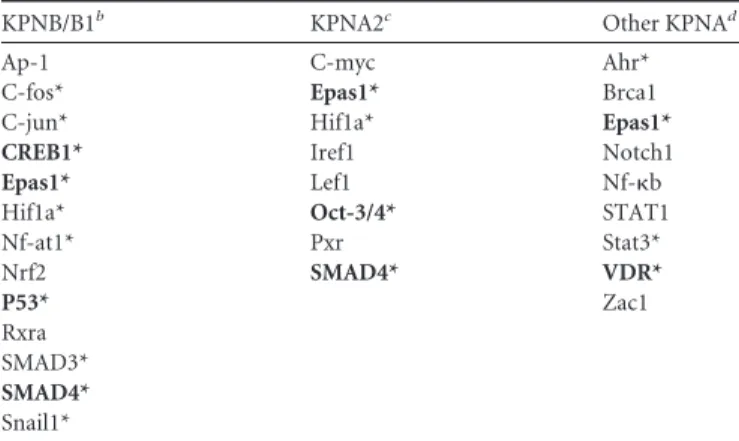
was particularly interesting, given that one of the ORF6 protein mechanisms of action is prevention of nuclear translocation of karyopherin-dependent cellular factors. Therefore, we focused on the genes in cluster C4 to identify potential downstream targets of karyopherins whose transcription is blocked in icSARS-CoV in-fection. In particular, we evaluated whether transcription factors whose transport is regulated by karyopherins were overconnected (transcription factors with a significant number of downstream target genes that were differentially expressed, in this case either up- or downregulated [P⬍0.05]) to downstream gene expression networks (or to downstream genes whose expression is regulated by the same transcription factor) by hypergeometric distribution within the C4 cluster. When the number of connections between target genes in the data set and upstream regulatory transcription factors are greater than would be expected by chance (based on the number of known connections), this indicates that these tran-scription factors are enriched and are important regulators of the host response by the ORF6 protein. All of the transcription factor hubs (schematically represented by large circles inFig. 3) associ-ated with gene cluster C4 that were identified as being regulassoci-ated by karyopherins in MetaCore are listed inTable 1. Six of these tran-scription factors (VDR, CREB1, Oct3/4, HIF␣2/Epas1, p53, and
FIG 2Differentially expressed (DE) genes in icSARS-CoV-infected versus icSARS-CoV⌬ORF6-infected Calu3 2B4 cells. (A) Heat map and table of gene ontology categories. The heat map represents unsupervised hierarchical clustering of the 6,947 differentially expressed genes (P⬍0.05; 2-fold change) between icSARS-CoV and icSARS-CoV⌬ORF6 infection of Calu3 2B4 cells, from 0 to 72 h postinfection. Values are the fold change (log2) compared to time-matched
mock infection or icSARS-CoV infection as indicated. Colored bars represent gene tree subclusters. On the right, functional enrichment of significant (P⬍0.05) biological process Gene Ontology categories for gene tree clusters C1 to C6. Genes within each cluster are indicated on the far right of the heat map. (B) Bar graph of differentially expressed genes (P⬍0.05,ⱍ1.5-fold changeⱍ[log2]) for time-matched comparisons in icSARS-CoV versus mock, icSARS-CoV⌬ORF6 versus
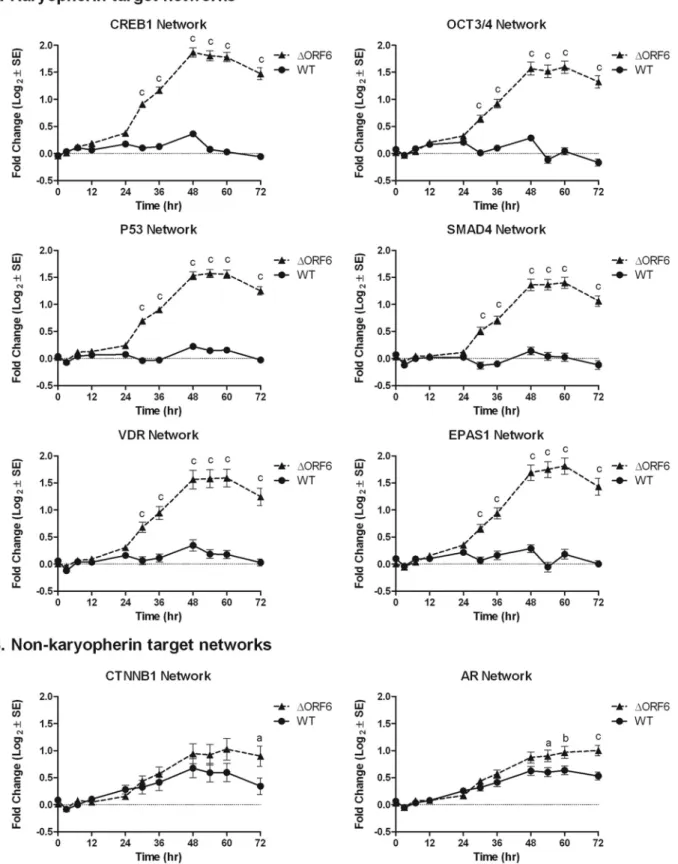
SMAD4) were significantly (P⬍0.05) overconnected to the data set (Table 1), indicating that there was differential signaling through these transcription factor hubs when comparing icSARS-CoV⌬ORF6 to icSARS-CoV. Over 350 gene nodes in the C4 clus-ter directly inclus-teract with these six transcription factors (Fig. 3), based on information in the Metacore knowledge base, suggesting their transcription is specifically blocked in the presence of func-tional ORF6 protein. As a summary of our network analysis, we graphed the fold change over mock for all of the genes regulated by each of the six transcription factors identified by our modeling approaches (Fig. 4A). In each graph, the differentially expressed networks in the icSARS-CoV ⌬ORF6-infected cells are signifi-cantly upregulated (7- to 22-fold increase over mock, which was significant from 48 to 60 h postinfection for all of the transcription factors) compared to steady levels in the icSARS-CoV-infected
cells, suggesting that the release of the ORF6 protein-mediated nuclear importation block does affect cellular transcription and is not limited to immune-responsive transcription factors. In con-trast, two transcription factors (beta-catenin and androgen recep-tor) that do not require karyopherin to translocate to the nucleus are shown inFig. 4Band demonstrate similar differential expres-sion patterns between icSARS-CoV⌬⌷RF6 and wild-type virus (only a 1.5-fold difference above mock, and the changes were sig-nificant only at 72 h postinfection for beta-catenin) through 60 h. The initial targeted approach that identified the six transcrip-tion factors was restricted to the subset of genes in cluster C4 (Fig. 2A), which were upregulated exclusively in icSARS-⌬ ORF6-in-fected cells. However, we wondered if additional karyopherin-regulated transcription factors were also present in networks gen-erated from the original 6,947 genes (in all 6 clusters) identified
(Fig. 2A), which would suggest that karyopherins import tran-scription factors that both positively and negatively regulate downstream target genes during the course of SARS-CoV infec-tion. To answer this question, we expanded our transcription fac-tor analysis to include all significant genes in the data set, resulting in 27 overconnected transcription factors whose nuclear impor-tation was mediated by karyopherins (Table 2). This analysis pro-vided a more global understanding of the potential impact of the nuclear importation block during SARS-CoV infection compared to the more targeted approach illustrated inFig. 3 and4. For example, STAT1 was identified as an important karyopherin-me-diated regulator of gene expression during infection. Our labora-tory and others have previously observed nuclear translocation of STAT1 in the absence of the ORF6 protein and the upregulation of common targets (i.e., cyclooxygenase 1 and 2/prostaglandin G/H synthase 1 and 2) in icSARS-⌬ORF6-infected but not in wild-type-infected cells (see Fig. S3A and B in the supplemental mate-rial) (17,58). For Calu3 2B4 cells, our data suggest that one of the functions of the ORF6 protein is to mediate complex hierarchical antagonism phenotypes of the nuclear import machinery, antag-onizing different cellular responses during virus infection.
Validation of transcription factor hubs in human primary airway epithelial cells.To independently confirm the transcrip-tion factors identified from network-based modeling analysis of the microarray data with Calu3 2B4 cells, similar modeling ap-proaches were performed to identify transcription factors from microarray data for icSARS-CoV- and icSARS-CoV⌬ ORF6-in-fected primary HAE cell cultures. Total RNA was harvested and analyzed by using an Agilent microarray from wild-type- and ic-SARS-CoV ⌬ORF6-infected HAE cultures at multiple times postinfection, and the data were compared to Calu3 2B4 tran-scriptomic data sets to determine if similar targets (genes down-stream of the transcription factors identified from just the Calu3 2B4 microarray data) could be identified in both primary and traditional cell isolates. We first examined the viral growth
kinet-ics in HAE cultures and determined that icSARS-CoV titers peaked at 48 h postinfection (Fig. 5A). In contrast, replication titers for icSARS-CoV⌬ORF6 increased over the entire 72-h time course (Fig. 5A). At a slightly reduced MOI (Calu3 2B4 cells at an MOI of 5 versus HAE at an MOI of 2), icSARS-CoV⌬ORF6 dem-onstrated slower growth kinetics until later in infection in primary cells, consistent with a role in early replication (Fig. 5A) and (59). Transcription factor analysis of the HAE data set resulted in 7 enriched transcription factor hubs regulated by karyopherins (P⬍0.05), including RelA, C-jun, CREB1, Hif1␣, C-fos, VDR, and SMAD3. Two of the enriched transcription factor hubs in HAE cultures, CREB1 and VDR, were also identified as important in the targeted Calu3 2B4 analysis of exclusively upregulated dif-ferentially expressed genes (cluster C4), whose transcription fac-tors enter the nucleus in a karyopherin-mediated process (Table 1; Fig. 3and4), while the other 4 transcription factors overlapped the hubs identified from the global Calu3 2B4 gene microarray data set (Table 2), independently confirming the overlap of target genes regulated by the VDR and CREB1 transcription factors be-tween HAE and Calu3 2B4 cells. A comparison of the CREB1 and VDR transcription factor networks, which were significantly en-riched in both HAE and Calu3 2B4 cells, is shown inFig. 5B(see also Fig. S4 in the supplemental material) and illustrates the genes that are either uniquely regulated by the overconnected transcrip-tion factor gene targets in each cell type or are genes that are common to both cell types. The mRNA expression levels (from the microarray data) for representative individual genes that were differentially expressed in both the HAE and Calu3 2B4 microar-ray data sets are graphed inFig. 5Cfor comparison, including the genes B cell translocation gene 2 (Btg2), forkhead box 03a (Foxo3a), hypermethylated in cancer 2 (Hic2), human p-throm-boglobulin gene (Ptg), thiamine transporter gene (Scl19a2), glu-cose transporter gene (Scl2a6), transforming growth factor3 (TGF3), and POK family transcription factor (Zbtb5). Tran-scription factor analysis in HAE cultures resulted in strong overlap with the transcription factor hubs identified in Calu3 2B4 cells and further supported the importance of karyopherin-mediated nu-clear importation during SARS-CoV infection.
Proteomic and ChIP-PCR validation of transcriptional hubs.To independently validate our transcriptomic results, we performed shotgun proteomics using the AMT tag approach and ChIP-PCR, with parallel sets of Calu3 2B4 cells infected with icSARS-CoV and icSARS-CoV ⌬ORF6. Following proteomic analysis, a total of 864 proteins were significantly (P⬍0.05) dif-ferentially expressed between icSARS-CoV- and icSARS-CoV ⌬ORF6-infected Calu3 2B4 cells across all time points. To most directly determine how the proteomics contributes to our under-standing of the role(s) for the ORF6 protein in karyopherin-me-diated nuclear translocation and host gene expression, we first integrated the transcriptomic and proteomic data sets. From the integrated data, we obtained a more comprehensive view of the changes mediated by the ORF6 protein in Calu3 2B4 cells at both the gene and protein levels, allowing us to determine whether karyopherin-mediated transcriptional hubs are further enriched (i.e., more significant) with the addition of the proteomic data. For example, if the proteomic data support a role for the ORF6 protein in karyopherin-mediated nuclear transport, then we would expect an increase in the enrichment scores (increased sig-nificance) of these hubs after addition of the proteomics; other-wise, the values would decrease. From a biological perspective, the
TABLE 1Transcription factor hubs associated with gene cluster C4a
KPNB/B1b KPNA2c Other KPNAd
Ap-1 C-myc Ahr*
C-fos* Epas1* Brca1
C-jun* Hif1a* Epas1*
CREB1* Iref1 Notch1
Epas1* Lef1 Nf-b
Hif1a* Oct-3/4* STAT1
Nf-at1* Pxr Stat3*
Nrf2 SMAD4* VDR*
P53* Zac1
Rxra SMAD3*
SMAD4*
Snail1*
a*, the transcription factor is overrepresented in the data set, based on the connectivity
ratio (actual/expected), calculated as the ratio of the actual number of connections to genes in the C4 cluster (seeFig. 2B) versus the number of connections expected using the Agilent platform. Bold highlighted transcription factors are significantly (P⬍0.05) overrepresented in the data set.
b
Karyopherin(importin1). cKaryopherin␣2 (importin␣1). d
FIG 4Differential gene expression quantitation for transcription factor networks. Average gene expression for icSARS-⌬ORF6 (dotted lines) and icSARS-CoV (solid lines) for target gene nodes (mRNA microarray values for genes regulated by transcription factors) are shown. For each network, a group of genes is regulated by a specific transcription factor. (A) Karyopherin target networks (VDR, CREB1, Oct3/4, p53, EpasI, and SMAD4) from cluster C4 (Fig. 2). (B) Representative nonkaryopherin target network. Values are the average fold change (log2)⫾the standard error compared to time-matched mock infection for 0
enrichment scores (Pvalues) represent how connected the tran-scription factors are to downstream targets (genes or proteins) in the data set compared to the number of targets expected by chance. If a transcriptional hub is significantly (P⬍0.05) more connected to the data set, this suggests that signaling through this hub is uniquely regulated, based on the experimental conditions: in this case, through deletion of ORF6. We can use the integrated gene and protein data to identify significant hubs whose down-stream targets may primarily be detected at the protein level and whose enrichment scores are greatly elevated by inclusion of the
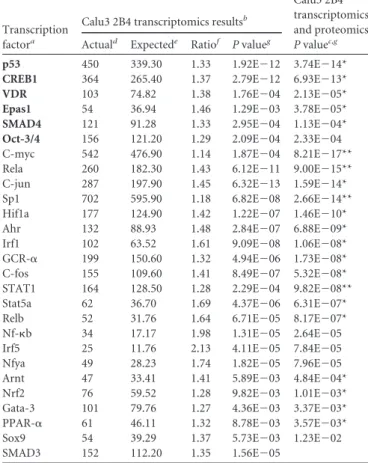
proteomics data. In our study, transcription factor analysis of the combined Calu3 2B4 proteomics and transcriptomics data re-sulted in an increase in enrichment scores, ranging from 1.5⫻ 1012- to 2⫻1012-fold, for 22 out of 27 of the transcription factor hubs requiring karyopherin for nuclear importation, including 5 out of the 6 transcription factor hubs uniquely upregulated during icSARS-CoV⌬ORF6 infection (Table 2). This suggests that many protein nodes in the proteomic data set share common upstream transcription factor regulators with gene nodes in the transcrip-tional data, including those that require karyopherin for nuclear import. For four transcription factor hubs in particular, C-myc, Rela, specificity protein 1 (Sp1), and STAT1, values from the com-bined transcriptomic/proteomic analysis were⬎1,000-fold more significant than for the transcriptomics alone, demonstrating the added value of including targets from both data types (Table 2). In support of the transcription factor analysis, expression levels of individual downstream targets were confirmed between Calu3 2B4 transcriptional and proteomics analyses. Enhancer of mRNA-decapping enzyme 3 (EDC3) and Golgi apparatus adapter-related complex of proteins mu 1 subunit (AP3M1), two target gene nodes predicted to be a part of CREB1 networks, were measured at both the transcript and protein levels (Fig. 6). Individual RNA expression values derived from microarray analysis demonstrated increased RNA expression trends in icSARS-CoV⌬ORF6 versus icSARS-CoV in both EDC3 and AP3M1 (Fig. 6AandC). Coordi-nately, protein abundance also increased at late times during ic-SARS-CoV⌬ORF6 infection; in contrast, icSARS-CoV infection protein levels failed to rise above mock infection values (Fig. 6B andD). When directly compared, both gene and protein analyses demonstrated augmentation of these gene nodes in icSARS-CoV ⌬ORF6 infection at late times compared to icSARS-CoV infec-tion. Together, these data confirm increased expression of tar-geted gene nodes downstream of identified transcriptional factors in icSARS-CoV⌬ORF6 infection, increases that are absent in ic-SARS-CoV infection.
Finally, to demonstrate that the transcription factors we iden-tified were actively engaged in transcription during icSARS-CoV ⌬ORF6 infection, we performed ChIP followed by real-time PCR (ChIP–RT-PCR) of target gene transcripts. Calu3 2B4 cells were infected with icSARS-CoV or icSARS-CoV⌬ORF6 or mock in-fected, protein and DNA were cross-linked, genomic DNA was sheared, and VDR- and CREB1-bound DNA promoter regions were precipitated with antisera directed against each of these tran-scription factors. Next, gene-specific primer pairs were used to amplify DNA regions of interest by real-time PCR. The results for transcription factor-specific antisera were compared to control IgG precipitations and time-matched mock-infected controls. We chose to amplify three representative downstream target genes: the matrix metalloproteinase 19 (MMP19) and cyclin-dependent kinase inhibitor 1A (CDKN1A) CREB1-regulated genes, as well as the myeloid leukemia cell differentiation gene (Mcl-1), a down-stream target of VDR.Figure 7shows the significant increase in the amount of chromatin precipitated relative to the fold enrich-ment in icSARS-CoV ⌬ORF6-infected samples for MMP19, CDKN1A, and Mcl-1 at both 24 and 48 h postinfection compared to wild-type icSARS-CoV. These results confirm that at least two transcription factors identified by modeling are significantly en-riched on the promoter elements of their target genes following icSARS-CoV⌬ORF6 infection, supporting the microarray data and validating our modeling approaches.
TABLE 2Significantly enriched transcription factor hubs regulated by karyopherins for differentially expressed genes of SARS-CoV versus SARS-⌬ORF6
Transcription factora
Calu3 2B4 transcriptomics resultsb
Calu3 2B4 transcriptomics and proteomics Pvaluec,g Actuald Expectede Ratiof Pvalueg
p53 450 339.30 1.33 1.92E⫺12 3.74E⫺14*
CREB1 364 265.40 1.37 2.79E⫺12 6.93E⫺13*
VDR 103 74.82 1.38 1.76E⫺04 2.13E⫺05*
Epas1 54 36.94 1.46 1.29E⫺03 3.78E⫺05*
SMAD4 121 91.28 1.33 2.95E⫺04 1.13E⫺04*
Oct-3/4 156 121.20 1.29 2.09E⫺04 2.33E⫺04
C-myc 542 476.90 1.14 1.87E⫺04 8.21E⫺17**
Rela 260 182.30 1.43 6.12E⫺11 9.00E⫺15**
C-jun 287 197.90 1.45 6.32E⫺13 1.59E⫺14*
Sp1 702 595.90 1.18 6.82E⫺08 2.66E⫺14**
Hif1a 177 124.90 1.42 1.22E⫺07 1.46E⫺10*
Ahr 132 88.93 1.48 2.84E⫺07 6.88E⫺09*
Irf1 102 63.52 1.61 9.09E⫺08 1.06E⫺08*
GCR-␣ 199 150.60 1.32 4.94E⫺06 1.73E⫺08*
C-fos 155 109.60 1.41 8.49E⫺07 5.32E⫺08*
STAT1 164 128.50 1.28 2.29E⫺04 9.82E⫺08**
Stat5a 62 36.70 1.69 4.37E⫺06 6.31E⫺07*
Relb 52 31.76 1.64 6.71E⫺05 8.17E⫺07*
Nf-b 34 17.17 1.98 1.31E⫺05 2.64E⫺05
Irf5 25 11.76 2.13 4.11E⫺05 7.84E⫺05
Nfya 49 28.23 1.74 1.82E⫺05 7.96E⫺05
Arnt 47 33.41 1.41 5.89E⫺03 4.84E⫺04*
Nrf2 76 59.52 1.28 9.82E⫺03 1.01E⫺03*
Gata-3 101 79.76 1.27 4.36E⫺03 3.37E⫺03*
PPAR-␣ 61 46.11 1.32 8.78E⫺03 3.57E⫺03*
Sox9 54 39.29 1.37 5.73E⫺03 1.23E⫺02
SMAD3 152 112.20 1.35 1.56E⫺05
a
Transcription factor hubs regulated by karyopherins and identified as significantly overconnected to data set (P⬍0.05; 5% FDR). Bold highlighted transcription factor hubs are significant for cluster C4 (seeFig. 2B) and are listed at the top. Otherwise, transcription factors were ranked based on thePvalue for transcriptomics and proteomics.
bValues for differentially expressed genes in the SARS-CoV versus SARS-⌬ORF6 Calu3 2B4 transcriptomics data set (6,947 genes), using the Agilent platform data as background.
c
Values for differentially expressed genes and proteins in CoV versus
SARS-⌬ORF6 Calu3 2B4 transcriptomics and proteomics data sets combined (6,947 genes, 871 proteins). *,Pvalues were more significant than for transcriptomics alone; **,P
values were⬎1,000-fold greater than for transcriptomics alone. d
Number of genes in the experimental data set that interacted with the transcription factor.
e
Number of genes in the experimental data set predicted to interact with the transcription factor based on the total number of interactions on the Agilent platform and calculated as the mean value for the hypergeometric distribution.
fConnectivity ratio (actual/expected).
g
icSARS-CoV⌬ORF6 is attenuated at low MOIs andin vivo. Airway epithelial cells are major targets for SARS-CoV infection in humans and in mice (36,60–62). Functional characterization of the gene sets differentially induced following icSARS-CoV⌬ORF6 and icSARS-CoV infection in either traditional human lung cell monolayers or primary HAE cultures revealed significant induc-tion of a number of key antiviral response genes (Fig. 8A) that may
play critical roles in the host response or in promoting efficient virus replication. These data are consistent with the possibility that icSARS-CoV⌬ORF6 might be less capable of maintaining efficient viral replication under more natural conditions (i.e., at a lower MOI)in vitro. For example, low numbers of virus-infected cells early in infection would afford robust antiviral host gene expression and paracrine signaling, potentially limiting secondary
FIG 5HAE independent confirmation studies. HAE cells were infected with wild-type or SARS-CoV⌬ORF6 (MOI of 2) and harvested at 24, 48, and 72 h postinfection for microarray analysis. (A) Apical wash samples were collected in triplicate at the indicated times and assessed by plaque assay in Vero E6 cells. Data are the average titers obtained at each time point (3 samples per time point) and were plotted as PFU/ml. icSARS-CoV titers (white bars) increased through 48 h postinfection and then decreased slightly at 72 h postinfection. In contrast, replication titers for icSARS-CoV⌬ORF6 titers (gray bars) increased over the entire course of the infection. At a slightly reduced MOI (Calu3 2B4 cell MOI of 5, versus HAE MOI of 2), icSARS-CoV⌬ORF6 demonstrated slower growth kinetics until later in infection in primary cells. (B) Karyopherin-mediated VDR and CREB1 transcription factor networks were significantly (P⬍0.05) enriched for both Calu3 2B4 and HAE data sets. Light gray circles, gene nodes from the Calu3 2B4 experiment; dark gray circles, gene nodes from the HAE experiment; black circles, gene nodes that overlapped in the two experiments. (C) Comparison of gene expression in Calu3 2B4 cells (closed circles) and HAE cells (open squares) postinfection for target gene nodes downstream, VDR and CREB1. Values are the fold change (log2) for icSARS-⌬ORF6 versus icSARS-CoV. Calu3 2B4 cell
rounds of viral replication. To test this hypothesisin vitro, we infected Calu3 2B4 cells at a low MOI (MOI of 0.01) with icSARS-CoV or icSARS-icSARS-CoV⌬ORF6 and assessed viral titers by plaque assays in Vero E6 cells. Peak titers for wild-type virus were de-tected at 72 h postinfection (⬃107PFU/ml), while in contrast, peak titers for icSARS-CoV⌬ORF6 (⬃106PFU/ml) were detected
at 96 h postinfection and titers were reduced by 1 to 2 logs at all time points examined (Fig. 8B). These data are in contrast to pre-viously published reports (9,59) in which titers in Vero E6 cells were compared, and the differences can likely be attributed to the intact innate immune and other antiviral signaling pathways pres-ent in the human conducting airway Calu3 2B4 cell line. Subse-quent studies using another recombinant SARS-CoV that does not express the ORF6 protein have also demonstrated that at a low MOI (MOI of 0.01) in nonhuman primate kidney cells, 2- to 5-fold reductions in viral titers were detected between 6 and 24 h postinfection (77).
To test the hypothesis that the release of the nuclear importa-tion block mediated by the ORF6 protein might attenuate patho-genesis, 20-week-old B6 mice (n⫽5 mice/time point) were in-fected with 105 PFU of icSARS-CoV mouse-adapted virus or icSARS-CoV⌬ORF6 mouse-adapted virus. Weight loss was mea-sured each day, and lungs were harvested to assess viral titers at days 1, 2, 4, and 7 postinfection. Mice infected with icSARS-CoV mouse-adapted virus steadily lost weight over the 7 days of infec-tion, while in contrast, mice infected with icSARS-CoV⌬ORF6 mouse-adapted virus lost weight through 4 days postinfection and
then began to recover and gain weight (Fig. 8C). Weight loss in animals infected with icSARS-CoV⌬ORF6 mouse-adapted virus was significantly different than in mice infected with icSARS-CoV mouse-adapted virus at days 2 to 7 postinfection (P⬍0.01 by Student’s t test). Mock-infected mice lost no weight over the course of the infection. Lung titers for both viruses were deter-mined by plaque assay, and no significant differences were measured at days 1, 2, or 7 postinfection. However, at 4 days postinfection, titers in the mouse-adapted icSARS-CoV⌬ ORF6-infected mice were significantly higher than mouse-adapted icSARS-CoV-infected mice, despite their weight gain, suggesting that viral growth kinetics were uncoupled from pathogenic out-come (Fig. 8D) following the removal of ORF6 protein expression. Future studies will examine the transcriptional and proteomic profiles of the infected mouse lungs, including those of targeted knockout mice, but these studies are beyond the scope of the cur-rent work.
DISCUSSION
Viral antagonism of host cellular processes is well recognized as a major mechanism for regulating viral pathogenesis and virulence. SARS-CoV encodes several interferon antagonists that delay host cell recognition of infection, innate immune sensing, and signal-ing pathways, as well as interferon-stimulated gene expression; one antagonist, ORF6 protein, does so by blocking nuclear im-port. Many other highly pathogenic RNA viruses encode proteins that specifically antagonize nuclear import to prevent host innate
FIG 6Proteomic validation studies. The graphs show comparisons of individual gene RNA expression (left panels) and protein abundance (right panels) as determined by microarray and global proteomics analysis for EDC3 and AP2M1. Values for transcripts reflect the log2-fold change in expression over mock
immune and other critical cellular macromolecular processes to enhance virus replication and transmission between hosts. For example, Ebola virus VP24 binds karyopherin ␣1 and blocks STAT1 nuclear import (10). The Nipah virus W protein is local-ized to the nucleus, where it inhibits both virus- and Toll-like receptor 3-triggered signaling in the infected cell by preventing the phosphorylation and activation of STAT1 and subsequent down-stream interferon-stimulated gene induction (11). Some cardio-virus L proteins interact directly with Ran-GTPases, which are required for the export of new nuclear mRNA (12). In these sys-tems, observations were conducted using candidate gene markers,
limiting full recognition of the impact of viral antagonism gene function on nuclear translocation during infection. To redress this limitation, we used systems biology approaches that integrated transcriptomic and proteomic data sets in primary and traditional human lung epithelial cells to identify the impact of the ORF6 protein on host macromolecular processes. An advantage of the SARS-CoV ORF6 protein model is that recombinant viruses lack-ing ORF6 expression are viable and replicate efficientlyin vitro andin vivo(9,59). Our data support the hypothesis that antago-nists of nuclear translocation differentially target host signaling pathways, perhaps in a tissue- and cell-specific manner, to prevent antiviral defenses and other subcellular responses that may limit virus replication. The data reported herein suggest that other viral nuclear import antagonists likely antagonize multiple host tran-scription factors and cellular processes to allow efficient virus rep-lication, transmission, and spread. Although speculative, these an-tagonists likely block paracrine signaling of cytoplasmic cargo (e.g., cytokines, steroids, hormones), blocking cellular antiviral responses during virus infection.
Viral antagonists that target nuclear translocation provide a novel model system to study the regulated inhibition of host re-sponse networks in the context of virus infection. One of the cur-rent ORF6 protein functional paradigms is that it blocks nuclear import by binding karyopherin␣2 on internal membranes, se-questering karyopherin1 and preventing karyopherin-regulated nuclear import of key antiviral transcription factors, like STAT1. However, STAT1 typically uses karyopherin␣1 and1 for im-port, suggesting that the primary targets for the ORF6 protein may actually be other key host response transcription factors and ex-pression networks during infection. Given the unique biochemi-cal targeting of the ORF6 protein and the fact that SARS-CoV also encodes other proteins that antagonize innate immune signaling (63,64), it is not surprising that STAT1 was not positioned more prominently as one of the key transcription factors targeted by ORF6 protein antagonism of nuclear import in either Calu3 2B4 and HAE cultures. The global genomics-based technologies used in this study provide an alternative approach to evaluate the role of specific viral genes on host transcription and proteomic regula-tory networks during infection. We recognize that karyopherin and cargo concentrations are heavily cell type dependent, and thus the ORF6 protein’s effect on nuclear import in other permissive cell types might result in dramatically different hierarchical activ-ities, leading to variations in host gene expression networks and/or the activation of alternate transcription factors (17,31,65, 66). Although our initial studies focused on a recombinant virus that lacked the entire ORF6 gene, future studies using recombi-nant viruses lacking either the N- or C-terminal portion of the ORF6 protein in early virus replication and nuclear import may provide further resolution to the precise domains in the ORF6 protein that mediate these phenotypes.
In support of earlier reports (9,17,59), deletion of ORF6 had minimal effects on the efficiency of virus replication in Calu3 2B4 and HAE cultures; however, these growth comparisons were per-formed at a high MOI, which is often a less powerful barometer of virus growth than studies with a low MOI in culture. The Calu3 2B4 and HAE culture systems represent continuous and primary models of the human airway epithelium, a major target for early SARS-CoV infection and replicationin vivoin many species (36, 59,67). Thus, host response outcomes in these cells likely modelin vivoresponses that inform downstream innate and adaptive
mune responses during infection. At lower MOIs, more subtle effects of the ORF6 protein have been reported on virus replica-tion rates, especially early, but not late, in infecreplica-tion (59,68). While our data in HAE and Calu3 2B4 cultures support these earlier findings, we designed the current experiment to include a high MOI to reduce the impact of paracrine signaling between infected and uninfected cells, allowing us to specifically focus on host
re-sponses during infection. Importantly, in the presence or absence of the ORF6 protein, similar RNA expression kinetics and levels of virus replication were noted in both Calu3 2B4 cells and HAE cultures; thus, the virus effects on differential gene expression likely reflected the targeted activities of the ORF6 protein directly on virus-host regulated interactions, like nuclear translocation. However, there were dramatic differences in the levels and rates of
FIG 8icSARS-CoV⌬ORF6 is attenuated at low MOIs and in B6 mice. (A) Gene expression for antiviral pathways. Hierarchical clustering by Euclidean distance of genes from two enriched biological process GO categories fromFig. 2B(cluster C6), the “defense response” (GO:0006952) and “response to virus” (GO: 0009615). A total of 71 out of 96 genes in these pathways were significantly upregulated in icSARS-CoV⌬ORF6 compared to icSARS-CoV between 0 and 72 h postinfection in Calu3 2B4 cells and are presented in the heat map. Values are the fold change (log2) in icSARS-CoV⌬ORF6 versus icSARS-CoV at each time
point. Red, green, and black represent upregulated, downregulated, and unchanged genes, respectively. (B) Low-MOI Calu3 2B4 cell infection. Calu3 2B4 human lung cells were infected with either icSARS-CoV or icSARS-CoV⌬ORF6 (MOI of 0.01). Medium from each well was collected and analyzed by plaque assay for viral growth kinetics in Vero E6 cells. Data are the average titer obtained at each time point (3 samples per time point) and were plotted as PFU/ml. Peak titers for icSARS-CoV were detected at 72 h postinfection, while titers for icSARS-CoV⌬ORF6 peaked at 96 h postinfection, suggesting that the mutant was attenuated at a low MOI over the course of the infection. Closed circles and unbroken line, icSARS-CoV; closed triangles and dashed line, icSARS-CoV⌬ORF6. (C and D) Weight loss (C) and titer data (D) for 20-week-old B6 mice (n⫽5) infected intranasally with 105PFU of virus. Weight loss was assessed each day postinfection
differential gene expression detected between the two viruses de-spite similar replication kinetics. icSARS-CoV differential gene expression was detectable as early as 24 h postinfection and was higher than the levels detected for icSARS-CoV⌬ORF6 through 36 h postinfection. At 48 h postinfection, a drastic change oc-curred with the number of differentially expressed genes still in-creasing for icSARS-CoV, but the number of genes detected for icSARS-CoV⌬ORF6 jumped to twice the level of the wild type (Fig. 2B,⌬ORF6 36 h 1600 versus 48 h 4750), a trend which con-tinued through 72 h postinfection. These data tracked with levels of detectable ORF6 protein expression (Fig. 1D) and suggest that the changes mediated by the ORF6 protein during infection can likely be uncoupled from replication kinetics but still modulate pathogenesis, as seen with the weight loss recovery in the mouse model (Fig. 8CandD).
Several of the identified transcription factors play critical roles in lung cancer but can also mediate many acute and chronic lung disease phenotypes. During normal lung development, CREB1 plays an important role in the differentiation of the mucin- or mucus-producing cells (69). In contrast, studies have also dem-onstrated that CREB1 and its associated pathways contribute to pathological lung disease progression via inflammatory response-mediated lung remodeling postinfection/post-lung injury (70, 71). VDR transcription factor levels are reduced in patients with chronic obstructive pulmonary disease (COPD), and vitamin D has been shown to be important in the onset of COPD (72,73). In VDR knockout mice, increased lung inflammation and emphy-sema were noted, suggesting an important role for VDR signaling in normal lung function and lung disease prevention or exacerba-tion (74). The transcription factor EpasI/HIF␣2 is critical for re-sponding to reduced oxygen levels in the intracellular environ-ment (75). EpasI/HIF␣2 is part of the hypoxia response and was one of the genes detected in the microarray analysis of wild-type SARS-CoV-infected nonhuman primates, whereas in the presence of the ORF6 protein its expression was downregulated (76,77). The SMAD family of transcription factors are potent inducers of TGF-, which can activate apoptosis signaling pathways during influenza virus infection (78). SMAD proteins as well as p53 have also been implicated as being underexpressed in a wide variety of cancers, including lung carcinomas (23,79). Many viruses have designed strategies to counter p53 signaling (80–83). Importantly, p53 expression enhances innate immunity by enhancing IFN-de-pendent antiviral activity via IRF-9 activation, indeIFN-de-pendent of its functions as a proapoptotic and tumor suppressor gene (80). In some cell lines, influenza virus infection can increase p53 expres-sion, where it is essential for the induction of cell death pheno-types, and loss of p53 expression enhances virus growth (81). SARS-CoV targets and infects Oct 4-expressing pluripotent lung stem cells, which differentiate into type 1 and type 2 pneumocytes, and is essential for repair and function of the alveoli (84). Lung stem cells are reported targets for SARS-CoV infection, and so blocking Oct 4 expression may well slow the rate of recovery from lung injury by preventing differentiation of stem cells that are essential for normal lung function and wound repair (85). All of the transcription factor hubs identified by modeling of systems biological approaches play critical roles in the regulation and maintenance of lung cell homeostasis and would not have been collectively identified in more-targeted studies.
Enrichment of karyopherin-mediated transcription factors in icSARS-CoV⌬ORF6 infection compared to infection with the
wild type was independently confirmed and validated from anal-ysis of different data sets, including proteomics and ChIP-PCR data from infected Calu3 2B4 cells and microarray data from in-fected HAE cultures. It is reassuring that bioinformatic ap-proaches independently validated earlier biochemical studies, demonstrating targeted antagonism of nuclear import by using a candidate gene approach. ChIP-PCR analysis demonstrated that some transcription factors identified by modeling approaches were actively bound to the promoters of specific downstream tar-get genes (identified by microarray analysis), lending further cre-dence to the modeling analysis (55,86). The strength of the cur-rent approach is that global integration of data in the context of biological pathways or functional processes, such as transcrip-tional factor regulation, provide a complementary interpretation of genomic and proteomic results that is necessary for systems-level comparisons (87). Direct comparison or integration of het-erogeneous data sets is complicated by inherent differences among cell types, platforms, and technologies. However, the iden-tification of common regulatory components that induce gene or protein signatures across model platforms can provide important information about underlying biological processes during infec-tion (88). The overlap in regulatory events across systems, includ-ing comparison of infection of traditional cell lines to infection of primary human cells, can be considered independent confirma-tion of the mechanism of acconfirma-tion for the ORF6 protein during SARS-CoV infection. In this study, a range of approaches were applied to provide a comprehensive view of karyopherin-depen-dent nuclear importation mediated by the ORF6 protein during SARS-CoV infection, and these approaches were not only vali-dated across systems but also could be interpreted within the con-text ofin vitroandin vivoviral endpoints.
Removal of the ORF6 protein-mediated nuclear importation block attenuated SARS-CoV pathogenesis in a 20-week-old B6 mouse model. There was no difference in viral growth kinetics between icSARS-CoV and icSARS-⌬ORF6 in human lung cells (Calu3 2B4) at high MOIs, and in the 20-week-old mouse model replication patterns were similar between the two viruses, with significant titer differences at only a single time point. However, despite similar virus loads in the lung, weight loss was significantly reduced in mice infected with icSARS-CoV ⌬ORF6 adapted virus compared to those infected with wild-type mouse-adapted virus, suggesting that viral titers do not necessarily corre-late with disease outcomes. Similar findings have been noted with recombinant SARS-CoV bearing zoonotic Spike glycoproteins, like HC/SZ/61/03 (77,89). The category of genes most affected by release of ORF6 protein nuclear importation blockin vitro -regu-lated overall gene expression, cellular rearrangement for division, and factors required for differentiation, suggesting that the intra-cellular environment may play a substantial role in determining levels of viral pathogenesis and controlling the intracellular anti-viral state.