What Do We Know About the Association Between Firearm Legislation and
Firearm-Related Injuries?
Julian Santaella-Tenorio*, Magdalena Cerdá, Andrés Villaveces, and Sandro Galea
*Correspondence to Dr. Julian Santaella-Tenorio, Department of Epidemiology, Mailman School of Public Health, Columbia University,
722 West 168th Street, Room 515, New York, NY 10032 (e-mail: [email protected]).
Accepted for publication September 4, 2015.
Firearms account for a substantial proportion of external causes of death, injury, and disability across the world. Legislation to regulate firearms has often been passed with the intent of reducing problems related to their use. However, lack of clarity around which interventions are effective remains a major challenge for policy development. Aiming to meet this challenge, we systematically reviewed studies exploring the associations between firearm-related laws and firearm homicides, suicides, and unintentional injuries/deaths. We restricted our search to studies published from 1950 to 2014. Evidence from 130 studies in 10 countries suggests that in certain nations the simul-taneous implementation of laws targeting multiple firearms restrictions is associated with reductions in firearm deaths. Laws restricting the purchase of (e.g., background checks) and access to (e.g., safer storage) firearms are also associated with lower rates of intimate partner homicides and firearm unintentional deaths in children, re-spectively. Limitations of studies include challenges inherent to their ecological design, their execution, and the lack of robustness of findings to model specifications. High quality research on the association between the implemen-tation or repeal of firearm legislation (rather than the evaluation of existing laws) and firearm injuries would lead to a better understanding of what interventions are likely to work given local contexts. This information is key to move this field forward and for the development of effective policies that may counteract the burden that firearm injuries pose on populations.
death; firearms; homicide; legislation; suicide; weapons; wounds and injuries
Abbreviations: NCHS, National Center for Health Statistics; NFA, National Firearms Agreement; UCR, Uniform Crime Reports.
INTRODUCTION
Firearms account for a substantial number of external causes of death across the world. In 2000, for example, it has been estimated that globally between 196,000 and 229,000 persons died from nonconflictfirearm-related injuries (1). Global estimates from 2010 indicate that the rates offirearm homicides and unintentionalfirearm injuries for this year were 2.5 and 0.7 per 100,000, respectively (2). Although less clear estimates for globalfirearm suicide rates are available, among high-income countries, the United States has one of the highest rates (5.8 per 100,000) (3). In the United States, 31,672 persons died from firearm injuries in 2010, at an age-adjusted rate of 10.1 per 100,000, and this has remained relatively unchanged since 2000 (4,5).
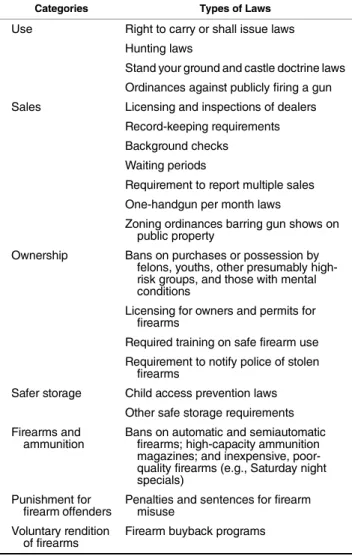
Governments around the world have adopted a range of ap-proaches to regulate the access and use offirearms in the gen-eral population, aiming to reducefirearm-related crime and
mortality rates (Table1). The variety of laws is matched by the diversity of ways in which laws are implemented, the het-erogeneity in law enforcement efforts, and the severity of penalties associated with legal violations.
This heterogeneity in approaches and implementation methods makes it critical to identify approaches that are less likely to be effective and to identify which strategies, looking forward, may be more likely to work (5–8). In addi-tion, examining the associations between specific policies andfirearm-related deaths across countries can improve our understanding about which types of laws are more likely to be successful in reducingfirearm mortality rates in similar contexts or within diverse legal frameworks. This review aimed to examine the association between firearm-related laws and the rate of firearm-related suicides, homicides, and unintentional injuries and deaths worldwide. Previous literature reviews assessing this issue (6–11) have focused mainly on US studies.
February 10, 2016
We conducted a systematic literature review of empirical studies directly assessing the association betweenfi rearm-related laws at the local, regional, and national levels and the rate offirearm-related homicides, suicides, and uninten-tional injuries/deaths. We definedfirearm-related laws as any law on regulations or restrictions on the use, sale, ownership, storage offirearms, those banning specific types offirearms or ammunition, those modifying the penalties and sentences forfirearm misuse, and those promoting voluntary rendition offirearms through buyback programs.
METHODS
We reviewed peer-reviewed and non-peer-reviewed pub-lished studies between 1950 and 2014. Given the fact that laws are enacted and implemented in social contexts and are not controlled by researchers as in an experimental study, evidence of the consequences of these laws is likely to be gen-erated from observational ecological cross-sectional or longi-tudinal studies. Although these studies have limitations related to confounding, the uncertainty of a temporal sequence, and
variation in the laws and enforcement across units of observa-tion, they provide an alternative when it is not feasible to con-duct randomized controlled trials for policy interventions. Therefore, our inclusion criteria included observational eco-logical studies examining the association betweenfi rearm-related laws and firearm-related suicides, homicides, and unintentional injuries/deaths at the national or local level. No randomized trials were available on this topic.
We searched the PubMed, Scopus, and Web of Knowledge databases to capture evidence from cross-sectional and longi-tudinal studies in diversefields including the social, medical, political, and criminology sciences. We also searched for studies cited in previous literature reviews and books on this topic, as well as studies cited in the reference lists of the original articles identified through our search.
The search was conducted in the English language but cov-ered studies in other languages (e.g., French, Spanish, or Portuguese) if abstracts were available in English so they could be detected in our search or if studies were cited in reviewed studies. We used keywords/Medical Subject Headings terms for the searches that included a combination of the following: 1)firearm terms (firearms, weapons, gun, handgun); 2) gun-control law terms (law enforcement, storage, trafficking, safety, carry, permit, ban, legislation, regulation, control, formal, back-ground check, child safety locks, childproof handguns); and 3) health outcome terms (impact, assessment, trends, mortality, wounds, injuries, suicide, homicide). We also searched citations in primary studies and literature reviews on the topic.
We excluded studies that did not assess the association be-tweenfirearm-related laws and homicides, suicides, or unin-tentional injuries/deaths; studies in whichfirearm deaths were reported as part of a combined outcome but specific results forfirearm death rates were not reported; longitudinal studies reporting only average rate comparisons in pre/post law peri-ods; or those reporting descriptive changes in rates but not using any statistical method to compare rates.
A total of 5,039 studies were retrieved by using the Med-ical Subject Headings/keywords terms in selected search en-gines: PubMed (n= 1,120), Scopus (n= 2,197), and Web of Science (n= 1,722). After exclusion of duplicates and those not meeting the inclusion or exclusion criteria after title screening (n= 2,861) and after reading the abstract or text (n= 852), a total of 90 primary studies were identified. In ad-dition, we identified 40 articles cited in selected studies or in reviews that met our inclusion or exclusion criteria for a total of 130 primary studies. A description of the number of stud-ies that were included or excluded in our study is presented in Figure1.
Design suitability and quality of execution of studies were assessed following criteria from the Guide to Community Preventive Services(12,13). Although there are other instru-ments, such as the environmental health perspectives tool or the Cochrane risk of bias assessment tool, we used the criteria from thisGuidegiven its applicability to the evaluation of eco-logical studies and because it has been used to examine studies on the effectiveness offirearm laws (9). In this review, assess-ments of studies were conducted by one of the coauthors. Lon-gitudinal prospective or retrospective cohort studies with a concurrent comparison group and multiple pre/post interven-tion measurements were classified as having“greatest”design
Table 1. Categorization of Firearm-Related Lawsa
Categories Types of Laws
Use Right to carry or shall issue laws
Hunting laws
Stand your ground and castle doctrine laws
Ordinances against publicly firing a gun
Sales Licensing and inspections of dealers
Record-keeping requirements
Background checks
Waiting periods
Requirement to report multiple sales
One-handgun per month laws
Zoning ordinances barring gun shows on public property
Ownership Bans on purchases or possession by
felons, youths, other presumably high-risk groups, and those with mental conditions
Licensing for owners and permits for firearms
Required training on safe firearm use
Requirement to notify police of stolen firearms
Safer storage Child access prevention laws
Other safe storage requirements
Firearms and ammunition
Bans on automatic and semiautomatic firearms; high-capacity ammunition magazines; and inexpensive, poor-quality firearms (e.g., Saturday night specials)
Punishment for firearm offenders
Penalties and sentences for firearm misuse
Voluntary rendition of firearms
Firearm buyback programs
a
Adapted from Cook and Goss (146).
suitability; longitudinal studies without a concurrent com-parison group but with multiple pre/post intervention mea-surements were classified as“moderate”; and cross-sectional studies or longitudinal studies without a concurrent comparison group and with only single pre/post intervention measurements or with only postintervention measurements were classified as
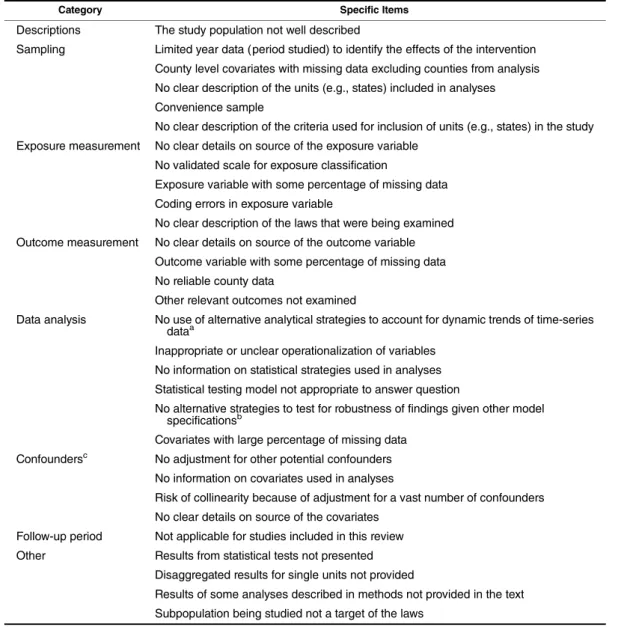
“least”design suitability (Web Table 1 available athttp://aje. oxfordjournals.org/). Potential limitations that could threaten the internal validity of studies are also presented in Web Table 1 (a description of limitations is provided in Table2).
The reporting and description offindings from included studies adhere to the Preferred Reporting Items for Sys-tematic Reviews and Meta-Analyses (PRISMA) statement guidelines (14).
FINDINGS
Results are presented and described according to catego-ries offirearm laws (Table1) and then according to specific
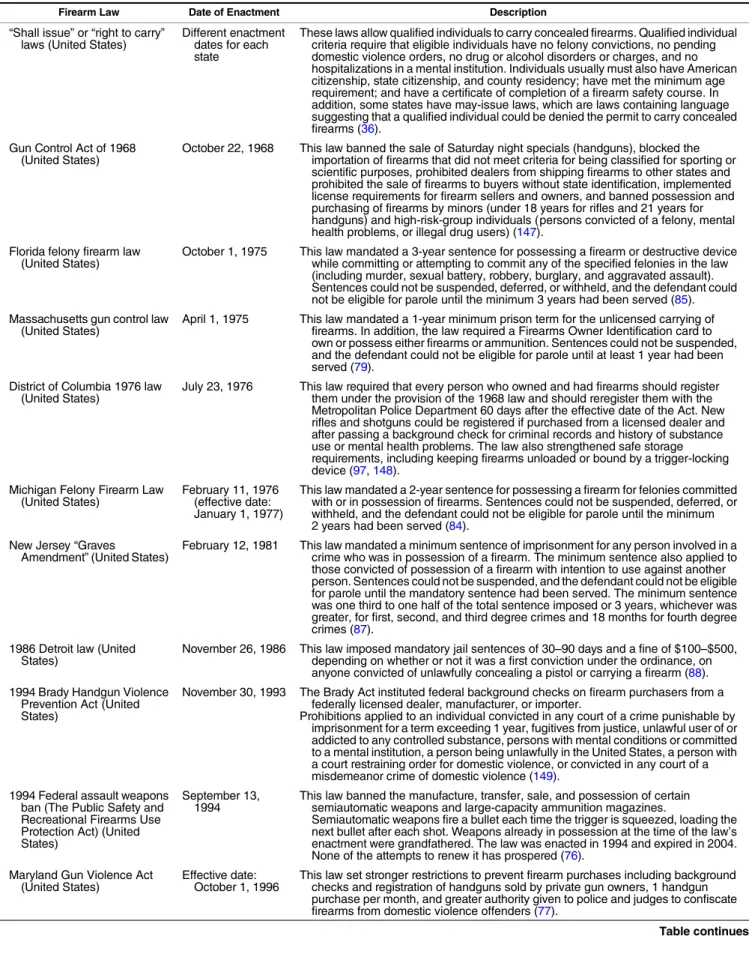
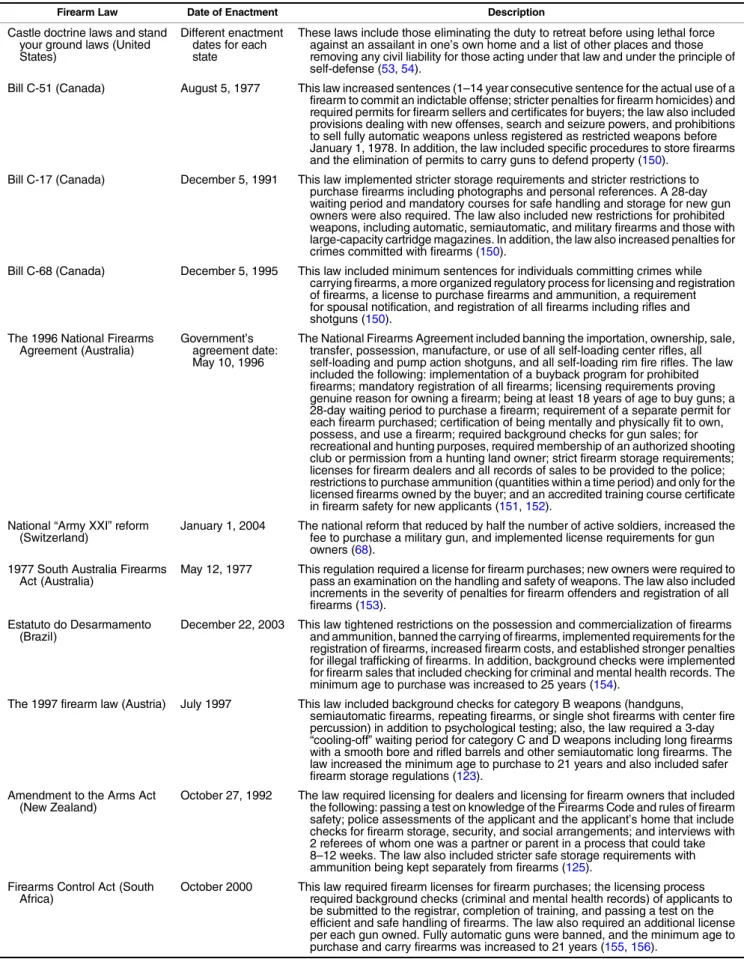
types of laws within these categories. A summary of different laws evaluated by studies in this review is provided in Table3. A description of studies reviewed here, including data, study design ratings, results, and potential limitations, is summarized in the Web Table 1. Most studies used a cross-sectional time-series design to compare rates and rate trends between pre/post-law periods. The majority of studies conducted in the United States compared states with and without laws over time while controlling for potential confounders. In addition, US cross-sectional studies frequently used an index of strictness offi re-arm laws to examine the association between laws andfirearm deaths (Web Table 1). Most international studies assessed the association between combinations of laws being simulta-neously implemented and different outcomes using pre/post-law period comparisons at the national level without a control group. Of all studies, 47.69%fit the“greatest,”20%fit the
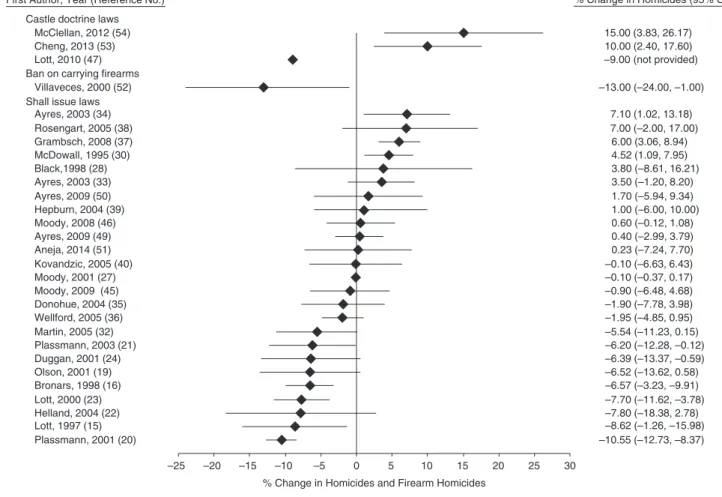
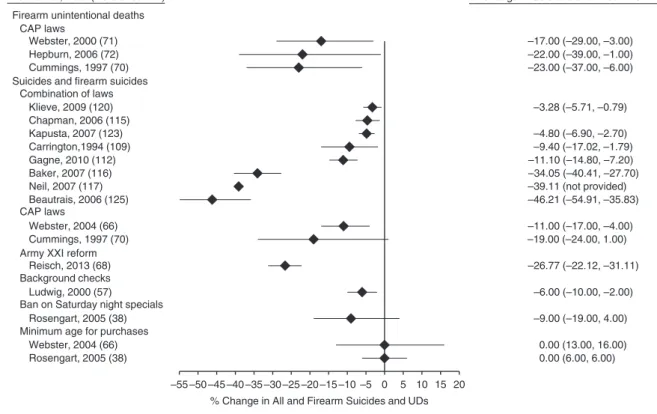
“moderate,”and 32.31%fit the“least”design criteria. We also provide a summary of results from some studies in Figures2–4. Results are grouped according to the laws being examined across studies and the different outcomes. A sum-mary of results for the association between laws restricting firearm use and homicides is shown in Figure2. The results for the association between all other laws and homicides and suicides/unintentional deaths are shown in Figures3and4, respectively.
Laws targeting firearms use
Licenses to carry concealed firearms or“shall issue”laws. These laws allow qualified individuals to carry concealed firearms (Table3). In the United States, Lott and Mustard (15) using a times-series design approach and data from the Federal Bureau of Investigation’s Uniform Crime Reports (UCR) (1977–1992) identified that shall issue laws were as-sociated with lower rates of homicides at the county and state levels. Bronars and Lott (16) also noted evidence that shall issue laws were associated with an apparent increase in the rate of homicides in adjacent counties without shall issue laws (16). Seven other studies (17–23) supported Lott and Mustard’sfindings. However, others found inconsistent re-sults when using different modeling strategies (24–31) and suggested the presence of errors in the data used in this study (32). Ayres and Donohue (33–35) used Lott and Mustard’s data and found, after recoding the data and varying model specifications, that shall issue laws were not associated with reductions in homicide rates. Particularly, they demon-strated that using county data introduced severe bias and that results were not robust to model specifications (such as in-cluding more year data or weighting strategies). Wellford et al. (36) from the National Research Council reached simi-lar conclusions. In addition, Grambsch (37) found that con-trolling for regression to the mean diluted the association between shall issue laws and homicides. Using additional data from the National Center for Health Statistics (NCHS), Rosengart et al. (38) and Hepburn et al. (39) showed no asso-ciation between these laws and overall andfirearm homicides. Studies comparing cities with a population of 100,000 or more (40) and others using samples of large cities in the United States (41,42) found similarfindings. Another study (43) looking at injury data from southern Arizona found higher Records Identified Through Database Searching:
PubMed (n=1,120) Scopus (n=2,197) Web of Science (n=1,722)
Exclusions Because of Duplicates (n=1,240)
Primary Studies on the Association Between
Firearm Laws and Homicides, Suicides, or
Unintentional Injury Deaths (n=90)
Studies Identified in Citations of Primary Studies, Meta-Analyses, and Literature Reviews
(n=40)
Total No. of Primary Studies Included in Study
(n=130)
Excluded After Screening for Title (n=2,861) No. of Records Screened
(n=3,799)
Excluded After Reading the Abstract and Text
(n=852) No. of Abstracts or
Full-Text Articles Assessed for Eligibility (n=938)
Figure 1. Process of selecting studies examining the effects of firearm-related laws with firearm homicides, suicides, and uninten-tional deaths.
proportions offirearm injuries/deaths associated with shall issue laws.
In recent years, studies by Strnad (44) using a Bayesian ap-proach and by Moody and Marvell (45,46), Lott (47), and
Gius (48) showed that shall issue laws were associated with re-ductions in homicide rates (extending data to 2000). Ayres and Donohue (49,50) responded to the studies by Moody and Marvell (45,46) showing the inconsistency of results when
Table 2. Potential Limitations in the Execution of Studies That Could Threaten Their Internal Validity
Category Specific Items
Descriptions The study population not well described
Sampling Limited year data (period studied) to identify the effects of the intervention
County level covariates with missing data excluding counties from analysis
No clear description of the units (e.g., states) included in analyses
Convenience sample
No clear description of the criteria used for inclusion of units (e.g., states) in the study
Exposure measurement No clear details on source of the exposure variable
No validated scale for exposure classification
Exposure variable with some percentage of missing data
Coding errors in exposure variable
No clear description of the laws that were being examined
Outcome measurement No clear details on source of the outcome variable
Outcome variable with some percentage of missing data
No reliable county data
Other relevant outcomes not examined
Data analysis No use of alternative analytical strategies to account for dynamic trends of time-series
dataa
Inappropriate or unclear operationalization of variables
No information on statistical strategies used in analyses
Statistical testing model not appropriate to answer question
No alternative strategies to test for robustness of findings given other model
specificationsb
Covariates with large percentage of missing data
Confoundersc No adjustment for other potential confounders
No information on covariates used in analyses
Risk of collinearity because of adjustment for a vast number of confounders
No clear details on source of the covariates
Follow-up period Not applicable for studies included in this review
Other Results from statistical tests not presented
Disaggregated results for single units not provided
Results of some analyses described in methods not provided in the text
Subpopulation being studied not a target of the laws
aAlternative analytical strategies to account for dynamic trends of time-series data: strategies to examine whether
trends are abrupt, delayed, gradual, or constant, with comparison of slopes in pre- and postlaw periods, as well as hybrid models (both dummy and spline/trends specifications).
b
Alternative strategies to test for robustness of findings given other model specifications: inclusion/exclusion of years of data, different sets of covariates, fixed year effects, fixed state effects, state-specific trend effects, lag of intervention or covariates, years of available pre- and postlaw data across states or cities, exclusion of states/cities with unusually high rates of the outcome, weights for population size, clustering of errors at the state level, and log transformations of covariates.
cPotential confounders of the laws-homicides association: baseline state-level firearm prevalence; percent of
population that is white, black, or Hispanic; percent of males aged 10–24 or 15–24 years; state average median
family income; percentage of the population residing in a metropolitan area; unemployment rate; alcohol con-sumption rates; percentage living under poverty threshold; incarceration rates; law enforcement officers per capita; and other laws and concurrent events influencing the use and availability of firearms during the period of observation. Potential confounders of the laws-suicides association: baseline state-level firearm prevalence, marriage rates and
divorce rates, unemployment rates, state average median family income, and the percentage of males aged 15–24
years, and other laws and concurrent events influencing the use and availability of firearms during the period of observation.
Table 3. Laws Examined in Primary Studies
Firearm Law Date of Enactment Description
“Shall issue”or“right to carry”
laws (United States)
Different enactment dates for each state
These laws allow qualified individuals to carry concealed firearms. Qualified individual criteria require that eligible individuals have no felony convictions, no pending domestic violence orders, no drug or alcohol disorders or charges, and no hospitalizations in a mental institution. Individuals usually must also have American citizenship, state citizenship, and county residency; have met the minimum age requirement; and have a certificate of completion of a firearm safety course. In addition, some states have may-issue laws, which are laws containing language suggesting that a qualified individual could be denied the permit to carry concealed
firearms (36).
Gun Control Act of 1968 (United States)
October 22, 1968 This law banned the sale of Saturday night specials (handguns), blocked the
importation of firearms that did not meet criteria for being classified for sporting or scientific purposes, prohibited dealers from shipping firearms to other states and prohibited the sale of firearms to buyers without state identification, implemented license requirements for firearm sellers and owners, and banned possession and purchasing of firearms by minors (under 18 years for rifles and 21 years for handguns) and high-risk-group individuals (persons convicted of a felony, mental
health problems, or illegal drug users) (147).
Florida felony firearm law (United States)
October 1, 1975 This law mandated a 3-year sentence for possessing a firearm or destructive device
while committing or attempting to commit any of the specified felonies in the law (including murder, sexual battery, robbery, burglary, and aggravated assault). Sentences could not be suspended, deferred, or withheld, and the defendant could
not be eligible for parole until the minimum 3 years had been served (85).
Massachusetts gun control law (United States)
April 1, 1975 This law mandated a 1-year minimum prison term for the unlicensed carrying of
firearms. In addition, the law required a Firearms Owner Identification card to own or possess either firearms or ammunition. Sentences could not be suspended, and the defendant could not be eligible for parole until at least 1 year had been
served (79).
District of Columbia 1976 law (United States)
July 23, 1976 This law required that every person who owned and had firearms should register
them under the provision of the 1968 law and should reregister them with the Metropolitan Police Department 60 days after the effective date of the Act. New rifles and shotguns could be registered if purchased from a licensed dealer and after passing a background check for criminal records and history of substance use or mental health problems. The law also strengthened safe storage requirements, including keeping firearms unloaded or bound by a trigger-locking
device (97,148).
Michigan Felony Firearm Law (United States)
February 11, 1976 (effective date: January 1, 1977)
This law mandated a 2-year sentence for possessing a firearm for felonies committed with or in possession of firearms. Sentences could not be suspended, deferred, or withheld, and the defendant could not be eligible for parole until the minimum
2 years had been served (84).
New Jersey“Graves
Amendment”(United States)
February 12, 1981 This law mandated a minimum sentence of imprisonment for any person involved in a
crime who was in possession of a firearm. The minimum sentence also applied to those convicted of possession of a firearm with intention to use against another person. Sentences could not be suspended, and the defendant could not be eligible for parole until the mandatory sentence had been served. The minimum sentence was one third to one half of the total sentence imposed or 3 years, whichever was greater, for first, second, and third degree crimes and 18 months for fourth degree
crimes (87).
1986 Detroit law (United States)
November 26, 1986 This law imposed mandatory jail sentences of 30–90 days and a fine of $100–$500,
depending on whether or not it was a first conviction under the ordinance, on
anyone convicted of unlawfully concealing a pistol or carrying a firearm (88).
1994 Brady Handgun Violence Prevention Act (United States)
November 30, 1993 The Brady Act instituted federal background checks on firearm purchasers from a
federally licensed dealer, manufacturer, or importer.
Prohibitions applied to an individual convicted in any court of a crime punishable by imprisonment for a term exceeding 1 year, fugitives from justice, unlawful user of or addicted to any controlled substance, persons with mental conditions or committed to a mental institution, a person being unlawfully in the United States, a person with a court restraining order for domestic violence, or convicted in any court of a
misdemeanor crime of domestic violence (149).
1994 Federal assault weapons ban (The Public Safety and Recreational Firearms Use Protection Act) (United States)
September 13, 1994
This law banned the manufacture, transfer, sale, and possession of certain semiautomatic weapons and large-capacity ammunition magazines.
Semiautomatic weapons fire a bullet each time the trigger is squeezed, loading the
next bullet after each shot. Weapons already in possession at the time of the law’s
enactment were grandfathered. The law was enacted in 1994 and expired in 2004.
None of the attempts to renew it has prospered (76).
Maryland Gun Violence Act (United States)
Effective date: October 1, 1996
This law set stronger restrictions to prevent firearm purchases including background checks and registration of handguns sold by private gun owners, 1 handgun purchase per month, and greater authority given to police and judges to confiscate
firearms from domestic violence offenders (77).
Table continues
Table 3. Continued
Firearm Law Date of Enactment Description
Castle doctrine laws and stand your ground laws (United States)
Different enactment dates for each state
These laws include those eliminating the duty to retreat before using lethal force
against an assailant in one’s own home and a list of other places and those
removing any civil liability for those acting under that law and under the principle of
self-defense (53,54).
Bill C-51 (Canada) August 5, 1977 This law increased sentences (1–14 year consecutive sentence for the actual use of a
firearm to commit an indictable offense; stricter penalties for firearm homicides) and required permits for firearm sellers and certificates for buyers; the law also included provisions dealing with new offenses, search and seizure powers, and prohibitions to sell fully automatic weapons unless registered as restricted weapons before January 1, 1978. In addition, the law included specific procedures to store firearms
and the elimination of permits to carry guns to defend property (150).
Bill C-17 (Canada) December 5, 1991 This law implemented stricter storage requirements and stricter restrictions to
purchase firearms including photographs and personal references. A 28-day waiting period and mandatory courses for safe handling and storage for new gun owners were also required. The law also included new restrictions for prohibited weapons, including automatic, semiautomatic, and military firearms and those with large-capacity cartridge magazines. In addition, the law also increased penalties for
crimes committed with firearms (150).
Bill C-68 (Canada) December 5, 1995 This law included minimum sentences for individuals committing crimes while
carrying firearms, a more organized regulatory process for licensing and registration of firearms, a license to purchase firearms and ammunition, a requirement for spousal notification, and registration of all firearms including rifles and
shotguns (150).
The 1996 National Firearms Agreement (Australia)
Government’s
agreement date: May 10, 1996
The National Firearms Agreement included banning the importation, ownership, sale, transfer, possession, manufacture, or use of all self-loading center rifles, all self-loading and pump action shotguns, and all self-loading rim fire rifles. The law included the following: implementation of a buyback program for prohibited firearms; mandatory registration of all firearms; licensing requirements proving genuine reason for owning a firearm; being at least 18 years of age to buy guns; a 28-day waiting period to purchase a firearm; requirement of a separate permit for each firearm purchased; certification of being mentally and physically fit to own, possess, and use a firearm; required background checks for gun sales; for recreational and hunting purposes, required membership of an authorized shooting club or permission from a hunting land owner; strict firearm storage requirements; licenses for firearm dealers and all records of sales to be provided to the police; restrictions to purchase ammunition (quantities within a time period) and only for the licensed firearms owned by the buyer; and an accredited training course certificate
in firearm safety for new applicants (151,152).
National“Army XXI”reform
(Switzerland)
January 1, 2004 The national reform that reduced by half the number of active soldiers, increased the
fee to purchase a military gun, and implemented license requirements for gun
owners (68).
1977 South Australia Firearms Act (Australia)
May 12, 1977 This regulation required a license for firearm purchases; new owners were required to
pass an examination on the handling and safety of weapons. The law also included increments in the severity of penalties for firearm offenders and registration of all
firearms (153).
Estatuto do Desarmamento (Brazil)
December 22, 2003 This law tightened restrictions on the possession and commercialization of firearms
and ammunition, banned the carrying of firearms, implemented requirements for the registration of firearms, increased firearm costs, and established stronger penalties for illegal trafficking of firearms. In addition, background checks were implemented for firearm sales that included checking for criminal and mental health records. The
minimum age to purchase was increased to 25 years (154).
The 1997 firearm law (Austria) July 1997 This law included background checks for category B weapons (handguns,
semiautomatic firearms, repeating firearms, or single shot firearms with center fire percussion) in addition to psychological testing; also, the law required a 3-day
“cooling-off”waiting period for category C and D weapons including long firearms
with a smooth bore and rifled barrels and other semiautomatic long firearms. The law increased the minimum age to purchase to 21 years and also included safer
firearm storage regulations (123).
Amendment to the Arms Act (New Zealand)
October 27, 1992 The law required licensing for dealers and licensing for firearm owners that included
the following: passing a test on knowledge of the Firearms Code and rules of firearm
safety; police assessments of the applicant and the applicant’s home that include
checks for firearm storage, security, and social arrangements; and interviews with 2 referees of whom one was a partner or parent in a process that could take
8–12 weeks. The law also included stricter safe storage requirements with
ammunition being kept separately from firearms (125).
Firearms Control Act (South Africa)
October 2000 This law required firearm licenses for firearm purchases; the licensing process
required background checks (criminal and mental health records) of applicants to be submitted to the registrar, completion of training, and passing a test on the efficient and safe handling of firearms. The law also required an additional license per each gun owned. Fully automatic guns were banned, and the minimum age to
purchase and carry firearms was increased to 21 years (155,156).
using alternative model specifications and suggesting that county data should not be used. The study by Aneja et al. (51) that included different model specifications also sug-gested that shall issue laws were not associated with reduction of homicides. A summary of study results for the association between shall issue laws and homicides is shown in Figure2. In Colombia, Villaveces et al. (52) examined the associa-tion between laws banning the carrying offirearms during weekends after paydays, holidays, and election days in Cali and Bogota and the rate of homicides. In an interrupted time series with multiple replications comparing the rates of homi-cides on days with and without the restriction, these authors identified a 14% reduction in all homicide rates in Cali during intervention days compared with days without it. The inter-vention was associated with a 13% reduction infirearm homi-cides in Bogota.
“Castle doctrine” laws and “stand your ground” laws. These laws eliminate the duty to retreat before using lethal force against an assailant in one’s own home and remove
civil liability for those acting under the principle of self-defense (Table 3). Lott (47), using time-series models and data over the 1977–2005 period, observed that castle doctrine laws were associated with a 9% reduction in homicide rates. In contrast, Cheng and Hoekstra (53) compared states during the 2000–2010 period using a differences-in-difference approach (UCR data) and found that these laws were associated with a 6%–11% increase in homicide rates. With a similar approach to that of Cheng and Hoekstra (53) but using NCHS monthly data (2000–2010), McClellan and Tekin (54) found that stand your ground laws were associated with a 6.8% increase in ho-micide rates, mainly driven by increments (14.7%) in hoho-micide rates among white males; other self-defense provisions were not consistently associated with homicides.
Laws targeting firearms sales
Cross-sectional studies assessing the association between background checks/waiting periods andfirearm deaths provide
–25 –20 –15 –10 –5 0 5 10 15 20 25 30
% Change in Homicides and Firearm Homicides
% Change in Homicides (95% CI) First Author, Year (Reference No.)
Bronars, 1998 (16) Duggan, 2001 (24) Olson, 2001 (19) Wellford, 2005 (36) Moody, 2001 (27) Hepburn, 2004 (39) McClellan, 2012 (54) Cheng, 2013 (53)
Villaveces, 2000 (52) Lott, 2010 (47)
Rosengart, 2005 (38) Ayres, 2003 (34)
Grambsch, 2008 (37) McDowall, 1995 (30) Black,1998 (28) Ayres, 2003 (33) Ayres, 2009 (50)
Kovandzic, 2005 (40)
Plassmann, 2001 (20) Moody, 2008 (46) Ayres, 2009 (49)
Moody, 2009 (45) Aneja, 2014 (51)
Donohue, 2004 (35)
Martin, 2005 (32) Plassmann, 2003 (21)
Lott, 2000 (23) Helland, 2004 (22) Lott, 1997 (15) Castle doctrine laws
Ban on carrying firearms
Shall issue laws
–6.57 (–3.23, –9.91) –6.52 (–13.62, 0.58) –0.90 (–6.48, 4.68) –1.90 (–7.78, 3.98) 0.60 (–0.12, 1.08) 15.00 (3.83, 26.17) 10.00 (2.40, 17.60)
–13.00 (–24.00, –1.00) –9.00 (not provided)
7.00 (–2.00, 17.00) 7.10 (1.02, 13.18)
6.00 (3.06, 8.94) 4.52 (1.09, 7.95) 3.80 (–8.61, 16.21) 3.50 (–1.20, 8.20) 1.70 (–5.94, 9.34)
–0.10 (–6.63, 6.43) 0.40 (–2.99, 3.79)
–0.10 (–0.37, 0.17) 0.23 (–7.24, 7.70)
–10.55 (–12.73, –8.37) –1.95 (–4.85, 0.95) –5.54 (–11.23, 0.15) –6.20 (–12.28, –0.12)
–7.70 (–11.62, –3.78) –7.80 (–18.38, 2.78) –8.62 (–1.26, –15.98)
1.00 (–6.00, 10.00)
–6.39 (–13.37, –0.59)
Figure 2. Summary of results from studies examining the effects of laws targeting firearms use (shall issue or right to carry laws, bans on carrying laws, and castle doctrine and stand your ground laws) on homicides and firearm homicides. We present only a single estimate from each study because of space limitations. We selected the estimates from models that, to our consideration, included the most important model specifications. We present the results from studies with comparable results in terms of percent change in firearm deaths (when not provided, we calculated the percent change if there was available information for calculations). Stand your ground laws are presented with castle doctrine laws. The estimate in Grambsch (37) represents the percent annual change in the rate of homicides in the postlaw period compared with the prelaw period. CI, con-fidence interval.
mixed results. Kleck and Patterson (7) used data from 170 US cities (1979–1981) and found no association between waiting periods and homicides or suicides; however,firearm purchase bans for those with mental health conditions were associated with fewer homicides. Ruddell and Mays (55) using a scale to rate the state’s ability to screen individuals found that more stringent background checks were associated with re-ductions infirearm homicides. Sumner et al. (56) wrote that local checks (as opposed to federal) for local mental health and court restraining records were associated with lower sui-cide rates, but not with homisui-cide rates, among adults aged 21 years or older.
Longitudinal studies have also examined these laws. Lott and Mustard (15) using time-series analyses and UCR data from counties and states in the United States found no asso-ciations between waiting periods and homicide rates at the state level (inconsistent results at the county level). Similar
findings were previously reported by McDowall et al. (30) using data from 5 cities. Ludwig and Cook (57) compared 32 “treatment” states directly affected by the Brady Act against 18“control”states that already had similar restrictions (NCHS data, 1985–1997). No associations between the Brady Act andfirearm homicides among adults (aged 21 years or older and 55 years or older) were observed. However, in states that included changes in waiting periods, the law was associated with fewerfirearm suicides only among those aged 55 years or older. More recently, Lott (47) using state-level data found no significant associations between the Brady Act and homicide rates. In contrast, La Valle (41), compar-ing 20 large cities in the United States by uscompar-ing UCR data (1990–2000), found that the Brady Act was associated with reductions in all andfirearm homicide rates.
Other studies examined specific aspects of these laws. Vigdor and Mercy (58,59), using UCR data (1982–1998), –50 –40 –30 –20 –10 0 10 20 30 40
First Author, Year (Reference No.) % Change in Homicides (95% CI)
% Change in Homicides and Firearm Homicides Zeoli, 2010 (60)
Vigdor, 2003 (58) Vigdor, 2006 (59) Ludwig, 2000 (57) Webster, 2002 (77)
Koper, 2001 (76)
Lott, 2001 (73) Cummings, 1997 (70)
Webster, 2014 (67)
Rosengart, 2005 (38) Marvell, 2001 (65) O'Carroll, 1991 (88)
Loftin, 1981 (84)
Ozanne–Smith, 2004 (78)
Rosengart, 2005 (38) 1986 Detroit law
1977 Detroit law
Victoria law
Ban on Saturday night specials
Assault weapons ban
CAP laws
Repeal of Missouri's law
Minimum age laws
Background checks Kapusta, 2007 (123)
Marinho de Souza, 2007 (122) Ozanne–Smith, 2004 (78) Baker, 2007 (116) Chapman, 2006 (115) Combination of laws
Matzopoulos, 2014 (126)
Neil, 2007 (117)
–9.90 (–18.90, –0.10)
–15.40 (not provided) –13.60 (–15.20, –12.00) –14.02 (–25.41, –0.90)
–3.57 (–10.57, 3.43) –4.50 (–10.30, 1.60)
–39.69 (not provided)
–19.00 (–32.00, –5.00) –11.00 (–18.00, –3.00) –8.00 (–14.00, –2.00) –3.00 (–13.00, 8.00) –8.60 (–14.50, –2.60)
–6.70 (not provided)
3.90 (–2.80, 10.60) –11.00 (–24.00, 5.00)
25.00 (19.49, 30.30)
–2.00 (–9.00, 6.00) –7.90 (–19.59, 3.79) 13.08 (–8.69, 34.85)
–28.41 (–44.76, –12.06)
–17.33 (–28.28, –4.71)
–6.00 (–27.00, 19.00)
Figure 3. Summary of results from studies examining the effects of firearm laws (firearms sales, firearms ownership, firearms storage regulations, laws targeting specific firearms and ammunition, sentences and punishment for gun offenders, and combinations of laws being simultaneously implemented) on homicides and firearm homicides. We present only a single estimate from each study because of space limitations. We selected the estimates from models that, to our consideration, included the most important model specifications. We present the results from studies with comparable results in terms of percent change in firearm deaths (when not provided, we calculated the percent change if there was available in-formation for calculations). The estimate in Chapman (115) represents the ratio between pre- and postlaw trends; the estimate in Kapusta (123) represents the difference between pre- and postlaw trends; the estimate in Ozanne-Smith (78) represents the percent change in the rate of firearm deaths; and the estimate in Matzopoulos (126) represents the percent annual change in the rate of firearm homicides in the postlaw period. CAP, child access prevention; CI, confidence interval.
found that states with laws preventing subjects with domestic violence restraining orders from owning/purchasingfirearms had a 9% reduction in the rates of intimate partner, female intimate partner, and female intimate partnerfirearm homi-cides; however, there was no association between these outcomes and restrictions for those convicted of domestic vi-olence misdemeanors. Zeoli and Webster (60) also described similarfindings using data from 46 of the largest cities in the United States (1979–2003). In addition, Rodríguez Andrés and Hempstead (61), using NCHS data from 1995 to 2004, found that purchasing restrictions for mental health issues and domestic violence convictions were associated with lower rates of male suicides in some age groups. Sen and Panjamapirom (62), using NCHS data from 1996 to 2005, found that, compared with states checking for criminal back-grounds only, there were lower homicide rates in states addi-tionally checking for restraining orders and lower suicide rates in states also checking for mental conditions, fugitive status, and misdemeanors.
Particularly on laws regarding licensing of dealers, Kleck and Patterson (7) in a cross-sectional study found an association between these laws and reductions in homicide rates but not in suicide rates. Moreover, Irvin et al. (63), using NCHS data
(1995–2010) in adjusted models, found that licensing require-ments for dealers were associated with firearm homicide reductions.
Laws targeting firearms ownership
Two cross-sectional studies (7,64) found that permits and licenses to purchasefirearms were associated with lower rates offirearm suicides. In a longitudinal study using NCHS data (1970–1998), Marvell (65) found that laws restricting juvenile access tofirearms were not associated with all orfirearm homi-cide or suihomi-cide rates among youth. Studies using times-series analyses from Webster et al. (66) and Rosengart et al. (38) did notfind evidence of reductions infirearm deaths associated with state and federal laws raising the legal age to 18 or 21 years for handgun purchases/possession. Rodríguez Andrés and Hempstead (61) in unadjusted models found that minimum age requirements were associated with fewer suicides among males.
Interestingly, Webster et al. (67) examined the association between Missouri’s 2007 repeal of the permit-to-purchase handgun law, which required all handgun purchasers to have a valid license to purchase handguns, and homicide rates. Webster, 2000 (71)
Beautrais, 2006 (125) Kapusta, 2007 (123)
Reisch, 2013 (68) Cummings, 1997 (70) Carrington,1994 (109) Gagne, 2010 (112) Chapman, 2006 (115)
Baker, 2007 (116) Neil, 2007 (117) Cummings, 1997 (70) Hepburn, 2006 (72)
Ludwig, 2000 (57)
Rosengart, 2005 (38) Webster, 2004 (66)
Webster, 2004 (66) Rosengart, 2005 (38)
% Change in All and Firearm Suicides and UDs Firearm unintentional deaths
CAP laws
Suicides and firearm suicides Combination of laws
CAP laws
Army XXI reform
Background checks
Ban on Saturday night specials
Minimum age for purchases
% Change in Suicides and Firearm UDs (95% CI) First Author, Year (Reference No.)
Klieve, 2009 (120)
–17.00 (–29.00, –3.00)
–26.77 (–22.12, –31.11) –19.00 (–24.00, 1.00) –46.21 (–54.91, –35.83) –39.11 (not provided) –34.05 (–40.41, –27.70) –11.10 (–14.80, –7.20)
–9.40 (–17.02, –1.79) –4.80 (–6.90, –2.70) –23.00 (–37.00, –6.00) –22.00 (–39.00, –1.00)
–6.00 (–10.00, –2.00)
–9.00 (–19.00, 4.00) –11.00 (–17.00, –4.00)
0.00 (13.00, 16.00) 0.00 (6.00, 6.00) –3.28 (–5.71, –0.79)
–55 –50 –45 –40 –35 –30 –25 –20 –15 –10 –5 0 5 10 15 20
Figure 4. Summary of results from studies examining the effects of firearm laws (firearms sales, firearms ownership, firearms storage regulations, laws targeting specific firearms and ammunition, and combinations of laws being simultaneously implemented) on suicides and firearm suicides and unintentional deaths. We present only a single estimate from each study because of space limitations. We selected the estimates from models that, to our consideration, included the most important model specifications. We present the results from studies with comparable results in terms of percent change in firearm deaths (when not provided, we calculated the percent change if there was available information for calculations). The estimates from Klieve (120) and Chapman (115) represent the ratio between pre-and postlaw trends; the estimate from Kapusta (127) represents the difference between pre- and postlaw trends; and the estimate from Gagne (112) represents the percent annual change in the rate of firearms in the postlaw period. CAP, child access prevention; CI, confidence interval; UD, unintentional death.
Using NCHS (1999–2010) and UCR (1999–2012) data, these authors found that repeal of the law was associated with a 25% increase infirearm homicide rates in Missouri.
In Switzerland, Reisch et al. (68) examined the association between the national army XXI reform and suicide rates; this reform reduced by half the number of active soldiers, in-creased the fee to purchase a military gun, and implemented license requirements for gun owners (Table3). The overall suicide andfirearm suicide rates were lower than predicted among males aged 18–43 years (targeted population), with-out changes among control groups (women aged 18–44 years and males aged 44–53 years). In Norway, Gjertsen et al. (69) examined differentfirearm laws using piecewise regression models (1969–2009 data). Theirfindings suggested that the 1990 restrictions requiring permits for firearm purchases were the onlyfirearm ownership laws likely contributing to reductions in suicides rates.
Laws targeting firearms storage regulations
Cummings et al. (70) examined the association between child access prevention laws andfirearm deaths using an eco-logical time-series design and NCHS data (1979–1994). These authors found that child access prevention laws were associated with fewer unintentionalfirearm deaths among children under the age of 15 years, but not among older ones. Results were pronounced in 3 states that allowed felony prosecution of law offenders, especially Florida and Califor-nia. Similar results were found by Webster and Starnes (71) using NCHS data (1979–1997) and Hepburn et al. (72) using NCHS data (1979–2000) in more complex models, with Florida driving most of the association (the authors suggest that the low number of unintentional deaths in some states may have resulted in limited power to identify significant as-sociations (72)). Only Lott and Whitley’s (73) study using UCR data (1977–1996) in time-series weighted tobits analy-ses found that child access prevention laws were not associ-ated with unintentionalfirearm deaths.
Regarding suicides and homicides, no clear association between child access prevention laws on these outcomes was observed by Lott and Whitley (73), who indicated that Poisson models suggested a decline infirearm suicides and an increment in homicides, or by Lott (47) (with homi-cides). In contrast, Webster et al. (66) found that child ac-cess prevention laws were associated with a reduction in all suicide andfirearm suicide rates among individuals aged 14– 17 years (8.3% and 10.8% reduction, respectively) and those aged 18–20 years (11% and 13%, respectively). Cummings et al. (70) observed a reduction of 19% infirearm suicides and 11% infirearm homicides among children aged 15 years or younger, almost reaching significance (95% confidence in-tervals: 0.66, 1.01 and 0.76, 1.05, respectively).
Other studies focused on hospital discharge data. A cross-sectional study by Lee et al. (74) found that child access prevention laws were associated with increments infirearm injuries. A longitudinal study by DeSimone et al. (75) using information from 11 states, of which 7 passed child access prevention laws between 1988 and 2003, found that child ac-cess prevention laws were associated with lower nonfatalfi re-arm injuries among individuals under the age of 18 years.
In Norway, Gjertsen et al. (69) found that the 2003 home guardfirearm law implementing safer storage requirements was likely contributing to reductions in homicide rates among males.
Laws targeting specific firearms and ammunition
1994 Federal assault weapons ban, United States. This law banned the sales and ownership of semiautomaticfi re-arms and large-capacity ammunition magazines. Koper and Roth (76) using UCR data (1980–1995) found no association between the law and homicide rates in 15 states after adjust-ing for the presence of otherfirearm laws and crime laws in New York and California. A recent study by Gius (48) showed that the federal assault weapons ban was associated with higher rates offirearm homicides.
Saturday night specials, United States. Saturday night specials are inexpensive poor-quality guns commonly used in crime activity. In a cross-sectional study, Kleck and Patterson (7) found no associations between these laws and homicide rates. Webster et al. (77) studied the 1988 Maryland law banning thesefirearms in time-series analyses using 2 neighboring states as controls and NCHS data (1975–1998). These authors found the law was associated with a 6.8%– 11.5% reduction in homicide rates when assuming a delayed effect model but not an immediate and constant model. Rosengart et al. (38) found no association of the law with re-ductions infirearm or all homicides rates when assuming an immediate and constant model. A reduction in suicide rates, but not infirearm suicide rates, was associated with the law. The 1988 Victoria state law, Australia. Ozanne-Smith et al. (78) examined the Victoria law that tightened restric-tions on semiautomatic long-arms and pump action guns, by comparing pre- versus posttrends of annual death rates in Victoria compared with other states in Australia. The law was associated with a 17.3% decrease in the rate offirearm deaths and lower rates offirearm suicides, but not withfi re-arm homicides (78).
Laws targeting sentences and punishment for gun offenders
Deutsch and Alt (79) examined the 1975 Bartley-Fox amendment to Massachusetts’gun control law that mandated a 1-year minimum prison term for carryingfirearms without a license and a 2-year sentence for crimes committed while in possession of afirearm. Examining the following 6 months postimplementation, these authors found no association be-tween the law and homicide rates. Similar results were ob-served by Berk et al. (80) and by Hay and McCleary (81) using UCR data up to 1976. Pierce and Bowers (82) using other cities as controls and data up to 1976 found a reduction of 55.7% in the rate of homicides, a reduction not observed in other control cities. In a posterior study, Deutsch (83) found the law to be associated with fewer homicides after adding more years of data.
Loftin and McDowall (84) examined the 1977 Michigan Felony Firearm Law, with 2-year mandatory sentences for felonies committed with or in possession offirearms. They found, in unadjusted autoregressive integrated moving average
models, that the law was associated with a 10.86% reduction in the number offirearm homicides in Detroit. These authors also observed similar results in 1 of 3 cities in Florida in re-gard to the state felonyfirearm law (3-year sentence for pos-sessing afirearm while committing or attempting to commit a felony) (85) and also reductions in Pittsburgh and Philadel-phia associated with legislation in Pennsylvania (5-year min-imum sentence for violent crimes committed withfirearms) (86). Fife and Abrams (87) also found similar results while examining the 1981 New Jersey“Graves Amendment” re-quiring minimum sentences of imprisonment without parole for possessing afirearm while committing a crime. O’Carroll et al. (88) found that the 1986 Detroit law (mandatory jail sentence for unlawfully carrying afirearm in public) was as-sociated with higher rates offirearm indoor and nonfirearm homicides but not withfirearm homicides or those committed outside.
Marvell and Moody (89) criticized previous studies for not adjusting models for confounders; in time-series analyses adjusting for state and year effects and state-level covariates, they found that laws requiring minimum sentences or addi-tions to sentences for crimes committed with guns (1970– 1993 data) were not associated with state-level homicide or firearm homicide rates; they confirmed only Deutsch’sfi nd-ings for the Massachusetts law (83). La Valle (90), using data from 20 major cities (1970–2005 data), found that additional jail time was associated with reductions infirearm homicide rates, and minimum sentencing enhancements were associ-ated with higherfirearm homicide rates.
With regard to Project Exile from Richmond, Virginia (con-sidered a sentence enhancement program as felons arrested for gun possession were brought to federal courts where sentences were more severe), Raphael and Ludwig (91) using UCR data (1994–1999) did notfind strong evidence suggesting that the program was associated with reductions infirearm homicide rates once 1997 (a year with unusual high rates) was excluded. Rosenfeld et al. (92) added more years (1992–2001) and used adjusted multilevel models, and they observed a 22% yearly reduction infirearm homicides; however, this reduction was only marginal (P< 0.10) when 1997 was excluded and re-placed by the average of 1996 and 1998 values.
Laws promoting voluntary rendition of firearms
Rosenfeld (93) found no association betweenfirearm buy-back programs implemented in St. Louis, Missouri (1991 and 1994) andfirearm homicides. More recently, Phillips et al. (94) found that yearly firearm buyback programs imple-mented in Buffalo, New York, from 2007 to 2012 were not associated with reductions infirearm homicides. Leigh and Neill (95) evaluated the 1997 Australian gun buyback pro-gram and found no association between the propro-gram andfi re-arm homicides but a reduction in suicide rates associated with the number offirearms that were bought back.
Simultaneous implementation of laws targeting multiple elements of regulations
US Gun Control Act of 1968. This law restricted the sale of some handguns, blocked the importation offirearms not
meeting specific criteria, prohibited the sale offirearms to buyers without state identification, implemented licenses forfirearm sellers and for owners, and banned the posses-sion/purchasing offirearms by high-risk-group individuals (Table3). Magaddino and Medoff (96), using data for the pe-riod 1947–1977 in structural models adjusted by state charac-teristics, found that the law was not associated with changes in homicide rates.
District of Columbia 1976 law. This law banned residents from owning automatic and semiautomaticfirearms and hand-guns, placed stronger requirements for homefirearm storage, and required registration of allfirearms. Loftin et al. (97), using NCHS data (1968–1987) from the District of Columbia and adjacent metropolitan areas of Maryland and Virginia, found an abrupt reduction in homicide and suicide rates with no similar changes in control areas. Similar results for suicides were found by McDowall et al. (98) comparing the District of Columbia with Boston, Massachusetts, Memphis, Tennessee, and Baltimore, Maryland. Britt et al. (99,100) questioned the selection of controls in the study by Loftin et al. (97), given the differences in homicide rates in the pre-law period; using Baltimore as the control area, Britt et al. found that the law was not associated with abrupt or gradual changes in homicide rates (no estimates for the law-suicide rates association were reported).
1996 Maryland Gun Violence Act. This law set stronger regulations including background checks and registration of handguns sold by private gun owners, 1 handgun purchase per month, and greater authority given to police and judges to confiscatefirearms from domestic violence offenders. Webster et al. (77) examined the law in models adjusted for sociode-mographics and trends in neighboring states (1975–1998 NCHS data) and found that the law was associated with re-ductions (from 10.3% to 11.4%) infirearm homicide rates in Maryland, assuming an immediate or delayed start, and constant/gradual effects.
Canadian firearm-related bills. Table3contains a sum-mary of the 3 Canadianfirearm bills. Regarding the variabil-ity in homicides rates, Leenaars and Lester (101) found that the 1977 bill C-51 was no longer associated with reductions infirearm homicide rates, as previously suggested (102,103), after controlling for other socioeconomic indicators (101); however, reductions in homicide rates remained associated with the bill (101). Mauser and Holmes (104) found no asso-ciations between bill C-51 and all homicides in dummy mod-els adjusted for covariates and time trends. Blais et al. (105) in models adjusted for potential confounders (1974–2004 data) found that bill C-51 was associated with reductions in firearm homicide rates. In this study, bill C-17 from 1991 was not associated with all orfirearm homicides, but bill C-68 from 1995 was associated with lowerfirearm homicide rates. More recently, Langmann (106) analyzed data from 1974 to 2008 using different modeling strategies and found no as-sociation of any of the 3 bills withfirearm homicide rates and also no association between bills C-17 and C-68 and spousal firearm homicide rates (results for bill C-51 on this outcome were not provided). Using a similar approach, McPhedran and Mauser (107) found no associations between bill C-68 andfirearm female homicides, but bill C-51 was associated with reductions infirearm female domestic homicides.
Studies on the association between the Canadian bills and suicide rates are also described. Unadjusted studies comparing pre- versus postlaw trend slopes showed that lower suicide (108) andfirearm suicide (103,109) rates were associated with bill C-51. Although the association withfirearm suicides was diluted after adjusting for divorce and unemployment rates (102), additional analyses assessing trends in pre/post intervention periods and models adjusting for additional fac-tors showed that bill C-51 reversed a prior steep increase in firearm suicides; further, although the bill was associated with lowerfirearm suicide rates in the population and among males and females (110), there was evidence of males switch-ing to other methods.
Caron et al. (111), using Quebec, Canada, data (1987– 2001), found that bill C-17 was not associated with changes infirearm suicide rates; an increment in the rates of suicides by hanging was observed among females. Gagné et al. (112) using Quebec data (1981–2006) in Joinpoint regressions found a breakpoint in 1996 indicating reductions infirearm suicides among males and individuals aged 15–34 years. Re-sults from Poisson regressions showed reductions in suicide rates when the anticipated effect of bill C-17 was moved to 1995 (112). Similar results were identified by Cheung and Dewa (113) forfirearm suicides after 1994. These 3 studies found that suicides due to hanging increased and that the rate of overall suicides did not change over time, which is sugges-tive of individuals switching to substitution methods.
Regarding unintentional firearm deaths, Leenaars and Lester (114) using national data (1969–1985) in models ad-justed by unemployment and divorce rates, initially found bill C-51 was only marginally associated with lower death rates among males; later the authors found the bill was also asso-ciated with lower death rates in the entire population (102).
The 1996 National Firearms Agreement (NFA) and the South Australia Firearms Act. A summary of these laws is provided in Table3. In regards to homicide rates, Ozanne-Smith et al. (78) examined the NFA using Victoria as a con-trol group, given that this state had previously enactedfirearm restrictions in 1988. The authors found a reduction (14%) in overallfirearm death rates in states implementing NFA re-strictions relative to Victoria (78). Another study by Chapman et al. (115), analyzed data from 1979 to 2003 and found ev-idence of an acceleration in the reduction infirearm deaths and all homicides after the passing of the law; although there was also a steeper reduction infirearm homicides, the trend ratio was not significant. In addition, no firearm mass shootings occurred in Australia after the NFA compared with 13 in the prelaw period (115). In contrast, Baker and McPhedran (116) compared observed versus predicted homi-cide rates after the NFA (1979–2004 data) in autoregressive integrated moving average models and found no association between the law and homicide rates, although the downward trend was observed to continue in the years after the law. Neill and Leigh (117) criticized Baker and McPhedran (116) for not using the log of death rates (which made expected rates become negative). Adjusting for new model specifications, they found a reduction in thefirearm homicide rates associ-ated with the NFA (117).
Lee and Suardi (118), using data from 1915 to 2004 and tests of unknown structural breaks, found no evidence suggesting
that the NFA was associated with reduction in homicides or suicide rates. In contrast, Chapman et al. (115) showed reduc-tions in the rate offirearm and total suicide rates after the im-plementation of the NFA. Similar results were observed by Neill and Leigh (117) and by Baker and McPhedran (116) forfirearm suicides. McPhedran and Baker (119), using an approach similar to that of Lee and Suardi (118), also identi-fied a breakpoint in 1997 forfirearm suicide rates but only for individuals aged 35–44 years (although no association was found in other models). Klieve et al. (120), examining data from the Queensland suicide register (1990–2004) and na-tional data (1968–2004), found that the NFA was associated with negative trends infirearm suicide rates at the national level, but not with suicides among males in Queensland.
In regard to the 1977 South Australia Firearms Act, Snowdon and Harris (121) using data from Australian states (1968–1989) observed that the law was associated with lower rates offirearm suicides.
Finally, in regard to unintentional firearm death rates, Baker and McPhedran (116) and Chapman et al. (115) showed an increment in the rate of unintentionalfirearm deaths asso-ciated with the NFA (115), although they conclude that rates can be greatly affected by small changes in the number of an-nual cases given that unintentionalfirearm deaths are rare events.
The Estatuto do Desarmamento in Brazil. This law tight-ened restrictions on the possession offirearms and ammuni-tion, implemented requirements for the registration of owned firearms, increased firearm costs, and established stronger penalties for illegal trafficking offirearms (Table3). Marinho de Souza et al. (122), using time-series models (1996–2004 data) found that observed deaths were lower than predicted ones in the next 6 postlaw months.
The 1997 Austrian firearm law. This law placed restric-tions for somefirearms (including handguns and semiauto-matics) and mandated background checks, minimum age requirements for purchases, saferfirearm storage regulations, and waiting periods (Table3). Kapusta et al. (123), using data from 1985 to 2005, found that the law was associated with reductions infirearm homicide ( percent change in trends in pre/postlaw periods =−4.8) and firearm suicide ( percent change =−9.9) rates in models adjusted for unemployment and alcohol consumption. Moreover, Niederkrotenthaler et al. (124) found that the law was associated with a long-term reduction in the rate offirearm suicides and the proportion of firearm suicides among adolescents (aged 10–19 years).
The New Zealand Amendment to the Arms Act. The law included bans on certainfirearms, licensing for dealers and firearm owners that required passing training tests, police as-sessments of applicant and applicant’s home, and interviews with family members. Beautrais et al. (125), using Poisson models and interrupted time-series analyses (1985–2002 data), found that the amendment was associated with reduc-tions in the rate offirearm suicides among those aged 15–24 and 25 years or older, but not with reductions in all suicides. South Africa’s Firearms Control Act. This law banned cer-tainfirearms (including automatic guns), required an addi-tional license per each gun owned and passing training tests to obtain licenses, increased age requirements for possession/ purchase of firearms, and mandated background checks
(Table3). Matzopoulos et al. (126) evaluated the association between the Act and changes in homicide rates in 5 major cit-ies (2001–2005 data). Results showed a decreasing trend (13.6% per year) forfirearm homicides through the imple-mentation of the program and until 1 year after the law was fully implemented. Reductions in nonfirearm homicides were also observed, although not as pronounced as the ones ob-served forfirearm homicides.
Additional studies comparing states/cities with a classification based on degrees of firearm law strictness
In regard to homicide rates, studies from the 1960s found little evidence of laws affecting homicide rates. Geisel et al. (127) compared states and major cities (1960–1965 data) and found that stricter laws were not associated with homicide rates. Magaddino and Medoff (96) and others (128–130) ex-amined state and federal laws (requirements for sales and pur-chases) using data from 1960 and 1970, and they observed that associations between laws and homicide rates vanished after controlling for sociodemographic factors. A study by Seitz (131) (1967 data) showed that states with carrying and purchasing prohibitions had lower homicide rates among whites. Recent studies found that states/cities with stricter laws had lower rates of homicides (132), firearm deaths (133–135), andfirearm injuries (136). Fleegler et al. (137), using a legislative strength score, found that states with scores in the highest quartile (more restrictive) compared with those in the lowest quartile had lower rates offirearm homicides.
In regard to variations in suicide rates, Geisel et al. (127) and other authors (129,138–141) reported that stricter laws were associated with lower rates of suicides and unintentional death rates; however, other authors described that these asso-ciations vanished when models were adjusted for confound-ers (128,130). Boor and Bair (142) (1985 data) found that stricterfirearm laws were associated with reductions in sui-cide rates. Sloan et al. (143) while comparing 2 cities also found similar results forfirearm suicides. In addition, Conner and Zhong (144) classified states according to strictness (1999–2000 data) and found lower suicide rates among males and females in states with stricter laws. Fleegler et al. (137) also identified lowerfirearm suicides in states in the highest quartile (most strict).
CONCLUSIONS
In a comprehensive review offirearm-control legislation worldwide, we identified a range of studies examining the as-sociation betweenfirearm-related laws andfirearm deaths. Three general observations emerge from this analysis: 1) The simultaneous implementation of laws targeting multi-ple elements offirearms regulations reducedfirearm-related deaths in certain countries; 2) some specific restrictions on purchase, access, and use offirearms are associated with re-ductions infirearm deaths; 3) challenges in ecological design and the execution of studies limit the confidence in study findings and the conclusions that can be derived from them. A variety of longitudinal studies describe the association between the simultaneous implementation of laws targeting multiple elements of regulations andfirearm deaths. Despite
their limitations, specifically on the identification of which laws are more likely to be effective, these studies inform on the potential synergistic effects, or the aggregated individual effects of multiple laws, when they are simultaneously imple-mented within a narrow time window. The Australian NFA provides a good illustration of this. Following the implemen-tation of the NFA, a decline infirearm deaths andfirearm sui-cides, as well as an absence of mass shootings (78,115,117, 120), occurred. We found similarfindings in other studies ex-amining legislation targeting multiple elements of regula-tions in other countries (122–126), although, except in the case of Austria,findings have not been replicated. In Canada, although there has been a continuous downward trend infi re-arm death rates over time and legislation including back-ground checks has been associated with fewer femalefirearm homicides, evidence of the association between these laws and overall homicides is mixed. Moreover, studies from Canada, New Zealand, and Australia (at least for thefirst post-NFA years) show that observed reductions in firearm suicides, after the implementation of these laws, were compensated by substitution methods that resulted in no significant changes in overall suicide rates.
There is also compelling evidence of specific laws being associated with reductions in the rate offirearm deaths. Stud-ies on background checks suggest that the quality of systems used to review applicants, in terms of the access to local and federal information on mental health conditions and criminal and domestic violence history, is a critical component of these laws. However, in some longitudinal studies, little at-tention is given to whether states conducted local checks and how results would vary after adjusting models for this. US studies examining more detailed aspects of background check laws describe how requiring checks on restraining or-ders is associated with reductions in intimate partner female firearm homicides, and how checking local mental health fa-cility records is linked to fewerfirearm suicides. Regarding child access prevention laws, most studies in the United States show that additional laws allowing for felony prosecu-tion of offenders are associated with greater reducprosecu-tions in un-intentional deaths among children. In addition, most studies show that relaxingfirearm restrictions, as in the case of“stand your ground”laws or the repealing of existing permit laws, may increase the rate offirearm homicides. We also found in-ternational evidence suggesting that, in a particular setting with high rates of homicides, banning the carrying offirearms on sensitive days along with police enforcement can be an ef-fective strategy to reduce homicide rates.
In contrast, evidence suggests that laws restricting the sales of certainfirearms are not associated with variations in all or firearm homicides. In this regard, it is possible that because of the fact that studies examine short periods after the laws are implemented, studies may not be able to identify a significant association, as the effects of these laws are more likely to be gradual and delayed given the already high rate offirearms ownership and the availability offirearms in secondary mar-kets. A similar situation may occur for studies with short postlaw periods examining laws targeting sentences for gun offenders, as described for studies on the 1975 Massachu-setts’law. In addition, for laws targeting sentences, variations in the restrictions and the types of sentence in states, and also