Hexuan Liu
A dissertation submitted to the faculty at the University of North Carolina at Chapel Hill in partial fulfillment of the requirements for the degree of Doctor of Philosophy in the Department
of Sociology.
Chapel Hill 2016
Approved by: Guang Guo
Kathleen M. Harris François Nielsen Michael J. Shanahan
ii © 2016 Hexuan Liu
iii
ABSTRACT
Hexuan Liu: Integration of Sociology with Genomic Data in Studies of Social Stratification and Delinquency
(Under the direction of Guang Guo)
This dissertation demonstrates how social theories and genomics can be integrated to improve our understanding of sociological issues. I conduct the following studies combining genomic data and conventional sociological measures.
First, I investigate the interaction of social environment and genetic factors on
delinquency and violence. Using data from the National Longitudinal Study of Adolescent to Adult (Add Health), I find that adverse social environments are associated with greater genetic risk of delinquency and violence, while favorable social environments are associated with smaller genetic risk of delinquency and violence.
Second, I assess genetic and environmental contributions to socioeconomic stability and mobility over the life course. I examine genetic and environmental influences on socioeconomic achievement at different life stages, taking advantage of the genome-wide data in HRS. I provide evidence that both genetic and environment factors make significant contributions to stability and mobility of socioeconomic achievement over the life span.
iv
v
vi
ACKNOWLEDGEMENTS
vii
TABLE OF CONTENTS
LIST OF TABLES ... xi
LIST OF FIGURES ... xiiiii
CHAPTER 1: INTRODUCTION ... 1
1.1 Opportunities of Genomic Data for the Social Sciences ... 1
1.2 Types of Genomic Data ... 4
1.2.1 Genome-wide genotype data... 6
1.2.2 DNA sequencing data ... 7
1.2.3 Genome-wide DNA methylation data ... 8
1.2.4 Gene expression data ... 9
1.3 Analytical Challenges: Genome-Wide Genotype Data as An Example ... 11
1.3.1 Genome-wide association ... 11
1.3.2 Polygenic scores... 12
1.3.3 Genomic-relatedness-matrix restricted maximum likelihood estimation.…15 1.3.4 Analytical and computational infrastructure……….…16
REFERENCES ... 18
CHAPTER 2: INTERPLAY OF SOCIAL ENVIRONMENT AND THE WHOLE GENOME ON DELINQUENCY AND VIOLENCE ... 29
2.1 Introduction ... 29
2.2 Background ... 30
2.2.1 Social regulation of gene expression ... 30
viii
2.2.3 Social moderators for delinquency ... 33
2.3 Data and Measurement ... 35
2.3.1 Data ... 35
2.3.2 Variable measurement ... 36
2.4 Analytical Strategy... 38
2.5 Results ... 40
2.5.1 Genomic contribution to delinquency and violence ... 40
2.5.2 Genomic contribution under differential conditions ... 41
2.5.3 Gene-environment correlations ... 41
2.6 Discussion and Conclusions ... 42
REFERENCES ... 46
CHAPTER 3: GENOMIC STRUCTURE OF SOCIOECONOMIC ACHIEVEMENT OVER THE LIFE COURSE ... 52
3.1 Introduction ... 52
3.2 Social and Genetic Contributions to Socioeconomic Achievement ... 53
3.3 Research Questions ... 55
3.3.1 What is the impact of socioenvironmental and genetic influences on socioeconomic achievement at different life stages? ... 55
3.3.2 Are the same or different genetic influences in operation influencing socioeconomic achievement at various life stages? ... 56
3.3.3 What are the genetic and environmental contributions to socioeconomic stability and mobility? ... 57
3.4 Data ... 58
3.5 Methods... 59
3.6 Analytical Strategy... 62
ix
3.7.1 Bivariate correlations among key variables ... 64
3.7.2 What is the impact of socioenvironmental and genomic influences on socioeconomic achievement at different life stages? ... 64
3.7.3 Are the same or different genetic influences in operation influencing socioeconomic achievement at various life stages? ... 65
3.7.4 What are the socioenvironmental and genetic contributions to socioeconomic stability and mobility? ... 67
3.7.5 An example of genetic attenuation ... 67
3.8 Discussion and Conclusions ... 68
REFERENCES ... 72
CHAPTER 4: SOCIAL AND GENOMIC CONTRIBUTIONS TO MULTIGENERATIONAL STABILITY AND MOBILITY OF EDUCATIONAL ATTAINMENT ... 77
4.1 Introduction ... 77
4.2 Multigenerational Transmission of Educational Attainment ... 78
4.2.1 Intergenerational influences ... 78
4.2.2 Multigenerational processes... 80
4.2.3 A model of multigenerational transmission of education ... 81
4.3 Increasingly Available Molecular Genetic Data and Analytical Methods ... 83
4.4 Aims of the Study ... 87
4.5 Data ... 87
4.6 Methods... 88
4.7 Analytical Strategy... 90
4.8 Results ... 91
4.8.1 Bivariate correlations ... 91
x
attainment between parents and children ... 93
4.8.4 Genetic mediation of the association in educaitonal attainment between grandparents and grandchildren ... 93
4.8.5 Social and biological pathways of the influence of parents’ genes on children’s educational attainment ... 94
4.8.6 Genetic and environmental contributions to intergenerational mobility in educational attainment... 95
4.9 Discussion and Conclusions ... 96
References ... 98
xi
LIST OF TABLES
Table 2.1 Variable Description ………...……….107 Table 2.2 Genomic Contribution to Serious Delinquency and Violence ……….108 Table 2.3 Genomic Contribution to Serious Delinquency and Violence under High-Social-
Control and Low-Social-Control Conditions………109 Table 2.4 Gene-Environment Correlations………...110 Table 3.1 Summary Statistics of Key Variables in the Genetic Sample …………...…………...111 Table 3.2 Bivariate Correlation between Standardized Key Variables……….112 Table 3.3 Genetic and Environmental Contributions to Life-course Socioeconomic
Achievement Outcomes ………...113 Table 3.4 Genetic Correlations among Life-course Socioeconomic Achievement
Measures………...………114 Table 3.5 Genetic Contribute to Socioeconomic Mobility…….………...115 Table 3.6 Associations between Intelligence-related Polygenic Scores and Socioeconomic
Achievement Outcomes………116 Table 4.1 Summary Statistics of Key Variables in the Genetic Sample …………...…………...117 Table 4.2 Bivariate Correlation between Standardized Key Variables……….118 Table 4.3 Bivariate GREML Results for Educational Attainment Between Two
Generations...119
Table 4.4 Genetic Mediation of the Association in Educational Attainment between (G1)
Parents and (G2) Selves………..………..120 Table 4.5 Genetic Mediation of the Association in Educational Attainment between (G1)
Grandparents and (G3) Children………121 Table 4.6 Social and Biological Pathways of the Influence of (G2) Parents’ Genes on (G3)
Children’s Educational Attainment ………...………..………..122 Table 4.7 Genetic and Environmental Contributions to Intergenerational Mobility in
xii
LIST OF FIGURES
1
CHAPTER 1 INTRODUCTION
1.1 Opportunities of Genomic Data for the Social Sciences
In the social sciences it is commonly assumed that human beings are homogeneous at birth and that differences across individuals are attributed to social, cultural, and environmental influences. This assumption has been challenged by rapid development in molecular genetics. In recent decades, considerable effort and resources have been devoted to discovering genetic causes of human diseases (Visscher et al. 2012). The National Institutes of Health (NIH)’s Catalog of Published Genome-Wide Association Studies (GWAS) of early 2015 includes more than 2,000 publications that have established associations between thousands of genetic loci and human diseases as well as other traits (Hindorff et al.). Reviewing evidence from behavior genetics based on biometrical analyses, Freese (2008) notes that most of social science outcomes at the individual level are genetically influenced to some extent, and that genetic effects on the outcomes must be mediated through a chain of biological and psychological mechanisms.
2
2015; Conley and Rauscher 2013; Conley et al. 2013a; Conley et al. 2013b; Domingue et al. 2015; Domingue et al. 2014a; Domingue et al. 2014b; Guo et al. 2008a; Guo et al. 2015a; Guo et al. 2015b; Guo et al. 2008b; Li et al. 2015; Liu and Guo 2015; Liu et al. 2015; Mitchell et al. 2015; Mitchell et al. 2014; Mitchell et al. 2013; Perry 2016; Pescosolido et al. 2008; Shanahan et al. 2008; Simons et al. 2011). Genomic sciences are still under rapid development and new types of genomic data have been produced all the time. Therefore, the ways in which social science research may benefit from genomic advances are likely to be extended considerably in the future.
First, studies of gene-environment interactions probably represent the most important opportunities for social scientists. Gene-environment interaction refers to the interdependence between an environmental effect and a genotypic effect. Gene-environment interaction implies that an environmental influence is sensitive to the effect of a genotype and vice versa. Ignoring gene-environment interactions forces us to estimate only an average genetic effect (averaged over all environments) or an average environmental effect (averaged over all genotypes), thus potentially dismissing genetic, environmental or both effects. For example, suppose we estimate a model in which body mass index (BMI) is predicted by variants in the FTO gene and
educational attainment. Gene-environment interaction is present when the effect of FTO on BMI depends on education or when the effect of education depends on FTO. Frayling et al. (2007) reported that individuals who carry particular variants of the FTO gene were found to weigh, on average, 1.2 kg more than those who do not carry such variants. This effect of 1.2 kg is obtained without considering the environment. The effect may be smaller than 1.2 kg (or even absent) for some individuals under certain social conditions but greater for others.
3
Fletcher and Conley 2013; Guo et al. 2015b). The strategy removes or adjusts influences of social exposures resulted from genetic propensities (e.g., alcoholics cluster due to their shared genetic propensities to drinking). The strategy is based on the idea that genotypes are fixed, but social exposures might be alterable. A variety of gene-environment interaction models have been proposed, theoretically discussed and empirically tested in the social sciences (Boardman et al. 2013; Conley et al. 2013b; Daw et al. 2013; Guo et al. 2015b; Liu and Guo 2015; Mitchell et al. 2015; Shanahan and Hofer 2005).
Second, genomic data could help social science researchers obtain evidence for a causal argument. At least two strategies have been developed for this purpose. The more obvious strategy is to use genomic data for isolating socioenvironmental effects from genetic and other biological confounders. Socioenvironmental effects yielded by conventional social science models are often a mixture of social and genomic effects due to genomic confounding. In such cases, socioenvironmental effects are likely to be misestimated. For example, parental influences (measured by parental education, parental occupation, and parental income) on children’s
educational attainment are rarely purely environmental. Because parents and children share 50% of their DNA, parental influences on children are ambiguously social and genetic. This
ambiguity is the so-called gene-environment correlation (Jaffee and Price 2007; Wagner et al. 2013). Parental genetic effects and socioenvironmental effects are correlated and entangled. Purer social effects can be isolated when relevant genetic measures correlated with parental measures are explicitly included in the analysis (Conley et al. 2015).
4
alcohol consumption and a social science outcome such as educational attainment or
occupational status. This approach takes advantage of the biological property that those with certain forms of ALDH2 have lower alcohol tolerance and higher allergy to alcohol
consumption. These reactions essentially amplify the negative effects of alcohol consumption. The resulting variation in alcohol consumption can then be treated as an exogenous variable in a study on the effect of alcohol consumption. More generally, as Freese (2011):88) notes that “(T)he strict intragenerational exogeneity of the DNA sequence—that the DNA sequence does not change as a result of external events or internal development,” DNA data may be explored in the design of a natural experiment.
Third, even if genomic measures are non-interactive and uncorrelated with social science measures, these genomic measures could still contribute to social science research.
Non-interaction and non-correlation mean that disregarding genomic information does not bias the estimated socioenvironmental effects; nevertheless, these genomic measures will improve prediction of the outcome under study. As more and more different types of genomic data and more and more measures within a type of genomic data are discovered and utilized, the
predictability of human genome for human outcomes will increase. Improved predictability can enrich and deepen our understanding of social science models (Freese 2011).
1.2 Types of Genomic Data
5
2015; Nielsen 2008; Turkheimer et al. 2003). In twin/family studies, genetic variants at the molecular level are not observed, and genetic and environmental contributions are estimated as latent variables based on relatedness among genetic relatives. Also, twin/family studies rely on critical statistical assumptions. These assumptions are questioned and violation of these
assumptions may lead to biases in the estimates of genetic and environmental influences (Goldberger 1979).
With the availability of candidate gene data in the late 1990s and the first ten years of the 21st century, many studies have been carried out linking human traits with DNA variants.
Candidate genes allow social science researchers interested in gene-environment interactions to examine variations in the environmental influences on individuals with different genotypes (e.g., Caspi et al. 2003; Caspi et al. 2002; Daw et al. 2013; Guo et al. 2008b; Guo et al. 2007; Mitchell et al. 2015; Mitchell et al. 2011; Simons et al. 2011). This candidate gene approach, however, has been criticized because its findings are often not replicated in subsequent studies, and the reliability of this approach has become a concern (Charney and English 2012; Risch et al. 2009). The need to produce more robust and replicable findings called for genome-wide methods with more comprehensive genetic variant coverage and more conservative gene-selection thresholds (Caspi et al. 2010; Duncan and Keller 2011).
A major data revolution has occurred in genomic studies since the middle of the first decade of the 21st century. During the period, advances in genomic sciences and technology have produced a dazzling range of genomic data. In this section we describe four major types of data that are already generated and analyzed routinely in the field of genomics: genome-wide
6
Boardman et al. 2014; Conley et al. 2015; Domingue et al. 2014b; Guo et al. 2015a). Although the usefulness of other types of genomic data to the social sciences remains less examined, making these data known will help draw attention to them and get their usefulness investigated.
1.2.1 Genome-wide genotype data
The human genome includes approximately 3 billion DNA base pairs (e.g., A-T or C-G) and about 1/300 of them vary across individuals (IHGSC 2004). Genome-wide genotype data use tag single-nucleotide polymorphisms (SNPs) to capture most of the DNA variation across the human genome. Such data typically measure 100,000-2,500,000 SNPs for each individual. These data are analyzed to identify DNA variants associated with specific phenotypes in the population (Hirschhorn and Daly 2005). Measuring genome-wide genotype data has been becoming
increasingly less expensive over the years, rendering it feasible to large-scale social science surveys. The Health and Retirement Study (HRS), for example, has genotyped more than two million genetic variants from each of about 20,000 respondents who provided DNA samples.1 Genome-wide genotype data of a similar scale have been collected in the National Longitudinal Study of Adolescent to Adult Health (Add Health)2. All of these data have been or will be publicly available through the NIH database of Genotypes and Phenotypes (dbGaP) (http://www.ncbi.nlm.nih.gov/gap). Together with longitudinally tracked health and social outcomes, as well as social contexts, these genome-wide genotype data are poised to make major contributions to the social sciences.
7
Social science research can benefit from genome-wide genotype data in various ways. Most importantly, such data can be used to assess interactions of the social environment and genes. In contrast to candidate gene studies that focus on one or a few genetic variants, studies based on genome-wide genotype data can provide a more comprehensive picture of gene-environment interactions by incorporating information from the whole genome. Genome-wide genotype data have been successfully used in assessing gene-environment interactions in medical research (Garcia-Closas et al. 2013; Wu et al. 2012). Similarly, social scientists can take
advantage of such data to study social outcomes such as personality, delinquency, and
educational attainment. In addition, genotype-wide genotype data can be used to isolate social environmental effects from genetic confounders. Conley et al. (2015), for example, estimate parental influence on children’s educational attainment by controlling a polygenic score
constructed using genome-wide genotype data. This approach can be extended to estimate “pure” environmental influences on other outcomes of interest to social scientists.
1.2.2 DNA sequencing data
DNA sequencing is the process of establishing the precise order of all base pairs within a DNA molecule. Current genome-wide genotype data typically cover common variants (the frequency of each alternative form of the same genetic variant is greater than 5%). Yet rare variants (the frequency of at least one alternative form of the same genetic variant is below 5%) largely outnumber common variants and may significantly contribute to human phenotypes (Altshuler et al. 2010a). Data on rare variants were limited due to the high cost of DNA
8
approximately 40 million common and rare variants (Altshuler et al. 2010a; Altshuler et al. 2012; Altshuler et al. 2010b; Consortium 2001; Consortium 2004; Consortium 2005; Frazer et al. 2007; Sachidanandam et al. 2001).
Rare variants may also play an important part influencing complex social outcomes. If rare variants are dismissed, the genetic contribution to the phenotype of interest can be
substantially underestimated. Take educational attainment as an example. While the heritability of educational attainment is estimated to be around 40% (Branigan et al. 2013), all measured common variants together explain only 2% of the total variation in educational attainment (Rietveld et al. 2013a). Such a discrepancy might be, at least partially, due to unmeasured rare variants. Although methods to handle sequencing data are still in their infancy, such data will likely prove valuable for the social sciences. They can provide a rich database to assess genetic contribution and thus improve our understanding of gene-environment interactions and genetic confounding.
1.2.3 Genome-wide DNA methylation data
Social scientists are particularly excited about the opportunities provided by epigenetic data (Landecker and Panofsky 2013; Shanahan 2013). The exceptional interest in epigenetics derives from that epigenetic mechanisms could alter how genes are expressed without modifying the underlying DNA sequence. Epigenetics is often considered a bridge that connects nature and nurture. Epigenetic processes are highly interactive with environment: environmental variation may routinely change epigenetic patterns, which can, in turn, affect phenotypes. Epigenetics is therefore poised to make major breakthroughs in understanding how genes are regulated and expressed in relation to environmental exposures and life course
9
DNA methylation is an epigenetic mechanism used by cells to control gene expression. By adding methyl groups to DNA, methylation modifies the function of the DNA. As a
consequence, the same genetic variant may express distinct phenotypes depending on the state of epigenetics. Beach et al. (2014), for example, find that cumulative socioeconomic
disadvantage is associated with methylation patterns in promoter regions that may lead to
mental and physical health risks in African American young adults. In another study,
Yehuda et al. (2015) show that holocaust exposure affects FK506 binding protein 5 (FKBP5) methylation that is observed in exposed parents as well in their offspring.
Recent development in genomic sciences has made it possible to measure epigenetic
markers across the whole genome in large population-based samples (Rakyan et al. 2011).
Genome-wide DNA methylation profiling, for example, can measure 500,000 to 1 million
methylation sites per individual (Michels et al. 2013). An integration of such genome-wide DNA methylation data with longitudinal socioenvironmental measures will enable social scientists to
improve our understanding on how epigenetic mechanisms mediate effects of the social environment on a phenotype over time (Mitchell et al. 2016; Notterman and Mitchell 2015; Shanahan and Hofer 2011).
1.2.4 Gene expression data
10
blots, DNA microarray, serial analysis of gene expression (SAGE), and RNA sequencing (RNA-seq). RNA-seq, currently the most advanced technique, for example, can detect the presence and quantity of RNA in a biological sample at a given moment in time.
Gene expression has been shown to be associated with the social environment (Cole 2013). Findings based on animal experiments have provided evidence that the social
environment regulates gene expression. In an assessment of genetic and environmental influences on aggressive behavior of rhesus monkeys, the expression of MAOA is found to be sensitive to early social experiences (Newman et al. 2005). Findings from another study show that a female macaque’s ranking within her social environment affects the expression of nearly 700 genes (Tung et al. 2012).
There are increasing human studies concerning the relationship between socioeconomic status (SES) and gene expression. Cole et al. (2007), for example, find that individuals who experienced chronic social isolation (i.e., loneliness) and those who experienced consistent social integration systematically differed in the expression of more than 200 genes in white blood cells. In a more recent study, Knight et al. (2016) show that low SES is associated with increased expression of stress-related gene expression profiles in hematopoietic stem cell transplant recipients. These human studies are mostly based on observational designs and the associations between variations in the social environment and gene expression may not be causal (see Conley 2009; Fletcher and Conley 2013). Nevertheless, such studies may provide additional insights that help understand and explain the complex relationships among the social environment, genes, and phenotypes.
11
surveys may collect whole-genome expression data when they become more affordable. These data in conjunction with genome-wide genotype data and social science measures can reveal new insights to important research questions, for example, which genes of interest are subject to social regulation, how the social environment provokes the dynamics, and what social, psychological and biological mechanisms mediate the effects.
1.3 Analytical Challenges: Genome-Wide Genotype Data as An Example
Analyzing genomic data is often quite different from traditional social science data analysis. Because of their massive sample size and high dimensionality, conventional statistical methods and data processing packages are often inadequate. In this section, I demonstrate recent statistical and computational advances in handling genome-wide genotype data. I focus on genome-wide genotype data because these data were made available the earliest, because geneticists and social scientists have had the most time to develop appropriate methods for such data, and because these data are already widely available for social scientists.
1.3.1 Genome-wide association
The standard genome-wide association approach typically involves two procedures. First, each genetic variant is used to predict the trait in a statistical model. Because the prediction involves a large number of genetic variants, it is likely that some small p-values are due to chances. To address the multiple testing issue, a conservative p-value threshold (e.g., 5×10⁻⁸ or smaller) is used to select associative variants. Second, even extremely small p-values do not completely rule out all possible false-positives (i.e., variants that do not contribute to the
12
The genome-wide association approach has been extended to study gene-environment interactions (Cornelis et al. 2012; Mukherjee et al. 2012; Thomas et al. 2012). In contrast to the traditional GWAS approach that assumes homogeneous genetic effects across samples, the genome-wide gene-environment interaction (GWGEI) approach allows genetic effects to vary across levels of the environmental indicator or vice versa. The first social science research using the GWGEI approach is the study of Boardman et al. (2014). Using more than 260, 000 SNPs, this study examines the interaction between each SNP and educational status (measured by whether the respondent has a colleague degree) on BMI. However, no consistent gene-environment interaction patterns were reported.
Although the GWGEI approach is useful to identify genetic variants whose effects on traits vary under different environmental conditions, it only estimates the interaction for one genetic variant and one environmental indicator at a time. An extremely stringent p-value threshold (e.g., 10-10) is required to minimize false positive findings (Hutter et al. 2013). Using such stringent standards may result in failures to identify interactions with moderate or small effects (i.e., Type II error) without a sufficiently large sample (Boardman et al. 2014).
1.3.2 Polygenic scores
Unlike the GWGEI approach that focuses on one genetic variant at a time, the polygenic score approach takes into account multiple variants simultaneously. The first successful
13
(Thorleifsson et al. 2010; Wood et al. 2014), BMI (Locke et al. 2015; Speliotes et al. 2010), and cardiovascular risk (Simonson et al. 2011).
There are two approaches to construct polygenic scores based on findings of extant GWAS: “top-hits” and “whole-genome.” The “top-hits” approach calculates polygenic scores by summing the number of risk alleles across genetic variants that pass a genome-wide significance threshold (p-values < 5 × 10⁻⁸) (e.g., Belsky et al. 2013c; Domingue et al. 2014a; Liu and Guo 2015; Qi et al. 2012). The “whole-genome” approach is more liberal. In the “whole-genome” approach, polygenic scores are constructed using all or a large number of measured genetic variants (i.e., more liberal or less stringent p-value thresholds), assuming that these variants have moderate or small effects on the outcome (e.g., Conley et al. 2015; Domingue et al. 2015).
14
males born in 1970s was three times as great as that for those born in 1930s. In another study, using polygenic scores based on the same 32 SNPs, Liu and Guo (2015) provide evidence that cumulative socioeconomic advantage over the life course compensates for the genetic influence on BMI in middle and late adulthood, whereas cumulative socioeconomic disadvantage amplifies such genetic influence. Third, polygenic scores provide a way to study genetic and
environmental contributions to social outcomes. Using genomic data from HRS, Domingue et al. (2014b) examine genetic and educational contributions to human homogeny (individuals tend to marry those who are similar to them). They show significant genetic correlation between married couples, but the strength of the genetic correlation is only about 10% of the assortative mating by education levels.
In recent years, there are increasingly GWAS on social outcomes, such as personality (Moor et al. 2012), cognitive functions (Davies et al. 2016), educational attainment (Rietveld et al. 2013a), antisocial behavior (Tielbeek et al. 2012), and subjective wellbeing (Benjamin et al. 2016). Social scientists can take advantage of findings in these studies to construct polygenic scores for traits of interest.
There are also limitations in applying polygenic scores in social science research. First, polygenic scores lack molecular specificity. While polygenic scores provide an individual-level measure of genetic predisposition to a trait, they offer little purchase on specific biological mechanisms through which genetic predisposition operates. Moreover, polygenic score results can be affected by population stratification. Currently most GWAS samples are of European descent. Differences in ancestry from this population may introduce noise into polygenic scores
applied in other populations. Finally, genetic correlation between the discovery sample (i.e., the
15
study sample (i.e., the sample that provides genotypes in the calculation of polygenic scores) may bias the polygenic score results (Wray et al. 2013). GWAS meta-analysis often uses samples from different sources. If the study sample is part of the discovery sample, polygenic scores in the study sample might be biased. For example, HRS is included in some GWAS discovery samples and so polygenic scores constructed based on those GWAS may have inflated
effect sizes in HRS.
1.3.3 Genomic-relatedness-matrix restricted maximum likelihood estimation (GREML)
GREML is another innovative approach that handles genome-wide genotype data. GREML was initially developed to tackle the “missing heritability” issue in GWAS (Yang et al. 2010). To illustrate, while about 80% of variance in human height is believed to be heritable, height-related genetic variants identified in GWAS collectively explain less than 20% of observed height variation (Wood et al. 2014). A major explanation of the gap in the estimate of genetic contribution is that there are more genetic variants associated with the trait, but these variants cannot be identified using the traditional GWAS approach due to a lack of statistical power (Visscher et al. 2012). Using GREML, Yang et al. (2011) show that genome-wide data account for more than 40% of the variation in human height.
16
on delinquency and violence under conditions with different levels of social control (Li et al. 2015; Liu et al. 2015). There is evidence that the collective genetic influence is greater among adolescents who live under conditions with lower levels of social control than those who live under conditions with higher levels of social control.
GREML is not without shortcomings. It assumes that all SNP effects follow a normal distribution. Violation of this assumption may bias the results (Wang et al. 2015). In addition,
GREML requires genetically unrelated individuals. Due to common environmental effects, the inclusion of related individuals could result in a biased estimate of the genetic variance. This requirement often leads to a reduction of the effective sample size. Finally, GREML estimates are sensitive to the sample size and the number of SNPs used in the analysis. The standard errors may increase dramatically when the sample size and the number of SNPs decrease (Kumar et al. 2016; Yang et al. 2016).
1.3.4 Analytic and computing infrastructure
17
18
REFERENCES
Altshuler, David L., Richard M. Durbin, Gonçalo R. Abecasis, David R. Bentley, Aravinda Chakravarti, et al. 2010a. "A Map of Human Genome Variation from Population-Scale Sequencing." Nature 467(7319):1061-1073.
Altshuler, David M., Richard M. Durbin, Gonçalo R. Abecasis, David R. Bentley, Aravinda Chakravarti, et al. 2012. "An Integrated Map of Genetic Variation from 1,092 Human Genomes." Nature 491(7422):56-65.
Altshuler, David M., Richard A. Gibbs, Leena Peltonen, Stephen F. Schaffner, Fuli Yu, et al. 2010b. "Integrating Common and Rare Genetic Variation in Diverse Human
Populations." Nature 467(7311):52-58.
Beach, Steven R.H., Meesha V. Dogan, Gene H. Brody, and Robert A. Philibert. 2014." Differential Impact of Cumulative SES Risk on Methylation of Protein–protein
Interaction Pathways as A Function of SLC6A4 Genetic Variation in African American Young Adults." Biological Psychology 96 (1): 28-34.
Belsky, Daniel W. and Salomon Israel. 2014. "Integrating Genetics and Social Science: Genetic Risk Scores." Biodemography and Social Biology 60(2):137-155.
Belsky, Daniel W., Terrie E. Moffitt, Timothy B. Baker, Andrea K. Biddle, James P. Evans, et al. 2013a. "Polygenic Risk and the Developmental Progression to Heavy, Persistent Smoking and Nicotine Dependence: Evidence from a 4-Decade Longitudinal Study." JAMA Psychiatry 70(5):534-542.
Belsky, Daniel W., Terrie E. Moffitt, and Avshalom Caspi. 2013b. "Genetics in Population Health Science: Strategies and Opportunities." American journal of public health 103 Suppl 1(1):S73-83.
Belsky, Daniel W., Terrie E. Moffitt, Karen Sugden, Benjamin Williams, Renate Houts, et al. 2013c. "Development and Evaluation of a Genetic Risk Score for Obesity."
Biodemography and Social Biology 59(1):85-100.
Belsky, Daniel W., Malcolm R. Sears, Robert J. Hancox, HonaLee Harrington, Renate Houts, et al. 2013d. "Polygenic Risk and the Development and Course of Asthma: An Analysis of Data from a Four-Decade Longitudinal Study." The Lancet Respiratory Medicine
1(6):453-461.
19
Benjamin, Daniel. J. , Magnus Johannesson, Peter Visscher, M., David Cesarini, Matthijs. J. H. M. van der Loos, et al. 2012. "The Genetic Architecture of Economic and Political Preferences." Proceedings of the National Academy of Sciences 109(21):8026-8031. Benjamin, Daniel, Meike Bartels, and Philipp Koellinger. 2016. "Genetic Associations with
Subjective Well-Being Also Implicate Depression and Neuroticism." http://biorxiv.org/content/biorxiv/early/2015/11/24/032789.full.pdf
Boardman, Jason D. , Benjamin Domingue, W., and Jason Fletcher, M. . 2012a. "How Social and Genetic Factors Predict Friendship Networks." Proceedings of the National Academy of Sciences 109(43):17377-17381.
Boardman, Jason D., Casey L. Blalock, and Fred C. Pampel. 2010. "Trends in the Genetic Influences on Smoking." Journal of Health and Social Behavior 51(1):108-123. Boardman, Jason D., Jonathan Daw, and Jeremy Freese. 2013. "Defining the Environment in
Gene-Environment Research: Lessons from Social Epidemiology." American Journal of Public Health 103(1):S64-S72.
Boardman, Jason D., Benjamin W. Domingue, Casey L. Blalock, Brett C. Haberstick, Kathleen M. Harris, et al. 2014. "Is the Gene-Environment Interaction Paradigm Relevant to Genome-Wide Studies? The Case of Education and Body Mass Index." Demography 51(1):119-139.
Boardman, Jason D., Benjamin W. Domingue, and Jonathan Daw. 2015. "What Can Genes Tell Us About the Relationship between Education and Health?" Social Science and Medicine 127:171-80.
Boardman, Jason D., Michael E. Roettger, Benjamin W. Domingue, Matthew B. McQueen, Brett C. Haberstick, et al. 2012b. "Gene–Environment Interactions Related to Body Mass: School Policies and Social Context as Environmental Moderators." Journal of Theoretical Politics 24(3):370-388.
Branigan, Amelia R., Kenneth J. McCallum, and Jeremy Freese. 2013. "Variation in the
Heritability of Educational Attainment: An International Meta-Analysis." Social Forces 92(1):109-140.
Caspi, Avshalom, Antony Braithwaite, Richie Poulton, Karen Sugden, Terrie E. Moffitt, et al. 2003. "Influence of Life Stress on Depression: Moderation by a Polymorphism in the 5-Htt Gene." Science (New York, N.Y.) 301(5631):386-389.
20
Caspi, Avshalom, Joseph McClay, Terrie E. Moffitt, Jonathan Mill, Judy Martin, et al. 2002. "Role of Genotype in the Cycle of Violence in Maltreated Children." Science
297(5582):851-854.
Chabris, Christopher F., Benjamin M. Hebert, Daniel J. Benjamin, Jonathan P. Beauchamp, David Cesarini, et al. 2012. "Most Reported Genetic Associations with General Intelligence Are Probably False Positives." Psychological Science 23(11):1314-1323. Charney, Evan and William English. 2012. "Candidate Genes and Political Behavior." American
Political Science Review 106(1):1-34.
Cole, Steve W., Louise C. Hawkley, Jesusa M. Arevalo, Caroline Y. Sung, Robert M. Rose, et al. 2007. "Social Regulation of Gene Expression in Human Leukocytes." Genome Biology 8(9):R189-R189.
Cole, Steven W. 2013. "Social Regulation of Human Gene Expression: Mechanisms and Implications for Public Health." American Journal of Public Health 103(1):S84-S92. Conley, Dalton. 2009. "The Promise and Challenges of Incorporating Genetic Data into
Longitudinal Social Science Surveys and Research." Biodemography and social biology 55(2):238-251.
Conley, Dalton, Benjamin W. Domingue, David Cesarini, Christopher Dawes, Cornelius A. Rietveld , et al. 2015. "Is the Effect of Parental Education on Offspring Biased or Moderated by Genotype?" Sociological Science 2:82-105.
Conley, Dalton and Emily Rauscher. 2013. "Genetic Interactions with Prenatal Social
Environment: Effects on Academic and Behavioral Outcomes." Journal of Health and Social Behavior 54(1):109-127.
Conley, Dalton, Emily Rauscher, Christopher Dawes, Patrik K. E. Magnusson, and Mark L. Siegal. 2013a. "Heritability and the Equal Environments Assumption: Evidence from Multiple Samples of Misclassified Twins." Behavior Genetics 43(5):415-426.
Conley, Dalton, Emily Rauscher, and Mark L. Siegal. 2013b. "Beyond Orchids and Dandelions: Testing the 5-Htt "Risky" Allele for Evidence of Phenotypic Capacitance and Frequency-Dependent Selection." Biodemography and Social Biology 59(1):37-56.
Consortium, International Human Genome Sequencing. 2001. "Initial Sequencing and Analysis of the Human Genome (Vol 409, Pg 860, 2001)." Nature 412(6846):565-566.
—. 2004. "Finishing the Euchromatic Sequence of the Human Genome." Nature 431(7011):931-945.
21
Cornelis, Marilyn C., Eric J. Tchetgen Tchetgen, Liming Liang, Lu Qi, Nilanjan Chatterjee, et al. 2012. "Gene-Environment Interactions in Genome-Wide Association Studies: A
Comparative Study of Tests Applied to Empirical Studies of Type 2 Diabetes." American Journal of Epidemiology 175(3):191-202.
Davies, G., M. Luciano, K. McGhee, L. Lopez, A. J. Gow, et al. 2011. "Genome-Wide Association Studies Establish That Human Intelligence Is Highly Heritable and Polygenic." Molecular Psychiatry 16(10):996-1005.
Davies, G, R. E. Marioni, D. C. Liewald, W. D. Hill, S. P. Hagenaars, S. E. Harris, S. J. Ritchie, M. Luciano, C. Fawnsritchie, D. Lyall, B. Cullen, S. R. Cox, C. Hayward, D. J. Porteous, J. Evans, A. M. Mcintosh, J. Gallacher, N. Craddock, J. P. Pell, D. J. Smith, C. R. Gale, and I. J. Deary. 2016. "Genome-wide Association Study of Cognitive Functions and Educational Attainment in UK Biobank (N=112151)." Molecular Psychiatry. DOI:10.1038/mp.2016.45
Daw, Jonathan, Michael Shanahan, Kathleen Mullan Harris, Andrew Smolen, Brett Haberstick, et al. 2013. "Genetic Sensitivity to Peer Behaviors: 5httlpr, Smoking, and Alcohol Consumption." Journal of Health and Social Behavior 54(1):92-108.
Deary, Ian J., Janie Corley, Paul Redmond, Helen C. Fox, Suzanne J. Rowe, et al. 2012. "Genetic Contributions to Stability and Change in Intelligence from Childhood to Old Age." Nature 482(7384):212-215.
Demerath, Ellen W., Bradford Towne, Audrey C. Choh, William Johnson, Joanne E. Curran, et al. 2013. "The Positive Association of Obesity Variants with Adulthood Adiposity Strengthens over an 80-Year Period: A Gene-by-Birth Year Interaction." Human Heredity 75(2-4):175-185.
Domingue, Benjamin W, Daniel W. Belsky, Dalton Conley, Kathleen Harris, and Jason D Boardman. 2015. "Polygenic Influence on Educational Attainment: New Evidence from the National Longitudinal Study of Adolescent to Adult Health." AERA Open 1(3):1-13. Domingue, Benjamin W., Daniel W. Belsky, Kathleen Mullan Harris, Andrew Smolen, Matthew
B. McQueen, et al. 2014a. "Polygenic Risk Predicts Obesity in Both White and Black Young Adults." PloS one 9(7):e101596.
Domingue, Benjamin W., Jason Fletcher, Dalton Conley, and Jason D. Boardman. 2014b. "Genetic and Educational Assortative Mating among Us Adults." Proceedings of the National Academy of Sciences 111(22):7996-8000.
22
Fletcher, Jason M. and Dalton Conley. 2013. "The Challenge of Causal Inference in Gene-Environment Interaction Research: Leveraging Research Designs from the Social Sciences." American journal of public health 103(1):S42-S45.
Fletcher, Jason M. and Steven F. Lehrer. 2009. "Using Genetic Lotteries within Families to Examine the Causal Impact of Poor Health on Academic Achievement." National Bureau of Economic Research.
Frayling, Timothy M., Nicholas J. Timpson, Michael N. Weedon, Eleftheria Zeggini, Rachel M. Freathy, et al. 2007. "A Common Variant in the Fto Gene Is Associated with Body Mass Index and Predisposes to Childhood and Adult Obesity." Science 316(5826):889-894. Frazer, Kelly A., Dennis G. Ballinger, David R. Cox, David A. Hinds, Laura L. Stuve, et al.
2007. "A Second Generation Human Haplotype Map of over 3.1 Million Snps." Nature 449(7164):851-861.
Freese, Jeremy. 2008. "Genetics and the Social Science Explanation of Individual Outcomes." The American Journal of Sociology 114(S1):S1-S35.
—. 2011. "Integrating Genomic Data and Social Science." Politics and the Life Sciences 30(2):88-92.
Garcia-Closas, Montserrat, Nathaniel Rothman, Jonine D. Figueroa, Ludmila Prokunina-Olsson, Summer S. Han, et al. 2013. "Common Genetic Polymorphisms Modify the Effect of Smoking on Absolute Risk of Bladder Cancer." Cancer Research 73(7):2211-2220. Ginsberg, Jeremy, Mark S. Smolinski, Larry Brilliant, Rajan S. Patel, Matthew H. Mohebbi, et
al. 2009. "Detecting Influenza Epidemics Using Search Engine Query Data." Nature 457(7232):1012-1014.
Goldberger, Arthur S. 1979. "Heritability." Economica 46(184):327-347.
Golder, Scott A. and Michael W. Macy. 2011. "Diurnal and Seasonal Mood Vary with Work, Sleep, and Daylength across Diverse Cultures." Science 333(6051):1878-1881.
Guo, G., Y. Y. Tong, and T. J. Cai. 2008a. "Gene by Social Context Interactions for Number of Sexual Partners among White Male Youths: Genetics-Informed Sociology." American journal of sociology 114(3):S36-S66.
Guo, Guang , Hexuan Liu, Ling Wang, Haipeng Shen, and Wen Hu. 2015a. "The Genome-Wide Influence on Human Bmi Depends on Physical Activity, Life-Course, and Historical Period." Demography 52(5):1651-1670.
23
Guo, Guang, Michael E. Roettger, and Tianji Cai. 2008b. "The Integration of Genetic Propensities into Social-Control Models of Delinquency and Violence among Male Youths." American Sociological Review 73(4):543-568.
Guo, Guang, Michael E. Roettger, and Jean C. Shih. 2007. "Contributions of the Dat1 and Drd2 Genes to Serious and Violent Delinquency among Adolescents and Young Adults." Human Genetics 121(1):125-136.
Guo, Guang and Elizabeth Stearns. 2002. "The Social Influences on the Realization of Genetic Potential for Intellectual Development." Social Forces 80(3):881-910.
Hindorff, L. A. , J (European Bioinformatics Institute) MacArthur, J (European Bioinformatics Institute) Morales, H. A. Junkins, P. N. Hall, et al. "A Catalog of Published Genome-Wide Association Studies.",www.genome.gov/gwastudies.
Hirschhorn, Joel N. and Mark J. Daly. 2005. "Genome-Wide Association Studies for Common Diseases and Complex Traits." Nature Reviews Genetics 6(2):95-108.
Hutter, Carolyn M., Leah E. Mechanic, Nilanjan Chatterjee, Peter Kraft, and Elizabeth M. Gillanders on behalf of the NCI Gene-Environment Think Tank. 2013.
"Gene-Environment Interactions in Cancer Epidemiology: A National Cancer Institute Think Tank Report." Genetic Epidemiology 37(7):643-657.
Jaffee, S. R. and T. S. Price. 2007. "Gene-Environment Correlations: A Review of the Evidence and Implications for Prevention of Mental Illness." Molecular Psychiatry 12(5):432-442. Knight, Jennifer M., J. Douglas Rizzo, Brent R. Logan, Tao Wang, Jesusa M. G. Arevalo, et al.
2016. "Low Socioeconomic Status, Adverse Gene Expression Profiles, and Clinical Outcomes in Hematopoietic Stem Cell Transplant Recipients." Clinical Cancer Research 22(1):69-78.
Kumar, Siddharth Krishna, Marcus W. Feldman, David H. Rehkopf, and Shripad Tuljapurkar. 2016. "Limitations of GCTA as A Solution to the Missing Heritability Problem." Proceedings of the National Academy of Sciences 113(1):E61-E70.
Landecker, Hannah and Aaron Panofsky. 2013. "From Social Structure to Gene Regulation, and Back: A Critical Introduction to Environmental Epigenetics for Sociology." Annual Review of Sociology 39:333-357.
Lee, S. H., J. Yang, M. E. Goddard, P. M. Visscher, and N. R. Wray. 2012a. "Estimation of Pleiotropy between Complex Diseases Using Single-Nucleotide Polymorphism-Derived Genomic Relationships and Restricted Maximum Likelihood." Bioinformatics
24
Lee, S. Hong, Teresa R. DeCandia, Stephan Ripke, Jian Yang, Patrick F. Sullivan, et al. 2012b. "Estimating the Proportion of Variation in Susceptibility to Schizophrenia Captured by Common Snps." Nature Genetics 44(3):247-U35.
Li, Yi, Hexuan Liu, and Guang Guo. 2015. "Does Marriage Moderate Genetic Effects on Delinquency and Violence?" Journal of Marriage and Family 77(5):1217-1233.
Liang, Liming, A. G. Willis-Owen Saffron, Catherine Laprise, C. C. Wong Kenny, Gwyneth A. Davies, et al. 2015. "An Epigenome-Wide Association Study of Total Serum
Immunoglobulin E Concentration." Nature 520(7549):670-674.
Liu, Hexuan and Guang Guo. 2015. "Lifetime Socioeconomic Status, Historical Context, and Genetic Inheritance in Shaping Body Mass in Middle and Late Adulthood." American Sociological Review 80(4):705-737.
Liu, Hexuan, Yi Li, and Guang Guo. 2015. "Gene by Social-Environment Interaction for Youth Delinquency and Violence: Thirty-Nine Aggression-Related Genes." Social Forces 93(3):881-903.
Liu, Yun, Martin J. Aryee, Leonid Padyukov, M. Daniele Fallin, Espen Hesselberg, et al. 2013. "Epigenome-Wide Association Data Implicate DNA Methylation as an Intermediary of Genetic Risk in Rheumatoid Arthritis." Nature biotechnology 31(2):142-147.
Locke, Adam E., Bratati Kahali, Sonja I. Berndt, Anne E. Justice, Tune H. Pers, et al. 2015. "Genetic Studies of Body Mass Index Yield New Insights for Obesity Biology." Nature 518(7538):197-U401.
Michels, Karin B., Alexandra M. Binder, Sarah Dedeurwaerder, Charles B. Epstein, John M. Greally, et al. 2013. "Recommendations for the Design and Analysis of Epigenome-Wide Association Studies." Nature Methods 10(10):949-955.
Mitchell, C., J. Brooks-Gunn, I. Garfinkel, S. McLanahan, D. Notterman, et al. 2015. "Family Structure Instability, Genetic Sensitivity, and Child Well-Being." American Journal of Sociology 120(4):1195-1225.
Mitchell, C., J. Hobcraft, S. S. McLanahan, S. R. Siegel, A. Berg, et al. 2014. "Social
Disadvantage, Genetic Sensitivity, and Children's Telomere Length." Proceedings of the National Academy of Sciences of the United States of America 111(16):5944-5949. Mitchell, Colter, Sara McLanahan, Jeanne Brooks-Gunn, Irwin Garfinkel, John Hobcraft, et al.
2013. "Genetic Differential Sensitivity to Social Environments: Implications for Research." American Journal of Public Health 103(1):S102-S110.
25
Proceedings of the National Academy of Sciences of the United States of America 108(20):8189-8193.
Mitchell, Colter, Lisa M. Schneper, and Daniel A. Notterman. 2016. "DNA Methylation, Early Life Environment, and Health Outcomes." Pediatric Research 79(1):212-219.
Moor, M. H. M. de, P. T. Costa, A. Terracciano, R. F. Krueger, and E. J. C. de Geus et al. 2012. "Meta-analysis of Genome-wide Association Studies for Personality." Molecular
Psychiatry 17(3):337-349.
Mukherjee, Bhramar, Jaeil Ahn, Stephen B. Gruber, and Nilanjan Chatterjee. 2012. "Testing Gene-Environment Interaction in Large-Scale Case-Control Association Studies: Possible Choices and Comparisons." American Journal of Epidemiology 175(3):177-190.
Newman, Timothy K., Yana V. Syagailo, Christina S. Barr, Jens R. Wendland, Maribeth Champoux, et al. 2005. "Monoamine Oxidase a Gene Promoter Variation and Rearing Experience Influences Aggressive Behavior in Rhesus Monkeys." Biological Psychiatry 57(2):167-172.
Nielsen, François. 2006. "Achievement and Ascription in Educational Attainment: Genetic and Environmental Influences on Adolescent Schooling." Social Forces 85(1):193-216. Nielsen, François and J. Micah Roos. 2015. "Genetics of Educational Attainment and the
Persistence of Privilege at the Turn of the 21st Century." Social Forces 94(2):535-561. Nielsen, François. 2008. "The Nature of Social Reproduction: Two Paradigms of Social
Mobility." Pp. 1-35 in Sociologica.
Notterman, Daniel A. and Colter Mitchell. 2015. "Epigenetics and Understanding the Impact of Social Determinants of Health." Pediatric Clinics of North America 62(5):1227-1240. Ottman, Ruth. 1996. "Gene-Environment Interaction: Definitions and Study Designs."
Preventive Medicine 25(6):764-770.
Perry, Brea L. 2016. "Gendering Genetics: Social and Biological Contingencies in the Protective Effects of Social Integration for Men and Women." American Journal of Sociology 121(6): 1655-1696.
Pescosolido, Bernice A., Brea L. Perry, J. Scott Long, Jack K. Martin, Jr John I. Nurnberger, et al. 2008. "Under the Influence of Genetics: How Transdisciplinarity Leads Us to Rethink Social Pathways to Illness." American Journal of Sociology 114(S1):S171-S201.
26
Purcell, Shaun M., Naomi R. Wray, Jennifer L. Stone, Peter M. Visscher, Michael C. O'Donovan, et al. 2009. "Common Polygenic Variation Contributes to Risk of Schizophrenia and Bipolar Disorder." Nature 460(7256):748-752.
Purcell, Shaun, Benjamin Neale, Kathe Todd-Brown, Lori Thomas, Manuel A. R. Ferreira, et al. 2007. "Plink: A Tool Set for Whole-Genome Association and Population-Based Linkage Analyses." The American Journal of Human Genetics 81(3):559-575.
Qi, Q., A. Y. Chu, J. H. Kang, M. K. Jensen, G. C. Curhan, et al. 2012. "Sugar-Sweetened Beverages and Genetic Risk of Obesity." New England Journal of Medicine 367(15):1387-96.
Rakyan, Vardhman K., Thomas A. Down, David J. Balding, and Stephan Beck. 2011.
"Epigenome-Wide Association Studies for Common Human Diseases." Nature Reviews Genetics 12(8):529-541.
Rietveld, Cornelius A., Arpana Agrawal, Johan G. Eriksson, Eva Albrecht, Behrooz Z. Alizadeh, et al. 2013a. "Gwas of 126,559 Individuals Identifies Genetic Variants Associated with Educational Attainment." Science 340(6139):1467-1471.
Rietveld, Cornelius A., Robert F. Krueger, Meike Bartels, David A. Collier, Daniel J. Benjamin, et al. 2013b. "Molecular Genetics and Subjective Well-Being." Proceedings of the National Academy of Sciences 110(24):9692-9697.
Risch, Neil, Richard Herrell, Thomas Lehner, Kung-Yee Liang, Lindon Eaves, et al. 2009. "Interaction between the Serotonin Transporter Gene (5-Httlpr), Stressful Life Events, and Risk of Depression: A Meta-Analysis." The Journal of the American Medical Association 301(23):2462-2471.
Sachidanandam, R., D. Weissman, S. C. Schmidt, J. M. Kakol, L. D. Stein, et al. 2001. "A Map of Human Genome Sequence Variation Containing 1.42 Million Single Nucleotide Polymorphisms." Nature 409(6822):928-933.
Shanahan, Michael J. 2013. "Social Genomics and the Life Course: Opportunities and Challenges for Multilevel Research." Pp. 255-76 in Changing Social Processes and Social Contexts in an Aging Society, edited by L. Waite: National Academy of Science. Shanahan, Michael J. and Scott M. Hofer. 2005. "Social Context in Gene-Environment
Interactions: Retrospect and Prospect." The Journals of Gerontology. Series B, Psychological Sciences and Social Sciences 60 Spec No 1(Special Issue 1):65-76. —. 2011. "Molecular Genetics, Aging, and Well-Being: Sensitive Period, Accumulation, and
27
Shanahan, Michael J., Stephen Vaisey, Lance D. Erickson, and Andrew Smolen. 2008. "Environmental Contingencies and Genetic Propensities: Social Capital, Educational Continuation, and Dopamine Receptor Gene Drd2." American Journal of Sociology 114 Suppl(1):S260-S286.
Simons, Ronald L., Man Kit Lei, Steven R. H. Beach, Gene H. Brody, Robert A. Philibert, et al. 2011. "Social Environment, Genes, and Aggression: Evidence Supporting the Differential Susceptibility Perspective." American Sociological Review 76(6):883-912.
Simonson, Matthew A., Amanda G. Wills, Matthew C. Keller, and Matthew B. McQueen. 2011. "Recent Methods for Polygenic Analysis of Genome-Wide Data Implicate an Important Effect of Common Variants on Cardiovascular Disease Risk." BMC Medical Genetics 12(1):146-146.
Speliotes, Elizabeth K., Reedik Mägi, Thomas A. Buchanan, Joshua C. Randall, Sailaja Vedantam, et al. 2010. "Association Analyses of 249,796 Individuals Reveal 18 New Loci Associated with Body Mass Index." Nature Genetics 42(11):937-48.
Thomas, Duncan C., Juan Pablo Lewinger, Cassandra E. Murcray, and W. James Gauderman. 2012. "Invited Commentary: Ge-Whiz! Ratcheting Gene-Environment Studies up to the Whole Genome and the Whole Exposome." American Journal of Epidemiology
175(3):203-207.
Thorleifsson, G., C. N. Palmer, T. Johnson, J. Luan, J. H. Park, et al. 2010. "Hundreds of Variants Clustered in Genomic Loci and Biological Pathways Affect Human Height." Nature 467(7317):832-838.
Tielbeek ,Jorim J., Sarah E. Medland, Beben Benyamin, Enda M. Byrne, Andrew C. Heath, Pamela A. F. Madden, Nicholas G. Martin, Naomi R. Wray, and Karin J. H.
Verweij.2012." Unraveling the Genetic Etiology of Adult Antisocial Behavior: A Genome-Wide Association Study." PloS One 7(10): e45086. doi:
10.1371/journal.pone.0045086.
Tung, Jenny, Luis B. Barreiro, Zachary P. Johnson, Kasper D. Hansen, Vasiliki Michopoulos, et al. 2012. "Social Environment Is Associated with Gene Regulatory Variation in the Rhesus Macaque Immune System." Proceedings of the National Academy of Sciences of the United States of America 109(17):6490-6495.
Turkheimer, Eric, Andreana Haley, Mary Waldron, Brian D'Onofrio, and Irving I. Gottesman. 2003. "Socioeconomic Status Modifies Heritability of Iq in Young Children."
Psychological Science 14(6):623-628.
Vinkhuyzen, A. A. E., M. Luciano, A. Payton, M. Horan, W. Ollier, et al. 2012. "Common Snps Explain Some of the Variation in the Personality Dimensions of Neuroticism and
28
Visscher, Peter M., Matthew A. Brown, Mark I. McCarthy, and Jian Yang. 2012. "Five Years of Gwas Discovery." American Journal of Human Genetics 90(1):7-24.
Wagner, Brandon, Jiang Li, Hexuan Liu, and Guang Guo. 2013. "Gene-Environment
Correlation: Difficulties and a Natural Experiment-Based Strategy." American Journal of Public Health 103 Suppl 1(Journal Article):S167-73.
Wang, Ling, Haipeng Shen, Hexuan Liu, and Guang Guo. 2015. "Mixture Snps Effect on Phenotype in Genome-Wide Association Studies." BMC Genomics 16(3):1-11.
Wang, Zhong, Mark Gerstein, and Michael Snyder. 2009. "Rna-Seq: A Revolutionary Tool for Transcriptomics." Nature Reviews Genetics 10(1):57-63.
Wood, A. R., T. Esko, J. Yang, S. Vedantam, T. H. Pers, et al. 2014. "Defining the Role of Common Variation in the Genomic and Biological Architecture of Adult Human Height." Nature Genetics 46(11):1173-1186.
Wray, Naomi R., Jian Yang, Ben J. Hayes, Alkes L. Price, Michael E. Goddard, et al. 2013. "Pitfalls of Predicting Complex Traits from Snps." Nature reviews. Genetics 14(7):507-515.
Wu, Chen, Peter Kraft, Kan Zhai, Jiang Chang, Zhaoming Wang, et al. 2012. "Genome-Wide Association Analyses of Esophageal Squamous Cell Carcinoma in Chinese Identify Multiple Susceptibility Loci and Gene-Environment Interactions." Nature Genetics 44(10):1090-1097.
Yang, J., B Benyamin, B. P. McEvoy, S. Gordon, A. K. Henders, et al. 2010. "Common SNPs Explain a Large Proportion of the Heritability for Human Height." Nature Genetics 42(7):565-569.
Yang, Jian, M. Geoffrey Hayes, William G. Hill, Maria Teresa Landi, Alvaro Alonso, et al. 2011. "Genome Partitioning of Genetic Variation for Complex Traits Using Common Snps." Nature Genetics 43(6):519-525.
Yang, Jian, S.Hong Lee, Naomi R. Wray, Michael E. Goddard, and Peter Visscher. 2016. "Commentary on 'Limitations of GCTA as A Solution to the Missing Heritability Problem' ". BioRxiv, http://biorxiv.org/content/early/2016/01/20/036574.abstract Yehuda, Rachel, Nikolaos P. Daskalakis, Linda M. Bierer, Heather N. Bader, Torsten Klengel,
29
CHAPTER 2: INTERPLAY OF SOCIAL ENVIRONMENT AND THE WHOLE GENOME ON DELINQUENCY AND VIOLENCE
2.1 Introduction
Previous studies have shown that gene-environment interplay contributes to a variety of behavioral and social outcomes (Boardman et al. 2012; Caspi et al. 2002; Fowler et al. 2011; Guo et al. 2008; Pescosolido et al. 2008; Shanahan et al. 2008; Simons et al. 2011). Yet these studies have typically focused on one or only a few candidate genes at a time. The aim of this research is to provide a more comprehensive view of the gene-environment interplay by incorporating genome-wide genotype data; particularly, to show how the social environment moderates genetic associations with youth delinquent and violent behaviors.
Traits determined by a single gene or allele are rare in human beings (Glazier et al. 2002). The vast majority of human diseases (e.g., cancer, heart disease, and diabetes) are
30
This study focuses on influences of the whole genome on delinquency. It assesses genomic contributions to youth delinquency and violence using a recently developed mixed linear model approach in genomics studies that simultaneously accounts for a large number of genetic variables in a single regression analysis (Yang et al. 2011b). Moreover, it investigates the extent to which the social environment moderates the genomic contribution to delinquency. To achieve this, I compare genomic contributions to delinquency and violence between individuals exposed to environments with lower levels of social control and those who were exposed to environments with higher levels of social control (e.g., low parental attachment versus high parental attachment; loose school discipline versus strict school discipline; and disadvantaged neighborhoods versus non-disadvantaged neighborhoods). This study provides evidence that the genetic risk for adolescent delinquency and violence is largely context-dependent: the genetic risk is amplified among individuals under low-social-control (LSC) conditions, but suppressed among those under high-social-control (HSC) conditions.
2.2 Background
2.2.1 Social regulation of gene expression
Genetic factors affect but do not determine human behavior, and their impact is
moderated by the environment (Freese 2008; Rutter et al. 2006; Shanahan and Boardman 2009). Findings from both animal and human studies provide evidence that changes in environmental conditions induce gene expression to varying degrees.
31
5-hydroxyindoleacetic acid (Bennett et al. 2002), ethanol consumption among females (Barr et al. 2004b), and adreno-corticotropic hormone (ACTH) levels (Barr et al. 2004a). In an
assessment of genetic and environmental influences on aggressive behavior, the expression of MAOA (the monoamine oxidase A) is found to be sensitive to early social experiences (Newman et al. 2005). Findings from a more recent study show that a female macaque’s ranking within her social environment affects the expression of nearly 700 genes (Tung et al. 2012).
32
2.2.2 Gene-environment interaction for delinquency
As discussed above, the social environment plays a crucial role in the expression of genes related to various phenotypes. Of greater importance for the purpose of this research is social regulation of the expression of the genes related to delinquency. The environmental
triggering/suppressing perspective offers important contributions to our understanding of how the social environment and genetic factors interactively affect delinquent and violent behaviors.
There are two components to the environmental triggering/suppressing perspective. First, adverse environments are likely to “trigger” the expression of risk alleles (Shanahan and Hofer 2005). This “triggering” mechanism is well demonstrated in the works of Caspi and colleagues (Caspi et al. 2003; Caspi et al. 2002), and is referred to as the diathesis stress model (Ellis et al. 2011). Central to this “triggering” mechanism is the coaction of the risky allele and the risky environment. For example, Caspi et al. (2002) identify an association between the MAOA genotypes and antisocial behaviors, but mainly among test subjects who experience childhood maltreatment. Second, favorable environments may suppress the expression of risk alleles. Particularly, social norms and structural constraints can inhibit individuals’ behavior and
33
Most of these studies focus on a single or only a few genetic variants at a time (Beaver et al. 2008; Caspi et al. 2002; Foley et al. 2004; Guo et al. 2007; Kim-Cohen et al. 2006; Simons et al. 2011; Vanyukov et al. 2007). However, delinquent and violent behaviors are complex human traits that can be affected by a large number of genetic factors with small to moderate effects. Therefore, it is crucial to investigate the collective contribution of multi-genetic factors to delinquency and violence.
2.2.3 Social moderators for delinquency
In this chapter, I focus on interaction of genetic variants and three important social institutions in childhood or adolescence: the family, the school, and the neighborhood. These social institutions not only contribute to inhibiting or reducing children’s deviant acts, but also have long-term impact on their development of characteristics relevant to future delinquency or crime (Gottfredson and Hirschi 1990; Hirschi 1969; Sampson and Laub 1993). Of particular interest to this study are the roles of these institutions in shaping individual propensity or self-control that can have persistent influence over the life course.
Parenting factors, such as parental attachment and supervision, are the most important source of self-control. According to Gottfredson and Hirschi (1990), self-control is cultivated during early childhood through careful rearing and effective discipline, whereas low self-control is mainly attributed to ineffective parenting. That is, if the caregivers of a child neglect to
monitor his/her behavior, fail to recognize his/her deviant behaviors or punish such behaviors, as a consequence, the child may lack the ability to delay gratification, be insensitive to others’ needs and interests, as well as be unwilling to accept restrictions on his/her behavior, and
34
and various dimensions of parenting factors. Twelve of the 13 studies have provided evidence that less effective parenting is associated with weaker self-control.
School is another powerful social institution in the development self-control (Gottfredson and Hirschi 1990). Because the school has a particular interest in maintaining a good educational environment, it is expected to recognize and prevent antisocial behavior and it has the authority and means to implement effective discipline. As Denise Gottfredson (2001) suggests, “schools have the potential to teach self-control and to engage informal social controls to hold youthful behavior in check.” Turner et al. (2005) show that the influence of school socialization on self-control is more effective for children of parents who failed in their task to teach self-self-control. Accordingly, school socialization may work to “pick up the slack” for inadequate parenting practices. This is consistent with the study of Meldrum (2008), in which self-control is found to be significantly predicted by school monitoring, even after controlling for familial factors.
In addition to family and school, neighborhood conditions are also critical in shaping self-control. Wikström and Sampson (2003) propose that individuals with weaker self-control are more likely to be found in disadvantaged neighborhoods with weak community capital and low collective efficacy (i.e., weak social cohesion among neighbors and their expectations to achieve common good), because these neighborhoods often lack resources and services, such as time, money, and knowledge, to support familial socialization practices. Empirical studies have provided mixed support for this position. Pratt et al. (2004) provide evidence that self-control is predicted by neighborhood conditions. In a more recent study, Gibson et al. (2010) also found support for associations between neighborhood structural characteristics and self-control, but these associations became nonsignificant after taking into account individual-level
35
In summary, prior studies have demonstrated associations among the social environment, delinquency, and self-control. Although they do not directly address genetic factors, these studies are consistent with the G×E interaction view that the social environment may moderate
individual propensities for delinquency. From the environmental triggering/suppressing perspective, I hypothesize that genetic risks for delinquency and violence are greater among individuals who were weakly attached to parents and schools, loosely disciplined by parents or school authorities, or lived in disadvantaged neighborhoods than those who were closely attached to their parents and schools, strictly disciplined by parents or school authorities, or lived in non-disadvantaged neighborhoods. This study extends previous G×E research by using genome-wide genotype data.
2.3 Data and Measurement
2.3.1 Data
36
exclude genetically related individuals to obtain unbiased results, I removed pairs with genetic relation greater than .025. As a result, 4972 genetic unrelated individuals compose the analytical sample of this study.
2.3.2 Variable measurement
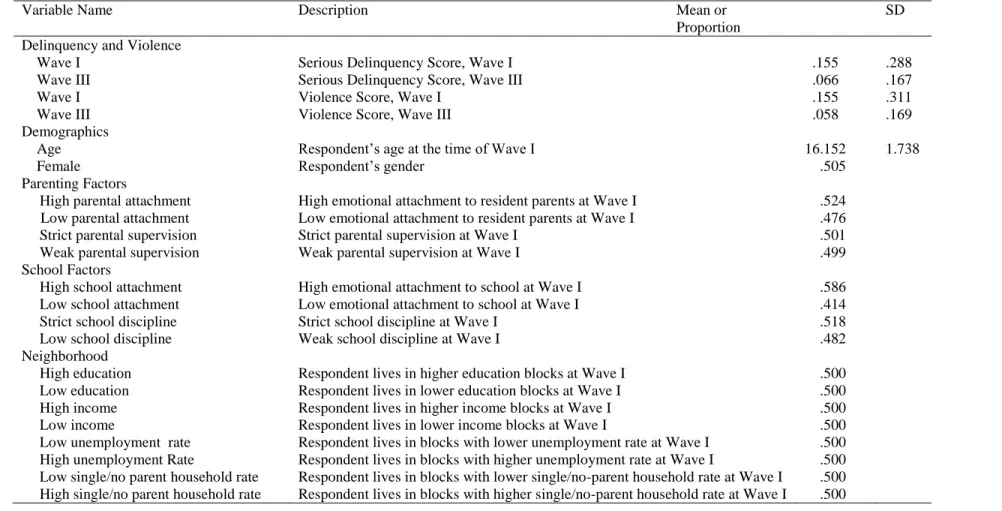
Outcome variables: serious delinquency and violence scores. The outcome variables are based on 11 items from Add Health questionnaires at Wave III: (1) deliberately damaged others’ property, (2) so badly hurt someone that medical treatment was needed, (3) used a weapon to get something from someone, (4) took part in group fights, (5) pulled a knife or gun on someone, (6) shot or stabbed someone, (7) took part in fights in which self was injured, (8)stole something worth more than $50, (9) broke into a house or building to steal, (10) sold drugs, and (11) stole something worth less than $50. (Cronbach’s alpha = .69). To be consistent with the delinquency literature (Hagan and Foster 2003; Hannon 2003), I divided the 11
questions into violent and nonviolent categories. The serious delinquency score is the average of all eleven items, with higher scores indicating greater delinquency. The violence score is the average of the first 7 items. I chose outcomes from a single wave because the analytic model does not allow repeated measures. Also, I used outcomes measured at Wave III and social-environmental measures from Wave I to minimize reverse causality.
37
indicating high parental attachment, and 0 otherwise (indicating low parental attachment).
Parental supervision is constructed based on seven Wave I questions asking the respondent if his or her parents allowed him or her to make their decisions about the following: the time they must be home on weekend nights; the people they hang around with; what they wear; how much television they watch; which television programs they watch; what time they go to bed on week nights; and what they eat (alpha = .63). Parental supervision was coded as 1 if the average of a respondent’s answers to seven questions was greater or equal to the sample median (indicating strict parental supervision), and 0 otherwise (indicating loose parental supervision).
School factors. I used two Wave I measures to assess school factors: school attachment and school discipline. To measure school attachment, I averaged responses to three questions (alpha = .77) asking whether a respondent (rated on a scale of 1 to 5) felt close to people at school, felt like being part of the school, or felt happy at school. I then constructed a school-level attachment variable by averaging school attachment of all students from each school. To
measure school discipline, I averaged school administrators’ responses to eleven questions (alpha = .87) asking in their schools what happens to a student who is caught the second time fighting with another student, injuring another student, possessing alcohol, possessing an illegal drug, possessing a weapon, drinking alcohol at school, using an illegal drug at school, smoking at school, verbally abusing a teacher, physically injuring a teacher, and stealing school property (1 = no policy; 2 = verbal warning; 3 = minor action; 4 = in-school suspension; 5 = out-of-school suspension;6 = expulsion). Like parental attachment and parental supervision, school