and research recommendations for advancing behavioral
interventions
Robin M. Masheb, PhD
1,2, Stephanie H. Chan, MPH
3, Susan D. Raffa, PhD
3,
Ronald Ackermann, MD MPH
4, Laura J. Damschroder, MS, MPH
5, Paul A. Estabrooks, PhD
6,
Gina Evans-Hudnall, PhD
7, Neil C. Evans, MD
8, Trina Histon, PhD
9, Alyson J. Littman, PhD
10,
Tannaz Moin, MD, MBA, MSHS
11,12, Karin M. Nelson, MD MSHS
10,13, Sherry Pagoto, PhD
14,
Nico P. Pronk, PhD
15, Deborah F. Tate, PhD
16, and Michael G. Goldstein, MD
31Yale School of Medicine, New Haven, CT, USA;2VA Connecticut Healthcare System, West Haven, CT, USA;3VHA National Center for Health Promotion and Disease Prevention, Durham, NC, USA;4Northwestern University Feinberg School of Medicine, Chicago, IL, USA;5VA Ann Arbor Center for Clinical Management Research, Ann Arbor, MI, USA;6University of Nebraska Medical Center, Omaha, NE, USA;7Michael E. DeBakey VA Medical Center, Houston, TX, USA;8VA Office of Connected Care, Washington, DC, USA;9Kaiser Permanente Care Management Institute, Washington, DC, USA;10VA Puget Sound Healthcare System, Tacoma, WA, USA;11VA Greater Los Angeles Healthcare System, Los Angeles, CA, USA;12David Geffen School of Medicine at UCLA, Los Angeles, CA, USA;13University of Washington, Seattle, WA, USA;14University of Massachusetts Medical School, Worcester, MA, USA;15HealthPartners Institute, Minneapolis, MN, USA;16University of North Carolina Gillings School of Global Public Health, Chapel Hill, NC, USA.
This article summarizes outcomes of the behavioral inter-ventions work group for the Veterans Health Administra-tion (VHA) State of the Art Conference (SOTA) for Weight Management. Sixteen VHA and non-VHA subject matter experts, representing clinical care delivery, research, and policy arenas, participated. The work group reviewed cur-rent evidence of efficacy, effectiveness, and implementa-tion of behavioral intervenimplementa-tions for weight management, participated in phone- and online-based consensus pro-cesses, generated key questions to address gaps, and attended an in-person conference in March 2016. The work group agreed that there is strong evidence for effica-cy and effectiveness of core behavioral intervention com-ponents and processes, but insufficient evidence to deter-mine the comparative effectiveness of multiple clinician-delivered weight management modalities, as well as tech-nologies that may or may not supplement clinician-delivered treatments. Effective strategies for implementa-tion of weight management services in VHA were identi-fied. The SOTA work group’s foremost policy recommen-dations are to establish a system-wide culture for weight management and to identify a population-level health metric to measure the impact of weight management interventions that can be tracked and clearly communi-cated throughout VHA. The work group’s top research recommendation is to determine how to deploy and scale the most effective behavioral weight management inter-ventions for Veterans.
KEY WORDS:obesity; overweight; weight management; weight loss; veterans.
J Gen Intern Med 32(Suppl 1):S74–S8 DOI: 10.1007/s11606-016-3965-y © Society of General Internal Medicine 2017
INTRODUCTION
Obesity is a leading cause of preventable death, is one of the most serious public health problems faced by our nation,1and disproportionately affects Veterans. Seventy-seven percent of Veterans seeking healthcare through the Veterans Health Ad-ministration (VHA) are classified as overweight/obese2 com-pared to 68 percent of the general population.1To help Veter-ans strive for a healthy weight, VHA’s National Center for Health Promotion and Disease Prevention (NCP) developed the MOVE!® Weight Management Program.
Launched nationally in 2006, MOVE! is VHA’s evidence-based, weight management health promotion program.3 Guid-ed by national policy, MOVE! is both a comprehensive life-style intervention and a population-based prevention program available at every VHA medical center. Although the program is designed to address excess weight in Veterans who are either overweight [body mass index (BMI) ≥25] with an obesity-related condition or obese (BMI≥30), any VHA patient can attend. The evidence-based, comprehensive lifestyle interven-tion includes dietary, physical activity, and behavioral compo-nents, delivered in group or individual format. This interven-tion can be stand-alone or used in conjuncinterven-tion with bariatric surgery or weight loss medications; there currently is no systematic integration of these interventions. The population-based approach includes high annual screening and referral to weight management services with almost 95% of patients screened and referred annually.4 Video-conferencing of MOVE! groups to outpatient clinics increases the reach of weight management services. Additionally, technology-based delivery methods such as home telehealth, telephone lifestyle
Electronic supplementary material The online version of this article (doi:10.1007/s11606-016-3965-y) contains supplementary material, which is available to authorized users.
coaching, and a MOVE! Coach mobile application have been developed to further increase the population reach and support in-person services.
Critical for VA is ensuring that best practices for policy and research are established for the MOVE! program, in part through on-going evaluation of a research literature on weight management that differs greatly from the Veteran population and VHA healthcare system. In terms of policy, VA is operat-ing one of the largest healthcare system weight management programs in the country without the benefit of guidelines for how to run such a program informed by other comparable health systems. In terms of research, VHA has the ability to set its own research agenda that is centered on the specific needs of the Veteran population and is funded through VA’s Health Services Research & Development (HSR&D).
To identify policy recommendations and research priorities regarding weight management for Veterans, VHA convened three weight management work groups, comprised of experts in behavioral, surgical, and pharmacological interventions, to participate in a State of the Art (SOTA) Conference. This article summarizes the outcomes of the behavioral interven-tions work group.
METHODS
Participants
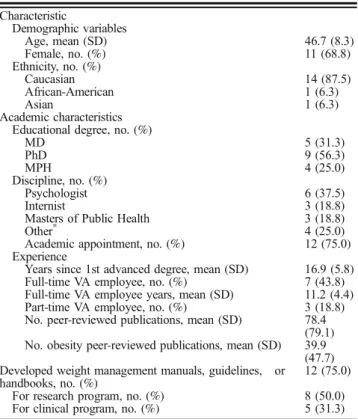
The SOTA Conference co-chairs and behavioral work group co-leads (RMM and MGG) identified 16 behavioral interven-tion experts who participated in the SOTA and are co-authors. Ten individuals (RMM, SHC, SDR, LJD, GEH, NCE, AJL, TM, KMN, and MGG) are affiliated with VHA, and six individuals (RA, PAE, TH, SP, NPP and DFT) represent other institutions including healthcare delivery systems and acade-mia. Additional demographic variables, academic character-istics, and experience of the experts are listed in Table1.
Identifying Six Key Question Areas
The SOTA Planning Committee developed a comprehensive list of questions. Members of the Behavioral Interventions Work Group then met remotely, using an on-line platform called Think Tank, to collectively discuss and cull the highest priority ques-tions for the SOTA. Think Tank provides a range of communi-cations tools that enable participants to discuss, refine, prioritize, and, ultimately, vote on the questions to be addressed. A final list of six questions, divided into two categories—efficacy and implementation/effectiveness of behavioral interventions (see Ta-ble2)—were discussed at the in-person conference.
Participant Pre-Work
Members of all three SOTA Conference work groups reviewed articles and guidelines for screening and manage-ment of obesity (see Online Appendix A). The behavioral work group co-leads selected additional articles, specifically
addressing the six key behavioral questions (see Online AppendixB). Articles were primarily limited to large-scale systematic reviews and meta-analyses or guidelines adhered to by multiple governmental or professional organizations. Work
Table 1 Demographic Variables, Academic Characteristics, and Experience of SOTA Behavioral Work Group Participants (N = 16)
Characteristic
Demographic variables
Age, mean (SD) 46.7 (8.3)
Female, no. (%) 11 (68.8)
Ethnicity, no. (%)
Caucasian 14 (87.5)
African-American 1 (6.3)
Asian 1 (6.3)
Academic characteristics Educational degree, no. (%)
MD 5 (31.3)
PhD 9 (56.3)
MPH 4 (25.0)
Discipline, no. (%)
Psychologist 6 (37.5)
Internist 3 (18.8)
Masters of Public Health 3 (18.8)
Other* 4 (25.0)
Academic appointment, no. (%) 12 (75.0)
Experience
Years since 1st advanced degree, mean (SD) 16.9 (5.8)
Full-time VA employee, no. (%) 7 (43.8)
Full-time VA employee years, mean (SD) 11.2 (4.4)
Part-time VA employee, no. (%) 3 (18.8)
No. peer-reviewed publications, mean (SD) 78.4 (79.1) No. obesity peer-reviewed publications, mean (SD) 39.9
(47.7) Developed weight management manuals, guidelines, or
handbooks, no. (%) 12 (75.0)
For research program, no. (%) 8 (50.0)
For clinical program, no. (%) 5 (31.3)
*One each for psychiatrist, endocrinologist, kinesiologist, and physiologist
Table 2 Six Key Question Areas for the Behavioral Interventions Work Group
EFFICACY EFFECTIVENESS/
IMPLEMENTATION
1. Optimal Treatment Dose: What is the evidence that the effectiveness of behavioral interventions varies by the number of visits and length of treatment (theBdose^of behavioral intervention)? What is the evidence that there is a threshold effect (i.e., minimum dose) or a plateau effect?
1. Desirable Implementation Components: What is the most effective strategy (climate, facilitation roles, etc.) for implementing a standardized behavioral weight management, based on the lessons from the most effective sites?
2. Desirable Behavioral Interventions: What components or modalities (ways of delivering) of behavioral interventions have proven effective and should be emphasized for behavioral weight management?
2. Barriers & Facilitators: What are the barriers and facilitators at the level of the patient, provider, facility, and health system to identification, referral, and sustained engagement of obese patients in behavioral weight management?
3. Stepped-Care: What is the definition ofBfailure^to lose weight via behavioral weight management that would make a Veteran eligible/appropriate for weight loss medications or weight loss surgery?
group members were asked to rank order the six questions by importance and to identify their level of expertise/ability to lead a discussion on each (see Online AppendixC).
SOTA Conference
The SOTA Conference began with a virtual Opening Plenary Session in January 2016 to convene all participants of the SOTA and provide a high-level overview of existing evidence related to weight management treatment in VHA. This was followed by individuals completing the aforementioned read-ings and culminated with a 2-day in-person meeting in March 2016. The work group co-leaders (RMM and MGG) and recorder (SHC) facilitated the 1st day of the in-person meeting. The day was divided into four sessions: (1) prioriti-zation of key questions, (2) identification of effective compo-nents of behavioral interventions, (3) identification of effective strategies to improve implementation, and (4) identification of consensus among the work group members and prioritization of policy and research recommendations. A summary of these sessions was presented on the 2nd day of the in-person meet-ing to all SOTA participants.
RESULTS
Consensus
Sufficient evidence (SE) for comprehensive behavioral weight management treatment included: (1) three key intervention components (SE1), (2) program intensity (SE2), and (3) pro-gram structure (SE3). Work group members agreed there was sufficient evidence to indicate that efficacy of weight loss treatment is dependent upon three key intervention compo-nents: caloric restriction, physical activity promotion, and behavior modification.5,6Systematic review of 12 trials with 3,893 participants deemed these componentsBnecessary^ to produce maximum weight loss for intensive, face-to-face comprehensive lifestyle intervention.7 Specifically, this includes advocating a strategy of moderately reduced calorie diet (deficit≥500 kcal/day), advocating a strategy of regular moderate-to-vigorous physical activity (≥150 min per week or
≥30 min most days of the week), and the use of behavioral strategies (self-monitoring, goal-setting with feedback, prob-lem-solving, and reinforcement) to facilitate adherence to the diet and physical activity recommendations. Consensus was also reached forprogram intensity, determined by the number of sessions and length of treatment, and roughly categorized as low (<1 session per month), moderate (1–2 sessions per month over 6 to 12 months), and high (≥14 sessions in 6 months).6 High-intensity programs generally produce greater weight loss than low-to-moderate programs. Moderate-to-high programs produce greater weight losses than usual care, and low-intensity programs do not produce outcomes superior to usual care.6
Finally, there was agreement that sufficient evidence existed to describe theprogram structurenecessary to obtain effective obesity treatment outcomes.8Evidence directly came from VHA facilities offering a group-based intensive lifestyle intervention in which superior outcomes were obtained with a standard curriculum and with a defined treatment length and structure.9 Additional evidence came from the literature on health behavior counseling and patient engagement. Interventions such as theB5 A’s^ (Assess, Advise, Agree on goals, Assist in resolving barriers, and Arrange for follow-up) increase the likelihood of weight loss intervention effectiveness.10,11
Areas of insufficient evidence (IE) included: (1) compara-tive effeccompara-tiveness of different weight loss intervention programming (IE1) and (2) strategies to increase the uptake, implementation and sustainability of weight management services (IE2). There was consensus that there is currently insufficient evidence to determine thecomparative effective-nessof multiple clinician-delivered weight management mo-dalities (group in-person, individual in-person, individual tele-phone, individual telehealth, and group video teleconferenc-ing), as well as multiple technology-delivered weight manage-ment channels (text, email, website, mobile applications, and electronic weight check-ins) that may or may not be used as supplements to clinician-delivered modalities.
The work group also agreed that there was some limited, but insufficient evidence identifying specific strategies to increase theuptake, implementation, and sustainabilityof an effective weight management program. In VHA, high implementation facilities, in comparison to low implementation facilities,12 used networks and communication (interdisciplinary MOVE! teams that met regularly and communicated about MOVE! to other staff and patients), placed high priority on weight man-agement compared to other initiatives, encouraged a learning climate (shared ideas with peers and superiors and regular forums to learn from others), and provided opportunities for reflection and evaluation (patient feedback prompting subse-quent program changes such as the location of classes).
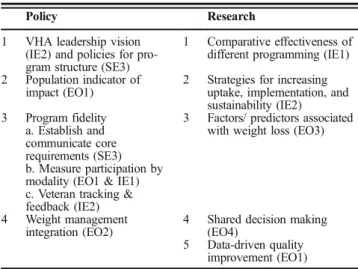
During the in-person meeting other topics, not covered in the literature, were discussed. Among these topics, the follow-ing areas were deemed essential for policy and/or research recommendations based upon expert opinion (EO): (1) devel-opment of a population indicator of impact (EO1), (2) the need to address integration of weight management services (behav-ioral, bariatric, and pharmacotherapy) (EO2), (3) treatment predictors (EO3), and (4) shared decision making (EO4). These areas are more fully described under the recommenda-tions. See Tables 3 and 4 for alignment of evidence and recommendations.
Policy Recommendations
supports striving for a healthy weight through supportive directives (IE2) and clear policy statements about program structure (SE3). Second, VHA should develop a population-based indicator of impact that combines intervention reach and effectiveness (EO1), for example, tracking the proportion of overweight/obese Veterans who achieve a meaningful weight loss (e.g., a 5% weight loss to achieve a threshold for clinical risk reduction6). This metric could be used at multiple levels, including a provider’s patient panel, a clinical population (e.g., diabetes), a facility or regional population, and the national VHA population. This metric could also be applied across behavioral, surgical, and pharmacological interventions to allow for consistent evaluation. Third, to support the imple-mentation of behavioral interventions with program fidelity, VHA should establish and communicate core requirements of MOVE! to staff and coordinators (SE3), measure participation by intervention modality at multiple levels (facility, region, national) (IE1), and develop a system for tracking and giving feedback about Veteran engagement, program implementa-tion, and fidelity (IE2 and EO1). Fourth, integration of weight management services that span behavioral, surgical, and
pharmacological options should be established to adequately and appropriately distribute resources (EO2).
Research Recommendations
Behavioral work group members identified four key areas of needed research. First, assessment of the full range of weight management interventions in VHA, comparing outcomes across variations in intensity, modality, and technology assis-tance (IE1), is needed. Second, research is needed to develop and test effective interventions to improve the uptake, imple-mentation, and sustainability of evidence-based behavioral weight loss practices (IE2). Third, we do not fully understand the patient characteristics that predict weight loss outcomes, or what factors might alter the course of outcome, such as treat-ment modality or patient preferences (EO3). In addition, shared decision making (SDM) is recommended for many types of healthcare decisions, but little is known about SDM in the context of weight management (EO4). Finally, there is a need for data-driven quality improvement for weight manage-ment to increase measuremanage-ment impact, including research to improve the consistency of weight data entered into the elec-tronic health record (EO1).
Limitations
Consensus and recommendations were drawn from research conducted with both civilian and Veteran populations; how-ever, a recent review of the weight loss literature13cautions that this literature has been primarily focused on young adult women. Thus, we have to consider the implications of gener-alizing findings from the broader weight loss literature to a Veteran population that is on average older and has a larger proportion of men. Findings from weight management trials of Veterans, however, may benefit civilians who are male, older, and have multiple medical and psychiatric morbidities and may generate greater interest in focusing on these patient groups outside VHA.
Conclusions
A work group consisting of VHA and non-VHA subject matter experts, representing clinical care delivery, research, and policy arenas, reached consensus regarding the key be-havioral intervention components and processes required to achieve effective treatment outcomes. The work group’s fore-most policy recommendations are to establish a VHA vision that supports striving for a healthy weight for all Veterans and to identify a population-level health metric that evaluates the impact of behavioral weight management interventions (in-cluding behavioral, surgical, and pharmacological interven-tions) that can be tracked and clearly communicated through-out VHA. The work group’s top research recommendation is to learn how VHA can reliably implement and scale the most effective behavioral weight management interventions for the benefit of Veterans.
Table 3 Areas of Sufficient Evidence (SE), Insufficient Evidence (IE), and Expert Opinion (EO)
Sufficient Evidence (SE)
Insufficient Evidence (IE)
Expert Opinion (EO)
SE1: Three components of behavioral intervention
IE1: Comparative effectiveness of different programming
EO1: Population indicator of impact
SE2: Program intensity
IE2: Strategies for increasing uptake, implementation, and sustainability
EO2: Weight management integration
SE3: Program
structure EO3: Treatmentpredictors
EO4: Shared decision making
Table 4 VA Policy and Research Recommendations for Advancing Behavioral Interventions
Policy Research
1 VHA leadership vision (IE2) and policies for pro-gram structure (SE3)
1 Comparative effectiveness of different programming (IE1)
2 Population indicator of
impact (EO1) 2 Strategies for increasinguptake, implementation, and sustainability (IE2) 3 Program fidelity
a. Establish and communicate core requirements (SE3) b. Measure participation by modality (EO1 & IE1) c. Veteran tracking & feedback (IE2)
3 Factors/ predictors associated with weight loss (EO3)
4 Weight management integration (EO2)
4 Shared decision making (EO4)
5 Data-driven quality improvement (EO1)
Acknowledgements:The authors would like to acknowledge David Atkins, MD, MPH, Matthew L. Maciejewski, PhD., and Geraldine McGlynn, MEd, for their support of the Behavioral Interventions Work Group and assistance with the SOTA.
Corresponding Author: Robin M. Masheb, PhD; VA Connecticut Healthcare System, 950 Campbell Ave Psychology Service, 116B, West Haven, CT 06516, USA (e-mail: [email protected]).
Compliance with ethical standards:
Conflict of Interest:None of the authors acknowledge conflicts of interest with the exception of Deborah Tate, PhD, who is on the Scien-tific Advisory Board for Weight Watchers.
Funding:The State of the Art Conference was supported by the De-partment of Veterans Affairs, Veterans Health Administration, Office of Research and Development, Health Services Research and Development.
Disclaimer:The views expressed in this article are those of the authors and do not necessarily reflect the position or policy of the Department of Veterans of Affairs or the US Government.
REFERENCES
1. Flegal KM, Kruszon-Moran D, Carroll MD, Fryar CD, Ogden CL.
Trends in obesity among adults in the United States, 2005-2014. JAMA. 2016;315(21):2284–91.
2. Kahwati LC, Lance TX, Jones KR, Kinsinger LS.RE-AIM evaluation of
the Veterans Health Administration’s MOVE! Weight Management Pro-gram. Transl Behav Med. 2011;1(4):551–60.
3. MOVE! Weight Management Program. http://www.move.va.gov/. Accessed July 13, 2016.
4. Littman AJ, Damschroder LJ, Verchinina L, et al.National evaluation
of obesity screening and treatment among veterans with and without mental health disorders. Gen Hosp Psychiatry. 2015;37(1):7–13.
5. Moyer VA, Force USPST.Screening for and management of obesity in
adults: US Preventive Services Task Force recommendation statement. Ann Intern Med. 2012;157(5):373–8.
6. Jensen MD, Ryan DH, Apovian CM, et al. 2013 AHA/ACC/TOS
guideline for the management of overweight and obesity in adults: a report of the American College of Cardiology/American Heart Association Task Force on Practice Guidelines and The Obesity Society. J Am Coll Cardiol. 2014;63(25 Pt B):2985–3023.
7. Wadden TA, Butryn ML, Hong PS, Tsai AG.Behavioral treatment of
obesity in patients encountered in primary care settings: a systematic review. JAMA. 2014;312(17):1779–91.
8. Kahwati L, Jacobs S, Kane H, Lewis M, Viswanathan M, Golin CE.
Using qualitative comparative analysis in a systematic review of a complex intervention. Syst Rev. 2016;5(1):82.
9. Kahwati LC, Lewis MA, Kane H, et al.Best practices in the Veterans
Health Administration’s MOVE! Weight management program. Am J Prev Med. 2011;41(5):457–64.
10. Estabrooks PA, Glasgow RE, Dzewaltowski DA. Physical activity
promotion through primary care. JAMA. 2003;289(22):2913–6.
11. Whitlock EP, Orleans CT, Pender N, Allan J.Evaluating primary care
behavioral counseling interventions: an evidence-based approach. Am J Prev Med. 2002;22(4):267–84.
12. Damschroder LJ, Goodrich DE, Robinson CH, Fletcher CE, Lowery
JC.A systematic exploration of differences in contextual factors related to implementing the MOVE! weight management program in VA: a mixed methods study. BMC Health Serv Res. 2011;11:248.
13. Gudzune KA, Doshi RS, Mehta AK, et al.Efficacy of commercial