BAYESIAN IMAGE SEGMENTATION THROUGH
LEVEL LINES SELECTION
C
HARLESK
ERVRANNINRA - Biom´etrie, Domaine de Vilvert, 78352 Jouy-en-Josas, France e-mail: [email protected]
(Accepted October 16, 2001)
ABSTRACT
Bayesian statistical theory is a convenient way of taking a priori information into consideration when inference is made from images. In Bayesian image segmentation, the a priori distribution should capture the knowledge about objects. Taking inspiration from (Alvarez et al., 1999), we design a prior density that penalizes the area of homogeneous parts in images. The segmentation problem is further formulated as the estimation of the set of curves that maximizes the posterior distribution. In this paper, we explore a posterior distribution model for which its maximal mode is given by a subset of level curves, that is the boundaries of image level sets. For the completeness of the paper, we present a stepwise greedy algorithm for computing partitions with connected components.
Keywords: area distribution, connected components, energy minimization, image segmentation, level curves.
INTRODUCTION
Image segmentation and object boundaries estimation are among the most challenging and fundamental addressed problems in image analysis (Mumford and Shah, 1989; Vincent and Soille, 1991; Morel and Solimini, 1994). Segmentation can be achieved by minimizing an energy model designed in conjunction with Bayes’s theorem as shown by Mumford and Shah (1989) and Zhu and Yuille (1996). Indeed, it is straightforward to transfer a Bayesian criterion into an energy minimization criterion (Morel and Solimini, 1994; Zhu and Yuille, 1996). Thereby, the discrete (Geman and Geman, 1984; Blake and Zisserman, 1987) or continuous (Mumford and Shah, 1989; Morel and Solimini, 1994) energy functional is traditionally comprised of two terms: the first term is a fidelity term describing the interaction between the observed data and the model (data model) and the second is a regularity term (prior model).
In Bayesian image segmentation, the prior model should capture the knowledge about objects. In particular, the incorporation of prior information about the outline of objects can be applied. There has been a growing interest in this field, particularly along the guidelines of Grenander’s general pattern theory using deformable templates (Grenander and Miller, 1994). In a separate way, Zhu and Yuille (1996) attempted to unify snakes (Kass et al., 1987) and region growing methods within a general energy/Bayes framework. Both approaches estimate the curves that maximally separate unknown statistics inside and outside the curves. Finally, the designed energy functionals are complex, for which it is
difficult to specify global minimizers corresponding to “best” segmentations. The maximum a posteriori (MAP) estimate is generally determined by prohibitive stochastic search procedures (Grenander and Miller, 1994) or other variants of steepest ascent algorithms (Zhu and Yuille, 1996). With these tools, additional a priori knowledge may be specified to ease the segmentation task: statistics inside region boundaries are assumed to be known (Grenander and Miller, 1994; Chan and Vese, 1999) or estimated using ad-hoc methods (Paragios and Deriche, 2000). In practical imaging, these methods still suffer from the problem of initialization of curves (Zhu and Yuille, 1996), off-line estimation of the mixture model of Gaussians approximating the probability density function of the image (Paragios and Deriche, 2000), or selection of hyperparameters weighting the contribution of energy terms (Zhu and Yuille, 1996; Chan and Vese, 1999; Paragios and Deriche, 2000).
THE BAYESIAN FRAMEWORK
Let S be an open subset (rectangle) of 2 and f a grey-scale image treated as a function defined on S. Below we will work in the continuous setup, where S is a subset of a Euclidian space and f : S
represents the observed data function. We use the terminology “site” or “pixel” to denote a point of the image, even in the continuous case. Each point x S is assigned
a grey value fx . According to Matheron (1975), we
interpret the image f as a family of sets defined by
Lτ f x S : fx τ , τ
. Each level set
Lτ f is assumed to be of finite perimeter. Therefore,
f will belong to the bounded variation (BV ) space as
shown by Alvarez et al. (1999).
Let Ωi S
be a set of disjoint and non-empty
image domains or objects, and ∂Ωi their boundaries.
A partition of the image domain S consists in finding a set Ωi
P
i 1 and a background Ω defined as the
complementary subset of the union of objects Ω
S
P
i 1 Ωi, Ωi i
jΩj
/0 and Ω
i iΩ
/0. We
assume that the observed image f has been produced by the model f f
true ε, where ε is a
zero-mean Gaussian white noise: εx
iid
0σ
2
, x S.
The true image ftruex ∑ P
i 1fΩ
i1x Ω
i fΩ1
x Ω
is supposed piecewise constant, where fΩ
iand fΩdenote
respectively the unknown average values of f overΩi
and Ω, and 1x
E
is the set indicator function of the set E. The variance σ2 is assumed to be known and constant over the entire image. So, the likelihood for the data f given Ω1 Ω
P is specified by
p fΩ
1 "!#!"!$ ΩP% ∝
exp&
1 2σ2
'
P
∑
i( 1) Ωi
fx
%
& f
Ωi%
2dx
*
)
Ω fx
%
& f
Ω%
2dx
+-, (1)
We seek a partition of the rectangle S into a finite set of objectsΩi, each of which corresponds to a part of the image where f is constant. Given the objects Ωi ,
the unknown background is explicitly determined as the complementary subset of the union of estimated objects. Therefore, we define the following collection
.
P of P 0 admissible, closed and connected
objects:
.
P / 0 Ω
1111 Ω
P
S ; S Ω
P
i 1
Ωi ; Ωi 1
2 i j2 P
Ωj /0 31 When P 0, there is no
object in the image. Following the Bayesian approach, we use some functional of the posterior distribution
pΩ
1Ω
P 4 f
∝ p f
4 Ω1
Ω
P πΩ
1Ω
P.
The likelihood p f
4 Ω1
5Ω
P is given by (1) and
πΩ
1Ω
P is the prior distribution of objects.
The posterior distribution is used in a further inferential issue concerning the objects within the Bayesian paradigm. The a priori distribution should
capture the knowledge about Ω15Ω
P . We
define a density that penalizes the area
4Ωi4
of objects. Additionally, the variables 4Ωi4
may be
considered as independent random variables with density g
4Ωi4
. Hence, the prior distribution is of the
form πΩ
1Ω
P6 Z7
1
p ∏
P
i 1
g
4Ωi4
a where Z
p is
a normalization constant and a a real positive value. The density g
4Ωi4
is chosen to be a non-negative
monotically decreasing function of the object area
4Ωi4
. For instance, Alvarez et al. (1999) have empirically observed that the area distribution of homogeneous parts in images follows a power law β
4Ωi4
7
γ. In
what follows, we shall consider this model for the density g
4Ωi4
. There are other possible choices of
g
4Ωi4
: the case of g
4Ωi4
∝exp89 β
4Ωi4
γ
related
to the Markov connected components fields, has been already discussed by Kervrann et al. (2000), Alvarez
et al. (1999) and Møller and Waagepetersen (1998).
BAYESIAN INFERENCE
All kinds of inference are made from
pΩ
1 Ω
P 4 f
. Finding the maximum a posteriori
(MAP) estimate is herein our choice of inference. As a consequence, the MAP estimation of objects is equivalent to the minimization of a global energy function Eλ fΩ
1111:Ω
P defined as
Eλ fΩ
1111Ω
P; E
pΩ
1111Ω
P
λEd
fΩ
1111: Ω
P< (2)
where
EpΩ
1111Ω
P6
P
∑
i 1
γlogΩ
i4
=8 A
is the penalty functional,
Ed fΩ
1111 Ω
P>
P
∑
i 1? Ωi
fx=8 fΩ
i
2
dx
? Ω
fx=8 f
Ω
2
dx
the data model, λ 2aσ
2 @
0 the regularization parameter and A logβ. The penalty functional
tends to regulate the emergence of objects Ωi in the image. The regularization parameter λ can be then interpreted as a scale parameter that only tunes the number of regions (Morel and Solimini, 1994; Kervrann et al., 2000). If λ 0, each point is
potentially a region andΩ /0 ; the global minimum
coincides with zero and this segmentation is called the “trivial segmentation” (Morel and Solimini, 1994).
By using classical arguments on lower semi-continuous functionals on the BV space, we assume here the existence of minimizers of Eλ fΩ
1Ω
P
variation) (Morel and Solimini, 1994; Zhu and Yuille, 1996). Our MAP estimator is defined by (when it exists)
:AΩ
1111AΩB
P> argmin
02 P2 Targmin
C
Ω1DEEEDΩP
F
HG
P
Eλ fΩ
1111Ω
P< (3)
where .
P I
.
TKJ P L T , and T is the maximum
number of admissible objects registered in a bank
.
T.
We recall that ΩA
S M
B
P
i 1
A
Ωi is the complementary
subset of estimated objects NAΩ
11115AΩB
P . A direct
minimization with respect to all unknown domains
Ωi and parameters fΩ
i is a very intricate problem,
even if T is low since objects are not designated. In what follows (Lemma 1), we prove that the object boundaries that minimize Eλ fΩ
1111:Ω
P are level
lines of the function f , which makes the problem tractable.
LEMMA 1 If there exist minimizers and no pathological minimum exists, then the energy minimizing set of curves is a subset of level lines of
f , i.e. the border∂ΩA
i of eachΩA
i is a boundary of a
connected component of a level set of f .
Proof of Lemma 1. Let Ωδ be a variation of a set Ω, i.e. the Hausdorff distance d∞Ω
δΩL δ . To
prove Lemma 1, we assume that, for any connected perturbation of Ω such that d∞Ω
δΩOL δ, two
neighboring sets Ω and ΩP do not merge into one
single setΩ ΩP and, for any connected perturbation
of Ω such d∞Ω
δΩQL δ, Ω does not split into two
new sets. This corresponds to prohibited topological changes. Without loss of generality, we prove Lemma 1 for one object Ω and a background Ω, that is the closure of the complementary set ofΩ. For two sets A and B such that B
I
A, we denoteR
ASB
f defTR
Af 8UR
Bf .
Then, we have
∆ΩV
) Ωδ
W
Ω1
def
VXΩ
δ$&YΩ and
Z
)
Ωδf[
2
&]\
)
Ωf^
2 V 2 ) Ωf ) Ωδ W Ωf * Z ) Ωδ W
Ωf[
2
, (4)
We define∆Eλ fΩ_ E
λ fΩ
δ`8 E
λ fΩ9 T
1
T2 T3 T4 T5, where
T1 V
) Ωδ
f2&
) Ω
f2
T2 V
1 Ω ) Ωδ W Ωλγ
T3 V &
1
Ω
δ
Z
)
Ωδ f
[ 2 * 1 Ω \ ) Ωf ^ 2
T4 V
)
S
W
Ωδ f
2 & ) S W Ωf 2
T5 V &
1
S$&OΩ
δ
Z
)
S
W
Ωδ f
[
2
* 1
S$&YΩ
\ ) S W Ωf ^ 2 , (5)
By definition we have T1 T4
0. Passing to the
limit∆
4Ω4
0, we obtain expressions for T
2T
3and T5 (higher order terms are neglected)
T2 V
λγ
Ω
) Ωδ
W
Ω1
T3 V &
2 Ω ) Ωδ W Ωf )
Ωf &
1 Ω Z ) Ωδ W
Ωf[
2
* 1
Ω
2
) Ωδ
W Ω1 \ ) Ω f^ 2
T5 V
1
S$&OΩ
'
2
) Ωδ
W
Ωf)
S
W
Ωf
&
Z
) Ωδ
W Ωf [ 2 & 1
S$&YΩ
) Ωδ W Ω1 \ ) S W Ω f ^ 2
+ , (6)
We define the image moments m0 R
Ω1, m1
R Ωf , K
0 aR
S1, K1 bR
Sf . Using the mean value
theorem for a double integral, which states that if f is continuous and a connected subset E is bounded by a simple curve, then for some point x0 in E we have
R
E fxdE fx
0c
4E4 where 4E4 denotes the area of
E, it follows that
∆Eλ f Ω
%
V d
M0
e fg h
i
m21 m2 0
&
K
1& m
1%
2
K
0& m
0% 2 * λγ m0 j * M1
e fg h
i
2K
1& m
1%
K0& m
0
&
2m1 m0
j
fx
0%
&
K0 m0K
0& m
0%
fx
0%
2
)
Ωδ
W
Ω1k
)
Ωδ
W
Ω1,
(7)
Let xb be a fixed point of the border ∂Ω. Choose Ωδ such that ∂Ωδ ∂Ω except on a small
neighborhood of xb. The energy having a minimum for
Ω, fx
b needs to be solution of the following equation
∆Eλ fΩ
∆4Ω4
mlM
0 M1f
x
b#n
O
By passing to the limit∆4Ω4
0, we obtain M
0
M1fx
bo 0. This equation has a unique solution.
The coefficients M0 and M1 depend on neither xbnor
fx
b, and M
0 p
0. The function f is continuous and ∂Ωis a connected curve. Therefore fx
b is constant
when xbcovers∂Ω. This completes the proof.
A STEPWISE GREEDY ALGORITHM FOR IMAGE SEGMENTATION
To implement our level set image segmentation based on energy minimization, a four step method is used. The proposed algorithm is not a region growing algorithm (Morel and Solimini, 1994) since all objects are built once and for all. It differs from the watershed approach since regions that emerge from the watershed segmentation are not necessarily connected components within the image level sets (Vincent and Soille, 1991). Let K,λ, 4Ωmin4 be the input parameters
set by the user.
Bilevel set construction. The first step completes a quantization of the function f ql f
min fmaxn in
K r 4:8 non-equal-sized and non-overlapping
intervals lt l
7
1t
l , l X 1: K . Given this set of
intervals estimated using the maximum entropy sum method (Kapur et al., 1985), let bl be the bilevel set image with blx< 1 if fxslt
l
7
1t
l and b
lx< 0
otherwise. The connected components of bilevel sets can be characterized by their surrounding curves, that is the level lines. If we map these level lines for a given set of K levels, we get a segmentation of the image also called topographic map (Caselles et al., 1999). More generally, one can consider a segmentation achieved using only some connected components of bilevel sets, which is the philosophy of our approach. The most perceptible level lines could be determined by the detection of T-junctions of level lines (Caselles et al., 1999). Instead, we use herein a simpler criterion where perceptually significant level lines are the bilevel sets boundaries of an quantized image by using K quantizers and an entropy method. The entropy method due to Kapur et al. (1985) chooses the thresholds tl
to be the values at which the information is maximum.
Object extraction. A crude way to build pixels sets corresponding to objects is to proceed to a connected components labeling of bilevel set images
bl and to associate each label with an object Ω
i.
Though this process may work in the noise-free case, in general we would also need some smoothing effect of the connected components labeling. So, we consider a size-oriented morphological operator acting on sets that consists in keeping all connected components of the output of area larger than a limit 4Ωmin4. This connected operator in mathematical
morphology will never introduce new features or edges and boundaries of remain connected components are preserved (Salembier and Serra, 1995). The list of connected components then forms the bank
.
T of
admissible objects Ω1111 Ω
T with
4Ωi4
4Ωmin4
.
Configuration determination. The connected components are then combined during the third step to form object configurations. For instance, these configurations can be built by enumeration of all possible object combinations, i.e. 2T configurations. Each configuration is made of a subset of connected components taken in the bank .
T. The background Ω corresponds to the complementary set of objects selected for each configuration.
Energy computation and object configuration selection. Energy calculations take the image intensities of the original (not quantized) image to establish piecewise-constant approximation errors. Energies of the form R
Ωi
fxQ8 fΩ
i
2 dx
are
computed once and stored on a RAM memory. The energy term R
Ω fx8 f
Ω
2 dx is efficiently updated for each configuration. For a fixed bank
.
T t Ω
1: Ω
T , one way to choose the optimal
set of of objects ΩA
1: ΩA B
P ,
A
P L T , is to search for
all possible combinations of P objects and compute the corresponding energy Eλ fΩ
15Ω
P. Enumerating
all possible sets of objects in the object bank and comparing their energies is computationally too expensive if T is large. Instead of a such brute force search, we propose a stepwise greedy algorithm for minimizing Eλ fΩ
15Ω
P . We start from P 0
and introduce one object Ωj at a time. At the first step, we compute the T energies with one single object Ωj at once against the complementary subset
Ω Su
T
j i 1Ωi
. Let ΩA
1 be the estimated object that best lowers Eλ fΩ
1: Ω
P . This object is
stored on a RAM memory as an object of the optimal configuration. It is removed from the initial bank
.
T.
At any step of the algorithm, a new object is chosen to maximally decrease the energy Eλ fΩ
1Ω
P .
Suppose that at the P-th step,P andA
A
Ωare not known but we have estimated P objects NAΩ
1AΩ
P and
a current background Ω S - ΩA
1: ΩA
P . Let
Eλ fAΩ
15AΩ
P be the current computed energy.
Then at the P
1
-th step, we choose the object
Ωj
.
T v NAΩ
1AΩ
P which has the maximal
difference, i.e.
A
ΩP
1 arg max
ΩjwG
TS
C
B
Ω1DxxxD
B
ΩPFzy
Eλ fAΩ
1AΩ
P
8 E
λ fAΩ
1AΩ
PΩ
The algorithm stops at the P-th step when the addition of any object does not decrease Eλ fΩ
1: Ω
P .
This means that the optimal number of objects is PA
P and the remaining objects of the bank
are a part of the estimated background ΩA
S
A
Ω15ΩA B
P . This algorithm selects a suboptimal
configuration of objects corresponding to a local minimum. Using this algorithm, at most T }~T
1: 2 object configurations are examined.
EXPERIMENTAL RESULTS
Experiments were conducted on satellite and medical images. The number of bilevel sets K was set fairly low (K 4 or K 8) to obtain large regions
and to improve robustness to noise and artifacts in the image. Regions with areas4Ωi4
l01000101001n}
4S4
are discarded. To estimate A andγ, we consider the sets of observations log
4Ωi4
logg
4Ωi4
1 L i L
T . We perform a linear regression on this set so as
to find the straight line (in the log-log coordinates) logg
4Ωi4
: A8 γlog
4Ωi4
closest to the data in
the least squares sense (Alvarez et al., 1999). The choice of the hyperparameter λ determines mostly
the properties of the segmentation result. If f is a function from S to l0255n, a default choice for the
hyperparameter isλ ~l01111n=} 255
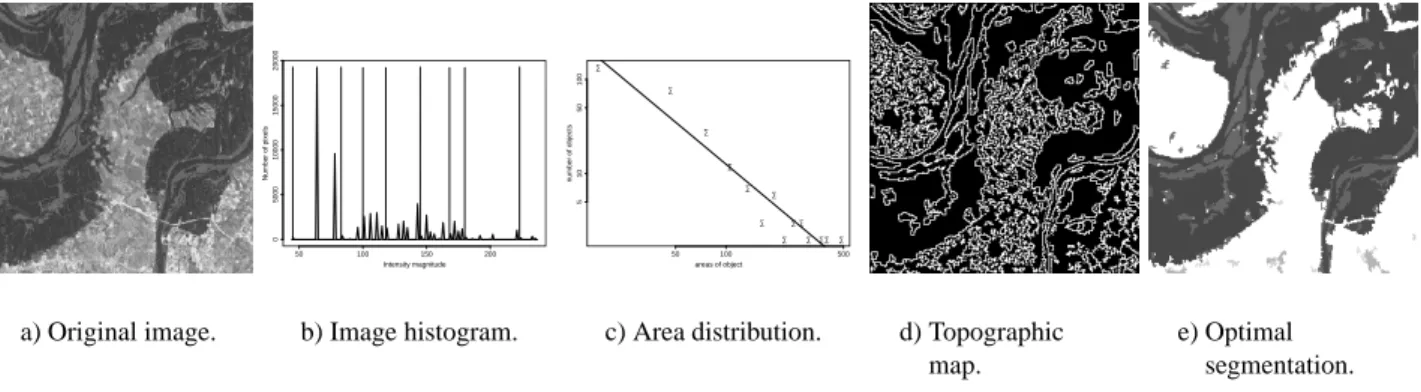
2. Fig. 1a shows an aerial 256 } 256 image (in the visual spectrum)
depicting the region of Saint-Louis during the rising of the Mississippi and Missouri rivers in July 1993. We are interested in extracting the rivers and a background corresponding to textured urban areas. Fig. 1 shows the segmentation results when K 8,
4Ωmin4
0100025}
4
S
4
and λ 0125 } 255
2. In this experiment, the maximum number of significant components is T
291. The corresponding topographic map is shown in Fig. 1d. The image histogram has been quantized with K 8 quantizers and an entropic method (Fig.
1b). We estimated the values of parameters A 31727
and γ 11486 by linear regression (Fig. 1c). In that
case, the residual sum of squares is 21007 and 17 L
4Ωi4
L 21886 10
4 pixels. It takes about 15 seconds (25 095
T } T
1
: 2 42 486 iterations) of
computing time for building
.
T and selecting the
best configuration shown in Fig. 1e (P 105 objects)
using the stepwise greedy algorithm (λ 0125 }
2552). Enumerating all the configurations is infeasible since 2T
3198 10
87 iterations! The non-connected background is labeled in “white” in Fig. 1e and the objects are filled with their mean gray values fΩ
i
.
a) Original image.
Intensity magnitude
Number of pixels
50 100 150 200
0
5000
10000
15000
20000
b) Image histogram. •
•
• •
• •
•
• • •
•• • • areas of object
number of objects
50 100 500
5
10
50
100
c) Area distribution. d) Topographic map.
e) Optimal segmentation.
Fig. 1. Segmentation of a (256 } 256) satellite image (K 8,
4Ωmin4
0100025}
4
S
4
,λ 0125} 255
2).
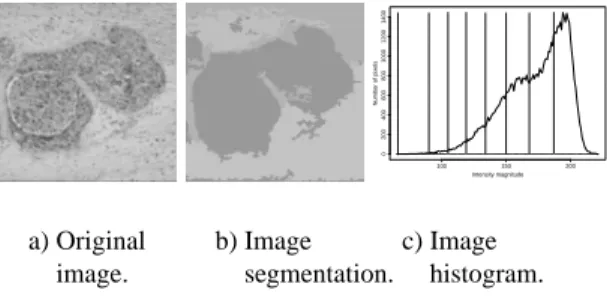
Finally, the performance of the segmentation procedure is demonstrated for a (181 } 217) MR
image shown in Fig. 2 and a microscopic medical breast (256 } 256) image shown in Fig. 3. In Fig. 2,
the dark background has been previously eliminated before processing. Segmentation of both grey and white matter is achieved using the set of parameters
K 8,λ 015} 255
2and
4Ωmin4
010001}
4S4. Fig.
3 exhibits an inflammatory carcinoma with metastases. Fig. 3b shows the segmentation results when K 8,
4Ωmin4
01001}
4S4 andλ
015} 255
2.
a) MR image.
b) Image segmen-tation.
c) Boun-daries.
Intensity magnitude
Number of pixels
0 50 100 150 200
250
0
500
1000
1500
d) Image histogram.
a) Original image.
b) Image segmentation.
Intensity magnitude
Number of pixels
100 150 200
0
200
400
600
800
1000
1200
1400
c) Image histogram.
Fig. 3. Segmentation of a microscopic image.
CONCLUSION AND
PERSPECTIVES
In this paper, we have presented a Bayesian approach for extracting structures in images. Although our work is related to morphological approaches based on connected operators (Salembier and Serra, 1995), it is an independent approach since we seek minimizers of a global objective functional. In addition, we proved that our MAP estimator can be determined by selecting a subset of image level lines. A total CPU time of a few seconds on a 296 MHz workstation makes the method attractive for many time-critical applications. In terms of future directions for research, we propose to create a non-linear scale-space by successive applications of an area morphology operator to select most meaningful regions in the image.
REFERENCES
Alvarez L, Gousseau Y, Morel JM (1999). Scales in natural images and a consequence on their bounded variation. In: Nielsen M, Johansen P, Olsen OF, Weickert J, eds. Scale-Space Theories in Computer Vision. Berlin, Heidelberg: Springer, 247-58.
Blake A, Zisserman A (1987). Visual Reconstruction. Cambridge, Mass.: MIT Press.
Caselles V, Coll B, Morel JM (1999). Topographic maps and local contrast changes in natural images. Int J Comput Vision 33(1):5-27.
Chan T, Vese L (1999). Active contour model without edges. In: Nielsen M, Johansen P, Olsen OF, Weickert J, eds. Scale-Space Theories in Computer Vision. Berlin, Heidelberg: Springer, 141-51.
Geman S, Geman D (1984). Stochastic relaxation, gibbs distributions, and the bayesian restoration of images. IEEE T Pattern Anal 6(6):721-41.
Grenander U, Miller MI (1994). Representations of knowledge in complex systems. J Roy Stat Soc B Met 56(4):549-603.
Kapur JN, Sahoo PK, Wong AKC (1985). A new method for gray-level picture thresholding using the entropy of the histogram. Comput Vision Graph 29:273-85.
Kass M, Witkin A, Terzopoulos D (1987). Snakes: active contour models. Int J Comput Vision 12(1):321-31. Kervrann C, Hoebeke M, Trubuil A (2000). Level lines
as global minimizers of energy functionals in image segmentation. In: Vernon D, ed. Computer Vision – ECCV 2000, 6th European Conference on Computer Vision, Dublin, Ireland, July 26 – July 1, 2000, Proceedings, Part II. Berlin, Heidelberg: Springer, 241-56.
Matheron G (1975). Random Sets and Integral Geometry. New York: John Wiley.
Møller J, Waagepertersen RP (1998). Markov connected component fields. Adv Appl Probab 30: 1-35.
Morel JM, Solimini S (1994). Variational methods in image segmentation. Boston: Birkhauser.
Mumford D, Shah J (1989). Optimal approximations by piecewise smooth functions and variational problems. Commun Pur Appl Math 42(5):577-685.
Paragios N, Deriche R (2000). Coupled geodesic active regions for image segmentation: a level set approach. In: Vernon D, ed. Computer Vision – ECCV 2000, 6th European Conference on Computer Vision, Dublin, Ireland, July 26 – July 1, 2000, Proceedings, Part II. Berlin, Heidelberg: Springer, 224-40.
Salembier P, Serra J (1995). Flat zones filtering, connected operators, and filters by reconstruction. IEEE T Image Process 4(8):1153-60.
Vincent L, Soille P (1991). Watershed in digital spaces: an efficient algorithm based on immersion simulations. IEEE T Pattern Anal 13(6):583-98.