O
Url: http://usnsj.com/index.php/JEE Email: [email protected]
The Ballot or the Bullet
(A Speech of Malcolm X)
A. Introduction
The Ballot or the Bullet is an address delivered in April 3rd, 1964 in Harlem, Cleveland,
shortly after Malcolm announced his break with Nation of Islam. It is a famous speech, a great example of a clear address using excellent text to persuade and inspire the audience, a natural leader, speaker and motivator. This famous Malcolm X Speech is famed for its great powers of verbal communication making good use of the words and language to illustrate the subject all critical requirements of a great speaker. This speech can be described in the category of powerful, persuasive, motivational speech. For knowing what does the purpose of Malcolm X in that speech so, in analysis below the writer intends to answer of what Malcolm’s ideas and attitudes which are implied on his speech.
Zakaria
Universitas Sembilanbelas November Kolaka [email protected]
+6285395472540
ISSN: 2502-6909
Vol. 1, No. 2, November 2016
URL: http://usnsj.com/index.php/JEE/article/view/JEE021
© 2016 JEE All rights reserved
Abstract
Indeed, this article focus on one of speech of Malcolm X related to political thought and idea that how to throw away the prejudice and racial discrimination of white people, so whites could live as equal as black in the United States. Malcolm mentioned that under the control of white hegemony, and also because black people had not given their liberation from whites, it was true if blacks legalized their actions (by necessary means) in getting their rights. They legalized whatever means to throw away the white racism for reaching their freedom, and whatever means will do in getting the goal. That’s the Malcolm, by necessary means come into the struggle for gaining black’s liberation, equality, and human justice in the United States. The final tendentious action of Malcolm is to come into political action; he tended to get the political ways rather than separation in solving the race problem in the United States. For Malcolm, integration and fight for getting the rights of vote was the moderate ways in gaining the black common humanity (freedom, equality, and human justice) because they were supported by the principles of Charter of the United Nation, the Universal Declaration of Human rights, and the Constitutional of the U.S.A. This article was conducted by interdisciplinary approaches; historical, sociological, political, biographical and literary approaching.
Keywords: liberation, separation, equal right, blacks nationalism, and human justice
AUTHORS INFO ARTICLE INFO
B. Literature review
The aim of literary review is to find and registered all the studies which presented before so that these studies could be known how far those studies runs on its topic and the next study like this can be conducted perfectly and do not show misunderstanding, misstatements, misrepresentation, etc. Therefore, here will show any studies that had written before although has relationship but not same such as Handayani’s thesis Black Resistance in the North Studies on Baldin’s The Fire Next Time and Malcolm X’s The Ballot or the Bullet (2000). In her thesis discussed about personal point of view. She compared the both resistance characters where Baldin mentioned as “nonviolent.” She said that “Malcolm especially in his speech is very radical. Baldin focused on the social problem experienced by Black through the narrative of his life in the past” (Handayani, 2007: 23).
The next thesis is Civil Rights Movement and Political Equality of Black American by Yosa Abdul Alzuhdy (2000). He discussed about civil rights movement in gaining political rights in United States, he stated that “The political equality of Black Americans as the American citizens consists of four main political rights, that is (1) the right to vote (suffrage), (2) the right to seek and hold office, (3) the right to organize political party, and (4) the right to petition” (Alzuhdy, 2000: 36).
Thus, the other was pound in Ulia Fitri’s thesis, The Political Struggle of Black American in the 21st Century: A Case Study of Barrack Obama (2008). In this thesis she discussed about struggle
of Barrack Obama as a black leader in American political institution. In thesis entitled Affirmative Action For Minorities: Case Study of African American written by Muh. Hasbi (1999) also discussed about blacks resistance but he focused on efforts or actions administratively in giving the progression for blacks’ rights in the United States, such as in employment, education, housing, and other public accommodations.
Another book was found in Charles W. Eagles’ essay which presented in a Boles’ compiled book, A Companion to the American South (2002). In this book Eagles discussed about blacks’ movement against the orders and systems of federal courts and congress to replaced the social, economic and social political system of white supremacy, there was stated that “The Second Reconstruction, under the pressure of black protests and orders by the federal courts and Congress, replaced the system of white supremacy with greater social, political, and economic equality for blacks” (Boles, 2002: 461).
C. Research design
In conducting the study the writer will use library research form and used two kinds of data on it, primary data and the second secondary data. The primary data, however, will be found in the Malcolm X’s speech, The Ballot or the Bullet itself. Meanwhile, as the secondary data, needed secondary sources or supporting dates in support the primary data, they are taken from novels, essay, and some articles.
In order to have significant of history, society, politics aspect and also the author’s personality which is presented in work, so the approaches that have been used are historical, sociological, political and literary approach. In presenting the analysis the writer used descriptive qualitative form, it means that analysis will try to reconstruct Malcolm X’s ides and present them on qualitative analysis.
D. Findings and Discussion
1. Protest of Malcolm X to Inconsistently American Democracy in the Case of African American Group
a. Criticism of Melting Pot Concept
to be part of American melting pot, so Alan Brinkley in The Unfinished Nation: A Concise History of the American People, there he remarked that:
The black man who had served in the armed forces during the war (367,000 of them) came in home in 1919 and marched down the main streets of the industrial cities with other troops. …. African American who believed that the glory of black heroism in the war world make it impossible for white society ever again to treat African American as less than equal citizens…. In truth, the fact that black soldiers had fought in the war had almost no impact at all on white attitudes. But it did have a profound effect on black attitudes: it accentuated African-American bitterness—and increased determination of blacks to fight for their rights. (Brinkley, 2004: 619).
Malcolm, also shown the same statement criticism, in paragraph (27) , there he stated: This is our investment. This is our contribution—our blood. Not only did we give of our free labor, we gave of our blood. Every time he had a call to arms, we were the first ones in uniform. We died on every battlefield the white man had. We have made a greater sacrifice than anybody who’s standing up in America today. We have made a greater contribution and have collected less. (Malcolm).
Here, Malcolm criticized the attitude of whites who always do the pretending and hypocrisy on blacks, said “We Shall Overcome” but they have never done and realized for doing better to the blacks, means that blacks always got nothing. Until 1960s they continually placed black people as a second-class society and the melting pot became very similar to the practice of Anglo-conformity. The contributions of minorities were often ignored, and the melting process consisted of discarding the ethnic in favor of the America.
It is ironically, America in one hand advocated the ideology of American melting pot and liberalism in hopes that freedom for all people, but the other hand, there was still kept racial determination and white supremacy measurement between whites and blacks. These conditions, Kallen in Kitano rejected the melting pot as the correct model for American society, he argued that:“….for culture diversity based on a model of a federation or commonwealth of national cultures….” That such a model represented the best of democratic ideas because individuals participated in groups, and therefore democracy for the individual must also mean democracy for the group (Kitano, 1985: 30). Morel in History of American Political Thought, said: “All of this hypocrisy that has been practiced by the so-called white liberal for the past four hundred years that compounds the problem, makes it more complicated, instead eliminating the problem” (Morel in Frost & Sikkenga, 2003: 690).
b. Malcolm X’s Criticism toward Social Degradation of Blacks under the Jim Crow Laws and Segregation System of Plessy v. Ferguson in South
Since the 1890s, Black people is obligated to use different hotels from those patronized by white people, they must stay in separate “Jim Crow,” section on trains and buses, they are allowed to sit only in special galleries in theaters. The segregation laws prohibited the mixing of the races and barred “color people” from virtually all white institutions, as remarked by Brinkley, “Jim Crow laws—that by the first years of the twentieth century had institutionalized an elaborate system of segregation reaching into almost every area of southern life. Blacks and whites could not ride together in the same railroad cars, sit in the same waiting rooms, use the same washrooms, eat in the same restaurant, or sit in the same theaters” (Brinkley, 2004: 425).
America’s conscience is bankrupt. She lost all conscience a long time ago. Uncle Sam has no conscience. They don’t know what morals are. They don’t try and eliminate an evil because it’s evil, or because it’s illegal, or because it’s immoral; they eliminate it only when it threatens their existence. So you’re wasting your time appealing to the moral conscience of a bankrupt man like Uncle Sam. If he had a conscience, he‘d straighten this thing out with no more pressure being put upon him. So it is not necessary to change the white man’s mind. (Malcolm).
Why did it happen on them (whites)? And why did spirit of American democracy and liberalism have been lost on the hand of whites? The answer is, because they didn’t want to loose their supremacy which known as white supremacy, as civilized class, and dominant status who has always defended their White Anglo-Saxon Protestant culture in the United States, “…. the right-wing white supremacist movement, which defined the differences that do exist as “cultural” and calls for a white-only society in order to maintain a “true Christian American” Culture” (Pincus & Ehrlich, 1994: 8). Furthermore, the same statement is also remarked by Issel, he stated that: “Because the dominant citizens have been WASP Americans, civil rights have been instrument to minority group members seeking jobs, housing, education, and health and warfare services. Because the nation’s values and institutions are descended from the Anglo-American political tradition, civil rights have protected the ability to vote, to hold office, to serve on juries and the enjoyment of full citizenship (Issel, 1985: 171).
The central assumption behind the WASP model is the desirability of maintaining the English language and culture as the standard of American life. According to Gordon, that “As the immigrants and their children have become Americans, their contributions as laborers, farmers, doctors, lawyers, scientists, and artists have been by way of culture patterns that have taken their major impress from the mold of the overwhelmingly English character of the dominant Anglo-Saxon culture or subculture in America, whose domination dates from colonial times and whose cultural domination in the United States has never been seriously threatened” (Gordon, 1964: 73).
There are many form of inequality, the model of domination is an example of unequal pluralism and is based on a racial stratification system in which there a dominant white group and dominated minority groups. The boundary mechanisms of the two category stratification system, prejudice, discrimination, and segregation become stronger than ever. Blacks were, for all intents and purposes, relegated to a caste position based on color, and no black person could expect equal treatment. In talking about prejudice may be defined as a system of negative beliefs, feelings, and actions orientation regarding a group of people. This definition characteristically emphasizes the negative side of prejudice. Literally, prejudice refers to positive as well as the negative attitudes. The relationship tends to hold for ethnocentrism of both dominant and minority group. “Ranking is one characteristic of ethnocentric and thinking; generalizing is another. The more another group differs from one’s own, the more one is likely to generalize about its social characteristics and to hold oversimplified attitudes toward its members (Rose, 1997: 112).
The basic problem with the pluralistic model has been that of unequal power. In the case of the United States social inequality based on racial lines means that whites usually will be assigned the more desirable position, and that people of color will end with the leftovers. Black people were welcomed in the United States for their labor, but once they outlived their usefulness, they no longer welcome.
In the 19th century, one critical factor affecting the power position of the black people in the South, so that Rose in They and We: Racial and Ethnic Relations in the United States remarked: “The competition continued between whites who sought to maintain their superordinate position and African Americans who were hungry for work, housing, and respect” (Rose, 1997: 36, 37). It was not a simple.
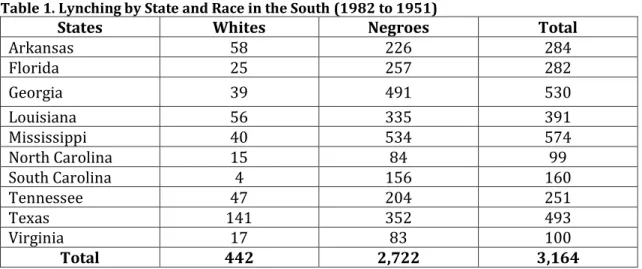
The extreme to which such treatment of black people has been carried in the South has been lynching (associated with Charles Lynch, a Virginia Quaker who was born near the present city of Lynchburg, Virginia in 1737), the hanging of a person suspected of crime by a mob which takes the law into its own hands. In the South, lynching was one means of handling conflict; it has been used mainly against black people. Individuals who were suspected, accused, or convicted of the victim, caught them, held court, brought witnesses, and then meted out punishment to those who they felt were guilty. Blacks become the primary targets in the decades preceding the Civil war, and increasingly so after the war. According to Barry in Kitano: Finally, the period of the Civil War and the Reconstruction saw the pattern of lynching firmly established: courts of law, through in full operation are circumvented; no effort is made to determinate the guilt of the accused; punishment is invariably death, often accompanied by torture; and the victim is usually a Negro (Kitano, 1985: 110). In criticism of lynching treatment by whites in several states in Southern part, so in paragraph (11) on his speech he stated: “…. Texas is a lynch state. It is in the same breath as Mississippi, no different; only they lynch you in Texas with a Texas accent and lynch you in Mississippi with a Mississippi accent.” (Malcolm). In Figure 2 below will show lynching by states in the Southern part based on race.
Table 1. Lynching by State and Race in the South (1982 to 1951)
States Whites Negroes Total
Arkansas 58 226 284
Florida 25 257 282
Georgia 39 491 530
Louisiana 56 335 391
Mississippi 40 534 574
North Carolina 15 84 99
South Carolina 4 156 160
Tennessee 47 204 251
Texas 141 352 493
Virginia 17 83 100
Total 442 2,722 3,164
Source: John Hope Franklin & Isidore Starr, “The Negro in 20th Century America: A Reader on the
Struggle for Civil Rights,” published by Random House, Inc. U.S.A.:1967, p. 186 & 187.
c. The Challenge of Malcolm X to White Superiority and Unequal Position on Civil Rights and Politics
As is well known, in the society governed democratically such America, election determine what laws will be enforce and who will occupy post that involve political rule. In the elections, all adult members of society have a vote and opportunity, and all votes and opportunities are weighed equally. Richard J. Anerson in Justice and Democracy by Dowding, et al. said, “….each person is owned equal concern and respect. Each person’s interest should be given equal consideration in the design of political institution (Dowdin, et al., 2004: 48).
statement below Malcolm was really disappointing with whites, it is because the impacts of the system always bring misery and suffering to the blacks. Paragraph (9) he continued:
No, I'm not an American. I'm one of the 22 million black people who are the victims of Americanism. One of the 22 million black people who are the victims of democracy, nothing but disguised hypocrisy. So, I'm not standing here speaking to you as an American, or a patriot, or a flag-saluter, or a flag-waver - no, not I. I'm speaking as a victim of this American system. And I see America through the eyes of the victim. I don't see any American dream; I see an American night mare. (Malcolm).
In facing those conditions, Malcolm on his speech explicitly opposed and criticized American politicians, both Democrats and Republicans who still practiced filibustering on legislation. They still make an effort to keep back blacks’ political rights passed in the constitution. For example in the case of Civil Rights Act of 1964, since they came into amendment of bill of rights to be constitution, they always played a filibustering effort for aim to keep back political rights of African Americans to pass on constitution. They put blacks at a decided disadvantage; blacks were not allowed to vote at all in many areas and always need to keep unequal rights between whites and blacks in the United States. The statement above was clarified by Malcolm in paragraph (32) on his speech, there he stated:
This is part of the conspiracy. This old, tricky, blue-eyed liberal who is supposed to be your and my friend, supposed to be in our corner, supposed to be subsidizing our struggle, and supposed to be acting in the capacity of an adviser, never tells you any thing about human rights. They keep you wrapped up in civil rights. And you spend so much time barking up the civil-rights tree, you don’t even know there’s a human rights tree on the same floor. (Malcolm).
Furthermore, in following statement, statement in paragraph (33), there was stated that Malcolm wasn’t only intending to struggle of civil rights for blacks, but there he tried to expand civil rights to the level human right. There he continually stated:
When you expand the civil rights struggle to the level human rights, you can then take the case of the black man in this country before the nations in the UN. You can take it before the General Assembly. You can take Uncle Sam before a world court. But the only level you can do it on is the level human rights. Civil rights keeps you under his restriction, under his jurisdiction. Civil rights keeps you in his pocket. Civil rights means you’re asking Uncle Sam to treat you right. Human rights are something you were born with, Human rights are your God-given rights. Human rights are the rights that are recognized by all nations of this earth. And anytime any one violets your human rights, you can take them to the world court Uncle Sam’s hands are dripping with blood, dripping with the blood of the black man in this country. (Malcolm).
Here, Malcolm felt disappointment in facing the filibustering of white politicians in Congress who has been conducting American political system by conspiracies, and all of those are done for the sake of their own interest. Why? It is because Democrats were having the power in controlling the two-third of the power in Congress to ratify the legislation and cut off blacks’ political rights on the constitution. Then by conspiracy they passed the civil rights legislation dependent on them, it means that the constitution has been passed unconstitutionally. In this section Malcolm really disappointed by ways of thinking of white politicians who always kept old giant con game (filibustering) on the ratifying process of the legislation in Congress. So, Malcolm in paragraph (12) on his speech criticized political consciousness of white Southern politicians, he stated:
In this present administration they have in the House of Representatives 257 Democrats to only 177 Republicans. They control two-thirds of the House vote. Why can't they pass something that will help you and me? In the Senate, there are 67 senators who are of the Democratic Party. Only 33 of them are Republicans. Why, the Democrats have got the government sewed up, and you're the one who sewed it up for them. And what have they given you for it? Four years in office, and just now getting around to some civil-rights legislation. Just now, after everything else is gone, out of the way, they're going to sit down now and play with you all summer long - the same old giant con game that they call filibuster. (Malcolm).
Americans to meet because the rule of white politicians coming from Southern part. “In 1964, there was a dramatic change, when over 80 percent of the Southern Democrats in Congress voted against Civil Rights Act” (Wilson, 1992: 532). In this section Malcolm want to say that Southerners are source of white racists in the United States. This statement affirmed in paragraph (11) on his speech, there he stated:
If he wasn't good in Texas, he sure can't be good in Washington, D.C. Because Texas is a lynch state. It is in the same breath as Mississippi, no different; only they lynch you in Texas with a Texas accent and lynch you in Mississippi with a Mississippi accent. And these Negro leaders have the audacity to go and have some coffee in the White House with a Texan, a Southern cracker - that's all he is - and then come out and tell you and me that he's going to be better for us because, since he's from the South, he knows how to deal with the Southerners. (Malcolm).
Malcolm in this part did not look any changes for making something better in American political system when the system still conducted by Southern politicians. He mentioned that either Texan or Mississippian as well, had some very convincing arguments against black people. Why? It is because dixiecreats controlled the government system in Washington D.C. and also because an integration component of the southern racial order is a body of ideas supporting and justifying the system in the United Stated., so that made Negroes couldn’t took part in politics and gaining their political rights. In paragraph (15) on his speech he added:
The Dixiecrats in Washington, D.C., control the key committees that run the government. The only reason the Dixiecrats control these committees are because they have seniority. The only reason they have seniority is because they come from states where Negroes can't vote. This is not even a government that's based on democracy. lt. is not a government that is made up of representatives of the people. Half of the people in the South can't even vote. Eastland is not even supposed to be in Washington. Half of the senators and congressmen who occupy these key positions in Washington, D.C., are there illegally, are there unconstitutionally. (Malcolm).
For Malcolm, word of “Dixiecrats” above is referred to symbol of the confederacy, racialists from Southern part, “These symbols have two meanings—one that promotes the South’s heritage and another that symbolizes slavery, racial separation, and hate…In 1948, the so-called Dixiecrats, rebelling against a strong civil rights plank in the Democratic platform, walked out of the party’s convention” (Ore, 2003: 460). With another words, it was referred to Southern politicians who have been quite open in admitting this discrimination against the Negro. Even before these decisions, white Southerners were working to separate the races to the greatest extent possible. They have maintained that the Negroes have not been given their right of vote because they afraid to lose their power, such as stated in paragraph (18,19,20) on his speech as follows:
If the black man in these Southern states had his full voting rights, the key Dixiecrats in Washington, D. C., which means the key Democrats in Washington, D.C., would lose their seats. The Democratic Party itself would lose its power. It would cease to be powerful as a party. When you see the amount of power that would be lost by the Democratic Party if it were to lose the Dixiecrat wing, or branch, or element, you can see where it's against the interests of the Democrats to give voting rights to Negroes in states where the Democrats have been in complete power and authority ever since the Civil War. You just can't belong to that Party without analyzing it. When you keep the Democrats in power, you're keeping the Dixiecrats in power. I doubt that my good Brother Lomax will deny that. A vote for a Democrat is a vote for a Dixiecrat (Malcolm).
2. Malcolm X’s Ideas and Political Struggle in against Racial Discrimination a. Reinforcing of Self-Help and Black Unity in the Spirit of Black Nationalism
Although I'm still a Muslim, I'm not here tonight to discuss my religion. I'm not here to try and change your religion. I'm not here to argue or discuss anything that we differ about, because it's time for us to submerge our differences and realize that it is best for us to first see that we have the same problem, a common problem, a problem that will make you catch hell whether you're a Baptist, or a Methodist, or a Muslim, or a nationalist. Whether you're educated or illiterate, whether you live on the boulevard or in the alley, you're going to catch hell just like I am. We're all in the same boat and we all are going to catch the same hell from the same man. He just happens to be a white man. (Malcolm).
For Malcolm himself, he considered that racial discrimination and segregation in the United States was the their common problem, so that for coming into the struggle African Americans have to eliminate the discussion about their difference, are they Christians or Muslims or nationalists or whatever they are have to get the solidarity. Here Malcolm argued to form the black unity for aim to get the power and strength in against discrimination and segregation treatment. He believed that the only way for blacks to solve their problem is to build a feeling of solidarity blacks, as Malcolm that is the only solution. Here, Malcolm hopes black people to face their common problem with full of consciousness and suggested to throw over religion diversity, so, in paragraph (2) on his speech he continually stated:
I'm still a Muslim; my religion is still Islam. That's my personal belief. Just as Adam Clayton Powell is a Christian minister who heads the Abyssinian Baptist Church in New York, but at the same time takes part in the political struggles to try and bring about rights to the black people in this country; and Dr. Martin Luther King is a Christian minister down in Atlanta, Georgia, who heads another organization fighting for the civil rights of black people in this country; and Reverend Galamison, I guess you've heard of him, is another Christian minister in New York who has been deeply involved in the school boycotts to eliminate segregated education; well, I myself am a minister, not a Christian minister, but a Muslim minister; and I believe in action on all fronts by whatever means necessary. (Malcolm).
The statement above, it was even if Malcolm himself suggested that religion diversity among African American must be kept in organizations or in the temples because those couldn’t bring the solution to solve the problem, Malcolm did not agree if those religions always bring into discussion then to conclude that you are good and those are bad. He thought that the best solution is how to form black’s solidarity in the sprit of nationalism and then think how to eliminate their common problem and then how to pursue their liberation in the United States. In social, by the spirit of Black Nationalism, Malcolm argued that blacks must become conscious and make serious efforts to remove the evils such as alcoholism, drug addiction, and so forth which can destroy their moral fiber in black communities, so in paragraph (45) he stated:
The social philosophy of black nationalism only means that we have to get together and remove the evils, the vices, alcoholism, drug addiction, and other evils that are destroying the moral fiber of our community. We ourselves have to lift the level our community, the standard of our community to a higher level, make our own society beautiful so that we will be satisfied in our own social circles and won’t be running around here trying to knock our way into a social circle where we’re not wanted. (Malcolm).
In economic, by the spirit of Black Nationalism, Malcolm argued for all of black to become conscious of the importance of controlling the economics of their community. Maybe by operating some businesses and stores, establish some industries, and creating employments, such as stated in paragraph (44) on his speech there he stated:
In politics, by the spirit of Black Nationalism, Malcolm argued that all over blacks must take part in political struggle, by whatever means, to bring blacks’ political rights return. For Malcolm, it means that the black people should control the politics and the politicians in their own community, political autonomy. The arguing for political autonomy that supposed by Malcolm, is a separate nationhood like remarked by Russell Hardin in Dowding’s Justice and Democracy. For Hardin, there are three classes of reason for seeking group autonomy or separate nationhood: 1) satisfaction of interests that the group’s members have in the ordinary kinds of policy that more or less all persons have interests in; 2) self-expression of a group or protection of its racial, linguistic, religious or other purity; 3) capacity to participate reasonably fully in politics, as in the case of some linguistic groups (this is essentially a concern grounded in the nature or democracy) (Dowding et al., 2004: 189). Here, in pursuing the separate nation or nationhood which is proposed by Malcolm, used the second class of Russell’ classification. Related to Russell’s purposing, Malcolm, in enforcing philosophy Black Nationalism among blacks by using racial identity (Blacks’ Pride) to protect the unity of black Americans in against discrimination such as stated in paragraph (42) on his speech, there he stated:
The political philosophy of Black Nationalism is being taught in the Christian church. It’s being taught in the NAACP. It’s being taught in CORE meetings. It’s being taught in the SNCC meetings. It’s being taught in the Muslim meetings. It’s being taught where nothing but atheist and agnostics come together. It’s being taught everywhere. Black people are fed up with the dillydallying, pussyfooting, compromising approach that we’ve been using toward getting our freedom. We want freedom now, but we’re not going to get it saying “We Shall Overcome.” We’ve got to fight until we overcome. (Malcolm).
b. Strengthening of International Approach on Civil-Rights Struggle
Malcolm began to moderate his hostile views of white Americans after forming The Organization of Afro-American Unity. He later changed his militant stance after visiting Mecca, Middle East and getting true taste of what it really meant to be a Muslim. The OAAU stressed Afro-American and African unity, an international approach to fighting colonialism and imperialism. He took their anxiety as a sign of strength that blacks in America could have if the unity with their brothers in Africa. The organization is an international nonreligious group, open for membership to all persons of Africa descent.
In organization of OAAU, Malcolm welcomed blacks of all religious denominations. The aim of OAAU is to promote social, education, and political reform in fighting colonialism and imperialism. And by this organization he then urged black people to come together in harmony to get the solution in eliminating the problem such as stated in paragraph (46) on his speech, that, “We have to see each other as brothers and sisters. We have to come together with warmth so we can develop unity and harmony that’s necessary to get this problem solved ourselves” (Malcolm).
3. Malcolm X’s Method and Strategy of Struggle
In his political struggle, Malcolm used “revenge” strategy in countering the white racist. It is done when he break with Nation of Islam, he provoked black unity and spirit of nationalism by using revenge strategy in against oppression and racism of white America in gaining blacks’ political rights and liberation. Malcolm himself, he mentioned that revenge strategy by non-violent action was the favorable means to solve the black’s problem or to eliminate discrimination and segregation. In paragraph (52) on his speech he stated: “We will work with anybody, anywhere, at any time, who is genuinely interested in tackling the problem head-on, nonviolently as long as the enemy is nonviolent, but violent when the enemy gets violent.
The aim of Malcolm to use this strategy was based of needing to eliminate white influence from blacks then advocated for a separate and independent black nation America. It said because Malcolm mentioned that “integration with white society was like trying to crawl back on the plantation” (Breitman, 1965: 10). So, he considered that the only thing for gaining the liberation is to propagandize violent action and revenge strategy then come into fighting by using guerilla warfare. It was stated in paragraph (24) on the speech he explicitly stated:
coming in. There’s new thinking coming in. There’s new strategy coming in. It’ll be Molotov cocktail this month, hand grenades next month, and something else next month. (Malcolm).
Malcolm enforced himself to use violent action or militant approach in countering white racists because he has been remembered by his lives and family as victims of white racist who brutally treated them during in his childhood, especially by memory of the death of his father and mother in the hand of Ku Klux Klan. So, the way in countering white racists must be done in revenge strategy. For Malcolm, he justified for using militant action to defend blacks’ property and lives from brutal action of whites because ha mentioned that blacks had had guarantee by constitution to defense their own rights, property, and lives from the enemies, so militant action was a legal action and didn’t be in conflict with constitution. So in facing brutal action of whites even police dog, as Malcolm, it was not prohibition to use militant action or by necessary means. Explicitly, stated in paragraph (29, 39):
Any time you demonstrate against segregation and a man has the audacity to put a police dog on you, kill that dog, kill him, I’m telling you, kill that dog. I say it, if they put me in jail tomorrow, kill—that—dog. Then you’ll put a stop on it. Now, if these white people in here don’t want to see that kind of action, get down and tell the major to tell the police department to pull the dogs in. That’s all you have to do. If you don’t do it, someone else will. (29). I just want to give you a little briefing on guerilla warfare because, before you know it, before know it—It takes heart to be a guerilla warrior because you’re on your own. In conventional warfare you have tanks and whole lot of other people with you to back you up, planes over your head and all that kind of stuff. But a guerilla is on his own. All you have is a rifle, some sneakers and a bowl of rice, and that’s all you need—and a lot of heart. (39).
E. Conclusion
The first thing to be said Malcolm as a political thinker when he was seventeen-years in Nation of Islam. There, he didn’t consider politics a legitimate activity for black Americans because he mentioned that American government represented the interest only for whites. He desired a separation, separate from whites is the better thing than integrated one. For Malcolm, the desire of African American to integrate with white society was like trying to return them on plantation. So Malcolm in the Nation of Islam he became spokesman and built a religious sect that was both anti-Christian and anti-American, he saw black citizens in the United States as the victims of Americanism.
Malcolm freed himself of the religious restrains which only based on teaching that sometimes called passive movement that had previously kept his social activism focused on gaining converts to the Nation of Islam rather than political reform. He no longer saw whites as devils and separatism rhetoric, he then forced brotherhood upon people. It is preached after returning from holy land of Mecca and by disagreement any loyalties to Elijah Muhammad. He left Nation of Islam at the climax of Martin Luther King, Jr. popular as leader of the civil rights movement during 1963 and 1964.
For Malcolm, he believed that in gaining the liberation of blacks, Nation of Islam must come into greater force in the American black man’s overall struggle. So, those times he preached a message of racial uplift that included a political element. Finally, he reformed racial movement with a simple definition of his program of Black Nationalism. Malcolm pressured the ideology black nationalism for blacks’ community, in which politically, advocated political participation in blacks’ community by controlling the own politics and black’s politicians. And economically, he pressured black ownership by the development of the stores and business entire blacks’ community. Finally, in black nationalism, he called for black unity and prepare blacks’ moral attitude and built a mental consciousness by eliminating the “evils” such as alcoholism and drug addiction that are destroying the moral fiber of blacks community.
What is happening in the United States is one facet of the world-wild revolution of rising expectation. Colonialism is dead. White supremacy is dying. Once the first Negro was educated, once slavery was abolished, America made her choice. Negroes will demand and secure the same rights as other citizens. But the question is, are African Americans so called Negro would be able to defend their equal rights in “American dream?”
F. References
Brinkley, Alan. (2004). The Unfinished Nation: A Concise History of the American People, 4th ed.
New York: The McGraw-Hill Companies, Inc.
Dowdin, Keith, Robert E. Goodin, & Carole Pateman. (2004). Justice and Democracy. U.K.: Cambridge University Press.
Franklin, H. John & Isidore Starr. (1967.). The Negro in 20th Century America: A Reader on the
Struggle for Civil Rights. U.S.A.: Random House, Inc.
Frost, Bryan-Paul and Jeffrey Sikkenga. (2003). History of American Political Thought. An editing book. U.S.A: Lexington Books.
Gordon, Milton. (1964). Assimilation in American Life, New York, U.S.A.: Oxford University Press. Issel, William. (1985). Social Change in the United States, 1945 – 1983, 1st American ed. New
York: Schocken Books.
Kitano, H. L. Harry. (1985). Race Relations, 3rd ed. New Jersey, U.S.A.: Prentice-Hall, Inc.
Meier, August, et al. (1971). Black Protest Thought in the Twentieth Century, 2nd ed. U.S.A.: The
Bobbs-Merrill, Inc.
Ore, E. Tracy. (2003). The Social Constitution of Difference and Inequality: Race, Class, Gender, and Sexuality, 2nd ed. New York: McGraw-Hill Companies, Inc.
Pincus, L. Fred and Howard J. Ehrlich. (1994). Race and Conflict: Contending Views on Prejudice, Discrimination, and Ethnoviolence. U.S.A.: Westview Press, Inc.
Rose, Peter Isaac. (1997). They and We: Racial and Ethnic Relations in the United States, 5th ed.
U.S.A.: The McGraw-Hill Companies, Inc.
Wilson, Q. James. (1992). American Government: Institutions and Policies: 5th ed. Lexington,