ISSN 2476-7611
1
Identification, analysis and analysis of the causes of delays in Iran's
development projects and their reduction rates
Amir Yaghouti Lighvan1*, Maria Mackova2
1- Master of geotechnical Engineering, Faculty of Civil engineering ,Tabriz university, Tabriz, Iran. 2- Faculty of Civil Engineering ،Cardiff University, UK.
Received: 12, September, 2018 Accepted: 21, October, 2018 Online Published: 26, December, 2018
Abstract
In the last decade, with the intensification of sanctions in Iran, there are problems in the process of construction and operation of construction projects. In this research, the effects of various factors on the emphasis on development projects by field studies and using the hierarchical analysis method have been investigated and solutions have been proposed to reduce emphasis. The results of field studies show that the impact of sanctions, inflation, and economic conditions on many projects and the implementation of operations of most of the projects have been interrupted, which should be restrained in terms of contracts or inflation control. Also, the wrong design and precision in the correct estimation have increased the length of the projects. Without proper planning and lack of contract to the timetable, other factors, partly due to lack of proper financing for the employer. Also, the lack of use of contractors and consultants in some projects is another reason for delays that increase delays in projects with high technical complexity. Credentials between employers, advisers and managers in the current economic situation in the country have not met the appropriate and measurable risks and costs, and there are more delays in the projects that need to be reviewed. Reducing government revenue and trading other currencies is another reason for the delay of development projects. Also, the results of this study indicate that the impact of the commitments on project financing, the prolongation of the time of entry of external equipment is another reason for the delays of these projects. Latency reduction solutions also strengthen the domestic contractor and the use of native forces, which accelerates the implementation of projects. Also, the use of indoor equipment and production will reduce the project's delay and cost. Delays in the payment of contractors' claims, and as soon as they have exceeded the contract, also reduced their willingness to continue working in projects, which is to start financing and execute any construction project from the secured place and in the maintenance fund for up to Project implementation has been gradually spent. The precision in designing and determining the price and cost of the project and the proper planning of management is one of the other ways of reducing the delays of construction projects. Based on the results of the AHP model, the delay in paying claims of contractors with the impact of 33.1% has the greatest impact, the increase in labor costs, and Kucho consumption and flow with a 26.26% effect, external trade delays, increased purchase time and external equipment utilization with an impact of 4.8% 17%, the lack of use of consultants and practitioners 8.8%, mistakes in the design and implementation of projects with an impact of 7.4%, employer problems such as lack of proper financing or delay in land tenure and provision of documents with an impact of 4 / 1 percent, increase in investment in Iran's construction projects with an impact of 3.1 percent, lowering the financial strength of banks in project financing, and an additional impact of 09.09 percent Factors delay Iran's development projects.
Keywords: Prioritization, Delays, Development Projects, Analytical Hierarchy Process AHP
1.INTRODUCTION
Iran's development projects play a major role in the economic growth of the country and they are always referred to as the vital arteries of the country's economy. Given the importance, diversity and complexity of these projects, as well as the limited financial resources of the country, the status of Iran's construction projects There are several conditions. Some projects are delayed and others have long delays. These long delays have caused some of these projects to go far behind their initial goals, and the benefits of constructing them with difficulty and interruption. In construction projects, employers usually seek to determine the delays so that they can exploit the project as soon as possible, and they are able to calculate damages and delinquency of contractors, and provide proper indications of the amount of additional expenditures imposed on the project. And on the other hand, using past experiences, they can prevent similar occurrences in the future. On the other hand, it is common practice for contractors to justify their delays and avoid damages. Therefore, identifying the reasons
for the delay in these projects will prevent future delays in future projects and other development projects.
2. LITERATURE AND RESEARCH BACKGROUND
Due to the general nature of the issue of delays in all countries and their importance, many researchers have studied the factors causing delays in development projects. Manger Vatwil has identified the most important causes of delays in construction projects in Lebanon as a delay in supplying materials, Human resources, equipment, financing, design changes, government affiliations, issues related to project management, workshop conditions, environmental issues, contractual relationships, and contract types. [1]
2 of materials are among the important factors of delays, while delinquency factors and rising costs in developed countries, such as the United States and the United Kingdom, are more than unpredictable factors. Forecast is like unfavorable weather and human resource performance. [3] Or Frampong and his colleagues, in reviewing the views of employers, consultants and contractors in Ghana, state the most important causes of delays in construction projects in the country [4]:
their continuous price
Dulong and his colleagues highlighted the five main causes of delays in the development projects of the country, with the emphasis on the impact of geographic variables during the implementation of the projects, and by collecting the views of the involved groups in the implementation of the development projects of the country. [5]
• Insolvency of designers and contractors • Changes in managers and miscalculations • Social and technical issues
• Issues of land and land ownership • Inappropriate techniques and procedures
Zara and colleagues explored the major causes of delays in Saudi Arabia's development projects in 2016. In his research, he identified eight major factors in this issue as follows:
perienced contractors
-assessment when selecting contractors
the employer and assistant
the contractor
Lack of experienced consultants in design and implementation
In this study, he cited the reasons for delays to the contractor,
as well as the reasons for the employer and the consultants. It also provides solutions to reduce delays
[6].
In a 2012 study, Mohamed studied the role of the employer in delaying construction projects in Saudi Arabia. In this study, he considers the bureaucracy in the employer's system to be the main reasons for project delays. Also, the lack of timely payment to contractors, land acquisition problems, and delays in resource allocation are among other reasons related to the employer [7].
In the year 2016, Caratos and his colleagues studied the causes of delays in nuclear power plant projects. In this study, he studied a case of several nuclear power plants in countries such as the United States and Japan. He cites the main reasons for delays as follows:
plant
specifications and project values
The results of his research show that, given that these plants have unique properties and use certain equipment, the main reason for delays in these projects is usually the supply and operation of these equipment. The reasons for mistakes in designing or changing values are also due to reasons attributed to the employer and the consultant. He also outlines ways to speed up the implementation of these projects [8]. Wambeek and colleagues explored the reasons for the change in the time of projects in 2013 and their reasons, such as changing the scope of the project, employer financial problems, design mistakes, poor contractor performance, and technical issues, among the main reasons for this issue. [9]. Aziz and his colleagues in 2016 examined the reasons for delays in construction projects in different countries and categorized them. The number of major reasons for delays in different countries is shown in the following
figure.
3 They then categorized and analyzed the reasons in different countries. The results of their research showed that the reasons for delays in developed countries are mainly due to unpredictable reasons such as natural disasters, earthquakes, etc., and the reasons for delay in developing countries are mainly financial and management issues, as well as the weakness of the contractor [10].
In 2012, Casas investigated major reasons for delays and increased costs in the development projects of Turkey. He studied 71 projects in this study. The results of his research showed that the main reasons for delays in the development projects of the country are as follows [11]:
In 2016, Larson and his colleagues examined three factors of time, cost, and quality in various development projects, and factors that affect these three parameters. The results of his research showed that in the discussion of the time, mainly financial reasons prolong the projects. Also, in the discussion of costs, the advisor's mistakes, the change of materials and equipment, and the change in volumes have led to an increase in project costs. Also, in the quality debate, contractors' mistakes and failures are among the main reasons for quality degradation. [12] Golzak and his co-author of the study in 2015 The reasons for delays from the employer's point of view were compared to projects in different countries, and compared some countries. In this study, by conducting field studies from employers of projects in different countries, they concluded that the reasons for delays and increases in costs in each country are usually unique and due to the economic and social conditions of that country, these reasons are different, but the main reasons In developing countries, it is related to economic issues.
[13] Joong and his collaborator in a 2016 study explored and modeled the causes of climate delays in high-rise buildings projects. Considering the fact that at the time of construction of high-rise buildings, the issue of climate change in altitude caused difficulty and increased the delay in the project's implementation process. In this study, by studying the climate conditions, its effects on the delays of these projects were examined [14] .
3. MATERIALS AND METHODS
In this research, various methods have been used for research. These methods generally include:
1. Field studies in development projects
2- Preparation of AHP Hierarchy Analytic Model Matrix for Weighting Factors Affecting Delays
One of the suitable methods for this research is interviews with project development experts and project executives in Iran. Based on their expertise and experience in this field, these people are the best people to get information about in this field. In this research, we have tried to obtain information from the statistical society, the status of construction projects and factors affecting Their delays are studied.
In statistics, to examine the effects of different factors in which the ranking or prioritization of the impact of different factors has been raised, has been open for several years with decision-making methods with multiple indicators. Of these, the Analytical Hierarchy Process (AHP) method has been used more than any other method in management science. Analytical hierarchy process can be used when the impact of several factors is important or decision making with several competing choices and criteria of decision-making can be used. The proposed criteria can be quantitative and qualitative. The basis of this decision-making method lies in paired comparisons [15]. In this research, hierarchical analysis method has been used to prioritize and weigh the factors affecting the delay of development projects. The use of this method involves the following five main stages:
A-modeling
In this step, the problem and purpose of decision making are presented in a hierarchy of decision elements that are interrelated. Decision elements include "decision indices" and "decision options". The hierarchical analysis process requires breaking a problem with several indicators into a hierarchy of levels.
B-Preference judgments (paired comparisons)
4 C. Relative weight calculations
The next step in the hierarchical analysis process is to perform the computations necessary to determine the priority of each decision element using the information of the pairwise matrix matrices.
D-Integration of relative weights
In order to rank the decision options, at this stage, we must multiply the relative weight of each element in the weight of the higher elements in order to obtain the final weight. By doing this for each option, the amount of final weight is obtained.
O Compatibility in options
Almost all calculations of the hierarchical analysis process are based on the initial judgment of the decision maker, which appears in the form of a paired
comparison matrix, and any errors and
incompatibilities in comparison and determining the importance between the options and the indices make the final result obtained from the calculation distorted. Makes. The adjustment rate shows how much confidence can be gained from the comparative priorities. Experience has shown that if the adjustment rate is less than 0.15, the comparative compatibility is acceptable and otherwise the comparisons should be reviewed [17].
The statistical population of this research has been selected by experts and players involved in the development projects of Iran including employers, consultants and contractors. These projects mainly include construction, construction, industrial, power plant, dam construction and water and sewage projects. At first, 70 experts were selected, some of whom were not available to access, and some were reluctant to collaborate or provide information. In the following, we received about 57 comments from experts, some of which were either misleading or incorrectly filled out. Finally, 50 valid and valid questionnaires were selected. The following is a summary of the results.
4- ANALYSIS OF FIELD DATA
In conducting field studies, the first factor to be considered was the late payment of contractors' claims. Due to the effect of sanctions on the general conditions of the country and the reduction of government revenues, this led to delays in the claims of contractors. Here are the effects of this issue.
In this question, there are differences in the views of employers, consultants and contractors. Most employers believe that the delay in paying contractor claims due to the impact of sanctions has had a moderate impact on the lag of projects, while most advisers believe that these effects are high and that contractors also consider it to be very significant if their demands are in place They were paid, while retaining their value, were able to offset project costs with lower percentages of inflation.
One of the challenges facing most of the construction projects in Iran is the lack of proper planning due to the economic and social conditions of the country. This makes the scheduling schedules at the beginning of the projects meet with long delays and can be seen That the project time is multiplied. Sanctions have also caused this problem to be doubled, and this has been more pronounced, especially in a number of development projects using special equipment and equipment. The results show that most experts believe that the impossibility of proper planning and contractor failure to schedule has had a major impact on project delays.
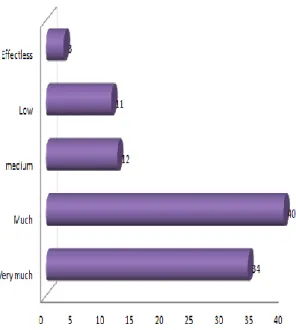
The use of contractors, advisers and experienced staff is also another factor that indirectly affects project delays. In many development projects that require the use of experienced consultants and contractors, these companies For various reasons, they do not have effective presence in the projects and practically do not
[15]
Table 1: Valuation of indices relative to each other in the AHP model
Preferred value Comparison of i with j
description
1 Equal importance
The option or index i is equal to or less important than j.
3 Relatively more important
The option or index i is somewhat more important than j.
5 More importantly
The option or index i is more important than j.
7 More importantly
The option or index i has a much higher priority than j.
9 Absolutely important
The option or index i of j is not much more than comparable to j
.
2.4.6.8 Intermediate effects
The mean values represent the preferred values, for example, 8, representing significance greater than 7 and
lower than 9
.
Preferred value Comparison of i with j
description
1 Equal importance
The option or index i is equal to or less important than j.
3 Relatively more important
The option or index i is somewhat more important than j.
5 More importantly
The option or index i is more important than j.
7 More importantly
The option or index i has a much higher priority than j.
9 Absolutely important
The option or index i of j is not much more than comparable to j
. 2 و 4 و 6 و 8 Intermediate effects
The mean values represent the preferred values, for example, 8, representing significance greater than 7
and lower than 9 .
5 seriously pursue the issues and problems of the projects. Normally, in order to compensate for some of the costs, some contractors use cheaper and less experienced forces, which ultimately lead to reduced quality, rework in some projects, and increased latency.
In this question, most employers, consultants and contractors also agree that the use of tried and tested contractors and consultants in some projects has decreased and this has had a great influence on the implementation process of construction projects, and in addition to the time of projects, their quality also Reduced. This is especially evident in high-tech projects such as oil projects.
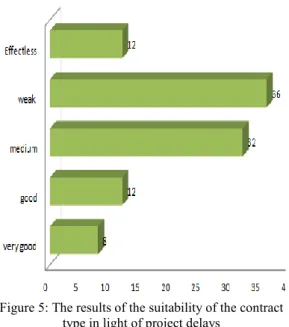
Another factor that directly affects project delays is the type of contract concluded between the project's agents, including the employer, the contractor and the consultant. In each country, depending on the circumstances of that country, the conditions of political, economic and social conditions in that country are concluded between the employer, the contractor and the consultant. Naturally, in countries with high levels of stability, changes in rates and contracts are not very high, but in a country like us that
is high in inflation and the political and economic conditions are not stable, the risk of contracts has been high and should be taken into account. In this section, the statistical community has come up with an idea of the appropriateness of contracts in terms of project conditions and delays.
Employers, consultants, and contractors all believe that depending on the conditions of the projects, the type of contracts concluded between different factors, such as the employer, the contractors and consultants, is not appropriate, and the existing risks do not fully cover risks and economic considerations and cause further delays Projects will be. This issue is more pronounced among contractors, and contractors believe that the current type of current contracts does not compensate for inflation caused by rising costs and risks, and should be reviewed according to the prevailing conditions of the community.
One of the other things that can be effective in improving the project's progress and reducing their costs and costs is to make Watka indigenous to domestic. This is one of the important issues in reducing the delay of Iran's development projects. Below are the results of the impact of the use of internal and internal capacity on reducing project delays.
Figure 3: Impact of contractor failure to schedule scheduling on project delays
Figure 4 - The effect of not using experienced and experienced staff on project delays
Figure 5: The results of the suitability of the contract type in light of project delays
6 These results show that all factors have the belief that in the present situation, the localization of Watka has had a positive impact on the process of projects, and has reduced the costs and costs of projects.
Construction projects are among the projects that make the most of the use of equipment, materials and materials for the materials. Other items that have a direct impact on the lagging of construction projects are the use of equipment, materials and domestic products. This has a two-way effect on projects:
development of the country has led to the development of production.
reduce project delays.
Among other important factors is the reduction of banks' ability to provide facilities, as well as the lack of allocation at the right time. This issue has affected construction projects in two respects:
foreign exchange transactions, a large part of the resources of banks abroad has been blocked and their ability to finance construction projects has been reduced.
financial institutions do not have much interest in investing in Iran's construction projects, and they require significant amounts when investing because of high risks.
Both of these factors will increase the time of projects and, ultimately, increase their costs. In this section, all the factors of the contractors have stated that the necessary facilities for the completion of the projects have not been allocated at the required time, and this The factor can be considered as an effective delay. Other factors affecting the delays in Iran's construction projects are false design and lack of proper estimation of values in some construction projects.
5- Weighing and lubricating factors affecting the delay of Iran's construction projects using the AHP model According to the contents presented in the previous section, in order to investigate the effect of each of the above factors on the delay of development projects, their impact on the AHP model was used. For this purpose, the matrix was prepared as follows, and experts were asked to assign the desired option depending on the effect of each of the factors relative to the other numerical factor from 1 to 9. The main causes of delays in development projects are:
A. Increased wages and labor costs and labor and labor costs of the country
B. Delays caused by foreign exchanges, increased purchase time and utilization of external equipment in the project
C. Lack of qualified consultants and consultants D. Wrong design and incorrect presentation of the volumes of projects
E. Reduce Banking Fiscal Power in Project Financing F. Late payment claims of contractors
G. Increasing investment risk in Iran's development projects
H. Employer problems such as lack of proper financing, or delays in land acquisition and documentation
Table 3. Outcomes of the AHP model
Figure 7: Impact of design and estimation of construction project delays
7 Considering the views of the statistical community, if we want to compare the impact of different factors on the delays in Iran's development projects using the AHP model, compare them with each other. The results will be as follows.
1- The delay in paying claims of contractors with the impact of 33.1% has the greatest impact
2. Increased wages and labor costs and drainage and drainage costs by 26.4%
3. Latents due to foreign exchange, increased purchase time and utilization of external equipment with an impact of 17.4%
4- Not employing experienced consultants and contractors with 8.8%
5- Misconception and incorrect presentation of the volumes and projects of the project with an impact of 7.4%
6- Employer problems such as lack of proper financing or delay in land tenure and provision of documents with an impact of 1.4%
7. Risk of investment in Iran's construction projects with an impact of 1/3%
8. Reduce banks' financial strength in financing projects with an impact of 1.9%
In this case, the index of CI or CONSISTENCY INDEX compatibility was 0.13, which is acceptable and shows the consensus and uniformity of the statistical community's views.
5-RESULTS AND SUGGESTIONS
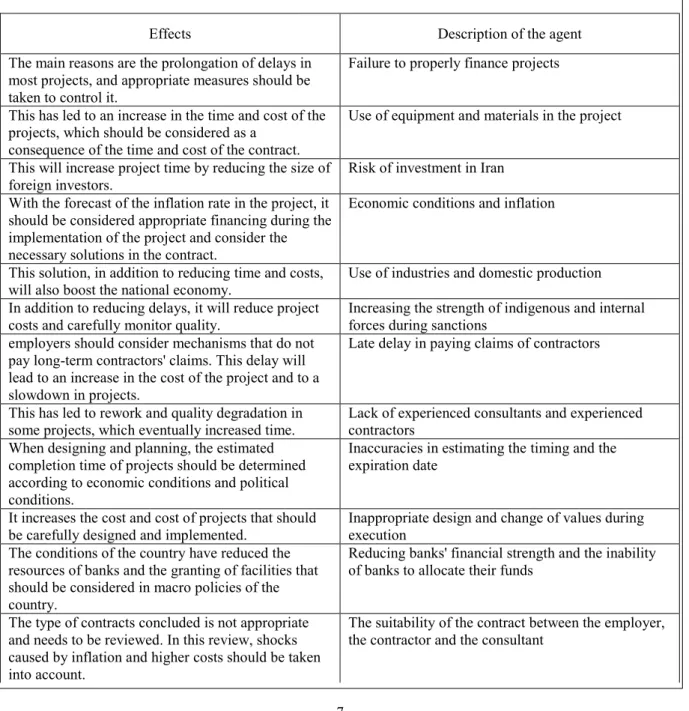
Considering the information obtained from the statistical society and field studies and considering the weight of various factors, we can summarize the effects of various factors on the delays of construction projects as follows:
Table 4. Summary of the Impact of Different Factors on Increasing Delays in Iran's Development Projects.
Effects Description of the agent
The main reasons are the prolongation of delays in most projects, and appropriate measures should be taken to control it.
Failure to properly finance projects
This has led to an increase in the time and cost of the projects, which should be considered as a
consequence of the time and cost of the contract.
Use of equipment and materials in the project
This will increase project time by reducing the size of
foreign investors. Risk of investment in Iran
With the forecast of the inflation rate in the project, it should be considered appropriate financing during the implementation of the project and consider the necessary solutions in the contract.
Economic conditions and inflation
This solution, in addition to reducing time and costs,
will also boost the national economy. Use of industries and domestic production In addition to reducing delays, it will reduce project
costs and carefully monitor quality. Increasing the strength of indigenous and internal forces during sanctions employers should consider mechanisms that do not
pay long-term contractors' claims. This delay will lead to an increase in the cost of the project and to a slowdown in projects.
Late delay in paying claims of contractors
This has led to rework and quality degradation in
some projects, which eventually increased time. Lack of experienced consultants and experienced contractors When designing and planning, the estimated
completion time of projects should be determined according to economic conditions and political conditions.
Inaccuracies in estimating the timing and the expiration date
It increases the cost and cost of projects that should
be carefully designed and implemented. Inappropriate design and change of values during execution The conditions of the country have reduced the
resources of banks and the granting of facilities that should be considered in macro policies of the country.
Reducing banks' financial strength and the inability of banks to allocate their funds
The type of contracts concluded is not appropriate and needs to be reviewed. In this review, shocks caused by inflation and higher costs should be taken into account.
8 According to the studies of this researcher and the experience gained from this research at the end of the proposals to improve the implementation process of construction projects are presented, most notably as follows:
of these projects, it is suggested that a fundamental review of the price of contracts concluded by the government, especially in 1397, be made.
cal knowledge, it is possible to build and use specific equipment within the country to minimize delays.
starting and executing any development project, its financing should be secured from secure locations and kept in a fund to be gradually spent during the project implementation.
of the projects and the proper planning will prevent delays, over-runs and re-expenditures.
reviewing the implementation of development projects and reducing the time of projects before starting
any
project.
FUNDING/SUPPORT
Not mentioned any Funding/Support by authors.
ACKNOWLEDGMENT
Not mentioned.
AUTHORS CONTRIBUTION
This work was carried out in collaboration among all authors.
CONFLICT OF INTEREST
he author (s) declared no potential conflicts of interests with respect to the authorship and/or publication of this paper.
References
1. Baldwin, J. R., Manthei, J. M., Rothbart, H., & Harris, R. B. (1971). Causes of delay in the construction industry. Journal of the Construction
Division, 97(2), 177-187. [Scholar]
2. Sonuga, F., Aliboh, O., & Oloke, D. (2002). Particular barriers and issues associated with projects in a developing and emerging economy. Case study of some abandoned water and irrigation projects in Nigeria. International Journal of project
management, 20(8), 611-616. [Scholar]
3. Chan, D. W., & Kumaraswamy, M. M. (2002). Compressing construction durations: lessons
learned from Hong Kong building
projects. International journal of project
management, 20(1), 23-35. [Scholar]
4. Frimpong, Y., Oluwoye, J., & Crawford, L. (2003). Causes of delay and cost overruns in construction of groundwater projects in a developing countries;
Ghana as a case study. International Journal of
project management, 21(5), 321-326. [Scholar]
5. Long, N. D., Ogunlana, S., Quang, T., & Lam, K. C. (2004). Large construction projects in developing countries: a case study from Vietnam. International Journal of project
management, 22(7), 553-561. [Scholar]
6. Alzara, M., Kashiwagi, J., Kashiwagi, D., & Al-Tassan, A. (2016). Using PIPS to minimize causes of delay in Saudi Arabian construction projects: university case study. Procedia Engineering, 145, 932-939. [Scholar]
7. Mahamid, I., Bruland, A., & Dmaidi, N. (2011). Causes of delay in road construction
projects. Journal of Management in
Engineering, 28(3), 300-310. [Scholar]
8. Alsharif, S., & Karatas, A. (2016). A framework for identifying Causal factors of delay in nuclear power plant projects. Procedia Engineering, 145, 1486-1492. [Scholar]
9. Wambeke, B. W., Hsiang, S. M., & Liu, M. (2011). Causes of variation in construction project task starting times and duration. Journal of construction
engineering and management, 137(9), 663-677.
[Scholar]
10.Aziz, R. F., & Abdel-Hakam, A. A. (2016). Exploring delay causes of road construction projects in Egypt. Alexandria Engineering
Journal, 55(2), 1515-1539. [Scholar]
11.Kazaz, A., Ulubeyli, S., & Tuncbilekli, N. A. (2012). Causes of delays in construction projects in Turkey. Journal of Civil Engineering and
Management, 18(3), 426-435. [Scholar]
12.Larsen, J. K., Shen, G. Q., Lindhard, S. M., & Brunoe, T. D. (2015). Factors affecting schedule delay, cost overrun, and quality level in public construction projects. Journal of Management in
Engineering, 32(1), 04015032. [Scholar]
13.Głuszak, M., & Leśniak, A. (2015). Construction delays in clients opinion–multivariate statistical analysis. Procedia engineering, 123, 182-189.
[Scholar]
14.Jung, M., Park, M., Lee, H. S., & Kim, H. (2016). Weather-delay simulation model based on vertical weather profile for high-rise building construction. Journal of construction engineering
and management, 142(6), 04016007. [Scholar]
15.de FSM Russo, R., & Camanho, R. (2015). Criteria in AHP: a systematic review of literature. Procedia
Computer Science, 55, 1123-1132. [Scholar]
![Figure 1. Delayed reasons for projects in different countries [10]](https://thumb-us.123doks.com/thumbv2/123dok_us/8078976.2140395/2.892.127.767.862.1089/figure-delayed-reasons-projects-different-countries.webp)