382
ANALYTICAL CALCULATION OF WATER RETENTION CAPACITY,
SPECIFIC FOR FORESTRY TERRACES SITUATED ON SLOPE DEGRADED
LANDS
TUDOSOIU C.1),ACHIM Elena. 1), GANEA-CHRISTU I.2)
1)INCDS “Marin Drăcea” / Romania, 2)INMA Bucharest / Romania E-mail: [email protected]
Keywords: forestry terraces, degraded lands, conterslope
ABSTRACT
Terracing slopes necessitate making of "steps" along level lines, which ensures the processing of land on a certain percentage of the total area. The main constructive feature of terraced is the platform, namely width and counterslopes. Platform terraces are arranged with counterslopes, which ensures conditions for accumulation of rainwater and slows surface leaks, favoring the development of woody vegetation (trees, shrubs, fruit trees, vines) and fixes the mobilized soil by terracing action.
Given the above, it raises the question of determining the water volume that canaccumulate depending on the width and terrace contraslope tilt.
INTRODUCTION
Degraded lands, especially those eroded, are mostly land situated on a slope which over time have been subject to deep compactions due to pasture activity of land whose destination were included in the category pastures. Mobilizing the entire soil surface located on slope, creates favorable conditions for erosion intensification. Therefore it is recommended if works are carried out, soil mobilization to be carry out along level curve by processing the land on strips, by plowing or terracing [3].
Lithological diversity, complexity of the geological structure and their powerful tectonic movements,new and existingcrustmovements, preponderance sculptural landforms and their obvious energy, aggressive manifestation of weather phenomena and geographical landscape anthropization is the cause of degradation processes and current rains[2].
Terracing slopes necessitate performance of "steps" along the contour line, processing that ensures a certain percentage of the total area. Achieving terraces can be done manually ,with minimal productivity, or it can be done through specific mechanical means [4]. The process of execution the terraces involves mobilizing soil to depths of 25 to 30 cm, and the terrace platform is arranged in contraslope of 5 ° ÷ 10 °.The distance between the executed terraces and platform width, vary depending on:
- way of manufacturing (manual / mechanical); - field slope;
- soil deepening;
- cantitateaquantity of skeleton located in mobilizat material; - nature of lithology rock;
- forest vegetation subzone.
383
Water accumulation at the baseof contraslope, favoring the development of forest vegetation, especially in the early years of its installation, thus minimizing the percentage of loss of seedlings, phenomenon due mainly from the lack of water.
In areas of forest vegetation, own steppe and forest steppe, where drought is particular, water accumulation in soil volume proper for platform for terrace builtin contraslope, is an essential condition for a successful crop, keeping humidity below wilting coefficient,together with the fact that soil moisture can be 10% ÷ 20% higher than in the non- terraced field condition [3].
Specialized work and research carried out of renowned experts in forestry, indicated that in the condition of unsupported terraces platform, executed with manual work, were registered for:
wide terraces 0.7÷ 0.8 m, with of distance of 2.0 ÷ 3.0 m, that measured form a ax of a platform to another, that had very good results in the forest area, respectively subareas beech, spruce and low productive land to highly eroded lands, with slopes between 15o ÷ 35o (40o);
wide terraces 0.75 ÷ 1.20 m, with of distance of 2.0 ÷ 3.0 measured form a ax to another, have achieved good results in dry regions such as steppe and forest steppe and the lower parts (of altitude) forest area, on slopes with a tilt of 5o ÷ 10o, medium deep soils (70 cm), disposed on the lithology substrate consists of friable rocks (loess, sands, gravels etc.) [3];
Regarding afforestation of degraded lands, on slopes, best results were achieved through the establishment of plantations, direct sowing not representing considerable success, due to heavy stationary conditions.Planting seedlings on resulting surface due to the use of terrace platform constructed in contraslope, It can be achieved by using most often a forest species such as, sea buckthorn (Hippophaë rhamnoides), locust (Robinia pseudaccia),glade (Gleditia triachanthos), willow (Elaeagnus angustifolia), (Celtis australis), black pine (Pinus nigra), scots pine (Pinus sylvestris). [4].
The literature indicates only slightly measurements made on the amount of water that accumulates and is retained in contraslope on terraces forest.Geometric elements and constructive of forestry terraces do not fall in the spectrum of terraces used in viticulture and fruit growing.
By this study it is desired to be determined analytically depending on the geometric characteristics of the terraces made with contraslope, the volume of water accumulations. In addition, according to the available information, determined experimentally, the accumulation of water which is carried on the forestry terraces having the widths between 0.6 ÷ 1.0 m, can determine the amount of water accumulated on the terraces with greater width, by interpolating the reported data.
MATERIAL AND METHOD
GEOMETRICELEMENTSSPECIFICFORFORESTRYTERRACESHAVINGCONTRASLOPE
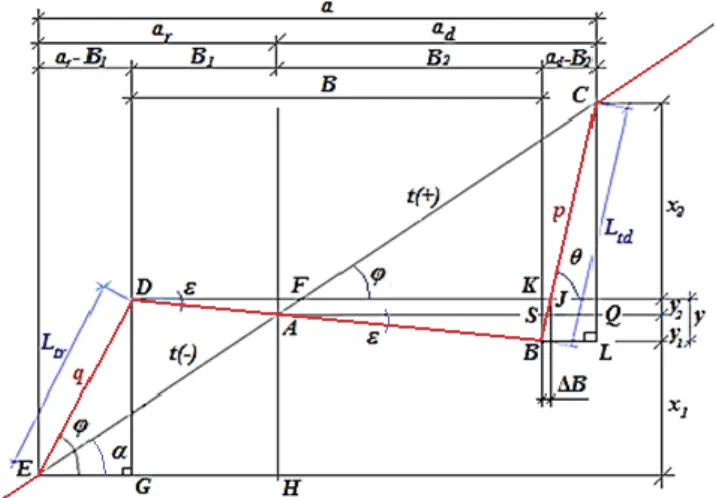
The figure below shows the cross section made through a slope at a given tilt, whose inclination is below the angle α.The red line shows the terrace formthat is equipped with a countraslope, accompanied by its geometrical elements.
Notations significance in Fig.1 are:
B – overall width of the platform terrace;
B1 – terrace platform width from the slope to the embankment;
B2 – terrace platform width from the slope to the excavation (form in non-mobilized
field);
a – width of the terrace footprint (total width occupied by platform and field slopes);
384
Fig. 1Presentation of terrace geometric elements fitted with a contraslope, in cross section φ – embankment footprint slope;
θ – excavation footprint slope;
ε – tilting angle of terraceplatform(contraslope angle);
t–tangent of the field angle, relative to the tangenta axis; [(+)above the axis; (−)under
terrace axis];
x1 – minimum quota (registered towards excavation slope); x2 – maximum quota (registered towards embankment slope);
y1 –measured quota from the bottom edge of the excavation slope to the platform axis
terrace; y2 – measured quota from the bottom edge of the embankment excavation slope to the
platform axis terrace
DETERMINATION OF WATER VOLUMES FROM RAINFALL THAT ACCUMULATES ON THE SURFACE OF FORESTRY TERRACES MADE IN CONTRASLOPE
Analytical calculation I
The terrace is equipped with a counterslope,whose horizontal angle is notedwithε (max. 15o). Calculation of water accumulations may be made in two hypotheses:
a. The terrace has already stabilized embankment slope,iethe terrace works were made some time ago, having a water retention capacity over the entire surface (Figure 1).
Looking at Figure 1, that water from rain would accumulate over the entire width of the terrace.Its volume can be determined by calculating the volume of the triangular prism,whose base is the triangle ΔDBJ and has the height of one meter (this for simplication).Cross-sectional area effected through the prism,is the area of the triangleΔDBJ, which are the basis of the considered triangular prism [5]. So:
𝐴∆𝐷𝐵𝐽= (𝐵1+ 𝐵2+ ∆𝐵)𝑦
2 𝑐𝑢𝑚: lim0 ∆𝐵 ⟶ 0, 𝑎𝑡𝑢𝑛𝑐𝑖: 𝐴∆𝐷𝐵𝐽=
(𝐵1+ 𝐵2)𝑦
2 =
𝐵𝑦 2
b. The terrace is recently performed, and the slope of the embankment is less stabilized, not taking into account the water retention capacity (fig.2).
385
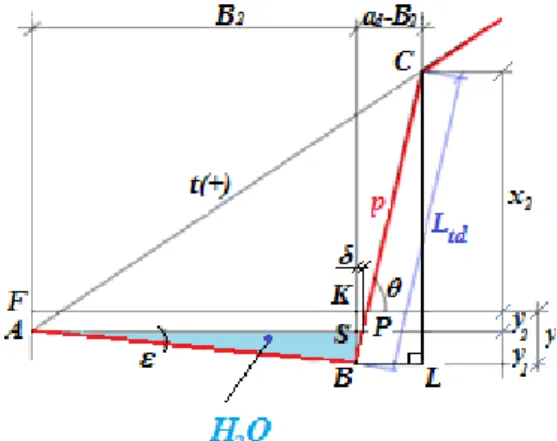
In this situation, considering the geometrical elements shown in Figure 1 in conjunction with Figure 2,water from rainfall would accumulate in a triangular prism with base formed by the triangle ΔABP and height (length) of a meter, respectively at the base of the transverse semi profile of excavation.
Fig. 2 Section executed through the body slope of excavation representation of portion of water accumulation
Sectional area, potential accumulator of precipitation, is represented by the color blue area, respectively ΔABP.
𝐴∆𝐴𝐵𝑃 =(𝐵2+ 𝛿) 𝑦 2⁄
2 =
(𝐵2+ 𝛿)𝑦
4 𝑐𝑢𝑚: 𝛿 ⟶ 0, 𝑎𝑡𝑢𝑛𝑐𝑖: 𝐴∆=
𝐵2𝑦
4 = 0,250𝐵2𝑦
In the right triangle ΔABS
tg 𝜀 = 𝑦 2⁄
𝐵2 ⟶ 𝑦 = 2𝐵2tg 𝜀
By replacing the value of y in the triangle area ΔABS
𝐴∆𝐴𝐵𝑆 =
𝐵2∙ 2𝐵2tg 𝜀
4 =
𝐵22
2 tg 𝜀 = 0,5𝐵2tg 𝜀
Table No. 1 The potential water volume,that might accumulate on a linear
meter of terrace depending on the geometrical characteristics of forestry terraces.
Terrace width
B Seated terrace (ε =5
o
) New terrace (ε =5o)
(m) (dm)
Aria of the prism base 𝐴∆=
0,5𝐵2tg 𝜀 (dm2)
Accumulated volumeVH2O
(dm3 = l)
ria of the prism base
𝐴∆= 0,25𝐵2tg 𝜀 (dm2)
Accumulated volumeVH2O
(dm3 = l)
1,5 15 9,79 97,9 4,90 49,0
1,6 16 11,14 111,4 5,57 55,7
1,7 17 12,57 125,7 6,29 62,9
1,8 18 14,09 140,9 7,05 70,5
1,9 19 15,70 157,0 7,85 78,5
2,0 20 17,40 174,0 8,70 87,0
386
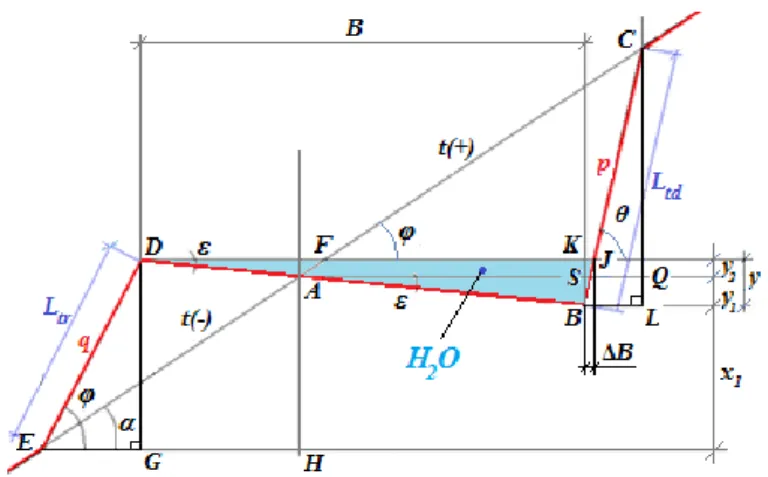
Water volume that can accumulate on a linear meter of terrace(Ie a right triangular prism with a height of one meter) it can be calculated determining at first cross-sectional area that acumulates, effected by the longitudinal profile represented in Figure 3.
Fig. 3 Section executed through the body slope of excavation representation of water accumulation area.
Thus, in the right triangle ΔBKJ by applying trigonometric functions [1], takes place:
ctg 𝜃 =∆𝐵
𝑦 ⟹ ∆𝐵 = 𝑦 ctg 𝜃
and in the right triangle ΔDBK takes place:
tg 𝜀 = 𝑦
𝐵1+ 𝐵2 ⟹ 𝑦 = 𝐵 tg 𝜀
Surface with water accumulator potential is the summation of surfaces forming triangle ΔDBJ (respective areas of the right triangles ΔDBK and ΔBKJ).The calculation of the two triangles areas are:
𝐴∆𝐷𝐵𝐾= (𝐵1+ 𝐵2)(𝑦1+ 𝑦2)
2 ; 𝐴∆𝐵𝐾𝐽 =
∆𝐵 ∙ (𝑦1+ 𝑦2) 2
𝐴∆𝐷𝐵𝐽= (𝐵1+ 𝐵2)(𝑦1+ 𝑦2)
2 +
∆𝐵 ∙ (𝑦1+ 𝑦2)
2 =
1
2(𝑦1+ 𝑦2)(𝐵 + ∆𝐵) = 1
2𝑦(𝐵 + ∆𝐵)
By replacing the expression ΔB and expression of y, previously determined is obtained:
𝐴∆𝐷𝐵𝐽 = 𝑦
2(𝐵 + 𝑦 ctg 𝜃) = 𝑦
2(𝐵 + 𝑦 ctg 𝜃) = 𝐵 tg 𝜀
2 (𝐵 + 𝐵 tg 𝜀 ∙ ctg 𝜃)
𝐴∆𝐷𝐵𝐽= 1
2𝐵2tg 𝜀 (1 + tg 𝜀 ∙ ctg 𝜃) (𝑑𝑚2)
The volume of accumulated water is:
𝑉𝐻2𝑂 = 𝐴∆𝐷𝐵𝐽∙ 𝐿 (𝑑𝑚3)
Aexample of applied numerical for its geometric features is presented below : θ – excavation slope, (θ =45o
);
ε – the tilting angle of platform terrace (contraslopeε =5o
); B – width of platform terrace, (B =1,5 m =15 dm);
L– length of triangular prism (L =10 dm).
𝐴∆𝐷𝐵𝐽 = 0,5 ∙ 1,52tg 50(1 + tg 50∙ ctg 450) = 10,7𝑑𝑚2 𝑉𝐻2𝑂 = 10,7𝑑𝑚2∙ 10 𝑑𝑚 = 107 𝑑𝑚3 = 107𝑙
387
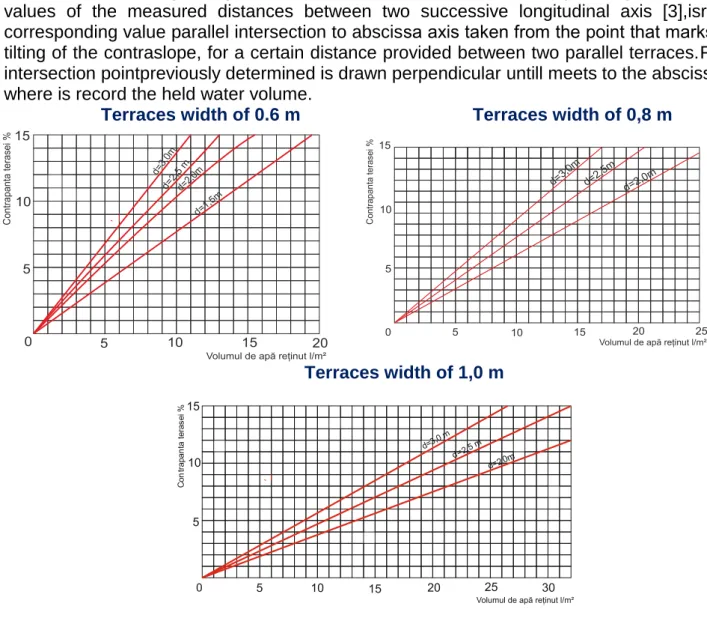
Form the nomograms presented for different values of contraslope tilting and the different values of the measured distances between two successive longitudinal axis [3],isread the corresponding value parallel intersection to abscissa axis taken from the point that marks the 5 ° tilting of the contraslope, for a certain distance provided between two parallel terraces.From the intersection pointpreviously determined is drawn perpendicular untill meets to the abscissas axis, where is record the held water volume.
Terraces width of 0.6 m Terraces width of 0,8 m
Terraces width of 1,0 m
Fig. 4 Nomograms on the correlation between terraces geometrical elements, location distance between the terraces and the accumulated water volume.
(nomograms taken from „Arranging of torrential hydrographic basins through forestry and hydro technical works”, vol. I; processed in authors electronic format)
It seeks to determine the coefficients of the interpolation polynomial in order to determine the values of accumulated water volume on the terraces which have widths greater than those shown in nomograms above. Holding a number of three nomograms by "reading" them at the values of considered constant terrace width is obtain a second degree polynomial, whose coefficients are undetermined [1].
Interpolation polynomial will take the form:
𝒇(𝒙) = 𝒂𝒙𝟐+ 𝒃𝒙 + 𝒄
Case 1
Is read from each nomogram the corresponding value for a distance between the vertical axes of two parallel terraces considered of 3 meters. Is considered the terrace contraslope having the tilt of ε =5o
.
388
respectivly 3,6 l/m2. So by assigning x = 0,6 and introducing in the general form of second-degree polynomial is obtained by equalizing, equation noted (1):
{𝑓(0,6) = 0,62𝑎 + 0,6𝑏 + 𝑐
𝑓(0,6) = 3,6 ⇒ 9𝑎 + 15𝑏 + 25𝑐 = 90 (1)
Procedure is repeated for the second nomogram, giving the equation (2):
{𝑓(0,8) = 0,8𝑓(0,8) = 5,22𝑎 + 0,8𝑏 + 𝑐 ⇒ 16𝑎 + 20𝑏 + 25𝑐 =
130 (2)
Finally in the third nomogram, respecting the described algorithm is obtained the equation
noted (3):
{𝑓(1,0) = 1,0𝑓(1,0) = 92𝑎 + 1,0𝑏 + 𝑐 ⇒ 𝑎 + 𝑏 + 𝑐 =
9 (3)
Solving the formed system by three noted equation (1), (2), (3) determining values of sought polynomial coefficients, obtaining: 𝑎 = 127,5 ; 𝑏 = −190,5; 𝑐 = 72. Introducing the determined values proper coefficients in the interpolation polynomial it can specify its general form:
𝒇(𝒙) = 𝟏𝟐𝟕, 𝟓𝒙𝟐− 𝟏𝟗𝟎, 𝟓𝒙 + 𝟕𝟐
Therefore, for a new value of terrace platform width of 1.5 m in size, the volume of accumulated water is determined using a general form of interpolation polynomial that retains the coefficients value previously determined; is assigned the width value x =1.5 m:
𝑓(1,5) = 127,5 ∙ 1,52 − 190,5 ∙ 1,5 + 72 = 73,13 l/𝑚2
The volume of water accumulated on a terrace of 1.5 m width ,contraslope of 5o for construction thevolume will be V = 73,13 l/m2
For a value of terrace platform width that has the predicted size of 2.0 m volume of accumulated water is:
𝑓(2,0) = 127,5 ∙ 2,02 − 190,5 ∙ 2,0 + 72 = 201 l/𝑚2
The intermediate values of spred 1.5 ÷ 2.0 m, were calculated based on the described algorithm and recorded in the table 2.
Case 2
Another interpolation polynomial results when the distance between two successive longitudinal axis considered parallel, is adopted different then the first presentedcase. Each nomogram is read corresponding value for a distance between the longitudinal axes of two parallel terraces considered of 2.5 meters. It is considered a terrace contraslope of ε= 5o
tilt.
{𝑓(0,6) = 0,62𝑎 + 0,6𝑏 + 𝑐
𝑓(0,6) = 4,2 ⇒ 9𝑎 + 15𝑏 + 25𝑐 = 105 (4)
{𝑓(0,8) = 0,8𝑓(0,8) = 6,52𝑎 + 0,8𝑏 + 𝑐 ⇒ 16𝑎 + 20𝑏 + 25𝑐 =
389 {𝑓(1,0) = 1,0𝑓(1,0) = 10,82𝑎 + 1,0𝑏 + 𝑐 ⇒ 𝑎 + 𝑏 + 𝑐 =
10,8 (6)
Once the formed system is solve from the three equations noted (4), (5), (6) is determined the values of the polynomial coefficients, obtaining 𝑎 = 27,5; 𝑏 = −27,5; 𝑐 = 10,8. So, polynomial will take form:
𝒇(𝒙) = 𝟐𝟕, 𝟓𝒙𝟐− 𝟐𝟕, 𝟓𝒙 + 𝟏𝟎, 𝟖
For a value of platform width of 1.5 m, accumulation of water will have the resulting value from the width introduction of x = 1.5 m, the general expression of polynomial interpolation result:
𝑓(1,5) = 27,5 ∙ 1,52− 27,5 ∙ 1,5 + 10,8 = 31,4 l/𝑚2
The volume of water accumulated on a terrace of 1.5 m width, the contraslope is constructed with a tilt of 5o the volume will be VH2O = 31,4 l/m2.
For a terrace of 2.0 m with, the volume of accumuleted water will be:
𝑓(2,0) = 27,5 ∙ 2,02− 27,5 ∙ 2,0 + 10,8 = 65,8 l/𝑚2
Approximating, is obtain: VH2O = 32,3 l/m2.
The second case is another example of how to obtain a polynomial function and is not considered in the condition of data final interpretation.
CONCLUSIONS
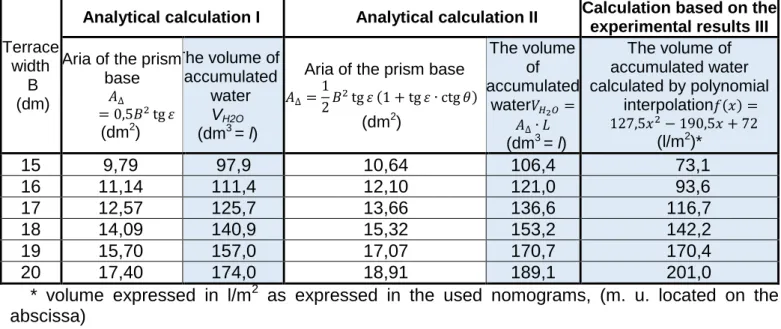
Table no. 2 The potential water volume, calculated by the three specific methods thespread of
1.5 ÷ 2.0 m widths of forestry terraces with a contraslope of ε = 5o
tilt.
Terrace width
B (dm)
Analytical calculation I Analytical calculation II Calculation based on the
experimental results III
Aria of the prism base
𝐴∆
= 0,5𝐵2tg 𝜀 (dm2)
The volume of accumulated
water VH2O
(dm3 = l)
Aria of the prism base
𝐴∆=
1
2𝐵2tg 𝜀 (1 + tg 𝜀 ∙ ctg 𝜃)
(dm2)
The volume of accumulated
water𝑉𝐻2𝑂= 𝐴∆∙ 𝐿 (dm3 = l)
The volume of accumulated water calculated by polynomial
interpolation𝑓(𝑥) = 127,5𝑥2− 190,5𝑥 + 72
(l/m2)*
15 9,79 97,9 10,64 106,4 73,1
16 11,14 111,4 12,10 121,0 93,6
17 12,57 125,7 13,66 136,6 116,7
18 14,09 140,9 15,32 153,2 142,2
19 15,70 157,0 17,07 170,7 170,4
20 17,40 174,0 18,91 189,1 201,0
* volume expressed in l/m2 as expressed in the used nomograms, (m. u. located on the abscissa)
The volume of potential accumulated water was determined by three methods,two analytical and one using interpolation of experimental data reported in the quoted literature,in the version where the terrace contraslope is at 5o horizontal angle and an excavation slope with a tilt of 45o.
390
Analytics calculus algorithms can be applied for different terraceswidths, different terrace tilts and excavation slope. By varying parameters involved in presented mathematical relations, can determine the volume of accumulated water on the platform surface under conditions requested by potential user. Thus, for example, if considered terrace width of 1.6 m, tilt of 8o, excavation slope of 22o, the volume of accumuleted water will be:
- based on analytically calculus I, VH2O = 179,8 l;
- based on analytically calculus II, VH2O = 242,2 l.
Regarding the algorithm calculation using experimental data is a working model,but the condition can be improved identifing more data collected from field experiments, the appearance of a higher rank function or a logarithmic or exponential distributions.
The models presented can be applied if the terraces soil volume is sufficient to establish and develop cultures of fruit trees and vineyards.
BIBLIOGRAPHY
1. Bachmann,K.H.,Berthold,G.,Beyer,O.,Bittner,L.,Bock,H.,Boseck,H.,Bothe,H. G.,etal.,1975.KleineEnzyklopadiedermathematik.VEBBibliographischesInstitutLei pzig, Leipzig.
2. Constandache, C., Untaru, E., Munteanu, F., 2002.Research on the evolution of torrential processes and land degradation in torrential hydrographic basins in
Vrancea,in order to optimize hydrological and
anti-erosionarranging.(Cercetăriprivindevoluţiaproceselortorenţialeşi de degradare a terenurilorînbazinehidrograficetorenţiale din Vrancea, învedereaoptimizăriitehnologiilor de amenajarehidrologicăşiantierozională). Annals ICAS No.45, Forestry Technical Publishing, Bucharest.
3. Munteanu, S.A., Traci, C., Clinciu, I., Lazăr, N., Untaru, D., 1991. (Arranging of torrential hydrographic basins through forestry and hydro technical works)Amenajareabazinelorhidrograficetorențialeprinlucrărisilviceșihidrotehnice, vol. I, Romania Academy Publishing, Bucharest.
4. Munteanu, S.A., Traci, C., Clinciu, I., Lazăr, N., Untaru, D., 1993.Arranging of torrential hydrographic basins through forestry and hydro technical works(Amenajareabazinelorhidrograficetorențialeprinlucrărisilviceșihidrotehnice), vol.II, Romanian Academy Publishing, Bucharest.
5. Tudosoiu, C., 1989. Worn terasier on SM-445 type T- 07 tractor.Technical and economic study, manuscript, I.C.A.S., Bucharest.