12
TOTAL PHENOLIC CONTENT IN SEVERAL POTATO CULTIVARS
(BRASOV, 2015-2016)
BĂDĂRĂU C.L.1,2)
, STEFAN M.F. 1), STROE F. 1), CANJA C.M. 2) 1) National Institute of Research and Development for Potato and Sugar Beet, Brasov 2) Transilvania University of Brașov, Faculty of Food and Tourism, 148 Castle Street, Brașov, 500014, Romania, Phone: +40268.472.222 Email: [email protected]
Keywords: potato, total phenolic content, flesh tissue, skin tissue.
ABSTRACT
Potato tubers are a valuable source of bioactive nutrients such starch, amino-acids, dietary fibers, vitamins, minerals and phenolic compounds. Some of these phenolics could have beneficial effects on humans health. The present study evaluated the total phenolic compounds (TPC) in skin and flesh of thirty potato genotypes grown in Brasov trials, over two years. Lower levels of TPC were found in the flesh than in the skin of the tubers. Blue varieties Salad Blue had the highest values for all parameters excepting the TPC in flesh which was higher in the genotype Blue Purple of Galanesti. For TPC, maximum values find in flesh and skin tissue were 3.76 and 10.79 mg / gallic acid equivalents (values reported on dry weight).
INTRODUCTION
Blue and purple potato with flesh strongly pigmented represents a rich source of polyphenols (chlorogenic acid) anthocyanin pigments unexploited enough in the world and almost at all, until now, in Romania. Even though many species produce polyphenols and anthocyanins, availability and the cost of certain materials vegetal origin limited commercial exploitation of these natural sources of anthocyanin pigments only for a few species [6].
Figure 1. Potatoes with strong colour in flesh and skin – valuable vegetable.
13
valuable polyphenols (chlorogenic acid, quercetin and kaempferol glycosylated with rutinose significant amounts of catechin, usually acylated glycosides of rutinose and glucose) as described by Andre et al. (2006) and Ezekiel et al. (2013) [1,10]. Recent studies on potato composition revealed however that there is much more in potatoes than starch. Indeed, the potato tubers contain important phytochemicals (as phenolic compounds) that may prevent the development of diabetes, cardiovascular diseases and certain types of cancers. In particular, potato components have been shown to have favourable impacts on several measures of cardio-metabolic health, including lowering blood pressure, improving lipid profiles and decreasing markers of inflammation [19, 20]. Tubers with increased level of poliphenols could have an impact on human health, because these compounds posses antioxidant, antiglycemic, antiviral and anti-inflammatory activities [16, 20]. This impact could be strong especially for people where potato is the most important food crop and therefore would be of interest to consumers, producers and policymarkers [19]. The main objective of this work was to evaluated the amount of total poliphenols content and antioxidant activity of ethanolic extracts of thirty potato varieties grown in Brasov over two years with different climatic conditions.
MATERIAL AND METHOD
Biological material. The following potato genotypes were chosen for this study: - BV 1791/1, BV 1871/4, BV 1876/1 - Romanian breeding lines from NIRDPSB Brasov with lower resitance to Potato Virus Y (data not show)
-‘Christian’, ‘Roclas’, ‘Sevastia’, ‘Marvis’, ‘Castrum’, ‘Brasovia’, ‘Cosiana’ (new and very new Romanian varieties)
-‘Albastru Violet Galanesti ‘(‘Blue Purple of Galanesti’), ‘Blue Congo’, ‘Vittelote’, ‘Salad Blue’ (cultivars with strong pigmentation in the flesh)
-‘Bellarosa’, ‘Riviera’, ‘Carrera’, ‘Jelly’, ‘Red Lady’, ‘Red Fantasy’, ‘Hermes’, ‘Arizona’ (cultivars very appreciated by the producers, being the top 20 varieties cultivated in the Romanian area with different resistance to Potato Virus Y) [5]
-‘La Bella’, ‘Tornado’, ‘Ferrari’, ‘Baltic Rose’, ‘Rudolph’, ‘Red Scarlet’, ‘Torino’, ‘Orlena’ (cultivars with a very interesting red colour skin).
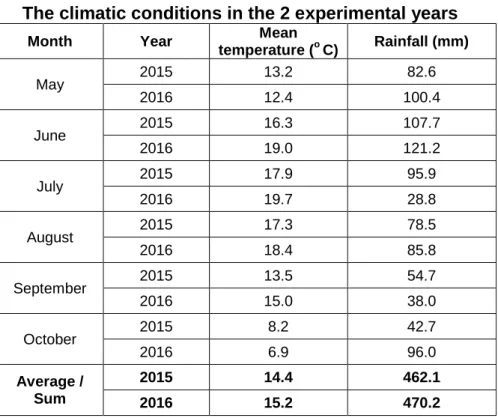
Seed tubers were planted in May in Brasov (coordinates lat. 45.6744234, long. 25.539622) in 2016 and 2015, with three replicates. Similar fertilizer chemical inputs were applied in both years. The climatic conditions of the experimental years are presented in table 1. Mature tubers were harvested 160 days after planting in Brasov in 2016 and 148 days in Brasov in 2015. After harvest, marketable tubers (medium size and free of damage
and defects) were selected, washed, stored at 4oC until the sample preparation.
Sample preparation. Composite samples (4 to 10 tubers from each cultivars, in fonction of their size) were prepared by pooling tubers with a potato peeler. The tuber flesh was quartered from stem to bud and one of the quarters sliced. The tissues were freeze-dried (ScanVac CoolSafe 55-9 Pro Freeze Dryer, Denmark), ground to a fine
powder (using a coffee grinder) and stored to -20oC until analysis.
Extraction. The extraction was carried following the method described by Valcarcel et al. (2015) [19]. So, 0.2 g of freeze-dried potato skin or 0.6 g of flesh were weight into a 50 ml centrifuge tubes and 5 ml of etanolic solution 80% (v/v) in distilate water were added. The tubes were shaken 5 min at room temperature and centrifuged 15 min at 4137g. A part of supernatant was transferred to 1.5 ml eppendorf tubes and stored at -20oC until analysis.
Total Phenolic Content (TPC) Analysis. The TPC was determined
spectrophotometrically by Folin Ciocâlteu method [18] with several modifications [8]. 20 l
of skin extracts and 50 l of flesh extracts were mixed with 50l, respectively 100l
14
Ciocalteu reagent were added and mixed for 1 min in the plate reader (TecanSun Rise,
softwere Magellan). After 5 min., 80 l of a 20% solution (w/v) of Na2CO3 were added and
mixed with a pipette; the microplates were shaken for 5 min. in the plate reader. After that, the plates were incubated at room temperature in the dark, agitating at 150 rpm on a MicroPlate Shaker (Biosan PST-60HL-4, Latvia) for 90 min. The absorbance of the samples was determined at 725 nm (TecanSun Rise, softwere Magellan). Gallic acid was used as standard and total phenolic content was expressed as milligrams GAE (Gallic acid equivalents) per gram of dry weight (DW) materials.
Table 1
The climatic conditions in the 2 experimental years
Month Year Mean
temperature (o C) Rainfall (mm)
May 2015 13.2 82.6
2016 12.4 100.4
June 2015 16.3 107.7
2016 19.0 121.2
July 2015 17.9 95.9
2016 19.7 28.8
August 2015 17.3 78.5
2016 18.4 85.8
September 2015 13.5 54.7
2016 15.0 38.0
October 2015 8.2 42.7
2016 6.9 96.0
Average / Sum
2015 14.4 462.1
2016 15.2 470.2
Statistical interpretation. Each set of comparable assay was conducted with the same bulk sample. Analysis of variance (ANOVA) and Duncan’s multiple range test were used to analyze the data.
RESULTS AND DISCUSSIONS
The trials conducted in Brasov in 2015 and 2016 show that cv. ‘Salad Blue’ had the highest mean TPC value in skin. In the flesh tissue, cv. ‘Blue Purple of Galanesti’ show the highest TPC value in both years. The genotype with the lowest quantified TPC values was breeding line BV 1791/1 in 2015 and 2016 for both tissues flesh and skin, respectively (table 2).
The levels of TPC ranged from 0.59 to 3.35 and 2.68 to 10.79 mg GAE g-1 DW in the
flesh and skin, respectively, with flesh and skin contents showing a significant difference between the cultivars (table 2). The skin of the potatoes studied contained on average 4.04 and 4.22 times more phenolic compounds (TPC) than the flesh, in 2015 respectively in 2016 (table 2). TPC in both tissue (skin and flesh) was positively correlated with the colour of the tissue, with a Pearson coefficient 0.731 (p<0.01) and 0.489 (p<0.01) for skin and flesh respectively.
The results obtained in our experiments are comparable with those reported by
another researchers, with values ranging from 1.56 to 12.9 and 0.54 to 3.59 mg GAE g-1
15
[7],from 0.92 to 12.37mg GAE g-1 DW for whole tubers [1,21] from 1.00 to 4.3 mg GAE g-1
DW in the skin [14,15].
.
Table 2
Total polyphenol content (mg GAE/g DW) of potato samples analysed
(Brasov, 2015-2016)
Cultivars / genotypes
Flesh / Skin colour
Brasov 2015 Brasov 2016
Flesh Skin Flesh Skin
BV 1791/1 W / LY 0.59 (l)* 2. 68 (p) 0.82 (n) 2.72 (m)
Arizona Y / Y 1.22 (fg) 4.07 (l) 1.30 (ghij) 4.89 (j)
AVG B/B 3.03 (b) 9.39 (a) 3.38 (b) 10.79 (a)
Baltic Rose LY / R - - 0.98 (jklmn) 6.60 (fg)
Bellarosa Y / R 1.18(fg) 6.36 (fgh) 1.20 (ghijkl) 7.47 (e)
Blue Congo PB / B 1.94 (c) 6.07 (h) 2.29 (c) 6.95 (f)
Brasovia WY / Y 0.92 (i) 3.35 (mn) 1.04 (ijklmn) 3.90 (k)
Carrera Y / Y 0.96 (hi) 3.63 (m) 1.34 (fghi) 3.48 (kl)
Castrum LY / Y 1.15(gh) 4.01 (l) 1.43 (efgh) 4.55 (j)
Christian Y / R 1.15 (gh) 6.54 (f) 1.53 (efg) 6.93 (f)
Cosiana WY / R 0.73(ijkl) 7.16 (e) 1.03 (jklmn) 7.68 (e)
Ferrari Y / R - - 1.41 (efgh) 6.15 (gh)
BV 1871/4 C / R 0.78 (ijkl) 7.96 (d) 0.88 (lmn) 8.32 (cd)
Hermes LY / C 0.75(ijkl) 2.94(op) 0.87 (lmn) 3.04(lm)
Jelly Y / Y 1.66(d) 5.16 (j) 1.65 (def) 5.73 (hi)
La Bella WY/PR - - 0.90 (lmn) 5.71 (hi)
Marvis WY / Y 0.75( ijkl) 4.51 (k) 0.91 (lmn) 4.66 (j)
Orlena DY/DY - - 1.73 (de) 4.55 (j)
BV 1876/1 LY / Y 0.90( ij) 3.48 (mn) 1.06 (ijklmn) 3.25 (l)
RedFantasy Y / R 1.23 (fg) 7.35 (e) 1.20 (hijklm) 8.38 (cd)
Red Lady Y / R 1.40 (ef) 8.97 (b) 1.51 (efgh) 9.68 (b)
Red Scarlet LY / R 0.99 (jklmn) 7.85 (de)
Riviera Y / Y 1.34(efg) 3.41 (mn) 1.65 (def) 3.95 (k)
Roclas Y / Y 0.88( ijkl) 3.15 (no) 1.27 (ghijk) 3.56 (kl)
Rudolph WY/R 0.95 (klmn) 34 (cd)
Salad Blue B / B 3.35 (a) 9.09 (ab) 3.76 (a) 9.26 (b)
Sevastia DY / Y 1.66 (d) 4.99 (j) 1.95 (d) 5.57 (i)
Torino LY / R - - 0.86 (mn) 6.86 (f)
Tornado W / R - - 0.96 (klmn) 6.95 (f)
Vittelot B/B 3.05 (b) 8.33 (c) 3.25 (b) 8.67 (c)
Mean 1.38 5.57 1.47 6.21
*Means with different letters are significantly different at p<0.05 in each column. Values reported for the two Romanian trials are the mean of three filed replicates. Abbreviations: AVG Albastru Violet de Galanesti (Blue Purple of Galanesti); BV 1791/1, BV 1871/4, BV 1876/1 breeding lines. DW dry weight; GAE gallic acid equivalents. W white; C cream; LY light yellow; Y yellow; R red; B blue; PR part red; PB part blue. cream; - no sample available
Despite the fact that some vegetable sources have higher TPC than potatoes, in many countries the potatoes are consumed in higher quantities and so, potatoes make a valuable contribution to the daily intake of phenolic compounds. A recent study in USA estimated that potatoes were the third highest contributor to the daily intake of phenolic
compounds, after oranges and apples, with a daily intake consumption of 171 g day-1 [6].
16
the future, the potato breeders correct these quality parameters by developing new valuable cultivars, with functional food characteristics.
A
B
Figure 2. Mean total phenolics content (TPC) according to the colour of the skin (A) and flesh (B) colour of the tubers. Bars represents mean values of samples collected in 2015 and 2016 with different skin and flesh colour. Error bars represent standard deviations. The letters different upper
the bars indicate significant difference at p<0.05.
17
Results regarding the influence of skin and flesh colour on TPC are presented in figure 2. The tubers with blue skin had the highest TPC values. These values were significantly different from other colours, except red-skinned varieties (figure 2). In the flesh tissue, blue potatoes had the highest TPC values, significant different from all the other colour variants. Blue and red colours are due to the presence of anthocyanins [2] and the higher TPC values obtained for this kind of tubers colour can be attributed to these pigments with high antioxidant potential. Strong correlations between TPC and antioxidant activity were reported in previous studies [1,12,17,19] which specified that both phenolic and flavonoid compounds are the main contributors to the antioxidant potential. This contribution depend on the extraction, quantity of each phenolic compounds and interactions between them, which could be additive, synergistic or antagonistic [9,11,13,19].
CONCLUSIONS
Thirty potato genotypes with different colour of the skin and flesh tissue (grown in Brasov trials two years) were analysed for estimation their total polyphenols content. The most popular Romanian cultivars were used for this study. In addition, some breeding lines, several new Romanian varieties and different potato cultivars with interesting skin and flesh colour were studied. The results obtained were in the range of values reported in the literature.
Significant differences between the different cultivars tested were found. The cultivar with blue skin and flesh had the higher values of total polyphenols content.
Because of the great importance of potato in population’s food, this study offer information to potato researchers, producers and public on the level of these phytochemicals with functional properties.
Acknowledgements This work was supported by a grant of the Romanian National Authority for Scientific Research, CNDI-UEFISCDI, PN-II-PT-PCCA-2013-4-0452, project number 178/2014.
BIBLIOGRAPHY
1. Andre, C.M., Ghislain, M., Bertin, P., Oufir M., Herrera Mdel R., Hoffmann, L., Hausman, J.F., Larondelle, Y., Evers, D., 2006- Andean potato cultivars (Solanum tuberosum L.), as a source of antioxidant and mineral micronutrients. Journal of Agriculture and Food Biochemistry 55: 366-378
2. Andre, C/M., Schaftleitner, R., Guignard, C., Oufir, M., Aliaga, C.A., Nomberto, G., Hoffmann, L., Hausman, J.F., Evers, D., Larondelle, Y., 2008- Modification of the health promoting value of potato tubers field grown under drought stress: emphasis on dietary antioxidant and glycoalcaloid contents in five Andean cultivars (Solanum tuberosum L.). Journal of Agriculture and Food Biochemistry 57: 599-609
3. Albishi, T., John, J., Al-Khalifa, A., Shahidi, F., 2013- Phenolic content and antioxidant activities of selected potato varieties and their processing by-products. Journal of Functional Food 5: 590-600
4. Al-Weshahy, A., Venket Rao. A., 2009- Isolation and characterisation of functional components from peel samples of six potatoes varieties growing in Ontario. Food Research International 41: 1062-1066
5. Bădărău, C.L., Damșa, F., Olteanu, Gh., Chiru, S.C., 2015- Tulpinile necrotice ale virusului Y al cartofului- permanent provocare pentru fermieri și producători. Cartoful in
18
6. Chun, O.K., Kim, D.O., Smith, N., Schroeder, D., Han, J.T., Lee, C.Y., 2005–
Daily consumption of phenolic and total antioxidant capacity from fruit and vegetables in the American diet. Journal of Sciences and Food Agriculture 85: 1715-1724
7. Cornacchia, R., Cabezas-Serrano, A.B., Amodio, M.L., Colleli, G., 2011-
Suitability of 4 different potato cultivars (Solanum tuberosum L.) to be processed as fresh-cut products. Early cultivars. American Journal for Potato Research 88: 403-412
8. Diganta, K .and Sastry, J., 2014- Comparison of poliphenol content and antioxidant capacity of colored potato tubers, pomgranate and blueberries. 2014 – Journal
of Food Processing Technology 5(8): 1-7
9. Epps, C.T., Stenquist, B.P., Lowder, K.T., Blacker, B.C., Low, RM., Egget, D.L., Parker, T.L., 2013- Synergetic endo and exo-interactions between blueberry phenolic compounds, grape variety functions, chocolate covered strawberry and fruit smoothies. Journal of Food Research 2: 33
10. Ezekiel, R., Singh, N., Sharma, S., Kaur, A., 2013- Beneficial phytochemicals in potato – a review. Food Research International 50: 487-496
11. Goupy, P., Hugues, M., Boivin, P., Amiot, M.J., 1999- Antioxidant composition and activity of barley (Hordeum vulgare) and malt extracts and of isolated phenolic compounds. Journal of Sciences Food and Agriculture 79: 1625-1634
12. Hu, C., Tsao, R., Liu, R., Alan Sullivan, J., McDonald, M.R., 2012- Influence of cultivar and year on phytochemical and antioxidant activity of potato (Solanum tuberosum L) in Ontario. Canadian Journal Plant Sciences 92: 485-493
13. Iacopini, P., Baldi, M., Storchi, P., Sebastiani, L., 2008- Catechin, epicatechin, quercetin, rutin and resveratrol in red grape: content in vitro antioxidant activity and interactions. Journal of Food Composition and Analysis 21: 589-598
14. Kahkonen, M.P., Hopia, A.I., Vuorela, H.J., Rauha, J-P., Pihlaja, K., Kujala, T.S., Heinonen, M., 1999- Antioxidant activity of plant extracts containing phenolic compounds. Journal of Agriculture and Food Chemistry 47: 3954-3962
15. Makris, D.P., Boskou, G., Andrikopoulos, N.K., 2007– Polyphenolic content and
in vitro antioxidant characteristics of wine industry and other agri-food solid waste extracts.
Journal of Food Composition and Analysis 20: 125-132
16. Duthie, G.G., Duthie, S.J., Kyle, J.A., 2000- Plant poliphenols in cancer and heart disease: implications as nutritional antioxidants. Nutrition Research Reviews 13:79-106. 17. Reyes, L.F., Miller, J.C., Cisneos-Zevalhos, L., 2005- Antioxidant capacity anthocyanins and total phenolics in purple and red –fleshed potato (Solanum tuberosum L) genotypes . American Journal for Potato Research 82: 271-277
18. Singleton, V.L., Orthofer, R., Lamuela-Raventos, R.M., 1999- Analysis of total phenols and other oxidant substrates and antioxidants by means of Folin-Ciocalteu reagent. Methods in Enzymology 299: 152-178
19. Valcarcel, J., Reilly, K., Gaffney, M., O’Brien, N.M., 2015- Antioxidant activity, total phenolic and total flavonoid content in sixty varieties of potato (Solanum tuberosum L.) grown in Ireland. Potato Research 58: 221-141
20. Wang, H., Nair, M.G., Strasburg, G.M., Chang, Y.C., Booren, A.M., 1999–
Antioxidant and antiinflammatory activities of anthocyanins and their aglicon, cyanidin, from tart cherries. Journal of Natural Products 62: 294-296