Journal of Global Pharma Technology
Available Online at:
www.jgpt.co.in
RESEARCH ARTICLE
Study UV-Visible and FTIR Characterization of ZnPc Dye using
Double Solvent
Asmaa S. Khalil
1,Ban Mazin Alshabander
1*,Mohammed Kadhim Jawad
1,Mohammed Oudah Salman
21. Department of Physics, College of Science, University of Baghdad, Baghdad, Iraq.
2. Iraqi National Monitoring Authority, Ministry of Science and Technology, Baghdad, Iraq.
*Corresponding Author:Ban Mazin Alshabander
Abstract
The effects of dissolving zinc phthalocyanine (ZnPc) in two solvents, (N, N-dimethylformamide (DMF)/water, dimethylsulphoxide (DMSO)/water, tetrahydrofuran (THF)/water), on the absorption spectra and infrared spectra were studied using (UV–Vis) spectroscopy and FTIR spectrophotometer. Solvents affected on the photochemical and photophysical properties of ZnPc complexes. The noticed trend inside the difference of Q-band position with solvent was occasionally attributed to solvent parameters comprising aromaticity, arrange power, polarity, and refractive index. UV-V spectra analysis showed non-proof of aggregation in sol as a display throught great unperturbed phthelocyanine Q band. zinc phthalocyanine emerge absorption spectra with duo essential band electron the Q band with a generality (685, 675 and 680) nm separately as well as Soret B band with an extreme of (340, 340 and 350) nm separately. Farthest potential aggregation included method is such the H-aggregation because of rise shift energy of absorption spectrum as well as provided information via the potential electrostatic allocation onto molecule zinc phthalocyanine . FTIR results showed that elevate include peaks belongs to ZnPc with the alteration in the present of the two solvent furthermore little shift toward low energy existed.
Keyword: Double solvent, Metal-Phthalocyanine dye, Energy bandgap.
Introduction
Photoelectron spectroscopy
test (PES) equipping method to
attractive comprehend the structures
electronic of molecular and interfaces
installation, absorption geometries,
allocation of energy levels, and asymmetries orbital of adsorbates. Phthalocyanine dyes (Pcs) studied vastly as sensitizers due
to their chemical constancy and high gradeof
sucking at afar red/near-IR region. Those Pcs exhibit workable advancement in energy conversion efficiencies by enough artificial adjustment [1-2].
Large types of phthalocyanines, like metal-free phthalocyanines and phthalocyanines with several metals had synthesized and now used in a broad diversity such as solar cells [3]. Phthalocyanines act as a type of organic compounds with major implementations in
diverse scopes as dyes and sensors, optical materials, solar cells, pigments, electronic
devices. Through metallated
phtahlocyanines, (ZnPc) comprises rise (Q.Y.) of odd oxygen generation, had been utilizing in several drug delivery vehicles like nanoparticles and liposomes [4,5]. Molecules
of Phthalocyanine had unusual
characteristics in terms of light absorption in the far visible region of the solar spectrum at (λ 690 nm) [6].
Study several type of dyes sensitive to light in solvent double mixtures, and behavrior photophysical. As photosensitizers, Pcs has the feature of top molar absorption, resestance to chemical, and photo chemical
degredation. Furthermore, Pcs have
which can permeate pointedly in to living tissues. The tendency to aggregation because of molecular stacking output in low Q.Y. of
1O2 and solubility limiting in watery media is
the dis advantage of the dyes [7-8]. Organic solvents are familiar to decrease aggregation, whereas hydrous solvents will highly produce accumulate complexes.
On the other hand, different phthalocyanine complexes remain accumulated even in non aqueous solutions. Moreover, the sols possess an influence on the photochemical and photophysical properties of MPc complexes [9-10]. In this search, we report on the affects
of a chains double solutions; N, N
-dimethylformamide (DMF),
dimethylsulphoxide (DMSO), and
tetrahydrofuran (THF), with D.W. on the solubility of ZnPc dye.
The influence of dissolution on the degree of aggregation of ZnPc in hydrous solution and the affect of solvents -ZnPc interaction photophysical and photochemical properties of the photosensitizer. UV visible and FTIR
have been used to investigate the impact of varying the ratio of the solvents.
Experimental Part Materials
Zinc phthalocyanine (ZnPc) dye,
Dimethylformamide (DMF) and Dimethyl sulfoxide (DMSO), all attained from Sigma-Aldrich, and Tetrahydrofuran (THF) received
from Merck-Germany. Distilled water
collected from the laboratory.
Samples Preparation
A sufficient amount of ZnPc dye (5×10⁻⁴ M)
was dissolved with two solvent in a glass bottle via utilizer a magnetic stirrer for 4 h. The solution was added dropwisely until obtaining a dark blue colloidal solution. The dissolve dye stored in a glass bottle which was wrapped with aluminum foil to avoid excitation of dye when sunlight or electrical lightening presented. The type of solvent and the ratio between the two solutions have been changing according to Table (1).
Table 1: The ratio of samples dissolved in (DMF, DMSO, and THF) and water
Sample Solvent
DMF, DMSO, THF (%) Water (%)
1 100 0
2 80 20
3 60 40
4 50 50
5 40 60
Characterization Methods
The prepared samples (Table 1) has been tested by UV absorbance using (Metertech SP-8001 UV/VIS Spectrophotometer) and
Fourier Transform Infrared (FTIR) test
using (Thermo- Scientific™ Nicolet™ iS™10 FTIR Spectrometer).
Results and Discussion
Study the Absorption Spectroscopy
Organic molecules of phthelocyanine and their derevatives appear characteristics optical due to the structure ring The spectra of the ZnPc in a solution of DMF/water, DMSO/water, and THF/water of various water mass percent appear in Figure 1 (a, b, & c) individually. Solvents moreover possess an influence on the photochemical and photophysical properties of MPc complexes. The interaction of a organize solvent
with MPc ring rises the (HOMO)
energy, causing a red-shifting of Q-band. zinc
phthalocyanine shows absorption spectra
by double essential band electronic,
the Q band with ultimate (685, 675 and
680) nm separately and subsequently
the Soret B band with final of (340, 340 and 350) nm independently. This noticing proposes that during the previous collection of solvents, loss of symmetry occur [8]. The figure of the spectra propose the aggregation double packs: one comparable toward solutions by water mass ratio lowerthan 80% and thus the second include altogether 40% water.
One notes a faint shift to toward long wavelength for the Q band peak at water
part altitude from zero to
60%.Furthermore, during this extent of
intensity and two wide little-intensity bands become broader with flat peaks at 620 nm , 750 nm. The descend variation of the ZnPc absorption ranges associated with the water mass fraction shall become official to slide alteration at the structure microscopic of the solvent.
This structural solvent alteration motivates a significant amendment of the solvent-solute
intaraction via aligning the zinc
phthalocyanine -water interaction.
Figure 1: Absorption spectra of Zinc phthalocyanine dye in (a) DMF/H2O, (b) DMSO/ H2O, and THF/ H2O, water mass percent parameter
The data is compatible with the results, point out the excess of water mass part bases a downy raise of PH [4]. The solution of absorption spectrum appear characteristic absorptions about 685 nm in the Q band region has appeared in Fig. 1(a). The other bands (Soret band) about 340 nm was observed due to the transetions from the deeper π levels to the L.U.M.O. Analysis of UV-V spectra appear no evidence of combination in solution as demonstreted via a sharp unperturbed phthalocyanine Q band
at 610 nm.
This result agrees with previous researches [11] The electronic absorption spectrum of ZnPc was recorded in DMSO/water solution, as shown in Figure (1.b). The DMSO /water
mixture contains extremely non-ideal
conducts as a result of its associative character that relies on the proportion of the two compounds. Significant deviations that occur at specific values of the water fraction into solvent mixture related to the formetion of molecular H-bond clusters such include a molecule D.M.S.O molecule and 2 molecules of H2O or 2 molecules of D.M.S.O and one molecule of H2O [12].
Absorption spectrum in THF/water displayed
characteristic absorptions about 680
nm within Q band region, appear in Figure 1c. The peak at 680 nm for THF due to the presence of oxygen at the axial position of complexes ZnPc results in the distortion of
the phthalocyanine (Pc) ring. THF
contains oxygen that could react with the central Zinc of the ZnPc molecule, enhancing the distortion. From the noticing of the band at 680 nm will probably invert loss of symmetry via distortions of the metal-phthalocyanine (MPc) molecule as photolysis progressed.
The absorption maxima (Q-band) in Pcs shift towards lower energies as an outcome of the formation of molecular aggregates. The creation of aggregates may be emerging from the ability of ZnPc to create π–π
accumulate structures in solution about
the orientated carboxylic acid with
Table 2: Absorption UV–V spectral data of ZnPc dye at several double solvents and bandgap energies (Eg)
Solvent Ratio (%) B-band (nm)
Q-band Q band Eg (eV) B band
Eg (eV)
Q1 peak position
(nm) position (nm) Q2 peak
DMF/water 80/20 340 610 685 1.78 3.12
100/0 340 610 700 1.73 2.84
DMSO/water 80/20 340 610 675 1.760 2.200
100/0 340 610 675 1.780 2.980
THF/water 80/20 348 610 680 1.280 2.520
100/0 350 640 - 1.720 2.680
The following equation can express the optical absorbance coefficient α of a semiconductor near the band edge:
Where α is the absorption coefficient, Eg is the absorption bandgap; A is constant, n rely of type transitions, n may had amount ½, 2, 3/2 and three corresponding to pliable direct, pliable indirect, forbedden direct and forbedden indirect transitions respectively. [13]. The bandgap energies (Eg) of ZnPc dissolved in DMF/ water, DMSO/water, and THF/water was tabulated in Table (2). The bandgap energy could be particular via extrepolation to the zero coefficients, which obtained by using equation (1)[14].
FTIR Studies
FTIR spectroscopy is an essential method in the realization of bonds and has been used to
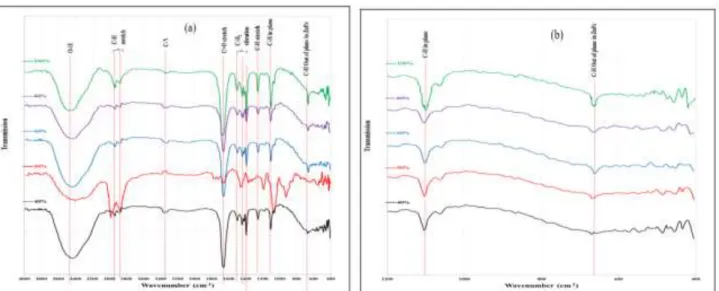
identify and analyze the presence of the functional group and determine whether any interactions or complexation among the components. FTIR spectra in transmittance mode, for ZnPc dye dissolved in DMF/Water, DMSO/Water and THF/Water with a different ratio as illustrated in Figs. (2-4) respectively. From Fig. 2 (a & b) which describe the FTIR of ZnPc in DMF/water with a different mass percent the peak at 725 is related to C-H out of plane bending in ZnPc molecular and the peaks at 1030 and
1100 cm-1 are due to C-H in-plane bending in
ZnPc [15].
At 1670 is a C=O stretch [16], while peaks at 2900 and 2850 C-H stretch and 2330 C-N stretch [12]. The peaks at 1395, 1450, and 1530 are CH2 vibration; these peaks are the characteristic peaks for DMF. We can observe an increase in the peaks belong to ZnPc with the change in the ratio of the two solvent also there is a small shift toward low energy.
Fig. 2: FTIR spectra of ZnPc dye in binary solvent DMF/water, (a) for wavenumber range 400-4000 cm-1, (b) 400-1200 cm-1
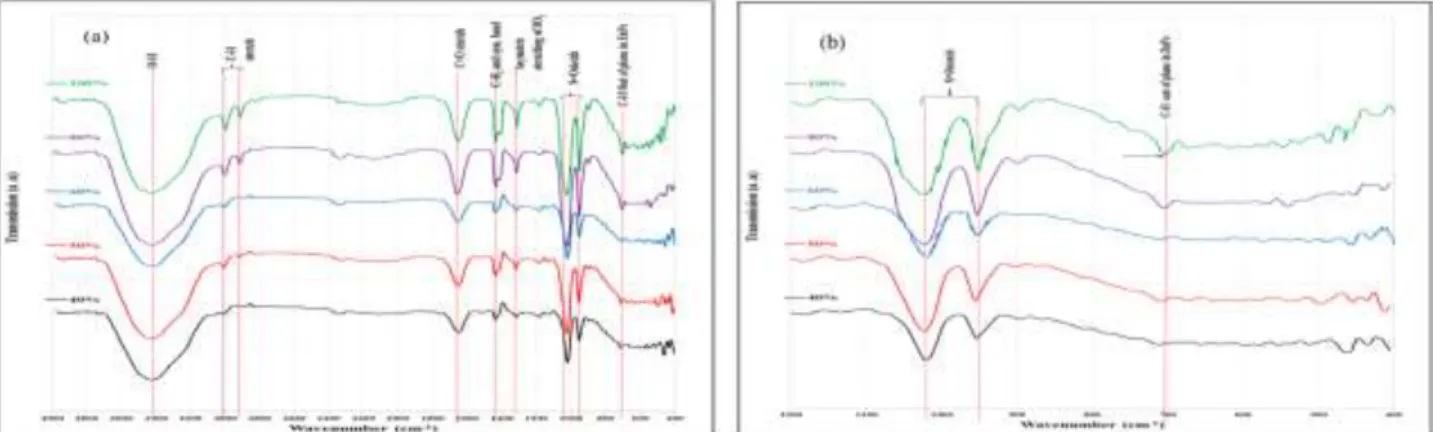
Fig.3 (a & b), display FTIR spectrum which indecates the detaels of functieonal groups found in ZnPc dye. For ZnPc dye dissolved with only DMSO, extreme and sharp intense
peak showed at 950 and 1020 cm-1 are related
S-O vibration stretching mode the
characteristic of DMSO due to the alkene sp2 C-H bend C-H stretching. The peak at (1135
cm−1), is a characteristic of DMSO. The
HO2−+ DMSO→ DMSO2 + OH −
However, for ZnPc dye with two solvent, the peek has been a shift to high wave number
approximately 1020 cm-1. The main peeks
over the range (3600-3000 cm-1) the
broadening of the band was related to O-H and N-H stretching. Peaks at 3000 and 2900
cm-1 related to carboxylic acid O-H stretch,
and aldehyde C-H stretch nearly disappears with increase water ratio up to 60% [18]
whereas the peak 1650 cm-1 is due to
vibration stretching of, C=O groups of
carbonyl. at wavenumber 1320 and1450 cm−1
correspond to the asymmetric and CH3 bending antisymmetric, respectively [19, 20]. The modeas by wavelangths of 1180 and
1191 cm−1 corraspond to the stretching
asymmatric group of SO2, which is the characteristic peaks for DMSO. The peak at 705 corresponds to C-H out of bending plane in ZnPc molecular [15] has appeared in Fig. 3(b). Also, one can note that there is a shift in the peaks position and an increase in the intensity of ZnPc.
Fig. 3: FTIR spectra of ZnPc dye in binary solvent DMSO/water, (a) for wavenumber range 400-4000 cm-1, (b) 400-1200 cm-1
Fig. 4(a & b) shows the location of C-H
in-plane bend band. There is no variation in- band energy with a variation the mixing in binary solvent THF/Water ratio.
Fig. 4: FTIR spectra of ZnPc dye in binary solvent THF/water, (a) for wavenumber range 400-4000 cm-1, (b) 400-1200 cm-1
Conclusion
Zinc phthalocyanine ZnPc of the
photophysical properties in two solvents (DMF/water, DMSO/water, and THF/water),
presently informed confirm very non-ideal
behavior of these two solvent mixtures. Absorption spectrum detect a dramatic
difference of intensity Q bands absorption of Zinc phthalocyanine in process for a mass water ratio more significant than 40%.This behavior has appointed for considerable
modification during the solute-solvent
interaction as a result of the changes in the solvent molecules assembling.
References
1. G Liu, A Klein, A Thissen, W Jaegermann
(2003) Electronic properties and interface characterization of phthalocyanine and
2. S Senthilarasu, S Velumani, R
Sathyamoorthy, A Subbarayan, JA
Ascencio, G Canizal, PJ Sebastian, JA Chavez, R Perez (2003) Characterization of zinc phthalocyanine (ZnPc) for photovoltaic applications, Appl. Phys. A 77: 383-389. DOI: 10.1007/s00339-003-2184-7.
3. Xuejun Zhang, Lijun Mao, Dan Zhang, Lei
Zhan (2012) Synthesis, characterization,
and electrochemistry of novel
unsymmetrical zinc phthalocyanines
sensitizer with extended conjugation, Journal of Molecular Structure, 1022: 153-158.
doi.org/10.1016/j.molsturuc.2012.04.046.
4. M Wojdyla, B Derkowska, Z Lukasiak, W
Bala (2006) Absorption and
photoreflectance spectroscopy of zinc phthalocyanine (ZnPc) thin films grown by thermal evaporation, Materials Letters,
60: 3441-3446.
doi:10.1016/j.matlet.2006.03.029.
5. A Staicu, A Pascu, M Boni, ML Pascu, M
Enescu (2013) Photophysical study of Zn phthalocyanine in binary solvent mixtures, Journal of Molecular Structure, 1044: 188-193.
doi.org/10.1016/j.molstruc.2012.12.010.
6. L Giribabu, CV Kumar, PY Reddy, JH
Yum, M Gratzel, MDK Nazeeruddin (2009) Unsymmetrical extended p-conjugated zinc phthalocyanine for sensitization of nanocrystalline TiO2 films, J. Chem. Sci., 121 (1): 75-82. DOI: 10.1007/s12039-009-0008-9.
7. AA Chernonosov, EA Ermilov, B Röder, LI
Solovyova, OS Fedorova (2014) Effect of
Some Substituents Increasing the
Solubility of Zn(II) and Al (III) Phthalocyanines on Their Photophysical
Properties, Hindawi Publishing
Corporation Bioinorganic Chemistry and Applications. DOI: 10.1155/2014/952632.
8. A Ogunsipe, D Maree, T Nyokong (2003)
Solvent effects on the photochemical and
fluorescence properties of zinc
phthalocyanine derivatives, Journal of
Molecular Structure, 650: 131-140.
doi.org/10.1016/S0022-2860(03)00155-8.
9. D Ajloo, M Ghadamgahi, F Shaheri (2014)
Absorption Spectroscopy, Molecular
Dynamics Calculations, and Multivariate, Bull. Korean Chem. Soc., 35 (5):
1440-1448.
DOI.org./10.5012/bkcs.2014.35.5.1440.
10.O Abimbola, N Tebello (2011) Solvent
Effects on the Photophysicochemical Properties of Tetra(tert-butylphenoxy)
phthalocyaninato Zinc(II), Acta
Phys.⁃Chim. Sin., 27 (5): 1045-10521. DOI:
10.3866/PKU.WHXB20110508.
11.S Cogal, K Ocakoglu, AU Oksuz (2014)
“The synthesis, photophysical and
electrochemical studies of symmetrical
phthalocyanines linked thiophene
substituents,” Inorganica Chim. Acta, 423: 139-144. doi.org/10.1016/j.ica.2014.08.014.
12.S Makhseed, M Machacek, W Alfadly, A
Tuhl, M Vinodh, T Simunek, V Novakova, P Kubat, E Rudolf, P Zimcik (2013)
Water-soluble non-aggregating zinc
phthalocyanine and in vitro study for photodynamic therapy, The Royal Society of Chemistry, DOI: 10.1039/c3cc44609c.
13.Y Zhao, C Li, X Liu, F Gu, H Jiang, W
Shao, L Zhang, Y He (2007) “Synthesis
and Optical Properties of TiO2
Nanoparticles,” Materials Letters, 61 (1): 79-83. doi:10.1016/j.matlet.2006.04.010.
14.KJ Hamam, MI Alomari (2017) A study of
the optical band gap of zinc
phthalocyanine nanoparticles using UV-Vis spectroscopy and DFT function, Appl. Nanosci, 7: 261-268. DOI 10.1007/s13204-017-0568-9.
15.JS Louis, D Lehmann, M Friedrich, DRT
Zahn (2007) “Study of dependence of
molecular orientation and optical
properties of zinc phthalocyanine grown under two different pressure conditions,” J. Appl. Phys., 101 (1): 1-7. DOI: 10.1063/1.2403845.
16.D Sülzle, P Klaeboe (1988) “The Infrared,
Raman and NMR Spectra of
Hexamethylene Triperoxide Diamine,” Acta Chem. Scand. A 42: 165-170. DOI: 10.3891/acta.chem.scand.42a-0165.
17.MY Skripkin, P Lindqvist-Reis, A Abbasi,
18.S Ramesh, KH Leen, K Kumutha, AK Arof (2007) ''FTIR studies of PVC/PMMA blend
based polymer electrolytes'',
Spectrochimica Acta Part A, 66: 1237-1242. DOI: 10.1016/j.saa.2006.06.012.
19.N Mozhzhukhina, LP Méndez De Leo, E J
Calvo (2013) “Infrared spectroscopy studies on stability of dimethyl sulfoxide for application in a Li-air battery,” J. Phys.
Chem. C, 117 (36): 18375-18380.
doi.org/10.1021/jp407221c.
20.NK Abbas, AF abdulameer, Ruaa M Ali,
Shaimaa M Alwash (2019) “The effect of heat treatment on optical properties of
copper(II) phthalocyaninetetrasulfonice