ASPECTS REGARDING THE INFLUENCE OF CLIMATIC FACTORS IN
DYNAMIC EVOLUTION OF SOME PESTS SPECIFIC TO APPLE
CULTURE FROM MĂRĂCINENI AREA BETWEEN 2014-2015
LAURENŢIU BĂLONIU1*, RODI MITREA1
1University of Craiova, Biology Department, 13, A.I.Cuza Street, 200583
*Corresponding author, e-mail:[email protected]
Keywords: biology, climatic conditions, corellation, pest
ABSTRACT
In 2014 and 2015, during the researches, was evidenced the direct influence of meteorological parameters variation on the eco-biology of the pests analyzed in this paper: Cydia pomonella, Phyllonorycter blancardella and Quadraspidiotus perniciosus.
For instance, the temperature variation between 2014 and 2015, in the same date range, led auttomatically to the accumulation of different degree amounts until the same date. In these conditions, the same stage in the life cycle of a pest, appeared at different data in the two years, considerind the first capture, or the adults fly period (start, maxim and end), in the successive generations.
INTRODUCTION
Knowing the biology of each pest and changes therein due to varying weather parameters is an important aspect in monitoring them. Continuous observation of this aspect helps us to take the most right decisions about the pests control in the apple culture, in each plant phenophase.
New data regarding the dependence of main pests eco-biology from apple culture to climatic conditions are brought every year by many researchers. Using pheromones traps and the latest monitoring stations improved the track of pests activity, thus establishing the best moments for the insecticides treatment application.
In Romania, studies regarding using pheromones in monitoring process of Cydia pomonella are found in the paper published by Sumedrea et. all., 2012. Also, studies regarding the ways of capture and control for Cydia pomonella are detailed in paper elaborated by Drosu S.,and colab., 2007, Mitrea I. and colab., 2010.
Data about the influence of abiotic factors on Phyllonorycter blancardella development are present in the work paper published by Drosu et. all, 1995.
Aspects on Quadraspidiotus perniciosus bio-ecology are mentioned in the paper written by Simeria Gh. and Nicorici M. in 1999. Results regarding warn and combat of this pest were obtained by Beşleagă R.et. all., in 2006, at S.C.D.P. Iaşi.
MATERIAL AND METHOD
The observations on pests-target behaviour were made during 2014-2015 at ICDPP-Mărăcineni, area which, climatically, belongs to the second climatic zone, moderately warm, semi-humid.
The annual average temperature is between 8,0 and 10,5C, solar radiation of 114-128 Kcal/cm2, the temperature sum, higher than 0 0C, is between 3400-4100 0C while of those higher than 100C is 2800-35000C.
The average annual rainfall is between 450-700 mm, in April-October 325-475 mm, in drier years, in the same time, the hydric deficit being of 220-391 mm.
The observations and determinations were done in an apple culture, on Idared variety, trees planted in 1992, at a distance of 3,5 x 2,5 (1842 trees/ha).
Data regarding the adults pests fly at each generation were extracted using WATCHDOG station, dedicated soft and IRFAN VIEW (Freeware).
RESULTS AND DISCUSSIONS
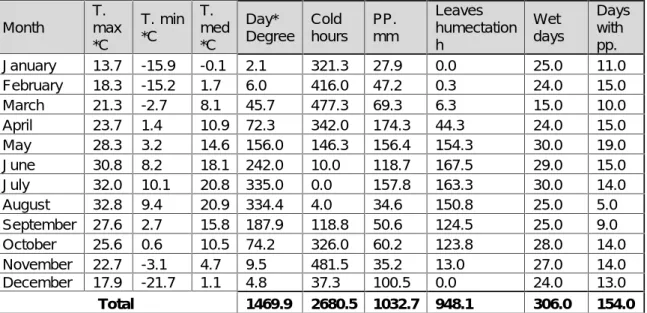
In 2014 the rainfall exceeded the multiannual average, especially during April, May, June and July, while the temperatures were closely to the values recorded in the last years.
Table 1 The evolution of meteorological parameters in 2014
Month
T. max *C
T. min *C
T. med *C
Day* Degree
Cold hours
PP. mm
Leaves humectation h
Wet days
Days with pp. January 13.7 -15.9 -0.1 2.1 321.3 27.9 0.0 25.0 11.0 February 18.3 -15.2 1.7 6.0 416.0 47.2 0.3 24.0 15.0
March 21.3 -2.7 8.1 45.7 477.3 69.3 6.3 15.0 10.0
April 23.7 1.4 10.9 72.3 342.0 174.3 44.3 24.0 15.0 May 28.3 3.2 14.6 156.0 146.3 156.4 154.3 30.0 19.0 June 30.8 8.2 18.1 242.0 10.0 118.7 167.5 29.0 15.0 July 32.0 10.1 20.8 335.0 0.0 157.8 163.3 30.0 14.0
August 32.8 9.4 20.9 334.4 4.0 34.6 150.8 25.0 5.0
September 27.6 2.7 15.8 187.9 118.8 50.6 124.5 25.0 9.0 October 25.6 0.6 10.5 74.2 326.0 60.2 123.8 28.0 14.0 November 22.7 -3.1 4.7 9.5 481.5 35.2 13.0 27.0 14.0 December 17.9 -21.7 1.1 4.8 37.3 100.5 0.0 24.0 13.0
Total 1469.9 2680.5 1032.7 948.1 306.0 154.0
In 2014 the monthly average temperature was 8.1 ºC in March, 10.9 ºC in April, 16.6ºC in May and 17.6 in June (figure 1).
In Quadraspidiosus perniciosus case, first capture was recorded at 29 April, after 273 day degree calculated. G1 fly had a maxim at 13 May and the end recorded at 02 June.
In G2 case, the fly time was between 05-28 July (table 2).
Tabel 2 Eco-biology ofQuadraspidiosus perniciosusin 2014
Year Date Day degree necessary
Day degree
calculated Event
2014 04 January 0 0
2014 29 April 269 273 first capture
2014 13 June 368 369 maxim fly G1
2014 02 June 556 563 end fly G1
2014 05 July 962 968 start fly G2
2014 28 July 1304 1313 end fly G2
Specware 9.0 Pro
Table 3 Eco-biology ofPhyllonorycter blancardellain 2014
Year Date Day degree necessary
Day degree
calculated Event
2014 04 January 0 0
2014 24 March 97 104 first capture
2014 14 April 183 184 maxim fly G1
2014 22 May 434 441 end fly G1
2014 05 June 590 594 start fly G2
2014 30 June 891 903 maxim fly G2
2014 23 April 1224 1233 end fly G2
2014 01 August 1370 1375 start fly G3 2014 13 August 1571 1575 maxim fly G3 2014 03 September 1854 1856 end fly G3 Specware 9.0 Pro
For Cydia pomonella were recorded the maxim fly for the two generations, these taking placed at 17 May, after 181 day degree calculated respectively 27 July, after 812 day degree calculated (table 4).
Table 4 Eco-biology ofCydia pomonellain 2014
Year Date
Day degree necessary
Day degree calculated
Event
2014 06 January 0 0
2014 17 May 181 181 maxim fly G1
2014 27 July 817 812 maxim fly G2
Specware 9.0 Pro
The adults fly dynamic forCydia pomonella, in the untreated, is observed in figure 1.
Figure 1. The adults fly dynamic forCydia pomonella, in the untreated, in 2014
0 0 0 0 0 0 0 0 0 5
11 8
0 0 4,5
1 0,50 1 1,51 3,50,50 0 0,51 0 0 0 0
0 2 4 6 8 10 12 14 16 18 20 22 24 26 2. 03 -8 .0 3 9. 03 -1 5. 03 16 .0 3-22 .0 3 23 .0 3-29 .0 3 30 .0 3-5. 04 6. 04 -1 2. 04 13 .0 4-19 .0 4 20 .0 4-26 .0 4 27 .0 4-3. 05 4. 05 -1 0. 05 11 .0 5-17 .0 5 18 .0 5-24 .0 5 25 .0 5-31 .0 5 1. 06 -7 .0 6 8. 06 -1 4. 06 15 .0 6-21 .0 6 22 .0 6-28 .0 6 29 .0 6-5. 07 6. 07 -1 2. 07 13 .0 7-19 .0 7 20 .0 7-26 .0 7 27 .0 7-2. 08 3. 08 -9 .0 8 10 .0 8-16 .0 8 17 .0 8-23 .0 8 24 .0 8-30 .0 8 31 .0 8-6. 09 7. 09 -1 3. 09 14 .0 9-20 .0 9 21 .0 9-27 .0 9 28 .0 9-4. 10 Fl ut ur i / cap can ă/ săî tăm ân ă (n
) Suma capturilor
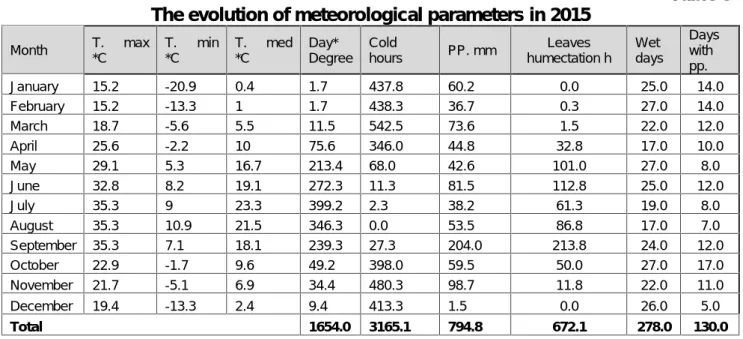
Table 5 The evolution of meteorological parameters in 2015
Month T. max *C
T. min *C
T. med *C
Day* Degree
Cold
hours PP. mm
Leaves humectation h
Wet days
Days with pp.
January 15.2 -20.9 0.4 1.7 437.8 60.2 0.0 25.0 14.0
February 15.2 -13.3 1 1.7 438.3 36.7 0.3 27.0 14.0
March 18.7 -5.6 5.5 11.5 542.5 73.6 1.5 22.0 12.0
April 25.6 -2.2 10 75.6 346.0 44.8 32.8 17.0 10.0
May 29.1 5.3 16.7 213.4 68.0 42.6 101.0 27.0 8.0
June 32.8 8.2 19.1 272.3 11.3 81.5 112.8 25.0 12.0
July 35.3 9 23.3 399.2 2.3 38.2 61.3 19.0 8.0
August 35.3 10.9 21.5 346.3 0.0 53.5 86.8 17.0 7.0
September 35.3 7.1 18.1 239.3 27.3 204.0 213.8 24.0 12.0
October 22.9 -1.7 9.6 49.2 398.0 59.5 50.0 27.0 17.0
November 21.7 -5.1 6.9 34.4 480.3 98.7 11.8 22.0 11.0
December 19.4 -13.3 2.4 9.4 413.3 1.5 0.0 26.0 5.0
Total 1654.0 3165.1 794.8 672.1 278.0 130.0
For Quadraspidiosus perniciosus first capture was recorded at 06 May, after 274 day degree calculated. G1 fly had a maxim at 16 May and the end recorded at 01 June.
In G2 case, the fly period was between 03-23 July (table 6).
Table 6 Eco-biology ofQuadraspidiosus perniciosusin 2015
Year Date Day degree necessary Day degree calculated Event
2015 03 January 0 0
2015 06 May 269 274 first capture
2015 16 May 368 371 maxim fly G1
2015 01 June 556 557 end fly G1
2015 03 July 962 975 start fly G2
2015 23 July 1304 1321 end fly G2
Specware 9.0 Pro
First capture of Phyllonorycter blancardella took place on 12 April. G1 had a maxim fly at 26 April while on 21 May was its end. For G2, start fly was on 04 June, with a maxim on 27 June, the fly end being on 19 July. G3 began the fly on 26 July with a maxim on 07 August and the end on 26 August (table 7).
Table 7 Eco-biology ofPhyllonorycter blancardellain 2015
Year Date Day degree necessary Day degree calculated Event
2015 03 January 0 0
2015 12 April 97 104 first capture
2015 26 April 183 185 maxim fly G1
2015 21 May 434 436 end fly G1
2015 04 June 590 599 start fly G2
2015 27 June 891 896 maxim fly G2
2015 19 July 1224 1242 end fly G2
2015 26 July 1370 1375 start fly G3
2015 07 July 1571 1582 maxim fly G3
2015 26 August 1854 1858 end fly G3
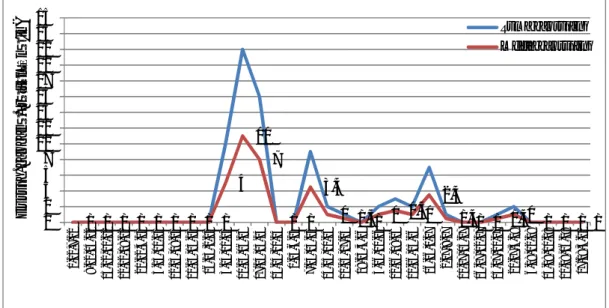
In Cydia pomonella case the maxim fly for G1 was recorded at 16 May, after 187 day degree calculated. In G2 case the maxim was on 19 July, after 817 day degree calculated (table 8).
Table 8 Eco-biology ofCydia pomonellain 2015
Year Date Day degree necessary Day degree calculate Event
2015 11 January 0 0
2015 16 May 181 187 maxim fly G1
2015 19 May 817 808 maxim fly G2
Specware 9.0 Pro
In figure 2 is observed the adult fly dynamic for Cydia pomonella at the untreated level.
Figure 2. The adult fly dynamic forCydia pomonellain 2015, in the untreated
CONCLUSIONS
Because of different climate conditions in the two years, the pests biology also varied, the correlation being visible in all stages from the lyfe cycle.
In Quadraspidiotus perniciosus case, first capture in 2014 took place on 29 April, with one week earlier than 2015 ( 06 May), being necessary seven more days to reach the 273 day degree calculated.
For the first capture of Phyllonorycter blancardella the difference was 19 days between 2014 (24 March) and 2015 (12 April), date when recorded the104 day degree calculated.
Cydia pomonella recored a maxim fly in G1 case almost in the same period, on 17
0 0 0 0 0 0 0 0 0 12
0 23,5
11,5
0 24,524
5,54,58 12,5
29 3635
26,5
0 0 0 0 0 0 0
0 5 10 15 20 25 30 35 40 45 50 55 60 65 70 75 80
Fl
ut
ur
i/
ca
pc
an
ă/
să
pt
ăm
ân
ă
(n
)
BIBLIOGRAPHY
1. Beşleagă R., Georgescu T., Cârdei E., 2006. Rezultate privind avertizarea and combaterea păduchelui ţestos din San Jose (Quadraspidiotus perniciosus Comst.), in plantaţiile de măr de la SCDP Iaşi. Lucrări ştiinţifice, vol 1(49), Edit. Ion Ionescu de la Brad, Iaşi.
2. Drosu S., Teodorescu G., and colab., 2007. Studies on the attract and kill method to control the codling moth (Cydia pomonella) in Romanian apple orchards, European Society for New Methods in Agricultural Research, XXXVII ESNA Annual Meeting, JINR Dubna, Russia Book of abstracts ISBN 5-9530-0159-2.
3. Drosu S., Hondru N., Paşol N., 1995 – Influenţa factorilor abiotici asupra dezvoltării moliei marmorate – Phyllonorycter blancardella. Analele I ICDP, vol XXVII.
4. Mitrea I., Mitrea Rodi, Ţucă O., Stan C., 2010. Studies regarding the biological control of the Cydia pomonella L. in the conditions of the Oltenia central area. South Western Journal of Horticulture, Bilogy and Environment. Vol.1No.1, 1-8.
5. Simeria Gh., Nicorici M., 1999 – Contribuţii la cunoaşterea bioecologiei and combaterii păduchelui ţestos din S-V ţării. Revista Sănătatea Plantelor, nr. 14. Bucureşti.
6. Sumedrea M., Marin F.C., Călinescu M., Iorgu A., Sumedrea D., 2012. Researches regarding the use of matting disruption pheromones in control of apple codling moth - Cydia pomonella L., International Conference of The University of Agronomic Sciences and Veterinary Medicine Agriculture For Life, Life for Agriculture, June 4-16, 2015 Bucharest Romania http://agricultureforlife.usamv.ro; Agriculture and Agricultural Science Procedia 6 (2015) 171–178.