Effect of nano particles on air conditioning compressor
performance
K P China Srinivasa
1, A.Srinivas Rao21
PG Scholar, Pydah College of Engineering, Kakinada, AP, India.
2Assistant Professor, Pydah College of Engineering, Kakinada, AP, India.
ABSTRACT
Nano particles are found to attract the attention in the recent years due to their diverse uses. Addition of metal or non-metal oxides to a base fluid leads to a different working fluid called NANO FLUID. Addition of Nano particles lead to change in both transport and thermal properties for fluid. In a traditional air conditioning system, there will be certain amount of lubricating oil that is carried away by the refrigerant in the compressor. So certain amount of lubricating oil circulates along with the refrigerant in the air conditioning circuit. If the solubility of lubricating oil in the refrigerant is low, there is a danger of accumulation of lubricating oil in the condenser. If the solubility of lubricating oil in the refrigerant is high, refrigerant washes away all the lubricating oil in the compressor and there is a danger of abrasion in the compressor. There is a danger of sedimentation of Nano particles in compressor if it is not dispersed properly in the oil. If the Nano particles are not correctly dispensed, there is a danger of their interference with environment. Nano particles are found to hinder the growth of plants. They are carcinogenic and hence care should be taken to handle them judiciously. Economic issues regarding the usage of Nano particles have also to be considered as they are quite expensive.The refrigerant used in the air-conditioning setup that is used for testing is R-410a. The refrigerant R-410a is azeotropic suggesting that the phase change temperature does not remain constant as in the case of traditional refrigerants. Temperature of the refrigerant (R-410a) decreases during the phase change. The refrigerant used in the air-conditioning setup that is used for testing is R-410a. The refrigerant R-410a is azeotropic suggesting that the phase change temperature does not remain constant as in the case of traditional refrigerants. Temperature of the refrigerant (R-410a) decreases during the phase change.
Introduction
There is an increase in energy utilization in recent years. So there has been a desire to decrease the energy utilized by different appliances used in
daily life. Nano particles are found to attract the attention in the recent years due to their diverse uses.
should be taken to handle them judiciously. Economic issues regarding the usage of Nano particles have also to be considered as they are quite expensive.The refrigerant used in the air-conditioning setup that is used for testing is R-410a. The refrigerant R-410a is azeotropic suggesting that the phase change temperature does not remain constant as in the case of traditional refrigerants. Temperature of the refrigerant (R-410a) decreases during the phase change.
Refrigerant R410a is the blend of R32 50 %( w/w) and R125 50 %( w/w).
It can operate at higher pressures than traditional refrigerants. Also, the ozone
depletion potential of R410a is zero which suggests that it is environmental friendly.
Properties of R410a:
R410A is a binary blend of HFC compounds 50% of R32 and 50% of R125
No chlorine content, no ozone depletion potential. ODP = 0. Global warming potential GWP = 1725.
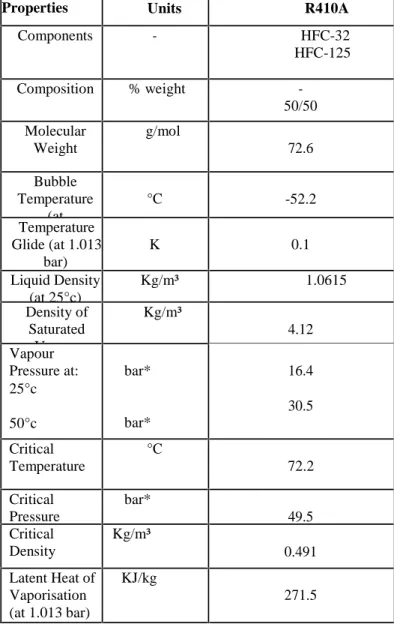
Table1. Properties of Refrigerant R410A :
NANO FLUID PREPARATION USING TWO-STEP METHOD
Two-step method is the most widely used method for preparing Nano fluids. Nanoparticles used in this method are first produced as dry powders by chemical or physical methods. Then, the Nano sized powder will be dispersed into Mineral oil in the second processing step with the help of intensive magnetic force agitation and ultrasonic agitation. The schematics of magnetic stirrer and magnetic beads are shown in the figures:
Figure 1: Magnetic stirrer
Lubricating oil with Nano particles is placed in a beaker on the stirrer with a magnetic bead in it.
Figure: 2 Different Magnetic Beads
Two-step method is the most economic method to
produce Nano fluids in large scale, because Nano powder
synthesis techniques have already been scaled up to
industrial production levels.
Table2.Mineral Oil–(Suniso 4gs Oil) Properties:
Due to the high surface area and surface activity,
nanoparticles have the tendency to aggregate. The
important technique to enhance the stability of
nanoparticles in fluids is the use of surfactants. However,
the functionality of the surfactants under high temperature
is also a big concern, especially for high- temperature
applications. Effects of Nano particles on air-conditioning
Properties Units R410A
Components - HFC-32
HFC-125
Composition % weight
-50/50
Molecular Weight
g/mol
72.6
Bubble Temperature
(at 1.013 bar)
°C -52.2
Temperature Glide (at 1.013
bar)
K 0.1
Liquid Density (at 25°c)
Kg/m³ 1.0615
Density of Saturated
Vapour (at boiling
point)
Kg/m³
4.12
Vapour Pressure at: 25°c
50°c
bar*
bar*
16.4
30.5
Critical Temperature
°C
72.2
Critical Pressure
bar*
49.5 Critical
Density
Kg/m³
0.491
Latent Heat of Vaporisation (at 1.013 bar)
KJ/kg
cannot be isolated if surfactants are used.
Amount of lubricating oil used for the experiment
is 650ml and the amount of TiO2 Nano particles
used is 0.2772 grams and the amount of Al2O3
Nano particles used is 0.1126 grams.
Spectral Absorbency Analysis
Spectral absorbency analysis is an efficient way
to evaluate the stability of Nano fluids. In
general, there is a linear relationship between
the absorbency intensity and the concentration
of nanoparticles in fluid. Experiments evaluated
the dispersion characteristics of TiO2and Al2O3
suspension using the conventional sedimentation
method with the help of absorbency
analysis by using a spectrophotometer after
the suspension deposited for 24 h and 7 days.
If the Nano materials dispersed in fluids have
characteristic absorption bands in the
wavelength 190–1100 nm, it is an easy and
reliable method to evaluate the stability of
Nano fluids using UV spectral analysis. The
variation of particle concentration of Nano
fluids with sediment time can be obtained
by the measurement of absorption of Nano
fluids, because there is a linear relation
between the nanoparticle concentration and
the absorbance of suspended particles. The
outstanding advantage comparing to other
methods is that UV spectral analysis can present
the quantitative concentration of Nano fluids. It
is believed that the stability of Nano fluids
was strongly affected by the characteristics
of the suspended particles and the base fluid
such as particle morphology.
The intensity of transmitted radiation is measured
using transducers. Intensity of incident radiation is
known. Absorption is defined as the logarithm of
ratio of intensities of incident and transmitted
radiation.
Absorption=log (I0/I)
Where I0 is the intensity of incident radiation and I is the intensity of transmitted radiation.
Figure 3. photo spectrometer
Results obtained from Photospectrometer:
TiO2Nano particles have peak absorption between the
wavelengths 225nm and 410nm.
Absorption of spectrum on 1stDay for TiO2
From the above Al2O3 nano particles have peak
absorption between 375nm to 460 nm.
Results of Photo spectrometer absorption on day1 and day 7 from the start of testing indicate that some amount of TiO2and Al2O3 Nano particles
form sediments in the lubricating oil , with TiO2
nano particles having less sedimentation in the lubricating oil as compared with Al2O3 nano
particles.
Methods to Enhance the Stability of Nano fluids:
Surfactants used in Nano fluids are also called
dispersants. Adding dispersants in the two-phase
systems is an easy and economic method to
enhance the stability of Nano fluids. Dispersants
can markedly affect the surface characteristics of
a system in small quantity. Dispersants
consists of a hydrophobic tail portion, usually a
long-chain hydrocarbon, and a hydrophilic polar
head group. Dispersants are employed to increase
the contact of two materials, sometimes known as
tends to locate at the interface of the two phases,
where it introduces a degree of continuity between
the Nanoparticles and base fluids.
When the base fluid of Nano fluids is polar
solvent, water-soluble surfactants should be
selected; otherwise, oil soluble ones are to be
selected.
Surface Modification Techniques: Surfactant-Free Method:
Use of functionalized nanoparticles is a promising
approach to achieve long-term stability of Nano
fluid. It represents the surfactant-free technique.
Yang and Liu presented a work on the synthesis of
functionalized silica (SiO2) Nanoparticles by
grafting Silanes directly to the surface of Silica
Nanoparticles in original nanoparticle solutions.
One of the unique characteristics of the Nano
fluids was that no deposition layer formed on the
heated surface after a pool boiling process.
Hwang et al. introduced hydrophilic functional
groups on the surface of the nanotubes by
mechanochemical reaction. The prepared Nano
fluids, with no contamination to medium,
good fluidity, low viscosity, high stability,
and high thermal conductivity, would have
potential applications as coolants in advanced
thermal systems.
THERMAL CONDUCTIVITY ANALYSIS Thermal conductivity of Nano fluid is investigated
by “THERMAL CONDUCTIVITY OF LIQUID
AND GASSES APPARATUS”. The apparatus
looks as shown in the Fig. 6.1:
The device consists of a console, a plug/jacket
assembly. Console consists of voltmeter, thermo
couple output, electrical input. Plug/jacket
assembly consistsof a heater, a water jacket,
annular space between the heater and water jacket
to accommodate the test fluid, thermo couples
input, an‘O’ ringseal. The annular space between
the heater and water jacket is kept small to supress
convection heat transfer between the surfaces.
figure 3.: thermal conductivity of liquid and gasses apparatus
Experimental procedure:
The apparatus is cleaned so as to remove
any dust present in the annular space.
Initially, apparatus is operated with dry
air to find the heat transfer losses occurring
due to radiation between the heater and water
jacket, temperature difference between heater
and atmosphere, conduction through ‘O’ seal
rings.
Heat loss through any of the above
reasons is plotted versus temperature.
Heat conducted through the fluid is the
difference between heat supplied and the heat
lost.
Now the apparatus is operated with the
given working fluid (lubricating oil without
CuO Nano particles) and its thermal
conductivity is calculated at different voltage
inputs.
given Nano fluid anh its thermal
conductivity is calculated.
Results:
The obtained values of thermal conductivity are as follows:
Where the temperatures denote the average of
heater and jacket temperatures. Obtained values of
Thermal conductivities are plotted versus
temperature on a graph.
Graphs:
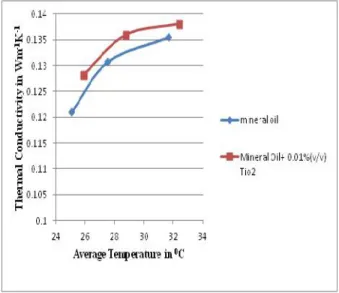
Thermal conductivity graph:
Where the values on X-axis denote the
temperatures in degrees Celsius and the values on
Y-axis denote Thermal conductivities in Watt per
meter per Kelvin.
From the above graphs, it ias observed that there is
increase in Thermal conductivity of Nano fluids as
compared with the base fluid. Literature studies
have shown an increase in Thermal conductivity
by the addition of Nano particles to Ethylene
Glycol/water.
Figure 5.2: Thermal Conductivity of Mineral Oil (vs) Nano Fluid (Mineral Oil + 0.01 % (v/v) TiO2
Nano particles)
PERFORMANCE TESTS ON
AIR-CONDITIONER COMPRESSOR SETUP
Figure 6.: Line diagram of experimental setup
Figure 7: Experimental Air-conditioning compressor equipment
The Nano lubricant prepared above is tested in the
compressor of air-conditioning test facility in M/S
TECUMSEH. The equipment is run till the time
steady state is reached or heat balance is attained.
The refrigerant used is R-410a. Apparatus are
available to maintain the same temperature all over
the room. Thermocouples are provided to ensure
the required conditions are maintained in the test
setup.
Apparatus is provided to measure the power input
to the compressor and temperatures at different
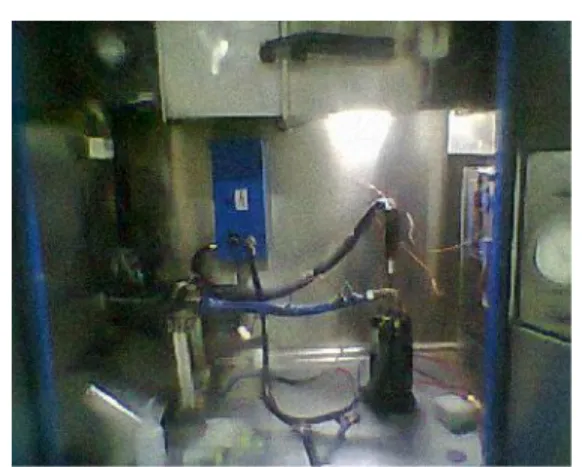
Figure 8: Compressor test cabin
Test Procedure:
LABORATORY AND TEST UNIT PREPERATION
1. Machine to be tested is selected and inspected according to the sampling, receiving check list. 2. If the machine is in satisfactory condition
(i.e., without damage and improper functioning) machine is installed in the facility and installation check list is followed.
3. Power supplies of test room, 2 TR chiller and computer software are switched ON.
4. Lab view software is initialised on the computer.
5. For the test conditions to be followed, TEST REQUEST is to be referred.
Following procedure should be followed for conducting cooling capacity test.
The purpose of the test is to determine the magnitude of following functions:
a) Net Cooling capacity,
b) Net power input to compressor,
1. Calorimetric test condition is selected (27°C/ 19°C, 35°C / 24°C) for the unitary air conditioner (IS – 1391 Part 1) and (27°C/ 19°C, 35°C / ----) for split air conditioner (IS–
1391 Part 2).
2. UUT (Unit Under Test) is switched ON.
3. Fan speed is set for the highest and ensuring the unit is in cooling mode, temperature is set to minimum set point.
4. System is allowed to be stabilized for the above mentioned test conditions.
5. Test unit is run for 4 hours under the
stabilized condition and the values obtained are recorded.
6. Test data is compared with the declared values.
7. For the test unit to qualify the cooling capacity test, cooling capacity of the unit should not be less than that of the 90% of the declared value and power consumption of the unit should not be more than 110% of the declared value.
Results And Discussions
Thermal conductivity of Nano particles mixed in lubricating oil is found to be greater than that of the base fluid. This result agrees with that of the results obtained in literature. This is to be expected as thermal conductivity of metals/ metal oxides nano particles is higher than the base low thermal conductivity mineral oil. Analysis of dispersion characteristics of nanoparticles in lubricating oil using spectrophotometer shows that the Nano fluid is not stable and nano particles form sediments on the 1stday and 7th day, this is perhaps the reason we got only slight improvement in EER as nanoparticles had settled in the crank casing of the compressor. In order to overcome the problem of sedimentation of nano particles, surfactants can be used in lubricating oil.
Compressor performance tests indicate that increase in EER is 0.1% when TiO2 Nano
particles are mixed with Mineral oil and 1.5% decrease in EER, when Al2O3 Nano particles are
mixed with Mineral oil which is not encouraging. So, further experimentation is required with higher concentrations of nanoparticles with smaller sizes of Nano particles; surfactants can also be added to the Nano Fluids and EER checked.
Conclusions And Scope Of Future Work
Spectroscopic analysis of nanoparticles added to lubricant oil shows that sediments start forming on the 7th day indicating that Nano particles are not fairly well dispersed in the base fluid. Surfactants may be added to enhance the dispersal level. Thermal conductivity of Nano fluids (TiO2, Al2O3Nano particles added to Mineral oil)
is greater than that of the base fluid. This is to be expected as thermal conductivity of metals/metal oxides nano particles added is higher than that of the base mineral oil. This is consistent with literature which reports an increase in Thermal Conductivity when Nano particles are added to water/Ethylene Glycol.
test facility was checked by repeating one case twice. Results showed agreement of EER values within ± 0.1%. The Energy Efficiency Ratio for TiO2spiked lubricant increased by 0.1% and for
Al2O3, spiked lubricant, EER decreased by 1.5%.
It is concluded that significant results were not obtained. It is inferred that in order to get an increase in EER, the nano particles concentration has to be increased and size of nano particles has to be decreased and tests have to be conducted afresh.
Also, care should be taken that lubricating oil left over in the crank case of the compressor housing after a particular experiment should be removed totally and filled afresh for next experiment, to avoid contamination.
SCOPE OF FUTURE WORK:
Examine other Nano particles at higher concentrations and smaller sizes.
Try out with surfactants added to the lubricating oil, to overcome sedimentation.
References
1. Adi T. Utomo, Heiko Poth, Phillip T. Robbins,
Andrzej W. Pacek “Experimental and theoretical studies of thermal conductivity, viscosity and heat transfer coefficient of titania and alumina nanofluids”International Journal of Heat and Mass Transfer, Volume 55, Issues 25–26, December 2012, Pages 7772-7781
2. Cherng-Yuan Lin, Jung-Chang Wang,
Teng-Chieh Chen “Analysis of suspension and heat transfer characteristics of Al2O3 nanofluids
prepared through ultrasonic vibration” Applied Energy, Volume 88, Issue 12, December 2011, Pages 4527-4533
3. I.M. Mahbubul, S.A. Fadhilah, R. Saidur, K.Y.
Leong, M.A. Amalin “Thermophysical properties and heat transfer performance of Al2O3/R-134a
nanorefrigerants”International Journal of Heat and Mass Transfer, Volume 57, Issue 1, 15 January 2013, Pages 100-108
4. R. Krishna Sabareesh, N. Gobinath, V. Sajith,
Sumitesh Das, C.B. Sobhan “Application of TiO2
nanoparticles as a lubricant-additive for vapor compression refrigeration systems – An experimental investigation” International Journal of Refrigeration, Volume 35, Issue 7, November 2012, Pages 1989-1996
5. R. Saidur , S.N. Kazi , M.S. Hossain , M.M. Rahman , H.A. Mohammed “A review on the performance of nanoparticles suspended with refrigerants and lubricating oils in refrigeration systems”Volume 15, Issue 1, January 2011, Pages 310-323
6. Ruixiang Wang, Qingping Wu, Yezheng Wu
“Use of nanoparticles to make mineral oil
lubricants feasible for use in a residential air conditioner employing hydro-fluorocarbons refrigerants” Energy and Buildings, Volume 42, Issue 11, November 2010, Pages 2111-2117 7. Sheng-shan Bi, Lin Shi *, Li-li Zhang, Application of nanoparticles in domestic refrigerators Volume 28, Issues 14–15, October 2008, Pages 1834-1843
8. Shengshan Bi, Kai Guo, Zhigang Liu, Jiangtao
Wu “Performance of a domestic refrigerator using TiO2-R600a nano-refrigerant as working fluid
Energy Conversion and Management”, Volume 52, Issue 1, January 2011, Pages733-737