Is Meaningful Use Meaningful?
Policy Driven Implementation of Health Information Technology from a Systems
Perspective
By
Matthew Wetschler
A Master’s Paper submitted to the faculty of
the University of North Carolina at Chapel Hill
in partial fulfillment of the requirements for
the degree of Master of Public Health in
the Public Health Leadership Program
Chapel Hill
2012
[Signature]
Advisor
Date
[Signature]
Second Reader
Abstract
In March of 2012 the Department of Health and Human Services released
the proposed rules for stage 2 of meaningful use; in addition to increasing the
requirements for electronic health record implementation, the rules newly require
that patients have continuous electronic access to their personal health
information and lab results, a functionality accomplished by most providers
through the use of “health portals” or “personal health records.” The purpose for
the rules is to improve the efficiency and quality of care delivered, both clinically
– improved patient outcomes - and on a systems level – reduced resource
utilization. Little research exists on the clinical or systems level usefulness of
health portals, yet stage 2 meaningful use, if approved, will greatly accelerate
widespread portal implementation.
We performed a retrospective analysis of University of North Carolina
(UNC) Emergency Department (ED) billing data to examine an association
between access to the UNC Family Medicine health portal and inappropriate ED
utilization. We used a subset of Ambulatory Care Sensitive Conditions, published
by the Agency for Healthcare Research and Quality, to define inappropriate ED
use. We examined mean total ED visits, mean inappropriate ED visits, and the
mean ratio of inappropriate to total ED visits.
Table of Contents
Body of Text
Introduction 1
Background 3
Methods 7
Data
Population
Independent Variable Dependent Variable
Fidelity of the outcome measurement Controls 8 8 9 9 11 12
Analysis 13
Results 15
Discussion 18
Conclusion 21
Methods Appendix A1:1 - 4
Background Appendix HITECH act
Information Technology in Health Care Need for Legislation
Implementation
Initial Challenges of Implementation Meaningful Use
Incentives Criteria
Stage 2 Meaningful Use Person Health Records
A2:1 – 13 A2:1 A2:1 A2:2 A2:4 A2:6 A2:7 A2:7 A2:8 A2:8 A2:10
Introduction Methods Limitations
Access to Personal Health Records Portal Based Interventions
A3:1 A3:2 A3:5 A3:5 A3:7 Discussion
Active control studies Low utilization
Lack of clear does-response relationship Length of study and outcomes
Provider role
A3:10 A3:11 A3:12 A3:12 A3:13 A3:13 Conclusion
Future research
A3:14 A3:14
Figures and Tables
Body of Text
Table 1: Distribution of Demographic Variables by Intervention 17
Table 2: Risk Ratio of 1 or More Inappropriate ED Visits by Portal Access 17 Table 3: Adjusted Mean or Percent of ED Visits Comparing Portal Access to No Portal Access
17
Methods Appendix
Table 1: Query date chart A1:1
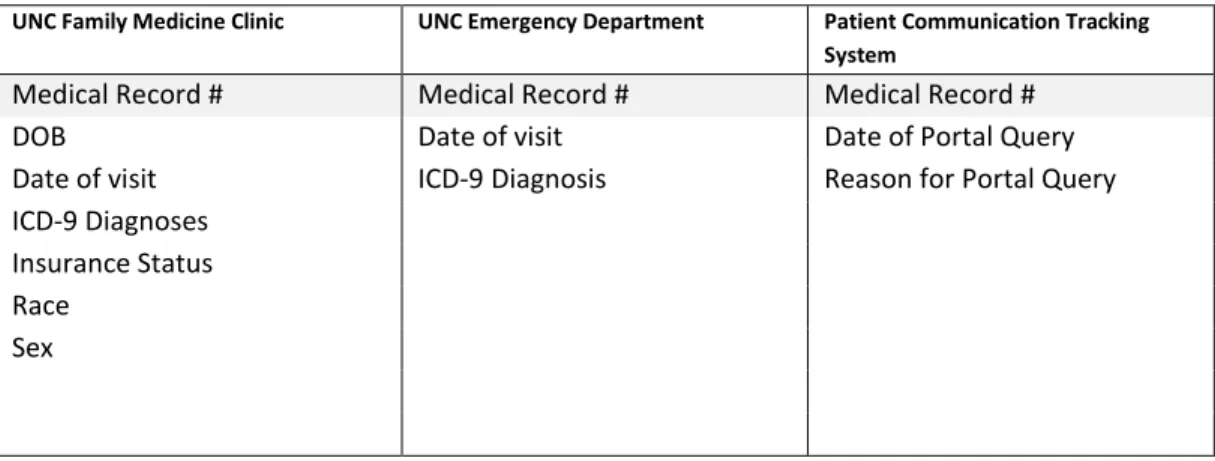
Table 2: Data points collected by dataset A1:1
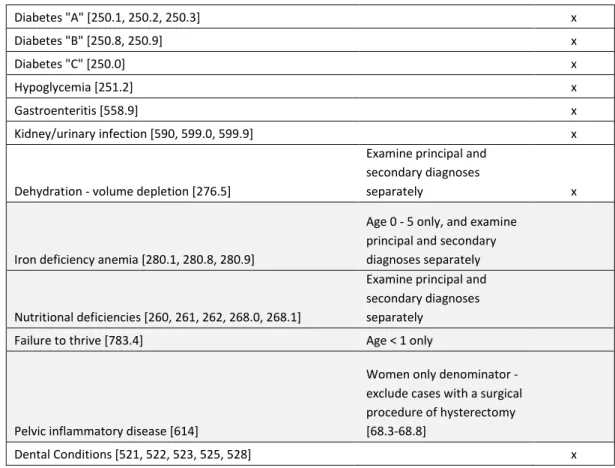
Table 3: Ambulatory Care Sensitive Conditions and Study Outcomes A1:2
Table 4: Index of variables in Final Dataset A1:3
Systematic Review Appendix
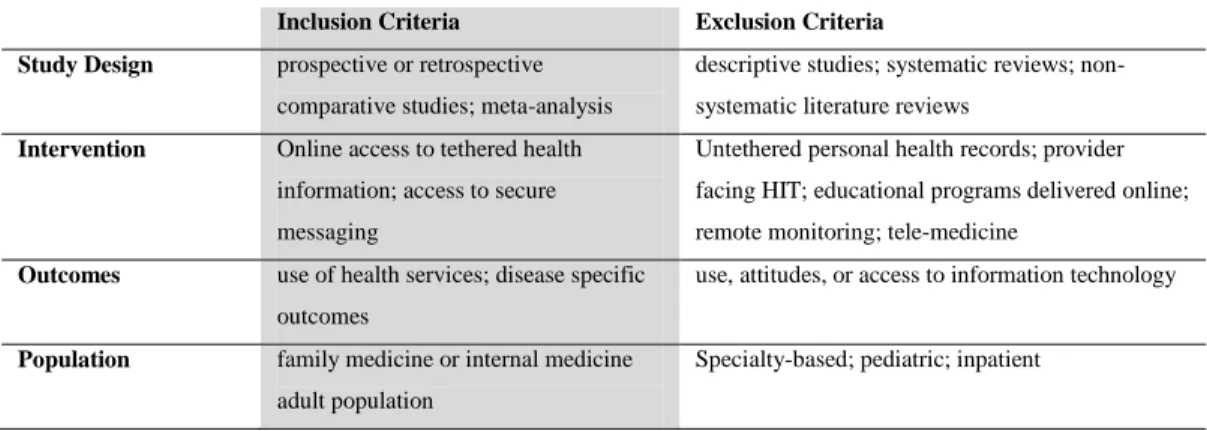
Table 1: Selection Criteria A3:3
Figure 1: Systematic Review Flow Diagram A3:4
1
Introduction
The Health Information Technology for Clinical and Economic Health Act
(HITECH) was passed in 2009 as a part of the American Reinvestment and
Recovery Act (ARRA), known generally as the “stimulus bill”. Central to
HITECH is “meaningful use”, legislation providing financial incentives to
providers who not only purchase electronic health records (EHR) but use them in
a way that lowers the cost and improves the quality of care. The Notice of
Proposed Rule Making (NPRM) for stage 2 of meaningful use requires that all
providers ensure that patients have continual electronic access to their personal
health information (PHI), an objective being fulfilled by the widespread
implementation of internet based patient portals or personal health records (PHR).
Personal health records and patient portals are ways for patients to see
their health information, communicate with their physicians, and perform simple
health care transactions such as scheduling an appointment or refilling a
prescription. Though early adopters have already begun implementing these
technologies, the emerging developments of the meaningful use criteria combined
with significant incentive payments will greatly accelerate the process. Although
we hypothesize that continual electronic access to PHI is beneficial to patient
outcomes and quality of care, no data as yet demonstrate clinical benefits or cost
savings (Tenforde, Jain, and Hickner 2011, 351-354).
Portals have theoretical benefits both on the individual level, with
improved clinical outcomes, and on the system level via improved care
2
extant randomized trials of portal technology focus primarily on the clinical utility
of the technology; no studies directly examine systems level outcomes of portal
technology (Archer et al. 2011, 515-522; Nazi et al. 2010, 62-67).
The emergency department (ED) has become a known repository for
failure in the health care system. Lack of convenience, no prior provider
relationships, or the inability to schedule a prompt appointment lead patients to
seek primary care in the emergency room or to seek emergent care for an
exacerbation of a process easily managed in an ambulatory setting (Shesser et al.
1991, 743-748). Theoretically, a patient portal is both a channel for provider
access and a mechanism for patient engagement. If portals can make it easier for
patients to access their PHI or contact a provider, they may alter when and where
patients seek care.
The UNC Family Medicine practice has a proprietary patient portal that
provides web-based scheduling, secure messaging with providers, and access to
self-care information – common features of most health portals and PHR. We
provide a preliminary exploration of associations between portal access and
appropriate emergency room utilization, and commence an examination of the
consequences of internet portals, a significant technology in the context
meaningful use criteria, from a systems perspective.
This and larger future studies can provide useful data for health care
decision makers both in demonstrating potential effects on the cost of care as well
as highlighting variables that moderate the utility of new technology.
3
consequences of national policy implemented in a variety of clinical and
organizational contexts (Archer et al. 2011, 515-522), all asking the same
essential question: “Is meaningful use meaningful?”
Background
The U.S. health care system remains the most expensive in the world yet
does not produce outcomes proportional to its spending(World Health
Organization 2000; Anderson et al. 2003, 89-105). The Institute of Medicine’s
landmark report,
To Err is Human
, estimated that 44,000 to 98,000 patients die
each year from preventable medical error (Kohn, Corrigan, and Donaldson 2000).
As medical knowledge grows and increased specialization further fragments care
processes, it is natural to expect medical errors to continue or even to increase.
Even though health care is an industry dependent on the management and
interpretation of data, it has been slow to adopt modern information technology;
as of 2008 only 17% of providers and 12% of hospitals had implemented
EHR.(DesRoches et al. 2008, 50-60) The major preoccupations of health care
delivery have changed from provision of acute care to the management of chronic
disease, requiring the intensive coordination of many providers. Efficient
communication is essential to reductions of both redundancy and error – a process
made difficult by the persistence of paper charting.
4
exist: many benefits of EHR are realized through information sharing between
providers, a complex functionality requiring the collaboration of stakeholders who
are often direct competitors as the system is organized now. Finally, with new
forms of information sharing come a new set of patient concerns about the
confidentiality and security of their PHI, a regulatory issue beyond the scope of
any one provider or EHR vendor.(Blumenthal 2011, 2323-2329; Tang et al.
2006b, 121-126)
The HITECH act combines up to $27 billion dollars in incentives with the
threat of reduced Medicare and Medicaid reimbursement to catalyze the
widespread adoption of EHR; it empowers the Office of the National Coordinator
of Health Information Technology (ONCHIT) to create an array of programs that
provide a comprehensive, multi-pronged response to the distinct barriers that have
prevented a market-driven adoption of HIT thus far. Included in the bill are
strategies such as training a new body of HIT experts, developing state-level
Regional Extension Centers, and modifying the Health Insurance Portability and
Accountability Act (HIPAA) to be more stringent. However, the central
provision, that which all other components of HITECH directly or indirectly
support, is “meaningful use.”
5
The initial bill authorized a disbursement of up to $44,000 for Medicare
dominant provider groups and up to $63,750 for Medicaid dominant provider
groups, each payment distributed over a 5 year period; hospitals were offered
from $2million to $10 million. The incentives are awarded in annual increments,
the amount of each gradually reducing over several years, finally to terminate in
2015 for Medicare and 2017 for Medicaid. (Blumenthal 2011, 2323-2329)
Stage 1 involves meeting approximately 25 criteria –varying slightly
between physicians and hospitals – among which are a set of required “core”
objectives and optional “menu” objectives. Providers must demonstrate
meaningful use by the end of 2012 to be eligible for the full incentive amount;
planned deadlines for stage 2 and stage 3 are 2013 and 2016 respectively, and
these deadlines must be met to continue to receive payments. The objectives for
future stages are yet to be written; stage 2 was released in March, 2012 as a
Notice of Proposed Rule Making (NPRM) and at this writing is in the 60 day
window of public commentary.
The changes and requirements in the NPRM demonstrate a balance of
clear movement forward towards goals of demonstrating clinical and quality
improvement with restraint to ensure that objectives remain feasible for providers
still struggling to adopt basic EHR. As its own Health IT web site
6
decision support, quality benchmark reporting, and health information exchange.
The proposed stage 2 rules in the Notice incrementally increase requirements in
each of the three domains.
Computerized provider order entry (CPOE) requirements have been
expanded so that most orders now must occur electronically. A large list of
quality measures have been suggested as candidates for required reporting to
achieve meaningful use. Initially, stage 1 only required that providers purchase
EHR with the ability to share information, but stage 2 requires that providers
actually use the functionality. Notably, the NPRM has increased the requirement
for patients to access their own PHI; the revised stage 1 and proposed stage 2
rules require that 50% of patients have the ability to view, download, and transmit
their data and that 10% actually do so. This requirement, if passed, will
effectively mandate that providers implement a patient portal or PHR.
The American Health Information Management Association (AHIMA)
defines Personal Health Records (PHR) as an “an electronic lifelong resource of
health information needed by individuals to make health decisions. Individuals
own and manage own and manage the information in the PHR, which comes from
healthcare (sic) providers and the individual. The PHR is maintained in a secure
and private environment, with the individual determining rights of access. The
PHR does not replace the legal record of any provider” (Tang et al. 2006a,
121-126). Older versions of PHR were populated manually by patients but more
7
to their PHI, and they also have additional functionalities such as scheduling and
communication. Portals, however, are often directly associated with a provider,
where as a PHR is often independent and may interface with several providers.
Currently, the distinction between PHR and portals, both in clinical
implementation and academic literature, is minimal, as most PHR or portals are
implemented and managed by a single provider.
Methods
We conducted a retrospective cohort study using an original dataset
generated by merging data extracted from two databases: the UNC Physicians and
Associates (P&A) billing database and the UNC Family Medicine Patient
Communication Tracking System (PCTS). Our period of interest for the study,
the time for which we tracked ED use, was between January 1
st2011 and January
1
st2012. Our query was designed to capture a population of patients that had
been seen in the 18 months prior to the study and were still active UNC Family
Medicine patients during the study.
8
2012. This dataset included ICD-9 diagnostic codes forming the basis for our
outcome measure. For data pertaining to portal access, we queried the UNC
Patient Communication Tracking System, a dataset that tracks multiple vectors of
communication between patients and physicians. We examined all instances of
portal access by our patient sample between the dates of January 1
st2010 and
January 1
st2011.
The first author coded the data for the FMC by ICD-9 codes to indicate the
presence or absence of three chronic diseases: Congestive Heart Failure, Diabetes
Mellitus Type II, and Hypertension. The first author also coded data for ED visits
to indicate if a visit included a diagnostic code we had determined to be an
inappropriate use of the ED because it reflected one of the ambulatory-sensitive
conditions we used to discriminate between causes of ED visits (see below). The
PCTS data were reduced to a unique list of medical record numbers, indicating
those patients that had used the portal at least once during the aforementioned
time period. The FMC, ED, and PCTS datasets were then merged using the
medical record number as a common unique identifier. We performed statistical
analysis on the resulting merged data to determine whether those who had used
the patient portal were less likely to appear in the ED with an
ambulatory-sensitive condition (See Appendix 1for further explanations of variable creation)
DATA
9
smaller subset of the larger, general FMC population. We chose to define the
study as such to improve the possibility of detecting a signal that indicated an
association between portal access and inappropriate ED use. The weakness of
this strategy is that the mean values for many of our outcomes will be higher than
the mean values of the entire FMC population, limiting our ability to interpret the
absolute values of the outcomes measured – our choice has created something of a
ceiling effect.
Independent variable:
The UNC Family Medicine portal provides three
functions: scheduling, secure messaging, and access to self-care information.
This varies from a traditional portal or PHR in that the patient does not have
access to personal health information. The UNC Family Medicine portal, in
providing secure messaging, serves as an example of electronic access to a
provider, a common, meaningful feature of many portals or PHR.
Dependent variable.
To define the outcome of “inappropriate” emergency
10
pneumonia, and asthma; CHF, a particular target of CMS readmission reduction
policies; hypertention and angina, cellulitis, conditions related to diabetes, and
dental conditions. All these conditions should, ideally, be managed with
ambulatory care such that their symptoms or exascerbations do not lead to ED
visits.
Defining inappropriate ED use is difficult; there is no standard method in
the literature and significant variation accompanies different attempts to quantify
inappropriate visits (Lowe and Bindman 1997, 133-136). We chose to use
ACSCs as the basis for our outcomes measure because this approach to defining
unnecessary ED use relies on conclusions by the federal agency charged with
assuring quality of care, uses ICD-9 billing codes, and has historic use in the
literature (Oster and Bindman 2003, 198).
The challenge of using ACSC as a sentinel for inappropriate ED use is that
these conditions can be prevented by early primary care. The exascerbations of
the conditions being tracked with the ACSC list are actually appropriate for the
emergency room, but it is inappropriate that the exascerbations ever occurred.
Several of the ACSC conditions are related to receiving appropriate
immunizations or basic preventive care. We chose to select conditions that would
result from either the inappropriate management of chronic disease or emergent
conditions that are usually preceded by a sub-acute presentation treatable in an
ambulatory setting, such as bacterial pneumonia.
11
one of the ICD-9 codes in our ACSC subset as “inappropriate.” We created a
variable that recorded the total number of ED visits per patient, another variable
that recorded the total number of inappropriate visits per patient, and a final
variable, the ratio of inappropriate ED visits to total ED visits. We then created a
further summary dummy variable indicating that a patient had inappropriately
used the ED at least once.
Our goal for the study was to detect a signal indicating an association
between ED use and portal access, not to quantify inappropriate ED use or
establish causal direction. We chose four different variables to track ED use in
order to provide an opportunity to triangulate our results. If multiple outcomes all
demonstrate a similar coherent signal, the observation is less likely to be random.
Conversely, if all four methods of examining the outcome demonstrate a null
finding, the observation that no association exists is strengthened.
12
It is important to emphasize that the primary endpoints are only
interpretable in the context of relative comparisons; they are not adequate to
quantify an absolute number of unnecessary visits. It is unlikely that the coding
of ICD-9 data varied systematically between the control and intervention group -
as those coding the data were unlikely aware of portal status. However, our
method only captures a subset of ED visits determined by ACSC criteria to be
inappropriate and likely underestimates the actual level of inappropriate.
Controls:
Age was calculated from the date of birth and we included
other demographic information – sex, race, payer status – as recorded in the
original dataset. Payer status was our only option for creating a proxy for the
patient’s socio-economic status and education. This proxy is admittedly coarse,
and thus likely understates the potential effectiveness of portal use. Although
Medicare and private insurance patients can vary significantly in income,
education, and internet access, Medicaid insurance likely corresponds to lower
income and less education. Demonstrating an effect independent of Medicaid
status, thus, will be strongly suggestive that at least part of the effect is also
independent of income and education. Internet access is quickly becoming
ubiquitous, but discrepancies in access by age, socioeconomic status, and race
may persist. We do not directly measure internet access; we know that it may
underlie any association between other demographic variables and portal use
13
chronic diseases: Hypertension, Diabetes Mellitus Type II, and Congestive Heart
Failure. Those with such diagnoses may have disproportionately worse health
status than those in the other arm of the study, for whom we do not control for
other chronic disease. Poor health may be associated with greater use of the ED in
itself, and it may be associated with greater rates of portal access because sick
patients have a greater need for health care resources. Though total ED visits
could also be used as a measure of health status, it is also a variable influenced by
a propensity to seek health care. Recording the presence of chronic disease
seemed to be a more direct measurement of the variable of interest.
Analysis
We examined differences in mean values or frequencies between the
portal access and non-portal access groups on each of the demographic and health
status variables with 2-sample t-tests for continuous variables and a Pearson’s
chi-square test for dichotomous or categorical variables. For those categorical
variables with more than two values, each value of the variable was analyzed
separately as a dichotomous variable using Pearson’s chi-square.
14
model adjusting for only those demographic variables with a potential
confounding effect, for each of three outcomes: total ED visits, total
inappropriate ED visits, and a ratio of inappropriate ED visits to total ED visits.
The sequence of analysis for each outcome variable was identical and is described
below.
Prior to running the model we created dummy variables for the categorical
variables with more than 2 categories - race and payer status. We initially ran a
linear regression for the effect of portal access on the outcome of interest,
adjusting for all measured demographic variables. We noted the Beta value for
portal access. We then used bivariate analysis to explore the association of any
other measured variable to the intervention, portal access; we used a 2 sample
t-test for continuous variables and a Pearson’s chi-square t-test for categorical
variables. For those variables with more than 2 categories, we created binary
dummy variables for each value of the variable and used Pearson’s chi-square test
to examine association between the newly created dummy variable and the
15
Results
Our study population, Family Medicine patients who had also visited the
ED between January 1
st2011 and January 1
st2012, totaled 2,977; this is only
17.05% of Family Medicine patients in the period. Thirty percent of Family
Medicine patients had accessed the portal at least once during the period (patients
manually enter their medical record numbers, and we found that we could not
match an additional 6.7% of patients who had used the portal to a valid medical
record number in the Family Medicine Clinic dataset, so the actual number of
portal users may be closer to 40%).
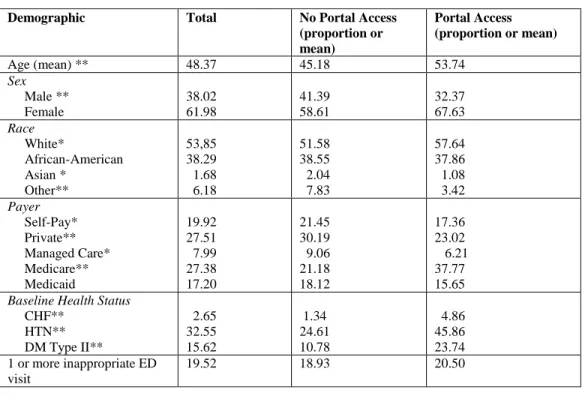
Most measured variables did significantly vary by portal access. As we
have noted, the two exceptions were African American race and Medicaid payer
status. (Table 1) Portal users were more likely to be older, female, white, insured
by Medicare, and have a chronic disease. Those who did not use the portal were
more likely to be self- or privately insured. Though the unadjusted frequency of
inappropriate ED use did not vary significantly by portal access, it is notable that
a fifth of the patients in this subsamplehad used the ED for a diagnosis we flagged
as inappropriate.
16
total inappropriate ED visits (β = -0.004, p=0.866), and the ratio of inappropriate
to total ED visits (β = -0.009, p=0.425). In the three reduced-model linear
regressions, controlling only for those variables that demonstrated an association
with portal access, a lack of statistically significant correlation persisted across all
measured outcomes; the beta values and statistical significance were unchanged
for all three variables.
17 Table 1: Distribution of demographic variables by intervention
Statistical significance calculated using 2 sided t-tests for continuous variables and Pearson’s Chi-square for categorical variables.
*p<0.05 **p<0.0001
Table 2. Risk Ratio of 1 or more inappropriate ED visits by portal access
Variable RR 95% CI
1 or more inappropriate ED visits 1.08 0.93 – 1.25
Table 3: Adjusted* Mean or Percent of ED visits comparing Portal Access to No Portal Access
Outcome Portal Access 95% CI No Portal
Access
95% CI p value
Total ED visits 2.02 1.88 – 2.13 1.88 1.78 – 1.97 0.1231
Inappropriate ED visits 0.239 0.21 – 0.27 0.243 0.217 – 0.269 0.866
Inappropriate/Total visits** 0.120 0.102 – 0.138 0.130 0.116 – 0.143 0.42
* based on beta estimates of a multiple linear regression model controlling for age, sex, payer status, race, and baseline health status
**proportion of inappropriate ED visits to total ED visits
Demographic Total No Portal Access
(proportion or mean)
Portal Access (proportion or mean)
Age (mean) ** 48.37 45.18 53.74
Sex Male ** Female 38.02 61.98 41.39 58.61 32.37 67.63 Race White* African-American Asian * Other** 53,85 38.29 1.68 6.18 51.58 38.55 2.04 7.83 57.64 37.86 1.08 3.42 Payer Self-Pay* Private** Managed Care* Medicare** Medicaid 19.92 27.51 7.99 27.38 17.20 21.45 30.19 9.06 21.18 18.12 17.36 23.02 6.21 37.77 15.65
Baseline Health Status
CHF** HTN** DM Type II**
2.65 32.55 15.62 1.34 24.61 10.78 4.86 45.86 23.74 1 or more inappropriate ED
visit
18
Discussion
The lack of significant association between the primary outcomes of the
study – total ED use, total inappropriate ED use, and the ratio of inappropriate to
total ED use – and portal access provides useful insight into the implementation
of portals. The data demonstrate that whatever care process led to the overall rate
of inappropriate ED visits in the Family Medicine population, the presence or
absence of a portal did not meaningfully alter that process for the sample as a
whole. Without knowing much more about the patients who can and do use a
portal, we cannot say that the mere presence of a portal can change outcomes.
Two conclusions can stem from our observations: portals do not have the
ability to modify rates of inappropriate ED use, or portals do have the ability to
modify ED use but that capacity is unrealized in this instance. A similar
conclusion can be made by most studies of portals and PHR with null findings.
A portal is a channel, with little implicit unique value; it primarily facilitates care
process that could occur in other, more resource intensive venues, such as a
face-to-face visit; it has the potential to deliver a similar care process but at greater
convenience and, potentially, lower cost, to the provider and patient.
19
way to practice a style of care that may be otherwise financially or logistically
infeasible without electronic communication.
Many physicians are concerned that technology such as health portals will
have a poor return on investment (DesRoches et al. 2008, 50-60); this is in part
due to fee-for-service financial arrangements that do not reimburse physicians for
efficiency, or for generating administrative and technologic investment. Though
meaningful use and the accompanying funds generate a temporary financial
incentive to drive the purchase and implementation of technologies like health
portals, the underlying payment structure causing provider reluctance to invest in
EHR and related technologies still exists. Physician involvement will likely be
the minimum required to remain eligible for incentive funds. However, without
genuine physician investment it is unlikely that many technologies, especially
those that primarily facilitate communication and information sharing between
patient and providers will produce meaningful benefit.
20
The common challenge of most PHR and portal studies, especially those
of observational design, is the confounding relationship of patient engagement.
The theoretical causal pathway of portal benefit is that a portal generates patient
engagement that in turn causes improved health behaviors – such as improved
self-care or better use of health care resources. However, patients that are
engaged at baseline may more likely to use a health portal; portal access may act
merely as a marker of patient engagement rather than a cause of it. Our inability
to account for patient engagement with our data is a significant shortcoming.
Though we did not observe an effect, if we had, the effect may have been caused
not by the intervention, but rather a baseline difference between the two cohorts,
as we have suggested.
The usability of technology is a significant, but unaddressed variable that
moderates the usefulness of technology. As mentioned previously, the term
“health portal” is a broad term encompassing a broad range of functions; across
varying health portals, designed by a multitude of vendors, is significant
21
Conclusion
Our study corresponds to other research examining portal or PHR use in
that it did not find a significant outcome clearly attributable to the presence of a
portal (Tenforde, Jain, and Hickner 2011, 351-354). However, the lack of findings
does not conclusively demonstrate that portals are valueless. Rather, from the
process of our exploration, it is the unanswered questions that inform future
research. Baseline patient engagement, physician engagement, and the design of
technology are important variables to capture when evaluating the utility of a
portal. The mere presence of a technology tells us nothing about how patients and
providers use it.
Meaningful use is reaching the end of the first stage, the stage of
purchasing and implementing EHR. Only future stages will reveal if policy has
the ability to generate meaningful outcomes from “meaningful use.” Some have
pointed to the lack of meaningful change in clinical or quality oriented outcomes
as evidence of the ineffectiveness of meaningful use, but that conclusion is likely
premature. It is unrealistic to assume that the presence of a technology itself will
produce change.
22
engagement with technology will be superficial during the meaningful use process
and recede once the incentive funds have been fully disbursed.
Stage 1 requirements of meaningful use are such that providers can
achieve objectives without significantly modifying clinical processes. The risk is
that the true burden of meaningful use will only become apparent in the future
stages. Currently providers may not have to grapple with usability issues, seeing
the collection of basic data as a minor inconvenience. However, when later
meaningful use stages begin to require demonstrated change in outcomes, a
process that will require a significant cultural shift and integration of technology
into the clinical workflow, more serious challenges may emerge.
The lack of a broader financial context that rewards physicians for
expending administrative effort to leverage technology and streamline care
combined with a distinct absence of focus on user interface and product design
from HIT vendors, may create a scenario in which providers reluctantly interface
with cumbersome, or even worse, error-ridden, technology. Meaningful use
criteria themselves, far from pushing health care into the 21
stcentury, can burden
the system with unrealistic expectations and drive the national implementation of
unrefined software.
23
and a newly trained body of HIT experts. Meaningful use and the accompanying
24 References
AHRQ. Appendix B: Ambulatory care sensitive condtions. [cited 06/10 2012]. Available from http://archive.ahrq.gov/data/safetynet/billappb.htm
Anderson, G. F., U. E. Reinhardt, P. S. Hussey, and V. Petrosyan. 2003. It’s the prices, stupid: Why the united states is so different from other countries. Health Affairs 22 (3): 89-105. Archer, N., U. Fevrier-Thomas, C. Lokker, K. A. McKibbon, and S. E. Straus. 2011. Personal
health records: A scoping review. Journal of the American Medical Informatics Association : JAMIA 18 (4) (Jul-Aug): 515-22.
Blumenthal, D. 2011. Wiring the health system—origins and provisions of a new federal program. New England Journal of Medicine 365 (24): 2323-9 (accessed 4/11/2012 12:50:23 PM). DesRoches, C. M., E. G. Campbell, S. R. Rao, K. Donelan, T. G. Ferris, A. Jha, R. Kaushal, D. E.
Levy, S. Rosenbaum, and A. E. Shields. 2008. Electronic health records in ambulatory care—a national survey of physicians. New England Journal of Medicine 359 (1): 50-60. Grant, R. W., J. S. Wald, J. L. Schnipper, T. K. Gandhi, E. G. Poon, E. J. Orav, D. H. Williams, L.
A. Volk, and B. Middleton. 2008. Practice-linked online personal health records for type 2 diabetes mellitus: A randomized controlled trial. Archives of Internal Medicine 168 (16): 1776.
Green, B. B., A. J. Cook, J. D. Ralston, P. A. Fishman, S. L. Catz, J. Carlson, D. Carrell, L. Tyll, E. B. Larson, and R. S. Thompson. 2008. Effectiveness of home blood pressure monitoring, web communication, and pharmacist care on hypertension control. JAMA: The Journal of the American Medical Association 299 (24): 2857.
HealthIT.gov. 2012. "Meaningful Use Defintion and Objectives."
http://www.healthit.gov/providers-professionals/meaningful-use-definition-objectives. Site last visited for this paper on 6 July 2012.
Kohn, L. T., J. Corrigan, and M. S. Donaldson. 2000. To err is human: Building a safer health system. Vol. 6Natl Academy Pr.
Lowe, R. A., and A. B. Bindman. 1997. Judging who needs emergency department care: A
prerequisite for policy-making. The American Journal of Emergency Medicine 15 (2): 133-6. Nazi, K. M., T. P. Hogan, T. H. Wagner, D. K. McInnes, B. M. Smith, D. Haggstrom, N. R.
Chumbler, et al. 2010. Embracing a health services research perspective on personal health records: Lessons learned from the VA my HealtheVet system. Journal of General Internal Medicine 25 Suppl 1 (Jan): 62-7.
Oster, A., and A. B. Bindman. 2003. Emergency department visits for ambulatory care sensitive conditions: Insights into preventable hospitalizations. Medical Care 41 (2): 198.
Shesser, R., T. Kirsch, J. Smith, and R. Hirsch. 1991. An analysis of emergency department use by patients with minor illness. Annals of Emergency Medicine 20 (7): 743-8.
Tang, P. C., J. S. Ash, D. W. Bates, J. M. Overhage, and D. Z. Sands. 2006a. Personal health records: Definitions, benefits, and strategies for overcoming barriers to adoption. Journal of the American Medical Informatics Association 13 (2): 121-6.
———. 2006b. Personal health records: Definitions, benefits, and strategies for overcoming barriers to adoption. Journal of the American Medical Informatics Association 13 (2): 121-6. Tenforde, M., A. Jain, and J. Hickner. 2011. The value of personal health records for chronic
disease management: What do we know? Family Medicine 43 (5) (May): 351-4.
Wagner, P. J., J. Dias, S. Howard, K. W. Kintziger, M. F. Hudson, Y. H. Seol, and P. Sodomka. 2012. Personal health records and hypertension control: A randomized trial. Journal of the American Medical Informatics Association : JAMIA (Jan 10).
A1- 1
Methods Appendix
Data collection methods were submitted to and approved by the University of North Carolina (UNC) Internal Review Board for clinical research. Data were extracted from UNC Physicians and Associates billing database and the UNC Patient
Communication Tracking System (PCTS) – a proprietary software that tracks instances of communication between patients and providers. Database queries were executed by the data custodians for each database, Sonya Buford and Todd Meath, respectively. The first author was the single coder of the ICD-9 codes used to create the outcome variable and is responsible for any errors that may have occurred.
Table 1: Query date chart
6/1/2009 1/1/2010 6/1/2010 1/1/2011 1/6/2011
UNC P&A Billing Data – ER visits PCTS Data – Portal Visits
UNC Continuity Clinic – Patient roster
Table 2: Data points collected by dataset
UNC Family Medicine Clinic UNC Emergency Department Patient Communication Tracking System
Medical Record # Medical Record # Medical Record #
DOB Date of visit Date of Portal Query
Date of visit ICD-9 Diagnosis Reason for Portal Query ICD-9 Diagnoses
Insurance Status Race
A1- 2 Table 3: Ambulatory Care Sensitive Conditions and study outcomes
Diagnosis Comments
Study outcome Congenital syphilis [090]
Immunization-related and preventable conditions [033, 037, 045, 320.0, 390, 391]
Hemophilus meningitis [320.2] age 1 - 5 only
Grand mal status and other epileptic convulsions [345]
Convulsions "A" [780.3] Age 0-5
Convulsions "B" [780.3] Age >5
Severe ENT infections [382, 462, 463, 465, 472.1]
Exclude otitis media cases [382] with myringotomy with insertion of tube
[20.01] x
Pulmonary tuberculosis [011]
Other tuberculosis [012-018]
Chronic obstructive pulmonary disease [491, 492, 494, 496, 466.0]
Acute bronchitis [466.0] only with secondary
diagnosis of 491, 492, 494,
496 x
Bacterial pneumonia [481, 482.2, 482.3, 482.9, 483, 485, 486]
Exclude case with secondary diagnosis of
sickle cell [282.6] and
patients < 2 months x
Asthma [493] x
Congestive heart failure [428, 402.01, 402.11, 402.91, 518.4]
Exclude cases with the following surgical procedures: 36.01, 36.02, 36.05, 36.1, 37.5,
or 37.7 x
Hypertension [401.0, 401.9, 402.00, 402.10, 402.90]
Exclude cases with the following procedures: 36.01, 36.02, 36.05, 36.1,
37.5, or 37.7 x
Angina [411.1, 411.8, 413]
Exclude cases with a surgical
procedure [01 - 86.99] x
Cellulitis [681, 682, 683, 686]
Exclude cases with a surgical procedure [01- 86.99], except incision of skin andsubcutaneous tissue [86.0] where it is the only
listed surgical procedure x
Skin grafts with cellulitis [DRG 263, DRG 264]
A1- 3
*Those conditions marked with “x” and highlighted in white are the selected outcomes used for the study.
Table 4: Index of variables in final dataset
Variable Name Values Description
patientmrn -
MR# of the patient, key for database
age 0 -999 Age, in years, calculated from DOB
sex Male, Female Sex of patient
patientrace
White, African American,
Asian, Other race of patient
insurance
Private, Managed Care,
Medicare, Medicaid, Self Pay FISC payer status
CHF 0,1
defines the presence or absence of a diagnosis of CHF during any FMC visit
DMII 0,1
defines the presence or absence of a diagnosis of DMII during any FMC visit
HTN 0,1
defines the presence or absence of a diagnosis of HTN during any FMC visit
ED_totalvisit 0 - 99 total ED visits
Diabetes "A" [250.1, 250.2, 250.3] x
Diabetes "B" [250.8, 250.9] x
Diabetes "C" [250.0] x
Hypoglycemia [251.2] x
Gastroenteritis [558.9] x
Kidney/urinary infection [590, 599.0, 599.9] x
Dehydration - volume depletion [276.5]
Examine principal and secondary diagnoses
separately x
Iron deficiency anemia [280.1, 280.8, 280.9]
Age 0 - 5 only, and examine principal and secondary diagnoses separately
Nutritional deficiencies [260, 261, 262, 268.0, 268.1]
Examine principal and secondary diagnoses separately
Failure to thrive [783.4] Age < 1 only
Pelvic inflammatory disease [614]
Women only denominator - exclude cases with a surgical procedure of hysterectomy [68.3-68.8]
A1- 4 ED_totalinapp 0 - 99 total inappropriate ED visits
ED_itratio 0 - 1
inappropriate ED visits / total ED visits
edinapp 0,1
Indicates if patient had 1 or more inappropriate ED visits. Used for caculating a risk ratio
portal 0,1
A2- 1
Background Appendix
HITECH act
The Heath Information Technology for Economic and Clinical Health (HITECH), passed in 2009 as part of the American Reinvestment and Recovery Act (ARRA), is the legislative catalyst for the current, widespread adoption of electronic medical records (EHR). The bill combines up to $27 billion dollars in incentives with the threat of decreased Medicare and Medicaid reimbursement and drives physicians to not only purchase health information technology but to use it in a way that may improve the quality and efficiency of care. The many components of the bill respond to distinct barriers that have prevented a market-driven adoption of HIT thus far.
Information Technology in Health care
The success of early adopters of EHR, such as Kiser Permanente and the Veterans Administration (VA), provided promising empirical backing to the benefits of HIT implementation. Some attribute the transformation of the VA, from a low-quality provider to a leader in the provision of high-quality care, to their intense leveraging of health information technology.(Jha et al. 2003, 2218-2227) Additionally, the experience of physicians have also been positive, 90% of physician EHR users reported positive experiences and could observe specific quality benefits to EHR use. (DesRoches et al. 2008, 50-60)
A2- 2
custom designed EHR implemented in large health networks are generalizable to late adopters purchasing out-of-the-box software packages. (Wu et al. 2006, 742-752) However, systematic reviews of the body of literature found an overall benefit to EHR implementation mostly realized through specific functionalities such as decision support
and reduced testing through information sharing. (Buntin et al. 2011, 464-471).
Need for Legislation
Counterproductive financial incentives, product complexity, the need for collaborative information exchange, and privacy concerns have each contributed to the general industry level resistance towards information technology. Current market dynamics have thwarted the necessary collaboration amongst stakeholders to
meaningfully implement health information technology. Policy makers believed that each barrier was one that would not resolve spontaneously and would benefit from legislative intervention, and the provisions of the HITECH act are structured to respond to each challenge. (Blumenthal 2011, 2323-2329)
Currently, most physicians are paid on a fee-for-service basis and in this form of reimbursement providers are dissuaded from investing in efficiency generating processes. Installing information technology is an expensive initial investment and, if successful, will lead to a process of care that requires fewer tests and fewer visits. Though payers and patients benefit from effective care, providers suffer financially; without significant changes to provider reimbursement, it is unlikely that they will spontaneously embrace HIT. Market failures such as this are generally agreed upon by economists as an appropriate intervention for government intervention. (Salvatore 2003, 02)
A2- 3
of a given product. Providers are reluctant to invest in systems of which they are uncertain and lack the expertise to competently evaluate. Furthermore, the management of IT systems can be complicated and require skills that may not exist in many practices. A successful effort to drive the use of EHR in New York City suggests that the
government can mitigate barriers to expertise through the provision of intellectual
support. (Mostashari, Tripathi, and Kendall 2009, 345-356)
Exchanging information between providers is an important but complicated capacity of health information systems; it requires standardization and collaboration of a myriad of vendors and product developers, many of which are direct competitors to each other. Some policymakers have considered mandating the national use of a single EHR – such as the system used for the VA. (Stark 2010, 12) However, current vendors would likely provide strong resistance and many providers have already invested significant time and capital implementing other EHR systems.
The most feasible solution is to the problem of data standardization is to facilitate the free exchange of information between multiple platforms. It is outside the interest and financial resources of any one vendor or provider to coordinate standard methods of communication and to ensure adherence to those standards. HITECH supports the development an infrastructure, certification process, and regulatory body to manage the standardization and sharing of health information.
Finally, a public concern is ensuring the privacy of health information as it is exchanged amongst providers. There have been reports of breaches in security
(Department of Health and Human Services, Office for Civil Rights. 2010), and a lack of trust on part of the public could quickly undermine the political will for pushing
A2- 4
the Health Insurance Portability and Accountability Act (HIPAA), needs to be modified to account for new ways of sharing and storing health information – such as personalized heath records and health information exchanges.
Implementation
The HITECH act first established the Office of the National Coordinator for Health Information Technology (ONCHIT) and budgeted $27 billion dollars over the course of 10 years to support the implementation and subsequent meaningful use of EHRs. Meaningful use will occur in 3 stages over the course of the next 5 years and combines two broad strategies: outcomes-based reimbursement and direct payment for EHR purchase.
To reimburse physicians based on demonstrated clinical improvement creates a natural incentive to adopt EHRs but may isolate benefits only to clinical care; there are other research and public health benefits that would be underemphasized or wholly ignored through this approach. The other strategy, to directly pay physicians to use
EHRs, risks physicians purchasing electronic systems but never appropriately using them.
Meaningful use, drafted and implemented by the HHS, guides the disbursement for incentive funds to physicians, via Medicare and Medicaid, initially for EHR
implementation and eventually, in later stages, for demonstrated improvement in clinical outcomes and quality measures. The use of a broad portfolio of requirements, instead of simple reimbursement for the purchase of EHR, allows HITECH to promote broad functionality beyond clinical care - such public health monitoring and care quality reporting.
A2- 5
actualization of meaningful use. To overcome logistic and technical challenges of purchasing and implementing EHR, HITECH created a national network of regional extension centers (REC). Mimicking a previously existing government program that assists farmers in staying current with agricultural technology, RECs provide hands-on intellectual support to providers in purchasing, implementing, and maintaining EHR
systems. (Blumenthal 2011, 2323-2329)
Too few HIT experts are available to support providers in transitioning to EHR use; in 2009, studies estimated that 50,000 additional health information technology professionals would be needed to match demand.(Rollins 2010, 28-34) The HITECH act mandated that the ONC train a sufficient professional body to interact with vendors, providers, and REC to realize policy goals. (Blumenthal 2011, 2323-2329) As a mechanism of consumer protection for providers newly adopting EHR, the bill required ONCHIT to establish and manage a certification process for meaningful use appropriate technology.
The exchange of health information across platforms and providers is also a focus of the legislation. ONCHIT was provided $300 million dollars to fund state level efforts in constructing regional information exchanges and $2 billion to construct a national health information exchange. The exchanges must fulfill several functions including creating standards for compatibility, establishing and maintaining an
information-sharing specific infrastructure, and reinforcing the adherence to established norms.
A2- 6
from $25,000 to $1.5 million and restrictions for the use of health information for marketing and fund-raising purposes were strengthened.
Initial Challenges of Implementation
The scope and complexity of the HITECH act cannot be emphasized too
strongly. A country of such size, heterogeneity, and political decentralization as the U.S. faces significant challenges in the creation of a coordinated national exchange of health information. The central provision of HITECH, Meaningful Use criteria, has no legal, political, or academic precedent. The remaining programs of the HITECH act have to be created anew by a nascent political committee, ONCHIT, with very little legislative experience and within a timeline that is considered, by those that drafted the legislation, ambitious. (Stark 2010, 12)
The secretary of Health and Human Services was required to draft meaningful use criteria, the standards for meaningful use appropriate technology, and the certification process to support those standards, within 10 months. Given the lack of precedence and the policy’s far reaching scope, the timeline was challenging. Similarly, the initial schedule for implementing MU criteria was rapid. The criteria were to be released by December 31, 2009; hospitals could begin receiving MU reimbursements by October 1, 2010 and professionals could receive payments by January 1, 2011. Reimbursements were scheduled to significantly decrease by 2012 and end by 2016, frontloading the reimbursement schedule to encourage providers to rapidly adopt EHR. (Blumenthal 2011, 2323-2329)
A2- 7
trained, and health information exchange programs developed. The rapid timeline doesn’t allow for the refinement of the many programs being developed before they are
scaled to a national level.
Furthermore, the pace of meaningful use implementation and accompanying financial incentives threaten to redirect the development of HIT in an unproductive way. Providers will focus on implementing certified HIT to ensure full reimbursement, and vendors on modifying existing software to adhere to new meaningful use certification requirements. The risk of severely redirecting provider and vendor energy is delaying the refinement clinically meaningful systems in favor of superficially modifying products with concerning usability issues in order to meet policy requirements. (Karsh et al. 2010, 617-623)
Meaningful Use
Among the objectives of meaningful use are complex functions such as information exchange, electronic prescribing, and automated reporting of quality performance – lofty goals for a system still dominated by paper charting. Many of the demonstrated cost and quality benefits of HIT have been associated with the use of decision support and information sharing (Wu et al. 2006, 742-752; Walker et al. 2005, 5), and policy makers felt that requiring only the purchase of EHR would be inadequate to reap the potential benefits of widespread EHR implementation. (Stark 2010, 12)
Incentives
A2- 8
offered from $2 to $10 million dollars. The incentives are awarded in annual increments, the amount of each gradually reducing over several years, to finally terminate in 2015 for Medicare and 2017 for Medicaid. (Blumenthal 2011, 2323-2329)
Criteria
Meaningful use is planned to occur in three stages, each with increasingly demanding requirements. The objective of stage 1 criteria is to promote the purchase of certified EHRs, the entry and reporting of structured data, and the development of an infrastructure to facilitate information sharing. Later stages will progress to requiring bi-directional exchange of information – with both other providers and patients - and eventually demonstrated improvements in quality, efficiency, and population health.
Stage 1 involves approximately 25 criteria – the amounts vary slightly between physicians and hospitals – of which are a set of required “core” objectives and optional “menu” objectives. Physicians, for example, must achieve all 15 core objectives and 5 of
10 menu objectives to be eligible for the incentive payments; hospitals have only 14 core objectives but must also achieve 5 of 10 menu objectives. Providers must demonstrate meaningful use by 2012 to be eligible for the full incentive amount; planned deadlines for stage 2 and stage 3 are 2013 and 2016 respectively and must each be met to continue to receive payments.
Stage 2 Meaningful Use
A2- 9
for just acquiring EHRs. The changes and requirements in the NPRM demonstrate a balance of clear movement forward but also restraint to ensure that objectives remained feasible achievable for most providers.
The central thrust of meaningful use, from its inception, was to promote specific functionalities in addition to EHR adoption: computerized prescribing with decision support, quality reporting, and health information exchange. To that, stage 2 rules stay true, incrementally increasing requirements in each of those three domains.
1. Computerized provider order entry (CPOE) requirements have been raised to require that most orders occur electronically.
2. A host of quality measures have been proposed for required reporting to achieve meaningful use.
3. Stage 1 only required providers to purchase EHRs with the ability to information share, stage 2 requires that they actually use the functionality.
A significant move forward, one that received attention from the ONC upon release of the NPRM, is the increased requirement for patients to access their own data. Previously, providers only needed to be able to provide patients an electronic copy of their health information upon request; the revised stage 1 and proposed stage 2 rules require that 50% of patients have the ability to view, download, and transmit their data and that 10% actually do so.
The final rule may differ, as providers will likely object to being held accountable for a patient’s behavior, but regardless, it signifies the importance of
A2- 10
access to health information, health portals will become increasingly ubiquitous and the line of inquiry into their utility will intensify.
Personal Health Records
Patient engagement and patient access to health information are becoming increasingly important concepts in an era of health care reform. Patient centered medical homes, accountable care organizations, and new modifications to meaningful use
objectives all embrace the importance of patients becoming more directly involved with their health care processes. A recent HIT action agenda states that access to personal health information (PHI) ‘empowers patients to actively partner with their health care
providers in making important health care decisions, which can potentially lead to better health care and better health outcomes.’ (Wilson C 2010) Though data exist to
demonstrate better health behaviors with patient engagement (Hibbard et al. 2007, 1443-1463), no literature has yet to demonstrate an association between electronic access to health information and patient engagement.
The American Health Information Management Association (AHIMA) defines Personal Health Records (PHR) as an “an electronic lifelong resource of health
information needed by individuals to make health decisions. Individuals own and manage own and manage the information in the PHR, which comes from health care providers and the individual. The PHR is maintained in a secure and private
environment, with the individual determining rights of access. The PHR does not replace the legal record of any provider.” (AHIMA e-HIM Personal health Record Work Group
2005, 1-7) The methods by which PHRs are filled with PHI vary. Initial versions were populated manually by the patient, but more recent PHRs, “tethered” to a provider,
A2- 11
have additional functionality such as electronic communication with a provider, scheduling, and self-management tools.
Patient portals are similar to PHRs in that they provide patients with online access to their PHI and also have additional functionalities such as scheduling and communication. Portals, however, are often directly associated with a provider, where as a PHR is often independent and may interface with several providers. Currently, the distinction between PHRs and portals, especially in the academic literature, is minimal. PHR seems to be the most inclusive and commonly used term, though the technology described within many PHR studies could just as easily be referred to as a patient portal - as most of the PHRs used in studies are directly associated with the researching
institution.
The current rates of PHR use by patients are modest. Although most believe that a PHR would provide significant benefit in managing their health care, there are
significant concerns about privacy and security. (Fuji, Galt, and Serocca 2008) A study of a large health cooperative, which encouraged all patients to use PHR, observed a 42% signup rate but only 16% active use rate. (Yamin et al. 2011, 568) Similar patterns of low registration and low utilization were observed in many of the recent studies of PHR and health portals. The current low utilization is in contrast to consumer survey research which has shown growing interest in using PHRs. (Kaelber et al. 2008, 729-736)
515-A2- 12
522; Tenforde, Jain, and Hickner 2011, 351-354) Additionally, there remains a clear need to explore potential benefits on a systems level. (Archer et al. 2011, 515-522)
Significant drivers for the political interest in health information technology are both its potential to improve the quality of care and reduce the cost of care. The
theoretical cost savings occur, not only on an individual level – with decision support tools - but on a systems level, through the prevention of unnecessary use of emergency or inpatient resources. Many episodes of inpatient care are the exacerbations of chronic disease and preventable by improving access to primary care and improved care coordination.
The emergency room has become known as a repository for failures in the health care system. Inadequate disease management or poor access to primary care leads patients either to seek primary care in the emergency room or to need emergent care for a disease that could have been treated earlier in an ambulatory setting. PHRs, especially those with secure messaging, constitute a form of increased access to a provider, but is it a type of access that is meaningful? In giving a channel of constant communication to physicians and improved access to personal health information, do PHRs or patient portals have the ability to change care seeking behavior?
A2- 13
References
AHIMA e-HIM Personal health Record Work Group. 2005. Defining the personal health record. J AHIMA. 15 (1): 1-7.
Archer, N., U. Fevrier-Thomas, C. Lokker, K. A. McKibbon, and S. E. Straus. 2011. Personal health records: A scoping review. Journal of the American Medical Informatics Association : JAMIA 18 (4) (Jul-Aug): 515-22.
Blumenthal, D. 2011. Wiring the health system—origins and provisions of a new federal program. New England Journal of Medicine 365 (24): 2323-9 (accessed 4/11/2012 12:50:23 PM). Buntin, M. B., M. F. Burke, M. C. Hoaglin, and D. Blumenthal. 2011. The benefits of health
information technology: A review of the recent literature shows predominantly positive results. Health Affairs 30 (3): 464-71.
Department of Health and Human Services, Office for Civil Rights. Breach notification rule. 2010 [cited 7/09/2012 2012]. Available from
http://www.hhs.gov/ocr/privacy/hipaa/administrative/breachnotificationrule/postedbreaches. html.
DesRoches, C. M., E. G. Campbell, S. R. Rao, K. Donelan, T. G. Ferris, A. Jha, R. Kaushal, D. E. Levy, S. Rosenbaum, and A. E. Shields. 2008. Electronic health records in ambulatory care—a national survey of physicians. New England Journal of Medicine 359 (1): 50-60. Fuji, K. T., K. A. Galt, and A. B. Serocca. 2008. Personal health record use by patients as
perceived by ambulatory care physicians in nebraska and south dakota: A cross-sectional study. Perspectives in Health Information management/AHIMA, American Health Information Management Association 5 .
Han, Y. Y., J. A. Carcillo, S. T. Venkataraman, R. S. B. Clark, R. S. Watson, T. C. Nguyen, H. Bayir, and R. A. Orr. 2005. Unexpected increased mortality after implementation of a commercially sold computerized physician order entry system. Pediatrics 116 (6): 1506-12. Hibbard, J. H., E. R. Mahoney, R. Stock, and M. Tusler. 2007. Do increases in patient activation
result in improved Self‐Management behaviors? Health Services Research 42 (4): 1443-63. Jha, A. K., J. B. Perlin, K. W. Kizer, and R. A. Dudley. 2003. Effect of the transformation of the
veterans affairs health care system on the quality of care. New England Journal of Medicine 348 (22): 2218-27.
Kaelber, D. C., A. K. Jha, D. Johnston, B. Middleton, and D. W. Bates. 2008. A research agenda for personal health records (PHRs). Journal of the American Medical Informatics
Association 15 (6): 729-36.
Karsh, B. T., M. B. Weinger, P. A. Abbott, and R. L. Wears. 2010. Health information technology: Fallacies and sober realities. Journal of the American Medical Informatics Association 17 (6): 617-23 (accessed 4/11/2012 12:41:52 PM; 4/11/2012 12:41:52 PM). Koppel, R., and D. Kreda. 2009. Health care information technology vendors'“Hold harmless”
clause. JAMA: The Journal of the American Medical Association 301 (12): 1276-8. Koppel, R., J. P. Metlay, A. Cohen, B. Abaluck, A. R. Localio, S. E. Kimmel, and B. L. Strom.
2005. Role of computerized physician order entry systems in facilitating medication errors. JAMA: The Journal of the American Medical Association 293 (10): 1197-203.
Mostashari, F., M. Tripathi, and M. Kendall. 2009. A tale of two large community electronic health record extension projects. Health Affairs 28 (2): 345-56.
Rollins, G. 2010. Forces of change: The growth of data drives demand for data management. J AHIMA 81 : 28-34.
Salvatore, D. 2003. Microeconomics: Theory and applications. Recherche 67 : 02.
Sittig, D. F., and H. Singh. 2011. Legal, ethical, and financial dilemmas in electronic health record adoption and use. Pediatrics 127 (4): e1042-7.
Sittig, D. F., J. M. Teich, J. A. Osheroff, and H. Singh. 2009. Improving clinical quality indicators through electronic health records: It takes more than just a reminder. Pediatrics 124 (1): 375-7.
Stark, P. 2010. Congressional intent for the HITECH act. Am J Manag Care 16 : 12 (accessed 4/11/2012 12:42:47 PM).
A2- 14
Walker, J., E. Pan, D. Johnston, J. Adler-Milstein, D. W. Bates, and B. Middleton. 2005. The value of health care information exchange and interoperability. HEALTH AFFAIRS-MILLWOOD VA THEN BETHESDA MA- 24 : 5.
Wilson C, Peterson A. 2010. Managing personal health information: An action agenda: (prepared by insight policy research under contract no. HHSA290200710072T). agency for healthcare research and quality march 2010 contract no.: AHRQ publication no. 10-0048-EF.
Rockville, MD: Agency for healthcare research and quality. 1st ed.
Wu, S., B. Chaudhry, J. Wang, M. Maglione, W. Mojica, E. Roth, S. C. Morton, and P. G. Shekelle. 2006. Systematic review: Impact of health information technology on quality, efficiency, and costs of medical care. Annals of Internal Medicine 144 (10): 742-52. Yamin, C. K., S. Emani, D. H. Williams, S. R. Lipsitz, A. S. Karson, J. S. Wald, and D. W. Bates.
A3- 1
Systematic Review Appendix
Introduction
The language surrounding health information technology, and specifically internet access to health information, is yet to be standardized. Lay-language is common and multiple terms refer to the same concept. A “patient portal” is a web page which
allows a patient to access her health information. This access can include recent lab reports or portions of the physician’s documentation. Portals can also include additional
functionalities such as secure messaging with a provider or online scheduling. Personal health records (PHR) are another relevant technology that provides patients with access to personal health information. PHRs exist independent of a single provider and allow patients to store, manage, and share personal health information. The method by which PHRs are populated with PHI vary; initially they existed separately of the clinician’s records and had to be filled in manually by patients, but more recently “tethered” PHRs automatically populate themselves from a provider’s records. The information stored in a PHR is separate of the clinician’s records and does not replace
any medical documentation. PHRs can also include functionalities like secure messaging and scheduling.
The line between a portal and a PHR are unclear. The most significant
A3- 2
common and inclusive term in the literature - encompassing the portal concept – but thematically contiguous research is occurring under both terms.
The most well developed body of literature in terms of portals is an examination of access, use, and attitudes. (Archer et al. 2011, 515-522) Recently, there has been a move beyond this approach into examining portal use in a clinical context via clinical outcomes - however this body of research is comparatively new. Though the focus of this systematic review is to explore system level research of portals, little literature exists on the topic. (Kaelber et al. 2008, 729-736; Nazi et al. 2010, 62-67) We have broadened the scope to capture the growing literature of clinically oriented research which will serve as a platform to extend into systems level research.
Methods
We searched MEDLINE database from January 2002 through May 2012 using a combined key word search of “(“personal health records” or “secure messaging” or
“electronic messaging” or “patient portal” or “internet portal” or “web portal” or
“online portal”) AND outcomes.” We supplemented these sources by searching with the keywords “personal health record” and “secure messaging” in EMBASE and Web of
Science as well as hand searching bibliographies. The search was executed in May of 2012 and returned 329 unique titles. A single reviewer performed title reviews and abstract reviews of the initial search results based on predetermined inclusion and exclusion criteria (Table 1). Of the articles remaining, the bibliographies were examined for additional articles; these articles were subjected to the same selection process as the initial search results.