Beyond Legislation: The relationship between physician and clinical
site characteristics, organizational citizenship behaviors and
intended retention of National Health Service Corps physicians in the
late 1990's
By
Ashley Campion
A Master's Paper submitted to the faculty of
the University of North Carolina at Chapel Hill
In partial fulfillment of the requirements for
the degree of Master of Public Health in
the Public Health Leadership Program.
Chapel Hill
Abstract
Objective: 1) To evaluate the relationship between National Health Service Corps (NHSC) physicians' participation in Organizational Citizenship Behaviors (OCBs) and their intention to stay at their assigned site or serve the underserved post obligation. 2) To examine the relationship between NHSC physician and site characteristics and NHSC physicians' participation in OCBs.
Design: Secondary analysis of a cross-sectional observational study.
Source of Study Data: Thomas R. Konrad, of the Sheps Center at UNC-CH, and colleagues at Mathematica Policy Research collected the data as part of "An Evaluation of the Effectiveness of the National Health Service Corps, "1 a project performed for the Health Services Resource Administration in 1998. The data come from a nationally representative survey of NHSC clinicians serving part of their NHSC obligation on December 31, 1997.
Sample: 387 NHSC physicians, stratified by Scholarship/Loan Repayment NHSC program and by whether they served their NHSC obligation in an urban or a rural community. The sample included 55 urban scholars, 104 urban loan repayors, 105 rural scholars, and 123 rural loan repayors.
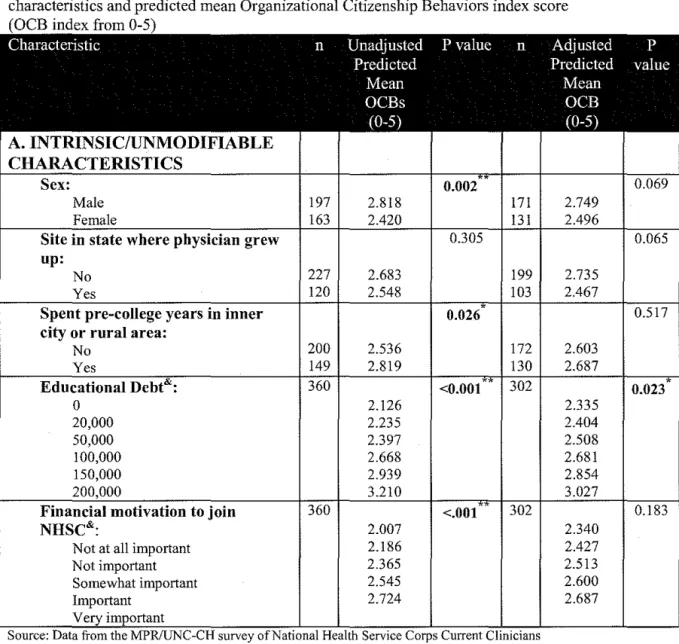
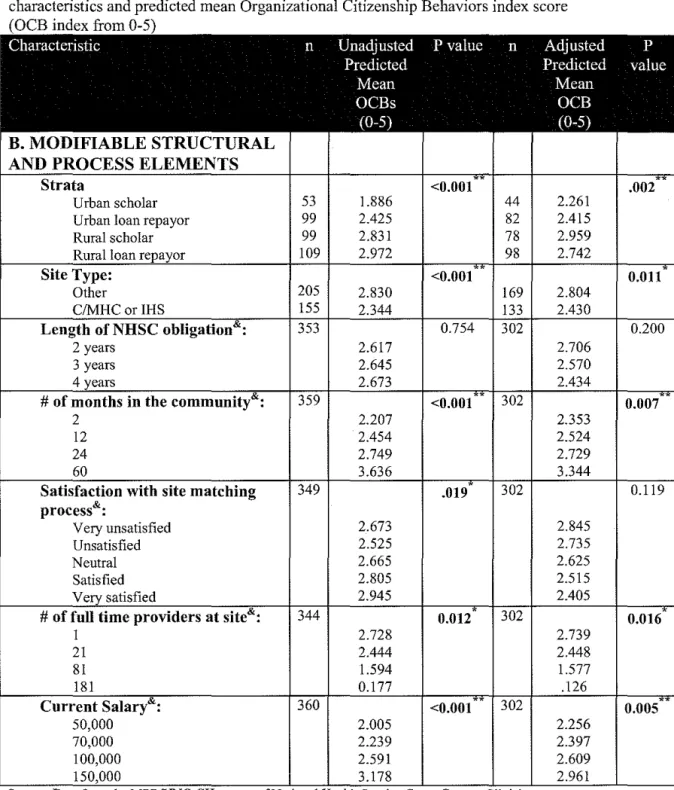
Findings: 1) NHSC physician participation in OCBs ("above and beyond" behaviors) is significantly associated with physician intention to stay at his/her NHSC assigned site for one year post obligation (p<.001) and with physician intention to serve the underserved for at least four years post obligation (p= .014), but not significantly associated with intention to stay at his/her NHSC assigned site for four years post obligation (p=.191 ). 2) Physicians with higher educational debt are involved in significantly more OCBs (p= .023). Scholars serving in rural areas participate in significantly more OCBs than do scholars or loan repayors serving in urban areas. Service in federally funded clinics and service at clinics with more full time providers are associated with performing fewer OCBs, but higher salaries, longer service, and family satisfaction with the community are associated with performing more OCBs
Conclusions: Participating in OCBs is correlated with intention to stay at the NHSC site and with a commitment to continue serving the underserved.
Table of Contents
L
Page
Abstract ...
iiTable of Contents ...
iiiList of Tables ...
ivList of Figures ...
v
I. Introduction ...
1II. Theoretical Perspectives ...
6
1) Beyond Legislation: Additional goals and methods of the National Health Service Corps ... 6
2) The Importance of Satisfaction for Retention ... 11
3) Organizational Citizenship Behaviors: The potential link between NHSC physician satisfaction and retention ... 18
Ill. Study Data and Methods ...
25IV. Findings ...
33I
V. Discussion ...
.43t
VI. Conclusions ...
52VII. Citations ...
53
List of Tables
Table
PageIa.
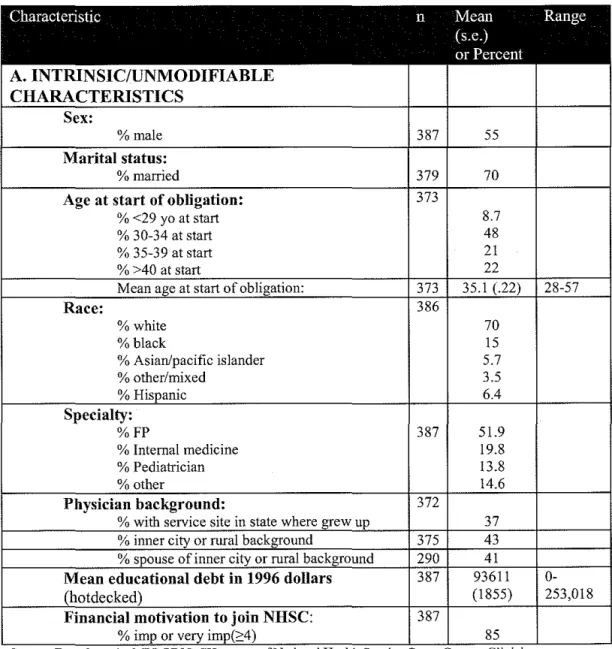
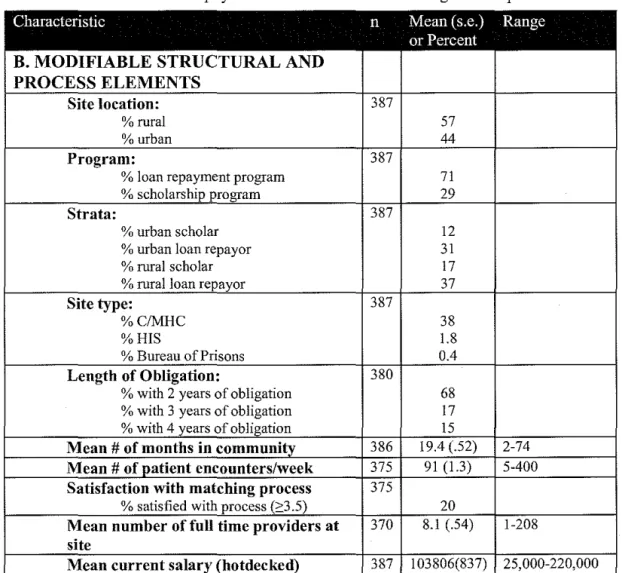
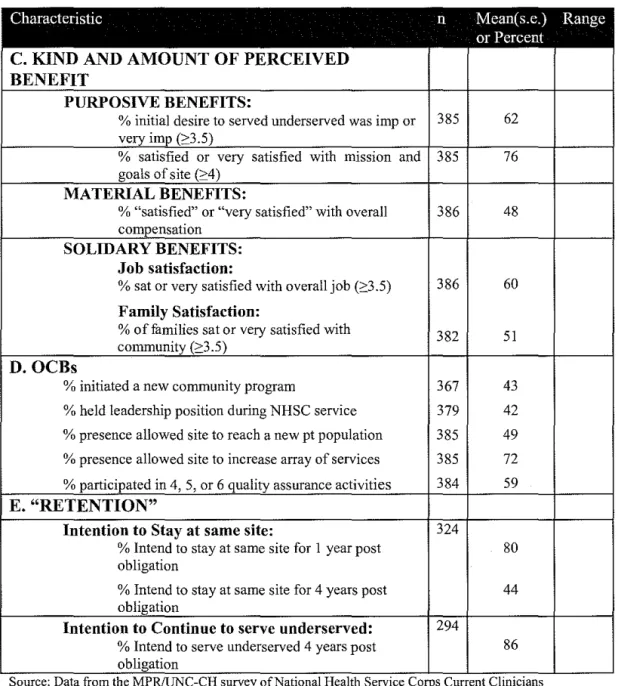
Characteristics of physicians and clinics based on weighted sample INTRINSIC/UNMODIFIABLE CHARACTERISTICS ... 33 1 b. Characteristics of physicians and clinics based on weighted sample .. MODIFIABLE STRUCTURAL AND PROCESS ELEMENTS ... 35 1c. Characteristics of physicians and clinics based on weighted sample KIND AND AMOUNT OF PERCEIVED BENEFIT, OCBs and"RETENTION" ... 36 2. Percentage of physicians who report engaging in various numbers
clOCBs ... ~
3a.
Unadjusted and Adjusted# Comparisons between Physician/Site characteristics and predicted mean OCB index score INTRINSIC/UNMODIFIABLE CHARACTERISTICS ...
38
3b. Unadjusted and Adjusted# Comparisons between Physician/Sitecharacteristics and predicted mean OCB index score MODIFIABLE
STRUCTURAL AND PROCESS ELEMENTS ... 39
3c. Unadjusted and Adjusted# Comparisons between Physician/Site characteristics and predicted mean OCB index score KIND AND
AMOUNT OF PERCEIVEDBENEFIT ... 40 4a. Unadjusted and Adjusted# Odds Ratio of OCBs for physicians
intending to stay or not stay at the same site for one year ... 41 4b. Unadjusted and Adjusted# Predicted Probability of intending to
stay one year post obligation for different OCB scores ... .41 Sa. Unadjusted and Adjusted# Odds Ratio of OCBs for physicians
intending to stay or not stay at the same site for four years ...
42
5b. Unadjusted and Adjusted# Predicted Probability of intending to
stay four years post obligation for different OCB scores ... .42 6a. Unadjusted and Adjusted# Odds Ratio of OCBs for physicians
intending to serve underserved fouryears post obligation ...
42
6b. Unadjusted and Adjusted# Predicted Probability of intending to serve underserved four years post obligation by OCB score ... 43t
List of Figures
Figures Page
1. N HSC in the organizational chart . .... .... . .. . .. ... .. ... ... .. .. .... .. ... . ... ... .. 4 2. Analysis plan and model of the proposed relationship between
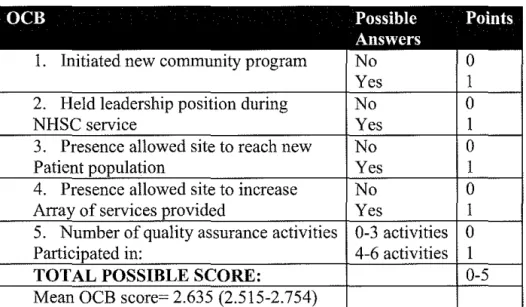
clinician/site factors, OCBs, and Intention to stay/serve underserved ... 26 3. OCB Index ... 29
1.
Introduction
The National Health Service Corps (NHSC) is a federal program created in 1970 to encourage health care providers to work in underserved areas of the United States. The NHSC has placed more than 23,000 health care providers in underserved areas since its inception,2 but as of 2002, around 50 million
Americans were still living in areas with an insufficient supply of primary care providers (PCPs). 3 The U.S. still needs a NHSC to help redistribute health care professionals, and the NHSC needs to recruit and retain health care providers more efficiently. The intent of this master's paper is to explore factors that might enable the NHSC to do so.
Recruiting physicians to provide primary care in underserved areas is challenging. First, primary care medicine is less popular with graduating medical students than are medical specialties. Specialists earn up to three times and more the salary of primary care physicians, and specialists generally receive more prestige as well.4 Primary care role models are not prevalent in medical school, and the current system of medical school rotations preferentially exposes medical students to specialists5 Finally, many medical students are attracted to the specialist's ability to focus in depth on one clinical area, rather than needing to keep up with all of general medicine and its rapid changes.'
Second, it is difficult to recruit physicians to serve the underserved because serving the underserved is hard work, often pays less, and some physicians worry about having a lower quality of life in NHSC-targeted areas.6 Mauksch believes that Americans' "persistent beliefs that those who are needy and those who are socially disadvantaged are somehow morally and socially less worthy" (p 42)5 also influences the number of medical students who are willing to join the NHSC and serve the underserved.
Eric Redman, a senator's aide, and Dr. Abraham Bergman, a pediatrician from Seattle, created the NHSC in 1970 when they wrote the Emergency Health Personnel Act of 1970 (P .L. 91-623). The Act expanded the authority of the Public Health Service (PHS) to allow PHS commissioned officers to provide
,
r
!
direct patient care to patients in federally designated "Health Manpower Shortage Areas"(p
1)'.
Originally, the only incentive to join the NHSC was the ability of NHSC physicians to avoid the military draft of doctors.6 A "doctor draft" separate from the general draft began in 1950 and required physicians to serve for two years in either the military or the PHS8 As an extension of the PHS, physicians serving in the NHSC would be spared a mandatory military tour.6 The military draft of physicians ended in 19739 just two years after the enactment of the NHSC and one year after the first 20 NHSC volunteers served, obviating this means of enticing physicians to join the NHSC.
Currently, the NHSC uses scholarship and loan repayment programs to encourage health care providers to serve in underserved areas. The scholarship program, enacted in 1972,10 provides one year of financial support for health professional students in exchange for a one year obligation to serve in an underserved area, with a minimum two year service obligation.11 The loan repayment program, enacted in 1987, allows the NHSC to repay a portion of a provider's medical education loans in exchange for providing health care in an underserved area.12
Initially the scholarship program was challenged by a large portion of scholarship recipients who chose to default on their scholarship rather than fulfill their service obligation. Between the scholarship program's inception in 1972 and 1980, 30% of scholarship recipients chose to default on their scholarship.13 Until 1980, scholars who defaulted were only required to pay the government the amount of their scholarship plus interest over a three year period. By 1980, Congress had passed an amendment that required defaulting NHSC scholarship recipients to pay back three times the amount of their scholarship in a single year.13. 14
Dr. Fitzhugh Mullan, the head of the NHSC from 1975 to1984, 15 attributed a portion of the high default rate to the time elapsing between receipt of an NHSC scholarship, at the beginning of medical school, and fulfillment of the obligation to serve, coming four years later, and following a curriculum that can be specialty-centric and discouraging for students wanting to go into primary care. The NHSC attempted to ameliorate this problem with programs including an NHSC preceptorship and NHSC orientation conferences to help encourage
t--'
'
L
f
student interest in providing primary care to the underserved.13 Also, the NHSC instituted a personal interview with all scholarship recipients to ensure that students understand the seriousness of the service obligation and the likelihood that service will take place in a rural area (because 70% of NHSC approved sites are rura1).16 Perhaps some of these methods of encouraging service to the underserved are having an effect: in 1997, an impressive 97% of NHSC recipients fulfilled their obligation to serve in an underserved area. 17
Gauging the overall success of the NHSC is difficult, because the initial legislation did not include explicit targets and timelines for the program. One way of considering success of the NHSC is the number of patients who were able to see a provider who otherwise would have gone without care. By this definition, the implication is that the NHSC has been very successful. According to its website, between 1972 and 2003 more than 23,000 NHSC providers have served; it is doubtful that so many physicians would have gone to these
underserved areas without the NHSC.18 Turnover of providers, however, is high and continuous, potentially impairing physician-patient relationships.
Nguyen, O'Sullivan and Fournier measured NHSC success in 1991 by comparing the difference in perinatal mortality rates in Dade County, Florida, at community health centers (CHCs) that did and did not have NHSC physicians. The authors observed a significant three-year reduction in perinatal mortality in the clinics that had NHSC providers, but not in others. The authors estimated that at least 320 fewer perinatal deaths occurred in Dade County than expected compared to a historical control, and attributed the drop in mortality to the presence of NHSC providers.19
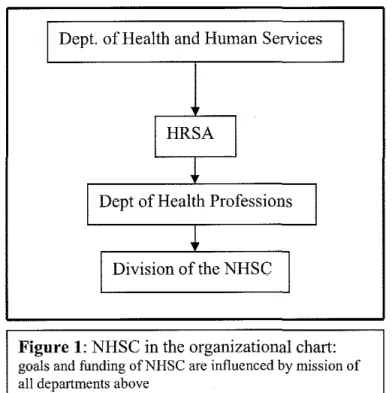
The NHSC is currently under the control of the Health Resources and Services Administration (HRSA) (see figure 1 ). Its goals and funding are influenced by HRSA's mission and objectives. HRSA is "the principal Federal Agency charged with increasing access to health care for those who are medically underserved" (p
9f
0 and its objectives include "lmprov[ing] the distribution of health professionals in underserved areas, including rural and border areas" and "promot[ing] the development of a culturally diverse and representative health care workforce" (p 7-8).20~-I
Dept. of Health and Human Services
I
I
HRSA
*
I
Dept of Health Professions
I
*
I
Division of the NHSC
I
Figure
1:NHSC in the organizational chart:
goals and funding ofNHSC are influenced by mission of all departments aboveOverall, the success of a program is grounded in its ability to meet its stated goals. The NHSC has multiple goals, including improving the health of underserved communities.' Assessing its success requires an understanding of the historical and political context surrounding its creation, and I provide that in the first part of the theoretical perspectives section
Attracting physicians to underserved areas is not enough, however. Retaining physicians beyond their service obligation or, at least, retaining their commitment to serve the underserved, is of critical importance. Thus I will turn next to a review of the literature on the relationship between physician
satisfaction and physician retention. Finally, I will explore the concept of Organizational Citizenship Behaviors (OCBs), an idea from the organizational psychology literature used to describe employees' "above and beyond"
behaviors. I hypothesize that OCBs are an observable intervening step between physician and clinical site characteristics, including physician satisfaction, and physician retention.
Following the theoretical perspectives, I present my own secondary analysis of a nationally representative survey of NHSC physicians in 1997/1998. For simplicity, I focus only on the role of primary care physicians in the NHSC in this paper although the NHSC recruits health care providers from other
'
disciplines including nurse practitioners, physicians assistants, certified nurse midwives, dentists, mental health care providers, and dental hygenists2 I use the survey data first to analyze the effect of multiple provider, clinic and program factors on providers' engagement in OCBs, and then to analyze the relationship between providers' engagement in OCBs and providers' intention to leave their assigned clinical site. I obtain partial corroboration of providers' self-reported levels of OCBs from a parallel survey of NHSC site administrators.
I make recommendations based on this analysis for the future research of OCBs in the NHSC context and I discuss potential policy implications of my study for multiple potential stakeholder groups. Multiple political actors have a stake in the policies and the overall success of the NHSC. Legislators control both the statutory mandates of the NHSC and its funding and they are interested in policy changes that would affect future funding requirements and the efficiency of the NHSC. Federal NHSC administrators are held accountable for the effectiveness of the NHSC, and are thus interested in any potential policy changes, as well as strategies to increase the NHSC's support. NHSC site administrators are the managers of individual clinical sites where NSHC-obligated clinicians serve. As clinical managers, site administrators are keenly aware of the difficulty of recruiting and retaining high quality providers in underserved areas and they have an interest in learning how to keep NHSC providers as long as possible. In many ways, the local clinical administrators have among the highest stakes-even higher than those of the NHSC physicians, and almost as high as those of the patients -- and the least political influence. Perhaps only NHSC clinicians and their patients in these underserved communities have weaker political voices, the former because their terms with the NHSC are limited, and the latter because they lack virtually all of the resources required for effective action in the political arena.
This paper is a two part political analysis. I will examine the potential influence of physician and site factors on physician involvement in "above and beyond" behaviors, and I will analyze the effectiveness and plausibility of those behaviors as predictors of physician retention.
~
l
r
r
jJ
'
r-t
f
II.
Theoretical Perspectives
A. Beyond Legislation: Additional goals and methods of
the National Health Service Corps
The goal of the NHSC is to
"improve the delivery of health services to persons living in communities and areas of the United States where health personnel and services are inadequate to meet the health needs of the residents of such
communities and areas"7
This dryly worded explanation of provider redistribution does not adequately express the other goals of the NHSC that evolved after the process of legislation was complete. Redman and Bergman crafted The Emergency Health Personnel Act of 1970 as a politically feasible and deliberately vague outline of a federal program to rectify physician maldistribution. Redman's and Bergman's idea of the NHSC was that it would be a corps of altruistic young physicians serving in "doctor deficient" areas voluntarily in exchange for a salary from the federal government and exemption from the military draft of physicians. Redman and Bergman saw the initial form of the NHSC as a "small but imaginative
experiment" (p 38)6, which implies that aspects of the program can and should be adjusted and tinkered with as needed. The ambiguity of the original NHSC legislation left the structure and goals of the NHSC open to multiple
interpretations. The NHSC has developed longstanding goals beyond those specified in the original statute in the years since P.L. 91-623 passed.
From private-practice to public service
Bergman and Redman packaged their idea of a corps of public-spirited doctors in a politically feasible container that emphasized private-practice
medicine. According to Oberlander, political feasibility "represents what is doable in the real world" (p W3-392)21 Throughout the political process, Bergman and Redman deliberately stressed the bill's potential to strengthen the current private-practice system of health care and down played any "socialized medicine"
aspects. Medicine as private practice was a politically powerful concept in Washington D.C. in 1970. Its creators claimed that the NHSC would promote private practice by "sensitizing" physicians to the needs of the underserved and
t
encouraging NHSC physicians to open private practices in their assigned communities after completing their service obligation.6
In addition, P.L. 91-623 dispelled worries about the federal government becoming financially responsible for underserved communities in the long term. The Act clearly states that physicians should charge for their services and "recover 'the reasonable cost' of providing medical care" (p 430),22 implying that the communities would sustain their own providers.
P.L. 91-623's vagueness left room for interpretation in the implementation of the NHSC, and the administrators of the Health Services Administration applied their own perspectives and goals to their interpretation of the NHSC legislation. P.L. 91-623 delegated the responsibility of implementing the NHSC to the Health Services and Mental Health Administration but, during a
reorganization in the early 1970's, the NHSC quickly became a part of the Health Services Administration (HSA)22 which has been part of HRSA since 1982.22•23 One of the goals of the HSA was to "develop health care service delivery for medically indigent inner-city, rural, and migrant populations"(p 431 ).22 The HSA also controlled public service programs such as Community Health Centers (CHCs) and Migrant Health Centers (MHCs). The philosophy of the HSA
supported providing medical care to the poor and disadvantaged in the setting of a group practice22
The HSA was able to shift the focus of the NHSC away from promoting private-practice in underserved areas. Although providing medical care to the disadvantaged (or 'socialized medicine') was politically risky when Bergman and Redman wrote P.L. 91-623, it became a possibility in the mid 1970's. First, in 1972, a revision of P.L. 91-623 stated that the NHSC should not consider a community's ability to pay for its own care when placing NHSC physicians. 22 Ignoring a community's ability to pay for services made staying in a community to work in private practice without federal support nearly impossible. The promotion of private practice was shown to be an obvious failure in 197 4, when only 6% of NHSC clinicians said they would stay in the community as private providers after fulfilling their obligation. Everyone except for the Department of Health,
Education, and Welfare (HEW), which in 1974 continued to encourage
physicians to pursue private-practice in underserved areas,22 must have known by then that the NHSC would not succeed as a private-practice model.
L
l--t~-r
'
With such clear signs of the infeasibility of private practice in underserved areas, it is not surprising that the HSA was having difficulty competing with private practices to recruit and retain clinicians at CHCs. The HSA helped the CHC program in the late 1970's by encouraging NHSC clinicians to serve in federally funded clinics, an expansion of the NHSC role. By 1980, more than two-thirds of NHSC clinicians were serving in federally funded group practices such as CHCs.22 With freedom from tight congressional control, NHSC officials adjusted the goals of the NHSC to overlap the goals of the other HSA programs. In 1990, NHSC director Donald Weaver maintained that the NHSC, CHCs, and Area Health Education Centers were all part of an effort to "remove the
geographic, cultural and financial barriers to primary care for underserved people"(p 244 ).'6
Role expansion, or "mission creep," in the NHSC apparently did not attract Congressional attention at the time. Lawmakers may truly not have noticed the imprecision of the NHSC legislation, or they may have been content to appear to be against socialized medicine while allowing the NHSC to change itself into a health care program for the indigent and the disadvantaged.
Increasing presence of minorities in health care
The scholarship program allowed the NHSC to help to increase the
presence of underrepresented minorities in the health workforce and increase the number of PCPs in medicines The racial distribution of the U.S. health work force does not reflect the racial distribution of the U.S. population. For example, in 1985, 12% of the U.S. population but only 3% of U.S. physicians were African American4 The NHSC can use scholarships to recruit medical students,
including ethnic minorities and people with disadvantaged backgrounds, who would otherwise be unable to afford to attend medical school.5 The NHSC scholarship program is successful at targeting minority students; in 2005 51% of NHSC scholars were racial or ethnic minorities.24
Many researchers and policy-makers believe that such needy populations are more likely to continue to serve the underserved.25 A study of physicians' reasons for serving the underserved found that many minority physicians and physicians with rural backgrounds reported feeling comfortable serving in this
6
t
L
,
The Loan Repayment Program serves the NHSC's original goal, but not its other objectives. The Loan Repayment Program allows NHSC administrators to get NHSC clinicians into the field more quickly 27 and appears to be associated with higher job satisfaction than is true for NHSC scholarship recipients.'· 28 However, the Loan Repayment Program cannot be used to further the goals of "increasing the number of underrepresented minorities in medicine or the total numbers of PCPs available" (p 244) 16 because recipients of the Joan repayment have already completed medical school and decided on their course of study when they apply for NHSC support. Although the Loan Repayment Program may be more efficient in attaining the original goal of getting clinicians into the field than is the Scholarship program, the NHSC administration values the
scholarship program for its contribution toward reaching subsequent objectives.16
Control by the lawmakers
Lawmakers never had significant control over the NHSC because the Emergency Health Personnel Act of 1970 (P.L. 91-623) did not meet the
"hierarchy assumption." Frank Thompson describes the hierarchy assumption as the idea that "elected policymakers ought to exert considerable control over the implementation of programs" (p. 427). 22 Lawmakers' control stems from their ability to ensure program compliance with a specified administrative organization, and guarantee that the program is meeting the goals and objectives as they are defined in the original legislation. P.L. 91-623 does not fit the hierarchy
assumption because the original legislation did not define goals for the NHSC and did not specify a timetable for implementation of the program or provide a target number of enrolled providers. Even the concept of "critical health manpower shortage areas," the term used to describe the areas where NHSC providers were allowed to practice, was not defined in P.L. 91-623.22 The vagueness of the text freed the NHSC from close Congressional control.
The main form of legislative control over the NHSC is the ability to alter the funding level of the program. The NHSC has been less a focus for budget cuts than are larger programs such as Medicare and Medicaid,22 but budget cuts have influenced the direction of the NHSC. For example, the budget cuts of the 1980's limited the ability of the NHSC to fulfill even its most basic missions. The Scholarship Program reached a peak in 1985 when over 1,600 NHSC
~-
F--~
scholarship recipients were available to serve in underserved communities.16 In 1980, the Graduate Medical Education National Advisory Committee predicted a significant physician surplus in future years. The predictions led legislators to believe that in an era of physician surplus the NHSC would be unnecessary, because market forces would cause physicians to diffuse to underserved areas on their own_4 As a result, the NHSC budget was significantly cut in the 1980s and Congress started to phase out the NHSC by limiting funding.27 The budget cuts meant that only 123 NHSC scholarship recipients were available to serve in 1990. Luckily, by the middle of the 1980s Congress realized that the "diffusion" method was not going to solve the country's provider maldistribution problem and "[t]he NHSC was able to reinstitute a limited Scholarship Program in fiscal year 1989," (p 244).16 The reinstated Scholarship Program continues to seek equal representation of minorities in the health care workforce by "focus[ing] on disadvantaged and minority students" (p 244 ).16
Summary: the winding path from the NHSC's origins
According to Eric Redman, the NHSC was "never intended to 'solve' the doctor distribution problem, and it never will. It is simply one tool for making things better. .. its value depends on the skill and understanding of those who use it" (p 298t The NHSC administrators may be trying to use the NHSC to solve too many problems at once, but the NHSC is not likely to return to the single goal of geographically redistributing health care providers because subsequent
extra legislative goals, such as staffing CHCs and working to increase the number of minorities and primary care physicians in medicine, are now publicly
embraced. This is shown in the Fiscal Year 2007 HRSA budget justification: it includes "recruitment of health professionals, including underrepresented
minority and disadvantaged individuals" (p 1
f
4 as a goal of the NHSC and states that around half of all NHSC clinicians are currently working in CHCs/MHCs.Budget justifications generally do not break new political ground; the language quoted here is evidence that the NHSC's multiple complex goals are now openly accepted.
As of 2000, 26,657 clinicians were needed to eliminate all underserved areas, yet only 2,366 NHSC clinicians were serving in such places.3 As we will see in the next section, increasing clinician retention beyond clinicians' service
r-l'--L
~-'
t-obligations is one possible way to decrease the cost of providing clinicians in underserved areas. We need to keep the history and the ethos of the NHSC in mind as we consider possible practical interventions to increase the effectiveness of the NHSC at meeting its goals. For example, the NHSC is unlikely to abandon the Scholarship program because the NHSC believes in increasing minorities in medicine. Also, the NHSC is unlikely to severe all ties to Consolidated Health Center programs (including CHCs/MHCs) because their histories are thoroughly intertwined.
B) The Importance of Satisfaction for Retention
In early 1970 Dr. Bergman proposed his idea for the NHSC to Eric Redman. During their first meeting Bergman explained his belief that
" ... at least some of the NHSC doctors would become 'sensitized' to the health needs of the poor ... after their tours of duty in the corps were complete, these doctors would choose the psychic satisfaction of treating the needy over the financial rewards of practicing in more affluent communities" (p 31).6
What Dr. Bergman described was his hope for retention of NHSC physicians after the completion of their service obligation. NHSC physician retention, or the lack of physician turnover, was important to the creator of the NHSC and
retention of NHSC physicians continues to be a goal of the NHSC thirty-six years later. In this section I will discuss the importance of physician retention. I will also discuss the link between satisfaction and retention, and unique factors of the NHSC experience that influence satisfaction.
Importance of retention
Physician turnover is common and expensive. Studies report annual physician turnover rates between 4% and 25% and a cost of recruiting a new physician between $20,000 and $123,000.29 The expense of lost revenues from the decrease in productivity after physician turnover is thought to be even higher.2e. 3o
Physician turnover is costly for patients and other physicians in the practice. Turnover leads to decreased physician morale and decreased patient satisfaction.29 Established physicians have to compensate for new physicians'
L l
!
~
t
p
I
inefficiency and patients have decreased access to physicians because of the stress new physicians place on the system.31
Physician turnover can affect communities. Perpetual physician turnover can be "disruptive to communities, where people are less willing to seek medical care from organizations staffed by providers who they believe are not committed to their communities and who will be gone soon" (p 1556).32 Retention of clinicians is important to communities with physician shortages. Poor physician recruitment, not poor retention, seems to cause health professional shortages because a study in 2004 found that retention of PCPs in rural Health Professional Shortage Areas (HPSAs) and rural non-HPSAs was comparable. Good retention can make up for inadequate recruitment and retention may be more easily improved through "programmatic interventions" (p 1727)33 than is recruitment because:
"retention is related to modifiable characteristics of work ... [but] recruitment is related to the relatively immutable characteristics of physicians' backgrounds and professional and lifestyle preferences, as well as the socioeconomic features of communities" (p 1727).33
Improving retention of physicians in HPSAs is an important and worthwhile goal.
NHSC goals and the role of retention efforts
The NHSC is a "Federal program designed to reduce or eliminate health professional shortages in local communities".34 Although poor physician
retention is not the cause of health professional shortages, retention of physicians can help reduce the problem of HPSAs. For example, the NHSC placed 837 clinicians in needy communities in 1999 but around 800 clinicians leave every year, so the NHSC is close to running in place, rather than increasing access.17 If previously-placed NHSC clinicians remained in their needy communities after completing their service obligation, the NHSC could send new clinicians to different communities and expand access.
The NHSC realizes the importance of retention. One of the NHSC's strategies to increase overall access to care is "Shaping the way clinicians practice by building a community of dedicated health professionals who continue to work with the underserved even after their NHSC commitment has been fulfilled" (NHSC web site).35
t
Two ways of measuring retention of NHSC providers
1. Same-Site Retention: The specific definition of retention is important to a useful measurement of it. Traditionally, NHSC physician retention was measured as the length of time that the NHSC physician remained at his or her NHSC-assigned practice site. I will call this same-site retention-'2· 34· 36"38 Same-site retention is an important measure; it is comparable to the measurement of retention used for non-NHSC clinicians, and it captures the costs of turnover for clinics, patients, providers and communities. Studies consistently show that NHSC physicians have lower same-site retention than do non-NHSC physicians despite the changing legislative and financial context of the NHSC.32· 36· 38
In the 1980's, levels of same-site retention of NHSC physicians were significantly lower than that of non-NHSC physicians, and NHSC participation predicted shorter retention. A study found that NHSC physicians were more than twice as likely to leave their index practice at any point in time than were non-NHSC physicians. 32 Even after controlling for individual, community and practice factors, "NHSC status remained the strongest predictor of shorter retention" (p 1556).32 In the late 1980's NHSC and non-NHSC physicians had comparable rates of same site retention during their first two years at a clinical site, but far fewer NHSC clinicians than non-NHSC clinicians stayed for more than two years. The stark change in NHSC physician retention after two years coincides with NHSC physicians' two year minimum service obligation.36
The pattern of lower same site retention for NHSC clinicians persisted after the NHSC revitalization legislation of 1990. A study of physicians working at CHC/MHCs between 1990 and 1992 found that only 17% of physicians who began working at the CHC/MHC under an NHSC obligation remained at the clinic after five years, as opposed to 36% of non-NHSC obligated physicians working at a CHC/MHC.38
2. Continuing service to the underserved: Alternatively, retention can be measured as the length of time NHSC clinicians continue to work in any underserved area or serve any underserved population. "Continuing service to the underserved" (CSU) is a more accurate measure of the overall effect of the NHSC on underserved populations, but is less relevant for individual patients and for clinic administrators who have to recruit replacements-'7
t
'
'
l
l
il
I
! !
l
l
Unlike same-site retention, NHSC clinicians are likely to have longer CSU than non-NHSC clinicians. A study of practice patterns of physicians in South Carolina found that the odds that an NHSC alumna/us was a "high-Medicaid-participation provider" in 1998 were close to twice the odds that a non-NHSC alumna/us was a high-Medicaid-participation provider in 1998. High-Medicaid-participation was defined as having more than 21.95% of inpatient discharges paid for by Medicaid in a year.39 The difference in the odds of CSU was not due to differences in the clinicians' demographics, their medical training, or their medical specialties.
The definition of retention (same-site vs. underserved) makes a
significant difference. In 2004 Holmes modeled PCPs' potential to enroll in the NHSC and their subsequent practice locations. He modeled the effect of NHSC participation on both same-site retention and CSU. According to the model, physicians who join the NHSC have characteristics that suggest that they would be more likely to stay at their first clinical site and are more likely to practice in an underserved area than physicians who don't join the NHSC. Holmes found that NHSC physicians were significantly Jess likely to stay at their original site and
were more likely to serve in any underserved area than were non-NHSC
physicians. He suggests that the NHSC experience may decrease the retention of providers at their original site (same-site retention) and increase the retention of clinicians in any underserved community in the long run (CSU).37
Political significance of retention statistics
Choosing to report either same-site or CSU as NHSC clinician retention may affect the audience's impression of the success of the NHSC because NHSC clinicians' rate of CSU is consistently higher than is their rate of same-site retention. I could support an argument of the ineffectiveness of the NHSC at decreasing the problem of health professional shortages by choosing to report same-site retention. For example, only 38% of NHSC providers placed between 1986 and 1991 remained at their NHSC-assigned site one year after completing their service obligation.34 However, I could support an argument that the NHSC is successfully increasing the number of providers serving underserved
populations nationwide by choosing to report CSU from a1998 survey that found
'
r
L
that 52% of NHSC-alumni physicians placed at NHSC sites between 1980 and 1997 were working with underserved populations in 1998.28
The timing of studies of retention is also politically important because legislative changes and budget changes can affect the success of the NHSC. For example, the 1998 survey discussed in the previous paragraph is politically significant because 32% of the providers in the study were assigned to their NHSC site after the NHSC Revitalization Amendments of 1990, which
significantly increased the federal financial support for the NHSC. This study more closely represents the current NHSC than studies that only include
providers who were placed in the 1980's, "a time when the NHSC was scheduled to be phased out of existence"(p 1 087).40
Satisfaction and retention
Workforce researchers seek causes of retention/turnover decisions because retention is important to clinic morale and finances. Thus, many studies have examined the relationship between satisfaction and retention. Physicians who are satisfied with their jobs are more likely to stay.29·4143 For example, physician satisfaction with opportunities to achieve professional goals and with their relationship with the community are related to physician retention.'3
Overall, NHSC physician job satisfaction is also related to retention. The odds that NHSC physicians who are satisfied with their work will remain at their index site a year after completing their obligation are more than three times greater than the odds that NHSC physicians who are not satisfied with their work will stay at their index site a year after completing their obligation.34 Overall, physicians in the NHSC are less satisfied with their jobs than physicians not in the NHSC-'6 Evaluations of NHSC satisfaction and retention must consider aspects of satisfaction unique to the NHSC experience.
1. Matching Process. One thing separating NHSC and non-NHSC experience is that NHSC clinicians must find a job from a limited number of practice sites and the matching process used for this elicits criticism. A 1994 report found that 61% of providers who had gone through the matching process were dissatisfied with the process and many providers were dissatisfied because the NHSC did not provide enough information about the available sites. The PHS responded to the report by claiming that they were "planning to provide
1
descriptive profiles of sites" (p B-7).34 The NHSC now has an online job search program that makes looking for available sites much easier, but as of February 251h 2006, only approximately 249 out of the 1839 listed job vacancies for
physicians had site profiles available.44 Lack of site information may still frustrate potential NHSC physicians.
In addition, 74% of NHSC providers placed between 1987 and 1990 felt they had either "very few" or "few" acceptable practice sites available to them.35 The NHSC cannot increase the number of sites or make the matching process more flexible by including less needy sites because of "statutory limitations" (p B-4).34 The primary mission of the NHSC includes "serving those most in need", which necessitates limiting NHSC scholarship clinicians' choice of sites to the neediest sites. To give each vacant site a good chance of receiving an NHSC clinician, the statute stipulates that the number of vacant sites available for NHSC scholars may not be more than two times the number of available NHSC scholars.'5 The limitation on the number of available sites makes it difficult for NHSC clinicians to find what they consider to be appropriate matches. For example, only 38% of NHSC but 73% of non-NHSC physicians grew up in or trained in the state of their index site. 34 NHSC physicians whose index site was in the state where they grew up or trained and who valued living in a small town were much more likely than were others to be at their assigned rural practice a year after completing their NHSC obligation. 34
2. Interaction and communication with NHSC and PHS
administration. Frustrations with the bureaucracy of the NHSC also affect the satisfaction of NHSC providers. For example, "poor communication [between the NHSC and providers] can lead providers to default, request transfers, leave after their obligation, and/or discourage others from joining the Corps" (p 6).34 In addition, many providers and clinic directors do not know who in the NHSC administration to contact with problems; in 1994, 27% of providers did not recall having any contact with the PHS. Also, 56% of NHSC Scholars placed in 1991 and 42% of NHSC loan repayment providers placed in 1991 felt that the PHS didn't contact them often enough.34 Any analysis of NHSC satisfaction and retention must take unique aspects of the NHSC experience such as site matching and additional bureaucracy into account.
~-Theory of incentives and rewards
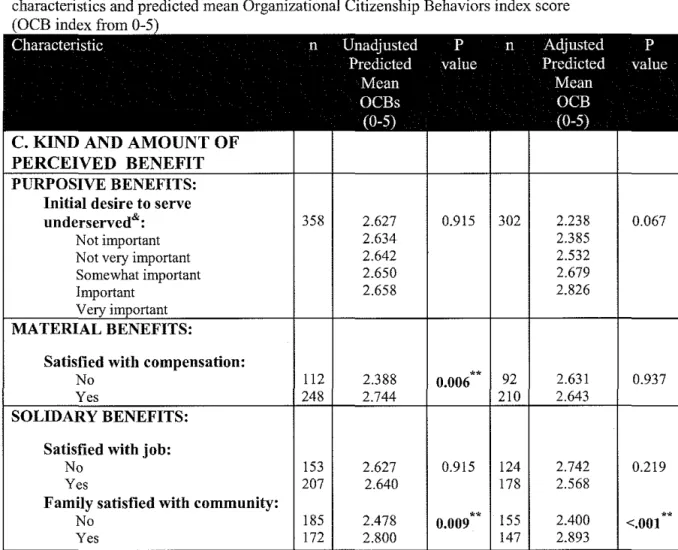
Overall job satisfaction is not the only measure of employee benefits. According to Clark and Wilson in 1961, employees receive three types of incentives from organizations in exchange for employee's contributing work.46 "Material" incentives "have a monetary value or can easily be translated into ones that have [monetary value]"(p 134).46 "Solidary" incentives are benefits that are intangible and result from the benefit of belonging to an organization, including the rewards of "socializing, congeniality, [and] the sense of group membership and identification".46 "Purposive" incentives are also intangible and are the benefits an employee derives from sharing the purpose of the organization46 This typology is easily applied to the NHSC. Satisfaction with compensation and benefits are evidence of perceived material benefits (or incentives), and family satisfaction with the community and clinician satisfaction with the job are evidence of solidary benefits. Finally, the psychic satisfaction of serving the underserved, as discussed by Dr. Bergman, is evidence of purposive benefit. considered physicians stated motivation to serve the underserved as evidence of their perceived "purposive" benefit of working for the NHSC.
Summary: the complex relationship of satisfaction to retention
Retention is important for all clinical practices, and it is especially so for the NHSC. The link between satisfaction and retention has been established in the non-NHSC literature and confirmed in the NHSC literature, but the
relationship is neither strong nor simple. We cannot assume that every improvement in satisfaction will translate into an improvement in retention43
The NHSC has made some attempts to improve provider retention. For example, beginning in 1991, the NHSC began to administer the Professional Training Information Questionnaire (PTIQ) to NHSC Scholars to assess which of the neediest sites are more attractive to Scholars. The NHSC uses the PTIQ results to make the list of sites available for Scholars. By including sites that Scholars prefer, the NHSC hopes more providers will stay at their assigned sites, creating a permanent solution to the community's provider need.34
Finally, even if we could easily understand the relationship between physician satisfaction and retention, managers would need to measure physician
l
f
I
'
it
satisfaction using in-depth surveys in order to target potential interventions to physicians most likely to leave.
C. Organizational Citizenship Behaviors (OCBs): A potential link
between NHSC clinician satisfaction and retention
NHSC clinicians must provide full-time patient care in an underserved community to fulfill their NHSC obligation, but some NHSC clinicians choose to be more involved in their clinical site and/or their community. Some clinicians start a new clinical program, some participate in quality improvement efforts, and some take on an additional role as a leader in their clinic or in their community. Organizational psychology researchers describe employees' voluntary, positive, extra-role behaviors as OCBs. In the organizational psychology literature the construct of OCBs is well described, and researchers have examined potential influences of employee engagement in OCBs and potential outcomes from OCBs. In this section I will discuss the definitions and dimensions of the OCB construct and how understanding OCBs in the context of NHSC clinicians' activities will benefit researchers, site managers, administrators, clinicians, and policy makers.
The Basics of the OCB construct
1. Definition of OCB. OCB, as conceived by Dennis Organ in 1977, is a measure of employees' behaviors that are not contractually required or rewarded but contribute to the overall functioning and effectiveness of the organization.47-55
OCBs include behaviors such as helping coworkers with work-related tasks and following organizational policies when no one is looking.49 Organ clarified the OCB construct by explaining that OCBs are not enforceable and are, "rather a matter of personal choice ... its omission is not generally understood as
punishable" (p 86).47 The OCB construct was difficult to operationalize because a discretionary and unrewarded behavior in one job setting may be required and rewarded in another job setting. Comparing results from studies of OCBs in different industries or cultures was difficult because of the requirement that behaviors be "discretionary" and not rewarded.
i
i
I
Lt
t
In 1997, Organ acknowledged that the current workplace environment does not rely on strict job definitions and requirements. He presented a revised definition of OCBs that relaxed the requirement that OCBs not be contractually required or rewarded. Currently, OCBs are defined as "contributions to the maintenance and enhancement of the social and psychological context that supports task performance ... [that are]less likely than task performance to be regarded by the performer as leading confidently to systemic rewards" (p 91 ).47 Put simply, OCBs are any behavior that could be considered "going the extra mile" for the organization.
2. Dimensions of OCB. Researchers have divided OCBs into many different dimensions. LePine, Erez and Johnson lumped the most commonly studied dimensions of OCBs under the headings of "helping behaviors," "organizational loyalty," "sportsmanship," "self development," "civic virtue," and "individual initiative."49 Helping a coworker with a problem, and acting as a peacemaker in the workplace are examples of "helping behaviors," a dimension that some researchers call "altruism." An employee who supports the
organization to those outside the organization portrays "organizational loyalty," and an employee who tolerates inconveniences for the good of the organization reveals "sportsmanship."49 None of these behaviors is strictly enforceable, but all are encouraged and appreciated by supervisors in any work environment,
including in a health care setting.
"Civic virtue" and "individual initiative" are particularly important
dimensions of OCBs for clinicians. "Civic virtue" describes the "willingness to participate actively in [an organization's] governance" (p 525)49 by attending meetings and expressing one's opinion about the organization's policies. Physician participation in decision making is key because physicians are more likely to accept a change in a clinic's policies, such as the implementation of a clinical guideline, if the clinician was involved in deciding to make the change-'6 Individual initiative: "involves engaging in task-related behaviors at a level that is so far beyond minimally required or generally expected levels that it takes on a voluntary flavor" (p 524)_49 Individual initiative, which is some call
improvement projects and volunteering at a free clinic for the good of the organization and the community. Clinician "individual initiative" behaviors are essential to the functioning of a health care organization.
Finally, "self-development" describes behaviors such as taking a class to learn an organizationally relevant new skill. The "self-development" dimension of OCBs has not been examined very often in the literature on OCBs49 but may potentially be an important step in ensuring that a high overall quality of care is provided in health care settings.
3. Construct Clarity. LePine, Erez and Johnson suggest that OCB is a "latent construct" with all of the dimensions of OCB portraying the same
underlying "true" OCB construct. In 2002, LePine, Erez and Johnson conducted a meta-analysis. The authors compared the relationship of Organ's initial five dimensions of OCBs (altruism, conscientiousness, sportsmanship, courtesy, and civic virtue); the five dimensions of OCBs were highly related to each other. Next, the authors compared the relationship of each dimension to well-studied antecedents of OCBs (satisfaction, commitment, fairness, leader support, and conscientiousness) and found that for every antecedent the relationship between every dimension and the antecedent was comparable.'8 Finally, measuring overall OCB versus the individual dimensions of OCB only made a difference in the relationship between "commitment" and OCB. The authors concluded that the OCB dimensions behave comparably, and thus OCB behaves as a latent construct. In a true latent construct the dimensions of OCB should act simply as different manifestations of the same overall OCB construct. 57
Stakeholders' perspectives of OCBs
1. Researchers on the healthcare work force. The OCB construct is relevant to researchers who evaluate the NHSC because OCBs are theoretically related to both employee satisfaction and employee retention. As I described in the previous section, the relationship between satisfaction and retention of clinicians in underserved areas is important in evaluations of the NHSC because of the NHSC's goal of increasing clinician retention. 26•28•31·41·43·58 Empirical studies provide theoretical links between OCBs and both job satisfaction and employee turnover.
t-First, multiple studies examine the relationship between employee satisfaction and OCBs.'9 Podsakoff, MacKenzie, Paine and Bachrach evaluated more than 28 studies conducted in multiple different organizational settings, and concluded that employee satisfaction is an important antecedent of OCBs.'9 The authors did not explain how job satisfaction was measured in the quoted studies. In a study of hospital employees, employee satisfaction with coworkers was related to OCBs, but other aspects of job satisfaction such as satisfaction with work, satisfaction with supervision and satisfaction with pay were not. 54 The relationship between satisfaction and OCB is obviously not simple, but the literature does theoretically link satisfaction and OCBs.
Second, OCBs are relevant because they have been linked to actual turnover. A study conducted in a Chinese manufacturing industry setting found that altruism, conscientiousness and sportsmanship dimensions of OCB were related to rates of employee turnover in the next 10 months.50 The authors of the study suggested a potential explanation for the relationship between OCBs and turnover, surmising that engaging in low levels of OCBs was a way for workers to "withdraw" from discretionary work behaviors prior to withdrawing from required work behaviors. They argued that "if turnover intention is the attitudinal indication of staying or leaving, OCB is the behavioral indication"(p 924).50 Despite the theory that OCB is a latent construct, the validity of the relationship between the dimensions of civic virtue and individual initiatives and turnover is untested. Also, the nature of work in a Chinese factory and a NHSC clinic is dramatically
different. Despite these limitations and the possible cultural differences between the OCB/turnover relationship in China and the U.S., the study gives theoretical support to a link between OCBs and turnover, and makes intuitive sense.
The theoretical basis exists for an examination of the relationship between clinician satisfaction, OCBs, and clinician retention.
2. Site Administrators/Managers. The OCB construct should be attractive to NHSC site administrators because it is an easily observable
measure that may provide a link between job satisfaction and clinician retention. Supervisors can easily assess employees' OCBs. In contrast, measuring attitudinal variables like clinician satisfaction or turnover intention require clinicians to fill out lengthy surveys-"0 Managers of clinics in underserved areas are under pressure to recruit and retain quality clinicians in their clinic; retention
~-'
t
!
I
r
i_
t
is particularly important because clinician turnover is expensive. If the
relationship between physician satisfaction, OCBs and retention proves strong in NHSC clinicians, site administrators may be able to observe a clinician's OCBs and intervene prior to a clinician leaving the clinic. According to cognitive dissonance theory, managers may also be able to decrease employee turnover by getting employees involved in OCBs because "once one is engaged in OCB, one has to admit to having positive attitudes toward the organization; and once one has positive attitudes toward the organization, one will be less willing to leave the organization" (p 928).50
Managers would also benefit from research about potential means of encouraging OCBs because managers and organizations benefit from OCBs. OCBs represent managers' ideal employee behaviors. Researchers developed the original OCB instrument by asking managers "what kinds of things do you like to have people in your group do, but you know that you can't actually force them to do it, can't prornise any tangible rewards for doing it, and can't punish them for not doing it?" (p 93).47 Multiple recent studies also suggest that OCBs increase overall organizational effectiveness.'9 Even if OCBs are not related to either satisfaction or retention, organizations benefit from OCBs and managers should encourage them.
3. NHSC Administrators. The NHSC should be in favor of an evaluation of NHSC clinicians' OCBs. According to a report by Konrad, Leysieffer and Stevens et al., NHSC administrators requested the identification of factors influencing clinician retention and evidence of clinicians' non-patient care contributions.' OCBs are related to turnover in a non-health care setting, and therefore OCBs may influence NHSC clinician retention. In addition, measuring OCBs would help satisfy HRSA's interest in documenting NHSC clinicians' non-patient care contributions to their clinical sites and communities.'
4. NHSC Clinicians. Employees can benefit from and be harmed by participation in OCBs. Employees experience personal costs for engaging in "individual initiative" OCBs. A recent study of mostly Caucasians in white collar jobs found that employees who portrayed "individual initiative" OCBs were more
likely to have job stress, were more likely to feel that they had insufficient time or ability to fulfill all of their responsibilities, and were more likely to have their work-role interfere with their family-work-role ("work-family conflict").59 The relationship
L
'
between individual initiative behavior and work-family conflict is stronger for women than it is for men. In contrast, employees who participate in "individual initiative" OCBs may be rewarded with higher performance ratings, more rapid promotions, and a "greater sense of personal accomplishment" (p 7 45)59 than are employees who do not participate in individual initiative OCBs.
It is unclear how a programmatic focus on OCBs would affect physicians. Physicians may benefit from increased recognition of their OCBs, or physicians may feel pressured to engage in more OCBs, which could lead to increased stress and work-family conflicts, especially for women. Clinicians may be particularly at risk for overloading themselves with OCBs because many clinicians have Type-A personalities and most are under a time pressure. A study of college students found that having a Type-A personality was related to engaging in more OCBs and that experiencing a perceived time pressure did not affect students' participation in OCBs.6
°
Clearly, supervisors must be careful to complement policies that encourage OCBs with policies to help physicians balance individual initiative behaviors with their family obligations. 59OCBs as possible measures of retention
We cannot apply the construct of OCB to NHSC clinicians without considering the potential influence of the clinicians' NHSC "obligation." The relationship between OCBs and both job satisfaction and retention may be influenced by clinicians' service obligation. I could not find literature on the effect of an obligation on OCBs, but in a study of hospital employees, continuance commitment, or a high perceived cost of leaving a job, was not linked to OCBs. 54 This suggests that an NHSC obligation, which is designed to demand a high cost for not fulfilling a service obligation, will not induce clinicians to participate in OCBs. I also believe that we should consider NHSC clinician behaviors aimed at improving either the effectiveness of their clinical site or the health of the
underserved community as OCBs because NHSC clinicians are "employed" by underserved communities to improve the health of members of the community.
The OCB construct is well described in the organizational psychology literature but the construct has not been considered in the literature of physician behavior. We don't know what makes clinicians who "go the extra mile" different from those who don't. Maybe they are more satisfied. Maybe they are more committed to serving the underserved. Or maybe clinicians who participate in
OCBs are more likely to stay in their underserved community past their
obligation. Examining the relation of clinician OCBs to both clinician satisfaction and clinician retention could potentially further our understanding of clinician behavior and elucidate potentially modifiable influences on employee OCBs and employee retention.
Goals of the study. The first goal of this study is to evaluate the relationship between unmodifiable clinician factors, modifiable structure and process factors and physicians perceived benefits of working for the NHSC (i.e. satisfaction) and physician engagement in OCBs. The second goal is to evaluate the relationship between physician engagement in OCBs and physician intention to stay at their assigned clinical site or intention to continue to serve the
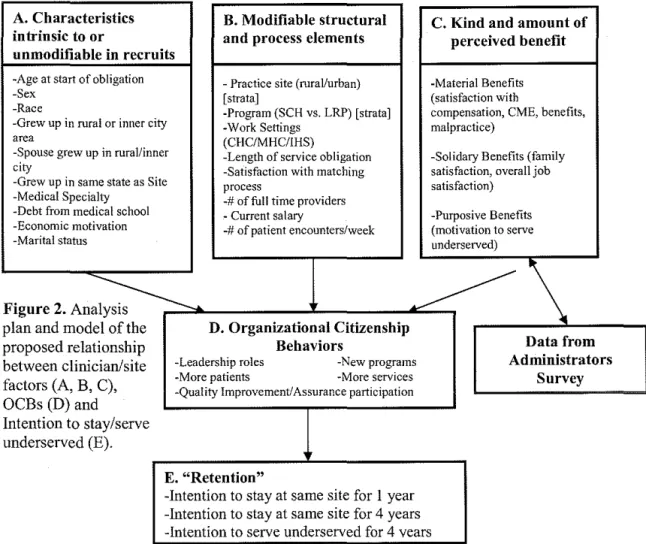
underserved. Figure 2 (on p. 26) provides a visual representation of the hypothetical relationships between physician/site components, OCBs and retention.
f
L
~--Ill. Study Data and Methods
Data source and study population. I conducted a secondary analysis of large cross-sectional survey data. Data are from mail surveys of nationally representative samples of NHSC "current" clinicians, "alumni" clinicians and NHSC site administrators in 1998. Data were collected by Thomas R. Konrad, of the Sheps Center at UNC-CH, as part of a project entitled "An Evaluation of the Effectiveness of the National Health Service Corps."1 This project was
conducted under contract for HRSA of the US Department of Health and Human Services under OMS #0915-0221 during 1998 through a subcontract with
Mathematica Policy Research (MPR).
The "alumni" data included clinicians who served NHSC obligations between January 1, 1980 and March 13, 1997. I chose not to analyze the "alumni" clinician data because such an analysis is beyond the scope of this master's paper. The findings from such data would be less politically relevant in 2006, because a significant portion of NHSC alumni served before the option of Loan Repayment existed and before the NHSC revitalization amendments of 1990. The original study examined physicians, nurse practitioners, physician assistants, or nurse midwives. I chose to examine only physicians (MD/DO) to narrow the scope of the study and simplify the analysis.
Physicians. All of the physicians in the study population served part of their service obligation on December 31, 1997. The physicians were stratified by program type (Scholarship or Loan Repayment) and by type of the current NHSC assignment community (urban or rural). The original investigators sent surveys to all physicians in a stratum if the stratum represented less than 150 clinicians. Surveys were sent to all 92 urban scholars and all 129 rural scholars.
significance of this. These response biases are based on data reflecting clinicians of all disciplines and are not physician-specific.
Site administrators. The site administrators worked at sites that employed an NHSC clinician at any point between January 1, 1997 and February, 1998. Site administrators were identified for every NHSC site from NHSC administrative files. The investigators drew a random sample of 369 site administrators from a total of 1 ,043 site administrators using "implicit stratification for urban/rural location and region"1 After sending the surveys, the investigators discovered that identifiers they had used did not identify unique clinical sites, and they truly sampled 333 unique site administrators out of a total 869
administrators. The final adjusted response rate was 62% for site administrators. I analyzed data only from the 126 site administrators who reported having at least one NHSC MD/DO at their clinical site.
A. Characteristics B. Modifiable structural
intrinsic to or and process clements unmodifiahle in recruits
-Age at start of obligation -Practice site (rural/urban)
-Sex [strata]
-Race -Program (SCH vs. LRP) [strata]
-Grew up in rural or inner city -Work Settings
area (CHC/MHC/IHS)
-Spouse grew up in rural/inner -Length of service obligation city -Satisfaction with matching -Grew up in same state as Site process
-Medical Specialty -# of full time providers -Debt from medical school - Current salary
-Economic motivation -#of patient encounters/week -Marital status
Figure 2.
Ana~
plan and model of the D. Organizational Citizenship proposed relationship Behaviors
between clinician/site -Leadership roles -New programs factors (A, B, C), -More patients -More services
OCBs (D) and
-Quality Improvement/Assurance participation
Intention to stay/serve underserved (E).
E. "Retention"
-Intention to stay at same site for I year -Intention to stay at same site for 4 years
C. Kind and perceived
amount of benefit
-Material Benefit (satisfaction with
compensation, C ME, benefits, malpractice)
-Solidary Benefit s (family all job satisfaction, over satisfaction)
-Purposive Bene fits rve (motivation to se underserved)
Data from Administrators
Survey
-Intention to serve underserved for 4 vears
Survey methods. The surveys were each pretested twice for
performance of the questions and response burden. Each survey form was eight pages long. Targeted clinicians and site administrators were sent the survey up to four times between February, 1998 and April, 1998. The investigators also "conducted extensive telephone follow-up to ensure that surveys reached
intended individuals and to encourage responses" (p 15)1. The response rate of
site administrators was especially low, so the investigators attempted to contact every non respondent site administrator by phone.
Study variables. My overall theoretical model is described in Figure 2 above. Please see my codebook in Appendix A for more detailed descriptions of the variables I used in the analysis. I categorized physicians based on
unmodifiable variables including physician age at the start of their service
obligation (S 29, 30-34, 35-39, <: 40); sex; race; whether they grew up in a rural or inner city area; whether they grew up in the state of their NHSC clinical site assignment; medical specialty; amount of debt from medical school; and degree to which economic motivation led the physician to join the NHSC.
I examined modifiable structural and process components of physicians experience including the length of service obligation; work settings (CHC/MHC/IHS vs. all others); salary; and the number of patient encounters for which the physician is responsible per week; satisfaction with the site matching process; and the number of fulltime providers at the clinical site. I also examined the practice site (rural/urban) and program type (Scholarship vs. Loan
Repayment) of clinicians individually and combined into the variable "STRATA" (rural Scholarship, rural Loan Repayment, urban Scholarship, urban Loan Repayment).
In the original analysis (by Korad, Leyseiffer and Stevens) some values of current salary and educational debt were imputed using ST ATA "hotdecking" procedures. The researchers "hotdecked" the current salary based on the clinician's discipline and "hotdecked" values of educational debt based on both the clinician's discipline and his/her NHSC program (Scholarship or Loan
Repayment). I created a variable "MISSALARY" where missalary =1 if the salary value was imputed and missalary=O if the salary data not imputed. Similarly, I