Abstract
Cervical cancer is caused by persistent infection with certain
genotypes of human papillomavirus (HPV). It is a significant public health problem among women in South America where some of the highest incidence rates in the world are observed. The International Agency for Research on Cancer (IARC) estimates the crude incidence and mortality of cervical cancer in South America to be 24.6 and 11.2 per 100,000 women respectively (IARC 2008). Both incidence and mortality are approximately two times higher than the rates in developed countries such as the United States. Also contributing to the seriousness of this problem is the fact that epidemiological studies suggest that incidence and mortality from cervical cancer are projected to increase in South America by 2020 (Agurto, Bishop, Sanchez, Betancourt & Robles 2004).
The purpose of this paper is to review the most current available information on cervical cancer in South American countries and summarize the methods and performance of existing screening programs. This information will be used to identify promising strategies, such as new screening methods and HPV vaccination, that are being researched or utilized in other low resource settings and could potentially be implemented in South America.
most South American countries, which makes collection of data, patient follow‐up, and program monitoring and evaluation difficult. Also important, some variation in these patterns was observed among South American countries. For example, though both could be improved upon, the screening programs in Chile and Colombia have resulted in modest reductions in incidence and/or mortality and can serve as a model for the rest of South America.
This research has led to the following recommendations to reduce cervical cancer incidence and mortality in South America. South American countries with screening programs already in place should continue to support screening, though revisions will be necessary. In countries without screening programs, it is advised that policy makers consider initiating a screening program for women at high risk of cervical cancer. In both instances, it is recommended that screening occur in
conjunction with vaccination of adolescent girls and women who are not yet
sexually active. Policy makers are urged to seek out resources to carry out all of the above, including maximizing the use of vaccine subsidies that are available.
Introduction
respectively (IARC 2008). Both incidence and mortality are approximately two times higher that the rates in developed countries such as the United States. Epidemiological studies suggest than incidence and mortality from cervical cancer are projected to increase in South America by 2020 (Agurto, Bishop, Sanchez, Betancourt & Robles 2004).
It is well established that cervical cancer is caused by persistent infection with one or more of approximately 15 oncogenic (high‐risk) types of human papillomavirus (HPV) (Lewis 2004; Arrossi, Ramos, Paolino & Sankaranarayanan 2008; Brown et al. 2009). Persistent HPV infection promotes cellular changes that result in the occurrence of precancerous lesions and, eventually, invasive cancer. The association of high‐risk HPV types and cervical cancer is causal in nature.
The three most commonly utilized cervical cancer screening methods are cervical cytology, visual inspection and HPV DNA testing (Table 1). Currently, there are no international guidelines for cervical cancer screening.
Introduced as early as the 1960s in South America (Murillo et al. 2008),
cervical cytology is the most common screening method utilized in South American countries, though the quality and uneven distribution of screening constitutes a major deficiency in cervical cancer prevention programs (Lewis 2004). Though numerous South American countries have implemented prevention programs utilizing cervical cytology, with few exceptions they have been unable to reduce the burden of cervical cancer. This is primarily due to “sub‐optimal cytology testing, lack of quality assurance, poor coverage of women at risk, and inadequate follow‐up of screen positive women” (Sankaranarayanan 2006). A disadvantage of cytologic screening is that it is resource intensive and difficult to utilize in many South American countries that have limited resources.
Visual inspection with acetic acid (VIA) has been found to have sensitivity similar to that of cytology for detecting pre‐malignant cervical lesions though
accepted definitions of test results, though IARC has published a handbook on interpretation of findings.
HPVs are designated by alphanumeric characters according to their genotype and are separated into high‐, moderate‐ or low‐risk types, depending on their
oncogenic potential (Ranst, Kaplan & Burk 1992). HPV DNA testing detects the high‐ risk HPV types associated with cervical cancer and may be more easily adapted for clinical practice than conventional cytology. HPV types 16, 18, 31, 33, 35, 39, 45, 51, 52, 56, 58, 59 and 68 are most commonly tested for, though types 16 and 18 cause the majority of cervical cancers (70%) (Sankaranarayanan 2006). Low risk types are not typically tested for as they are not cancer causing, however they can contribute to co‐infection with HPV and other sexually transmitted infections.
Research on HPV DNA testing is ongoing to assess the diagnostic reproducibility and ability to reliably aid in the detection of cervical cancer precursors and not merely HPV. This method of testing is more expensive than other screening tests; requires laboratory infrastructure, water and electricity; and produces results in over six hours (Sankaranarayanan 2006).
A promising new rapid HPV DNA test designed for use in low‐resource settings is currently undergoing clinical trials and demonstration projects in
manufacturer’s website (Qiagen n.d.), Governments and NGOs intending to
implement large‐scale screening programs will be able to apply for reduced pricing. Due to the recent development of two HPV vaccines, primary prevention is also available. Licensed in over 100 countries worldwide, the vaccines are highly immunogenic, well tolerated and represent an important opportunity to reduce the burden of cervical cancer disease (Cervical Cancer Action Coalition 2010). Clinical trials have demonstrated that both vaccines are at least 95% effective in preventing persistent infection and at least 93% effective in preventing cervical lesions caused by HPV types 16 and 18 when administered to girls prior to infection with those HPV types (Cervical Cancer Action Coalition 2010). “The WHO recommends that routine HPV vaccination be included in national immunization programs based on the following key considerations:
• Prevention of cervical cancer or other HPV‐related diseases, or both, constitutes a public health priority;
• Vaccine introduction is programmatically feasible; • Sustainable financing can be secured;
• The cost‐effectiveness of vaccination strategies in the country or region is considered; and
• HPV vaccination is targeted to adolescent girls prior to sexual debut” (World Health Organization 2009).
The purpose of this paper is to review the most current available information on HPV and cervical cancer in South American countries and summarize the
methods and performance of existing screening programs. This information will be used to identify promising strategies that are being researched or utilized in other low resource settings that could potentially be implemented in South America.
Methods
I conducted a search in MEDLINE (Medical Literature Analysis and Retrieval System Online) database, looking for articles published in English from January 1999 through December 2010 using the following search terms in combination with South America and all South American country names: cervical cancer, human papillomavirus, HPV, incidence, prevalence, mortality, screening, prevention, strategies, intervention, testing, program. I’ve included in this review data on HPV prevalence, predominant HPV types, annual number of cases of cervical cancer and deaths due to cervical cancer, crude and age‐standardized (ASR) incidence rates of cervical cancer, crude and ASR incidence rates of mortality due to cervical cancer, and relative ranking of cervical cancer incidence and mortality to other cancers for all countries of South America where available.
Reports from World Health Organization (WHO), International Agency for Research on Cancer (IARC), Institut Català d'Oncologia, and Pan American Health Organization (PAHO) were also reviewed. The most current and frequently utilized source for incidence and mortality information in the literature was IARC’s
GLOBOCAN 2008 presents age‐standardized (to the World Standard Population 1960) estimates for the year 2008. Although the populations of the various countries are those estimated for the middle of 2008, the disease rates are not those for the year 2008, but from the most recent data available, generally two to five years earlier. The degree of delay in the available data was taken into account by computing predictions of the national incidence and mortality rates for the year 2008, wherever possible (IARC 2005). The world standard population used in GLOBOCAN 2008 to calculate incidence and mortality ASR is as proposed by Segi and modified by Doll et al., calculated using 10 age‐groups (Ferlay et al. 2008). The IARC bases its relative ranking of cervical cancer incidence and mortality on crude incidence and mortality rates. The relative ranking is used to compare disease rates among South American countries, to developing and developed regions of the world, and to the world.
Incidence statistics from GLOBOCAN 2008 presented later in the Results section (Table 4) are derived from population‐based cancer registries. Though the quality of information for many South American countries may be suboptimal, often relying on modeling or averaging of data, “it often remains the only relatively
unbiased source of information available on the profile of cancer” (IARC 2005). Incidence estimation methods utilized in the GLOBOCAN 2008 database vary by country according to what data are available, and for most South American
using a set of age‐, sex‐ and site‐specific incidence mortality ratios obtained by the aggregation of recorded cancer registry data from cities exclusively within the country (Brazil, Colombia) or combined with representative cities from other South American countries (Argentina, Chile, Ecuador, Guyana, Paraguay, Peru, Suriname, Uruguay and Venezuela). Incidence data for Bolivia was calculated by taking a simple average of incidence rates from the country’s capital city (La Paz) and the nations of Ecuador and Peru. Incidence data for French Guiana were calculated using incidence rates from three to five years prior.
Mortality statistics in Table 4 are estimated from previous rates collected by WHO, providing national coverage and long‐term availability, though quality of data are dependent on that of the national registration systems. For most countries, national mortality rates for 2008 were projected from past years (Argentina, 1997‐ 2006; Brazil, 2003‐2005; Chile, 1997‐2005; Colombia, 2005‐2006; Ecuador, 2005‐ 2006; Paraguay, 2005‐2006; Peru, 1999‐2000; Suriname, 2004‐2005; Uruguay, 2004; Venezuela, 2005‐2006). For Bolivia, the number of cervical cancer deaths in 2008 is estimated from incidence estimates and site‐specific survival using the GDP method. For French Guiana and Guyana, mortality rates from previous years
corrected for ill‐defined causes of death or under‐reporting were applied to the 2008 population.
Results
HPV Infection
The highest rates of HPV infection are seen in Argentina, Paraguay and Guyana, the lowest in Chile and Peru. The most frequently detected HPV types across all of South America are 16 and 18. Table 2 also illustrates the absence of HPV prevalence and type distribution data in Bolivia, French Guiana, Suriname, Uruguay and Venezuela. The high prevalence of oncogenic HPV infection combined with a lack of effective screening programs are responsible for the high burden of cervical cancer in much of South America (Sankaranarayanan, Budukh & Rajkumar 2001). The estimated proportion of women in the general population with a cervical HPV infection at a given time is compiled from IARC data published by the WHO/ICO and two retrospective analysis studies conducted by Kightlinger et al. and Brown et al. (Table 2). Data are derived from official reports by the WHO, United Nations, The World Bank, IARC GLOBOCAN 2008, and published literature. Sample sizes tend to be small, but the statistics provide at least some reference to the HPV types that are prevalent and show the high rate of HPV infection (> 10%) present in all of the countries for which data are available.
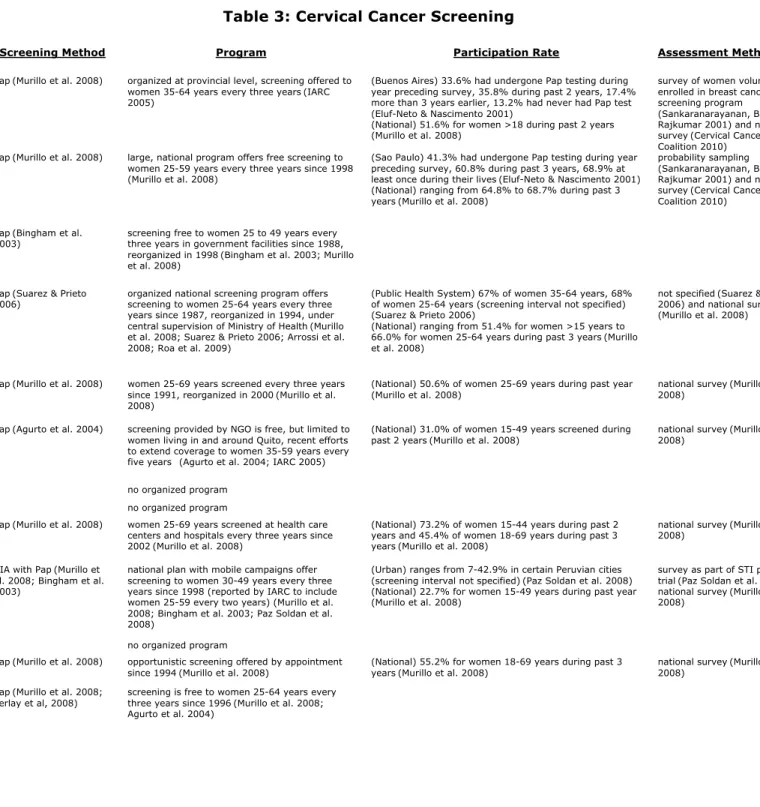
Screening
planning services, though later was expanded in some countries into primary health care (IARC 2005). Most South American countries have not achieved well‐organized screening programs, offering opportunistic screening mainly in urban areas through public family planning and reproductive health care facilities (Murillo et al. 2008). Rural and indigenous populations are often excluded. These factors contribute to poor program performance and an overall lack of participation. Cytological screening requires a high level of infrastructure, monitoring and training and requires follow‐up for treatment.
populations, therefore national data cannot be assumed to be representative nor is it comparable from country to country. Only Chile’s screening coverage data was based on estimates from a national screening program.
Cervical Cancer Incidence and Mortality
Incidence rates of cervical cancer vary widely among countries within South America (Table 4). Guyanese women suffer from the highest incidence rate (ASR of 44.7 per 100,000 women), with Bolivia (ASR of 36.4 per 100,000 women), Paraguay (ASR of 35.0 per 100,000 women) and Peru (ASR of 34.5 per 100,000 women) following. Women in Chile have the lowest incidence rate of cervical cancer (ASR of 14.4 per 100,000 women), though still much greater than what is seen in the
developed world.
Similarly, mortality rates due to cervical cancer in South America are high compared to most other regions in the world. With a mortality rate nearly seven times greater than the developed world, Guyana is at the top of the list again (ASR of 20.5 per 100,000 women). Bolivia (ASR of 16.7 per 100,000 women), Paraguay (ASR of 16.6 per 100,000 women) and Peru (ASR of 16.3 per 100,000 women) once again follow. Women in Chile have the lowest mortality rate (ASR of 6.6 per 100,000 women), though still twice that experienced in the developed world (ASR of 3.2 per 100,000 women).
Relative Ranking
The relative incidence and mortality of cervical cancer are determined by comparing cervical cancer to other cancers that affect women in each country. For the world as a whole (all countries combined), the relative ranking of cervical cancer to other cancers is third for incidence and fourth for mortality. The relative ranking of cervical cancer incidence to other cancers is higher for 10 out of 13 South American countries than for the World when looking at all women, 8 out of 13 for women 15‐44 years. The relative ranking of cervical cancer mortality is higher for 10 out of 13 South American countries than for the World when looking at all women, 11 out of 13 for women 15‐44 years. The only exceptions across all categories are Argentina and Uruguay.
Discussion
Data and Information Systems
The absence or poor quality of surveillance systems in most South American countries for cervical cancer poses a significant problem, making collection of consistent disease data difficult. Inadequate information systems preclude effective patient follow‐up, impact evaluation, ongoing assessment of coverage and reliable program monitoring (Lewis 2004). The most reliable sources of cervical cancer estimates are available from IARC (GLOBOCAN) and WHO, though they produce different estimates of the cancer burden. WHO produces estimates of the burden of disease using mortality data as the first source of information together with
information: when necessary, mortality is derived from incidence estimates and survival probabilities (IARC 2005). The development of efficient and integrated surveillance systems at the national and subnational levels will be imperative to accurately estimate disease burden, shape cervical cancer screening program policies and measure impact of prevention and treatment programs.
High Burden of Disease
Despite poor data and surveillance systems, it is clear that the burden of cervical cancer is high in South America. The incidence ASR in South America is 24.1 per 100,000 compared to 9.0 in the developed world. Similarly, the mortality ASR in South America is 10.8 per 100,000 compared to 3.2 in the developed world where access to cervical cancer screening is more widely available (Ferlay et al. 2008). Variation in incidence among South American countries is large, ranging from 17.4 in Chile to 43.3 per 100,000 women per year in Guyana (Bosch et al. 2010).
Mortality rates also vary greatly, ranging from 8.5 in Chile to 19.9 per 100,000 women per year in Guyana (Bosch et al. 2010). In South America, national screening rates range from 22.7% (Peru) to 73.2% (Paraguay) (Murillo et al. 2008). IARC reports Peru with the lowest HPV infection rate at 7.5% and Paraguay with the second highest rate of HPV prevalence at 19.8%. Persistent infection with HPV is a concern, as HPV is detected in nearly 100% of cervical cancers. However, majority of HPV infections are subclinical and transparent, hence cervical cancer incidence and mortality rates better reflect HPV disease burden.
Effectiveness of Current Screening Programs
Many of the South American countries demonstrate that the presence of and level of participation in a national screening program are associated with the observed cervical cancer incidence and mortality rates. Chile, the country with the lowest incidence (ASR of 14.4 per 100,000) and mortality (ASR of 6.6 per 100,000) rates in South America, launched an organized national screening program in 1994 that reports a national screening rate of 66%. The program mandates cytology screening of women 25‐64 years every three years (Murillo et al. 2008). The Ministry of Health supervises the information system managed and utilized by municipalities to identify, trace and follow‐up patients (Murillo et al. 2008). Though Uruguay does not have a national screening program, it is reported to have a
national screening rate as high as 55.2%. Similar to Chile, Uruguay exhibits low incidence (ASR of 16.5 per 100,00) and mortality (ASR of 6.8). Colombia has had a national screening program in place since 1991, reports a national screening rate of 50.6% and experiences relatively low incidence (ASR of 21.5) and mortality (ASR of 10.0) as well. By comparison, the country with the highest rates of incidence (ASR of 44.7) and mortality (ASR of 20.5), Guyana, and has no organized screening program. It becomes apparent that there is a need in most South American countries for the design and implementation of organized, national prevention programs.
Successful Screening Programs in South America
death rate of 5 per 1,000 population (2011). In Colombia, the public health system and private organizations have been offering cytology screening since the 1970s. A five‐year national cervical cancer program was launched in 1990 to provide Pap smears to over 60% of women 25‐69 years of age (Sankaranarayanan, Budukh & Rajkumar 2001). Over 4,000 nurses, 40 gynecologists and 36 pathologists received training through the program and extensive community information and education campaigns were initiated (Sankaranarayanan, Budukh & Rajkumar 2001). Health sector reform in the mid 1990s privatized and decentralized the delivery of health care, but legislation ensured preventive care including cervical cancer screening (IARC 2005). Improvements in nationwide quality and coverage of screening and a decrease in the incidence of cervical cancer has occurred in the city of Cali, but similar effects for all of Colombia have not been documented (IARC 2005). Despite screening program efforts, numerous studies report either unchanged or
insignificant reductions in Colombian cervical cancer mortality rates
(Sankaranarayanan, Budukh & Rajkumar 2001; Choconta‐Piraquive, Alvis‐Guzman & Hoz‐Restrepo 2010; IARC 2005).
Chile’s 2011 life expectancy at birth is also 78 years with a lower infant mortality rate of 7 per 1,000 births and an overall crude death rate of 6 per 1,000 population (U.S. Census Bureau 2011). With support from PAHO, the Chilean
Offering cytological screening yearly to women already receiving health care through the Maternal and Perinatal Program, the CCP was arbitrary and oriented toward a low‐risk segment of women (Suarez & Prieto 2006). Based upon analysis of evidence from this early initiative, in 1987 Chile’s Cancer Division strategically reorganized the CCP with a focus on improving follow‐up of women screened positive and involving all public laboratories involved in the program in a quality assurance system (IARC 2005; Suarez & Prieto 2006). Initially applied as a five‐year pilot program in the city of Santiago, in 1993 the CCP became nationwide.
As it is currently organized, the program is centrally supervised by the Ministry of Health, but managed by each health region. Screening and treatment occur across three levels of health care. The first level consists of 1700 urban and rural primary health clinics where midwives perform nearly all (92%) Pap smears and are sent to one of 21 cytology laboratories located all over the country (Suarez & Prieto 2006). All patients are notified of results. Patients receiving positive results are referred to one of 42 cervical pathology units located in facilities that
correspond to the second level of health care usually in/near a hospital where further evaluation and diagnosis occur (Suarez & Prieto 2006). Treatment is
recommended according to national guidelines. Those with invasive cervical cancer are referred to a major hospital center within the third level of health care where a Gynecological Oncology Board determines the course of treatment based on
pre‐malignant lesions are widely offered and access to cancer treatment is guaranteed (IARC 2005).
An additional benefit of Chile’s organized national program is its ability to accurately estimate and track changes in cervical cancer screening rates. According to Suarez & Prieto, as a result of the CCP the coverage rate of Pap screening rose by 162% between 1990 and 2004 (2004). An evaluation in 2001 indicated that more than 80% of married women in Chile have been screened at least once
(Sankaranarayanan, Budukh & Rajkumar 2001). Though reductions in cervical cancer mortality were not seen in the early years of the CCP, since its reorganization in the 1990s mortality was reduced by 53% for women 35 to 64 years (Suarez & Preito 2004).
Though the programs in Chile and Colombia can be improved upon, as the only national cervical cancer screening programs in South America they can serve as a model for others to strive for.
Recommendations
Future Screening and Vaccination Programs
Given the lack of well‐organized screening programs in South America, individual countries need to commit to strengthening their cervical cancer
discussed above, these programs have been largely ineffective at reducing the cervical cancer burden due to their lack of organization, opportunistic availability and exclusion of rural populations. Due to the availability of immediate results and hence ability to detect and treat disease at the same medical visit, VIA or, upon its availability, the rapid HPV test may be better‐suited approaches to ensure
compliance. Additionally, though both VIA and the rapid HPV test appear attractive in terms of efficacy and cost effectiveness, data from demonstration studies in developing world settings needs to be reviewed.
Addressing the quality of screening programs will depend largely on what method of screening is chosen. With the current method of cytological screening, issues related to the quality of smear sampling, collection, preparation and interpretation have been identified in numerous program reviews (Lewis 2004). The use of VIA or HPV testing would avoid some of these issues, though external quality control systems would still need to be instituted or improved to monitor the effectiveness and consistency of screening procedures.
Low screening coverage in many countries may be attributable to
inappropriate target populations and how the screening programs are linked to other health services. By targeting women at higher risk for invasive cervical cancer, women over 30 years of age and those who live in rural areas and/or low socio‐ economic levels (Murillo et al. 2008), and linking screening to primary care services rather than family planning/prenatal care programs, coverage can be greatly
The most promise for eradicating cervical cancer deaths is held in a comprehensive approach of cervical cancer screening and HPV vaccination. This would require the development of strategies to effectively reach adolescent girls for vaccination, a population that is not typically the focus of public health programs (“Human Papillomavirus Vaccines” 2009). More information needs to be gathered to assess the feasibility of HPV immunization programs which will be possible only with substantial subsidies (“Human Papillomavirus Vaccines” 2009). It is hoped that the GAVI Alliance and the PAHO could provide such subsidies to facilitate the
purchase of HPV vaccine for those countries that qualify (“Human Papillomavirus Vaccines” 2009). With phase three trials of a second generation HPV vaccine which protects against five additional oncogenic HPV types underway, additional research studies to better clarify the type‐specific prevalence of HPV may not be the most efficient use of research efforts. What should be examined is the impact of HPV vaccination in other developing world countries where pilot programs testing the feasibility of HPV vaccine delivery are underway and their applicability to South America. Studies in Peru have already shown vaccination of girls at school to be an effective and acceptable strategy (Cervical Cancer Action Coalition 2010).
Limitations of Study
biased national registration system data. In Methods, I highlighted the derivation methods used to estimate incidence and mortality data: The result is crude national estimates based on select subpopulations, averages from neighboring countries, and data of poor quality. HPV type distribution data are lacking for Bolivia, French Guiana, Suriname, Uruguay and Venezuela. Because screening programs need data collection and summarization capabilities, the limitation of consistent and reliable data will need to be remedied before new screening or vaccination programs can be implemented.
Conclusions
This paper establishes that data on national cervical cancer screening program participation in most of South America is limited. Through the
establishment of improved surveillance systems, more public health evidence can be gathered to aid in policy formulation and program development. In order to
effectively utilize technological advances in primary and secondary prevention of HPV infection and cervical cancer, public health programs need to be designed and implemented in a way that allows efficient use of resources.
to be done on the use of VIA or the rapid HPV test as screening methods. VIA shows the potential to offer similar sensitivity to the currently utilized cytology method but with significantly lower cost, personnel training and infrastructure requirements, while also offering immediate test results. VIA screening could mean more efficient use of resources and more widespread availability of screening, making an
organized program more achievable. Early trials with the rapid HPV test have shown it to have higher sensitivity than conventional cytology. Additional
advantages of the rapid HPV test are less stringent test environment requirements, rapid results and the need for only basic health worker training.
Secondary prevention through screening is necessary for the already
sexually active female population, however future generations could benefit greatly from primary prevention through HPV vaccination. More research on the cost effectiveness and feasibility of primary prevention through the development of national immunization programs needs to be pursued as well as examination of impact data from developing world immunization pilot programs.
Moving forward, there are actions that countries of South America can take to strengthen cervical cancer prevention and control methods through a regional strategy. It would beneficial if country‐specific situational analyses were conducted, though improvements to data and surveillance systems will need to precede them. Strengthening of information systems and cancer registries through the
and exchange of information. Countries with screening programs already in place should continue to support screening, though revision will be necessary if
reductions in cervical cancer incidence and mortality are to be seen. In countries without screening programs, policymakers might consider initiating a screening program for women aged 30 and older at least once or twice in their lifetimes. In both instances, it would be most beneficial if screening occurred in conjunction with vaccination of adolescent girls and women who are not yet sexually active. Policy makers should be encouraged to seek out resources to carry out all of the above, including maximizing the use of vaccine subsidies that are available.
Resources are scarce in many South American countries. Due to the dependency of data and surveillance systems and cervical cancer prevention programs on financial resources, there would be much to gain from analysis of the economic factors that can be a limiting factor to health information systems and program effectiveness.
In the short run, lack of knowledge and lack of funding must be overcome so countries will have the incentive and resources to put surveillance programs in place. Only when reliable data on burden of disease is available will countries be able to effectively and efficiently implement comprehensive cervical cancer reduction strategies.
Table 1: Three Most Commonly Used Cervical Cancer Screening Methods
Method Test Description Sensitivity Specificity Requirements
Cervical cytology (Pap)
Cervical cells are collected, prepared on a slide,
stained, read and reported
47-62% 60-95% Multiple medical personnel, laboratory infrastructure, extensive training and education, quality assurance
Visual screening
Referred to as visual inspection with acetic acid (VIA), direct visual
inspection (DVI), acetic acid test (AAT), or cervicoscopy. Visual inspection of cervix after application of 3-5% acetic acid with the naked eye using a bright light. Test results are immediately available.
29-96% 49-98% Regular and consistent quality assurance, short period of training
Visual inspection with Lugol's iodine (VILI) method involves visual inspection of the cervix after application of Lugol's iodine. Test results are immediately available.
44-92% 50-90% Regular and consistent quality assurance, short period of training
HPV testing Cervical cells are collected and analyzed using
polymerase chain reaction (PCR)-based method for presence of HPV DNA.
66-100% 62-96% Multiple personnel, technical and infrastructure
Table 2: Prevalence of Cervical HPV Infection in South American Countries
Region tested No. %* types** HPV
Argentina 995 20.1 16, 18
Bolivia no data
Brazil 5582 14.1 16, 18
Chile 913 11.2 16, 31
Colombia 2882 15.9 16, 18 Ecuador*** 302 14.6 16 French
Guiana no data
Guyana**** 1423 19.3 18 Paraguay 91 19.8 16, 18
Peru 4894 7.5 16, 18
Suriname no data
Uruguay no data
Venezuela no data
*HPV prevalence in women with normal cytology
**two most prevalent types detected in cervical cancer
***16 most prevalent, 52/58/59 all second in prevalence
****18 most prevalent, 16/31/39 all second in prevalence
Sources: Castellasgue et al. 2007; Brown et al. 2008; Kightlinger et al. 2010
Table 3: Cervical Cancer Screening
Country Screening Method Program Participation Rate Assessment Method
Argentina Pap(Murillo et al. 2008) organized at provincial level, screening offered to
women 35-64 years every three years(IARC
2005)
(Buenos Aires) 33.6% had undergone Pap testing during year preceding survey, 35.8% during past 2 years, 17.4% more than 3 years earlier, 13.2% had never had Pap test
(Eluf-Neto & Nascimento 2001) (National) 51.6% for women >18 during past 2 years
(Murillo et al. 2008)
survey of women voluntarily enrolled in breast cancer screening program
(Sankaranarayanan, Budukh & Rajkumar 2001) and national
survey(Cervical Cancer Action
Coalition 2010)
Brazil Pap(Murillo et al. 2008) large, national program offers free screening to
women 25-59 years every three years since 1998 (Murillo et al. 2008)
(Sao Paulo) 41.3% had undergone Pap testing during year preceding survey, 60.8% during past 3 years, 68.9% at
least once during their lives(Eluf-Neto & Nascimento 2001)
(National) ranging from 64.8% to 68.7% during past 3
years(Murillo et al. 2008)
probability sampling
(Sankaranarayanan, Budukh & Rajkumar 2001) and national
survey(Cervical Cancer Action
Coalition 2010)
Bolivia Pap(Bingham et al.
2003) screening free to women 25 to 49 years every three years in government facilities since 1988,
reorganized in 1998(Bingham et al. 2003; Murillo
et al. 2008)
Chile Pap(Suarez & Prieto
2006) organized national screening program offers screening to women 25-64 years every three
years since 1987, reorganized in 1994, under
central supervision of Ministry of Health(Murillo
et al. 2008; Suarez & Prieto 2006; Arrossi et al. 2008; Roa et al. 2009)
(Public Health System) 67% of women 35-64 years, 68% of women 25-64 years (screening interval not specified)
(Suarez & Prieto 2006) (National) ranging from 51.4% for women >15 years to
66.0% for women 25-64 years during past 3 years(Murillo
et al. 2008)
not specified(Suarez & Prieto
2006) and national survey (Murillo et al. 2008)
Colombia Pap(Murillo et al. 2008) women 25-69 years screened every three years
since 1991, reorganized in 2000(Murillo et al.
2008)
(National) 50.6% of women 25-69 years during past year (Murillo et al. 2008)
national survey(Murillo et al.
2008)
Ecuador Pap(Agurto et al. 2004) screening provided by NGO is free, but limited to
women living in and around Quito, recent efforts to extend coverage to women 35-59 years every
five years (Agurto et al. 2004; IARC 2005)
(National) 31.0% of women 15-49 years screened during
past 2 years(Murillo et al. 2008) national survey2008) (Murillo et al.
French Guiana no organized program
Guyana no organized program
Paraguay Pap(Murillo et al. 2008) women 25-69 years screened at health care
centers and hospitals every three years since
2002(Murillo et al. 2008)
(National) 73.2% of women 15-44 years during past 2 years and 45.4% of women 18-69 years during past 3
years(Murillo et al. 2008)
national survey(Murillo et al.
2008)
Peru VIA with Pap(Murillo et
al. 2008; Bingham et al. 2003)
national plan with mobile campaigns offer screening to women 30-49 years every three years since 1998 (reported by IARC to include women 25-59 every two years) (Murillo et al. 2008; Bingham et al. 2003; Paz Soldan et al. 2008)
(Urban) ranges from 7-42.9% in certain Peruvian cities
(screening interval not specified)(Paz Soldan et al. 2008)
(National) 22.7% for women 15-49 years during past year (Murillo et al. 2008)
survey as part of STI prevention
trial(Paz Soldan et al. 2008) and
national survey(Murillo et al.
2008)
Suriname no organized program
Uruguay Pap(Murillo et al. 2008) opportunistic screening offered by appointment
since 1994(Murillo et al. 2008)
(National) 55.2% for women 18-69 years during past 3
years(Murillo et al. 2008)
national survey(Murillo et al.
2008)
Venezuela Pap(Murillo et al. 2008;
Ferlay et al, 2008) screening is free to women 25-64 years every three years since 1996(Murillo et al. 2008;
Table 4: Incidence and Mortality of Cervical Cancer in South America vs. Other Geographic Regions
Region Annual # cases Annual # deaths Crude incidence rate incidence* ASR Crude mortality rate mortality* ASR
World** 529828 275128 15.8 15.3 8.2 7.8
Developing regions 453321 241969 16.7 17.8 8.9 9.8
Developed regions 76507 33159 12.1 9.0 5.2 3.2
South America 47881 21836 24.6 24.1 11.2 10.8
Argentina 3996 1809 19.7 17.5 8.9 7.4
Bolivia 1422 638 29.3 36.4 13.1 16.7
Brazil 24562 11055 25.2 24.5 11.4 10.9
Chile 1478 721 17.4 14.4 8.5 6.6
Colombia 4736 2154 20.7 21.5 9.4 10.0
Ecuador 1666 832 24.8 27.1 12.4 13.3
French Guiana 27 10 24.5 29.1 9.1 11.7
Guyana 161 74 43.3 44.7 19.9 20.5
Paraguay 864 407 28.0 35.0 13.2 16.6
Peru 4446 2098 30.9 34.5 14.6 16.3
Suriname 66 27 25.7 27.2 10.5 11.1
Uruguay 348 159 20.1 16.5 9.2 6.8
Venezuela 4116 1853 29.4 31.4 13.2 14.4
*ASR: Age-standardized rate, per 100,000 women per year **All countries combined
Table 5: Ranking of Cervical Cancer Incidence and Mortality to Other Cancers in South America* vs. Other Geographic Regions
Incidence Mortality
Region All women Women 15-44 years All women Women 15-44 years
World 3rd 2nd 4th 2nd
Developing regions 2nd 2nd 2nd 2nd
Developed regions 10th 3rd 10th 2nd
South America 2nd 2nd 2nd 1st
Argentina 3rd 2nd 5th 2nd
Bolivia 1st 1st 1st 1st
Brazil 2nd 2nd 2nd 1st
Chile 3rd 2nd 6th 1st
Colombia 2nd 1st 1st 1st
Ecuador 2nd 1st 2nd 1st
French Guiana 2nd 1st 2nd 1st
Guyana 1st 1st 1st 1st
Paraguay 2nd 1st 1st 1st
Peru 1st 1st 2nd 1st
Suriname 2nd 2nd 2nd 1st
Uruguay 3rd 2nd 6th 2nd
Venezuela 2nd 1st 1st 1st
*Ranking is based on crude incidence and mortality rates
surface of the cervix and may be referred to as mild dysplasia, low‐grade squamous intraepithelial lesions (LSIL), or cervical intraepithelial neoplasia grade 1 (CIN‐1).
Source: Castellsague et al. 2007
Mortality Mortality is the number of deaths occurring in a given period
in a specified population. It can be expressed as an absolute number of death per year or as a rate per 100,000 persons per year.
Source: Ferlay et al. 2008
Ranking of cervical cancer Cervical cancer is ranked in comparison to other cancers in
women in each country according to the highest crude rates of incidence and mortality (i.e. 1st ranking the highest) Source: Castellsague et al. 2007
Reproducibility The ability of the result of a screening test to be accurately
reproduced with the same method on identical test material but under different conditions.
Sensitivity The proportion of true positives that are correctly identified
by a screening test.
Specificity The proportion of true negatives that are correctly identified
References
Agurto, I., Bishop, A., Sanchez, G., Betancourt, Z., & Robles, S. (2004). Perceived barriers and benefits to cervical cancer screening in Latin America. Preventive Medicine, 39(1), 91-98.
doi:10.1016/j.ypmed.2004.03.040
Arrossi, S., Ramos, S., Paolino, M., & Sankaranarayanan, R. (2008). Social inequality in pap smear coverage: Identifying under-users of cervical cancer screening in Argentina. Reproductive Health Matters, 16(32), 50-58. doi:10.1016/S0968-8080(08)32410-0
Bingham, A., Bishop, A., Coffey, P., Winkler, J., Bradley, J., Dzuba, I., & Agurto, I. (2003). Factors affecting utilization of cervical cancer prevention services in low-resource settings. Salud Publica De Mexico, 45 Suppl 3, S408-16.
Bosch, F. X., Xavier Castellsagué, Silvia de Sanjosé, Francisco Alarcón, Ginesa Albero, Laia Bruni, Elena Ferrer, Karly S. Louie, Carles Miralles, Núria Monfulleda, Jesus Muñoz, Susana Pérez, Cristina Rajo, Esther Roura. Human Papillomavirus and Related Cancers. Summary Report Update. September 15, 2010. WHO/ICO Information Centre and HPV and Cervical Cancer (HPV Information Centre). Available at http://apps.who.int/hpvcentre/statistics/dynamic/ico/SummaryReportsSelect.cfm. Brown, C. R., Leon, M. L., Munoz, K., Fagioni, A., Amador, L. G., Frain, B., Tu, W., Qadadri, B., &
Brown, D. R. (2009). Human papillomavirus infection and its association with cervical dysplasia in Ecuadorian women attending a private cancer screening clinic. Brazilian Journal of Medical and Biological Research = Revista Brasileira De Pesquisas Medicas e Biologicas / Sociedade Brasileira De Biofisica ...[Et Al.], 42(7), 629-636.
Castellsague, X., Sanjose, S., Aguado, T., Louie, K.S., Bruni, L., Munoz, J., Diaz, M., Irwin, K., Gacic, M., Beauvais, O., Albero, G., Ferrer, E., Byrne, S., Bosch, F.X. HPV and Cervical Cancer in the World. 2007 Report. WHO/ICO Information Centre and HPV and Cervical Cancer (HPV Information Centre). Available at www.who.it/hpvcentre
Cecchini, G., Paganini, G., D'Amico, M., Cannone, M., Bertuletti, C., & Barberis, M. C. (2009). Cervical cancer screening programs in low-income communities. experiences from Ecuador. low cost detection of HPV infection in a developing country. Pathologica, 101(2), 76-79.
Cervical Cancer Action Coalition. (2010). Strategies for HPV Vaccination in the Developing World. Governing Council Issue Brief. Retrieved 20 April, 2011 from
www.cervicalcanceraction.org/pubs/CCA_HPV_vaccination_strategies.pdf
Choconta-Piraquive, L. A., Alvis-Guzman, N., & De la Hoz-Restrepo. F. (2010). How protective is cervical cancer screening against cervical cancer mortality in developing countries? The Colombian case.
BMC Health Services Research, 2010, 10:270.
Eluf-Neto, J., & Nascimento, C. M. (2001). Cervical cancer in Latin America. Seminars in Oncology, 28(2), 188-197.
Ferlay, J., Shin, H.R., Bray, F., Forman, D., Mathers, C. and Parkin, D.M. GLOBOCAN 2008, Cancer Incidence and Mortality Worldwide: IARC Cancer Base No. 10 [Internet]. Lyon, France: International Agency for Research on Cancer; 2010. Available from http://globocan.iarc.fr
Gamarra, C. J., Valente, J. G., & Silva, G. A. (2010). Correction for reported cervical cancer mortality data in Brazil, 1996-2005. Revista De Saude Publica, 44(4), 629-638.
“Human papillomavirus vaccines”: World Health Organization position paper. Weekly Epidemiological Record. 2009, 84:118-131. Available at: www.who.int/wer/2009/wer8415.pdf
IARC. IARC Handbooks of Cancer Prevention. Volume 10: Cervix Cancer Screening. 2005. Available from http://www.iarc.fr/. Accessed 12/5/2010.
Kightlinger, R. S., Irvin, W. P., Archer, K. J., Huang, N. W., Wilson, R. A., Doran, J. R., Quigley, N. B., & Pinkerton, J. V. (2010). Cervical cancer and human papillomavirus in indigenous Guyanese women.
American Journal of Obstetrics and Gynecology, 202(6), 626.e1-626.e7. doi:10.1016/j.ajog.2010.03.015
Lewis, M. J. (2004). A situational analysis of cervical cancer in Latin America & the Caribbean. Pan American Health Organization.
Murillo, R., Almonte, M., Pereira, A., Ferrer, E., Gamboa, O. A., Jeronimo, J., & Lazcano-Ponce, E. (2008). Cervical cancer screening programs in Latin America and the Caribbean. Vaccine, 26 Suppl 11, L37-48. doi:10.1016/j.vaccine.2008.06.013
Paz Soldan, V. A., Lee, F. H., Carcamo, C., Holmes, K. K., Garnett, G. P., & Garcia, P. (2008). Who is getting pap smears in urban Peru? International Journal of Epidemiology, 37(4), 862-869. doi:10.1093/ije/dyn118
Qiagen. The careHPV™Test: Qiagencares. http://www.thehpvtest.com/ Accessed 06/10/2011.
Qiao, Y., Sellors, J. W., Eder, P.S., Bao, Y., Lim, J. M., Zhao, F., Weigl, B., Zhang, W., Peck, R. B., Li, L., Chen, F., Pan, & Q., Lorincz, A. T. (2008). A new HPV-DNA test for cervical-cancer screening in developing regions: a cross-sectional study of clinical accuracy in rural China. The Lancet Oncology, 2008; 9: 929-936.
Ranst, M. V., Kaplan, J. B., Burk, R. D. (1992). Phylogenetic classification of human papillomaviruses: correlation with clinical manifestations. Journal of General Virology (1992) 73, 2653-2660.
Roa, J. C., Garcia, P., Gomez, J., Fernandez, W., Gaete, F., Espinoza, A., Lepetic, A., & Suarez, E. (2009). HPV genotyping from invasive cervical cancer in Chile. International Journal of Gynaecology and Obstetrics: The Official Organ of the International Federation of Gynaecology and Obstetrics, 105(2), 150-153. doi:10.1016/j.ijgo.2008.12.017
Rolon, P. A., Smith, J. S., Munoz, N., Klug, S. J., Herrero, R., Bosch, X., Llamosas, F., Meijer, C. J., & Walboomers, J. M. (2000). Human papillomavirus infection and invasive cervical cancer in Paraguay. International Journal of Cancer.Journal International Du Cancer, 85(4), 486-491. Sankaranarayanan, R. (2006). Overview of cervical cancer in the developing world. FIGO 6th annual report
on the results of treatment in gynecological cancer. International Journal of Gynaecology and Obstetrics: The Official Organ of the International Federation of Gynaecology and Obstetrics, 95 Suppl 1, S205-10. doi:10.1016/S0020-7292(06)60035-0
Sankaranarayanan, R., Budukh, A. M., & Rajkumar, R. (2001). Effective screening programmes for cervical cancer in low- and middle-income developing countries. Bulletin of the World Health Organization, 79(10), 954-962.
Suarez, E., & Prieto, M. (2006). Cervical Cancer: The Chilean Perspective. FIGO 6th annual report on the
results and treatment in gynecological cancer. International Journal of Gynaecology and Obstetrics: The Official Organ of the International Federation of Gynaecology and Obstetrics, 95 Suppl 1, S235-8. doi:10.1016/S0020-7292(06)60038-6
Tonon, S. A., Picconi, M. A., Zinovich, J. B., Liotta, D. J., Bos, P. D., Galuppo, J. A., Alonio, L. V., Ferreras, J. A., & Teyssie, A. R. (1999). Human papillomavirus cervical infection and associated risk factors in a region of Argentina with a high incidence of cervical carcinoma. Infectious Diseases in Obstetrics and Gynecology, 7(5), 237-243.
U.S. Census Bureau. International Data Base (IDB). (2011)
http://www.census.gov/ipc/www/idb/country.php Accessed 06/17/2011.
World Health Organization, mortality database http://www.who.int/whosis/whosis/ Accessed 03/05/2010.