IS MENTAL HEALTH SCREENING NECESSARY AS PART OF THE COMPREHENSIVE HEALTH SCREENING FOR REFUGEES RESETTLED IN
MARYLAND?
By
"Ndidi Nwamaka Anude" April 4, 2008
A Master's paper submitted to the University of North Carolina at Chapel Hill in partial fulfillment of the requirements for the degree of Master of Public Health in the School of
Public Health, Public Health Leadership Program.
ABSTRACT
Refugees are vulnerable populations who have been forced to leave their homes and countries of origin as a result of persecutions, wars, political and civil unrest, etc. and are unable to return back. A significant number of the refugees resettled in the United States are resettled in the state of Maryland. The Federal Refugee Act of 1980 entitles refugees being resettled in the U.S to be screened systematically. This screening, though not mandatory, is intended to ensure that the unique health needs of refugees which may impede successful resettlement are addressed, while protecting public health. In
Maryland the refugee health screening provided is geared towards reducing the spread of infectious diseases. Mental health screening is not part of this initial health screening. This paper looks at the policy issues around refugee health screening provided in
Maryland. It focuses on the justification for mental health screening to be included as part of the comprehensive screening provided for refugees in Maryland outlining the mental health needs of refugees being resettled. Refugees have been shown to have
psychological needs as a result of experiences undergone prior to, during flight and after resettlement. Post traumatic stress disorders, depression, and somatic illness are the mental illness commonly reported in refugees. These psychological problems can affect individual functioning and thus impede their ability to achieve the resettlement goal of financial self-sufficiency in good time.
TABLE OF CONTENT
1. List of Abbreviations ... 3
2. Lists of Figures ... 4
3. List of Tables ... 5
4. Introduction ... 7
5. Background ... 8
6. Literature Review ... 14
7. Methodology ... 22
8. Results ... 23
9. Recommendations ... .36
10. Conclusion ... 39
List of Abbreviations
CDC- Centers for Disease Control and Prevention DHMH- Department of Health and Mental Hygiene HIV- Human Immunodeficiency Virus
INA- Immigration and nationality Act
MONA- Maryland Office for New Americans ORR- Office of Refugee Resettlement
STD- Sexually Transmitted Diseases TB- Tuberculosis
UN- United nations US- United States
USCIS- United States Citizens and immigration Services VOLAG- Voluntary Agency Organization
List of Figures
List of Table
Introduction
The United States (US) has been a place of hope for refugees and inuuigrants from time inuuemorial. In the past two decades more than two million refugees have resettled in the US. Approximately 70 percent of this total refugee population was resettled in 15 states including Maryland. Between 1986 and 2006, 29,494 refugees, 1.4 percent of this total, were resettled in Maryland (Maryland Office for New Americans, 2007). These refugees come from various parts of the world, mostly developing countries where there have been wars, famine, civil conflict, political instability and the attendant violations of human rights, situations increasingly recognized as public health problems. The unending crises all over the world and the numbers of refugees resettling in the US as a result calls for a continuous re-evaluation of refugees' needs as well as the services being offered to them (Schmitz, Jacobus, Stakeman, Valenzuela, and Sprankel, 2003).
psychiatric illness in refugees can also pose a threat to public health. Thus, the individual and public health benefits of mental health screening for refugees will be addressed as the basis for this recommendation.
The primary study question for this paper is: Is mental health screening necessary as part of the comprehensive health screening for refugees resettled in
Maryland?
Background Who is a Refugee?
Following the 1951 United Nations (UN) refugee convention, the term refugee is defined as "a person who is outside his or her country of nationality or habitual residence; has a well founded fear of persecution because of his or her race, religion, nationality, membership of a particular social group or political opinion; and is unable or unwilling to avail himself or herself of the protection of that country, or to return there, for fear of persecution" (United Nations High Commissioner for Refugees (UNHCR), 2007). This definition of refugee was expanded in 1967 to include those who fled general danger (such as war and violence in their home country) rather than just those who feared persecution because of the special situations previously defined. Examples include the national wars of emancipation and post-independence conflicts in both Africa and Asia which contributed greatly to the problem of mass refugee movements in the early 1960s. Again, in 1984, this definition was further expanded to include victims of massive human rights violations. Given the above definitions, it is important to note that the term
The Refugee Resettlement in the US
Based on the above definitions, individuals who have been recognized as refugees by the UN and by the international community are entitled to humanitarian assistance and legal benefits in the countries where they are resettled. Due to the constant need for refugee resettlement, the Federal Refugee Act was enacted in 1980 in the US, incorporating into US law the international definition of a refugee contained in the 1951 United Nations Convention Relating to the Status of Refugees and its 1967 Protocol (United States Citizenship and Immigration services (USCIS), n.d). This allowed refugees to be admitted into the US on humanitarian grounds. In addition, the Refugee Act standardized the resettlement services for all refugees admitted to the US resulting in the establishment of the Refugee Resettlement Program, a federally-funded program that provides cash assistance, medical assistance, health screening, and social services to refugees in order to assist with resettlement and to help them to achieve economic self-sufficiency as quickly as possible after arrival in the United States (Office of Refugee Resettlement (ORR), 2007).
(STDs) such as syphilis, gonorrhea, chancroid, etc; and mental disorders or problems with current drug use result in ineligibility for admission to (or exclusion from) the United States under the provisions of the Immigration and Nationality Act (Centers for Disease Control and Prevention (CDC), 2007). In addition, because refugees often have unmet health needs and/or come from situations of poor hygienic conditions, infectious diseases may be endemic. Thus, US regulations permit and fund (through a federally subsidized refugee resettlement program) a second, domestic screening to be initiated as soon as possible following arrival to the U.S. The aim of this second screening is to help eliminate any health-related barriers to successful resettlement while protecting the health of the public. Thus, all states are required to provide health screening and any necessary referrals for follow-up services to all newly arriving refugees in accordance with the Office of Refugee Resettlement (ORR) Medical Screening Protocol for Newly Arriving
Refugees (Office of Refugee Resettlement (ORR), 1995). States are notified by the
Division of Global Migration and Quarantine of the CDC of the impending arrival and refugees are also instructed to contact the respective health department in their location of resettlement within 90 days of their arrival. However, while this health screening is highly recommended it is not compulsory for the refugee to comply in order to remain in the country. Local health departments notified by state refugee programs of a refugee's arrival will attempt to locate any individual who does not report to them. If the person cannot be found, this information is reported back to the state refugee health program.
Miller, Martin and Cookson, 2003). Yet, basic components of the health screening
provided for refugees vary from state to state and from one refugee health program to
another, even within a state (Pickwell, 1996 and Vergara et al., 2003)
The Maryland Refugee Health Assessment Program
Although Maryland is not among the top ten states in terms of refugee
resettlement, a significant number of refugees do settle there. From 2000-2006, a total of
5884 refugees were resettled in Maryland (Office of Refugee Resettlement, 2007). These
refugees arrived mostly from Afghanistan, Burma, Burundi, The Democratic Republic of
Congo, Ethiopia, Iran, Liberia, Sierra Leone, Somali, Sudan, and countries that comprise
the former USSR and Yugoslavia. Figure 1 shows an overview of refugees resettled in
Maryland in 2005 and 2006 using the United Nations defined world regions (United
Figure I: Maryland Refugee arrival and region of origin 2005 and 2006
Refugee Arrival in Maryland and their Regions of Origin
No of Refugees
2005 2006
Region of origin
Source: Author's graphical representation of Office of Refugee Resettlement data, 2007.
With approximately 1100- 1200 refugees being resettled in Maryland each year, the Maryland Refugee Health Program stipulates that refugees be provided with an initial health screening within 90 days of their arrivaL This screening is provided free of charge by the local health departments in the different jurisdictions of the state, except in
Baltimore City, where the refugee health screening service is contracted out by the local health department to a private sector provider, Baltimore Medical Center, a Federally Qualified Health Center (FQHC),
According to the Maryland DHMH Refugee Health Assessment Manual (2002), the purpose of the refugee health screening is as follows;
L "To verify and ensure follow-up (evaluation, treatment and/or referral) of disease conditions identified during the overseas medical exam and reported on Centers for Disease Control (CDC) forms.
2. To identify, and follow-up persons with communicable disease of potential public importance.
3. To identify and follow-up personal health conditions that adversely impact on effective resettlement (e.g. job placement, language training or attending school)
4. To initiate appropriate immunizations: childhood immunizations and
immunizations required for all refugees to become lawful permanent residents of the U.S.
Review of Literature
The Mental Health problems of Resettled Refugees
A study by Ackerman (1997) based on a review of articles on refugee heath studies done from 1981 to 1997 in the MEDLINE files revealed that the most commonly encountered medical problem in refugees were malnutrition, parasitic infestation,
hepatitis B infection, dental caries, depression, posttraumatic stress disorder and other related mental health issues. Other investigators report that the most frequent presenting problems among refugees seeking medical care are somatic complaints that defied medical explanation, anxiety, chronic fear, nightmares and sleep disturbances (Arcel,
1995; Barnes, 2001; Frye and D' Avanzo 1994; Westermeyer, 1991). These symptoms were proposed to be the symptoms of the refugees' difficulties with emotional and mental health adjustments during the resettlement process (Barnes, 2001 ).
Research conducted among refugees in the U.S and elsewhere using standardized mental health screening instruments such as the Hopkins Symptom Checklist and the Harvard Trauma Questionnaire showed post traumatic stress disorders, depression, anxiety and somatization to be common among refugees (Ovit, Larrison and Nackeraud ,2003; Sabin, Sabin, Kim, Vergara and Varese, 2006).
Post Traumatic Stress Disorder
towards others, loss of family members, and a sudden loss of home and country. The
symptoms of PTSD include sleep disorders, nightmares, somatic complaints and an
exaggerated startle response (Gore and Richards-Reids, 2006). Most people with PTSD
frequently re-experience the traumatic incidence in their thoughts usually in nightmares
when they sleep and at times during the day. This is called flashbacks. Flashbacks may
consist of smells, sounds, image or feelings, and are often triggered by normal events,
such as a door slamming, a car firing or seeing a news report. A person having a
flashback may believe that the traumatic incident is happening all over again and in the
interim lose touch with reality. It is noted that not every traumatized person develops minor or even full blown PTSD (National Institute of Mental Health, 2007). PTSD is to
be considered only when symptoms last for more than a month. Usually symptoms begin
within 3 months of the traumatizing event, but occasionally will emerge many months or
even years afterward. The course of the illness varies. Some people recover within 6
months, while others have symptoms that last much longer becoming chronic. According
to the National Institute of Mental Health (NIMH) (2007), people experiencing PTSD
often have concurring depression.
Depression
Depression is a serious medical problem that is often debilitating. The severity,
frequency and duration of symptoms will differ depending on the individual and his or
her particular illness. People with depressive illnesses do not all experience the same
symptoms. But signs of this disorder may include persistent sadness, anxiety or "empty"
feelings; feelings of hopelessness and/or pessimism; guilt; worthlessness; irritability or
including sex. An individual may experience extreme fatigue and decreased energy, have difficulty concentrating and remembering details and find it hard to make decisions. Other common symptoms of depression include insomnia, early-morning wakefulness, or excessive sleeping. Appetite changes can include overeating or loss of appetite. Thoughts of suicide or even suicide may occur (National Institute of Mental Health, 2007).
Somatization Disorder
Somatization is a disorder in which there is expression of physical symptoms despite the absence of an underlying medical condition that can fully explain their presence. It often occurs in response to psychosocial stress and generally persists even after the acute stressor has resolved, resulting in the belief that the correct medical diagnosis has not yet been found (Pratt, DeMaso, 2006). People with somatization often present to general medical settings rather than mental health setting which leads to a wrong diagnosis of the associated mental illness, incessant use of health care services and unnecessary medical treatment. Somatization causes significant impairment in
functioning and is independently associated with poor health-related quality of life (Prince et al., 2007).
Mental Health Disorders of Refugees in the US
California or the US in general. However, similar mental health problems were also found to be common in studies done among Southeast Asian refugees and other refugee populations with comparatively high levels of physical and mental dysfunction expressed during the first two years of resettlement (Kroll et a!., 1989).
Even though research indicates some improvement and individual adaptability three years after resettlement, severe adjustment problems affecting some refugees such as depression, post traumatic stress disorder and somatization still persisted (Ater, 1998 and Lipson, 1993). Moreso, Sack, Green and Seeley (1995), in their study on the mental health of Cambodian refugees resettled in the US, found that the prevalence of
psychiatric symptoms was high in this refugee population as well. Infact, even after almost twenty years of being resettled, a study done among the largest Cambodian refugee community in the US revealed a high rate of PTSD (62 percent) and depression (51 percent) in this population (Marshall et a!., 2005). Furthermore, a meta-analysis on the prevalence of serious mental disorder in 7000 refugees resettled in western countries revealed that about one in ten adult refugees in western countries experienced post-traumatic stress disorder, about one in 20 had major depression, and about one in 25 had a generalized anxiety disorder, with the probability that these disorders overlapped in many people (Fazel, Wheeler, and Danesh, 2005). About two thirds of data used in this meta-analysis were derived from the US (Fazel et a!., 2005).
conducted documented that refugee children expose to both violent and non violent trauma exhibit symptoms of post traumatic stress disorder at alarmingly high rates, as high as 75 percent in one community sample (All wood, Bell-Dolan, and Husain., 2002 and Refugee Trauma Task Force, 2003). These symptoms have been experimentally linked to exposure to trauma prior to migration since these studies were done on children in the midst of war and immediately post war (Allwood et al., 2002; Boothby, 1994; Felsman et al., 1990; Goldstein et al., 1997 and Mollica et al., 1997). Mental disorders in children, if not identified and treated, can significantly impair functioning and academic performance (Mckelvey eta!, 2002, Pumariega et al 2005, and Fox et al 2004).
Psychological stressors
The composite array of emotional and mental health needs demonstrated by many refugees are due to a variety of reasons including persecutions and other traumatic
experiences in and while escaping from their countries of origin, difficult camp or transit experiences, and the social and environmental challenges (culture conflict and adjustment problems) in the new host country (Lipson, 1993). The difficult experiences refugees go through prior to, during flight and after being resettled make them extremely vulnerable to mental health problems.
Coelho, Yuan and Ahmed (1980) noted that being forced to uproot and leave home and country can be devastating. It disrupts the stability of a person's selfhood and meaningful relationships to his or her surrounding and often results in reactive
psychological disorders. (Lipson, 1993) Threats to personal safety and those of family members, separation and, in many cases, death of family members and friends as a result of civil conflict and political turmoil likewise render many refugees vulnerable to
psychological distress. Experiences undergone or witnessed may include actual or threatened physical violence including rape, human rights abuses such as imprisonment without trial, actual or feared persecution and torture. A participant in Lipson's (1993) study on Afghan refugees was quoted as saying:
"The communists imprisoned me in 1978; my family did not know where I was. They
treated me like hell those eight months, and since then I am not the same. Once I
was beaten and left for dead. Another time they beat me on different parts of my
body, they electrocuted me in the testicles and under my shoulders. It was like they
ache and could not sleep. 1 went to many doctors and took different medications. but
nothing worked".
While in-flight the continuum of losses incurred and the devastating conditions such as overcrowding, poor hygiene and under-nutrition experienced also put refugees at risk of developing mental problems. This is particularly true for those who have spent time in refugee camps or detention centres where living conditions are very primitive. The in-flight phase is also usually filled with a lot of uncertainties as the refugees speculate about their fate and that of their loved ones. Wartime and flight provide little opportunity for mental stress/or illness to be addressed or treated since countries of first asylum rarely have the resources to deal with the mental health requirements of a large influxes of refugees. There is often an absence of culturally appropriate means of addressing psychological distress in refugee camps even those that are well established with strong international support and funding (United Nations High Commissioner for Refugees (UNHCR), 2001-2008).
On arrival to the host country and while being resettled, refugees are frequently faced with being separated from close family and friends, a loss of lack of community and associated social networks and concern about the ongoing oppression back home. They have to deal with the complex make-up of the American society including language barriers, cultural differences, sometimes an unwelcoming community expressed as racism and marginalisation by the local host community. The virtual absence of a familiar
community network to help them when problems arise in their new country makes many refugees feel very isolated. The economic difficulties many also face upon initial
during resettlement. The expectation is that within nine months, the ORR structured goals of financial self sufficiency, language acquisition, infectious disease control and
community orientation will be met. Attaining these goals for many refugee populations can be overwhelming for local programs, especially if significant mental health problems among individual refugees are preventing cooperation with health department and other social agency staff. Several studies suggest that stressors associated with exile may be as significant in terms of contributing to traumatic stress as many events experienced prior to flight (Pernice & Brook, 1996; Gorst-Unsworth & Goldenberg, 1998). Gong-Guy, Cravens, and Patterson (1991) noted that refugees constantly face adjustment difficulties during resettlement which require effective and sustained coping skills that can be made worse by the manifestation of psychiatric symptoms. When these symptoms go
unrecognized, successful adaptation and functioning after resettlement is adverse! y affected (Pumariega, Rothe and Pumariega, 2005).
Methodology
in terms of context-specific cost-effective and sustainable policy alternatives. Leadership issues and strategies in public health practice in this context were explored.
Results
An assessment of three refugee health clinic sites located in Washington County, Montgomery County and Baltimore city in Maryland was done in June 2007. The assessment revealed that the basic components of the initial health screenings service provided in Maryland varied from county to county. Wide discrepancies existed in the screening procedures and practices of the three clinics visited. In Washington and Montgomery Counties, refugee health screening services were provided by the local health departments while in Baltimore city, screening was contracted out to a private primary care provider, Baltimore Medical Services (BMS). Consequently, the screening services offered by the local health department were provided by nurses while services in Baltimore city were provided by physicians. In addition, TB screening, a routine
screening procedure was done optionally based on doctors' discretion in Baltimore city. On the contrary, Montgomery county clinic focused services mainly on TB screening.
This discrepancy in services was assessed to be primarily as a result of the absence of uniform implementation of a standardized state protocol for refugee health assessment. Thus, even though a written protocol was available at the state health department office, it was not in current use at the local level. The absence of a standard operating protocol to guide providers resulted in a lack of understanding of
agency is constantly being shared. Oversight of program activities by leadership is also critical to ensure that program expectations and standards are complied with.
The key components of the routine initial health screening and assessment for newly arrived refugees were;
1. A review of the overseas health examination documentation provided by the refugee
2. Health history and physical examination
3. Basic laboratory testing and medical screening for communicable diseases such as TB (Tuberculin Skin Testing (TST) and Chest X-ray if TST is positive), Hepatitis B, Sexually Transmitted Diseases, and intestinal parasites
4. Immunization review and updates
5. Lead testing for children six years of age and younger
ensuring on-site continuity of care and follow-up. Interpreter services and culturally sensitive health education for refugees are also provided during initial health screening.
The "compendium" of health screening services being provided in Maryland and other states are large! y geared towards the reduction of the spread of infectious diseases, treating current disease, and promoting preventive health practices for good physical health. While this is very important as "the successful integration of migrant populations into their new communities' health-care systems is critical to the prevention and control of new and reemerging infectious diseases" (Cookson, Waldman et a!, 1998), the focus on physical health does not entirely address the health needs of this refugee population. The absence of mental health assessment and appropriate referrals (if needed) may interfere with their resettlement and successful integration into the community. Is Mental Health Screening Necessary as a Component ofthe Comprehensive Health
Assessment Provided for Refugees?
The numerous pre and post migration stress factors identified during a review of the literature highlights the need to broaden the initial health assessment of refugees in Maryland to include a basic mental health assessment.
contribution to his or her community" (WHO, 2007). Hence, a screening program centered on infectious disease prevention and control without addressing mental health issues cannot fully accomplish the anticipated goals of:
I. Identifying, in order to follow-up, personal health conditions that can adversely impact effective resettlement (e.g. job placement, language training or attending school); and
2. Facilitating full participation in activities that encourage self sufficiency and successful integration into the larger society.
Since refugees are at risk of mental health issues, public health leaders have to ensure that health promotion and secondary disease prevention is addressed in this population in order to prevent the problem from becoming worse. Mental health is already a serious public health issue in the US. "The United States has the highest prevalence rates (26 percent) of mental illnesses, according to a comparison of 14 developing and developed countries" (JAMA, 2004). Therefore, if refugees are not screened in order to detect mental problems and address them in a timely fashion, they will only add to the numbers. Secondly, as well stated by Barnes (2001) "there are undiagnosed costs to undiagnosed depression" and unquestionably other mental
Somatic disorder has been shown to be independently associated with poor health-related quality of life and increased health care utilization (Barsky, Orav and Bates, 2005; Gureje Simon, Ustun and Goldberg, 1997). Medically unexplained symptoms such as pain, fatigue, dizziness, etc., which are attributes of most somatic disorders, are the underlying cause of the frequent health care visits (Barsky et al., 2005). Mezey (1960) discovered in his study that the somatic complaints presented by
Hungarian refugees were often cultural manifestations of mental distress. Even though depression and anxiety were described as underlying causes of the somatic complaints, they were seldom diagnosed (Mezey, 1960). Individuals with psychological problems may also find it difficult to secure remunerative employment which may cause additional economic burden on society. In the case of those already employed, lost work days and productivity as a result of undiagnosed psychological and mental health problems impose additional economic costs to both the individual and the larger community (Prince et a!., 2007)
Aside from the economic burden, mental disorders have been shown to increase the risk for communicable and non-communicable diseases, as well as contributing to unintentional and intentional injury (Prince et a!., 2007). Therefore, the early detection and treatment of mental health problems will ensure that refugees are in fairly good health to maximize their potential for meeting the critical and time limited (ORR) goals of employment and self sufficiency (Ovitt, Larrison & Nackerud, 2003).
and coping skills affect responses to stress. Mental health screening with these individuals serves as a good avenue to reinforce positive feelings of adjustment and coping skills, and provide education on available mental health services in the community facilitating entry into mental health care and treatment should it ever be needed in the future.
There have been some global efforts to address the mental health needs of refugees. Attempts have been made in some developed countries that resettle refugees, including Canada, Australia, and the United Kingdom, to provide mental health services for refugees. However, there is paucity of data describing exactly how mental health screening is done in these countries. Literature does iridicate that extensive effort are channeled towards providing mental health intervention/services after diagnosis while neglecting the role screening plays in facilitating early entry into treatment.
Here in the US a few states, including Colorado, Texas, Virginia, and Minnesota have included mental health screening as part of their initial health screening for refugees while others like Maryland have yet to do so. The reason for the exclusion of mental health screening for refugees resettled in Maryland is not clear. Since 1995, ORR, Refugee Mental Health Program provides refugee mental health consultation and
derived, noted the mental health needs of refugee population and provided some guidelines on offering mental health assessments to both refugee adults and children.
Mental Disorders (DSM-IV), a mental health assessment form, which screens for concerns such as anxiety, depression, and Post-Traumatic Stress Disorder, etc. Based on the result, minor cases are handled in-house (for screening services contracted out to private primary care providers with psychiatry services) while severe cases, especially those due to trauma, are referred to special centers.
Ovitt et a! (2003) notes that using standard instruments developed specifically for the task of screening refugees makes the mental health screening process doable, without causing undue stress to the patients. New Hampshire health policy mandates a mental health assessment be addressed in the initial evaluation of refugees. This assessment is usually extensive involving screening for depression, torture, etc. Following assessment, voluntary resettlement agencies (VOLAGS) such as the Interfaith Refugee Resettlement Program work together with refugees, the local health departments and other medical providers in New Hampshire to coordinate and ensure that the mental health needs identified are addressed.
In Wisconsin the Mental Health Program is a federally funded program, under which the Bureau of Migrant, Refugee, and Labor Services (BMRLS) receives a grant (from ORR), which it subcontracts to counties, private mental health agencies, and refugee resettlement agencies" to provide mental health screening and mental health services to refugees (Wisconsin Department of Workforce Development, 2007). This program is distinct from the refugee health screening program and is not connected to the general initial health screening done for refugees in Wisconsin.
Policy Options (or Mental Health Screening for Maryland
After a review of literature, various mental health screening policies and programs, the following various policy alternatives can be considered for mental health screening for newly arriving refugees in Maryland.
assurance role of public health, leadership should therefore ensure that the appropriate service needed to meet the needs of refugees are available.
2. Routine mental health screening for all refugees as part of the initial health screening-This approach appears to be the gold standard recommended by both mental health professionals and federal agencies concerned with refugee resettlement. The general recommendation is that mental health screening be considered where routine screening is already in place. According to a report by the National Institute of Mental Health on refugee assistance programs, "The broad range of the needs and multiple problems of the refugee population make it essential that mental health service delivery be closely integrated with health and other services" (National Institute of Mental Health, 1985). In other words, mental health screening is best if incorporated into the already existing communicable disease screening, immunization and laboratory testing services. Including mental health screening does not necessarily mean that it will be the focus of the program. Refugees are at high risk for this health problem. Screening them routinely in order to address any mental health problem early in the resettlement process can improve individual functioning, and hence their ability to integrate properly into the society. Then again, including mental health screening to the already existing screening process means an increase in program cost, time and work schedule. A lot of effort will be needed to build the capacity needed to conduct mental health screening among refugees and ensure subsequent follow-up.
distress. Moreover, even among those exposed, there are individual responses to experiences, and thus not all may be having negative effects and exhibiting resultant symptoms of mental problems. It is noted this approach may not be as effective as screening all refugees since people who may have major mental health problems can be missed. One cannot accurately predict those who are at high risk solely by their country of origin. As contended by Westermeyer (1985), there are no culturally unique psychiatric disorders as mental health manifestations and distribution varies across cultures. Identifying those in need of help cannot be accurately ascertained without a form of assessment being done routinely during history taking.
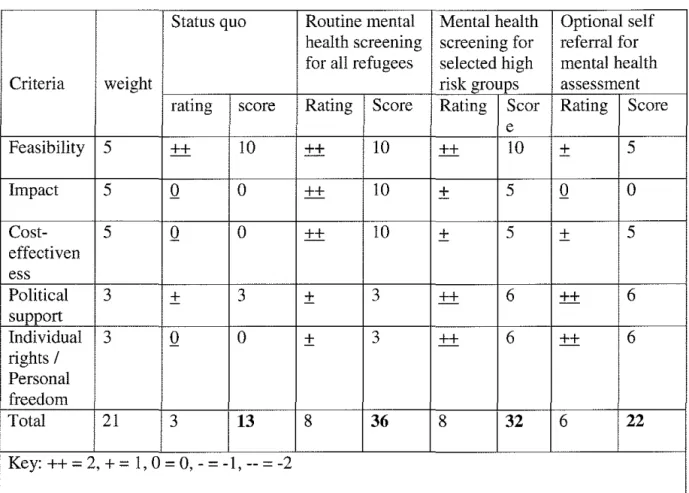
A ranking of the outlined policy options using a matrix table (see tablel) and evaluation based on criteria is shown. Using a scale of 0-5 (5 =very high importance, 4= high importance; 3 = medium importance, 2 = low importance; 1 = very low importance; 0 = not important) each criterion has been weighted based on importance. The criteria of feasibility, impact, cost-effectiveness, political support and individual rights/personal freedom will be used to assess the policy options.
• Feasibility: The assessment of administrative feasibility, operational feasibility, patient acceptability as well as commitment of time and resources needed to implement the policy option. Administrative and operational feasibility is defined here in terms of compatibility with the program's goals, procedures and the availability of personnel needed for implementation of the mental health screening process. In other words, can mental health screening be actually done as part of the initial refugee health screening? How will it be funded? Are there identified funding pathways and levels? Patient acceptability is defined here in terms of its being readily accepted by refugees. This criterion is weighted at 5 because feasibility is crucial to statewide implementation of a mental health screening process.
• Cost-effectiveness: The assessment of the costs and benefits of a policy change. How much will including a mental health screening process into the current health screening program cost? How beneficial will mental health screening be in order to address mental health problems early in resettlement? Will the effectiveness outweigh the cost? This is also weighted at 5 as it is critical to analyze the cost-effectiveness of any program alternative before making a definitive choice.
• Political support: This term is defined here as sustained buy-in from relevant stakeholders, technical personnel, funders, and program executives who make the major decisions on allocation of resources and program goals. Legislative support at the state and county level is not critical for this policy as mental health screening is already recommended in the ORR protocol for states to adopt and implement. No policy change at state level can be easy without political support. This is weighted at
3.
Table 1: The Policv Option Analysis and Prioritv Ranking Matrix
Status quo Routine mental Mental health Optional self health screening screening for referral for for all refugees selected high mental health
Criteria weight risk groups assessment
rating score Rating Score Rating Scor Rating Score e
Feasibility 5 ++ 10 ++ 10 ++ 10
±
5Impact 5 Q 0 ++ 10
±
5 Q 0Cost- 5 Q 0 ++ 10 + 5
±
5effectiven ess
Political 3 + 3
±
3 ++ 6 ++ 6support
Individual 3 Q 0
±
3 ++ 6 ++ 6rights I
Personal freedom
Total 21 3 13 8
36
832
622
Key:++= 2, +=I, 0 = 0,- = -1,-- = -2
Source: Constructmg a Weighted Matnx, 2006 Recommendations
The two policy options with the highest ratings are routine mental health screening for all refugees or mental health screening for selected high risk groups. Based on a review of the literature on mental health and refugee populations, what other states are currently doing in terms of mental health screening, and the policy option with the prospect of making the most impact, routine mental health screening option is recommended for all refugees in Maryland with the following adaptations:
intervention. Mental health screening should be done in a culturally competent manner and with adequately trained interpreters. Leadership should ensure that all providers and resettlement staff are aware of all the cultural factors involved in delivering mental health care to refugees and that mental health information is provided in different languages bearing in mind the cultural norm of the various refugee populations. Education and cultural awareness trainings should be conducted for staff to meet the requirements for refugee health service.
2. Widely used screening tools such as the Hopkins Symptom Checklist (HSCL-25) or the DSM-IV checklist can be adapted and used. The Hopkins Symptom Checklist is recommended by researchers as a good tool to consider because it is quick, easy to understand and already widely tested with and accepted by various refugee
populations. Although it has a direct format that avoids use of open-ended questions; it is still able to elicit emotional complaints necessary for basic diagnostic referrals to be made. There are translated versions of this tool already in existence. More
information on screening tools for psychiatric care for refugees and how generic screening tools can be adapted for use can be accessed from The Harvard Program in Refugee Trauma website (http://www.hprt-cambridge.org/
needed to sustain the program. Thus advocacy, consensus and partnership building is required to explore ORR funding and technical assistance to establish a mental health screening component in Maryland
4. Strong public-private partnership development is also recommended as this will help increase funding, program support, advocacy as well as the technical capacity needed for the implementation of this course of action. A good example is the partnership between the Colorado Refugee screening program and the University of Colorado's Departments of Family Medicine and Psychiatry. Apart from private partnerships, the Maryland Refugee Health Program could also look into possible resource sharing from the Mental Health Administration, an organizational division of the Maryland DHMH. When forming partnership, leadership have an important role of helping build a shared vision which is in line with refugee health program.
5. To ensure uniformity, the Maryland refugee health assessment protocol should be standardized across all the clinics providing this service. Standardization should include both general health and mental health assessments. Providers should be trained to carry out mental health screening using an approved screening tool, be aware of and able to recognize symptoms which may require referral for further intervention. They should be aware of where mental health referrals should be made within the community.
culture specific mental health contexts. Refugee advocates such as the Advocates for
Survivors of Torture and Trauma in Baltimore can also help design recovery
programs that are culturally appropriate and sensitive.
7. On going evaluation of the effectiveness of mental health screening and the general
health screening based on data collected during screening should be done when
program is implemented. Continuous evaluation will help monitor program
performance and ensure assessment of the current and potential health needs of the
refugee population resettling in Maryland. Refugee health program leadership should
use information from data collected to make effective decisions that will help meet
the health needs of the refugee population in Maryland.
Conclusion
In conclusion, the refugee health screening provided in Maryland is incomprehensive and
inadequate in identifying the health needs which may impede successful refugee
resettlement. Refugees are particularly vulnerable to mental health problems and have
been shown to have a high prevalence of mental health problems during and after
resettlement. The spectrum of mental health and psycho-social disorders experienced by
refugees can lead to individual dysfunction, increased health care utilization, increased
risk of communicable and non-communicable diseases, and ultimately poor quality of
life. These conditions ultimately can challenge the possibility of attaining the critical goal
of employment, self-sufficiency and integration into the larger society. Including mental
health screening as part of the general health screening is therefore imperative in order to
identify and refer refugees with mental health issues for intervention early in the
Based on literature review and ability to make the most impact, routine mental health screening for all refugees is recommended for Maryland. Leading and implementing this change will require time, careful planning, staff training and constant communication between leaders, partners and stakeholders. The role of leadership in implementing a mental health component to the already existing screening program include; planning and analyzing the actions necessary to accomplish this task. Partnership with private and public sectors must be built in order to, increase buy-in, advocacy, funding requirements and expertise needed to sustain this policy. Importantly, the support of all relevant key players, stake holders, funders, technical personnel, etc. must be established through constant communication, education and persuasion. Community mobilization and involvement to help build and strengthen the program is also required. Like every health program, fluctuating funds will be an issue. Innovation will be needed in order to garner the funds required to sustain this venture. Since ORR has provided recommendations for mental health screening and opportunities for funding,
consultations, and technical assistance, it is critical that the leadership take advantage of these opportunities when trying to implement this policy.
References
Ackerman, LK (1997): Health problems of Refugees. Journal of American Board of Family Practice 1997; 10:337-348.
Allwood, MA, Bell-DolanD, Husain SA (2002), Children's trauma and adjustment
reactions to violent and nonviolent war experiences. Journal of the American Academy of Child and Adolescent Psychiatry 41: 450-457
All wood, MA, Bell-DolanD, Husain SA (2002), Children's trauma and adjustment reactions to violent and nonviolent war experiences. Journal of the American Academy of Child and Adolescent Psychiatry 41: 450-457
Arcel, LT (1995): Core experiences of refugees: In: Arcel LT eta] (Eds). Psych-social Help for War Victims: Refugee Women and Their Families. Copenhagen: International Rehabilitation Council for Torture victims.
Ater R. (1998). Mental health issues of Resettled Refugees. Ethnomed. Retrieved July 17, 2007, from http:/ /ethnomed.org/ethnomed/ clin _ topics/mental_health.html
Barnes, DM (2001). Mental health screening in a refugee population: a program report. Journal of Immigrant Health. 2001 Jul; 3 (3):141-9.
Birman, D., Trickett, EJ. & Bacchus, N. (2001). Somali Refugee Youth in Maryland: Needs Assessment; A Report prepared for The Maryland Office for New Americans Maryland Department of Human Resources. November, 2001. Retrieved February 01, 2008, from http://www .dhr.state.md.us/mona/refugee.htm
Boehnlein, JK (1987). Clinical relevance of grief and mourning among Cambodian refugees. Social Science and Medicine, 25, 765-772.
Boothby N (1994), Trauma and violence among refugee children. In: Amidst peril and pain: The mental heath and well-being of the world's refugees, Marsella AJ, Bornemann T, Ekblad S, Orley J, eds. Washington, D. C.: American Psychological Association, pp 239-259
Centers for Disease Control and Prevention (CDC) Domestic Refugee Health Program: Frequently Asked Questions. Retrieved June 28, 2007, from
http://www.cdc.gov/ncidod/dg/refugee/faq/fag.htm
Coehlo, GV, Yuan and Ahmed, PI. (1980). Uprooting and development- Dilemmas of coping with modernization. New York press
Constructing a Weighted Matrix (2006). Retrieved March 15, 2008, from
Cookson S, Waldman Ret a! ( 1998); Immigrant and Refugee Health, Emerging Infectious Diseases Vo14 NO 3; Jul-Sept 1998.
Cardozo BL, Bilukha 00, Crawford CA, Shaikh I, Wolfe MI, Gerba ML, Anderson M. (2004). Mental health, social functioning, and disability in postwar Afghanistan. JAMA 2004; 292:585-93.
Fazel, M., Wheeler, J & Danesh, J (2005). Prevalence of serious mental disorder in 7000 refugees resettled in western countries: a systematic review. The Lancet 2005;
365:1309-1314.
Felsman JK, Leong FT, Johnson MC, Felsman IC (1990), Estimates of psychological distress among Vietnamese refugees: Adolescents, unaccompanied minors and young adults. Social Science & Medicine 31: 1251-1256
Fox, P, Bums K, Popovich J, et al (2004), South eastern Refugee children Self Esteem as a predator of depression and scholastic achievement in the Us. The international Journal of Psychiatric Nursing Research 9(2), 1063-1072.
Frye BA, D' Avanzo CD (1994): Cultural themes in family stress and violence among Cambodian refugee women in the inner city. Ans Adv Nurs Sci 1994; 16:64-77.
Goldstein RD, Wampler NS, Wise PH (1997), War experiences and distress symptoms of Bosnian children. Pediatrics 100: 873-878
Gong-Guy,E., Cravens,RB., Patterson, TE (1991). Clinical Issues in Mental Health Service Delivery to Refugees, American Psychologists 46(6):642-8.
Gore, T A, Richards-Reids, GM (2006). Posttraumatic Stress Disorder. Emedicine. Retrieved April4, 2008, from http://www.emedicine.corn!med/topicl900.htm Garst-Unsworth, C and Golenberg, E (1998). Psychological sequelae of torture and organised violence suffered by refugees from Iraq. Trauma-related factors compared with social factors in exile. The British Journal of Psychiatry 172: 90-94 ( 1998).
Journal of the American Medical Association (JAMA) (2004). Retrieved, February 05, 2008, from http://www.nmha.org/go/annualmeeting
Kennedy J, Seymour DJ, Hummel BJ. A Comprehensive Refugee Health Screening Program. Public Health Rep 1999; 114:469-77.
Kroll, J., Habenicht, M., Mackenzie T, Yang M, Chan S, Yang T, Nguyen T, Ly M, Phommasouvanh B, Nguyen H, eta!. Depression and posttraumatic stress disorder in Southeast Asian refugees. Am J Psychiatry. 1989 Dec; 146(12): 1592-7.
Lipson JG. (1993). Afghan refugees in California: mental health issues. Issues in Mental Health Nursing, 14(4), 411-423.
Lipson JG. (1991). Afghan refugee health- Some findings and suggestions. Qualitative Health Research. 1991;1: 349-369.
Maryland Office for New Americans. New American and Refugee statistics. Retrieved December 19, 2007 from http://www.dhr.state.md.us/mona/stat.htm
McKelvey, R. et a! (2002). The prevalence of psychiatric disorder among Vietnam children and adolescents. The Medical Journal of Australia, 177(8), 413-417.
Miller KE, Weine SM, Ramie A, Brkic N, Bjedic ZD, Smajkic A, eta!. The relative contribution of war experiences and exile-related stressors to levels of psychosocial distress among Bosnian refugees. J Trauma Stress. 2002; 15:377-87.
Mollica RF, Donelan K, TorS, Lavelle J, Elias C, Frankel M, Blendon RJ.(1993) The effect of trauma and confinement on functional health and mental health status of Cambodians living in Thailand- Cambodia border camps. JAMA 1993; 270:581-6.
Mollica RF, Poole C, Son L, Murray C, Tor S ( 1997), Effects of war trauma on
Cambodian refugee adolescents' functional health and mental health status. Journal of the American Academy of Child and Adolescent Psychiatry 36: 1098-1106.
Mollica, RF., Wyshak, G., and Lavelle J. The Psychosocial Impact of War, Trauma and Torture on Southeast Asian Refugees. Am J Psychiatryl987; 144:1567-72.
National Institute ofMenta1 Health (1985). The Refugee Assistance Program: Mental Health. MH 85-10. Rockville, Maryland.
National Institute of Mental Health (2007). Post Traumatic Stress Disorder. Retrieved January 28, 2008, from http://www.nimh.nih.gov/health/topics/post-traumatic-stress-disorder-ptsd/index.shtrnl
National Institute of Mental Health (2007). Depression. Retrieved January 28, 2008, from http://www.nimh.nih.gov/health/publications/depression/symptoms.shtml
Ovitt, N., Larrison CR, Nackeraud, L (2003). Refugees' responses to mental health screening: A resettlement initiative. International Social Work 2003; 46; 235.
Pham PN, Weinstein HM, Longman T. (2004).Trauma and PTSD Symptoms in Rwanda: Implications for Attitudes Toward Justice and Reconciliation. JAMA 2004; 292:602-12.
Pickwell SM ( 1996). Providing healthcare to refugees. Advance Practice Nursing 1996; 2(2):39-44.
Pratt, EG and DeMaso, DR., (2006). Somatoform Disorders: Somatization, May 2006, e-medicine, Retrieved February 0 I, 2008, from
http://www .emedicine.com/PED/topic30 15 .htm
Prince, M., Patel V., Saxena, S., Maj, M., Maselko, J., Phillips, MR., Rahman, (2007) A. No health without mental health. Global health 1. Lancet 2007;370:859-77.
Promoting mental health: concepts, emerging evidence, practice: report of the World Health Organization. Retrieved January 31, 2008, from
http://www.who.int/mental_health/evidence/en/promoting_mhh.pdf.
Pumariega AJ, Rothe E, Pumariega JB. (2005). Mental health of Immigrants and refugees, Community Mental health Journal, Vol 41, No 5, October, 2005.
Refuge Trauma Task Force (2003). Review of child and adolescent refugee mental health. White Paper from the National Child Traumatic Stress Network Refugee Trauma Task Force. Retrieved February I 0, 2008, from
http://www. nctsnet. org/nctsn assets/pdfs/reports/refu geereview. pdf
Sabin M, Sabin K, Kim HY, Vegara M, Varese M (2006). The mental health status of Mayan refugees after repatriation to Guatemala. Pan American Journal of Public Health Vol 19 (3), 163-171.
Sack WH, Clarke GN, and Seeley J. (1996). Multiple forms of stress in Cambodian adolescent refugees. Child Dev 1996; 67:107-16. 7.
Sack WH, Clarke GN, Seeley J. (1995). Post-traumatic stress disorder across two generations of Cambodian refugees. JAm Acad Child Adolesc Psychiatry 1995; 34:1160-6.
Savin D, Sack WH, Clark GN, Meas N, Richart I. The Khmer Adolescent Project: III. A study of trauma from Thailand's Site II refugee camp. JAm Acad Child Adolesc
Psychiatry 1996; 35:384-91. 8.
Savin D, Seymour, DJ, Nguyen Littleford L., Bettridge J, and Giese, A. (2005). Findings from mental health screening of newly arrived refugees in Colorado. Public Health Rep.
Schmitz, CL, Jacobus, MV, Stakeman, C, Valenzuela, GA, Sprankel J (2003). Immigrant and Refugee Communities: Resiliency, Trauma, Policy, and Practice In Practicing Social Justice, 2003 (Eds) by Stretch, J J, Burkemper, EM, Hutchison, W J, Wilson, J), pp.
135-158(24).
Scholle WF, Olff M, Ventevogel P, de Vries GJ, Jansveld E, Cardozo BL, Crawford CA. (2004). Mental health symptoms following war and repression in eastern Afghanistan.
lAMA 2004; 292:585-93.
Seymour and Hummel (1999)
Skuglik, DL, Alarcon, DR, Lapeyre, AC III., Williams, MD., and Logan, KM.(2007) When the Poetry No Longer Rhymes: Mental Health Issues Among Somali Immigrants in the USA. Transcultural Psychiatry, Vol. 44, No.4, 581-595 (2007).
United States Citizenship and Immigration Services (USCIS), n.d) Retrieved December 27, 2007, from (http://www.uscis.gov/portal/site/uscis/menuitem
US Department of Health and Human Services. Office of the Refugee Resettlement (l995).Medical screening protocol for newly arrived refugees. Retrieved June 2007, from http://dhfs.wisconsin.gov/intemational/refugee/PDF/ORRprotocal.pdf
US Department of Health and Human Services Office of the Refugee Resettlement Program. Policy Guide and Reporting Form- Refugee Act. Retrieved December 26, 2007, from http://www.acf.hhs.gov/programs/orr/policy/refact1.htm (assessed 12/26/07)
US Department of Health and Human Services, Office of Refugee Resettlement (2007). Refugee arrival data, 2005 and 2006. Retrieved February 02, 2008, from
http://www.acf.hhs.gov/programs/orr/data!refugee arrival data.htm
US Department of Health and Human Services. Mental health: a report of the Surgeon General. Rockville, MD: US Department of Health and Human Services; 1999. Retrieved February Ol, 2008, from
http://www.surgeongeneral.gov/library/mentalhealth/summary.html
United Nations High Commissioner for Refugees (UNHCR) (2001-2008). Refugee resettlement. An international handbook to guide programs. Retrieved February 05, 2008, from http://www. unhcr. org/ c gi-binltexis/vtx/template ?page
UNHCR (2007). Protecting Refugees and the role of UNHCR. Retrieved January 17, 2008, from http://www.unhcr.org/basics/BASICS/4034b6a34.pdf
United Nations (2002). World macro regions and components. Retrieved March 14, 2008, from http://www .un.org/Depts/dhl!maplib/worldregions.htm
Weine SM, Becker DF, McGlashan TH, Vojvoda D, Hartman S, Robbins JP.(l995). Adolescent survivors of "ethnic cleansing": observations on the first year in America. J Am Acad Child Adolesc Psychiatry 1995; 34:1153-9.
Weine SM, Vojvoda D, Becker DF, McGlashan TH, Hodzic E, Laub D, eta!. (1998). PTSD Symptoms in Bosnian Refugees One Year after Resettlement in the United States. Am J Psychiatry 1998; 155:562-4.
Westermeyer (1985) Psychiatric diagnosis across cultural boundaries. American Journal of Psychiatry, 142:798-805, 1985.
Williams C. Prevention programs for refugees: An interface for mental health and public health. The Journal of Primary Prevention. 10(2);167-186.
Wisconsin Department of Workforce Development. Mental health Program. Retrieved February 13,2008, from
(http://dwd.wisconsin.gov/rnigrantsandrefugees/Refugee/programs/healthprog.htm World Health Organization (WHO) (2007). Mental health: a state of well being. Retrieved January 27, 2008, from
http://www. who .int/features/factfiles/mental health/ en/index.html
WHO (2006). Mental and behavioral disorders; International Classification of Diseases (ICD-10). Retrieved January 28,2008,
http://www. who.int/classifications/apps/icd/icd I Oonline