Socio-ecological Approaches for Preventing Childhood Obesity:
A Literature Review to Inform Efforts in Durham, North Carolina
by
Amanda McMillan
A master’s paper submitted to the faculty of the University of North Carolina at Chapel Hill in partial fulfillment of the requirements for the degree of Master of Public Health in
the Public Health Leadership Program.
Chapel Hill
2011
_____________________________________________________
Advisor signature/printed name
_____________________________________________________ Second reader signature/printed name
Abstract
Childhood obesity has reached almost epidemic proportions; in 2007, it was estimated that
16.4% of U.S. children were obese and 15.2% were overweight. Numerous government and
academic-based attempts to put a halt to this trend have centered on the socio-ecological model
for health behavior, which posits that effective health promotion interventions must target both
individual and social factors, including interpersonal relationships, organizational policies,
community environments, and public policy, all of which can contribute to the perpetuation of
(un)healthy behaviors. In this paper, approaches to reducing the prevalence of childhood obesity
are examined. Specifically, recent programs based on the socio-ecological theory of health
behavior are parsed for key lessons to inform interventions tackling this problem in a
multi-dimensional, community-based fashion. The knowledge gained from these earlier efforts are then
applied to the case of Achieving Health for a Lifetime, a Durham, North Carolina-based program
facing a challenging set of circumstances in its struggle to rein in weight gain among the city’s
1 Background
In 2010, the Partnership for Children in Durham, North Carolina, released a report titled
―Healthy and Ready: Assessing Children’s Health Status upon Public School Entry‖ (Durham’s
Partnership for Children, 2010). Using data collected on the standardized Kindergarten Health
Assessment Form—which must be completed by a healthcare professional prior to a child’s
entry into the North Carolina public school system—the Partnership was able to identify the
major health and wellness issues confronting the city’s youngest school children. Notably, the
study revealed that approximately 18% of Durham’s rising kindergarteners could be classified as
either overweight or obese based on body mass index (BMI). This finding, while disturbing, sets
the stage for the troubling trend observed among older children (ages 10–17 years) across the
state of North Carolina, 18.6% of whom are obese and 14.9% of whom are overweight (Singh,
Kogan, & van Dyck, 2010). Nationally speaking, childhood obesity has reached almost epidemic
proportions; in 2007, it was estimated that 16.4% of U.S. children were obese and 15.2% were
overweight (Singh GK, 2010). By comparison, only 5% of U.S. children and adolescents were
considered obese and 4% were considered overweight in the period between 1971 and 1974
(Ogden & Carroll, 2010; National Center for Health Statistics, 2010).
These numbers effectively highlight the ever-increasing prevalence of childhood
overweight and obesity, but they do not speak to the short- and long-term consequences of
unchecked weight gain for individuals and the society in which we live. The health effects of
excess weight in childhood and adolescence are well documented and include early maturation,
insulin resistance and type 2 diabetes, high blood lipids, hypertension, asthma, sleep apnea,
2 stigmatization and discrimination (Centers for Disease Control and Prevention [CDC], 2009a;
Dietz, 1998). Unfortunately, overweight and obese children and adolescents are more likely to
become overweight and obese adults (Serdula et al., 1993), who, in turn, suffer from a host of
other diseases due to their excess weight: coronary heart disease, cancer, dyslipidemia, stroke,
liver and gallbladder disease, respiratory problems, infertility, and osteoarthritis, among others
(CDC, 2009b).
The U.S. healthcare system must mobilize to treat obesity-related disease in children and
adults—a massive undertaking that results in escalating costs for an already over-burdened
healthcare infrastructure. Estimates put the annual direct expense of treating obesity-related
disease in U.S. adults at approximately $147 billion in 2008 (Finkelstein, Trogdon, Cohen, &
Dietz, 2009). Obesity alone is thought to account for as much as 10% of all medical spending;
broken down by payer status, that’s 8.5% of Medicare spending, 11.8% of Medicaid spending,
and 12.9% of individual payer spending (Finkelstein et al., 2009). Across all categories of
healthcare payers, it is estimated that an obese person generates $1,429 in per-capita medical
spending per year, which is 42% higher than the costs incurred by a person of normal weight
(Finkelstein et al., 2009). The economic burden posed by the obesity epidemic is not limited to
these direct medical costs, however. Indirect costs, such as the value of wages lost by people
unable to work because of illness, disability, or premature death, must also be considered when
tallying up the bill for America’s weight gain(Office of the Surgeon General, 2001). In addition
to their negative impact on job earnings, obesity-related health problems also affect the nation’s
employers, with work absenteeism costing $4.3 billion annually and reduced job productivity
3 Given these dire consequences for the nation’s physical and fiscal wellbeing, the U.S.
government and the healthcare community have become increasingly concerned about the issue
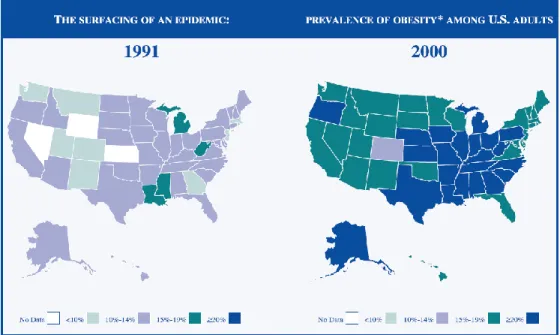
of obesity. In 2001, faced with incontrovertible evidence that America was getting heavier
(Figure 1), the U.S. Surgeon General issued a ―Call to Action to Prevent and Decrease
Overweight and Obesity‖(Office of the Surgeon General, 2001), in which he proposed the
CARE strategy for developing an action plan to curb the epidemic: Communication, Action,
Research, Evaluation. This framework, he posited, should be deployed in a range of settings—
from homes to schools to worksites—because the problem of obesity requires a multifaceted
approach: one that combines individual behavior change with changes to the communities in
which people live and the public policies that govern their lives(Office of the Surgeon General,
2001).
Figure 1. Increasing prevalence of obesity among Americans, 1991–2000
4 Recognizing that obesity frequently has its roots in childhood, Congress, in 2002,
instructed the Institute of Medicine (IOM) to develop a plan of action for decreasing obesity
among the nation’s children and adolescents, resulting in the IOM report ―Preventing Childhood
Obesity: Health in the Balance‖ (IOM, 2005). The IOM Committee on Prevention of Obesity in
Children and Youth, echoing the sentiments of the Surgeon General, proposed a number of
recommendations for the promotion of healthy weight among children across various segments
of society, including federal, state, and local governments, industry and the media, healthcare
providers, community and nonprofit groups, schools, and families.1 The 2007 follow-up to this
report—―Progress in Preventing Childhood Obesity: How Do We Measure Up‖—expanded upon
the notion that a multidimensional approach to combating childhood obesity is required, noting
that ―there will be greater likelihood of success when public, private, and voluntary organizations
purposefully combine their respective resources, strengths, and comparative advantages to ensure
a coordinated and sustained long-term effort‖ (IOM, 2007, p. 8).
What these government calls to action have in common is an espousal of the
socio-ecological model (SEM) for health behavior. The SEM posits that effective health promotion
interventions must target both individual and social factors, including interpersonal relationships,
organizational policies, community environments, and public policy, all of which can contribute
to the perpetuation of (un)healthy behaviors (McLeroy, Bibeau, Steckler, & Glanz, 1988). By
recognizing the interconnectedness of individuals and the various social circles they inhabit, the
model proposes that changes made to both the public and interpersonal environments will
1
The 2005 IOM recommendations subsequently were discussed at regional symposia, where practice and
evaluation plans were developed. The 2007 follow-up report mentioned above provides details about these plans, as well as information on progress made on the earlier recommendations:
5 produce changes in individual behavior. Applying this model to the issue of childhood obesity,
Davison and Birch (2001) identify the following spheres of influence as contributing to a child’s
propensity for weight gain: genetic environment (i.e., family history of obesity), family
environment (i.e., behaviors modeled by parents and other household members), and
community/social influences (e.g., government and school policies, built environment,
sociodemographics) (Figure 2).
Figure 2. Socio-ecological landscape of childhood obesity
Borrowed from: Davison, K.K., & Birch L.L. (2001). Childhood overweight: a contextual model and recommendations for future research.
Obesity Reviews, 2, 159–171.
With this theoretical backdrop, one can pinpoint a number of factors as possible targets
6 elements and behaviors contribute to the imbalance between caloric intake and energy output
resulting in weight gain. Frequent consumption of sweetened beverages, processed foods, and
oversized meal portions; the increased use of high-fructose corn syrup in food manufacturing;
elimination of physical activity from the school day; increased time spent in front of the
television; lack of healthy role models; and failure of the built environment to provide viable
means for physical activity participation—these are just a few of the factors that have received
attention as obesity researchers and policymakers debate the best formula for reducing
overweight and obesity among the nation’s children (CDC, 2009c).
Data from the 2007 North Carolina Youth Risk Behavior Survey (YRBS) demonstrate
the impact that these factors can have. In a state where more than 30% of youth aged 10–17
years are either overweight or obese, only two out of five young people in grades 9 through 12
meet current physical activity recommendation levels set forth by the U.S. Department of Health
and Human Services,2 35% watch 3+ hours of television per day, only 15% eat fruits or
vegetables five or more times a day, and 37% drink at least one sweetened beverage every day
(CDC, 2009d). Youth in Durham, North Carolina, fare even worse. According to the 2009
Durham YRBS, 52% of Durham middle-schoolers and 41% of high schoolers watch 3+ hours of
television per day, only 39% of middle schoolers eat breakfast every day, and 89% of high
schoolers drink one or more sweetened beverages per day (Durham County Partnership for a
Healthy Durham, 2011a, 2011b).
Numerous efforts to change these statistics and reduce the prevalence of childhood
2
The U.S. Department of Health and Human Services physical activity guidelines for children and adolescents recommend 60 minutes or more of physical activity daily (available at:
7 obesity have focused primarily on the school environment because it represents a well-controlled
location in which most children spend a substantial portion of their time. Certainly, obesity
researchers and policymakers can affect the nutritional choices and physical activity
opportunities made available during the school day; however, given the statistics presented
above regarding sedentary behavior and dietary choices made outside of the school day, as well
as the socio-ecological framework espoused by the Surgeon General and the IOM, it seems that
one should explore a broader array of potential sites for intervention to reduce childhood obesity
(Nestle, 2010). In Durham, for example, many factors may be contributing to the weight gain
among its youth, including a dearth of urban grocery stores, unsafe neighborhoods, few
well-maintained public parks, and an overabundance of convenience stores and fast food outlets
(Achieving Health for a Lifetime team, 2009). Unfortunately, there is no magic formula for
solving the problem of childhood obesity, forcing researchers and community members to rely
on trial and error in determining what will work in a range of environments. The following
section will review the design and outcomes of several programs targeting childhood obesity to
tease out key themes for successful implementation and sustainability of socio-ecological
approaches in this context.
Literature review
A literature search was conducted using the PubMed, Embase, and CINAHL databases.
Search terms included MeSH terms such as obesity and overweight, in combination with other
keywords: community, health, childhood, children, intervention, socio-ecological,
8 and that related findings regarding programs involving multiple levels of the socio-ecological
model. The latter search parameter proved the most limiting factor, as most programs targeting
childhood obesity to date are school-focused, given the advantages that the school setting can
provide of a controlled environment with guaranteed access to children. In light of the
multivariable approach advocated by the Surgeon General and the IOM, however, the following
literature review will provide an overview of eight programs modeled on the socio-ecological
approach to childhood obesity. See Appendix A for a summary of the programs and their various
components.
Full-blown deployment of the SEM in this area of public health remains a relatively
novel undertaking. The timeframe mentioned above among the search parameters (2006–2011)
practically set itself as reports of socio-ecological programs to combat childhood obesity
predating this period were scarce. The authors of the articles cited in this review often referred to
the same pilot programs and theoretical policy papers as they outlined the context and
background for their respective programs. Obviously, interest in applying the SEM to this
problem is growing stronger, but the knowledge gap is wide.
The review that follows presents critical lessons learned from SEM-based programs at
various stages along the planning–implementation–evaluation continuum. Some reports focus
mainly on the program infrastructure and community-building needed to facilitate a halt to the
obesity epidemic. These reports are critical for enabling the public health and policy-making
communities visualize what is possible and identify potential barriers; they also provide a basic
roadmap for recreating program infrastructure elsewhere. Others come ―from the trenches,‖
9 potential impact of SEM programming. These studies and the outcomes data they provide are
essential for supplying the evidence base needed to refine methodology and promote adoption of
SEM approaches broadly through policy decision-making and related budgeting measures.
Although the literature on this subject is relatively sparse, the following representation of what
has been done and what has worked may help to guide future efforts in Durham, North Carolina.
“Aligning the stars”: taking advantage of political opportunities
Behavior change doesn’t occur in a vacuum but rather is circumscribed by a larger
environment determined by politics and economics. The outermost circle of the socio-ecological
model concerns policy-level factors affecting the resources available to the remaining SEM
circles (individual, family, institutional, community). The first of these reports, ―Action Schools!
BC: A Socioecological Approach to Modifying Chronic Disease Risk Factors in Elementary
School Children‖ (Naylor, McDonald, Reed, & McKay, 2006), details how researchers were able
harness political will at this policy level in British Columbia (BC), Canada, to foster a
community and provincial environment conducive to behavior change at the organizational (i.e.,
school) and individual levels. Naylor et al. describe how a variety of partners were engaged
across government (BC Ministry of Health; BC Ministry of Education; BC Ministry of Tourism,
Sports, and the Arts; BC Recreation and Parks Association), academia (University of BC),
community stakeholder groups, and schools (e.g., teachers, principals, parents, superintendents)
to devise, implement, and evaluate a physical activity model among students in grades 4–7 in the
public schools (see Appendix A for a listing of the program’s components). Quite notably, this
10 preparing for the upcoming, high-profile Vancouver-Whistler Games—looked favorably on
programs designed to promote and highlight physical activity participation among young people.
With this encouraging backdrop, the Action Schools! BC researchers had somewhat of a
mandate to organize parties from across the socio-ecological spectrum in the dual mission of
making children more active and underscoring British Columbia’s commitment to physical
excellence and sports promotion.
The results outlined in the Action Schools! BC report are short on concrete data but long
on observations regarding the possible benefits of multi-sector participation in childhood obesity
reduction. By means of focus groups, stakeholder meeting reports, media scanning, and
government policy reviews, the research team concluded that their efforts had resulted in
macro-level changes that would contribute to ongoing and sustainable promotion of physical activity in
BC schools and communities. Perhaps the greatest outcome of the effort was the BC
government’s subsequent decision to allot $14.5 million for expansion of the Action Schools!
program. The authors recognize the obvious influence that the provincial government played in
the success of the program (as it dovetailed nicely with the BC agenda to promote the
Vancouver-Whistler Games), and they are justifiably reluctant to directly attribute the impacts
observed to the model that was implemented. These limitations aside, however, the report
provides an example of how political opportunism can work in favor of SEM approaches and
should be exploited when appropriate.
Building the infrastructure for change
11 importance is assembling and organizing the stakeholders needed to plan, implement, and
evaluate the intervention. A notable example of such an undertaking can be found in a report on
a multi-level initiative to prevent childhood obesity in Chicago, Illinois. ―Taking on Childhood
Obesity in a Big City: Consortium to Lower Obesity in Chicago Children (CLOCC)‖ (Becker,
Longjohn, & Chrisoffel, 2008) provides an overview of an attempt to create a broad-based
infrastructure, in this case to monitor and prevent childhood obesity through multiple points of
intervention while also creating the evidence base to inform and sustain future efforts. Founded
in 2002, the CLOCC has enlisted more than 700 Chicago organizations to the fulfillment of its
mission to ―foster and facilitate connections between childhood obesity prevention researchers,
public health advocates and practitioners, and the children, families, and communities of
Chicagoland‖ (Becker et al., 2008, p. 200). The CLOCC employs its own full-time and part-time
staff to oversee and facilitate the partnerships comprising the consortium and to maintain a
website for dissemination of information and results (http://www.clocc.net/).3 The staff is
overseen by the CLOCC Executive Committee, External Advisory Board, and Corporate
Advisory Committee, the individual members of which provide guidance in decision-making and
critical connections to stakeholders at the local and national levels. The importance of the
organizational and decision-making mechanisms embodied by these committees and the paid
staff cannot be understated. Mobilizing hundreds of stakeholders can create tremendous
momentum for change but would be nearly impossible without adequate attention to
organizational oversight and communication.
3
12 CLOCC efforts detailed in the report relate to data surveillance (e.g., creating a
surveillance system using school health forms), policy development (e.g., generating a legislative
agenda and a strategy for passage at the state and city levels), clinical care (e.g., providing
clinicians with education and resources for the prevention of childhood obesity), public
education (e.g., promoting a media campaign that encourages healthy eating and active lifestyles
among elementary school-aged children), and community-based initiatives (e.g., establishing
―vanguard communities‖ as models for local mobilization, capacity development, outreach, and
evaluation) (Appendix A). As with the BC study, the CLOCC report is unable at this juncture to
deliver outcomes data demonstrating the effectiveness of its SEM strategy. It does, however,
describe a multi-layered evaluation plan designed to connect the changes made through its
actions to individual behavior change and reduced obesity rates among Chicago’s children. A
look at the coalition’s website reveals that recent work has centered on developing and
advancing a policy agenda at the city and state levels, with an emphasis on facilitating data-based
surveillance collaboration, health education, insurance coverage for obesity prevention activities,
and access to healthy foods and physical activity resources.4 Given its ambitious agenda and
complex organizational structure, the CLOCC supplies a critical lesson for similar efforts—that
is, the need for strong leadership and staff support to shape goals and structure the effort.
Engaging multiple stakeholders
Keeping in mind the importance of leadership and program infrastructure in the CLOCC
example, one must also consider the types and numbers of stakeholders that will be asked to
4
13 engage with the project of preventing childhood obesity. The literature search uncovered two
very different models for this undertaking—one that espouses vast community involvement and
another that opts for a more streamlined, single-focus approach. The first model is exemplified
by the report titled ―The California Endowment’s Healthy Eating, Active Communities (HEAC)
Program: A Midpoint Review‖ (Samuels et al., 2010). The HEAC enlists government,
organizational, and community stakeholders in the development and roll-out of unique models
promoting healthy eating and physical activity tailored to youth in six low-income California
communities. The HEAC program targets five sectors that influence children’s health
decision-making: schools, after-school programs, neighborhoods, health care, and marketing and
advertising. Stakeholders in each of the six selected communities were provided with a general
logic model for obesity-related behavior change and instructed to tailor it to the unique needs of
their communities. In turn, the changes espoused by the stakeholder models will be presented to
important community players, such as industry, transportation, and policy decision-makers, and
their support for those changes will be solicited. The HEAC researchers present preliminary
results from these efforts, mainly in the form of numbers of persons exposed to various
interventions (e.g., 769,000 students exposed to enhanced P.E. interventions; 300 healthcare
providers supplied with training on childhood obesity prevention) (Appendix A). Future
evaluation plans include measurement of changes in food and physical activity environments,
individual-level outcomes (behavior/attitude changes, BMI), and stakeholder awareness about
the issue and support for change (to be determined from surveys, focus groups, etc.).
Given the HEAC’s embrace of multiple stakeholders, the authors of the report underscore
14 the ability to mobilize their networks to support the cause of obesity prevention in children. They
call these advocates ―catalysts or facilitators of change‖ (Samuels et al., 2010, p. 2116), and their
contributions to the success of the undertaking are reportedly quite valuable. In each of the six
communities targeted, HEAC has enlisted lead partner organizations to provide a focal point for
activity; these organizations range from departments of public health and school districts to
groups such as East Bay Asian Youth Center, Latino Health Access, and the Anderson
Partnership for Healthy Children. The authors explain that these ―catalysts‖ are essential for
providing technical assistance, funding, data, advocacy, and community engagement—all critical
elements for a socio-ecologically based approach to stimulating behavior change. Of course,
challenges remain: reduced community and school resources due to the economic downturn
being the most formidable obstacle. For change to be sustainable over the long term, time and
resources must be committed to the project. The HEAC authors remain optimistic, however,
observing that ―as momentum builds and more partners join the effort, change will happen more
quickly at a lower cost‖ (Samuels et al., 2010, p. 2121).
An example of a program that has enlisted multiple partners with resources to devote to
creating low-cost change is Healthy Living Cambridge Kids, which has built upon ongoing
efforts of the Cambridge, Massachusetts, public schools to monitor student BMI and fitness via
annual collection of height, weight, and fitness test scores in a computerized data system
(Chomitz et al., 2010). The already-existing Healthy Children Task Force in Cambridge was
tapped to guide the design of the intervention with community input; see Appendix A for a
listing of the program’s key components. BMI z-scores were calculated from the collected
15 fitness tests passed between baseline and the follow-up time point three years into the
intervention. (Fitness tests gauged cardiovascular endurance, abdominal strength, flexibility,
upper-body strength, and agility.) Results showed a significant decrease in mean unadjusted BMI
z-score (–0.04, P≤0.001) and significant improvement in fitness test scores, with the percent of
students passing all five tests increasing by 14.6% between baseline and follow-up. Notably, the
researchers also observed an increase of 2.4% in the prevalence of healthy weight in the study
population; the prevalence of obesity decreased significantly by 2.2% (P<0.05). The availability
of regularly collected data from the Cambridge public schools enabled these useful comparisons
among a broad swath of the city’s school-aged population, underscoring the importance of
buy-in from critical partners like local government and existbuy-ing coalitions with resources to commit.
Another benefit of the multiple-stakeholder model is the fostering of community
ownership, as is seen in an example from Australia. The Be Active Eat Well (BAEW) program
(Sanigorski, Bell, Kremer, Cuttler, & Swinbern, 2008) bolstered the capacity of a rural
community in Victoria, Australia, to create behavior change among its youngest residents
through coalition-building among government agencies, local stakeholders, and community
members. Program activities are outlined in Appendix A and are similar to those reported for the
studies mentioned above. BAEW used as its primary outcome differences over time in the
weight, waist, and BMI z-score of study participants. Children (n=833) were measured at
baseline and again two years later. Results showed that children in the intervention group gained
less weight (–0.92 kg; standard error [SE] 0.41) and had significantly smaller increases in waist
size (–3.14 cm; SE 0.96) and BMI z-score (–0.11; SE 0.05) than those in a control group. While
16 BAEW were not of sufficient magnitude to have an impact on the incidence of overweight and
obesity. ―The challenges ahead,‖ they observe, ―are to determine the level of intervention
required to achieve a reduction in childhood overweight and obesity prevalence, how to ensure
sustainability of the successful intervention strategies within the community, and to assess the
longitudinal effects of the reductions in unhealthy weight gain as children become adolescents
and then adults‖ (Sanigorski et al., 2008, p. 1066). While still puzzling over how best to make an
impact in this area, the BAEW researchers do supply an example of how program sustainability
may be achieved through cultivation of community ownership of child wellness efforts by local
leaders, organizations, and community members, who merge resources, reorient priorities, and
generate widespread support to achieve the desired outcome of halting weight gain among
children.
Taking a stream-lined approach
In contrast to the three reports described above, which place an emphasis on solutions
derived from multiple stakeholders, the program described in the report titled ―A Statewide
Strategy to Battle Child Obesity in Delaware‖ (Chang, Gertel-Rosenberg, Drayton, Schmidt, &
Angalet, 2010) attempts to reduce childhood obesity by delivering a ready-made strategy to
community partners in selected settings representing varying levels of the socio-ecological
model. Spearheaded by a children’s health system—Nemours (www.nemours.org)—this
program promotes changes in policy and practice in specific environments (schools, child care
facilities, and primary care practices) to slow and eventually reduce the prevalence of childhood
17 Action Schools! BC program insofar as it is somewhat circumscribed by the agenda of an
organizational body (the BC government in Action Schools! and Nemours Health System in the
Delaware initiative). In other words, the interventions presented serve the interests of a particular
stakeholder as opposed to the collective will of an assembled body of stakeholders (as is the case
in the CLOCC, HEAC, Healthy Living Cambridge Kids, and BAEW examples).
The Nemours researchers base their program on the 5-2-1-Almost None prescription for
healthy living—five servings of fruits/vegetables per day, only two hours in front of the
television or game console, at least one hour of physical activity, and almost no sugar-sweetened
beverages. To ensure maximum exposure for this behavior model, the research team is seeking to
facilitate policy and practice changes in three settings in which children spend time outside of the
home—schools, child care facilities, and primary care practices. Partnerships have been formed
with organizations and agencies with a shared focus on child-related issues and an ability to
influence policy decision-making. Learning collaboratives and training toolkits have been
developed to educate school staff, childcare providers, and healthcare providers about obesity
prevention and treatment, and a 5-2-1-Almost None social marketing campaign targets both
children and their families to inspire behavior change and to create a groundswell of support for
policy change (Appendix A). Findings to date reveal that more schools have adopted wellness
policies, the Delaware state legislature has passed laws to boost physical education/activity in the
schools and in child care settings, and the prevalence of overweight and obesity among Delaware
children has not increased significantly since 2006. Although direct causation cannot be
established between the Nemours intervention and these accomplishments, the authors credit
18 conducive to producing the changes in policy and behavior observed. Certainly, each approach
has its advantages: the Delaware program focuses attention and resources on the accomplishment
of an immediate goal, and the multiple-stakeholder approach builds a network of collaborators
that can contribute to the long-term sustainability of shared objectives. There is a place for each
model in the battle against childhood obesity, although the optimal approach likely resides
somewhere along this continuum between single- vs. multi-focus effort.
Building the evidence base for credibility and sustainability
Efforts that focus mainly on creating the momentum, securing the funding, and building
the organizational infrastructure needed to facilitate behavior change are critical to producing an
environment in which children and their families have the resources and motivation to make
healthier choices about diet and exercise. Ensuring that such infrastructure continues to receive
priority status in policy-making and funding discussions depends in large part on the ability of
program leaders to produce tangible evidence showing that the efforts are successful in
decreasing weight gain among a targeted population of children. It is only within the past decade
or so that the concept of evidence-based public health (EBPH) has received attention (Brownson,
Fielding, & Maylahn, 2009). Borrowing from the lexicon of evidence-based medicine, EBPH
represents a logical extension of the ongoing effort to professionalize public health practice via
higher education and accreditation (Council on Linkages between Academia and Public Health
Practice, 2010; Tilson, 2008). Like its medical cousin, EBPH strives to link high-quality
evidence from the peer-reviewed literature with real-world practice settings, thereby ensuring
19 resources. Unlike evidence-based medicine, however, public health research lacks a ―gold
standard‖ for its evidence base; randomized controlled trials often are not feasible given the
complex and unpredictable nature of public health settings (Brownson, 2009). Consequently,
EBPH places results from quasi-experimental studies against a backdrop of population
demographics, available resources, and organizational/environmental contexts to arrive at what
might be deemed ―best practice.‖ Although there are no guarantees that results stemming from
sound statistical analyses of public health data will persuade a policy-maker or funder to throw
support behind a program, rigorous evaluation of public health interventions will contribute to a
growing evidence base that may bolster future efforts to influence health policy (Brownson,
2009).
Demonstrating efficacy
Among the vanguard of projects providing the evidence base for this area of public health
is a study described in the report titled ―A Community Intervention Reduces BMI z-score in
Children: Shape Up Somerville First Year Results.‖5 Published in 2007, this report presents the
findings from a non-randomized trial of environmental intervention for obesity prevention in
three Boston-area cities (Economos et al., 2007). The researchers used a community-based
participatory research approach in designing and implementing a program to enhance the
availability of healthy food and physical activity in the before-, during-, and after-school
environments of early elementary school-aged children (grades 1–3). Through focus groups,
community meetings, interviews, and advisory council sessions, the research team solicited input
5
20 from a range of community members in the design of the intervention. Strategies selected
resemble many of those seen in the previously described reports (Appendix A). Unlike many
other studies, however, this project incorporated a plan of statistical analysis to quantify the
credibility of its hypothesis that a community-wide approach to the problem of childhood obesity
is effective. The primary outcome of interest was change in BMI z-score from the pre- to the
post-study periods; multiple height and weight measurements were made for each student at each
time point to enable the necessary calculations.
Results from Shape Up Somerville (SUS) revealed a modest but significant effect size in
BMI z-score change (β = –0.1005, P = 0.001), which is best represented by the example of a
child at the 75th percentile for BMI z-score and 50th percentile for height. With the stated effect
size of the SUS intervention, this child would be expected to avoid gaining approximately 1
pound (0.8 lb for a male, and 0.9 lb for a female) over the eight-month period of the intervention.
The authors acknowledge that controversy exists regarding appropriate analytic approaches to
data gathered via community-based participatory research efforts of this nature, but they describe
in detail the variety of methods used to validate their findings in view of their hypothesis.
Clearly, however, additional scholarly attention should be paid to the analytical methodology to
undergird the evidence base for public health practice so that effective arguments (above and
beyond those based solely on face validity) may be made to policy-makers and funding bodies
for the continued support of these types of programs.
In contemplating the SUS results, one should take into account the carefully selected
circumstances under which the study was performed. The median household income ranged from
21 $52,000); the percentage of families living below the poverty level varied from 12.5–14.5% (the
U.S. average in 2008 was 13.2%). Most parents had at least a high school diploma, with
education levels generally being higher in the intervention community. More than 60% of
families included parents who were married (Economos et al., 2007). Obviously. the researchers
chose a study population of middle class people with some resources to devote to child wellness.
The results, then, should be viewed as reflecting the efficacy of this intervention strategy under
―ideal‖ circumstances but not necessarily its effectiveness in ―real world‖ settings, where
circumstances cannot be so carefully controlled and positive outcomes are not often likely.
Challenges in building the evidence base for SEM-based approaches to preventing childhood
obesity will involve thinking creatively about what constitutes legitimate evidence and in
translating tested models into public health practice.
Using multiple outcomes measures to expand the definition of “evidence”
Against a backdrop of the SUS results, another program, the Travis County CATCH trial,
sought to measure the impact that community involvement may have on the success of an
existing child health intervention program (in this case, the Coordinated Approach to Child
Health BasicPlus [CATCH BP]) (Hoelscher et al., 2010). The research team devised a
community component to complement the original program, creating what they termed CATCH
BPC (CATCH BP and Community involvement). Community-based features of the program are
listed in Appendix A; these included family fun nights, school-based social marketing (e.g.,
morning announcement messages, CATCH signage, school menu messages), community
22 community members, and development/distribution of a community health promotion activity
guide. Supplementing the BMI z-score measure, the research team employed a range of
measurement tools to examine the primary outcome of reduction in prevalence of overweight
and obesity. A self-administered, 62-question survey was completed annually by a cross-section
of student participants (in grade 4), assessing their physical activity level, dietary patterns,
physical activity knowledge, self-efficacy, and outcome expectations. Process measures included
the System for Observing Fitness Instruction Time (which gauges the level of
moderate-to-intense physical activity during P.E. class time), structured interviews with program leaders, and
self-administered questionnaires to teachers regarding their perceptions of the program.
Interestingly, results indicated that schools receiving the CATCH BPC programming attained
greater gains in the desired outcomes than their CATCH BP counterparts. Prevalence of
overweight and obesity decreased by 8.2% among students in the BPC schools as compared with
3.1% in the BP schools. Student dietary intake behaviors and physical activity levels were also
more favorable in BPC students. The process measures revealed greater uptake of intervention
activities at schools receiving community support, with more activities and teacher interest being
reported. The usefulness of these additional measures above and beyond the standard BMI
comparisons should be acknowledged as critical to providing much-needed context and support
for the SEM evidence base in childhood obesity prevention.
As this literature review reveals, the obesity research community is zeroing in on best
practices for reduction of obesity and overweight among children. Embracement of the
23 leaders and public health professionals alike; however, its application in this context is easier
visualized than accomplished, with a multitude of factors to be considered, stakeholders to be
enlisted, resources to be marshaled, and strategies to be explored. No study summarized above is
perfect. Each lists limitations in scope (e.g., population size and sociodemographics),
implementation (collaboration challenges, funding limitations, etc.), and evaluation (namely,
statistical/analytical shortcomings). Each also adds another brick to the growing evidence base
for public health approaches to childhood overweight and obesity, either by creating a roadmap
for execution or by providing concrete results validating the efforts made to date. Overall, the
findings point toward a promising path for future research into SEM-based programs, one of
which—Achieving Health for a Lifetime—is currently unfolding in Durham, North Carolina.
Achieving Health for a Lifetime: a Durham, North Carolina, case study
In 2008, Durham Health Innovations (DHI, www.dtmi.duke.edu/dccr/dhi) issued a
request for proposals for projects combining resources from Duke University and community
stakeholders to reduce death or disability from specific diseases prevalent in Durham, North
Carolina.6 The purpose of this grant program was to underwrite planning of activities that would
enable healthcare providers and community members in Durham to take charge of their health in
a sustainable way (the caveat being that funding did not extend beyond the planning stage).
Applicant teams were instructed to emphasize community ownership and low-cost sustainability
of their proposed activities; focus on securing grant-based funding for long-term implementation
was discouraged. One of the ten projects chosen for planning grant funding is titled Achieving
6
24 Health for a Lifetime (AHL), which mobilizes community resources to reduce the incidence and
prevalence of childhood obesity in Durham through capacity-building efforts and intervention
development. Specifically, the program team is targeting northeast central Durham—an
economically depressed area with a 95% minority population that has been the focus of recent
government efforts in crime reduction and historical preservation. Hoping to ―piggyback‖ on the
momentum generated by these efforts and to make an impact in an area of Durham with the most
need, the team has chosen northeast central Durham’s elementary school, Y.E. Smith
Elementary, as the locus for the pilot project. The program’s long-term goal is to create a ―web
of wellness‖ that will eventually encompass the area’s middle school and high school, as well as
churches, community groups, local organizations, and eventually other parts of the city in a
comprehensive approach to reducing obesity among Durham’s youth. This ―web‖ constitutes a
version of the socio-ecological model insofar as it addresses the issue of childhood obesity from
a number of angles; however, AHL has been forced to re-envision the SEM somewhat to account
for the meager resources of its initial target population, many of whom have little attention to
give to matters of nutrition and exercise when concerns about personal safety, employment, and
transportation are more pressing. Far from the likes of Somerville, MA, northeast central
Durham does not represent the median of anything but rather the outer edge of survival. As such,
AHL has come to place greater emphasis on the organizational and community levels of the
SEM to compensate for resources lacking at the interpersonal and individual levels.
As is true of other SEM-based programs, AHL has drawn on a large constituency of
academic, institutional, and community stakeholders to design and drive its planning efforts.
25 Family Medicine, the Durham County Health Department, and Durham Public Schools to local
groups like Durham Congregations in Action, El Centro Hispano, and the YMCA of the
Triangle. Interventions are designed to spiral out from the school setting, with initial emphasis
placed on activities occurring during the school day (e.g., nutrition classes, cafeteria learning
displays, increased opportunities for physical activity before, during, and after school) and later
attention paid to incorporating families and communities (faith-based and otherwise) into the
effort to improve diet and physical fitness in the overall population (Achieving Health for a
Lifetime team, 2009). Of note, during the planning process underwritten by the DHI grant, the
AHL team struggled with issues pertaining to the program’s long-term sustainability, as well as
its intent—that is, testing efficacy (as was done in Shape Up Somerville) versus achieving
effectiveness in a community with the greatest need and the fewest resources. The fiscal realities
of delivering nutrition and exercise programming to an economically disadvantaged community
quickly became apparent, as did competing agendas among the funding body and team members
(discussed below).
In terms of evaluation, the original proposal for AHL lists a number of possible sources
of data and information (Achieving Health for a Lifetime team, 2009). The major clinical end
point is child BMI (the collection of which is recommended, but not mandated by the state).
Other quantifiable health measures include headcounts at AHL events and response rates to
children’s obesity risk assessments sent home to parents. Survey-based and/or qualitative
measures, including self-reports of behavior change among children, parents, and staff, are
mentioned as other possible gauges for program success.
26 (Appendix B). Individual children are expanding their palates to include more healthy foods
thanks to the USDA Fruit and Vegetable Grant, which brings samples into the classroom for
tasting. They are also being encouraged to be more physically active outside of the school day
through a student walking program, which offers incentives for distances walked. Families are
being educated about nutritious eating via mailings sent to the home. Likewise, parents are being
alerted to their children’s overweight or obesity (determined via annual BMI measurement at the
school) and referred to local health/weight loss resources.7 Teachers are being supplied with
resources for introducing health topics and exercise into the classroom; they are also taking
advantage of a teachers’ walking club to model healthy behaviors for their students, families, and
friends. At the community level, various programs are being developed in conjunction with local
religious congregations and the Durham County Health Department that will enable weight loss
and regular physical activity among neighborhood residents.
As AHL enters its second full year of implementation, some early lessons have been
learned and unforeseen challenges encountered, according to Jennifer McDuffie, PhD, AHL
program manager (J. McDuffie, personal communication, February 8, 2011). Looming large for
the AHL team is the recent turnover in the state legislature from a Democratic to a Republican
majority. The North Carolina Republican Party platform espouses public school reform based on
standardized testing, cutting of administrative waste, and teacher retention and promotion based
on test scores (NC Republican Party, 2010). Y.E. Smith Elementary School, the early focal point
of the AHL program, has already felt the repercussions of this political stance as embodied by
7
27 the No Child Left Behind Act of 2001: after its students garnered low scores in 2009
end-of-grade testing, the school’s principal was unexpectedly dismissed and several teachers have been
let go. Becky Posada, the Durham County Health Department nutritionist assigned to Y.E.
Smith, reports that this upheaval has taken a toll on the school’s staff, increasing stress levels and
spawning concerns about job security (B. Posada, personal communication, February 28, 2011).
Understandably, school commitment to the AHL program is waning as other more dire
concerns come to the foreground. Resources and attention are being devoted elsewhere—
namely, to student preparation for end-of-grade testing. Unfortunately, this redistribution of
classroom time and effort will do little to address the fact that almost 40% of Y.E. Smith students
are overweight or obese. As studies have shown an association between overweight and poor
academic performance (Taras & Potts-Datema, 2005), AHL’s promotion of nutrition education
and physical activity in the classroom could do as much to ensure better academic outcomes as
more time spent on test preparation. Attention will need to be drawn to this connection in the
months ahead to reengage school faculty and staff with the AHL mission and potentially to ward
off future cuts to physical education/nutrition education budgets.
Furthermore, the AHL infrastructure has not held together seamlessly, partially due to
conflicting agendas among the program’s major player, Duke Medicine (the driving force behind
the DHI initiative), and its community stakeholders. Although, at the outset, DHI professed an
interest in community-based strategies for long-term, sustainable activities to prevent chronic
disease, its interests evolved over the funding period to focus more on collaborative ways to
reduce death or disability from disease using information technology and coordinated care. In
28 believing that prevention is the best means for reducing the prevalence of childhood obesity.
Here we see a possible shortcoming in the single-focus approach embodied by the
Nemours/Delaware study described earlier. Because of these differing views (and the fact that
DHI/Duke Medicine held the purse-strings for the planning grant funding and so needed to be
placated), several early AHL participants withdrew from the program, expressing concerns
regarding independence in planning activities that they felt would be most effective, such as
community health education and weight loss counseling efforts to keep people from developing
chronic, obesity-related disease. Among the AHL partners who have remained involved, other
disagreements have emerged as to what types of interventions are feasible and practical for a
low-income, low-budget environment like Y.E. Smith Elementary and its surrounding
community (B. Posada, personal communication, February 28, 2011). At the heart of this issue is
the efficacy vs. effectiveness problem: Is AHL’s time best spent showing how childhood obesity
can be curbed under ideal sociodemographic circumstances, or should it devote its efforts to
finding out what can actually work in an underserved community?
Further stymieing efforts is the fact that a few of the ―community catalysts‖ who
comprised an important bloc of the core team were forced to turn their attention to other
commitments for personal/professional reasons. Another blow to the AHL infrastructure came as
representatives of Durham’s Latino community (e.g., El Centro Hispano) were unable to sustain
their commitment to the project due to other obligations, leaving the core team without any input
from a segment constituting 12% of Durham’s population (and almost 25% of the Y.E. Smith
student body). Thus, as the DHI planning grant period ends (and Duke Medicine’s financial
29 of its network of supporters to carry on and underwrite its work. To this end, it is considering
alliances with local organizations committed to obesity prevention rather than coordinated care
and, in the process, is redefining its goals to better match the perspectives of its core team rather
than the agenda of its former primary funding body (i.e., DHI/Duke Medicine).
Part of this network-building process hinges on the team’s ability to foster community
buy-in and ownership of the AHL objectives. Efforts on this front have proven challenging as
Dr. McDuffie is the only paid staff person on the project and is allotted only 10 hours/week to
devote to overseeing its many facets, including neighborhood outreach (J. McDuffie, personal
communication, February 8, 2011). As a result of this understaffing, aside from select
community members and the staff and parents at Y.E. Smith, few people know about AHL in
northeast central Durham. McDuffie notes that what is needed is more manpower, mainly in the
form of hired staff and volunteers who are motivated to spread the word and create the
groundswell of support necessary for AHL to have a lasting impact.
An additional challenge is inspiring people with more pressing concerns—such as finding
work, paying the rent, and keeping themselves safe—to care about nutrition and exercise. In
northeast central Durham, unemployment is approximately 15%, and some 36% of individuals
live below the poverty level. The median household income is only 41% of the citywide median
(Environmental Protection Agency, 2006). Transportation poses an additional hurdle for many
families who might otherwise have an interest in eating healthfully and/or exercising; without a
car or ready access to public transportation, a person might be more inclined to sit on the couch
eating junk food than to walk miles through unsafe neighborhoods to the nearest grocery store or
30 bus routes or encourage the conversion of abandoned, city-owned homes into low-cost gyms for
area residents. The team also foresees enlisting the local faith community, whose roots in the
community may encourage greater volunteer participation to help families in the target
population access the resources needed to make behavior change as easy as possible. Whether
it’s providing a weekly shuttle to a grocery store, hosting free exercise classes on church
grounds, opening a healthy foods pantry, or supplying volunteers in Y.E. Smith classrooms to
oversee nutritional and/or exercise activities, the religious institutions of northeast central
Durham could bolster the AHL effort tremendously by virtue of their service-oriented missions
and their connections to the community. Because money does not currently exist to fund staff
support, volunteer labor is critical to the success of the AHL program; the recruitment of a
committed body of ready volunteers will do much to enhance existing efforts and extend the
program’s overall reach. Becky Posada of the Durham County Health Department observed that
this is, perhaps, the greatest challenge facing the program—fostering local ownership of AHL so
that volunteers are long-term and stable in their commitment. Finding a church to ―adopt‖ Y.E.
Smith and get involved with the larger AHL project, she posits, would be a step in the right
direction for accomplishing this goal (B. Posada, personal communication, February 28, 2011).
The question of funding also looms large; the DHI grant only underwrote the planning
stage, and so implementation monies must be secured independently by the project team,
unfortunately during a period of economic downturn. As mentioned above, the disconnect
between DHI priorities and the AHL team’s views on how best to reduce obesity prevalence
among Durham’s children resulted in an uncomfortable partnership with uncertain goals. Now
31 bodies that will embrace its upstream approach and be willing to subsidize actual
implementation. In particular, the team is looking for organizations and/or businesses in the
Durham area with concrete ties to the community and a genuine interest in improving the lives of
the city’s children by innovative means (J. McDuffie, personal communication, February 8,
2011).
A possible obstacle to securing financial backing concerns the fact that AHL is trying to
make change happen in a less-than-ideal laboratory. Unlike the study population in Shape Up
Somerville, the average household income in northeast central Durham is only $16,680/year
(City-Data.com, 2011). The population tends to be mobile, as households move or are
reconfigured due to economic and/or personal need. The student body at Y.E. Smith changes
from year to year; Dr. McDuffie estimates that, of the 370 students whose BMIs were measured
in 2010, approximately 60% had been among the 290 students measured the preceding year.
Consequently, the popular BMI z-score outcome measure is not an ideal gauge of program
impact. Alternative measures may need to be explored, such as attendance counts at AHL events
and self-reports of time spent in physical activity. Efficacy of AHL interventions, in any case,
will be difficult to prove using the metrics of studies like Shape Up Somerville. McDuffie
explains, however, that although weight may not change, fitness can be improved, and that
would be an acceptable outcome according to the AHL team, whose focus is more on
establishing intervention effectiveness in this challenging environment. Convincing funding
bodies of the acceptability of such metrics may be a challenge, which is why efforts will be
focused on gaining support from local government, businesses, and organizations with an interest
32 Recommendations
Northeast central Durham obviously faces many challenges in addressing the health
needs of its children. The prospect of mounting a multi-dimensional, socio-ecological campaign
to reduce and prevent childhood obesity seems daunting as there are many other pressing issues
demanding priority. However, lessons learned from the studies included in the literature review
inform what steps may be taken to ensure eventual success for AHL. Based on these lessons, the
following recommendations should be considered:
1. Make the stars align—As demonstrated in the Action Schools! BC example, political opportunities should be exploited to draw attention to and gain allies for the AHL program. Of
note, Durham is a ―Let’s Move‖ City—part of Michelle Obama’s campaign against childhood
obesity (http://www.letsmove.gov/officials-step-1-php), which just celebrated its one-year
anniversary in February 2011.8 Combine this fact with the Democratic National Committee’s
choice of Charlotte, NC, as the host for its 2012 nominating convention, and the scene is set for
Durham’s government officials to make a showcase of the city and its efforts to align itself with
the presidential agenda for childhood wellness. A potential ally in this effort would be the
superintendant of Durham Public Schools, Dr. Eric Becoats, who was appointed in 2010. Dr.
Becoats unveiled a new strategic plan for the school system in January 2011
(http://www.dpsnc.net/stratplan/pdf/dpsstrategicplan.pdf), a portion of which concerns student
wellness and safety. Capitalizing on this change in leadership and the possibility for national
attention in conjunction with the 2012 presidential election, interest in the AHL objectives could
8
33 be ignited among local government leaders with resources and policy-making clout to commit.
Hopefully, armed with some baseline data (e.g., BMI measurements of Y.E. Smith students pre-
and post-AHL, end-of-grade test scores across successive years both before and after AHL),
these leaders may be convinced of the integral role of health and fitness in achieving academic
success. Ideally, as Becky Posada observed, AHL could become part of the ―culture of the
school‖—not an extracurricular undertaking but rather an essential component of the curriculum
(B. Posada, personal communication, February 28, 2011). This can only be accomplished
through widespread buy-in at the legislative level, and so every possible avenue to influence
should be explored and exploited as appropriate.
2. Grow the AHL infrastructure—The core team overseeing the AHL program should be expanded to include more local government leaders (see point 1 above) and the local business
community.9 Presently, members of the team abound in good intentions and have some resources
to devote to the effort, but an influx of policy-making power and financial support would
increase the program’s visibility and credibility among the target population as well as among
untapped allies in the community. Additional data collection sources might be accessed (via
various government agencies), policies could be changed (e.g., zoning, parks/recreation), and
money could be applied toward a social marketing campaign and incentive program to educate
and motivate the target population. A recent alliance with the like-minded East Durham
Children’s Initiative (www.eastdurhamchildrensinitiative.org) should be strengthened as a means
to further boost the program’s profile, potentially increasing its appeal to locally based funders
9
A 2009 effort to generate neighborhood plans for six areas comprising northeast central Durham enlisted more than 50 local government agencies and businesses. These stakeholders may be viewed at
34 who can align themselves with AHL’s approach to childhood obesity prevention and fund
much-needed AHL staff positions.
Committees should also be formed, along the lines of those seen in the CLOCC effort: an
executive committee (comprising key leadership), an external advisory board (with broad
community representation), and a corporate advisory committee (to oversee efforts to enlist local
business and raise funds to sustain the program). Each of these bodies should include at least one
prominent community member from northeast central Durham and at least one Y. E. Smith staff
member; inclusion of these individuals will ensure that discussions and plans are based in reality,
dictated more by on-the-ground circumstances instead of theoretical possibilities. Smaller,
task-oriented working groups might also be considered to facilitate more collaboration among various
AHL volunteers who may find it difficult to attend larger, AHL-wide meetings scheduled during
the work day. This will open up volunteer opportunities to a broader swath of the community and
perhaps will nurture more community ownership of the program. Finally, money needs to be
found to fund a full-time staff position to oversee communication among the various
stakeholders and to augment community outreach efforts.
3. Expand the evidence base—As mentioned above, northeast central Durham presents numerous challenges in measuring outcomes over time. Accordingly, the AHL team should think
creatively about potential means for quantifying success, including use of some of the survey
tools mentioned in the CATCH BPC intervention outlined in the literature review. Additionally,
they might enlist assistance from faculty and students in health outcomes research at local
universities such as Duke and the University of North Carolina at Chapel Hill to develop and
35 evidence-based public health practice. Furthermore, potential funders will need to be educated
both about the difficulties inherent to measuring behavior change in this challenging context and
the legitimacy of such alternate measures of health and behavior change. Such conversations will
likely stress the need for proven effectiveness versus efficacy when dealing with an unstable and
impoverished environment like northeast central Durham. Additionally, more traditional
measures (such as BMI z-score) may be used if the population is over-sampled to account for its
transience and instability.
4. Foster community ownership—Critical to long-term sustainability of this effort is the nurturing of program ownership among the people living in northeast central Durham. The
addition of a full-time staff person will aid in getting the word out about AHL objectives and
events. Even more support might be gained, however, by tapping community organizing
networks both locally and nationally. Because the target area has a mostly African-American
population, assistance from local African-American service organizations should be solicited to
support AHL programming. For example, the Durham chapter of The Links, Inc.
(www.links.org) has signed on as a community partner, although the partnership has not yielded
tangible results to date; avenues for future collaboration with this organization are being
explored.10 Other options include SpiritHouse NC, a Durham-based cultural organizing
collective that engages people of color, women, and teens in leadership roles for
10With a membership of over 12,000 professional women of color in 42 states, the Links is a volunteer service
36 driven strategies to improve quality of life (www.spirithouse-nc.org), and the Durham Striders
Youth Association, a Durham-based volunteer organization that provides track-and-field training
for children between the ages of 6 and 18 years (www.durhamstriders.com). Furthermore, as
Becky Posada suggested, local churches could be asked to ―adopt‖ a school in northeast central
Durham, providing a steady stream of volunteers to assist with various activities, as well as
spreading the word in the community.11
Because childhood obesity may be framed as a social justice issue (in terms of its
socio-economic roots), national volunteer organizations could be contacted about the possibility of
recruiting community organizers to help mobilize neighborhoods and families to make the
changes needed—at the policy, community, organizational, and individual levels—to prevent
obesity among their children. Such organizations might include Americorps and Volunteers in
Service to America (VISTA).12 Opportunities for semester-long, credit-earning internships
through local institutions such as UNC-Chapel Hill, Duke, and North Carolina Central
University should also be explored. The more individuals who can be on the ground, spreading
the word, and getting people excited about behavior change for healthier living, the more likely it
11
A number of churches in northeast central Durham have a history of community involvement, most notably Union Baptist on the border of Old Five Points and Cleveland-Holloway. The AHL team should capitalize on the strong relationship that it has already formed with Union Baptist and expand its reach to include other churches in the area, such as: Shabach Ministries in Old Five Points; Full Gospel Holy Church on Ashe Street; Angier Avenue Baptist Church at Angier Avenue and Driver Street; and Antioch Baptist Church on Holloway Street (UNC Dept. of City and Regional Planning, 2009).
12
In fact, Durham Health Innovations is currently in the process of hiring three community health organizers. These positions will be full-time under a six-month contract, with the potential of continued funding. According to the job posting, the organizers “will engage community leaders and residents to address neighborhood health and
37 is that AHL’s objectives will be met and sustained beyond the duration of the program.
As was seen in the literature review and is represented by the above recommendations,
there is no cut-and-dry, one-size-fits-all solution to the problem of childhood obesity. The
socio-ecological model shows promise for addressing the many factors that contribute to childhood
weight gain, but the application of the model remains an experiment in trial and error based on
the setting. One lesson, however, seems to stretch across all of the programs examined in this
paper; that is, it takes a village to raise a healthy child, or, more specifically, a village and a