Acknowledgments
I would first like to express gratitude to my faculty mentor, Dr. Kelly Giovanello, for her guidance throughout this project. She has been incredibly supportive of my efforts both inside and outside of the lab. I could not have asked for a more thoughtful mentor who inspires those around her to engage in research.
I also wish to show my appreciation to Dr. Chris Wahlheim who greatly helped with data analysis. Most importantly, his enthusiasm for the project continuously motivated me to work harder throughout the completion of my thesis.
Thank you to my committee members for reviewing my work and offering creative ideas for future directions. In particular, I would like to thank Dr. Aysenil Belger for her generous collaboration. I would not have had access to such a unique population if it were not for her advocacy for open science. In addition, this project could not have been accomplished without the brilliant help of Stephanie Langella who always made herself available to explain to me the functions of E-Prime and answer any question I had.
Furthermore, I wish to express my wholehearted gratitude to my uplifting friends and family who are the pillars of my strength. My academic endeavors and intellectual curiosity are a product of their unwavering support. Their love incites confidence and encourages me to be the best version of myself.
Abstract
Free Recall Organization in Young People at Varying Risk for Schizophrenia Schizophrenia is a psychotic disorder characterized by distorted thoughts, perceptions, emotional responsiveness, self-concept, and behavior (American Psychiatric Association, 2013). Although 21 million people worldwide had a diagnosis of schizophrenia in 2018, little is known about the development of the disorder (WHO, 2018). Interpretation of functional and structural brain changes is primarily used to explain the pronounced cognitive deficits in executive
functioning, language, and memory that accompany the disorder (Kuperberg, McGuire, & David, 1998; Minzenberg, Laird, Thelen, Carter, & Glahn, 2009; Silver, Feldman, Bilker, & Gur, 2003). Dysfunction of the hippocampus, a brain structure situated in the medial temporal lobes, as well as the dorsolateral prefrontal cortex (DLPFC) suggests that those with schizophrenia have difficulties properly encoding, processing, and retrieving learned information (Bonner-Jackson, Haut, Csernansky, & Barch, 2005; Heckers et al., 1998). More specifically, these people are less able to maintain and manipulate the context in which information was learned, resulting in poor memory retrieval of contextual information(Polyn et al., 2015). Impairments in episodic
memory, a context-related process involving memory for autobiographical events, is a characteristic of schizophrenia that has been observed in a few populations with a heightened risk for schizophrenia.
2000). Altered cortical activity during demanding working memory tasks further indicates inefficiencies regulating memory functions in high-risk people (Callicott et al., 2003; Keshavan et al., 2002; Seidman, 2006). Similar cognitive deficiencies are found to a greater degree in schizophrenia patients (Sitskoorn, Aleman, Ebisch, Appels, & Kahn, 2004). The relationship between structural and functional impairments and the onset of psychotic symptoms, however, remains unclear due to limited research on the precursors of schizophrenia development (Seidman et al., 2006). Neuropsychological differences preceding psychosis in younger at-risk people, including the 10-15% of high-risk relatives who develop schizophrenia, could provide insight to the pathophysiology of the disorder and promote early treatment (Ban, 2004).
Schizophrenia, schizoaffective disorder, and bipolar disorder have neurocognitive similarities that increase susceptibility to psychosis in first-degree relatives. Genetic relatives of those with bipolar disorder, a manic-depressive illness associated with shifts in mood and energy levels, are at a greater risk of developing schizophrenia than healthy people (Rasic, Hajek, Alda, & Uher, 2016). Such symptomatic overlap may be due to distinct polygenic similarities between schizophrenia and bipolar disorder (International Schizophrenia Consortium, 2009).
The cognitive deficits experienced by non-psychotic relatives reflect a multidimensional expression of symptoms that underlie the schizotypal continuum. Schizotypy is associated with personality traits that convey a vulnerability to psychosis (Barrantes-Vidal, Grant, & Kwapil, 2015). Specifically, negative schizotypy is characterized by diminished emotions, thoughts, and behaviors (i.e., lack of speech, reduced desire for and pleasure from interpersonal interactions). Positive schizotypy includes symptoms of affective dysregulation, magical thinking, and unusual perceptual experiences. Assessments for evaluating schizotypy use either a psychometric high-risk strategy or a clinical high-high-risk approach. The Wisconsin Schizotypy Scale (WSS) employs the Revised Social Anhedonia Scale (Eckblad, Chapman, Chapman, & Mishlove, 1982) to determine negative schizotypy scores and uses both the Perceptual Aberration Salience
(Chapman, Chapman, & Raulin, 1978) and Magical Ideation Scale (Eckblad & Chapman, 1983) to determine positive schizotypy scores. The primary tool used in the clinical approach is the Structured Interview for Prodromal Syndromes (SIPS; Miller et al., 2003). Within the SIPS is a 19-item Scale of Prodromal Symptoms (SOPS) that measures the severity of prodromal
symptoms. SOPS ratings have been shown to predict prodromal symptoms and positively correlate with scores on the Wisconsin Schizotypy Scale (Cicero, Martin, Becker, Docherty, & Kerns, 2014; Racioppi et al., 2018). Although genetic relatives are at a higher risk than
Episodic memory deficits specific to positive and negative schizotypy dimensions
illuminate some of the cognitive changes involved in schizophrenia. For example, negative rather than positive symptoms of schizophrenia are more often associated with cognitive deficits, such as reduced episodic memory recall (Addington, Addington, & Maticka-Tyndale, 1991;
Kaczorowski, Barrantes-Vidal, & Kwapil, 2009). Using the WSS to characterize risk for
psychosis, Sahakyan and Kwapil (2016) reported that overall episodic memory impairments are associated with negative schizotypy. Compared to positive schizotypy and control groups, those with negative schizotypy showed impaired source memory and free recall, or the output of previously studied items in any order. All groups, however, showed a standard disadvantage in an associative cuing task when recalling words that implicitly activate many associated concepts – known as the set-size effect. The associating cuing task involves the presentation of a novel cue to initiate retrieval of a related item from the study phase. Such invariant effects suggest that the memory deficits observed in the negative schizotypy group are unlikely to be due to
abnormal associate networks but rather are a consequence of impaired maintenance of internal context representation.
schizotypy dimensions. People with negative schizotypy were found to experience deficits on all context-related measures, whereas neither control nor positive schizotypy groups showed
impairments. Specifically, those with negative symptoms showed decreased likelihood of
initiating retrieval with the first list item (i.e., first response probability) and had longer latencies between retrieval outputs (i.e., interresponse times). All groups exhibited similar serial position functions, which describe item recall across input positions and are characterized by enhanced recall of the first (i.e., primacy effect) and last few items in a list (i.e., recency effect) as
compared to the middle items in a list. The negative schizotypy group, however, showed lower recall overall. More specifically, due to a delay between encoding and test phases in the
Sahakyan and Kwapil (2018) study, the positive schizotypy and control groups demonstrated an expected primacy effect and no recency effect. Collectively, these findings suggest comparable difficulties in encoding and utilizing context to guide item retrieval between people with schizophrenia and at-risk people with negative symptoms. Such an approach to analyzing context-processing may be extrapolated to examine the status of these free recall measures in people with overlapping symptoms with schizophrenia.
schizophrenia-related psychosis (Keshavan et al., 2003). Similarly, anxiety syndromes and symptoms co-occur at high rates with schizophrenia spectrum disorders (Achim et al., 2011; Braga, Reynolds, & Siris, 2013; Ross, Heinlein, & Tragellas, 2006). Extending the investigation of context processing in people at increased risk for schizophrenia beyond first-degree relatives and into non-psychotic nonrelatives with a diagnosis of ADHD or an anxiety disorder is a promising approach to understanding cognitive impairment along a continuum of risk for schizophrenia.
The purpose of the current study is to elucidate the early cognitive changes involved in people at varying levels of risk for schizophrenia. Free recall deficits have been associated with a heightened risk of schizophrenia development (Sahakyan & Kwapil, 2016). Providing a more thorough examination of free recall, Sahakyan and Kwapil (2018) related poor memory performance to impaired context processing in nonrelatives with greater scores of negative schizotypy; however, nuanced changes in episodic memory have not been explored in a young population of at-risk people. Analysis of free recall performance offers a promising method for evaluating context processing in younger, non-psychotic people at varying risks for
schizophrenia.
and Kwapil (2018) including serial position function, first response probability, and interresponse times.
I hypothesized that recall deficits would be greatest for the high-risk and mid-risk groups, who were more likely to have cognitive disorganization, compared to the low-risk group. It was unclear how high-risk and mid-risk groups would vary from one another. Below I provide
specific hypotheses for the free recall measures of serial position function, first recall probability, and interresponse times. Hypotheses were generated based on group membership.
Serial position functions describe recall patterns and are characterized by primacy and recency effects. People with schizophrenia and nonrelatives with negative schizotypy have exhibited a depressed but similarly shaped serial position curve compared to healthy control subjects (Polyn et al., 2015; Sahakyan & Kwapil, 2018). It was therefore expected that the high-risk and mid-high-risk groups would correctly recall fewer items overall than the low-high-risk group. All groups were expected to maintain qualitatively similar curves with a primacy effect due to delayed free recall.
First recall probability reflects retrieval initiation and is determined as the serial position of the first recalled item. The buffer model of memory assumes that contextual features are most strongly encoded with the first list item in delayed free recall (Lehman & Malmberg, 2013). Consequently, initiating retrieval with the item from the first serial position indicates how well context-item associations were encoded and reinstated. First recall probability was expected to decrease with increasing risk for schizophrenia, suggesting that the high-risk and mid-risk groups would have the greatest difficulty encoding contextual features during learning.
throughout the recall period as there are less items to retrieve from memory (Murdock & Okada, 1970). Longer interresponse times may suggest an impaired use of context as a retrieval
framework to limit search time (Unsworth & Engle, 2007). I hypothesized that increased risk would positively relate to interresponse times.
Method Participants
Twenty-nine people aged 9-16 years old were recruited from an ongoing Cognition and Neuroimaging in Teens (CogNIT) study directed by Dr. Aysenil Belger at the University of North Carolina at Chapel Hill. The CogNIT study utilizes a battery of cognitive assessments, brain physiology measurements, and neuroimaging to examine the behavioral and physiological stress response of adolescents with ADHD Not Otherwise Specified (NOS), anxiety, or a
behavioral/conduct disorder. Participants also included children and adolescents with a first-degree relative with a psychotic disorder diagnosis. Exclusion criteria included having a DSM-V psychotic, developmental, or substance abuse disorder; having magnetic material in the body; taking medication that directly alters cardiovascular function (e.g. Propranolol); and being pregnant or unwilling to take a pregnancy test.
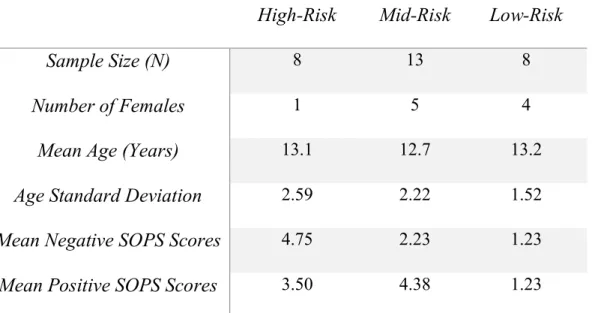
mentioned psychotic or mood disorders. Participants were residents of North Carolina and represented an ethnic and racial mix of 62.07% Caucasian, 31.03% African American, and 6.9% Hispanic. Risk group demographics are depicted in Table 1.
Materials
Materials included 55 nouns with: 4-7 letters (M = 5.66), 1-3 syllables (M = 1.82), an age of acquisition ≤ 9.1 years (M = 5.75), and a Kučera and Francis (1967) written frequency of 34-80 occurrences (M = 50.34). Averages of all characteristics, including word concreteness (M = 584.9) and log-transformed Hyperspace Analogue to Language frequency norms
(log_freq_HAL; M = 9.55), were matched across five lists that each consisted of 10 words. Kučera and Francis frequencies were used to be consistent with the stimuli characteristics in Sahakyan and Kwapil (2018); however, log_freq_HAL norms were used as a more recent measure of word frequency that is based on a larger corpus. Stimuli were generated and their characteristics were collected from the Medical Research Council (MRC) psycholinguistic database of English words (Coltheart, 1981). HAL_frequency norms were obtained from the English Lexicon Database at Washington University (Balota et al., 2007).
Procedure
consent in accordance with The University of North Carolina at Chapel Hill’s ethics committee. Participants gave informed assent and received $10 for their participation.
The free recall task began with a practice trial in which participants read aloud and studied five words (each presented individually on a computer monitor for 4 s with an interstimulus interval of 250 ms) before solving math problems for 30 s and then verbally recalling the prior words in a 30 s period. Math problems included simple addition and subtraction in order to ensure that the younger participants could perform. Participants were instructed to type recalled items in any order. Correct recall of all five words was not necessary to continue to the experimental task. Following a similar structure to the practice trial, each of the five actual study-test trials included the presentation of 10-words study lists prior to solving math problems for 30 s and then recalling list items in a 60 s period. A total of 50 target words, or 5 target lists, were studied during the actual experiment.
Design
Risk group served as the between-subjects factor and was composed of three levels: high-risk, mid-high-risk, low-risk. Within-subjects measures included serial position functions, first recall probability, and interresponse times.
Measures
computed as the probability of correct recall conditionalized on the input position during study. The three risk groups were compared on whether they exhibited typical primacy and recency effects, which reveal the functioning of long term and working memory, respectively. First recall probabilities (FRP) were calculated as the average number of correct recalls that were
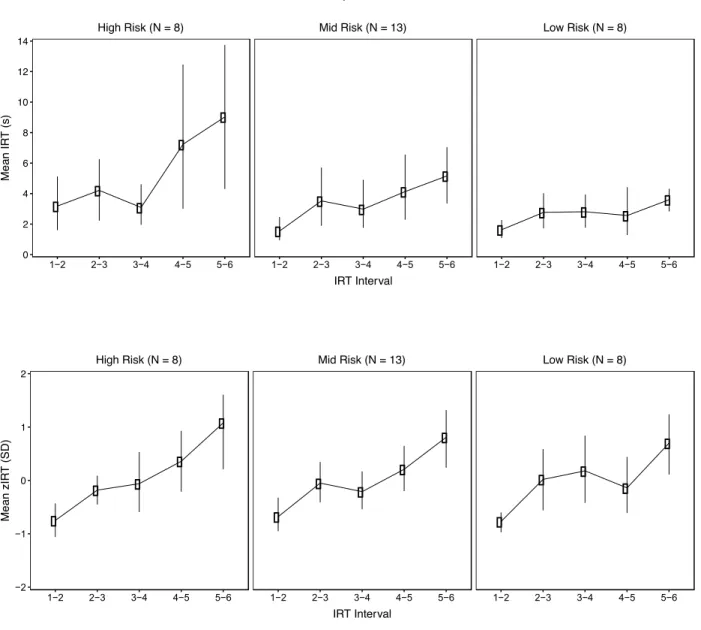
output first during the recall period conditionalized on input position from the study list. This measure provides a serial position function for the first recalled item. Lehman and Malmberg (2013) proposed that a higher first recall probability in the first serial position reflects a more effective context reinstatement. Interresponse times (IRT), or the latency between responses, were averaged for the first six output intervals across trials for each participant. Mean IRTs were then computed by averaging across subjects within each risk group. IRTs tend to slow
throughout the retrieval process as there are fewer items available to recall (Murdock & Okada, 1970). Due to the constraining effects of context reinstatement on search time, it is assumed that longer IRTs, or a slower memory search, reflect a less effective use of context to cue retrieval (Unsworth & Engle, 2007).
Results Accuracy and Errors
intrusions (EEI), prior-list intrusions (PLI), and repetitions (REP). Table 2 shows the percentages of each type of error produced in total recall for each risk group.
Serial Position Curve
The average number of correct recalls per trial across the ten input positions were
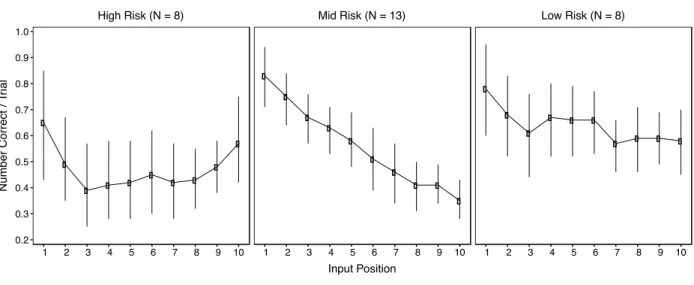
computed separately for each risk group. Figure 2 shows the serial position function of recall for each of the three groups. SPCs were smoothed to more clearly illustrate the general trends within the small sample. A 3 (Risk Group) X 10 (Input Position) ANOVA indicated a main effect of risk group, F(2, 260) = 12.25, p < .001, a main effect of input position, F(9, 260) = 5.96, p < .001, and a significant interaction, F(18, 260) = 1.67, p = .045. A Tukey’s post hoc test revealed a depressed recall performance in the high-risk group compared to the mid-risk and low-risk groups, which did not significantly differ from one another. Significance of these findings, however, was most likely enhanced by the variation in data from the small sample sizes. Specifically, group differences in SPCs do not support the non-significant group differences in overall accuracy. I therefore did not consider SPC significance to be valid. As seen in Figure 2, all groups demonstrated a primacy effect, consistent with the general patterns of a delayed free recall task. In contrast, given there was a delay between study and test phases, an unexpected recency effect was found for the high-risk group.
First Recall Probability
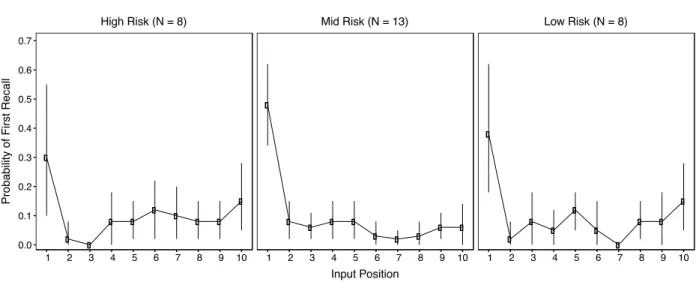
Figure 3 presents the first recall probability of each group, averaged across five lists. Initiating retrieval with an item from the first serial position indicates a primacy effect
between risk groups, F(2, 260) = .016, p = .98, and no interaction, F(18, 260) = 1.00, p = .45. All groups demonstrated a preference for initiating retrieval with the first list item.
Interresponse Times
Interresponse times were analyzed with a 3 (Risk Group) X 5 (IRT Interval) ANOVA that revealed a main effect of risk group, F(2, 124) = 5.65, p = .005, a main effect of IRT
interval, F(4, 124) = 4.75, p = .001, but no interaction, F(8, 124) = .89, p = .53. These results are an interpretation of a raw data set in which within-group IRT differences may be misleading across an unstandardized scale. Average IRTs were therefore computed as z-scores to
standardize the scale upon which IRT differences were compared within groups. Figure 4 shows raw and z-transformed IRT patterns. A 3 (Risk Group) X 5 (IRT Interval) ANOVA of
standardized IRTs revealed a main effect of IRT interval, F(4, 124) = 13.85, p < .001, but no main effect of risk group, F(2, 124) = .088, p = .92, and no interaction, F(8, 124) = .48, p = .87. All groups experienced slowing of interresponse times throughout recall period, as evidenced by increased IRT growth between later recalls.
Discussion
nonrelatives with ADHD and/or an anxiety disorder. Specifically, I analyzed serial position functions, first recall probability, and interresponse times to further understand the underlying dynamics of free recall performance among these various risk groups.Our findings showed the expected primacy effect, a preference for retrieval initiation with the first list item, and
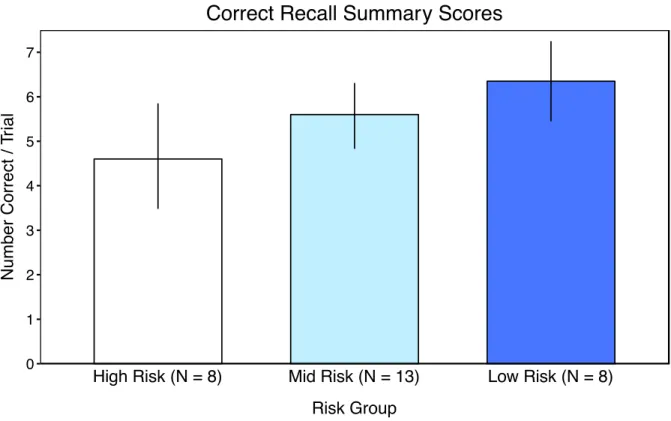
increasing IRTs throughout the recall period among groups. Although statistical differences were not observed for total recall of items per group, there was a numerical trend for the high-risk group to recall fewer items than the mid-risk group who recalled fewer items than the low-risk group. Additional testing will provide more statistical power to determine whether or not our hypotheses were supported.
should be noted, however, that the individuals in those studies were people with negative schizotypy or people with schizophrenia, respectively.
All risk groups were significantly more likely to commence retrieval with the list item from the first input position. Although there were no significant group differences in FRP, the high-risk group appeared to inititate retrieval with a list item from the middle or late serial position more often than the mid-risk and low-risk groups. The recall of items presented later in the list could, in part, account for the recency effect demonstrated by the high-risk group. Similarly, high FRPs among groups are consistent with the primacy effects illustrated by the SPCs. Context reinstatement has been strongly associated with initiating recall at the beginning of the list (Lehman & Malmberg, 2013). Similar FRPs among risk groups therefore suggest a common ability to encode and reinstate context to guide recall.
Our study’s preliminary findings provide promising evidence for episodic memory differences among risk groups. Future analyses will include more participants per risk group, which could potentially bring significance to trends suggesting recall deficits in the high-risk group. Additionally, I will examine the relationship between SOPS scores and recall measures for a more direct comparison with the results of Sahakyan and Kwapil (2018). In concurrence with their findings that negative schizotypy is related to memory-related deficits, our study found that negative schizotypy scores increased with risk for schizophrenia. Furthermore, this research could be translated for use in a clinical setting. Specifically, this study’s approach to analyzing cognitive deficits could be developed into a clinical diagnostic tool to assess risk for
schizophrenia.
Conclusion
Deficits in episodic memory, a context-related process, is a distinctive feature of schizophrenia that has been observed in a few adult populations at-risk for schizophrenia. The majority of analyses on cognitive impairment in these at-risk populations, however, have been limited to genetic relatives. Sahakan and Kwapil (2018) were the first to investigate the
Additional testing is necessary to clarify the observed trends and strengthen the power of the analyses for a more accurate interpretation of the results.
References
Achim, A. M., Maziade, M., Raymond, É., Olivier, D., Mérette, C., & Roy, M. (2011). How prevalent are anxiety disorders in schizophrenia? A meta-analysis and critical review on a significant association. Schizophrenia Bulletin, 37(4), 811-821. doi:10.1093/schbul/ sbp148
Addington, J., Addington, D., & Maticka-Tyndale, E. (1991). Cognitive functioning and positive and negative symptoms in schizophrenia. Schizophrenia Research, 5(2), 123-134.
doi:10.1016/0920-9964(91)90039-T
American Psychiatric Association. (2013). Schizophrenia Spectrum and Other Psychotic
Disorders. In Diagnostic And Statistical Manual Of Mental Disorders (5th ed.). Arlington, VA: Author. https://doi.org/10.1176/appi.books.9780890425596.dsm02
Balota, D.A., Yap, M.J., Cortese, M.J., Hutchison, K.A., Kessler, B., Loftis, B., Neely, J.H., Nelson, D.L., Simpson, G.B., & Treiman, R. (2007). The English Lexicon Project. Behavior Research Methods, 39, 445-459.
Ban, T. A. (2004). Neuropsychopharmacology and the genetics of schizophrenia: a history of the diagnosis of schizophrenia. Progress in Neuro-Psychopharmacology and Biological Psychiatry, 28(5), 753-762. doi:10.1016/j.pnpbp.2004.05.021
Barrantes-Vidal, N., Grant, P., & Kwapil, T. R. (2015). The role of schizotypy in the study of the etiology of schizophrenia spectrum disorders. Schizophrenia Bulletin, 41(suppl 2), S408- S416. doi:10.1093/schbul/sbu191
Callicott, J. H., Mattay, V. S., Verchinski, B. A., Marenco, S., Egan, M. F., & Weinberger, D. R. (2003). Complexity of prefrontal cortical dysfunction in schizophrenia: more than up or down. American Journal of Psychiatry, 160(12), 2209-2215.
Chapman, L. J., Chapman, J. P., & Raulin, M. L. (1978). Body-image aberration in Schizophrenia. Journal of Abnormal psychology, 87(4), 399-407.
Cicero, D. C., Martin, E. A., Becker, T. M., Docherty, A. R., & Kerns, J. G. (2014). Correspondence between psychometric and clinical high risk for psychosis in an undergraduate population. Psychological Assessment, 26(3), 901-915.
doi:10.1037/a0036432
Coltheart, M. (1981). The MRC psycholinguistic database. The Quarterly Journal of Experimental Psychology A: Human Experimental Psychology, 33A(4), 497-505.
Demjaha, A., Valmaggia, L., Stahl, D., Byrne, M., & McGuire, P. (2012).
Disorganization/Cognitive and negative symptom dimensions in the at-risk mental state predict subsequent transition to psychosis. Schizophrenia Bulletin, 38(2), 351-359. doi:10.1093/schbul/sbq088
Eckblad, M., & Chapman, L. J. (1983). Magical ideation as an indicator of schizotypy. Journal of Consulting and Clinical Psychology, 51(2), 215-225. doi: 10.1037/0022-
006X.51.2.215
Eckblad, M., Chapman, L. J., Chapman, J. P., & Mishlove, M. (1982). The Revised Social Anhedonia Scale. (Available from L. J. Chapman, Department of Psychology, 1202 West
Johnson Street, University of Wisconsin, Madison, WI 53706)
schizophrenia. Nature neuroscience, 1(4), 318-323. doi:10.1038/1137
International Schizophrenia Consortium. (2009). Common polygenic variation contributes to risk of schizophrenia and bipolar disorder. Nature, 460(7256), 748.
Kaczorowski, J. A., Barrantes-Vidal, N., & Kwapil, T. R. (2009). Neurological soft signs in psychometrically identified schizotypy. Schizophrenia research, 115(2-3), 293-302. doi:10.1016/j.schres.2009.06.018
Keshavan, M. S., Diwadkar, V. A., Spencer, S. M., Harenski, K. A., Luna, B., & Sweeney, J. A. (2002). A preliminary functional magnetic resonance imaging study in offspring of schizophrenic parents. Progress in Neuro-psychopharmacology and biological psychiatry, 26(6), 1143-1149. doi:10.1016/S0278-5846(02)00249-X
Keshavan, M. S., Sujata, M., Mehra, A., Montrose, D. M., & Sweeney, J. A. (2003). Psychosis
proneness and ADHD in young relatives of schizophrenia patients. Schizophrenia
research, 59(1), 85-92. doi:10.1016/S0920-9964(01)00400-5
Kučera, H., & Francis, W. N. (1967).Computational analysis of present-day American English.
Brown University Press, Providence, RI.
Kuperberg, G. R., McGuire, P. K., & David, A. S. (1998). Reduced sensitivity to linguistic context in schizophrenic thought disorder: Evidence from on-line monitoring for words in linguistically anomalous sentences. Journal of Abnormal Psychology, 107(3), 423-434. doi:10.1037/0021-843X.107.3.423
Lawrie, S. M., Whalley, H. C., Abukmeil, S. S., Kestelman, J. N., Donnelly, L., Miller, P., . . . Johnstone, E. C. (2001). Brain structure, genetic liability, and psychotic symptoms in subjects at high risk of developing schizophrenia. Biological Psychiatry, 49(10), 811-823. doi:10.1016/S0006-3223(00)01117-3
Lehman, M., & Malmberg, K. J. (2013). A buffer model of memory encoding and temporal correlations in retrieval. Psychological Review, 120(1), 155-189. doi: 10.1037/a0030851 Miller, T. J., McGlashan, T. H., Rosen, J. L., Cadenhead, K., Ventura, J., McFarlane, W.,
Perkins, D. O., Pearlson, G. D., & Woods, S. W. (2003). Prodromal assessment with the structured interview for prodromal syndromes and the scale of prodromal symptoms: predictive validity, interrater reliability, and training to reliability. Schizophrenia bulletin, 29(4), 703-715. doi: 10.1093/oxfordjournals.schbul.a007040
Minzenberg, M. J., Laird, A. R., Thelen, S., Carter, C. S., & Glahn, D. C. (2009). Meta-analysis of 41 Functional Neuroimaging Studies of Executive Function in Schizophrenia. Arch Gen Psychiatry. 2009;66(8), 811–822. doi:10.1001/archgenpsychiatry.2009.91
Murdock, B. B., & Okada, R. (1970). Interresponse times in single-trial free recall. Journal of Experimental Psychology, 86(2), 263-267. doi: 10.1037/h0029993
Phelps, E. A. (2004). Human emotion and memory: interactions of the amygdala and hippocampal complex. Current opinion in neurobiology, 14(2), 198-202. doi:10.1016/j.conb.2004.03.015
Polyn, S. M., McCluey, J. D., Morton, N. W., Woolard, A. A., Luksik, A. S., & Heckers, S. (2015). Temporal context and the organisational impairment of memory search in schizophrenia. Cognitive Neuropsychiatry, 20(4), 296-310.
Polyn, S. M., Norman, K. A., & Kahana, M. J. (2009). A context maintenance and retrieval model of organizational processes in free recall. Psychological review, 116(1), 129-156. doi:10.1037/a0014420
Racioppi, A., Sheinbaum, T., Gross, G., Ballespi, S., Kwapil, T., & Barrantes-Vidal, N. (2018). Prediction of prodromal symptoms and schizophrenia-spectrum personality disorder traits by positive and negative schizotypy: A 3-year prospective study. Plos One, 13(11).
doi:10.1371/journal.pone.0207150
Rasic, D., Hajek, T., Alda, M., & Uher, R. (2014). Risk of mental illness in offspring of parents with schizophrenia, bipolar disorder, and major depressive disorder: A meta-analysis of family high-risk studies. Schizophrenia Bulletin, 40(1), 28-38. doi:10.1093/schbul/sbt114 Ross, R. G., Heinlein, S., & Tregellas, H. (2006). High rates of comorbidity are found in
childhood-onset schizophrenia. Schizophrenia Research, 88(1), 90-95. doi:10.1016/j.schres.2006.07.006
Sahakyan, L., & Kwapil, T. R. (2016). Positive schizotypy and negative schizotypy are associated with differential patterns of episodic memory impairment. Schizophrenia Research: Cognition, 5, 35-40. doi:10.1016/j.scog.2016.07.001
Sahakyan, L., & Kwapil, T. R. (2018). Moving beyond summary scores: Decomposing free recall performance to understand episodic memory deficits in schizotypy. Journal of Experimental Psychology: General, 1-12. doi:10.1037/xge0000401
Seidman, L. J., Faraone, S. V., Goldstein, J. M., Goodman, J. M., Kremen, W. S.,
Toomey, R., ... & Tsuang, M. T. (1999). Thalamic and amygdala–hippocampal
volume reductions in first-degree relatives of patients with schizophrenia: an
doi:10.1016/S0006-3223(99)00075-X
Seidman, L. J., Faraone, S. V., Goldstein, J. M., Kremen, W. S., Horton, N. J., Makris, N., . . . Tsuang, M. T. (2002). Left hippocampal volume as a vulnerability indicator for
schizophrenia: A magnetic resonance imaging morphometric study of nonpsychotic first-degree relatives. Archives of General Psychiatry, 59(9), 839-849.
doi:10.1001/archpsyc.59.9.839
Seidman, L. J., Thermenos, H. W., Poldrack, R. A., Peace, N. K., Koch, J. K., Faraone, S. V., & Tsuang, M. T. (2006). Altered brain activation in dorsolateral prefrontal cortex in
adolescents and young adults at genetic risk for schizophrenia: An fMRI study of working memory. Schizophrenia Research, 85(1), 58-72.
doi:10.1016/j.schres.2006.03.019
Silver, H., Feldman, P., Bilker, W., & Gur, R. C. (2003). Working memory deficit as a core neuropsychological dysfunction in schizophrenia. American Journal of Psychiatry, 160(10), 1809-1816. doi:10.1176/appi.ajp.160.10.1809
Sitskoorn, M. M., Aleman, A., Ebisch, S. J., Appels, M. C., & Kahn, R. S. (2004). Cognitive deficits in relatives of patients with schizophrenia: a meta-analysis. Schizophrenia research, 71(2-3), 285-295. doi:10.1016/j.schres.2004.03.007
Tarbox, S. I., & Pogue-Geile, M. F. (2011). A multivariate perspective on schizotypy and familial association with schizophrenia: A review. Clinical Psychology Review, 31(7), 1169-1182. doi:10.1016/j.cpr.2011.07.002
World Health Organization. (2018, April 9). Schizophrenia. http://www.who.int/news-room/fact- sheets/detail/schizophrenia
Table 1. Demographic information for each of the three risk groups.
High-Risk Mid-Risk Low-Risk
Sample Size (N) 8 13 8
Number of Females 1 5 4
Mean Age (Years) 13.1 12.7 13.2
Age Standard Deviation 2.59 2.22 1.52
Mean Negative SOPS Scores 4.75 2.23 1.23
Figure 1. Proportion of total correctly recalled items per list across the three risk groups. Average correct recall per trial by group is as follows: high-risk (M = 4.6), mid-risk (M = 5.6), low-risk (M = 6.4). Error bars represent standard error of the mean.
0 1 2 3 4 5 6 7
High Risk (N = 8) Mid Risk (N = 13) Low Risk (N = 8)
Risk Group
N
u
m
b
e
r
C
o
rr
e
ct
/
T
ri
a
l
Table 2. Percentages of different types of recall errors made across the three risk groups.
Group EEI (%) PLI (%) REP (%)
High-Risk 2.61 0 2.61
Mid-Risk 4.56 1.77 1.52
Figure 2. Smoothed serial position function across the three risk groups. Error bars represent standard error of the mean.
High Risk (N = 8) Mid Risk (N = 13) Low Risk (N = 8)
1 2 3 4 5 6 7 8 9 10 1 2 3 4 5 6 7 8 9 10 1 2 3 4 5 6 7 8 9 10
0.2 0.3 0.4 0.5 0.6 0.7 0.8 0.9 1.0
Input Position
N
u
m
b
e
r
C
o
rr
e
c
t
/
Tr
ia
l
Figure 3. First recall probability across the three risk groups. Error bars represent standard error of the mean.
High Risk (N = 8) Mid Risk (N = 13) Low Risk (N = 8)
1 2 3 4 5 6 7 8 9 10 1 2 3 4 5 6 7 8 9 10 1 2 3 4 5 6 7 8 9 10
0.0 0.1 0.2 0.3 0.4 0.5 0.6 0.7
Input Position
P
ro
b
a
b
ili
ty
o
f
F
ir
s
t
R
e
c
a
ll
Figure 4. Raw (top) and z-transformed (bottom) interresponse times across output positions. Error bars represent standard error of the mean.
High Risk (N = 8) Mid Risk (N = 13) Low Risk (N = 8)
1−2 2−3 3−4 4−5 5−6 1−2 2−3 3−4 4−5 5−6 1−2 2−3 3−4 4−5 5−6
0 2 4 6 8 10 12 14 IRT Interval M e a n I R T ( s ) Interresponse Times
High Risk (N = 8) Mid Risk (N = 13) Low Risk (N = 8)