Lise
Marx
and
Lee
Steppacher
Evaluation
of
Industrial
Development
Efforts
One of the difficulties of public/private ventures is that firms and governmental
insti-tutions often look at projects from very
differ-ent perspectives. In this paper we illustrate
this problem by evaluating a proposed economic development project in North Carolina from three
different points of view: financial analyst,
economic development planner, and social
cost-benefit analyst. The objective of a financial analysis is to determine the long run profit-ability of a project. Economic development planners, on the other hand, often view the
costs of a project as the incentives used by the
government, and the output of a project as
in-creased regional income or employment. A social
cost-benefit framework provides a more compre-hensive approach for evaluating public invest-ment decisions. A social cost-benefit analysis
attempts to measure the value of all inputs and
outputs of a project according to society's wil-lingness to pay for them.
BACKGROUND
The Wanchese Seafood Industrial Park opened in late 1980 and is advertised as the first
in-dustrial park of its type on the Atlantic coast.
Located on the North Carolina coast, it provides
easy access to an extremely rich natural coastal fishery. The North Carolina Department of
Com-merce feels that this natural asset combined with the provision of seafood processing serv-ices and access to markets will attract such
processing firms to the Wanchese Park. In re-turn, the park would boost the local economy by
providing a central place for fishermen to sell their fish, and by providing a place for local
residents to work.
A large part of the local population is
de-pendent on seasonal jobs such as shrimping and tourism. The February 1982 unemployment rate was twenty-two percent; this typically high fig-ure begins to drop in April as fishing
opportun-ities increase. It reaches a low percentage during the summer months as the Outer Banks tourist industry thrives. Because the fishing season does not coincide with the tourist sea-son, it is anticipated that Wanchese Park will
generate some off-season employment
opportun-ities.
The development of Wanchese Park has been a
cooperative venture between the federal
govern-ment, the State of North Carolina, and Dare
County. In total, the public agencies involved
have invested $11.4 million in development of
the site. This money has been used to acquire
the land, design and build wastewater treatment
facilities, and provide other infrastructure
needs. The funding has come from several
sources, including the United States Economic Development Administration, the Coastal Plains Regional Commission, and the North Carolina
Gen-eral Assembly. Dare County will provide fire and police protection at no additional cost: the sheriff will simply increase his usual pa-trol to include the industrial park, and the
fire department is voluntary.
Plans for the park include four processing
plants and numerous supporting industries. The
park consists of thirty-eight acres of land
available for lease, and fifteen hundred feet of
dock area have been constructed to facilitate fishing vessel access and unloading of catch.
Roads and parking areas have been built, and a
wastewater treatment plant services the park.
By providing these services, the state hopes to
create a park in which the presence of certain
firms will attract other complementary indus-tries. Ideally, the park would be
self-contained and house all services required for fish processing firms.
Provision of these basic facilities has
been a major selling point for North Carolina's industrial recruitment program. In the Wanchese
case, emphasis has been put on foreign firms, and one potential leasee of space is the
Japanese-based surimi industry. Surimi is a
processed fish food made from underutilized fish meat, such as croaker. The end product is a
fast food style dish, often shaped to look like shrimp.
The abundance of the croaker fishery off the south Atlantic coast should be attractive to
Japanese surimi firms. Only 50,000 tons of an
estimated four million ton croaker fishery are
used by the petfood industry each year, at an
average price of ten cents per pound. A single plant producing surimi would demand 1600 tons of
croaker to produce 400 tons of surimi each year, and the surimi produced by the plant would sell at $1.75 - $2.50 per pound wholesale.
A Japanese surimi plant is currently in
operation in Alabama, where most of the fishing
is done by company boats. The Alabama plant
Lise Marx and Lee Steppacher are Masters candidates in the Department of City and Regional Planning at the University of North
buys about 400 tons of croaker a year from
in-dependent fishermen, and the remaining 1200 tons of croaker are landed by the firm's boats. Since one vessel could supply over 3000 tons of
croaker per year, the excess capacity provided
by the firm's boats enables the firm to increase production as demanded. The Alabama surimi plant hired eleven people to assist the incoming vessels in unloading, sorting and storing the catch. An additional sixteen workers were hired
to gut fish and work in the production process.
There are three management positions, one filled by a Japanese manager and two by Americans.
The end product of a North Carolina surimi production facility would probably be exported back to Japan, because Japan is a known market.
Although the U.S. market for surimi may increase
in the future, at present its viability is un-certain.
rented from the state. The total amount of land
needed by the firm is assumed to be two acres,
which will be leased at twenty-five cents per
square foot annually. The analysis assumes that the time period for which this and other
analy-ses are done will be a twenty year time period, and that the rent in real terms will remain con-stant over this time period. Rent is the only
yearly charge for facilities because all
addi-tional support facilities are supplied by the state.
Other capital costs for the firm include
the plant facility, specialized equipment
im-ported from Japan, and a boat for catching
croaker. The total initial investment for the
firm is approximately $1,690,000. These prices
were calculated using information from the Ala-bama plant and the National Oceanic and Atmos-pheric Association.
One possible consequence of locating a
surimi plant on the North Carolina coast
in-volves the shrimping industry, which is
impor-tant for the local coastal economy. Because fishing for croaker utilizes traulers, shrimp
may be disturbed by croaker fishing. These
dis-turbances may affect the future shrimp
popula-tion, although such an effect can only be hypo-thesized since croaker fishing is not a wide-spread activity at this time.
A final complication associated with the
Wanchese Seafood Industrial Park concerns the
navigability of Oregon Inlet. The park is
situ-ated on the coast, but protected from the open
ocean by the Outer Banks, a series of barrier
islands. To reach the park vessels must travel
through Oregon Inlet, but in its present state this inlet presents a hazard to boats because of
quickly shifting shoals and high probabilities
of grounding. To solve this problem the inlet
would need to be dredged periodically, a contro-versial solution partly because the Outer Banks are a protected National Seashore. The analysis presented in this article assumes that boats
have no difficulties in entering or exiting the inlet. The Oregon Inlet Project is assumed to
be completed by the time the surimi plant locat-ed at Wanchese Park. If the project was not
completed, boats would probably not risk coming into the Park and potential tenants for the
in-dustrial park might decide against locating
there.
In the next three sections of the paper, we
examine the pros and cons of a surimi plant
lo-cating in Wanchese Seafood Industrial Park.
Three perspectives are used: financial, econo-mic development, and social cost-benefit.
FINANCIAL ANALYSIS
Typically, a major component of the capital investment for a firm is the land on which the
company is located. In this case, the land is
Labor costs to the firm were calculated as
follows: for the twenty-seven dock and produc-tion workers it was estimated that they would work a total of thirty-one weeks, since the
typ-ical croaker season is 210 days long. We
as-sumed their annual wage would be $17,000 or
$10,000 for the thirty-one weeks actually
work-ed. The management staff of three was assumed
to work the entire year at an average salary of
$40,000.
Another portion of the labor cost is the
crew of the company-owned boat, all of whom are
assumed to be Japanese. At $20,000 a year, the
captain's wage for the season would be about $11,500. The two crew members are assumed to be
paid at an annual rate of $17,000 per year or
$10,000 a season, bringing the total labor cost for the firm to approximately $425,000 a year.
Another cost to the firm is payment of both state and federal taxes. About $60,000 in fran-chise and corporate income taxes would be paid to the state each year. Adding federal
corpor-ate income taxes increases this payment
substan-tially. This analysis is done both with no fed-eral tax calculated and with a maximum tax
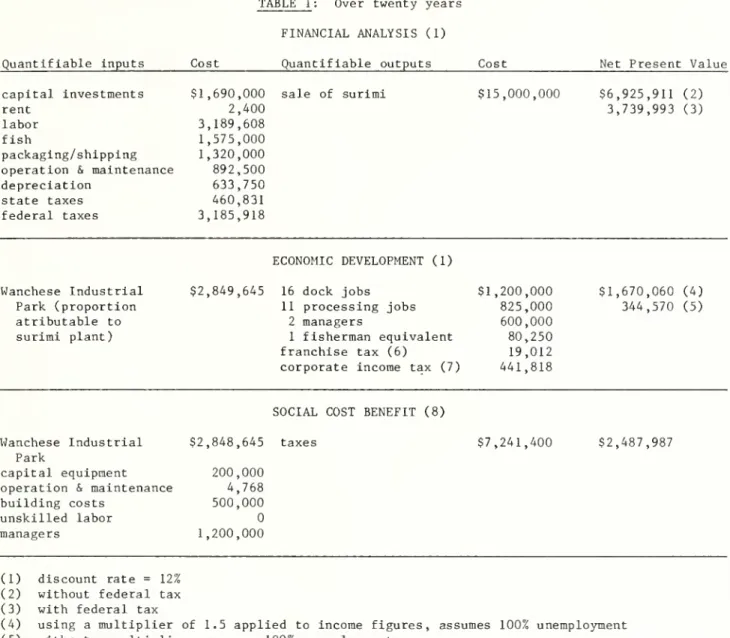
cal-culated (see table 1). The amount actually paid
would probably fall in the middle of these val-ues. Other expenses not associated with
produc-tion levels are operation and maintenance costs,
which were calculated as ten percent of the ini-tial investment in the boat and equipment or
$119,000 per year.
Other costs are more directly dependent on
production levels. At our assumed production
level of 400 tons of surimi a year, packing ma-terial and shipping will cost $176,000.
The final input to this project is the
croaker used as raw material for the production
process. Currently croaker is not only readily available but also underutilized, so there are no supply constraints to the firm. The majority
of the fish used would be furnished by the
com-pany's own boat, and it is assumed that about 400 tons of croaker would collected by
indepen-dent fishermen. At a price per pound of twenty-five cents, yearly payment to these fishermen would be $210,000.
Balancing all of these costs to the firm is
the money received from the sale of the surimi.
We assume a value in U.S. prices of $2.50 per
pound in 1982 dollars, based on prices published
by the National Oceanic and Atmospheric
Adminis-tration. For this plant, the yearly revenue from sales of surimi would be two million dol-lars. Using a twelve percent discount rate, the net present value of this project was calculated over a twenty year period. When no federal taxes were included, the net present value of
the project was approximately $6.9 million.
This dropped to about $3.7 million when maximum
taxes were calculated and included. The real
value would depend on actual federal tax levels. This is an annual level ranging from $498,666 to $923,455. Given the assumptions presented in this scenario, a private firm would probably
un-dertake such an investment.
ECONOMIC DEVELOPMENT PERSPECTIVE
State economic development planners eval-uate projects primarily on the basis of their impact on regional development as shown through increases in income. When recruiting an
indus-try, the economic developer frequently appears to calculate the cost to the government of the inputs used to attract the industry to a
parti-cular location, and compares this to the income
generated by the project. To be successful in
attracting an industry, the economic developer must compete with other areas by offering more
incentives. In the case of the Wanchese Seafood
Industrial Park, the facilities of the park are the incentives.
Plans for the park indicate that four
pro-cessing firms can be accomodated in addition to
some support industries. Because the vast
ma-jority of the facilities were built for and will be used solely by the processing firms, input costs are divided among these four firms. It is
assumed that all firms will use the facilities
equally, although in fact this may not be case. In this scenario, one-quarter of the state's
in-vestment, or $2.8 million, is assumed to be
at-tributable to the surimi processing plant.
Twenty-seven jobs for unskilled labor would
be created by the incoming surimi plant. Sal-aries for these workers hired for thirty-one weeks of the year are assumed to be $10,000.
Additional income is also generated by purchases
of 420 tons of fish from the four independent fishing crews. When evaluated relative to labor costs of the company vessel and associated tons caught, this amounts to the equivalent of one
new job, or $10,700. In addition, two of the
management positions are to be filled by
Ameri-cans, and these managers are assumed to earn
$40,000 per year. The Japanese manager is not
considered in this analysis, because from a
do-mestic economic development view the creation of these jobs is unimportant. The equivalent of
thirty American held jobs will be created, with total yearly salaries of $360,700.
In this context, the project can be
eval-uated using an economic development perspective. Although only a crude indicator, it is possible
to estimate the amount of money the state has
invested per job created. The cost of the park
which is attributable to the surimi plant, $2.8
million, is divided by thirty, the number of
American-held jobs (including the one job equi-valent) created by the plant. The result shows that $93,000 dollars has been invested by the
state for each job created by the firm. This is
assuming that all laborers were previously unem-ployed and two managers relocated to Dare
Coun-ty, so that in essence thirty new jobs were
created by the plant. If, in fact, only 50% of the workers were previously unemployed, the
state would be investing approximately $187,000
per job created.
To more accurately assess the impact of the
surimi plant, two additional factors must be
considered: tax revenues generated from the
project and the regional multiplier effect of
the income earned. Since the state owns the land on which the park is located, the firm is
exempt from paying Dare County real estate
taxes. Both a franchise tax and corporate in-come tax are paid to the state. No state sales tax is collected since the surimi are to be sold in Japan. Federal income taxes are not
through revenue sharing mechanisms. Based on these assumptions, the total amount of taxes
paid to the state by the surimi firm would be
about $75,000 per year (see Table 1. page 41).
Much of the income earned by the firm's
workers is re-spent within the region and has a
net effect on the economy which is greater than the original sum. This concept is captured in the use of regional multiplier. Economic devel-opment planners commonly utilize income multi-pliers and so we have followed their practice in this situation. A multiplier of 1.5 has been
used, meaning that the $564,000 earned in income
the first year of operation is equivalent to
$845,000 when re-spent in the economy.
A final analysis of this project from an
economic development perspective is obtained when both income and tax revenues to the state are included. When combined, franchise and
cor-porate income taxes total approximately $61,000 per year. When all inputs and outputs are
val-ued over the twenty-year life of the project, the result is a net present value of $1.6 mil-lion (see Table 1).
In other words, for every dollar spent by the state, 1.6 dollars in regional income and tax
revenue are generated over twenty years. If no
regional multiplier is used this figure
de-creases to 1.7 dollars generated for every dol-lar spent by the state. Again, if only 50% of the laborers were unemployed, for every state
dollar spent, $.88 in regional income would be
generated over twenty years. Disregarding a
multiplier effect, this figure decreases to
$.63. The obvious conclusion is that the
via-bility of this project from an economic
develop-ment viewpoint is dependent on the extent to
which unemployed people are put to work. It is for the decisionmaker to decide whether a surimi plant which generates between
1.1 and 1.6 dollars for each state dollar repre-sents the best return on investment when
compar-ed to other seafood processing companies and
other investment opportunies. It is also for
them to decide whether the economic development justification for the project should be based on the number of jobs created, without regard for the quality of the work.
SOCIAL COST-BENEFIT ANALYSIS
A social cost-benefit analysis attempts to
quantify all the positive and negative conse-quences of a project, usually from the
perspec-tives of a national government. Its application
to the construction of a surimi plant presents an interesting illustration because the private investment is Japanese and the major output of
the plant is sold in Japan.
The major public input to this project is
the investment in infrastructure for the Wan-chese Seafood Industrial Park. The market value
of the investment attributable to the surimi
plant is $2.8 million. The next step is to
de-termine how society values this investment; that
is, the social opportunity cost must be
calcu-lated. This involves estimating the value of
the investment in its next best use, which in this case would be an alternative investment
op-portunity for the state. Because this is
impos-sible to accurately predict, for this analysis
the market price is assumed to reflect the so-cial value of this investment. Operation and
maintenance of the park facilties are included
in the rent charged to the firm. Therefore,
this amount is charged to the project as a cost
because it precludes alternative uses of this
money.
Based on the experience of the Alabama
plant, the investment the firm makes in American equipment is $200,000. Again, the alternative next best use is difficult to assess, especially because it is so specialized. Consequently, the
project will be charged the market value for
these inputs. Building costs will also be
as-sessed at market value. The remaining invest-ment for equipment is in Japanese goods and
therefore have no social opportunity cost from a
U.S. perspective.
The next input to be valued is the croaker
to be used in the production process. The only
alternative use for this fish is as an input for the petfood industry. Only croaker coinciden-tally caught in the process of shrimping is
use-ful for this purpose. This implies that the
so-cial value of the croaker is less than the
pet-Continued on page 40
Continued from page 10
food price of ten cents per pound and may be
quite close to zero. For this analysis, the
fish will be valued at a social opportunity cost of zero. This is due to the underutilization of
the fishery. It should be understood that a
higher social value may be placed on croaker if
the surimi plant continues to be successful. The final input to this project is labor.
Twenty-seven of the jobs created by the project
are assumed to employ formerly unemployed resi-dents. Society loses nothing by putting them to
work, therefore these jobs are valued at zero.
The benefit derived from the creation of these jobs is the value associated with the work over and above the wage paid. This is the difference
THE MOST DIFFICULT TYPE OF PROJECT OUTPUTS TO
EVALUATE ARE OFTEN ENVIRONMENTAL EFFECTS
between the wage they are willing to work for and the amount they are actually paid. What is
the value of a job processing fish or unloading boats, over and above the wage paid? This is
difficult to assess.
The two American-held managerial positions created by the plant do have a social opportu-nity cost, since it is assumed that these
mana-gers will already be employed. The cost to
so-ciety of the jobs vacated will be valued at the
corresponding salaries. The project will be
charged $40,000 per manager.
The major output of any production process,
whether it be publicly or privately financed, is
the final commodity. In this case, the end
pro-duct is 400 tons of surimi, all of which is
as-sumed to be shipped to Japan for sale. From the
viewpoint of the U.S., this output does not
in-crease aggregate domestic consumption; in other
words, it does not increase national income. As
a result, the value of this output in a social cost-benefit analysis is zero.
Taxes derived from this project are handled differently than they would be if the firm was
American-owned. In this case, taxes are a di-rect benefit to American society, since the
American government is receiving a new source of revenue. The annual benefit from taxes is
$486,000. If this firm was American-owned, these taxes would be no more than transfer
pay-ments. They would not appear at all in the
ac-counting of the costs and benefits of the pro-ject.
The most difficult type of project outputs to evaluate are often environmental effects. In this example, several potential environmental
costs have been indentified. The first of these
involves the treatment of wastes from the
pro-cessing plant. As a result of this waste
treat-ment process, there could be negative effects on
the nursery grounds of fish species in the area.
Future production may be reduced by this
pollu-tion; however, the amount and value of this lost
production is unknown at this time. Another possible negative environmental effect of this
project is that the fishing technology used in
catching croaker could damage the shrimp nursery
area. This could hurt the fishermen, who would receive a lower price for damaged shrimp, or it
could hurt the consumer who may have to pay a
higher price if there is a smaller supply. A final major environmental issue concerns Oregon Inlet and the need for frequent dredging.
From a social cost-benefit analysis perspective,
the value of preserving the natural integrity of
the Inlet could be measured by how much indivi-duals would be willing to pay to prevent
dredg-ing. As with other environmental issues, this
amount would be difficult to quantify.
Many of the environmental issues and other
outputs present problems in terms of
quantification. In this social cost-benefit analysis, the cost of the inputs to this project
are less than the benefits received. This is
primarily due to the unique way in which taxes
were accounted. Note that this would not be the case if the firm was American-owned. Also, these benefits assumed no type of tax break and as a result may be unrealistically high.
For this project, the only benefit that was not
quantified was the value of using unemployed la-bor; however, many of the outputs that could not be quantified were at the same time costs of the
project. It seems that if values could be
as-signed to these unquantified benefits and costs, the total costs could outweigh the total
bene-fits. From a social cost-benefit point of view, this project should be closely scrutinized be-fore being undertaken.
IMPLICATIONS FOR PLANNERS
Three perspectives have been used to eval-uate the case of a surimi plant locating in the
Wanchese Seafood Industrial Park. These
per-spectives show that analysts can take the same
project and depending on their own perspective, arrive at different answers about the value of a
project. The question becomes: What is the
ap-propriate framework to use when evaluating
pro-jects that require public investment?
Certain-ly, the value of jobs to a region cannot be dis-puted. However, does a perspective centered on that objective really encompass the costs and
benefits of a project from society's point of
view? Economic development planners do not
al-ways include considerations such as job quality,
environmental effects, or costs of providing
other services. Often a more thorough examina-tion of a project's impacts with a wider point of view would more accurately represent the val-ue of that project in relation to the money being spent by the government agencies
Quantifiable Inputs Cost
TABLE 1 ; Over twenty years
FINANCIAL ANALYSIS (1)
Quantifiable outputs Cost Net Present Value capital investments $1,690,000
rent 2,400
labor 3,189,608
fish 1,575,000
packaging/shipping 1,320,000 operation & maintenance 892,500
depreciation 633,750
state taxes 460,831
federal taxes 3,185,918
sale of surimi $15,000,000 $6,925,911 (2)
3,739,993 (3)
Wanchese Industrial
Park (proportion atributable to
surimi plant)
ECONOMIC DEVELOPMENT (1)
$2,849,645 16 dock jobs $1,200,000
11 processing jobs 825,000
2 managers 600,000
1 fisherman equivalent 80,250
franchise tax (6) 19,012
corporate income tax (7) 441,818
$1,670,060 (4)
344,570 (5)
Wanchese Industrial Park
capital equipment operation & maintenance building costs
unskilled labor
managers
SOCIAL COST BENEFIT (8)
$2,848,645 taxes 200,000
4,768
500,000 1,200,000
$7,241,400 $2,487,987
(1) discount rate = 12% (2) without federal tax
(3) with federal tax
(4) using a multiplier of 1.5 applied to income figures, assumes 100% unemployment
(5) without a multiplier, assumes 100% unemployment
(6) franchise tax $1.50/$1,000 value of assests; assests = $1,690,000 (7) corporate income tax, 6% of net income; net income/year = $981,818 (8) social rate of discount = 3%
REFERENCES
Information on state tax rates and the operation
of Wanchese Seafood Industrial Park
pro-vided by the North Carolina Department of
Commerce.
U.S. Department of Commerce, National Oceanic
and Atmospheric Administration. Prospectus
for Development of the United States
Fisheries. 1979.
CONSULTING SERVICES
Advertise your firn via your consultant
card to over 800 city, county, state, and
re-gional officials in the Southeast. $40 00 for two issues $25 00 for one issue