Occupational
health
and safety management
systems -
Guidelines for
the implementation of
OHSAS 18001 :2007
NO COPYING WITHOUT BSI PERfv1ISSION EXCEPT AS PERMITIED BY COPYRIGHT LAW
raising standards
worldwide'
..
=t""J:~~
~.
National foreword
Publishing information
This British Standard was published by BSI and comes into effect on DATE. It is the official UK implementation of OHSAS 18002:2008, which supersedes OHSAS 18002:2000.
BS OHSAS 18002 will be maintained in line with any changes to
OHSAS 18002, subject to the approval of BSI Technical Committee HS/1, Occupational health and safety management, which collated the UK comments on the second Working Draft of OHSAS 18002 and put forward its preferred position.
A list of organizations represented on this committee can be obtained on req uest to its secreta ry.
Relationship with other documents
BS OHSAS 18002 is one of three related documents on occupational health and safety management systems published by the BSI since June 2007. The first was BS OHSAS 18001:2007, which specifies what an organization needs to have in place to meet the criteria for occupational health and safety management.
BS OHSAS 18002:2008 is a guidance standard that identifies what an organization should consider when implementing and operating a system that meets the requirements of BS OHSAS 18001. It is a supportive guidance document to BS OHSAS 18001 :2007 and does not impose any additional requirements.
BS 18004:2008, Guide to achieving effective occupational health and
safety performance, gives good practice guidance on successful health
and safety management and builds on the guidance given in HSG65').
Structured around the OHSAS 18001 framework, it provides guidance in line with developments in OHS management within the UK and provides extensive annexes intended to support those organizations that wish to deliver good health and safety performance.
"'
Contractual and legal considerations
In the UK, and Europe generally, there are various legal requirements for occupational health and safety that apply to the potentially harmful effects of work activities and which extend beyond the workplace to those who might be affected by workplace activities (see Note to3.12 on the definition of occupational health and safety). It is essential for the organization to take the matters addressed by these legal requirements into account in establishing, implementing and maintaining its OH&S management system - and in particular when identifying hazards, assessing risks and determining controls (see4.3.1 and4.3.2). This standard ought therefore to be read in conjunction with BS 18004 and HSG65,which give good practice guidance on complying with such legal requirements in the UK. This publication does not purport to include all the necessary
provisions of a contract. User are responsible for its correct application. Compliance with a British Standard cannot confer immunity from legal obligation.
Publishing and copyright information
The BSI copyright notice displayed in this document indicates when the document was last issued.
©BSI2008
ISBN 978 0 580 62686 9 ICS 13.100
Publication history
First published November 2008
Amendments issued since publication
Contents
Acknowledgement iiForeword
iv
Introduction 11 Scope 4
2 Reference publications 5 3 Terms and definitions 5
4 OH&S management system requirements 9 Annexes
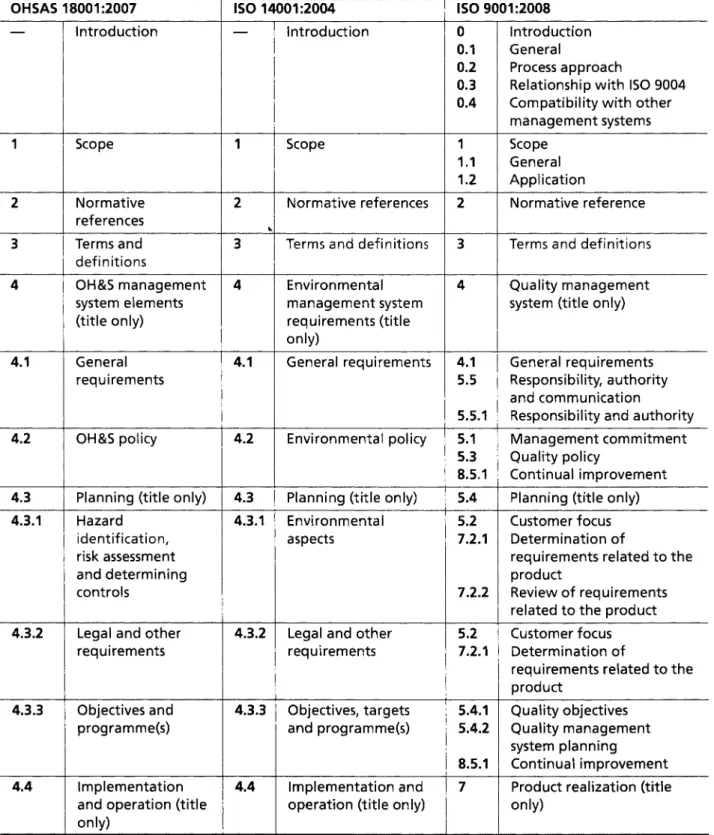
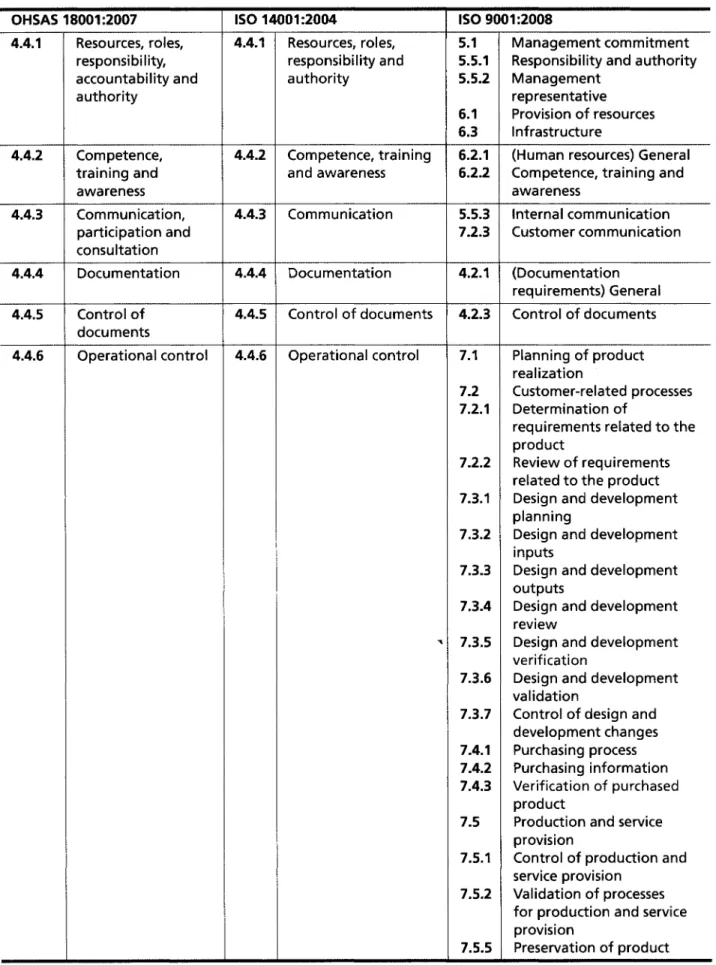
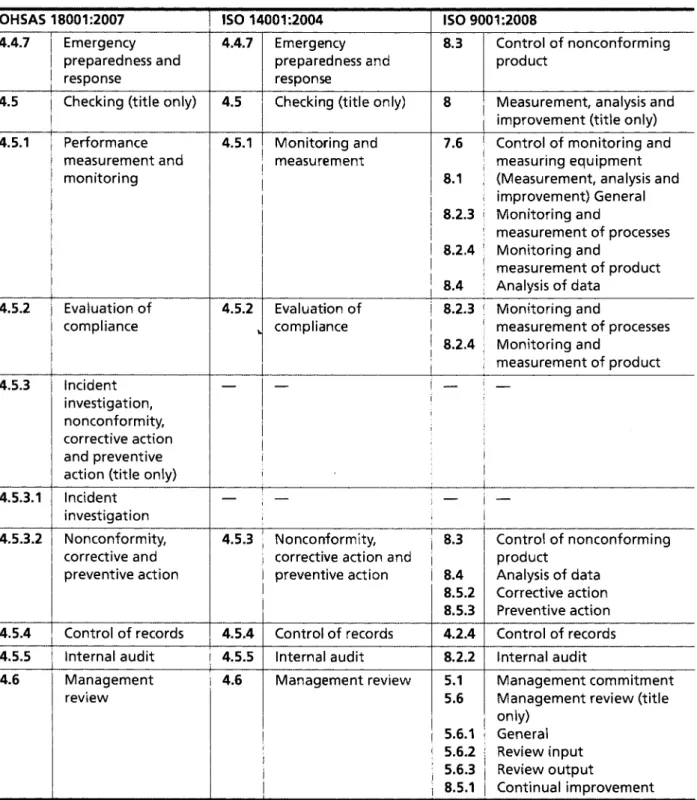
Annex A (informative) Correspondence between OHSAS 18001:2007, ISO 14001:2004 and ISO 9001:2008 68
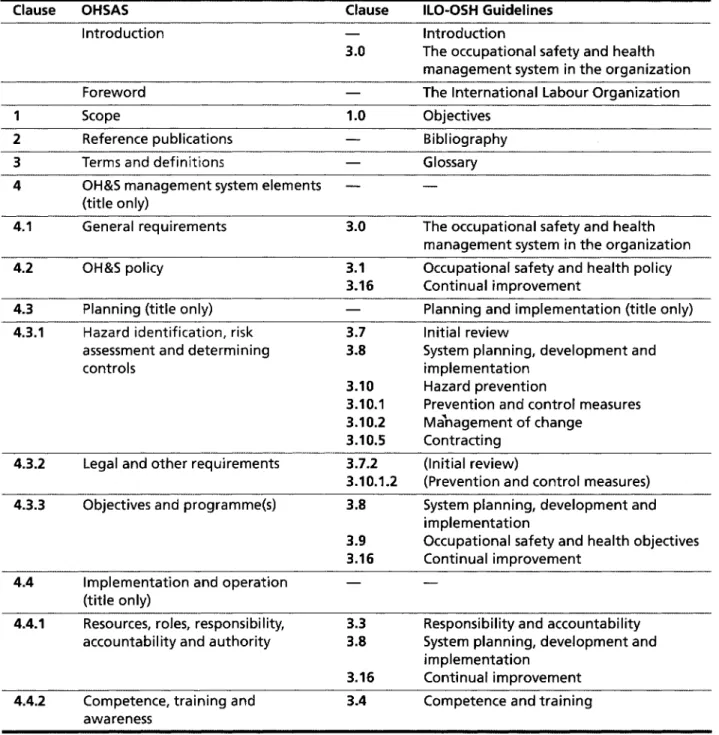
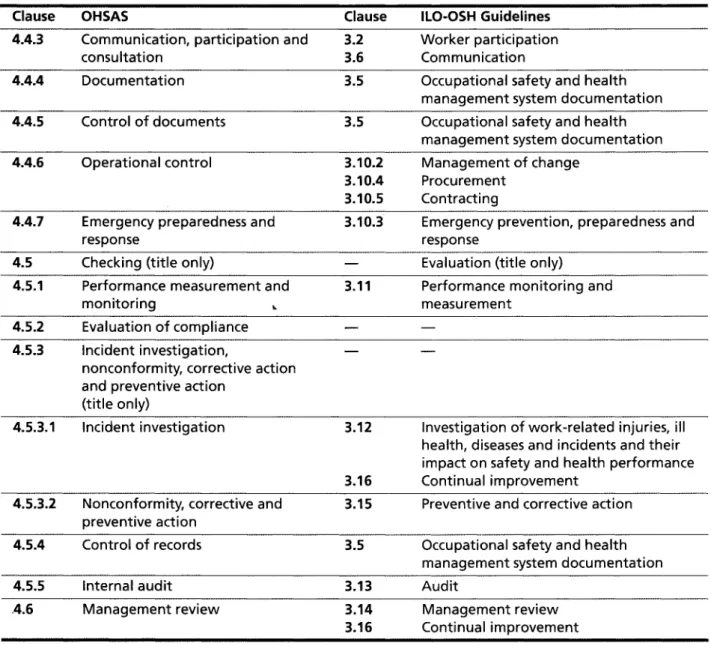
Annex B (informative) Correspondence between OHSAS 18001, OHSAS 18002 and the ILO-OSH:2001 Guidelines on occupational safety and health management systems 71
Annex C (informative) Examples of items for inclusion in a hazard identification checklist 75
Annex D (informative) Comparisons of some examples of risk assessment tools and methodologies 77
Brbliography 78 List of figures
Figure 1 - OH&S management system model for this OHSAS Standard 2
Figure 2 - Overview of the hazard identification and risk assessment process 15
List of tables
Table A.1 - Correspondence between OHSAS 18001:2007, ISO 14001:2004 and ISO 9001:2008 68
Table B.1 - Correspondence between the clauses of the OHSAS documents and the clauses of the ILO-OSH Guidelines 73
Summary
ofpages
This document comprises a front cover, an inside front cover, pages i to vi, pages 1 to 78, an inside back cover and a back cover. The copyright notice displayed in this document indicates when the document was last issued.
ii
•
©BSI 2008Acknowledgement
The following organizations are included in this listing either to recognize their assistance in the development of this edition of OHSAS 18002, or to recognize their general support of the OHSAS standards.
AFAQ EAQA
American Industrial Hygiene Association (AIHA) American Society of Safety Engineers (ASSE)
Asociaci6n Espanola de Normalizaci6n y Certificaci6n (AENOR) Association of British Certification Bodies (ABCB)
British Standards Institution (BSI) Bureau Veritas Certification Cesky normalizacni institute (CNI)
Comisi6n Federal de Electricidad (CFE), (Gerencia de la seguridad industrial)
Czech Accreditation Institute (CAl) Det Norske Veritas (DNV)
DS Certification A/S
EEF the manufacturers' organisation ENLAR Compliance Services, Inc.
Estonian Centre for Standardisation (EVS) Health and Safety Executive')
Hong Kong Quality Assurance Agency (HKQAA) iMS Risk Solutions
Institute for Standardization of Serbia (ISS)
Institution of Occupational Safety and Health (lOSH) Instituto Argentino de Normalizaci6nyCertificaci6n (lRAM) Instituto Colombiano de Normas 'recnicas y Certificaci6n (lCONTEC) Instituto de Normas Tecnicas de Costa Rica (lNTECO)
Instituto Mexicano de Normalizaci6n y Certificaci6n, A.C. (lMNC, A.C.) Instituto Uruguayo de Normas Tecnicas (UNIT)
ITS Consultants
Japan Industrial Safety and Health Association (JISHA) Japanese Standards Association (JSA)
Korea Gas Safety Corporation (ISO Certificate Division) Lloyds Register Quality Assurance (LRQA)
Management Systems Certification Limited
1) As the regulatory authority responsible for health and safety in Great
Britain, the Health and Safety Executive would wish to make it clear that reliance on the OHSAS Standard by organizations will not absolve them from compliance with any of their legal health and safety obligations under the laws of England and Wales, and Scotland.
National Standards Authority of Ireland (NSAI) National University of Singapore (NUS)
Nederlands Normalisatie-instituut (NEN) NPKF ELECTON
NQA
QMI-SAI Global
SABS Commercial (Pty) Ltd.
Service de Normalisation Industrielle Marocaine (SNIMA) SGS United Kingdom Ltd
SIRIM QAS International
Slovensky ustav technickej norrnalizacie(SUTN) SPRING Singapore
Standards Institution of Israel (511)
Sucofindo International Certification Services (SICS)
"-Swedish Industry Association (Sinf) Swedish Standards Institute (SIS) Technofer Ltd.
TOV Rheinland Cert GmbH - TOV Rheinland Group Standards Association of Zimbabwe (SAZ)
We would also like to recognize the invaluable contribution made by those many organizations who took the time to review the working drafts of OHSAS18002, and who submitted comments for consideration. This helped us greatly in improving the standard, and is much appreciated.
iv •
© SSI 2008Foreword
This Occupational Health and Safety Assessment Series (OHSAS) guideline, and OHSAS 18001:2007,Occupational health and safety management systems - Requirements,have been developed in response to customer demand for a recognizable occupational health and safety management system standard against which their management systems can be assessed and certified, and for guidance on the implementation of such a standard.
OHSAS 18001 is compatible with the ISO 9001 :2008 (Quality) and ISO 14001:2004 (Environmental) management systems standards, in order to facilitate the integration of quality, environmental and occupational health and safety management systems by organizations, should they wish to do so.
OHSAS 18002 quotes the specific requirements from OHSAS 18001 and follows with relevant guidance. The clause numbering of OHSAS 18002 is aligned with that of OHSAS 18001. Text given with an outlined box is an exact duplication of text from OHSAS 18001. OHSAS 18002 will be reviewed and amended or revised when
considered appropriate. Reviews will be conducted when new editions of OHSAS 18001 are published (expected when revised editions of either ISO 9001 or ISO 14001 are published).
This OHSAS Standard will be withdrawn on publication of its contents in, or as, an International Standard.
This OHSAS Standard has been drafted in accordance with the rules given in the ISO/IEC Directives, Part 2.
This second edition cancels and replaces the first edition (OHSAS 18002:2000), which has been technically revised.
The principal changes with respect to the previous edition are as follows:
1) in relation to the revised text of OHSAS 18001:
The importance of "health" has now been given greater emphasis.
OHSAS 18001 now refe?s to itself as a standard, not a specification, or document, as in the earlier edition. This reflects the increasing adoption of OHSAS 18001 as the basis for national standards on occupational health and safety management systems.
The "Plan-Do-Check-Act" model diagram is only given in the Introduction, in its entirety, and not also as sectional diagrams at the start of each major clause.
Reference publications in Clause 2 have been limited to purely international documents.
New definitions have been added, and existing definitions revised.
Significant improvement in alignment with ISO 14001:2004 throughout the standard, and improved compatibility with ISO 9001:2008.
The term "tolerable risk" has been replaced by the term "acceptable risk" (see3.1).
The term "accident" is now included in the term "incident" (see 3.9).
The definition of the term "hazard" no longer refers to "damage to property or damage to the workplace environment" (see3.6).
It is now considered that such "damage" is not directly related to occupational health and safety management, which is the purpose of this OHSAS Standard, and that it is included in the field of asset management. Instead, the risk of such "damage" having an effect on occupational health and safety should be identified through the organization's risk assessment process, and be controlled through the application of appropriate risk controls.
Sub-clauses4.3.3 and 4.3.4have been merged, in line with ISO14001 :2004.
A new requirement has been introduced for the
consideration of the hierarchy of controls as part of OH&S planning (see4.3.1).
Management of change is now more explicitly addressed (see4.3.1 and 4.4.6).
A new clause on the "Evaluation of compliance" (see4.5.2)
has been introduced.
New requirements have been introduced for participation and consultation (see4.4.3.2).
New requirements have been introduced for the investigation of incidents (see4.5.3.1).
2) in relation to changes that are specific toOHSAS 18002:
OHSAS18002:2000included a presentation format where firstly the relevantOHSAS 18001 clause was given followed by: a) a description of the intent of the clause;
b) typical inputs needed for meeting the requirements of the clause;
c) a description of processesthat an organization could use to meet the requirements;
d) typical outputs expected from meeting the requirements. This format was found to be difficult to apply, so has not been followed in this edition (in fact, the format had not been applied consistently in the 2000edition). Instead, this edition of OHSAS 18002is now presented in a more logical format, in which items in a) to d) have been followed during the drafting of the guidance, but have not been given overtly, as previously.
New sub-clauses, as per OHSAS18001 (and from ISO14001),
e.g.:
• for OHSAS18001 :2007,4.4.3Communication,
participation and consultation (including new sub-clauses on participation/consultation), and 4.5.3.1 Incident investigation.
• from ISO 14001 :2004, 4.3.3Objectives and programme(s) (through the merging of the former sub-clauses4.3.3 and
4.3.4), and 4.5.2Evaluation of compliance.
vi •
© BSI 2008New sub-clauses in alignment with the ILO-OSH:2001
Guidelines, e.g.4.1.2 Initial review, and4.3.1.5Management of change
Additional new sub-clauses and annexes, e.g.4.4.2.4
Awareness, Annex C - Examples of items for inclusion in a hazard identification checklist and Annex D - Comparisons of some examples of risk assessment tools and methodologies Expanded guidance given in many sub-clauses, e.g. for4.3.1
Hazard identification, risk assessment and determination of controls,4.3.2Legal and other requirements,4.3.3
Objectives and programme(s),4.4.6Operational control,4.4.7
Emergency preparedness and response,4.5.5Internal audit This publication does not purport to include all the necessary provisions of a contract. Usersare responsible for its correct application.
Compliance with this Occupational Health and Safety Assessment Series (OHSAS) Standard cannot confer immunity from legal obligations.
Introduction
Organizations of all kinds are increasingly concerned with achieving and demonstrating sound occupational health and safety (OH&S) performance by controlling their OH&S risks, consistent with their OH&S policy and objectives. They do so in the context of increasingly stringent legislation, the development of economic policies and other measures that foster good OH&S practices, and of increased concern expressed by interested parties about OH&S issues.
Many organizations have undertaken OH&S "reviews" or "audits" to assess their OH&S performance. On their own, however, these "reviews" and "audits" may not be sufficient to provide an organization with the assurance that its performance not only meets, but will continue to meet, its legal and policy requirements. To be effective, they need to be conducted within a structured management system that is integrated within the organization.
The OHSAS Standards covering OH&S management are intended to provide organizations with the elements of an effective OH&S management system that can be integrated with other management requirements and help organizations achieve OH&S and economic objectives. These standards, like other International Standards, are not intended to be used to create non-tariff trade barriers or to increase or change an organization's legal obligations.
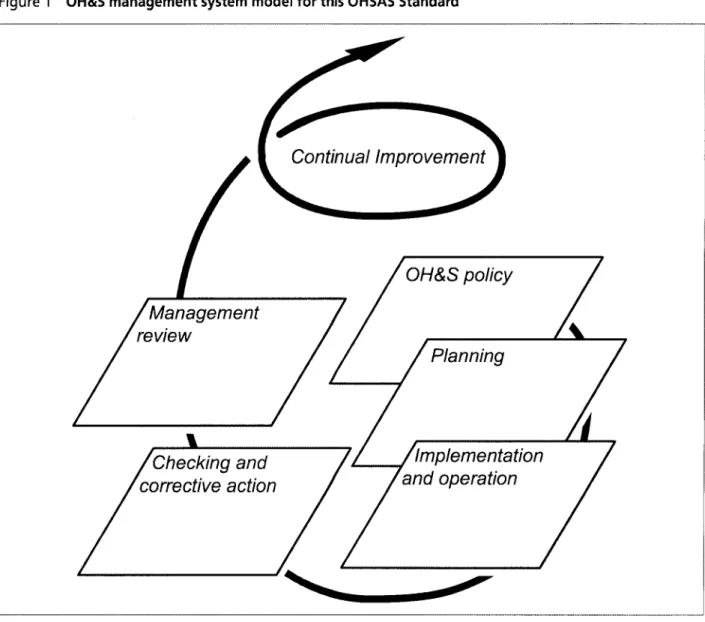
OHSAS 18001 specifies requirements for an OH&S management system to enable an organization to develop and implement a policy and objectives which take into account legal requirements and information about OH&S risks. It is intended to apply to all types and sizes of organizations and to accommodate diverse geographical, cultural and social conditions. The basis of the approach is shown in Figure 1. The success of the system depends on commitment from all levels and functions of the organization, and especially from top management. A system of this kind enables an organization to develop an OH&S policy, establish objectives and processes to achieve the policy commitments, take action as needed to improve its performance, and demonstrate the conformity of the system to the requirements of OHSAS 18001. The overall aim of OHSAS 18001 is to support and promote good OH&S practices, including self regulation, in balance with socio-economic needs. It should be noted that many of the requirements can be addressed concurrently or revisited at any time.
The development of OHSAS 18001:2007 focused on improving the standard by:
improving alignment with ISO 14001 and ISO 9001;
seeking opportunities for alignment with other OH&S management system standards, e.g. the ILO-OSH:2001 Guidelines;
reflecting developments in OH&S practices;
clarifying the original text from the OHSAS 18001:1999 requirements based on experience of its use.
There is an important distinction between OHSAS 18001, which describes the requirements for an organization's OH&S management system and can be used for certification/registration and/or
self-declaration of an organization's OH&S management system, and
a non-certifiable guideline, such as OHSAS 18002, intended to provide generic assistance to an organization for establishing, implementing or improving an OH&S management system. OH&S management encompasses a full range of issues, including those with strategic and competitive implications. Demonstration of successful implementation of OHSAS 18001 can be used by an organization to assure interested parties that an appropriate OH&S management system is in place. Any reference to other International Standards is for information only.
Figure 1 OH&S management system model for this OHSAS Standard
Planning
Implementation
and operation
Checking and
corrective action
Management
review
NOTE This OHSAS Standard is based on the methodology known as Plan-Do-Check-Act (PDCA). PDCA can be briefly describedasfollows.
Plan: establish the objectives and processes necessarytodeliver results in accordance with the organization's OH&S policy. Do: implement the processes.
Check: monitor and measure processes against OH&S policy, objectives, legal and other requirements, and report the results. Act: take actionstocontinually improve OH&S performance.
Many organizations manage their operations via the application
of a
system
of
processes and their interactions, which can be referredto
as the "process approach". ISO 9001 promotes the useof
the process approach. Since PDCA can be appliedto
all processes, the two methodologies are consideredto
be compatible.OHSAS 18001 contains requirements that can be objectively audited; however, it does not establish absolute requirements for OH&S performance beyond the commitments, in the OH&S policy, to comply with applicable legal requirements and with other requirements to which the organization subscribes, to the prevention of injury and ill health and to continual improvement. Thus, two organizations carrying out similar operations but having different OH&S performance can both conform to its requirements.
OHSAS 18001 does not include requirements specific to other management systems, such as those for quality, environmental, security, or financial management, though its elements can be aligned or integrated with those of other management systems. It is possible for an organization to adapt its existing management system(s) in
order
to establish an OH&S management system that conforms to the requirements of OHSAS 18001. It is pointed out, however, that the application of various elements of the management system might differ depending on the intended purpose and the interested parties involved. The level of detail and complexity of the OH&S management system, the extent of documentation and the resources devoted to it depend on a number of factors, such as the scope of the system, the size of an organization and the nature of its activities, products and services, and the organizational culture. This may be the case in particular for small and medium-sized enterprises.NOTE 1As all
of
the requirementsof
OHSAS 18001:2007 are included within OHSAS 18002:2008, organizations can chooseto
retainacopy of OHSAS 18002 alone, for certification purposes.NOTE 2There are some small variations in text between the Introduction given in OHSAS 18001 and this Introduction
to
account for the differences in the two OHSAS standards.Occupational health and safety management
systems -
Guidelines for the implementation of
OHSAS 18001:2007
1 Scope
This Occupational Health and Safety Assessment Series (OHSAS) guideline provides generic advice on the application of OHSAS 18001:2007.
It explains the underlying principles of OHSAS 18001 and describes the intent, typical inputs, processes and typical outputs, against each requirement of OHSAS 18001. This is to aid the understanding and implementation of OHSAS 18001.
OHSAS 18002 does not create additional requirements to those specified in OHSAS 18001 nor does it prescribe mandatory approaches to the implementation of OHSAS 18001.
OHSAS 18001
text
This Occupational Health and Safety Assessment Series' (OHSAS) Standard specifies requirements for an occupational health and safety (OH&S) management system, to enable an organization to control its OH&S risks and improve its OH&S performance. It does not state specific OH&S performance criteria, nor does it give detailed specifications for the design of a management system. This OHSAS Standard is applicable to any organization that wishes to:
a) establish an OH&S management system to eliminate or minimize risks to personnel and other interested parties who could be exposed to OH&S hazards associated with its activities;
b) implement, maintain and continually improve an OH&S management system;
"'i
c) assure itself of its conformity with its stated OH&S policy; d) demonstrate conformity with this OHSAS Standard by:
1) making a self-determination and self-declaration, or 2) seeking confirmation of its conformance by parties
having an interest in the organization, such as customers, or
3) seeking confirmation of its self-declaration by a party external to the organization, or
4) seeking certification/registration of its OH&S management system by an external organization. All the requirements in this OHSAS Standard are intended to be incorporated into any OH&S management system. The extent of the application will depend on such factors as the OH&S policy of the organization, the nature of its activities and the risks and complexity of its operations.
This OHSAS Standard is intended to address occupational health and safety, and is not intended to address other health and safety areas such as employee wellbeing/wellness programs, product safety, property damage or environmental impacts.
2 Reference publications
Other publications that provide information or guidance are listed in the Bibliography. It is advisable that the latest editions of such publications be consulted. Specifically, reference should be made to the following publications.
OHSAS 18001:2007, Occupational health and safety management
systems - Requirements
International Labour Organization:2001, Guidelines on occupational
safety and health management systems (lLO-OSH:2001)
ISO 19011:2002, Guidelines for quality and/or environmental
management systems auditing
NOTE A project was approved by the International Organization for Standardization (ISO) in March 2008torevise ISO 19011 andtoexpand its scopetocover the auditingofadditional fields of management systems, including OH&S management systems. Reference should be madeto the revised version when it is available.
3 Terms and definitions
For the purposes of this document, the terms and definitions given in OHSAS 18001 apply.
OHSAS 18001
text
3.1
acceptable risk
risk that has been reduced to a level that can be tolerated by the organization having regard to its legal obligations and its own OH&S policy(3.16)
3.2
auditsystematic, independent and documented process for obtaining "audit evidence" and evaluating it objectively to determine the extent to which "audit criteria" are fulfilled
[ISO 9000:2005, 3.9.1]
NOTE1 Independent does not necessarily mean externalto the organization. In many cases, particularly in smaller organizations, independence can be demonstrated by the freedom from responsibility for the activity being audited.
NOTE2 For further guidance on "audit evidence" and "audit criteria", see ISO 19011.
6 • © 8512008
3.3
continual improvement
recurring process of enhancing the OH&S management system (3.13) in order to achieve improvements in overall OH&S performance (3.15) consistent with the organization's (3.17) OH&S policy (3.16)
NOTE1 The process need not take place in all areasofactivity simultaneously.
NOTE2 Adapted from ISO 14001:2004, 3.2.
3.4
corrective action
action to eliminate the cause of a detected nonconformity (3.11) or other undesirable situation
NOTE1 There can be more than one cause foranonconformity. NOTE2 Corrective action is taken
to
prevent recurrence whereas preventive action(3.18)is takento
prevent occurrence.[ISO9000:2005,3.6.5] 3.5
document
information and its supporting medium
NOTE The medium can be paper, magnetic, electronic or optical computer disc, photograph or master sample, oracombination thereof.
[ISO14001 :2004, 3.4]
3.6 hazard
source, situation, or act with a potential for harm in terms of human injury or ill health (3.8), or a combination of these 3.7
hazard identification
process of recognizing that a hazard (3.6) exists and defining its characteristics
3.8 ill health
identifiable, adverse physical or mental condition arising from and/ or made worse by a work activity and/or work-related situation
3.9
incident
work-related event(s) in which an injury or ill health (3.8)
(regardless of severity) or fatality occurred, or could have occurred
NOTE1 An accident is an incident which has given rise
to
injury, ill health or fatality.NOTE2 An incident where no injury, ill health, or fatality occurs may also be referred
to
asa
"near-miss", "near-hit", "close call" or "dangerous occurrence".NOTE3 An emergency situation (see4.4.7)isaparticular typeof
3.10
interested party
person or group, inside or outside the workplace (3.23),
concerned with or affected by the OH&S performance (3.15) of an organization (3.17)
3.11
nonconformity
non-fulfilment of a requirement [ISO 9000:2005,3.6.2; ISO 14001,3.15]
NOTE A nonconformity can be any deviation from: relevant work standards, practices, procedures, legal requirements, etc.
OH&S management system(3.13)requirements.
3.12
occupational health and safety (OH&S)
conditions and factors that affect, or could affect, the health andsafety of employees or other workers (including temporary workers and contractor personnel), visitors, or any other person in the workplace (3.23)
NOTE Organizations can be subjectto legal requirements for the health and safety of persons beyond the immediate workplace, or who are exposedto the workplace activities.
3.13
OH&S management system
part of an organization's (3.17) management system used to develop and implement its OH&S policy (3.16) and manage its OH&S risks (3.21)
NOTE1 A management system is
a
set of interrelated elements usedto establish policy and objectives andto achieve those objectives. NOTE2 A management system includes organizational structure, planning activities (including, for example, risk assessment and the setting of objectives), responsibilities, practices, procedures (3.19), processes and resources.
NOTE3 Adapted from ISO 14001:2004,3.8.
3.14
OH&S objective
OH&S goal, in terms of OH&S performance (3.15),that'an
organization (3.17) sets itself to achieve
NOTE1 Objectives should be quantified wherever practicable. NOTE2 4.3.3requires that OH&S objectives are consistent with the OH&S policy (3.16).
3.15
OH&S performance
measurable results of an organization's (3.17) management of its OH&S risks (3.21)
NOTE1 OH&S performance measurement includes measuring the effectivenessofthe organization's controls.
8
•
© 8512008NOTE2 In the contextofOH&S management systems (3.13), results can also be measured againstthe organization's (3.17) OH&S policy(3.16), OH&S objectives(3.14),and other OH&S performance requirements.
3.16
OH&S policy
overall intentions and direction of an organization (3.17) related to its OH&S performance (3.15) as formally expressed by top management
NOTE1 The OH&S policy providesaframework for action and for the settingofOH&S objectives (3.14)
NOTE2 Adapted from ISO 14001:2004,
3.11.--3.17
organization
company, corporation, firm, enterprise, authority or institution, or part or combination thereof, whether incorporated or not, public or private, that has its own functions and administration
NOTE For organizations with more than one operating unit,asingle operating unit may be defined as an organization.
[ISO 14001:2004,3.16] 3.18
preventive action
action to eliminate the cause of a potential nonconformity (3.11) or other undesirable potential situation
NOTE 1 There can be more than one cause forapotential nonconformity.
NOTE2 Preventive action is takentoprevent occurrence whereas corrective action(3.4)is takentoprevent recurrence.
[ISO 9000:2005, 3.6.4] 3.19
procedure
specified way to carry out an activity or a process
NOTE Procedures can be documented or not.
[ISO 9000:2005, 3.4.5] 3.20
record
document (3.5) stating results achieved or providing evidence of activities performed
[ISO 14001:2004,3.20] 3.21
risk
combination of the likelihood of an occurrence of a hazardous event or exposure(s) and the severity of injury or ill health (3.8) that can be caused by the event or exposure(s)
3.22
risk assessment
process of evaluating the risk(s) (3.21) arising from a hazard(s), taking into account the adequacy of any existing controls, and deciding whether or not the risk(s) is acceptable
3.23
workplace
any physical location in which work related activities are performed under the control of the organization
NOTE When giving considerationto what constitutesa workplace, the organization(3.17)should take into account the OH&Seffects on personnel who are, for example, travelling or in transit (e.g. driving, flying, on boats or trains), workingatthe premisesofaclient or customer, or workingathome.
4
OH&S management system requirements
4.1
General requirements
OHSAS 18001
text
,"he organization shall establish, document, implement, maintain and continually improve an OH&S management system in accordance with the requirements of this OHSAS Standard and determine how it will fulfil these requirements.
The organization shall define and document the scope of its OH&S management system.
4.1.1
OH&S
management system
This OHSAS 18001 requirement is a general statement concerning the establishment and maintenance of an OH&S management system within an organization
"Establish" implies a level of permanency and the system should not be considered established until all its elements have been demonstrably implemented. "Maintain" implies that, once established, the system continues to operate. This requires active effort on the part of the organization. Many systems start well but deteriorate due to lack of maintenance. Many of the elements of OHSAS 18001 (such as checking and corrective action and
management review) are designed to ensure active maintenance of the system.
An organization seeking to establish an OH&S management system that conforms to OHSAS 18001 should determine its current position with regard to its OH&S risks by means of an initial review (see4.1.2
for further details on initial review). In determining how it will fulfil the requirements of OHSAS 18001 the organization should consider the conditions and factors that affect, or could affect, the health and safety of persons, what OH&S policies it needs, and how it will manage its OH&S risks.
The level of detail and complexity of the OH&S management system, the extent of documentation and the resources devoted to it are dependent on the nature (size, structure, complexity) of an organization and its activities.
4.1.2
Initial review
An initial review should compare the organization's current management of OH&S against the OHSAS 18001 requirements (including those for applicable legal or other requirements), in order to determine the extent to which these requirements are being met. The initial review will provide information which an organization can use in formulating plans for implementing and prioritizing improvements to the OH&S management system.
The aim of an initial review should be to consider all OH&S risks faced by the organization, as a basis for establishing the OH&S management system. An organization should consider, but not limit itself to, the following items within its initial review:
legal and other requirements (see the examples in4.3.2);
identification of the OH&S hazards and evaluation of risks faced by the organization;
OH&S assessments;
an examination of existing systems, practices, processes and procedures;
evaluations of OH&S improvement initiatives;
an evaluation of feedback from the investigation of previous incidents, work related ill health, accidents and emergencies; relevant management systems and available resources. A suitable approach to the initial review can include the use of:
checklists, interviews, direct inspection and measurement; the results of previous management system audits or other reviews, depending on the nature of the organization's activities; the results of consultations with workers, contractors or other relevant external interested parties.
Where hazard identification and risk assessment processes already exist, they should be reviewed for adequacy against the requirements of OHSAS 18001.
It is emphasized that an initial review is not a substitute for the implementation of the structured systematic approach to hazard identification, risk assessment and determining controls given in4.3.1.
However an initial review can provide additional inputs into planning these processes.
4.1.3
Scope of the OH&S management system
An organization can choose to implement an OH&S management system with respect to the entire organization, or to a subdivision of the organization, provided this is consistent with its definition of its workplace (see3.23). However, once the workplace is defined, all the work related activities and services of the organization, or subdivision, within that workplace need to be included in the OH&S management system.
Care should be taken in defining and documenting the scope of the OH&S management system, to determine who, what and where, are to be covered. The scope should not be limited so as to exclude an
operation or activity that can impact on theOH&S(see3.12)of an organization's employees and other persons under its control in the workplace.
NOTE The ILO-OSH:2001 Guidelines recommend that employees are consulted when defining the scope, or when changesto the scope are considered.
4.2
OH&S policy
OHSAS 18001text
Top management shall define and authorize the organization's
OH&Spolicy and ensure that within the defined scope of its
OH&Smanagement system it:
a) is appropriate to the nature and scale of the organization's
OH&Srisks;
b) includes a commitment to prevention of injury and ill health and continual improvement inOH&Smanagement and
OH&Sperformance;
c) includes a commitment to at least comply with applicable legal requirements and with other requirements to which the organization subscribes that relate to itsOH&Shazards; d) provides the framework for setting and reviewing OH&S
objectives;
e) is documented, implemented and maintained;
f) is communicated to all persons working under the control of the organization with the intent that they are made aware of their individualOH&Sobligations;
g) is available to interested parties; and
h) is reviewed periodically to ensure that it remains relevant and appropriate to the organization.
Top management should demonstrate the leadership and commitment necessary for theOH&Smanagement system to be successful and to achieve improvedOH&Sperformance.
An OH&Spolicy establishes an overall sense of direction and is the driver for implementing and improving an organization'SOH&S
management system so that it can maintain and potentially improve itsOH&Sperformance.
It should enable persons under the control of the organization to understand the overall commitment of the organization and how this can affect their individual responsibilities.
The responsibility for defining and authorizing anOH&Spolicy rests with the organization'S top management. The ongoing and proactive involvement of top management in developing and implementing an
OH&Spolicy is crucial.
The organization'SOH&Spolicy should be appropriate to the nature and scale of its identified risks and should guide the setting of objectives. In order to be appropriate, theOH&Spolicy should:
operation or activity that can impact on the OH&S (see3.12)of an organization's employees and other persons under its control in the workplace.
NOTE The ILO-OSH:2001 Guidelines recommend that employees are
consulted when defining the scope,
orwhen changes
tothe scope are
considered.
4.2
OH&S
policy
OHSAS 18001text
Top management shall define and authorize the organization's OH&S policy and ensure that within the defined scope of its OH&S management system it:
a) is appropriate to the nature and scale of the organization's OH&S risks;
b) includes a commitment to prevention of injury and ill health and continual improvement in OH&S management and OH&S performance;
c) includes a commitment to at least comply with applicable legal requirements and with other requirements to which the organization subscribes that relate to its OH&S hazards; d) provides the framework for setting and reviewing OH&S
objectives;
e) is documented, implemented and maintained;
f) is communicated to all persons working under the control of the organization with the intent that they are made aware of their individual OH&S obligations;
g) is available to interested parties; and
h) is reviewed periodically to ensure that it remains relevant and appropriate to the organization.
Top management should demonstrate the leadership and commitment necessary for the OH&S management system to be successful and to achieve improved OH&S performance.
An OH&S policy establishes an overall sense of direction and is the driver for implementing and improving an organization's OH&S management system so that it can maintain and potentially improve its OH&S performance.
It should enable persons under the control of the organization to understand the overall commitment of the organization and how this can affect their individual responsibilities.
The responsibility for defining and authorizing an OH&S policy rests with the organization's top management. The ongoing and proactive involvement of top management in developing and implementing an OH&S policy is crucial.
The organization's OH&S policy should be appropriate to the nature and scale of its identified risks and should guide the setting of objectives. In order to be appropriate, the OH&S policy should:
The OH&S policy should be reviewed periodically (see4.6)to ensure that it remains relevant and appropriate to the organization. Change is inevitable, as legislation and societal expectations evolve; consequently, the organization's OH&S policy and OH&S management system need to be reviewed regularly to ensure their continuing suitability and effectiveness. If changes are made to the policy, the revised policy should be communicated to all persons working under the control of the organization.
NOTE "OH&Smanagement" is equivalentto "the management ofOH&S'Iand is the coordinated activitiestodirect and controlan
organization with regardto OH&S.
4.3
Planning
4.3.1
Hazard identification, risk assessment and determining
controls
OHSAS 18001
text
The organization shall establish, implement and maintain a procedure(s) for the ongoing hazard identification, risk assessment, and determination of necessary controls.
The procedure(s) for hazard identification and risk assessment shall take into account:
a) routine and non-routine activities;
b) activities of all persons having access to the workplace (including contractors and visitors);
c) human behaviour, capabilities and other human factors; d) identified hazards originating outside the workplace capable
of adversely affecting the health and safety of persons under the control of the organization within the workplace; e) hazards created in the vicinity of the workplace by
work-related activities under the control of the organization; ""
NOTE 1 It may be more appropriate for such hazardsto be assessedas an environmental aspect.
f) infrastructure, equipment and materials at the workplace, whether provided by the organization or others;
g) changes or proposed changes in the organization, its activities, or materials;
h) modifications to the OH&S management system, including temporary changes, and their impacts on operations, processes, and activities;
i) any applicable legal obligations relating to risk assessment and implementation of necessary controls (see also the NOTE to 3.12);
j) the design of work areas, processes, installations, machineryl equipment, operating procedures and work organization, including their adaptation to human capabilities.
14 •
© BSI 2008The organization's methodology for hazard identification and risk assessment shall:
a) be defined with respect to its scope, nature and timing to ensure it is proactive rather than reactive; and
b) provide for the identification, prioritization and
documentation of risks, and the application of controls, as appropriate.
For the management of change, the organization shall identify the OH&S hazards and OH&S risks associated with changes in the organization, the OH&S management system, or its activities, prior to the introduction of such changes.
The organization shall ensure that the results of these assessments are considered when determining controls.
When determining controls, or considering changes to existing controls, consideration shall be given to reducing the risks according to the following hierarchy:
a)-. elimination; b) substitution;
c) engineering controls;
d) signage/warnings and/or administrative controls; e) personal protective equipment.
The organization shall document and keep the results of identification of hazards, risk assessments and determined controls up-to-date.
The organization shall ensure that the OH&S risks and determined controls are taken into account when establishing, implementing and maintaining its OH&S management system.
4.3.1.1
General
Hazards have the potential to cause human injury or ill health. Hazards therefore need to be identified before the risks associated with these hazards can be assessed and, if no controls exist or existing controls are inadequate, effective controls should be implemented according to the hierarchy of controls [see bullets a) to e) in OHSAS18001 :2007,4.3.1].
An organization will need to apply the process of hazard identification (see3.7)and risk assessment (see3.22)to determine the controls that are necessaryto reduce the risks of incidents (see3.9).The overall purpose of the risk assessment process is to recognize and understand the hazards (see3.6)that might arise in the course of the organization's activities and ensure that the risks (see3.21)to people arising from these hazards are assessed, prioritized and controlled to a level that is acceptable (see3.1).
This is achieved by:
developing a methodology for hazard identification and risk assessment,
estimating the associated risks, taking into account the adequacy of any existing controls (it could be necessary to obtain
additional data and perform further analysis in order to achieve a reasonable estimation of the risks),
determining whether these risks are acceptable, and determining the appropriate risk controls, where these are found to be necessary (workplace hazards and the way they are to be controlled are often defined in regulations, codes of practice, guidance published by regulators, and industry guidance documents).
The results of risk assessments enable the organization to compare risk reduction options and prioritize resources for effective risk management.
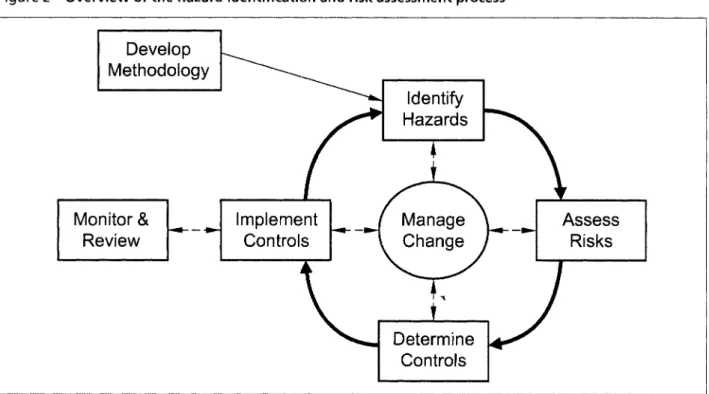
The outputs from the hazard identification, risk assessment and determining control processes should also be used throughout the development and implementation of the OH&S management system. Figure 2 provides an overview of the risk assessment process.
Figure 2 Overview of the hazard identification and risk assessment process
Develop
Methodology
Monitor &
Review
Implement
Controls
Identify
Hazards
Determine
Controls
Assess
Risks
NOTE The development of the methodology can itself be subjectto
change or improvement.
4.3.1.2
Developing a methodology and procedures for hazard
identification and risk assessment
Hazard identification and risk assessment methodologies vary greatly across industries, ranging from simple assessments to complex quantitative analyses with extensive documentation. Individual hazards can require that different methods be used, e.g. an
assessment of long term exposure to chemicals can need a different method than that taken for equipment safety or for assessing an
16 •
©SSI 2008office workstation. Each organization should choose approaches that are appropriate to its scope, nature and size, and which meet its needs in terms of detail, complexity, time, cost and availability of reliable data. In combination, the chosen approaches should result in an inclusive methodology for the ongoing evaluation of all the organization's OH&S risks.
The management of change (see 4.3.1.5) needs to be considered for changes in assessed risks, determination of controls, or the implementation of controls. Management review should be used to determine whether changes to the methodology are needed overall. To be effective, the organization's procedures for hazard identification and risk assessment should take account of the following:
hazards, risks, controls,
management of change, documentation,
to..
ongoing review.
To ensure consistency of application, it is recommended that these procedure(s) be documented.
OHSAS 18001:2007,4.3.1, identifies in bullets a) toj)what should be taken into account in developing the procedure(s). Guidance" on these can be found in sub-clauses 4.3.1.3 to 4.3.1.8.
4.3.1.3
Hazard Identification
Hazard identification should aim to determine proactively all sources, situations or acts (or a combination of these), arising from an
organization's activities, with a potential for harm in terms of human injury or ill health (see the definition of "hazard" in 3.6). Examples include:
sources (e.g. moving machinery, radiation or energy sources), situations (e.g. working at heights), or
acts (e.g. manual lifting).
Hazard identification should consider the different types of hazards in the workplace, including physical, chemical, biological and psychosocial (see Annex C for examples of hazards).
The organization should establish specific hazard identification tools and techniques that are relevant to the scope of its OH&S management system.
The following sources of information or inputs should be considered during the hazard identification process:
OH&S legal and other requirements (see 4.3.2), e.g. those that prescribe how hazards should be identified,
OH&S policy (see 4.2), monitoring data (see 4.5.1),
occupational exposure and health assessments, records of incidents (see 3.9),
reports from previous audits, assessments or reviews,
input from employees and other interested parties (see 4.4.3), information from other management systems (e.g. for quality management or environmental management),
information from employee OH&S consultations,
process review and improvement activities in the workplace, information on best practice and/or typical hazards in similar organizations,
reports of incidents that have occurred in similar organizations, information on the facilities, processes and activities of the organization, including the following:
• workplace design, traffic plans (e.g. pedestrian walkways, vehicle routing), site plan(s),
• process flowcharts and operations manuals,
• inventories of hazardous materials (raw materials, chemicals, wastes, products, sub-products),
• equipment specifications,
• product specifications, material safety data sheets, toxicology and other OH&S data.
Hazard identification processes should be applied to both routine and to non-routine (e.g. periodic, occasional, or emergency) activities and situations.
Examples of non-routine activities and situations that should be considered during the hazard identification process include:
facilities or equipment cleaning, temporary process modifications, non-scheduled maintenance,
plant or equipment start-ups/shut-downs,
off-site visits (e.g. field trips, customer supplier visits, prospecting,
excursions), '\
refurbishment,
extreme weather conditions,
utility (e.g. power, water, gas, etc.) disruptions, temporary arrangements,
emergency situations.
Hazard identification should consider all persons having access to the workplace (e.g. customers, visitors, service contractors, delivery personnel, as well as employees) and:
the hazards and risks arising from their activities,
the hazards arising from the use of products or services supplied to the organization by them,
their degree of familiarity with the workplace, and their behaviour.
18 •
© 8512008Human factors, such as capabilities, behaviours and limitations, have to be taken into account [see bullet c) of OHSAS 18001:2007,4.3.1]
when evaluating the hazards and risks of processes, equipment and work environments. Human factors should be considered whenever there is a human interface and take into account issues such as ease of use, potential for operational errors, operator stress and user fatigue. In considering human factors, the organization's hazard identification process should consider the following, and their interactions:
the nature of the job (workplace layout, operator information, work load, physical work, work patterns),
the environment (heat, lighting, noise, air quality), human behaviour (temperament, habits, attitude), psychological capabilities (cognition, attention),
physiological capabilities (biomechanical, anthropometrics/ physical variation of people).
In some instances, there can be hazards which occur or originate outgidethe workplace that can have an impact on individuals within the workplace (e.g. releases of toxic materials from neighbouring operations). Where such hazards are foreseeable, these should be addressed.
The organization could be obliged to give consideration to hazards created beyond the boundary of the workplace, particularly where there is a legal obligation or duty of care concerning such hazards. In some legal jurisdictions such hazards are instead addressed through the organization's environmental management system.
For the hazard identification to be effective the organization should use an approach that includes information from a variety of sources, especially inputs from people who have knowledge of its processes, tasks or systems, e.g.:
observations of behaviour and work practices and analyses of the underlying causes of unsafe behaviour,
benchmarking,
interviews and surveys, safety tours and inspections,
incident reviews and subsequent analyses,
monitoring and assessment of hazardous exposures (chemical and physical agents),
workflow and process analysis, including their potential for creating unsafe behaviour.
Hazard identification should be conducted by a person(s) with competence in relevant hazard identification methodologies and techniques (see4.4.2) and appropriate knowledge of the work activity. Checklists can be used as a reminder of what types of potential
hazards to consider and to record the initial hazard identification; however, care should be taken to avoid over reliance on the use of checklists (see Annex C). Checklists should be specific to the work area, process or equipment being evaluated.
4.3.1.4
Risk assessment 4.3.1.4.1 GeneralRisk is the combination of the likelihood of an occurrence of a hazardous event or exposure(s) and the severity of injury or ill health (3.8) that can be caused by the event or exposure(s) (see 3.21). Risk assessment is a process of evaluating the risk(s) arising from a hazard(s), taking into account the adequacy of any existing controls, and deciding whether the risk(s) is acceptable (see 3.22).
An acceptable risk (see 3.1) is a risk that has been reduced to a level that the organization is willing to assume with respect to its legal obligation, its OH&S policy and its OH&S objectives.
NOTE Some reference documents use the term "risk assessment"to
encompass the entire process of hazard identification, risk assessment and determining controls; OHSAS 18001 and OHSAS 18002 refertothe individual elementsofthis process separately and use the term "risk essessment"torefer explicitlytothe second stage of this process.
4.3.1.4.2 Risk assessment inputs
Inputs to the risk assessment processes can include, but are not be limited to, information or data on the following:
details of location(s) where work is carried out,
the proximity and scope for hazardous interaction between activities in the workplace,
security arrangements,
the human capabilities, behaviour, competence, training and experience of those who normally and/or occasionally carry out hazardous tasks,
toxicological data, epidemiological data and other health related information,
the proximity of other personnel (e.g. cleaners, visitors, contractors, the public) who might be affected by hazardous work,
details of any work instructions, systems of work and/or permit-to-work procedures, prepared for hazardous tasks, manufacturers' or suppliers' instructions for operation and maintenance of equipment and facilities,
the availability and use of control measures [e.g. for ventilation, guarding, personal protective equipment (PPE), etc.],
abnormal conditions (e.g. the potential interruption of utility services such as electricity and water, or other process failures), environmental conditions affecting the workplace,
the potential for failure of plant and machinery components and safety devices or for their degradation from exposure to the elements or process materials,
details of access to, and adequacy/condition of emergency procedures, emergency escape plans, emergency equipment, emergency escape routes (including signage), emergency communication facilities, and external emergency support, etc.,
monitoring data related to incidents associated with specific work activities,
the findings of any existing assessments relating to hazardous work activity,
details of previous unsafe acts either by the individuals performing the activity or by others (e.g. adjacent personnel, visitors, contractors, etc.),
the potential for a failure to induce associated failures or disabling of control measures,
the duration and frequency at which tasks are carried out, the accuracy and reliability of the data available for the risk assessment,
any legal and other requirements (see 4.3.2) which prescribe how the risk assessment has to be performed or what constitutes an acceptable risk, e.g. sampling methods to determine exposure, use of specific risk assessment methods, or permissible exposure levels.
to.
Risk assessment should be conducted by a person(s) with competence in relevant risk assessment methodologies and techniques (see 4.4.2) and appropriate knowledge of the work activity.
4.3.1.4.3 Risk assessment methodologies
An organization can use different risk assessment methods
as-part
of an overall strategy for addressing different areas or activities. When seeking to establish the likelihood of harm, the adequacy of existing control measures should be taken into account. A risk assessment should be detailed enough to determine appropriate control measures. Some risk assessment methods are complex and appropriate to special or particularly hazardous activities. For example, risk assessment of a chemical process plant might require complex mathematical calculations of the probabilities of events that could lead to a release of agents that might affect individuals in the workplace or the public. In many countries, sector-specific legislation specifies where this degree of complexity is required.In many circumstances, OH&S risk can be addressed using simpler methods and can be qualitative. These approaches typically involve a greater degree of judgment, since they place less reliance on quantifiable data. In some cases, these methods will serve as initial screening tools, to determine where a more detailed assessment is needed.
The risk assessment should involve consultation with, and appropriate participation by, workers and take into account legal and other requirements. Regulatory guidance should be taken into account where applicable.
The organization should consider limitations in the quality and accuracy of the data used in the risk assessments and the possible effect this could have on the resulting calculation of risk. The higher the level of uncertainty in the data, the greater is the need for caution in determining whether the risk is acceptable.
NOTE See Annex D foracomparisonofrisk assessment tools and methodologies.
4.3.1.4.4 Other considerations for risk assessment
Some organizations develop generic risk assessments for typical activities that can occur in several different sites or locations. Such generic assessments can be useful as a starting point for more specific assessments, but could need to be customized to be appropriate to the particular situation. This approach can improve the speed and efficiency of the risk assessment process and improve the consistency of risk assessments for similar tasks.
When the organization's risk assessment method uses descriptive categories for assessing severity or likelihood of harm, they should be clearly defined, e.g. clear definitions of terms such as "likely" and "unlikely" are needed to ensure that different individuals interpret them consistently.
The organization should consider risks to sensitive populations (e.g. pregnant workers) and vulnerable groups (e.g. inexperienced workers), as well as any particular susceptibilities of the individuals involved in performing particular tasks (e.g. the ability of an individual who is colour-blind to read instructions).
The organization should evaluate how the risk assessment will take into account the number of persons that might be exposed to a particular hazard. Hazards that could cause harm to large numbers of persons should be given careful consideration even when it is less likely for such severe consequences to occur.
Risk assessments to evaluate the harm from exposure to chemical, biological and physical agents might require measurement of exposure concentrations with appropriate instruments and sampling methods. Comparison of these concentrations should be made to applicable occupational exposure limits or standards. The organization should ensure that the risk assessment considers both the short-term and long-term consequences of exposure and the additive effects of multiple agents and exposures.
In some cases risk assessments are performed using sampling to cover a variety of situations and locations. Care should be taken to ensure that the samples used are sufficient and adequately represent all the situations and locations beinq-assessed.
4.3.1.5
Management of change
The organization should manage and control any changes that can affect or impact its OH&S hazards and risks. This includes changes to the organization's structure, personnel, management system, processes, activities, use of materials, etc. Such changes should be evaluated through hazard identification and risk assessment prior to their introduction.
The organization should consider hazards and potential risks associated with new processes or operations at the design stage as well as changes in the organization, existing operations, products, services or suppliers. The following are examples of conditions that should initiate a management of change process:
new or modified technology (including software), equipment, facilities, or work environment,
new or revised procedures, work practices, designs, specifications or standards,
22 • © BSI 2008
different types or grades of raw materials,
significant changes to the site's organizational structure and staffing, including the use of contractors,
modifications of health and safety devices and equipment or controls.
The management of change process should include consideration of the following questions to ensure that any new or changed risks are acceptable:
have new hazards been created (see 4.3.1.4)? what are the risks associated with the new hazards? have the risks from other hazards changed?
could the changes adversely affect existing risk controls?
have the most appropriate controls been chosen, bearing in mind usability, acceptability and both the immediate and long-term costs?
4.3.1.6
Determining the need for controls
Having completed a risk assessment and having taken account of existing controls, the organization should be able to determine whether existing controls are adequate or need improving, or if new controls are required.
If new or improved controls are required, their selection should be determined by the principle of the hierarchy of controls, i.e. the elimination of hazards where practicable, followed in turn by risk reduction (either by reducing the likelihood of occurrence or potential severity of injury or harm), with the adoption of personal protective equipment (PPE) as a last resort.
The following provides examples of implementing the hierarchy of controls:
a) Elimination - modify a design to eliminate the hazard, e.g. introduce mechanical lifting devices to eliminate the manual handling hazard;
b) Substitution - substitute a less hazardous material or reduce the system energy (e.g. lower the force, amperage, pressure, temperature, etc.);
c) Engineering controls - install ventilation systems, machine guarding, interlocks, sound enclosures, etc.;
d) Signage, warnings, and/or administrative controls - safety signs, hazardous area marking, photo-luminescent signs, markings for pedestrian walkways, warning sirens/lights, alarms, safety procedures, equipment inspections, access controls, safe systems of working, tagging and work permits, etc.;
e) Personal protective equipment (PPE) - safety glasses, hearing protection, face shields, safety harnesses and lanyards, respirators and gloves.
In applying the hierarchy consideration should be given to the relative costs, risk reduction benefits, and reliability of the available options.
An organization should take into account:
the need for a combination of controls, combining elements from the above hierarchy (e.g. engineering and administrative controls),
established good practice in the control of the particular hazard under consideration,
adapting work to the individual (e.g. to take account of individual mental and physical capabilities),
taking advantage of technical progress to improve controls, using measures that protect everyone [e.g. by selecting engineering controls that protect everyone in the vicinity of a hazard in preference to personal protective equipment (PPE)], human behaviour and whether a particular control measure will be accepted and can be effectively implemented,
typical basic types of human failure (e.g. simple failure of a frequently repeated action, lapses of memory or attention, lack of understanding or error of judgement, and breach of rules or procedures) and ways of preventing them,
the need to introduce planned maintenance of, for example, machinery safeguards,
the possible need for emergency/contingency arrangements where risk controls fail,
the potential lack of familiarity with the workplace and existing controls of those not in the direct employment of the organization, e.g. visitors, contractor personnel.
Once the controls have been determined the organization can prioritize its actions to implement them. In the prioritization of actions the organization should take into account the potential for risk reduction of the planned controls. It is preferable that actions addressing a high risk activity or offering a substantial reduction of risk take priority over actions that have only limited risk reduction benefit.
In some cases, it is necessaryto modify work activities until risk controls are in place or apply temporary risk controls until more effective actions are completed. For example, the use of hearing protection as an interim measure until the source of noise can be eliminated, or the work activity segregated to reduce the noise exposure. Temporary controls should not be regarded as a long-term substitute for more effective risk control measures.
Legal requirements, voluntary standards and codes of practice can specify appropriate controls for specific hazards. In some cases, controls will need to be capable of attaining "as low as reasonably practicable" (ALARP) levels of risk.
The organization should conduct ongoing monitoring to ensure that the adequacy of the controls is being maintained (see 4.5.1).
NOTE The term "residual risk" is often usedtodescribe the risk that remains after controls have been implemented.
4.3.1.7
Recording and documenting the results
The organization should document and keep the results of hazard identification, risk assessments and determined controls.
The following types of information should be recorded: identification of hazards,
determination of the risks associated with the identified hazards, indication of the levels of the risks related to the hazards, description of, or reference to, the measures to be taken to control the risks,
determination of the competency requirements for implementing the controls (see4.4.2).
When existing or intended controls are used in determining OH&S risks, these measures should be clearly documented so that the basis of the assessment will be clear when it is reviewed at a later date. The description of measures to monitor and control risks can be included within operational control procedures (see4.4.6).The determination of competency requirements can be included within training procedures (see4.4.2).
4.3.1.8
Ongoing review
It is a requirement that hazard identification and risk assessment be ongoing. This requires the organization to consider the timing and frequency of such reviews, as affected by the following types of issues:
the need to determine whether existing risk controls are effective and adequate,
the need to respond to new hazards,
the need to respond to changes that the organization itself has made (see4.3.1.5),
the need to respond to feedback from monitoring activities, incident investigation (see4.5.3),emergency situations or the results of testing of emergency procedures (see4.4.7),
changes in legislation,
external factors, e.g. emerging occupational health issues, advances in control technologies,
changing diversity in the workforce, including contractors, changes proposed by corrective and preventive action (see4.5.3).
Periodic reviews can help ensure consistency across risk assessments carried out by different people at different times. Where conditions have changed and/or better risk management technologies have become available, improvements should be made as necessary. It is not necessary to perform new risk assessments when a review can show that the existing or planned controls remain valid.
Internal audits (see4.5.5)can provide an opportunity to check that hazard identifications, risk assessments and controls, are in place and up-to-date. Internal audits can also be a useful opportunity to check whether the assessment reflects actual workplace conditions and practice.