Contents
Contents ... 2
Introduction ... 4
The Challenge of Standards Adoption and Implementation ...4
How To Use This Workbook ...6
Workbook Organization ...6
Chapter 1: Designate a Strategic Leadership Team, Review Your Capacity for Adoption and
Implementation, and Create a Timeline for Adoption and Preliminary Implementation ... 9
Step 1: Designate a Strategic Leadership Team and Understand Its Role ...9
EXERCISE 1: Designate Your Strategic Leadership Team ... 11
Step 2: Complete a Diagnostic Assessment of Your State’s Capacity To Adopt and Implement ... 12
EXERCISE 2: Review Capacity To Adopt and Implement the NGSS ... 17
Step 3: Establish an Adoption and Preliminary Implementation Timeline ... 19
EXERCISE 3: Establish Your Adoption and Preliminary Implementation Timeline ... 21
Chapter 2: Define Your Aspiration ... 24
Step 1: Develop a Vision for How the NGSS Will Affect Students and Your State ... 24
EXERCISE 4: Articulate Your NGSS Vision ... 28
Step 2: Understand What the NGSS Will Require ... 30
EXERCISE 5: Determine the Biggest NGSS Shifts for Your State ... 35
Conclusion ... 36
Chapter 3: Evaluate Past and Present Performance ... 37
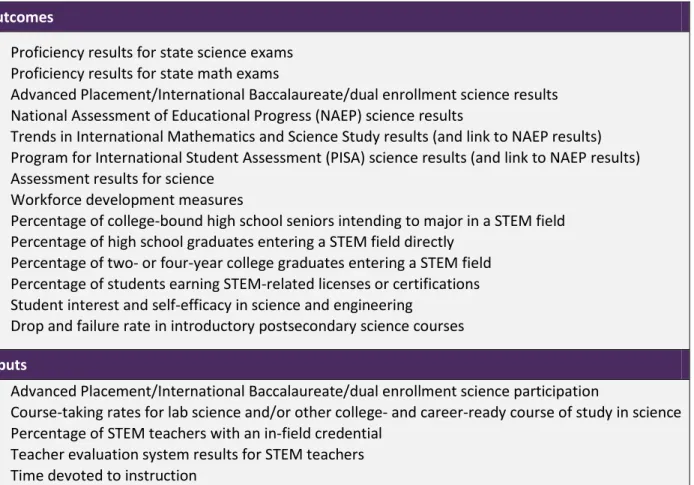
Step 1: Gather the Relevant Data ... 37
EXERCISE 6: Identify Measures of Science Performance ... 39
Step 2: Distill Key Performance Patterns and Identify Root Causes ... 40
EXERCISE 7: Identify Performance Patterns and Root Causes of Science Performance ... 42
Step 3: Identify Implications for Adoption and Implementation ... 44
EXERCISE 8: Use Performance Patterns and Root Causes To Identify Implications for NGSS Adoption and/or Implementation Planning ... 45
Conclusion ... 46
Chapter 4: Determine the State’s Role and Approach to Implementation ... 47
Step 1: Define Your State’s Role ... 48
EXERCISE 9: Define Your State’s Role ... 50
Step 2: Identify Core Implementation Strategies ... 51
EXERCISE 10: Brainstorm and Define Potential Strategies ... 59
EXERCISE 11: Prioritize Potential Strategies According to Impact and Difficulty ... 60
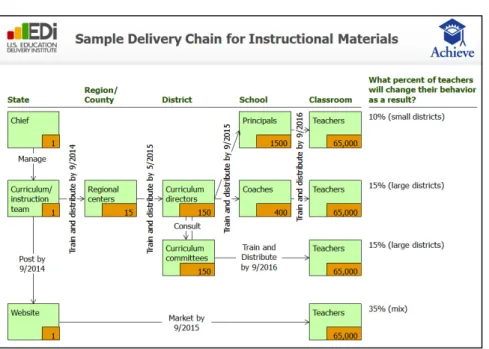
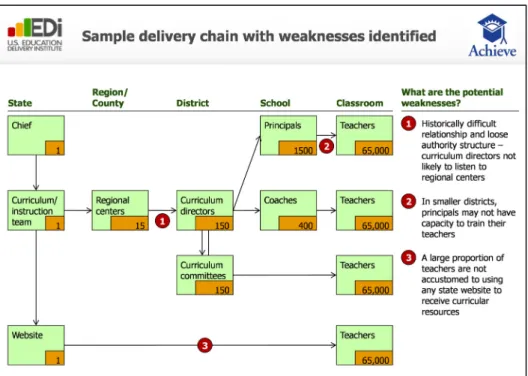
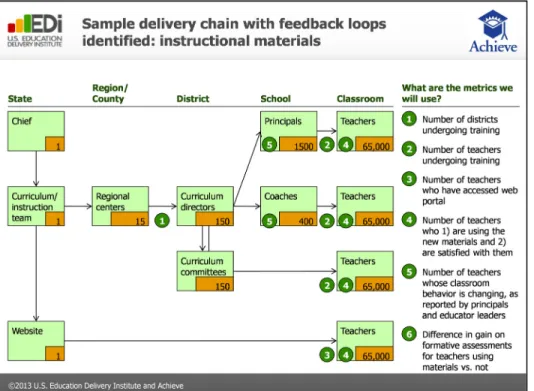
Step 3: Draw the Delivery Chain and Identify Feedback Loops ... 61
EXERCISE 12: Draw a Delivery Chain for One or More Strategies ... 63
EXERCISE 14: Define Feedback Loops for Your Strategies ... 68
Conclusion ... 69
Chapter 5: Set Targets and Trajectories ... 70
Step 1: Establish a Performance Target ... 71
EXERCISE 15: Determine a Metric and Target for Each Goal ... 73
Step 2: Connect Your Strategies to Expected Outcomes ... 74
EXERCISE 16: Evaluate the Expected Impact of Strategies on Established Goals ... 75
Step 3: Create More Detailed Trajectories To Monitor Implementation Progress ... 76
EXERCISE 17: Establish a Baseline for Performance ... 77
EXERCISE 18: Classify Your Strategies as Having a High, Medium or Low Impact Over Time ... 79
EXERCISE 19: Use the Projected Impacts of Strategies To Map Your Trajectory ... 81
Conclusion ... 82
Chapter 6: Develop a Stakeholder Engagement Strategy ... 83
Step 1: Develop Key Three Messages ... 83
EXERCISE 20: Develop Key Three Messages ... 86
Step 2: Identify and Analyze the Stakeholders Who Are Most Critical to Successful Adoption and Implementation ... 87
EXERCISE 21: Identify and Map Your Stakeholders ... 89
Step 3: Build Your Guiding Coalition ... 90
EXERCISE 22: Build Your Guiding Coalition... 91
Step 4: Establish a Process and Plan To Handle Potential Challenges ... 92
Step 5: Develop a Stakeholder Outreach Strategy... 92
EXERCISE 23: Develop a Stakeholder Outreach Strategy ... 94
Conclusion ... 95
Chapter 7: Establish Routines and Solve Problems ... 96
Step 1: Reflect on Existing Performance Management Routines and Consider How They Can Be Adapted To Monitor the Progress of NGSS Implementation ... 97
EXERCISE 24: Reflect on the Quality of Existing Routines ... 98
Step 2: Organize, Prepare for and Conduct Routines (Optional) ... 99
EXERCISE 25: Define the Data Used for Measuring Progress ... 100
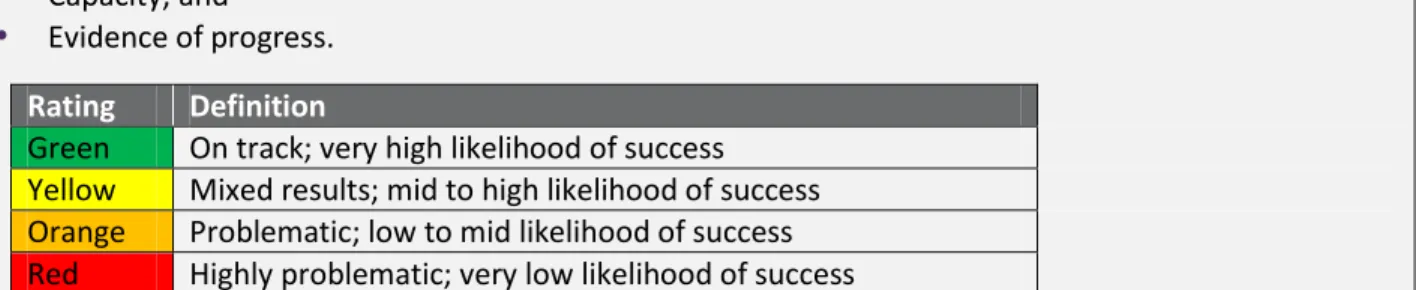
EXERCISE 26: Use the Assessment Framework To Make a Judgment on the Likelihood of Success for a Given Strategy or Goal ... 104
EXERCISE 27: Develop an Agenda for a Routine ... 108
Conclusion ... 110
Glossary of NGSS Workbook Terms ... 111
Introduction
The Challenge of Standards Adoption and Implementation
The Next Generation Science Standards (NGSS) represent the culmination of years of collaboration and effort by states, science educators and experts from across the United States. Based on the National Research Council’s A Framework for K-12 Science Education1 and developed in partnership with 26 lead states, the NGSS, when implemented with fidelity, have the potential to fundamentally alter the landscape of American science education and prepare students for college, careers and life in the 21st century.
This workbook is designed for state leaders who intend to adopt and implement the NGSS so that the standards bring about the change in classroom instruction and student achievement that they promise. If you are reading this workbook, you probably already recognize the potential of the NGSS to improve science education and achievement (and if you do not, the partnership developing the standards has already astutely articulated the case for them through the many resources at www.nextgenscience.org). Adoption and implementation of the NGSS are no small tasks for several reasons. One reason is the content of the standards themselves: The NGSS require several shifts in the way that science is taught, which will be explored throughout this workbook. At the heart of these shifts is a fundamental change in how students will demonstrate proficiency.
The vision represented in the Framework is new in that it requires — for the first time — that students be engaged at the nexus of three dimensions: (1) Science and Engineering Practices, (2) Crosscutting Concepts and (3) Disciplinary Core Ideas. Given the importance of science and engineering in the 21st century, students require a sense of contextual understanding with regard to scientific knowledge, how it is acquired and applied, and how science is connected through a series of concepts that help further their understanding of the world. To that end, the standards have been written as performance
expectations requiring that students demonstrate all three dimensions through contextual application of the three dimensions.
This change is illustrated in the side-by-side comparison of middle school science standards in Figure 1.
1 National Research Council. A Framework for K-12 Science Education: Practices, Crosscutting Concepts, and Core Ideas. Washington,
FIGURE 1: Standards Comparison: Structure and Properties of Matter
Current State Middle School Science Standards NGSS Middle School Sample Standards*
a. Distinguish between atoms and molecules. b. Describe the difference between pure substances (elements and compounds) and mixtures.
c. Describe the movement of particles in solids, liquids, gases and plasma states.
d. Distinguish between physical and chemical properties of matter as physical (i.e., density, melting point, boiling point) or chemical (i.e., reactivity, combustibility).
e. Distinguish between changes in matter as physical (i.e., physical change) or chemical (i.e., development of a gas, formation of precipitate, and change in color).
f. Recognize that there are more than 100 elements and some have similar properties as shown on the Periodic Table of Elements. g. Identify and demonstrate the Law of Conservation of Matter.
a. Develop molecular-level models of a variety of substances, comparing those with simple
molecules to those with extended structures. b. Design a solution that solves a practical problem by using characteristic chemical and physical properties of pure substances.
c. Construct an explanation about why change in temperature and/or change of state can occur when adding or removing thermal energy from a pure substance.
d. Analyze and interpret the properties of products and reactants to determine if a chemical reaction has occurred.
*Note that these are only samples and do not necessarily reflect the final standards.
The difference in the verbs used in the NGSS tells the story. Gone is the conception of science education as an abstract recall of facts. Instead, students demonstrate proficiency in science by engaging in actual scientific practices — in this case, developing models, designing solutions and constructing arguments. In the words of one standards author, the NGSS require that students move from demonstrating good note-taking skills to demonstrating true understanding of scientific practices, concepts and core ideas. The resulting implications for classroom practice could not be greater.
This first challenge for NGSS adoption and implementation is multiplied by the second: the sheer scale at which the change must take place. Each state adopting and implementing the NGSS will need to equip and motivate hundreds or thousands of district leaders, principals and teachers to change their day-to-day practices. Moreover, this change comes in the context of existing and ongoing efforts in most states to implement the Common Core State Standards (CCSS) for English Language Arts/Literacy and
Mathematics. Any NGSS implementation effort will need to be coherent with, and build upon, the work that is already under way.
One of the main objectives of this workbook is to help state leaders think through an NGSS adoption strategy and timeline. State science education advocates will need to make the case for these new standards and be prepared to answer questions from those charged with standards adoption in their states (usually state boards of education, but in some states adoption is the purview of general
assemblies or chief state school officers). These questions are likely to include inquiries about the state’s transition timeline and strategy for incorporating these standards into the full range of education
reforms unfolding in states. In many states that are implementing the CCSS, the role of the state education agency is changing from compliance/monitoring to supporting and responding to district and school needs. State boards of education, legislatures and chiefs will be more willing to adopt the NGSS if they are given a clear sense that state leaders — and the districts, schools and classrooms that the NGSS will ultimately affect the most — will be able to meet these challenges. Of course, states will also have flexibility to determine their own implementation timelines and structures. They can review their capacity and greatest needs in determining how to sequence and roll out the standards. Importantly, states can and should learn from each other and work together to meet common objectives.
How To Use This Workbook
All of this implies a need for state leaders to develop, manage and hold themselves accountable to a clear plan for NGSS adoption that anticipates the legitimate questions from policymakers and the need from the field to lay out a high-level strategy for implementation, including a timeline. This workbook should aid you in that process.
Taken as a whole, the elements in this workbook will allow your team to create a high-level
implementation plan — an operational guide to your work — which will need to become much more detailed as standards implementation occurs over the next several years. At a minimum, this preliminary implementation plan will need to answer the questions that policymakers will most likely need to see addressed before they take action on adoption, and your plan will likely have multiple iterations. Given the current environment in state policymaking, an adoption plan will need to address key elements of your implementation plan: a clear case for change that is well communicated and is grounded in strategies that the state will employ and how the strategies will be implemented to improve student achievement.
Workbook Organization
The workbook is organized around elements of NGSS adoption and implementation that are critical to include in your state’s plan; each chapter includes action steps to help guide your state’s adoption and preliminary implementation of the NGSS:
Chapter 1: Designate a Strategic Leadership Team, Review Your Capacity for Adoption and Implementation, and Create a Timeline for Adoption and Preliminary Implementation
• Designate a strategic leadership team and understand its role;
• Complete a diagnostic assessment of your state’s capacity to adopt and implement; and • Establish an adoption and preliminary implementation timeline.
Chapter 2: Define Your Aspiration
• Develop a vision for how the NGSS will affect students and your state; and • Understand what the NGSS will require.
Chapter 3: Evaluate Past and Present Performance
• Gather the relevant data;
• Distill key performance patterns and identify root causes; and • Identify implications for adoption and implementation.
Chapter 4: Determine the State’s Role and Approach to Implementation
• Define your state’s role;
• Identify core implementation strategies; and
• Draw the delivery chain and identify feedback loops.
Chapter 5: Set Targets and Trajectories
• Establish a performance target;
• Connect your strategies to expected outcomes; and
• Create more detailed trajectories to monitor implementation progress.
Chapter 6: Develop a Stakeholder Engagement Strategy
• Develop key three messages;
• Identify and analyze the stakeholders who are most critical to successful adoption and implementation;
• Build your guiding coalition;
• Establish a process and plan to handle potential challenges; and • Develop a stakeholder outreach strategy.
Chapter 7: Establish Routines and Solve Problems
• Reflect on existing performance management routines and consider how they can be adapted to monitor the progress of NGSS implementation; and
• Organize, prepare for and conduct routines.
Though you can read the workbook in a linear fashion from start to finish, some elements of the workbook will be more pertinent or pressing at certain times. Start with identifying the strategic leadership team and completing the diagnostic tool and self-assessment exercise in Chapter 1. Use the results to inform your reading and work on the areas of true need. Then set a timeline for adoption and preliminary implementation of the NGSS.
The remaining chapters of the workbook are organized around the above outline. Each of these chapters contains the following components:
Narrative, step-by-step guidance on how to develop the plan in your state. This guidance includes an introduction that defines the element, why it is important and what it comprises. After the introduction, each element is broken down into a series of action steps for state leaders to take.
Examples and references to NGSS content and practices. Where appropriate, the workbook illustrates the concepts in each of the elements and action steps with examples of how they might play out in a state. It also includes occasional references to the broader content and work around the standards. Many are drawn from the NGSS website (www.nextgenscience.org).
Exercises for state teams. Nearly every action step includes one or more exercises that will help your state team complete the step collaboratively. Exercises consist of discussion prompts, guiding questions and templates to fill out, as well as guidance for facilitators who are running the exercises. Taken as a whole, the exercises in this workbook should help your state team have the conversations necessary to develop and manage your adoption and implementation plans for the NGSS.
Finally, it is worth noting that states’ roles in standards implementation continue to evolve. Capturing, distilling and sharing the lessons learned from your experiences will be important. Adoption and
implementation of the NGSS are critical to the goal of providing students with a well-rounded education experience that prepares them for college, careers and life.
Chapter 1: Designate a Strategic Leadership Team, Review Your
Capacity for Adoption and Implementation, and Create a Timeline for
Adoption and Preliminary Implementation
This chapter consists of a discussion of the need for and role of your state’s strategic leadership team in coordinating, driving and monitoring the adoption and implementation of the NGSS; a diagnostic tool for assessing your state’s current capacity to adopt and implement the NGSS; and guidelines for setting a timeline for adoption and preliminary implementation of the NGSS.
Action Steps
Step 1: Designate a strategic leadership team and understand its role.
Step 2: Complete a diagnostic assessment of your state’s capacity to adopt and implement. Step 3: Establish an adoption and preliminary implementation timeline.
Step 1: Designate a Strategic Leadership Team and Understand Its Role
Ownership of the NGSS will sit in many different places across the state and even within the state education agency, which can pose a challenge for adoption and implementation. Thus, your state should put together a strategic leadership team tasked with creating an overall vision for the NGSS and a timeline, phase-in strategy and work plan for both adoption and implementation. The strategic
leadership team ought to include a balance of leaders with the skills to drive implementation. Strategic leadership team members must be skilled at working with and coordinating a team. Thus, they will need strong problem-solving skills, interpersonal and relationship management skills, and “run room” from the senior leadership. The strategic leadership team should include representatives who are
knowledgeable about your state’s current science standards, have the capacity to consider and make recommendations about each of the elements that should be in the adoption and implementation plan, and ultimately can execute and oversee such a plan. The team must have knowledge of the state
education agency’s priorities and timing for action. The team also must be able to embed the NGSS work in and communicate with policymakers about how these elements of a broader agenda fit together and/or reinforce one another in a coherent way. In addition, the team needs to be cognizant of the political landscape and the levers of influence related to NGSS adoption.
The team should include representatives from the state department of education (curriculum and instruction, assessment, data, district support, special education, English language learners, etc.), higher education, the legislature, the governor’s office and the business community. It is also critical that the team have deep expertise in relevant policies, budget and communications. The state may also want to include representation from leading districts and schools, including teachers, administrators and content area experts.
From the outset, identifying how the NGSS will be adopted in your state is critical and may influence your team’s composition. Begin by considering the “who, what, when, why, where and how” questions. For example, who has the authority to adopt standards varies across states — from the state board of education to the legislature and, in some cases, the chief state school officer. States also differ with respect to how statutory requirements, public comment periods and hearings shape their standards adoption processes. (Preparation and documentation of how the state has been engaged in the standards development process may also be a helpful resource.)
Your strategic leadership team needs to grapple with a host of questions to create an adoption strategy, which you will explore in the remainder of this workbook. These questions include:
• What is the big-picture aspiration — or end goal — that grounds and focuses your NGSS efforts; allows for you to build the necessary coalition for adoption; and when challenges arise, allows for perseverance to implement the standards with fidelity? (See Chapter 2.)
• When do you anticipate the NGSS reaching the classroom? In all grades? Working backward, what are the elements that must be addressed in your plan and by when? Who has authority to make decisions in each of those areas? What expertise exists, and what capacity gaps remain? How will you know whether or not your state is on track? If full implementation takes years, how will you sustain your efforts over time? (See Chapters 1 and 4.)
• What supports will your state provide educators, and how do those needs inform the state’s
implementation timeline? What sort of professional development will be provided — and by whom? Will there be an effort to create curriculum frameworks and other instructional materials for
classroom teachers? (See Chapter 4.)
• How will this work be funded? Have you had conversations with key legislators on appropriate committees to help them understand the purpose and timing of adopting the NGSS? Have you had internal budget discussions to identify various state and federal funding streams that can support this work? (See Chapter 4.)
• What impact will implementation of the NGSS have on the state’s existing college- and career-ready policies and priorities? How can this effort move forward coherently to reinforce the state’s goals for college and career readiness? (See Chapters 2 and 4.)
• Does your state have a coalition of supporters of the NGSS — including those both inside and outside the government — and how can you make certain that they are engaged around the adoption and implementation of the NGSS? (See Chapters 2 and 6.)
The strategic leadership team will help develop and monitor a strategy to engage stakeholders, provide briefing materials and timely updates to policymakers, and establish and monitor key feedback loops. (See Chapter 4.) Focusing on stakeholder engagement well before adoption of new standards is critical: Who needs to be engaged in the work? Who needs to be kept informed, and how you are going to interact with the various stakeholders? Informing and involving key state board of education members and legislators in discussions around adoption and implementation strategy is essential. Your state education agency public information officer and communications staff will need a plan and will need to reach out to a broader coalition of key stakeholders to build and maintain support for your efforts. These critical partners must be engaged from the beginning.
Adopting the standards in a state represents the beginning, not the end, of the process. The goal is for the content standards to actually affect teaching and learning in the classroom. As the implementation effort proceeds, your strategic leadership team will likely need to create other working teams to delve into specific issues, such as professional development design, and recommend how to proceed. Consider what mechanisms are in place to ensure fluid communication among the department of education, governor’s office and other state education entities such as your higher education system or your teacher licensing board. Consider also what mechanisms can be used to provide project oversight to the agency’s leadership team (e.g., the chief and key deputies).
EXERCISE 1: Designate Your Strategic Leadership Team
Objective(s) for participants:• Identify the members of the strategic leadership team.
• Develop a strategy for engaging each member to support NGSS adoption and implementation. • Identify the role(s) each member can play in creating an overall vision, timeline, adoption strategy
and phase-in strategy for implementation. Discuss existing mechanisms that strategic leadership team members can use to execute, monitor and reinforce the state’s efforts.
Instructions:
• Brainstorm possible members of the strategic leadership team, casting the widest net possible. • Narrow the list by excluding those who would be unlikely to support the work.
• Evaluate the list using criteria such as diversity, balance, potential to work together, etc. Materials needed:
• Flipchart paper • Markers
Template for Exercise 1 Potential Member of the Strategic Leadership Team
Current Level of Engagement and Awareness of the NGSS (very low, low, high, very high)
Sphere of
Influence (content knowledge, policy expertise,
stakeholder engagement, etc.)
Step 2: Complete a Diagnostic Assessment of Your State’s Capacity To Adopt and
Implement
The diagnostic tool includes a category for each of the critical elements of NGSS adoption and implementation that are explored in each chapter of the workbook. Each of these critical elements contains a series of guiding questions for discussion and a description of what types of evidence to consider when answering the questions. Completing this assessment with your strategic leadership team before reading further will enable you to identify areas of relative strength and challenge and may help focus preliminary conversations around adoption and implementation planning. The diagnostic questions also appear at the beginning of each chapter to help your state team gauge the extent to which you have already addressed the action(s) in question.
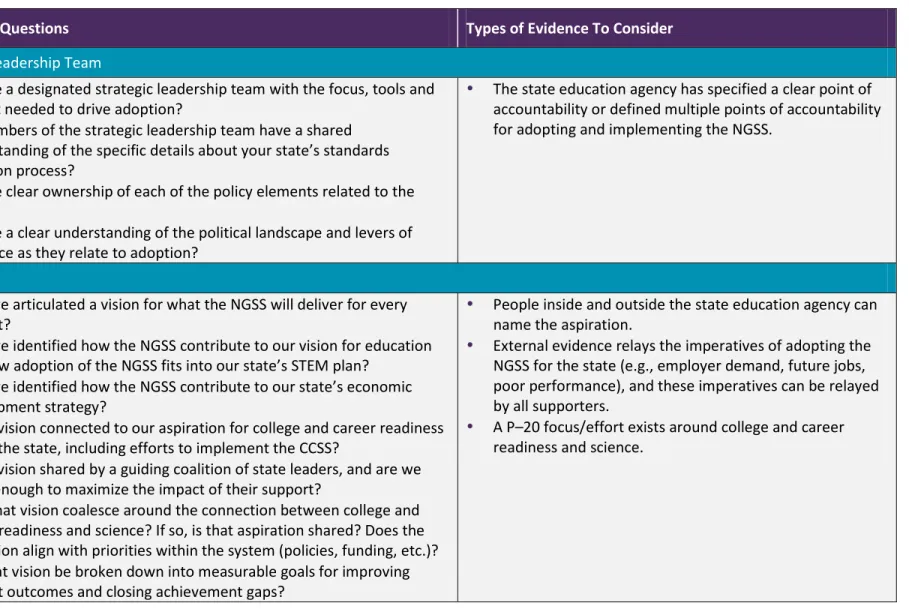
FIGURE 2: Diagnostic Tool
Diagnostic Questions Types of Evidence To Consider
Strategic Leadership Team
• Is there a designated strategic leadership team with the focus, tools and skill set needed to drive adoption?
• Do members of the strategic leadership team have a shared understanding of the specific details about your state’s standards adoption process?
• Is there clear ownership of each of the policy elements related to the NGSS?
• Is there a clear understanding of the political landscape and levers of influence as they relate to adoption?
• The state education agency has specified a clear point of accountability or defined multiple points of accountability for adopting and implementing the NGSS.
Aspiration
• Have we articulated a vision for what the NGSS will deliver for every student?
• Have we identified how the NGSS contribute to our vision for education and how adoption of the NGSS fits into our state’s STEM plan?
• Have we identified how the NGSS contribute to our state’s economic development strategy?
• Is that vision connected to our aspiration for college and career readiness across the state, including efforts to implement the CCSS?
• Is that vision shared by a guiding coalition of state leaders, and are we doing enough to maximize the impact of their support?
• Does that vision coalesce around the connection between college and career readiness and science? If so, is that aspiration shared? Does the aspiration align with priorities within the system (policies, funding, etc.)?
• Can that vision be broken down into measurable goals for improving student outcomes and closing achievement gaps?
• People inside and outside the state education agency can name the aspiration.
• External evidence relays the imperatives of adopting the NGSS for the state (e.g., employer demand, future jobs, poor performance), and these imperatives can be relayed by all supporters.
• A P–20 focus/effort exists around college and career readiness and science.
Diagnostic Questions Types of Evidence To Consider
Past and Present Performance
• Have we arrived at a clear view of our current performance in science relative to subgroups within our state, district comparisons, other states and other countries?
• Have we identified key areas of strength and weakness based on this evidence?
• Have we analyzed the root causes of students’ academic achievement — both successes and areas in need of improvement?
• Have we established clear goals for student performance?
• Have we identified how much instructional time is devoted to science in K–12?
• Have we identified how the current classroom practice aligns to the NGSS shifts?
• Based on past and present performance, have we derived implications for our NGSS implementation plan?
• What are the workforce projections for our state? How many STEM-capable jobs will be added?
• Participation, scores and/or passage rates on third-party national assessments (e.g., Advanced Placement, International Baccalaureate and dual enrollment)
• Course-taking and passage rates for rigorous science courses at the high school level
• National Assessment of Educational Progress science proficiency or proficiency on internationally benchmarked science assessments
• Closing equity gaps between disadvantaged students and their peers
• Rates of proficiency on existing science exams
• Number/percentage of high school graduates who enroll in college with the intent of majoring in a STEM discipline
• Number/percentage of high school graduates who begin careers in fields that require STEM knowledge and skills (many of which require some postsecondary experience but not a four-year degree)
• Number/percentage of college graduates who graduate with majors in a scientific discipline
Diagnostic Questions Types of Evidence To Consider
State’s Role and Approach
• Is there a designated strategic leadership team responsible for selecting the strategies — a coordinated set of activities designed to achieve our goals in science — and for ensuring delivery?
• Is there clear ownership of each of the policy elements related to the NGSS?
• Is there a clear understanding of the political landscape and levers of influence as they relate to adoption?
• Have we identified what districts need for adoption, what their highest priorities are and what assistance they need from the state?
• Have we identified what the state’s role in NGSS implementation will be and how it may need to be different from the current state role?
• Have we specified strategies for the state’s role in NGSS implementation
that are based on evidence?
• Are we confident that the strategies for the state’s role in NGSS
implementation will facilitate the shifts required by the standards in every classroom?
• To what extent are the strategies for the state’s role in NGSS
implementation coherent with CCSS implementation, teacher/leader effectiveness work and other significant initiatives?
• Have we defined feedback loops — evidence that identifies whether implementation is on track — that we can use to monitor the likelihood that this plan will deliver its promised results?
• Those responsible for specific strategies (e.g., instructional materials, professional development, etc.) can name the core priority activities.
• Confidence is high that these activities are the ones with the highest potential for impact.
• Measures of success have been articulated to determine whether the combination of levers and strategies (e.g., instructional materials, professional development, etc.) has been successful.
• Analysis shows how completing this strategy successfully will result in improved outcomes for students.
Targets and Trajectories
• Do the appropriate leaders have access to the data needed to determine past and present performance? How easy or difficult is pulling historical or real-time data? Is there a culture of using data to shape state goals and track progress against them?
• Have we estimated the impact that each of our strategies will have on these goals over time?
• Do we have confidence that the strategies will be sufficient to help us achieve our goals?
• There is a shared understanding of the expected baseline for performance.
• Specific, measurable, ambitious, realistic and time-limited (SMART) targets have been set for each of the student outcome goals that are defined by the aspiration and based on where performance is now (baseline) and where it has been (historical progress).
Diagnostic Questions Types of Evidence To Consider
Stakeholder Engagement Strategy
• Have we created core messages for our adoption and implementation plan?
• Have we identified the stakeholders whose support we will need? Do our messages speak to them?
• Do we have a plan for engaging stakeholders, including champions in the field and the public at large?
• Have we identified our key opponents and their points of opposition, and do we have a strategy for addressing the challenges they may pose?
• Teachers, principals and superintendents in the field understand how their work environments are going to change as a result of the NGSS and are supportive.
• Key stakeholders understand their role in supporting adoption and implementation of the standards.
Routines for Monitoring Progress
• Have we established regular performance dialogues to monitor our progress toward achieving our goals and the likelihood that we will achieve them in the future?
• Is there clear ownership of each of the policy elements related to the NGSS?
• Do these routines rely on a broad evidence base, including the feedback loops in the implementation plan, to arrive at a regular and shared view of progress?
• Do these routines help leaders identify and solve the most challenging problems as they arise?
• Do these routines build on established processes and mechanisms for management that are already in place?
• Do we regularly communicate our progress/decisions internally to the state education agency and externally to those interested and/or affected (e.g., districts, state board, key legislators)?
• Performance data are frequently discussed by the system leader and those who are accountable at the state education agency.
• Performance dialogues are regular and/or consistent — from the point of view of the chief and the point of view of those accountable.
• In the course of a given month, the routines give the system leader the right performance information at the right level of depth to drive decisionmaking.
EXERCISE 2: Review Capacity To Adopt and Implement the NGSS
Objective(s) for participants:• Arrive at a consensus on current areas of strength and challenge in the critical elements of NGSS adoption and implementation.
Instructions:
• Read through the diagnostic tool and take notes individually on evidence of strength or challenge for each critical element.
• Determine who has access to/holds the evidence.
• Use the evidence to arrive at an individual rating for each critical element.
• Share individual ratings (weak = 1 to strong = 4) with the group by marking on flipchart paper. • Discuss and come to consensus as a group on areas of relative strength and challenge across the
critical elements. Materials needed:
• Copies of the diagnostic tool for each participant • Flipchart paper and/or handouts with the template • Markers
Exercise notes:
• Guiding questions for discussion:
▪
What were some of the strongest ratings? What was the evidence behind them? What were the weakest ratings and their evidence?▪
Does our evidence match our ratings across elements? What adjustments do we need to make?▪
What does this tell us about where we need to focus?• You may not need to bring the group to complete consensus; the discussion and agreement on evidence is more important than any specific rating.
Template for Exercise 2
Element Rating
(1–4)
What Is the Evidence — and What Is the Level of Transparency and Access to the Evidence? Aspiration
Past and present performance
State’s role and approach
Targets and trajectories
Stakeholder engagement strategy
Routines for monitoring progress
Step 3: Establish an Adoption and Preliminary Implementation Timeline
A timeline is a useful tool for giving a broad overview of your plan; it should reflect your state’s strategy for incorporating these standards into the full range of education reforms unfolding in your state. As such, it is also a vital mechanism for communicating your adoption and implementation plan while making the case for adoption.
Developing this high-level implementation plan prior to adoption means anticipating the questions that policymakers and stakeholders will have about the timing, sequence and plan for implementation of the new standards. States should be careful not to underestimate what a preliminary implementation plan entails; it goes far beyond a timeline with teaching and assessment dates. This plan should be perceived as a living document that will change over time; it should be used to help structure and guide more detailed planning, especially as many areas are still under transition (e.g., science assessment, teacher evaluation, accountability). These areas may not be appropriate for inclusion today but will be
important to improve the coherence of the overall NGSS effort in the future.
There are four major issues to consider in creating a timeline. First, what are the broad and general milestones? For example, does your team understand your state’s associated legal and legislative requirements for adopting new content standards (e.g., public hearings, feedback windows, fiscal impact analysis)? Second, what are the key milestones for each? If you have not done so already,
defining these key milestones will help you further flesh out your strategies and form a view of how they fit together with each other and with your general milestones. Third, consider the rollout of your
strategies. Most states do not implement standards in all grades simultaneously — but what is the best way for your state to sequence implementation? Be sure to consider pros and cons to each option and be able to support the decision with appropriate data and messaging. Options include:
• The state could roll out the standards in the early grades and incrementally add a new grade each year.
• The state could roll out the standards at key transition grades (K, 6 and 9) and then subsequently add three new grades per year.
• The state could focus its rollout on the middle grades (6–8) and then move to K–5 and 9–12. • The state could stagger implementation by starting earlier in voluntary pilot districts and then
moving statewide.
Fourth, leaders from across the state education agency and broader education stakeholders will be implicated in this work; engaging in this process will help you identify where those connections exist to strengthen communication and collaboration among leaders and managers responsible for moving the work forward.
These milestones can include, but are not limited to: • Formal adoption of the standards:
▪
Identification of the strategic leadership team;▪
Research on specific details about your state’s standards adoption process, rules, etc.;▪
Fulfillment of any associated legal and legislative requirements (e.g., public hearings, feedback windows, fiscal impact analysis);▪
Identification of the target date for adoption; and▪
Adoption of the standards by the state board, legislature or appropriate authority. • Definition of your aspiration for what the NGSS will accomplish in your state:▪
Development of a vision for what the NGSS will accomplish for students and for your state; and▪
Sharing of your vision with key stakeholders in your state and refinement of your vision. • Evaluation of past and present performance in science in your state:▪
Gathering of the relevant data;▪
Distillation of key performance patterns and identification of root causes; and▪
Identification of implications for adoption and implementation.• Development of a stakeholder engagement strategy for adoption and implementation of the NGSS:
▪
Development of key three messages;▪
Identification and analysis of the stakeholders who are most critical to successful adoption and implementation;▪
Building of your guiding coalition;▪
Establishment of a process and plan to handle potential challenges; and▪
Development of a stakeholder outreach strategy.• Establishment of routines and solving of problems:
▪
Reflection on existing performance management routines and consideration of how they can be adapted to monitor the progress of NGSS implementation; and▪
Organization of, preparation for and conducting of routines. • Other policy changes (e.g., course credit, graduation requirements).• Alignment with/creation of a STEM plan for your state (e.g., integration with STEM efforts, including increasing access to STEM courses/pathways for all students).
• Development of educator preparation that reflects the NGSS, including preservice, in-service and licensure.
• Transition of assessment practices, including formative, summative and high-stakes exit exams. • Transition of the accountability system.
There is no one-size-fits-all approach to establishing a timeline. To determine the best approach for your state, it will be important to consider implications for curricular transitions, budget and other drivers that may create specific urgency. For example, state leaders will need to determine how to reallocate or realign funding streams to support implementation of the NGSS and ensure that professional
development and other supports are aligned to the NGSS. These processes will have an impact on the implementation timeline in each state.
EXERCISE 3: Establish Your Adoption and Preliminary Implementation Timeline
Objective(s) for participants:• Create an adoption and working implementation timeline for the NGSS. Instructions:
• Identify the broad and general milestones that must occur during your adoption and
implementation, using the list in this chapter as a reference. Record those milestones on the flipchart.
• Identify the key milestones for each critical element and discuss the ideal order for those milestones.
• Record the milestones where they belong on the flipchart. • Reflect on the overall timeline and discuss:
▪
Do the elements and action steps fit together properly?▪
Does the timeline take into account resource availability?▪
Does the timeline take into account other major events? Materials needed:• Flipchart • Markers
• Sticky notes (optional) Exercise notes:
• You may wish to place milestones on sticky notes first, so you can move around the order more easily as the discussion evolves.
Template for Exercise 3
Critical Elements and Action Steps Re sp o n sib le Party Ro le o f Stra te gi c Lea d ersh ip Te am Wi nt er 20 13 Sp rin g 20 13 Su mme r 20 13 Fa ll 20 13 Wi nt er 20 14 Sp rin g 20 14
Formal adoption of the standards Identification of the
strategic leadership team Research on specific details about our state’s standards adoption process, rules, etc. Fulfillment of any associated legal and legislative requirements (e.g., public hearings, feedback windows, fiscal impact analysis)
Critical Elements and Action Steps Re sp o n sib le Party Ro le o f Stra te gi c Lea d ersh ip Te am Wi nt er 20 13 Sp rin g 20 13 Su mme r 20 13 Fa ll 20 13 Wi nt er 20 14 Sp rin g 20 14
Identification of the target date for adoption Adoption of the
standards by the state board, legislature or appropriate authority
Definition of our aspiration for what the NGSS will accomplish in our state Understanding of what
the NGSS will require Development of a vision for what the NGSS will accomplish for students and for our state
Sharing of our vision with key stakeholders in our state and refinement of our vision
Evaluation of past and present performance in science in our state Gathering of the relevant
data
Distillation of key performance patterns and identification of root causes
Identification of
implications for adoption and implementation
Development of a stakeholder engagement strategy for adoption and implementation of the NGSS Development of key
three messages Identification and analysis of the stakeholders who are most critical to successful adoption and
implementation Building of our guiding coalition
Critical Elements and Action Steps Re sp o n sib le Party Ro le o f Stra te gi c Lea d ersh ip Te am Wi nt er 20 13 Sp rin g 20 13 Su mme r 20 13 Fa ll 20 13 Wi nt er 20 14 Sp rin g 20 14
Establishment of a process and plan to handle potential challenges Development of a stakeholder engagement strategy
Establishment of routines and solving of problems Reflection on existing
performance
management routines and consideration of how they can be adapted to monitor the progress of NGSS implementation Organization of, preparation for and conducting of routines
Other policy changes (e.g., course credit, graduation requirements)
Alignment with/creation of a STEM plan for our state
Development of educator preparation that reflects the NGSS, including preservice, in-service and licensure
Transition of assessment practices, including formative, summative and high-stakes exit exams
Chapter 2: Define Your Aspiration
Questions from Diagnostic Tool• Have we articulated a vision for what the NGSS will deliver for every student?
• Have we identified how the NGSS contribute to our vision for education and how adoption of the NGSS fits into our state’s STEM plan?
• Have we identified how the NGSS contribute to our state’s economic development strategy?
• Is that vision connected to our aspiration for college and career readiness across the state, including efforts to implement the CCSS?
• Is that vision shared by a guiding coalition of state leaders, and are we doing enough to maximize the impact of their support?
• Does that vision coalesce around the connection between college and career readiness and science? If so, is that aspiration shared? Does the aspiration align with priorities within the system (policies, funding, etc.)?
• Can that vision be broken down into measurable goals for improving student outcomes and closing achievement gaps?
At first glance, aspirations may seem superfluous to the adoption and implementation of the NGSS. Leaders involved in change efforts know why they are making this change, but an aspiration is not a meaningful goal unless and until it is shared and held in common — by leaders, outside stakeholders and practitioners in the field. A shared aspiration must first be defined and articulated.
As noted in the introduction, the NGSS represent a major shift in the way science is taught in most classrooms. A shared aspiration will be important in your state’s efforts to build the necessary coalition for adoption and, when the going gets tough, to persevere in implementation. Developing an aspiration, including the benefits of improved science education and performance for your state’s students, will force you to develop your own deeper understanding of the NGSS — one that will anchor decisions about strategy and implementation down the road.
Action Steps
Step 1: Develop a vision for how the NGSS will affect students and your state. Step 2: Understand what the NGSS will require.
Step 1: Develop a Vision for How the NGSS Will Affect Students and Your State
The NGSS will transform science instruction to make it relevant for students’ lives — and ultimately improve science performance. Given the interest of policymakers, business and higher education to expand the STEM-capable workforce, the fact that you are undertaking the challenge to better prepare K–12 students for these options is likely to win you support. You need to be able to show where the NGSS can take your students. This vision is a critical piece of your case for adoption, and it will guide and shape your work in implementation.
A good vision for NGSS will answer five questions:
• What are we trying to accomplish for our students and why? • How will we know that we have done it?
• Why and how are the NGSS essential to our success?
• How do the NGSS fit into our overall STEM agenda and more broadly the economic development and growth agenda for our state?
What are we trying to accomplish for our students and why? Every state will have its own take on how best to answer this question, but a core principle is the vision that science competency unlocks the larger aspiration of college and career readiness. In fact, for many experts, the idea of college and career readiness simply cannot be separated from scientific literacy. With this in mind, the NGSS authors have developed a working definition of college and career readiness in science — shown in Figure 3 — which may be useful as you consider this question.
FIGURE 3: An Initial Draft Definition of College and Career Readiness in Science2 College- and Career-Ready Students can demonstrate evidence of:
• Applying a blend of Science and Engineering Practices, Crosscutting Concepts and Disciplinary Core Ideas (DCIs) to make sense of the world and approach problems not previously encountered by the student, new situations, new phenomena, and new information;
• Self-directed planning, monitoring and evaluation;
• Applying knowledge more flexibly across various disciplines through the continual exploration of Science and Engineering Practices, Crosscutting Concepts and DCIs;
• Employing valid and reliable research strategies; and
• Exhibiting evidence of the effective transfer of mathematics and disciplinary literacy skills to science. This working definition of college and career readiness in science is based on the following assumptions: • As indicated in A Framework for K-12 Science Education, students are expected to operate at the
nexus of the three dimensions of science: 1) Science and Engineering Practice; 2) Crosscutting Concepts; and 3) DCIs.
• The learning expectations are equivalent for college and career.
• A student is ready to enter and succeed in coursework beyond high school in science and technical subjects that leads to a degree or credential. This includes the military and credentialing that can occur during the high school experience such as credentialing programs, dual enrollment programs and advanced placement courses.
And why do you want your students to be college and career ready in science? The reasons will vary from state to state, but here are some of the most common:
The economic imperative: The 21st century workforce continues to move toward one that demands an increased proficiency in science, technology, engineering and mathematics in all fields as well as traditional STEM fields. During the recession of the mid- to late 2000s, postings for STEM jobs outnumbered the STEM unemployed.3 Even when the United States fills STEM jobs, businesses rely heavily on foreign-born workers to fill these positions rather than finding the skilled labor on the nation’s shores. What’s more, in the last 60 years, the percentage of foreign-born workers filling STEM positions has more than doubled — from 7 percent in 1950 to 17 percent in 2008.4 Are there dominant industries in your state that depend on core science skill sets in their employees? Is it imperative that they be able to find the skilled high school and college graduates they need for these roles within your
2
APPENDIX C – A DRAFT Definition of College and Career Readiness in Science. (Updated January 2013). Available at
www.nextgenscience.org/sites/ngss/files/Appendix C - A DRAFT Definition of College and Career Readiness in Science - FINAL.pdf 3
Change the Equation. (2012). STEM Help Wanted: Demand for Science, Technology, Engineering and Mathematics Weathers the Storm. Available at http://changetheequation.org/sites/default/files/CTEq_VitalSigns_Supply (2).pdf
state? What do your state’s economic/job projection data say? What do your employers tell policymakers they need? What are your state’s economic development ambitions? Remember that STEM jobs are not just for STEM graduates from four-year programs. Importantly, the number of STEM jobs is growing at every level, from postsecondary certification programs to those that require advanced degrees.
The competition imperative: Regardless of the situation inside your state’s borders, these changing requirements for careers are a global phenomenon. How important is it for your state to compete for these jobs? How important is it for your graduates, as other states and other countries improve their systems of science education, to meet this challenge?
The equity imperative: True scientific literacy has historically been the province of more privileged students — something reserved for the “gifted” rather than a requirement for all. We cannot close the college and career readiness gap without giving every student the opportunity to build his or her skills in scientific practices — practices that will apply both in and beyond STEM fields. White men still dominate the science and engineering workforce, accounting for 55 percent of those in science and engineering occupations. White women make up 18 percent of those employed in science and engineering occupations. Black men and women comprise just 3 percent of the scientists and engineers in science and engineering occupations; Hispanic men and women comprise just 4 percent.5
The informed citizen imperative: Science — and therefore science education — is central to the lives of all Americans, preparing them to be informed citizens in a democracy and knowledgeable consumers in a world fueled by innovations in science and technology.
How will we know that we have done it? Reflecting on the question of what you are trying to
accomplish for your students and why will help you answer the question of how you will know you have done it. This is where you establish specific goals for science education in the context of your overall goals for education in your state. Simply defined, a goal translates the vision defined above into a series of specific measures. You do not need to get into detail about exact targets and dates at this point, but you need to establish goals that you know you will be able to measure and put numbers on in the future. Some examples of goals to consider:
• Increasing participation, scores and/or passage rates on third-party national assessments (e.g., Advanced Placement, International Baccalaureate and dual enrollment);
• Increasing course-taking and passage rates for rigorous science courses at the high school level; • Improving National Assessment of Educational Progress science proficiency or proficiency on
internationally benchmarked science assessments (e.g., the Trends in International Mathematics and Science Study);
• Increasing the number and percentage of high school graduates who enroll in postsecondary programs with the intent of acquiring a STEM credential or majoring in a STEM discipline; • Increasing the number and percentage of high school graduates who begin careers in fields that
require STEM knowledge and skills (many of which require some postsecondary experience but not a four-year degree);
• Increasing proficiency over time on science assessments aligned to the NGSS;
• Increasing the number and percentage of college graduates who graduate with majors in a scientific discipline;
• Closing equity gaps between disadvantaged students and their peers on any of the above measures; and
5
National Science Foundation, Division of Science Resources Statistics. (2011). Women, Minorities, and Persons with Disabilities in Science and Engineering: 2011. Special Report NSF 11-309. Arlington, VA. Available at http://www.nsf.gov/statistics/wmpd/
• An index that aggregates and/or weights two or more of the above measures.
What is holding us back from getting there? Once you have established your goals, you are ready to reflect on the third question. What are the greatest areas of weakness in current practice and
instruction? What deeply ingrained beliefs may impose a constraint? How will these things stand in the way of achieving the broad vision you have articulated?
Why and how are the NGSS essential to our success? The first three questions thus set up the problem that the NGSS are there to solve — and this question makes this solution explicit. From what you know about the NGSS, can you make the case for how they will help you confront the unique challenges your state faces? This is an opportunity to explain, in language that resonates in your state, why the
conceptual shifts in the NGSS are essential to improving student performance.
How do the NGSS fit into our overall STEM agenda and more broadly the economic development and growth agenda for our state? The final key question to consider is one that will help place the NGSS within your state’s broader STEM goals, including K–12, postsecondary, and economy- and business-related goals — thus improving the coherence of your state’s STEM agenda across the pipeline. For example, suppose that you know that engineering is a major jobs growth area for industries in your state and that, accordingly, your state has set a goal of doubling the number of high school and college graduates with engineering credentials. Going back to the conceptual shifts, you might realize that engineering is not a familiar concept in most of the major educator preparation programs in your state and that it is not emphasized in current K–12 coursework. Engineering literacy, then, has just become the watchword of your campaign for NGSS adoption and implementation because it is something that your state needs that the NGSS, properly implemented, can deliver.
EXERCISE 4: Articulate Your NGSS Vision
Objective(s) for participants:• Answer the five key questions to develop the vision for what the NGSS will accomplish for students in the state.
Instructions:
• Consider the five key questions and any reference materials or evidence associated with each of them.
• Discuss each of the five questions in turn and record the answers on the flipchart template:
▪
What are we trying to accomplish for our students and why?▪
How will we know that we have done it?▪
What is holding us back from getting there?▪
Why and how are the NGSS essential to our success?▪
How do the NGSS fit into our overall STEM agenda and more broadly the economic development and growth agenda for our state?• Discuss and agree on a concise answer to each question. Materials needed:
• Copies of questions to consider for each participant • Flipchart paper
• Markers Exercise notes:
• A great deal will depend on context and evidence to consider for each of the five questions. • It will be critical for participants to bring information about their broader environment to consider.
For example:
▪
Public statements from policymakers about aspirations for the state (e.g., the governor’s economic development agenda);▪
Strategic plans or visions developed for the state for college and career readiness in general and/or science in particular;▪
Studies and/or other research on the economic or business landscape in your state regarding STEM skills, current science standards and practices, etc.;▪
State-specific STEM plans; and▪
Documentation on the NGSS and the conceptual shifts.• Consider splitting the team into groups to consider the five questions, and have the groups compare answers.
• Consider assigning the writing of “concise answer” statements to one person or a smaller team after the exercise is completed and general agreement is reached.
Template for Exercise 4
Question Potential Answers
What are we trying to accomplish for our students and why?
How will we know that we have done it?
What is holding us back from getting there?
Why and how are the NGSS essential to our success?
How do the NGSS fit into our overall STEM agenda and more broadly the economic development and growth agenda for our state?
Step 2: Understand What the NGSS Will Require
To effectively articulate an aspiration, your state strategic leadership team will need to be grounded in a clear understanding of the NGSS; what the standards require of students, educators and education systems; and how those requirements compare to what you are already doing in your state. This is not meant to be a “crosswalk” exercise, in which old standards are compared to new. In fact, the NGSS are sufficiently different in architecture and demand that a traditional crosswalk would be meaningless. Still, the question of how your state’s old science standards compare to the new will be asked, and your state must be well prepared to respond. Understanding what the NGSS are, the overall shifts they will require, what will be most challenging for your state, and what the implications will be for both adoption and implementation is critical. Ironically, the things that may be hardest (e.g., integrating practice and content) will also be the things that create the most value for your students; as such, they will become a key part of the case that you make for adoption.
So what is different about the NGSS? Figure 4 gives a summary; for more in-depth information, go to the NGSS website at www.nextgenscience.org.
FIGURE 4: An Introduction to the NGSS
The overarching shift demanded by the NGSS is a change in the meaning of scientific proficiency. Students will demonstrate their proficiency in science not by recalling specific facts but by engaging in actual scientific practices that demonstrate the ability to apply scientific concepts and ideas in any context. Effective science teaching and learning comes from the combination of engaging in Disciplinary Core Ideas through Science and Engineering Practices, frequently in the context of Crosscutting
Concepts. As such, the NGSS are organized around three dimensions:
• Disciplinary Core Ideas that are acquired by students through an overall K–12 learning progression and can be taught at increasing levels of depth and complexity over time.
• Science and Engineering Practices, like developing and using models or analyzing and interpreting data, that are critical to scientific inquiry in any content area. These are not teaching strategies; they are a necessary student outcome to show proficiency in science.
• Crosscutting Concepts, like patterns and cause and effect, that provide the connective tissue between sciences. These concepts are found throughout all scientific disciplines and will be continually revisited and built on through the exploration of core content.
At their core, the NGSS are defined and set apart by their focus on the blending of these three
dimensions and the coherence between them. A student who can demonstrate understanding of these three dimensions as portrayed as performance expectations is literate in science. An example of each is given below.
Sample Draft Kindergarten Standard PS1-a: Matter and Its Interactions
Students who demonstrate understanding can:
K-PS1-a Design and conduct an investigation of different kinds of materials to describe their observable properties and classify the materials based on the patterns observed. [Clarification Statement: Observations are qualitative only and could include relative length, weight, color, texture and hardness. Patterns include the similar properties that different materials share.]
The performance expectation above was developed using the following elements from the National Research Council’s document A Framework for K-12 Science Education.
Science and Engineering Practices
Planning and Carrying Out Investigations
Planning and carrying out investigations to answer questions or test solutions to problems in K–2 builds on prior experiences and progresses to simple investigations, based on fair tests, which provide data to support explanations or design solutions.
With guidance, design and conduct
investigations in collaboration with peers.
Make direct or indirect observations and/or measurements to collect data which can be used to make comparisons.
---Connections to Nature of Science
Science Knowledge is Based on Empirical Evidence
Scientists look for patterns and order when making observations about the world.
Disciplinary Core Ideas
PS1-a: Structure and Properties of Matter
Different kinds of matter exist (e.g., wood, metal, water), and many of them can be either solid or liquid, depending on temperature.
Matter can be described and
classified by its observable properties (e.g., visual, aural, textural), by its uses, and by whether it occurs naturally or is manufactured.
Crosscutting Concepts
Patterns
Patterns in the natural and human designed world can be observed, used to describe phenomena and used as evidence.
Common Core State Standards Connections: Mathematics
K.MD.1 Describe measurable attributes of objects, such as length or weight. Describe several measurable attributes of a single object.
K.MD.2 Directly compare two objects with a measurable attribute in common, to see which object has “more of”/”less of” the attribute, and describe the difference.
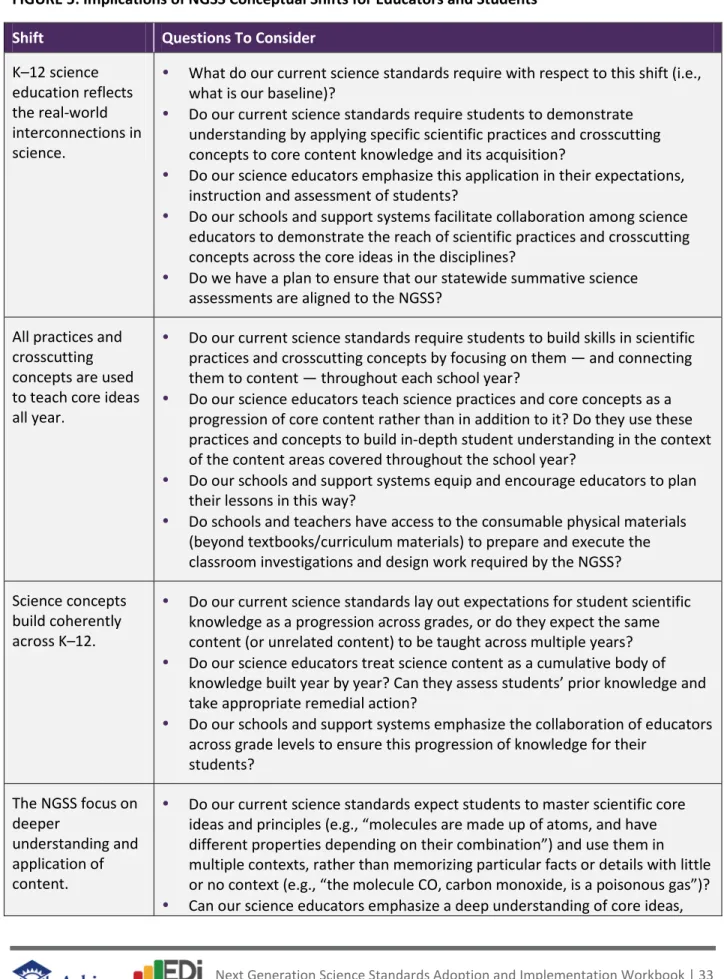
How is this different from current science expectations in most states? The NGSS authors have defined six conceptual shifts that the standards require for faithful implementation:
• K–12 science education should reflect the interconnected nature of science as it is practiced and experienced in the real world. Most state and district standards express the three dimensions as separate entities, leading to their separation in both instruction and assessment. The NGSS expectations for both students and teachers are that they will engage at the nexus of these three dimensions, applying practices to content knowledge and making use of Crosscutting Concepts to do so.
• The NGSS are student performance expectations — NOT curriculum. The Disciplinary Core Ideas themselves form a progression of knowledge for students that is clearly laid out in the NGSS, but the Science and Engineering Practices and Crosscutting Concepts should not be limited to specific time periods of instruction. Rather, educators and students should return to the Science and Engineering