Amanda L. Brasfield. School Librarian Participation in Professional Learning Communities. A Master’s Paper for the M.S. in L.S degree. April, 2011. 52 pages. Advisor: Sandra Hughes-Hassell
This study describes a survey given to school librarians regarding their participation in professional learning communities (PLCs). School librarians who are members of AASLForum and LM_Net were emailed the survey. The study was conducted to
determine what roles the librarians are playing within professional learning communities and how those roles compare with American Association of School Librarian standards. There are currently no quantitative studies of librarian roles in PLCs.
PLCs are an increasingly common strategy used to improved student achievement by focusing on student learning rather than teaching. Of the librarians survey 110 participate in at least one PLC. The survey covers in what type of PLC librarians are participating and what the obstacles are for participating. Most librarians surveyed participate in core subject area PLCs, and they cite ―time‖ as the biggest barrier to participation.
Headings:
School libraries
Surveys/School libraries
by
Amanda L. Brasfield
A Master’s paper submitted to the faculty of the School of Information and Library Science of the University of North Carolina at Chapel Hill
in partial fulfillment of the requirements for the degree of Master of Science in
LibraryScience.
Chapel Hill, North Carolina
April 2011
Approved by
_______________________________________
Professional Learning Communities (PLCs) are becoming more and more
commonplace in schools across the country. The groups are made up of teachers and
administrators that seek out and share learning and then act on that learning to improve
instruction (Hord, 1997). The movement is seen as one having great potential and
widespread adoption (Stoll & Louis, 2007). There is abundant literature on how to form
these groups and the norms that need to be established. The literature details successful
PLCs and presents data on how PLCs support student learning. Teachers, administrators,
and librarians are typically participants in these groups, but little research exists as to the
role librarians play within the PLC. This study seeks to establish what librarians are
doing in PLCs, as well as determine obstacles that stand in the way of librarian
participation.
Literature Review
In 1989, Susan Rosenholtz published Teacher's Workplace: The Social
Organization of Schools, a book that explored the way teachers in elementary schools
worked together. Her research found that teachers who feel supported through ongoing
professional development, a collaborative work environment, and increased responsibility
are more effective in their jobs at meeting student needs.
The idea that the teacher needs to be a continuous learner in order to best impact
student learning grew throughout the 1990s as more focus was put on teaching according
"No Child Left Behind" gave learning communities more data to consider and the ability
to evaluate if changes in instruction had an effect on student learning (Stoll & Louis,
2007). Providing teachers with more preparation, training, and autonomy was found to be
key in getting improved student outcomes. The autonomy should include teachers
participating in action research, setting standards, and "collaborative inquiry," as well as
the time to do these things during the school day (Darling-Hammond, 1996).
An attempt to give teachers the support they needed and the opportunities to
collaborate led to the development of the PLC (Hord, 1997). Teachers need capacity, "a
complex blend of motivation, skill, positive learning, organisational conditions and
culture, and infrastructure of support" in order to be most effective (Stoll et al, 2006). Not
only does the PLC create a space for teachers to get what they need for success, it is also
a sustainable model in which all school stakeholders--community members,
administrators, staff, and librarians--can participate (Stoll, et al., 2006).
The term PLC became popular in the education with the publication of
Professional Learning Communities: Best Practices for Enhancing Student Achievement
by Richard DuFour and Robert Eaker in 1998. Members of a PLC practice and share a
variety of instructional strategies, tools, experiences, data, and methods of approaching
problems (Wenger, 2006). Seen as an alternative to teachers working in isolation, most
definitions of PLC include members who work collaboratively, are reflective, and who
are learner-centered. A successful PLC is self-sustaining and taken seriously by its
members (Stoll & Louis, 2007). Conflicts within the PLC structure are dealt with openly
and with the groups help (Hord & Southwest Educational Development Laboratory,
The members of PLCs can vary, but almost always involve teachers. The
involvement of teaching assistants, non-teaching staff, community members,
administrators, central office staff, and parents varies from site to site (Stoll & Louis,
2006). PLCs may also extend beyond the walls of a school and be made up of people
from different schools, districts, or it can also be a virtual PLC made up of people who
may be unable to meet together in person. Within a school, a PLC may be made up of
teams of the same grade or subject-area. These groupings often make it easier to plan
collaborative units, share lesson plans, create assessments, and examine data because
there is already a shared subject area or the participants are teaching the same students.
Special area teachers who are often the only one of their type in a building—
librarian, art teacher, band teachers, physical education teacher, etc.— will come together
and form a PLC. At times, these special area teachers may also belong to a district-level
PLC. It is not unusual for the school to meet periodically in whole group to ensure the
school vision is clear. PLC time should not be used for administrative matters like
announcements.
The characteristics of a PLC are said to be "essential to the sustained
improvement of any organization" (Eaker, DuFour, & DuFour, 2002). There are five
attributes typically associated with PLCs. Administrators are expected to give supportive
and shared leadership by offering staff members decision-making opportunities and
giving other staff members the chance to lead and have authority. There is a collective
creativity where ideas are shared and staff work together to solve problems, plan, and
learn. The PLC needs shared values and vision in which the goals for PLCs are clear and
PLCs. On the small-scale, individual PLCs must have a relationship of trust and comfort
to share successes and failures. At the larger level, there must be a structure in place to
protect PLC time and to set the tone for what is expected in the PLCs. Finally, there
should be shared personal practicewith peers observing one another, sharing feedback,
offering critical suggestions for better practice and giving encourage all with the end
result of better student learning in mind (Stoll & Louis, 2006). To be most effective,
PLCs require full staff participation, supportive and participatory administration, and a
shared vision of increased student achievement (Buffum & Hinman, 2006 and Hord,
1997).
There is significant evidence that shows the formation of PLCs improves student
achievement at low performing schools (Hord & Southwest Educational Development
Laboratory, 2004). Data from 11,000 students from 820 secondary schools across the
country gathered by the Center on Organization and Restructuring of Schools revealed
that those schools that had organized into PLCs had greater student achievement in math,
science, history, and reading (Hord & Southwest Educational Development Laboratory,
2004). PLCs have been shown to increase student achievement and reduce gaps in
learning between students of different backgrounds. Some schools also report more
students present for school and fewer cut classes (Hord, 1997).
Within the data from the Center on Organization and Restructuring of Schools,
Hord (2004) identifies four factors that led to increased student achievement that are also
supported by PLCs. The first of the factors is "student learning" where teachers agree on
an authentic learning experience where students use higher order thinking skills to
and to parents. "Authentic pedagogy" is the second factor supported by PLCs. Within
their learning communities, teachers are able to develop a method of instruction and
assessment that supports their students and minimizes the effects of students' upbringing
or experience. The "organizational capacity" of a school staff to work together is another
important factor with a shared responsibility for student learning at the forefront. Finally,
a school needs "external support" in the form of a sufficient budget, parental support, and
governmental support (Hord & Southwest Educational Development Laboratory, 2004).
The teaching impact from PLCs results in tasks that take higher level thinking
skills. Teachers also reported higher morale and an improved attendance rate (Hord &
Southwest Educational Development Laboratory, 2004). Teaching performance is found
to improve with the autonomy of PLCs (Stoll & Louis, 2007). Teachers have the power
to meet together and make changes and then see the results of their work through the data
they collect. The PLC uses action research and inquiry to improve their professional
practice and determine the most appropriate techniques to use in the classroom (Eaker,
DuFour & DuFour, 2002). Teachers involved in PLCs feel a sense of responsibility to
make substantial and sustainable change in their school, which often leads to changes
system-wide (Harris & Jones, 2010).
These impacts are, of course, limited to schools with effective PLCs that exhibit
the attributes recognized by Hord (1997). Schools must have full participation with
system-wide support, the locus of the PLC must be improving teaching in order to
improve student learning, and research and results observed within the school must fuel
collective agreement to cooperate and use the PLC system, trusting one another and
buying in.
The attractiveness of PLCs may be the relationships formed out of the creative
work and the shared vision of the group (Stoll & Louis, 2006). But why is the PLC model
so popular right now? One theory is that fast-changing technology, changing corporate
structures, and the world literally at one's finger tips creates an overwhelming task for
teachers (Stoll & Louis, 2006). Facing the changing world in isolation is denying and in
direct opposition to globalization. The collective brain of the internet is also influencing
the way people see one another as sources of information. The PLC model brings minds
together as one as seeing in cloud computing, message boards, forums, wiki's, and
Twitter. The difference in PLCs is that the focus of the group’s work and study is to
solve the problems of their specific schools and students (Stoll & Louis, 2006). The hub
of resources, information, and technology in a school is the school media center.
The entire school faculty is expected to participate in PLCs, the librarian included.
The standards set forth by the American Association of School Librarians (AASL) in
Empowering Learners: Guidelines for School Library Media Programs (2009) are very
closely aligned to the goals of a PLC. The librarian can "lead from the center" (p. 19) by
working directly with teachers at the PLC level (AASL, 2009). One can see the
connection when aligning the goals for school library media programs and those of the
PLC.
First, the exemplary media program is learner-centered. The standards emphasize
an inquiry-based approach to teaching and learning where the student constructs his own
understanding (AASL, 2009). The model PLC is also learner-centered, which is different
from past school reform programs that were teaching-centered.
The library should also reflect the "mission, goals, and objectives of the school"
(p. 29) (AASL, 2009). The librarian creates a program to fit the school using both
qualitative and quantitative data to create policies and a vision. In the PLC model, it is
essential for the school to have a shared vision, mission, and values.
A culture of collaboration is expected from librarians in the standards. The media
specialist is expected to work with classroom teachers to "design, implement, and
evaluate inquiry lessons and units (p. 20)" (AASL, 2009). The PLC is a natural way for
the librarian to become involved in collaboration. The librarian and library staff are in the
unique position of serving the entire school and staff through the library. Being a figure
that has access to so many resources, as well as the opportunity to communicate with
students and faculty through the media center, the librarian is in a key position to be
involved in PLCs.
The units designed by librarians and teachers should be "inquiry-driven,"
according to the AASL standards (20). One of the goals for PLCs is also to provide
inquiry-based lessons (Darling-Hammond, 1996 and Eaker, DuFour & DuFour, 2002).
The constructivist theory of learning puts students in the driver's seat for their learning
while giving the opportunity to assess their own work throughout the process. Students
use their prior knowledge to help address new questions, and come to new
understandings (AASL, 2009).
The second half of the constructivist theory involves assessment. The assessment
might see where there are gaps. However, the data should also inform the instructor about
the effectiveness of the instruction and whether or not standards were met. The librarian
must be a reflective practitioner and this reflection should be daily to improve instruction
(AASL, 2009). Teachers and librarians working together should work throughout a unit
to assess how well students are learning. When a librarian makes a mistake, it should be a
learning experience and an area in which to grow (Zmuda & Harada, 2008). Student
assessment informs instruction, and the information gathered can be used to build new
knowledge for the teacher and librarian when they teach and plan together in the future
(AASL, 2009). Finding the best learning strategies and using those and adapting creates
change not only on the building level, but it can bring change at a system level.
Roles of the School Librarian in a PLC
The various roles of the school librarian are fundamental in examining the roles of
the librarian within PLCs, and they were the basis for the line of questioning in the
survey administered. The roles addressed here are found throughout the literature.
Information Specialist
The librarian is an information specialist, finding tools, acquiring access, and
removing obstacles for teacher and student learning (Gilmore-See, 2010). The AASL
identifies this role as using technology tools, creating learning experiences along with
teachers, connecting the school with the world through technology, and providing around
the clock access to the media center. The information specialist brings in new models and
demonstrates their use whether it be technology, pedagogy, research, or assessment
present. Ideally, the librarian would be a member of the PLC and be able to anticipate the
needs of the group. The librarian would also be familiar with the topics of discussion and
can pinpoint certain needs that may affect collection in the library. The librarian may be
able to suggest resources that teachers begin to gather on their own, such as subscribing
to certain blogs or following a particular person on Twitter.
Staff Developer
The school librarian also works in the role of staff developer, organizing or
facilitating staff training on the large- and small-scale. In The Many Faces of School
Library Leadership, Janice Gilmore-See writes, "Providing learning opportunities for
professional educators is at the core of the PLC." Because the librarian is expected to
communicate with the whole staff and its PLCs and to know the curriculum of the school,
he or she is uniquely positioned to be aware of what professional development teachers
may want and need (2010). The focus of professional development is taken off trying to
provide "one size fits all" training. Trainings might be smaller, come at point-of-need,
and may be on-going as a group peruses a particular topic.
Critical Friend and Reflective Learner
The librarian also plays the role of a critical friend, providing feedback to PLC
members about instruction, planning, and assessment. In schools, lesson plans are often
not reviewed by administrators or by colleagues, and the PLC offers an opportunity for
this reflective process to take place (McTighe, 2007). The librarian can help lead and
model the practice for teachers who may be nervous receiving or giving feedback to other
teachers. The librarian can also help to develop and research standardized practices for
professional’s practice and cultivates learning (Hughes-Hassell & Harada, 2007).
Because PLCs are focused on student learning, there is real-life, student data available to
make determinations about practice.
Collaborator and Teaching Partner
The librarian is a collaborator within the school, knowing well the resources
available. Librarians also have no specific grade level, nor department allegiances, so he
or she can help plan units that integrate a variety of curriculum areas. The librarian can
also participate in developing curriculum (AASL, 2009). The participation of the media
specialist also ensures equitable sharing of resources and ensures the schedule of the
media center and the availability of resources will coincide with need (Woolls, 2008).
Units are planned to incorporate media literacy and technology standards, ethical use of
information, as well as to foster inquiry-based learning (AASL, 2009).
When collaborating, the librarian can also implement assessment strategies
throughout a unit (AASL, 2009). The librarian can also offer resources to the teacher for
alternative assessment methods (Woolls, 2008). By working together the librarian and the
teacher have a plan for what students are expected to learn and the path students are
expected to take to accomplish the goals (Harada & Yoshina, 2005). This allows the
librarian to directly contribute to student success.
The librarian often plays the role of technology trainer (Gilmore-See, 2010). The
librarian might model a new technology, set-up accounts for teacher exploration, or help
to determine the potential of a new technology tool for a variety of content areas.
Technology is often housed in the library, managed by the librarian, and was purchased
PLC. The training can include, not only how to use the tool, but how the tool will impact
student learning, how the tool will help students construct knowledge and build
understanding.
When teaching, the librarian supports student reading, guides the use of
information, helps students build their own knowledge, teaches reflective practices,
encourages peer-editing, and models numerous technologies and communication tools to
reach a broader world (AASL, 2009).
Leader
In taking on the role of leader, the librarian is also taking on the role of listener.
The PLC is where the librarian can go to hear the concerns, needs, and ideas of teachers
and staff, and develop relationships with those people (AASL, 2009). Shared vision is an
important aspect of PLCs. When the librarian acts as a leader, sharing his or her library
vision with the group, the PLC can begin to see how that vision relates to each person’s
own professional goals (Kearney, 2000).
Being a leader in PLC may mean being prepared and anticipating questions or
issues before the meeting. The librarian may be a curriculum leader and help teachers see
beyond their own standards (Woolls, 2008). The librarian may also be the first to
volunteer to use a new teaching practices or technology tool in order to model the
strategy or to troubleshoot it.
Student Advocate
With access to a number of assistive technologies like portable amplifiers,
captioned videos, or print-enlarging computers, the librarian can be student advocates by
specialist can meet with special education teachers to determine alternative teaching
strategies that can be applied across the curriculum and shared in PLC (Hughes-Hassell
& Harada, 2007). By working with PLCs, the librarian can become aware of the learning
styles of students and take these into consideration by ordering appropriate resources and
making them available in the media center, as well as making teachers aware of the
resources available to address different learning styles (Kearney, 2000).
Rationale
The literature on the participation of librarians in PLCs is limited to what
librarians should be doing (in the case of the standards in Empowering Learners) and
what librarians could do to contribute.
Librarians can bring professional development opportunities and professional
resources for teachers to support pedagogy, as well as to support the formation and
effectiveness of PLCs. One of the articles detailing these roles is by Dianne Dees, et al.,
in a brief piece about librarians as leaders in PLCs (2010). The librarian can also provide
technology support and suggestions for incorporating technology into lessons. The piece
focuses on the librarian's "whole school view," which gives the librarian a significant role
in PLCs.
Susan Pennell in her article for California School Library Association Journal
echoes these roles and adds that librarians should be involved with teachers when
planning units from the beginning through to the final evaluation (Pennell, 2008).
PLCs are effective in ending teacher isolation, but librarians can reduce their own
within a district. This PLC network can be expanded by creating a virtual PLC (Jaeger,
2010).
There is no quantitative research of what librarians are doing in PLCs. The above
articles that do connect librarians to PLCs only speak from anecdotal evidence or a look
at the standards for librarians. There is nothing in the literature about what, if anything,
may keep some librarians from participating fully when PLCs are present in their school.
This study is designed to fill some of the gaps in the literature and provide the field with
more information for future studies.
Methodology
To help determine what school librarians are doing in professional learning
communities, an online survey was administered to members of the AASL (AASL) who
elect to receive the AASLForum listserv. The mission of the AASL is to support the
profession of school librarianship by providing access to best practices, research, and
trends in the field. The AASL links together professionals into a community. The listserv
is a way to contact this community all at once. This sample group was selected because it
represents a broad group of librarians who serve many grade levels across the United
States. Only members of AASL are able to view or post to the forum, and one must be a
member of the American Library Association first before joining the AASL. There are
692 members of AASL forum.
The survey was also sent to LM_NET members. LM_NET is a discussion group
in the form of a listserv for school librarians and people associated with school libraries.
This sample group was selected for the same reasons as AASLForum—it has broad
membership.
An email invitation was sent to members of the AASLForum and LM_NET to
respond to the survey. The invitation included a message of consent to participate in the
survey. A link in the posting sent respondents to the web-based survey where a second
message of consent was displayed. The survey was hosted by Qualtrics, a web-based
survey tool.
The survey is made up of items derived from the literature describing a librarian's
role in a PLC. The survey begins with demographic data collected in order to determine
any differences that exist based on grade level, school size, size of library staff, librarian
experience, and school district size.
It is expected that results will show a diversity of participation in PLCs, and it is
within reason to hypothesize that certain demographic factors may influence these
differences. For example, scheduling in secondary schools may allow for more shared
planning time than the scheduling in primary schools, so we may see differences among
grade levels.
School enrollment and staff size may affect a school's ability to break into or
organize PLCs. Very small schools may feel they have insufficient staff to have effective
PLCs or very large schools may have difficulty scheduling shared planning time for
PLCs. The location of a school may affect its PLC model with smaller, more rural
districts not having a central office that requires PLCs. A larger district may have more
and reduced lunch may also reflect the resources of a school. Differences in these areas
may offer information about how these variables affect, or not, PLC participation.
Items were included to determine librarian experience within their current school,
as well as in the profession to determine if those play a role in PLC participation. PLCs
require relationships and trust, so does a librarian's experience in the job or time at the
school play a role?
Extensive PLC participation can require a great deal of time from a librarian, and
a flexible schedule is also helpful for flexible meeting times. Items were included to
determine if having a library assistant affects the librarian's ability to more fully
participate in PLCs or if there is a difference for those with flexible versus fixed
scheduling.
A filter question: "Is PLC participation required at your school?" was included to
route those who have no PLCs at their school to items that relate to other types of PLCs
and to PLCs in general. Those who do have PLCs within their school were asked to
specifically list the PLCs in which they participate. This item will be used to determine
what types of PLCs librarians participate in like leadership, technology, core subjects,
special areas, or literacy.
As discussed in the literature review, there are a number of roles the librarian is
proposed to play within a PLC. Survey respondents who indicated their school had PLCs
were given a number of statements to which they could reply how often they perform
these roles within the PLC on a 4-point Likert scale. Participants were also asked to
respond to a question of how they communicate with PLCs in their school to determine if
The next section on the survey contains items that ask librarian opinions and
feelings towards PLCs, as well as to discuss obstacles to PLC participation. Items in this
section may help inform responses gathered in previous sections.
Finally, as mentioned in the literature review, librarians are encouraged to connect
with others in the profession through PLCs, and the survey contains items relevant to
their participation in these PLCs. (See Survey, Appendix A)
The survey was open for 10 days. Participants were sent an email 7 days after the
initial call for participation, reminding of the closure date.
Once the survey window was closed, educational research methods were used to
analyze the data. Patterns in the data are presented as appropriate in table form.
Descriptive statistics are provided. As this study is exploratory in nature and results will
not be generalized to larger populations, inferential statistics were not used. The results
reflect only the survey respondents and are not trend projections of librarians at-large.
Results
Characteristics of respondents
While the exact number of librarians invited to take the survey is unknown, the
final results show that 210 participants completed at least some of the survey and 169
participants completed the entire survey. Librarians serving all grade levels were
represented, with an even distribution across all grade levels. Each grade level is served
by at least 38% of participants, except for pre-Kindergarten (served by 23% of
Participants represent a wide range of school sizes, with 56% representing schools
with students enrollment from 200-800. Large schools were better represented that small
schools, with 13% of respondents representing schools with enrollments over 1400 and
3% representing schools of fewer than 200 students. Urban schools (13%) were
underrepresented compared to suburban (49%) and rural (33%) schools. The participants
serve at schools with a range of economic profiles, with the plurality (42%) of librarians
surveyed responding that, to their knowledge, fewer than 20% of students at their school
receive free or reduced lunch (FRL). 34% responded that between 20 and 50% of
students receive FRL, and 25% responded that over 50% of their students receive FRL.
The librarians surveyed also represent a wide range of experience, with
current-school tenures ranging from 0 – 35 years. The mean tenure at the librarians’ current
schools was 6.8 years, and the median tenure was 4 years. Similarly, the career lengths of
librarians surveyed were wide-ranging, with a minimum of zero years, a maximum of 39
years, mean of 12.4 years, and a median of 12 years. The means and medians show that
the participants in this survey were, on average, experienced librarians rather than ones
new to the field.
Results showed that 58% of respondents have at least one library assistant and
that 80% of respondents have either a flexible schedule or a hybrid fixed/flexible
schedule.
Participation in PLCs
Participation in PLCs is required for all staff at 39% of schools represented. PLC
participation is optional at 42% of respondents’ schools, and 19% of respondents report
participation at their school is optional, 57% reported that they participate in at least one
PLC at their school. Participants in the survey were also asked about participation in
PLCs specifically for librarians. Of the 179 surveyed who responded to the question, 132
(74%) indicated that they participate in a librarian PLC. Of these, the vast majority(114)
participate in a PLC for librarians outside of their school or online, while 18 participate in
one within their school—most likely in schools with more than one librarian.
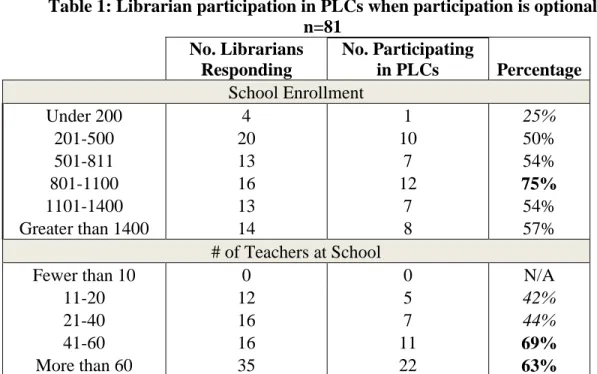
In order to see any potential effects of demographic factors on PLC participation,
the responses of the 81 librarians who reported that PLC participation was optional were
analyzed (Table 1). As the survey samples were not randomly obtained, results cannot be
generalized to any population outside that of the respondents themselves. With that in
mind, statistical significance was not calculated for any results from the survey.
Percentages obtained only reflect true differences in the responses of survey respondents,
not projections of trends among school librarians at large.
Table 1: Librarian participation in PLCs when participation is optional n=81
No. Librarians Responding
No. Participating
in PLCs Percentage
School Enrollment
Under 200 4 1 25%
201-500 20 10 50%
501-811 13 7 54%
801-1100 16 12 75%
1101-1400 13 7 54%
Greater than 1400 14 8 57%
# of Teachers at School
Fewer than 10 0 0 N/A
11-20 12 5 42%
21-40 16 7 44%
41-60 16 11 69%
More than 60 35 22 63%
Table 1 (con’t)
No. Librarians Responding
No. Participating
in PLCs Percentage
School Setting
Urban 11 6 55%
Suburban 42 26 62%
Rural 28 14 50%
Percentage of Students on FRL
Less than 20% 37 23 62%
21-50% 26 14 54%
Greater than 50% 18 9 50%
Schedule Type
Flexible 46 28 61%
Fixed 18 10 56%
Hybrid 16 7 44%
Primary Grades Served Pre-K
Many librarians served multiple grade levels, so the percentages are an average
by grouped grade level.
69%
K-5 55%
6-8 56%
9-12 65%
Experience
0-4 Years 15 7 47%
5-9 Years 23 15 65%
10-19 Years 25 14 56%
20 or More Years 18 10 56%
Tenure at Current School
0-4 Years 40 22 55%
5-9 Years 18 12 67%
10 or More Years 23 12 52%
*Percentages greater than 10% above the overall average participation rate of 57% are in bold. Percentages lower than 10% below the overall participation rate of 57% are in italics.
The number of students enrolled at a school does not appear to be strongly
associated with librarian PLC participation. Only 25% of librarians at schools with an
enrollment of fewer than 200 students participate, but the extremely small sample size
with enrollments of between 801 and 1100 students participate, but it is unlikely that this
is a unique factor to this particular school size that does not occur in schools slightly
larger or smaller. Although no pattern seems to exist in school enrollment, there does
appear to be a pattern of increasing PLC participation as faculty size increases. There is a
distinct difference between librarians from schools with 40 or fewer classroom teachers
and schools with more than 40 classroom teachers in terms of PLC participation. Other
school characteristics may also play a role in PLC participation as well - librarians at
suburban schools and schools with fewer than 20% of students on FRL report higher rates
of PLC participation than those in other categories. The grade levels served by a librarian
exhibited an interesting relationship with PLC participation, with Pre-K and High School
librarians considerably more likely to participate than elementary and middle school
librarians.
In addition to characteristics of the librarians’ schools, characteristics of the
librarians themselves also showed differences between categories. Librarians with a
flexible schedule were slightly more likely to participate than librarians with a fixed
schedule, and considerably more likely to participate than librarians with a hybrid
schedule. Librarian experience, both overall and at their current school, showed a
relationship with PLC participation. Librarians with 5-9 years of experience were the
group most likely to participate, as were librarians with 5-9 years of experience at their
current school.
Librarians’ Roles in PLCs
Survey respondents were asked to rate the frequency with which various
from the 110 librarians who indicated participation in at least one PLC are displayed in
Table 2.
Table 2. Percentage of respondents selecting "Often" or "Sometimes" for PLC Tasks
n=110
PLC Task Often/
Sometimes Affiliated Role
Provide knowledge to PLC members by providing relevant professional literature and research.
84% Information
Specialist
Take responsibility for extra assignments from the PLC, above and beyond what is normally expected.
76% Leader
Help teachers integrate technology into their
instruction. 74%
Information Specialist
Provide honest, positive and/or critical feedback to PLC members regarding instruction or
planning.
73% Critical Friend & Reflective Learner
Prepare for meetings by reading professional literature to anticipate topics or "jump start" conversation.
66% Information
Specialist
Co-plan a unit with a teacher(s) in a PLC. 63% Collaborator &
Teaching Partner
Offer alternative teaching strategies or assessment strategies to address different learning styles or needs.
63% Student Advocate
Teach a portion of a unit co-planned with a
teacher. 60%
Collaborator & Teaching Partner
Provide mini-lessons or training to a PLC at
their request to address a specific need. 49% Staff Developer
Meet with a PLC after the completion of a collaboratively taught unit to refine lessons or make adjustments to the unit plan for future practice.
45% Critical Friend & Reflective Learner
Create an assessment(s) within a PLC. 40% Collaborator &
Teaching Partner
Eight of the 12 tasks were performed at least ―sometimes‖ by over 50% of
responding librarians, with providing mini-lessons, exchanging feedback after a lesson,
creating assessments, and agenda-setting as the least-performed tasks. When examining
the prevalence of the various roles taken by librarians in a PLC, one can view the results
in Table 2 in two different ways, as seen in Table 3. If one believes that the performance
of all tasks within a given role is essential to the performance of that role, then the mean
participation rate should be used to compare roles. Using that paradigm, the role of
Information Specialist is the one most taken by responding librarians, followed, in order,
by Student Advocate, Critical Friend & Reflective Learner, Leader, Collaborator &
Teaching Partner, and Staff Developer. If, on the other hand, one believes that
performing one key task is sufficient to the performance of a role, then the ordering of
roles as in Table 2 produces an accurate rank. Under that paradigm, Information
Specialist is still the most prevalent role, followed in order by Leader, Critical Friend &
Reflective Learner, Collaborator & Teaching Partner, Student Advocate, and Staff
Developer. Under both paradigms, Information Specialist is the most common and Staff
Developer is the least common.
Table 3. Prevalence of Roles in PLCs
Rank Performance of all tasks are necessary to fill role
Performance of only one key task is sufficient to fill
role
1 Information Specialist Information Specialist
2 Student Advocate Leader
3 Critical Friend Critical Friend
4 Leader Collaborator
5 Collaborator Student Advocate
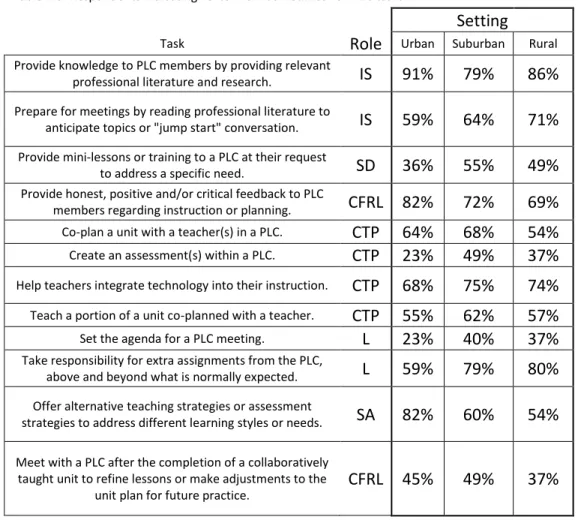
Due to the diversity in role popularity among librarians who indicated PLC
participation, various demographic factors were cross-tabulated with the prevalence of
the roles to determine if any relationships existed, the full results of which can be found
in Appendix B. Few patterns were found that suggest strong trends, but there were a few
noteworthy exceptions:
Librarians in schools with the fewest classroom teachers were considerably more
likely to perform the information specialist role than their colleagues at larger
schools, and 100% reported providing knowledge to PLC members by providing
relevant professional literature and research.
Librarians in schools with >50% FRL, librarians in urban schools, and librarians
with high levels of experience and/or tenure at their schools were extremely likely
(>90%) to provide knowledge to PLC members by providing relevant professional
literature and research.
Librarians at urban schools were much more likely that their peers to perform the
student advocate role, at 82% vs. 60% at suburban schools and 54% at rural
schools. Similarly, librarians at schools with >50% FRL were also much more
likely than their peers to perform the student advocate role.
Librarians at schools with high rates of FRL are less likely than their peers to
perform the role of Collaborator & Teaching Partner.
Career experience seems related to the Collaborator & Teaching Partner role, as
librarians with the most experience are more likely than their peers to perform
Librarians with a fixed schedule are far less likely than their peers to perform the
role of Collaborator & Teaching Partner.
Librarians in high-FRL schools and librarians with a fixed schedule are far less
likely than their peers to meet with a PLC after the completion of a collaboratively
taught unit to refine lessons or make adjustments to the unit plan for future
practice.
Librarians in urban schools perform the tasks related to the Leadership role less
often than their peers.
Librarians with 0-4 years of experience were less likely than their peers to take a
Staff Development role in PLCs.
Librarians with fixed schedules were more likely than their peers to ―never‖
perform the following tasks: Prepare for meetings by reading professional
literature to anticipate topics or "jump start" conversation; provide mini-lessons or
training to a PLC at their request to address a specific need; co-plan a unit with a
teacher(s) in a PLC; create an assessment(s) within a PLC; help teachers integrate
technology into their instruction; teach a portion of a unit co-planned with a
teacher; and meet with a PLC after the completion of a collaboratively taught unit
to refine lessons or make adjustments to the unit.
Across the board, librarians at the highest- and lowest-enrollment schools tend to
take on the roles at a higher rate than their peers at more moderate-sized schools.
Librarians at mid-sized schools are also much more likely to ―never‖ perform most
In summary, multiple factors related to both the school and the librarian may be
associated with the roles librarians take in their PLCs, but true randomized samples
should be surveyed before any strong conclusions are drawn.
How Librarians Keep Up With PLC Happenings
Respondents were asked how they keep up with PLC happenings at their school.
In all, 158 librarians reported that PLCs were in place at their school, and their responses
are displayed in Table 4.
Table 4. How librarians keep up with PLC happenings n-158
Attend school improvement team meetings, or leadership meetings 47%
Minutes and agendas are distributed through email 34%
Meet regularly with PLC team leaders 32%
Other 25%
Minutes and agendas are posted to a management system like Blackboard, etc. 15%
As seen in Table 4, school improvement team and leadership meetings are the
most popular way librarians keep up with PLC happenings, and very few schools post
minutes and agendas to a management system. 25% of respondents indicated that they
keep up through a non-listed method. Of those, the most common experience is that
librarians are unaware of the activities of other PLCs, or that they keep up through e-mail
and/or word of mouth.
PLC Type
Respondents were asked to name the PLCs in which they actively participate. Of
respondents who indicate that they participate in at least one PLC, responses were
analyzed and coded into seven categories: core subjects (English, Math, etc.), Specialists
Literacy, Community-focused (at-risk students, etc.), and non-traditional (reserved for
PLCs that do not meet the standard definition of a PLC, but respondents listed as a PLC).
Each PLC named was coded, and the number of librarians participating in a PLC
category was divided by the total number of librarians who participate in at least one
PLC.
Table 5. Prevalence of PLC type
Core Subjects 43%
Leadership 28%
Specialists 23%
Technology 16%
Literacy 14%
Nontraditional 9%
Community Focused 3%
Benefits and Obstacles of PLCs
Librarians surveyed were asked what they saw as the greatest benefits of PLC
participation. The results are shared in Table 6. The values indicate the percentage of the
110 PLC-active librarians that indicate that a potential benefit is true for them.
Table 6. Perceived benefits of PLC participation n=110
Professional growth 85%
Shared vision and goals within the school 76%
Increased communication among staff 72%
Collaborative atmosphere 68%
Improved student achievement 65%
Building relationships 64%
Less isolation 63%
Personal growth 55%
Focus on the student 51%
Shared responsibility 51%
Focus on results 42%
Feeling supported by the administration 41%
In addition to the categories listed in Table 6, 13 respondents indicated that the
greatest benefit they receive from PLC participation falls under the category of ―other.‖
These respondents were asked to describe the benefit, and one particularly interesting
benefit to arise from this item was that PLCs provide ―an important way to be seen as
valuable.‖
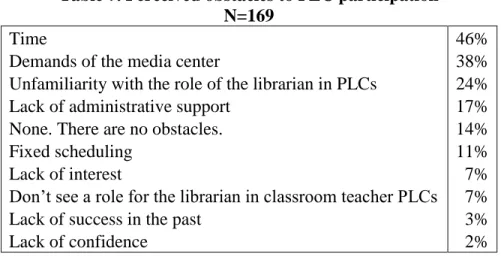
Whether they indicated participation in a PLC or not, respondents were asked to
indicate what they perceive to be the biggest obstacles to PLC participation. Responses
are shown in Table 7. Obstacles listed in the ―other‖ category include non-acceptance of
librarians in teacher PLCs and the demands of covering classes for teachers in PLCs.
Table 7. Perceived obstacles to PLC participation N=169
Time 46%
Demands of the media center 38%
Unfamiliarity with the role of the librarian in PLCs 24%
Lack of administrative support 17%
None. There are no obstacles. 14%
Fixed scheduling 11%
Lack of interest 7%
Don’t see a role for the librarian in classroom teacher PLCs 7%
Lack of success in the past 3%
Lack of confidence 2%
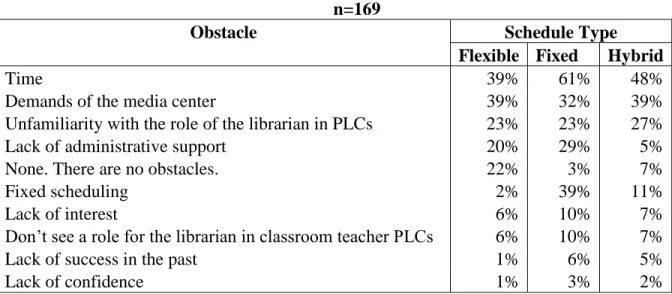
As discussed in the section on roles librarians take within PLCs, librarians with
fixed schedules are considerably more likely to ―never‖ perform many of the tasks
associated with the prescribed roles. In order to examine potential reasons for this
relationship, schedule type was cross-tabulated with perceived obstacles. Results are
Table 8. Perceived Obstacles by schedule type n=169
Obstacle Schedule Type
Flexible Fixed Hybrid
Time 39% 61% 48%
Demands of the media center 39% 32% 39%
Unfamiliarity with the role of the librarian in PLCs 23% 23% 27%
Lack of administrative support 20% 29% 5%
None. There are no obstacles. 22% 3% 7%
Fixed scheduling 2% 39% 11%
Lack of interest 6% 10% 7%
Don’t see a role for the librarian in classroom teacher PLCs 6% 10% 7%
Lack of success in the past 1% 6% 5%
Lack of confidence 1% 3% 2%
Not surprisingly, librarians on fixed schedules list time as a major obstacle to
participation in PLCs, and are much less likely than their peers to claim no obstacles to
PLC participation.
Discussion
PLC Participation
With 39% of respondents reporting that PLCs were required and another 19
percent reporting no PLCs at their school, the remaining respondents were considered to
determine librarian participation in PLCs by choice. Of the 81 respondents who reported
that PLCs were optional, only 57 percent participate in a PLC at their school. With the
AASL standards focusing considerably on inquiry-based instruction and collaboration, as
well as the goals of PLCs being similar, one may wonder where these librarians are
creating the relationships to sustain an ideal program. Because the PLCs are optional, and
there is not whole school participation, the conditions may not be ideal for the librarian to
be active in the groups. The optional PLCs may lack administrative support or district
also be independently formed and then not all have a shared vision or goals, making it
difficult for a librarian to navigate within the different PLC cultures. The librarian may
need to do extra leg work to reach out to PLCs that are not organized in the whole school
and find ways to more efficiently fulfill ideal roles.
The size of school faculty has an increasing pattern of PLC participation by
librarians when PLC participation is optional. Schools of fewer than 40 teachers have less
than 45% participation, but schools with between 41 and 60 teachers have 69%
participation and schools with more than 60 teachers have 63% participation. Larger
schools may have more PLCs and thus more opportunity for the librarian to find PLCs
that make sense in the library mission. More PLCs may also give the librarian
opportunity to have more successful PLC encounters or to work with a different PLC if
one is found to not be a good fit. There may also be multiple librarians at larger schools,
which may permit for a more flexible schedule for librarians to take turns attending PLCs
and working in the media center.
Optional PLC participation is also higher at schools with fewer than 20% of
students on FRL and at suburban schools. Increased parental support in a school with
more resources may make it easier for PLCs to meet. Community and system-wide
support can help create the time needed for librarian participation in PLCs by providing
library assistants or volunteers to monitor the library. More affluent school populations
may also reflect a larger school budget that can support PLCs with resources and
professional development that might be coordinated by the librarian.
Librarians with flexible schedules were slightly more likely (61%) to participate
only 44% of librarians with a hybrid schedule are participating in optional PLCs in their
school. The unique and varying ways in which a hybrid schedule may be manifested
makes it difficult to make a conjecture as to why this difference exists.
An area that may warrant further research or could also be a random artifact of the
data is the participation of librarians with tenure of 5-9 years at their current school or 5-9
years experience as a librarian. Those groups were more likely to participate in optional
PLCs than their more or less experienced counterparts.
When it comes to PLCs for librarians, 74% of all respondents reported
participation in a librarian PLC. Most of those (86%) were in PLCs outside of their
school either in person or virtually. Further research may be needed to determine how the
online PLCs function, and if the PLC is a true PLC or are actually professional
development, tips and tricks, or point-of-need advice forums. Only 14% are able to meet
in PLCs with other librarians within their own school, which may also reflect
practitioners who are the only media specialist at their school.
Librarians' Roles in PLCs
The literature suggests several different roles the school librarian may play in
PLCs. The survey focused on 6 of these roles: information specialist, leader, collaborator
and teaching partner, critical friend and reflective learner, student advocate, and staff
developer. Of those who indicated participation in at least one PLC, 84% indicated they
"Often" or "Sometimes" provide professional literature to PLC members (Table 2). This
was the top response from this section of the survey. This role of information specialist
was the one most taken by survey respondents, with 66% also indicating they read
74% reporting they help teachers integrate technology into their lessons. In Empowering
Learners, the text indicates that the role of information specialist ranked 2nd in a survey
of media specialists who were describing their current roles and predicting their future
roles in the media center (2009). While the librarians who answered that survey placed
the information specialist role second, the librarians surveyed reported this role as the one
they take most often in PLCs (Table 3).
Librarians did not rank leader as a current or future role in the AASL survey, but
the role is mentioned in the literature (2009). The role of leader is second when all survey
questions regarding roles are considered, as 76% of respondents report taking on
additional responsibilities beyond what is expected of members. In contrast, when
considering both questions about leadership the rank drops to fourth. For librarians in
urban schools, the leadership role was less likely to be performed than it is at suburban
and rural schools. In contrast, the role of staff developer ranks last when considering
either perspective for rankings. Training other staff members is also a type of leadership
role that empowers staff members. A closer look at how PLC members are learning and
where their professional development comes from is warranted here.
The highest ranking role librarians named for the future was that of instructional
partner (AASL, 2009). In this study, the collaborative role ranks fifth if all questions of
collaboration on the survey are considered and fourth if one only considers one task,
which in this case in co-planning a unit with a teacher (63%). While the samples for
neither survey can be applied to librarians at-large because the samples were not
randomly selected among all librarians, it appears that within PLCs, the collaborative role
When the collaborative data is cross-tabulated with demographic data, librarians
at schools with a higher rate of FRL are less likely than their peers to participate in
collaboration in PLC. Additional support may be needed in these schools to provide time
and resources librarians may need to collaborate.
Librarians with a fixed schedule were also less likely to collaborate and be
teaching partners. These fixed schedule librarians may also need more support in the
form of planning time to meet with teachers. This needed support is also reflected in the
way that fixed schedule librarians are much more likely to answer "never" for seven of
the 12 tasks on the survey. These librarians may also need to explore alternatives to
face-to-face meetings with teachers and explore options that allow virtual collaboration and
communication. Fixed schedule librarians may also want to seek out a mentor with a
fixed schedule who is finding ways to make their system work so that librarian standards
may be more completely fulfilled. Ideally, fixed scheduling would be transitioned to
flexible scheduling as is recommended in the AASL standards (2009).
PLC Type
The most popular PLC type where librarians participated are the core subject
areas in which grade level PLCs were also included (43%). It might be likely that the
core subject teachers are also the most likely to be higher traffic library uses, so the
librarian is catering to the largest group of active patrons (Table 5).
The second most popular group of PLCs for librarians is leadership (28%). These
PLCs include curriculum, school climate, and school improvement team. Being a leader
is an important component of the librarians’ position (AASL, 2009). With slightly less
finding that many are taking on the role of leader within a PLC, further research may
need to be done to determine how librarians are ―leading from the center‖ as suggested in
the standards (AASL, 2009).
Only 16% of respondents indicated they belonged to a PLC that focuses on
technology. This may be attributed to there not being such a PLC at their school, so a
future study may look to determine how schools as a whole are looking at technology
integration and use. Are perhaps these topics being discussed in all PLCs rather than
having a separate PLC for the subject?
A small number, only 9%, responded that they belonged to other, less traditional
PLCs. Some of the answers to the open response question, however, indicated that the
respondent may not know what makes a group a PLC. One response listed Linkedin.com,
an online networking tool, as a PLC. Other indicated they were members of listservs, but
the format of the listserv and the purpose of it may not make it a PLC as described by
Richard DuFour and Robert Eaker in 1998. Some of the responses may be online support,
networking, point-of-need advice, but they were not traditional PLCs.
The literature supports the claim that PLCs are beneficial, and this was supported
by the survey results. The spread between the most popular perceived benefit and the
least popular answer was from 85%-39%. Professional growth (85%) was the most
commonly cited benefit with shared vision and goals within the school (76%) as the
second more common response. At the bottom of the list was that time is well spent in
PLCs, as results are valuable, but even this response was selected by 39% of respondents.
Time is the largest obstacle librarians see in participating in PLCs (Table 7).
There a number of factors that could be at play here. At some schools, PLCs are
scheduled to all meet at the same time. It is impossible, even with multiple librarians, to
attend all of the meetings with regularity. Librarians may be in a position to have to
choose where to attend. Librarians may also be limited with time because they are
assigned to a PLC that meets at the same time as other PLC. If administration is assigning
the librarian to only meet with the English department, regardless of what the English
department actually needs, the librarian may not have time to also get to other meetings.
The second most popular response that may also contribute to a librarian’s time
crunch is the demands of the media center (38%). With media center hours often
beginning before the school day s begins and extending beyond the last bell, the librarian
may be called upon to supervise students during these times. The media center may also
be in use when teachers are using their different planning times to meet in PLC. The 6th grade science class, for example, may meet in the library while the 8th grade math PLC is meeting. Schools with only one librarian could not make this scenario work. One might
also consider the demands of the library program itself. Librarians must find time to
create budgets, do collection development, plan, and perform other maintenance duties. If
the librarian is not required to take time to attend PLCs, that time may be being used to
attend to administrative matters. Each of these areas could be investigated in future
studies.
Similarly to the way fixed schedule librarians indicated they ―never‖ do many of
the tasks on the survey more often than their peers, fixed schedule librarians standout in
schedule contributed to their inability to participate in PLCs (Table 8). Time was an
obstacle for 61% of fixed schedule librarians. In comparison, only 39% of flexible
schedule librarians and 48% of hybrid schedule librarians said time was an obstacle.
Flexible schedule librarians were the most likely to say there are no obstacles to meeting
in PLC, whereas only 7% of hybrid and 3% of fixed schedule say there are no obstacles.
The responses of librarians with fixed scheduling raises several questions about
how a librarian can fulfill the roles ascribed in the literature and the AASL standards
without the time to do so. It is apparent that more research needs to be done to determine
if fixed scheduling and successful, full PLC participation can co-exist. Districts that
require PLC participation but also have fixed schedule school libraries may want to
reexamine their librarians’ role so that it might be expanded to better serve the school
community.
Study Limitations
There are a few questions that should have been included in the survey. Librarians
were asked about library assistants, but were not asked how many librarians worked at
their school. Librarians should have also been asked if they are active in at least one PLC
on their school level. They were asked if PLCs were required or optional at their schools,
but this did not give enough information for the analysis. PLC participation was
determined by a combination of the PLC requirement question with an item that asked
librarians to name the PLCs in which they participate. A librarian indicating that PLCs
were not required at their school and not listing any PLCs in the open response question
were assumed to not participate in any PLCs. Coding open response questions for the
answered "All" or used acronyms to answer. Asking librarians to code their own PLC
involvement may have been more accurate.
Conclusion
The purpose of this study was to gather data about what librarians are actually
doing in PLCs. The exploratory nature of the study has revealed a number of areas where
further research may be warranted. It is worth noting that some of the expected roles of
the school library media specialist laid out in Empowering Learners are not necessarily
being acted upon in the context of PLCs. A future survey with a truly random sample
would be a good next step to explore these areas.
To put it into the words of one of the survey respondents, PLCs are ―an important
way to be seen as valuable.‖ If a librarian is not active in PLCs, how are standards being
fulfilled? More importantly, however, is the school community, namely the students,
being served if the librarian is not involved?
With 24% of respondents unaware of what is expected, there may also be a
knowledge deficit by others at the school level. If librarians do not know their role,
teachers and administrators aren’t likely to understand it either.
References
American Association of School Librarians. (2009). Empowering learners: Guidelines
for school library media programs. Chicago, Ill: American Association of School
Librarians.
Black, S. (2007). A Community of Learners. American School Board Journal, 194(11),
40-47. Retrieved from EBSCOhost.
Buffum, A., & Hinman, C. (2006). Professional Learning Communities: Reigniting
Passion and Purpose. Leadership, 35(5), 16-19. Retrieved from Education Full
Text database.
Cox, E. (2010). Critical Friends Groups: Learning Experiences for Teachers. School
Library Monthly, 27(1), 32-4. Retrieved from Education Full Text database.
Darling-Hammond, L. (1996). The quiet revolution: Rethinking teacher development.
Educational Leadership 53(6): 4-10.
Dees, D., Mayer, A., Morin, H., & Willis, E. (October 01, 2010). Librarians as Leaders in
Professional Learning Communities through Technology, Literacy, and
Collaboration. Library Media Connection, 29, 2, 10-13.
Eaker, R. E., DuFour, R., & DuFour, R. B. (2002). Getting started: Reculturing schools
to become professional learning communities. Bloomington, Ind: National
Educational Service.
Gamble, J. (January 01, 2008). Professional Learning Communities. School Library
Gilmore-See, J. (2010). Staff development--teacher-librarians as learning leaders. In S.
Coatney (Ed.), The Many Faces of School Library Leadership (pp. 115-122).
Santa Barbara, CA: Libraries Unlimited.
Harada, V. H., & Yoshina, J. M. (2005). Assessing learning: Librarians and teachers as
partners. Westport, Conn: Libraries Unlimited.
Harris, A., & Jones, M. (2010, July). Professional learning communities and system
improvement. Improving Schools, 13(2), 172-181.
doi:10.1177/1365480210376487
Hord, S.M. (1997). Professional learning communities: Communities of continuous
inquiry and improvement. Austin: Southwest Educational Development
Laboratory.
Hord, S. M., & Southwest Educational Development Laboratory. (2004). Learning
together, leading together: Changing schools through professional learning
communities. New York: Teachers College Press.
Hughes-Hassell, S., Dupree, D., & Cox, E. In press.
Hughes-Hassell, S., & Harada, V. H. (2007). School reform and the school library media
specialist. Westport, CT: Libraries Unlimited.
Jaeger, P. (October 01, 2010). Virtual PLC's @ Their Best: A Daily Diatribe. Library
Media Connection, 29, 2, 14-15.
Kearney, C. A. (2000). Curriculum partner: Redefining the role of the library media
McTighe, J. (2007) Making the most of professional learning communities. Retrieved from
http://www.ksde.org/Portals/0/Innovation%20and%20Improvement%20Division/PLC
%20Article.pdf.
Pennell, S. (2008). Teacher Librarians in Professional Learning Communities. (Cover
story). CSLA Journal, 32(1), 25-26. Retrieved from EBSCOhost.
Public Schools of North Carolina. (n.d.). Professional learning communities. In
Professional Learning Communities at School. Retrieved from State Board of
Education, Dept. of Public Instruction website:
http://www.ncpublicschools.org/profdev/resources/proflearn/
Stoll, L., Bolam, R., McMahon, A., Wallace, M., & Thomas, S. (2006). Professional
learning communities: a review of the literature. Journal of Educational Change,
7(4), 221-258. doi:10.1007/s10833-006-0001-8.
Stoll, L., & Louis, K. S. (2007). Professional learning communities: Divergence, depth
and dilemmas. Maidenhead: McGraw-Hill/Open University Press.
Woolls, B. (2008). The school library media manager. Westport, Conn: Libraries
Unlimited.
Zmuda, A. & Harada, V.H. (2008). Librarians as learning specialists: Meeting the
Appendix A. Survey
School librarian participation in professional learning communities Q1 What grade levels do you serve? (check all that apply)
Pre-K (1)
Kindergarten (2)
1 (3)
2 (4)
3 (5)
4 (6)
5 (7)
6 (8)
7 (9)
8 (10)
9 (11)
10 (12)
11 (13)
12 (14)
Q2 What is your school's enrollment?
Under 200 (1)
201-500 (2)
501-800 (3)
801-1100 (4)
1101-1400 (5)
greater than 1400 (6)
Q3 How many classroom teachers work in your school?
10 or less (1)
11-20 (2)
21-40 (3)
41-60 (4)
Q4 Do you consider your school population to be primarily...
Urban (1)
Suburban (2)
Rural (3)
Q5 What is the approximate percentage of students receiving Free and Reduced Lunch at your school?
Fewer than 20% (1)
21-50% (2)
Greater than 50% (3)
Q6 How long have you worked as a librarian in your current school? Fill in the blank with the number of years completed. (First year=0, Second year=1)
Q7 How long have you worked as a school librarian? Fill in the blank with the number of years completed. (First year=0, Second year=1)
Q8 Do you have a library assistant?
No (1)
Yes, 1 and he/she is full-time (2)
Yes, 1 and he/she is part-time (3)
Yes, more than one full-time (4)
Yes, more than one part-time (5)
Yes, a combination of full- and part-time (6)
Q9 Do you have a flexible schedule?
Yes, it is flexible. (1)
No, it is a fixed schedule. (2)
No, it is a hybrid, partially fixed and flexible. (3)
Q10 Is PLC participation required in your school?
Yes, for everyone (1)
Yes, for teachers only (2)
No, participation is optional (3)
There are no PLCs at my school. (4)