Douglas S. Diesenhaus. Analysis of the Impact of Library Instruction on the Writing Ability of Community College Students. A Master’s Paper for the M.S. in L.S degree. July, 2012. 59 pages. Advisor: Evelyn H. Daniel.
This study performs a content analysis on a series of written assignments submitted by students in an undergraduate English Composition class at a community college. Students attended four collaboratively-planned library instruction sessions during the semester. This study seeks to determine how these sessions may have affected the essay products.
The study used a rubric to make a quantitative and quantitative assessment of the quality and development of student writing over the course of three writing assignments,
examining the writing against the standards of the Association of College and Research Libraries’ (ACRL) “Information Literacy Competency Standards for Higher Education.” Five recommendations to strengthen the collaboration with the goal of improving student writing are included.
Headings:
ANALYSIS OF THE IMPACT OF LIBRARY INSTRUCTION ON THE WRITING ABILITY OF COMMUNITY COLLEGE STUDENTS
by
Douglas S. Diesenhaus
A Master’s paper submitted to the faculty of the School of Information and Library Science of the University of North Carolina at Chapel Hill
in partial fulfillment of the requirements for the degree of Master of Science in
Information/Library Science.
Chapel Hill, North Carolina
July 2012
Approved by
_______________________________________
© 2012
Table of Contents
Acknowledgements ... 3
Problem Statement ... 4
Introduction ... 6
Literature Review... 10
Location ... 12
Collaboration... 14
Methodology ... 15
Constraints ... 18
Findings... 19
Table 1: Summary of Quantitative Scores ... 19
Intercoder Validity ... 30
Table 2: Summary of Independent Evaluator Quantitative Scores ... 30
Limitations ... 32
Conclusions and Recommendations ... 33
Appendix A: Writing Assignments and Professor’s Grading Rubrics ... 42
Appendix B: Author’s Grading Rubric ... 49
Appendix C: Scoring Spreadsheet ... 50
Appendix D: Independent Evaluators’ Scoring ... 53
Acknowledgements
Problem Statement
For years, teachers, administrators, and librarians have been raising the alarm about
declining writing skills among high school and college students. These calls for reform
often take the form of formal reports, including the National Commission on Writing’s
“The Neglected ‘R’: The Need for a Writing Revolution” (2003) or descriptions of
programmatic changes at universities, such as Thomas Bartlett’s “Why Johnny Can’t
Write, Even Though He Went to Princeton” (2003). Each warning usually focuses on the
same problem: while “many models of effective ways to teach writing exist, both the
teaching and practice of writing are increasingly shortchanged throughout the school and
college years.”1
These efforts also emphasize the centrality of writing as a core competency
among college students. In Jonathan Monroe’s examination of the various theoretical
approaches to writing instruction, he notes that “effective writing is central to the work of
higher education,”2
while others suggest that writing is “among those [skills] that
undergraduates are expected to master during their college education, regardless of
discipline (Greenlaw and Deloach 2003)”3 and “is so essential to learning, that one
cannot be educated and yet unable to communicate one’s ideas in writing form.”4 Yet
despite these repeated calls for more effective writing instruction, and for better
outcomes, “the quality of writing continues to pose significant challenges to educators,”5
and “too few student writers are producing adequate prose.”6
What can be done to improve student writing? Some suggestions call for more
at the Turn of the Twenty-First Century” (2005). However, are there additional or
innovative methods of instruction that could marshal current resources in new ways?
While collaboration between composition teachers and library instructors is a
well-established process (with examples detailed below), as Birmingham et al. note,
Ricker and Kaplan’s 2006 survey on library and writing program collaboration found that
only 47% of respondents reported formal collaboration,7 “only 24% collaborate with one
another to create instructional tools, 19% plan instructional sessions together, and only
16% team-teach even a single session” (Ricker and Kaplan in Birmingham et al.)8
Additionally, as Artman notes about the popularity of single “one-shot” sessions,
yet even as institutions are beginning to embrace direct information literacy instruction as part of the twenty-first century college curriculum, sustained attention to students’ use of information resources has not yet become a central curricular component of first-year composition, where information and research instruction is too often relegated to a one-shot library session.9
In response to this identified need, the current study will examine whether a strengthened
collaboration between English composition classes and library instruction could address
Introduction
What is “good” writing? One definition is that good writing is the representation of well-developed critical thinking skills. This connection between “good writing” and “good
thinking” has been discussed in a number of disciplines. Political scientists Cavdar and
Doe refer to writing as “thought on paper,”10
and in their survey of writing in professional
environments, Faigley and Miller received responses that prized clarity, brevity, and
organization, as well as one which indicated that “good writing and clear thinking are
inseparably tied.”11
Additionally, writing instructor D. Gordon Rohman notes that “in
terms of cause and effect, thinking precedes writing,” and “good thinking can produce
good writing; and, conversely, without good thinking, good writing is impossible.”12
While this question of what defines “good writing” is addressed in many
disciplines, it is the fields of composition, English, and library science that will likely
bear the largest burden of work in actually improving student writing, often through
mandatory writing-intensive courses such as “Comp 101,” “English 101,” or the
“First-Year Experience” (Barclay and Barclay, 1994). It is in these courses where innovative
approaches to improving student writing may be experimented with and tested.
Additionally, these types of classes often include a library instruction or “information
literacy” component to teach students the skills necessary for using library resources to
find information and research material, whether through a one-shot class, a sequence of
multiple sessions, or online instruction (Atwood and Crosetto, 2009). These fields also
have some common goals, with both encouraging “undergraduates to educate themselves
through reading, critical thinking, and the effective and ethical use of information.”13 The
information literacy instruction at the library, and will examine whether the collaboration
between composition professor and librarian was sufficient to improve students’ critical
thinking and writing skills.
Support for “information literacy” core competencies has been identified as a key
element of students’ educational needs at many levels. In their exploration of student
learning needs in community colleges, Cindy Miles and Cynthia Wilson identified
several information literacy-related concepts among their necessary “21st century skills,”
including “Information management skills (collecting, analyzing, and organizing
information from a variety of sources)” and “Technology skills (computer literacy,
Internet skills, retrieving and managing information via technology).”14
Additionally,
“information literacy” core competencies have been implemented with the
encouragement of regional accrediting agencies around the country, including the
Southern Association of Colleges and Schools (SACS), the Western Association of
Schools and College (WASC), and the Middle States Commission on Higher Education
(MSCHE).15 These core competencies have also been recognized at a statewide level in
California16 and in Missouri, where the Department of Education identifies “managing
information” as a general education requirement for all public institutions of higher
education and aims to “develop students’ abilities to locate, organize, store, retrieve,
evaluate, synthesize, and annotate information from print, electronic, and other sources in
preparation for solving problems and making informed decisions.”17
In library science, the Association of College and Research Libraries (ACRL)
retrieve, analyze, and use information,”18
and characterizes an “information literate”
individual by a set of six standards, including the ability to:
1. Determine the extent of information needed
2. Access the needed information effectively and efficiently 3. Evaluate information and its sources critically
4. Incorporate selected information into one’s knowledge base 5. Use information effectively to accomplish a specific purpose
6. Understand many of the economic, legal, and social issues surrounding the use of information and accesses and uses information ethically and legally.
From the composition perspective, the Council of Writing Program Administrators’
“Outcomes Statement for First-year Composition,” describes “the common knowledge,
skills, and attitudes sought by first-year composition programs in American
postsecondary education” and cites the following core competencies from among a larger
list:
Use writing and reading for inquiry, learning, thinking, and communicating
Understand a writing assignment as a series of tasks, including finding, evaluating, analyzing, and synthesizing appropriate primary and secondary sources
Integrate their own ideas with those of others
The uses of writing as a critical thinking method
The interactions among critical thinking, critical reading, and writing
Practice appropriate means of documenting their work 1920
From the English discipline, the National Council of Teachers of English notes in its
“Framework for 21st Century Curriculum and Assessment” that:
Students conduct research on issues and interests by generating ideas and questions, and by posing problems. They gather, evaluate, and synthesize data from a variety of sources....Students use a variety of technological and
information resources (e.g., libraries, databases, computer networks, video) to
gather and synthesize information and to create and communicate knowledge.21
These overlapping frameworks and standards suggest that continued and strengthened
notes: “both rhetoric and composition and library reference and instruction would
become more robust if each would more fully understand and integrate the work of the
Literature Review
The contribution of library instruction to the overall goals of an information literate
student is well-established, as seen in a review of the literature. The study of the
connections between library instruction and writing ability, however, seems more limited,
with fewer studies directly addressing the impact of library instruction on student writing,
as opposed to the effect on a student’s library use skills or overall levels of information
literacy. Also, as Artman, Frisicaro-Pawlowski, and Monge note in their 2010 study of
incorporating or embedding information literacy instruction into composition and writing
classes, these studies usually appear in the library science literature: “Prior to 2009, the
majority of scholarship that seeks to theorize the influence of IL instruction within
composition classrooms—or the role of writing in information literacy instruction—
appears in journals outside the field of Composition.”23
Examples include Molly
Flaspohler’s (2003) study using a “laddered approach to information literacy
integration”24
and “triangulated assessment”25 of questionnaires, bibliographic analysis,
and an in-class writing assignment to show increased student performance across nine
sections of first-year writing and speaking courses; Smiti Gandhi’s (2004) study on the
effectiveness of specific instruction strategies in a five-session library instruction class at
Valencia Community College, and Barclay and Barclay’s (1994) survey of freshman
writing programs and students’ information literacy competencies. While Gandhi’s
teacher evaluation survey and pre- and post-test results showed an increase in learning
and comfort with database use after the multiple library sessions of classroom instruction,
to report their own classroom techniques for introducing research skills based upon their
assessments of their students’ needs.”26
Gandhi’s study (2004), with its description of the creation of a collaborative
multi-session library instruction plan at a community college, offered a particularly
helpful model for the current study, and suggested the value of incorporating ongoing
assessment and feedback into the collaboration.27 Gandhi’s demonstration (along with
that of Jacobs & Jacobs (2009) and Artman et al. (2010) of the inferiority of “one-shot”
instruction sessions of usually 50 or 75 minutes, were also valuable, though were slightly
outside of the purview of this study because of its focus on whether an ongoing,
multi-session collaboration between a teacher of writing composition and library instructor can
Location
The assignments examined in this study were completed by students enrolled in
three separate spring 2012 sections of an introductory English composition course at
Washington County Community College, in Calais, Maine.28 The college, one of seven in
the state system, is a career-oriented school in the northeastern town on the border with
New Brunswick, Canada. The students were given a sequence of writing assignments that
asked them to incorporate evidence and research from library source materials. To
provide the students with the skills and resources to gather research for the assignments,
the professor collaborated with the college librarian to create a series of four library
instruction sessions where students were taught how to access library resources, in books,
databases, journal articles, encyclopedias, and newspaper Web sites. A brief description
of the three assignments reviewed in this study is given here: (See Appendix A for the
full assignments and grading rubrics).
In the second essay assignment (the first essay assignment is not reviewed here), the students were asked to write a “Definition Essay,” that “uses division, classification, and/or definition as its main rhetorical mode(s).” Prior to this assignment, the students received a library instruction session on general
reference databases, including the Credo Reference, CQ Researcher, and Points of View Reference Center database products. The students were also given
instruction on specialized Google searching, including site searches and doctype searches, with a focus on .org, .gov, .edu, and .pdf searches.
In the third assignment, the students were asked to write a “Comparative Analysis
including date ranges, abstracts, source types, and truncation searching, as well as reviewing Google searching.
In the fourth assignment, the students were asked to write a “Persuasion and Argumentation Essay” that “establishes your position on an issue of local or regional importance.” Prior to this assignment, the students attended a third library instruction session, where they received additional information on library databases, including resources that contain local newspapers, such as ProQuest-Maine Newsstand. They also received instruction on using PEW Resource Center and Gallup polls, and had a review of CREDO and CQ Researcher and a review of site search and doctype searches, as well as online newspapers.
These assignments were sent by the professor to the author of this study with all names
removed and replaced with letter codes. Care was taken at all times to protect student
privacy. Additionally, this study (#12-1244) was submitted to the Institutional Review
Board at the University of North Carolina at Chapel Hill Office of Human Research
Collaboration
The composition professor and librarian who planned and coordinated the collaboration
met periodically during the semester, including twice in the first few weeks to create a
schedule, discuss the number and length of the sessions, and create a library assessment.
They also met prior to each session to review the assignment guidelines, determine the
intended outcomes, and decide on the example subjects the librarian would use to guide
the students through the library resources. The librarian’s hope was to provide a relatively
large cross-section of students with deeper and broader instruction than the typical “intro
to the library” presentation that happens during student orientation. The composition
professor “wanted students to be in a computer lab with a librarian, moving through the
research process” and wanted them to “be able to refer back to the examples used to
reinforce work they were doing in both the classroom and in their writing assignments.”29
The library sessions were collaboratively taught, with the professor meeting with
students for the first twenty minutes of the class session to review the assignment and its
research requirements and to explain how they could develop a thesis and use library
research to support their analysis. For the remaining hour of the library instruction
session, the librarian taught the library content, with students following along on lab
Methodology
To determine if this collaboration between the composition professor and librarian
contributed to improvements in student writing, the author of the current study performed
a “content analysis” on the series of three writing assignments completed by students.
Content analysis is “a research method for the subjective interpretation of the content of
text data through the systematic classification process of coding and identifying themes
or patterns.”30
The use of the qualitative content analysis methodology was chosen
because of the narrative nature of the student writing assignments, where evaluation of
these “forms” and “patterns” (terms also used by Smith31
and Berg32) was best performed
by analyzing the “unique themes that illustrate the range of the meanings of the
phenomenon, rather than the statistical significance of the occurrence of particular texts
or concepts.”33
Within the content analysis methodology, this study utilized elements of a
“directed approach,” which uses “codes and categories derived from existing theories and
explanations relevant to the research focus.”34
In choosing this approach, the study seeks
to use a pre-existing theoretical framework,35 in this case the information literacy
competencies developed by the ACRL for its information literacy competency
standards36 and the core competencies from the Council of Writing Program
Administrators.37 This qualitative assessment of how students used research material
from library sources was combined with a quantitative scoring system that assigned point
values to those assessments. This was done to address a concern noted in Burton and
Chadwick’s study of student processes for evaluating Internet sources: “Because
been favored in the field of composition and rhetoric...few studies have explored the
benefits to be gained from quantitative approaches and from studying the writing
practices of students in courses across the curriculum.”38
By combining these methods, the current study seeks to quantify and measure the
results of a holistic approach that considers the overall success and clarity of student
writing through its use of factual and supporting material and the level of critical analysis
applied to those sources. In the scoring system, each assignment was given point value
grades between one and three (with 1 point equaling no ability, 2 points equaling
beginning ability, and 3 points equaling proficiency) in three categories, developed using
the ACRL information literacy standards definitions as a framework: 1) an awareness of
the need for supporting research from library sources, 2) the use and incorporation of
library information sources, and 3) the level of critical evaluation of sources used.
These judgments were made using a rubric of the author’s own design (See
Appendix B) after reviewing several other rubrics created to assess information literacy
in other studies. Megan Oakleaf’s “Assessing Information Literacy Skills: A Rubric
Approach” (2006) suggested a number of useful models, especially Ilene Rockman’s
“Rubrics for Assessing Information Competence in the California State University”
(2002). An effort was made to use Rockman’s rubric, but it soon became apparent that
this would not work well for this study. In particular, evaluating each instance of a
student’s use of an information resource according to the six ACRL standards quickly
became unwieldy, and while Rockman’s rubric was a useful inspiration and model, the
need for a revised and simplified rubric became clear. In the same vein, a methodology
of sources used by students also served as an early model for the scoring system
described here, but the process of assessing the student papers showed that students were
not using a sufficiently large range of sources to justify this system.
In addition to assigning point values for how students used information sources, a
single point value was also assigned by the evaluator to the overall degree of
improvement between the first and second essay, as well as between the second and third.
In this system, scores between 1 and 3 were given, with 1 equaling no improvement, 2
equaling some improvement, and 3 equaling substantive improvement. The total scores
for each essay were then combined with the improvement scores for an overall total score
Constraints
Several developments occurred as the study progressed that changed the approach to
evaluating the student writing assignments. While a total of 38 students were enrolled
across the three sections of the class, only 20 finished a sufficient number of assignments
to be evaluated in this study. This attrition rate was attributable both to the process of
adding and dropping classes at the beginning of a semester, with some students
completing the first assignment and/or attending the first library instruction session but
then dropping the class, as well as to students who did not complete all of the individual
assignments evaluated. While the initial plan was to choose a random selection of student
assignments, this attrition suggested that it would be necessary to read all three
assignments of the students who had completed essays 2, 3, and 4. Additionally, the
students in these classes were given other assignments not evaluated in this study,
including a first introductory essay that did not utilize library information sources, an
annotated bibliography, and a fifth writing assignment. The annotated bibliography
assignment did not include enough original writing content, and the fifth and final
assignment was not completed by a sufficient number of students to contribute to this
Findings
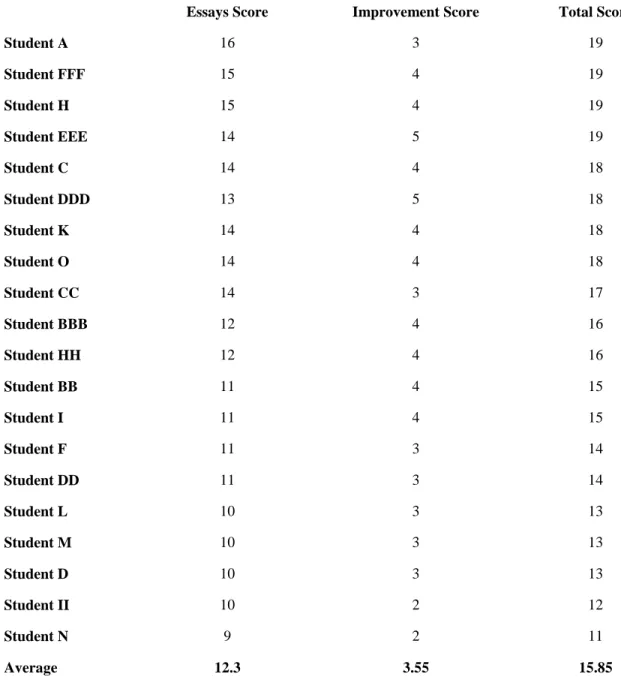
Table 1: Summary of Quantitative Scores, n=20
Essays Score Improvement Score Total Score
Student A 16 3 19
Student FFF 15 4 19
Student H 15 4 19
Student EEE 14 5 19
Student C 14 4 18
Student DDD 13 5 18
Student K 14 4 18
Student O 14 4 18
Student CC 14 3 17
Student BBB 12 4 16
Student HH 12 4 16
Student BB 11 4 15
Student I 11 4 15
Student F 11 3 14
Student DD 11 3 14
Student L 10 3 13
Student M 10 3 13
Student D 10 3 13
Student II 10 2 12
Student N 9 2 11
Average 12.3 3.55 15.85
Some interesting patterns and themes emerged from this quantitative assessment
(See Appendix C for full scoring results). While 18 out of 20 students showed some level
out of a possible six points, with an average improvement score for all students of 3.55),
this improvement was most often confined to the student’s “awareness of the need” and
“use and incorporation” of information sources, as opposed to the “critical evaluation and
analysis.” Only seven students showed an increase in their critical evaluation and analysis
scores, and of these seven, only one student showed an increase of greater than one point.
To some extent, this lack of critical evaluation fits with some findings in the literature. As
Corbett notes in his study of first-year writing students’ use of scholarly and popular
sources,
the challenge of successfully using point-of-need instructional delivery is that it frames library research as a means to an end when library research is instead part of the practice of making knowledge and inseparably integrated with the
intellectual project undertaken by the student.39
This student tendency to use research as “means to an end,” rather that integrating it into
a broader critical framework contributed to low overall scores, with no student receiving
20 points or higher (a score of 61%) out of the possible 33 points, a lowest score of 11
(33%), and an average total score of 15.85 (48%). Additionally, the essays were
characterized by three recurrent themes and patterns:
1. The dominant use of personal or private information and knowledge, as opposed
to a critical framework integrating the personal with a research-oriented background.
2. The use of quoted research material inserted in a “tacked on” manner that indicated a lack of contextual understanding for the source.
3. The repeated use of a source or use of a single type of library research tool or database.
Personal or Private Information and Knowledge
A number of assignments contained significant amounts of information and knowledge
on subjects that appeared to be well-known to the students. In these essays, students
provided sometimes highly technical and sophisticated information on various subjects,
such as rock climbing, automobile maintenance, hockey, fishing, Native American
traditions, and motherhood. This information was delivered in detail, seemingly without
much effort, and often serially, with an overwhelming accretion of detail and
categorization. While this mode did not contribute to benefiting the students’ scores in
this study, it actually fit somewhat well with the call in Assignment 2: “Definition Essay”
and Assignment 3: “Comparative Analysis Essay” to “use division, classification, and/or
definition as its main rhetorical mode(s)” and to “make an argument/claim by analyzing
the similarities and differences between two people, places, objects, or ideas.”
Essays characterized by this element often used first-person pronouns, as in
phrases such as “I learned,” and “as we know,” and while these descriptions often
sounded reliable and authoritative, in these contexts the personal voice tended to instill an
amount of doubt and uncertainty. While these students took to heart the adage to “write
what you know,” without sufficient background support, the reader was left with
uncertainty as to whether the writer knew what he or she was discussing, and how he or
she knew it.
An example of this characteristic was found in student C’s third essay on changes
in automobile technology, where the student notes that, “my father told me when he was
a boy it was only $0.35/gallon” (C3). In another essay where personal, unsourced
essay on the difference between outdoor and indoor rock climbing notes, somewhat
disjointedly, “if someone were to look at rock climbing they might think that all climbers
are the same, but when it boils down to it each is different and they all share many of the
same styles and technique” (F3). Finally, student D’s third essay on the “cultural
difference in death” suggests both a weakness within the context of the essay itself, but
also an opportunity for growth and development in the future. After listing a number of
different funeral and mourning traditions from Buddhism, Judaism, and Islam, with most
of the descriptions sourced to Wikipedia pages, the student transitions into a description
of his or her own Native American tradition: “Being a Native American, our custom is to
sit with someone who is dying or be right by that person as soon as death has occurred....I
have experienced this myself. While my sister and I were sitting with our niece...” (D3).
Considered as a whole, this section is the clearest, honest, and most bracing moment of
the essay, with the student engaging deeply with known, personal information. However,
in this moment the student does not seek recourse to an outside reference source, even to
Wikipedia. While the student notes that “a lot of our Native ways are not written, they are
passed down orally” (D3), this moment strongly suggests a missed opportunity to support
personal and private information and knowledge with library research. As this essay
shows, even a student unfamiliar or unable to engage in the “research conversation”
could find ways to align a knowledgeable personal voice with the backbone of academic
“Tacked on” Research Material
Another feature that characterized a number of assignments was a lack of context and
awareness of the manner in which source information was used. Too often, the sources
utilized by students were simply inserted into longer descriptions of the personal or
private knowledge described above, and often lacked a fuller awareness of whether the
source or quote was contextually appropriate for the topic the writer was writing about. In
these instances, there was little incorporation or integration of the source material into the
writer’s own words, and the quote usually added no particular additional analysis or
information, often including information that it seemed the writer did not fully
understand. For instance, in student DDD’s essay “Love Your Heart,” he or she
paraphrases material from the American Heart Association: “There are many easy and
manageable ways to keep your heart healthy and also many bad habits that can lead to
ischemic heart disease” and “eating fish at least twice a week can help keep low-density
liprotein” (DDD3). It seems clear here that the student may not know exactly what these
terms mean or their specific relevancy to the topic. The inclusion seems intended to just
meet the requirements of the assignment, without even a basic definition of the terms.
At other times, students’ reliance on providing these kinds of dictionary and
encyclopedia sources, even when accessed through approved and encouraged general
reference library databases, suggests a low level of engagement with research sources.
For instance, the statement by Student I in Essay 2 that “depression is defined in
Merriam-Webster's on-line Dictionary as…” (I2), or Student H writing in his or her
second essay, on the definition of a family, that “the American Heritage Dictionary of
students are not applying a level of critical analysis to the research material, even though
they have taken the important step of using a library database (Credo Reference) to
access this information. In these instances, while the student has made some beginning
effort to identify and access approved library resources, the use and critical evaluation
Single Type of Source
Student D’s essay on “cultural differences in death” also highlights another characteristic
found across many students’ work: the use of a single type of source to find all the
research material used. Often, even in essays where the student utilized more sources
than were required for the assignment, a student would rely on one type of source, such
as a Web page, newspaper, magazine, encyclopedia, or single database for all his or her
quoted material. For instance, even student FFF’s third essay on the difference between
the ideas of marriage in the 18th and 21st centuries used the EBSCO Host database to
find all of the citations to quotes from the magazines Psychology Today, the Chronicle of
Higher Education, the Washington Times, and the Economist.
Although these essays sometimes used a variety of different sources within a
single type of database, this characteristic still stood out. This was not a weakness per se,
as in some instances the students’ use of sources was fairly broad. However, it indicated a
lack of awareness or context that would enable a student to put together the pieces of the
different instruction lessons they received, and suggested a kind of linear responsiveness
to the instruction lessons: a student learned how to use ProQuest Newsstand in their
library instruction session, so in the assignment he or she used ProQuest Newsstand to
find all of their sources in a variety of newspapers. The student thus neglected to use
another database, such as EBSCO, Credo Reference, or CQ Researcher, or from a
magazine, journal, or Web source, all of which are tools he or she had the opportunity to
learn. In this way, this characteristic has a double-edge to it—it shows that the student is
beginning skill level, with a kind of tunnel vision that lacks the expansiveness and
Specific Instances of Increased Skill Level
Essays by several students showed some substantive developments over the course of the
three assignments. Student FFF, who again had one of the highest total scores (19 points)
and who had an improvement score of 4, showed an increasing facility with research
material in later essays. This student’s second essay on the definition of fatherhood
utilized mostly private and personal information, with long stretches where no sources
were referenced. When references—from a blog and a journal article from the ERIC
database—were utilized, they were simply inserted onto this personal material, with no
real incorporation or context. Subsequently, this student’s third essay, on the difference
between the ideas of marriage in the 18th and 21st centuries, showed a greater
engagement with sources used, including citations to quotes from the magazine
Psychology Today, the Chronicle of Higher Education, the Washington Times, and the
Economist, all accessed through the EBSCO database. This essay featured a smooth transition between the student’s voice and an effective use of research materials to
support the student’s points:
Marriage in the 18th century was considered to be a big deal because of the financial stability and social class standards it could give a couple. “Until the late 18th century, most societies around the world saw marriage as far too vital an economic and political institution to be left entirely to the free choice of the two individuals involved…” (Coontz B7). …Couples that were married in the 19th century were carefully placed by their families based on their social class and their financial situation, not based on love” (FFF).
This student’s fourth essay, on the construction of a road to create a shortcut between two
parts of a Maine highway, used a much greater variety of sources, including from a Web
site, a blog, and two from online newspapers accessed through ProQuest Newsstand. It
student’s voice and the research material, with the student responding to a quote by a
construction official in a quoted source:
If you arrest people often enough, they slow down or take another route...
Everybody speeds but it seems to me that if police did their job, we wouldn't have this problem, former Road foreman Robert Boyd said (Tucker). This statement is true; if there were more policemen on this road to monitor speed limits then there might not be so much speeding traffic. But the issue I see with this thinking is that... (FFF).
Finally, the student wrote a sentence that suggests a facility for considering issues from
different points of view, noting, “When I look at this issue from the resident's point of
view, the answer is clear” (FFF). This back-and-forth engagement also appeared in the
assignments of student C, who received a total score of 18. While this student’s essays
were less successful overall, the student received an improvement score of 4 because of
an increasing facility with using research. This student’s second essay utilized the Credo
Reference database to identify definitions of functional and dysfunctional families,
noting, “I agree with this definition,” while the third essay, on the cost of college,
engaged more deeply with purported experts from quoted sources. Here the student
writes, “According to Price,” before a quote, framing it well as an outside source, though
still not quite explaining to the reader who Price is or why he or she has authority. Soon
thereafter, the student writes a line that integrates, albeit a bit clumsily, both the quoted
source and the student’s own opinions: “I said that a lot of people couldn't afford to go to
college. Price says right there that it is far out of the reach of most families....” The
student’s final essay, about the proposal for a liquefied natural gas terminal in the town of
Pleasant Point, Maine, also makes progress in its incorporation and integration of
If the proposal for the LNG terminal were to go through it would give many people in Maine jobs. “Of the 90 jobs available once the plan is operating… (Cassidy).” ...As I stated earlier LNG can be one of the most dangerous gases in the world and it can do a great amount of damage. Mayor John Craig of St. Andrews, New Brunswick said, “it’s dangerous...” (Graettinger). In my opinion, I do not think the terminal is worth all the risk (C4).
Additional examples include student BB, whose second essay on the definition of
hope includes only a definition from the Web site dictionary.com and a reference to
another nonprofit Web site, and whose third essay on the difference between fictional and
nonfictional stories features references only to the entertainment Web site TMZ.com, the
box office tally Web site Boxoffice.com, and the “Tomatometer” from the movie rating
Web site RottenTomatoes.com. The student’s last essay, however, on the debate over
permitting the building of a “racino” (a combination casino and race track) in Maine,
includes the line, “Phyllis Austin exclaimed in an article that was written for the Maine
Times that, ‘The Passamaquoddy gambling casino is promoted…’ and “But, according to
Rep. Bruce Bickford of the Sun Journal….” While this particular usage is somewhat
inelegant, and while it incorrectly suggests that the state representative is “of” the Sun
Journal newspaper, as opposed to being quoted by it, this usage still represents a
movement forward for this student, who utilized the ProQuest Newsstand database to
Intercoder Validity
In order to test the validity of scoring assessments, this study sought out independent
evaluators from the Writing Center at University of North Carolina at Chapel Hill to
perform an independent analysis of a sub-sample of the papers and to test reliability or
intercoder validity, “the extent to which content classification produces the same results
when the same text is coded by more than one coder.”40 As Spurgin and Wildemuth note, quoting Lombard, “High measures of intercoder agreement indicate the reliability of the
results of the coding process (Lombard et al., 2002).”41
A random number between 1 and 20 was generated using the Web site
www.random.org. The number chosen was used to select a single set of essays from
student HH to give to the group of independent evaluators, along with instructions and
the author’s grading rubric. The evaluators were compensated for their time with a
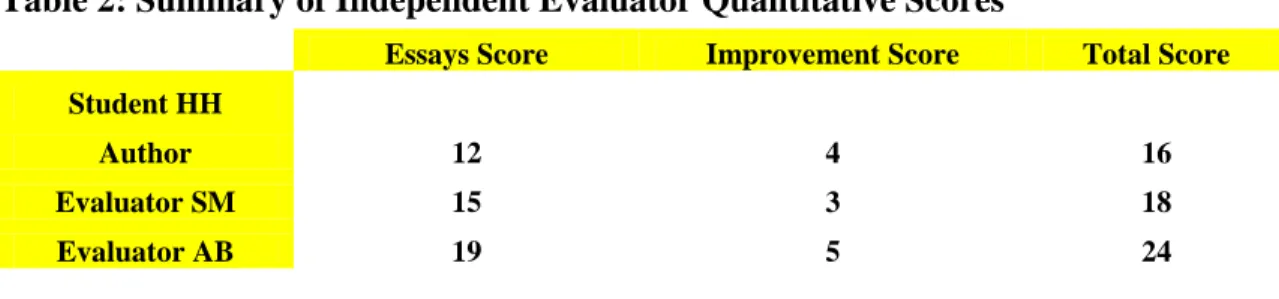
payment of $25. Table 2 presents a summary of scores given by independent evaluators
(See Appendix D for full independent evaluator scoring).
Table 2: Summary of Independent Evaluator Quantitative Scores
Essays Score Improvement Score Total Score
Student HH
Author 12 4 16
Evaluator SM 15 3 18
Evaluator AB 19 5 24
As these summary scores show, there is a discrepancy between the author’s scoring and
that of the independent evaluators, ranging from a difference of three points to a much
more substantial difference of eight points. While both scorers were in general agreement
essays higher scores than the author. As noted in the literature, this lack of
“confirmability,” “the extent to which the characteristics of the data, as posited by the
researcher, can be confirmed by others who read or review the research results (Bradley,
1993, p. 437)”42 is troubling, as “different people should code the same text in the same
way.”43
A number of reasons might explain this discrepancy, including fatigue, where
“human coders are subject to fatigue and are likely to make more mistakes as the coding
proceeds”44; the graders interpretation of the coding and scoring rules, where “the coders’
understanding of the categories and coding rules may change subtly over time, which
may lead to greater inconsistency (Miles and Huberman, 1994; Weber, 1990)”45
; as well
as deficiencies in the author’s explanation of the project, the coding practices, and the
grading rubric. Several steps could be taken in the future to try to address this
discrepancy with a greater effort to calibrate scoring, including employing additional
independent evaluators and “triangulating”46
the scores by comparing the scores
Limitations
Several additional limitations had an impact on the study, and could possibly be
improved upon in future studies or with additional time and resources. First, a larger pool
of students would offer additional examples and a broader representation of student work.
In the same vein, the study suffers somewhat from the “overwhelmingly local” problem
described by Artman et al., who notes that “published accounts on collaborative IL
instruction commonly represent how particular programs have integrated library and
research instruction within specific writing courses, or using particular collaborative
models.”47
It would be interesting to use this study methodology on a higher-level writing
composition course at the college examined here, or to apply the methodology and design
to another institution where a collaborative teaching effort is taking place between
Conclusions and Recommendations
This study showed several interesting and useful results that could result in productive
recommendations for future collaboration by the Washington County Community
College professor and librarian and by other instructors and librarians. With nearly all
students examined in this content analysis showing some level of improvement over the
series of three writing assignments, the collaboration between the composition professor
and the librarian clearly enhanced the student’s awareness of the need to use library
sources to support their claims and arguments, and helped them understand how they
might go about using and incorporating that evidence into their writing. At the same time,
fewer than half of the students improved in their level of critical evaluation and analysis.
These results show that while students are clearly beginning to learn the “mechanical”
aspects of searching for and using library research in their writing, they still lack a critical
framework that integrates the information sources with their own thinking, as well as a
contextual understanding of the source of information or the need to incorporate a variety
of sources across variant formats.
Going forward, the results of this study and the collaboration it examines suggest
several possible steps for strengthening the composition/library collaboration, and several
ideas for future investigation using the methodology utilized here. These steps are: 1)
Adjusting scheduling and timing; 2)Re-thinking the structure of instruction sessions; 3)
Increasing feedback to the librarian; 4) Creating more specific assignments and rubrics;
Adjusting Scheduling and Timing
First, considering the students’ tendency to use only one type of source from one
individual database multiple times in one assignment, it would be interesting to consider
whether students should receive a broader introduction to a variety of sources at an earlier
point in the semester. With students’ relative success at using library research materials
discovered in their library sessions in sequence, this change would permit students more
opportunity to work with and incorporate a wider range of materials. This idea presents
some obvious challenges: students can’t learn everything at once; there is a risk of
overwhelming them with too much material at one time; and there are a limited number
of class sessions that can be given over to library time. However, structural and
scheduling solutions could offer some flexibility, and these collaborators have shown a
willingness to commit substantial time to this type of project. In theory, before a specific
assignment was due, students could be given an introductory session to explore a diverse
group of library resources casually, without the pressure of a deadline. Library sessions
that teach resources for specific assignments could then follow in a more in-depth
manner, as per the schedule described in this study.
Additionally, the composition professor suggests that the timing of the assignment
deadlines and the library instruction session could also be altered. In this study, students
attended the library session one week before the draft due date, and most students
therefore came to the session without a narrowly-defined subject. Moving the instruction
session date to the class before the draft due date (taking into account student’s tendency
topic in mind (this could also be a requirement), and might even permit some students to
complete some preliminary research before the session.
Re-thinking the Structure of Instruction Sessions
The eighty-minute instruction sessions examined in this study were comprised of a
twenty-minute portion taught by the composition professor followed by a sixty-minute
lesson on the specific resources taught by the librarian. Reducing the library instruction
time to half an hour and instead including a hands-on, in-class research assignment could
provide further models for student research, or could permit students to begin to work on
searching for the next assignment in class.
Increasing Feedback to the Librarian
While the composition professor and librarian continued their active collaboration
throughout the semester, meeting before each instruction session to review the materials,
the amount of feedback given to the librarian after the assignments were completed was
minimal. The librarian was periodically given some of the students’ Works Cited lists,
but this was informal, and did not expose the librarian to the broader results of the
information awareness, use and incorporation, and critical analysis skills as manifested
through the student writing. The collaboration examined in this study did not quite meet
the “blending” of composition and library instruction described in Sult and Mills (2006)
or the “team-teaching” described in Peary and Ernick (2004), where instructor and
librarian shared the teaching and grading of assignments equally.48 Building this feedback
were absorbing (or missing) information and could suggest opportunities for revising and
fine tuning the sessions and assignments.
Creating more Specific Assignments and Rubrics
Increasing the specificity of the grading rubrics and assignment guidelines and offering
guidelines that emphasize “research processes” and “laddered assignments”49
could also
help the students understand more clearly the expectations for the assignment, and could
push students to engage with a broader variety of resources in an effort to satisfy
assignment requirements.
Exploring Integration of Personal Knowledge with Research
Finally, the last recommendation for future exploration considers ways to encourage
students to better integrate a research framework that utilizes library resources for topics
in which they are personally invested and interested. As described above, students in this
study often wrote about topics they were fairly knowledgeable about, but usually these
assignments contained too much personal or private information and too little
background research. While many of the above suggestions focus on structural and
administrative steps, this final idea could be the most productive, since students naturally
gravitate towards comfortable and familiar subjects. While a line must sometimes be
drawn to eliminate frivolous subjects, almost any topic can be approached in a
substantive manner, and the assignments examined here showed a significant variety of
worthwhile ideas. With this in mind, additional effort could be made to layer the
necessary library and information literacy instruction over these natural student interests
and analysis skills lacking in this study by working to transition the personal voice so
often encountered in the study into the research-oriented, academic voice required in a
college setting.
As noted, nearly all students examined in this study showed some level of
improvement in writing ability through their use of library information sources over the
series of three writing assignments. The collaboration between the composition professor
and the librarian clearly enhanced the students’ understanding of the need to use library
sources in their writing and to use and incorporate these sources into their own work.
While students generally still showed a lack of improvement in their critical use of
information sources, instituting these five steps above could further improve student
writing and could provide guidance to other library, composition, and information
Notes
1
National Commission on Writing in America’s Schools and Colleges (2003). The neglected R: The need for a writing revolution. New Jersey: College Entrance Examination Board, p. 3. Retrieved from
www.californiawritingproject.org/Documents/neglectedr.pdf.
2
Monroe, J. (2003). Writing and the disciplines. Peer Review, 6(1), 4-7, p. 4.
3
Cavdar, G., & Doe, S. (2012). Learning through writing: Teaching critical thinking skills in writing assignments. PS-Political Science & Politics, 45(2), 298-306, p. 299. 4
Paul, R. & Elder, L. (2007). The thinker’s guide to how to write a paragraph: The art of
substantive writing : How to say something worth saying about something worth saying something about. Dillon Beach, CA: Foundation for Critical Thinking, p. 4.
5
Cavdar, G., & Doe, S. (2012), p. 299.
6
Meeks, M. G. (2006). Between abolition and reform: First-year writing programs, e- Literacies, and institutional change. Chapel Hill, N.C.: University of North Carolina at Chapel Hill, p. xi.
7
Ricker, S., & Kaplan, I. Are we crossing the line?: A survey of library/writing program collaboration. Composition in the center spaces: Building community, culture, coalitions, CCCC. Chicago, March 23, 2006, slide 9 and 10. Retrieved from
docushare.lib.rochester.edu/docushare/dsweb/Get/Document-22020/Library_Writing_Collaboration.pdf.
8
Birmingham, E., Chinwongs, L., Flaspohler, M. R., Hearn, C., Kvanvig, D., & Portmann, R. (2008). First-year writing teachers, perceptions of students’ information literacy competencies, and a call for a collaborative approach. Communications in Information Literacy, 2(1), 6-24, p. 8.
9
Artman, M., Frisicaro-Pawlowski, E., & Monge, R. (2010). Not just one shot:
Extending the dialogue about information literacy in composition classes. Composition Studies, 38(2), 93-110, p. 94.
10
Cavdar & Doe. (2012), p. 298.
11
12
Rohman, D. G. (1965). Pre-Writing the Stage of Discovery in the Writing Process
College Composition and Communication, 16(2), 106-112, p. 106. 13
Birmingham, E., Chinwongs, L., Flaspohler, M. R., Hearn, C., Kvanvig, D., & Portmann, R. (2008), p. 7.
14
Miles, C. L., & Wilson, C. (2004). Learning outcomes for the twenty-first century:
Cultivating student success for college and the knowledge economy. New Directions for
Community Colleges, 2004(126), 87-100, p. 90. 15
Association of College and Research Libraries. (2000). Information literacy competency standards for higher education. Retrieved from
http://www.ala.org/acrl/standards/informationliteracycompetency.
16
Academic Senate for California Community Colleges. (2002). Information competency: challenges and strategies for development. Retrieved from http://www.asccc.org/sites/default/files/InfoCompetency.pdf.
17
Ury, C., Park, S., Baudino, F, & Ury, G. (2007).Taking flight—pilot testing the information literacy test. Sailing into the future: charting our destiny: Proceedings of the thirteenth national conference of the Association of College and Research Libraries, March 29-April 1. Ed. Hugh A. Thompson. Baltimore: Association of College and Research Libraries, 256-263, p. 258. Retrieved from
http://www.ala.org/acrl/sites/ala.org.acrl/files/content/conferences/confsandpreconfs/nati onal/baltimore/papers/256.pdf.
18
Association of College and Research Libraries (2003). Introduction to information literacy. Retrieved from http://www.ala.org/acrl/issues/infolit/overview/intro.
19
Harrington, S., Malencyzk, R., Peckham, I., Rhodes, K., & Yancey, K. B. (2001). WPA outcomes statement for first-year composition. College English, 63(3), 321-325, p. 323-325.
20
Council of Writing Program Administrators (WPA). (1999). WPA outcomes statement for first-year composition. WPA: Writing Program Administration, 23(1-2), 59-70, p. 60, 61-63.
21
National Council of Teachers of English (2007). Framework for 21st Century Curriculum and Assessment. Retrieved from
http://www.ncte.org/governance/21stcenturyframework.
22
23
Artman, M., Frisicaro-Pawlowski, E., & Monge, R. (2010), p. 95.
24
Birmingham, E., Chinwongs, L., Flaspohler, M. R., Hearn, C., Kvanvig, D., & Portmann, R. (2008), p. 8-9.
25
Ibid., p. 8-9.
26
Ibid., p. 9.
27
Gandhi, S. (2004). Faculty-librarian collaboration to assess the effectiveness of a five- session library instruction model. Community & Junior College Libraries, 12(4), 15-48, p. 29.
28
The author is a colleague of the composition professor.
29
Personal communication. June 23, 2012.
30
Shannon, S. E., & Hsieh, H. (2005). Three approaches to qualitative content analysis.
Qualitative Health Research, 15(9), 1277-1288, p. 1278. 31
Smith, H. W. (1975). Strategies of Social Research: The Methodological Imagination. Englewood Cliffs, NJ: Prentice Hall, p. 218.
32
Berg, B. L. (2012). Qualitative research methods for the social sciences (8th ed.). Boston: Pearson, p. 364.
33
Zhang, Y. & B. M. Wildemuth. (2009) Qualitative analysis of content. P.
308-319. In Wildemuth, B. M. Applications of social research methods to questions in information and library science. Westport, Conn.: Libraries Unlimited, p. 309.
34
Berg, B. L. (2012), p. 352.
35
Shannon & Hsieh. (2005), p. 1281.
36
Association of College and Research Libraries. (2000). Information literacy competency standards for higher education. Retrieved from
http://www.ala.org/acrl/standards/informationliteracycompetency.
37
38
Burton, V. T., & Chadwick, S. A. (2000). Investigating the practices of student
researchers: Patterns of use and criteria for use of internet and library sources. Computers and Composition, 17(3), 309-328, p. 310.
39
Corbett, P. (2010). What about the “Google effect”? Improving the library research habits of first-year composition students. Teaching English in the Two Year College, 37(3) 265-277, p. 266.
40
Weber, R. P. (1990). Basic content analysis (2nd ed.) Beverly Hills: Sage Publications, p. 17.
41
Spurgin, K. & B. M. Wildemuth. (2009). Content analysis, p. 297-307. In
Wildemuth, B. M. Applications of social research methods to questions in information and library science. Westport, Conn.: Libraries Unlimited, p. 301.
42
Zhang & Wildemuth. (2009), p. 314.
43
Weber. (1990), p. 12.
44Zhang & Wildemuth. (2009), p. 312.
45
Ibid., p. 312.
46
Ibid., p. 313.
47
Artman, M., Frisicaro-Pawlowski, E., & Monge, R. (2010), p. 95.
49
Essay 2 Grading Rubric
Thesis establishes a clear, supportable purpose /15
Organized examples, anecdotes, and descriptions support thesis /25
Fully developed, coherent paragraphs /25
Effective introduction /5
Effective conclusion /5
Two Outside Sources: -Works Cited Page (15) -In-text citations (10)
/25
Content Grade
Form Errors
Overall Grade
Essay 3 Assignment: Comparison and Contrast
To compare, one notes similarities; to contrast, one notes differences. A writer may make an argument/claim by analyzing the similarities and differences between two people, places, objects, or ideas. In this essay, you will use comparison and contrast as your basic rhetorical strategy. Determine a thesis, and support that thesis through the use of comparison and contrast.
Determine a logical organization for your essay: point-by-point, subject-by-subject, or some combination of the two.
Length: 1000-1250 words (4-5 typed, double-spaced pages)
*Please incorporate a minimum of three outside sources into your essay. If you are incorporating internet sources, you are required to use sources from the databases on the WCCC library, rather than a general web search. You are encouraged to use print sources.
Some suggestions for topics:
• Compare two ways to solve a specific problem.
• Compare two different cultures and their views about how people should manage some specific
ask (birth, death, marriage, business, education, religion).
• Compare some aspect(s) of your lifestyle with that of an earlier generation.
• Compare the way two magazines or newspapers cover the same story.
• Compare and contrast arguments on both sides of a controversial issue. Such issues produce controversy because there are legitimate arguments on each side, and because people can simplify them. Compare and contrast the assumptions, evidence and logic of both sides of the argument.
• Compare and contrast two essays that seem to be in conversation with one another. Why should they be considered in tandem?
• Compare and contrast two historical events or historical figures.
Banned topics: abortion, death penalty, euthanasia, evolution v. creationism, Chevy vs. Ford, etc. Please do not write about an issue for which the two sides are polarized, as 1) it will be difficult to incorporate objective research, and 2) it will be difficult to change or influence the reader's perspective regarding your subject. These types of essays tend to be driven primarily by pathos and ethos, rather than logos. Please run your subject by me if you are uncertain about it.
First draft due: M, 3/8 Final draft due: W, 3/22
Essay 3 Grading Rubric
Clearly stated thesis makes a precise, focused assertion /10
Points of comparison/contrast are used to effectively support your thesis /20
Effective Introduction and Conclusion /10
Well-developed paragraphs: includes both detail (specifics) and reflection (analysis); paragraphs are unified, coherent, and fully supported
/35
Inclusion of outside sources. Correctly formatted Works Cited page; inclusion of paraphrases, summaries, and quotations, along with correctly formatted in-text citations
/25
Total Content Points
Form Errors (-2 points each)
Essay 4 Grading Rubric
Clearly stated thesis makes a precise, focused assertion /10
Follows structure of an argumentation essay: exordium, narration, confirmation, reprehension, peroration
/20
Effective Introduction and Conclusion /10
Well-developed paragraphs; includes both detail (specifics) and reflection (analysis); paragraphs are unified, coherent, and fully supported
/35
Inclusion of outside sources. Correctly formatted Works Cited page; inclusion of paraphrases, summaries, and quotations, along with correctly formatted in-text citations
/25
Total Content Points
Form Errors (-2 points each)
Appendix B: Author’s Grading Rubric
1 point: No Ability 2 points: Beginning Ability 3 points: Proficiency
Awareness of Need for Supporting Evidence and Research
Student has no awareness of the need to use
supporting evidence and research in his or her assignment.
Student has a low level of awareness of the need to use supporting evidence and research in his or her
assignment. Student has begun to formulate rough concepts through a topic and/or thesis statement that can be used to find supporting evidence and research.
Student has devised a clear, focused, and narrowly-defined topic and/or thesis statement that can be effectively researched and supported with evidence.
Use and Incorporation of Information Sources to Support Claims and Opinions Student has
identified little or no research material, and/or the material identified is not effectively incorporated with the student’s own writing.
Student identifies some research and information sources and begins to incorporate material into essay. However, research may be from similar or identical sources or formats, may not adequately support the topic or thesis, and is often “tacked-on” and does not effectively interact with student’s own writing.
Extensive research materials are identified in a variety of formats. Student uses supporting evidence in concert and in balance with his or own writing.
Critical and Reflective Evaluation of Information Sources and Research
Student has no awareness of criteria for judging
information sources or information quality.
Student begins to evaluate information quality by considering the accuracy, credibility, authority, and relevance of sources used. Student may also begin to engage and reflect on the information sources used, and may find opportunities to agree or disagree with the cited information.
Student analyzes multiple information sources in a variety of formats. Student also considers multiple viewpoints in
Appendix C: Scoring Spreadsheet Essay 2 Score Essay 3 Score Essay 3 Improvement Score Essay 4 Score Essay 4 Improvement Score Total Essay Score Total Improvement Score Total Score Student A
Awareness 2 2 2
Use of Information 2 2 2
Critical Evaluation 1 1 2
Essay Subtotal Score 5 5 6 16
Improvement Score 1 2 3
Total Score 19
Student FFF
Awareness 1 2 2
Use of Information 2 2 2
Critical Evaluation 1 1 2
Essay Subtotal Score 4 5 6 15
Improvement Score 2 2 4
Total Score 19
Student H
Awareness 2 2 2
Use of Information 1 2 2
Critical Evaluation 1 1 2
Essay Subtotal Score 4 5 6 15
Improvement Score 2 2 4
Total Score 19
Student EEE
Awareness 1 2 2
Use of Information 1 2 2
Critical Evaluation 1 1 2
Essay Sub-Total Score 3 5 6 14
Improvement Score 2 3 5
Total Score 19
Student C
Awareness 1 1 2
Use of Information 2 2 2
Critical Evaluation 1 1 2
Essay Subtotal Score 4 4 6 14
Improvement Score 1 3 4
Total Score 18
Student DDD
Awareness 1 1 2
Use of Information 1 2 2
Critical Evaluation 1 1 2
Essay Subtotal Score 3 4 6 13
Improvement Score 2 3 5
Total Score 18
Student K
Awareness 2 1 2
Use of Information 2 1 2
Critical Evaluation 2 1 1
Essay Subtotal Score 6 3 5 14
Improvement Score 1 3 4