Implicit Positivity: Improving Mood with Environmental Cues
Amanda Kramer
University of North Carolina at Chapel Hill
Supported by:
Abstract
Implicit Positivity: Improving Mood with Environmental Cues
In recent years, popular culture has touted the power of positivity, and with good reason. Evidence supporting the mental, social, psychological, and physical benefits of positive emotions abounds in psychological literature. Positive emotions have been found to increase cognitive breadth, leading to more creative (Isen, Daubman, & Nowicki, 1987), unusual (Isen, Johnson, Mertz, & Robinson, 1985), flexible (Isen & Daubman, 1984), and efficient (Isen & Means, 1983) thinking. These emotions promote stronger relationships (Aron et al., 2000), more unpredictable and interesting social interactions (Gottman, 1998), and reduced prejudice, aggression, and violence toward outgroup members (Bridgeman, 1981; Feshbach & Feshbach, 1982). They also help to de-escalate anger and interpersonal conflict (Gottman, 1998; Smith, 1973). Resilience and optimism have also been found to increase with positivity (Fredrickson et al., 2003). Furthermore, positive emotions have even been found to reduce life stress and related illness (Cousins, 1985; Fry, 1994; Kuiper & Martin, 1998; Stone et al., 1994), improve heart health via stronger vagal tone (Kok et al., 2013), and increase the length of the lifespan (Danner et al., 2001).
LeDoux, 1996). These emotions thus narrow an individual’s focus (Easterbrook, 1959) to identify the source of threat and limit their choice of action (Levenson, 1992) to best respond to the threat.
Positive and negative emotions thus appear to play contrasting roles. In fact, positive emotions have been shows to counteract, or “undo,” the effects of negative emotions. Decades of research support the idea that positive emotions are incompatible with negative emotions (Baron, 1976; Cabanac, 1971; Nezu, Nezu, & Blissett, 1988; Solomon, 1980; Wolpe, 1958). However, until recently, no research served to examine the direct impact that positive emotions had on negative states. Recent research shows that encouraging positive emotions can revert the cardiovascular effects, such as rapid heartbeat, of negative emotions such as fear (Fredrickson & Levenson, 1998) or anxiety (Fredrickson, Mancuso, et al., 1999). Positive emotions not only exact their own effects, but they also serve to resolve the negative effects of negative emotions.
Positivity thus appears to be a worthy goal. In fact, the pursuit of positive emotions, such as happiness, is built into our Declaration of Independence and it a tenet of the American
lifestyle. It should then be no surprise that most people think about happiness on a daily basis (Freedman, 1978) and consider happiness to be very important to them (Diener, Suh, Smith, & Shao, 1995; Triandis, Bontempo, Leung, & Hui, 1990). Several reports show that a majority of people explicitly value happiness and set goals to attain it (Myers, 2000; Diener, 2000). Though these studies focused specifically on happiness, they may represent the widespread pursuit of positivity at large.
For some, however, this goal is less realistic. Consider depression, a disorder whose symptoms “often involve lack of positive emotion” (Seligman, Rashid, & Parks, 2006) or
their milder counterparts represent a significant deficit in positivity for those who have them. Do these individuals simply “miss out” on the benefits of positive emotions, or can they be directed toward positivity?
Striving for Happiness
Practitioners of several models of therapy, such as positive psychotherapy or variations of cognitive-behavioral therapy, have addressed the issue of positivity in the context of disordered thinking (see Seligman, Rashid, & Parks, 2004 and Karlin et. al, 2012, for examples). These models emphasize the goal of gaining positivity rather than simply reducing negativity and have found marked success. Once more, achieving positive emotions, and not just reducing negative emotions, is the goal.
According to standard models of goal pursuit (e.g. Mischel, Cantor, & Feldman, 1996) valuing positivity and setting a goal to achieve it would lead one to feel more positive. One sets goals according to his or her values and then strives to achieve them, resulting in goal
fulfillment. However, the specific case of positivity has a less straightforward path. In fact, some recent research suggests that actively seeking positive emotions may be detrimental.
While a person’s values do determine his or her goals, such values also determine the standard against which progress toward the goal is compared (Carver & Scheier, 1981). When progress falls short of one’s standard, the result is a shift from positive expectations to negative results (Miceli & Castelfranchi, 2000). This violation of expectations leads to frustration and thereby suffering (Miceli & Castelfranchi, 1997) and is the basis of a host of negative emotional experiences (e.g., Mandler, 1984; Scherer, 1984; Stein & Levine, 1987, 1990).
ultimately achieve his goal. However, in the case of positivity, the suffering induced by failing to meet one’s standards is in direct opposition to the goal (Schooler, Ariely, & Loewenstein, 2003). If a person values positive emotions, such as joy, he may set high expectations of what “joy” should be (Carver & Sheier, 1981). Then, in evaluating his joy compared to that standard, he is more apt to feel disappointed at his current level of joy. Because joy and disappointment are opposing states, his disappointment will lead him further from his goal of joy.
Mauss et al. (2011) describe such a goal as a “paradoxical” goal. In evaluating progress toward the goal, one pushes themselves farther away from achieving their goal. For instance, Shapira (2013) found that giving participants an explicit goal of being close to another led to decreased ratings of closeness. In attempting to monitor closeness, people observed more distance between themselves and therefore felt farther from their goal of closeness.
The effect is particularly strong for goals involving positive emotions. An early study by Schwartz and Inbar-Saban (1988) found that participants who highly valued happiness failed to lose weight in a long-term weight loss study, whereas those who prioritized wisdom were
successful, suggesting a detrimental impact of valuing happiness. Later research investigated the particular mechanism behind this detriment. Mauss and colleagues found that when participants were led to value happiness, they reported increased feelings of loneliness (2012) and decreased levels of positive emotions at large (2011). This research suggests that the explicit goal of a positive emotions, such as happiness, is often what makes one less positive and leads to negative consequences.
such as “I am a lovable person,” and later report their mood. They found that while participants with high self-esteem reported limited mood repair after repeating such statements, those with low self-esteem reported significantly more negative mood after the repetition. The researchers theorize that this occurred because repeating the statement continuously called to mind reasons why the statement was not true, at least in the perception of the participants. The attempt to repair mood using this common mechanism backfired for those whose mood was most subject to negativity. Therefore, it appears that an explicit goal of positivity is commonly self-defeating. How, then, can we try to cultivate positive emotions?
Implicit Emotion Regulation
Implicit goals of emotion regulation may provide a solution. Evidence suggests that implicit, or automatic, goals can be just as potent as explicit, or conscious, goals (Bargh et al, 2001). For instance, Chartrand and Bargh (1996) found that giving participants an implicit goal of impression formation or of memorization changed the way they processed information in order to better suit their specific goal. Implicit goals can also change a person’s behavior, leading them to cooperate more with a partner (Bargh et al, 2001), perform better on
achievement tasks (Bargh et al, 2001), and be more honest on self-report measures (Rasinski, Visser, Zagatsky,& Rickett, 2004).
Mauss, 2011). In fact, after finding that implicit positivity could be boosted by activating one’s concept of the self with self-referential primes, researchers found that increased implicit
positivity decreased negative affect (Quirin, Bode, & Kuhl, 2011). It seems that, given the right implicit motivation, the emotion regulation system can be guided away from negative emotions and toward more positive outcomes without actively trying to “feel better.”
Another line of research suggests that such implicit goals may be influencing a
preexisting automatic emotion regulation system. Gilbert et al. (1998) posit the existence of a “psychological immune system.” When faced with negative emotions, the psychological system shuts down responses to the negative emotions and instead attends to more positive stimuli to adjust mood. Research supports this notion. For instance, DeWall and Baumeister (2007) found that reminding participants of the notion of death facilitated access to positive emotional
information and enhanced attention to positive over neutral stimuli. In the presence of negative thoughts, attention automatically shifted to positive stimuli, presumably to improve mood. In a different study, DeWall et al. (2011) found that after failing to be selected to be part of a social group, participants recalled a greater proportion of positive childhood memories on an ostensibly unrelated recall task. Social rejection thus increased implicit positive affect. When presented with negative situations, people begin to engage implicit positivity on a nonconsious level.
study conducted by Lightsey et al. (2013) confirm that having more positive automatic thoughts is associated with increased positivity. To date, no studies have investigated the mediating effects of positive automatic thoughts on mood repair.
If an automatic mood regulation system exists and is sensitive to implicit goals, then implicit goals of positivity may provide a solution to the pitfalls of consciously seeking
positivity. Because implicit goals are nonconscious, progress toward them cannot be constantly monitored. Such goals should eliminate the disappointment that one feels when “positivity” is not adequately attained and should allow one to continue seeking, and eventually achieve, greater levels of positivity.
The Present Study
In sum, we will examine whether implicit goals of positivity, as driven by environmental cues, are more effective in aiding recovery from a negative mood. This design will particularly examine the mechanism of positive automatic thoughts. We expect that mood repair will be predicted by the incidence of positive automatic thoughts. In other words, more positive thoughts will predict greater mood repair.
This study will make use of a 2 X 2 experimental design. Differing instructions in a thought-listing task will determine whether or not the participant is using an explicit goal to improve mood. The instruction type will be crossed with the valence of the environmental cues, either positive or negative, to vary the nature of the implicit goal. Positive cues will give an implicit goal, while neutral cues will not. The 2 X 2 design will allow us to determine if the nonconscious, automatic mood regulation system is actually more effective and whether or not that system can be influenced by environmental stimuli.
We expect a main effect of instruction type such that those in the automatic thought condition will demonstrate greater recovery from negative mood than those in the directed thought condition as measured by mood repair, thought valence, proportion of positive thoughts, and number of positive thoughts. Further, we expect an interaction of instruction type and cue valence such that, within the automatic thought condition, those given positive thought cues will demonstrate greater recovery than those given neutral thought cues due to the implicit goal of positivity.
design. We expect that individuals with a high level of rumination will exhibit decreased
recovery from negative emotion across conditions, leading to a main effect of level of rumination on resultant positivity. However, we expect that, among ruminators, the use of an implicit goal of positivity will indeed be more effective than an explicit goal. Similarly, we expect that individuals exhibiting greater pessimism will demonstrate decreased recovery from negative mood across conditions, but that, among pessimists, the use of an implicit goal will be more effective. If these individual differences do impact the results of the primary analyses, our secondary hypotheses will allow a more complete understanding of the results.
Method
Participants
One hundred and sixty five participants from the University of North Carolina at Chapel Hill were recruited for this study. All participants were students of General Psychology courses on campus and registered anonymously for sessions via an online university participant pool. Each participant was compensated with partial class credit for their participation.
Of the students that participated, 127 were women and 36 were men. Two participants did not provide gender information. Participants were aged 17-21 with an average age of 18.4. The ethnic composition was mixed: 72.6% Caucasian, 8.5% African American, 9.1% East Asian, 4.2% South Asian, and 5.5% reporting other ethnic identities.
Procedure
The content of the quotes and images varied by experimental condition. In the positive
condition, the stimuli focused on the goal of being positive. In the neutral condition, the stimuli were centered on the topic of research. All stimuli were matched for color, size, and amount of text to control for extraneous variables.
Before beginning the session, participants were given a brief overview of the
experimental setup and were asked to give their informed consent. Participants were then asked to engage in a brief writing task. The task was intended to be a negative mood induction in which participants were asked to write about a recent negative experience in which they felt sadness, fear, or shame. This method has been shown to have an effect on mood lasting approximately 15 minutes and therefore fit the study time frame (Abele, 1990). Mood was assessed immediately following the task.
Following the mood induction, participants engaged in a thought listing task. The paradigm was modeled from a study by Cacioppo, Glass, and Merluzzi, (1979). In each
condition, participants were asked to list “any and all thoughts” that crossed their mind in a three minute time frame. The specific instructions varied by condition. In the automatic condition, participants were simply asked to list all of their thoughts. In the directed condition, participants were given the additional instruction to try to “improve their mood” and “feel better.” These two conditions were crossed with the two cue conditions to create a fully crossed 2 X 2 design. As they listed each thought, participants were asked to rate the automaticity of each thought.
To conclude the study session, participants completed a variety of surveys to assess levels of rumination and life orientation. Demographic information was collected at this time.
Before leaving, all participants were debriefed about the true nature of the study and provided with information regarding counseling resources in the event that the writing task provoked any lingering emotional distress.
Measures
Mood evaluation: The affect grid (Russell, Weiss, & Mendelsohn, 1989) assesses mood on a nine by nine grid along dimensions of valence and arousal. The four quadrants of the grid represent variable levels of energy and pleasantness. For example, a response in the upper right of the grid represents positive valence and high arousal indicative of emotions such as joy. A lower left quadrant response represents negative valence and low arousal, as seen in depression. Participants are asked to select one box on the grid that best represents their feelings in the present moment. Each dimension is coded separately on a scale of -4 to 4. Mood repair will be calculated by subtracting the mood valence scores of the pre-thought task mood evaluation from those of the post-thought task mood evaluation.
Thought Automaticity: Participants were directed to rate how automatic each thought they listed was on a scale of 1, or not at all automatic, meaning that they had to consciously conjure that thought, to 5, or entirely automatic, meaning that the thought simply popped into their mind. The scale was described to each participant as written above. The automaticity scores of each thought were averaged to provide a summary score for thought automaticity.
The valence scores of each thought were averaged to provide a summary score for thought valence.
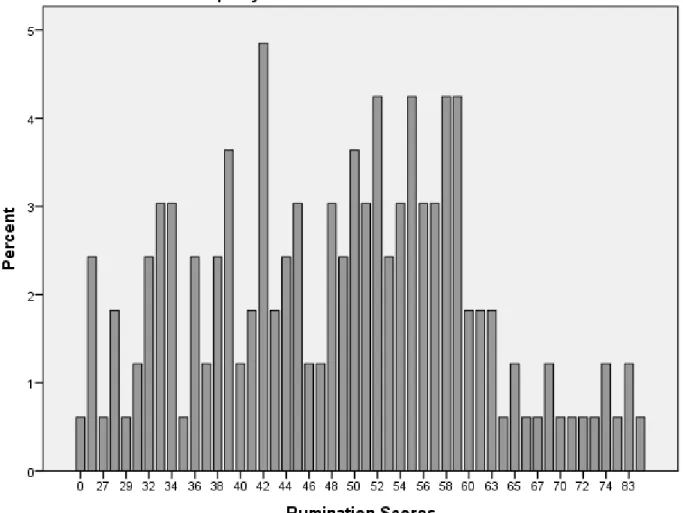
Rumination: The Ruminative Responses Scale (Treynor, Gonzalez, & Nolen-Hoeksema, 2003) assesses one’s typical ruminative tendencies, including the tendency to dwell on past negative events and linger in negative moods. It contains 22 items and is assessed on a 1, meaning almost never, to 4, meaning almost always, Likert scale. The scale includes items such as “How often do you think about how sad you feel?” and “How often do you analyze recent events to try to understand why you are depressed?” In this study, several items were edited to better reflect sad mood rather than depression and to inquire about a school, rather than a work, setting to better suit the sample population. The scores of each item were summed to provide a total rumination score. Higher scores indicate higher levels of rumination. The scale
demonstrated high reliability in this study (α=.907).
Life Outlook: The Life Orientation Test – Revised (Scheier, Carver, & Bridges, 1994) was used to assess optimism. The scale measures one’s overall outlook on life, typified as optimism or pessimism. It contains ten statements to which participants respond from 1, meaning I disagree a lot, to 5, meaning I agree a lot. Sample items include “I’m always optimistic about my future” and “In uncertain times, I usually expect the best.” Three items, including “I hardly ever expect things to go my way,” are reverse scored. All scores are
averaged to provide a mean representative score for life orientation. This scale showed adequate reliable in this study (α=.810).
Results
Manipulation checks were used to assess the effectiveness of the negative mood induction and of the thought instructions. Participants in all conditions should have reported consistently negative mood following the negative mood induction. However, on average, mood was neutral (M = 0.26, SD = 2.22). A one-way analysis of variance showed that there was no significant differences in mood valence between groups following the mood induction, F(3,163) = 0.455, p < 0.714, signifying that all groups responded equally to the induction. The median reported mood valence was 0.00, and nearly half (48.2%) of participants reported positive mood (Table 1; Figure 1). Despite the lack of negative response to the manipulation, all participant data were retained for analysis.
Participants in the automatic thought condition should have reported more automatic thoughts than those in the directed thought condition as they were not given an explicit goal for how to think. However, no significant differences in thought automaticity were found between the two thought instruction conditions. A t-test returned no significant difference in average thought automaticity between the directed (M = 3.47, SD = 0.65) and the automatic (M = 3.43, SD = 0.58) thought conditions, t = 0.397, p < 0.692. Means for both groups were neutral. A separate t-test yielded no significant difference in the proportion of automatic thoughts reported between the directed (M = 0.52, SD = 0.25) and the automatic (M = 0.52, SD = 0.22) thought conditions, t = -0.044, p < 0.965. Furthermore, there was no significant difference in the total number of thoughts reported between the directed (M = 12.64, SD = 6.08) and the automatic (M=12.55, SD = 5.5), t = 0.105, p < 0.917. The manipulation checks did not support the effectiveness of the varying thought instructions between the two groups.
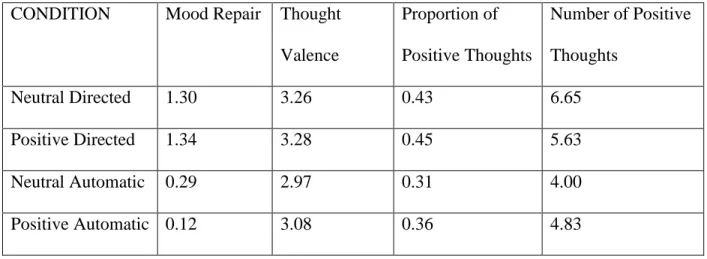
Among the total sample, mean mood repair was 0.75 (SD = 2.29), mean thought valence was 3.14 (SD = 0.63), and the mean thought ratio (number of positive thoughts of total thoughts) was 0.39 (SD = 0.22). As expected, increases in mood repair were predicted by an increase in positive automatic thoughts. Mood repair was significantly correlated with both average thought valence (r = 0.244, p < 0.002) and with the proportion of positive thoughts recorded (r = 0.254, p
< 0.001). These correlations are represented in Figure 2 and Figure 3, respectively. R-values are summarized in Table 2.
Recovery from negative mood, or resultant positivity, following the thought task was assessed using four dependent variables: change in reported mood (hereafter referred to as ‘mood repair’), average valence of reported thoughts (‘thought valence’), proportion of positive
thoughts of all thoughts reported (‘proportion of positive thoughts’), and total number of positive thoughts reported. Each dependent variable was subjected to a two-way analysis of variance with two levels of instruction type (directed or automatic) and two levels of environmental cues (neutral or positive).
instruction type on proportion of positive thoughts, F(1,161) = 8.945, p < 0.003, meaning that there was a greater proportion of positive thoughts in the directed thought condition (M = 0.438,
SD = 0.025) than in the automatic thought condition (M = 0.335, SD = 0.024). Finally, the analysis returned a main effect of instruction type on number of positive thoughts, F(1,161) = 6.202, p < 0.014, such that a significantly higher number of positive thoughts was reported in the directed thought condition (M = 6.142, SD = 0.494) than in the automatic thought condition (M = 4.417, SD = 0.485).
Also contrary to predictions, the analyses yielded no significant interactions. The interaction between instruction type and cue type was insignificant for mood repair [F(1,161) = 0.089, p = 0.766], thought valence [F(1,161) = 0.208, p = 0.649], proportion of positive thoughts [F(1,161) = 0.220, p = 0.640], and for number of positive thoughts [F(1,161) = 1.781, p = 0.184]. Across all dependent variables, then, the thought instructions produced a similar unexpected effect regardless of cue type.
Secondary Hypotheses
Because the expected results were not demonstrated in the full sample, trait rumination and trait pessimism were explored as potential moderating factors. Each trait was first used in a two-way analysis of variance as an independent variable with two levels (high trait level and low trait level). A 2 X 2 ANOVA (trait level X instruction type) was conducted on the sample. The “cue type” variable was removed from this analysis to isolate the impact of instruction type on each group in these analyses. All results are summarized in Table 4.
were analyzed using a two-way analysis of variance with two levels of instruction type (directed and automatic) and two levels of rumination (low or high).
As expected, there was a main effect of rumination level on several measures of resultant positivity. The two-way analysis of variance yielded a significant main effect of rumination level on average thought valence, F(1, 161) = 11.650, p < 0.001, such that thoughts were significantly less positive among high ruminators (M = 2.986, SD = 0.066) than low ruminators (M = 3.306, SD = 0.067). The main effect of rumination level on proportion of positive thoughts was also significant, F(1,161) = 4.954, p < 0.027, such high ruminators reported significantly fewer positive thoughts (M = 0.348, SD = 0.024) than low ruminators (M = 0.424, SD = 0.024). However, there was no main effect of rumination level on mood repair (F(1,161) = 0.00, p = 0.992) nor on number of positive thoughts (F(1,161) = 0.867, p = 0.353).
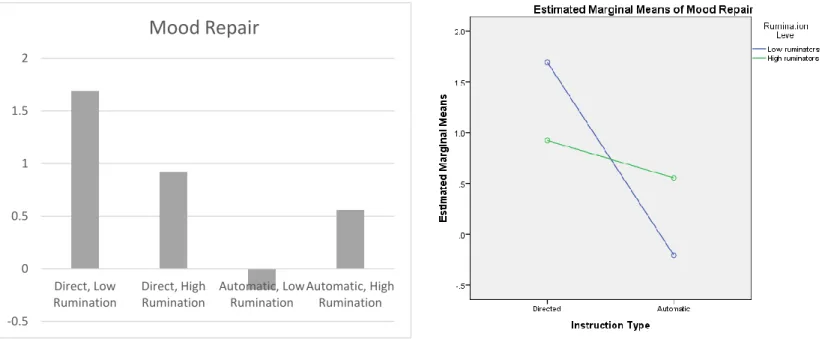
There was, however, a significant interaction between level of rumination and instruction type on mood repair, F(1,161) = 4.907, p < 0.028, such that whereas ruminators in the directed thought condition demonstrated less mood repair, those in the automatic thought condition demonstrated greater mood repair (Figure 4). However, no significant interactions between level of rumination and instruction type were found for thought valence [F(1,161) = 1.477,p = 0.226], proportion of positive thoughts [F(1,161) = 2.169, p = 0.143], nor number of positive thoughts
[F(1,161) = 1.181, p = 0.279].
Following those analyses, those in the high trait group were isolated and the resulting sample was subjected to a 2 X 2 ANOVA (rumination X instruction type). The original
main effect of instruction on mood repair [F(1,74) = 0.530, p = 0.469], thought valence [F(1,74) = 0.148, p = 0.702], proportion of positive thoughts [F (1,74) = 0.629, p = 0.430], or number of positive thoughts [F(1,74) = 0.417, p = 0.521] among the high ruminating group.
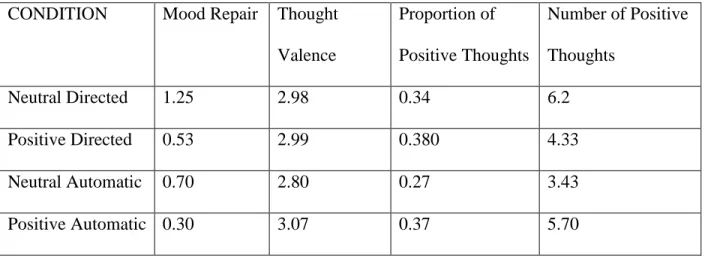
However, there was a marginally significant interaction of instruction type and cue type on positive thoughts, F(1,74) = 3.638, p < 0.060, such that while ruminators in the automatic thought condition reported fewer positive thoughts in the neutral cue condition, those in the positive cue condition reported more positive thoughts (Figure 5). There was no significant interaction of instruction type and cue type on mood repair [F(1,74)=0.088, p=0.768], thought valence [F(1,74)=0.694, p=0.407], or proportion of positive thoughts [F(1,74)=0.403, p=0.528]. There was some evidence that, whereas the expected interactions were not present in the full sample, they surfaced in the ruminative subset.
Similar analyses were performed regarding trait pessimism. Scores on the Life Orientation Test-Revised were used to split the sample. The sample was split at the median score (median=3.2) into high and low pessimism groups. A two-way analysis of variance was conducted for each of the four dependent variables with two levels of instruction type (directed and automatic) and two levels of life outlook (pessimist and optimist).
(M = 0.430, SD = 0.022. Finally, the main effect of life outlook on the number of positive thoughts reported was marginally significant, F(1.161) = 3.066, p < 0.082, such that fewer positive thoughts were reported among the high pessimism group (M = 4.566, SD = 0.526) than among the low pessimism group (M = 5.784, SD = 0.456). However, there was no main effect of life outlook on mood repair, F(1,161) = 1.187, p < 0.654.
There was no significant interaction of instruction type and life outlook on mood repair
[F(1,161) = 0.202, p = 0.654], thought valence [F(1,161) = 0.715, p = 0.399], proportion of positive thoughts [F(1,161) = 0.266, p = 0.607], nor number of positive thoughts [F(1,161) = 1.006, p = 0.317].
As with the rumination analyses, the primary hypotheses were then tested on the high pessimism group alone. A two-way analysis of variance was conducted for each of the four dependent variables with two levels of instruction type (directed and automatic) and two levels of cue type (neutral and positive).
There were no significant results in these analyses. There was no main effect of
instruction on mood repair [F(1,67) = 2.725, p = 0.103], thought valence [F(1,67) = 0.638, p = 0.427], proportion of positive thoughts [F(1,67) = 2.162, p = 0.146], nor number of positive thoughts [F(1,67) = 0.525, p = 0.471]. There was also no interaction of instruction type and cue type on mood repair [F(1,67) = 0.047, p = 0.829], thought valence [F(1,67) = 0.638, p = 0.427], proportion of positive thoughts [F(1,67) = 0.065, p = 0.800], nor number of positive thoughts
Discussion
This study was designed to test whether implicit goals of positivity could be more effective in improving negative mood than explicit goals. Evidence suggests that explicit goals to be more positive can backfire, but according to recent evidence, implicit goals could avoid this issue. It was expected that participants given an implicit goal, as prompted by positive
environmental cues, would exhibit greater recovery from negative mood than participants who were simply told to try to feel better.
Unfortunately, this design did not support the primary hypotheses. According to the data, it was found that individuals with an explicit goal of positivity reported greater positivity as represented by better mood, more positive thought valence, a greater proportion of positive thoughts, and a greater total number of positive thoughts. The “backfiring” effect of striving for positivity that was present in previous studies was not supported by this design - those given an explicit goal actually fared better. The automatic mood repair system, as prompted by
environmental cues, was less effective in this experiment.
repair mechanism to take action, meaning that implicit goals would also fail to be effective. Without the presence of negativity at the start of this experiment, the primary hypotheses could not be properly tested. Further investigation of these hypotheses would benefit from a more effective mood induction.
It may be that this particular mood induction was not well standardized. Each participant was required to reflect on a personal experience and write about it. Effectiveness may thus vary according to each participant’s motivation and ability to pursue such reflection. One way to improve effectiveness would be to place the induction in the hands of the experimenter. Studies have supported the use of a storytelling mood induction in which the experimenter reads a story with a distinct emotional tone (such as sadness) to the participant and instructs them to imagine that the events of the story are happening to them (Morrow & Nolen-Hoeksema, 1990). Using this method would ensure that each participant was given the same stimulus and dedicated the same amount of time to the induction. This method has been effective for inducing both sadness and anxiety in prior studies and may be more effective in a design like this (Morrow & Nolen-Hoeksema, 1990).
The data also failed to support the effectiveness of the manipulation of thought
instructions. If the manipulation had worked, then those in the directed thought condition should have reported less automatic thoughts as they should have been focused on their goal of
This design was also susceptible to demand characteristics. The design called for the use of an explicit goal, meaning that individuals were told exactly what they were supposed to do. Unfortunately, it also made use of an explicit measure. Participants were asked to try to feel better and were then asked to report how they felt. If the typical model of demand characteristics is applied here, then it may not be surprising that participants would report feeling better on the second mood evaluation because they believed that is what they were “supposed” to do. The data are consistent with this explanation. Participants in the directed thought condition reported feeling more positive and having more positive thoughts than did those in the automatic thought condition. While other measures were used to try to combat the demand characteristics, the use of such explicit measures to measure the outcome of an explicit goal was a clear pitfall of this design.
The use of implicit mood measures may have added clarity to the results of this study. For instance, the recently-developed Implicit Positive and Negative Affect Test (IPANAT) presents participants with nonsense words from a fictional language and asks them to rate the extent to which the words express a variety of affective states (Quirin & Bode, 2014). Because the words have no inherent meaning, it is presumed that participants will project their implicit affect onto the meaning of the word. This measure is less subject to demand characteristics and may be able to shed light on any effects this design has on implicit affect.
may have been perfectly capable of calling positive thoughts to mind when given a direct goal to try to be positive. If this were the case, then the explicit goal of positivity would have worked perfectly and there would be no need to find a “more effective” mechanism, such as an implicit goal. It may be that with a less healthy sample, such as those prone to negative cognitive patterns, the hypotheses would have been better supported.
Indeed, analysis of the secondary hypotheses supports this idea. When comparing those with a greater tendency to ruminate to those with a lesser tendency to do so, the expected trends begin to emerge. For instance, even though they showed less mood repair in the directed thought condition, ruminators showed greater mood repair in the automatic thought condition. This suggests that while an explicit goal is effective for non-ruminators, it may indeed be detrimental to ruminators. Further, when separating the ruminators from the rest of the sample, the predicted interaction between instruction and cue type emerged, albeit at the level of a trend. For instance, those in the automatic thought condition reported a greater number of positive thoughts when surrounded by positive cues. Indeed, for this group, the use of an implicit goal seemed to be effective. With this in mind, the idea that the sample was simply “too happy” becomes more plausible. It may be that the hypotheses would have been better supported if those in the sample had a greater tendency to ruminate. While there was not an overwhelming amount of support for the moderating effect of rumination, it is certainly worth exploring in future studies.
rumination scores and thereby a greater tendency to dwell on negative thoughts, these hypotheses may have found better support. The data regarding the ruminative sample support this notion and is worth exploring.
Future studies will also benefit from the flaws discovered in this study. The writing task mood induction proved ineffective here, but an improved mood induction could enable a proper test of the hypotheses. Furthermore, the inclusion of more implicit mood measures as dependent measures may elucidate effects of explicit versus implicit goals that were obscured in this study due to demand characteristics. All in all, though the results of this particular design did not turn out as expected, the study was a useful first step. There is sufficient evidence here to warrant further test of these hypotheses, and hopefully future studies will be able to support the effectiveness of implicit goals in improving mood in those for whom explicit goals prove detrimental. Research has prompted the search for an emotion regulation system that is not subject to the potential problems of explicit goals; this study provides a lead for such a system. If positive cues placed in one’s environment can indeed stimulate positive thoughts and thereby increase a person’s positivity, as was true for certain individuals in this study, then using such cues provides a mechanism of recovery from negative emotions that is less subject to backfire. Considering the abundance of models that emphasize actively changing one’s thought patterns, evidence supporting a more passive model sheds light on a new approach to recovery from negative emotions and/or cognitive patterns. This mechanism could be instrumental in
Index:
Table 1: Frequencies of Mood Valence Scores after Mood Induction
Frequency Percent Valid Percent
Cumulative Percent
Valid -4 4 2.4 2.4 2.4
-3 12 7.2 7.3 9.8
-2 33 19.9 20.1 29.9
-1 22 13.3 13.4 43.3
0 14 8.4 8.5 51.8
1 16 9.6 9.8 61.6
2 29 17.5 17.7 79.3
3 27 16.3 16.5 95.7
4 7 4.2 4.3 100.0
Total 164 98.8 100.0 Missing System 2 1.2
Total 166 100.0
Table 2: R-values for correlations
R-value P-value
Mood repair and thought valence
0.244 0.002
Mood repair and proportion of positive thoughts
0.254 0.001
Figure 2: Correlation of Mood Repair and Average Thought Valence
Table 3: Summary of Means for Primary Hypotheses (Full Sample) CONDITION Mood Repair Thought
Valence
Proportion of Positive Thoughts
Number of Positive Thoughts
Neutral Directed 1.30 3.26 0.43 6.65
Positive Directed 1.34 3.28 0.45 5.63
Neutral Automatic 0.29 2.97 0.31 4.00
Positive Automatic 0.12 3.08 0.36 4.83
Figure 4: Means for Resultant Positivity Across Conditions (Full Sample)
2.8 2.85 2.9 2.95 3 3.05 3.1 3.15 3.2 3.25 3.3 3.35 Neutral Directed Positive Directed Neutral Automatic Positive Automatic
Thought Valence
0 0.2 0.4 0.6 0.8 1 1.2 1.4 1.6 Neutral Directed Positive Directed Neutral Automatic Positive AutomaticMood Repair
0 0.05 0.1 0.15 0.2 0.25 0.3 0.35 0.4 0.45 0.5 Neutral Directed Positive Directed Neutral Automatic Positive AutomaticProportion of Positive Thoughts
Table 4: Resultant Positivity for Secondary Hypotheses Mood Repair Thought
Valence
Proportion of Positive Thoughts
Number of Positive Thoughts
High ruminators 0.78 3.31 0.43 5.63
Low ruminators 0.73 2.98 0.35 4.9
Optimists 0.94 3.29 0.43 5.81
Pessimists 0.51 2.95 0.32 4.53
Figure 5: Interaction of Level of Rumination and Instruction Type on Mood Repair
-0.5 0 0.5 1 1.5 2
Direct, Low Rumination
Direct, High Rumination
Automatic, Low Rumination
Table 5: Summary of Means for Primary Hypotheses (Ruminators Only) CONDITION Mood Repair Thought
Valence
Proportion of Positive Thoughts
Number of Positive Thoughts
Neutral Directed 1.25 2.98 0.34 6.2
Positive Directed 0.53 2.99 0.380 4.33
Neutral Automatic 0.70 2.80 0.27 3.43
Positive Automatic 0.30 3.07 0.37 5.70
Figure 6: Interaction of Instruction Type and Cue Type on Number of Positive Thoughts
0 1 2 3 4 5 6 7
Neutral Directed
Positive Directed
Neutral Automatic
References
Abele, A. (1990). [Recall of positive and negative life events. Studies of mood-inducing effect and production of texts]. Zeitschrift fur experimentelle und angewandte Psychologie, 37(2), 181-207.
Aydin, K. (2009). Automatic thoughts as predictors of Turkish university students' state anxiety.
Social Behavior And Personality, 37(8), 1065-1072. doi:10.2224/sbp.2009.37.8.1065 Aron A, Norman CC, Aron EN, McKenna C, Heyman RE. Couple’s shared participation in
novel and arousing activities and experienced relationship quality. Journal of Personality and Social Psychology. 2000;78:273–284.
Bargh, J., Gollwitzer, P. M., Lee-Chai, A., Barndollar, K., & Trötschel, R. (2001). The automated will: Nonconscious activation and pursuit of behavioral goals. Journal Of Personality And Social Psychology, 81(6), 1014-1027. doi:10.1037/0022-3514.81.6.1014 Baron, R. A. (1976). The reduction of human aggression: A field study of the influence of
incompatible reactions. Journal of Applied Social Psychology, 6, 260–274.
Block, J. & Kremen, A. M. (1996). IQ and ego-resiliency: Conceptual and empirical connections and separateness. Journal of Personality and Social Psychology, 70, 349-361.
Bridgeman, D. (1981). Enhanced role-taking through cooperative interdependence: A field study.
Child Development, 52, 1231–1238.
Cabanac, M. (1971).Physiological role of pleasure. Science, 173, 1103–1107.
Carver, C. S., & Scheier, M. F. (1981). Attention and self-regulation: A control theory approach to human behavior. New York: Springer- Verlag.
instructions. Journal Of Personality And Social Psychology, 71(3), 464-478. doi:10.1037/0022-3514.71.3.464
Cousins, N. (1985). Therapeutic value of laughter. Integrative Psychiatry, 3, 112.
Custers, R., & Aarts, H. (2005). Positive Affect as Implicit Motivator: On the Nonconscious Operation of Behavioral Goals. Journal Of Personality And Social Psychology, 89(2), 129-142. doi:10.1037/0022-3514.89.2.129
Danner, D.D., Snowdon, D.A., Friese,n W.V. Positive emotions in early life and longevity: Findings from the nun study. Journal of Personality and Social Psychology.
2001;80:804–813.
Derryberry, D. & Tucker, D.M. Motivating the focus of attention. In: Neidenthal PM, Kitayama S, editors. The heart’s eye: Emotional influences in perception and attention. San Diego, CA: Academic Press; 1994. pp. 167–196.
DeWall, C., & Baumeister, R. F. (2007). From terror to joy: Automatic tuning to positive affective information following mortality salience. Psychological Science, 18(11), 984-990. doi:10.1111/j.1467-9280.2007.02013.x
DeWall, C., Twenge, J. M., Koole, S. L., Baumeister, R. F., Marquez, A., & Reid, M. W. (2011). Automatic emotion regulation after social exclusion: Tuning to positivity. Emotion, 11(3), 623-636. doi:10.1037/a0023534
Diener, E. (2000). Subjective well-being: The science of happiness and a proposal for a national index. American Psychologist, 55, 34–43.
Easterbrook JA. (1959). The effect of emotion on cue utilization and the organization of behavior. Psychological Review, 66, 183–201.
Feshbach, N. D., & Feshbach, S. (1982). Empathy training and the regulation of aggression: Potentialities and limitations. Academic Psychological Bulletin, 4, 399–413.
Fredrickson, B. L., & Levenson, R. W. (1998). Positive emotions speed recovery from the cardiovascular sequelae of negative emotions. Cognition and Emotion, 12, 191–220. Fredrickson, B. L., Mancuso, R. A., Branigan, C., & Tugade, M. M. (2000). The undoing effect
of positive emotions. Motivation And Emotion, 24(4), 237-258. doi:10.1023/A:1010796329158
Fredrickson BL, Tugade MM, Waugh CE, Larkin G. (2003). What good are positive emotions in crises?: A prospective study of resilience and emotions following the terrorist attacks on the United States on September 11th, 2001. Journal of Personality and Social
Psychology, 84, 365–376.
Freedman, J. (1978). Happy People: What Happiness Is, Who Has It, and Why. Harcourt Brace Jovanovic, New York.
Frijda, N.H. (1986). The emotions. Cambridge, UK: Cambridge University Press.
Fry, W. F. (1994). The biology of humor. Humor: International Journal of Humor Research, 7, 111–126.
Gilbert, D. T., Pinel, E. C., Wilson, T. D., Blumberg, S. J., & Wheatley, T. P. (1998). Immune neglect: A source of durability bias in affective forecasting. Journal Of Personality And Social Psychology, 75(3), 617-638. doi:10.1037/0022-3514.75.3.617
Harris, J. L., Bargh, J. A., & Brownell, K. D. (2009). Priming effects of television food advertising on eating behavior. Health Psychology, 28, 404–413
Hopp, H., Troy, A. S., & Mauss, I. B. (2011). The unconscious pursuit of emotion regulation: Implications for psychological health. Cognition And Emotion, 25(3), 532-545. doi:10.1080/02699931.2010.532606
Isen, A. M., & Daubman, K. A. (1984). The influence of affect on categorization. Journal Of Personality And Social Psychology, 47(6), 1206-1217. doi:10.1037/0022-3514.47.6.1206 Isen, A. M., Daubman, K. A., & Nowicki, G. P. (1987). Positive affect facilitates creative
problem solving. Journal Of Personality And Social Psychology, 52(6), 1122-1131. doi:10.1037/0022-3514.52.6.1122
Kahn BE, Isen AM. (1993). The influence of positive affect on variety-seeking among safe, enjoyable products. Journal of Consumer Research, 20, 257–270.
Karlin, B. E., Brown, G. K., Trockel, M., Cunning, D., Zeiss, A. M., & Taylor, C. (2012). National dissemination of cognitive behavioral therapy for depression in the department of veterans affairs health care system: Therapist and patient-level outcomes. Journal Of Consulting And Clinical Psychology, 80(5), 707-718.
Keyes, C. L. M. (2002). The mental health continuum: From languishing to flourishing in life.
Journal of Health and Social Behavior, 43, 207-222.
Kuiper, N. A., & Martin, R. A. (1998). Laughter and stress in daily life: Relation to positive and negative affect. Motivation and Emotion, 22, 133–153.
Lazarus, R.S. (1991). Emotion and adaptation. New York: Oxford University Press. LeDoux, J. (1996). The emotional brain. New York: Simon & Schuster.
Levenson, R. W. (1992). Autonomic nervous system differences among emotions. Psychological Science, 3, 23–27.
Levenson, R.W. (1994). Human emotions: A functional view. In: Ekman P, Davidson R, editors. The nature of emotion: Fundamental questions. New York: Oxford University Press, 123–126.
Lightsey, O. R., Gharghani, G., Katz, A., McKinney, V., & Rarey, E. (2013). Positive automatic cognitions mediate the relationship between personality and trait positive affect. Journal Of Happiness Studies, 14(1), 115-134. doi:10.1007/s10902-011-9319-x
Lyubomirsky, S., & Lepper, H. (1999). A measure of subjective happiness: Preliminary reliability and construct validation. Social Indicators Research, 46, 137-155. Mandler, G. (1984). Mind and body: Psychology of emotion and stress. New York: Norton. Mauss, I. B., Cook, C. L., & Gross, J. J. (2007). Automatic emotion regulation during anger
provocation. Journal Of Experimental Social Psychology, 43(5), 698-711. doi:10.1016/j.jesp.2006.07.003
Mauss, I. B., Savino, N. S., Anderson, C. L., Weisbuch, M., Tamir, M., & Laudenslager, M. L. (2012). The pursuit of happiness can be lonely. Emotion, 12(5), 908-912.
Mauss, I. B., Tamir, M., Anderson, C. L., & Savino, N. S. (2011). Can seeking happiness make people unhappy? Paradoxical effects of valuing happiness. Emotion, 11(4), 807-815. doi:10.1037/a0022010
Miceli, M., & Castelfranchi, C. (1997). Basic principles of psychic suffering: A preliminary account. Theory & Psychology, 7(6), 769-798. doi:10.1177/0959354397076003
Miceli, M., & Castelfranchi, C. (2000). Nature and mechanisms of loss of motivation. Review Of General Psychology, 4(3), 238-263. doi:10.1037/1089-2680.4.3.238
Mischel, W., Cantor, N., & Feldman, S. (1996). Principles of self-regulation: The nature of willpower and self-control. In E. Higgins, A. W. Kruglanski (Eds.). Social psychology: Handbook of basic principles (pp. 329-360). New York, NY US: Guilford Press.
Morrow, J. & Nolen-Hoeksema, S. (1990). Effects of responses to depression on the remediation of depressive affect. Journal of Personality and Social Psychology, 58), 519–527.
Myers, D. G. (2000). The funds, friends, and faith of happy people. American Psychologist, 55(1), 56–67.
Nezu, A. M., Nezu, C. M., & Blissett, S. E. (1988). Sense of humor as a moderator of the relation between stressful events and psychological distress: A prospective analysis.
Journal of Personality and Social Psychology, 54, 520–525.
Papies, E. K., & Hamstra, P. (2010). Goal priming and eating behavior: Enhancing self-regulation by environmental cues. Health Psychology, 29(4), 384-388.
doi:10.1037/a0019877
Quirin, M., Bode, R. C., & Kuhl, J. (2011). Recovering from negative events by boosting implicit positive affect. Cognition And Emotion, 25(3), 559-570.
Quirin, M., & Bode, R. C. (2014). An alternative to self-reports of trait and state affect: The implicit positive and negative affect test (IPANAT). European Journal Of Psychological Assessment, doi:10.1027/1015-5759/a000190.
Rasinski, K. A., Visser, P. S., Zagatsky, M., & Rickett, E. M. (2005). Using implicit goal priming to improve the quality of self-report data. Journal Of Experimental Social Psychology, 41(3), 321-327. doi:10.1016/j.jesp.2004.07.001
Russell JA, Weiss A, Mendelsohn GA. (1989). The affect grid: A single-item scale of pleasure and arousal. Journal of Personality and Social Psychology, 57, 493–502.
Scherer, K. R. (1984). Emotion as a multi-component process. In P. Shaver (Ed.), Review of personality and social psychology: Vol. 5. Emotions, relation- ships, and health (pp. 37-63). Newbury Park, CA: Sage.
Schooler, J. W., Ariely, D., & Loewenstein, G. (2003). The pursuit and assessment of happiness may be self-defeating. In J. Carrillo & I. Brocas (Eds.), The psychology of economic decisions (pp. 41–70). Oxford: Oxford University Press.
Schwartz, S. H., & Inbar-Saban, N. (1988). Value self-confrontation as a method to aid in weight loss. Journal Of Personality And Social Psychology, 54(3), 396-404. doi:10.1037/0022-3514.54.3.396
Seligman, M. P., Rashid, T., & Parks, A. C. (2006). Positive psychotherapy. American Psychologist, 61(8), 774-788. doi:10.1037/0003-066X.61.8.774
Smallwood, J., Fitzgerald, A., Miles, L. K., & Phillips, L. H. (2009). Shifting moods, wandering minds: Negative moods lead the mind to wander. Emotion, 9(2), 271-276.
doi:10.1037/a0014855
Smith, R. E. (1973). The use of humor in the counterconditioning of anger responses: A case study. Behavior Therapy, 4, 576–580.
Solomon, R. L. (1980). The opponent-process theory of acquired motivation: The costs of pleasure and benefits of pain. American Psychologist, 35, 691–712.
Stein, N. L., & Levine, L. J. (1987). Thinking about feelings: The development and organization of emotional knowledge. In R. E. Snow & M. Farr (Eds.), Aptitude, learning, and
instruction: Vol. 3. Cognition, conation, and affect (pp. 165-197). Hillsdale, NJ: Eribaum. Stein, N. L., & Levine, L. J. (1990). Making sense out of emotion: The representation and use of
goal-structured knowledge. In N. L. Stein, B. Lev- enthal, & T. Trabasso (Eds.),
Psychological and biological approaches to emotion (pp. 45-73). Hillsdale, NJ: Erlbaum. Stone, A. A., Neale, J. M., Cox, D. S., & Napoli, A. (1994). Daily events are associated with a
secretory immune response to an oral antigen in men. Health Psychology, 13, 440–418. Treynor, Gonzalez, and Nolen-Hoeksema (2003). Cognitive Therapy and Research, 27, 247-259. Triandis, H. C., Bontempo, R., Leung, K., & Hui, C. (1990). A method for determining cultural,
demographic, and personal constructs. Journal Of Cross-Cultural Psychology, 21(3), 302-318. doi:10.1177/0022022190213003
Wood, J. V., Perunovic, W., & Lee, J. W. (2009). Positive self-statements: Power for some, peril for others. Psychological Science, 20(7), 860-866.