Martin Borbone. From doodle to Google: Exacerbating old problems or causing new ones? The relationship between laptop usage and in-class student behavior. A Master’s Paper for the M.S. in I.S degree. April 2009. 93 pages. Advisor: Deborah Barreau.
This study describes a survey of undergraduate and postgraduate students currently enrolled in the School of Information and Library Science at the University of North Carolina at Chapel Hill during the Spring semester 2009. The study investigates in-class laptop usage by students and what laptop activities students engage in during class.
The study examines student perceptions towards their own laptop usage and if such usage distracts, annoys, or bothers other students, and explores student perceptions as to how they may be distracted by such behaviors in class.
The study also examines varying degrees of laptop restrictions in class and how this affects student involvement with a class and the predisposition to participate in an elective course if they knew in advance that such restrictions were to be imposed.
Headings:
Student attitudes
Student behavior
Multitasking in class
Classroom environment
Classroom research
Laptops in classrooms
STUDENT BEHAVIOR.
by Martin Borbone
A Master’s paper submitted to the faculty of the School of Information and Library Science of the University of North Carolina at Chapel Hill
in partial fulfillment of the requirements for the degree of Master of Science in
InformationScience.
Chapel Hill, North Carolina
April 2009
Approved by
TABLE OF CONTENTS
LIST OF FIGURES ... 2
INTRODUCTION... 3
PURPOSE OF THE STUDY ... 7
REVIEW OF THE LITERATURE ... 8
RESEARCH METHODOLOGY ... 27
RESULTS ... 35
DISCUSSION ... 58
CONCLUSIONS ... 69
REFERENCES ... 72
APPENDIX A: SURVEY QUESTIONS ... 79
APPENDIX B: EMAIL TEXT CANVASSING STUDENT PARTICIPATION ... 85
APPENDIX C: REMINDER EMAIL TEXT CANVASSING STUDENT PARTICIPATION ... 88
LIST OF FIGURES
Figure 1: Participants by degree and program ... 30
Figure 2: Gender of participants versus SILS population ... 36
Figure 3: Age of participants ... 37
Figure 4: Degree level of participants versus SILS population ... 38
Figure 5: Participants year of study as of Spring semester 2009 ... 39
Figure 6: Where did participants access and complete the survey? ... 40
Figure 7: How often do participants take their laptops to class? ... 41
Figure 8: How often do participants use their laptops in class? ... 42
Figure 9: Participants laptop activities related to class ... 43
Figure 10: Frequency of participant’s laptop activities related to class content ... 44
Figure 11: Time spent by participants on laptop activities related to class content ... 45
Figure 12: Participants laptop activities that are not class related ... 46
Figure 13: Top non-class related laptop activities ... 47
Figure 14: Frequency of participant’s laptop activities not related to class content ... 48
Figure 15: Time spent by participants on laptop activities not related to class ... 49
Figure 16: Reasons for student distraction by another student’s laptop activity .... 50
Figure 17: Laptop activities that participants notice other students’ engage in during class ... 51
Figure 18: Top activities other students are viewed engaging in during class ... 52
Figure 19: How laptop usage by other students affects participant’s consciousness of their own usage? ... 53
Figure 20: Does viewing other students’ using their laptop make participants more or less likely to use their laptops in class? ... 54
Figure 21: Do participants find other students’ laptop activities bothersome, annoying or distracting? ... 55
Figure 22: Do participants find other students’ laptop activities bothersome, annoying or distracting and if so, how often do they notice? ... 56
Figure 23: How often do participants believe their laptop activities distract other students? ... 57
Figure 24: Student views on class involvement and participation given different laptop restriction ... 64
INTRODUCTION
Concluding the opening remarks of her weekly lecture Professor Jones espied one of her
more promising students, a young woman who always sat in the center of the second row,
engaging in activity that troubled her.
“Miss Smith, what are you doing with that deck of cards?” asked Professor Jones.
“Playing solitaire!” replied Miss Smith. “Why?” exclaimed the Professor.
“Because my laptop is broken,” came back the retort.
While this account is fictitious, there is more than a kernel of truth in the above scenario.
Student classroom behavior with respect to computers is the subject of much research in
light of the fact that “laptops are the latest in a series of technologies that are
revolutionizing classroom teaching” (Granberg and Witte, 2005). However, this corpus of
knowledge focuses primarily on the use of computers1 as classroom teaching aids (Barak,
Lipson and Lerman, 2006; Bates, 2009; Bhave, 2002; Yamamoto, 2008) and the
perceptions of instructors as to the practicality and value of computers as part of the
classroom environment (Arend, 2004; Anderson, 2008; Bhave, 2002; Demb, Erickson,
and Hawkins-Wilding 2004; Foster 2008). There is a dearth of research with respect to
student perceptions and behaviors towards their personal use of laptops in class, the use
of laptops by other students, and whether such activity disturbs students to the extent that
it reduces their inaction and involvement with a class (Elwood, Chuleeporn, & Cutshall,
2006; Fried, 2008). Indeed, in a 2002 University of North Carolina at Chapel Hill, School
of Information and Library Science survey by Li and Newby, students expressed
concerns with respect to classroom laptop usage. One student states, “People will check
their email or play games in class instead of paying attention, annoying the rest of us with
their typing.” Another student cautions that “right now we have great discussions in
some classes, but if we all have our attention directed at our laptops we will be losing a
lot of the interpersonal communication and class participation” (Li & Newby, 2002). Yet
little additional research appears to have evolved from this study as to the potential
benefits or pitfalls of in-class laptop usage from the student’s perspective, which begs the
question why? This question is beyond the scope of the current research yet raises another
avenue of exploration. Do students consider laptops a ‘must have’ tool or a “Trojan
horse” that brings into the classroom new distractions not only for the student operating
the laptop but also for those around them?
This paper analyzes the findings of a research study that looked into laptop usage
and in-class student behavior in the spring semester 2009. To begin, the paper provides a
contextual framework in which the research was conceived and outlines the purpose of
the study. Following this is a review of the extant literature providing background and
insight into the early adoption of laptop technology and the later issues surrounding
wireless networking when combined with unfettered in-class laptop usage. Next is the
research methodology highlighting participant selection criteria, participant involvement,
data collection, and data analysis. This leads to the results of the study, a discussion of
Framing the Issue
As part of the university's coordinated technology plan, the Carolina Computing Initiative (CCI) aims to ensure that Carolina students, faculty, and staff have easy access to high quality and affordable technology and can use it effectively. At the center of the initiative is the requirement that, beginning with incoming freshmen in the fall of 2000, undergraduates at the University of North Carolina at Chapel
Hill own laptop computers that meet University specifications (Our Mission,
2007).
Wireless networking of the UNC campus opened up many new avenues for educational
instruction, providing a richer context to traditional classroom materials through
collaboration and knowledge discovery. The successful introduction of the Carolina
Computing Initiative (CCI) eight years ago foreshadowed the exponential growth in
online educational services to complement conventional pedagogies. Technological
advances, such as wireless networking, have significantly changed the classroom
environment and the instructor/student paradigm (Arend, 2004; Fried, 2008; Yamamoto,
2008). However, the combination of increased laptop usage with unfettered accessibility
to the Internet offered new opportunities for student distraction, both individually and
collectively (Bugeja, 2007; Foster, 2008; Terry, 2008; Yamamoto, 2008). However, there
are those such as Yamamoto (2008) who argues that computers are not the real villain.
Doodling or a crossword puzzle can be just as distracting, though in less obvious ways.
Boredom is likely one of the main culprits and idle minds have always found innovative
ways to occupy themselves. For some, laptops offer the modern equivalent of doodling.
The advent of laptop computers and wireless networking provided opportunities
to enrich the learning experience enabling students to verify facts, link to resources for
additional information, and access online course materials (Barkhuus, 2005; Elwood,
Chuleeporn, and Cutshall, 2006; Granberg and Witte, 2005). Yet laptops have the
messaging with friends, online Scrabble™, crosswords, and a myriad of other services
unrelated to classroom activities (Anderson, 2008; Barak, Lipson, and Lerman, 2006;
Yamamoto, 2008). From the fervent tapping of the keyboard to the pulsating aural and
visual alerts when Instant Messages arrive, computers demand attention not only from
those using them but also from those in the immediate vicinity who, rightly or wrongly,
are distracted by such enterprises. ‘Doodling’ on a scratch pad or drawing stick figures on
the surface of a desk are solitary activities often associated with daydreaming and
therefore may go unnoticed by other students. However, the visual and aural qualities of
laptops have the potential to intrude or disrupt the personal space of those in the
surrounding environment (Bhave, 2002; Granberg and Witte, 2005). Yamamoto (2008)
notes that, “a crossword puzzle and doodling are done on a horizontal surface, not lit and
in glowing color, and will not distract (most likely) those behind, or even possibly the
person next to them.” Laptops, and similar devices, require active participation by their
users. Unlike the doodling of daydreamers, “browsing, playing computer games,
exchanging email and Instant Messaging,” (Bhave, 2002) synonymous with the Internet
age, potentially results in passive participation by students in the immediate vicinity,
curious to see what another student is looking at on screen (Bhave, 2002; Granberg and
Witte, 2005; Yamamoto, 2008). This in turn is likely to create a distraction, or what I
term a residual or over-flow effect2, that may be fleeting or more prolonged. “Since
laptop screens are vertical, students sitting in line-of-sight of the offending screen are
distracted. One person in the front row can distract almost the entire class if the screen is
2
In this instance, the term residual implies something leftover by the active party that consciously
interferes with a passive third party, or where the enterprise of the active party over‐flows involuntarily
to the passive third party, such that the third party participates of the enterprise temporarily or for
large, and what is being viewed is provocative,” asserts Yamamoto (2008). What remains
unclear is under what circumstances is a student distracted by another student’s laptop
activity, how often does this happen, and what effects, if any, does this have on the
classroom experience of the distracted student.
PURPOSE OF THE STUDY
This study seeks to address student behavioral issues with respect to the use of laptops,
including Personal Digital Assistants (PDA’s), and other similar devices during
classroom instruction sessions. Specifically, the study focuses on the student behavior of
bachelor and master degree majors enrolled full-time in one of the School of Information
and Library Science’s (SILS) programs at the University of North Carolina at Chapel Hill
during the spring semester, 2009.
Previous studies in the area of in-class student interaction with computers take a
position from the vantage of the instructor’s standpoint (Owen, 2006), with less
understanding or analysis for how and why students use laptops in class. Where students
feel engaged in the classroom experience and subject matter, does laptop usage increase
or decrease? In what other contexts do students use their laptops during class, for what
curricula and non-curricula purposes, and most importantly, in what ways do students
believe such usage enhances or diminishes their educational experiences? How might
students react to the potential curtailment of classroom internet accessibility to
context-specific environments (Barreau, Crystal, Greenberg, Sharma, Conway, Oberlin, Shoffner,
& Seiberling, 2007; Conway, Shoffner, Moffat, and Oberlin, n.d.) or the outright banning
of laptops (Anderson, 2008; Jaschik, 2008; Mangan, 2001; McGlynn 2008; Yamamoto,
instructors could restrict internet access to specific class websites (context-aware
classrooms) or disable the wireless network during a given class period, would students
avoid taking such classes specifically due to such restrictions?
REVIEW OF THE LITERATURE
Numerous studies and reports address the use of laptop technology both within and
beyond the traditional classroom setting (Fried, 2008; Lecher, 2005; Levine 2002a;
Levine, 2002b; McGlynn, 2008, Owen, 2006). Many studies focus specifically on
professorial perceptions of use and abuse of laptops during class instructional periods
(Arend, 2004; Barak, Lipson, and Lerman, 2006; Granberg and Witte, 2005; Fried, 2008:
Hembrooke and Gay, 2003), times when students should be using computer technology
in furtherance of their education. Less well served by the current literature is the student
perspective of laptop usage and under what conditions students feel sufficiently distracted
that they resort to using their laptops as a means to disengage temporarily or completely
from the educational process (Arend, 2004; Demb, Erickson, and Hawkins-Wilding,
2004; Lloyd, Dean, and Cooper, 2007). Before resorting to draconian measures, for
example banning of laptops from classrooms, we must first acknowledge if a residual or
over-flow effect exists, how this manifests itself, and what ramifications, if any, this has
on other students (Borja, 2006; Foster, 2008; Hembrooke and Gay, 2003; Ribble and
Bailey, 2004; Ribble, Bailey, and Ross, 2004; Young, 2006). In turn, this raises the
broader question – are laptops within classrooms aiding or hindering the diffusion of
In 1998, Michael Hooker, Chancellor, University of North Carolina at Chapel Hill
(UNC) stated, “My goal is to put a computer on the desk of every faculty, staff, and
student” (Carolina Computing Initiative, 1998). Hooker’s vision was realized in Fall
2000, when laptops became mandatory for all incoming freshmen (Li and Newby, 2002).
In 2001, all entering graduate students at the university’s School of Information and
Library Science were expected to have laptops, purchased directly or via UNC through
the Carolina Computing Initiative. At the time, UNC was the largest public university
with a mandatory laptop requirement (Li and Newby 2002) and a, “decision to require
students to own a laptop is not unusual among higher education institutions” (Elwood et
al., 2006). Many other institutions, both public and private have followed suit with
similar initiatives.
Students will have so many options for learning that traditional formats, void of much technology, will have little to offer in the marketplace of the next century. I believe the clock is ticking for higher education, and it may be a wired bomb unless we act fast to take advantage of the opportunities, and avoid the threats, of
a fully digital, networked, multimedia world. -- Thomas W. West, Associate Vice
Chancellor for IT, California State University System Office.
Source: http://www.unc.edu/faculty/faccoun/minutes/CCIM98FC02.pdf
To be sure as West predicted, “technology-infused teaching” (Ribble and Bailey, 2004)
has become the de facto standard within higher education. The raison d'êtrebehind the
Carolina Computing Initiative was to create a comprehensive laptop policy that allowed
for the “integrationof technology into the curriculum with the confidence that students
had the equipment required to access it.” However, a study of students by Cutshall,
Changchit, and Elwood (2006) found that while many “… may see the benefits of using
laptop computers in their education, they [students] do not believe that it [laptop] should
value of the laptop to their academic success was tightly correlated with their perception
of the success of faculty in integrating the laptop into teaching and classroom activity.” In
that respect students regarded laptop purchases as an added expense to an already
expensive service, that of education, where cost is “deemed a critical success factor” in
implementation and the subsequent take-up rate of a laptop program.
In recent years relatively inexpensive and lightweight laptops have entered the
market, and professors can “reasonably require” (Granberg and Witte, 2005) students to
bring them to class. Not surprisingly however, research points to the availability of
on-campus wireless network access as the most important factor in the success of a laptop
initiative (Cutshall et al., 2006) and a major reason why students bring laptops to class,
even when not required.
As compulsory programs were established in the mid to late 1990’s, many studies
suggested a generally positive response to the introduction of laptops. Barack et al.
(2006), quoting previous studies, refers to the overall increase in “students’ motivation
and collaboration, strengthened connections between disciplines, improving students’
problem solving skills, and promoting academic achievement,” with respect to laptop
usage in class. Others, including Lloyd, Dean, and Cooper (2007) and Demb et al. (2004)
state that, “as students become more accessible to each other, and as faculty become more
accessible to students, a laptop strategy could be viewed as a means to further develop a
sense of community on a campus or in specific classes.” Bhave (2002) supports this sense
of community going further by saying, “the normal ‘one-to-many’ method of any teacher
will now be augmented and overlaid by numerous one-to-many electronic conversations,
‘many-to-many’ relationships and a study by Anderson (2008) suggests that students view
classroom interactions as a “bunch of ‘parallel bilateral’ relationships between teacher
and student, not a multilateral set of relationships in class.” Such multilateral
relationships are evident in the outside world where social-networking sites such as
MySpace and Facebook have quickly interweaved into the societal fabric of the new
economy increasing communication and learning in non-traditional ways.
Wake Forest University, which has had a laptop initiative since 1997, reported
that students with computer access, “led to better communication and collaboration,
which in turn has enhanced teaching and learning” (Olsen, 2001). Similar studies
corroborate the Wake Forest University findings. A two-year study aimed at middle
school students in Beaufort County, S.C. found that the “use of laptops as electronic
notebooks is associated with sustained levels of academic achievement over time.”
Evidence suggests that the “use of laptop computers as notebooks is associated with
sustaining and improving academic achievement among groups of students who
historically have not been as successful in school” (Stevenson, 1999). However, not all
studies support such findings and indeed, with the advent of wireless networking and the
ability to access the internet through a myriad of different devices, recent studies are
questioning the wisdom of laptop usage within the classroom setting.
First, the lack of eye contact itself means a key indicator of student engagement and understanding is missing. Second, a student looking at a laptop screen and concentrating on solitaire looks identical to a student concentrating on the material for the day. This means a professor lacks the capacity to control students’ attention level and the flow of analysis in his or her classroom (Yamamoto, 2008).
The ubiquitous nature of computing is related to and became available due to
potential for laptop teaching required the availability of the second technology, wireless
Internet access.” With many institutions providing wireless networking, universities are
offering students new ways to learn via electronic discussion boards such as Blackboard
and WebCT and enabling “in-class on-line interactions between teachers and students”
(Barkhuus, 2005). To be sure, some already argue that wireless laptops, PDA’s and PIM
devices are changing the educational environment (Anderson, 2008; Barak et al., 2006;
Brubaker, 2006).
Such an evolutionary progression towards laptop computing potentially belies a
greater concern that the technology is disrupting the very essence of the classroom
environment. Indeed, in recent years concerns have been expressed by a growing number
of academics as to the value and use of laptops within the classroom. Quoting Dennis
Adams, writing in the September 2006 issue of Communications of the ACM, Bugeja
(2007) attributes the following: “While classroom access to the Internet may be a
wonderful teaching tool it can also be a barrier to learning.” Such barriers are both
physical and cognitive. Physical in the sense that the nature of most laptops requires the
raising of a screen behind which a student can hide and furtively surf the web, and
cognitive in the sense that any activity not directly related to the current class is
distracting both for the student and for those within his or her immediate vicinity. Indeed,
Barak et al. (2006) note how laptops unintentionally provide students’ with
“opportunities for non-learning usages and limit or even reverse benefits when measured
in terms of academic performance.” Foster (2008) similarly argues that if you allow
students’ unfettered use of laptops in-class they will “surf the web instead of engaging in
who sit near them.” Some students unwittingly make such nefarious activities obvious by
hiding behind their laptop screens nestled way in the back rows where they think they are
unseen by a professor.
Others take a different view arguing that “unlike whispering or passing paper
notes, students can non-disruptively communicate with each other through the access
point [laptop], as well as in a peer-to-peer manner” (Bhave, 2002). Indeed, some
professors advocate the use of laptops during class where they feel the technology “aids
in the educational process” (Yamamoto, 2008). Additionally, there are those who contend
that wireless networks and laptops allow students to “communicate silently with their
peers” (Granberg and Witte, 2005) without disrupting them. Yamamoto (2008) contends
that, “Instant Messaging (IM) by students during class is also seen as positive. Some
professors believe it keeps the room quieter because students can IM each other instead
of talking.” However, such arguments fail to take into account the clandestine nature of
many of these ‘conversations’ and the distraction that keyboard tapping can cause other
students. This suggests that a “key challenge in leveraging technologies to support
innovative teaching and learning, is to determine how to design curricula that effectively
integrate technology in a coherent and authentic way” (Barak et al., 2006). As Granberg
and Witte (2005) contend, “the aim is to use technology to channel these normal
classroom behaviors… sideways glances, knowing looks, and discrete whispers… in a
way that would be more efficient and less disruptive.” Such challenges suggest a wider
issue concerning the integration of laptops within the learning environment and how
actively involved are students. Barak et al. (2006) go further and suggest that,
students learning as well as address the concerns of instructional change.” These
challenges also highlight how technology hitherto embraced and adopted as an innovative
education tool, is creating unforeseen issues that need addressing (Foster, 2008). As
Anderson (2008) argues,
Internet access has done more to lower attention and thought in the classroom that anything I am aware of – having a TV, blackberry, IM machine, email device and web surfer is simply an impossible distraction.
Citing a 1972 article by Eda LeShan, Bugeja (2007) refers to the “Sesame Street
syndrome” in which children are the passive onlookers within the information chain,
waiting on adults to feed them the answer. Latterly, this syndrome has come to denote
the interactivity and entertainment of a given class where “if the entertainment doesn’t
come from the front of the wireless classroom, it comes from the Internet” (Bugeja,
2007). While this may be the case, much depends on whether laptops are a requirement
for a given class and the attitude of the professor towards laptop usage in class generally.
As Barak et al. (2006) state,
A key challenge in leveraging technologies to support innovative teaching and learning is to determine how to design curricula that effectively integrate technology in a coherent and authentic way.
While the issue of how to successfully integrate technology into the classroom
environment is ongoing, there has recently been a growing backlash towards laptops
generally within classrooms (Bugeja, 2007; McWilliams, 2005) and a move towards
more draconian measures aimed at curbing Internet usage or banning laptops outright.
One solution is to have students log into a particular class as part of a subscription
management system, where the professor preordains accessibility to specific services
while other services remain blocked. However, student ingenuity to swap usernames and
switch” (Anderson, 2008; Bhave, 2002; Mangan, 2001) which effectively gives the
professor the control as to when to enable and disable the Internet during class. When
attention needs focusing towards the front of the classroom the Internet is disabled and
students asked to lower their laptop screens (Granberg and Witte, 2005; Levine, 2002a).
At other times, the Internet is enabled for research, project work, tests, etc. However,
bleed-through from other wireless networks together with mobile communication devices
such as smart-phones and PDA’s have already “rendered the classroom permeable to
outside interruptions” (Bhave, 2002). Faculty at UCLA’s Anderson School of
Management concluded that “stopping the [wireless] signals amounted to a technology
arms race that couldn’t be won” (McWilliams, 2005), and subsequently gave up trying.
Such interruptions may be mitigated to an extent, by providing “context-aware
classrooms” (Barreau, Crystal, Greenberg, Sharma, Conway, Oberlin, Shoffner, 2007;
Conway, Schultz, Shoffner, Moffat, and Oberlin, n.d.; Yang, 2006). In a context-aware
environment the student is “recognized and assigned various services based on their prior
needs and requirements which together seamlessly integrates the computing and
communication devices into a physical environment” (Wang, 2006). Other solutions take
a show-and-shame approach. The use of “RFID’s (Radio Frequency Identifiers), mobile
sensors, and device controllers” (Wang, 2006) enables the professor to monitor in-class
network usage, capture the contents on an individual student’s screen, and project this for
the class to see (Mangan, 2001). Although Owen, Farsaii, Knezek, and Christensen,
(2006) note how the Internet has changed the “locus of control from the teacher to the
student when the students were given laptops of their own,” such technical solutions,
imbalance of power that some professors perceive. Technical solutions may also improve
student attention and interaction within the classroom generally, though as Fried explains,
“unstructured use of laptops in lecture courses is a disadvantage,” both to the student and
professor. Of course, there are arguments on the other side as well, and some evidence
that some students actually prefer lecture to being required to participate.
Banning laptops form the classroom is the most draconian of measures though
may be the only viable solution in some circumstances. Indeed, a number of studies show
that bans, although unpopular with students at first (Foster, 2008), have shown attention
levels to increase by a factor of 200% or more. “Students are more engaged and talkative
in class and show an increased ability to reason” (Yamamoto, 2008). In-class test results
between those who used their laptops versus those who did not revealed an average 5%
variance in results favoring those students who did not use their laptops (Pinchin, 2009).
This suggests a correlation between laptop usage and recall of information.
Hembrooke and Gay (2003) note that, “students in an open laptop condition suffered
decrements on traditional measures of memory for lecture content,” and that despite this
decrement in recall students are not only happy to multitask, but also continue to do so in
ever-increasing numbers. Yet, as Hembrooke and Gay (2003) contend there is a “long
tradition of psychological and media communication research that indicates that our
ability to engage in simultaneous tasks is, at best, limited and at worst, virtually
impossible.” While that might be the case, students nevertheless continue to multitask
with impunity, which suggests that some form of laptop restriction may be an appropriate
An anonymous survey of students taken after a one-day laptop ban suggested that
75% of students favored a no-laptop policy while 95% of students acknowledged using
their laptops for non-class activities at other times (Foster, 2008). Another approach is to
inform students from the outset that if they are found to be using their laptops for
anything other than recognized class work, e.g. email they will lose the privilege to use
their laptop in class for the rest of the semester (Terry, 2008).
This raises the issue of attitudes and expectations between faculty on the one hand
and students on the other. Cutshall et al. (2006) argue that the “success of computer use is
largely dependent upon the attitudes of both instructors and students,” while Barkhuus
(2005) points out that, “unless the teacher specifically prohibits the use of laptops in the
classroom, the wireless networks will inevitably provide a source of distraction for
students who bring their devices to class.” Foster (2008), quoting Ann Althouse, a
professor at the University of Wisconsin Law School says, “there will always be
distracted students regardless of the Internet. Before the Internet, students gazed out of
the windows, doodled or simply fidgeted.” That may be the case, but the advent of
laptops and wireless networks are clearly providing new avenues down which students
can be distracted. All of which suggests that laptops are not being fully integrated as part
of the education experience and that students are taking the opportunity afforded by the
technology to multitask or completely ‘zone-out’ from the lecture.
In a study by Demb et al. (2003), 51% of students “disagreed that faculty
demonstrated how the laptops could enrich the [learning] experience,” a thought echoed
by Fried (2008) who contends that in the “rush to adopt laptops as the tool-du-jour in
Granberg and Witte (2005) remark, “making laptops and wireless networks widely
available does not necessarily improve student learning,” a marked departure from earlier
studies that support such programs. Some suggest that distracted students really are not
missing much of long-term value. This view is reflected in the comments of Demb et al.
(2007) who contend that there is a “perception by colleges that technology will have a
positive impact on student learning,” without explicitly detailing what these benefits
might be. Conversely, the findings of Fried’s (2008) study at Winona State University in
Minnesota (2007) suggest that those students who used laptops in class did so for an
average of 48.7% of the time. Of this “81% checked email, 68% used Instant Messaging,
43% surfed the web, 25% reported playing games, and 35% reported doing “other”
things” (Fried, 2008). Overall, 17 minutes out of each 75-minute class period was used in
whole or part to non-class activities. Others report that in some classes “85-90% of
students are doing non-class activities on their computers during class” (Yamamoto,
2008).
The Wharton School at the University of Pennsylvania is out of step with the
mainstream institutional approach to laptops and wireless networks. Mangan (2001),
quoting Gerry McCartney, associate dean for computing and technology, states, “we
never wanted technology to get in the way of the relationship between the student and the
faculty member.” That may be so, but evidence suggests that this is exactly what is
happening. As Fried (2008) attests, “attention is often controlled voluntarily [however],
external events and visual stimulation can result in involuntary shifts of attention,” and
while this is true in any classroom environment Fried’s findings led her to conclude that,
lecture material.” This in turn was reflected in lower test scores. Furthermore, Fried
suggests that students who struggle in class “are more likely to bring their laptops as a
diversion.” This last finding is interesting insomuch as it raises the issue as why students’
bother attending class if they feel so disconnected from what is taking place. If it were
not for the participation grade, would they attend at all?
Students in higher education are in a unique position where they pay upfront for
education services rendered over a future time-period. In this regard, some students’ see
themselves as consumers of education. This point is explored by Anderson (2008) who
contends that some in the student population consider themselves the customer of an
“expensive consumer product called education, and that [the professor is] a sort of highly
paid barista who provides it.” Anderson goes on to suggest that if students “want to spend
their tuition paid time surfing the Internet” that is their prerogative and nothing to do with
the professor. Others take a similar view:
Professors worry that as wireless networks and laptops become ubiquitous, students will direct about as much attention to the front of the classroom as
airline passengers do to a flight attendant reviewing safety information
(Young, 2006).
Yamamoto (2008) points out that knowing you cannot keep the attention of
students for all or even some of the time, some faculty is taking an alternative approach
where the onus of responsibility resides with the student. If students “do not want to
learn, then let them do what they want, and it will be reflected in their final grade’
(Yamamoto, 2008). Pinchin (2009) quotes a student at Simon Fraser University as
saying, “my attention span only lasts so long. I don’t know what I would do without my
laptop, plus I pay for this class, it’s my money, so if I fail I only have myself to blame.”
multitasking is nothing new. McWilliams (2005), quoting Linda Stone, a lecturer as
Towson University, attributes this “trying-to-do-everything-at-once phenomenon [to]
‘continuous partial attention.’”
Increasingly, many students are bringing their outside lives into the classroom,
without regard for the implications this has on their ability to concentrate and participate
in lessons, or how this might affect others. As Pinchin (2009) asserts, many students
know they are unable to focus on more than one task at a time, yet juggling jobs, school,
and home life as separate entities is not possible and the “luxury of sitting and
concentrating on the lecture” is not viewed as a good use of time. This in turn results in
an attention deficit not only for the student, but active involvement with a laptop can
easily distract others around them and detract from the wider class experience.
One factor often overlooked is the health and wellbeing of students with respect
to computing, its “addictive nature” (Lloyd et al., 2007; Mangan, 2001), and the growing
issue of “Internet dependency,” brought about by third generation (3G) networking
services and the plethora of new mobile devices such as the iPhone and Blackberry. How
and to what extent such addictions to technology have on in-class participation by
students remains unclear, though findings of a 2005 study suggests that nondependent
students spent more time on academic research and studies (92%) versus dependent
students who played games, surfed the web and visit pornographic sites (88%) (Lloyd
2007). Yet as Lloyd et al. (2007) contend, “technology could [further] interfere with these
practices if students have dependent natures.” Mangan (2001), citing Elliott N. Weiss,
associate dean for M.B.A. education at the University of Virginia’s Darden School, likens
were hungry or not.” In that respect, has the Internet become too much of a good thing, so
ubiquitous that its very presence outweighs its advantages, and where controls are
necessary to rein in the excesses of the technology, or is there a broader societal issue at
play – one of technology etiquette?
The integration of laptops into the classroom environment has been a challenge
from both the pedagogical standpoint and that of student application. While institutions
are still developing new and innovative ways to harness the power of the technology, or
in other cases to reduce the negative effect the technology may have within class, the
issue of social responsibility with respect to technology remains underserved by the
literature and in the broader context of the educational paradigm. Many institutions are
struggling with “boundary setting and high tech classroom etiquette” (Hembrooke and
Gay, 2003).
The term ‘digital citizenry’ (Ribble and Bailey, 2004) is not new, but within the
context of the growing pedagogical debate on laptop usage in the classroom this issue is
likely to gain in prominence. Whether it is called digital citizenship, “interpersonal
intelligence,” or “etiquette education” (Bujega, 2007), the misuse and abuse of
technology may need addressing. Etiquette education, in terms of respect for oneself,
respect for others, and for societal and ethical issues generally, are issues explored by
Borja, 2006; Bhave, 2002; Bugeja, 2007; Jaschik, 2008, who suggest the inclusion of
these topics within the curriculum.
As stated previously, low-tech distractions in the form or doodling, whispering,
note passing etc. have a passive quality that involves either one student or at best those
(2006) contends, “students must learn how to amplify the academic applications of the
computing devices, not just use them to pass electronic notes to each other or play
games.” As McGlynn (2008) points out, “sometimes their [students] social connectedness
creates distractions on the classroom.” For some, the issue lies with the lack of instruction
on how and when the use of technology is befitting. Bujega (2007) asserts that an
orientation class that addresses “when, where, and for what purposes technology is
appropriate or inappropriate,” should be a requirement for all incoming freshman, yet for
many it may already be too late to change such behaviors. Such classes would look at
expected “norms and behavior with regard to technology use” (Ribble, Bailey and Ross,
2004) with respect to how such behaviors influences others, how such behaviors may
“infringe on others’ rights,” and what “courtesy do [you] extend to others” when using
technology.
Developing a set of basic rules and applying these as part of the curricula may
reinforce patterns of etiquette. Ribble and Bailey (2004) outline the primary goals of such
a class as:
1. Students understand the ethical, cultural, and societal issues related to
technology.
2. Students practice responsible use of technology systems, information, and
hardware. [Quiet keyboards, turning off the sound, keeping power cables out
of pathways etc.]
3. Students develop positive attitudes toward technology applications that
support lifelong learning, personal pursuits, and productivity.
Such an approach may work but as Young (2006) points out expectations must be created
by the professor from the outset and then enforced. “The laptop isn’t the problem. It is
teachers who refuse to engage students well enough and who don’t set proper boundaries
alternatives are to maintain the status-quo or to enforce a so called “forbidden laptop
zone” (Foster, 2008) in which students cannot turn on any personal electronic devices
(Young, 2006). As Yamamoto (2008) argues,
One reason that professors ban laptops or use of the Internet is out of respect for all students in the class. While students should respect each other, it is up to the professor to create and foster this environment in class. In many classes when another student starts to talk or ask a question, the other students start playing solitaire or doing other activities on their computers. This shows a lack of respect.
Respect between teacher and student should flow in both directions though as
Jaschik (2008) contends, “trying to teach people and do something positive for them,
only to have them completely ignore you and disrespect your work by sending text
messages or playing tic-tac-toe during class” is frustrating at the least. Jaschik goes on to
say, “text-messaging is a very intentional behavior. One cannot unthinkingly engage in
text-messaging.” However, students have a responsibility to use technical resources
appropriately based on need and environmental circumstances (Lecher, 2005).
While the literature suggests some professors verbally communicate their
expectations vis-à-vis in-class laptop etiquette (Jaschik, 2008; Terry, 2008), others
believe that these expectations should form part of the syllabi or by placing a “prohibition
of extra-curricular use of laptops during class in the student integrity code” (Yamamoto,
2008) as is the case at Columbia University’s Law School. While the latter approach is
not the norm, more institutions are including clauses in syllabi with respect to laptops. At
the Iowa State University, School of Journalism, approximately one-fifth of all syllabi
incorporate such clauses. Bugeja (2007) provides two such examples:
1. Anyone who engages in rude, thoughtless, selfish behavior, such as use of a
cell phone will be returned after the student apologizes to the class at the next class session.
2. If your cellular phone is heard by the class, you are responsible for
completing one of two options:
I. Before the end of the class period you will sing a verse and chorus of
any song of your choice or,
II. You will lead the next class period through a 10-minute discussion on
a topic to be determined by the end of the class. (To the extent that there are multiple individuals in violation, duets will be accepted).
By stating upfront the expectations and consequences of the class policy the implication
is that the student only has himself or herself to blame if he or she then falls foul. Others
take a similar view including Terry (2008) who tells his students that anyone caught
using laptops for non-classroom purposes will be banned from bring any electronic
device into class thereafter. This circumvents the collective punishment model some
professors deploy (Jaschik, 2008), by placing the onus squarely on the individual. As
Bhave (2002) says, “the teacher needs to draw the line at what is permissible, no matter
what is possible.” Jaschik (2008) echoes such sentiments and asserts that, “there is only
one person in that room who has the bureaucratic, legal, and moral authority to establish
discipline – and that is the instructor.” While this certainly should be the case, the power
dynamics between teacher and student might not always produce the desired results.
Irrespective of the in-class dynamics with respect to laptops “patterns of engagement are
changing due to computers, yet many institutional services are barely keeping up with
student expectations for technology” (Arend, 2004). If students are so bored with lectures
that they prefer to surf the web, IM, or play games, why bother with class at all. As Bates
(2009) attests, “if most students have laptops, why are they still having physically to
Many institutions offer online courses, often taken by commuter students, those
with busy lifestyles, or those who want to avoid the typical classroom environment. Is
non-class related laptop usage within the classroom indicative of a student’s desire to
forego the classroom experience? Certainly, email and video-conferencing makes
communication easier and more convenient, as does the use of Blackboard and WebCT
applications, and while “fostering these forms of communication between students and
teachers” (Arend, 2004) is ongoing, research shows that most “curricula changes are
accompanied by difficulties, inconveniences, and sometimes even resistance from both
the teachers and the students” (Barak, 2006).
This raises a number of issues not least of which is for those students who choose
to use their laptops in-class for “off-task use” (Fried, 2008) do they really want to be in
class and does such activity suggest they would prefer to be elsewhere? To be sure, some
students prefer distance learning to the traditional classroom environment, yet there are
studies that show even distance education students prefer face-to-face instruction when it
is convenient (Braun, 2008; Cragg, Dunning, and Ellis, 2008; Deka and McMurry, 2006;
Summers, Waigandt, and Whittaker, 2005). As Arend (2004) remarks, the new dynamic
for wireless networking, multitasking, and on the move technical communications, is
changing the educational paradigm. However, to what extent might those technical
changes affect the fundamental tenets of a bricks-and-mortar education, and is traditional
education under serious threat? As Cutshall et al. (2006) suggest, “One of the main
benefits of laptop computers in education is the ‘learning anywhere, anytime’ ability.” If
classroom based teaching unless changes to pedagogical teaching methods address such
issues.
Just as students are increasingly eschewing a visit to the library, preferring to
research and acquire information resources via online databases and search engines
(Arend, 2004), are students more likely to elect to take online distance education courses
rather than participate in person? Some professors clearly see the warning signs and
recognize that if students can access course resources remotely, how long will it be
before they “attempt to rely on online resources as a substitute for class?” (Grabe, 2005).
What implications does this have for the traditional university campus and how can
academia respond in a way that provides outreach educational services while protecting
and enhancing the fabric of the physical environment.
The comparative advantage of traditional universities will be the learning environment they offer; if they focus solely on their informational role, they will rapidly become obsolete. The question, though, is whether large universities can establish the educational setting that sets them apart from commercial providers and justifies their additional expense. It may be that just a few small and
expensive private institutions can continue without significantly changing the way they operate. The remainder will have to undergo fundamental change as
technology permits mass production of instruction, and commercial competitors
transform the higher education marketplace (Noam, 1998).
Such questions and predictions are beyond the scope of this paper but are, nevertheless,
RESEARCH METHODOLOGY
This study, taking a qualitative research approach, canvassed students for their
perceptions, feelings, and beliefs on their personal use of laptop computers in-class and
the use of laptop computers by other students, and if such behaviors were deemed
bothersome, annoying or distracting either to them or those around them. In order to
gather this information an online survey was developed to solicit the attitudes of students
towards their own in-class laptop behavior and that of others. Specifically, the target
population for the study consisted of all students enrolled in one or more SILS courses
during the Spring semester 20093. This included graduate students in the library or
information programs, and declared undergraduate majors in the information science
program. The choice of SILS students was determined by the type of degree programs
available and the high percentage of computer orientated courses offered by SILS, which
together represented a technically engaged and computer literate target population for
whom laptop and PDA’s were already a major part of the classroom environment. Table
1 provides an enrollment breakdown of fulltime undergraduate and graduate students in
either the BS or MS information science programs or the MS library science program4.
Undergraduate Graduate Totals:
Library Science n/a 195 195
Information Science 29 75 104
Totals: 29 270 299
Table 1: Bachelor and master’s degree majors enrolled in SILS classes – Spring 2009 Source: SILS Administration Office - November 7, 2008.
3
The primary researcher (Martin Borbone), studying for an MSIS at SILS during this period, excluded
himself from the study and is not included as a member of SILS for statistical or analytical purposes.
The sections that follow detail the procedures and methodologies used to conduct this
study, describing the survey design and implementation, the process taken to contact
participants, participant response rates, and data collection and analysis.
Survey design and implementation
The survey (see Appendix A) consisted of a variety of closed-ended questions with
multiple-choice answers. The majority of questions required the respondent to pick the
most applicable answer based on their thoughts and perceptions. Several questions
relating to in-class laptop usage and the activities students engaged in allowed for
multiple answers. Stemming out of those questions were supplementary questions
requiring respondents to select the top five (or up to five) activities that they had
previously listed as those activities most frequently undertaken by them or seen
undertaken by other students. Lastly, an open-ended question solicited additional
thoughts, clarifications or comments that participants felt relevant to the survey or wider
research project using a free-text response form.
The online survey consisted of 28 questions, which together with follow-on
questions amounted to a maximum 42 possible response sets. To aid in focusing
participants on specific genres and themes, the survey was split into three sections as
follows:
1. The first section concentrated on the participant’s views and perceptions as
they pertained to their in-class laptop usage.
2. The second section solicited the perceptions of the participant as they related
3. The third section sought to collect basic demographic information for
analytical purposes relating to the participants degree status, age, sex, and
their whereabouts when they took the survey.
Prior to releasing the survey, all applicable documentation relating to the survey
questionnaire was submitted to the Institutional Review Board (IRB) at the University of
North Carolina at Chapel Hill for review and approval.
The survey was developed using Qualtrics.com5 web-based survey software. This
software package was chosen for its flexibility in terms of the types of questions that
could be selected and for its scalability in analyzing large datasets. Throughout the
survey, ‘skip-logic’ was employed channeling participants along different paths and,
based on the participant’s prior response(s), to skip questions that were not applicable.
This means that response rates for individual questions and sets of questions vary in
accordance to the skip-logic rules and is in addition to questions a participant elected not
to answer.
Participants and participant response rates
SILS maintains a variety of email listservs that are available to faculty, students, and staff
to broadcast information to specific population groups. For the purposes of this study,
two listservs were used to contact potential participants: [email protected]
for all students taking either an MS in information or library science, and
[email protected] for undergraduate students taking a BS in information science.
5
0% 10% 20% 30% 40% 50% 60% 70% 80% MSIS students Study participants SILS students MSLS students Study participants SILS students BSIS students Study participants SILS students
MS information science MS library science BS information science
Participants by degree and program
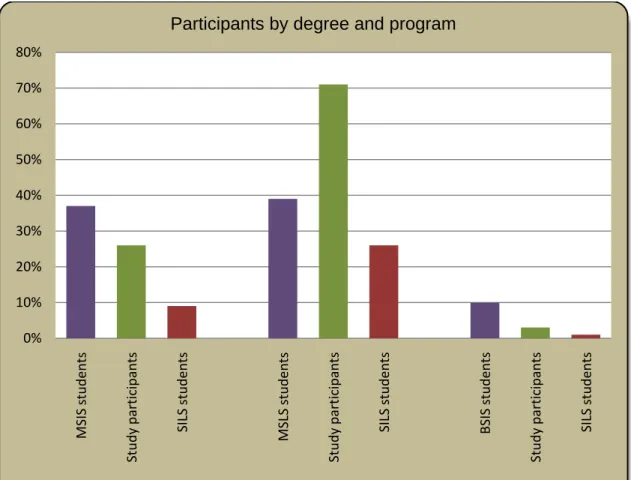
Figure 1: Participants by degree and program compared with enrollment by degree and program (Q 24 of survey, n=298).
The data in Figure 1 provides a breakdown of and participation rates for the different
SILS student populations based upon degree, program, and as a percentage of total SILS
students. The data highlights the corresponding number of students that participated in
the research study (n=108) by degree and program and is further broken down as follows:
• MS information science (n=28) represents 28% of the total SILS graduate
population:
o 26% of all participants
o 9% of the total target population
• MS library science (n=77) represents 72% of the total SILS graduate population:
o 71% of all participants
o 26% of the total target population o 39% of all MS library science students
• BS6 information science (n=3) represents:
o 3% of all participants
o 0.1% of the total target population
o 10% of all BS information science students
The expectation was to achieve a 20% participation rate (n=60). This target was reached
within the first 48-hours, though with only one undergraduate response. One week after
the initial email was circulated a reminder email was sent to both the masters and
undergraduate listservs in order to solicit additional responses primarily from
undergraduate student community. In the event, only two additional undergraduate
students participated in the study.
Data collection and analysis
The research survey went live via Qualtrics on 02/03/09 and an email (See Appendix B)
sent via the listservs to all potential participants the following morning. Responses were
monitored during the course of the first week and a reminder email (See Appendix C)
was sent to both listservs on 02/11/09. The survey closed at midnight 02/13/09.
Prior to starting the survey, all participants were informed that participation was
voluntary and that all responses would be kept anonymous. No personally identifiable
information relating to individual participants was collected as part of the survey research
other than the Internet Protocol (IP) address of the computer through which the
participant accessed the survey. The IP address was used within Qualtrics to track
participation and ensure that only one set of responses was received from any given IP
address. Such monitoring allowed partially completed surveys to be accessed and
finished during the period the survey remained open. At the close of the survey all
surveys were confirmed as complete and the IP address data was deleted from the results
before any analysis took place.
Qualitative and quantitative (demographic) data was exported as a .csv file and
imported into a Microsoft Excel spreadsheet for analysis. Qualitative data was
reconstructed in Microsoft Excel to bring together questions of a similar nature such that
a participant’s view of his or her own behavior versus his or her views on other students’
behaviors could be analyzed. Review of the data drew out key themes in terms of
attitudes and beliefs, which either reinforced a given value set or on occasion provided
contradictory information. Patterns, discrepancies, and relationships were noted for
themes and sub-themes, the findings of which are presented in the results and discussion
sections that follow. Quantitative data, primarily demographic information, was
processed and presented at the beginning of the results section.
Textual data (n=29) relating to question 28 was exported out of Microsoft Excel
and imported into Microsoft Word. The comments, opinions, thoughts, and suggestions
as to future research opportunities were noted and form part of the discussion section of
this paper.
Limitations of the study
Given the total population size under review, approximately 300 students, an acceptable
undergraduate and graduate student population. A 35.24% response rate was achieved
from the graduate student population, while the undergraduate response rate was 10.3%.
The discrepancy between these two figures can probably be attributed to a number of
factors. First is the general lack of interaction between graduate and undergraduate
students, and therefore the importance of the study may not have been fully appreciated
at the undergraduate level. Deploying a survey/questionnaire across the user population,
was deemed the most efficient and appropriate technique to elicit immediate feedback
based on time and financial constraints imposed by UNC, Institution Review Board, and
SILS. Most SILS students are used to filling in online surveys, especially when they
know that such surveys are related to the research studies of a student within the school.
However, having the name and affiliation of the primary researcher on the survey may
have unknowingly influenced the response rate in a positive manner as students sought to
support the researcher’s studies. Another factor is the small numbers of undergraduate
students in the population, which may have made them feel vulnerable to identification,
or defensive if they felt that graduate students’ may be critical of their practices. These
factors are something for future research to look at as to what differences may exist
between graduate and undergraduate student behaviors in the same school.
Response set bias, as an issue, may also be present in the findings. Due to the
nature of the study, soliciting opinions with respect to an individual’s behavior and their
perceptions on the behaviors of others, may have resulted in some participants being less
judgmental when it came to their activities and more judgmental when reviewing the
where such participation puts them in a less than positive light, and play up the roles of
others in similar circumstances.
While the high graduate response rate enables the results to be extrapolated across
the broader graduate SILS body, the low undergraduate response rate may not be
indicative of the opinions and beliefs of the wider SILS undergraduate body. As such, the
findings should act purely as a guide and require future investigation to corroborate.
Similarly, the restricted nature of the target population to SILS students means that any
findings are limited solely to the SILS student body and should not be extrapolated
farther across the UNC graduate body.
The primary researcher acknowledges his own personal beliefs and perceptions
towards other student’s usage of laptops in the classroom environment and was mindful
at the time of writing that the survey questions and ensuing discussion remained neutral.
To that end, the primary researcher was guided by his SILS advisor, Dr. Deborah
Barreau, and sought counsel as necessary from other SILS faculty to mitigate any charges
of personal bias with respect to the survey or to the interpretation of the findings, thereby
safeguarding the validity and objectivity of the results.
The intent of this research was to gain valuable information on the views and
perceptions of SILS students towards classroom laptop behavior. However, the sensitivity
of the subject matter notwithstanding, it was anticipated that the results would generate
sufficient new knowledge and interest that future replications of this study within other
departments at UNC and among other library schools at universities throughout the
RESULTS
This section presents the results of the study, outlining the quantitative and then the
qualitative data. Results are not presented in the same order in which the survey questions
were shown to participants. For example, demographic information presented to
participants at the end of the survey is shown here at the beginning of the results section.
The relevant survey question number is listed as (Q n) at the end of each figure.
The online survey was available for a period of ten (10) days during February
2009, and had 108 participants.
Quantitative Data Analysis
Not every respondent answered every question, primarily due to the skip-logic employed
within the survey. To account for this, the total number of respondents is listed for each
0% 10% 20% 30% 40% 50% 60% 70% 80%
Male Female Prefer not to answer
Gender
Survey participants SILS population
Figure 2: Gender of participants versus SILS population (Q26, n=108).
The gender of participants broadly reflects the wider SILS population with a slight
preference in favor of female respondents. This margin of difference does not materially alter
the results of the survey. Data displayed in Figure 2 shows female participants outnumbering
0% 10% 20% 30% 40% 50% 60% 70% 80%
18‐21 22‐29 30‐39 40‐49 50‐59 60+ Prefer not
to answer Age
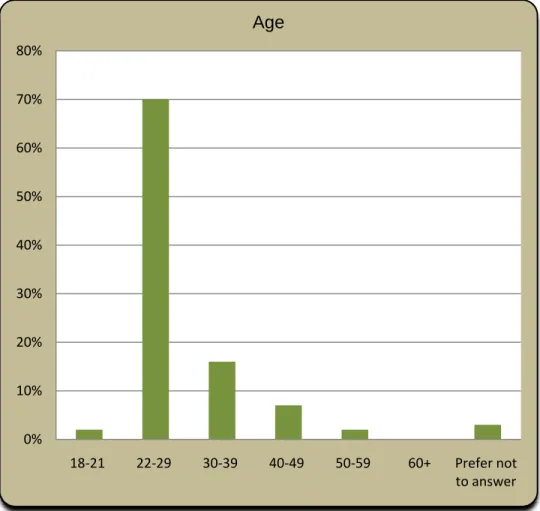
Figure 3: Age of participants (Q 27, n=108).
The majority of participants fell within the 22-29 age range representing 70.4% of
all respondents. This mirrors the overall SILS student population. The 1.9% of
0% 20% 40% 60% 80% 100% 120%
Undergraduate student Graduate student Degree level
Survey participants SILS population
Figure 4: Degree level of participants versus SILS population (Q 23, n=108). The degree level of participants is indicative of and reflects the overall SILS
population, split approximately 9:1 in favor of graduate students. Figure 1 (see page 31)
provides a breakdown of students by degree program while Figure 5 provides an analysis
0% 10% 20% 30% 40% 50% 60%
Year of study
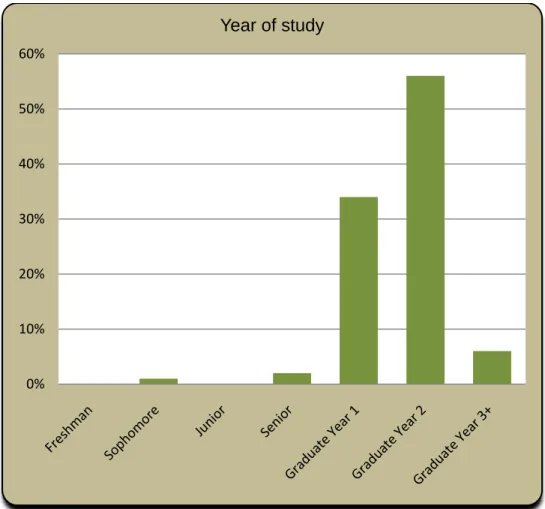
Figure 5: Participants year of study as of Spring semester 2009 (Q 25, n=108). Approximately two-thirds of participants were in their second or subsequent year
of study in the graduate program, with one-third in the first year of study. Three
respondents were undergraduates; one sophomore and two seniors.
The disparity between graduate students in their first, second, and subsequent
0% 5% 10% 15% 20% 25% 30% 35% 40% 45% 50%
In‐class SILS library or
lab
On campus but
not in SILS
At Home Other
Where participants completed survey
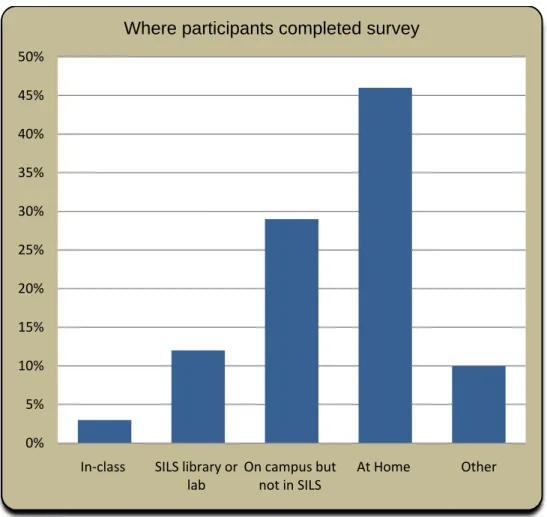
Figure 6: Where did participants access and complete the survey? (Q 22, n=108). All participants answered this question of which, 46.3% of participants accessed
and responded to the survey from home (n=50), 28.7% responded from somewhere on
the UNC campus but not within the SILS computer lab (n=31), 12.0% responded within
the SILS computer lab or library (n=13). Of note, and despite the nature of the survey
0% 5% 10% 15% 20% 25% 30% 35% 40% 45%
Every Class Most classes
(>50% of the time)
Some classes
(<50% of the time)
Never
Frequency of laptops taken to class
Figure 7: How often do participants take their laptops to class? (Q 2, n=108).
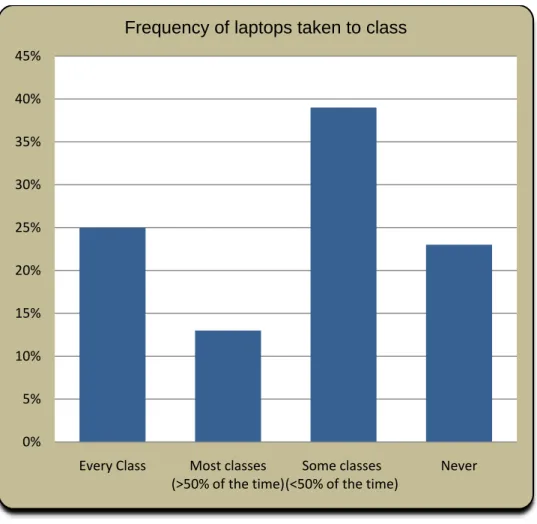
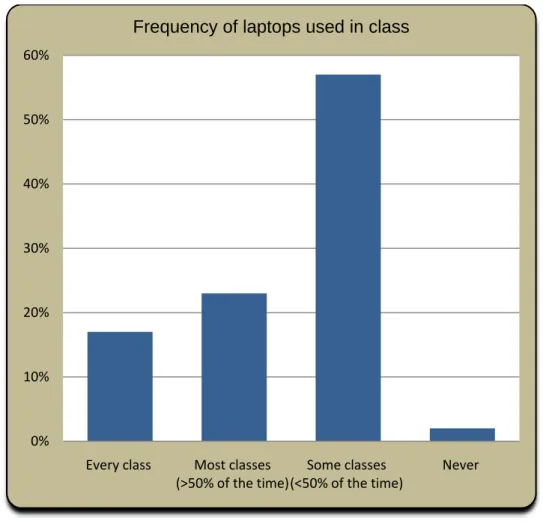
Figure 7 and Figure 8 look at the availability and frequency of laptop use in class.
Figure 7 shows that of all participants, 25.0% of respondents took their laptops to every
class (n=27), 13% took them to more than half but not all their classes (n=14), 38.9%
took them to less than half their classes (n=42), while 23.1% of respondents never took
their laptops to class (n=25). Although it would be interesting to know why these latter
students never took their laptops to class, this was not part of the original survey
0% 10% 20% 30% 40% 50% 60%
Every class Most classes
(>50% of the time)
Some classes
(<50% of the time)
Never Frequency of laptops used in class
Figure 8: How often do participants use their laptops in class? (Q 3, n=82).
Of those students who took their laptops to class, 17.1% used them in every class
(n=14), 23.2% used them in more than half of all their classes (n=19), 57.3% used them
in some classes but less than half the time (n=47), and 2.4% never used their laptops in
class (n=2). The latter statistic is interesting insomuch as respondents carried their laptops
to UNC but never actually used them in class. This implies there is another usage
Figures 9-11 look at laptop usage specifically related to class activities. Data excludes
activities undertaken where laptops are required for class.
0% 10% 20% 30% 40% 50% 60% 70% 80% 90% 100%
Laptop activity - class related
Figure 9: Participants laptop activities related to class (Q 4, n=81).
Participants were allowed multiple answers to the above (336 answers), which
sought to identify in-class student activities used on laptops. 91.4% of respondents used
Blackboard to access the class website (n=74), 85.2% used their laptops for in-class work
of some description. Other activities of note included 55.6% of respondents taking
electronic lecture notes (n=45), 51.9% used the web for fact checking (n=42), and 51.9%