Katherine M. Collins. Copyright and Fair Use Resources for Undergraduates: A Content Analysis of Academic Libraries’ Websites. A Master’s Paper for the M.S. in L.S degree. March, 2012. 47 pages. Advisor: Paul Jones
Using content analysis, this study examines what information on copyright and fair use academic libraries offer users through their websites, with a particular focus on
undergraduate information needs. This was done by analyzing the websites of thirty-three academic libraries, selected from the list of the member institutions of the Association of Research Libraries. The results of this exploratory study show that while most libraries provide general educational information on copyright, they do not fully explain all aspects of copyright and fair use. Particularly lacking are resources that help undergraduate creators understand what they can and cannot do under fair use. For academic libraries to support undergraduates in becoming effective information users and creators, they should offer resources that fully educate undergraduate students on their rights and responsibilities as both creators and consumers of information.
Headings:
Copyright
Fair use (Copyright)
by
Katherine M. Collins
A Master’s paper submitted to the faculty of the School of Information and Library Science of the University of North Carolina at Chapel Hill
in partial fulfillment of the requirements for the degree of Master of Science in
Library Science.
Chapel Hill, North Carolina March 2012
Approved by
Table of Contents
Introduction ... 2
Literature Review ... 3
Copyright and Fair Use Law and History ... 3
Undergraduates, Copyright, and Fair Use ... 6
Undergraduates as Creators ... 10
Libraries’ Role ... 13
Similar Studies ... 16
Methodology ... 18
Results ... 20
Discussion ... 27
Conclusion ... 34
References ... 36
Appendix A: Content Analysis Codebook ... 40
Appendix B: Institutions Surveyed ... 43
Introduction
Writing a paper. Posting photos to Facebook. Watching a video on YouTube. Shooting a short film. Reblogging a Tumblr post. Recording a song and uploading it to Bandcamp. Though undergraduates in colleges and universities across the United States create, share, and reuse content in situations like these everyday, they are often unaware of how copyright reaches each of those activities. For much of copyright’s existence it was a rather obscure and technical part of the law that was irrelevant to most people, except for writers and publishers. With the advent of digital technologies, today “copyright law is even more technical, inconsistent and difficult to understand; more importantly, it touches everyone and everything... Most of use can no longer spend even an hour without colliding with the copyright law” (Litman, 1994, p. 34-35).
While libraries have dealt with copyright issues internally for many years, and have recently begun reaching out to faculty on the topics such as open access publication and author rights, undergraduates have been a neglected population despite being
This exploratory study seeks to examine current practices in academic libraries in teaching undergraduates students about copyright, fair use, and related issues. After reviewing the literature regarding what undergraduates know about copyright and fair use, their activity as creators of content, and libraries’ potential role in educating them, I present a content analysis of the websites of 33 Association of Research Libraries (ARL) members. This analysis examines what information libraries provide to educate patrons on copyright, fair use, and associated topics. I pay particularly close attention to how libraries help undergraduate students understand copyright, fair use, and their rights and responsibilities as both consumers and creators of content.
Literature Review
Copyright and Fair Use Law and History
Copyright is the only power enumerated in the constitution where a specific reason is given for its purpose, “To promote the progress of science and the useful arts, by securing for limited times to authors and inventors the exclusive rights to their
respective writings and discoveries” (US Constitution, Section 8). By providing a way for artists, authors, scientists and others to protect their work, the hope was to create a
those 14 years authors could register for another 14 years but 28 years was the final limit to their exclusive rights. If an author never registered their work, as many chose not to, or didn’t renew their registration, copyrighted works passed into the public domain where it was freely available for use and reproduction by all citizens.
Since the original act, U.S. Copyright Law has undergone significant changes; the most recent major reform came in 1976, with further term extensions in 1998. Today copyright protects far more than just “maps, charts and books.” “Original works of authorship fixed in any tangible medium of expression, now known or later developed, from which they can be perceived, reproduced, or otherwise communicated, either directly or with the aid of a machine or device” automatically receive protection (17 U.S.C. Sect. 102); one does not need to register their work or place any notice, such as the copyright symbol, on their work. Copyright also no longer means just the right to print, reprint, publish, or sell a work. The exclusive rights of copyright holders today include the right to reproduce copies; prepare derivative works, such as translations and adaptations; distribute copies to the public through sale; and to perform or display the work publicly. Additionally the copyright term has been extended far beyond the original limit of twenty-eight years. Today, copyright holders receive exclusive rights for the life of the author plus an additional 70 years. Corporate authors receive copyright protection for 95 years from the date of publication or 120 years from the date it was created.
as criticism, comment, news reporting, teaching […] scholarship, or research” (17 U.S.C. Sect. 107). Fair use is what makes it possible for Jon Stewart to show clips from other news networks on The Daily Show, for parodists to imitate another’s work, for writers to include quotations from books, movies, and other sources, and for teachers to distribute copies of an article to their students, all without having to seek permission from the copyright holder. The statute includes four factors to be considered in making a fair use determination:
(1) the purpose and character of the use, including whether such use is of a commercial nature or is for nonprofit educational purposes;
(2) the nature of the copyrighted work;
(3) the amount and substantiality of the portion used in relation to the copyrighted work as a whole; and
(4) the effect of the use upon the potential market for or value of the copyrighted work. (17 U.S. Code Sect. 107)
the argument that fair use is a right that must continuously be exercised or else it will atrophy, leaving it vulnerable to encroachment by over-aggressive rights holders.
While these scholars may disagree on the utility of fair use, they all maintain that the current copyright system does not serve American citizens as the framers intended. Lessig (2008) contends that the current model of copyright serves corporate and professional interests well but has increasingly been forced upon other uses, such as amateur and educational, that would function better under a different model of copyright, especially in a world where technology makes copying and sharing easy. Inspired by the Open Source software movement, Lessig helped found Creative Commons, a non-profit organization that has developed a variety of copyright licenses that allow creators of all types of works to decide which exclusive rights of copyright they want to retain and which they want to waive so others can make copy, distribute, or build upon their work (Lessig 2004). The project has been greatly successful, with millions of works licensed under Creative Commons. Uses range from photographs posted on Flickr, where it is easy for users to choose a Creative Commons license, to albums by the band Nine Inch Nails, to scientific articles in the Public Library of Science, an open access publisher.
Undergraduates, Copyright, and Fair Use
copyrighted content, young adults have a poor understanding of the law, especially their own rights as creators. These studies also reveal that today’s current and future college students have many questions about copyright and fair use, giving insight into what misconceptions and confusion librarians can help clarify.
In their 2009 report “Youth, Creativity, and Copyright in the Digital Age” Palfrey, Gasser, Simun, and Barnes take an in-depth look at how students between the ages of 12 and 22 understand copyright. An overwhelming majority (84%) of
respondents in the study claimed to know what copyright was, but their descriptions of copyright demonstrated that they only thought they knew what copyright was, with copyright, patents, trademarks, and plagiarism confused into one murky concept (Palfrey, et al, 2009, 84). Palfrey et al. (2009) found it particularly troubling that young adults often described copyright in terms of the financial rights creators have over their work and tended to see it “as a protection that is afforded to others, rather than a legal concept applicable to society as a whole, including young people” (84).
Aufderheide and Jaszi (2007) of the American University Center for Social Media report on how college students and recent graduates who create and upload online videos see copyright. The participants Aufderheide and Jaszi spoke with had a slightly better understanding of what copyright was than the younger cohort Palfrey et al. studied, but “generally did not understand elementary facts about copyright” such as what receives copyright protection (2007, p. 6). Only 56% of them believed they held the copyright to their online videos. One participant described using a Creative Commons license as an alternative to copyright, which he thought would be too expensive to register
believed that “copyright is a near-absolute ownership right” and “lack[ed] a sense that the user is an entitled citizen in this domain” (Aufderheide, Jaszi, 2007, p. 9).
With young adults having only a vague grasp on what copyright entails, it is not surprising that they also struggle to see how the law applies in their own use of
copyrighted works. As Palfrey et al. point out, many of these students have become accustomed to an environment where media, especially music and video, is available freely, sometimes legally and sometimes not. Because young adults lack clear guidance on copyright and understand little of the law, the social norms of their peers, which favor the free sharing of content and information, become more important in their decision-making. While most students Palfrey, et al. studied, especially the older ones, understood peer-to-peer file sharing as illegal (likely because of noisy media campaigns against it) they did not usually understand what made it illegal. Those who did not engage in file sharing said they feared being sued and instead chose to exchange songs with friends either through email or ripping CDs, unaware this behavior would also be considered a violation of copyright law (Palfrey et al. 2009, p., 85, 88).
And while young adults’ understanding of copyright is full of misconceptions, both Palfrey et al. (2009) and Aufderheide and Jaszi (2007) found that even worse is their knowledge of fair use, or any rights they had to make use of copyrighted material legally. Almost none of the 12 to 22 year olds Palfrey et al. spoke with had even heard of fair use. In Aufderheide and Jaszi’s survey of college students and recent graduates in the
communication field, 54% said “they did not understand when it was permissible to use copyrighted materials at all” and the researchers suspect the number is even higher as in their interviews with students “ignorance and confusion was manifest” (2007, p. 6). Fair use was similarly unclear with those Aufderheide et al. surveyed. “76% believed that the fair use doctrine permitted them to use copyrighted materials” but “none of the
interviewees were able to describe this doctrine accurately” (Aufderheide and Jaszi, 2007, p. 7).
was permissible without seeking permission and fearing they would be caught doing something illegal (Aufderheide and Jaszi, p. 5-6).
Undergraduates as Creators
Much of the dialogue on undergraduate students and copyright has focused on piracy, the illegal downloading of media, usually music and film. This moral panic obscures the creative output and capabilities of undergraduate students both academically and in their personal lives. As Jenkins, et al. (2006) describe, the tendency to write young adults off as the “Napster Generation” reduces “their complex forms of
appropriation and transformation into the simple – arguably illegal – action of ripping and burning someone else's music and sharing the files” (32). It also obscures their need for a comprehensive education in copyright and fair use, one that does not scold them for file sharing but treats them as the active creators and participants they are.
self-archive their work (Nolan and Costanza, 2008). Students were generally excited that their work would be online and discoverable, making it possible for future employers and graduate school admissions offices to see it (Nolan and Costanza, 2008).
But even outside of their academic work undergraduates are, without a doubt, creators. According to a 2005 survey by the Pew Internet and American Life Project, 57% of Internet-using teens have created online content through blogging, webpage creation, or sharing other works they created. A more recent survey by Pew focused specifically on young Americans content-sharing habits found that 39% of teens and 37% of 18-29 year olds shared self-created content online. A 2007 survey on the content creation and sharing practices of first-year students at University of Illinois, Chicago found that 61% of the students created content, with music being the most popular followed by artistic photography, poetry and fiction, and film and video (Hargittai and Walejko, 2008). 56% percent of those creators went on to share their work online. Poetry and fiction were the most commonly shared, followed closely by video. Some mediums were not included in this study, such as nonfiction or non-artistic photography, so there may have been some creators whose activities are not captured in these numbers.
The earlier referenced study conducted by Aufderheide and Jaszi (2007) provides further insight into the types of videos made by college-age video makers. 52% used their own video recordings with recorded music, 44% made slide shows of photos they had taken of friends and families, 39% recorded an event with friends or families, 30% recorded a public event, and 20% reported using clips from television or film.
Life project found that 21% of teenagers as well as 19% of adults 18-29 have remixed digital content, which Pew defined as “taking material they find online such as songs, text or images and remixing it into their own artistic creation” (Pew, 2010). Hargitatti and Walejko’s study found that 7% of first-year students at the University of Illinois reported posting remixed music, and 4% have made and posted remixed videos. These numbers seem low in comparison to what the Pew study found, but this study was limited to video and audio remixes and only measured those that students made and shared online.
A number of scholars see the new modes of creating and sharing expressive works that undergraduates and other young adults engage in as part of a larger cultural shift that repositions ordinary citizens as creators of and participants in culture rather than just consumers. Jenkins et al. (2009) call this “participatory culture,” where individuals find low barriers to “artistic expression and civic engagement” and there is “support for creating and sharing one’s creations” (7). Lessig (2008) borrows a metaphor from the computing world to describe a “Read/Write” culture, which stands in contrast to the “Read/Only” culture that dominated the twentieth century when creative expressions were created by professionals and consumed by the rest with little cultural production by amateur citizens. Many scholars offer remixes as a salient example of the new ways for citizens to take a hand in the production of culture. Rather than passively absorbing content produced for mass consumption, people can manipulate the cultural objects that surround them, recombining them in new ways to produce new meanings.
Libraries’ Role
While few librarians address the importance of providing undergraduates with a thorough education in copyright and fair use directly, it fits well within the mission and values articulated by many academic librarians. Smith (2010) writes:
It is often in libraries that patrons find inspiration and begin the process of new creation. Librarians see the benefits of reuse and remixing as new works emerge from old. Thus, librarians are well placed to speak for new creators and to resist the content industries’ attempts to make the law serve only their profit motives instead of the balanced approach it was designed to take that would foster innovation” (6).
Based on undergraduates’ activity as creators and their need for accurate information regarding copyright and fair use, I would suggest that librarians are also well placed to educate new creators on these matters and to resist the content industries’ attempts to inculcate a different understanding of copyright that favors their interests.
In recent years, the entertainment industry has developed anti-piracy and
copyright education campaigns aimed at middle school and high school students through “educational” materials ranging from “games and comics posted on organization
(Gillespie, 2009). Given this is a model of consumption entertainment industries would like to perpetuate, it is not surprising that the curricular materials make little mention of fair use. Those that do mention fair use often limit it far beyond what statutory or
common law dictates. In one case, the material for the teacher explains that fair use only applies in the classroom and asks teachers to remind students that “no one is allowed to copy copyrighted material outside the classroom for any reason without getting
permission” (Gillespie, 2009, p. 296). Perhaps part of the reason undergraduates have such a poor understanding of copyright, especially their rights under fair use, is because these materials were used in their middle schools and high schools. Libraries can offer undergraduates a balanced view of copyright that emphasizes their rights as creators.
The movement to create information commons or learning commons in academic libraries further increases the importance of educating undergraduates on copyright and fair use. Information commons offer access to digital content as well as the hardware and software necessary to participate in the kind of technological and cultural engagement celebrated by Lessig, Jenkins, and others. As Birdsall (2010) describes, learning
commons are turning libraries into sites for active engagement in participatory culture: The learning commons may be considered as a stage in the transformation of the academic library as a whole to a communicative commons whose objective is to insure that all members of the academic community can exercise their right to communicate, that is, to be informed and to inform. (234)
Birdsall goes on to argue that libraries have been too focused on educating students in the one-way process of information seeking without helping students with the equally
understanding of how they can ethically make use of others’ works in their communications.
While libraries often teach information literacy in the context of students’
academic work, the lessons of copyright and fair use can go beyond the classroom walls. As Murray (2008) describes, a balanced copyright education can be a form of resistance against the corporatization of creativity:
Standing up for user rights such as fair use or fair dealing, then, has repercussions outside the world of writers and teachers, to the world of private use, where citizens’ abilities to incorporate small pieces of cultural materials into their relationships and lives is being commodified and controlled to a whole new extent. It is crucial that the principle of some degree of fair use of materials under copyright be articulated as a public good – not just, as corporate lobbyists insist, the accident of ancient primitive technologies now improved upon (p. 180).
It may also be in the library’s own long-term interest to provide students with a thorough understanding of copyright law. Trinity University, mentioned earlier for their institutional repository that archives undergraduates’ academic work, used student self-archiving to introduce students to copyright, fair use, Creative Commons licensing, and alternative publishing models with hopes of influencing students’ attitudes in the future, recognizing that today’s students are the future scholars and creators whose works libraries hope to provide access to (Nolan and Costanza, 2008). As Hickey (2011) describes, providing guidance on copyright issues to students is an opportunity for user services librarian to influence the discussion on Open Access and scholarly
communication “on the ground,” making “the librarian’s role as copyright educator and reuse evangelist… critical to the mission of libraries” (9).
challenge libraries can resist from within. At the top of his list of “priorities for arming this community” he wants librarians to “be knowledge resources for their communities, sources, of accurate and current information about copyright” and to “educate their users to respect copyright and to practice responsible use of copyrighted works” (Neal 2011, 172).
Similar Studies
Despite the clear role for libraries in educating users, especially undergraduates, on copyright law, most studies that examine libraries’ interactions with copyright focus on the policies libraries have, as opposed to their educational role. Gould, Lipinski, and Buchanan (2005) sought to determine the types of policies university libraries have for course reserves and how those policies aligned with fair use by surveying ARL members. They conclude that libraries’ arbitrary limits on the amount of a work that can be placed on reserve are an oversimplification of the law, and may be limiting fair uses. They also suggest that libraries should be campus educators on copyright and their engagement with copyright policies and education should extend beyond setting reserve policies.
tutorials, and the remaining twenty percent were related to policies, e-resources, or document delivery services. Unfortunately, Shachaf and Rubenstein did not go into details of what information was being conveyed to readers within those categories.
Bishop undertook a study of copyright information on library websites in 2011, in preparation for the development of a new web-based copyright guide by the Colorado State University Libraries. Bishop used a random sample of 20 members of the Association of Research Libraries to look at what information they presented on copyright. Bishop acted as an “experienced user” in this study, but she also had an undergraduate look at the same set of websites with the same criteria to get the perspective of a “novice user.” Both searchers looked for copyright information in a number of different places including the library’s home page, course reserves, archives and special collections, institutional repositories, subject/research guides, and scholarly communication pages. In addition to looking at where on the library’s website copyright information was and how easy it was to find, Bishop also tried to get a sense of whether libraries were “innovative copyright leaders” on campus, with a “a designated copyright officer or designated service within the library” (p. 7).
This finding demonstrates the importance of easy to understand labeling if libraries want to help educate undergraduates on copyright.
Methodology
This study uses content analysis to determine what information academic libraries in the United States are providing to educate undergraduate users on copyright, fair use, and Creative Commons, as well as common attributes of the websites. Based on the literature on copyright and undergraduates, this study looked at five areas for analysis and developed specific elements to be examined in each area (See Figure 1). Data was also recorded on the web resources each library points users to for more information.
Figure 1
Area Elements
Copyright Purpose of copyright, what receives copyright protection, rights afforded under copyright, difference between copyright infringement and plagiarism,
Fair Use What fair use is, four factors used to determine fair use, how to apply fair use, Creative Commons Links to Creative Commons, explains CC,
how to find CC licensed works, how to use CC licensed works, how to license their own work under CC
Undergraduates as Creators Audiences addressed, treat undergraduates as consumers, treat undergraduates as creators
Website Presentation of content, naming
conventions, currency, hosting department, point of contact for more information
elements were analyzed using manifest content analysis to measure “the concrete terms contained in a communication” (Babbie, 2007, p. 325). However, the question of whether undergraduates were treated as consumers or creators codes latent content that “cannot be measured directly but can be represented by one or more indicators” (Hair, Anderson, Tatham, & Black, 1998, p. 581 as cited in Neuendorf, 2002, p. 23). The full codebook is included in Appendix A. A coding form based on the codebook was created using Google Documents to facilitate the collection of this information.
The current study uses ARL member libraries as its sample group. ARL members were chosen as the sample group because they are a well-defined population that
represents the largest and most developed research libraries in the United States and Canada. The ARL is also invested and interested in copyright and intellectual property policy that affect libraries and their patrons and has educational initiatives to educate librarians and users on these topics. While the ARL’s advocacy is not representative of how individual libraries behave, it does suggest that member libraries may be more aware of these issues.
numbers. Then a random number generator (Random.org, operated by the School of Computer Science and Statistics at Trinity College, Dublin) was used to choose thirty-three different libraries, one-third of the sample population. A list of the libraries sampled is available in Appendix B.
The author of this study personally conducted the content analysis during a one-week period in February 2012. The unit of analysis in this study is websites, pages, or subject guides hosted by the library that provide general information on copyright and fair use. To find this information, the researcher searched for “copyright” in the library websites’ site search as well as in the subject guides, if that functionality was available. If the library provided a site index, that was also consulted. Excluded were webpages that discussed copyright in the context of a service the library provided such as course
reserves or interlibrary loans. Also not included were subject guides that were intended to guide students in the process of researching copyright and intellectual property, in
contrast with guides that aimed to educate patrons on the issues. Some libraries maintained multiple resources that addressed copyright and fair use, in such cases, the resource that provided the most information and was most relevant to undergraduates was used. The specific webpages analyzed are also included in Appendix B.
Results
Of the 82% of libraries that had a place for information on copyright, 59% presented it as a static webpage or collection of static webpages and the other 41% included this information in a LibGuide, with either a whole LibGuide devoted to the subject or included copyright information in a broader LibGuide. In 44% of libraries it was unclear which department hosted the information, but when it was determinable 22% were the work of the reference department and 33% of the scholarly communications office. On 41% of the websites that provided links all of the links were functional. 44% had one or two broke links, while 15% had more.
A third of libraries had a webpage about copyright that provided no content that explained any of the elements of copyright and consisted entirely of links to other resources. Only one library provided information on all four elements of copyright information that were examined in this study. When libraries presented more than just links, information on what receives copyright protection was the most commonly available, with 48% of libraries offering some form of explanation that fixed works of original authorship receive copyright at the time of their creation. Slightly less common was information on what rights are protected by copyright, with 42% of libraries
Figure 2
Figure 3
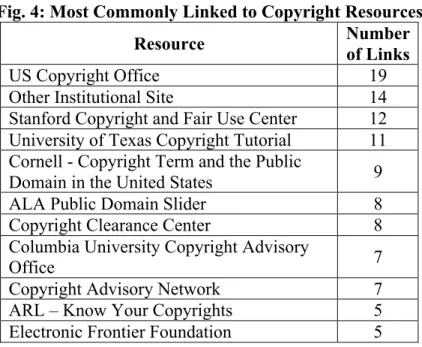
Fig. 4: Most Commonly Linked to Copyright Resources
Resource Number
of Links
US Copyright Office 19
Other Institutional Site 14
Stanford Copyright and Fair Use Center 12 University of Texas Copyright Tutorial 11 Cornell - Copyright Term and the Public
Domain in the United States 9
ALA Public Domain Slider 8
Copyright Clearance Center 8
Columbia University Copyright Advisory
Office 7
Copyright Advisory Network 7
ARL – Know Your Copyrights 5
Electronic Frontier Foundation 5
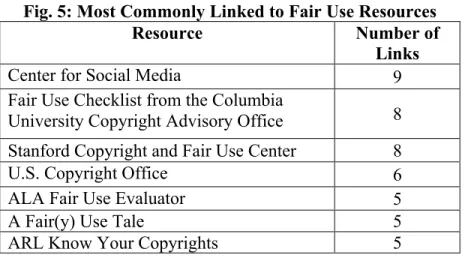
Fig. 5: Most Commonly Linked to Fair Use Resources
Resource Number of
Links
Center for Social Media 9
Fair Use Checklist from the Columbia
University Copyright Advisory Office 8 Stanford Copyright and Fair Use Center 8
U.S. Copyright Office 6
ALA Fair Use Evaluator 5
A Fair(y) Use Tale 5
ARL Know Your Copyrights 5
58% percent of libraries specifically addressed the copyright and fair use concerns and needs of faculty, but only 24% did so for undergraduates. All of the libraries that offered information specifically for undergraduates addressed undergraduates as users of copyrighted content, providing information on what they could and could not do with copyrighted content. Seventy-five percent of those that addressed undergraduate concerns also treated undergraduates as creators, giving them guidance on how they could
Seventy-three percent of libraries provided format-neutral information on
copyright and fair use, without describing how the law applies to specific types of media. Of the libraries that provided format-specific content, the most commonly covered were images and moving images, followed by multimedia, text, and audio (See Figure 7).
Figure 7
Figure 8
Discussion
While the fact that 82% of libraries provided some sort of portal for information on copyright and fair use sounds encouraging, most libraries were lacking in the
information they provided by not covering all aspects of copyright and fair use. Nearly all of the libraries sampled did a particularly poor job addressing undergraduates’ needs.
promoting the progress of learning and knowledge (Loren,1998). “This misconception, repeated so often that it has become accepted among the public as true, poses serious dangers to the core purpose that copyright law is designed to serve” (Loren, 1998). This lesson is particularly important for undergraduates, who conceptualize copyright in terms of money and as a right afforded primarily to others (Palfrey, et al. 2009).
Another area of copyright that confuses undergraduates but was poorly covered by libraries was the distinction between plagiarism and copyright infringement. Only three libraries (9%) explained the difference between plagiarism and copyright
infringement. A third of libraries that had a page with copyright information only added to the confusion by covering both topics on the same page, without explaining how they differ. The lack of distinction made by libraries between the two can be seen also in the names of pages or guides where libraries provided this information. For example, one was called “Avoiding Plagiarism” and another “Plagiarism, Citation, Copyright and Fair Use.” This only reinforces undergraduates’ tendency to conflate the two concepts
without helping them understand either. It is entirely possible to use but not acknowledge material that is in the public domain and thus free of copyright restrictions or to use a source in a way that would fall under fair use but not provide attribution, both of which would still be considered plagiarism. Similarly, simply providing a citation does not free one from copyright law.
work without permission but with attribution, and that “it is crucial for academics and students to understand that permission is not part of the citation system – otherwise they will not see what they are giving away in this increasingly copyrighteous world” (p. 179-80).
Murray’s point also raises the importance of educating students on fair use, which is what makes it possible for them use others’ works without either infringing on their copyright or paying them for permissions. Nearly 75% of libraries surveyed made mention of fair use, with 52% of the sampled libraries actually defining the doctrine. Those that made mention of fair use but didn’t define it usually used it as a heading for links that provided more information on fair use. Strangely, the number of libraries that enumerated the four factors (55%) was greater than the number that defined fair use (52%) as two libraries listed the four factors but seemed to have assumed that readers were already aware of what the fair use doctrine was. This may be preferable though to the misinformation provided by one library that had only to say about fair use that it “makes provision for the use of copyrighted works under specific ‘educational’ situations.”
In general, undergraduates were poorly served by the information libraries did provide on fair use and copyright. Only 24% percent of libraries address undergraduates concerns specifically. This number stands in sharp contrast with the 58% of libraries that specifically provided resources for faculty questions about fair use and copyright. The tendency for these pages to focus on faculty concerns over undergraduate concerns only reinforces the sense young adults have that copyright is a right others receive, making it difficult for them to see how copyright and fair use apply to them either as creators or users.
All of the eight libraries that did address undergraduates specifically treated undergraduates as consumers of content, but six (75%) recognized undergraduates as creators by providing information on topics such as whether students can include class projects that incorporate portions of copyrighted works in their portfolio or what
students’ rights are to papers they wrote for classes. As the literature reviewed earlier in this study demonstrates, undergraduates are unequivocally creators but are also creators who are unaware of their rights to reuse others’ materials or protect their own works, so providing this information is crucial in fully preparing students to be active participants and creators of culture. Palfrey et al. (2009) also suggest that when students see
themselves as creators, they empathize with other creators and are more likely to respect copyright law.
provide format-specific advice, images and moving images were most commonly covered (78%), followed by multimedia and text (44%), and finally audio (33%). Copyright laws apply across formats, but factors like “amount and substantiality” mean different things depending on the medium. For written works it is possible to provide a short excerpt, but it is less clear how to fairly use an image. Students are especially likely to be interested in this information as research shows students’ creativity is not bound by format, and they may combine multiple formats through remixes and mash-ups.
Links to other resources were an important element in these pages, with all of the libraries that provided information on copyright issues linking to other sources and an average of seven links per library. 33% of libraries’ pages consisted entirely of links to other resources rather than summarizing and synthesizing the law of copyright and fair use in a way that would be most useful to their audience. Being a source for content and instruction rather than just providing access to other sources of information is a newer role for libraries, but educating patrons on copyright and fair use is an important place to practice doing so. Providing only links places the burden on users to navigate and
interpret what is a remarkably confusing area of the law. Fortunately, most of the
libraries’ links were reasonably up to date, with either no broken links or only one or two. The United States Copyright office was the most frequently linked to resources for information on copyright, as it provides the text of the law as well as other
of the information provided on the websites libraries linked to was beyond the scope of this study, most appeared to be good sources of copyright information, balancing the creator’s interests with the rights others’ have to make use of copyrighted works.
The resources libraries linked to for information on fair use were similar to those linked to for information on copyright, with the Stanford Center for Fair Use, the
Columbia Copyright Advisory Office, ALA Fair Use Evaluator, and ARL’s Know Your Copy Rights coming up again. The Center for Social Media was the most popular site for more information on fair use, and for good reason. The Center for Social Media has developed Codes of Best Practices in Fair Use for a number of disciplines including poetry, online video, and documentary filmmaking, as well as providing general
information on fair use. Another popular resource on fair use was “A Fair(y) Use Tale.” This video, created by Eric Faden of Bucknell University, cleverly remixes clips from Disney movies to explain fair use. Some universities embedded this video as their only source for information on fair use. While amusing, the video runs ten minutes long and the quick cuts between clips can make it distracting, so it is not an ideal source to introduce people to fair use for the first time.
part of the publishers’ litigation feeds (Albanese, 2011). Charles Lowry, the Executive Director of the ARL, wrote a letter to the CCC expressing “deep disappointment” with the CCC for underwriting the cost of litigation, saying “this action by the CCC signals to the content user community that the CCC no longer seeks to serve the interests of all of the partners in the scholarly communications enterprise” (Lowry 2010).
One library that linked to the CCC did mention that “we include the perspective of the corporate sector in the video from the CCC” and that the CCC places “a stronger emphasis on rights of copyright holders.” However, others try to be more neutral, one describing it as “a not for profit organization, originally created by an act of Congress” and another library calling it “a non-profit organization designed to help organizations comply with copyright law and to facilitate copyright clearance” which offers “an excellent guide to Internet resources.” If libraries continue to link to recommend the CCC as a resource of information of copyright, they should review the information the Copyright Clearance Center provides with a critical eye to ensure that it aligns with the library’s own position and will serve its users well.
It was encouraging to see that nearly half of libraries (48%) linked to Creative Commons, but too few provided additional information. While users may be unfamiliar with Creative Commons, only 44% of the libraries that linked to Creative Commons also explained what Creative Commons are. And even fewer libraries described what
may be of particular interest to younger creators who value sharing and reuse over exclusivity. Similarly, only two libraries explained how to find works that are licensed under Creative Commons. The Creative Commons are an important resource for creators who want to incorporate more of a work than would be allowable under fair use but do not have the money for permissions necessary in using an all rights reserved copyrighted work.
None of the libraries sampled discussed how to use Creative Commons licensed works. Creative Commons offers six different variations on the license ranging from licenses that only let others download and share to licenses that allow users to distribute and create derivatives, even for commercial purposes. The Creative Commons website provides simple explanations that libraries can build off of to help students understand exactly what rights the creator has shared with them. Additionally, all of the basic Creative Commons licenses include attribution as one of the requirements for further reuse or sharing, making proper attribution an important part of knowing how to use Creative Commons licensed work.
Conclusion
information that addressed undergraduates as the content creators they are. By not educating students’ on the restrictions and liberties copyright presents, libraries are neglecting the next step of information literacy, which carries students from simply consumers of information to being creators, contributors, and active participants in the creation of knowledge and culture.
The libraries that do not provide information on copyright and fair use, or those whose information is lacking, should not be intimidated by the process of improving their resources. While no website examined in this study fulfilled all of the criteria examined, The University of Minnesota’s website came the closest. Perhaps not surprisingly, the University of Minnesota used a Creative Commons license on these webpages, making it possible for other libraries to expand and adapt the information provided to their own institutional needs. Many of the websites frequently linked to by libraries are also excellent starting points: the Stanford University Fair Use and Copyright Center,
References
Albanese, Andrew. (2011, March 29). Judge sets trial date in Georgia State University E-Reserves Lawsuit. Publishers Weekly. Retrieved from:
http://www.publishersweekly.com/pw/by-topic/digital/copyright/article/46638-judge-sets-trial-date-in-georgia-state-university-e-reserves-lawsuit.html
Aufderheide, P. & Jaszi P. (2007). The good, the bad, and the confusing: User-generated video creators on copyright. Center for Social Media. Retrieved from
http://aladinrc.wrlc.org/handle/1961/4612
Aufderheide, P. and Jaszi, P. (2011). Reclaiming Fair Use: How to Put Balance Back in Copyright. Chicago: University of Chicago Press.
Birdsall, W. F. (2010). Learning commons to communicative commons: transforming the academic library. College & Undergraduate Libraries, 17(2-3), 234-247.
doi:10.1080/10691316.2010.487781
Gerhardt, D. and Wessel, M. (2010). Fair use and fair use on campus. North Carolina Journal of Law and Technology 11(3), 461-530.
Gillespie, T. (2009). Characterizing Copyright in the Classroom: The Cultural Work of Antipiracy Campaigns. Communication, Culture & Critique, 2(3), 274-318. doi:10.1111/j.1753-9137.2009.01039.x
Gould, T. H. P., Lipinski, T., & Buchanan, E. a. (2005). Copyright policies and the deciphering of fair use in the creation of reserves at university libraries. The Journal of Academic Librarianship, 31(3), 182-197.
doi:10.1016/j.acalib.2005.02.001
Hargittai, E., & Walejko, G. (2008). The participation divide: content creation and sharing in the digital age. Information, Communication & Society, 11(2), 239-256. doi:10.1080/13691180801946150
Hickey, Daniel. (2011). The reuse evangelist: taking ownership of copyright questions at your library. Reference and User Services Quarterly 51(1), 9-11.
Jenkins, H., Clinton, K., Purushotma, R., Robison, A., & Weigel, M. (2009). Confronting the Challenges of Participatory Culture : Media Education for the 21 Century.
Boston: MIT Press.
Lenhart, A., & Madden, M. (2005). Teen Content Creators and Consumers. Washington, D.C.: Pew Internet and American Life Project. Retrieved from
Lenhart, A., Purcell, K., Smith, A., & Kathryn, Z. (2010). Social media & mobile internet use among teens and young adults. Washington, D.C.: Pew Internet and American Life Project. Retrieved from
http://web.pewinternet.org/~/media/Files/Reports/2010/PIP_Social_Media_and_Y
oung_Adults_Report_Final_with_toplines.pdf
Lessig, L. (2004). Free Culture: How Big Media Uses Technology and the Law to Lock Down Culture and Control Creativity. New York: Penguin Press.
Lessig, L. (2008). Remix: Making Art and Commerce Thrive in the Hybrid Economy. New York: Penguin Press.
Litman, J. (1994). The exclusive right to read. Cardozo Arts and Entertainment Law Journal, 13(1), 29-54.
Lowry, C. B. (2010, November 11). Letter to Tracey L. Armstrong, President and Chief Executive Officer, Copyright Clearance Center. Retrieved from:
http://www.arl.org/bm~doc/ltccc-final.pdf
Murray, L. (2008). Plagiarism and copyright infringement: The costs of confusion. Originality, imitation, and plagiarism: Teaching writing in the digital age (pp. 173–182). Ann Arbor: University of Michigan Press.
Neal, James G. (2011) Fair use is not civil disobedience: rethinking the copyright wars and the role of the academic library. Paper presented at Declaration of
Nolan, C. W. and Costanza, J. (2008). “Promoting and Archiving Student Work through an Institutional Repository: Trinity University, LASR, and the Digital Commons." Library Faculty Research. Paper 6.
Palfrey, J., Gasser, U., Simun, M., & Barnes, R.F. (2009). Youth, creativity, and copyright in the digital age. International Journal of Learning and Media, 1(2), 79-97. doi:10.1162/ijlm.2009.0022
Smith, K. L. (2010). Copyright renewal for libraries: seven steps towards a user-friendly law. portal: Libraries and the Academy (10)1, 5-27.
Vaidhyanathan, Siva. (2004, July 07). Fair use (in)action. Retrieved from
http://web.archive.org/web/20040803104816/http://www.nyu.edu/classes/siva/20
04/07/fair-use-in-inaction.html
Wu, H. C., Chou, C., Ke, H. R., & Wang, M. H. (2010). College students’ misunderstandings about copyright laws for digital library resources. The Electronic Library, 28(2), 197-209. doi:10.1108/02640471011033576
Appendix A: Content Analysis Codebook
Is there a webpage or website on the library's website that provides general information on copyright? [Choose one]
1. Yes 2. No
What does the library call this page?
Whose copyright concerns or needs are specifically addressed? [Can choose multiple options]
1. Faculty
2. Graduate Students 3. Undergraduate Students 4. Staff
5. unable to determine/no one specified 6. Other:
How is content presented? [Can choose multiple options] 1. LibGuide
2. Static webpage 3. Tutorial
4. Quiz 5. Video 6. Other:
What information is provided on copyright? [Can choose multiple options] 1. Copyright's purpose
2. Chat receives copyright protection 3. What rights copyright affords
4. The difference between copyright infringement and plagiarism 5. Links to other sources for information on copyright
If the library links to outside sources on copyright, where does it direct users?
Does the library make mention of fair use? [Choose one] 1. Yes
What information on fair use does the library provide? [Can choose multiple options] 1. What Fair Use Is
2. An explanation of the four factors used to determine fair use 3. How to apply fair use
4. Links to information on fair use outside the library
If the library links to outside sources on fair use, where does it direct users? Is the website maintained and updated (no broken links)? [Choose one]
1. Yes 2. No
3. Mostly (1 or 2 broken links)
What formats are addressed? [Can choose multiple options] 1. Text
2. Audio 3. Images 4. Multimedia 5. Video
6. None specified 7. Other:
What library department hosts this information? [Choose one] 1. Reference or Instruction
2. Scholarly Communication 3. Not Clear
4. Other:
Does the website direct users to someone at the institution for more information on copyright and fair use? [Choose one]
1. Yes 2. No
What information does the library provide on Creative Commons [Can choose multiple options]
1. What Creative Commons Is
2. How to find Creative Commons licensed work 3. How to use Creative Commons licensed work
5. Links to Creative Commons 6. None
If undergraduates are addressed, are they treated as consumers (talks about copyright as it applies to students in the context of students reading, watching, or downloading someone else’s work) or as creators (talks about copyright and fair use in relation to students producing their own work)? [Can choose multiple options]
Appendix B: Institutions Surveyed
Boston University Libraries
http://www.bu.edu/library/guides/ed/copyright.html
Brown University
University of California, Irvine
http://libguides.lib.uci.edu/content.php?pid=133212&sid=1256246
University of California Los Angeles http://guides.library.ucla.edu/citing
University of California, San Diego Libraries University of California, Santa Barbara Libraries http://guides.library.ucsb.edu/content.php?pid=63327
University of Chicago
http://www.lib.uchicago.edu/copyrightinfo/index.html
University of Colorado at Boulder Libraries
http://ucblibraries.colorado.edu/copyright/index.htm Columbia University
http://copyright.columbia.edu/copyright/copyright-in-general/copyright-quickguide/
University of Delaware Library
http://guides.lib.udel.edu/content.php?pid=163717 University of Florida Libraries
http://guides.uflib.ufl.edu/copyright
Georgia Tech Library and Information Center
http://libguides.gatech.edu/content.php?pid=205132&sid=1711876
Indiana University Libraries Bloomington
http://www.libraries.iub.edu/index.php?pageId=5318
University of Kansas
http://cds.lib.ku.edu/services/copyright-information-for-instructors-and-students
Kent State University Libraries
http://www.library.kent.edu/page/13578
University of Kentucky Libraries
http://libguides.uky.edu/content.php?pid=126674&sid=1087454
Louisiana State University
http://www.lib.lsu.edu/admin/copyright/
University of Minnesota Libraries http://www.lib.umn.edu/copyright
University of Nebraska-Lincoln Libraries
http://unl.libguides.com/content.php?pid=305974&search_terms=copyright
Ohio University Libraries
University of Oklahoma Libraries University of Pennsylvania Libraries
http://gethelp.library.upenn.edu/PORT/documentation/copyright.html
University of Pittsburgh Libraries
http://www.library.pitt.edu/guides/copyright/
Purdue University Libraries
http://www.lib.purdue.edu/uco/CopyrightBasics/index.html
Rice University Library http://libguides.rice.edu/content.php?pid=45887&sid=338941 University of Southern California Libraries
University of Tennessee, Knoxville Libraries http://www.lib.utk.edu/copyright/
Tulane University Libraries
http://libguides.tulane.edu/content.php?pid=6016&sid=628990
Vanderbilt University Library
http://campusguides.library.vanderbilt.edu/content.php?pid=46305
Washington University in St. Louis Libraries