Announcing Intermediate Breakthroughs in an R&D Race
Sidartha Gordony
This version: November 2011. First version: January 2004.
Abstract
We study a two-step R&D race between two …rms, each with private information on its own position. Each …rm can veri…ably disclose an intermediate breakthrough without being imitated. Disclosing a breakthrough has ambiguous e¤ects on the rival’s e¤ort but always causes it to remain silent. There are at most two equilibria within a certain class. In one, either …rm discloses as soon as it takes the lead. In the other, no disclosure ever occurs. The …rms expected payo¤ is higher in the silent equilibrium, as the expectation of announcements is associated with overinvestment in the initial phase of the race.
JEL classi…cation codes: D63, D71, H41.
Keywords: multi-stage R&D races, dynamic games, strategic information disclosure.
This article has circulated under the title “Publishing to Deter in R&D Competition”. It grew out of common preliminary work with Talia Bar and of the …rst chapter of my PhD dissertation at Northwestern University. I am thankful to audiences at the Kellogg School of Management, HEC Montréal, Université de Montréal, CETC 2004, Society for Economic Design 2004, and IIOC 2004 for comments and questions. I bene…tted from very helpful conversations with Heski Bar-Issac and Michael D. Whinston and from detailed comments from Peter B. Meyer and Talia Bar. I particularly wish to thank my supervisor James Schummer for very detailed remarks and constant support during this project, and Johannes Hörner and James Dana for their illuminating insights.
1
Introduction
Research and Development is often undertaken under the protection of secrecy, in order to prevent
the risk of expropriation. The patent system was created to facilitate the di¤usion of ideas by
enabling inventors to disclose inventions to the public, without fear of expropriation. A patent
provides a certain guarantee that the inventor will be rewarded. When a patent is awarded, the
in-ventor discloses the invention to the society, while the society grants the inin-ventor a monopoly on the
use of the invention. In a way, the society buys the invention from the inventor. Nevertheless, there
are occasions in which …rms freely disclose information on their R&D activities. Firms sometimes
publish results in scienti…c or technical journals, thereby allowing the public to use an invention
without receiving any monetary compensation for it.1 Firms also commonly release information
through the media on the advancement of their research or development of a new product. This
paper integrates such actions as components of a broader strategy in R&D competition.
R&D competition refers to situations where several …rms race to be the …rst to create an
invention or, in certain cases, gain a lasting technological lead.2 In such a situation, information
on rival …rms is a crucial element in an investment decision. For example a …rm may abandon
a research project or instead double its e¤orts, depending on whether a rival has a signi…cant
technological lead, an important cost advantage in a certain type of R&D activity, or a scienti…c
advantage due to its other research projects. Firms value information on parameters such as the
value, the cost and the expected duration of a project and on variables such as rivals’positions in
the race.
1
As documented in Baker, Lichtman and Mezzetti (2003), some …rms publish research in their own journals, such
as Xerox and the IBM Technical Disclosure Bulletin. Alternatively, online journals such as IP.com or disclosure.com
o¤er all …rms an easy way to publish results. 2
Hörner (2003) models a never-ending race where each …rm’s objective is to run ahead of its competitors as long
How is it that such information is available? Part of it is purposefully made available by …rms
themselves, through announcements or publications. Here we envision these voluntary disclosures
as resulting from the communication strategy of each competing …rm, itself part of a broader racing
strategy that integrates investment and communication aspects.3
In a sense, …rms’announcements play an even greater role in the context of R&D competition
than in other contexts where disclosure has been studied. This is because other contexts usually
involve other vehicles for information in addition to announcements. For example, in market
compe-tition a signi…cant amount of information is revealed through prices and quantities. In an election,
agents’private information is aggregated during the election itself. In R&D competition, however,
no such devices exist. Announcing or publishing is the only means of exchanging information.
Its importance is illustrated in the example of the race to complete the sequencing of human
genes, between The Human Genome Project, a publicly funded consortium of university labs located
mainly in the United States and Britain, and Celera Genomics, a private …rm based in Maryland.4
The Human Genome Project started in 1990, with a target completion date of 2005. The work
proceeded slowly however until 1998, when Craig Venter, founder of Celera announced that he had
obtained private funds to form a company that would sequence the genome by 2001. His claim was
at least somewhat credible since one of his earlier enterprises had completed the sequencing of the
Bacterium Haemophilius In‡uenzae in 1995. According to Sulston and Ferry (2002),
3Voluntary disclosure is only one among di¤erent possible sources. Regulation sometimes forces …rms to disclose
information. In other cases, information on rivals is acquired through espionage. 4
The information and the quotations of the couple of next paragraphs are from John Sulston and Georgina Ferry,
The Common Thread, A Story of Science, Politics, Ethics, and the Human Genome,Washington: The Joseph Henry
Press, 2002. John Sulston received the Nobel Prize in 2002 in Physiology and Medecine with two other colleagues
for their work on the wormCaenorhabditis elegans. He was one of the leading researchers of the Human Genome
[Venter] suggested that perhaps it would be better for everyone if the Human Genome
Project left the human genome to him and turned its attention to sequencing the genome
of the laboratory mouse.5
The immediate reaction was mixed among the researchers and sponsors of the Human Genome
Project. The Wellcome Trust, a British institution that sponsored the British labs, reacted by
substantially increasing the funding, while U.S. authorities tergiversated for some time. A reporter
of the New York Times who covered the entire race commented:
[The U.S.] Congress might ask why it should continue to …nance the Human Genome
Project through the National Institute of Health and the Department of Energy if
[Celera] is going to …nish …rst.6
In the following years, Celera issued a series of press releases announcing successes. In September
1999, it announced the sequencing of the fruit ‡y genome in …ve months. In comparison, it had
taken Sulston’s team nine years to sequence the wormCaenorhabditis elegans. According to Sulston
and Ferry (2002),
a relentless barrage of Celera press releases made it look as though they were simply
blowing the public project out of the water. [...] Celera lost no opportunity to make
unfavorable comparisons with ‘other early genomes’that had, in the words of the press
statement, taken ‘over a decade’to complete.7
Strategic announcements during the race also came from the public side, as the scientists of the
Human Genome Project realized that developing a communication strategy had become a matter
5
Sulston and Ferry,The Common Thread, (2002), p. 153. 6
of survival for the public project. In December 1999, HGP published the sequence of chromosome
22 in Nature. Sulston and Ferry (2002) explained:
With the Human Genome Project under such pressure from the Celera PR machine, we
had to make as much of [the publication] as we could. [...] It proved that our strategy
worked. [...] It was very satisfying to be able to make a statement about the progress
of the publicly funded project that really meant something.8
The Genome example shows that announcements and publications have a strategic dimension
and that communication is an essential strategic element in R&D competition. In this paper, we
model an R&D race where …rms’ information on their rivals’ progress in the race is endogenous.
The race is between two …rms, which must each complete two phases of research, an initial phase
and a …nal phase. Phases capture the idea of progress or position in a research program. The
winner of the race is the …rm which completes the …nal phase …rst. Each …rm always knows its own
position, but never directly observes the position of its rival. Firms can “publish,”that is, announce
their own completion of the initial phase in a veri…able manner. Publications do not directly a¤ect
the position of the rival, but only provide information on the position of the announcer and may
be used strategically to induce the rival to cut the intensity of its R&D investment. Investment
and publications are determined in equilibrium. Within a certain parameter set of interest, we
characterize the class of symmetric, perfect Bayesian equilibria in pure strategies satisfying a weak
Markovian property of invention-date-independence, which requires that strategies do not depend
on the speci…c dates at which advancement was achieved.
There are either one or two such equilibria. For all parameters in the set of interest, there is
a non-revealing equilibrium. Under this equilibrium, …rms start the race at a slow pace and never
publish any progress. When a slow pace is relatively more cost e¢ cient, there are no other equilibria
8
than the non-revealing one. In the complement of this subset, such that a fast pace is relatively
more cost e¢ cient, there is another partially revealing equilibrium. Under this equilibrium, …rms
start the race at a faster pace and only the …rst …rm which completes the intermediate step publishes
and does so immediately. The …rms’joint expected payo¤ is higher in thenon-revealing equilibrium,
as publications are associated with overinvestment in the initial phase of the race.
Incentives and disincentives to publish are analyzed in terms of three distinct strategic e¤ects
of publishing on the rival’s behavior. The …rst e¤ect is on the rival’s investment, as long as it
will remain in its initial phase. Publishing always induces the rival to slow down in this case.
The second e¤ect is on the rival’s investment, once it has reached its …nal phase. Publishing
always stimulates the rival in this case, inducing it to speed up. The third e¤ect is on the rival’s
publications. Publishing always induces the rival not to publish in response, which represents a
loss of information for the publishing …rm. The …rst e¤ect is bene…cial to the publishing …rm, while
the second and third e¤ects are detrimental. When taking a publication decision, a …rm weighs
the …rst e¤ect against the other two. Their relative importance crucially depends on what the …rm
believes on the position of its rival, but beliefs are themselves determined in equilibrium by the
publication and investment strategies of the rival.
Section 2 reviews the related literature. Section 3 presents the model. Equilibria are
charac-terized in Section 4. The decision whether to publish is analyzed in Section 5. We compare the
two equilibria in terms of expected payo¤ for the …rms in Section 6. Two benchmark models are
analyzed in Section 7. Section 8 concludes. Proofs and additional information are set forth in the
2
Related Literature
The …rst models that incorporate both uncertainty in R&D activity and a notion of progress towards
the completion of a research project are the multi-stage races of Grossman and Shapiro (1987) and
Harris and Vickers (1987).9 In these models, …rms race towards a …nish line by discrete stochastic
jumps, which represent their progress with each new invention towards a prize or a patent. These
authors simplify the analysis by assuming that parameters such as the costs of research, the
pro-ductivity of research e¤ort or the value of the prize are commonly known, and positions can be
publicly observed. From a modelling viewpoint, these assumptions o¤er the advantage of giving the
model a stationary structure, in spite of the notion of progress. Indeed, if information is either
in-complete or imperfect (as in this paper), agents’beliefs evolve over time and the system is no longer
stationary, which renders the analysis signi…cantly more di¢ cult. These seminal models provide a
convenient framework to study R&D competition. From a conceptual viewpoint, however, these
assumptions have a very high price. They amount to assume that information is freely available
among competitors. They completely eliminate important questions such as which information is
released to whom and under what circumstances, and how information is managed as part of an
integrated investment-communication strategy in R&D competition.
Information aggregation, sharing and disclosure are not speci…c to R&D. These are vast themes
of economic theory and industrial organization. In particular, the literature on strategic information
disclosure (Milgrom (1981), Milgrom and Roberts (1986), Okuno-Fujinara et al. (1990)) analyzes
how agents release information in strategic situations when certain statements are veri…able. A
branch of this literature concentrates on oligopolies (Gal-Or (1985, 1986), Gong (2003)). Two points
di¤erentiate our work from the rest of this literature. First, this literature almost exclusively focuses
on static games. In these models, information is disclosed in a communication stage followed by the
9
actual strategic interaction.10 In contrast, the model studied in this paper studies how information
is released in a dynamic real-time context.11 The second point is that information disclosure
in oligopoly or in other settings could in certain cases be redundant, as variables such as prices
and quantities could serve as alternative information vehicles. We analyze here a context where, as
argued earlier, neither prices nor elections are available to aggregate information, and where almost
all information that is not directly observable but becomes available to agents is purposefully made
available as the result of a …rm’s decision to disclose, with a potentially strategic intention.
Several papers address information aggregation, sharing or disclosure in R&D competition. Choi
(1991), Matlueg and Tsustui (1997) and Moscarini and Squintani (2003) study how …rms learn the
productivity of R&D activity from the observation of their rivals’ e¤orts. Jansen (2001) studies
incentives to disclose information on R&D costs. We contribute to this literature by providing a
model where information on rivals’positions is endogenous.12
The main purpose of this paper is to provide a multi-stage model where …rms observe the
progress of their rivals only when the rivals choose to disclose it, by means of a publication. The
1 0
An exception is a paper by Ostrovsky and Schwarz (2003) on grade in‡ation. There, students can disclose their
transcript in real time to potential employers and choose the date at which they do so. A major di¤erence between
their model and ours is that they study dynamic disclosure to a third party (employers), while …rms in our model
choose whether to disclose to each other. 1 1
In the Conclusion, we describe a broader class of models, from which the present model could be considered as a
special case, where information disclosure occurs as a real-time on-going dynamic process. We argue there that the
incentives to disclose information in any such model could be analyzed in terms of the three e¤ects of this model. 1 2Imperfect information on the position of the rival appears in an example in Fudenberg, Gilbert, Stiglitz and
Tirole (1983). The position of the …rms is perfectly observed in their model, but …rms can complete more than one
step at once, which creates an instantaneous uncertainty on the position of the rival at certain points of the race.
However, these authors are not interested in the information structure in R&Dper se. Their objective is to analyze
under what conditions leapfrogging occurs in equilibrium and the type of imperfect information they introduce is
model not only identi…es an incentive to disclose in order to deter a lagging competitor, but also sets
forth two moderating counter-incentives: the fear of further stimulating an advanced competitor
and the fear of inhibiting a rival’s future release of information.
This paper is not the …rst one to emphasize the strategic importance of publications. Two sorts
of incentives to publish have been studied in the literature: defensive publications and o¤ ensive
publications.
Baker et al. (2003) and Bar (2003) study models where publishing prolongs a race. In these
models, an exogenous legal constraint that requires an invention to be novel relative to the prior
art for an inventor to be rewarded. By establishing prior art, a publication prevents a rival who
runs ahead from patenting and is therefore defensive. In this model, we ignore such a possibility,
making the purpose of publications essentiallyo¤ ensive. An important shortcoming of thedefensive
publication literature is that it uses the simplifying perfect information assumption of the early
multi-stage race literature. Firms directly observe their rivals’position, regardless of whether they
publish. Publications in those models are merely bureaucratic actions with no actual informational
content.
A natural question is whether there is any need for a model on o¤ ensive publications if the
defensive theory provides su¢ cient justi…cation as to why …rms publish. First, one could point out
that the possibility to publish defensively does not eliminate the possibility to publish in order to
deter. Second, the data presented by Baker et al. (2003) does not entirely support the defensive
theory.
Baker et al. (2003) provide data on patents issued between January 1, 1996 and July 17,
2001. During this period, 13,854 patents were assigned to IBM. During the same period, the IBM
Technical Disclosure Bulletin was cited 9,066 times by IBM or other labs. Citations of the IBM
nearly one of every six patents assigned to IBM during this period. Baker et al. (2000) point out
that in most cases the delay between the publication date and the patent application date was
remarkably short. In 30% of the cases, this delay was under three years. In 20%, the delay was
under two years. In 7.4%, the delay was even under one year. Baker et al. (2000) logically conclude
that IBM was knowingly publishing information about active patent races. But they also interpret
the typical short length of the delay between publication and application dates as supporting the
defensive theory, even though ashort delay would seem to contradict the idea of publications meant
toprolong a race. Perhaps IBM published right before patenting to deter possible competitors and
reduce the risk of being leapfrogged in the last stages of the race. These di¤erent possibilities call
for a deeper empirical investigation on the subject.
Prior to this paper, only Lichtman et al. (2000) have studied o¤ ensive publications. They
provide an example of a three-period model of R&D competition with incomplete information,
where …rms have an incentive to publish to deter their rival. Although their model does capture
the notion of why publishing can deter, it overestimates this e¤ect by ignoring the two disincentives
identi…ed in this paper: the fear of further stimulating an advanced rival and the fear of inhibiting
a rival’s publications. These e¤ects are absent because each stage in their model takes place during
a single period of discrete time, instead of a durable phase involving a large number of periods.
This choice has important strategic consequences.13 One of them is that publications always have a
1 3
Here is a strategic di¤erence between the two models that is not immediately relevant to explain why they
yield di¤erent predictions but that illustrates how modeling R&D competition as a static game radically di¤ers from
modeling it as a dynamic race. In aone period static race, the best response investment of a …rm is decreasing in
its rival’s investment. In a race with one durable phase, equilibria are stationary. When one …rm has a stationary
investment level, its rival also has a stationary best response investment, but this time the best response level is
increasing in the investment level of the rival. This is because when research takes place in a durable phase, the
rival’s investment not only a¤ects the total investment of a …rm, but also how the research e¤ort is spread over time.
deterring e¤ect on the rival, regardless of its position in the race. As a result, unless the publication
cost is too high, publishing is always a dominant strategy. This is because publishing only has one
strategic e¤ect, which is to deter rivals. In contrast, in the present model, we show that with two
competing …rms, at most one …rm publishes in equilibrium, because once a …rm has published,
the other …rm’s incentive to publish vanishes. Another major di¤erence is that in the model by
Lichtman et al. (2000), there is no relationship between the publication behavior of …rms and their
investment at the beginning of the race, while this relation is one of the keys of our results.
Finally, this paper contributes, at a general level, to the theory of dynamic games with in…nite
horizon. To our knowledge, this model is the only existing dynamic game in in…nite horizon where
private information, which in this case is the position of the …rms, follows a stochastic process,
resulting in asymmetric belief dynamics. In particular, it is impossible here to use players’beliefs
as state variables, which signi…cantly complicates the analysis.
3
The model
Two …rms, aand b;are engaged in an R&D race. A generic …rm is denoted by i and its rival by
j: Time t 2 T [0;1) is continuous and the horizon is in…nite. Each …rm’s research program is
divided into two phases: the initial phase and the …nal phase. As soon as it has completed its initial
phase, a …rm immediately starts its …nal phase. As soon as at least one …rm has completed its …nal
phase, the race ends. Innovation occurs according to a pointwise deterministic stochastic process.
The date at which a …rm completes a phase is stochastic and depends on this …rm’s instantaneous
R&D e¤orts at every point in time during this phase. At every point in time, a …rm chooses from
investments are strategic substitutes in the …rst model and one could almost say that they are strategic complements
in the second model, although this is not exactly correct, as we are only considering vertical shifts of stationary
two possible levels of research intensity, resulting in two possible arrival rates of phase completion
r 2 fl; hg; where l < h. R&D activity is costly and its ‡ow cost cr is increasing in the intensity
of research r, i.e. cl < ch: A …rm receives an award for completing its research program, which
depends on the order of completion of the programs between the two …rms. Speci…cally, the …rst
…rm which completes the …nal phase receives a prize v; while the second one receives a prize of
zero:14Any time during its …nal phase, a …rm can publish, that is veri…ably disclose the information
that it started its …nal phase. An R&D race is de…ned by the list of parametersk= (v; l; h; cl; ch):
3.1 Outcomes and histories
The outcome of the race is described as follows. Let z 2 T be the date at which the …rst …rm
completes the …nal phase, thereby ending the race. For alli2 fa; bg;if …rmicompleted the initial
phase in [0; z];let i 2[0; z]be the date at which …rm icompleted the initial phase. If …rm idid
not complete the initial phase in [0; z];let i 0:For all i2 fa; bg;let i 2[0; z][ f 0; 1g be
a variable that summarizes the past publications and the current position of …rmi: If i = 0, let
i
0: If …rmidid complete the initial phase but never published, let i 1:Finally, if …rm i
completed the initial phase at date i2[0; z]and published, let i 2 i; z be …rmi’s publication
date. Note that a …rm can only publish after it completes the initial phase. Let F be the set of
Borel measurable functions [0; z]! fl; hg:For all i2 fa; bg;a realization of past investments is a
function rit t2[0;z]2 F. Thus anoutcome realization is a datez2 T and a list
a; b; a; b;(ra
t)t2T ; r
b t
t2T 2([0; z][ f 0g)
2
([0; z][ f 0; 1g)2 F2
1 4The possibility that the two …rms complete their programs simultaneously is ignored, as this event has probability
that satis…es the veri…ability constraint
i=
0 () i = 0
if i 2[0; z]; then i 2 0; i :
Note that although a publication does certify that the publishing …rm has entered its …nal phase,
the absence of a publication does not guarantee that a …rm is still in its initial phase, as a “mute”
i
2 f 0; 1g …rm may well be hiding its progress.15
For any outcome realization, …rm i earns a prize depending on whether it was the …rst to
complete the …nal phase and pays the cost of its investments during the race. Its payo¤ is
i = 1
fiwongv
z
Z
0
c rti dt:
At any point in time t2[0; z]prior to the end of the race, an outcome is only partially realized
up to date t. We now de…ne variables describing these partial realizations:Firm i’s record at date
t; denoted by i
t; equals 0 if …rm i has not completed the initial phase by date t: It equals 1 if
…rm i has completed the initial phase at datet but has not published by date t: Finally, if …rm i
has completed the initial phase and published by datet;then itequals the date of publication:In
other words, for allt2[0; z];let
i
t i if i 2[0; t); it 0 if i2= [0; t]; and it 1 otherwise:
The information structure is as follows. At any date t 2 [0; z], a …rm knows whether it has
completed the initial phase, whether it or its rival has published and at which dates these events
occurred. When its rival has not published, it does not know whether this is because the rival has
1 5For example, it would have been easy for Irak to prove the world it had developped weapons of mass destructions,
provided that this were true, but impossible to prove it had not developped weapons of mass destruction, even if this
were true. Similarly, in most cases, R&D labs can veri…ably disclose non-patented discoveries or instead, maintain
not completed the initial phase or because it has completed the initial phase but has not published
yet. Formally, …rm i cannot distinguish between jt = 0 and jt = 1: Let f 0; 1g: What
…rmiknows of its rival is the public component of …rm j’s record at date t; which is a garbling of
j
t, denoted by p j
t 2[0; t][ f g;such that for all j
t 2[0; t][ f 0; 1g;
j
t 2[0; t] ) p
j t
j t
j
t 2 ) p
j
t :
A …rm also knows the history of its own past investments up to datet ris s
2[0;t)but does not observe
the past investments of its rival. Asummarized history for …rm iconsists of a date t2 T and the
variables i
t andp
j
t:LetHi be the set of summarized histories for …rmi:
Hi
n
t; it; pjt :t2 T; it2[0; t)[ f 0; 1g; pjt 2[0; t)[ f g o
:
3.2 Strategies
A pure strategy of …rm i may depend at every point in time on the entire history observed by
…rm i up to that point. To simplify the presentation and with no loss of generality, we restrict
attention to pure strategies that do not depend on a …rm’s own past investments up to date t.16
In addition, we restrict attention to pure strategies that do not depend on the speci…c date at
which the own initial phase was completed, but only on whether the initial phase was completed
or not, on which …rms published and at which dates.17 Thus a pure investment strategy of …rm
1 6That this assumption is without loss of generality when strategies are pure can be shown by induction ont. The
same decisions made at datetas a function of the entire observed history at datetcould have been made ignoring
past investments, as each past investment made at dates < tis itself a function of the entire observed history at
dates.
1 7In general, after having completed the intermediate step, a …rm’s strategy may depend in a non-trivial manner
on the speci…c date at which the experimental phase was completed. For example, a …rm may delay its publication by
i is described by a function ri : Hi ! fl; hg: Firm i’s R&D investment at t; i; pj 2 Hi is
denoted by ri t; i; pj : A publication is feasible for …rm i only at summarized histories in Hi
that satisfy i = 1: The publication decision arises only at those histories. Accordingly, a pure
publication strategy is described by a subset Di t; pj : t; 1; pi 2 Hi interpreted as the
set of summarized histories for …rm i at which …rm i publishes. In addition to the assumption
of invention-date-independence implicit in the de…nition of the strategies, we restrict attention to
strategies that satisfymeasurability and right-continuity.
Measurability. An investment strategy ri is measurable if for all i; j 2 T [ f 0; 1g the set
t2 T :ri t; i; pj =h is Borel-measurable. A publication strategy Di is measurable if for all
pj 2 T [ f g;the set t2 T : t; pj 2Di is Borel-measurable.
Right-continuity. A publication strategyDi isright-continuous if for all t; pj and all
decreas-ing sequence(tn) inT such that for alln2N; tn; pj 2Di and tn!t;we have t; pj 2Di:
Measurability insures that payo¤s are well-de…ned. Right-continuity is a common requirement
in stopping-time models. It insures that a publication date realization is well-de…ned. We now
explain how publication dates are de…ned in our game.
De…nition of the realization of publication dates
A common problem in continuous time games is that a strategy pro…le may not determine a
well-de…ned outcome.18 The problem arises when players may simultaneously react to each other’s
actions. Here, for example, …rmbmay react to …rma’s publication by publishing at the exact same
date, and refrain from publishing ifadoesn’t. A consequence of allowing for such strategies is that
the speci…c date of completion is a sunk piece of private information that does not directly a¤ect payo¤s. A …rm
which would chose di¤erent actions depending on this date would simply be using it as a randomization device. 1 8
some strategy pro…les admit multiple consistent outcome realizations. Some pro…les even admit
a continuum of consistent outcome realizations. We handle this problem by selecting an outcome
de…nition out of the possible candidates. The particular selection we choose can be justi…ed by a
continuity argument analogous to the method proposed by Bergin and MacLeod (1993).19
Let a; b; z be a realization of completion dates and Da; ra; Db; rb be a strategy pro…le
satisfying our assumptions:For all i2 fa; bg;let Ti be the set of dates at which …rm ipublishes
if it has completed its initial phase, has not yet published and the rival has not yet published, and
let i be the most lower bound of this set. In other words,
Ti t2 i; z : (t; )2Di and i infTi:
The realization of publication dates is de…ned as follows.
If a = b=1; letpa pb 1:
If a = b<1; letpa pb a:
If i < j;let pi i and pj inf t2 j; z : t; pi 2Dj :
3.3 Beliefs and Bayesian updating
Given any history, a …rm has a certain belief over its rival’s position in the race. It also has beliefs
over its rival completion date of the initial phase. By invention-date-independence, only whether
the rival has completed the initial phase matters, not the speci…c date at which this happened.
Accordingly, the belief of …rm i is represented by a function wi : Hi ! [0;1]; such that for all
t; i; pj 2 Hi;the realwi t; i; pj is the subjective probability for …rm ithat …rm jis still in its
initial phase at datet; i.e. jt = 0 conditional on …rm i’s information t; i; pj at date t.
1 9The idea is to consider a simultaneous reaction as a delayed reaction (exhibitinginertia), in the limit where the
duration of the delay goes to0. Publication dates realization are then required to be continuous with respect to this
When …rm i observes a publication by …rm j, it knows forever on that …rm j has completed
the initial phase. We now consider summarized histories for …rmiwhere …rm jhas not published,
i.e. such that pj = . At any point in time, …rm i’s belief on the position of its rival is updated
to take into account three factors. The …rst factor corresponds to the possibility that the rival
has completed the initial phase in the last instant. This factor pushes the belief downwards, with
an intensity increasing in the investment of the rival in the initial phase rj t; 0; pi : The second
factor corresponds to the information that the rival has not completed the …nal phase in the last
instant, since the race is still going on. This factor pushes the belief upwards, with an intensity
increasing in the product
1 wi t; i; rj t; 1; pi
of …rm i’s subjective probability that the rival has reached the …nal phase times the investment
of the rival in the …nal phase conditional on its information. The third factor plays a role only
when the rival would publish conditional on having reached step 1, i.e. at summarized histories
t; i; 2 Hi such that t; pi 2Dj:The absence of a publication from …rm j at such a history
causes the belief (that …rm j has not completed the initial phase) to jump to 1: Firm i’ belief is
discontinuous in time at such a history, unless the belief was already at1 prior the the realization
of this history.
The …rst two factors are continuous. As a result, they can be ignored whenever the third factor
is present, that is for all t; i; 2 Hi such that t; pi 2Dj:However, the …rst two factors must
be taken into account in the absence of the third factor, that is, for histories in which a publication
from the rival is not expected. As a result, we obtain the following.
Lemma 1 For all t; i; py 2 Hi;
If pj = and t; pi 2Dj;limt0!
>tw
i t0; i; pi = 1:
If pj = and t; pi 2= Dj; wi ; i; satis…es
@ln wi t; i;
@t = r
j t;
0; pi
| {z }
Second factor
+ 1 wi t; i; rj t; 1; pi
| {z }
Third factor
:
Interestingly, even in the third case, where no publication by …rmjis expected, i.e. t; pi 2= Dj,
the belief wi t; i; pj may be locally increasing int; which means that a …rm’s belief may locally
increase (and thus become increasingly optimistic).
Proof. The …rst point is a direct consequence of our veri…ability assumption. Let us prove the
second point. Let pj = and t; pi 2Dj: In this case, by not publishing, …rm j reveals that it
has not yet completed the intermediate step:Let us now prove the third point. Let Pn(t) be the
probability that …rmj has completednphases at history t; i; pj ;given that the …rm’s strategy
is Dj; rj ;such that t; pi 2=Dj:Note thatPnis not conditional on the race not being terminated
at datet: By Bayes rule, P0 and P1 satisfy
P00(t) = rj t; i; 0 P0(t)
P10(t) = rj t; i; 0 P0(t) rj t; i; 1 P1(t):
Since wi=P0=(P0+P1), it follows that
@wi
@t
wi =
P00 P0
P00 +P10 P1+P0
= rj t; i; 0 +rj t; i; 1 1 wi ;
the desired conclusion.
3.4 Value Functions
Let(D; r)be a strategy pro…le:20The value function for …rmiassociated with(D; r)at summarized
historyq t ; i; pj ;denoted byVi(q) is the expected payo¤ for …rmiat summarized historyq
2 0
if …rms play according to(D; r).
The value function for …rm i can be expressed in terms of the following probabilities. The
probability that …rm iwill have completed at datetthe phase it is working on at date t is
Xqi(t) 1 exp
t
R
t
ri s; i; pj ds :
The probability that …rmj will have won the race at date t is
Yqi(t) 1 exp
t
R
t
rj s; pj ; pi 1 wi s; i; pj ds ;
where ( ) 1 and for all pj 2 T; pj =pj:
The probability that …rmj will have published at date tis
Zqi(t) 1 "
Q
s:(s;pi)2Dj
wi s; pi exp
t
R
t
rj s; 0; pi 1(s;pi)2Djds
#1pj=
:
The exponential corresponds to publications that occur immediately after the invention is made.
The product term corresponds to publications that are delayed. The probability that eitheri) …rm
iwill have competed a phase,ii) …rmj will have won the race oriii) …rm j will have published at
datet is
Fqi(t) 1 1 Xqi(t) 1 Yqi(t) 1 Zqi(t) :
Firm i’s publication strategy Di de…nes an intended publication date at history q. For all q; if
i =
1; let inf t0 2(t;1) : t0; 1; pj 2Di ; otherwise, let 1: The value function of
…rm iatq is then
Vi(q) Z
t
1 Fqi(t) V
i(q)dXi q(t)
1 Xi
q(t)
+V
i t; i; t dZj q(t)
1 Zqj(t)
!
+Vi ; ; pj 1 Fqi( )
1
Z
t=t
min(Z ;t)
s=t
c ri s; i; pj ds dFqj(t):
The integral in the …rst line accounts for the value …rmiexpects if, between datest and ;either
second term of the sum (second line) di¤ers from 0 only if, at history q; …rm i is already working
on its …nal phase, but has not published:It accounts for the value …rm i expects to obtain from
publishing at date ; provided that none of the events accounted for in the …rst term is realized
betweent and :The third term (second line) accounts for the R&D costs …rmiexpects to incur,
until at least one of the events accounted for in the …rst and second terms is realized.
4
Equilibria
In this Section we characterize the set of perfect Bayesian equilibria in symmetric pure and
invention-date-independent strategies. In 4.1, we de…ne the parameter set of interest. In 4.2,
we show that the subgames where at least one …rm has published have a unique equilibrium. In
4.3, we show that when no …rm has published yet, there are either one or two equilibria.
A perfect Bayesian equilibrium is a pro…le of strategies Da; ra; Db; rb and a pro…le of belief
functions wa; wb that satisfy sequential rationality and such that belief functions are updated
according to Bayes rule whenever possible.21;22
4.1 Parameter set of interest
We now introduce the parameter set of interest K, de…ned by three inequalities. Inequalities ( l)
and( h) insure that information on the position of the rival has value for a …rm which has already
completed the initial phase. If ( l) is violated, it is optimal for such a …rm to investl regardless
2 1See Fudenberg and Tirole (1995), p. 333. Bayes rule applies on the equilibrium path. The only o¤-the-equilibrium
path histories where beliefs are still needed are histories where only one …rm has published at a certain date when
its strategy prescribes not to do so. The beliefs of this …rm after its own deviation are updated according to Bayes
rule, applying the condition “no signaling what you don’t know.”
2 2Note that our equilibrium concept is neitheropen-loop (since …rms observe their rival’s publications) nor
closed-loop(since …rms do not observe their rival’s instantaneous investment levels). For a discussion on equilibrium concepts
of the position of its rival. If ( h) is violated, it is optimal for such a …rm to invest h regardless
of the position of its rival. In either case, information on the position of the rival would have no
value. Without these constraints, our model leads to equilibria where publishing when the rival
has published has no e¤ect and is therefore indi¤erent. These constraints make our model more
interesting, given our assumption that there are only two possible levels of investment. Finally,
inequality ( v) says that winning is valuable enough relative to the expected cost of completing
a phase of R&D using the high investment technology. To see this, notice that h1 is the expected
duration of a phase carried out with the high investment technology, thus ch
h is the expected cost
of completing a phase using this technology. This constraint insures that at any history, no …rm
prefers to exit the race.
Parameter set of interest. Let K be the set of R&D races k = (v; l; h; cl; ch) 2 (0;1)5 such
thatl < h and in addition the following inequalities hold.
ch cl
h l < v
2 +
cl
2l ( l)
v
4 +
ch
4h +
cl
2l <
ch cl
h l ( h)
3 ch
h < v ( v)
Notice that ( l),( h) and ( v)further imply the inequality
cl
l < ch
h: ( c)
Using the interpretation we gave earlier, this inequality says that the expected cost of completing
an R&D phase using the high investment technology is higher than the expected cost of completing
an R&D phase using the low investment technology. This inequality also implies that a monopolist
would always prefer the low investment technology to the high investment technology to complete
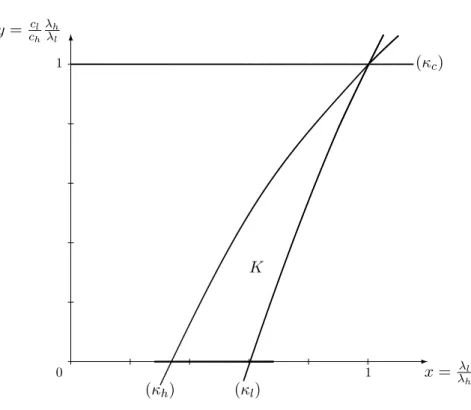
It is helpful to introduce the reduced coordinates
x= l
h y = cl
ch
h
l and z= hv
ch
;
which can be interpreted as corresponding respectively to l; cl
l and v under the normalization
h= ch
h = 1:
23 Figure 1 shows the intersection of the image of the setK in coordinates(x; y; z)with
the plane f(x; y; z) :z= 5g:
[Figure 1]
4.2 Equilibrium after at least one publication
Here we study the equilibrium after at least one of the …rms, say …rma, has published. Firm ais
commonly known to have reached its …nal phase. Letpa be …rma’s publication date and letw be
he value of …rm a’s belief at the publication date pa: We show that there is a unique equilibrium
at such histories.
Equilibrium strategies are such that if the two …rms have published, both …rms investhforever.
However, if only …rm a has published, …rmb never publishes and remains silent forever. On the
equilibrium path, …rm binvestsl in its initial phase andh in its …nal phase. The belief of the …rm
ahas an asymptote when t goes to in…nity equal to1 l=h: If …rm a’s initial beliefw is greater
than this value, the belief is monotonically decreasing over time. If it is lesser than this value, the
belief is monotonically increasing over time. The publishing …rm invests l until its belief is less or
equal to a certain threshold and investsh forever afterwards. This threshold equals
v
2
ch cl
h l +
ch
2h h
h+l v
2
ch
2h
:
Under assumptions ( l) and ( h); we have 2 1 hl;1 :24 Given the publishing …rm’s belief
2 3Such a normalization is without loss of generality. It can be interpreted as a choice of time and dollar units. 2 4
In the limit where( l)is violated at the boundary (i.e., the relation holds with equality), we have !1 l h:In
dynamics, this threshold is reached in
h p
1
h lln
h max(h lw ; ) h h l
!
units of time after the publication date. In particular, forw = 1;let
p 1p=
1
h lln l h h l
!
:
Also, notice that ifh ;we have hp = 0;so that the publishing …rm starts investingh at date0
in this case.25
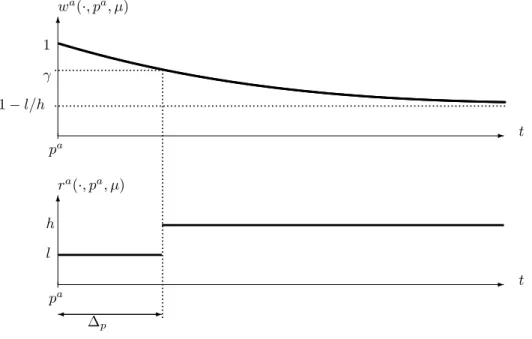
We are now ready to describe more precisely equilibrium strategies of both …rms and the belief of
…rma: When …rmbhas also published, so thatpa; pb t; we havera t; pa; pb =rb t; pb; pa =h:
When only …rmahas published, …rmb never publishes, i.e.
Db\(pa;1) fpag=;:
and invests low in the initial phase and high in the …nal phase, i.e.
rb(t; 0; pa) =l rb(t; 1; pa) =h:
This strategy induces …rma (see Figure 2) to believe
wa(t; pa; ) = h l
h h h lw e (h l)(t pa)
and to invest low on pa; pa+ wp and high on pa+ pw ;1 :In other words, for allt2[pa;1);
ra(t; pa; ) =lfort < pa+ wp and ra(t; pa; ) =h fort pa+ wp :
The following is proved in the Appendix (section A).
[Figure 2]
2 5Holding
l, hand hconstant, hp is decreasing in from1to 0on 1 hl; h
i
and constant equal to0on
[h;1]:Holding l, hand constant, phis constant equal to0from1to0on 1 hl;
i
and increasing from0
Theorem 1 The pro…le ra; wa; Db; rb de…ned above is the unique perfect Bayesian equilibrium
in any subgame where only …rm a has published.
4.3 Equilibrium when no …rm has published
To complete our analysis, we need to characterize equilibrium behavior at histories where no …rm
has published yet. We concentrate on symmetric equilibria, i.e. such that Da =Db and ra =rb:
We show that at such histories, there are either one or two symmetric equilibria, depending on
the parameters. For all parameters in K;there is a non-revealing equilibrium, where no …rm ever
publishes. In a subset of parameters, there is in addition apartially revealing equilibrium, such that
only the …rst …rm which completes the initial phase publishes, and does so immediately.
Partially revealing equilibrium. When no …rm has published yet, both …rms believewip(t; 0; ) =
1;investrip(t; 0; ) hand publish as soon as they complete the initial phase: Dpi f(t; ) :t2 T g:
After one …rm publishes, strategies and beliefs are as described in Theorem 1, with the publishing
…rm in the role of …rm a.26
In the second equilibrium, …rms’behavior changes at date n 1l 1 1 ;which is the date
at which the …rms’common belief reaches the value :27
Non-revealing equilibrium (see Figure 3). Neither …rm ever publishes: Dni ;:If one …rm
deviates and publishes, strategies and beliefs are as in Theorem 1. In the initial phase, both …rms
constantly investri
n(; 0; ) l. In the …nal phase, they both invest, for all t2 T;
ift < n rin(t; 1; ) =l and ift > n rni (t; 1; ) =h:
2 6Note that under the partially revealing strategy pro…le, there are no o¤-the-equilibrium path histories. Every
non-zero measure set of histories with a non-zero measure is reached with a positive probability. 2 7
Holdinglconstant, n is decreasing in from h1l to0on 1 hl;1 :Notice that in general n6= hp:This is
When no …rm has published yet, both …rms believe
for all t 2 [0; n) win(t; ; ) =
1 1 +lt
for all t 2 ( n;1) win(t; ; ) =
h l
h h h l e (h l)(t n)
:
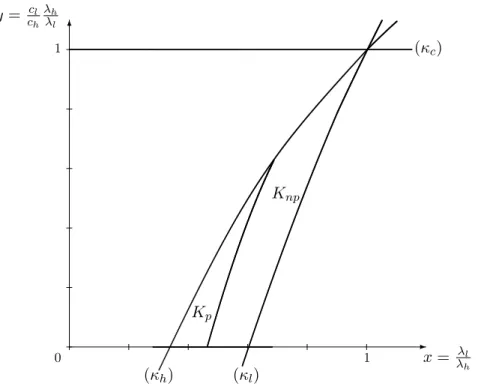
The non-revealing pro…le is an equilibrium for all parameters in K: In contrast, the partially
revealing pro…le is an equilibrium only in a subsetKp K;which we de…ne next (see Figure 4). We
now introduce a function of the parameters d(k) which is shown in section B of the Appendix to
measure the di¤erence between the instantaneous marginal bene…t and the instantaneous marginal
cost of investing “high”at the beginning of the race, when no publication has yet occurred, if …rms
play partially revealing strategies in the continuation game. For allk2K; let
d(k) l
l+hv ch
h 2 ch cl
h l +
ch cl
2 (h+l) + v
ch h + l h 1 cl l
he 2l p
2 (h+l) 0
@l v
ch cl
h l
h(1 ) l 1 + h
l 2 v cl
l
v ch
h + v 2 ch 2h 1
Ale (l+h) p
h+l :
Consider the partition of the parameter setK =Kp[Knp such that
Kp fk2K :d(k) 0g and Knp fk2K:d(k)<0g:
[Figure 3]
The following result, proved in section B of the Appendix, characterizes the equilibrium set for
all k2K:
Theorem 2 The set of symmetric perfect Bayesian equilibria in pure strategies satisfying
mea-surability, right-continuity and invention-date independence is as follows. For all k 2 Knp; the
non-revealing pro…le (rn; Dn; wn) is the unique equilibrium. For all k2 Kp; there are exactly two
[Figure 4]
The following deserves to be stressed. First, strategies are nonstationary in the two equilibria,
due to the evolution of beliefs. On any time segment where no phase is completed, the …rms (weakly)
accelerate. Second, the (immediate) partial revelation is associated with initial high investment in
the initial phase, while non-revelation is associated with initial low investment in the initial phase.
A more detailed discussion of the publication decision is provided in section 5.
5
Endogenous cost and bene…ts of publishing
When facing the decision of whether to publish, a …rm compares two distributions over future play
path realizations following its decision. A publication has three types of e¤ects on the distribution
of future play path realizations, all three via the rival’s reaction to the publication. The …rst e¤ect
is on the investment behavior of the rival before it completes the initial phase, in the event that it
has not already done so. In the case where it has already completed the initial phase, this e¤ect is
simply null. But a publication also a¤ects the investment of the rival after it completes the initial
phase and reaches the …nal phase. It does so in two ways which correspond to our second and third
e¤ects. The second e¤ect is on the investment behavior of the rival in the …nal phase. The third
e¤ect is on the publication behavior of the rival in the …nal phase.
Next, we analyze in detail each of the three e¤ects. Keep in mind that these are durable e¤ects
that operate in the present as well as in the future.
E¤ ect on investment in its initial phase. Publishing (weakly) reduces the investment of the rival
in the initial phase. This e¤ect is bene…cial for the publishing …rm, as it reduces the probability
that the opponent …rm will ever reach the …nal phase, in the event that it has not already reached
E¤ ect on investment in its …nal phase. Publishing increases the investment of the rival in the
…nal phase. The increase is only weak relative to the rival’s previous investment level. However, the
increase is strict relative to the rival’s investment in the alternative scenario where the publication
is not carried out. This e¤ect is thus strictly detrimental to the publishing …rm, by increasing the
probability that the opponent …rm will complete the …nal phase early, once it reaches the …nal
phase.
E¤ ect on publication. Publishing (weakly) decreases the rival’s publications in the future. This
e¤ect result in a loss of information for the publishing …rm and is thus detrimental to the latter.
It is now clear that in this model, the only motive as to why a …rm would ever publish is to
take advantage of the …rst e¤ect, that is, to “deter” its rival while it is behind or at least believed
to be behind. This e¤ect is best understood by examining the equilibria of our …rst benchmark
model with observable positions in 7.1. In the initial high investment equilibrium, once one of the
…rms completes the initial phase, its rival observes this and slows down.
The second e¤ect is easily explained. When the rival is in its …nal phase, a publication reduces
its belief that the race will last long and thus induces it to speed up, rather than to use a cheap
R&D technology.
The third e¤ect is a consequence of the second one. Suppose that …rmais in its …nal phase and
faces the publication decision, while …rm bhas already published. Firm acompares two scenarios,
one where it publishes and one where it does not (or at least delays the publication). By the
second e¤ect, publishing (strictly) increases the investment of the rival in the …nal phase, relative
to non-publishing, whether a publication is expected by the rival or not. Since the rival is known
to be in its …nal phase and has already published, the second e¤ect is the only one …rm a should
consider. Therefore a …rm will never publish once its opponent has done so. This creates the third
Now consider the situation of a …rm which has completed the initial phase and whose rival
has not published. In such a situation, the …rm must weigh all three e¤ects described here. In
the partially revealing equilibrium, the …rst e¤ect dominates the second and third ones, leading to
immediate publication. In the non-revealing equilibrium, the …rst and third e¤ects are null but the
second e¤ect is not, leading to no publication.
6
Ex ante expected payo¤ comparison
For those parameters for which there are two equilibria (k 2Kp), a natural question is how they
compare in terms of ex ante expected payo¤ at date 0. We show here that the non revealing
equilibrium gives …rms a higher ex ante pro…t than the partially revealing one. Let indexp refer
to the partially revealing equilibrium and indexnrefer to the non-revealing equilibrium.
Proposition 1 For all k2Kp Vpa(0; 0; )< Vna(0; 0; ):
Proof. Under the partially revealing pro…le, a publication is always weakly bene…cial, provided
that the opponent has not published. In particular, publishing at date 0 (an invention made at
date 0) is weakly bene…cial. Thus Vpa(0; 1; ) Vpa(0;0; ): Under the non-revealing pro…le, a
publication is never bene…cial. In particular, publishing at date 0 (an invention made at date0)
is not bene…cial. Thus, Va
n (0;0; ) Vna(0; 1; ): The equilibrium in the subgame following a
publication at date0by …rmais identical under the two pro…les:28 ThusVna(0;0; ) =Vpa(0;0; ):
From the last three inequalities, we obtainVpa(0; 1; ) Vna(0; 1; ):The …rst order conditions
on the non revealing pro…le and the partially revealing pro…le at date0 imply
Vna(0; 1; ) Vna(0; 0; ) ch cl
h l < V
a
p (0; 1; ) Vpa(0; 0; )
2 8
Note that this is the case only at date0since this is the only datetsuch that …rmxhas the same beliefs under
As a result, we obtain Vpa(0; 0; )< Vna(0; 0; );the desired conclusion.
7
Benchmark models
In this Section, we present two benchmarks that shed light on our main result. In 7.1, we present a
model where …rms’positions in the race are directly observable. We characterize the set of subgame
perfect equilibria in this game within our parameter set. In 7.2, we present a model where …rms’
positions are unobservable and where publishing is not feasible. We characterize the set of Nash
equilibria in this game within our parameter set.
7.1 Observable position
Here, we examine a benchmark model that di¤ers from our main model only in its information
structure. We assume that …rms’ positions are publicly observed (so that publications are
irrele-vant).29 In this setting, there are two Markov perfect equilibria that depend only on the positions
of the …rms. Let0represent the initial phase and 1represent the …nal phase. For allm; n2 f0;1g;
let rmn be the investment of a …rm in phase m;when its rival is in phase n:
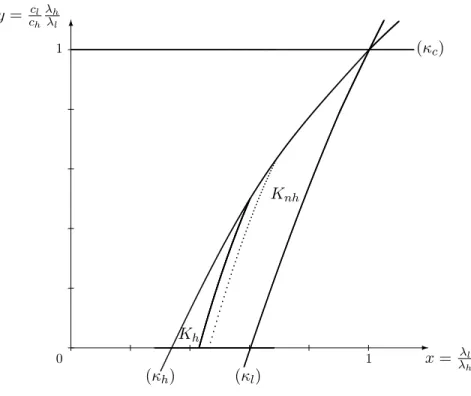
Consider the following partition of K=Kh[Knh:Figure 5 shows in reduced coordinates
x= l
h y = cl
ch
h
l and z= hv
ch
;
the intersection ofKh and Knh with the planez= 5:The …gure also shows the boundary between
Knp and Kp: It can be veri…ed numerically30 that Kh Kp; as shown in the picture within the
2 9This model is a variant of models by Grossman and Shapiro (1987) and Harris and Vickers (1987). 3 0It su¢ ces to verify that for allk
2K;
ch cl h l
v
4 +
ch
plane z= 5:
Knh k2K:
ch cl
h l > v
4 +
ch
2h
Kh k2K:
ch cl
h l v
4 +
ch
2h :
[Figure 5]
The following result characterizes the Markov perfect equilibria of this …rst benchmark.
Proposition 2 For all k2Knh;there is a unique Markov perfect equilibrium:
r11=h and r00=r10=r01=l:
For all k2Kh;there are two Markov perfect equilibria:
r11 = h andr00=r10=r01=l:
r11 = r00=h and r10=r01=l:
Proof. For all m; n 2 f0;1g; let Vmn be the value of a …rm in phase m; when its rival is in
phase n: The Hamilton-Jacobi-Bellman (HJB) equations are necessary and su¢ cient equilibrium
conditions.
0 = max
r11 f
r11(v V11) c(r11)g r11V11
0 = max
r10 f
r10(v V10) c(r10)g+r01(V11 V10)
0 = max
r01 f
r01(V11 V01) c(r01)g r01V01
0 = max
r00 f
r00(V10 V00) c(r00)g+r00(V01 V00)
By the …rst HJB equation, condition( l) and
V11=
r11v c(r11)
2r11
the relationr11=h holds. By the second and third HJB equation, condition( h) and
V10 =
r10v+r01V11 c(r10)
r10+r01
V01 =
r01V11 c(r01)
r10+r01
the relations holdr10=r01=l. By the fourth and last HJB equation and
V00=
r00V10+r01V01 c(r00)
2r00
;
if in addition k 2 Knh; the relation r00 = l holds. If instead k 2 Kh; either r00 = h or r00 = l
holds.
In theinitial low investment equilibrium,both …rms initially invest “low,”as long as at least one
of them is still in the initial phase. As soon as the second …rm completes the initial phase, so that
both …rms have reached their …nal phase, provided that the race has not ended, both …rms invest
“high” until the end of the race. In the initial high investment equilibrium, both …rms initially
invest “high,”as long as both …rms are in their initial phases. As soon as one …rm completes it and
starts its …nal phase while the other is still in its initial phase, both …rms cut investment to “low.”
As soon as the second …rm completes the initial phases, so that both …rms have reached their …nal
phases, provided that the race has not ended, both …rms invest “high” again until the end of the
race.
There is a connection between theinitial low investment equilibrium in this game and the
non-revealing equilibrium in our main model on the one hand, and between the initial high investment
equilibriumin this game and thepartially revealing equilibrium in our main model on the other hand.
Parameter values determine whether there is an equilibrium where both …rms invest “high” at the
beginning of the race. The set of parameters such that this is the case roughly coincides in the two
in Figure 5. For such parameter values and in this equilibrium, publications occur endogenously in
our main model: the …rm that …rst completes the initial phase knows it in equilibrium and has an
incentive topublish to deter. By publishing, it induces its rival to cut its investment. Nevertheless,
for all parameter values in K;both models have an equilibrium where both …rms invest “low” at
the beginning of the race. In the main model, this translates into a lack of incentive to publish
to deter and no publications in equilibrium. In conclusion, publication in equilibrium is associated
with a high level of investment early in the race.
We now study a second benchmark, where the position of the rival is unobservable and
publi-cations are unavailable.
7.2 Unobservable positions and unavailable publications
Here, we examine another benchmark model that where publications are unavailable. As a shortcut,
consider an exogenously …xed publication strategyD=;for both …rms. In this simpli…ed model,
the third argument of an investment function can be ignored. Let r:T f 0; 1g ! fl; hg denote
an invention-date-independent investment strategy.31 We study the Nash equilibrium set of the
induced investment game.32
Let r be the strategy induced in this reduced game by the non-revealing strategy in the main
model (see section 4), i.e. such that r (t; 0) = rn(t; 0; ) and r (t; 1) = rn(t; 1; ): As we
3 1If, instead, we allow strategies to take on values
r 2[l; h]and the cost function is a¢ ne in r (or equivalently
if non-degenerated mixed strategies are feasible), the set of equilibrium payo¤s is a continuum for a full-dimension
subset of parameters. Interestingly, in some of these equilibria, beliefs are non-monotonic with respect to time. Firms
are at times increasingly pessimistic and at other times, increasingly optimistic. These phenomena are studied in
Gordon (2003).
3 2The equilibrium concept here is a closed-loop Nash-equilibrium, since …rms do not observe the investment of the
opponent nor its position at any date. The decision problem faced by each of the players is time-consistent, thus any
showed in section 4, this strategy induces beliefsw (t) =wn(t; ; ):The following result is proved
in section C of the Appendix.
Proposition 3 For allk2K; r is the unique symmetric Nash equilibrium of the investment game
with unobservable positions and unavailable publications.
This result mitigates a conclusion that one might have been tempted to draw from the study of
the …rst benchmark model. We observed earlier that in our main model, publications in equilibrium
are associated with a high level of investment at the beginning of the race. Our intuition was then
that when investment is high early in the race, the …rst …rm which completes the initial phase, and
knows it in equilibrium, has an incentive to publish to deter. This intuition is perfectly correct
but incomplete, as it suggests a one-way causal relation. Proposition 3 shows instead that when
publications are not available, …rms do not invest heavily early in the race in equilibrium. It is thus
more accurate to say that initial high e¤ort and publications reinforce each other in equilibrium
than to say that initial high e¤ort causes publications.
8
Conclusion
Within a certain parameter set of interest, we characterized the class of symmetric, perfect Bayesian
equilibria in pure strategies satisfying a weak Markovian property of invention-date-independence,
which requires that strategies do not depend on the speci…c dates at which advancement was
achieved.
There are either one or two such equilibria. For all parameters in the set of interest, there is
a non-revealing equilibrium. Under this equilibrium, …rms start the race at a slow pace and never
publish any progress. When a slow pace is relatively more cost e¢ cient, there are no other equilibria
more cost e¢ cient, there is another partially revealing equilibrium. Under this equilibrium, …rms
start the race at a faster pace and only the …rst …rm which completes the intermediate step publishes
and does so immediately. The …rms’joint expected payo¤ is higher in thenon-revealing equilibrium,
as publications are associated with overinvestment in the initial phase of the race.
We analyzed incentives and disincentives to publish in terms of three distinct strategic e¤ects
of publishing on the rival’s behavior. The …rst e¤ect is on the rival’s investment, as long as it
will remain in its initial phase. Publishing always induces the rival to slow down in this case.
The second e¤ect is on the rival’s investment, once it has reached its …nal phase. Publishing
always stimulates the rival in this case, inducing it to speed up. The third e¤ect is on the rival’s
publications. Publishing always induces the rival not to publish in response, which represents a
loss of information for the publishing …rm. The …rst e¤ect is bene…cial to the publishing …rm, while
the second and third e¤ects are detrimental. When taking a publication decision, a …rm weighs
the …rst e¤ect against the other two. Their relative importance crucially depends on what the …rm
believes on the position of its rival, but beliefs are themselves determined in equilibrium by the
publication and investment strategies of the rival.
Although the model presented here was used to answer a speci…c set of questions in a speci…c
context, the model could be adapted to study a variety of other situations.
Consider the following oligopoly example. Two …rms compete in prices in a product market
over time. Suppose in addition that they each simultaneously engage in parallel R&D projects
aimed at reducing costs. Suppose further that the outcome of its own project is a …rm’s private
information, so that …rms only have beliefs evolving over time about their rival’s costs. Should
any success in cost reduction translate into a price cut? On the one hand, cutting prices may
intensify competition in the market and thus reduce revenue. On the other hand, cutting prices
The latter is most likely to happen if the rival has not yet achieved a cost reduction, whereas the
former is most likely to happen if the rival has already achieved a cost reduction. In this oligopoly
example, each …rm faces a decision on whether to cut prices that is comparable to the decision on
whether to publish studied in this paper.
More generally, this paper’s model and the oligopoly example we just described belong to a
broader class of problems where at least two agents acquire their own information over time. In
this paper’s model, each …rm acquires information on its own evolving position in the race. In the
oligopoly problem, each …rm acquires information on its own evolving costs. In fact, one can think
of many such situations. Even an agent’s preferences in virtually any situation are likely to change
over time, so that this agent acquires information on its own preferences. On the one hand, an
agent’s decision on whether to reveal information is likely to depend on her beliefs on other agents’
“evolving types.” On the other hand, beliefs are determined by the informational content of other
agents’actions, such as publications in this paper’s model or pricing in the oligopoly example.
To our knowledge, our paper is the …rst to analyze a problem of this type. The entire class of
problems with these characteristics, of which our paper only provides an example, has yet to be
analyzed.
References
[1] Aoki, R. and Y. Spiegel, Pre-Grant Patent Publication and Cumulative Innovation,
Interna-tional Journal of Industrial Organization, 27, 333–345, 2009.
[2] Basar, T. and G. Olsder, Dynamic Noncooperative Game Theory, Second Edition, San Diego: