631
Astronomy
Introduction to Chapter 32
So far in this unit, you have learned mostly about objects that are relatively close to Earth such as other planets, their moons, and the sun. The solar system occupies a very tiny portion of the Milky Way Galaxy. This galaxy contains hundreds of billions of stars like the sun, and is one of many billions of galaxies in the universe. The universe is a term astronomers use to describe everything that exists including all matter and energy. In this chapter, you will learn about objects that are very far away including stars and galaxies. You will also read about how many scientists believe the universe began.Investigations for Chapter 32
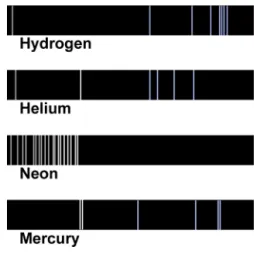
Astronomers use a spectrometer to analyze the light emitted by stars and determine the elements from which stars are composed. In this Investigation, you will use a spectrometer to analyze light and examine spectral diagrams to determine the composition and temperature of stars.
Distances to stars and galaxies in the universe are so vast that they are very difficult to measure. One of the tools astronomers use to measure distances in the universe is light. In this Investigation, you will discover the mathematical relationship between how bright an object appears from a distance, and how much light it actually gives off. This important relationship is used by astronomers to calculate distances in the universe.
32.1 Stars What are stars made of?
32.2 Galaxies and the
Universe How do we use light to measure the distances tostars and galaxies?
632
Learning Goals
In this chapter, you will:
D Identify the conditions necessary for fusion to occur inside a star.
D Describe the information that spectroscopy provides about stars.
D Relate the color of a star to its temperature.
D Explain the factors that determine the brightness of a star in the sky.
D Discuss the importance of the H-R diagram to astronomers.
D Explain the relationship between mass and the life cycle of a star.
D Describe the phases in the life cycle of a sun-like star.
D Discuss how the death of a massive star is responsible for the creation of elements heavier than helium on the periodic table.
D Describe how the composition and size of planets is related to their formation and proximity to the sun.
D Identify the structure of the Milky Way Galaxy and the location of our solar system within the galaxy.
D Explain how astronomers measure the distance to stars and galaxies.
D Identify the scientific evidence that supports the Big Bang theory.
Vocabulary
absolute brightness constellation main sequence stars protostar
apparent brightness Doppler shift nebula spectroscopy
Big Bang H-R diagram parallax standard candle
633
32.1 Stars
Figure 32.1: The star at the tip of the Little Dipper’s handle is called Polaris. If you look toward Polaris, you are facing the North Pole.
Constellations
A constellation is a group of stars that, when seen from Earth, form a pattern. The stars in the sky are divided into 88 constellations. The largest, Centaurus, contains 101 stars. The most familiar star formation, the Big Dipper, is actually part of a larger constellation called Ursa Major (the Great Bear). The Little Dipper, part of Ursa Minor, contains Polaris, the North Star, which is located at the tip of the handle (Figure 32.1). Anybody in the Northern Hemisphere who is looking toward Polaris is facing the North Pole.
32.1 Stars
During the day, we see only one star, the sun, which is 150 million kilometers away. On a clear night, about 6,000 stars can be seen without a telescope. The closest star in the nighttime sky is Alpha Centauri—4.3 light years (41 trillion kilometers) away. Where do stars come from? How long do they last? In this section you will find the answers to these questions and more.
Stars and fusion
What is a star? A star is essentially a giant, hot ball of gas. Stars generate light and heat through nuclear reactions. Specifically, they are powered by the fusion of hydrogen into helium under conditions of enormous temperature, mass, and density. When hydrogen atoms fuse, helium is created. During this process, some mass is lost and converted to energy as described in Albert Einstein’s famous equation:
What makes fusion occur?
The conditions required for the continuous fusion of hydrogen include extremely high values for temperature, density, and mass. Furthermore, hydrogen fusion does not take place throughout the star, but only deep in its core, where the temperature is hot enough. The minimum temperature required for fusion to occur is 7 million°C. The sun’s core reaches a temperature of 15 million°C.
Density and mass Even though stars are made of gas, they have extremely high values for density and mass. For example, the density of the sun’s core is about 158.0 g/cm3. This is
634
Examining light from stars
What is spectroscopy?
Stars shine because they are hot. Astronomers analyze the light emitted by stars, and other “hot” objects in space in order to determine their chemical composition and temperature. Sometimes they can even determine how fast the object is moving, its mass, and its density by analyzing the light it emits. Spectroscopy is a tool of astronomy in which the electromagnetic radiation (including visible light) produced by a star or other object (called its spectrum) is analyzed.
Chemical composition of stars
During the mid-1800s, scientists used a device called a spectrometer to observe flames produced by burning substances. A spectrometer splits light into a spectrum of colors and displays lines of different colors along a scale. The scale measures the wavelength of each of the lines of color in nanometers (nm). The scientists discovered that each element has its own unique pattern of lines—like a fingerprint. For example, when the element sodium is burned, two prominent yellow lines at precisely 589.0 and 589.6 nanometers are observed when the light is passed through a spectrometer (Figure 32.2). Spectroscopy was born, and astronomers now had a tool they could use to determine the chemical composition of the stars.
The composition of the sun
In 1861, Sir William Huggins, an amateur astronomer in England, used spectroscopy to determine that the sun and the stars are composed mostly of hydrogen. A few years later, his countryman Sir Joseph Norman Lockyer observed a line at the precise wavelength of 587.6 nanometers. Since no known element on Earth had a line at this wavelength, he concluded that this must be an undiscovered element and named it helium, after the Greek name for the sun,
Helios. Today, we know that hydrogen is the most abundant element in the universe, with helium second (Figure 32.3).
Color and temperature
When a bar of iron is heated, it first glows red. As its temperature increases, its color changes to orange, yellow, and finally white. The hottest objects have a bluish color. Scientists use this fact to determine the temperature of stars and other objects in space. For example, red stars have the coolest temperatures while blue stars have the hottest. Our sun is yellow, which means that its temperature is somewhere in between those of red stars and blue stars.
Figure 32.2: When the element sodium is burned, two prominent yellow lines are observed at 589.0 and 589.6 nanometers on the scale of a spectrometer.
635
32.1 Stars
Classifying stars
How are stars classified?
At least 6,000 stars are visible in the night sky without the aid of a telescope. There are countless billions of stars in the universe that you cannot see. Astronomers classify stars according to their physical characteristics. The main characteristics used to classify stars are size, temperature, and brightness.
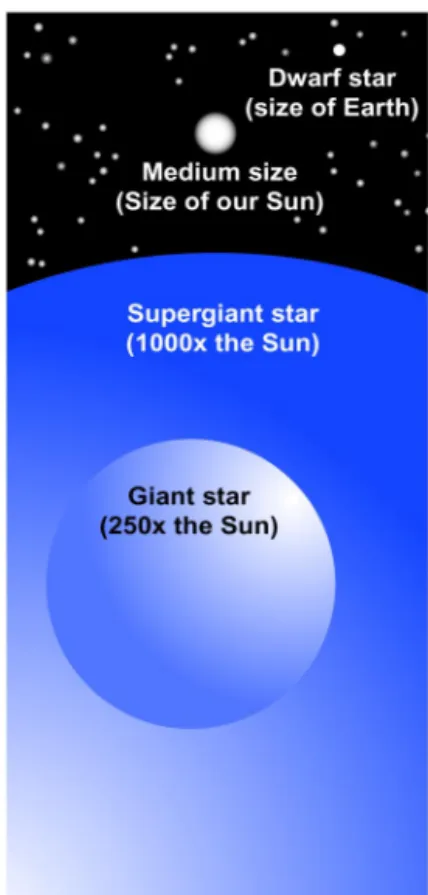
Sizes of stars The sun, with a diameter of 1.4 million kilometers, is a medium-sized star. The closest star to the sun, Alpha Centauri, is also a medium-sized star. The largest stars, called supergiants, have a diameter that can exceed 1,000 times that of the sun. The largest known supergiant is 2,700 times the diameter of the sun. The next largest group of stars, simply called giants, are about 250 times the diameter of the sun. Stars that are smaller than the sun come in two categories, white dwarfs and
neutron stars. White dwarfs are about the size of the smaller planets. Sirius B, the largest known white dwarf, has a diameter of 10,400 kilometers, making it slightly smaller than Earth. Neutron stars are even smaller—their diameter is only 20 to 30 kilometers! Figure 32.4 shows the relative sizes of each type of star.
Temperatures of stars
If you look closely at the stars on a clear night, you will see slight differences in their colors. This is related to the fact that their surface temperatures are different. You have already read that a red star is cooler than a white star, while blue stars are the hottest. The table below names some stars and gives their colors and their surface temperatures.
Table 32.1: Stars, their colors, and their surface temperatures
Star Color Temperature range (°C)
Betelgeuse red 2,000 to 3,500
Arcturus orange 3,500 to 5,000
Sun yellow 5,000 to 6,000
Polaris yellow-white 6,000 to 7,500
Sirius white 7,500 to 11,000
Rigel blue-white 11,000 to 25,000
Zeta Orionis blue 25,000 to 50,000
636
Magnitudes You will notice too that stars vary in their brightness. About 2,200 years ago, a Greek astronomer named Hipparchus classified the stars into six groups according to their brightness. He called these groups magnitudes. In his system, the brightest stars were called first-magnitude stars, and the faintest stars sixth-magnitude. Hipparchus’ system is still in use. Because of improved tools, the magnitude scale has been extended to include fainter and brighter objects. Through a good telescope, we can see much fainter stars, almost to the 30th magnitude. This is 4 billion times fainter than the human eye can see unaided!
Apparent and absolute brightness
How bright a star appears in the sky depends on two factors: the star’s distance from Earth and the amount of light (energy) it actually gives off. Astronomers define a star’s brightness as observed from Earth as its apparent brightness. This quantity can be measured fairly easily using a photometer (an instrument that measures brightness). A star’s absolute brightness is defined as the brightness the star would have if it were a standard distance from Earth. Astronomers arbitrarily set the standard distance at 10 parsecs. One parsec is equal to 3.26 light years. This means that 10 parsecs equals 32.6 light years.
The difference between apparent and absolute brightness
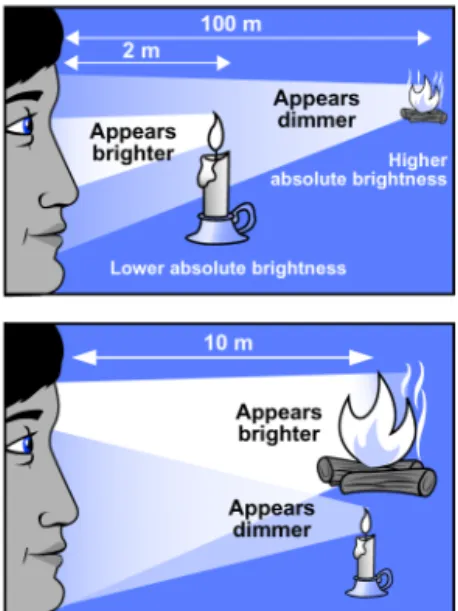
Imagine observing a candle that is two meters from you, and a campfire that is 100 meters away. From where you are, the candle appears brighter than the campfire, even though the campfire is giving off much more light. At these distances, the candle has a greater apparent brightness than the campfire. Suppose the candle and campfire are moved so that both are now 10 meters from you. When this happens, the campfire appears much brighter than the candle. This is because the campfire has a greater absolute brightness than the candle. Therefore, absolute brightness is a measure of how much light an object actually emits (Figure 32.5). Apparent
brightness decreases as distance increases
This example explains why the apparent brightness of an object depends on its absolute brightness and on how far away it is from an observer. As Figure 32.6 shows, just because one star appears brighter than another does not mean that it has a higher absolute brightness. The apparent brightness of an object decreases the farther away from it you move regardless of its absolute brightness. If you were to observe the sun from Pluto, the farthest planet, the sun would appear much dimmer. The relationship between apparent brightness, absolute brightness, and distance will be explored in Section 32.2.
Figure 32.5: An illustration of apparent and absolute brightness.
637
32.1 Stars
Comparing temperature and brightness of stars
H-R diagrams In the early 1900s, the Danish astronomer Ejnar Hertzsprung and American astronomer Henry Russell developed an important tool for studying stars. They made a graph in which they plotted the temperature of the stars on the x-axis and the absolute brightness on the y-axis. The result is known as the Hertzsprung-Russell, or H-R diagram. In the example below, each dot on the diagram represents a star whose absolute brightness and temperature are known.
Reading H-R diagrams
H-R diagrams are useful because they help astronomers categorize stars into distinct groups. Stars that fall into the band that stretches diagonally from cool, dim stars to hot, bright stars are called main sequence stars. Main sequence stars, like the sun, are in a very stable part of their life cycle (described on the next page). White dwarfs are in the lower left corner of the diagram. These stars are hot and dim and cannot be seen without a telescope. Red giants appear in the upper right side of the diagram. These stars are cool and bright and can be seen without the aid of a telescope in the night sky. Supergiants, both red and blue, are found in the extreme upper portion of the diagram. H-R diagrams are also useful because astronomers can use them to predict the absolute brightnesses of stars for which that value has not been determined.
Observing stars
638
Life cycle of stars
Stars have a life cycle
Like living organisms, stars have a life cycle. Of course, stars are not truly “alive” but astronomers sometimes use the terms “born,” “live,” and “die” to represent parts of that cycle. Our sun, a medium-sized star, was born about 5 billion years ago. Because most medium-sized stars have a life span of around 10 billion years, it will live for another 5 billion years before it dies. Stars that are larger than the sun have shorter life spans.
How are stars born?
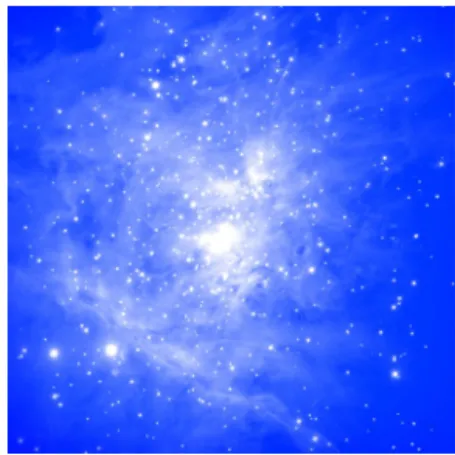
A star, regardless of its size, begins its life inside a huge cloud of gas (mostly hydrogen) and dust called a nebula (Latin for “mist”). Gravitational forces cause denser regions of the nebula to collapse, forming a protostar. A protostar is the earliest stage in the life cycle of a star. The gases at the center of the protostar continue to collapse, causing pressure and temperature to rise. A protostar becomes a star when the temperature and pressure at its center become great enough to start nuclear fusion. This is the nuclear reaction in which hydrogen atoms are converted into helium atoms and energy is released. Figure 32.7 shows a portion of the Orion Nebula, the birthplace of many stars.
A star is born when temperature and pressure
become great enough to start nuclear fusion.
Main sequence stars
Once nuclear fusion begins, a star is in the main sequence stage of its life cycle. This is the longest and most stable part of a star’s life. The length of the main sequence stage depends on a star’s mass. You may suppose that stars with larger masses live longer than those with smaller masses because they contain more hydrogen fuel for nuclear fusion. The opposite is true. Stars with large masses use up their hydrogen fuel more quickly than stars with small masses, so they have much shorter life spans. Because of this, they burn brighter, and hotter than smaller stars. The main sequence stage of sun-like stars (stars with the same mass as the sun) lasts for about 10 billion years. The main sequence stage of stars with masses over 100 times that of the sun, lasts for only a few million years. This stage for stars that are less massive than the sun can last for more than 50 billion years.
Figure 32.7: A NASA/HST photo of a portion of the Orion Nebula. A group of protostars is visible in the center of the nebula.
The Orion Nebula
639
32.1 Stars
Old age As a star grows old, its core begins to run out of hydrogen fuel. Gravity causes the core to contract, raising its temperature and igniting the helium inside the core, along with any hydrogen in the outer layers. The star expands, and the outer layers begin to cool. At this stage in its life cycle, a small or medium-sized star becomes a red giant. When the sun reaches this stage in its life cycle (about 5 billion years from now), it will become so large that it will swallow up Mercury, Venus, and Earth.
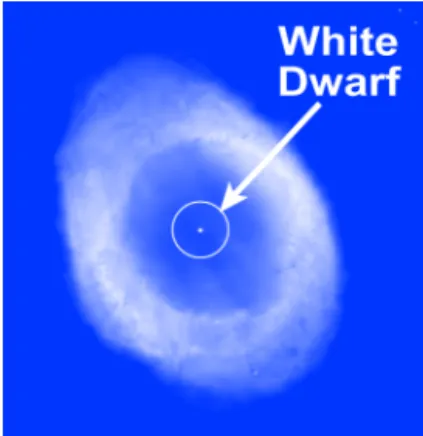
Death Once the nuclear reactions in the core of small to medium-sized stars cease there is nothing to prevent gravity from crushing the matter together as close as possible. At this stage, the core glows brightly and is called a white dwarf. It is about the size of Earth, and has the same mass as the sun. Because of its high density, a thimbleful of matter from a white dwarf on Earth would weigh about the same as an elephant! During the white-dwarf stage, the outer layers of the star expand and drift away from the core, forming what is called a planetary nebula. This is different from a nebula where stars are born.
Remnants When a white dwarf stops glowing, it is called a black dwarf, the final stage in the life cycle of small and medium-sized stars. The life cycle of stars is summarized in the diagram below. The death of massive stars is discussed on the following page.
Figure 32.8: The famous Ring Nebula, showing the death of a sun-like star. The outer rings are called the planetary nebula. The glowing, white dwarf can be seen in the center. Photo courtesy NASA/HST.
640
The death of massive stars = the birth of elements
The creation of elements
Stars that are at least five times more massive than the sun have a different end to their life cycle. As the core begins to run out of hydrogen fuel, it yields to gravity and begins to shrink, growing hotter and denser. More heat is generated by this contraction than in a small or medium star, so the core does not become a white dwarf. Instead, the tremendous heat generated causes helium atoms to fuse into carbon and oxygen atoms. This is followed by the fusion of carbon and oxygen atoms into neon, sodium, magnesium, sulfur, and silicon. Meanwhile, the outer layers of the massive star expand and cool, making the star a red supergiant. The end of fusion
in the core
Once the carbon atoms in the core are depleted, it shrinks again, creating even greater pressure and temperatures. This causes the fusion of even heavier elements such as calcium, nickel, chromium, copper, iron, and others. When the core of the star contains mostly iron, the fusion stops. This is because iron’s nuclear structure does not allow the fusion of heavier elements. In fact, the fusion of elements heavier than iron requires energy, rather than producing it.
Supernovas Because a giant star has such a great mass, almost the moment fusion stops in its core, it begins to collapse from the tremendous gravity. This collapse of the entire mass of the star upon the core causes the temperature inside to rise to over 100 million °C as the iron atoms are crushed together. A huge repulsive force between the iron nuclei overcomes the force of gravity, causing a spectacular explosion to occur, called a supernova. The actual explosion takes only a few minutes (Figure 32.10). During this brief period, heavier elements such as gold and uranium are created, as atomic nuclei are smashed together. The explosion propels the matter out into space in all directions.
Neutron stars and black holes
The light and heat produced by a supernova fades over time, and the remnants become a nebula that can be recycled again to make more stars. All that remains of the original star is a core composed entirely of neutrons called a neutron star. This super-dense object is no more than a few kilometers in diameter! If a dying star has a core that is three or more times the mass of the sun, the force of its collapse is so strong that an explosion cannot occur. The gravitational forces are so strong that not even light can escape. All that is left is a phenomenon called a black hole.
Figure 32.10: How a supernova happens.
j
Supernova sightings641
32.1 Stars
The formation of the solar system
Do other planetary systems exist?
In 1995, three Earth-sized planets were discovered orbiting a star much like our sun. This was among the first evidence of a star other than the sun with orbiting planets. A star with orbiting planets is called a planetary system. Since then several other planetary systems have been detected. Scientists now believe that planets are a natural by-product of the formation of stars. Therefore, planets of some type should exist around many stars in the universe.
How was our solar system formed?
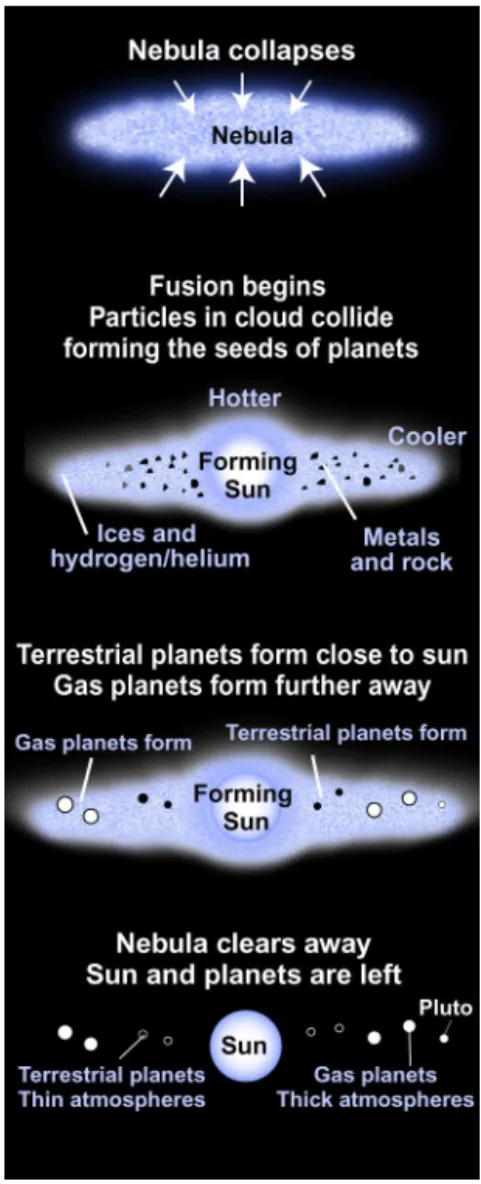
The solar system was formed out of the same nebula that created the sun. As the sun was being formed 4.6 billion years ago, it was surrounded by a cloud of dust and gas. This cloud was made mostly of hydrogen and helium, but contained smaller amounts of other elements such as carbon, nickel, iron, aluminum, and silicon. As this cloud spun around, it flattened, with the help of gravity, into a disk-shape along the axis of its rotation. This explains why all of the planets formed in the same plane around the sun, and why they all orbit in the same direction. Planet formation At the center of the disk, temperatures became hot enough for fusion to begin,
creating the sun. Farther away from the center, the heaviest molecules began to condense into solid and liquid droplets. These droplets began to collide, forming small clumps—the seeds of the planets. Through further collisions, these clumps of material grew larger and eventually formed into the planets.
The terrestrial planets
Terrestrial planets, like Earth, were formed in the warmer, inner regions of the disk. Because the heat drove off the lighter elements such as hydrogen and helium, these planets were made mostly of metals and rock. These materials made up less than one percent of the disk, these planets could not grow very large. Because of their small masses, their gravity could not attract hydrogen and helium and their atmospheres were thin and contained little of these elements.
The gas planets The outer regions of the disk were rich in icy materials made of lighter elements and the planets there grew comparatively large. Because of their large masses, they were able to capture hydrogen and helium through their gravitational force and so form thick atmospheres. These became gas planets, rich in hydrogen and helium with dense, frozen cores. The outermost planet, Pluto, is neither a gas nor a terrestrial planet, but a tiny, frozen object with a thin atmosphere.
642
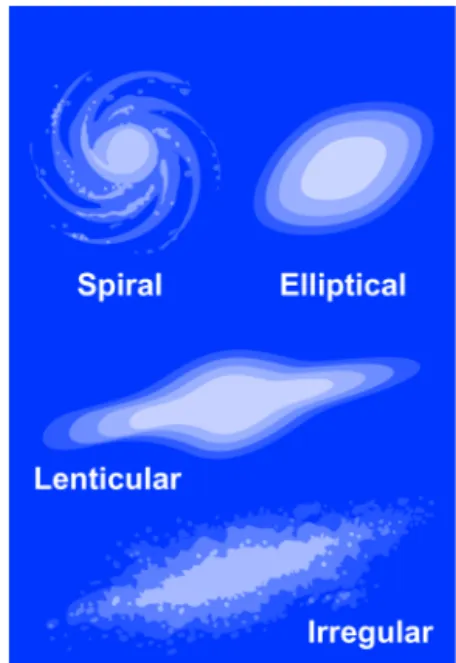
Figure 32.12: Galaxy shapes.
Figure 32.13: When the Cartwheel Galaxy was struck by a smaller galaxy, a ring-like band of stars formed, much like ripples form in a pond.
32.2 Galaxies and the Universe
Early civilizations believed that Earth was the center of the universe. In the 16th century, we became aware that Earth is a small planet orbiting a medium-sized star. It was only in the 20th century that we became aware that the sun is one of billions of stars in the Milky Way Galaxy, and that there are billions of other galaxies in the universe. In the past three decades, astronomers have found evidence that the universe is expanding and that it originated 10 to 20 billion years ago. In this section you will learn about galaxies and theories about how the universe began. You will also learn how astronomers measure the vast distances of galaxies and stars from Earth.
What is a galaxy?
The discovery of other galaxies
A galaxy is a huge group of stars, dust, gas, and other objects bound together by gravitational forces. In the 1920s, American astronomer Edwin Hubble (1889-1953) discovered that there were galaxies beyond the Milky Way. He used a new, 2.5-meter reflecting telescope to establish that some of the many fuzzy patches of light long known to astronomers were indeed separate galaxies. For example, when he focused the huge telescope on an object thought to be a nebula in the constellation Andromeda, Hubble could see that the “nebula” actually consisted of faint, distant stars. He named the object the Andromeda Galaxy. Just since Hubble’s time, astronomers have discovered a large number of galaxies. In fact, many new galaxies are detected each year using the telescope named after Hubble—the Hubble Space Telescope or HST.
Galaxy shapes Astronomers classify galaxies according to their shape. Spiral galaxies like the Milky Way consist of a central, dense area surrounded by spiraling arms. Elliptical galaxies look like the central portion of a spiral galaxy without the arms.
643
32.2 Galaxies and the Universe
The Milky Way Galaxy
Structure of our galaxy
The sun, along with an estimated 200 billion other stars, belongs to the Milky Way Galaxy. The Milky Way is a typical spiral galaxy. From above, it would look like a giant pinwheel, with arms radiating out from a central region. The stars are arranged in a disk that is more than 100,000 light years across. If you could look at it from the side, you would see that our galaxy is much flatter than it is wide. In fact, it is only about 3,000 light years thick on average. At the center of the disk is a denser region of stars called the nuclear bulge. Surrounding the outer regions of the galaxy is an area containing clusters of older stars known as the halo.
Figure 32.14 shows a diagram of the Milky Way Galaxy.
The disk The disk of the Milky Way is a flattened, rotating system that contains young to middle-aged stars, along with gas and dust. The sun sits about 26,000 light years from the center of the disk and revolves around the center of the galaxy about once every 250 million years. When you look up at the night sky, you are actually looking through the disk of the galaxy. On a very clear night, you can see a faint band of light stretching across the sky. This is the combined light of billions of stars in the disk of our galaxy, so numerous that their light merges together. The center of
the galaxy
Since we are located in the outer part of the galaxy, the interstellar (between the stars) dust blocks out much of the visible light coming from objects within the disk. Because of this, astronomers use infrared and radio telescopes to study our galaxy. Using these tools, they have learned that the center of the galaxy is crowded with older stars and hot dust. Recent studies have suggested that a black hole, with a mass of more than a million suns, exists at the very center of the galaxy. It is believed that this black hole has enough gravitational pull to keep in orbit all of the stars, gas, and dust in the Milky Way Galaxy.
Evidence for the black hole theory
The evidence for a huge black hole comes from measurements of the orbital speeds of stars and gas at the center of the galaxy. In one study, an infrared telescope was used to measure the orbital speeds of 20 stars over a three-year period. It was determined that these stars were orbiting at speeds of up to 1,000 kilometers per second (3 million miles per hour!). This extremely high orbital speed requires an object with a mass that is over 2 million times that of the sun.
Figure 32.14: The Milky Way is a typical spiral galaxy.
The Local Group
644
Determining distances to closer objects in the universe
Measuring the distance of closer stars
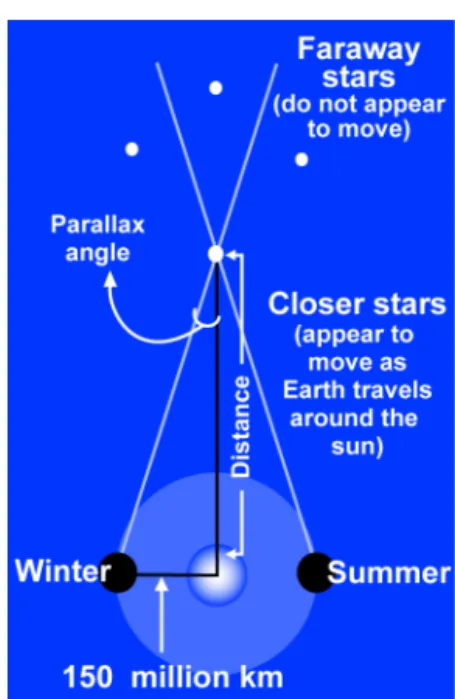
One of the greatest challenges facing astronomers is how to determine the vast distances of stars and galaxies from Earth. This information is key to mapping the universe. For objects that are under 1,000 light years from Earth, astronomers use a method called parallax. Parallax is the apparent change in position of an object when you look at it from different directions.
An illustration of parallax
To illustrate parallax, hold one finger about six inches from your nose. Close your left eye and look at your finger with your right eye. Next, close your right eye and look at your finger with your left eye. Because your eyes are in different positions, your finger appears to move. The same is true of stars in the sky. As Earth revolves around the sun, the stars appear to change positions in the sky over the course of one year. It is actually Earth that is changing position as it revolves around the sun, while the stars remain fixed in the background (Figure 32.15).
Parallax only works for closer stars
Parallax only works for stars that are relatively close because as distance from Earth increases, the change in angle of a star becomes less measurable. You can demonstrate this by looking at a finger held before your nose as you did before. This time, try moving your finger farther and farther away from your nose while looking at it with each eye. You will notice that the farther away it is, the smaller the movement appears to become until you can detect no movement at all.
How to measure distance using parallax
To use parallax, astronomers determine the position of a star in the sky in relation to other stars that are too far away to show movement. Next, they look at the star six months later—when Earth is on the opposite side of the sun, and measure its change in position in relation to the faraway stars. Using geometry, they can determine the distance of the star from Earth (Figure 32.16 and below).
Figure 32.15: The night side of Earth always faces away from the sun. As Earth revolves around the sun, the stars seen in the sky appear to move even though they remain fixed.
645
32.2 Galaxies and the Universe
Measuring distances to faraway objects in the universe
The inverse square law
Light is very important to astronomers in measuring the distances to objects that are more than 1,000 light years away. Recall that the apparent brightness of an object depends on how far away it is, and how much light it actually gives off (its absolute brightness). The mathematical relationship between these variables is known as the inverse square law and is used to determine the distance to stars and galaxies.
Apparent brightness vs. distance
The inverse square law shows how the apparent brightness of an object decreases as you move away from it. The amount of decrease in apparent brightness can be quantified using the formula at left. The symbol α indicates a proportional relationship. For example, if you are looking at a candle from one meter away, and then you move two meters away, its apparent brightness will decrease by a factor of four. Or if you move three meters away, its apparent brightness will decrease by a factor of nine. By what factor will its apparent brightness decrease if you move 10 meters away? If you did an experiment where you measured the apparent brightness of a candle at various distances, starting at one meter, your graph would look similar to Figure 32.17.
Solving for distance
The inverse square law is important to astronomers because if they know the apparent and absolute brightness of an object, they can determine its distance by rearranging the variables to solve for D as shown in the equation at left.
Recall that apparent brightness (B) can be easily measured using a photometer. The challenge facing astromomers is how to determine the absolute brightness (L) of faraway objects.
2
1
B D
α
4 L D
B
π =
Figure 32.17: A graph of the apparent brightness of a candle at various distances.
Measuring brightness
Brightness is measured in units of power. In the laboratory, you can measure the brightness of a light source in watts. Because the brightness of objects in space is so great, astronomers developed solar luminosity units. One solar luminosity unit is equal to the brightness of the sun, or about
3.9 × 1026 watts. This is
646
Standard candles Astronomers have found a way to infer values for absolute brightness (L) using a source of light called a standard candle. A standard candle is an object, such as a star, whose absolute brightness is known.
Measuring the distance to stars in the Milky Way
You are already familiar with one type of standard candle called main sequence stars. Recall that main sequence stars are found in a diagonal band on the H-R diagram. It is estimated that 90 percent of all stars are main sequence. Through observation, astronomers can determine if a star is a main sequence star by comparing it to stars on the H-R diagram. By determining the unknown star’s temperature (using a spectrometer), they can infer its absolute brightness by choosing a similar main sequence star on the H-R diagram as shown in Figure 32.18. Next, they measure the unknown star’s apparent brightness, and use the inverse square law to calculate its distance. Astronomers use this method to measure distances to stars in the Milky Way and nearby galaxies—out to distances of about 200,000 light years. Beyond that, astronomers cannot see main sequence stars and must rely on other types of standard candles.
Measuring distances to galaxies
A second type of standard candle is called a Cepheid star. This type of star was discovered by Henrietta Leavitt (1868-1921), an American, in the early 1900s. Cepheid stars “pulsate” in regular periods ranging from a few days to a few weeks. Leavitt discovered that there is a relationship between the period of Cepheid star and its absolute brightness. This meant that by measuring the period of a Cepheid star, astronomers could determine its absolute brightness and then, use the inverse square law to calculate its distance. Astronomers locate Cepheids in faraway galaxies and use them to map distances between galaxies in the universe. The Hubble Space Telescope actively searches for Cepheids in faraway galaxies. Going
even farther
Beyond 100 million light years, Cepheid stars are too faint to observe—even with the Hubble. For these distances, astronomers must rely on a third type of standard candle—a certain type of supernova. By observing the rate at which light from the supernova fades after the initial explosion, astronomers can use a mathematical formula to determine its absolute brightness, and then use the inverse square law to infer the distance to the galaxy in which the supernova resides.
Figure 32.18: Inferring the absolute brightness of an unknown star using the H-R diagram and main sequence stars as a standard candle.
The North Star
647
32.2 Galaxies and the Universe
The Big Bang theory
What is the Big Bang theory?
The universe is defined as everything that exists, including all matter and energy. While there are many theories about how it began, the one that has gained credibility among scientists is called the Big Bang. The Big Bang theory states that the universe began as a huge explosion that occurred somewhere between 10 and 20 billion years ago.
The explosion According to the Big Bang theory, all of the matter and energy in the universe started out compressed into a space no bigger than the nucleus of an atom. Suddenly, a huge explosion occurred that sent everything that makes up the universe out in all directions. For an instant, the universe was an extremely hot ball of fire that began to expand rapidly. Extreme heat from the explosion (10 billion°C) caused the formation of subatomic particles.
Formation of hydrogen and helium
Immediately after the explosion, the universe began to expand and cool. Some scientists believe that it expanded from the size of an atomic nucleus, to 6×1030kilometers in a fraction of a second! In less than a second, the expansion
of the universe started to slow down. The universe became a cloud of matter and energy that was rapidly cooling and becoming less dense as it expanded. After a few minutes, at temperatures of around 1 billion°C, hydrogen nuclei began forming. Next, hydrogen nuclei began combining in pairs to form helium nuclei. Radiation period Ten thousand years after the explosion, most of the energy in the universe was in
the form of electromagnetic radiation of different wavelengths including X rays, radio waves, and ultraviolet radiation. As the universe continued to cool and expand, these waves were changed into a form called cosmic microwave background radiation which can be measured today.
The first galaxies After 300,000 years, the temperature had cooled to around 10,000°C. Lithium atoms began to form at this stage and electrons joined with the atomic nuclei to form the first stable (neutral) atoms. The universe continued as a giant cloud of gas until about 300 million years after the Big Bang. Parts of the gas cloud began to collapse and ignite to form clusters of stars—the first galaxies. The universe has continued to form galaxies since then. These galaxies continue to expand outward
648
Evidence for the Big Bang
Growing evidence When it was first introduced, not everyone believed the Big Bang. In fact, the name “Big Bang” was made up by scientists to mock the theory. Unfortunately for them, the name stuck! As with any new theory, the Big Bang became more accepted as new scientific tools and discoveries established supporting evidence. In particular, scientific understanding of electromagnetic waves such as visible light, X rays, and microwaves, has provided important evidence for supporting the Big Bang theory.
Doppler shift In the 1800s, Christian Doppler (1803-53), an Austrian physicist, discovered that when the source of a sound wave is moving, its frequency changes. You may have noticed this effect if you have heard a car drive by with its horn blaring. As the car approaches, you hear the horn playing high “notes,” and as the car passes, you hear the horn shift to lower notes as the car moves farther away. The change in sound you hear is caused by a Doppler shift (also called the Doppler effect). How does it
work?
As the car is moving toward you, the sound waves are compressed relative to where you are standing. This shortens the wavelength and causes the frequency to increase (recall that wavelength and frequency are inversely related). As the car moves away, the sound waves are stretched out, causing longer wavelengths and lower frequencies (Figure 32.20). The sound of the horn changes as the car passes by because the sound waves are being compressed and then stretched. If you could measure the rate of change in the frequency, you could measure the speed of the car.
Doppler shift and electromagnetic waves
Doppler shift also occurs with electromagnetic waves such as visible light, X rays, and microwaves. This phenomenon is an important tool used by astronomers to study the motion of objects in space. For example, if an object is moving toward Earth, the light waves it emits are compressed, shifting them toward the violet end (shorter wavelengths, higher frequencies) of the visible spectrum. If an object is moving away from Earth, the light waves it emits are stretched, shifting them toward the red end (longer wavelengths, lower frequencies) of the visible spectrum (Figure 32.21).
Figure 32.20: The Doppler effect occurs when an object is moving toward or away from an observer.
649
32.2 Galaxies and the Universe
Sirius is moving away from Earth
In the 1890s, astronomers began to combine the use of spectroscopy and Doppler shift to study the motion of stars and other objects in space. One of the first stars they studied, Sirius, had spectral lines in the same pattern as the spectrum for hydrogen. However, these lines did not have the exact same measurements as those for hydrogen. Instead, they were shifted toward the red end of the visible spectrum. Scientists realized that this meant that Sirius was moving away from Earth. They could even determine how fast Sirius was moving away by measuring the amount that the lines had shifted toward red (Figure 32.22).
Evidence for the Big Bang
In the early 1900s, Hubble began to study the motion of galaxies. He used Cepheid stars to determine the distances of galaxies from Earth. Next, he studied the Doppler shift of each galaxy and found that the farther away a galaxy was, the faster it was moving. He was also able to determine the direction that each galaxy was moving. By the early 1930s, he had enough evidence to prove that galaxies were moving away from a single point in the universe. This supported two key parts of the Big Bang Theory: that the universe is expanding and that it originated from a single point.
Microwave background radiation
In the 1960s, Arno Penzias and Robert Wilson, two American astrophysicists, were trying to measure electromagnetic radiation emitted by the Milky Way. No matter how they refined their technique, they kept detecting a background noise that interfered with their observations. This noise seemed to be coming from all directions and had little variation in frequency. After publishing a paper describing their failed experiment, it was determined that they had discovered the cosmic microwave background radiation predicted by the Big Bang theory. Penzias and Wilson won the Nobel Prize for their discovery.
650
Chapter 32 Review
Vocabulary review
Match the following terms with the correct definition. There is one extra definition in the list that will not match any of the terms.
Concept review
1. Describe the conditions necessary to create a star.
2. Explain why spectroscopy is an important tool of astronomy. 3. What information does the color of a star provide?
4. What are the three main characteristics used to classify stars? 5. What is the difference between apparent brightness and
absolute brightness?
6. What is the difference between a refracting telescope and a reflecting telescope?
7. What information about a star is required in order to plot it on the H-R diagram?
8. Why is the H-R diagram useful to astronomers?
9. Describe the life cycle of a sun-like star. Include in your description the following terms: nebula, protostar, red giant, planetary nebula, white dwarf, and black dwarf.
10. How long a star lives is related to which of the following quantities? (a)size; (b)temperature; (c)mass; or (d)color ? 11. How do astronomers classify galaxies?
12. What is a standard candle? How are they used to measure distances to faraway galaxies?
13. What is Doppler shift? How does Doppler shift provide evidence for the Big Bang theory?
Set One Set Two
1. apparent brightness a. A cloud of gas and dust that gives rise to stars 1. parallax a. A star with orbiting planets 2. absolute brightness b. The most numerous category of stars in the
universe
2. inverse square law b. An object, such as a star, whose absolute brightness is known
3. main sequence star c. A diagram used to categorize stars 3. standard candle c. The universe began when a huge explosion occurred
4. protostar d. How bright an object appears from a distance 4. Big Bang theory d. The apparent change in position of an object when viewed from different positions 5. nebula e. How bright an object actually is - for a star, how
bright it appears from a standard distance
5. Doppler shift e. The relationship between apparent brightness, absolute brightness, and distance
651
Problems
1. A star is 15 parsecs from Earth. How far is this distance in light years? How far is it in kilometers?
2. The diagram below shows a group of stars as seen in the night sky. In the diagram, the relative size of each star indicates how bright it appears in the sky. Next to each star, its distance from Earth, in light years (ly) is shown. Use the diagram to answer the three questions below.
a. Which star has the greatest apparent brightness? Explain your answer.
b. If all of the stars in the diagram were moved to a distance of ten parsecs from Earth, which star would appear the brightest?
c. Which star do you think has the lowest absolute brightness? Explain your answer.
3. Arrange the stars in the table below in order, from highest temperature, to lowest temperature.
4. Use the H-R diagram below to answer the following questions.
a. Which letter corresponds to a sun-like star? b. Which letter corresponds to a blue supergiant? c. Which letter corresponds to a white dwarf? d. Which letter corresponds to a red supergiant?
e. Which letter corresponds to an old star that was once a sun-like, main sequence star?
5. You are looking at a candle from 3 meters away. By what factor will its apparent brightness decrease if you move 18 meters away?
6. You are looking at a candle from 20 meters away. By what factor will its apparent brightness increase if you move 10 meters closer to the candle?
Star Color
A white
B orange
C blue
D red
E blue-white
652
l
Applying your knowledge
1. The table below lists some data for six stars. Use the table, and your knowledge of stars, to answer questions a through g.
a. Which star is the final stage of a sun-like star’s life cycle? Explain your answer. What is the name astronomers give to this type of star?
b. Which star is the most like our sun? Justify your answer.
c. Which star is a blue supergiant?
d. Which stars could become black holes? Explain your answer.
e. Which star will have the shortest life span? Explain why.
f. Which stars are most likely main sequence stars? Explain your answer.
g. Which star resembles what our sun will become in about 5 billion years? Explain your answer.
2.
l
Everything you are made of orignally came from the stars. Explain the meaning of this statement and why it is reasonable.3.
k
Create a printed catalog or computer presentation about the astronomical objects you learned about in this unit (planets, stars, galaxies, etc. Follow these steps:a. Make a list of all of the astronomical objects you learned about in this unit (planets, stars, etc.).
b. Write a definition and description of each type of object.
c. Using the Internet, find images of each type of object to use for your catalog or presentation.
4. The light from two stars (A and B) is analyzed using a spectrometer. The spectral lines for these stars are shown below. Also shown are the spectral lines for hydrogen from a light source that is not moving.
Which star is moving toward Earth? Which star is moving away from Earth? Explain your answer in both cases.
Star Color Solar mass(× mass of the sun)
Solar diameter (× diameter of
the sun)
Prominent spectral lines
(elements present)
A white 1.0 .02 carbon, helium
B red 6.0 400 magnesium, sodium
C yellow-white 1.5 1.5 hydrogen
D blue 12.0 900 hydrogen, helium
E blue 1.5 1.5 hydrogen, helium