Chris Okasaki
September 1996
CMU-CS-96-177
School of Computer Science Carnegie Mellon University
Pittsburgh, PA 15213
Submitted in partial fulfillment of the requirements for the degree of Doctor of Philosophy.
Thesis Committee: Peter Lee, Chair
Robert Harper Daniel Sleator
Robert Tarjan, Princeton University
Copyright c1996 Chris Okasaki
This research was sponsored by the Advanced Research Projects Agency (ARPA) under Contract No. F19628-95-C-0050.
When a C programmer needs an efficient data structure for a particular prob-lem, he or she can often simply look one up in any of a number of good text-books or handtext-books. Unfortunately, programmers in functional languages such as Standard ML or Haskell do not have this luxury. Although some data struc-tures designed for imperative languages such as C can be quite easily adapted to a functional setting, most cannot, usually because they depend in crucial ways on as-signments, which are disallowed, or at least discouraged, in functional languages. To address this imbalance, we describe several techniques for designing functional data structures, and numerous original data structures based on these techniques, including multiple variations of lists, queues, double-ended queues, and heaps, many supporting more exotic features such as random access or efficient catena-tion.
In addition, we expose the fundamental role of lazy evaluation in amortized functional data structures. Traditional methods of amortization break down when old versions of a data structure, not just the most recent, are available for further processing. This property is known as persistence, and is taken for granted in functional languages. On the surface, persistence and amortization appear to be incompatible, but we show how lazy evaluation can be used to resolve this conflict, yielding amortized data structures that are efficient even when used persistently. Turning this relationship between lazy evaluation and amortization around, the notion of amortization also provides the first practical techniques for analyzing the time requirements of non-trivial lazy programs.
Without the faith and support of my advisor, Peter Lee, I probably wouldn’t even be a graduate student, much less a graduate student on the eve of finishing. Thanks for giving me the freedom to turn my hobby into a thesis.
I am continually amazed by the global nature of modern research and how e-mail allows me to interact as easily with colleagues in Aarhus, Denmark and York, England as with fellow students down the hall. In the case of one such colleague, Gerth Brodal, we have co-authored a paper without ever having met. In fact, sorry Gerth, but I don’t even know how to pronounce your name!
I was extremely fortunate to have had excellent English teachers in high school. Lori Huenink deserves special recognition; her writing and public speaking classes are undoubtedly the most valuable classes I have ever taken, in any subject. In the same vein, I was lucky enough to read my wife’s copy of Lyn Dupr´e’s BUGS in Writing just as I was starting my thesis. If your career involves writing in any form, you owe it to yourself to buy a copy of this book.
Thanks to Maria and Colin for always reminding me that there is more to life than grad school. And to Amy and Mark, for uncountable dinners and other out-ings. We’ll miss you. Special thanks to Amy for reading a draft of this thesis.
Abstract v
Acknowledgments vii
1 Introduction 1
1.1 Functional vs. Imperative Data Structures . . . 1
1.2 Strict vs. Lazy Evaluation . . . 2
1.3 Contributions . . . 3
1.4 Source Language . . . 4
1.5 Terminology . . . 4
1.6 Overview . . . 5
2 Lazy Evaluation and $-Notation 7 2.1 Streams . . . 9
2.2 Historical Notes . . . 10
3 Amortization and Persistence via Lazy Evaluation 13 3.1 Traditional Amortization . . . 13
3.1.1 Example: Queues . . . 15
3.2 Persistence: The Problem of Multiple Futures . . . 19
3.2.1 Execution Traces and Logical Time . . . 19
3.3 Reconciling Amortization and Persistence . . . 20
3.3.1 The Role of Lazy Evaluation . . . 20
3.4 The Banker’s Method . . . 23
3.4.1 Justifying the Banker’s Method . . . 23
3.4.2 Example: Queues . . . 25
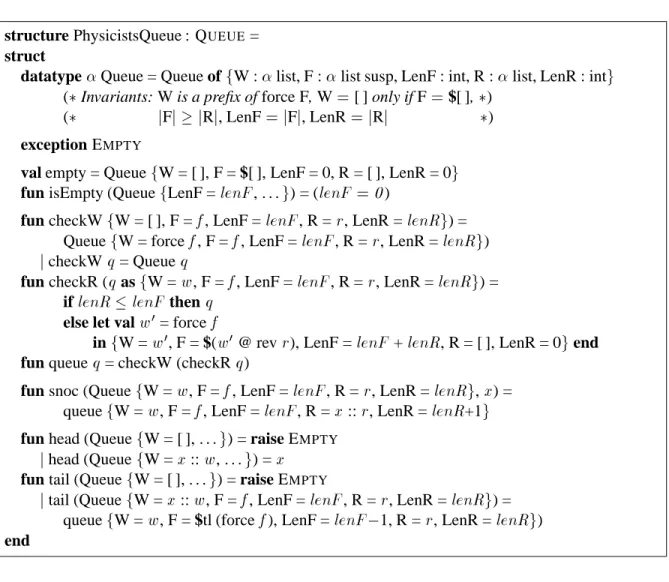
3.5 The Physicist’s Method . . . 28
3.5.1 Example: Queues . . . 30
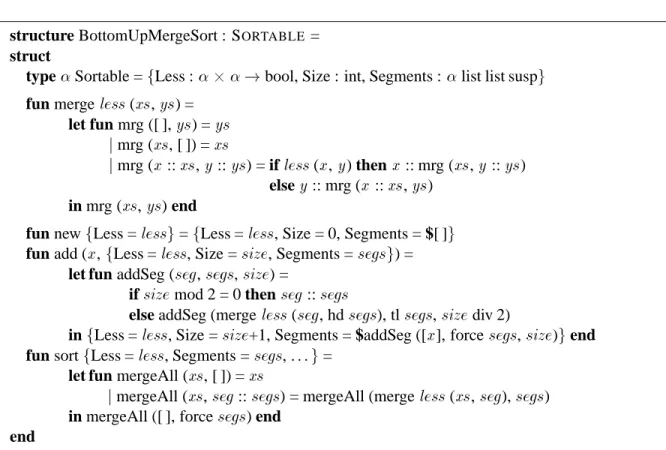
3.5.2 Example: Bottom-Up Mergesort with Sharing . . . 32
3.6 Related Work . . . 37
4 Eliminating Amortization 39 4.1 Scheduling . . . 40
4.2 Real-Time Queues . . . 41
4.3 Bottom-Up Mergesort with Sharing . . . 44
4.4 Related Work . . . 48
5 Lazy Rebuilding 49 5.1 Batched Rebuilding . . . 49
5.2 Global Rebuilding . . . 51
5.3 Lazy Rebuilding . . . 51
5.4 Double-Ended Queues . . . 52
5.4.1 Output-restricted Deques . . . 53
5.4.2 Banker’s Deques . . . 54
5.4.3 Real-Time Deques . . . 57
5.5 Related Work . . . 58
6 Numerical Representations 61 6.1 Positional Number Systems . . . 62
6.2 Binary Representations . . . 64
6.2.1 Binary Random-Access Lists . . . 66
6.2.2 Binomial Heaps . . . 68
6.3 Segmented Binary Numbers . . . 72
6.4 Skew Binary Numbers . . . 76
6.4.1 Skew Binary Random-Access Lists . . . 77
6.4.2 Skew Binomial Heaps . . . 80
6.5 Discussion . . . 82
6.6 Related Work . . . 82
7 Data-Structural Bootstrapping 85 7.1 Structural Decomposition . . . 86
7.1.1 Non-Uniform Recursion and Standard ML . . . 86
7.1.2 Queues Revisited . . . 87
7.2 Structural Abstraction . . . 91
7.2.1 Lists With Efficient Catenation . . . 93
7.2.2 Heaps With Efficient Merging . . . 99
7.3 Related Work . . . 101
8 Implicit Recursive Slowdown 105 8.1 Recursive Slowdown . . . 105
8.2 Implicit Recursive Slowdown . . . 107
8.3 Supporting a Decrement Function . . . 110
8.4 Queues and Deques . . . 112
8.5 Catenable Double-Ended Queues . . . 115
8.6 Related Work . . . 124
9 Conclusions 127 9.1 Functional Programming . . . 127
9.2 Persistent Data Structures . . . 128
9.3 Programming Language Design . . . 128
9.4 Open Problems . . . 130
A The Definition of Lazy Evaluation in Standard ML 131 A.1 Syntax . . . 131
A.2 Static Semantics . . . 132
A.3 Dynamic Semantics . . . 133
Bibliography 137
Introduction
Efficient data structures have been studied extensively for over thirty years, resulting in a vast literature from which the knowledgeable programmer can extract efficient solutions to a stun-ning variety of problems. Much of this literature purports to be language-independent, but unfortunately it is language-independent only in the sense of Henry Ford: Programmers can use any language they want, as long as it’s imperative.1 Only a small fraction of existing data structures are suitable for implementation in functional languages, such as Standard ML or Haskell. This thesis addresses this imbalance by specifically considering the design and analysis of functional data structures.
1.1
Functional vs. Imperative Data Structures
The methodological benefits of functional languages are well known [Bac78, Hug89, HJ94], but still the vast majority of programs are written in imperative languages such as C. This apparent contradiction is easily explained by the fact that functional languages have historically been slower than their more traditional cousins, but this gap is narrowing. Impressive advances have been made across a wide front, from basic compiler technology to sophisticated analyses and optimizations. However, there is one aspect of functional programming that no amount of cleverness on the part of the compiler writer is likely to mitigate — the use of inferior or inappropriate data structures. Unfortunately, the existing literature has relatively little advice to offer on this subject.
Why should functional data structures be any more difficult to design and implement than imperative ones? There are two basic problems. First, from the point of view of designing and implementing efficient data structures, functional programming’s stricture against destructive
1Henry Ford once said of the available colors for his Model T automobile, “[Customers] can have any color
updates (assignments) is a staggering handicap, tantamount to confiscating a master chef’s knives. Like knives, destructive updates can be dangerous when misused, but tremendously effective when used properly. Imperative data structures often rely on assignments in crucial ways, and so different solutions must be found for functional programs.
The second difficulty is that functional data structures are expected to be more flexible than their imperative counterparts. In particular, when we update an imperative data structure we typically accept that the old version of the data structure will no longer be available, but, when we update a functional data structure, we expect that both the old and new versions of the data structure will be available for further processing. A data structure that supports multiple versions is called persistent while a data structure that allows only a single version at a time is called ephemeral [DSST89]. Functional programming languages have the curious property that all data structures are automatically persistent. Imperative data structures are typically ephemeral, but when a persistent data structure is required, imperative programmers are not surprised if the persistent data structure is more complicated and perhaps even asymptotically less efficient than an equivalent ephemeral data structure.
Furthermore, theoreticians have established lower bounds suggesting that functional pro-gramming languages may be fundamentally less efficient than imperative languages in some situations [BAG92, Pip96]. In spite of all these points, this thesis shows that it is often possible to devise functional data structures that are asymptotically as efficient as the best imperative solutions.
1.2
Strict vs. Lazy Evaluation
Most (sequential) functional programming languages can be classified as either strict or lazy, according to their order of evaluation. Which is superior is a topic debated with religious fervor by functional programmers. The difference between the two evaluation orders is most apparent in their treatment of arguments to functions. In strict languages, the arguments to a function are evaluated before the body of the function. In lazy languages, arguments are evaluated in a demand-driven fashion; they are initially passed in unevaluated form and are evaluated only when (and if!) the computation needs the results to continue. Furthermore, once a given argument is evaluated, the value of that argument is cached so that if it is ever needed again, it can be looked up rather than recomputed. This caching is known as memoization [Mic68].
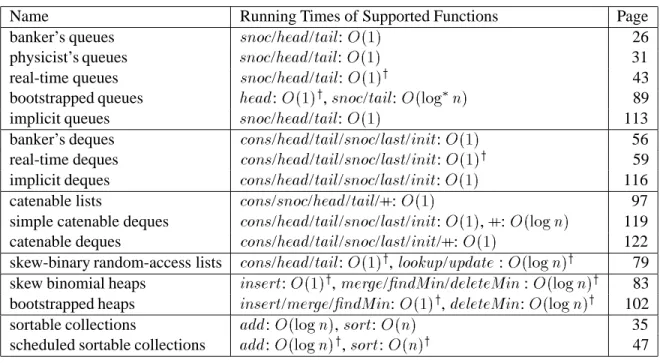
Name Running Times of Supported Functions Page
banker’s queues
snoc
/head
/tail
:O (1) 26physicist’s queues
snoc
/head
/tail
:O (1) 31real-time queues
snoc
/head
/tail
:O (1) y43 bootstrapped queues
head
:O (1)y
,
snoc
/tail
:O (logn) 89
implicit queues
snoc
/head
/tail
:O (1) 113banker’s deques
cons
/head
/tail
/snoc
/last
/init
:O (1) 56 real-time dequescons
/head
/tail
/snoc
/last
/init
:O (1)y
59 implicit deques
cons
/head
/tail
/snoc
/last
/init
:O (1) 116 catenable listscons
/snoc
/head
/tail
/++:O (1) 97 simple catenable dequescons
/head
/tail
/snoc
/last
/init
:O (1), ++:O (logn) 119 catenable dequescons
/head
/tail
/snoc
/last
/init
/++:O (1) 122 skew-binary random-access listscons
/head
/tail
:O (1)y
,
lookup
/update
:O (logn) y79 skew binomial heaps
insert
:O (1)y
,
merge
/ndMin
/deleteMin
:O (logn) y83 bootstrapped heaps
insert
/merge
/ndMin
:O (1)y
,
deleteMin
:O (logn) y102 sortable collections
add
:O (logn),sort
:O (n) 35 scheduled sortable collectionsadd
:O (logn)y
,
sort
:O (n) y47 Worst-case running times marked withy. All other running times are amortized.
Table 1.1: Summary of Implementations
are often reduced to pretending the language is actually strict to make even gross estimates of running time!
Both evaluation orders have implications for the design and analysis of data structures. As we will see in Chapters 3 and 4, strict languages can describe worst-case data structures, but not amortized ones, and lazy languages can describe amortized data structures, but not worst-case ones. To be able to describe both kinds of data structures, we need a programming language that supports both evaluation orders. Fortunately, combining strict and lazy evaluation in a single language is not difficult. Chapter 2 describes $-notation — a convenient way of adding lazy evaluation to an otherwise strict language (in this case, Standard ML).
1.3
Contributions
This thesis makes contributions in three major areas:
Functional programming. Besides developing a suite of efficient data structures that
designing and analyzing functional data structures, including powerful new techniques for reasoning about the running time of lazy programs.
Persistent data structures. Until this research, it was widely believed that amortization
was incompatible with persistence [DST94, Ram92]. However, we show that memoiza-tion, in the form of lazy evaluamemoiza-tion, is the key to reconciling the two. Furthermore, as noted by Kaplan and Tarjan [KT96b], functional programming is a convenient medium for developing new persistent data structures, even when the data structure will eventu-ally be implemented in an imperative language. The data structures and techniques in this thesis can easily be adapted to imperative languages for those situations when an imperative programmer needs a persistent data structure.
Programming language design. Functional programmers have long debated the relative
merits of strict and lazy evaluation. This thesis shows that both are algorithmically im-portant and suggests that the ideal functional language should seamlessly integrate both. As a modest step in this direction, we propose $-notation, which allows the use of lazy evaluation in a strict language with a minimum of syntactic overhead.
1.4
Source Language
All source code will be presented in Standard ML [MTH90], extended with primitives for lazy evaluation. However, the algorithms can all easily be translated into any other functional language supporting both strict and lazy evaluation. Programmers in functional languages that are either entirely strict or entirely lazy will be able to use some, but not all, of the data structures in this thesis.
In Chapters 7 and 8, we will encounter several recursive data structures that are difficult to describe cleanly in Standard ML because of the language’s restrictions against certain sophisti-cated and difficult-to-implement forms of recursion, such as polymorphic recursion and recur-sive modules. When this occurs, we will first sacrifice executability for clarity and describe the data structures using ML-like pseudo-code incorporating the desired forms of recursion. Then, we will show how to convert the given implementations to legal Standard ML. These examples should be regarded as challenges to the language design community to provide a programming language capable of economically describing the appropriate abstractions.
1.5
Terminology
An abstract data type (that is, a type and a collection of functions on that type). We will
refer to this as an abstraction.
A concrete realization of an abstract data type. We will refer to this as an
implementa-tion, but note that an implementation need not be actualized as code — a concrete design is sufficient.
An instance of a data type, such as a particular list or tree. We will refer to such an
instance generically as an object or a version. However, particular data types typically have their own nomenclature. For example, we will refer to stack or queue objects simply as stacks or queues.
A unique identity that is invariant under updates. For example, in a stack-based
in-terpreter, we often speak informally about “the stack” as if there were only one stack, rather than different versions at different times. We will refer to this identity as a persis-tent identity. This issue mainly arises in the context of persispersis-tent data structures; when we speak of different versions of the same data structure, we mean that the different versions share a common persistent identity.
Roughly speaking, abstractions correspond to signatures in Standard ML, implementations to structures or functors, and objects or versions to values. There is no good analogue for persistent identities in Standard ML.2
The term operation is similarly overloaded, meaning both the functions supplied by an abstract data type and applications of those functions. We reserve the term operation for the latter meaning, and use the terms operator or function for the former.
1.6
Overview
This thesis is structured in two parts. The first part (Chapters 2–4) concerns algorithmic aspects of lazy evaluation. Chapter 2 sets the stage by briefly reviewing the basic concepts of lazy evaluation and introducing $-notation.
Chapter 3 is the foundation upon which the rest of the thesis is built. It describes the mediating role lazy evaluation plays in combining amortization and persistence, and gives two methods for analyzing the amortized cost of data structures implemented with lazy evaluation. Chapter 4 illustrates the power of combining strict and lazy evaluation in a single language. It describes how one can often derive a worst-case data structure from an amortized data struc-ture by systematically scheduling the premastruc-ture execution of lazy components.
2The persistent identity of an ephemeral data structure can be reified as a reference cell, but this is insufficient
The second part of the thesis (Chapters 5–8) concerns the design of functional data struc-tures. Rather than cataloguing efficient data structures for every purpose (a hopeless task!), we instead concentrate on a handful of general techniques for designing efficient functional data structures and illustrate each technique with one or more implementations of fundamental ab-stractions such as priority queues, random-access structures, and various flavors of sequences. Chapter 5 describes lazy rebuilding, a lazy variant of global rebuilding [Ove83]. Lazy re-building is significantly simpler than global rere-building, but yields amortized rather than worst-case bounds. By combining lazy rebuilding with the scheduling techniques of Chapter 4, the worst-case bounds can be recovered.
Chapter 6 explores numerical representations, implementations designed in analogy to rep-resentations of numbers (typically binary numbers). In this model, designing efficient insertion and deletion routines corresponds to choosing variants of binary numbers in which adding or subtracting one take constant time.
Chapter 7 examines data-structural bootstrapping [Buc93]. Data-structural bootstrapping comes in two flavors: structural decomposition, in which unbounded solutions are bootstrapped from bounded solutions, and structural abstraction, in which efficient solutions are boot-strapped from inefficient solutions.
Chapter 8 describes implicit recursive slowdown, a lazy variant of the recursive-slowdown technique of Kaplan and Tarjan [KT95]. As with lazy rebuilding, implicit recursive slowdown is significantly simpler than recursive slowdown, but yields amortized rather than worst-case bounds. Again, we can recover the worst-case bounds using scheduling.
Lazy Evaluation and $-Notation
Lazy evaluation is an evaluation strategy employed by many purely functional programming languages, such as Haskell [H+
92]. This strategy has two essential properties. First, the evalu-ation of a given expression is delayed, or suspended, until its result is needed. Second, the first time a suspended expression is evaluated, the result is memoized (i.e., cached) so that the next time it is needed, it can be looked up rather than recomputed.
Supporting lazy evaluation in a strict language such as Standard ML requires two primi-tives: one to suspend the evaluation of an expression and one to resume the evaluation of a suspended expression (and memoize the result). These primitives are often called
delay
andforce
. For example, Standard ML of New Jersey offers the following primitives for lazy eval-uation:type
suspval delay : (unit!
)!suspval force :
susp!These primitives are sufficient to encode all the algorithms in this thesis. However, program-ming with these primitives can be rather inconvenient. For instance, to suspend the evaluation of some expression
e
, one writesdelay
(fn
())e
). Depending on the use of whitespace, thisintroduces an overhead of 13–17 characters! Although acceptable when only a few expressions are to be suspended, this overhead quickly becomes intolerable when many expressions must be delayed.
If
s
is a suspension of typesusp
, thenforce
s
evaluates and memoizes the contents ofs
and returns the resulting value of type. However, explicitly forcing a suspension with aforce
operation can also be inconvenient. In particular, it often interacts poorly with pattern matching, requiring a singlecase
expression to be broken into two or more nestedcase
ex-pressions, interspersed withforce
operations. To avoid this problem, we integrate $-notation with pattern matching. Matching a suspension against a pattern of the form $p
first forces the suspension and then matches the result againstp
. At times, an explicitforce
operator is still useful. However, it can now be defined in terms of $ patterns.fun force ($
x
) =x
To compare the two notations, consider the standard
take
function, which extracts the firstn
elements of a stream. Streams are defined as follows:datatype
StreamCell = NiljCons ofStreamwithtype
Stream =StreamCell susp Usingdelay
andforce
,take
would be writtenfun take (
n
,s
) =delay (fn ())case
n
of0)Nil
j )case force
s
ofNil)Nil jCons (
x
,s
0))Cons (
x
, take (n
;1,s
0))) In contrast, using $-notation,
take
can be written more concisely asfun take (
n
,s
) = $case (n
,s
) of (0, ))Nil j( , $Nil))Nil j( , $Cons (x
,s
0
)))Cons (
x
, take (n
;1,s
0)) In fact, it is tempting to write
take
even more concisely asfun take (0, ) = $Nil
jtake ( , $Nil) = $Nil
jtake (
n
, $Cons (x
,s
)) = $Cons (x
, take (n
;1,s
))However, this third implementation is not equivalent to the first two. In particular, it forces its second argument when
take
is applied, rather than when the resulting stream is forced.2.1
Streams
As an extended example of lazy evaluation and $-notation in Standard ML, we next develop a small streams package. These streams will also be used by several of the data structures in subsequent chapters.
Streams (also known as lazy lists) are very similar to ordinary lists, except that every cell is systematically suspended. The type of streams is
datatype
StreamCell = NiljCons ofStreamwithtype
Stream =StreamCell suspA simple stream containing the elements 1, 2, and 3 could be written $Cons (1, $Cons (2, $Cons (3, $Nil)))
It is illuminating to contrast streams with simple suspended lists of type
list susp
. The computations represented by the latter type are inherently monolithic — once begun by forcing the suspended list, they run to completion. The computations represented by streams, on the other hand, are often incremental — forcing a stream executes only enough of the computation to produce the outermost cell and suspends the rest. This behavior is common among datatypes such as streams that contain nested suspensions.To see this difference in behavior more clearly, consider the append function, written
s
++t
. On suspended lists, this function might be written funs
++t
= $(forces
@ forcet
)Once begun, this function forces both its arguments and then appends the two lists, producing the entire result. Hence, this function is monolithic. On streams, the append function is written
fun
s
++t
= $cases
of$Nil)force
t
j$Cons (x
,s
0
))Cons (
x
,s
0++
t
)Once begun, this function forces the first cell of
s
(by matching against a $ pattern). If this cell isNil
, then the first cell of the result is the first cell oft
, so the function forcest
. Otherwise, the function constructs the first cell of the result from the first element ofs
and — this is the key point — the suspension that will eventually calculate the rest of the appended list. Hence, this function is incremental. Thetake
function described earlier is similarly incremental.However, consider the function to drop the first
n
elements of a stream. fun drop (n
,s
) = let fun drop0(0,
s
0) = force
s
0 jdrop0
jdrop 0
(
n
, $Cons (x
,s
0)) = drop0
(
n
;1,s
0) in $drop0
(
n
,s
) endThis function is monolithic because the recursive calls to
drop
0are never delayed — calcu-lating the first cell of the result requires executing the entire drop function. Another common monolithic stream function is
reverse
.fun reverse
s
= let fun reverse0($Nil,
r
) =r
jreverse 0
($Cons (
x
,s
),r
) = reverse0(
s
, Cons (x
, $r
)) in $reverse0(
s
, Nil) end Here the recursive calls toreverse
0are never delayed, but note that each recursive call creates a new suspension of the form $
r
. It might seem then thatreverse
does not in fact do all of its work at once. However, suspensions such as these, whose bodies are manifestly values (i.e., composed entirely of constructors and variables, with no function applications), are called trivial. A good compiler would create these suspensions in already-memoized form, but even if the compiler does not perform this optimization, trivial suspensions always evaluate inO(1)
time.Although monolithic stream functions such as
drop
andreverse
are common, incremental functions such as ++ andtake
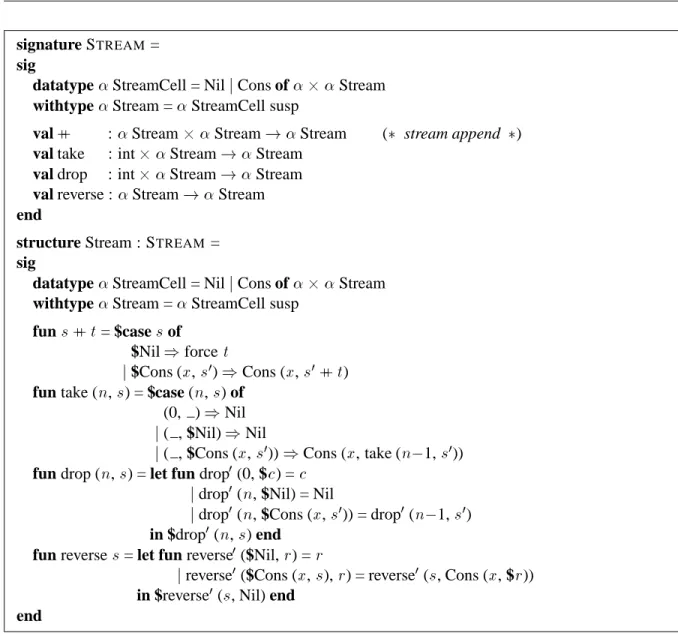
are the raison d’ˆetre of streams. Each suspension carries a small but significant overhead, so for maximum efficiency laziness should be used only when there is a good reason to do so. If the only uses of lazy lists in a given application are monolithic, then that application should use simple suspended lists rather than streams.Figure 2.1 summarizes these stream functions as a Standard ML module. Note that the type of streams is defined using Standard ML’s
withtype
construction, but that older versions of Standard ML do not allowwithtype
declarations in signatures. This feature will be sup-ported in future versions of Standard ML, but if your compiler does not allow it, then a sim-ple workaround is to delete theStream
type and replace every occurrence ofStream
withStreamCell susp
. By including theStreamCell
datatype in the signature, we have delib-erately chosen to expose the internal representation in order to support pattern matching on streams.2.2
Historical Notes
Lazy Evaluation Wadsworth [Wad71] first proposed lazy evaluation as an optimization of normal-order reduction in the lambda calculus. Vuillemin [Vui74] later showed that, under certain restricted conditions, lazy evaluation is an optimal evaluation strategy. The formal semantics of lazy evaluation has been studied extensively [Jos89, Lau93, OLT94, AFM+
signature STREAM=
sig
datatypeStreamCell = NiljCons ofStream
withtypeStream =StreamCell susp
val ++ :StreamStream!Stream ( stream append )
val take : intStream!Stream
val drop : intStream!Stream
val reverse : Stream!Stream
end
structure Stream : STREAM=
sig
datatypeStreamCell = NiljCons ofStream
withtypeStream =StreamCell susp
fun
s
++t
= $cases
of $Nil)forcet
j$Cons (x
,s
0
))Cons (
x
,s
0++
t
)fun take (
n
,s
) = $case (n
,s
) of (0, ))Nil j( , $Nil))Nil j( , $Cons (x
,s
0
)))Cons (
x
, take (n
;1,s
0))
fun drop (
n
,s
) = let fun drop0(0, $
c
) =c
jdrop0
(
n
, $Nil) = Nil jdrop0
(
n
, $Cons (x
,s
0)) = drop0
(
n
;1,s
0)
in $drop0
(
n
,s
) endfun reverse
s
= let fun reverse0($Nil,
r
) =r
jreverse0
($Cons (
x
,s
),r
) = reverse0(
s
, Cons (x
, $r
))in $reverse0
(
s
, Nil) endend
Figure 2.1: A small streams package.
Streams Landin introduced streams in [Lan65], but without memoization. Friedman and Wise [FW76] and Henderson and Morris [HM76] extended Landin’s streams with memoiza-tion.
memoization, in the original sense of Michie, to functional programs.
Algorithmics Both components of lazy evaluation — delaying computations and memoizing the results — have a long history in algorithm design, although not always in combination. The idea of delaying the execution of potentially expensive computations (often deletions) is used to good effect in hash tables [WV86], priority queues [ST86b, FT87], and search trees [DSST89]. Memoization, on the other hand, is the basic principle of such techniques as dynamic program-ming [Bel57] and path compression [HU73, TvL84].
Syntax for Lazy Evaluation Early versions of CAML [W+
Amortization and Persistence via Lazy
Evaluation
Over the past fifteen years, amortization has become a powerful tool in the design and analysis of data structures. Implementations with good amortized bounds are often simpler and faster than implementations with equivalent worst-case bounds. Unfortunately, standard techniques for amortization apply only to ephemeral data structures, and so are unsuitable for designing or analyzing functional data structures, which are automatically persistent.
In this chapter, we review the two traditional techniques for analyzing amortized data struc-tures — the banker’s method and the physicist’s method — and show where they break down for persistent data structures. Then, we demonstrate how lazy evaluation can mediate the con-flict between amortization and persistence. Finally, we adapt the banker’s and physicist’s meth-ods to analyze lazy amortized data structures.
The resulting techniques are both the first techniques for designing and analyzing persis-tent amortized data structures and the first practical techniques for analyzing non-trivial lazy programs.
3.1
Traditional Amortization
up a wide design space of possible solutions, and often yields new solutions that are simpler and faster than worst-case solutions with equivalent bounds. In fact, for some problems, such as the union-find problem [TvL84], there are amortized solutions that are asymptotically faster than any possible worst-case solution (assuming certain modest restrictions) [Blu86].
To prove an amortized bound, one defines the amortized cost of each operation and then proves that, for any sequence of operations, the total amortized cost of the operations is an upper bound on the total actual cost, i.e.,
m
X
i=1
a
im
X
i=1
t
iwhere
a
i is the amortized cost of operationi
,t
i is the actual cost of operationi
, andm
is the total number of operations. Usually, in fact, one proves a slightly stronger result: that at any intermediate stage in a sequence of operations, the accumulated amortized cost is an upper bound on the accumulated actual cost, i.e.,j
X
i=1
a
ij
X
i=1
t
ifor any
j
. The difference between the accumulated amortized costs and the accumulated actual costs is called the accumulated savings. Thus, the accumulated amortized costs are an upper bound on the accumulated actual costs whenever the accumulated savings is non-negative.Amortization allows for occasional operations to have actual costs that exceed their amor-tized costs. Such operations are called expensive. Operations whose actual costs are less than their amortized costs are called cheap. Expensive operations decrease the accumulated savings and cheap operations increase it. The key to proving amortized bounds is to show that expen-sive operations occur only when the accumulated savings are sufficient to cover the cost, since otherwise the accumulated savings would become negative.
Tarjan [Tar85] describes two techniques for analyzing ephemeral amortized data structures: the banker’s method and the physicist’s method. In the banker’s method, the accumulated sav-ings are represented as credits that are associated with individual locations in the data structure. These credits are used to pay for future accesses to these locations. The amortized cost of any operation is defined to be the actual cost of the operation plus the credits allocated by the operation minus the credits spent by the operation, i.e.,
a
i=
t
i+
c
i;c
iwhere
c
i is the number of credits allocated by operationi
, andc
i is the number of credits spent by operationi
. Every credit must be allocated before it is spent, and no credit may be spent more than once. Therefore, Pc
i Pc
i, which in turn guarantees thatPa
i Pt
i,the distribution of credits in such a way that, whenever an expensive operation might occur, sufficient credits have been allocated in the right locations to cover its cost.
In the physicist’s method, one describes a function
that maps each objectd
to a real number called the potential ofd
. The function is typically chosen so that the potential is initially zero and is always non-negative. Then, the potential represents a lower bound on the accumulated savings.Let
d
i be the output of operationi
and the input of operationi+1
. Then, the amortized cost of operationi
is defined to be the actual cost plus the change in potential betweend
i;1andd
i,i.e.,
a
i=
t
i+ (d
i)
;(d
i ;1)
The accumulated actual costs of the sequence of operations are
Pj
i=1
t
i=
Pji=1
(a
i+ (d
i ;1)
;
(d
i))
=
Pji=1
a
i+
Pji=1
((d
i ;1)
;
(d
i))
=
Pji=1
a
i+ (d
0)
;
(d
j)
Sums such asP
((d
i;1)
;
(d
i))
, where alternating positive and negative terms cancel eachother out, are called telescoping series. Provided
is chosen in such a way that(d
0)
is zeroand
(d
j)
is non-negative, then(d
j)
(d
0)
andP
a
i Pt
i, so the accumulated amortizedcosts are an upper bound on the accumulated actual costs, as desired.
Remark: This is a somewhat simplified view of the physicist’s method. In real analyses, one often encounters situations that are difficult to fit into the framework as described. For example, what about functions that take or return more than one object? However, this simplified view
suffices to illustrate the relevant issues. 3
Clearly, the two methods are very similar. We can convert the banker’s method to the physi-cist’s method by ignoring locations and taking the potential to be the total number of credits in the object, as indicated by the credit invariant. Similarly, we can convert the physicist’s method to the banker’s method by converting potential to credits, and placing all credits on the root. It is perhaps surprising that the knowledge of locations in the banker’s method offers no extra power, but the two methods are in fact equivalent [Tar85, Sch92]. The physicist’s method is usually simpler, but it is occasionally convenient to take locations into account.
Note that both credits and potential are analysis tools only; neither actually appears in the program text (except maybe in comments).
3.1.1
Example: Queues
signature QUEUE=
sig
typeQueue
exception EMPTY
val empty :Queue
val isEmpty :Queue!bool
val snoc :Queue!Queue
val head :Queue! (raises EMPTYif queue is empty)
val tail :Queue!Queue (raises EMPTYif queue is empty)
end
Figure 3.1: Signature for queues.
(Etymological note:
snoc
iscons
spelled backward and means “cons on the right”.)A common representation for purely functional queues [Gri81, HM81, Bur82] is as a pair of lists,
F
andR
, whereF
contains the front elements of the queue in the correct order andR
contains the rear elements of the queue in reverse order. For example, a queue containing the integers 1. . . 6 might be represented by the listsF
= [1,2,3] andR
= [6,5,4]. This representation is described by the following datatype:datatype
Queue = Queue offF :list, R :listgIn this representation, the head of the queue is the first element of
F
, sohead
andtail
return and remove this element, respectively.fun head (QueuefF =
x
::f
, R =r
g) =x
fun tail (QueuefF =
x
::f
, R =r
g) = QueuefF =f
, R =r
gRemark: To avoid distracting the reader with minor details, we will commonly ignore error cases when presenting code fragments. For example, the above code fragments do not describe the behavior of
head
ortail
on empty queues. We will always include the error cases whenpresenting complete implementations. 3
Now, the last element of the queue is the first element of
R
, sosnoc
simply adds a new element at the head ofR
.Elements are added to
R
and removed fromF
, so they must somehow migrate from one list to the other. This is accomplished by reversingR
and installing the result as the newF
wheneverF
would otherwise become empty, simultaneously setting the newR
to [ ]. The goal is to maintain the invariant thatF
is empty only ifR
is also empty (i.e., the entire queue is empty). Note that ifF
were empty whenR
was not, then the first element of the queue would be the last element ofR
, which would takeO(n)
time to access. By maintaining this invariant, we guarantee thathead
can always find the first element inO(1)
time.snoc
andtail
must now detect those cases that would otherwise result in a violation of the invariant, and change their behavior accordingly.fun snoc (QueuefF = [ ], . . .g,
x
) = QueuefF = [x
], R = [ ]g jsnoc (QueuefF =f
, R =r
g,x
) = QueuefF =f
, R =x
::r
gfun tail (QueuefF = [
x
], R =r
g) = QueuefF = revr
, R = [ ]g jtail (QueuefF =x
::f
, R =r
g) = QueuefF =f
, R =r
gNote the use of the record wildcard (. . . ) in the first clause of
snoc
. This is Standard ML pattern-matching notation meaning “the remaining fields of this record are irrelevant”. In this case, theR
field is irrelevant because we know by the invariant that ifF
is [ ], then so isR
.A cleaner way to write these functions is to consolidate the invariant-maintenance duties of
snoc
andtail
into a single pseudo-constructor. Pseudo-constructors, sometimes called smart constructors [Ada93], are functions that replace ordinary constructors in the construction of data, but that check and enforce an invariant. In this case, the pseudo-constructorqueue
re-places the ordinary constructorQueue
, but guarantees thatF
is empty only ifR
is also empty.fun queuefF = [ ], R =
r
g= QueuefF = revr
, R = [ ]g jqueuefF =f
, R =r
g= QueuefF =f
, R =r
gfun snoc (QueuefF =
f
, R =r
g,x
) = queuefF =f
, R =x
::r
gfun tail (QueuefF =
x
::f
, R =r
g) = queuefF =f
, R =r
gThe complete code for this implementation is shown in Figure 3.2. Every function except
tail
takesO(1)
worst-case time, buttail
takesO(n)
worst-case time. However, we can show thatsnoc
andtail
each take onlyO(1)
amortized time using either the banker’s method or the physicist’s method.structure BatchedQueue : QUEUE=
struct
datatypeQueue = Queue offF :list, R :listg (Invariant: F is empty only if R is also empty)
exception EMPTY
val empty = QueuefF = [ ], R = [ ]g
fun isEmpty (QueuefF =
f
, R =r
g) = nullf
fun queuefF = [ ], R =
r
) = QueuefF = revr
, R = [ ]g jqueueq
= Queueq
fun snoc (QueuefF =
f
, R =r
),x
) = queuefF =f
, R =x
::r
gfun head (QueuefF = [ ], . . .g) = raise EMPTY jhead (QueuefF =
x
::f
, . . .g) =x
fun tail (QueuefF = [ ], . . .g) = raise EMPTY
jtail (QueuefF =
x
::f
, R =r
g) = queuefF =f
, R =r
gend
Figure 3.2: A common implementation of purely functional queues [Gri81, HM81, Bur82].
Using the physicist’s method, we define the potential function
to be the length of the rear list. Then everysnoc
into a non-empty queue takes one actual step and increases the potential by one, for an amortized cost of two. Everytail
that does not reverse the rear list takes one actual step and leaves the potential unchanged, for an amortized cost of one. Finally, everytail
that does reverse the rear list takesm+1
actual steps and sets the new rear list to [ ], decreasing the potential bym
, for an amortized cost ofm + 1
;m = 1
.3.2
Persistence: The Problem of Multiple Futures
In the above analyses, we implicitly assumed that queues were used ephemerally (i.e., in a single-threaded fashion). What happens if we try to use these queues persistently?
Let
q
be the result of insertingn
elements into an initially empty queue, so that the front list ofq
contains a single element and the rear list containsn
;1
elements. Now, supposewe use
q
persistently by taking its tailn
times. Each call oftail q
takesn
actual steps. The total actual cost of this sequence of operations, including the time to buildq
, isn
2+
n
. If the operations truly took
O(1)
amortized time each, then the total actual cost would be onlyO(n)
. Clearly, using these queues persistently invalidates theO(1)
amortized time bounds proved above. Where do these proofs go wrong?In both cases, a fundamental requirement of the analysis is violated by persistent data struc-tures. The banker’s method requires that no credit be spent more than once, while the physi-cist’s method requires that the output of one operation be the input of the next operation (or, more generally, that no output be used as input more than once). Now, consider the second call to
tail q
in the example above. The first call totail q
spends all the credits on the rear list ofq
, leaving none to pay for the second and subsequent calls, so the banker’s method breaks. And the second call totail q
reusesq
rather than the output of the first call, so the physicist’s method breaks.Both these failures reflect the inherent weakness of any accounting system based on ac-cumulated savings — that savings can only be spent once. The traditional methods of amor-tization operate by accumulating savings (as either credits or potential) for future use. This works well in an ephemeral setting, where every operation has only a single logical future. But with persistence, an operation might have multiple logical futures, each competing to spend the same savings.
3.2.1
Execution Traces and Logical Time
What exactly do we mean by the “logical future” of an operation?
We model logical time with execution traces, which give an abstract view of the history of a computation. An execution trace is a directed graph whose nodes represent “interesting” operations, usually just update operations on the data type in question. An edge from
v
tov
0indicates that operation
v
0futures. We will sometimes refer to the logical history or logical future of an object, meaning the logical history or logical future of the operation that created the object.
Execution traces generalize the notion of version graphs [DSST89], which are often used to model the histories of persistent data structures. In a version graph, nodes represent the various versions of a single persistent identity and edges represent dependencies between versions. Thus, version graphs model the results of operations and execution traces model the operations themselves. Execution traces are often more convenient for combining the histories of several persistent identities (perhaps not even of the same data type) or for reasoning about operations that do not return a new version (e.g., queries) or that return several results (e.g., splitting a list into two sublists).
For ephemeral data structures, the out-degree of every node in a version graph or execu-tion trace is typically restricted to be at most one, reflecting the limitaexecu-tion that objects can be updated at most once. To model various flavors of persistence, version graphs allow the out-degree of every node to be unbounded, but make other restrictions. For instance, version graphs are often limited to be trees (forests) by restricting the in-degree of every node to be at most one. Other version graphs allow in-degrees of greater than one, but forbid cycles, making every graph a dag. We make none of these restrictions on execution traces. Nodes with in-degree greater than one correspond to operations that take more than one argument, such as list catenation or set union. Cycles arise from recursively defined objects, which are supported by many lazy languages. We even allow multiple edges between a single pair of nodes, as might occur if a list is catenated with itself.
We will use execution traces in Section 3.4.1 when we extend the banker’s method to cope with persistence.
3.3
Reconciling Amortization and Persistence
In the previous section, we saw that traditional methods of amortization break in the presence of persistence because they assume a unique future, in which the accumulated savings will be spent at most once. However, with persistence, multiple logical futures might all try to spend the same savings. In this section, we show how the banker’s and physicist’s methods can be repaired by replacing the notion of accumulated savings with accumulated debt, where debt measures the cost of unevaluated lazy computations. The intuition is that, although savings can only be spent once, it does no harm to pay off debt more than once.
3.3.1
The Role of Lazy Evaluation
malicious adversary might call
f x
arbitrarily often. (Note that each operation is a new logi-cal future ofx
.) If each operation takes the same amount of time, then the amortized bounds degrade to the worst-case bounds. Hence, we must find a way to guarantee that if the first application off
tox
is expensive, then subsequent applications off
tox
will not be.Without side-effects, this is impossible under by-value (i.e., strict evaluation) or call-by-name (i.e., lazy evaluation without memoization), because every application of
f
tox
will take exactly the same amount of time. Therefore, amortization cannot be usefully combined with persistence in languages supporting only these evaluation orders.But now consider call-by-need (i.e., lazy evaluation with memoization). If
x
contains some suspended component that is needed byf
, then the first application off
tox
will force the (potentially expensive) evaluation of that component and memoize the result. Subsequent op-erations may then access the memoized result directly. This is exactly the desired behavior! Remark: In retrospect, the relationship between lazy evaluation and amortization is not surprising. Lazy evaluation can be viewed as a form of self-modification, and amortization often involves self-modification [ST85, ST86b]. However, lazy evaluation is a particularly disciplined form of self-modification — not all forms of self-modification typically used in amortized ephemeral data structures can be encoded as lazy evaluation. In particular, splay-ing [ST85] does not appear to be amenable to this technique. 33.3.2
A Framework for Analyzing Lazy Data Structures
We have just shown that lazy evaluation is necessary to implement amortized data structures purely functionally. Unfortunately, analyzing the running times of programs involving lazy evaluation is notoriously difficult. Historically, the most common technique for analyzing lazy programs has been to pretend that they are actually strict. However, this technique is completely inadequate for analyzing lazy amortized data structures. We next describe a basic framework to support such analyses. In the remainder of this chapter, we will adapt the banker’s and physicist’s methods to this framework, yielding both the first techniques for analyzing persistent amortized data structures and the first practical techniques for analyzing non-trivial lazy programs.
the sum of its shared and unshared costs. Note that the complete cost is what the actual cost of the operation would be if lazy evaluation were replaced with strict evaluation.
We further partition the total shared costs of a sequence of operations into realized and unrealized costs. Realized costs are the shared costs for suspensions that are executed during the overall computation. Unrealized costs are the shared costs for suspensions that are never executed. The total actual cost of a sequence of operations is the sum of the unshared costs and the realized shared costs — unrealized costs do not contribute to the actual cost. Note that the amount that any particular operation contributes to the total actual cost is at least its unshared cost, and at most its complete cost, depending on how much of its shared cost is realized.
We account for shared costs using the notion of accumulated debt. Initially, the accumu-lated debt is zero, but every time a suspension is created, we increase the accumuaccumu-lated debt by the shared cost of the suspension (and any nested suspensions). Each operation then pays off a portion of the accumulated debt. The amortized cost of an operation is the unshared cost of the operation plus the amount of accumulated debt paid off by the operation. We are not allowed to force a suspension until the debt associated with the suspension is entirely paid off. This treatment of debt is reminiscent of a layaway plan, in which one reserves an item and then makes regular payments, but receives the item only when it is entirely paid off.
There are three important moments in the life cycle of a suspension: when it is created, when it is entirely paid off, and when it is executed. The proof obligation is to show that the second moment precedes the third. If every suspension is paid off before it is forced, then the total amount of debt that has been paid off is an upper bound on the realized shared costs, and therefore the total amortized cost (i.e., the total unshared cost plus the total amount of debt that has been paid off) is an upper bound on the total actual cost (i.e., the total unshared cost plus the realized shared costs). We will formalize this argument in Section 3.4.1.
3.4
The Banker’s Method
We adapt the banker’s method to account for accumulated debt rather than accumulated savings by replacing credits with debits. Each debit represents a constant amount of suspended work. When we initially suspend a given computation, we create a number of debits proportional to its shared cost and associate each debit with a location in the object. The choice of location for each debit depends on the nature of the computation. If the computation is monolithic (i.e., once begun, it runs to completion), then all debits are usually assigned to the root of the result. On the other hand, if the computation is incremental (i.e., decomposable into fragments that may be executed independently), then the debits may be distributed among the roots of the partial results.
The amortized cost of an operation is the unshared cost of the operation plus the number of debits discharged by the operation. Note that the number of debits created by an operation is not included in its amortized cost. The order in which debits should be discharged depends on how the object will be accessed; debits on nodes likely to be accessed soon should be discharged first. To prove an amortized bound, we must show that, whenever we access a location (possibly triggering the execution of a suspension), all debits associated with that location have already been discharged (and hence the suspended computation has been paid for). This guarantees that the total number of debits discharged by a sequence of operations is an upper bound on the realized shared costs of the operations. The total amortized costs are therefore an upper bound on the total actual costs. Debits leftover at the end of the computation correspond to unrealized shared costs, and are irrelevant to the total actual costs.
Incremental functions play an important role in the banker’s method because they allow debits to be dispersed to different locations in a data structure, each corresponding to a nested suspension. Then, each location can be accessed as soon as its debits are discharged, without waiting for the debits at other locations to be discharged. In practice, this means that the initial partial results of an incremental computation can be paid for very quickly, and that subsequent partial results may be paid for as they are needed. Monolithic functions, on the other hand, are much less flexible. The programmer must anticipate when the result of an expensive monolithic computation will be needed, and set up the computation far enough in advance to be able to discharge all its debits by the time its result is needed.
3.4.1
Justifying the Banker’s Method
We can view the banker’s method abstractly as a graph labelling problem, using the execu-tion traces of Secexecu-tion 3.2.1. The problem is to label every node in a trace with three (multi)sets
s(v)
,a(v)
, andr(v)
such that(I)
v
6=
v
0)
s(v)
\s(v
0) =
;
(II)
a(v)
Sw2 ^v
s(w)
(III)
r(v)
Sw2 ^v
a(w)
s(v)
is a set, buta(v)
andr(v)
may be multisets (i.e., may contain duplicates). Conditions II and III ignore duplicates.s(v)
is the set of debits allocated by operationv
. Condition I states that no debit may be allocated more than once.a(v)
is the multiset of debits discharged byv
. Condition II insists that no debit may be discharged before it is created, or more specifically, that an operation can only discharge debits that appear in its logical history. Finally,r(v)
is the multiset of debits realized byv
(that is, the multiset of debits corresponding to the suspensions forced byv
). Condition III requires that no debit may be realized before it is discharged, or more specifically, that no debit may realized unless it has been discharged within the logical history of the current operation.Why are
a(v)
andr(v)
multisets rather than sets? Because a single operation might dis-charge the same debits more than once or realize the same debits more than once (by forcing the same suspensions more than once). Although we never deliberately discharge the same debit more than once, it could happen if we were to combine a single object with itself. For example, suppose in some analysis of a list catenation function, we discharge a few debits from the first argument and a few debits from the second argument. If we then catenate a list with itself, we might discharge the same few debits twice.Given this abstract view of the banker’s method, we can easily measure various costs of a computation. Let
V
be the set of all nodes in the execution trace. Then, the total shared cost isP
v2V
j
s(v)
jand the total number of debits discharged is Pv2V
j
a(v)
j. Because of memoization,the realized shared cost is notP
v2V
j
r(v)
j, but ratherj Sv2V
r(v)
j, where S
discards duplicates. By Condition III, we know thatS
v2V
r(v)
S
v2V
a(v)
. Therefore, jS
v2V
r(v)
jjS
v2V
a(v)
jP
v2V j
a(v)
jSo the realized shared cost is bounded by the total number of debits discharged, and the total actual cost is bounded by the total amortized cost, as desired.
Remark: This argument once again emphasizes the importance of memoization. Without memoization (i.e., if we were using call-by-name rather than call-by-need), the total realized cost would beP
v2V
j
r(v)
j, and there is no reason to expect this sum to be less than Pv2V
3.4.2
Example: Queues
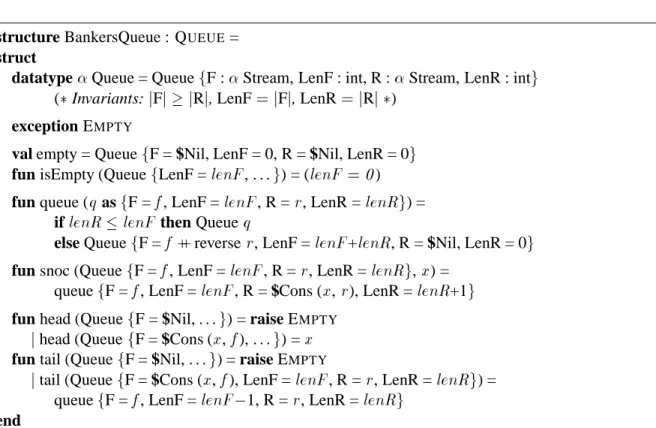
We next develop an efficient persistent implementation of queues, and prove that every opera-tion takes only
O(1)
amortized time using the banker’s method.Based on the discussion in the previous section, we must somehow incorporate lazy eval-uation into the design of the data structure, so we replace the pair of lists in the previous implementation with a pair of streams.1 To simplify later operations, we also explicitly track the lengths of the two streams.
datatype
Queue = QueuefF :Stream, LenF : int, R :Stream, LenR : intgNote that a pleasant side effect of maintaining this length information is that we can trivially support a constant-time
size
function.Now, waiting until the front list becomes empty to reverse the rear list does not leave suf-ficient time to pay for the reverse. Instead, we periodically rotate the queue by moving all the elements of the rear stream to the end of the front stream, replacing
F
withF
++reverse R
and setting the new rear stream to empty ($Nil
). Note that this transformation does not affect the relative ordering of the elements.When should we rotate the queue? Recall that
reverse
is a monolithic function. We must therefore set up the computation far enough in advance to be able to discharge all its debits by the time its result is needed. Thereverse
computation takesjR
jsteps, so we will allocatejR
jdebits to account for its cost. (For now we ignore the cost of the ++ operation). The earliest the
reverse
suspension could be forced is after jF
japplications oftail
, so if we rotate the queuewhenj
R
j jF
jand discharge one debit per operation, then we will have paid for the reverseby the time it is executed. In fact, we will rotate the queue whenever
R
becomes one longer thanF
, thereby maintaining the invariant thatjF
j jR
j. Incidentally, this guarantees thatF
is empty only if
R
is also empty. The major queue functions can now be written as follows: fun snoc (QueuefF =f
, LenF =lenF
, R =r
, LenR =lenR
g,x
) =queuefF =
f
, LenF =lenF
, R = $Cons (x
,r
), LenR =lenR
+1gfun head (QueuefF = $Cons (
x
,f
), . . .g) =x
fun tail (QueuefF = $Cons (
x
,f
), LenF =lenF
, R =r
, LenR =lenR
g) =queuefF =
f
, LenF =lenF
;1, R =r
, LenR =lenR
gwhere the pseudo-constructor
queue
guarantees thatjF
jjR
j.fun queue (
q
asfF =f
, LenF =lenF
, R =r
, LenR =lenR
g) =if
lenR
lenF
then Queueq
else QueuefF =
f
++ reverser
, LenF =lenF
+lenR
, R = $Nil, LenR = 0gThe complete code for this implementation appears in Figure 3.3.
structure BankersQueue : QUEUE=
struct
datatypeQueue = QueuefF :Stream, LenF : int, R :Stream, LenR : intg (Invariants:jFjjRj, LenF=jFj, LenR=jRj)
exception EMPTY
val empty = QueuefF = $Nil, LenF = 0, R = $Nil, LenR = 0g
fun isEmpty (QueuefLenF =
lenF
, . . .g) = (lenF
=0
)fun queue (
q
asfF =f
, LenF =lenF
, R =r
, LenR =lenR
g) =if
lenR
lenF
then Queueq
else QueuefF =
f
++ reverser
, LenF =lenF
+lenR
, R = $Nil, LenR = 0gfun snoc (QueuefF =
f
, LenF =lenF
, R =r
, LenR =lenR
g,x
) = queuefF =f
, LenF =lenF
, R = $Cons (x
,r
), LenR =lenR
+1gfun head (QueuefF = $Nil, . . .g) = raise EMPTY jhead (QueuefF = $Cons (
x
,f
), . . .g) =x
fun tail (QueuefF = $Nil, . . .g) = raise EMPTY
jtail (QueuefF = $Cons (
x
,f
), LenF =lenF
, R =r
, LenR =lenR
g) = queuefF =f
, LenF =lenF
;1, R =r
, LenR =lenR
gend
Figure 3.3: Amortized queues using the banker’s method.
To understand how this implementation deals efficiently with persistence, consider the fol-lowing scenario. Let
q
0 be some queue whose front and rear streams are both of lengthm
, andlet
q
i=
tail
q
i;1, for0
< i
m + 1
. The queue is rotated during the first application oftail
,and the
reverse
suspension created by the rotation is forced during the last application oftail
. This reversal takesm
steps, and its cost is amortized over the sequenceq
1:::q
m. (For now, weare concerned only with the cost of the
reverse
— we ignore the cost of the ++.)Now, choose some branch point
k
, and repeat the calculation fromq
k toq
m+1. (Note thatq
kis used persistently.) Do this
d
times. How often is thereverse
executed? It depends on whether the branch pointk
is before or after the rotation. Supposek
is after the rotation. In fact, supposek = m
so that each of the repeated branches is a singletail
. Each of these branches forces thereverse
suspension, but they each force the same suspension, so thereverse
is executed only once. Memoization is crucial here — without memoization thereverse
would be re-executed each time, for a total cost ofm(d + 1)
steps, with onlym + 1 + d
operations over which to amortize this cost. For larged
, this would result in anO(m)
amortized cost per operation, but memoization gives us an amortized cost of onlyO(1)
per operation.point just before the rotation). Then the first
tail
of each branch repeats the rotation and creates a newreverse
suspension. This new suspension is forced in the lasttail
of each branch, executing thereverse
. Because these are different suspensions, memoization does not help at all. The total cost of all the reversals ism
d
, but now we have(m + 1)(d + 1)
operationsover which to amortize this cost, yielding an amortized cost of
O(1)
per operation. The key is that we duplicate work only when we also duplicate the sequence of operations over which to amortize the cost of that work.This informal argument shows that these queues require only
O(1)
amortized time per operation even when used persistently. We formalize this proof using the banker’s method.By inspection, the unshared cost of every queue operation is
O(1)
. Therefore, to show that the amortized cost of every queue operation isO(1)
, we must prove that dischargingO(1)
debits per operation suffices to pay off every suspension before it is forced. (In fact, onlysnoc
andtail
must discharge any debits.)Let
d(i)
be the number of debits on thei
th node of the front stream and letD(i) =
P
ij=0
d(j)
be the cumulative number of debits on all nodes up to and including thei
th node.We maintain the following debit invariant:
D(i)
min(2i;
jF
j;jR
j)
The
2i
term guarantees that all debits on the first node of the front stream have been discharged (sinced(0) = D(0)
2
0 = 0
), so this node may be forced at will (for instance, byhead
ortail
). ThejF
j;jR
jterm guarantees that all debits in the entire queue have been dischargedwhenever the streams are of equal length (i.e., just before the next rotation).
Theorem 3.1 The
snoc
andtail
operations maintain the debit invariant by discharging one and two debits, respectively.Proof: Every
snoc
operation that does not cause a rotation simply adds a new element to the rear stream, increasingjR
j by one and decreasingjF
j;jR
j by one. This will cause theinvariant to be violated at any node for which
D(i)
was previously equal tojF
j;jR
j. Wecan restore the invariant by discharging the first debit in the queue, which decreases every subsequent cumulative debit total by one. Similarly, every
tail
that does not cause a rotation simply removes an element from the front stream. This decreases jF
j by one (and hence jF
j;jR
jby one), but, more importantly, it decreases the indexi
of every remaining node byone, which in turn decreases
![Figure 3.2: A common implementation of purely functional queues [Gri81, HM81, Bur82].](https://thumb-us.123doks.com/thumbv2/123dok_us/8183011.2169281/30.918.124.797.136.516/figure-common-implementation-purely-functional-queues-gri-bur.webp)
![Figure 4.1: Real-time queues based on scheduling [Oka95c].](https://thumb-us.123doks.com/thumbv2/123dok_us/8183011.2169281/55.918.132.799.136.614/figure-real-time-queues-based-on-scheduling-oka.webp)