SPATIAL DISTRIBUTION AND DISEASE ECOLOGY OF GASTRIC CANCER IN WESTERN HONDURAS
Jill Marie Furgurson
A thesis submitted to the faculty of the University of North Carolina at Chapel Hill in partial fulfillment of the requirements for the degree of Masters of Arts in the Department of Geography in the College of
Arts and Sciences.
Chapel Hill 2013
iii ABSTRACT
Jill Marie Furgurson: Spatial Distribution and Disease Ecology of Gastric Cancer in Western Honduras (Under the direction of Michael Emch)
Gastric cancer, etiologically linked to infection with Helicobacter pylori, is the leading infectious-related cancer and the second most common cause of cancer mortality worldwide. Previous research has shown that gastric cancer rates are higher at high altitudes; however causal factors remain poorly understood. This research examines the relationship between altitude and gastric cancer risk, and explores potential explanatory covariates related to human behavior that may help explain the spatial patterns of gastric cancer incidence. Using a case control study of gastric cancer cases in western
iv
v
TABLE OF CONTENTS
LIST OF TABLES……….………..vii
LIST OF FIGURES………viii
CHAPTER I………...1
Introduction………...1
Theoretical Frameworks………...4
Background………...6
Conclusion………..11
References………...……14
CHAPTER 2:SPATIAL PATTERNS OF GASTRIC CANCER IN WESTERN HONDURAS: EXPLORING ALTITUDINAL PATTERNS……….……….19
Abstract and Keywords………...………19
Introduction……….…………20
Background……….………21
Study Area and Data………..….22
Methods………...25
Results……….27
Discussion……….……..36
References………...…38
CHAPTER 3:THE DISEASE ECOLOGY OF GASTRIC CANCER IN WESTERN HONDURAS, THE ROLE OF REFRIGERATION………...………...40
Abstract and Keywords………...40
Introduction……….41
vi
Study Area and Data ………..43
Methods………...46
Results……….48
Discussion………...49
References………...51
CHAPTER 4: Conclusions………...54
vii
LIST OF TABLES
Table 2.1 Incidence rates of gastric cancer cases by sex and mean altitude value per municipio……28-29
viii
LIST OF FIGURES
Figure 2.1 Study area states and municipios in western Honduras………..24
Figure 2.2 Map of male gastric cancer rates in western Honduras. ………29
Figure 2.3 Map of female gastric cancer rates in western Honduras.………..30
Figure 2.4 Crude incidence rates and mean altitude (m) values for 40 municipios in western Honduras...32
Figure 2.5 Significant spatial clustering of male gastric cancer cases……….34
Figure 2.6 Significant spatial clustering of female gastric cancer cases………..35
Figure 3.1 Study area states and municipios in western Honduras………..45
1 CHAPTER 1
INTRODUCTION
Nearly two million new cancer cases were attributed to infectious agents in 2008, and 80 percent of cases occurred in less developed regions (de Martel et al., 2012). Gastric cancer, etiologically linked to infection with Helicobacter pylori, is the leading infectious-related cancer and the second most common cause of cancer mortality worldwide. H. pylori are bacteria found in the stomach and gastrointestinal tract of half the world’s population and an identified risk factor for the development of gastric cancer.
Genetic polymorphisms in the human host population and virulent strains of the pathogen have been linked to increased susceptibility to the disease (El-Omar et al., 2001; de Sablet et al., 2011). However, these factors alone do not explain the distinctly heterogeneous geographical distribution of incidence and mortality. Many of the lowest rates occur in North America and Western Europe, while the highest rates
occur in East Asia, Latin America, and Eastern Europe. This pattern is pronounced with an up to 10-fold variation in incidence between the lowest and highest at-risk populations, but the pattern is not always straight forward (Forman and Burley, 2006). Within high risk regions, some countries have relatively low rates, and within low-risk populations, there are high-risk groups, such as Japanese and Korean ethnic groups living in Los Angeles (Parkin et al., 2002). Furthermore, although over 70 percent of gastric cancer cases occur in less developed countries, the ‘developed’ vs. ‘less developed’ dichotomy does not always hold true. Japan has one of the highest rates of gastric cancer incidence and mortality, while some poorer countries have notably low rates (Bray et al., 2013).
2
among the highest ranking 20 countries worldwide, while Mexico (9.4) and Argentina (10.4) have notably low rates (Ferlay et al., 2010).In the high altitude region of western Honduras a larger than expected proportion of gastric cancer cases have been documented, a pattern observed in regions throughout Latin America (Torres et al., 2013). Among those infected with H. pylori, gastric cancer rates have been observed to be higher within populations living at high altitudes than in coastal or other low altitude populations (Palmeiro et al, 1988; de Sablet et al., 2011), although altitude is thought to be a proxy for other factors. The mountainous region of western Honduras is characterized as an area of endemic gastric cancer susceptibility due to a combination of genetic pre-disposition within the host population and prolific H. pylori infection rates (Morgan et al., 2006). Within populations with a genetic-predisposition, marked heterogeneity in disease incidence is indicative of additional risk factors (Amieva and El-Omar, 2008). This research aims to describe the spatial distribution of gastric cancer across the high-incidence region of western Honduras and identify behavioral and environmental covariates associated with the geographical variation of gastric cancer rates.
The majority of the research investigating gastric cancer comes from the field of epidemiology, where the emphasis tends to be on individual-level risk factors and the biological underpinnings of disease development. However, a gap in the literature has resulted from the lack of studies incorporating the role of space in disease dynamics. Behavioral and environmental risk factors vary across geographical space. Increasingly, public health research is revealing the importance of considering space and area-level characteristics when analyzing health and disease (Diez-Roux, 2000; Kawachi and Berkman, 2003; Macintyre et al., 2002). Previous gastric cancer studies have identified risk factors that are associated with disease risk, including diet, infection with H. pylori, tobacco use, and socio-economic status (Graham and Yamaoka, 2000; Forman and Burley, 2006; Ladeiras-Lopes et al. 2008; Moayyedi et al. 2002). Less understood are how behavioral and environmental factors that vary in space affect gastric cancer risk.
3
and vegetables, and is associated with a decreased dependency on salting, smoking, and adding nitrates/nitrites to preserve meat, factors thought to be associated with increased gastric cancer risk (Tsugane, 2005; Crew and Neugut). The evidence is scant, especially in Latin America, but some studies have shown that increased refrigerator use corresponds to lower gastric cancer risk (La Vecchia et al., 1990,1995; Larsson et al., 2006). Woodstoves are common in western Honduras, and a recent study in Honduras found evidence of an association between exposure to wood smoke from the use of an indoor wood stove and increased risk of invasive cervical cancer in women with human papilloma virus (HPV)
(Velema et al., 2002).
The field of medical geography emphasizes the roles of human behavior and environment in understanding spatial variation in disease incidence patterns (Audy, 1958; Meade, 1977). The disease ecology framework from the field of medical geography, which posits that a variety of behavioral, environmental, and population variables are relevant to understanding disease etiology, in combination with spatial statistical methods from spatial epidemiology and the neighborhoods and health literature are used to investigate the following research questions:
How do behavioral factors help explain the altitudinal spatial patterns in western Honduras?
Specifically, how do the behavioral factors of refrigerator and woodstove use affect gastric cancer
incidence patterns in western Honduras?
Using a combination of disease mapping, cluster analysis, and multi-level modeling techniques applied to a case-control study of gastric cancer incidence in western Honduras, the geographical patterns of disease prevalence are explored. Behavioral, environmental, and population covariates are examined through the lens of disease ecology, a holistic approach to a multi-factorial disease. The findings
4
gastric cancer cases remain largely unknown, understanding the roles of geographically-variable and behavioral covariates relevant to disease dynamics provide valuable etiological insight.
THEORETICAL FRAMEWORKS
This research is informed by the disease ecology research framework within the
human-environment tradition of geography and the neighborhoods and health framework from the public health literature. The theory of disease ecology applies a holistic perspective – one that includes the relevant behavioral, environmental, and population variables – in order to understand the etiology of multi-factorial diseases like gastric cancer (Meade and Emch, 2010). This frameworks enables research that considers the numerous and diverse factors, as well as the interactions between factors, which lead to specific disease patterns in specific places and times. The theory guiding research in neighborhoods and health can be applied to disease ecology studies in order to appropriately define the specific places or ‘neighborhoods’ to serve as units of analysis (Diez Roux, 2001). A compliment of statistical methods and
spatial techniques has been developed to support and build the theory (Subramanian et al., 2003).
Disease Ecology
The subdiscipline of medical geography falls within the human-environment tradition of the discipline of geography and emphasizes the roles of human behavior and environment in understanding spatial variation in disease incidence patterns. Behavioral variables include factors related to culture (diet, smoking, recreation, beliefs), social organization (occupation, family structure) and technology
(refrigeration). Behavior impacts the disease ecology framework in several ways. (1) Cultural behaviors expose individuals and populations to certain hazards while protecting them from others; (2) cultural behavior creates built human habitats; (3) health is impacted by marriage customs, food customs, and access to/use of health technologies, such as vaccines and antibiotics (Meade and Emch, 2010).
5
(Meade and Emch, 2010). Modern applications of disease ecology trace their roots back to concepts posited by May (1958) and Dubos (1959), namely that disease is a product of environment and sociocultural factors and results from imbalances in the human-environment equilibrium. The various aspects of the disease ecology approach can be understood as the vertices of a triangle that encompass human health and disease. Used in combination with techniques and methods of spatial analysis, the disease ecology framework facilitates the investigation of where disease is occurring and how potential contextual factors are driving the observed spatial patterns. This framework, with an underlying tenet that it is important to understand not only the clinical manifestations of disease, but also how and where the disease process begins and ends, is especially useful for an investigation of the complex etiology of gastric cancer.
Neighborhoods and Health
Citing the pronounced differences between and within populations, many studies suggest that a combination of genetic, dietary, behavioral and environmental risk factors is influencing both gastric cancer incidence and H. pylori infection (Tkachencko et al., 2007; Graham and Yamaoka, 2000). In order to address a complex disease etiology, this study investigates the roles of space and place. The idea that where you live impacts your health, i.e. place matters, is not a novel concept (Kawachi and Berkman, 2003). However, in recent years the development of sophisticated spatial and multilevel modeling
6
who live in the same spatially-defined neighborhood tend to be more similar than a random sample of the entire population, thus violating the assumption that observations are independent of one another.
Most of the gastric cancer literature to date has focused on individual level risk factors. However, human populations are organized by a number of area level factors, such as urbanization, ethnic and class residential segregation, and geographical barriers. These organizational patterns can correspond to diverse built and natural environments that in turn have diverse effects on human health and disease. These “neighborhood” effects can be protective or harmful, leading to reduced or excess risk respectively
(Kawichi and Berkman, 2003). Incorporating multilevel modeling methods from the neighborhoods and health literature allows the units of analysis and the constructs relevant to explaining variability in the outcome to be defined at distinct levels, thereby providing a framework for recognizing that there is a lack of independence between observations that are clustered within groups. Such analyses attempt to
differentiate between compositional differences (differences caused by differences in the kinds of people who inhabit a place) and contextual explanations (differences between the places) (Macintyre and Ellaway, 2003).
The two frameworks and their associated concepts are used to both structure and answer the research questions. Rather than using a simple causal model where disease is a result of infection with the parasite, the multilevel models created incorporate numerous environmental and behavioral components related to gastric cancer risk. This includes spatial variables such as altitude and municipios of residence, and behavioral variables related to use of refrigeration and a woodstove. Moving beyond a host-pathogen relationship, the disease ecology and neighborhoods and health frameworks enhance understanding of gastric cancer disease dynamics.
BACKGROUND
7
H. pylori are common bacteria found in the stomach and gastrointestinal tract of half the world’s
population. If left untreated, infection is linked to chronic gastritis, gastric ulcers and gastric cancer. Over the past 25 years, infection with H. pylori has been etiologically implicated in gastric cancer pathogenesis in numerous ecological, cohort, and case-control studies (Forman and Burley, 2006). Neither the exact sources of infection nor transmission pathways have been identified, although evidence supports person to person transmission via an oral-oral or fecal-oral routes (Frenck and Clemens, 2003). The majority of infections occur in childhood when the bacteria colonize the environment of the human stomach, where they persist for decades. Over time, infection can cause chronic inflammation of the gastric mucosa. However, the majority of people infected do not have clinical consequences to infection (Covacci et al., 1999). Genetic evidence suggests ancestral forms of H. pylori have coevolved with human populations for over 100,000 years, and until recently the bacterium was believed to be present in nearly all adults
(Blaser, 2006). Disease symptoms appear in only a small fraction of those infected, suggesting the
bacteria is most often a commensal rather than a pathogenic organism. Among those who develop disease symptoms, significant spatial heterogeneity exists on both a global and local scale.
H. pylori strains can be divided into populations and subpopulations that reveal human migratory
8
strains of European origin were strongly associated with increased premalignant histological lesions and gastric epithelial DNA damage regardless of whether they were from the high-risk or low-risk human population.
Recent evidence has demonstrated that certain strains of H. pylori, are particularly virulent (de Sablet et al., 2011; Wroblewski et al., 2010). Blocks of DNA present in pathogenic bacteria but absent from their nonpathogenic ancestors are known as pathogenicity islands. Strains of H. pylori isolated from patients diagnosed with diseases associated with severe gastritis, such as peptic ulcer and gastric cancer, contain a pathogenicity island known as cagA, which is absent from strains isolated from asymptomatic infected individuals (Covacci et al., 1999). Studies have identified Cag-A positive strains of H. pylori that lead to an increased risk of developing gastric cancer compared to infection with a Cag-A negative strain (Peek et al., 1995, Blaser et al., 1995; Parsonnet et al., 1997). Studies report varied odds-ratios, mostly in the 2-3 range and a few studies have failed to find evidence of the association (Amieva and El-Omar, 2008). One study claims that none of the virulence factors have proven disease-specificity, although there is evidence that Cag-A strains of H. pylori result in increased inflammation. Rather, the study concludes that the variation in patterns of gastritis in response to H. pylori infection can be primarily explained through environmental factors such as diet, and secondarily by the particular strain acting synergistically with the host-environment interactions (Graham and Yamaoka, 2000). It is clear that there is some disagreement in the literature on the role pathogenic virulence factors play in disease etiology.
Gastric Cancer and H. pylori Incidence Patterns
9
Countries in Eastern Asia, Eastern Europe and Latin America have some of the highest age-standardized rates (ASR) of incidence. Eastern Asia has age-age-standardized incidence rates of 42.4 for males and 18.3 for females (Jemal et al., 2011). Honduras and Guatemala are ranked highest in the region with an ASR of 26.6 per 100,000 population, and fifth worldwide. Ecuador (23.7), Costa Rica (21.8), Peru (21.8), and Chile (17.9) are all among the 20 highest incidence countries worldwide, while Mexico
(9.4) and Argentina (10.4) have notably lower rates (Ferlay et al., 2010).
Some of the regional variation in gastric cancer incidence is attributed to differences in H. pylori prevalence. Current prevalence rates of H. pylori infection vary by geographic location and ethnicity (Brown et al., 2000). Japan and Eastern Europe have particularly high prevalence rates of H. pylori (71 and 82 percent respectively), but prevalence is notably lower in Central America (62 percent) (Parkin, 2006).
Wide variation in prevalence exists both within and between populations of children, suggesting that unknown environmental factors are influencing the rate of acquisition and/or transmission pathways (Tkachenko et al., 2007). Due to an unknown combination of factors related to socioeconomic status, sanitation, diet, housing conditions, environment, and genetic predisposition, H. pylori prevalence and acquisition rates are higher in children in developing countries than in developed countries.
Host Genetics
Although the stomachs of half the world’s population are colonized by H. pylori, only around one
10
with both bacterial and host high-risk genotypes had the greatest odds of developing gastric cancer (Rad et al., 2003; Figueiredo et al., 2002).
An analysis of high risk alleles within the western Honduras population reveals that 89 percent of the population carried at least one risk allele, and the overall prevalence of risk alleles in the population is among the highest reported worldwide (Morgan et al., 2006). Although the role of these risk alleles within the Hispanic population is not well understood, evidence suggests concurrent H. pylori infection and carriage of risk alleles increases gastric cancer risk (Yang el al., 2004; El-Omar et al., 2003). Morgan et al. (2006) found significantly increased gastric cancer risk associated with persons with multiple risk alleles in western Honduras. That study concluded that the polymorphism profile of this Hispanic population mirrored those of Asian populations, supporting the hypothesis that early human migrations from Asia populated regions of Mesoamerica and in line with the distinctly high incidence rates.
Behavior and Environmental Risk Factors
11
Brandt et al., 2003), and the consumption of pickled vegetables (Ren et al., 2012) and processed meats (Larsson et al. 2006).
In a recent systematic review of studies investigating the role of smoking and tobacco use in gastric cancer, the relative risks for current smokers compared to never-smokers were 1.62 for males and 1.20 for females (Smyth et al., 2012). After controlling for education level, diet, alcohol consumption, and body mass index (BMI), smoking tobacco was associated with an increased gastric cancer risk. The hazard ratios were 1.73 and 1.87 in currently smoking males and females respectively, and 1.45 for
ever-smokers (González et al., 2003).
The availability of refrigeration is thought to contribute to the overall decrease in gastric cancer rates in recent decades. The use of refrigeration has increased access to fruits and vegetables, a factor associated with decreased gastric cancer risk, and decreased dependency on salting, smoking, and adding nitrates/nitrites to preserve meat, factors thought to be associated with increased risk (Crew and Neugut, 2006; Larsson et al., 2006). The evidence is scant, especially in Latin America, but some studies have shown that increases in the number of years of refrigerator use correspond to decreases in gastric cancer risk (La Vecchia et al., 1990; La Vecchia et al., 1995).
A recent study in Honduras investigated the effects of wood smoke associated with the use of an indoor wood stove on the risk of invasive cervical cancer in women with human papilloma virus (HPV) (Velema et al., 2002). The study found an elevated risk of cervical cancer for the use of wood as fuel in the kitchen in women infected with HPV. Wood stoves are common in western Honduras, and this study contains detailed information about the type and duration of stove use.
OVERVIEW
12
the meta-analysis excluded analysis of the behavioral factors the present study proposes to address, namely use of a refrigerator and use of a woodstove, as well as the environmental variable of altitude due to a limited number of studies (Bonequi et al., 2013).
The present work will contribute to this identified gap in the literature by taking a disease ecology approach to the study of gastric cancer. The key to understanding and preventing infectious-related diseases such as gastric cancer is to explore the underlying causes and interactions that facilitate the transmission of pathogens and the development of disease. Those interactions most relevant to disease dynamics and patterns include the biological, hormonal, and immunological relationships between the pathogen and host, but also include the interactions born of an individual’s personal environment.
Individual personal environments are in turn shaped by human behavior and external macroenvironmental forces, including political, socioeconomic and technological factors (Wasserheit, 1994).
It may appear more obvious how human behavior impacts infectious disease patterns and prevalence by considering sexually-transmitted diseases (STDs). STD patterns are shaped by a variety of human behaviors, including drug use, condom use, early health-care utilization, and compliance with therapy (Amirkhanian et al, 2013; Wasserheit, 1994). All of these behaviors act to expose or protect individuals from harmful pathogens (Meade and Emch, 2010), and similar processes are at work with all infectious-related diseases.
13
studies (Bray et al., 2013, Parkin, 2006). This study is unique in its focus on the small-area units of municipios.
14 REFERENCES
Amieva, M. R., & El–Omar, E. M. (2008). Host-bacterial interactions in Helicobacter pylori infection. Gastroenterology, 134(1), 306-323. doi:10.1053/j.gastro.2007.11.009.
Amirkhanian, Y.A., Kelly, J.A., Kabakchieva, E., et al. (2013). High-risk sexual behavior, HIV/STD prevalence, and risk predictors in the social networks of young Roma (gypsy)men in Bulgaria. Journal of Immigrant and Minority Health (15):1.
Audy. (1958). Medical Ecology in Relation to Geography. The British Journal of Clinical Practice, 12. Blaser M.J., Perez-Perez G.I., Kleanthous H., Cover T.L., Peek R.M., Chyou P.H., et al. (1995). Infection
with Helicobacter pylori strains possessing cagA is associated with an increased risk of developing adenocarcinoma of the stomach. Cancer Res, 55:2111–5.
Blaser, M.J. (2006). Who are we: Indigenous microbes and the ecology of human diseases. EMBO Report 7(10), 956-960.
Block, G., Patterson, B., & Subar, A. (1992). Fruit, vegetables, and cancer prevention: A review of the epidemiological evidence. Nutrition and Cancer, 18(1), 1-29. doi:10.1080/0163558920951420. Bonequi P, Meneses-Gonzalez F, Correa P, et al. (2013). Risk factors for gastric cancer in Latin America:
a meta-analysis. Cancer Causes Control, 24, 217-231.
Bray F., Ren J.S., Masuyer E., & Ferlay J. (2013). Estimates of global cancer prevalence for 27 sites in the adult population in 2008. Int J Cancer. Mar 1;132(5):1133-45. doi: 10.1002/ijc.27711. Epub 2012 Jul 26.
Brown, L.M. (2000). Helicobacter pylori: epidemiology and routes of transmission. Epidemiologic Reviews. 22(2), 283-297.
Chen, J., Bu, X. L., Wang, Q. Y., Hu, P. J., & Chen, M. H. (2007). Decreasing seroprevalence of Helicobacter pylori infection during 1993 - 2003 in Guangzhou, southern China. Helicobacter, 12(2), 164-169. doi:10.1111/j.1523-5378.2007.00487.x.
Covacci, A., Telford, J. L., Giudice, G. D., Parsonnet, J., & Rappuoli, R. (1999). Helicobacter pylori virulence and genetic geography. Science, 284(5418), 1328-1333.
doi:10.1126/science.284.5418.1328.
Crew, K. D., & Neugut, A. I. (2006). Epidemiology of gastric cancer. World Journal of Gastroenterology, 12(3): 354-362.
de Martel, C., Ferlay, J., Franceschi, S., Vignat, J., Bray, F., Forman, D., et al. (2012). Global burden of cancers attributable to infections in 2008: A review and synthetic analysis. The Lancet Oncology, 13(6), 607-615. doi:10.1016/S1470-2045(12)70137-7.
de Sablet, T., Piazuelo, M. B., Shaffer, C. L., Schneider, B. G., Asim, M., Chaturvedi, R., et al. (2011). Phylogeographic origin of Helicobacter pylori is a determinant of gastric cancer risk. Gut, 60(9), 1189-1195. doi:10.1136/gut.2010.234468.
15
Diez Roux, A. (2003). The examination of neighborhood effects on health: Conceptual and
methodological issues related to the presence of multiple levels of organization. In Kawachi, I. and Berkman, L.F. (Ed.), Neighborhoods and health (pp. 45-64) Oxford University Press. Dubos, R.J. (1958). Mirage of Health: utopias, progress and biological change. New Brunswick: Rutgers
University Press.
El-Omar E.M., Carrington M., Chow W.H., McColl K.E., Bream J.H., Young H.A., et al. (2001). The role of interleukin-1 polymorphisms in the pathogenesis of gastric cancer. Nature, 412(6842), 99. El-Omar, E. M., Rabkin, C. S., & Gammon, M.D. (2003). Increased risk of noncardia gastric cancer
associated with proinflammatory cytokine gene polymorphisms. Gastroenterology, 124, 1193-1201.
Falush, D., Wirth, T., Linz, B., Pritchard, J. K., Stephens, M., Kidd, M., et al. (2003). Traces of human migrations in Helicobacter pylori populations. Science, 299(5612), 1582-1585.
doi:10.1126/science.1080857.
Ferlay J., Shin H.R., Bray F., Forman D., Mathers C. & Parkin D.M.
GLOBOCAN 2008 v2.0, Cancer Incidence and Mortality Worldwide: IARC CancerBase No. 10 [Internet].
Lyon, France: International Agency for Research on Cancer; 2010. Available from: http://globocan.iarc.fr, accessed on day/month/year.
Figueiredo, C., Machado, J. C., Pharoah, P., Seruca, R., Sousa, S., Carvalho, R., et al. (2002).
Helicobacter pylori and interleukin 1 genotyping: An opportunity to identify high-risk individuals for gastric carcinoma. Journal of the National Cancer Institute, 94(22), 1680-1687.
doi:10.1093/jnci/94.22.1680.
Fleischauer, A. T., Poole, C., & Arab, L. (2000). Garlic consumption and cancer prevention: Meta-analyses of colorectal and stomach cancers. The American Journal of Clinical Nutrition, 72(4), 1047-1052.
Forman, D., & Burley, V. J. (2006). Gastric cancer: Global pattern of the disease and an overview of environmental risk factors. Best Practice & Research Clinical Gastroenterology, 20(4), 633-649. doi:10.1016/j.bpg.2006.04.008.
Frenck Jr, R. W., & Clemens, J. (2003). Helicobacter in the developing world. Microbes and Infection, 5(8), 705-713. doi:10.1016/S1286-4579(03)00112-6.
Furuta, T., El–Omar, E. M., Xiao, F., Shirai, N., Takashima, M., & Sugimurra, H. (2002). Interleukin 1β polymorphisms increase risk of hypochlorhydria and atrophic gastritis and reduce risk of duodenal ulcer recurrence in japan. Gastroenterology, 123(1), 92-105.
doi:10.1053/gast.2002.34156.
Garza-González, E., Bosques-Padilla, F. J., El-Omar, E., Hold, G., Tijerina-Menchaca, R., Maldonado-Garza, H. J., et al. (2005). Role of the polymorphic IL-1B, IL-1RN and TNF-A genes in distal gastric cancer in Mexico. International Journal of Cancer, 114(2), 237-241.
doi:10.1002/ijc.20718.
16
ancient human carriage. Proceedings of the National Academy of Sciences, 99(23), 15107-15111. doi:10.1073/pnas.242574599.
González, C. A., Pera, G., Agudo, A., Palli, D., Krogh, V., Vineis, P., et al. (2003). Smoking and the risk of gastric cancer in the European prospective investigation into cancer and nutrition (EPIC). International Journal of Cancer, 107(4), 629-634. doi:10.1002/ijc.11426.
Graham, D. Y., & Yamaoka, Y. (2000). Disease-specific Helicobacter pylori virulence factors: The unfulfilled promise. Helicobacter, 5(S1), 3-9. doi:10.1046/j.1523-5378.2000.0050S1003.x. Howson, C. P., Hiyama, T., & Wynder, E. L. (1986). The decline in gastric cancer: Epidemiology of an
unplanned triumph. Epidemiologic Reviews, 8.
Jemal, A., Bray, F., Center, M. et al. (2011). Global cancer statistics. CA: A Cancer Journal for Clinicians(61):2, 69-90.
Kawachi, I. and Berkman, L.F. (2003). In Kawachi, I. and Berkman, L.F. (Ed.), Neighborhoods and health. New York: Oxford University Press.
La Vecchia, C., Negri, E., D'Avanzo, B., & Franceschi, S. (1990). Electric refrigerator use and gastric cancer risk. British Journal of Cancer, 62(1).
La Vecchia, C. L., D'Avanzo, B., Negri, E., Decarli, A. & Benichou, J. (1995). Attributable risks for stomach cancer in Northern Italy. Int. J. Cancer, 60: 748–752. doi: 10.1002/ijc.2910600603. Ladeiras-Lopes, R., Pereira, A., Nogueira, A., Pinheiro-Torres, T., Pinto, I., Santos-Pereira, R., et al. (2008). Smoking and gastric cancer: Systematic review and meta-analysis of cohort studies. Springer Netherlands. doi:10.1007/s10552-008-9132-y.
Larsson, S. C., Orsini, N., & Wolk, A. (2 August 2006). Processed meat consumption and stomach cancer risk: A meta-analysis. Journal of the National Cancer Institute, 98(15), 1078-1087.
doi:10.1093/jnci/djj301.
Liu, R. H. (2003). Health benefits of fruit and vegetables are from additive and synergistic combinations of phytochemicals. The American Journal of Clinical Nutrition, 78(3), 517S-520S.
Machado, J. C., Pharoah, P., Sousa, S., Carvalho, R., Oliveira, C., Figueiredo, C., et al. (2001).
Interleukin 1B and interleukin 1RN polymorphisms are associated with increased risk of gastric carcinoma. Gastroenterology, 121(4), 823-829. doi:10.1053/gast.2001.28000.
Macintyre, S. Ellaway, A. and Cummins, S. “Place effects on health: how can we conceptualise, operationalise and measure them?” Social Science and Medicine 55(2002):125-39. May, J.M. (1958). The Ecology of Human Disease. New York: MD Publications.
Meade. (1977). Medical geography as human ecology: The dimension of population movement. Geographical Review 67.
Meade, M. & Emch, M. (2010) Medical Geography. New York: Guilford Press.
17
Morgan, D. R., Dominguez, R. L., Keku, T. O., Heidt, P. E., Martin, C. F., Galanko, J. A., et al. (2006). Gastric cancer and the high combination prevalence of host cytokine genotypes and Helicobacter pylori in Honduras. Clinical Gastroenterology and Hepatology, 4(9), 1103-1111.
doi:10.1016/j.cgh.2006.05.025.
Parkin, D. M., Whelan, S. L., Ferlay, J., Teppo, L., & Thomas, D. B. (2002). Cancer incidence in five continents, vol VIII (IARC Scientific Publications No. 155). Lyon: IARC.
Parkin, D.M. (2006). The global-health burden of infection-associated cancers in the year 2002. International Journal of Cancer 118(12), 3030-3044.
Parsonnet J., Friedman G.D., Orentreich N., Vogelman H. (1997). Risk for gastric cancer in people with CagA positive or CagA negative Helicobacter pylori infection. Gut 40:297–301.
Palmeiro, R., Senra, A., Garcia-Blanco, P., & Millan, J. (1988). Changing patterns of gastric cancer mortality in spain. Cancer Letters, 42(1–2), 99-102. doi:10.1016/0304-3835(88)90245-5. Peek, R. M. J., Miller, G. G., Tham, K. T., Perez-Perez, G. I., Zhao, X., Atherton, J. C., et al. (1995).
Heightened inflammatory response and cytokine expression in vivo to cagA+ helicobacter pylori strains. Cancer Research, 55.
Rad, R., Prinz, C., Neu, B., Neuhofer, M., Zeitner, M., Voland, P., et al. (2003). Synergistic effect of Helicobacter pylori virulence factors and interleukin-1 polymorphisms for the development of severe histological changes in the gastric mucosa. Journal of Infectious Diseases, 188(2), 272-281. doi:10.1086/376458.
Recavarren-Arce, S., Ramirez-Ramos, A., Gilman, R. H., Chinga-Alayo, E., Watanabe-Yamamoto, J., Rodriguez-Ulloa, C., et al. (2005). Severe gastritis in the Peruvian Andes. Histopathology, 46(4), 374-379. doi:10.1111/j.1365-2559.2005.02102.x.
Ren, J., Kamangar, F., Forman, D., & Islami, F. (2012). Pickled food and risk of gastric Cancer—a systematic review and meta-analysis of English and Chinese literature. Cancer Epidemiology Biomarkers & Prevention, 21(6), 905-915. doi:10.1158/1055-9965.EPI-12-0202.
Riboli, E., & Norat, T. (2003). Epidemiologic evidence of the protective effect of fruit and vegetables on cancer risk. The American Journal of Clinical Nutrition, 78(3), 559S-569S.
Smyth, E.C., Capanu, M.,Janjigian, Y.Y., Kelsen, D.K. et al. (2012). Tobacco use is associated with increased recurrence and death from gastric cancer. Annals of Surgical Oncology, 19(7): 2088-2094.
Subramanian, S.V., Jones, K., Duncan, C. (2003). Multilevel methods for public health research. In Kawachi, I. and Berkman, L.F. (Ed.), Neighborhoods and health (pp. 45-64) Oxford University Press.
Tkachenko, M. A., Zhannat, N. Z., Erman, L. V., & et al. (2007). Dramatic changes in the prevalence of Helicobacter pylori infection during childhood: A 10‐year follow‐up study in Russia. Journal of Pediatric Gastroenterology and Nutrition, 45, 428-432.
18
Tsugane, S. (2005). Salt, salted food intake, and risk of gastric cancer: Epidemiologic evidence. Cancer Science, 96(1), 1-6. doi:10.1111/j.1349-7006.2005.00006.x.
van den Brandt, P. A., Botterweck, A. A. M., & Goldbohm, R. A. (2003). Salt intake, cured meat consumption, refrigerator use and stomach cancer incidence: A prospective cohort study (Netherlands). Cancer Causes and Control, 14:427-438. doi:10.1023/A:1024979314124. Velema, J. P., Ferrera, A., Figueroa, M., Bulnes, R., Toro, L. A., de Barahona, O., et al. (2002). Burning
wood in the kitchen increases the risk of cervical neoplasia in HPV-infected women in Honduras. International Journal of Cancer, 97(4), 536-541. doi:10.1002/ijc.1622.
Wasserheit, J.N. (1994). Effect of changes in human ecology and behavior on patterns of sexually transmitted diseases, including human immunodeficiency virus detection. Proc. Natl. Acad. Sci.(91).
Wroblewski LE, Peek RM, Jr., Wilson KT. (2010). Helicobacter pylori and gastric cancer: factors that modulate disease risk. Clin Microbiol Rev;23:713-39.
19
CHAPTER 2:SPATIAL PATTERNS OF GASTRIC CANCER IN WESTERN HONDURAS: EXPLORING THE ALTITUDE ENIGMA
20 INTRODUCTION
Worldwide, nearly one million gastric cancer cases are diagnosed each year. However, significant geographical variation in disease incidence exists both within and between countries. The disease etiology of gastric cancer is linked to infection with Helicobacter pylori, a common bacterium that colonizes the human stomach of half the world’s population. The high-altitude region of western Honduras is
characterized as an area of endemic gastric cancer susceptibility due to a combination of genetic pre-disposition within the host population and prolific H. pylori infection (Morgan et al., 2006). Estimated gastric cancer standardized incidence rates in western Honduras are 39 for men and 21 for women (per 100,000 population), nearly double the global estimates for males and females of 22 and 10.3 respectively (Morgan et al., 2006; Parkin et al., 2005). The observed high incidence rates represent a larger pattern within Latin America, a region where countries have some of the highest morality rates from gastric cancer worldwide (Bonequi et al., 2013).
21 BACKGROUND
Each year, nearly two million new cancer cases are attributed to infectious agents. Gastric cancer is the leading infectious-related cancer, and is the second most common cause of cancer mortality (de Martel et al., 2012). The highest rates of gastric cancer are found in East Asia, Eastern Europe and Latin America, while many of the lowest rates occur in North America, parts of Africa and Western Europe (Jemal et al., 2011; Parkin et al., 2002) Although over 70 percent of gastric cancer cases occur in less developed counties (Bray et al., 2013), high gastric cancer incidence rates are not simply a reflection of development status. Many parts of Africa experience some of the lowest documented rates (Jemal et al., 2013), although this may in part reflect limited resources for detection. Japan has one of the highest rates of gastric cancer incidence and mortality, although survival rates are considered moderately good due to mass screening efforts in place since the 1960’s (Parkin et al., 2002). Countries in Latin America have
some of the highest age-standardized rates (ASR) of incidence and mortality. Honduras and Guatemala are ranked highest in the region with an ASR of 26.6 per 100,000 population, and fifth worldwide. Ecuador (23.7), Costa Rica (21.8), Peru (21.8), and Chile (17.9) are all among the 20 highest incidence countries worldwide, while Mexico (9.4) and Argentina (10.4) have notably lower rates (Ferlay et al., 2010). Within Central and South America, high gastric cancer rates are observed to be higher in the mountains than in coastal areas with low elevations. This association has been observed in both the high-altitude Andes and at more moderate high-altitudes (Torres et al., 2013; Recavarren-Arce et al., 2005; de Sablet et al., 2011). Additional factors effecting the distribution include prevalence of H. pylori infection and diet (Parkin et al., 2002; Parkin, 2006).
meta-22
analysis of gastric cancer in Latin America examined risk factors for gastric cancer. Like other studies worldwide, the study found that smoking, alcohol use, increased dietary salt and processed meat, and a specific genetic polymorphism were associated with increased risk. However, the meta-analysis excluded analysis of the environmental variable of altitude due to a limited number of studies (Bonequi et al.,
2013).
The present work contributes to this identified gap in the literature by looking specifically at the relationship between gastric cancer and altitude in western Honduras. The analyses presented control for
known individual-level risk factors and effects to demonstrate the role of spatially-variable area effects such as altitude in gastric cancer etiology. Establishing a relationship between gastric cancer risk and altitude is the first step in understanding the underlying factors that cluster in space along altitudinal gradients. Because altitude is hypothesized to be a proxy for other factors that cluster in space, exploring altitude as both a threshold variable by using altitude classes and as a continuous variable may shed further light on the mechanisms by which altitude affects risk.
Developing effective local public health responses and prevention efforts demands a detailed understanding of the geographical patterns of disease. In addition to the investigation of the role of altitude in gastric cancer risk, a spatial analysis of municipio-level variation in gastric cancer in western Honduras is presented. The resulting disease maps, which are used to understand the geographical distribution of disease incidence, demonstrate where incidence rates are highest and identify significant spatial clustering.
STUDY AREA AND DATA
23
is Hispanic Mestizo. The remaining 5% of the population consist of two small indigenous groups, the Lenca and the Chorti (Morgan et al., 2006). The case data were collected from the Western Regional Hospital of the Ministry of Health, the single district hospital located in the state of Copán. The hospital has an established referral pattern, well-defined catchment area, and provides the only endoscopy services in the region. Details on the validation of the catchment area and the determination of the definitive at-risk population can be found in Dominguez et al. (2012). The area is bounded by geopolitical borders and has modest geographical isolation. In addition, the region has some altitudinal variation but does not
represent the entire country. Notably, the study area lacks a coast low elevation area.
The cases used in the study were drawn from the database of all individual cases presenting to Western Regional Hospital. Controls were selected in a systematic, population-based sampling design and were age and sex matched from a subset of 20 municipios. Villages within a 50-mile radius of the
hospital with populations ranging from 3,000 to 50,000 were included (Morgan et al., 2006). Every fifth household was sampled. One limitation of the study is that sampling of controls is geography-based at the level of municipio, making it difficult to identify altitudinal effects. Each individual case and control has associated survey data that contains information on age, sex, municipios of residence, and occupation. These variables are used to control for established individual risk factors in multilevel models of gastric cancer risk.
25 METHODS
Multilevel models were constructed to examine how variation in the contextual factor of altitude affects gastric cancer risk within western Honduras. Altitude is thought to be a proxy for neighborhood factors directly related to gastric cancer, such as higher concentrations of genetic phenotypes and diet. Incorporating altitude as an area-level factor is important to account for the nested nature of the data, and failing to do so violates the regression assumption of independence between observations.
The role of altitude in gastric cancer risk was assessed via two pathways. As an area-level predictor, a mean altitude value was assigned to each municipio and used in the multilevel analyses. However, the relationship between altitude and high rates of gastric cancer was not expected to be a linear one. Therefore, in a second analysis two altitude classes were created (low = 0 – 900 m, high = 900 – 1400 m). These classes were defined based on the geography of the interior highlands of Honduras in which the valleys attend to occur at 300-900 m elevation. This distinction reflects the hypothesis that altitude differences represent differences in the characteristics of populations rather than a direct effect of altitude, such as hypoxia. Each municipio was then assigned to an altitude class based on their mean altitude value. In both analyses the area-level effect of altitude was examined by controlling for individual level confounders.
The basic model is a binomial multi-level likelihood model, where yi takes the form 0 or 1 for each individual in group j (0 = control, 1 = case):
Yi ~ Binomial (pi)
Log[pi/(1-pi)] = βo + βXi µj
26
compositional factors of age, sex, smoking, and occupation were controlled for in the models. The area-level predictors include municipio and altitude, both as a linear and class factor.
In order to examine the neighborhood effects on gastric cancer rates, statistical analyses incorporate multiple levels of organization. Multilevel modeling is recognized as an asset for
incorporating random effects, correctly modeling correlated error that occurs in clustered data, and to account for some spatial autocorrelation (Garson, 2012; Lawson et al., 2003). The use of hierarchal modeling will help to elucidate distinctions between contextual (characteristics of the population) and
compositional factors (physical/social characteristics of place).
27 RESULTS
Table 2.1 displays mean altitude values and incident gastric cancer case rates per 100,000 by sex for each municipio within the Western Regional Hospital catchment area. Overall, the mean altitude values ranged from 447 meters above sea level in Macuelizo, Santa Barbara to 1406 meters above sea level in San Marcos, Ocotepeque (mean = 996 m). The case rates ranged for males from 3.87 (per 100,000) in Ocotepeque, Ocotepeque to 58.54 in San Agustin, Copán (mean = 15.72) (Figure 2.2). The female case rates ranged from 1.61 in Naranjito, Santa Barbara to 19.43 (mean = 7.82) in San Agustin, Copán (Figure 2.3). The age-standardized incidence rates for the entire study site are 15.07 for men and 6.59 for women. Similar to previous studies that have found rates to be higher for males than females, (Crew and Neugut, 2006; Jemal et al., 2008), this analysis found males to experience rates of gastric cancer nearly twice those of females.
Municipio State Male Crude IR
(per 100,000)
Female Crude IR (per 100,000)
Mean Altitude (m)
Santa Rosa Copán 17.09 8.12 855
Cabañas Copán 4.62 3.05 1156
Concepción Copán 15.92 8.51 1136
Corquin Copán 16.77 6.34 1237
Cucuyagua Copán 18.50 6.93 985
Dolores Copán 18.51 16.79 1010
Dulce Nombre
Copán 25.64 12.58 1023
El Paraiso Copán 15.75 5.23 790
Florida Copán 12.36 5.93 837
La Jigua Copán 23.24 4.06 614
La Union Copán 5.97 6.68 1072
Nueva Arcadia
28
San Agustin Copán 58.54 19.43 1179
San Antonio Copán 9.94 14.70 1016
San Jeronimo Copán 9.88 15.35 977
San Jose Copán 17.39 12.85 746
San Juan de Opoa
Copán 43.69 13.19 733
San Nicolas Copán 16.95 2.90 874
San Pedro Copán 15.02 2.93 1214
Santa Rita Copán 11.73 3.25 1019
Trinidad Copán 17.62 17.39 933
Veracruz Copán 35.97 11.70 987
Gracias Lempira 5.82 2.53 1317
Guarita Lempira 10.53 6.51 716
Las Flores Lempira 8.15 2.07 918
Lepaera Lempira 9.23 7.36 1052
Talgua Lempira 15.09 19.15 1018
Ocotepeque Ocotepeque 3.87 3.54 1637
La
Encarnacion
Ocotepeque 4.16 4.47 1367
La Labor Ocotepeque 11.63 6.87 1197
Lucerna Ocotepeque 29.20 17.33 1351
San Fernando Ocotepeque 18.81 6.39 1132
San
Francisco del Valle
Ocotepeque 16.96 2.48 1277
San Marcos Ocotepeque 4.00 3.80 1406
Senseti Ocotepeque 11.20 11.74 1078
Azacualpa Santa Barbara
6.76 4.92 590
Macuelizo Santa Barbara
6.79 2.88 447
Naranjito Santa Barbara
21.83 1.61 704
Proteccion Santa Barbara
29 Nueva
Frontera
Santa Barabara
8.46 2.50 869
Mean Total 15.72 7.82 996
Table 2.1 Incidence rates of gastric cancer cases by sex and mean altitude value per municipio
30 Figure 2.3 Map of female gastric cancer rates in western Honduras
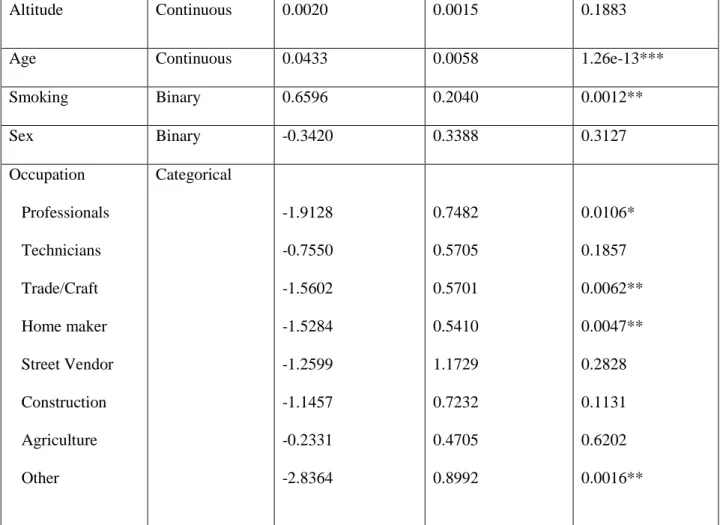
The multilevel analysis of altitude and gastric cancer risk based on the case/control data found no significant effect of altitude on gastric cancer risk when measured as a mean value or as a categorical
value of high/low (Table 2.2, Table 2.3). The relationship between altitude and gastric cancer incidence rates is shown graphically in Figure 2.2.
Variable Type Parameter
estimate (β)
31
Altitude Continuous 0.0020 0.0015 0.1883
Age Continuous 0.0433 0.0058 1.26e-13***
Smoking Binary 0.6596 0.2040 0.0012**
Sex Binary -0.3420 0.3388 0.3127
Occupation Professionals Technicians Trade/Craft Home maker Street Vendor Construction Agriculture Other Categorical -1.9128 -0.7550 -1.5602 -1.5284 -1.2599 -1.1457 -0.2331 -2.8364 0.7482 0.5705 0.5701 0.5410 1.1729 0.7232 0.4705 0.8992 0.0106* 0.1857 0.0062** 0.0047** 0.2828 0.1131 0.6202 0.0016**
Table 2.2 Results from the multi-level analysis of mean altitude and gastric cancer risk. * p <. 05, ** p < .01, *** p < .001
Variable Type Parameter
estimate (β)
SE (β) p-value
Altitude Categorical -1.0050 0.7569 0.1842
Age Continuous 0.0434 0.0059 1.15e-13***
Smoking Binary 0.6614 0.2042 0.0012**
Sex Binary -0.3298 0.3393 0.3310
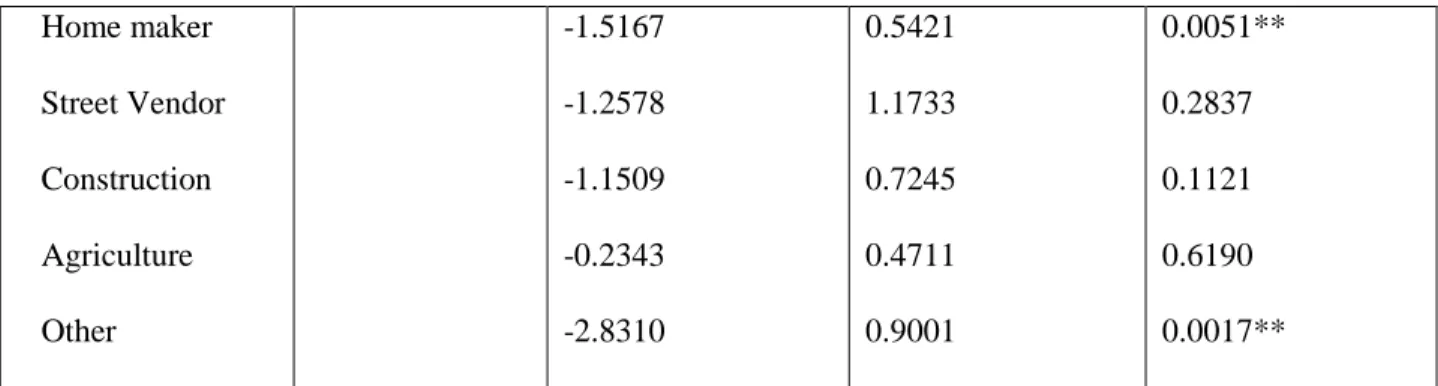
32 Home maker
Street Vendor Construction Agriculture Other
-1.5167 -1.2578 -1.1509 -0.2343 -2.8310
0.5421 1.1733 0.7245 0.4711 0.9001
0.0051** 0.2837 0.1121 0.6190 0.0017** Table 2.3 Results from the multi-level analysis of altitude class and gastric cancer risk.
* p <. 05, ** p < .01, *** p < .001
Figure 2.4 Crude incidence rates and mean altitude (m) values for 40 municipios in western Honduras. Each circle represents a municipio.
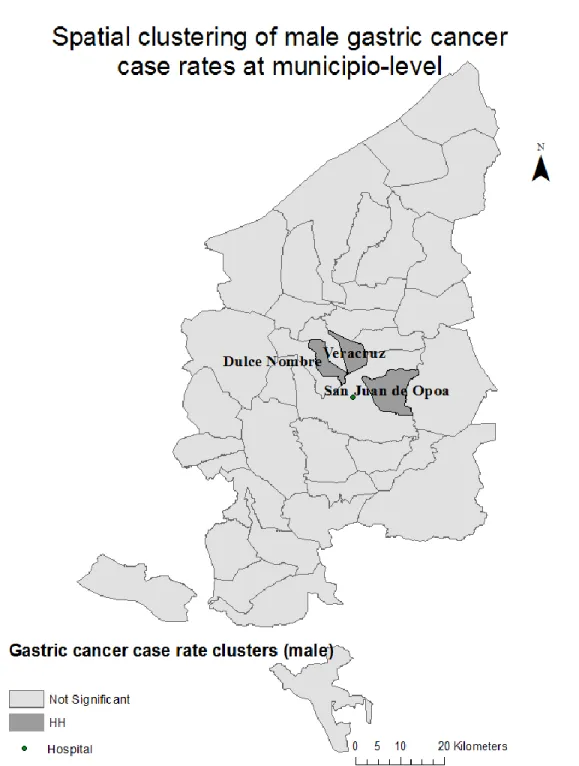
Results of the local Moran’s I analysis of spatial clustering of the disease indicate that there are
33
clusters are characterized by high positive z-scores, indicating that surrounding municipios have similar high case rate values. Six of the seven female clusters are also characterized by high positive z-scores, however one of the seven has a low negative z-score (<-1.96) which indicates a significant spatial outlier, in this case a high case rate municipio surrounded by lower case rates (ESRI, 2011). The three municipios with male high case rate clustering are Dulce Nombre, San Juan de Opoa, and Veracruz, all within the state of Copán. The six municipios with female high case rate clustering are Dolores, Dulce Nombre, San Agustin, San Jeronimo, Santa Rosa de Copán, and Trinidad, all within the state of Copán. The spatial outlier of a high case rate surrounded by low case rates is Lapaera in the state of Lempira. Significant
34
35
36
Four occupational categories were found to have significant protective effects on gastric cancer risk. These include working as a home maker; working as a professional, which includes all college graduates; working at craft or trade, which includes work as a seamstress, cook, carpenter, tailor, electrical work, etc.; and work falling under the category “other”.
DISCUSSION
37
mountainous area we do not have an included coastal region, where rates have been found to be lower than in the mounatins (Torres et al., 2012).
This study found that four occupational categories had a significant protective effect on gastric cancer risk. There are a number of epidemiological studies reporting relationships between gastric cancer risk and occupation, and evidence suggests a link between increased gastric cancer risk and occupations that result in exposure to dusty and high temperature environments (Santibanez et al., 2012; Krstev et al., 2005). It is possible that professional work and work in the home results in decreased exposures and therefore are protective. However, none of the occupational categories in this study were associated with increased risk.
38
R
EFERENCESAhmad, O.B., Boschi-Pinto, C, Lopez, A. D., Murray, C.J.L., Lozano, R. Inoue, M. (2001). Age standardization of rates: a new WHO standard. World Health Organization, GPE Discussion Paper Series, 31.
Anselin, L. (1995). Local Indicators of Spatial Association – LISA. Geographical Analysis, 27, 93-115. Bonequi P, Meneses-Gonzalez F, Correa P, et al. (2013). Risk factors for gastric cancer in Latin America:
a meta-analysis. Cancer Causes Control, 24, 217-231.
Bray F., Ren J.S., Masuyer E., & Ferlay J. (2013). Estimates of global cancer prevalence for 27 sites in the adult population in 2008. Int J Cancer. Mar 1;132(5):1133-45. doi: 10.1002/ijc.27711. Epub 2012 Jul 26.
Crew, K. D., & Neugut, A. I. (2006). Epidemiology of gastric cancer. World Journal of Gastroenterology, 12(3): 354-362.
de Martel, C., Ferlay, J., Franceschi, S., Vignat, J., Bray, F., Forman, D., et al. (2012). Global burden of cancers attributable to infections in 2008: A review and synthetic analysis. The Lancet Oncology, 13(6), 607-615. doi:10.1016/S1470-2045(12)70137-7.
de Sablet, T., Piazuelo, M. B., Shaffer, C. L., Schneider, B. G., Asim, M., Chaturvedi, R., et al. (2011). Phylogeographic origin of Helicobacter pylori is a determinant of gastric cancer risk. Gut, 60(9), 1189-1195. doi:10.1136/gut.2010.234468.
Dominguez, R.L., Crokcett, S.D., Lund, J.L., et al., (2012). Gastric cancer incidence estimation in a resource-limited nation: use of endoscopy registry methodology. Cancer Causes Control 24(2): 233-239.
ESRI (2011). ArcGIS Desktop: Release 10. Redlands, CA: Environmental Systems Research Institute. Ferlay J., Shin H.R., Bray F., Forman D., Mathers C. & Parkin D.M.
GLOBOCAN 2008 v2.0, Cancer Incidence and Mortality Worldwide: IARC CancerBase No. 10 [Internet].
Lyon, France: International Agency for Research on Cancer; 2010. Available from: http://globocan.iarc.fr, accessed on day/month/year.
Garson, G.D. (2012). Fundamentals of hierarchical linear and multilevel modeling. Hierarchical linear modeling: Guides and applications (p. 3-26). Lost Angeles: Sage.
Jemal, A., Siegel, R., Ward, E., Hao, Y., et al. (2008). Cancer Statistics, 2008. Cancer Journal for Clinicians, 58(2).
Jemal, A., Bray, F., Center, M. et al. (2011). Global cancer statistics. CA: A Cancer Journal for Clinicians(61):2, 69-90.
Kawachi, I. and Berkman, L.F. (2003). In Kawachi, I. and Berkman, L.F. (Ed.), Neighborhoods and health. New York: Oxford University Press.
39
Lawson, A.B. Browne, W.J., & Vidal Rodeiro, C.L. (2003). Disease mapping with WinBUGS and MLwinN. West Sussex: John Wiley and Sons, Ltd.
Lazcano-Ponce, E. and Martinez, M.E. (2013). Latin America: ripe for cutting edge research proposals for prevention and control of Helicobacter pylori. Cancer Causes & Control, 24.
Macintyre, S. and Ellaway, A. (2003). Neighborhoods and health: an overview. In Kawachi, I. and Berkman, L.F. (Ed.), Neighborhoods and health. New York: Oxford University Press.
Morgan, D. R., Dominguez, R. L., Keku, T. O., Heidt, P. E., Martin, C. F., Galanko, J. A., et al. (2006). Gastric cancer and the high combination prevalence of host cytokine genotypes and Helicobacter pylori in Honduras. Clinical Gastroenterology and Hepatology, 4(9), 1103-1111.
doi:10.1016/j.cgh.2006.05.025.
Moayyedi, P., Axon, A. T., Feltbower, R., Duffett, S., Crocombe, W., Braunholtz, D., et al. (2002). Relation of adult lifestyle and socioeconomic factors to the prevalence of Helicobacter pylori infection. International Journal of Epidemiology, 31(3), 624-631. doi:10.1093/ije/31.3.624. Parkin, D. M., Whelan, S. L., Ferlay, J., Teppo, L., & Thomas, D. B. (2002). Cancer incidence in five
continents, vol VIII (IARC Scientific Publications No. 155). Lyon: IARC.
Parkin, D.M. (2006). The global-health burden of infection-associated cancers in the year 2002. International Journal of Cancer 118(12), 3030-3044.
Palmeiro, R., Senra, A., Garcia-Blanco, P., & Millan, J. (1988). Changing patterns of gastric cancer mortality in spain. Cancer Letters, (1–2), 99-102. doi:10.1016/0304-3835(88)90245-5.
Recavarren-Arce, S., Ramirez-Ramos, A., Gilman, R. H., Chinga-Alayo, E., Watanabe-Yamamoto, J., Rodriguez-Ulloa, C., et al. (2005). Severe gastritis in the Peruvian Andes. Histopathology, 46(4), 374-379. doi:10.1111/j.1365-2559.2005.02102.x.
Riboli, E., & Norat, T. (2003). Epidemiologic evidence of the protective effect of fruit and vegetables on cancer risk. The American Journal of Clinical Nutrition, 78(3), 559S-569S.
Santibanez, M., Alguacil, J., de la Hera, M.G. et al., (2012). Occupational exposures and risk of stomach cancer by histological type. Occupational and Environmental Medicine, 69(4).
Torres, J., Correa, P., Ferreccio, C., & et al. (2013). Gastric cancer incidence and mortality is associated with altitude in mountainous regions of Pacific Latin America.Cancer Causes Control, 24: 249-256.
Tsugane, S. (2005). Salt, salted food intake, and risk of gastric cancer: Epidemiologic evidence. Cancer Science, 96(1), 1-6. doi:10.1111/j.1349-7006.2005.00006.x.
40
CHAPTER 3:THE DISEASE ECOLOGY OF GASTRIC CANCER IN WESTERN HONDURAS:THE ROLE OF REFRIGERATION.
ABSTRACT:Gastric cancer is the second most common cause of mortality worldwide. Infection with Helicobacter pylori and genetic polymorphisms within the host population are linked to increased risk of gastric cancer, however behavioral risk factors receive far less attention within the literature. The population of western Honduras experiences endemic H. pylori infection in combination with a
41 INTRODUCTION
Honduras, like many Latin American countries, has notably high rates of gastric cancer incidence and mortality. Estimated gastric cancer standardized incidence rates in western Honduras are 39 for men and 21 for women (per 100,000 population), nearly double the global averages for males and females of 22 and 10.3 respectively (Morgan et al., 2006; Parkin et al., 2005). Established risk factors for gastric cancer include infection with Helicobacter pylori, identified host genetic polymorphisms, diet, and smoking (Graham and Yamaoka, 2000; El-Omar et al., 2001; Forman and Burley, 2006; Smyth et al., 2013). Within the literature, the causal factors behind the exceptionally high rates of gastric cancer in Latin America remain poorly understood (Bonequi et al., 2013). Gastric cancer is a complex disease and understanding the disease etiology requires that investigators move beyond host-pathogen physiology.
This study emphasizes the roles of human behavior in understanding geographical variation in disease incidence patterns. The use of refrigeration increases access to fruits and vegetables, and is associated with a decreased dependency on salting, smoking, and adding nitrates/nitrites to preserve meat, factors thought to be associated with increased gastric cancer risk. The evidence is scant, especially in Latin America, but some studies have shown that increased refrigerator use corresponds to decreases in gastric cancer risk (Crew and Neugat, 2006; Larsson et al., 2006). A recent study in Honduras found an increased risk of invasive cervical cancer among women with human papilloma virus (HPV) was associated with the use of an indoor wood stove (Velema et al., 2002).
BACKGROUND
42
bacterium found in the human gastrointestinal tract (Graham and Yamaoka, 2000; El-Omar et al., 2001; Forman and Burley, 2006). Nevertheless, gastric cancer has a complex disease etiology and these factors alone do not explain the distinctly heterogeneous patterns of disease.
The majority of the research investigating gastric cancer comes from the field of epidemiology, where the emphasis tends to be on the biological underpinnings of disease development. Within the literature, environmental and behavioral variables have received less attention. Previous gastric cancer studies have identified risk factors that are associated with disease risk, including diet, infection with H. pylori, tobacco use, and socio-economic status (Graham and Yamaoka, 2000; Forman and Burley, 2006;
Ladeiras-Lopes et al. 2008; Moayyedi et al. 2002). Less understood are how environmental and
behavioral factors that vary in space, such as refrigerator and woodstove use, affect gastric cancer risk.
The availability of refrigeration is thought to contribute to the overall decrease in gastric cancer rates in recent decades. The use of refrigeration has increased access to fruits and vegetables, a factor associated with decreased gastric cancer risk (Crew and Neugut, 2006), and decreased dependency on salting, smoking, and adding nitrates/nitrites to preserve meat, factors thought to be associated with increased risk (Larsson et al., 2006). The evidence is scant, especially in Latin America, but some studies have shown that increases in the number of years of refrigerator use correspond to decreases in gastric cancer risk (La Vecchia et al., 1990; La Vecchia et al., 1995).
A recent study in Honduras investigated the effects of wood smoke associated with the use of an indoor wood stove on the risk of invasive cervical cancer in women with human papilloma virus (HPV) (Velema et al., 2002). The study found an elevated risk of cervical cancer for the use of wood as fuel in the kitchen in women infected with HPV. Wood stoves are common in western Honduras and
inflammation is known to contribute to gastric cancer pathogenesis (Fox and Wang, 2007).
43
and processed meat, and a specific genetic polymorphism were associated with increased risk. However, the meta-analysis excluded analysis of the behavioral factors the present study proposes to address, namely use of a refrigerator, use of a woodstove, and occupation, as well as the environmental variable of altitude due to a limited number of studies (Bonequi et al., 2013).
Used in combination with techniques and methods of spatial analysis, the disease ecology framework will facilitate the investigation of where disease is occurring and how potential contextual factors are driving the observed spatial patterns. This framework, with an underlying tenet that it is important to understand not only the clinical manifestations of disease, but also how and where the disease process begins and ends, is especially useful for an investigation of the complex etiology of gastric cancer. As the etiologies of the majority of gastric cancer cases remain largely unknown, understanding the roles of geographically-variable and behavioral covariates can provide valuable etiological insight.
STUDY AREA AND DATA
44
has modest geographical isolation. In addition, the region has some altitudinal variation but does not represent the entire country. Notably, the study area lacks a coast low elevation area.
The cases used in the study were drawn from the database of all individual cases presenting to Western Regional Hospital. Controls were selected in a systematic, population-based sampling design and were age and sex matched from a subset of 20 municipios. Villages within a 50-mile radius of the
45
46 METHODS
Multilevel analysis of public health data has emerged as a statistical approach for simultaneously analyzing individual and area, or “neighborhood”-level, variables on individual-level outcomes such as
disease incidence (Diez-Roux, 2000). Increasingly, public health research is revealing the importance of considering space and area-level characteristics when analyzing health and disease data (Kawachi and Berkman, 2003). Such research aims to make the distinction between the level of “people” and the level of “place”, and subsequently maintain these levels within analyses (Subramanian et al., 2001). Binomial multilevel likelihood models were constructed to examine how the use of a refrigerator and the use of a woodstove affect gastric cancer risk within western Honduras. The 397 cases and 633 controls are nested within 20 municipios of residence. Using the area-level factors of municipio and altitude combined with individual-level behavioral covariates, the role of use of a refrigerator and use of a woodstove on gastric cancer risk are investigated. The unit of analysis is the individual, however the use of multi-level models allows incorporation of both individual-level and area-level predictors (Diez Roux, 2001). Multilevel modeling is recognized as an asset for incorporating random effects, correctly modeling correlated error that occurs in clustered data, and to account for some spatial autocorrelation (Garson, 2012; Lawson et al., 2003). The use of hierarchal modeling helps to elucidate distinctions between contextual (characteristics
of the population) and compositional factors (physical/social characteristics of place).
The basic model is a binomial multi-level likelihood model, where yi takes the form 0 or 1 for each individual in group j (0 = control, 1 = case):
Yi ~ Binomial (pi)
47
Where pi is the probability of response 1, Xi is a matrix of individual and area-level covariates associated with individual i, µj is the random effect term at the area level.
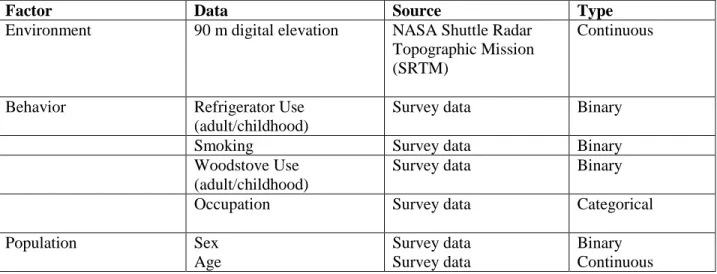
The area-level predictors include municipio and altitude. The individual-level compositional factors of age, sex, and smoking are controlled for in the models. These variables have been shown to be significantly associated with gastric cancer risk in previous research. In this analysis, occupation is used as a proxy for socioeconomic status. Additional individual-level variables include refrigeration and woodstove use. The variables come from the associated survey data for each case/control (Table 3.1).
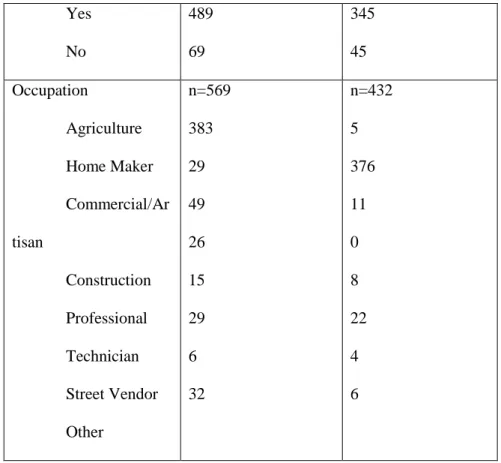
Table 3.2 displays descriptive statistics for the behavioral variables of interest.
Factor Data Source Type
Environment 90 m digital elevation NASA Shuttle Radar Topographic Mission (SRTM)
Continuous
Behavior Refrigerator Use
(adult/childhood)
Survey data Binary
Smoking Survey data Binary
Woodstove Use (adult/childhood)
Survey data Binary
Occupation Survey data Categorical
Population Sex
Age
Survey data Survey data
Binary Continuous Table 3.1 Contextual and compositional covariates and data sources.
Variable Males Females
48 Yes No 489 69 345 45 Occupation Agriculture Home Maker Commercial/Ar tisan Construction Professional Technician Street Vendor Other n=569 383 29 49 26 15 29 6 32 n=432 5 376 11 0 8 22 4 6
Table 3.2 Behavioral variables descriptive statistics
The final mixed logit model specifies that the outcome data comes from a binomial distribution and uses a logit link function. The lme4 package for the statistical program R was used for all multilevel analyses. This package allows for random effects with varying intercepts, a component of multilevel analysis. In this case, municipio of residence is the neighborhood-level random effect variable. This allows the slope to vary by municipio of residence.
RESULTS
Table 3.2 displays the results of the final multilevel model. Neither altitude nor use of a woodstove had a significant effect on gastric cancer. The effect of use of refrigeration as an adult was significant (-0.8627, p-value=<.001), indicating that using a refrigerator as an adult decreases gastric cancer risk. Similar to other studies of gastric cancer and smoking (Wu et al., 2001; Trédaniel et al.,
49
Parameter β (log odds) SE p-value
Refrigerator use, adult -0.8621 (-1.22,-0.43) 0.200 3.63e-05 *** Woodstove use, adult 0.0130 (-0.57, 0.59) 0.2962 0.9649
Altitude -0.0017 (-0.005 0.001 0.0016 0.2849
Smoking 0.6674 (.24, 1.09) 0.2174 0.0021**
Sex -0.4220 (-1.13, 0.29) 0.3623 0.2441
Age 0.0460(.03, .06) 0.0062 1.25e-13***
Occupation Agriculture Home Maker Commercial/Artisan Construction Professional Technician Street Vendor Other
-0.5682 (-1.54, 0.40) -1.7085 (-2.83, -0.59) -1.3812 (-2.56, -0.20) -1.7169 (-3.23, -0.20) -1.5939 (-3.13, -0.06) -0.8928 (-2.05, 0.26) -1.3581 (-3.70, 0.98) -2.9584 (-4.77, -1.15)
0.4948 0.5724 0.6011 0.7735 0.7851 0.5882 1.1946 0.9227 0.2508 0.0028** 0.0216* 0.0264* 0.0423* 0.1290 0.2556 0.0013** Table 3.3 Results from two-level model of gastric cancer risk in western Honduras, 2002 – 2012. *** p-value < .001, **p-value < .01, *p-value < .05
DISCUSSION
This study found that in western Honduras the use of a refrigerator is protective against gastric cancer. Among adults that used refrigeration, gastric cancer risk was significantly protective (β = -0.8627, p<.001). This finding suggests that access to refrigeration is an important component to preventing gastric cancer. The protective mechanisms are hypothesized to be related to dietary changes brought about though access to fresh fruits and vegetables and decreased dependency on preserved meats. Refrigeration can keep fruits and vegetables fresh longer, maintain higher anti-oxidant levels and reduce the use of salt
for preservation (Tsugane, 2005; Cai et al., 2002).