ARCHIVED - Archiving Content ARCHIVÉE - Contenu archivé
Archived Content
Information identified as archived is provided for reference, research or recordkeeping purposes. It is not subject to the Government of Canada Web Standards and has not been altered or updated since it was archived. Please contact us to request a format other than those available.
Contenu archivé
L’information dont il est indiqué qu’elle est archivée est fournie à des fins de référence, de recherche ou de tenue de documents. Elle n’est pas assujettie aux normes Web du gouvernement du Canada et elle n’a pas été modifiée ou mise à jour depuis son archivage. Pour obtenir cette information dans un autre format, veuillez communiquer avec nous.
This document is archival in nature and is intended for those who wish to consult archival documents made available from the collection of Public Safety Canada.
Some of these documents are available in only one official language. Translation, to be provided by Public Safety Canada, is available upon request.
Le présent document a une valeur archivistique et fait partie des documents d’archives rendus disponibles par Sécurité publique Canada à ceux qui souhaitent consulter ces documents issus de sa collection.
Certains de ces documents ne sont disponibles que dans une langue officielle. Sécurité publique Canada fournira une traduction sur demande.
2007-2008 Interim Evaluation of the Renewed National Crime Prevention Strategy
VOLUME I
July 17, 2007
Prepared for:
The National Crime Prevention Centre Public Safety Canada
500-363 Broadway · Winnipeg, MB · R3C 3N9 · Ph: 204.987.2030 · Fx: 204.989.2454 208-350 Sparks Street · Ottawa, ON · K1R 7S8 · Ph: 613.233.5474 · Fx: 613.233.5673
TABLE OF CONTENTS
EXECUTIVE SUMMARY ... i
1.0 Introduction... 1
1.1 Outline of the report... 1
2.0 Overview of the renewed NCPS ... 2
2.1 Context and chronological overview ... 2
2.2 Objectives ... 3
2.3 Components ... 3
2.4 Organization... 7
2.5 Expected results and logic model ... 8
2.6 Recent developments ... 10
3.0 Methodology ... 11
3.1 Evaluation framework... 11
3.2 Data collection methods... 11
4.0 Evaluation findings ... 15
4.1 Design and delivery ... 15
4.2 Impact ... 36
4.3 Effectiveness and efficiency ... 39
4.4 Relevance... 43
5.0 Conclusions and recommendations... 45
Appendix A Evaluation Framework Appendix B Data Collection Instruments
[ * ] - In accordance with the Privacy and Access to Information Acts, some information may have been severed from the original reports.
EXECUTIVE SUMMARY
The National Crime Prevention Centre (NCPC) contributes to the federal government’s role in sustaining community safety. It is responsible for administering the National Crime Prevention Strategy (NCPS), through which the federal government provides grant and contribution funding to community-based crime prevention projects; develops local, provincial/territorial, national, and international partnerships; and develops and transfers knowledge to further the practice of crime prevention.
The NCPS was renewed in 2005/2006. The renewed Strategy consists of three components. Under the community action component, NCPC provides funding and technical support to crime prevention initiatives across Canada through three funding programs: the Crime Prevention Action Fund (CPAF); the Policing, Corrections and Communities Fund (PCCF); and the Research and Knowledge Development Fund (RKDF). In addition, NCPC works to develop multi-sector partnerships to strengthen crime prevention efforts through the partnership component of the Strategy, and under the knowledge component, it gathers, interprets and exchanges knowledge about evidence-based crime prevention.
The Accountability, Risk and Audit Framework (ARAF) for the renewal included an evaluation plan and reporting requirements, including a requirement for an Interim Year Two Progress Evaluation. Public Safety Canada (PSC) engaged PRA Inc. to conduct the interim evaluation. The evaluation, which examined issues of relevance, design and delivery, impact, and cost-effectiveness/alternatives, was charged with the challenging task of evaluating a moving target. When the evaluation began in February 2007, the NCPS was not the same Strategy as it was in April 2005 when it first received renewal funding. But the challenges facing the evaluation are insignificant in comparison to those that NCPC has confronted. Since April 2005, the
organization has experienced a 27% reduction in FTEs, an internal reorganization including elimination and downgrading of many positions, a department-wide “pause” in funding between July 2006 and December 2006 that resulted in $22 million being lapsed and reductions of $3.6 million in 2006-2007 and $10.5 million in 2007-2008 as part of the government-wide fiscal responsibility framework. Most recently, NCPC has been given a new, more focused mandate that, like the events of the last two years, will affect the delivery of the NCPS. This interim evaluation has attempted to take these contextual issues into account in drawing conclusions and providing recommendations.
Methodology
To enhance the reliability and validity of the findings, multiple data sources were used wherever possible to respond to the evaluation questions. Data collection methods included:
a review of program documents
a review of Canadian and international literature on crime prevention
a review of administrative data contained in NCPC’s Grants and Contributions Information Management System (GCIMS)
a review of program files (n=112)
key informant interviews (n=34)
a survey of funded organizations (n=164).
The findings, conclusions and recommendations of the evaluation follow below.
Findings, conclusions and recommendations Design and delivery
Under the community action component of the NCPS, NCPC provides funding and technical support to crime prevention initiatives across Canada. With the renewal of the NCPS, NCPC streamlined its program platform by reducing the number of funding programs and introducing various changes to their design and delivery. These changes included funding a higher proportion of projects through contribution agreements; emphasizing multi-year, strategic, comprehensive crime prevention projects; increasing the targeting of NCPS funding; and emphasizing evidence-based crime prevention projects with strong research and evaluation components.
The evaluation found widespread (though not unanimous) agreement among key informants that these changes represent an appropriate direction for the Strategy and for NCPC. Furthermore, there is some evidence that NCPC has begun to fund projects that reflect these changes. For projects funded since April 2005, the ratio of contribution agreements to grants is 63:37, in comparison to 26:74 in the pre-renewal period, and the average NCPC contribution per CPAF project is almost three times more than it was for projects funded under the Community Mobilization Program (CMP), the predecessor to CPAF.
On the other hand, the available data on project duration are inconclusive. Although CPAF projects were, on average, longer than CMP projects, median project duration in both cases was one year. Similarly, the evaluation found little change in the comprehensiveness or strategic nature of funded projects pre- and post-renewal (using number of other revenue sources as an indicator), and because of a lack of comparable pre-renewal data, it could not assess whether projects funded since the renewal are more targeted in comparison to the pre-renewal period. In future, data on projects funded in the first two years of the renewal should be used as a baseline against which progress in these areas can be assessed.
Recommendation 1. In order to measure progress in implementing the changes to funding program design and delivery that were introduced with the renewal of the NCPS, NCPC should use the data on projects funded in the first two years of the renewal as a baseline for comparison.
NCPC has taken several steps to emphasize evidence-based crime prevention projects with strong research and evaluation components. However, NCPC key informants acknowledged that compiling and communicating easy to use, current information on the state of evidence in a variety of crime prevention areas is an area of weakness for the organization. Indeed, results from the survey of funded organizations indicate that applicants require more assistance from NCPC staff in integrating evidence-based crime prevention strategies into their proposals. In this context, it is important to note that neither the CPAF Overview nor the Applicants’ Guide
developing a proposal, and the CPAF Application Form does not specifically require applicants to describe the evidence base of their proposed interventions. Therefore, some applicants may not be aware that this is an expectation for all proposals. As a further consequence, the extent to which funded interventions are based on available evidence on effective crime prevention cannot be systematically ascertained.
Moreover, it is clear that there are differing interpretations among NCPC personnel of the term “evidence-based crime prevention projects,” with some interpreting the term narrowly to mean projects that have been tested against very rigorous evaluation standards, and others interpreting it more loosely to mean that the available evidence was consulted when designing the proposed intervention. These different perspectives within NCPC itself suggest a need to clarify NCPC’s understanding of the term.
Recommendation 2. NCPC should clearly define what it means by “evidence-based,” in order to ensure a common understanding of the term among NCPC staff.
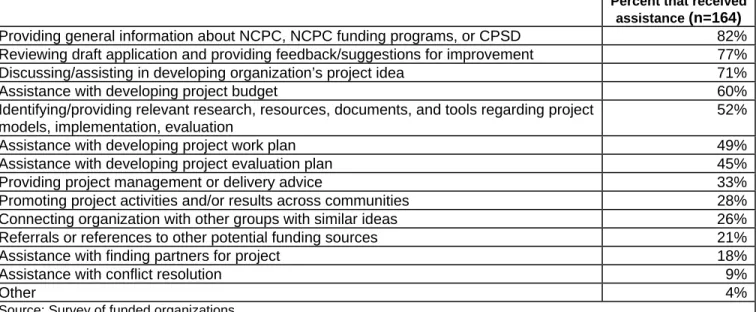
Recommendation 3. To fulfill its commitment to evidence-based practice, NCPC should, first, inform funding applicants of the requirement to integrate the evidence base into their proposed interventions; and second, develop a means of tracking the extent to which successful applicants integrate evidence into their projects. The evaluation found that the technical assistance provided by NCPC staff is essential to the development of strong funding proposals. Moreover, the need for technical assistance has grown considerably as a result of the renewed Strategy’s more stringent demands for project planning and accountability, while cuts to NCPC staffing have effectively limited the amount of technical assistance that can be provided. While projects surveyed found the technical assistance they received to be useful, the evaluation found clear evidence that increased efforts to assist
applicants may be required in some areas, particularly in identifying risk and protective factors, evaluation planning, and integrating evidence-based crime prevention strategies. Furthermore, many key informants expressed concern that the current proposal requirements have placed NCPS funding beyond the reach of many high-needs and high-risk communities (particularly Aboriginal and/or Northern communities), where the capacity to prepare sophisticated proposals and administer complex, comprehensive prevention projects remains a major challenge.
Recommendation 4. NCPC should ensure that sufficient resources (i.e., staff, tools, and resources) are available to ensure that funding applicants receive adequate technical assistance during proposal
development, particularly in identifying risk and protective factors, evaluation planning, and integrating evidence-based crime prevention strategies.
Recommendation 5. Given that crime and victimization are pressing issues for many Aboriginal and Northern communities, and given that one of NCPC’s priorities under its new mandate is to foster prevention specifically in Aboriginal communities, NCPC
should consider either simplifying proposal requirements or modifying the proposal development process for applicants that meet the program’s funding criteria but have language or other barriers that may prevent them from putting forth successful proposals. In addition, NCPC should consider providing additional assistance with certain aspects of project management, such as financial reporting, to successful
applicants that lack the capacity to manage projects effectively on their own.
Under NCPC’s repositioning, the process by which it solicits applications for funding will shift from generic calls for proposals (which have for the most part continued, to date, under the renewed Strategy despite a commitment to increased targeting and the application of this principle at the proposal review stage) to targeted solicitations that explicitly identify the
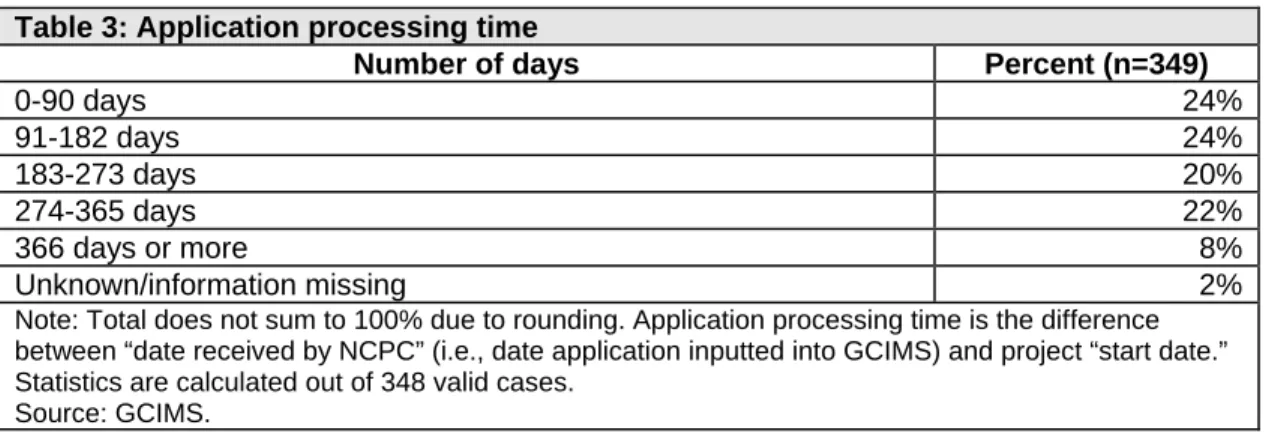
priorities, types of interventions, and particular communities that will be funded. By reducing the volume of proposals received, targeted solicitations are widely expected to improve efficiencies and ultimately produce more effective projects that better contribute to achieving objectives. The major weaknesses in NCPC’s proposal process are, at present, lengthy proposal review and approval times. For projects funded since the renewal, average processing time is 199 days (just over half a year). While the “pause” is partly responsible for these delays, a major contributing factor is the complex process of review and approval that has emerged since the renewal. Whereas in the past, the delegation of authority to approve projects for funding was dependent on the funding amount (with authority to approve some funding residing at the NCPC and Branch level), PSC now requires all projects recommended for funding by NCPC and the regional Joint Management Committees (JMCs) to be scrutinized and approved by the Minister to ensure compliance with departmental priorities. The approval process now consists of three stages – program review, JMC or external review, and Ministerial review – and at least 15 distinct steps. In addition to creating lengthy delays, this process has jeopardized the viability of some projects and created resentment among NCPC’s provincial/territorial partners who believe that their priorities, as reflected in the decisions of the JMCs, are not being respected. In order to improve efficiencies and repair goodwill, therefore, efforts should be made to streamline the proposal review and approval process and to clearly articulate the roles and responsibilities of all parties involved.
Recommendation 6. In the interest of improving efficiencies, NCPC, together with PSC representatives, should investigate ways of rationalizing the proposal review and approval process, including the possibility of re-delegating the authority to approve project funding to the Branch and Directorate levels.
Recommendation 7. The roles and responsibilities of all parties in the proposal review and approval process and, in particular, the roles and responsibilities of the JMCs should be clearly articulated.
Recommendation 8. While the lengthy processing times experienced since the renewal of the NCPS may be an aberration resulting from unusual circumstances, NCPC and/or PSC should consider implementing and adhering to a standard processing time for funding proposals. The same recommendation was made by the Blue Ribbon Panel on Grant and Contribution Programs for federal departments in general. A reasonable target could be identified by examining processing times of similar funding programs within the federal government, such as Status of Women Canada’s Women’s Program, which also takes a social development approach.
The partnership component of the NCPS is based on the recognition that multi-sector
partnerships and coalitions of governmental and non-governmental stakeholders will strengthen crime prevention efforts. NCPC has had a mixed record in implementing this component of the Strategy. Its unstable situation since renewal has had an impact on its partnership activity, and its relationship with the provinces and territories, in particular, has suffered. Among NCPC’s
provincial/territorial partners, there is a strong belief that the organization has failed to consult them regarding the renewal and has failed to keep them fully abreast of developments over the past two years (although we do report evidence from minutes that show that NCPC provided information on the renewal at federal/provincial/territorial meetings). In addition, the provinces and territories object to what they perceive as the federal government’s unilateral decision-making since the renewal. Many believe that their priorities are not being respected in funding decisions, that the federal government has set priorities for the NCPS that they do not share (e.g., youth gangs, guns, and drugs are not pressing issues in all jurisdictions) and that the federal government has begun to move away from crime prevention through social development (CPSD) in favour of other approaches. While these tensions are beginning to ease, many
provincial/territorial key informants emphasized that the NCPS is a bilateral strategy and that there is a need for genuine collaboration between the federal and provincial/territorial
governments in its delivery.
Recommendation 9. NCPC should continue to work at repairing its relationship with the provinces and territories. Efforts should be made to ensure a common vision of the NCPS, as well as a common understanding of the respective roles and responsibilities of the partners.
In contrast to the strained relationship with the provinces and territories, NCPC has had some success at horizontal policy work within the federal government. NCPC works closely with other units within PSC on joint research and policy planning, and has signed important new
agreements with Justice Canada, Statistics Canada, and Heritage Canada, among other departments. Many external partners envision NCPC as the lead organization responsible for coordinating the federal role in crime prevention. Such a role, furthermore, is strongly supported by evidence from the literature on effective crime prevention strategies, which points to the need for integrated action by multiple stakeholders to solve social problems.
Recommendation 10. To enhance the federal government’s response to crime and victimization, NCPC should work to establish itself as the lead agency responsible for coordinating the federal role in crime prevention.
In addition, NCPC’s long-standing relationships with external partners, such as the Royal Canadian Mounted Police (RCMP) and the Canadian Association of Chiefs of Police (CACP), have been strengthened, and key informants reported that strong partnerships have developed in some regions. All external partners believe that their organization has goals in common with the NCPS (although some are worried that CPSD is no longer a focus of the Strategy) and that their partnership with NCPC influences their policy development in positive ways. Some, such as the RCMP and the CACP, have incorporated CPSD into their official policy.
Finally, under the partnership component of the NCPS, NCPC is expected to facilitate the formation of partnerships among other organizations. NCPC personnel observed that this has occurred simply as a function of the requirement that all funding applicants identify partners and other funding sources in their proposals. Both GCIMS and file review data confirm that projects funded since the renewal involve multiple partners from a wide range of organizational sectors – nine partners each, on average, for CPAF and PCCF projects. Project partners played diverse roles and came from a diverse range of organizational sectors, including community, social and voluntary services; criminal justice, corrections and police; education; health; and
provincial/territorial governments. Based on the available data, however, this does not appear to represent any change over the pre-renewal period, which is perhaps not unexpected given NCPC’s historic emphasis on partnerships.
Under the knowledge component of the NCPS, NCPC committed to improve efforts to synthesize best practices and lessons learned and to disseminate this information to the crime prevention community and the general public. Some of this work is occurring through projects funded through the RKDF. To date, 12 projects have been funded under this component, although only one (the planning phase of a demonstration project) has yet been completed. NCPC also supports this component of the Strategy by publishing on its website and in hard copy materials specifically devoted to disseminating knowledge on evidence-based practices, providing technical assistance to projects, developing guidance materials for funding applicants and funded projects, and participating in a wide variety of workshops, conferences, training sessions, presentations, and other activities related to the production and dissemination of knowledge. A knowledge function composed of five FTEs within the Research and Knowledge Unit has been created to implement and coordinate knowledge activities.
Nevertheless, the evidence from this evaluation suggests that the knowledge component is an area of weakness for NCPC. Among key informants, only a few of NCPC’s external and
provincial/territorial partners had ever used or heard of NCPC knowledge products, and many of those who had used them found them impractical, too limited or superficial to be of real value, or culturally or linguistically inappropriate in their jurisdictions. On the other hand, many of
NCPC’s partners noted that the NCPC’s research and knowledge capacity is its greatest strength, and suggested that it focus on becoming a centre of excellence for evidence-based crime
prevention. NCPC key informants view the synthesis and dissemination of evidence-based knowledge as a major challenge, particularly given current staffing levels, and suggested that
part of the solution lies in improved linkages between the organization’s Programs and Policy, Research and Evaluation divisions.
Recommendation 11. NCPC should continue to develop its knowledge component, with a view to becoming a recognized source for evidence-based crime prevention information in Canada.
The resource reductions that NCPC has experienced over the past two years have profoundly hampered its ability to implement and achieve the objectives of the renewed NCPS. The pause severely curtailed the number of projects that were funded and delayed others; in total, some 150 projects were affected. Because NCPC did not communicate the changing program parameters to communities in a timely fashion, both NCPC and the provinces and territories, as delivery agents of the Strategy, lost credibility with community organizations. At the same time, commitments to increased use of contribution agreements, increased targeting of funding, integration of evidence-based interventions, and an enhanced knowledge function were made even though staff capacity to implement these changes was reduced. As a consequence, NCPC has suffered from high turnover in staff and senior leadership since the renewal, further diminishing its ability to deliver on the mandate of the renewed NCPS.
Many key informants observed that these developments forced NCPC to rethink its mandate and to emerge better positioned to achieve the objectives of the renewed NCPS. Nevertheless, there remain ongoing issues with respect to organizational structure, delivery structure, and resources. First, the current organizational structure was created in response to external imperatives, without any strategic analysis of the structure and resources necessary to deliver on the renewed NCPS mandate. There is evidence, for example, that staffing at the regional level may be inadequate, particularly given increased demands for project planning and accountability. There is also evidence that, although the relationship between the Programs and Policy, Research and Evaluation Divisions has greatly improved in recent months as a result of NCPC’s new senior leadership, the organization still lacks a mechanism for integrating policy, research, and
evaluation with program delivery, especially at the regional level. As a result, the regions, which are responsible for recommending projects for funding, have no mechanism for systematically accessing information on best practices and evidence-based crime prevention. An organizational analysis examining such questions as staffing levels and allocation among the national and regional offices, the role of different NCPC units at each stage of the project cycle from
solicitation to evaluation, and the structures that need to be in place to enable NCPC to fulfill the two core activities of its mandate since the repositioning (supporting targeted interventions and building and sharing practical knowledge), would help to identify any necessary modifications to the current structure.
Recommendation 12. NCPC should undertake a strategic analysis of its
organizational structure in order to identify any modifications that may be necessary to enable it to deliver on the mandate of the renewed NCPS. The analysis should examine questions such as staffing levels and allocation of staff among the national and regional offices; the role of the various NCPC units at each stage of the project cycle from solicitation to
evaluation; and the structures that need to be in place to enable the organization to fulfill its mandate.
Second, while tensions between the provinces and territories are beginning to ease, the strained relationship has by no means been completely repaired. In addition to ongoing uncertainty over federal and provincial/territorial roles and responsibilities in the NCPS, there is also uncertainty about the roles and responsibilities of the Federal/Provincial/Territorial (FPT) Working Group. Indeed, it is not clear if the Working Group has a policy or an operational focus, and its
membership is quite diverse in rank and background. The resulting mixture has not produced a particularly cohesive or effective group. Key informants agreed that there is a need to refine and refocus the mandate of the Working Group to ensure that it can be an effective agent in
delivering the renewed NCPS.
Recommendation 13. Together with its provincial/territorial partners, NCPC should refine and focus the mandate of the FPT Working Group and clearly articulate its roles and responsibilities with respect to the renewed NCPS. The membership of the Working Group should be composed of individuals of similar background and rank within their organizations. Ideally, members should have decision-making authority within their own organizations. Under the renewed NCPS, NCPC committed to implementing an enhanced performance measurement system and has taken several steps toward implementing this system, including developing standard application forms and reporting templates for each funding program, requiring all funded projects to provide final reports and conduct evaluations, providing evaluation training and developing evaluation resource materials for NCPC staff and funding recipients, enhancing the electronic GCIMS system, and developing performance measurement templates to track activity under the partnership and knowledge components of the NCPS. At present, the main challenge for performance measurement is related to GCIMS, which is intended to capture information collected by the standard forms used by the funding programs. While development and data entry have been underway since 2004/2005, the database is not yet capable of generating reports or data to support timely project management, performance monitoring, or impact assessment. NCPC has developed an Action Plan to address the main obstacles to full implementation of GCIMS, namely inconsistent data entry and incomplete development of the database. However, from an evaluation perspective, there are two additional issues with respect to GCIMS. First, there is evidence of poorly defined fields and attributes within the database, leaving substantial opportunity for subjective judgment in data entry that will ultimately affect the quality and validity of the data (although it is true that these issues are currently being addressed by NCPC). Second, although GCIMS is an information management system, it is nevertheless capturing primarily qualitative data; the task at hand is to design a database capable of ensuring that these qualitative data can be quantified, and that they will be meaningful once quantified. At the same time, NCPC should not rely solely on a database solution for performance measurement and evaluation purposes and overlook the value of other qualitative approaches, such as in-depth case studies, especially for illustrating program impact. Based on the evaluator’s limited exposure to GCIMS, further work on GCIMS would benefit
from the expertise of specialists in database development, performance measurement, and evaluation.
Recommendation 14. In order to ensure that GCIMS will ultimately be capable of generating useful, valid, and reliable data, NCPC should consider involving additional expertise in database
development, performance measurement, and evaluation to assist with its development and implementation.
Recommendation 15. Rather than relying solely on a database solution that focuses on capturing and summarizing the information collected on the standard forms, NCPC should consider a diversified
performance measurement strategy that also includes objective qualitative methods, such as in-depth case studies, to
illuminate outcomes achieved.
Impact
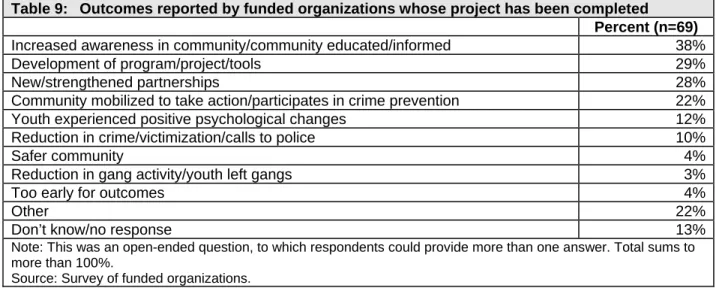
Given the relative infancy of the renewed NCPS, impact is difficult to discern at this time. Only about 20% of projects funded since April 2005 have concluded and GCIMS does not yet capture information on project outcomes. Consequently, data on impact is very limited.
Nevertheless, the evaluation found some preliminary indications of positive impacts, particularly in the area of increased local capacity to prevent crime and victimization. About 70% of funded organizations, for example, agreed that NCPC funding has improved their organization’s and their community’s capacity to prevent crime and victimization. Among key informants, many agreed that the objective of increased local capacity has been accomplished or that substantial progress has been made in this direction, particularly since increased community capacity has been a focus of the NCPS for some years, not only since renewal. However, while some key informants believe that the time has come for the NCPS to focus on more concrete outcomes, others believe that increasing local capacity should continue to be a goal of the Strategy, given that many communities (particularly Aboriginal communities) continue to struggle to plan and implement crime prevention initiatives.
There is also some evidence of improved comprehensive partnerships under the renewed NCPS. GCIMS and file review data show that funded projects involve multiple partners (nine each, on average) from a wide range of organizational sectors including, most commonly, community, social and voluntary services; criminal justice, corrections and police; education; health; and provincial/territorial governments. Moreover, 78% of funded organizations agreed that their organization has developed partnerships with organizations whose involvement was necessary to achieving their project objectives as a result of NCPC funding or technical assistance, and 59% agreed that NCPC funding helped their organization to leverage other sources of funding. As for NCPC’s own partnership activity, positive developments include numerous new horizontal partnerships with other federal departments and a strengthening of existing
partnerships with the RCMP and the CACP, both of which have incorporated CPSD into their official policy. However, in the evaluator’s opinion, the current expected outcomes pertaining to the partnership component of the renewed NCPS are more accurately described as “outputs,”
since they seem to imply that simply establishing partnerships is, by itself, sufficient to achieve crime prevention objectives. That being said, it should be acknowledged that the revised logic model for the NCPS, currently being drafted, appears to address this issue.
Recommendation 16. In revising the logic model for the NCPS, NCPC should take care to ensure that all expected outcomes articulate what is expected to change as a result of NCPS activities and outputs and do not merely reflect those activities or outputs.
Finally, the evaluation found very preliminary evidence of progress in integrating evidence-based crime prevention into policies and practices. Key informants believe that there is greater awareness among community organizations of evidence-based crime prevention, and indeed 62% of funded organizations agreed that their organization has a better understanding of
evidence-based crime prevention strategies as a result of NCPC funding and technical assistance. As mentioned earlier, this component of the renewed NCPS is an acknowledged area of
weakness, and one that will require greater effort in the future. Projects funded through the RKDF should help to improve knowledge production and dissemination.
Effectiveness/alternatives
Like program impact, it is somewhat early to assess whether there are more effective ways of achieving the objectives of the renewed NCPS. That being said, the evaluation found
considerable support in the literature for various features of the NCPS, including involvement of national government in crime prevention; a whole government approach to crime prevention that engages multiple stakeholders to deliver integrated solutions to problems; and evidence-based crime prevention. Among key informants, there is also general agreement that these are desirable features of an effective crime prevention strategy. That being said, some key informants
expressed caveats. Provincial/territorial representatives, for example, cautioned that a strong federal role should not mean that provincial/territorial interests and priorities are subsumed or ignored. Other key informants argued that emphasis on evidence-based interventions should not mean forgoing innovative but untested initiatives, particularly where there is a dearth of evidence on “what works” (as is the case for Aboriginal populations who are judged to be particularly high risk and therefore most in need of intervention). Indeed, funding and evaluating previously untested crime prevention interventions is arguably one important way in which NCPC might fulfill its commitment to producing evidence-based knowledge.
Recommendation 17. While there is considerable support in the international literature for implementing evidence-based approaches to crime prevention, NCPC should ensure that innovative interventions continue to be funded, particularly for
communities or populations where evidence may be lacking. Furthermore, such interventions should be evaluated in order to contribute to the evidence base.
The literature review also highlighted the importance of effective implementation to successful crime prevention initiatives. As has been emphasized throughout this report, effective
implementation of the renewed Strategy has been hampered by significant reductions to NCPC resources over the past two years. Given the context, it should not come as a surprise that evidence of impact is limited at this stage. However, based on the literature it appears that the basic elements are in place for success in the future, provided that the outstanding
implementation issues identified in this evaluation are addressed. Among NCPC key informants there is considerable agreement that if NCPC implements its new mandate, focusing on a more limited number of targeted interventions, both the effectiveness and the efficiency of the renewed NCPS will improve dramatically.
Relevance
The evaluation found the renewed NCPS to be closely aligned with the strategic objectives of PSC as well as federal priorities. Among key informants as well as funded organizations, there is a broad consensus that the federal government should continue to play a role in crime prevention and that the NCPS is still relevant to crime prevention in Canada. In fact, many stakeholders believe that if the NCPS did not exist, the consequences for crime prevention would be
devastating. Two-thirds of survey respondents said that in the absence of the NCPS, their own crime prevention work would be severely limited or altogether curtailed, and about one-fifth said the outcomes they have achieved would not have been realized. A similar proportion predicted an increase in crime and victimization in the absence of the Strategy.
Despite general agreement on the relevance of the NCPS, some key informants are unconvinced that the changes that have been introduced to ensure alignment with departmental and federal priorities are appropriate. In particular, they object to what they perceive to be a reduced emphasis on community capacity building, a focus on selected issues that are not relevant in all communities or jurisdictions, and a perceived move away from CPSD. These key informants believe that to be truly relevant, as well as effective in the long term, the NCPS must permit communities and jurisdictions to focus on local and provincial/territorial issues and priorities. Recommendation 18. NCPC should clarify for all stakeholders both whether and the
extent to which community capacity building, locally identified issues, and CPSD continue to be elements of the renewed NCPS.
1.0 Introduction
The National Crime Prevention Centre (NCPC) contributes to the federal government’s role in sustaining community safety. It is responsible for administering the National Crime Prevention Strategy (NCPS), through which the federal government provides grant and contribution funding to community-based crime prevention projects; develops local, provincial/territorial, national, and international partnerships; and develops and transfers knowledge to further the practice of crime prevention.
The NCPS was renewed in 2005/2006. The Accountability, Risk and Audit Framework (ARAF) for the renewal included an evaluation plan and reporting requirements, including a requirement for an Interim Year Two Progress Evaluation. Public Safety Canada (PSC) engaged PRA Inc. to conduct the interim evaluation. The evaluation examined issues of relevance, design and
delivery, impact, and cost-effectiveness/alternatives.
1.1 Outline of the report
This report is divided into several sections. Section 2 provides an overview of the renewed NCPS while Section 3 describes the methodology used to complete the evaluation. Section 4 provides the evaluation findings, and Section 5 concludes and provides recommendations.
Two appendices follow the main body of the report. Appendix A contains the evaluation framework and Appendix B the data collection instruments. In addition, we have provided detailed technical results from the data collection methods used in this evaluation in a separate volume of appendices (Volume II).
2.0 Overview of the renewed NCPS
This section of the report provides a description of the context for the renewed NCPS, and describes the Strategy’s objectives, components, and expected results.
2.1 Context and chronological overview
The National Crime Prevention Strategy has evolved substantially since its inception in 1994. In the Safe Home/Safe Streets policy set out in Towards Safer Communities,1 the federal
government made a commitment to a comprehensive approach to crime that involved five related initiatives, one of which was the National Strategy for Community Safety and Crime Prevention. At the heart of the Government’s approach at that time was the belief that traditional measures to deal with crime – law enforcement, the courts, and incarceration – must be balanced with strong crime prevention efforts which recognize that the communities that are most resistant to crime are those that actively participate in addressing the social and economic factors that can lead to crime.
The National Strategy provided a framework for federal efforts in this area, facilitated
cooperation with provincial and territorial governments, and emphasized community-level action to prevent crime. The most visible part of Phase I of the Strategy was the creation of the National Crime Prevention Council. The Council, which consisted of volunteers and the support of a professional Secretariat, was charged with focusing on crime prevention across Canada and addressing crime in a comprehensive manner by involving a broad range of partners and sectors. Phase II of the National Strategy, launched in 1998, consisted of the Safer Communities
Initiative (consisting of five funding programs), a Promotion and Public Education Program, and the National Crime Prevention Centre (NCPC), which was located within the Department of Justice and which was responsible for implementing the Strategy in partnership with the Solicitor General of Canada.2 Like its predecessor, Phase II was based upon a crime prevention through social development (CPSD) approach. Through its funding programs, the National Strategy provided grant and contribution funding to projects at the community level, where resources, needs, and problems are best understood and can be most effectively addressed. Phase II had an initial investment of $32 million per year. In 2001, Phase II was expanded with an additional investment of $145 million over four years (2001–2005). During the expansion period, the Strategy was renamed the National Crime Prevention Strategy (NCPS), and responsibility for it was transferred from the Department of Justice to the Department of Public Safety and
Emergency Preparedness Canada (PSEPC, now Public Safety Canada or PSC). [ * ]
1
Department of Justice Canada. (1995, August). Towards Safer Communities: A Progress Report on the Safe Homes/Safet Streets Agenda. Ottawa: Department of Justice Canada.
2
National Crime Prevention Centre. (1998). Crime Prevention Partnership Program: Access Guide. Ottawa: NCPC.
2.2 Objectives
According to the ARAF, the objectives of the renewed NCPS are:
To increase sustainable community action
To develop and share knowledge of crime prevention strategies To coordinate multilevel support for crime prevention efforts.
In addition, each of the funding programs under the renewed NCPS has its own set of objectives, which are included in the descriptions of the individual programs below.
2.3 Components
The renewed NCPS consists of three components: community action, partnerships, and knowledge.
2.3.1 Community action
Under the community action component, NCPC provides funding and technical support to crime prevention initiatives across Canada. NCPC launched its new funding program platform,
consisting of the CPAF, the PCCF, and the RKDF, in autumn 2005. Despite the recent changes to its funding programs described above, these three original programs are the subject of the current interim evaluation and are described below.
Crime Prevention Action Fund
The CPAF provides time-limited grant and contribution funding that supports crime prevention initiatives at the community level.3 The program is delivered regionally in partnership with the provincial and territorial governments, and nationally for projects that involve more than one jurisdiction. The objectives of the CPAF are to:
Enhance the capacity of diverse communities to decrease risk factors and increase protective factors related to crime and victimization
Promote cross-sector collaboration in crime prevention, with particular emphasis on engaging the voluntary and private sectors and participating in multi-partnership initiatives
Develop, disseminate and transfer information, tools and resources, including best practices and evidence of what works in crime prevention
3
Information about the CPAF is taken from the CPAF Application Form, the CPAF Overview on the NCPC website, and the Applicant’s Guide.
Support the development of comprehensive community initiatives to address crime and victimization issues.
Eligible organizations include not-for-profit volunteer organizations, groups, and professional organizations and associations; community-based coalitions and networks; Aboriginal
communities including Band and Tribal Councils; provincial, municipal, and Aboriginal police services; and provincial, municipal, and regional governments. The maximum available funding per recipient for an individual project is $100,000 per year for up to three consecutive years for grants and $200,000 per year for up to five consecutive years for contributions. CPAF does not fund 100% of project costs.
NCPC has developed a detailed Applicant’s Guide that covers topics such as preparing a project budget, project planning and evaluation, sustainability for crime prevention, partnerships, and risk and protective factors. The Guide is intended to assist applicants to CPAF as well as applicants to PCCF in preparing a strong proposal for funding.
Policing, Corrections and Communities Fund
The PCCF funds projects where community partners work together to prevent crime, primarily through social development.4 The goals of the PCCF are to:
Develop partnerships, tools and knowledge of CPSD within police and other law enforcement organizations, community corrections services, community-based organizations, and Aboriginal communities
Develop and implement demonstration projects targeting high-risk communities and at-risk groups, including children, youth and their families, and Aboriginal people
Support families of Aboriginal offenders to prevent the cycle of institutionalization of Aboriginal youth and to promote Aboriginal community mobilization and wellness Develop, implement and evaluate comprehensive models of crime prevention in the
community that include efforts to support the reintegration of offenders in order to prevent further criminal behaviour and victimization
Strengthen partnerships between community corrections and other crime prevention initiatives within communities.
Eligible organizations are similar to those eligible under CPAF. The maximum available funding under PCCF is $200,000 per year per project for up to three years. According to the PCCF Overview, the PCCF does not normally fund 100% of project costs. As previously mentioned, when the NCPC experienced budget cuts in 2006, the PCCF was eliminated as a separate funding program. No new projects have been funded through this program since October 2006. Research and Knowledge Development Fund
4
The RKDF is delivered through the national NCPC office.5 Broadly speaking, the RKDF is intended to enhance public awareness, understanding, and practice of crime prevention, and to strengthen linkages among NCPC, academics, academic institutions, and crime prevention researchers and practitioners. More specifically, the objectives of the RKDF are to:
Identify, develop, support and evaluate promising community-based crime prevention models of potential Canada-wide significance
Support research, including community-based action research, and other activities related to the compilation of evidence on crime prevention and victimization, with particular emphasis on social development approaches
5
Promote and facilitate linkages with crime prevention researchers, practitioners, and communities
Support and promote the advancement of effective approaches to crime prevention at the international level.
The RKDF supports three types of projects: research projects, demonstration projects with associated evaluations, and knowledge transfer projects. Research projects help advance basic crime prevention knowledge, policy and/or practice; demonstration projects test the theory underlying a program and determine its effectiveness; and knowledge transfer projects ensure the widespread distribution of practical crime prevention information and knowledge, generated by research and demonstration projects, in usable formats.
Eligible organizations include some of the same types of organizations as those eligible under CPAF, but also Canadian educational institutions and boards of education; networks of academics; and academic institutions and centres of excellence, among others. The RKDF provides both grant and contribution funding (although no grants have been awarded to date) and, like CPAF, does not fund 100% of project costs. The maximum grant per recipient per project is $100,000 per year, while the maximum contribution per recipient per project is $500,000 per year.
Technical support
NCPC personnel provide technical support to applicants and funded projects under all three funding programs. The types of technical support provided include:
provision of general information about NCPC or NCPC funding programs
assistance with proposal development, such as developing a project budget, logic model, evaluation plan, or work plan; referrals to other potential funding sources; and assistance in finding project partners and other sources of funding
assistance to recommended projects, including providing feedback on proposals or explaining the results of the proposal review process
assistance to funded projects in areas such as cash flow review, review of project reports, provision of project management or delivery advice, and conflict resolution
assistance with networking, such as connecting organizations with similar groups and providing ideas or assistance to promote project activities or results across communities. Through the provision of technical support, NCPC hopes to improve local community capacity to prevent crime and victimization and help projects move toward an evidence-based approach.
2.3.2 Partnerships
The partnership component is based on recognition that multi-sector partnerships and coalitions of governmental and non-governmental stakeholders will strengthen crime prevention efforts. According to the ARAF, the NCPS “provides a framework for increased cooperation on crime prevention via partnership arrangements signed with each province and territory” and works with key partners such as the Royal Canadian Mounted Police (RCMP), the Canadian Association of Chiefs of Police (CACP), and other federal departments such as Justice and Health, among others, to “promote shared, collaborative undertakings.” As a result of such partnerships, crime prevention initiatives are expected to have greater impact and sustainability over time. In
addition, partnerships are expected to help embed CPSD approaches in the policies and practices of organizations that have an impact on community safety.
2.3.3 Knowledge
Under the knowledge component, the NCPS is responsible for gathering, interpreting, and exchanging knowledge about best practices in crime prevention and evidence-based crime prevention. Knowledge transfer activities are expected to increase community capacity to address local crime and victimization issues, to inform policy and programming decisions at all levels of government, and to increase knowledge on integrating CPSD approaches into policies and practices.
2.4 Organization
The following bodies have responsibilities related to the management and delivery of the NCPC elements of the renewed NCPS.6
National NCPC office – The National NCPC office consists of the Executive Director’s Office, the Programs Division, and the Policy, Research and Evaluation Division. The National office is responsible for the overall program and policy direction of the NCPC elements of the renewed NCPS, and delivers the PCCF and the RKDF as well as CPAF projects that involve more than one jurisdiction. The National office also provides functional guidance to the NCPC regional offices and is responsible for performance monitoring, measurement, and evaluation of the renewed Strategy.
Regional NCPC offices – The regional NCPC offices are the regional arms of the NCPS. They deliver the CPAF in collaboration with the provinces and territories (e.g., soliciting, developing, and recommending projects for funding), and also play a role in managing RKDF and YGPF projects, developing and maintaining relationships with regional stakeholders, liaising with other federal government representatives, and providing regional input into crime prevention policy. There are six regional offices: Northern, British Columbia, Prairies, Ontario, Quebec, and
6
Information in this section is taken primarily from the ARAF and from an NCPC document entitled “Planned Staffing and Reporting Relationships.”
Atlantic, with staff located in 16 cities. The six Regional Managers report to the Director of Programs.
Joint Management Committees – Since its inception, the NCPS has been administered by the NCPC and co-managed with the provinces and territories through Joint Management
Committees (JMCs). JMCs are comprised of NCPS officials, provincial/territorial representatives and community representatives, and are responsible for the strategic implementation of the NCPS in their respective jurisdictions. As such, one of their main responsibilities is to review submitted proposals and select projects for funding that meet identified provincial/territorial needs within the parameters of the NCPS.
Federal/Provincial/Territorial (FPT) Working Group on Community Safety and Crime Prevention – The FPT Working Group was established as a forum for collaboration and coordination of community safety and crime prevention activities overseen by the NCPS. The FPT Working Group currently consists of one representative from each of the provinces and territories, one representative from the RCMP, and three representatives from NCPC: the Director of Programs, the Director of Policy, Research and Evaluation, and a Policy Advisor from the Policy, Research and Evaluation Division.
2.5 Expected results and logic model
The ARAF for the renewed NCPS identifies three immediate outcomes, three intermediate outcomes, and one ultimate outcome that are all expected to result from the Strategy. The immediate outcomes are:
Improved leadership/facilitator/educator role in crime prevention Increased comprehensive and strategic partnerships
Improved knowledge of effective crime prevention approaches
The intermediate outcomes are:
Increased local capacity to prevent crime and victimization
Improved comprehensive partnerships in effective crime prevention
Improved integration of evidence-based crime prevention into policies and practices.
Ultimately, the renewed Strategy is expected to lead to enhanced community safety. The logic model on the next page is reproduced from the ARAF and depicts the activities, outputs, and outcomes associated with the Strategy.
Community action Partnerships Knowledge
Renewal is centred on sustainable community action, coordinating crime prevention efforts and, sharing knowledge.
Logic Model – Renewed National Crime Prevention Strategy
Key assumptions
Components
Engagement / involvement / coordination with key
stakeholders
Gathering / interpretation / exchange of knowledge Funding and support to crime
prevention initiatives Activities
Funding agreements, partnership arrangements, networks
Funding and technical assistance Knowledge products and
mechanisms
Improved leadership / facilitator / educator role in Crime Prevention
Increased comprehensive and strategic partnerships
Improved knowledge of effective crime prevention approaches
Increased local capacity to prevent crime and victimization
Improved comprehensive partnerships in effective crime
prevention
Improved integration of evidence-based crime prevention into
policies and practices
Enhanced Community Safety
Outputs
Immediate outcomes
Intermediate outcomes
Ultimate outcome
2.6 Recent developments
NCPC continues to take action on the commitments it made to Treasury Board in its September 2005 Management Action Plan and March 2006 Management Plan. Beginning in the fall of 2006, the organization began a “repositioning” exercise that will have implications for the delivery for the NCPS. The repositioning is being driven by several factors, including an
increased need to focus and target efforts; the need to better collaborate with and better integrate crime prevention with enforcement, corrections, and other relevant interventions; the need to ensure a balanced and targeted approach in response to priority and specific crime issues affecting particular groups and places (where a balanced approach includes CPSD as well as situational crime prevention and secondary and tertiary prevention); and the requirement to obtain measurable results by affecting the risk factors specific to priority crime and victimization issues.7
In response to these drivers, NCPC recently proposed to adopt a renewed mission and core activities that provide a sharper focus on crime prevention and reduction. The Minister of Public Safety announced the new, more focused approach for NCPC on June 8, 2007.8 A document released at the time of the announcement (“A Blueprint for Effective Crime Prevention”) describes NCPC’s new mission: “to provide national leadership on effective and cost-efficient ways to both prevent and reduce crime by addressing known risk factors in high-risk populations and places.”9 To accomplish this mission, NCPC will concentrate on two core activities:
supporting targeted interventions, and building and sharing practical knowledge. All NCPC activity will be based on principles that, in order to be effective, crime prevention initiatives must be:
Integrated with the activities of other programs and services
Based on knowledge of known risk and protective factors, and evidence-based practices
Focused on specific priorities. NCPC’s new priorities are to address early risk factors among vulnerable families and children and youth at risk; to respond to priority crime issues (youth gangs, drug-related crime); to prevent recidivism among high-risk groups; and to foster prevention in Aboriginal communities.
Able to provide measurable results.
The NCPS logic model is currently being revised in order to align it with the organization’s new directions.
7
Federal/Provincial/Territorial Working Group on Community Safety and Crime Prevention. (2007, April 12). Implementing the National Crime Prevention Centre’s New Directions: A Blueprint for Change
[Draft]. 8
Public Safety Canada. (2007, June 8). Minister Day announces focused crime prevention approach. 9
3.0 Methodology
This section of the report provides a detailed description of the methodology used to complete the evaluation.
3.1 Evaluation framework
PRA, in consultation with an Evaluation Advisory Committee composed of three NCPC representatives and one PSC representative, developed an evaluation framework to guide the research. The framework (Appendix A) covers the standard issues of relevance, design and delivery, impact, and cost-effectiveness/alternatives required by Treasury Board for formative or interim evaluations. However, it replaces some of the standard questions with others better suited to the particular context in which this evaluation is taking place. As described earlier, since the renewal of the NCPS in 2005, NCPC has experienced an internal reorganization, cuts to funding, and a departmental-wide “pause” in funding. In addition, NCPC has recently been given a new, more focused mandate as a result of its repositioning exercise. One of the key issues for this evaluation, therefore, is to determine the impact of these recent events and changes on the implementation of the renewed NCPS and on NCPC’s ability to meet the objectives of the renewed Strategy. The evaluation framework includes questions and indicators intended to capture this information.
3.2 Data collection methods
To enhance the reliability and validity of the findings, multiple data sources were used wherever possible to respond to the evaluation questions. Data collection methods included:
document review
literature review
GCIMS data review
file review
review of performance measurement data
key informant interviews
survey of funding recipients.
3.2.1 Document review
The document review focused on materials produced as a result of the development, implementation, and management of the renewed NCPS. The document review assisted in developing the program profile and helped to answer many of the evaluation questions, as outlined in the evaluation framework. Materials reviewed as part of this task included:
policy documents – for context, historical perspective, and current policy directions
departmental documents, such as reports on plans and priorities
NCPC submissions to Treasury Board
NCPC responses to Treasury Board directives, particularly the March 2006 Management Plan and September 2005 Management Action Plan
documentation describing organizational and delivery structure
the ARAF for the renewal of the NCPS
the ARAF for the Youth Gang Prevention Fund
funding program guides and guidelines, application forms, and reporting templates
minutes and reports from meetings of the CACP, the FPT Working Group on Community Safety and Crime Prevention, and regional JMCs for the NCPS
documentation pertaining to NCPC’s GCIMS system (e.g., user manual and implementation work plans)
previously completed evaluation reports.
3.2.2 Literature review
PRA examined the national and international literature on crime prevention. An important component of the literature review was to examine how other countries (namely, the U.K., Australia, and the United States) have organized their crime prevention activities. This added to our knowledge of the role that national governments can play in crime prevention, thus helping to determine whether the NCPS is relevant. In addition, the literature review examined the available evidence on best practices in crime prevention. This helped us to determine if the new approach is a valid one and if there are more effective ways of achieving the objectives of the renewed NCPS. The literature review is in Volume II.
3.2.3 GCIMS data analysis
We analyzed data contained in NCPC’s Grants and Contributions Information Management System (GCIMS) for projects funded under the new funding programs between April 1, 2005 and February 26, 2007 and, for comparison purposes, projects funded under the Community Mobilization Program between April 2005 and October 2005.
An electronic data extract was provided to PRA by NCPC in Excel format and was imported into SPSS for purposes of analysis. Because GCIMS is still in development, the analysis was limited to variables for which data entry has been reasonably consistent across the country, and for which GCIMS could produce valid and reliable data. Detailed results from the analysis of GCIMS data are in Volume II.
3.2.4 File review
In light of the fact that GCIMS is still in development, we supplemented the analysis of GCIMS data with a detailed review of a sample of projects funded under the new funding programs since April 1, 2005 and up until a cutoff date of February 26, 2007. We reviewed a systematic sample of 25% of CPAF projects (to ensure an equal percentage of projects from each region) and, in light of their small number, 100% of projects funded through the PCCF and the RKDF. Overall, 32% of all funded projects (n=112) were included in the file review. Table 1 below summarizes our sampling methodology for this task.
Table 1: Sampling methodology for file review
Funding program Projects
funded
Sampling plan
Number of files reviewed
Crime Prevention Action Fund 317 25% 79
Policing, Communities and Corrections Fund 22 100% 21
Research and Knowledge Development Fund 12 100% 12
Total 351 32% 112
Separate file review templates were developed for each of the funding programs, based on the typical contents of the files. The file review templates for CPAF and PCCF consist primarily of closed-ended questions based on the standard application forms and final report templates for these programs. These results were data entered and analyzed quantitatively using SPSS, a statistical software package commonly used in social science research. By contrast, standardized forms do not exist for the RKDF program, so the RKDF template consists mainly of open-ended questions. For this reason, and because of the very small number of projects funded through the RKDF to date (n=12), the results of the RKDF file review were analyzed qualitatively. Detailed tabular results from the review of CPAF and PCCF files are appended in Volume II.
3.2.5 Review of performance measurement data
We conducted a review and analysis of performance measurement data provided by NCPC. NCPC provided us with activity logs enumerating the following activities: memoranda of understanding, letters of agreement, partnership arrangements, and networks; committees on which NCPC staff participated in some form; policy/program delivery tools and resources; workshops, conferences, internal/external training and presentations; and technical assistance. We extracted from these logs an extensive activity list that is included in Volume II and integrated the main findings into the body of the report.
3.2.6 Key informant interviews
We interviewed a total of 34 individuals offering particular insights into various aspects of the renewed NCPS. Potential key informants were identified by NCPC and included representatives of three groups: NCPC personnel, external partners, and provincial/territorial representatives. Provincial/territorial representatives were drawn from the co-chairs of the JMCs or FPT Working Group members, while external partners included representatives from other federal departments and non-governmental organizations with which NCPC has or has had partnerships. Within
NCPC, potential interviewees were selected to represent the functional areas addressed by the evaluation questions (e.g., senior management, program delivery, policy, research and
knowledge, evaluation) and as much as possible to reflect different regional perspectives, although not every region was represented. Where possible, individuals were selected who had “worn another hat” in the organization and could thus provide information about more than one area. A separate interview guide was developed for each of the three groups of key informants. Before being contacted, all key informants except for NCPC personnel received a letter from PRA describing the purpose and nature of the evaluation and inviting them to participate (NCPC personnel received an email notice from NCPC’s evaluation representative instead of a mailed letter). Approximately one week after the introductory letter was circulated, we contacted key informants by telephone to schedule interviews. We completed the majority of the interviews by telephone in the preferred official language of key informants.
3.2.7 Survey of funding recipients
The survey of funding recipients provided important information on the NCPS from those who are its primary, intended beneficiaries. We used a census approach to the survey of funding recipients. That is, all organizations that had received funding under the new funding programs of the renewed NCPS between April 1, 2005 and February 26, 2007 were sent the survey (n=342). The survey sample was provided to PRA by NCPC in Excel format, and contained names, contact information, and language preferences.
We used a mail survey to distribute the questionnaire. The questionnaire was accompanied by an introductory letter explaining the purpose of the evaluation and the importance of the survey. Respondents had the option of returning the survey to PRA by mail in a self-addressed, postage-paid envelope included with the mailed questionnaire, or by toll-free fax. We conducted several follow-ups by telephone to secure a high response rate.
Twelve surveys were returned to PRA because of invalid addresses, leaving a final sample of 330. In total, we received 164 completed surveys (115 in English and 49 in French), resulting in a 50% response rate. This is an excellent response rate for a survey of grant and contribution program beneficiaries. The survey results were data entered and analyzed using SPSS. Detailed tabular results from the survey are found in Volume II.
4.0 Evaluation findings
This section of the report summarizes the findings from all data collection methods used in this evaluation.
4.1 Design and delivery
4.1.1 Funding programs
With the renewal of the NCPS, NCPC streamlined its program platform by reducing the number of funding programs and introducing various changes to the design and delivery of these
programs with the overall goal of improving accountability, risk management, and objectives achievement. These changes included funding a higher proportion of projects through
contribution agreements; emphasizing multi-year, strategic, comprehensive crime prevention projects; increasing the targeting of NCPS funding; and emphasizing evidence-based crime prevention projects with strong research and evaluation components.
Among key informants, there is a broad consensus that these changes – which will continue to be pursued as a result of NCPC’s repositioning – represent an appropriate direction for the Strategy and for NCPC. Furthermore, there is evidence that NCPC has begun to fund projects that reflect the changes implemented with the renewal.
Higher ratio of contribution agreements to grants
NCPC has successfully achieved a higher ratio of contribution agreements to grants since the renewal. GCIMS data show that of the 349 projects that received NCPS funding under the new funding programs, 63% were funded through contribution agreements, while 37% were funded through grants. This ratio represents a significant shift in NCPC’s program platform, which prior to April 2005 consisted primarily of grants (74% grants compared to 26% contributions).10 Emphasis on multi-year, strategic, comprehensive crime prevention projects
Recognizing that its previous practice of funding many small, short-term projects through the Community Mobilization Program (CMP) may not be the most effective way of achieving NCPS objectives, NCPC committed to funding larger, longer-term, more strategic projects under the renewed Strategy. The available evidence suggests that NCPC has begun to move in this direction. GCIMS data show that under CPAF, the successor to the CMP, the average NCPC contribution per project was $91,155. This compares with $33,005 committed per project under the CMP (note that under the CMP, funding was capped at $50,000 per project).11 Thus, the average contribution under CPAF represents an almost threefold increase over the CMP. Notwithstanding this increase, more than half of CPAF projects are relatively small, receiving $50,000 or less in NCPC funding.
10
NCPC. (2006, March 20). Report to the Treasury Board Secretariat: Management Plan. p. 17. 11
Ekos Research Associates Inc. (2005, April 27). Summative Evaluation of the Phase II Expansion of the National Crime Prevention Strategy. p. 12.