TECHNICAL UNIVERSITY OF CLUJ-NAPOCA
ACTA TECHNICA NAPOCENSIS
Series: Applied Mathematics, Mechanics, and Engineering Vol. 62, Issue IV, November, 2019
TECHNO-ECONOMIC ANALYSIS OF A GRID-CONNECTED
RESIDENTIAL PHOTOVOLTAIC SYSTEM: A ROMANIAN CASE STUDY
Ciprian CRISTEA, Maria CRISTEA, Iulian BIROU, Constantin-Sorin PICĂ, Radu-Adrian
TÎRNOVAN, Florica Mioara ȘERBAN, Carmen-Elena STOENOIU
Abstract: Solar energy represents one of the most important renewable sources which may help solving the challenge of decarbonizing the electricity system especially thanks to the development and evolution of technologies. A residential photovoltaic system deserves to be considered an alternative electricity source for households. The aim of this paper is to assess the technical and economic aspects of a grid-connected rooftop solar photovoltaic system used for supplying of household electricity needs in Romania. The results obtained showed the photovoltaic system was feasible when subsidies offered to encourage the adoption of solar energy were available.
Key words: Solar electricity, Photovoltaic system, Net present value, Discounted payback period, Grid-connected PV, Economic analysis.
1. INTRODUCTION
The systematic and sustainable rise of resources and energy utilization is vital for the accomplishment of the progress of human civilization [1]. The growth of air pollutions and greenhouse gas emissions has been linked to the expanding demand for the production of electricity from fossil fuels [2].
The European Council has been involved in the development of the energy policies of the European Union since 1986 [3]. The European Parliament and Council have grounded the regulatory framework to encourage the use of energy from renewable sources in the European Union until 2020 through Directive 2009/28/EC [4]. The governments from European Union came to an agreement which stipulates that one fifth of the total energy consumption should be obtained from renewable energy sources by 2020 [5].
The Paris Agreement entered into force on 4th of November 2016 is stipulating the decreasing of fossil fuel use and increasing the share of renewable sources [6].
Romania imposed a goal of 24 percent share of energy from renewable sources in final
consumption till 2020, more than the average of the countries from European Union, and, by applying public policies, it achieved this goal in 2014 [7].
Solar energy represents an encouraging energy source to cope with the potential energy crises [8]. Solar energy is the most abundant available and can meet twice the annual world energy consumption if Earth receives only 0.05 percent of it and electricity is produced with an efficiency of 10 percent [9]. The concentrating solar power and solar photovoltaic technologies are used to generate electricity. Solar photovoltaic has an annual increase of about 35 percent especially due to the supporting policies and lower costs. Thus, this technology has benefited from one of the fastest growths in the electricity generation sector [10].
Considering the successful development of the photovoltaic technologies in a short time, the solar photovoltaic global capacity has grown rapidly from year to year, as shown in Fig. 1.
using the energy surplus generated by photovoltaic panels.
Fig. 1. Global cumulative capacity of solar photovoltaic, 2008-2018 [11]
As the solar photovoltaic technology evolved, there was significant interest in this segment, which has expanded in several markets, including residential and commercial applications. Demand for this type of energy technology has grown considerably, thus, in 2012 the solar photovoltaic global capacity exceeded 100 gigawatts, and four years later, in 2016, it tripled [11].
Various studies have been focused on rooftop grid-connected photovoltaic system performances in different countries, including Morocco [12]. This paper compared the performances of the following photovoltaic technologies: mono-crystalline, polycrystalline and amorphous, placed on the roof of the University in Tetouan. The results revealed that the mono-crystalline technology is more efficient in terms of the energy volume injected in the grid. Another study, conducted in India, used different software tools to determine the feasibility of a grid-connected rooftop solar photovoltaic system and indicated the most reliable software that can be used to perform different simulations regarding this type of solar system [13]. In [14] are presented the performances of an 11.2 kWp grid-connected photovoltaic system installed on the roof of a university located in Eastern India and are described the parameters of the photovoltaic solar system, including photovoltaic module and inverter efficiency, the array and system yield, and the total energy injected in the grid.
In this paper, we investigate the technical and economic aspects of a grid-connected rooftop
solar photovoltaic system in Romania in the context of announced solar rooftop rebate scheme. This study supports the development of theory and practice. No research, to the extent of our knowledge, has investigated the feasibility of a grid-connected residential photovoltaic system in Romania after the announced subsidy program for solar prosumers. The rest of this work is structured in the following way: in the second chapter the photovoltaic energy in Romania is briefly presented. In the third chapter the case-study methodology is exposed. The fourth chapter shows the case study-based action research for the grid-connected residential photovoltaic system. The results are presented in the fifth section and, finally, the last chapter reveals the conclusions.
2. PHOTOVOLTAIC ENERGY IN ROMANIA
The Government Decision No. 443/2003 was the starting point in the Romanian legislation regarding the production and use of electricity from renewable energy sources. It created the legal framework to support the production of electricity from renewable energy sources, based on these energy sources’ current potential for utilization [15].
The Law No.220/2008 was the first one issued regarding renewable energy sources. It established a system for supporting the production of energy from renewable sources. An incentive scheme was established to encourage the development of the system. A part of this incentive scheme was the “green certificate” that attests the production of electricity from renewable sources [16].
Regarding Romania, solar photovoltaic technologies have not been fully embraced at the beginning. Thus, in 2011 the total capacity of solar photovoltaic installed power was around 1 megawatt. The situation changed dramatically when the Government decided to support the solar power plant constructions and granted three green certificates per MWh for electricity produced in these plants. As a result, in 2013 the solar photovoltaic capacity installed in Romania was over 1100 MW, as can be seen in Fig. 2. This ascending trend has been maintained in the following years, but the growth slope was much
15 23 40 71
101 138 177
229 305
405 505
T
o
ta
l
ca
p
a
ci
ty
[
g
ig
a
w
a
tt
smaller, in 2018 the solar photovoltaic capacity being 1347 MW [17], [18].
Fig. 2. Solar photovoltaic capacity in Romania [17,18]
Another important aspect is the Law no. 184/2018, approved by the Romanian Parliament, in which a prosumer is defined as an end-consumer, which has installed a renewable energy system on his building, whose activity aims not to produce electricity, but who consumes and may store electricity in order to sell the surplus of generated power [19]. The above-mentioned law states that the prosumers that produce electricity from renewable energy sources from systems with a maximum capacity of 27 kW can sell the electricity fed into the utility grid without paying additional taxes [19].
The Decision no. 1287/2018 is an important program that intends to increase the capacity of solar photovoltaic in Romania. It covers up to 90% of the total amount of eligible expenses, in the limit of 4.200 €, for procurement, installation and any adjacent costs of rooftop grid-connected photovoltaic systems, with the installed power between 3 and 27 kW [20].
3. METHODOLOGY
The residential photovoltaic systems generate electricity that flows in various paths. A grid-connected residential photovoltaic system may use the photovoltaic production to power the household consumption, to export the surplus to the electrical grid and to consume from the grid the shortage of electricity.
The PVSOL program was utilized to simulate annual energy production of the photovoltaic system from the analyzed case-study. Starting
by defining the load and irradiation data, the PVSOL program facilitates the sizing of the system configuration, providing the number and arrangement of the photovoltaic solar panels, along with the wiring diagram.
At the same time, an appropriate project economic evaluation is necessary before investing on a new project. The resolution is based on an economic evaluation of the viability, profitability and permanency of the investment [21]. To ascertain the usefulness of the investment, a couple of indicators have to be taken into account, before the final decision concerning the project investment is taken [22], [23].
In this paper are used the following economic assessment parameters: Net Present Value, Internal Rate of Return, Profitability Index and Discounted Payback Period.
The Net Present Value is the most widely employed method in financial evaluation for longstanding project investments. This method compares the present value of all cash flows received with the present value of all cash flows made over the period taken into account for the investment. Net Present Value can be computed as follows:
∑ (1)
where: NPV represents the Net Present Value;
NCFi is the net cash flow obtained in year i; r is the discount rate; II represents the initial investment in photovoltaic system; SV is the salvage value; n is the project lifetime.
The yearly net cash flow is determined from the difference between cash flows received and cash flows made. The cash flows received represent the savings obtained on the electricity bill by installing the photovoltaic system and the money obtained by injecting the surplus of energy into the grid. The cash flows made are operation and maintenance costs represented as a percentage of total investment.
If NPV is positive, then the project is accepted and if NPV is negative, then the project is rejected.
Internal Rate of Return is used to quantify the investment’s profitability. The Internal Rate of Return represents the value of the discount rate 1,01 50
1158 1230
1296 1342 1344 1347
2011 2012 2013 2014 2015 2016 2017 2018
T
o
ta
l
ca
p
a
ci
ty
i
n
R
o
m
a
n
ia
[m
e
g
a
w
a
tt
that makes NPV takes the value zero. For a project to be feasible, the Internal Rate of Return has to be greater than the discount rate. Internal Rate of Return equation is given by:
∑ 0 (2)
where: IRR represents the Internal Rate of Return.
The Profitability Index represents an economic assessment parameter which is calculated as the ratio of the present value of an investment project’s considered cash flows received to the present value of its considered cash flows made. Profitability index is determined as follows:
∑# !"
∑# $ (3)
where: PI represents the Profitability Index; ICFi is the incoming cash flow obtained in year i;
OCFi is the outgoing cash flow obtained in year
i.
The investment project is going to be accepted if PI is greater than the unit value, otherwise it is declined.
The Discounted Payback Period represents the time it takes to break even from undertaking the initial project investment from discounting the expected future net cash flows. The project is going to be approved if Discounted Payback Period is less than the project lifetime, otherwise it is declined.
4. CASE STUDY
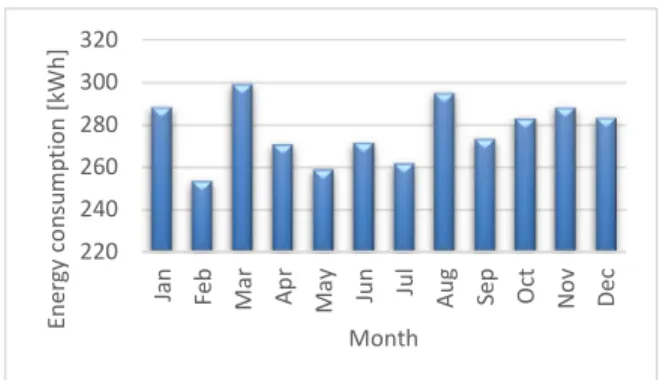
The analyzed case study refers to a single-family residence, measuring 150 square meters, located in the city of Bacău, Romania. It is situated in the Eastern part of Romania at a latitude of 46.5670o N, longitude of 26.9146o E. The monthly values of energy consumption for the considered building are shown in Fig. 3.
The main goal of this paper is to evaluate the viability of the grid-connected residential photovoltaic system of a house located in Bacău, Romania. This system is a photovoltaic array power system connected to a central grid. The
excess electricity produced by the photovoltaic system can be injected into the grid.
Fig. 3. The energy consumption
The basic elements of a grid-connected solar photovoltaic power systems are the following [13], [24]:
•Photovoltaic panels capture sunlight to generate direct current electricity;
•Maximum power point tracker (MPPT) to optimize power capture from photovoltaic panels during sunshine duration;
•Solar inverter to convert direct current (DC) to alternating current (AC);
•Electrical meter to measure the energy imported from the grid and the energy exported to the grid;
•A mounting hardware or a framework, cabling;
•Grid connection safety equipment, depending on the regulations.
The photovoltaic modules are connected to the grid through a power conditioning unit and operate in parallel with the utility grid. Fig. 4 shows the main grid-connected photovoltaic components.
Fig. 4. The main grid-connected photovoltaic components [24]
220 240 260 280 300 320
Ja
n
F
e
b
M
a
r
A
p
r
M
a
y
Ju
n
Ju
l
A
u
g
S
e
p
O
ct
N
o
v
D
e
c
E
n
e
rg
y
c
o
n
su
m
p
ti
o
n
[
k
W
h
]
In this analysis, the system described in table 1 has been selected.
Table 1
System description. Installed power [kWp] 3.6
Type of modules Mono-crystalline No. of modules 12 Azimuth/inclination 180o (south)/26.6o Nominal max. power [W] 300 Opt. operating voltage [V] 32.5 Opt. operating current [A] 9.24
Operating temperature -40oC ~ +85oC Panel area [m2] 1.66
Lifetime [years] 25
The system includes twelve pieces of mono-crystalline panels with a capacity of 300 W. In order to finalize the photovoltaic system, it is necessary to assign an inverter. The photovoltaic module configuration was optimized in PVSOL software by choosing the configuration that maximizes the production. After configuring the photovoltaic panels, the shading analysis and cabling was achieved. In the next step, simulations were performed for the photovoltaic system.
5. RESULTS
Using PVSOL program as indicated in Fig. 5, it could be seen that December is a minimum of energy production (155 kWh) and the maximum is in July, of 562 kWh.
Fig. 5. The variation of energy generation and
consumption
The energy output decreased during the months of December and January because winter days are significantly shorter than summer days, the Sun’ rays hit the photovoltaic modules more directly during summer than
winter and also, during winter months the snow accumulation on the photovoltaic panels prevent the system from converting energy.
The coverage of consumption is shown in Fig. 6.
Fig. 6. Coverage of consumption
The residence’ energy consumption is about 3327 kWh. The energy consumption covered by the photovoltaic system is about 24 percent. The electricity grid covers the rest of energy consumption.
The way electricity generated by the photovoltaic system is used is presented in Fig. 7.
Fig. 7. The way electricity generated by the photovoltaic system is used
Total annual amount of energy generated from the photovoltaic system is about 4514 kWh. During the daytime, the electricity supplied by the photovoltaic system for own consumption is about 18 percent and remaining energy is fed into the grid.
In this paper, the following parameters were considered for the economic assessment: discount rate of 5 percent, investment period of 25 years, operation and maintenance expenses represent one percent of investment [25]. -400
-200 0 200 400 600 800
Ja
n
F
e
b
M
a
r
A
p
r
M
a
y
Ju
n
Ju
l
A
u
g
S
e
p
O
ct
N
o
v
D
e
c
E
n
e
rg
y
[
k
W
h
]
PV Energy Consumption
Consumption covered by the grid
Consumption covered by the PV
Grid feed-in
Consumption covered by
Presently, the domestic consumers pay around 0.1552 USD/kWh for the electricity acquired. Recent legislative changes state the establishing of a feed-in tariff for the prosumers. The previous year’ average price from Day-Ahead Market is taken into account in establishing the selling price of electricity. Thus, in 2019, the prosumers would earn about 0.0517 USD/kWh for the electricity fed into the public network.
The photovoltaic system investment took into account the prices reported for solar modules, solar inverter, electrical meter, installation fees, supplemental materials and labor fee. The investment costs for the rooftop system analyzed in this paper amounted to 5.400 USD.
In this paper, two different scenarios are going to be economically evaluated: one that considers the subsidies provided to stimulate the adoption of photovoltaic system and another in which a residential owner bears all the investment costs.
In the scenario in which no subsidies are granted for the residential photovoltaic system, the NPV is about -2.147 USD, the IRR records the value of about -0.32 percent, the PI is about 0.65. The cumulative discounted cash flows are presented in Fig. 8.
Fig. 8. Cumulative discounted cash flows when no subsidies are granted
As can be seen from Fig. 8, the investment is not going to be recovered. The values obtained for the economic assessment parameters for this scenario demonstrate that the configuration is not viable for investment.
In the scenario in which subsidies are given for the photovoltaic system, the NPV is about
2.913 USD, the IRR records the value of about 40 percent, the PI is about 2.91. The cumulative discounted cash flows are shown in Fig. 9.
Fig. 9. Cumulative discounted cash flows when subsidies are given
As can be noticed from Fig. 9, the initial investment is recovered after about three years and four months. The economic assessment parameters for this scenario indicate that the photovoltaic system is feasible for investment.
6. CONCLUSIONS
In this paper, the techno-economic analysis of a grid-connected residential photovoltaic system, located in the city of Bacău, Romania was examined. The simulation was performed to establish the performance of a 3.6 kWp photovoltaic system. The simulation determined electricity feed in grid and energy yield. The analyzed photovoltaic system reduces the annual energy consumption from the grid by about 24 percent. PVSOL reveals to be reliable for the simulation of photovoltaic system.
This work also investigated the feasibility of using a residential photovoltaic system.
In the scenario based on the absence of financial support for the implementation of such systems, the initial investment is not going to be recovered. The economic assessment parameters for this scenario indicate that the photovoltaic system is not feasible.
In the scenario in which subsidies are available for the installation of photovoltaic systems, the initial investment is going to be recovered in about three years and four months. -6000
-5000 -4000 -3000 -2000 -1000 0
1 3 5 7 9 11 13 15 17 19 21 23 25
C
u
m
u
la
ti
v
e
d
is
co
u
n
te
d
c
a
sh
fl
o
w
s
[U
S
D
]
Year
-1000 -500 0 500 1000 1500 2000 2500 3000 3500
1 3 5 7 9 1 1 1 3 1 5 1 7 1 9 2 1 2 3 2 5
C
u
m
u
la
ti
v
e
d
is
co
u
n
te
d
c
a
sh
-fl
o
w
s
[U
S
D
]
All the economic assessment parameters specify that the photovoltaic system is feasible.
During the last years the photovoltaic technology has reached a maturity and the installation of photovoltaic systems is a real option in the power generation mix. However, the installation of small sized photovoltaic systems in the absence of financial support for the installation of such systems is not feasible.
Government policymakers may find these results helpful, in order to encourage policies to promote the installation of residential photovoltaic systems.
7. REFERENCES
[1] Meadowcroft, J., What about the politics? Sustainable development, transition management, and long term energy transitions, Policy Science, 42 (4), pp. 323– 40, 2009.
[2] Shahsavari, A., Akbari, M., Potential of solar energy in developing countries for reducing energy-related emissions, Renewable and Sustainable Energy Review, 90, pp. 275–91, 2018.
[3] Montoya, F. G., Aguilera, M. J., Manzano-Agugliaro, F., Renewable energy production in Spain: A review, Renewable and Sustainable Energy Reviews, 3, pp. 509-531, 2014.
[4] Resch, G., Gephart, M., Steinhilber, S, Klessmann, C., del Rio, P., Ragwitz, M.,
Coordination or harmonisation? Feasible pathways for a European RES strategy beyond 2020, Energy & Environment 24(1), pp. 147–70, 2013.
[5] Klessmann, C., Rathmann, M., de Jager, D., Gazzo, A., Resch, G., Busch, S., Ragwitz, M.,
Policy options for reducing the costs of reaching the European renewables target, Renewable Energy, 57, pp. 390–403, 2013. [6] Lacal Arantegui, R., Jäger-Waldau, A.,
Photovoltaics and wind status in the European Union after the Paris Agreement, Renewable Sustainable Energy Review, 81, pp. 2460–71, 2018.
[7] Zamfir, A., Colesca, S. E., Corbos, S.A.,
Public policies to support the development of renewable energy in Romania: A review,
Renewable Sustainable Energy Review, 58, pp. 87–106, 2016.
[8] Kannan, N., Vakeesan, D., Solar energy for future world: - A review, Renewable Sustainable Energy Review, 62, pp. 1092-1105, 2016.
[9] Gorjian, S., Zadeh, B.N., Eltrop, L., Shamsihiri, R.R., Amanlou, Y., Solar photovoltaic power generation in Iran: development, policies, and barriers, Renewable Sustainable Energy Review, 106, pp. 110-123, 2019.
[10] Ghasemi, G., Noorollahi, Y., Alavi, H., Marzband, M., Shahbazi, M., Theoretical and technical potential evaluation of solar power generation in Iran, Renewable Sustainable Energy Review, 138, 1250-1261, 2019. [11] Appavou, F., Brown, A., Epp, B., Gibb, D.,
Kondev, B., McCrone, A., Murdock, H.E., Musolino, E., Ranalder, L., Sawin, J.L., Seyboth, K., Skeen, J., Swerrisson, F.,
Renewables 2019 Global status report, REN21, Paris, 2019.
[12] Baghdadi, I., Yaakoubi, A.E., Attari, K., Leemrani, Z., Asselman, A., Performance investigation of a PV system connected to the grid, Procedia Manufacturing, 22, pp.667-674, 2018.
[13] Dondariya, C., Porwal, D., Awasthi, A., Shukla, A.K., Sudhakar, K., Murali Manohar, S.R., Bhimte, A., Performance simulation of grid-connected rooftop solar PV system for small households: A case study of Ujjain, India, Energy Reports, 4, pp.546-553, 2018. [14] Sharma, R., Goel, S., Performance analysis
of a 11.2 kWp rooftop grid-connected PV system in Eastern India, Energy Reports, 3, pp.76-84, 2017.
[15] Romanian Government, Decision no. 443 of 10 April 2003 on promoting the production of electricity from renewable energy sources, Romania, 2003.
[16] Romanian Parliament, Law no. 220 of 27 October 2008 to establish a system to promote the production of energy from renewable energy sources, Romania, 2008. [17] Nastase, G., Serban, A., Dragomir, G.,
has been done, Renewable and Sustainable Energy Reviews, 94, pp.523-535, 2018. [18] Tiseo, I., Solar photovoltaic capacity
installed and connected in Romania from 2013 to 2018 (in megawatts),
https://www.statista.com.
[19] Law 184/2018, Official Journal, Bucharest, 2018.
[20] Romanian Government, Decision no. 1287 of December 14, 2018, Romania, 2018. [21] Riesz, J., Rose, I., Vanderwaal, B.,
Gilmore, J., Integration of solar generation into electricity markets: an Australian National Electricity Market case study, IET Renewable Power Generation, 9(1), pp. 46– 56, 2015.
[22] Brealey, R., Myers, S., Allen, F., Principles of Corporate Finance, 2nd Edition, McGraw-Hill Higher Education, 2010.
[23] Ross, S., Westerfield, R., Jordan, B.,
Fundamentals of Corporate Finance, 11th Edition, McGraw-Hill Education, 2015. [24] Vazquez, N., Vazquez, J., Photovoltaic
system conversion, in Rashid, M. H. (eds.),
Power Electronics Handbook, 4th Edition, Butterworth-Heinemann, Oxford, 2018. [25] Gheorghe, M., Ciobanu D., Saulescu R.,
Jaliu C., Economic analysis algorithm of a PV – wind hybrid system, Acta Technica Napocensis: Series: Applied Mathematics, Mechanics, and Engineering, Vol. 61, Special Issue, Ed. UT Pres, ISSN 1221-5872, Cluj-Napoca, September, 2018.
Analiza tehnico-economică a unui sistem fotovoltaic rezidențial conectat la rețea: un studiu de
caz din România
Rezumat: Energia solară reprezintă una dintre cele mai importante surse de energie regenerabilă
care poate ajuta la rezolvarea decarbonizării sistemului electric, în special datorită dezvoltării și evoluției tehnologiilor. Un sistem fotovoltaic rezidențial merită să fie considerat ca o sursă de energie electrică pentru gospodării. Scopul acestei lucrări este de a evalua aspectele tehnice și economice ale sistemului fotovoltaic conectat la rețea pentru satisfacerea nevoilor de energie electrică la o casă din România. Rezultatele obținute au arătat fezabilitatea sistemului fotovoltaic atunci când sunt disponibile subvențiile oferite pentru încurajarea adoptării energiei solare.
Ciprian CRISTEA, PhD Eng., Associate professor, Technical University of Cluj-Napoca, Department of Electrical Machines and Drives, [email protected], +40-264-202-385, 26-28 G. Barițiu Street, Cluj-Napoca.
Maria CRISTEA, PhD Student Eng., Assistant professor, Technical University of Cluj-Napoca, Department of Electrical Power System and Management, [email protected], +40-264-401-904, 25 G. Barițiu Street, Cluj-Napoca.
Iulian BIROU, PhD Eng., Professor, Technical University of Cluj-Napoca, Department of Electrical Machines and Drives, [email protected], +40-264-401-490, 26-28 G. Barițiu Street, Cluj-Napoca.
Constantin-Sorin PICĂ, PhD Student Eng., Assistant professor, Technical University of Cluj-Napoca, Department of Electrical Power System and Management, [email protected], +40-264-401-259, 25 G. Barițiu Street, Cluj-Napoca.
Radu-Adrian TÎRNOVAN, PhD Eng., Professor, Technical University of Cluj-Napoca, Department of Electrical Power System and Management, [email protected], +40-264-401-904, 25 G. Barițiu Street, Cluj-Napoca.
Florica Mioara ȘERBAN, PhD Eng., Assistant professor, Technical University of Cluj-Napoca, Department of Electrical Machines and Drives, [email protected], +40-264-401-232, 26-28 G. Barițiu Street, Cluj-Napoca.
![Fig. 1. Global cumulative capacity of solar photovoltaic, 2008-2018 [11]](https://thumb-us.123doks.com/thumbv2/123dok_us/7994425.2119944/2.918.98.426.116.366/fig-global-cumulative-capacity-solar-photovoltaic.webp)
![Fig. 2. Solar photovoltaic capacity in Romania [17,18] Another important aspect is the Law no](https://thumb-us.123doks.com/thumbv2/123dok_us/7994425.2119944/3.918.140.464.174.383/fig-solar-photovoltaic-capacity-romania-important-aspect-law.webp)