УДК
629.463.65.027.2
S. MYAMLIN
1, L. NEDUZHA
2*, O. TEN
3, A. SHVETS
21 Vice-Rector, The Dniepropetrovsk National University of Railway Transport named after Academician V. Lazaryan, Lazaryan
Str., 2, 49010, Dnіepropetrovsk, Ukraine, tel./fax +38 (056) 793 19 03, e-mail [email protected]
2*Department of Structural Mechnics Chair, The Dnipropetrovsk National University of Railway Transport named after
Academician V. Lazaryan, Lazaryan Str., 2, 49010, Dnepropetrovsk, Ukraine, tel./fax +38 (056) 793 19 03, e-mail [email protected]
3 Promtractor-Wagon CJSC, 429332, Кanash, Illicha Str., 1а, Russia, tel./fax +78 (83533) 2 55 65, e-mail [email protected]
DETERMINATION OF DYNAMIC PERFORMANCE OF FREIGHT
CARS TAKING INTO ACCOUNT TECHNICAL CONDITION
OF SIDE BEARERS
Purpose. The railway transport plays an important role in social and economic life of the country and carries out the large containment of transportation activities. The transport industry should migrate towards innovation changes and increase its significance as an important transit subsystem on the way of renovation of both the infra-structure and the strategy of all transportation process components including the interaction with other transport modes. At present the life sets strategic challenges for the railway branch, and the basic goals among them are as follows: high-speed train traffic development, increase of the weight of freight trains, new rolling stock development etc. Due to the urgency of this subject, the researchers should cope with the task devoted to one of aspects of im-proving the freight transportation efficiency, namely to the study of effects of various factors and characteristics of technical conditions of the freight cars running gears (which are unavoidable to arise during operation) on their basic dynamic indices. The deviations of technical conditions of running gears from the normal state of the wedge system of bogie swing suspension also play an important role among them. The purpose of the paper is to investigate the in-fluence of different factors of the technical conditions of freight car running gears (size deviation in both the bearers and the wedge system during operation) on their basic indices – coefficients of horizontal and vertical dynamics, ve-hicle body acceleration, frame strength, and derailment stability coefficient. Methodology. The study was con-ducted by numerical integration and mathematical modeling of the freight car dynamic loading using the software package “Dynamics of Rail Vehicles” (“DYNRAIL”). Findings. As a result of the research for freight car dynamic coefficients determination taking into account technical conditions of the side bearers, the dependencies of the basic freight cars dynamic coefficients on the parameters of side bearers (the clearances in the side bearers and the wedge system conditions of the bogie swing suspension) considering running speed in the tangent and curved track sections of minor and mean radii were obtained. Originality. The impact of the technical condition of the car running gears on the traffic safety factors is determined. Practical value. The theoretical research results in determination of freight car dynamic indices taking into consideration the technical conditions of the side bearers of freight cars allow for an adequate assessment of effect of the freight car bogies’ technical conditions, namely the bearers parameters, on the railway traffic safety factors (coefficients of horizontal and vertical dynamics, vehicle body acceleration, frame strength and derailment stability coefficient).
Keywords: freight cars; bogie side bearers; running speed; tangent and curved track sections; dynamic coeffi-cients
Introduction. Railway Transport of Ukraine
plays an important role in social and economic life of our country and the large containment of transportation activities (its share in the total freight turnover is about 85% and passenger turnover share is 45% – Ukrainian railways are the fourth in Eurasia and the sixth in the world rank in good transportation volume) when only 2% of the total working population works on the railway transport. [3].
This confirms that the transport industry should
migrate towards innovation changes and increase its significance as an important transit subsystem on the way of renovation of both the infrastructure and the strategy of all transportation process com-ponents including the interaction with other trans-port modes.
At present, life sets strategic challenges for the railway branch; the basic objectives among them are as follows:
- high-speed train traffic development;
moderniza-tion of the operated car fleet;
- increase of freight trains weight (due to using cars with increased loadings per axle and introduc-tion of multicar trains);
- reconstruction of the railway infrastru-cture; - improvement of the railway transportation technology, as well as its quality improvement, in-cluding the organization of container and contrailer transportations;
- traffic safety increase;
- improvement of technical and economic per-formance of railway operation due to migration towards innovative way of the rolling stock con-struction.
It is clear that these and other tasks may be im-plemented only on the basis of innovative technical decisions, technologies, scientific researches, engi-neering developments, the railway industry of Ukraine is oriented on in prospect.
Urgency. In November 2005 by the decision of
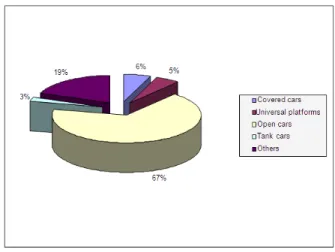
authorized experts of car facilities of Railway Transport Commission of CIS and Baltic countries two projects of freight car modernization were ap-proved [7]. According to this decision in Ukraine about 42 thousand of cars were modernized, the largest amount of which are open cars (Fig. 1).
Figure 1. Data of car modernization
Modernization of the freight car bogies is per-formed for both the repair costs reduction and im-provement of the technical and economic perform-ance in operation. Modernization involves the use of bearing (for bogie 18-100) ISB-12C, CCB and Preloud Plus, as well as spacer installation into the center pad, friction wedge with polyurethane plate and friction plate. Modernization with the use of
wear-resistant elements allows increasing the overhaul life of cars from 110 to 160 thousand of km. The interrepair time is also assumed to in-crease from 2 to 3 years.
Basic requirements for the construction of a new generation cars according to the “Program of rolling stock renovation” are the requirements that allow reducing the operating costs and enhance-ment the economic effectiveness of their use, tak-ing into account scientific and technical progress.
Problem definition. Owing to the urgency of
this subject, the task of scientists is devoted to one of the aspects of freight transportation efficiency enhancement, namely to the study of the various factors influence and characteristics of technical state of the freight cars running gears (which are bound to arise during operation) on their basic dy-namic parameters. The technical state of running gears deviations from normal condition of the wedge system of the bogie swing suspension also play an important role among them.
The famous domestic scientists have already carried out the research of the impact on the dy-namic qualities or the wheel wear (Doctor of tech-nical sciences, Professor Ye. P. Blokhin, V.D. Da-novych, Yu. V. Demin, M. L. Korotenko, О. М. Savchuk, V. F. Ushkalov).
Theoretical researches were conducted in motion of the empty and loaded freight cars with the bogie TsNII-Kh3 in the tangent and curved track sections of different radii with the given running speed. The study was conducted by numerical integration and mathematical modeling methods of the freight car dynamic loading using the software system “Dynam-ics of Rail Vehicles” (“DYNRAIL”).
Main part. It is commonly known, that the
set-ting of permissible car speeds in the tangent and curved track sections is a hard engineering task, which requires differential approach and takes into account the technical condition of the track super-structure (TS) and the running gears of the rolling stock [2].
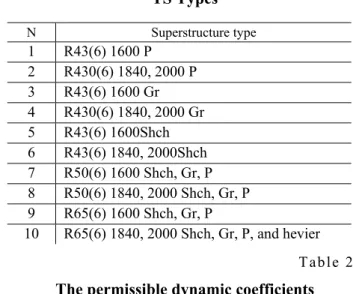
the type of the track superstructure (for curved track sections). According to these data the most durable of the chosen superstructure types are the R65(6) 1840, 2000Shch, Gr, P and heavier tracks, which allow moving with 90 km/h in both the curved and the tangent track sections. The use of these track marks allows motion in the minor ra-dius track section with the speed 70 km/h, which is much higher in comparison with the other marks.
a
b
Fig. 2. The running speed value, depending on the track superstructure for tangent (a) and curved (b) track
sections
The permissible running speeds were set on the results of dynamic coefficients with their permissi-ble values. The current recommended and permis-sible dynamic coefficients of the cars according to the “Standards” [5] are presented in the Table 2.
Wheels take the highest horizontal transverse forces from the tracks in the curved track sections [1]. These forces, especially in the minor radii curves, can for several times exceed the forces, arising during the vehicle hunting in the tangent track sections. A considerable amount of accidents and train wrecks caused by the lack of durability of the track or rolling stock construction, as well as the loss of their resistance happens in the curved track sections.
The values of the vertical and horizontal dy-namics coefficients, resistance coefficient, the
di-rective, side and frame forces during the vehicle motion in the curves, are necessary for the durabil-ity calculations of the track and rolling stock con-struction, for determination of the minimum radii of the curves, in which certain vehicles can be passed, as well as for the calculation of their resis-tance.
Table 1
TS Types
N Superstructure type 1 R43(6) 1600 P
2 R430(6) 1840, 2000 P 3 R43(6) 1600 Gr 4 R430(6) 1840, 2000 Gr 5 R43(6) 1600Shch 6 R43(6) 1840, 2000Shch 7 R50(6) 1600 Shch, Gr, P 8 R50(6) 1840, 2000 Shch, Gr, P 9 R65(6) 1600 Shch, Gr, P
10 R65(6) 1840, 2000 Shch, Gr, P, and hevier Table 2
The permissible dynamic coefficients for the freight cars
Criterion Loaded car Empty car
[VDC] 0.8 0.85
[HDC] 0.4 0.4
[CR] 1.3 1.3
[Нp/Ро] 0.3 0.38
[ah] 0.3 0.3 [аv] 0.6 0.7
Dynamic forces, affecting the car depend on many reasons. One of them is elastic and dissipa-tive characteristic in swing suspension.
Theoretical calculations dedicated to the impact research of different factors of the running gears technical condition of the freight cars (which are unavoidable to arise during operation) on their ba-sic dynamic coefficients. The clearances between bearers and the deviations of technical conditions of running gears from the normal state of the wedge system of bogie swing suspension also play an important role among them.
is provided [8]. In the majority of cases on the four-wheel freight car bogies on the post-Soviet space as the simplest ones the hard bearers are ing used. They are placed with the clearance be-tween the bogie bearer and the vehicle body, which allows swaging the vehicle body on the center plates till this clearance exists.
During the wedge dampeners of the friction force operation with the relative vertical and hori-zontal movement of the surfaces the friction of the wedges 1 on the friction plates 2 arises (Fig. 3).
Fig. 3. Installation diagram of bearers on the bogie 18-100^ 1 – wedge, 2 – friction plate
Size deviations in both the bearers and the wedge system, undoubtedly, influence the change of the car values. The level of this influence will be examined further.
Results. Theoretical researches of the influence
of bearer clearances on the freight car dynamic loading were conducted with nominal clearances in all four bearers, equal to 5 mm. This means that the total clearance on both sides of the car ends equaled 10 mm. Permissible clearance in the freight car depot repair is 6 - 16 mm in total for all types of eight-wheel cars except hoppers and dumpcars, for which this value is equal to 6 - 12 mm.
During calculation the clearances between bearers to 12.5 mm (i.e. 25 mm. in total that ex-ceeds the permissible depot repair value but occurs in operation) were examined.
In Fig. 3 (a– b) the resulted values of dynamic performance of the vertical dynamics coefficients (VDC) and coefficient of resistance against the wheel mounting of a wheel on a rail, as well as framed force value Hp and the vertical acceleration value in the center plate zone Zp during the open car motion in a curve with radius of 600 m.
The obtained results show that VDC and CR are higher than permissible values (Table 2).
How-ever, Zp value significantly increases with the run-ning speed of 80 and 90 km/h and reaches the max-imum value with 2,5 mm clearance. Perhaps, it is reasonable to reduce the permissible speed of 90 km/h to 75 km/h (Fig. 4–5).
a
b
Fig. 4 Dependence of the vertical dynamics coefficients (a) and the framed force of freight car on the clearance
in the bearers during motion in the curve with radius 600 m
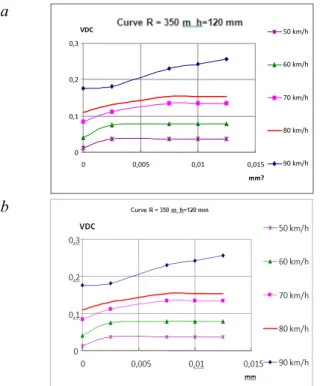
In the Fig. 6–7 the similar values of the dy-namic values during car motion in the curve with radius of 350 m are given. The results show that VDC and CR values are also higher than minimal permissible values (Table 2). The framed force value is almost 1.5 times exceeds the values ob-tained for the curve with 600 m radius, and the ac-celeration in the center plate zone is not a stable value when the running speed is 70 km/h. The permissible running speed in the minor radius curves should be considered at the level 65 km/h (Fig. 2, b).
The simultaneous increase or decrease of clear-ances in the bearers practically does not affect the dynamic values. Clearance changes in the bearers, located diagonally across the body, also do not af-fect the above mentioned values and the stability coefficients.
coefficients change within the clearance range from 5 to 0 mm and then become stable.
a
b
Fig. 5. Dependence of the vertical acceleration value in the center plate zone (a) and the resistance coefficient of
the freight car (b) on the clearance in the bearer during motion in a curve with the radius 600 m a
0 0,1 0,2 0,3
0 0,005 0,01 0,015
mm?
VDC 50 km/h
60 km/h
70 km/h
80 km/h
90 km/h
b
Fig. 6. Dependence of the vertical dynamics coefficient (a) and the framed force (b) on the clearance in the bearer during motion in the curve with the radius 350 m
During further increase of clearances in the bearers some degradation of the car dynamic
load-ing occurs. Hence, the value of nominal clearances up to 5 mm is substantiated.
a
b
Fig. 7. Dependence of the vertical acceleration value in the center plate zone (a) and resistance coefficient (b) of
the freight car on the clearance in bearer during motion in the curve with radius 350 m
As a result of calculations, it is also established that the total longitudinal clearance less than 7 mm (transverse less than 5 mm) is unacceptable. Since the “Standards” accept the minimal clearances: longitudinal clearance – 6 mm, transverse clear-ance – 5 mm, then these clearclear-ances are recom-mended to accept as the minimal ones.
In the research of the impact of deviations from normal condition of the bogie swing suspension wedge system on the dynamic loading of the car several conditions of the wedge system are studied [4, 9]:
- the normal condition, at which the damping factor is taken as 1;
- the condition of low friction that arises in the bogie design when the wedge is higher as compared to the normal condition; in that case the coefficient φ is taken as 0.2 or 0.5
- overdamped condition of the system, at which the coefficient φ is taken as 1.5;
Conclusions. As a result of the research the dependencies of the eight-wheel freight car on the bearer parameters, taking into account the running speed were obtained. Thus, the resulted calcula-tions allow for an objective assessment the impact of the technical condition of the car running gears on the traffic safety factors.
LIST OF REFERENCE LINKS
1. Вериго, М. Ф. Взаимодействие путии подвиж
-ногосостава / М. Ф. Вериго, А. Я. Коган. – М. : Транспорт, 1986. – 560 с.
2. Данович, В. Д. Определение допускаемых ско
-ростей движения грузовых вагонов по ж.-д. пу
-тямколеи 1520 мм / В. Д. Данович, В. В. Рыбкин, С. В. Мямлин, А. Г. Рейдемейстер, А. Г. Трякин, Н. В. Халипова // ВісникДніпропетр. нац. ун-ту залізн. трансп. ім. акад. В. Лазаряна – Д. : ДНУЗТ, 2003. – Вип. 2. – С. 77–86.
3. Костюк, М. Д. Железнодорожный потенциал
Украины / М. Костюк // Евразия. Вести. – 2009. – № 11. – С. 14.
4. Луханин, Н. И. Динамика грузовых вагонов с
учетом поперечного смещения тележек /
Н. И. Луханин, С. В. Мямлин, Л. А. Недужая, А. А. Швец / Зб. наук. праць ДонІЗТ. – 2012. – Вип. 29. – С. 234–241.
5. Нормы для расчета и проектирования вагонов
железных дорог МПС колеи 1520 мм (несамо
-ходных). – М. : ГосНИИВ – ВНИИЖТ, 1996. –
352 с.
6. Свидетельство о регистрации авторского права
на произведение №7305. Компьютерная про
-грамма «Dynamics of Rail Vihscles»
(«DYN-RAIL») / МямлинС. В.; зарегистр. 20.03.2003.
7. Сергиенко, Н. И. Состояниеиперспективыраз
-вития вагонного хозяйства Укрзализныци /
Н. И. Сергиенко // Вагонный парк. – 2011. –
№ 9. – С. 4–13.
8. Шадур, Л. А. Вагоны: Конструкция, теория и
расчет : учебникдля ВУЗовж.-д. трансп. / ред. Л. А. Шадура. – М. : Транспорт, 1980. – 440 с. 9. Myamlin, S. Spatial Vibration of Cargo Cars in
Computer Modelling with the Account of Their In-ertia Properties / S. Myamlin, A. Ten, L. Neduzha, A. Shvets // Mechanika 2010 (8.04.2010 – 9.04.2010) : proc. of 15th International Conference. – Kaunas : Kaunas University of Technology, 2010. – Р. 325–328.
С
.
В
.
МЯМЛИН
1,
Л
.
А
.
НЕДУЖАЯ
2*,
А
.
А
.
ТЕН
3,
А
.
А
.
ШВЕЦ
21Проректорпонаучнойработе, Днепропетровскийнациональныйуниверситетжелезнодорожноготранспортаимени академикаВ. Лазаряна, ул. Лазаряна, 2, 49010, Днепропетровск, Украина, тел./факс +38 (056) 793 19 03, эл. почта
2*Каф. «Строительнаямеханика», Днепропетровскийнациональныйуниверситетжелезнодорожноготранспортаимени академикаВ. Лазаряна, ул. Лазаряна, 2, 49010, Днепропетровск, Украина, тел./факс +38 (056) 793 19 03, эл. почта
3«Промтрактор–Вагон», ул. Ильича, 1а, 429332, Канаш, РоссийскаяФедерація, тел./факс +78 (83533) 2 55 65, эл. почта
ОПРЕДЕЛЕНИЕ
ДИНАМИЧЕСКИХ
ПОКАЗАТЕЛЕЙ
ГРУЗОВЫХ
ВАГОНОВ
С
УЧЕТОМ
ТЕХНИЧЕСКОГО
СОСТОЯНИЯ
СКОЛЬЗУНОВ
Цель.Железнодорожныйтранспортиграетважнуюрольвсоциально-экономическойжизнигосударства
иосуществляетбольшойобъемперевозочнойработы. Транспортнаяотрасльдолжнадвигатьсявнаправле
-нииинновационных изменений, повышать свое значение как важнойтранзитной подсистемы напути об
-новлениянетолькоинфраструктуры, ноистратегиивсехсоставляющихперевозочногопроцесса, втомчис
-леи приработевовзаимосвязи сдругими видамитранспорта. Насовременномэтапе жизнь ставитперед
железнодорожнойотраслью стратегическиезадачи, основныесредикоторых: развитие скоростногодвиже
-нияпоездов, увеличениемассыгрузовыхпоездов, разработкановогоподвижногосоставаит. п. Всвязис
актуальностьюданнойтематикиперед ученымипоставленазадача, посвященнаяодномуизаспектов повы
-шенияэффективностигрузовыхперевозок, аименно - исследованиювлиянияразличныхфакторовихарак
-теристиктехническогосостоянияходовыхчастейгрузовыхвагонов (которыенеизбежновозникаютприих
эксплуатации) наихосновныединамическиепоказатели. Срединихважнуюрольиграютиотклонениятех
-ниятележки. Цельданнойработыпосвященаисследованиювлияния различныхфакторовтехническогосо
-стоянияходовыхчастейгрузовыхвагонов (отклонениеразмеровкаквскользунах, такивклиновойсистеме
вовремяэксплуатации) наихосновныепоказатели – коэффициентыгоризонтальнойивертикальнойдина
-мики, ускорениекузова, рамная сила, коэффициентустойчивостиотсходасрельсов. Методика.Исследо
-вание проводилосьметодом численногоинтегрированияи математического моделирования динамической
нагруженности грузового вагона с использованием программного комплекса «Dynamics of Rail Vehicles»
(«DYNRAIL»). Результаты. Врезультате исследованийпоопределениюдинамических показателейгрузо
-выхвагоновсучетом технического состоянияскользуновполучены зависимостиосновных динамических
показателейгрузовоговагонаотпараметров скользунов (зазороввскользунахисостоянияклиновойсисте
-мырессорногоподвешиваниятележек) сучетомскоростидвижениявпрямыхикривыхмалогоисреднего
радиусаучастковпути. Научнаяновизна. Определеновлияниетехническогосостоянияходовыхчастейва
-гонанафакторы безопасностидвижения. Практическая значимость.Результатытеоретических исследо
-ваний по определению динамических показателей грузовых вагонов с учетом технического состояния
скользуновгрузовыхвагоновпозволяютобъективнооценитьвлияниетехническогосостояниятележекгру
-зовых вагонов в части параметровскользунов на показатели безопасности движения на железнойдороге
(коэффициентыгоризонтальнойивертикальнойдинамики, ускорениекузова, рамнаясила, коэффициентус
-тойчивостиотсходасрельсов).
Ключевые слова: грузовые вагоны; скользуны тележек; скорость движения; прямые и кривые участки
пути; динамическиепоказатели
С
.
В
.
МЯМЛІН
1,
Л
.
О
.
НЕДУЖА
2*,
О
.
О
.
ТЕН
3,
А
.
О
.
ШВЕЦЬ
21Проректорзнауковоїроботи, ДніпропетровськийнаціональнийуніверситетзалізничноготранспортуіменіакадемікаВ. Лазаряна, вул. Лазаряна, 2, 49010, Дніпропетровськ, Україна, тел./факс. +38 (056) 793 19 03, ел. пошта
2*Каф. «Будівельнамеханіка», ДніпропетровськийнаціональнийуніверситетзалізничноготранспортуіменіакадемікаВ. Лазаряна, вул. Лазаряна, 2, 49010, Дніпропетровськ, Україна, тел./факс. +38 (056) 793 19 03, ел. пошта [email protected]
3«Промтрактор–Вагон», вул. Илліча, 1а, 429332, Канаш, РосійськаФедерація, тел./факс +78 (83533) 2 55 65, ел. пошта
ВИЗНАЧЕННЯ
ДИНАМІЧНИХ
ПОКАЗНИКІВ
ВАНТАЖНИХ
ВАГОНІВ
З
УРАХУВАННЯМ
ТЕХНІЧНОГО
СТАНУ
КОВЗУНІВ
Мета.Залізничнийтранспорт відіграєважливу рольусоціально-економічномужиттідержавитаздійс
-нюєвеликийобсягперевізноїроботи. Транспортнагалузьповиннарухатисявнапрямкуінноваційнихзмін,
підвищуватисвоєзначенняякважливоїтранзитноїпідсистеминашляхуоновленнянетількиінфраструкту
-ри, айстратегіївсіхскладовихперевізногопроцесу, втомучислііприроботіувзаємозв’язкузіншимиви
-дамитранспорту. Насучасному етапіжиттяставить передзалізничною галуззюстратегічнізадачі, основні
середяких: розвиток швидкісногорухупоїздів, збільшеннямасивантажнихпоїздів, розробкановогорухо
-могоскладутощо. Взв’язкузактуальністюцієїтематикипереднауковцямипоставленазадача, присвячена
одномузаспектівпідвищенняефективностівантажнихперевезень, асаме – дослідженнювпливурізнихфа
-кторівтахарактеристиктехнічного стануходовихчастинвантажнихвагонів (якінеминучевиникаютьпри
їхексплуатації) наїхосновнідинамічніпоказники. Середнихважливурольвідіграєівідхиленнятехнічного
стану ходових частин віднормального стану клинової системи ресорного підвішування візка. Мета даної
роботиприсвяченадослідженнювпливурізнихфакторів технічногостануходовихчастинвантажнихваго
-нів (відхиленнярозмірівяквковзунах, таківклиновійсистеміпідчасексплуатації) наїхосновніпоказники
– коефіцієнтигоризонтальноїтавертикальноїдинаміки, прискореннякузову, рамнасила, коефіцієнтстійко
-стівідсходузрейок. Методика.Дослідженняпроводилосьметодомчисельногоінтегруваннятаматематич
-ногомоделюваннядинамічноїзавантаженості вантажноговагонузвикористаннямпрограмногокомплексу
«Dynamics of Rail Vehicles» («DYNRAIL»). Результати. Врезультатідослідженьщодовизначеннядинаміч
-нихпоказниківвантажнихвагонівзурахуваннямтехнічногостануковзунівотриманозалежностіосновних
динамічнихпоказників, вантажноговагонувідпараметрівковзунів (зазоріввковзунахтастануклиновоїси
-стемиресорногопідвішуваннявізків) зурахуваннямшвидкості рухунапрямихтакривихмалоготасеред
на фактори безпеки руху. Практична значимість. Результати теоретичних досліджень щодо визначення
динамічнихпоказниківвантажнихвагонівзурахуваннямтехнічногостануковзунівдозволяютьоб`єктивно
оцінитивпливтехнічногостанувізківвантажнихвагоніввчастиніпараметрівковзунівнапоказникибезпе
-кирухуназалізниці (коефіцієнтигоризонтальноїтавертикальноїдинаміки, прискореннякузову, рамна си
-ла, коефіцієнтстійкостівідсходузрейок).
Ключовіслова: вантажнівагони; ковзунивізків; швидкістьруху; прямітакривіділянкиколії; динамічні показники
REFERENCES
1. Verigo M.F., Kogan A.Ya. Vzaimodeystviye puti i podvizhnogo sostava [Railway track and rolling stock inter-action]. Moscow, Transport Publ., 1986. 560 p.
2. Danovich V.D., Rybkin V.V., Myamlin S.V., Reydemeyster A.G., Tryakin A.G., Khalipova N.V. Opredeleniye dopuskaemykh skorostey dvizheniya gruzovykh vagonov po zh.-d. putyam kolei 1520 mm [Permissible veloci-ty determination of the freight cars on the railroads with the 1520 mm.track]. Vіsnik Dnіpropetrovskoho natsionalnoho universytetu zalіznychnoho transportu іmeni akademika V. Lazaryana [Bulletin of Dnipropet-rovsk National University of Railway Transport named after Academician V. Lazaryan], 2003, issue 2, pp. 77-86.
3. Kostyuk M.D. Zheleznodorozhnyy potentsial Ukrainy [Railway potential of Ukraine]. Yevraziya. Vesti – Eurasia. News, 2009, no. 11, pp. 14.
4. Lukhanin N.I., Myamlin S.V., Neduzhaya L.A., Shvets A.A. Dinamika gruzovykh vagonov s uchetom poperechnogo smeshcheniya telezhek [Freight cars dynamics, taking into account transversal displacement of the bogies]. Zbіrnik naukovykh prats Donetskoho instytutu zaliznychnoho transportu –Proceedings of the Do-netsk Railway Transport Institute, 2012, issue 29, pp. 234-241.
5. Normy dlya rascheta i proektirovaniya vagonov zheleznykh dorog MPS kolei 1520 mm (nesamokhodnykh) [Standards for design and construction of railroads with 1520 mm. track cars (non–self–propelled)]. Moscow, GosNIIV –VNIIZhT Publ., 1996. 352 p.
6. Myamlin S.V. Computer«Dynamics of Rail Vihscles » («DYNRAIL»). Certificate of copyright registration on the invention, no. 7305, 2003.
7. Sergiyenko N.I. Sostoyaniye i perspektivy razvitiya vagonnogo khozyaystva Ukrzaliznytsi [Condition and de-velopment prospects for Ukrzalinytsia’s car facilities]. Vagonnyy park – Wagon fleet, 2011, no. 9, pp. 4-13. 8. Shadur L.A. Vagony: Konstruktsiya, teoriya i raschet [Cars: construction, theory and calculation]. Moscow,
Transport Publ., 1980. 440 p.
9. Myamlin S., Ten A., Neduzha L., Shvets A. Spatial Vibration of Cargo Cars in Computer Modelling with the Account of Their Inertia Properties. Proceedings of 15th International Conference “Mechanika 2010”. Kaunas, 2010, pp. 325-328.
Prof. V. L. Horobets, D.Sc. (Tech); Prof. O. O. Beygul, D.Sc. (Tech) recommended this article to be published