IC, 2016 – 12(5): 1157-1191 – Online ISSN: 1697-9818 – Print ISSN: 2014-3214 http://dx.doi.org/10.3926/ic.759
Effect of ingratiation on supervisor satisfaction through
helping behavior: A moderated mediation model
Muhammad Ali Asadullah 1, Sajid Haider 2, Carmen De Pablos Heredero 3,
Mariam Musaddiq 1
1Air University Multan Campus (Pakistan)
2Department of Management Sciences, COMSATS Institute of Information Technology, Vehari Campus (Pakistan) 3Universidad Rey Juan Carlos (Spain)
[email protected], [email protected], [email protected], [email protected]
Received February, 2016 Accepted August, 2016
Abstract
Purpose: This research intends to investigate the mediating role of helping behavior in relationship between employee ingratiation and supervisor satisfaction across high and low levels of ingratiation behavior, and answers the questions: how, when and why ingratiation is effective.
Design/methodology: Data were collected through questionnaire surveys in hotel industry, and structural equation modelling was applied to analyze these data by using hypothetical-deductive approach.
Research limitations/implications: This study is not experimental in nature, but a cross-sectional design has been followed. Future research can focus on an experimental design by incorporating a time element, and the design and analysis should be nested since this study did not use multilevel analysis. Moreover, this study used only two forms of ingratiation for measuring employee ingratiation behavior. We suggest researchers to consider all four dimensions of ingratiation by using some distinct scales.
Practical implications: This research explains mechanisms underlying supervisor-subordinate relationship, and contributes to organizational behavior research by answering the question; 'when and how ingratiation could be effective?' The findings of this study have important managerial implications, and provide future lines of research.
Social implications: The findings of this research demonstrate that ingratiation is an important tool for satisfying superiors if employees exhibit helping behaviors towards coworkers and supervisors. Particularly, new employees can benefit from ingratiation to socialize within work organizations. Moreover, existing employees can use ingratiation to establish as well as maintain better social relations with supervisors and colleagues.
Originality/value: Previous research emphasized more on customer-directed employee ingratiation but this study offers its contribution by emphasizing coworker as well as supervisor directed employee ingratiation. Moreover, this study measures effectiveness of ingratiation in terms of employee task performance representing supervisor satisfaction.
Keywords: Ingratiation, Helping Behavior, Supervisor Satisfaction, Mediation, Moderation
Jel Codes: M1, L1
1. Introduction
performance seems to focus on employee’s personality and ability to perform a specific job (Kolo, 2006). In this regard, social interaction processes have been relatively less explored (Hackman, 1986; Liden & Mitchell, 1988). Hence, there is need to work on social interaction processes to understand how, other than personality and ability, employees make efforts to achieve supervisor satisfaction.
As careers are evolving expeditiously, the importance of self management and social interactions is increasing among employees (Arthur & Rousseau, 1996; Wu, Kwan, Wei & Liu, 2013). In addition to career growth, the need for effective impression management (Harris, Kacmar, Zivnuska & Shaw, 2007) resulting from high work pressures also increases the importance of social interactions targeted at supervisors. In many service organizations employees closely interact with their supervisors. Usually, these employees remain under high pressure of their supervisors’ demands for exhibiting high professional attitudes towards customers. Moreover, heavy workloads make them victims of work-family and work-family-work conflicts (Choi & Kim, 2012; Davidson, Timo & Wang, 2010; Deery, 2008). Consequently, they experience high emotional labor, become highly demotivated and dissatisfied, develop high turnover intentions and their job performance reduces. Lost in these problems, they are more likely to involve themselves in supervisor-focused social influence tactics for developing and maintaining their impression in front of their supervisors (Ma & Qu, 2011).
Insights from Goffman’s (1959) theory of impression management suggest that people engage in self presentation to control others' reactions to them (Leary & Kowalski, 1990, pp. 37). As an impression management tactic, ingratiation is a deliberate effort of an employee to display those behaviors which are usually preferred by his or her supervisor or organization (Appelbaum & Hughes, 1998). Ingratiation refers to “those episodes of social behavior that are designed to increase the attractiveness of the actor to the target” (Jones, 1964, pp. 2). It enables people to acquire social influence on behalf of social relations (Jones, 1964). Ingratiation directed upwards in organizational hierarchy usually targets supervisors (Porter, Allen & Angle, 1981; Ralston, 1985). Supervisor-attributed motivation theory explains that employees ingratiate their supervisors either to maintain and manage their impression, or to satisfy prosocial motives (Ashford & Cummings, 1983; Ashford & Tsui, 1991; Grant, 2008; Lam, Huang & Snape, 2007). However, little empirical evidence exists on the relationship between employee ingratiation and supervisor satisfaction.
Duke, Adams and Thatcher (2007) reported that ingratiation facilitates employees in achieving personal as well as career goals. However, they found that supervisors rated lower those subordinated who were highly engaged in ingratiation behavior. Empirical evidence suggests that ingratiation does not always result in positive consequences. For instance, Park, Westphal and Stern (2011) investigated how ingratiation increases overconfidence of a CEO leading him towards biased strategic decision making. Ingratiation can lead employees to distress, particularly, if the employee is lacking political skills (Wu, Yim, Kwan & Zhang, 2012). This swing of pendulum between positive and negative poles of ingratiation outcomes requires researchers to understand mechanisms underlying the relationship between employee ingratiation and supervisor satisfaction (Beehr et al., 2006). Examining such mechanisms can strengthen this line of research. However, less attention has been paid to identify and examine the factors explaining this relationship.
2. Theoretical Framework and Hypotheses
2.1. Employee ingratiation and supervisor satisfaction
As already discussed, ingratiation is an impression management tactic which refers to the process used by people for controlling others’ impression toward them (Goffman, 1959; Leary & Kowalski, 1990). According to Jones (1964) ingratiation is a "class of strategic behaviors illicitly designed to influence a particular other (...) concerning the attractiveness of one's personal qualities" (1964, pp. 11). From this definition, one can imagine that the major purpose of exhibiting ingratiation is to influence someone. As discussed earlier, evidence from existing literature shows that we can expect both positive and negative consequences of ingratiation. However, the important point is to understand why employees continue ingratiating their supervisors if they face negative consequences also. Ingratiation is neither a disease nor a psychological disorder. It can discourage a normal and healthy ingratiator to exhibit more ingratiation if he or she remains unsuccessful in achieving desired behaviors or receives negative behaviors from superiors. Insights from the Theory of Reasoned Action (Fishbein & Ajzen, 1975) and Reinforcement Theory (Skinner, 1963, 1971) inform that a person involves in a certain behavior after considering its consequences. Moreover, these theories assume that a person’s association with a specific behavior is not only because of internal elements (i.e. personality) but the external factors also influence his or her behavior towards a particular direction. Ralston (1985) argued that ingratiation is not only individually initiated but also organizationally induced phenomenon. In other words, an ingratiator’s individual action is not the only source of ingratiation; organizational factors also require her or him to exhibit such behavior. It is quite possible that an employee involves in ingratiation because the supervisory behavior in the organization requires that, or gives positive acceptance to such behavior. If this is the case, it is also possible that supervisors show more satisfaction towards ingratiating employees. Vroom’s (1964) Expectancy Theory guides that a person’s use of influence tactic happens after the cognitive evaluation of the success or failure resulting from it. People choose to exhibit a behavior or take an action for which their perceptions of success are high, and they expect the results beneficial to them (Steizel & Rimbau-Gilabert, 2013). Based on this discussion, we expect that employees involve in supervisor-focused ingratiation because it satisfies their supervisors.
2.2. Employee Ingratiation and Helping Behavior
Although the relationship between employee ingratiation and supervisor satisfaction can be established based on existing theory and evidence, the mechanisms underlying this relationship are not clear yet. This research introduces employee helping behavior as a factor clarifying the relationship between ingratiation and supervisor satisfaction. In order for a factor to act as a clarifying or mediator variable, independent variable should significantly predict it (Baron & Kenny, 1986). Therefore, there is a need to develop argument for the association between ingratiation and helping behavior.
Various researchers investigated ingratiation to advance theory and research, but a few of them addressed its effectiveness. Positive psychology guiding individuals to behave more effectively (Gable & Hadit, 2005; Seligman & Csikszenmihalyi, 2000) can help in determining effectiveness of ingratiation. The researchers of positive psychology are interested in finding out organizationally favorable employee behaviors like organizational citizenship behavior (OCB), to improve strategic effectiveness of an organization (Ghalamkari, Mahmoodzadeh, Barati, Isah-Chikaji, Alkali & Anvari, 2015). The studies investigating the relationship between ingratiation and helping behavior are very limited. A mere exception is the work of Eastman (1994) who investigated relationship between ingratiation and OCB, and argued that ingratiation and OCB, which were previously considered distinct from each other, are in fact similar and intertwined. Further, Nguyen, Seers and Hartman (2008) found that ingratiation and OCB are positively associated. Since, helping behavior is also a form of OCB (Bateman & Organ, 1983; Eastman, 1994) this study assumes positive association of ingratiation and helping behavior.
similar situation. The principal of reciprocity (Gouldner, 1960; Cialdini, 2001) also supports the notion that people have a greater tendency to like those people who like them. It means that ingratiation from a coworker may lead an employee to like him/her and obviously, any individual is highly likely to help those whom he/she likes more. When all this happens, the supervisors and coworkers observing this phenomenon can make positive attributions of the existence of helping behaviors in their team. Although inconsistent in Eastman’s (1994) sense, the illusionary attributions of OCBs for these ingratiation behaviors are likely to create a spillover effect towards real helping behaviors in teams. We agree with Jones & Wortman (1973) and Gurevitch (1985) that employees identified as ingratiators are considered ineffective, and face negative attitudes from others. Nevertheless, our previous discussion based on the principal of reciprocity and other theories reveals that despite its negative image in the eyes of beholder (Eastman, 1994) ingratiation has ability to create an environment of helping behaviors within teams. Consequently, these helping behaviors can satisfy not only coworkers but also supervisors. Based on previous arguments, this study assumes that employees, using ingratiation as an influence tactics, are highly likely to exhibit helping behavior. Thus, we hypothesize that ingratiation and helping behavior are positively associated with each other.
Hypothesis 2: Employee’s ingratiation behavior is positively associated with his/her helping behavior toward coworkers and supervisor.
2.3. Helping Behavior and Supervisor Satisfaction
Employee behavior inside an organization is categorized as in-role and extra role behavior (Katz, 1964). In-role behavior is based on routine jobs and is part of employee job description while extra-role behavior, as already described, is discretionary and positive that goes beyond formal job descriptions. Based on the increasing need to differentiate among extra role and in-role behaviors, Van Dyne, Cummings and McLean Parks (1995) developed typology of extra role behaviors and described that extra role behavior are primitive or prohibitive and affiliative or challenging. Promotive behaviors cause or promote a behavior to occur, whereas prohibitive behaviors prevent or stop an employee to experience inappropriate or unethical behavior. Affiliative behaviors are interpersonal and other-oriented which strengthen relationships whereas challenging behaviors are change-other-oriented and damage relationships.
helping behaviors in his/her team members. Thus, this study hypothesizes that helping behavior is positively associated with supervisor satisfaction.
Hypothesis 3: Employee’s helping behavior toward coworkers and supervisor is positively associated with supervisor satisfaction.
2.4. Mediating Role of Helping Behavior
Impression management tactic could be verbal or nonverbal (Peters & Lievens, 2006). Verbal tactics are either assertive or defensive. Assertive verbal tactics are other-focused, and are used to construct self-image. Liden and Mitchel (1988) demonstrated four reasons for an employee to demonstrate ingratiation: desire to be liked; to maintain a positive image as attractive (Cooper & Fazio, 1984; Festinger, 1957) and competent; to enhance the self (Epstein, 1973) and to fulfill defensive and assertive needs (Tedeschi & Melburg, 1984). Ingratiation is an assertive, other- focused, verbal impression management tactic (Peters & Lievens, 2006) that employees use to satisfy their assertive needs like expected positive reactions of other employee (Tedeschi & Melburg, 1984) including high supervisor ratings. Thus, supervisor satisfaction acts as an assertive need that drives an employee to ingratiate their supervisors. Supervisor-attributed motive theory distinguished between two different categories of supervisor-attributed motives, i.e. pro-social motives and impression management motives (Ashford & Cummings 1983; Ashford & Tsui, 1991; Grant, 2008; Lam et al., 2007). However, supervisors are highly likely to interpret employee's intentions to ingratiate (Thomas & Pondy 1977) that makes ingratiation risky for employees (Liden & Mitchell, 1988). Particularly, the employee could be at a greater disadvantage if ingratiation motives are instrumental in nature, like acquiring resources (Ralston, 1985) or to ensure career success (Ferris, Frink, Beehr & Gilmore, 1995).
Helping is sub-dimensions of organizational citizenship behavior that is highly appreciated by supervisors (Van Dyne & LePine, 1998). Helping could be both verbal as well as nonverbal in nature that is either an assertion or a defensive impression management tactic. The classification of helping behavior by Spitzmuller and Van Dyne (2013) as proactive is an assertive impression management tactic whereas reactive form of helping is a defensive impression management tactic. It is important to note that defensive impression management tactics are used to repair one’s image therefore helping behavior could serve as a fruitful mechanism for any employee to overcome the risk associated with ingratiation and to balance ingratiation and supervisor reaction relationship. Therefore, helping behavior could easily facilitate employee to bridge ingratiation and supervisor satisfaction relationship.
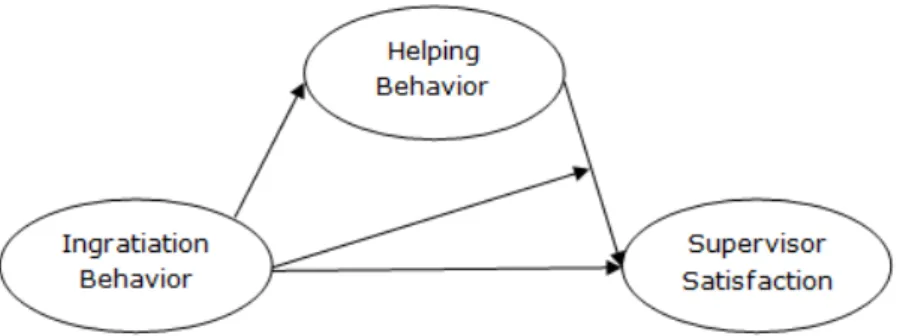
Based on hypothesis one and two, and discussion about the correlation of ingratiation and helping behavior (Organ, 1988), it can be assumed that helping behavior toward coworkers and supervisor, positively predicts supervisor satisfaction because the ingratiator is forced to exhibit helping behavior to achieve balance due to supervisors’ hierarchical position. Therefore, this study hypothesizes that helping behavior mediates the relationship between employee ingratiation and supervisor satisfaction. The general notion is that subordinate ingratiates supervisor to achieve favorable supervisor sentiments, but cannot achieve balance due to the greater formal power of supervisor. Thus, subordinate fills this gap by exhibiting helping behavior. Since helping behavior positively affects quality of work (Susskind et al., 2007) it can be expected that supervisor’s satisfaction for that employee will increase. Thus, this study hypothesizes that:
Hypothesis 4: Employee helping behavior toward coworkers and supervisor mediates the relationship between ingratiation behavior and supervisor satisfaction.
2.5. Moderating Role of Ingratiation Behavior
Owing to conflicting empirical evidences, researchers are still investigating “in what situations or when can ‘helping’ bring positive consequences for the actor?” Such questions are most often answered through moderation analysis (Hayes, 2012, pp. 2). This study investigates moderating effect of employee ingratiation on the relationship between helping behavior and supervisor satisfaction. Ingratiation is a political skill, and political skills can strongly affect impression management techniques as described by social influence theory (Levy, Blatt & Shaver, 1998). As a political influence tactic, ingratiation can strongly influence the relationship between helping behavior and supervisor satisfaction. The employee receives a less favorable impression from a supervisor in situations where extra role behaviors are interpreted as impression management motives. However, employee expects positive attribution of ingratiation from supervisor (Castro, Douglas, Hochwarter, Ferris & Frink, 2003; Johnson, Smith-McLallen, Killeya & Levin, 2004). Balance Theory (Heider, 1958) and the principle of reciprocity (Jones, 1964) both support that ingratiation makes the target feel great and balance or reciprocate with positive exchanges. For instance, if a subordinate does those things which supervisor likes, the supervisor may uphold positive stance about employee to make a balance. Similarly, if subordinates do those things which supervisor dislikes, the supervisor holds negative attitude towards subordinates (Wu et al., 2013). Thus, ingratiation may moderate the relationship between helping and supervisor satisfaction and employees may achieve higher supervisor ratings even in situations when the supervisor responds less favorably to helping (as extra role behavior). Political skills enable individuals to comprehend other and control the situations (social influence theory (Levy et al., 1998)). Therefore, it is highly likely that individuals who demonstrate high ingratiation behavior are capable of achieving higher supervisor ratings as compared to employees who exhibit low ingratiation behavior. Ferris et al. (2005) found that employees having better political skills can obtain better job performance appraisal. Since ingratiation is also a political influence tactic, employees who use ingratiation in the situation when their helping behavior is not resulting in positive consequences are highly likely to obtain higher performance ratings from their supervisors. Based on these arguments, this study hypothesizes that ingratiation moderates the relationship between helping behavior and supervisor satisfaction.
2.6. Moderated Mediation
The fourth hypothesis of the study stated that helping behavior mediates the relationship between ingratiation and supervisor satisfaction, and the fifth hypothesis assumed the moderating role of ingratiation between helping and supervisor satisfaction. The sequence of these hypotheses signifies moderated mediation that occurs when the mediating effect of a variable depends upon the level of a third variable (Bauer, Preacher & Gil, 2006; Edwards & Lambert, 2007). As stated earlier, mediation facilitates researchers in answering questions of ‘how’ and moderation facilitates them in answering questions of ‘when’ (Hayes, 2012). Unfortunately, methods for answering ‘how’ and ‘’when’ questions simultaneously were still lacking which could have led to incomplete explanations of the mechanisms (Hayes, 2012). Introduction of moderated mediation methodology facilitates researchers to answer ‘how’ and ‘why’ questions together. The authors benefitted from moderated mediation approach and tested if mediating role of helping between ingratiation and supervisor satisfaction differs across high and low ingratiation behavior.
Ingratiation is an assertive influence tactic that could alter supervisors’ perception regarding the employee. The intensity of ingratiation may determine the level of significance of the mediating role of helping behavior between ingratiation and supervisor satisfaction. Particularly, this indirect effect would be insignificant for employees who exhibit low ingratiation and significant for employees who exhibit high ingratiation behavior. Thus, we hypothesized that:
Hypothesis 6a: The mediating role of helping behavior between employee ingratiation and supervisor satisfaction would be significant for employees demonstrating high ingratiation.
Hypothesis 6b: The mediating role of helping behavior between employee ingratiation and supervisor satisfaction would be insignificant for employees demonstrating low ingratiation.
3. Research Methodology
3.1. Sample
Front line employees in service organizations directly interact with customers as well as their supervisors who evaluate their performance in terms of service delivery. Any customer complaint could make an employee’s position more vulnerable in front of their supervisors. Such employees could exhibit ingratiation to obtain favorable ratings from supervisors. Thus, participants in this study were front line employees and their supervisors working in the hotel industry of federal capital Islamabad, Pakistan. Islamabad, being the capital city, is synchronized with other cities of the world, and has a modern culture. Overall, the culture of Islamabad is a mix of Islamic, Western, and Indian cultures. The survey took place during September-October 2015. This study used a purposive sampling method to collect data from key informants, i.e. frontline employees and their supervisors, who were able to provide us with relevant information. The ability of participants to understand the objective of this research and provide relevant information makes the sample important. Data were collected from 168 supervisors and 453 subordinates working in 35 hotels (2 to 3 star) located in Islamabad, the capital of Pakistan. The majority of hotels in Islamabad are 2 to 3 star nationally owned hotels. These hotels were focused for data collection due to easy access to supervisors and employees. The major occupants of these hotels are government officials, employees of national and international organizations, and a small number of tourists. The supervisors and employees in these hotels are Pakistani nationals. Five star hotels are small in number, and researchers’ access to these hotels involves complex processes, and these hotels were not included for the purpose of simplicity and time saving. Each of the supervisors in selected hotels rated employees’ helping behavior and their satisfaction with employees in terms of employee task performance. The supervisor rated at least three employees working under his/her supervision. The subordinates provided their ratings regarding ingratiation. We obtained minimum four cases from each hotel.
3.2. Procedures
Therefore, the survey was administered in English language. A cover letter with the questionnaires that sought the consent of participants and ensured the privacy of data was attached. First, questionnaires were distributed among supervisors containing items of employee proactive helping behavior and supervisor satisfaction. Supervisors were requested to provide their ratings on helping behavior and performance of employees working under their supervision since, at least, one year. Each supervisor provided ratings about three employees at minimum. A coding scheme to match the responses of supervisors with relevant employees was used. Then corresponding employees were contacted to obtain ratings on ingratiation behavior. We did not disclose employees that we have already obtained information from their supervisors about them. Terms as ‘ingratiation’ were avoided to remove any kind of perceptual biases and positive terms like ‘opinion conformity’ were used while explaining them the purpose of study.
3.3. Measures
3.3.1. Employee - Provided Measures
3.3.1.1. Ingratiation Behavior
Four different dimensions of ingratiation have been reported in literature, which include
• Flattery,
• opinion Conformity,
• self-promotion, and
• favor.
5-point Likert-type scale in which first two items were measured on the scale ranging from 1= ‘not at all’ to 5= ‘to a very great extent’ and the rest of 7 items were measured on a scale ranging from 1= ‘never’ to 5= ‘very frequently.’ The sample item included ‘over the past six months, how often have you complimented the supervisor about his/her insight on a particular work related issue?’ The internal consistency reliability of the scale (Cronbach’s alpha) was 0.85.
3.3.2. Supervisor- Provided Measures
3.3.2.1. Supervisor Satisfaction
Supervisor’s satisfaction was measured using 7-item scale developed by Williams and Anderson (1991). All items were measured on a five point Likert scale ranging from 1= not at all to 5= extremely. The sample item included ‘This employee engages in activities that will directly affect his/her performance appraisal.’ The internal consistency reliability of the scale (Cronbach’s alpha) was 0.67.
3.3.2.2.Helping Behavior
3.3.2.3.Control Variables
According to Treadway et al. (2007), gender and tenure are significant predictors of ingratiation. Similarly, gender could also affect performance ratings (Bowen, Swim & Jacobs, 2000). Thus, we introduced age, gender, and tenure as control variables. 83% of the respondents were male and 17% were female. Since the duration of an employee’s interaction with supervisor due to full time and part time work arrangement could affect a supervisor’s perception about an employee’s performance, work arrangement (part time/full time) was introduced as a control variable. 88% of respondents were full time employees and 12% were part time employees. The education level of an employee was introduced as control variable because it could affect his/her quality of work, and consequently could develop positive or negative perceptions about him/her in the eyes of supervisor. 56% respondents had completed 16 years of education, 24% had completed 14 years of education, and the rest of 20% had completed 12-year education.
3.4. Results
The data analysis process began with a preliminary data screening and checking for different assumptions. The detail of mean, standard deviation, and correlations between independent, dependent, and mediating variables is given in Table 1. The table demonstrates that the correlation between ingratiation and helping is positive and moderate. Similarly, the correlation between helping and supervisor satisfaction is also positive and moderate.
Mean SD HB IB
Helping Behavior(HB) 3.55 1.062 1
Ingratiation Behavior(IB) 3.84 1.045 .318** 1
Supervisor Satisfaction(SS) 3.89 .715 .317** 0.09
**. Correlation is significant at the 0.01 level (2-tailed); *. Correlation is significant at the 0.05 level (2-tailed).
Table 1. Mean, Standard Deviation (SD) and Correlations
whereas the values of baseline comparison indices were above 0.90 that demonstrated perfect fit (Table 2).
CMIN/DF RMR CFI TLI RMSEA
Model 1: Ingratiation Behavior 2.54 .025 .995 .987 .060
Model 2: Helping Behavior 2.27 .034 .992 .983 .054
Model 3: Supervisor Satisfaction 1.54 .035 .987 .980 .035
Model 4: Full CFA Model 2.816 .076 .932 .921 .063
Table 2. The Results of Confirmatory Factor Analysis: The Model Fit Indices
The values of the critical ratio (CR) and average variance extracted (AVE) are above or almost near to threshold values of .70 and .50 and demonstrate convergent validity of the scales. Similarly, values of MSV and ASV below AVE demonstrate adequate discriminant validity. Moreover, ratio of chi-square to degrees of freedom is less than 3 that also represents discriminant validity (Carmines & Mclever, 1981).
Variables CRConvergent ValidityAVE MSVDiscriminant ValidityASV
1) Ingratiation Behavior 0.87 .53 0.11 0.06
2) Helping Behavior 0.90 0.57 0.31 0.21
3) Supervisor Satisfaction (SS) 0.63 0.48 0.31 0.16
Table 3. Convergent Validity and Discriminant Validity Statistics of the Measures
latent variables of this CFA model was compared with the standardized regression weights obtained from the CFA model without common latent factor. However, no significant differences were observed in the regression weights. Overall, both of the tests demonstrated that common method variance was not an issue in our study.
3.5. Mediation Analysis
Mediation was analyzed with the help of structural regression models in AMOS (fifth version) and performed bootstrapping as recommended by Preacher and Hayes (2004, 2008). The first structural regression model tested direct effect of ingratiation on supervisor satisfaction and did not contain mediating variable. This model demonstrated adequate fit (chi-square = 81.9; df = 51; CMIN/df= 1.606; RMR = .05; CFI = .98; RMSEA = .03; PClose = .92). The direct effect of ingratiation on supervisor satisfaction in the absence of the mediator was significant (β = .10; p<.05). Hypothesis 1 was supported. Then second structural model was tested to examine the indirect effect of ingratiation on supervisor satisfaction through helping behavior. A 95% bias-corrected confidence interval with 2000 bootstrapping samples was used. This model also demonstrated adequate fit (chi-square = 313.6; df = 141; CMIN/df= 2.148; RMR = .07; CFI = .95; RMSEA = .051; PClose = .367). The results demonstrated support for hypothesis 2 (H2) as the relationship of ingratiation with helping behavior was significant and positive (β =.33; p<.01). The results also supported hypothesis 3 stating that helping behavior is positively associated with supervisor satisfaction as the relationship of helping behavior with supervisor satisfaction was also positive and significant (β =.694; p=.01). The statistical support for hypotheses H2 and H3 represents that the basic conditions of mediation are satisfied (Preacher & Hayes, 2008). Similarly, the bootstrapping estimates also demonstrated that the indirect effect of ingratiation behavior (IB) on supervisor satisfaction in presence of helping behavior was also significant (p=.000; CI = 95%; 5000 bootstrapping samples). Thus, hypothesis H4 was also supported.
DV=SS
IBàSS( Direct Effect of IB on SS without Mediator) .10*
IBàHB(Path a) .33**
HBàSS(Path b) .59**
Direct effect with mediator Mediation Supported (p <.001; 95% CI, 2000-.11* bootstrapping samples)
**. The relationship is significant at the level .01; *. The relationship is significant at the level .05.
3.6. Moderation Analysis
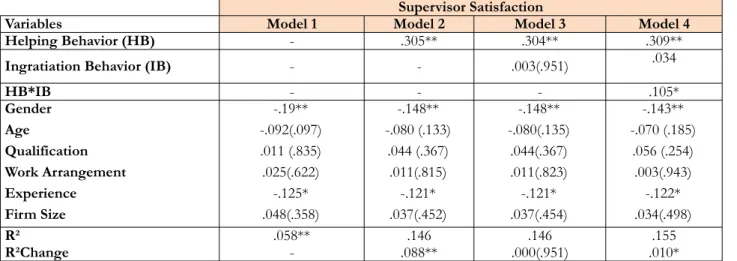
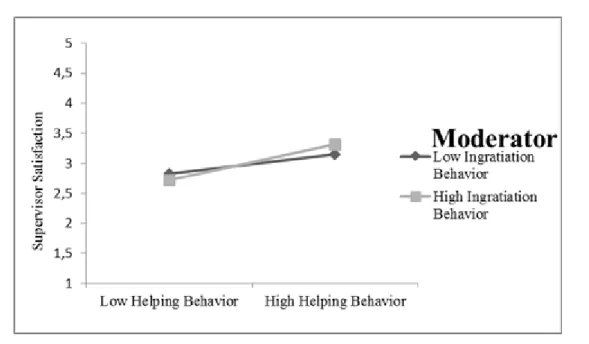
Following three conditions of moderation explained by Baron and Kenny (1986), a multiple hierarchical regression was performed to examine moderating role of ingratiation between helping behavior and supervisor satisfaction. Multicollinearity issue was resolved by standardizing independent (helping behavior), moderating (ingratiation behavior) and control variables. Control variables were entered in the first block, independent variable in the second block, moderator in third block and product term was entered in the fourth block. The results (Table 5) demonstrate that main effect of moderator is insignificant (β = .034; p>.05) but main effect of the independent variable (β = .31; p < .01), and the effect of interaction term (β = .105; p<.05) on supervisor satisfaction are significant.
Supervisor Satisfaction
Variables Model 1 Model 2 Model 3 Model 4
Helping Behavior (HB) - .305** .304** .309**
Ingratiation Behavior (IB) - - .003(.951) .034
HB*IB - - - .105*
Gender Age Qualification Work Arrangement Experience Firm Size -.19** -.092(.097) .011 (.835) .025(.622) -.125* .048(.358) -.148** -.080 (.133) .044 (.367) .011(.815) -.121* .037(.452) -.148** -.080(.135) .044(.367) .011(.823) -.121* .037(.454) -.143** -.070 (.185) .056 (.254) .003(.943) -.122* .034(.498) R²
R²Change .058**- .088**.146 .000(.951).146 .010*.155
**. The relationship is significant at the level .01; *. The relationship is significant at the level .05.
Table 5. Results of Regression Analysis Examining Moderating Effects of Ingratiation (IB) on Relationship of Helping (HB) and Supervisor Satisfaction (SS)
Figure 2: Moderation of Ingratiation Behavior
3.7. Moderated Mediation Analysis
low ingratiation (95 percent CIs between -0.0600 and 0.0724) and employees who demonstrate average ingratiation (95 percent CIs between -0.0144 and 0.0748) as the confidence intervals included zero. However, the conditional indirect effect for employees showing high level of ingratiation was significant (95 percent CIs between 0.0257 and 0.0842) as the confidence intervals did not include zero. Thus, hypothesis H6a and H6b were also supported.
4. Discussion
This research highlights the importance of supervisor-subordinate relationships in service organizations. This study contributes to the research in organizational behavior by answering question that 'when and how ingratiation could be effective?' Previous research emphasized more on customer-directed employee ingratiation but this study offers its contribution by emphasizing coworker as well as supervisor directed employee ingratiation. Moreover, this study measures effectiveness of ingratiation in terms of employee task performance representing supervisor satisfaction. There is a lack of empirical evidence on the association between ingratiation and helping behavior (H2) except for seminal work of Eastman (1994) and Nguyen et al. (2008). This is the first study that confirms a positive association between ingratiation and helping behavior. Traditionally, ingratiation is considered as an upward or supervisor-directed influence tactic (Ralston, 1985; Porter et al., 1981). The findings of this research demonstrate that ingratiation is an important tool for satisfying superiors if employees exhibit helping behaviors towards coworkers and supervisors. Particularly, new employees can benefit from ingratiation to socialize within work organizations. Moreover, existing employees can use ingratiation to establish as well as maintain better social relations with supervisors and colleagues.
Statistical support for hypothesis 4 i.e. the mediating role of helping behavior between ingratiation and supervisor satisfaction answers the question that ‘how ingratiation could be effective?’ and supports the view that employees demonstrate job performance behaviors as a part to strengthen their self-image (Yun et al., 2007). An examination of moderating effect of ingratiation on relationship between helping behavior and supervisor satisfaction revealed that ingratiation alone does not predict supervisor satisfaction. These findings contradict propositions of Balance Theory (Heider, 1958), principle of reciprocity (Jones, 1964) as well as findings of previous studies (Gordon, 1996; Higgins, Judge & Ferris, 2003; Judge & Bretz, 1994; Liden & Mitchell, 1988; Orpen, 1996; Westphal, 1998; Westphal & Stern, 2006, 2007) reporting various positive outcomes of ingratiation like increases in compensation, recommendation for promotion. These findings discourage sole use of ingratiation at the workplace. This also represents that supervisor’s value task-related performance more and ingratiation alone cannot facilitate employees to achieve personal motives until and unless they don’t exhibit helping behaviors. Yet significant interaction effect of ingratiation and helping behavior on supervisor satisfaction answers ‘when ingratiation could be effective?’ and explains that employees exhibiting higher levels of helping behavior but not using ingratiation may be at a disadvantage in achieving supervisor satisfaction as compared to those employees demonstrating high helping as well as high ingratiation behavior. Statistical support for mediating role of helping between ingratiation and supervisor satisfaction highlights importance of helping behavior as a political skill.
develop certain skills to differentiate between employees. This is because not only competent employees but also those lacking task-related competencies may use ingratiation (Ralston, 1985).
5. Conclusion
The key motive of the study was to explain the mechanism through which employees can satisfy their prosocial motives (supervisor satisfaction) with social influence/impression management tactics by exhibiting organizationally desired behaviors (helping). We conclude that organizational members need to accept that ingratiation is useless without helping behavior. They also need to recognize the importance of helping behavior for achieving satisfaction of their supervisors through high level of helping behavior. However, due to the nature of ingratiation as an upward directed and soft influence strategy, organizational members also need to accept the conditional influence of ingratiation in explaining such mechanisms. Thus, we provide a thoughtful insight into how the effect of ingratiation on supervisor satisfaction may be enhanced or restrained through helping behavior within a dyadic supervisor-subordinate relationship.
6. Limitations and Future Research
outcomes (Gordon, 1996; Higgins et al., 2003; Judge & Bretz, 1994; Liden & Mitchell, 1988; Orpen, 1996; Westphal, 1998; Westphal & Stern, 2006, 2007; Treadway et al., 2007). Future studies can replace supervisor satisfaction with some employee-desired outcomes. Further, as we know ingratiation is a political influence tactic (Wortman & Linsenmier, 1977). Wu et al. (2012) reported that ingratiation leads to stress when employee is lacking political skill. Future research must investigate political skill as a possible mediator between ingratiation and employee-desired outcomes including supervisor satisfaction.
References
Appelbaum, S.H., & Hughes, B. (1998). Ingratiation as a political tactic: effects within the organization. Management Decision, 36(2), 85-95. http://dx.doi.org/10.1108/00251749810204160
Arthur, M.B., & Rousseau, D.M. 1996. The boundaryless career as a new employment principle. In M.G. Arthur & D.M. Rousseau (Eds.), The boundaryless career (pp. 3-20). New York: Oxford University Press.
Ashford, S.J., & Cummings, L.L. (1983). Feedback as an individual resource: Personal strategies of creating information. Organizational Behavior and Human Performance, 32(3), 370-398.
http://dx.doi.org/10.1016/0030-5073(83)90156-3
Ashford, S.J., & Tsui, A.S. (1991). Self-regulation for managerial effectiveness: The role of active feedback seeking. Academy of Management Journal, 34(2), 251-280. http://dx.doi.org/10.2307/256442
Baron, R.M., & Kenny, D.A. (1986). The moderator-mediator variable distinction in social psychological research: Conceptual, strategic, and statistical considerations. Journal of Personality and Social Psychology, 51, 1173-1182. http://dx.doi.org/10.1037/0022-3514.51.6.1173
Bateman, T.S., & Organ, D.W. (1983). Job satisfaction and the good soldier: The relationship between affect and employee citizenship. Academy of Management Journal, 26, 587-595.
http://dx.doi.org/10.2307/255908
Beehr, T.A., Glaser, K.M., Beehr, M.J., Beehr, D.E., Wallwey, D.A., Erofeev, D. et al. (2006). The nature of satisfaction with subordinates: Its predictors and importance to supervisors. Journal of Applied Social Psychology, 36, 1523-1547. http://dx.doi.org/10.1111/j.0021-9029.2006.00070.x
Bergeron, D.M. (2007). The potential paradox of organizational citizenship behavior: Good citizens at what cost?. Academy of Management Review, 32, 1078-1095. http://dx.doi.org/10.5465/AMR.2007.26585791
Blau, P. (1964). Exchange and Power in Social Life. New York: Wiley.
Bolino, M., Kacmar, K., Turnley, W., & Gilstrap, J. (2008). A Multi-Level Review of Impression Management Motives and Behaviors. Journal of Management, 34(6), 1080-1109.
http://dx.doi.org/10.1177/0149206308324325
Bolino, M., Long, D., & Turnley, W. (2016). Impression Management in Organizations: Critical Questions, Answers, and Areas for Future Research. Annual Review of Organizational Psychology and Organizational Behavior, 3, 377-406. http://dx.doi.org/10.1146/annurev-orgpsych-041015-062337
Bolino, M.C., & Turnley, W.H. (1999). Measuring impression management in organizations: A scale development based on the Jones and Pittman taxonomy. Organizational Research Methods, 2, 187-206.
http://dx.doi.org/10.1177/109442819922005
Bolino, M.C., & Turnley, W.H. (2005). The personal costs of citizenship behavior: the relationship between individual initiative and role overload, job stress, and work-family conflict. Journal of Applied Psychology, 90, 740-748. http://dx.doi.org/10.1037/0021-9010.90.4.740
Bowen, C.C., Swim, J.K., & Jacobs, R. (2000). Evaluating Gender Bias on Actual Job Performance of Real People: A Meta-Analysis. Journal of Applied Social Psychology, 30, 2194-2215.
http://dx.doi.org/10.1111/j.1559-1816.2000.tb02432.x
Brown, S.L., Nesse, R.M., Vinokur, A.D., & Smith, D.M. (2003). Providing social support may be more beneficial than receiving it: Results from a prospective study of mortality. Psychological Science, 14, 320-327. http://dx.doi.org/10.1111/1467-9280.14461
Carmines, E.G., & McIver, J.P. (1981). Analyzing Models with Unobserved Variables: Analysis of Covariance Structures. In George W. Bohrnstedt & Edgar F. Borgatta (eds.), Social Measurement: Current Issues (pp. 65-115). Beverly Hills, CA: Sage Publications.
Choi, H.J., & Kim, Y.T. (2012). Work-family conflict, work-family facilitation, and job outcomes in the Korean hotel industry. International Journal of Contemporary Hospitality Management, 24(7), 1011-1028.
http://dx.doi.org/10.1108/09596111211258892
Cook, K.S., & Eric R.R. (2003). Social Exchange Theory. Pp. 53-76 in Handbook of Social Psychology, edited by John Delamater. New York: Kluwer Academic/Plenum Publishers.
Cooper, J., & Fazio, R.H. (1984). A new look at dissonance theory. In L. Berkowitz (Ed.), Advances in experimental social psychology (pp. 229-262). New York: Academic Press.
http://dx.doi.org/10.1016/s0065-2601(08)60121-5
Davidson, M.C.G., Timo, N., & Wang, Y. (2010). How much does labor turnover cost? A case study of Australian four- and five-star hotels. International Journal of Contemporary Hospitality Management, 22(4), 451-466.
Deery, M. (2008). Talent management, work-life balance and retention strategies. International Journal of Contemporary Hospitality Management, 20(7), 792-806. http://dx.doi.org/10.1108/09596110810897619
Eastman, K.K. (1994). In the eyes of the beholder: An attributional approach to ingratiation and organizational citizenship behavior. Academy of Management Journal, 37, 1379-1391.
http://dx.doi.org/10.2307/256678
Edwards, J.R. & Lambert, L.S. (2007). Methods for integrating moderation and mediation: A general analytical framework using moderated path analysis. Psychological Methods, 12, 1-22.
http://dx.doi.org/10.1037/1082-989X.12.1.1
Epstein, S. (1973). The self-concept revisited: On a theory of a theory. American Psychologist, 28, 404-416.
http://dx.doi.org/10.1037/h0034679
Ferris, G.R., Frink, D.D., Beehr, T.A., & Gilmore, D.C. (1995). Political fairness and fair politics: The conceptual integration of divergent constructs. In R.S. Cropanzano & K.M. Kacmar (Eds.), Organizational Politics, Justice, and Support: Managing the Social Climate of the Workplace (pp. 21-36). Westport, CT: Quorum.
Ferris, G.R., Treadway, D.C., Kolodinsky, R.W., Hochwarter, W.A., Kacmar, C.J., Douglas, C. et al. (2005). Development and validation of the political skill inventory. Journal of Management, 31, 126-152. http://dx.doi.org/10.1177/0149206304271386
Fishbein, M., & Ajzen, I. (1975). Belief, attitude, intention, and behavior: An introduction to theory and research. Reading, MA: Addison-Wesley.
Fornell, C., & Larcker, D.F. (1981). Evaluating structural equation models with unobservable variables and measurement error. Journal of Marketing Research, 18, 39-50. http://dx.doi.org/10.2307/3151312
Gable, S.L., & Haidt, J. (2005). What (and why) is positive psychology?. Review of General Psychology, 9(2), 103-110. http://dx.doi.org/10.1037/1089-2680.9.2.103
Ghalamkari, B., Mahmoodzadeh, N., Barati, N., Isah-Chikaji, A., Alkali, A.H., & Anvari, R. (2015). The Role of HR Managers: A Conceptual Framework. Asian Social Science, 11(9), 119-124.
http://dx.doi.org/10.5539/ass.v11n9p118
Glomb, T.M., Bhave, D.P., Miner, A.G., & Wall, M. (2011). Doing good, feeling good: Examining the role of organizational citizenship behaviors in changing mood. Personnel Psychology, 61, 191-223.
http://dx.doi.org/10.1111/j.1744-6570.2010.01206.x
Godfrey, D.K., Jones, E.E., & Lord, C.G. (1986). Self-promotion is not ingratiating. Journal of Personality and Social Psychology, 50, 106-115. http://dx.doi.org/10.1037/0022-3514.50.1.106
Goffman, E. (1959). The presentation of self in everyday life. Garden City, NY: Doubleday Anchor.
Gordon, R.A. (1996). Impact of ingratiation on judgments and evaluation: A meta-analytic investigation. Journal of Personality & Social Psychology, 71, 54-68.
http://dx.doi.org/10.1037/0022-3514.71.1.54
Gouldner, A. (1960). The norm of reciprocity: A preliminary statement. American Sociological Review, 25, 161-178. http://dx.doi.org/10.2307/2092623
Grant, A.M., (2008). Does intrinsic motivation fuel the prosocial fire? Motivational synergy in predicting persistence, performance, and productivity. Journal of Applied Psychology, 93(1), 48-58.
http://dx.doi.org/10.1037/0021-9010.93.1.48
Green, S.G., & Mitchell, T.R. (1979). Attributional processes of leaders in leader-member interactions. Organizational Behavior and Human Performance, 23, 429-458. http://dx.doi.org/10.1016/0030-5073(79)90008-4
Gurevitch, Z.D. (1985). The receiver’s dilemma: impressions formed in response to impression management. Basic Applied Social Psychology, 6, 145-157. http://dx.doi.org/10.1207/s15324834basp0602_4
Hansen, D.M., Larson, R.W., & Dworkin, J.B. (2003). What adolescents learn in organized youth activities: A survey of self-reported developmental experiences. Journal of Research on Adolescence, 13, 25-55. http://dx.doi.org/10.1111/1532-7795.1301006
Harris, K.J., Kacmar, M., & Witt, L.A. (2005). An examination of the curvilinear relationship between leader–member exchange and intent to turnover. Journal of Organizational Behavior, 26 (4), 363-378.
http://dx.doi.org/10.1002/job.314
Harris, K.J., Kacmar, K.M., Zivnuska, S., & Shaw, J.D. (2007). The impact of political skill on impression management effectiveness. Journal of Applied Psychology, 92, 278-285.
http://dx.doi.org/10.1037/0021-9010.92.1.278
Hayes, A.F., (2012). PROCESS: A versatile computational tool for observed variable mediation, moderation, and conditional process modeling [White paper]. Retrieved from: http://www.afhayes.com/ public/process2012.pdf
Heider, F. (1958). Psychology of Interpersonal Relations. New York: Wiley. http://dx.doi.org/10.1037/10628-000
Higgins, C.A., Judge, T.A. & Ferris, G.R. (2003). Influence tactics and work outcomes: A meta-analysis. Journal of Organizational Behavior, 24, 89-106. http://dx.doi.org/10.1002/job.181
Holmes, J.G. (2002). Interpersonal Expectations as the building blocks of social cognition: An interdependence theory perspective. Personal Relationships, 9(1), 1-26.
http://dx.doi.org/10.1111/1475-6811.00001
Janssen, O., & Van Yperen, N.W. (2004). Employees’ goal orientations, the quality of leader–member exchange, and the outcomes of job performance and job satisfaction. Academy of Management Journal, 47(3), 368-384. http://dx.doi.org/10.2307/20159587
Jernigan, I.E., & Beggs, J.M. (2005). An examination of satisfaction with my supervisor and organizational commitment. Journal of Applied Social Psychology, 35(10), 2171-2192.
http://dx.doi.org/10.1111/j.1559-1816.2005.tb02214.x
Johnson, D.W., & Johnson, R.T. (2002). Cooperative learning and social interdependence theory. Theory and Research on Small Group, 4(1), 9-35. http://dx.doi.org/10.1007/0-306-47144-2_2
Johnson, B., Smith-McLallen, A., Killeya, L., & Levin, K. (2004). Truth or consequences: Overcoming resistance to persuasion with positive thinking. In E. Knowles & J. Linn (Eds.), Resistance and persuasion (pp. 215-233). Mahwah, NJ: Erlbaum.
Jones, E.E., & Pittman, T.S. (1982). Toward a general theory of strategic self-presentation. In J. Suls (Ed.), Psychological perspectives of the self (pp. 231-261). Hillsdale, NJ: Eribaum.
Jones, E.E., & Wortman, C. (1973). Ingratiation: An attributional approach. Morristown, NJ: General Learning Press.
Judge, A.T., & Bretz, R.D. (1994). Political influence behavior and career success. Journal of Management, 20, 43-65. http://dx.doi.org/10.1177/014920639402000103
Katz, D. (1964). Motivational basis of organizational behavior. Behavioral Science, 9, 131-146.
http://dx.doi.org/10.1002/bs.3830090206
Kelley, H.H., & Thibaut, J.F. (1978). Interpersonal relations: A theory of interdependence. New York: Wiley.
Kim, S., O'Neil, J.W., & Cho, H. (2010). When does an emloyee not help coworkers? The efffect of leader-member exchange on employee envy and organizational citizenship behavior. International Journal of Hospitality Management, 29, 530-537. http://dx.doi.org/10.1016/j.ijhm.2009.08.003
Kolo, E. (2006). Does Automotive Service Excellence (ASE) certification enhance job performance of automotive service technicians? Ph.D. dissertation, Virginia Polytechnic Institute and State University, United States -- Virginia. Retrieved December 12, 2006, from: Dissertations & Theses: Full Text database. (Publication No. AAT 3207969).
Kumar, K., & Beyerlein, M. (1991). Construction and validation of an instrument for measuring ingratiatory behaviors in organizational settings. Journal of Applied Psychology, 76, 619-627.
http://dx.doi.org/10.1037/0021-9010.76.5.619
Lam, W., Huang, X., & Snape, E. (2007). Feedback-seeking behavior and leader–member exchange: Do supervisor-attributed motives matter. Academy of Management Journal, 50(2), 348-363.
http://dx.doi.org/10.5465/AMJ.2007.24634440
Leary, M.R., & Kowalski, R.M. (1990). Impression management: A literature review and two-component model. Psychological Bulletin, 107, 34-47. http://dx.doi.org/10.1037/0033-2909.107.1.34
LePine, J.A., & Van Dyne, L. (1998). Predicting voice behavior in work groups. Journal of Applied Psychology, 83(6), 853-868. http://dx.doi.org/10.1037/0021-9010.83.6.853
Levy, K.N., Blatt, S.J., & Shaver, P.R. (1998). Attachment styles and parental representations. Journal of Personality and Social Psychology, 74, 407-419. http://dx.doi.org/10.1037/0022-3514.74.2.407
Liden, R.C., Sparrowe, R.T., & Wayne, S.J. (1997). Leader–Member Exchange Theory: The Past and Potential for the Future. In G.R. Ferris (Ed.), Research in Personnel and Human Resource Management (vol. 15, 47-119). Greenwich, CT: JAI Press).
Ma, E., & Qu, H. (2011). Social exchange as motivators of hotel employees' organizational citizenship behavior: The proposition and application of a new three-diensional framework. International Journal of Hospitality Management, 30, 680-688. http://dx.doi.org/10.1016/j.ijhm.2010.12.003
Muller, D., Judd, C., & Yzerbyt, V. (2005). When moderation is mediated and mediation is moderated. Journal of Personality and Social Psychology, 89, 852-863. http://dx.doi.org/10.1037/0022-3514.89.6.852
Ng, K., Ang, S., & Chan, K. (2008). Personality and leader effectiveness: A moderated mediation model of leadership selfefficacy, job demands, and job autonomy. Journal of Applied Psychology, 97, 733-743.
http://dx.doi.org/10.1037/0021-9010.93.4.733
Nguyen, N.T., Seers, A., & Hartman, N.S. (2008). Putting a good face on impression management: Team citizenship and team satisfaction. Journal of Behavioral and Applied Management, 9(2), 148-168.
Organ, D.W. (1988). Organizational citizenship behavior: The ‘‘Good Soldier” syndrome. MA: Lexington Books.
Organ, D.W., & Konovsky, M.A. (1989). Cognitive versus affective determinants of organizational citizenship behavior. Journal of Applied Psychology, 74, 157-164.
http://dx.doi.org/10.1037/0021-9010.74.1.157
Orpen, C. (1996). Construct validation of a measure of ingratiatory behavior in organizational settings. Current Psychology, 15: 38-42. http://dx.doi.org/10.1007/BF02686932
Park, S.H., Westphal, J.D., & Stern, I. (2011). Set up for a Fall: Insidious effects of flattery and opinion conformity towards corporate leaders. Administrative Sciences Quarterly, 56(2), 257-302.
http://dx.doi.org/10.1177/0001839211429102
Parker, S.K., & Collins, C.G. (2010). Taking stock: Integrating and differentiating multiple proactive work behaviors. Journal of Management, 36, 633-662. http://dx.doi.org/10.1177/0149206308321554
Peters, H., & Lievens, F. (2006). Verbal and Non-verbal Impression Management Tactics in Behavior Description and Situational Interviews. International Journal of Selection and Assessment, 14(3), 206-222.
http://dx.doi.org/10.1111/j.1468-2389.2006.00348.x
Podsakoff, P.M., Ahearne, M., & MacKenzie, S.B. (1997). Organizational citizenship behavior and the quantity and quality of work group performance. Journal of Applied Psychology, 82, 262-270.
Podsakoff, P.M., & MacKenzie, S.B. (1994). Organizational citizenship behaviors and sales unit effectiveness. Journal of Marketing Research, 3(1), 351-363.
Podsakoff, P.M., MacKenzie, S.B., & Podsakoff, N.P. (2012). Sources of method bias in social science research and recommendations on how to control it. Annual Review of Psychology, 63, 539-569.
http://dx.doi.org/10.1146/annurev-psych-120710-100452
Podsakoff, N.P., Whiting, S.W., Podsakoff, P.M., & Blume, B.D. (2009). Individual- and Organizational-Level Consequences of Organizational Citizenship Behaviors: A Meta-Analysis. Journal of Applied Psychology, 94(1), 122-141. http://dx.doi.org/10.1037/a0013079
Podsakoff, P.M., & Organ, D.W. (1986). Self-reports in organizational research: problems and prospects. Journal of Management, 12, 531-544. http://dx.doi.org/10.1177/014920638601200408
Porter, L.W., Allen, R.W., & Angle, H.L. (1981). The politics of upward influence in organizations. In B.W. Staw & L.L. Cummings (Eds.), Research in organizational behavior (Vol. 3, pp. 109-149). Greenwich, CT: JAI Press.
Preacher, K.J. & Hayes, A.F. (2004). SPSS and SAS procedures for estimating indirect effects in simple mediation models. Behavior Research Methods, 36, 717-731. http://dx.doi.org/10.3758/BF03206553
Preacher, K.J., Rucker, D.D., & Hayes, A.F. (2007). Addressing moderated mediation hypotheses: Theory, methods, and prescriptions. Multivariate Behavioral Research, 42, 185-227.
http://dx.doi.org/10.1080/00273170701341316
Preacher, K.J., & Hayes, A.F. (2008). Asymptotic and resampling strategies for assessing and comparing indirect effects in simple and multiple mediator models. Business Research Methods, 40(3), 879-891. doi: 10.3758/BRM.40.3.879. http://dx.doi.org/10.3758/BRM.40.3.879
Ralston, D.A. (1985). Employee Ingratiation: The Role of Management. Academy of Management Review, 10(3), 477-487.
Rich, T.A. (2008). Becoming the boss whisperer: An examination of the relationship between employee follower behaviors and supervisor satisfaction with employee performance. Doctoral Thesis, Minneapolis, MN., Capella University, 183 p.
Rioux, S.M., & Penner, L.A. (2001). The causes of organizational citizenship behavior: A motivational analysis. Journal of Applied Psychology, 86, 1306-1314. http://dx.doi.org/10.1037/0021-9010.86.6.1306
Seligman, M., & Csikszentmihalyi, M. (2000). Positive psychology: An introduction. American Psychologist, 55, 5-14. http://dx.doi.org/10.1037/0003-066X.55.1.5
Skinner, B.F. (1963). Operant Behaviour. American Psychologist, 188, 503-515.
http://dx.doi.org/10.1037/h0045185
Skinner, B.F. (1971). Contingencies of Reinforcement. East Norwalk, CT: Appleton-Century-Crofts.
Smith, C.A., Organ, D.W., & Near, J.P. (1983). Organizational citizenship behavior: Its nature and antecedents. Journal of Applied Psychology, 68, 655-663. http://dx.doi.org/10.1037/0021-9010.68.4.653
Sonnentag, S. & Grant, A.M. (2012). Doing good at work feels good at home, but not right away: When and why perceived prosocial impact predicts positive affect. Personnel Psychology, 65, 495-530.
http://dx.doi.org/10.1111/j.1744-6570.2012.01251.x
Spitzmuller, M., & Dyne, L.V. (2013). Proactive and reactive helping: Contrasting the positive consequences of different forms of helping. Journal of Organizational Behavior, 34, 560-580.
http://dx.doi.org/10.1002/job.1848
Steizel, S., & Rimbau-Gilabert, E. (2013). Upward influence tactics through technology-mediated communication tools. Computers in Human Behaviour, 29(2), 462-472.
http://dx.doi.org/10.1016/j.chb.2012.04.024
Susskind, A.M., Kacmar, M., & Borchgrevink, C.P. (2007). How organizational standards and coworker support improve restaurant service. Cornell Hotel and Restaurant Administration Quarterly, 48(4), 370-379. http://dx.doi.org/10.1177/0010880407300158
Tedeschi, J.T., & Melburg, V. (1984). Impression management and influence in the organization. In S.B. Bacharach & E.J. Lawler (Eds.), Research in the sociology of organizations (Vol. 3, pp. 31-58). Greenwich, CT: JAI Press.
Thomas K.W., & Pondy, L.R. (1977). Towards an ‘intent’ model of conflict management among principal parties. Human Relations, 30(12), 1089-1102. http://dx.doi.org/10.1177/001872677703001203
Treadway, D.C, Ferris, G.R., Duke, A.B., Adams, G.L., & Thatcher, J.B. (2007). The moderating role of subordinate political skill on supervisors' impressions of subordinate ingratiation and ratings of subordinate interpersonal facilitation. Journal of Applied Psychology, 92, 848-855.
Van Dyne, L., Cummings, L.L., & McLean Parks, J. (1995). Extra Role Behaviors: In pursuit of construct and definitional clarity. In L.L. Cummings & B.M. Staw (Eds.). Research in Organizational Behavior, 17, 215-285. Greenwich, CT: JAI Press.
Van Dyne, L., & LePine, J.A. (1998). Helping and Voice Extra-Role Behaviors: Evidence of Construct and Predictive Validity. Academy of Management Journal, 41(1), 108-119. http://dx.doi.org/10.2307/256902
Van Willigen, M., (1998). Doing good, feeling better: The effect of voluntary association membership on individual well-being. Paper presented at the Annual Meeting of the American Sociological Association, August, San Francisco, CA.
Vroom, V.H. (1964). Work and Motivation. New York: Wiley.
Westphal, J.D. (1998). Board games: How CEOs adapt to increases in structural board independence from management. Administrative Science Quarterly, 43: 511-538. http://dx.doi.org/10.2307/2393674
Westphal, J.D., & Stern, I. (2006). The other pathway to the boardroom: How interpersonal influence behavior can substitute for elite credentials and demographic majority status in gaining access to board appointments. Administrative Science Quarterly, 51, 169-204. http://dx.doi.org/10.2189/asqu.51.2.169
Westphal, J.D., & Stern, I. (2007). Flattery will get you everywhere (especially if you are a male caucasian): How ingratiation boardroom behavior, and demographic minority status affect additional board appointments at U.S. companies. Academy of Management Journal, 50(2), 267-288.
http://dx.doi.org/10.5465/AMJ.2007.24634434
Williams, L.J., & Anderson, S.E. (1991). Job Satisfaction and Organizational Commitment as Predictors of Organizational Citizenship and In-Role Behaviors. Journal of Management, 17(3), 601-617.
http://dx.doi.org/10.1177/014920639101700305
Wortman, C.B., & Linsenmeier, J.A.W. (1977). Interpersonal attraction and techniques of ingratiation in organizational settings. In B.M. Staw & G.R. Salancik (Eds.), New directions in organizational behavior (pp. 133-178). Chicago: St. Clair Press.
Wu, L.-Z., Yim, F.H.-K., Kwan, H.K., & Zhang, X. (2012). Coping with Workplace Ostracism: The Roles of Ingratiation and Political Skill in Employee Psychological Distress. Journal of Management Studies, 49(1), 178-199. http://dx.doi.org/10.1111/j.1467-6486.2011.01017.x
Wu, L.-Z., Kwan, H.K., Wei, L.-Q., & Liu, J. (2013). Ingratiation in the Workplace: The Role of Subordinate and Supervisor Political Skill. Journal of Management Studies, 50(6), 991-1017.
Yukl, G., & Tracey, J.B. (1992). Consequences of influence tactics used with subordinate, peers and the boss. Journal of Applied Psychology, 77(4), 525-535. http://dx.doi.org/10.1037/0021-9010.77.4.525
Yun, S., Takeuchi, R., & Liu, W. (2007). Employee self-enhancement motives and job performance behaviors: Investigating the moderating effects of employee role ambiguity and managerial perceptions of employee commitment. Journal of Applied Psychology, 92(3), 745-756.
http://dx.doi.org/10.1037/0021-9010.92.3.745
Appendix B: Convergent and Discriminant Validity Estimates (A Snapshot)
Intangible Capital, 2016 (www.intangiblecapital.org)
Article's contents are provided on an Attribution-Non Commercial 3.0 Creative commons license. Readers are allowed to copy, distribute and communicate article's contents, provided the author's and Intangible Capital's names are included. It must not be used for