ISSN 1307-234X RESEARCH ARTICLE
© 2007 www.fisheriessciences.com ARAŞTIRMA MAKALESİ
THE EFFECTS OF GRAVADING PROCESS ON THE
NUTRITIVE VALUE OF RAINBOW TROUT
(
Oncorhynchus mykiss
)
Magdalena Michalczyk and Krzysztof Surówka
∗Agricultural University of Cracow, Department of Refrigeration and Food Concentrates, ul. Balicka Kraków, Poland.
Abstract:
Gravad trout is a low-processed product prepared by sprinkling fillets with a mixture of salt and sugar and subsequently placing them in cold storage. During the gravading process, there is some loss of nitrogenous substances to the brine, as well as changes in meat protein struc-ture, which was proved in the present study by the increase of available thiol groups and disul-fide bond content. Therefore, it is of interest to investigate whether the nutritive value of pro-teins is altered in the process, and both in vitro and in vivo studies of nutritive value were con-ducted. In vitro assays revealed that gravading of fish leads to an increase (about 5 %) in rela-tive total essential amino acid content compared to raw fish proteins. The chemical score (CS) and exogenous amino acids integrated index (EAA), calculated according to the FAO/WHO (1991) standard reference pattern, reached to maximum values equivalent to 100%. The gra-vad’s nutritive indices measured by the in vivo methods, namely biological value (BV) and net protein utilization (NPU), were close to those for steam cooked fish, but slightly worse than those for raw fish. True digestibility (TD) changes were verified as statistically insignificant.Keywords: Nutritive value, rainbow trout, gravad, protein
∗
Correspondence to: Prof. Dr. Krzysztof Surówka, Agricultural University of Cracow, Department of Refrigeration and Food Concentrates, ul. Balicka 122, 30-149 Kraków, Poland.
Introduction
Despite the fact that the nutritional value of fish is well known, it nevertheless plays only a limited role in the diet of many countries. Therefore, it would seem appropriate to find new processing methods for this valuable raw material so as to increase consumer interest. Compared to mammalian meat, fish meat has more water and less connective tissue, which contains very little elastin (Kołakowska and Kołakowski, 2001). Whereas in mammalian muscles the fibres are surrounded by endo-mysium, their bundles by perimysium and their muscles by epimysium, in fish the myomeres are longitudinally bound into segments called myotomes by means of the myocommata. This is clearly visible when fish meat is heated and separates into segments (gapping) (Sikorski, 1980; Mackie, 1994; Gawęcki, 1997). Myofibrillar fraction accounts for 65-75% of the total protein in white muscle of fish. The myosin, found in white meat fish from temperate waters, is the least stable of all known myosins and therefore, easily affected by proteolytic enzymes. Fish actin, on the other hand, does not differ much from mam-malian actin in its characteristics (Mackie, 1994). As for its nutritional value, fish protein contains all the exogenous amino acids in amounts exceeding the FAO/WHO standard of 1991 (FAO/WHO, 1991) and its digestibility is above 97% (Kołakowska and Kołakowski, 2001). However, during the sterilization of canned products at 115˚C, the digestibility falls (Krauze et al., 1970; Gajewska and Lipka, 1978; Ganowiak and Lipka, 1979). This de-crease in digestibility and the accompanying loss of available exogenous amino acids is caused by the formation of inter- and in-tramolecular crosslinking bonds within pro-teins. Moreover, the frequently observed loss of methionine and cysteine can be intensified by oxidative processes occurring in the presence of oxidized fats (Gawęcki, 1997). With such delicately structured muscle tissue, fish is suited to low-temperature processing, from which such well-known products as salted and marinated herring are obtained, as well as the less popular Maatjes, Tidbits, Schnell-maaties and Surstromming (Knochel, 1993). However, species other than herring also provide good raw material for low-processed products.
The initial quality of raw material is the most important problem for the quality of such products. Therefore, the product should be processed immediately after fish gaining. If it is impossible, proper chilling conditions ought to be assured to reduce the risk of bacteria growth and postmortem spoilage, which is associated with an increase of biogenic amines concentration (Özogul et al., 2002; Özogul et al.,2006).
Among the more attractive delicatessen fish, low-processed products are gravads which are obtained by filleting such oily and medium oily fish as salmon, greenland halibut and trout, sprinkling the fillets with a mixture of salt, sugar and spices, and finally cold storing them for 1-4 days. After being removed from the resultant brine, the gravads may be con-sumed directly or vacuum packed and cold stored for several weeks (Knochel, 1993; Paa-rupet al., 1996; Lyhs et al., 2001).
Although a great deal of attention has been paid to the issue of microbiological safety, especially with respect to Listeria monocyto-genes (Loncarevic et al., 1996; Paarup et al., 1996; Lyhs et al., 2001; Lyhs et al., 2002; Michalczyk and Leszczyńska-Fik, 2003), the available literature contains little information on the processes which take place during gra-vading. It gives no information on the possible roles played by enzymes and microorganisms in the process (Knochel, 1993). Similarly, little is known about the effect of the gravading process on the nutritional value of the product. Therefore, the aim of the present study was to determine how the process of gravading trout, which causes changes in fillet structure and the loss of water and nitrogenous substances to the resultant brine, affects the nutritional value of the protein in the product.
Materials and Methods
Sample preparation
divided into three groups. The first was di-rected to the basic chemical composition and sulfur containing group’s analysis and then freeze dried (OE 950 Labor MIM, Hungary) as unprocessed, the second was boiled in steam for 10 min before freeze drying, and the rest was reserved for gravading.
The gravading process involved sprinkling both sides of each fillet with a mixture of salt and sugar (1:2) at a rate of 350 g of mixture/kg of fillet, matching them in pairs meatside to meatside and placing in layers in enamelled containers under light pressure for 48 hours at 3°C (Michalczyk and Surówka, 2003). The gravads thus obtained were then removed from the brine, analysed for the basic chemical composition and sulfur containing groups and freeze-dried. After freeze-drying, the skin was removed from the dried samples, namely un-processed, boiled and gravaded, and the muscle tissue was ground and passed through a 40 mesh sieve. The samples then underwent amino acids and in vivo nutritive value analy-sis.
Chemical analyses
The basic chemical composition was de-termined according to Polish standards, namely protein by the Kjeldahl method (PN-75 A-04018, 1976), water content by drying at 105ºC (PN-62 A-86783, 1988), fat content by the Soxhlet method (PN-67 A-86734, 1987) and ash at 550ºC (PN-ISO936, 2000). Sugar content was estimated using the phenol method described by Dubois et al. (1956), and chlo-rides by the Mohr method (PN-74 A-86739, 1975).
The content of the available thiol groups (-SH), was determined using Ellman's reagent (5,5’–dithiobis (2 nitrobenzoic) acid) (DTNB) in accordance with the method described by Habeeb (1972). Disulfide bonds (-SS-) were analysed colorimetrically according to Chan and Wasserman (1993), after reaction with 2-nitro-5-thiosulfobenzoate (NTSB), which was synthetised using the method described by Thannhauser et al. (1987). The molar absorbancy index for –SH groups was assumed to be 13600 M-1 cm-1.
Amino acids analysis
Determination of the amino acid content was carried out by ion-exchange column chromatography using a T339M analyzer
(Mikrotechna, Praha, Czech Republic) equip-ped with a column 5 mm in diameter and 35 cm in length. Acidic hydrolysis of proteins contained in the freeze dried samples was car-ried out using the Davies & Thomas method (1973). Hydrolysis for determining sulphur amino acids was conducted in accordance with Moore et al. (1958). Cysteine was oxidized to cysteic acid and methionine to methionine sul-fone; then, after determining these derivatives, the results were recalculated to amino acids. Tryptophan was determined using the colori-metric method as described by Fik and Pro-tasowicka (1983). On the basis of the results obtained and the FAO/WHO reference pattern (FAO/WHO, 1991), the chemical score (CS) and the exogenous amino acids integrated in-dex (EAA) were calculated (Rakowska et al., 1978).
In vivo nutritive value analysis
Biological analyses of the nutritive value of the protein were performed on 6-week old male Wistar rats. Their body mass ranged from 95 to 115 grams.During the test, the animals were kept in individual metabolic cages at con-stant optimum temperature and air humidity. The adaptation period lasted 6 days and the remaining period was 5 days.The animals were weighed at the beginning of the study, after the adaptation period, and at the end of the test. They were fed a semi-synthetic AIN-93G diet (Reeves et al., 1993) containing 10% of the analysed protein and given to the animals at a daily dose of 10 gram. Access to water was unrestricted. The source of protein adminis-tered to the four groups of animals examined, consisting of six individuals each, was milk casein and freeze dried muscle tissue of raw, steam cooked and gravaded rainbow trout. During the test, the urine and faeces of the animals were collected, and at the end of test, their total nitrogen was determined by the Kjeldahl method, while metabolic and endoge-nous nitrogen were calculated using the Bock et al. formula, quoted in Eggum (1973). On the basis of the results obtained, true digestibility (TD) biological value (BV) and net protein utilization (NPU) were determined (Eggum, 1973).
Statistical analysis
were analysed statistically with the CSS Sta-tistica package (Stat Soft, Tulsa, OK, USA). The significance of differences between means was determined using the one way Anova test at a confidence level of 5%.
Results and Discussion
Basic chemical composition
Sprinkling the trout fillets with the gravad-ing mixture and storgravad-ing them in a cold tem-perature causes brine to be released, with the partial diffusion of salt and sugar into the tis-sue. The effect on the basic chemical
compo-sition is given in Table 1, showing that the gravad contained a slightly higher proportion of protein and ash (NaCl) and sugar than those in raw fish. It also contained less water and fat than fresh trout. The content of proteinaceous substances (N x 6,25) in the discarded brine was 1.8 ± 0.16%. Earlier studies revealed that the ratio of gravading mixture to fish mass was more significant for the leaching of these sub-stances into the brine than the proportion of salt in the mixture (Michalczyk and Surówka, 2003).
Table 1. Basic chemical composition (%) of raw and gravaded rainbow trout meat
Component Raw fish Gravad
Protein 20.5 ±0.49* 22.5 ±0.41
Fat 4.5 ±0.79 3.8 ±0.29
Ash 1.3 ±0.08 7.1 ±1.32
Sucrose 0 6.4 ±0.53
Water 73.4 ±2.24 60.4 ±1.68
* Mean values ± standard deviation
Thiol groups and disulfide bonds
The partial dehydratation of muscle tissue during gravading was also the trigger for its structural changes, while the protein structure of the tissue had a manifold effect on the di-gestibility and nutritional value of the protein. In order to characterize the changes that pro-tein undergoes in the gravading process, the number of available thiol groups and disulfide bonds were determined since changes in pro-tein structure tend to be denaturative and occur in the presence of sulphur amino acid moieties (Opstvedt et al., 1984). Although Connell (1965) believed that the denaturative aggrega-tion of fish protein during freezing is caused by hydrogen, hydrophobic and other bonds, with no contribution from disulfide bridge forma-tion, it was Buttkus (1970, 1971) who sug-gested that the denaturation of trout proteins occurs as the effect of such formation. This was later proved by the studies of Jiang et al. (1988) and Surówka (1996). The energy of covalent disulfide bonds greatly exceeds that of ionic, hydrogen, hydrophobic, and van der Walls interactions, which is why they play an important role in protein structure formation even though they do not occur in large num-bers. The content of sulfur-containing func-tional groups in the protein of raw fish and the
Table 2. The content of sulfur containing groups in raw and gravaded rainbow trout meat (mol/g
pro-tein)
Specification Raw fish Gravad
-SS- groups 4.3x10⁻⁵ ±0.35x10-5* 13.2x10-5 ±2.02x10⁻⁵ Available –SH groups 8.1x10⁻⁵ ±0.10x10⁻⁵ 12.0x10⁻⁵ ±0.10x10⁻⁵ * Mean values ± standard deviation
Mean values in rows differ significantly (P≤0.05)
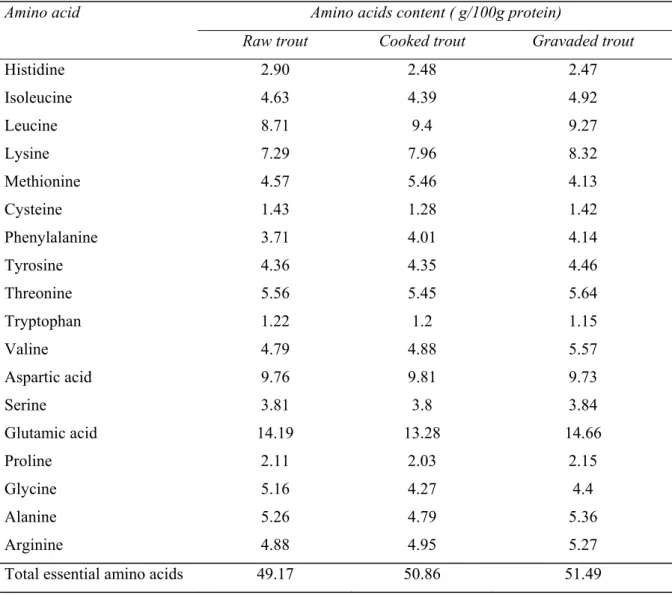
Table 3. Amino acids content in raw, steam cooked and gravaded rainbow trout meat Amino acids content ( g/100g protein) Amino acid
Raw trout Cooked trout Gravaded trout
Histidine 2.90 2.48 2.47
Isoleucine 4.63 4.39 4.92
Leucine 8.71 9.4 9.27
Lysine 7.29 7.96 8.32
Methionine 4.57 5.46 4.13
Cysteine 1.43 1.28 1.42
Phenylalanine 3.71 4.01 4.14
Tyrosine 4.36 4.35 4.46
Threonine 5.56 5.45 5.64
Tryptophan 1.22 1.2 1.15
Valine 4.79 4.88 5.57
Aspartic acid 9.76 9.81 9.73
Serine 3.81 3.8 3.84
Glutamic acid 14.19 13.28 14.66
Proline 2.11 2.03 2.15
Glycine 5.16 4.27 4.4
Alanine 5.26 4.79 5.36
Arginine 4.88 4.95 5.27
Total essential amino acids 49.17 50.86 51.49
Nutritive value of protein
The in vitro investigation concerned the
amino acid composition of proteins in the muscle tissue of raw trout and trout gravad as well as, steam cooked trout. The results are presented in Table 3. The amino acid content of raw trout muscle tissue did not differ sig-nificantly from that reported in the literature. However, it should be pointed out that there are considerable discrepancies in the values obtained by different authors for specific
the brine and cooked drip. On the basis of the results, CS and EAA values were computed. However, due to the fact that no limiting amino acid became apparent in the tests, and the content of all exogenous amino acids was higher than in the 1991 FAO/WHO reference pattern applied in the present investigation, these indices amounted to 100 for each of the analysed proteins. The results of the in vitro studies suggest that the protein in trout gravad is complete and the small loss of nitrogen passing into brine as a result of the gravading process does not significantly affect its nutri-tive value.
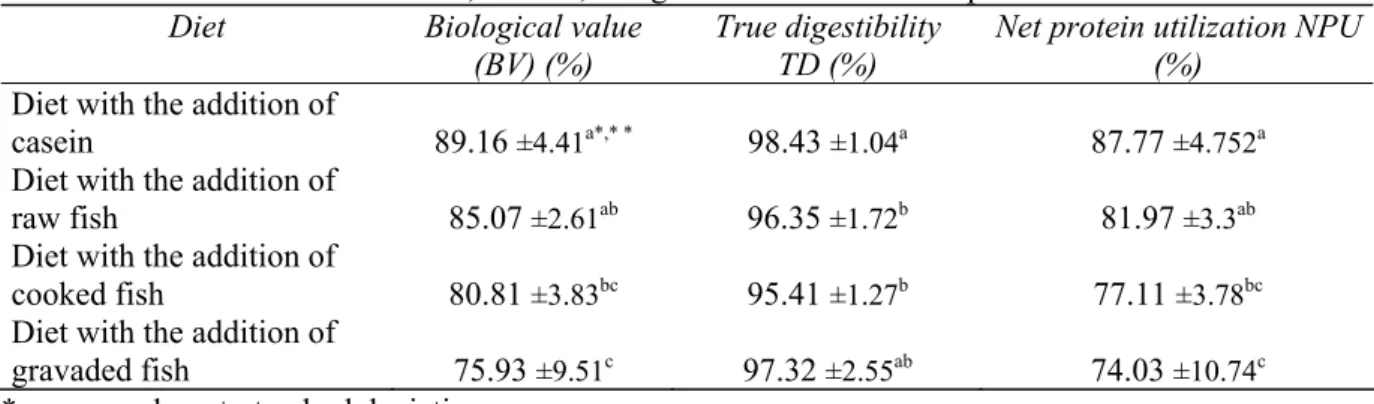
The results of studies involving TD, BV and NPU with respect to raw trout, steam cooked trout and trout gravad are presented in Table 4. The control group in this study con-sisted of rats receiving a diet in which milk casein was the source of protein. The data ob-tained did not significantly differ from those given in the literature for certain species of fish
(Astavan et al., 1994; Castrillón et al., 1996; Vishwanath et al., 1998). Generally, the nutri-tion index values obtained for all kinds of diets with the addition of trout were fairly high. Among the diets tested, that with the highest nutritive value was raw trout, second only to casein, which was regarded as the standard, while gravad proved to be the least nutritive. The differences between the gravad and steam cooked trout were found to be statistically in-significant. Moreover, the diet with the addi-tion of gravad showed the highest values of standard deviations. The wide range of results in the case of this product may not so much due to the value of the fish protein as to the salt contained in the trout gravad. Although Asta-van et al. (1994) did not find any significant effect of NaCl on the nutritive value of tuna using it as an 8-10% addition in diet, it is, however, difficult to find any other explanation for these observations.
Table 4. The nutritive value of raw, cooked, and gravaded rainbow trout protein
Diet Biological value
(BV) (%)
True digestibility TD (%)
Net protein utilization NPU (%)
Diet with the addition of
casein 89.16 ±4.41a*,* * 98.43 ±1.04a 87.77 ±4.752a Diet with the addition of
raw fish 85.07 ±2.61ab 96.35 ±1.72b 81.97 ±3.3ab Diet with the addition of
cooked fish 80.81 ±3.83bc 95.41 ±1.27b 77.11 ±3.78bc Diet with the addition of
gravaded fish 75.93 ±9.51c 97.32 ±2.55ab 74.03 ±10.74c * mean values ± standard deviation
** values in columns marked with the same letter do not differ significantly (P > 0.05)
Conclusion
As a result of the gravading process, there was partial dehydratation of muscle tissue in raibow trout, accompanied by an increase in the proportion of protein in it and the leaching of some proteinaceous substances into the brine.This led to a modification of the protein structure, expressed by an increase in the con-tent of available thiol groups and disulfide cross-links. Moreover, changes in some in vivo nutritive value indices occured, namely de-creases in biological value (BV) and net pro-tein utilization (NPU); however, true digesti-bility (TD) slightly increased although they are not statistically significant. In addition, the proportion of exogenous amino acids increased
slightly in gravads; however, it did not have an effect on the chemical score (SC) and exoge-nous amino acids integrated index (EAA); as in the case of raw fish, the maximum values were obtained.Generally, the effects of the gravading process on the nutritive value of trout meat are similar to those of the steam cooking process.
Acknowledgments
References
Americo, M., Ruggi, C., Badini, C., (1996). Meat quality of reared fish; nutritional as-pects. Italian Journal of Food Science, 8
(3): 221-229.
Astavan, M., Wahyuni, M., Yamada, K., Tadokoro, T., Maekawa. A., (1994). Effect of high salt content of Indonesian dried-salted fish on rats. Journal of Agricultural
and Food Chemistry, 42 (10): 2265-2269.
Buttkus, H., (1970). Accelerated denaturation of myosin in frozen solution. Journal of
Food Science,35 (5): 558-562.
Buttkus, H., (1971). The sulfhydryl content of rabbit and trout myosin in relation to pro-tein stability. Canadian Journal of Biochemistry, 49: 97-102.
Castrillón, A.M., Navarro, M.P., Garcia-Arias, M.T., (1996). Tuna protein quality changes after canning. Journal of Food Science, 61
(6): 1250-1253.
Chan, K., Wasserman, B.P., (1993). Direct colorimetric assay of free thiol groups and disulfide bonds in suspensions of solubilized and particulate cereal proteins. Cereal Chemistry, 70 (1): 22-26.
Connell, J.J., (1965). The use of SDS in the study of protein interactions during the storage of cod flesh at -14°C. Journal of
the Science of Food and Agriculture, 16:
769-772.
Davies, M.G., Thomas, A.J., (1973). An investigation of hydrolytic techniques for the amino acid analysis of foodstuffs. Journal of the Science of Food and Agri-culture, 24 (12): 1525-1540.
Dubois, M., Gilles, K.A., Hamilton, J.K., Rebers, P.A., Smith, F., (1956). Colorimetric method for determination of sugars and related substances. Analytical Chemistry, 28 (3): 350-356.
Eggum, B.O., (1973). A study of certain factors influencing protein utilization in rats and pigs. Trykt; Frederiksberg Bogtrykkeri, pp. 8-55.
FAO/WHO, (1991). Protein quality evaluation. Report of the Joint FAO/WHO Expert Consultation; FAO Food and Nutrition, paper 51, FAO, Roma, Italy.
Fik, M., Protasowicka, A., (1983). Feed proc-essing – laboratory manuals. Akademia Rolnicza w Szczecinie, Szczecin.
Gajewska, R., Lipka, E., (1978). Analysis of raw and canned fish protein digestibility. Przemysł Spożywczy, 32 (8): 305-306.
Ganowiak, Z., Lipka, E., (1979). Biological assays of nutritive value of raw and processed fish. Bromatologia i Chemia Toksykologiczna, 12 (2): 97-101.
Gawęcki, J. (Ed.), (1997). Proteins in food and nutrition. Biblioteczka Olimpiady Wiedzy o Żywieniu, Wydawnictwo AR im. A Cieszkowskiego, Poznań.
Habeeb, A.F.S.A., (1972). Reaction of protein sulfhydryl groups with Ellman’s reagent. In: Hivs, C.-H.W., Timashoff, S.N. (Eds.), Methods in enzymology. pp. 457-464. Jiang, S.T., Hwang, D.C., Chen, C.S., (1988).
Denaturation and change in SH group of actomyosin from milkfish (Chanos
Chanos) during storage at -20°C. Journal
of Agricultural and Food Chemistry, 36
(3): 433-437.
Knochel, S., (1993). Fish fermentation tech-nology. The United Nations University. pp. 53-70.
Kołakowska, A., Kołakowski, E., (2001). Fish nutritive value. Przemysł Spożywczy, 55
(6): 10-13.
Kunachowicz, H., Nadolna, I., Przygoda, B., Iwanow, K., (1998). The tables of nutritive value of foodstuffs. Instytut Żywności i Żywienia, Warszawa.
Krauze, S., Olędzka, R., Buczyńska, Z., (1970). In vitro enzymic digestibility of animal protein. Roczniki PZH, 21 (3):
287-292.
Le Blanc, E.L., Le Blanc, R.J., (1992). Determination of hydrophobicity and reactive groups in proteins of cod (Gadus
morhua) muscle during frozen storage.
Food Chemistry, 43 (1): 3-11.
Loncarevic, S., Tham, W., Danielsson-Tham, M.L., (1996). Prevalence of Listeria monocytogenes and ather Listeria spp. in smoked and „gravad” fish. Acta
Lyhs, U., Korkeala, H., Björkroth, J., (2002). Identification of lactic acid bacteria from spoiled vacuum-packaged „gravad” rainbow trout using ribotyping. International Journal of Food
Microbiology, 72 (1-2): 147-153.
Lyhs, U., Lahtinen, J., Fredriksson-Ahomaa, M., Hyytiä-Trees, E., Elfing, K., Korkeala, H., (2001). Microbiological quality and shelf-life of vacuum-packaged “gravad” rainbow trout stored at 3 and 8°C. International Journal of Food Microbiology, 70 (3): 221-230.
Mackie, I., (1994). Fish protein. In: Hudson B.J.F. (Ed), New and developing sources of Food Proteins. Chapman Hall, London, N.York, Tokyo, Melbourne. pp. 95-143. Mai, J., Shetty, J.K., Kan, T.-M., Kinsella, J.E.,
(1980). Protein and amino acid composi-tion of select freshwater fish. Journal of
Agricultural and Food Chemistry, 28 (4):
884-885.
Michalczyk, M., Leszczyńska-Fik, A., (2003).
Listeria monocytogenes in gravad rainbow
trout (Oncorhynchus mykiss). Żywność, Supl., 35 (2): 122-128.
Michalczyk, M., Surówka, K., (2003). Tech-nology and consumer acceptability of gra-vad rainbow trout (Oncorhynchus mykiss).
Żywność, Supl.36 (3): 131-140.
Moore, S., Spackman, D.H., Stein, W.H., (1958). Chromatography of amino acids on sulfonated polystyrene resins. Analytical
Chemistry, 30: 1185-1190.
Opstvedt, J., Miller, R., Hardy, R.W., Spinelli, J., (1984). Heat-induced changes in sulfhydryl groups and disulfide bonds in fish protein and their effect on protein and amino acid digestibility in rainbow trout
(Salmo gairdneri). Journal of Agricultural
and Food Chemistry, 32 (4): 929-935.
Özogul, F., Taylor, K.D.A., Quantick, P., Özogul, Y., (2002). Biogenic amines for-mation in Atlantic herring (Clupea haren-gus) stored under modified atmosphere packaging using a rapid HPLC method. International Journal of Food Science and
Technology, 37: 515-522
Özogul, Y., Ahmad, J.I., Hole, M., Özogul, F., Deguara, S., (2006). The effects of partial replacement of fish meal by vegetable
protein sources in the diet of rainbow trout
(Onchorynchus mykiss) on post mortem
spoilage of fillets. Food Chemistry, 96:
549-561.
Paarup, T., Ruiz-Capillas, C., Morales, J., Lopez, E., Moral, A., (1996). „ Gravad” – type rainbow trout, packed in vacuum and modified atmosphere: microbiological, biochemical and sensory aspects. Refrigeration and aquaculture, in Bordeaux (France) colloquium, Proceedings IIR Conference-Commission C2. pp. 333-337. PN-75 A-04018, (1976). Polish Standard. Ag-ricultural and food products. Nitrogen de-termination by Kjeldahl method.
PN-74 A-86739, (1975). Polish Standard. Fish and fish products. Sodium chloride deter-mination.
PN-67 A-86734, (1987). Polish Standard. Fish, fish products and by-products of fish ori-gin. Fat determination.
PN-62 A-86783, (1988). Polish Standard. Fish and fish products. Water determination. PN-ISO936, (2000). Polish Standard. Meat and
meat products. Total ash determination.
Rakowska, M., Szkiłłądziowa, W., Kunachowicz, M., (1978). Biological value of food protein. Wydawnictwa Naukowo-Techniczne, Warszawa.
Reeves, P.G., Nielsen, F.H., Fahey, G.C., (1993). AIN – 93 Purified diets for labo-ratory rodents. Final Report of the Ameri-can Institute of Nutrition Ad Hoc Writing Committee on the Reformulation of the AIN-76A Rodent Diet. Journal of Nutri-tion, 123: 1939-1951.
Sikorski, Z.E., (1980). Technology of sea-foods. Wydawnictwa Naukowo-Techniczne, Warszawa.
Surówka, K., (1996). Hydrophobicity and sul-phur containing groups content in the meat of superchilled rainbow trout (Salmo
gairdneri Rrich). Zeszyty Naukowe AR
Krakowie (Technologia Żywności), 309
(8): 29-40.
Thannhauser, T.W., Konishi, Y., Scheraga, H.A., (1987). Analysis for disulfide bonds in peptides and proteins. Methods of
Vishwanath, W., Lilabati, H., Bijen, M., (1998). Biochemical, nutritional and microbiological quality of fresh and
smoked mud eel fish Monopterus albus – a comparative study. Food Chemistry, 61