Original Research Article
Doctors'self-prescribing behavior: an exploratory study
Shakeel Ahmad Mir
1*, Junaid Ahmed Ahangar
2, Danish Shakeel
3INTRODUCTION
Treating one`s self, family, friends and colleagues are aspects of the practice of medicine that are not often taught or discussed.1 Self-prescribing is widespread in
medical culture, with physicians learning such practices while training as medical students.2 Self-prescribing
includes prescribing to self, family, relatives and close
friends. It is generally considered unwise due to the lack of objectivity. General Medical Council of England (GMC) prohibits self-care and prescribing for close relations and also states that self-care should be avoided whenever possible.3 GMC`s updated guidance states,”
wherever possible you must avoid prescribing for yourself or anyone with whom you have a close personal relationship.”4 The Medical Council recognizes that there 1Department of Clinical Pharmacology, Sher-I-Kashmir Institute of Medical Sciences (SKIMS), Srinagar, Kashmir,
India
2Senior Resident, Department of Clinical Pharmacology, Sher-I-Kashmir Institute of Medical Sciences (SKIMS),
Srinagar, Kashmir, India
3Student, Department of Computer Sciences and Engineering, University Institute of Engineering, Chandigarh
University, Mohali, Punjab, India
Received: 14 December 2019
Revised: 30 December 2019
Accepted: 07 January 2020
*Correspondence:
Dr. Shakeel Ahmad Mir,
E-mail: [email protected]
Copyright: © the author(s), publisher and licensee Medip Academy. This is an open-access article distributed under
the terms of the Creative Commons Attribution Non-Commercial License, which permits unrestricted non-commercial use, distribution, and reproduction in any medium, provided the original work is properly cited.
ABSTRACT
Background: Self-prescribing among doctors is common. But the General Medical Council (GMC) and American Medical Council recommend that doctors should avoid prescribing for themselves, and close family members. Self-prescribing can lead to serious consequences. The present study reports the prevalence and pattern of self-Self-prescribing among doctors working in various healthcare facilities of Kashmir Valley.
Methods: Pre-validated questionnaires were sent to 200 doctors selected by convenience sampling. Only 184 returned the completely filled questionnaires.
Results: At which 95.7% male doctors and 97.8% female doctors were self-prescribing. 100% doctors above the age
of 40 years were self-prescribing. 100% post graduate students and consultants were practicing self-prescribing. 98.0% of those active as doctors for 1-5 years and 95.1% of those active for more than five years were self-prescribing. 60.7% doctors cited convenience, 40.4% time saving, 27.0% quick relief, 60.7% confidence, 14.6% low cost of treatment, and 15.7% crowd avoidance as a reason for self-prescribing. Major diseases self-treated were: headache (78.7%), respiratory symptoms (79.8%), fever (53.9%) and pain syndromes (31.5%). Major drugs used were: analgesics (80.9%), antipyretics (68.5%), antibiotics (58.4%), decongestants (49.4%) and antispasmodics (33.7%).
Conclusions: The observed prevalence of self-prescribing was very high in this study. The issue of self-prescribing is common and requires attention.
Keywords: Disease, Doctor, Drugs, Self-prescribing, Treatment
are some situations where self-prescribing may occur but this should only occur when overall management of patient care is being monitored by an independent practitioner.3 American Medical Council Code of Ethics
also suggests that physicians should generally not treat themselves or members of their immediate family.5
Although self-prescribing is legal in many countries yet the legislation prohibits the doctors from self-prescribing in some countries except for minor self-limiting conditions, emergency situations or chronic diseases that are being regularly monitored by their GPs.3,4,6 It is very
difficult to identify clear boundaries that separate inappropriate self-care from more acceptable one.1
There are few studies addressing self-prescribing by doctors.6 The official data on self-prescribing is scanty.4
The current study assesses the prevalence of self-prescribing among medical doctors and explores the predictors for this type of behaviour.
METHODS
This is a descriptive cross-sectional questionnaire based study. The study was conducted in the month of September 2019. The study population consists of registered medical practitioners working in various healthcare institutions of Kashmir. A structured questionnaire in English languages was created by reviewing relevant literature. The offline questionnaire was also converted into online survey.
The first part of the questionnaire investigated socio-demographic characteristics of the study subjects, such as age, gender, qualification, designation and years active as doctor. The second part asked questions about the self-prescribing behaviour. By convenience sampling a total of 200 doctors were given the questionnaire either by email to complete it online or by hand to return it manually. Only 184 doctors returned the completely filled questionnaires.
Inclusion criteria
• All registered medical practitioners.
• Willing to participate in the study.
Exclusion criteria
• Unregistered medical practitioners. (period)
• Medical students.
• Not willing to participate in the study
Ethical considerations
The study was approved by the Institutional Ethics Committee. To ensure confidentiality, the identity of the respondents was kept anonymous. Returning of the completed survey questionnaire by the participants was accepted as consent. Participation was voluntary, and without compensation.
Data analysis
Data were analyzed with descriptive statistics. Chi-square and linear regression tests were used to find the correlations. The analysis was done with manual calculators and SPSS v20. Correlations were tested at 95% significance level (p<0.05).
RESULTS
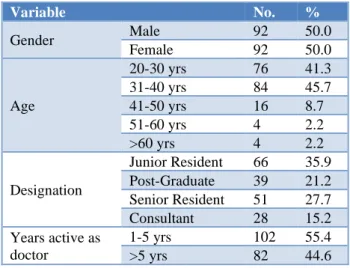
A total of 184 doctors returned the completely filled questionnaire. The respondents consisted of 50% (n=92) male and 50% (n=92) female doctors. 41.3% (n=76) were in the age group of 20-30 years, 45.7% (n=84) 31-40 years, 8.7% (n=16) 41-50 years, 2.2% (n=4) 51-60 years and 2.2% (n=4) above the age of 60 years.35.9% (n=66) were junior residents, 21.2% (n=39) post-graduate scholars, 27.7% (n=51) senior residents and 15.2% (n=28) consultants. 55.4% (n=102) were active as doctors for 1-5 years and 44.6% (n=82) were active for more than 5 years (Table 1).
Table 1: Demographics of study population.
Variable No. %
Gender Male 92 50.0
Female 92 50.0
Age
20-30 yrs 76 41.3 31-40 yrs 84 45.7 41-50 yrs 16 8.7 51-60 yrs 4 2.2 >60 yrs 4 2.2
Designation
Junior Resident 66 35.9 Post-Graduate 39 21.2 Senior Resident 51 27.7 Consultant 28 15.2 Years active as
doctor
1-5 yrs 102 55.4 >5 yrs 82 44.6
Table 2: Self prescribing behavior of study population.
Do you self-prescribe Yes No
No. % No. %
Males 88 95.7 4 4.3
At which 95.7% (n=88) male doctors, and 97.8% (n=90) females doctors were self-prescribing. Self-prescribing in doctors in the age group of 20-30 years was 97.4% (n=74), age group 31-40 years 95.2% (n=80), age group 41-50 years 100% (n=16), age group 51-60 years 100% (n=4) and above 60 years 100% (n=4). 93.9 % (n=62)
junior residents, 100% (n=39) postgraduates, 96.1% (n=49) senior residents, and 100% (n=28) consultants were self-prescribing. 98.0% (n=100) of those active as doctors for 1-5 years and 95.1% (n=78) of those active for more than five years were self-prescribing (Table 2).
Table 3: Frequency of self-prescribing in respondents.
Frequency of self-prescribing Always Occasionally Rarely
No. % No. % No. %
Males 14 15.9 72 81.8 2 2.3
Females 30 33.3 54 60.0 6 6.7
Age 20-30 yrs 14 18.9 56 75.7 4 5.40
Age 31-40 yrs 24 30.0 52 65.0 4 5.0
Age 41-50 yrs 2 12.5 14 87.5 0 0.0
Age 51-60 yrs 4 100.0 0 0.0 0 0.0
Age>60 yrs 0 0.0 4 100.0 0 0.0
Junior Residents 14 22.6 46 74.2 2 3.2
Post Graduates 6 15.4 33 84.6 0 0.0
Senior Residents 22 44.9 21 42.6 6 12.2
Consultants 2 7.1 26 92.9 0 0.0
Active as doctor for 1-5 yrs 24 24.0 72 72.0 4 4.0 Active as doctor for 6-10 yrs 20 25.6 57 73.1 1 1.3
15.9% (n=14) male doctors were always self-prescribing, and 2.3% (n=2) were rarely self-prescribing. 81.8% (n=72) were occasionally self-prescribing. 33.3% (n=30) female doctors were always self-prescribing, and 6.7% (n=6) were rarely self-prescribing. 60.0% (n=54) were occasionally self-prescribing. 18.9% (n=14) doctors aged 20-30 years were always self-prescribing, and 5.4% (n=4) were rarely self-prescribing. 75.7% (n=56) were occasionally self-prescribing. 30.0% (n=24) doctors aged 31-40 years were always self-prescribing, and 5.0% (n=4) were rarely self-prescribing. 65.0% (n=52) were occasionally self-prescribing. 12.5% (n=2) doctors aged 41-50 years were always self-prescribing and 87.5% (n=14) were occasionally self-prescribing. 100% (n=4) doctors aged 51-60 years were always self-prescribing. 100% (n=4) doctors above 60 years were occasionally self-prescribing. 22.6% (n=14) junior residents were always prescribing, and 3.2% (n=2) were rarely prescribing. 74.2% (n=46) were occasionally prescribing. 15.4% (n=6) postgraduates were always prescribing and 84.6% (n=33) were occasionally self-prescribing. 44.9% (n=22) senior residents were always prescribing and 12.2% (n=6) were rarely prescribing. 42.9% (n=21) were occasionally prescribing. 7.1% (n=2) consultants were always prescribing and 92.9% (n=26) were occasionally self-prescribing. 24.0% (n=24) with short service of 1-5 years were always self-prescribing, and 4.0% (n=4) were rarely prescribing. 72.0% (n=72) were occasionally self-prescribing. 25.6% (n=20) with service of more than 5 years were always self-prescribing, and 1.3% (n=1) were
rarely self-prescribing. 73.1% (n=57) were occasionally self-prescribing (Table 3).
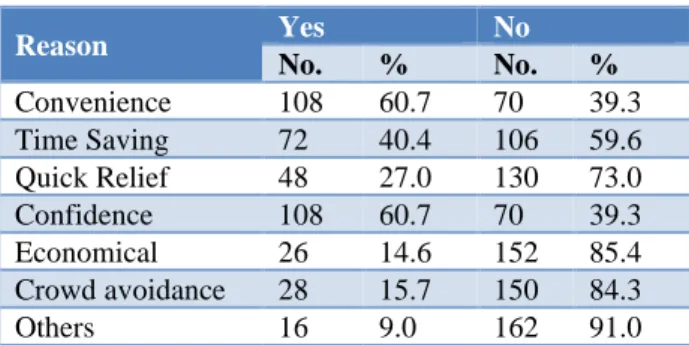
60.7% (n=108) doctors cited convenience, 40.4% (n=72) time saving, 27.0% (n=48) quick relief 60.7% (n=108) confidence, 14.6% (n=26) low cost of treatment, 15.7% (n=28) crowd avoidance as a reason for self-prescribing. 9.0% (n=16) cited other reasons for the practicing self-prescribing (Table 4).
78.7% (n=140) doctors self-prescribed for headache, 79.8% (n=142) for respiratory symptoms, 31.5% (n=56) for pain syndromes 53.9% (n=96) for fever, 51.2% (n=92) for stomach aches, 56.2% (n=100) for diarrhoea, 47.2% (n=84) for nausea and vomiting, 19.1% (n=34) for insomnia, 22.5% (n=40) for menstrual symptoms, 13.5% (n=24) for ocular symptoms. 7.9% (n=14) cited various other reasons for self-prescribing (Table 5).
Table 4: Reasons for self-prescribing.
Reason Yes No
No. % No. %
Table 5: Indications for self-prescribing.
Indications Yes No
No. % No. %
Headache 140 78.7 38 21.3 Cough/Cold/sore throat 142 79.8 36 20.2 Pain Syndromes 56 31.5 122 68.5 Fever 96 53.9 82 46.1 Stomachache 92 51.7 86 48.3 Diarrhea 100 56.2 78 43.8 Nausea Vomiting 84 47.2 94 52.8 Insomnia 34 19.1 144 80.9 Menstrual symptoms 40 22.5 138 77.5 Ocular symptoms 24 13.5 154 86.5 Others 14 7.9 164 92.1
Table 6: Self-prescribed Drugs.
Self-prescribed Drugs Yes No
No. % No. %
Analgesics 144 80.9 34 19.1 Antipyretics 122 68.5 56 31.5 Lozenges 42 23.6 136 76.4 Multivitamins 70 39.3 108 60.7 Decongestants 88 49.4 90 50.6 Antibiotics 104 58.4 74 41.6 Antispasmodics 60 33.7 118 66.3 Anxiolytics 32 18.0 146 82.0 Others 10 5.6 168 94.4
DISCUSSION
There are several important findings in our study. The prevalence of self-prescribing was slightly higher in female doctors as compared to male doctors. As compared to young doctors the prevalence of self-prescribing was higher in older and elderly. The prevalence of self-prescribing was higher among post-graduate scholars and consultants as compared to junior and senior residents. The doctors with shorter service had slightly higher prevalence of self-prescribing. All the observed differences in self-prescribing were statistically insignificant (p>0.05). Very low correlation was found between self-prescribing and: age 0.003), gender (r=-0.061), designation (r=-0.059), length of service (r=0.079). The most common reasons for self-prescribing were convenience, confidence and time saving. The most common diseases for which self-prescription was done were respiratory symptoms, headache, GI symptoms and pain syndromes. The drugs most commonly self-prescribed were analgesics, antipyretics, antibiotics, decongestants, multivitamins and antispasmodics. Ruth also found that most practitioners manage their own healthcare by self-prescribing.7 It has been reported that
convenience, confidence, confidentiality and cost are most often cited as the reason for self-prescribing.8
In some surveys, the diseases for which self-prescription was done were pain, mental disorders, insomnia, GI symptoms.9
A survey conducted in Norway found that 90% doctors practiced prescribing. No difference in self-prescribing behaviour were found between males and females. The most frequently self-prescribed drugs were antibiotics, contraceptives, analgesics and hypnotics.10
Montgomery et.al while reviewing self-treatment behaviour found that the mean number of physicians reporting self-prescription was 61% (range of 9-99 %).2
The validity of our findings relies primarily on the accuracy of responses. We tried to minimize recall bias by a using a well-structured pre-validated questionnaire. Another limitation of this study is the limited sample size. The design of the study does not ensure that the study population is representative of medical fraternity as a whole. Though the relatively high level of self-prescribing in our study concurs with the findings in other studies, however the direct comparisons are difficult. The present study is only exploratory in nature. There is a need to conduct large scale studies to reach a definitive conclusion.
CONCLUSION
Self-prescribing raises a number of ethical, emotional, and competency issues and may impair judgment about the diagnosis or treatment. The present study found that self-prescribing is very common among doctors. Strategies are needed to challenge the culture of self-prescribing. Educational programs on self-prescribing should be developed for medical students as well as practitioners.
Funding: No funding sources Conflict of interest: None declared
Ethical approval: The study was approved by the Institutional Ethics Committee
REFERENCES
1. Krall EJ. Doctors who doctor self, family, and colleagues. Wisconsin Medi J (WMJ). 2008 Sep;107(6):279.
2. Montgomery AJ, Bradley C, Rochfort A, Panagopoulou E. A review of self-medication in physicians and medical students. Occup Medi. 2011 Jul 4;61(7):490-7.
3. The Medical Council of New Zealand. Doctors who provide care to themselves or those close to them.
Available at:
https://www.mcnz.org.nz/assets/standards/1ea7db06 d0/Statement-on-providing-care-to-yourself-and-those-close-to-you.pdf. Accessed 12th December
4. MOBERLY T. The perils of self-prescribing. BMJ. 2014;349(7987):14-5.
5. American Medical Association. Opinion 8.19 Self-treatment or Self-treatment of immediate family members. AMA Code Medi Ethics. 1993 Jun. 6. Del Mar CB, Mitchell G, Kay M. Does legislation
reduce harm to doctors who prescribe for themselves?. Austr Fam Physi. 2005 Jan;34(1-2):94-6.
7. Chambers RU, Belcher JO. Self-reported health care over the past 10 years: a survey of general practitioners. Br J Gen Pract. 1992 Apr 1;42(357):153-6.
8. Dusdieker LB, Murph JR, Murph WE, Dungy CI. Physicians treating their own children. Am J Dis Child. 1993 Feb 1;147(2):146-9.
9. Töyry S, Räsänen K, Seuri M, Aärimaa M, Juntunen J, Kujala S, et al. Increased personal medication use among Finnish physicians from 1986 to 1997. Br J Gen Pract. 2004 Jan 1;54(498):44-6.
10. Hem E, Stokke G, Tyssen R, Grønvold NT, Vaglum P, Ekeberg Ø. Self-prescribing among young Norwegian doctors: a nine-year follow-up study of a nationwide sample. BMC Medi. 2005 Dec;3(1):16.
Cite this article as: Mir SA, Ahangar JA, Shakeel D.