TECHNICAL UNIVERSITY OF CLUJ-NAPOCA
ACTA TECHNICA NAPOCENSIS
Series: Applied Mathematics, Mechanics, and Engineering Vol. 61, Issue III, September, 2018
KNOWLEDGE MANAGEMENT CONCEPT TO COMPENSATE A HIGH
EMPLOYEE FLUCTUATION
Dominik KRETSCHMAR, Matthias SCHMIEDER, Jörg NIEMANN
Abstract: Knowledge is our most valuable asset! Due to the increasing fluctuation caused by demographic change, the change in society and the industry, companies are increasingly confronted with knowledge management. Therefore, companies have problems with carrying out projects effectively. There are several models, methods and tools to develop an effective concept for knowledge management. Can the process capability of projects be ensured despite high fluctuation? What appropriate methods and tools are available to manage knowledge? These and more questions are clarified in the course of this work and presented in a conceptual proposal.
Key words: knowledge management, project management, collaboration
1. INTRODUCTION
Knowledge is one of our most valuable assets and there are several reasons why knowledge gets lost, which makes knowledge management increasingly important [1]. In case of a lack of activities in knowledge management, effective and successful project work is not possible. The objective in this work is to develop a concept which identifies, keeps and distributes employees' knowledge, so that they can use it to achieve objectives and become more efficient. The "model of the building blocks of knowledge management" by Probst, Raub and Romhardt forms the basis of the elaborated concept [2]. Selected tools and methods for knowledge management are presented in/by the respective blocks. Because of the features of the Web 2.0 and their software for knowledge management, the solution of the software engineers at Alfresco was chosen as an example. The findings are compared with the requirements and are combined into a concept.
1.1 State of the art
Knowledge management became more important when we moved from an industrial society to a knowledge society [3]. As a
consequence, knowledge became the key competitive factor in the industry [1]. Some of the main researchers of this topic are Probst, Raub and Romhardt; they developed the Building Blocks of Knowledge Management [2]. In addition, they did a lot of practical research on how knowledge management in companies works [4].
The Web 1.0 was based on a network of hypertexts, the Web 2.0 is defined by a new architecture of participation. [5]. In the next generation, the Web 3.0, it is expected that new knowledge can be generated from processing and structuring information. [6]
1.2 Conceptual conditions
open up and transfer the knowledge of the employees.
2. THE NEED FOR KNOWLEDGE MANAGEMENT AND THE DIFFERENT TYPES OF KNOWLEDGE
To manage knowledge, it is important to communicate the value of knowledge and identify the different types of knowledge, particularly, tacit and explicit knowledge.
2.1 The importance of knowledge
Knowledge is one of our most valuable assets and drives innovation. There is a transformation of society towards the knowledge society, which acquires knowledge through the processing of information that belongs to the most important capital [7]. This means knowledge is the main driving force behind the development process of society. This is strongly influenced by electronic data processing in the working world. In this way, new working methods and work processes are possible, which are not local and allow much more flexible working models. It also confronted companies with the task of isolating relevant knowledge from the unimportant and masses [8]. In addition, opportunities for the use of global knowledge and cooperation with regional and international partners are added in order to cover task areas perfectly.
2.2 The importance of knowledge
The fluctuation in companies describes the rate of employee change. One classification is the natural and the organizational fluctuation. Natural fluctuation includes all types of employee fluctuation with no personal reason [9]. Organizational fluctuation includes dismissals, moving to other sites and personnel development activities. One of the biggest drivers for natural fluctuation in Germany is the demographic change towards an older society and the pension of the baby boomer generation.
2.3 Types of knowledge
Knowledge can be defined by the totality of all processed information of a person or a group of people. According to Probst, Raub and
Romhardt, knowledge refers to the totality of expertise and skills that individuals use to solve problems. Knowledge relies on data and information but is always tied to persons [2]. Basically, knowledge can be distinguished into tacit and explicit knowledge (figure 1).
Tacit knowledge
Tacit knowledge describes silent knowledge, which lies in the head of individual persons and is not accessible to the general public. This knowledge is very important for the companies but is difficult to distribute or communicate. If this does not happen, it has no meaning for a company as a learning unit. It is essential to extract this knowledge from the employees and to provide a wide access [10]. If this is not the case, the development of this knowledge is not possible [7]. Primarily intuitions or habits are typical for tacit knowledge [10].
Explicit knowledge
Explicit knowledge is accessible and open to everyone, for example, a document or a file. The effectiveness of distribution determines the usefulness. Due to the huge amounts of data that can be processed in companies, the focus is on the fast finding and processing of relevant information. Therefore, an important step in knowledge management is the identification and documentation of tacit knowledge and the transformation into explicit knowledge [7].
3. CONCEPT DEVELOPMENT
There are several kinds of principal models for knowledge management and a lot of different tools and methods connected with them. Collaboration software deliver a large scope of them and have to be selected according to the requirements.
3.1 Models
Fig. 1. Theoretical (organisational) knowledge classification [11].
Fig. 2. The Model of Building Blocks of Knowledge [2].
It can be divided into the following blocks: knowledge identification, knowledge acquisition, knowledge development, knowledge distribution, knowledge preservation, knowledge use, knowledge measurement and knowledge goals (figure 2). Knowledge identification is the process that creates transparency about existing knowledge. The existing knowledge of a company is protected and stored by knowledge preservation [2]. The patent for a secure inter-company collaboration environment can ensure the protection [13]. The use of knowledge is the central goal of knowledge management because knowledge only adds value to the company by working with it. In this case, the knowledge distribution plays an important role. A good distribution ensures that every employee has the
right knowledge at the right time and at the right place. Knowledge development includes processes where new knowledge is produced in the company. In contrast to acquisition, here processes are summarized, and is knowledge which a company acquires from external sources. In addition, with goals and measurement, the model includes the company management and its integration into the company strategy. The knowledge goals are the guidelines for knowledge management [2].
3.2 Tools
Some of the tools and methods are necessary for the developed knowledge management concept
[14][15]. Software solutions are treated separately in chapter 3.3.
Table 1 Selected tools and methods of knowledge management by block [14][15].
Block Short description Matrix of standard
knowledge strategies
goals y-axis with knowledge lead and x-axis with knowledge exploitation, strategies can be associated in the respective quadrant Expert Debriefing identification
preservation
knowledge preservation of a fluctuating employee; replacement must be prepared
Personal knowledge database
identification preservation
employee saves the core and special knowledge using systematic and relevant documents
JobMap identification preservation
all steps and documents for a job are listed and structured
Coaching preservation distribution
an inexperienced person is supported by an experienced person
Manual distribution, use contains written information about complex tasks or processes
Web 2.0 Development of the Internet: wikis, blogs, podcasts, feeds, communities, instant messaging, mashup and online software
Wikis preservation
distribution, use
reference book as a website
Video tutorials / learning videos
preservation distribution, use
screencast, lecture for the (web-) cam, live lectures, trick film technique, time lapse technique, green screen technique
Electronic
communication forums / blogs
preservation distribution, use
the opportunity to discuss tasks and topics and to clarify questions with experts
Instant Messenger distribution, use communication with immediately text messages
3.3 Software solutions
There were many software solutions on the market. The selection was made because of these various reasons: Alfresco, due to its user-friendliness, Microsoft SharePoint, due to it working closely with Office, Central Point, through its reviews, and lastly, the solution by Bitrix24 team, because it is easy to use and cheap. It is said that the use of software solution applications comes with a dependency. The smaller the software company, the more uncertain the support.
After the evaluation of all software solutions, Alfresco was chosen as a suitable solution. Alfresco offers an open source-based solution for Enterprise Content Management and Business Process Management. The main advantages are simplicity, fast implementation and the costs. Alfresco is the central part of the knowledge management concept and is the knowledge and communication base. It provides
wikis, task management and a guided documentation [16].
4. CONCLUSIONS / CONCEPT
The increasing fluctuation rate, changes in the society and work environment are increasingly challenging for companies. Projects are difficult to carry out, because a frequent exchange of project members who require constant training. New members should build on the knowledge which former members have worked out and ensure a continuous progress.
Many existing methods and tools for knowledge management and especially for the above-mentioned areas have been analyzed and elaborated in the underlying work. Special features are the functions provided by the Web 2.0. There are some software solutions that include the required methods, but Alfresco Community has proven itself as a suitable software. It is user-friendly, simple in design and provides the most required functions.
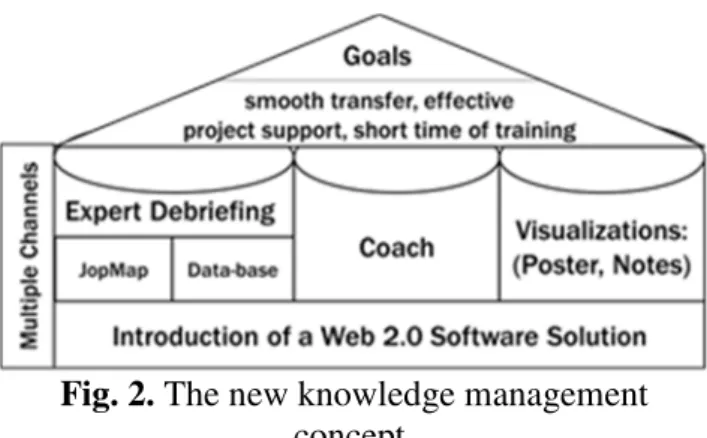
Because information can be processed and implemented more effectively across multiple channels, the developed concept includes digital, personal and visual approaches. The concept is designed with the introduction of the software solution, Alfresco Community, and is supported by an expert debriefing, added with a job map, and the timely support of new employees by a coach. In addition, visualizations are recommended by posters and notes, which indicate important steps or summarize the processing steps, so that the overall picture of a project can be conveyed quickly (see figure 3). One of the most important prerequisites for effective knowledge management is to integrate it into the company culture. In addition, it must be actively operated and maintained, as information can become obsolete and descriptions can no longer be used.
Fig. 2. The new knowledge management concept.
In conclusion, there is no general knowledge management concept. Specifically, the size, the employment relationships and the industry are pivotal for the development of a concept. Many knowledge management tools have been developed for large companies, therefore they are complex and hinder a fast implementation.
Since the problems that have been mentioned are likely to continue to grow in the future and the change to the knowledge society will have an even greater impact, knowledge management becomes an increasingly important success factor for companies. Thus, more and more complex concepts are expected, which are supported by suitable software. However, a personnel exchange and support between experienced and inexperienced employees will continue to be part of knowledge management for a long time, since implicit knowledge can be conveyed effectively.
5. REFERENCES
[1.]Gibbert, M., Leibold, M., Probst, G. Five
Styles of Customer Knowledge
Management. European Management
Journal, 20 (5), 459–469, doi:10.1016/S0263-2373(02)00101-9. (2002).
[2.]Probst, G., Raub, S., Romhardt, K.
Managing knowledge: Building blocks for
success. Chichester: John Wiley & Sons.
(2000).
[3.]Lara, F. J. Knowledge Society:
Opportunities and Challenges.
Management Decision, Vol. 49 (2), 297-302. doi:10.1108/00251741111109179. (2011).
[4.]Probst, G., & Romhardt, K. Building Blocks of Knowledge Management – A
Practical Approach. Hoboken: John
Wiley & Sons. (2000).
[5.]O’Reilly T. What is Web 2.0: Design patterns and business models for the next
generation Of software. Retrieved from
http://oreilly.com/web2/archive/what-is-web-20.html. (2005).
[6.]Rudman, R., Bruwer, R. "Defining Web
3.0: opportunities and challenges", The
Electronic Library, Vol. 34 Issue: 1, pp.132-154, https://doi.org/10.1108/EL-08-2014-0140. (2016).
[7.]Kremin-Buch, B., Unger, F., Walz, H.
Wissen – das neue Kapital [Knowledge -
the new capital]. Sternenfels:
Wissenschaft & Praxis. (2004).
Critical Knowledge. Houston, Texas:
APQC. (2013).
[9.]Erlach, C., Orians, W., Reisach, U.
Wissenstransfer bei Fach- und
Führungskräf-tewechsel -
Erfahrungswissen erfassen und
weitergeben [Knowledge distribution in the upper management and specialist change - Capturing and passing on
experience]. München: Carl Hanser
Verlag GmbH & Co. KG. (2013).
[10.]Kreideweis, H., & Steincke, W.
Wissensmanagement - Studienkurs
Management in der Sozialwirtschaftt [Knowledge Management - Study Course Management in the Social Economy].
Baden-Baden: Nomos. (2005).
[11.]Buckman, R. H. Building a
Knowledge-driven Organization. New York:
McGraw-Hill. (2004).
[12.]Ortiz Laverde, A. M., Baragano, A. F., Sarriegui Dominguez, J. M. Knowledge Processes: On overview of the principal
models. In: 3rd European Knowledge
Management Summer School: "KM in Action", 7-12 September 2003, San
Sebastian, Spain. Nottingham, GB: University of Nottingham. (2003).
[13.]Drenan, A. L., George, S., Smith, R. P., Upadhyay, D.P., Schmidt, J., Werner, J., Matzke, W.-E., Ligtenberg, A. U.S. Patent No. 7,143,136 B1. Washington, DC: U.S. Patent and Trademark Office. (2006).
[14.]Agarwal, N. K., & Islam, A. Knowledge management implementation in a library: Mapping tools and technologies to phases
of the KM cycle, VINE, 44(3), 322-344,
doi: 10.1108/VINE-01-2014-0002. (2014).
[15.]Massingham, P. An evaluation of knowledge management tools: Part 1 –
managing knowledge resources. Journal
of Knowledge Management, 18(6), 1075-1100. doi:10.1108/jkm-11-2013-0449. (2014).
[16.]Alfresco Software Limited. Alfresco Content Services. Retrieved from https://www.alfresco.com/platform/conte nt-services-ecm. (n.d.)
Conceptul de managementul cunoasterii pentru compensarea fluctuatiei mari a numarului de angajati
Rezumat: Cunoștințele sunt cele mai valoroase bunuri! Datorită fluctuației crescânde cauzate de schimbările demografice, schimbarea societății și a industriei, companiile se confruntă din ce în ce mai mult cu gestionarea cunoștințelor. Prin urmare, companiile au probleme în ceea ce privește eficiența realizării proiectelor. Există mai multe modele, metode și instrumente pentru a dezvolta un concept eficient pentru gestionarea cunoștințelor. Poate fi asigurată capacitatea de proces a proiectelor, în ciuda fluctuațiilor mari? Ce metode și instrumente adecvate sunt disponibile pentru gestionarea cunoștințelor? Aceste și mai multe întrebări sunt clarificate în cursul acestei lucrări și prezentate într-o propunere conceptuală.
Dominik KRETSCHMAR, Hochschule Düsseldorf, [email protected]
Matthias SCHMIEDER, Technische Hochschule Köln, [email protected]
![Fig. 2. The Model of Building Blocks of Knowledge [2].](https://thumb-us.123doks.com/thumbv2/123dok_us/7997668.2120594/3.892.251.686.466.747/fig-model-building-blocks-knowledge.webp)